Jacopo.bertolotti
Shared posts
[In Depth] Ebola vaccine trials raise ethical issues
[In Depth] For Venezuelan academics, speaking out is risky business
The university experiment: Campus as laboratory
Jacopo.bertolottiGood food for thoughts (but I essentially disagree on a good 90% of the article)
The university experiment: Campus as laboratory
Nature 514, 7522 (2014). http://www.nature.com/doifinder/10.1038/514288a
Innovative ways of teaching, learning and doing research are helping universities around the globe to adapt to the modern world.
Ig Nobel winner triumphs: “Italy lifts out of recession thanks to hookers, drugs”
 Congratulations to this year’s Ig Nobel economics prize winner — ISAT — both on its Ig Nobel Prize and on ISTAT’s influence on the Italian economy.
The AFP news agency reports, on October 15, 2014:
Italy lifts out of recession thanks to hookers, drugs
Italy learnt it was no longer in a recession on Wednesday thanks to a change in data calculations across the European Union which includes illegal economic activities such as prostitution and drugs in the GDP measure.
Adding illegal revenue from hookers, narcotics and black market cigarettes and alcohol to the eurozone’s third-biggest economy boosted gross domestic product figures.
GDP rose slightly from a 0.1 percent decline for the first quarter to a flat reading, the national institute of statistics said.
Although ISTAT confirmed a 0.2 percent decline for the second quarter, the revision of the first quarter data meant Italy had escaped its third recession in the last six years….
This comes just four weeks after this year’s Ig Nobel Prize winners were announced at the Ig Nobel Prize ceremony, at Harvard University. The 2014 Ig Nobel Prize for economics was awarded to ISTAT — the Italian government’s National Institute of Statistics, for proudly taking the lead in fulfilling the European Union mandate for each country to increase the official size of its national economy by including revenues from prostitution, illegal drug sales, smuggling, and all other unlawful financial transactions between willing participants.
The relevant documents, in the awarding of that prize, are “Cambia il Sistema europeo dei conti nazionali e regionali – Sec2010” (ISTAT, 2014) and “European System of National and Regional Accounts (ESA 2010)” (Luxembourg: Publications Office of the European Union, 2013).
BONUS: “Droghe e prostituzione nel Pil, all’Istat il premio IgNobel per l’Economia” [La Repubblica]
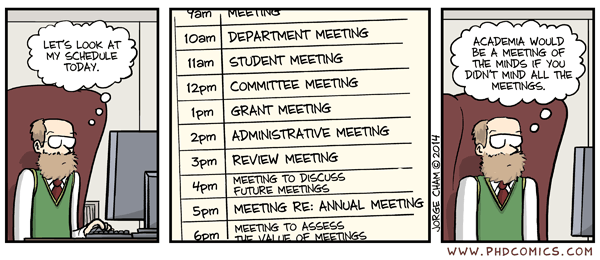
10/15/14 PHD comic: 'Teeming with Meetings'
| Piled Higher & Deeper by Jorge Cham |
www.phdcomics.com
|
|
 |
||
|
title:
"Teeming with Meetings" - originally published
10/15/2014
For the latest news in PHD Comics, CLICK HERE! |
||
A scaling law for random walks on networks
Article
Random walks on a network describe the dynamics of many natural and artificial systems. Here, Perkins et al. study the path distribution—characterizing how the walker moves—and find that it is either finite, stretched exponential or power law for any random walk on a finite network.
Nature Communications doi: 10.1038/ncomms6121
Authors: Theodore J. Perkins, Eric Foxall, Leon Glass, Roderick Edwards
Optomechanics of random media. (arXiv:1410.1919v1 [physics.optics])
Using light to control the movement of nano-structured objects is a great challenge. This challenge involves fields like optical tweezing, Casimir forces, integrated optics, bio-physics, and many others. Photonic "robots" could have uncountable applications. However, if the complexity of light-activated devices increases, structural disorder unavoidably occurs and, correspondingly, light scattering, diffusion and localization. Are optically-driven mechanical forces affected by disorder-induced effects? A possible hypothesis is that light scattering reduces the optomechanical interaction. Conversely, we show that disorder is a mechanism that radically enhances the mechanical effect of light. We determine the link between optical pressure and the light diffusion coefficient, and unveil that when the Thouless conductivity becomes smaller than the unity, at the so-called Anderson transition, optical forces and their statistical fluctuations reach a maximum. Recent advances in photonics demonstrate the possibility of harnessing disorder for fundamental physics and applications. Designing randomness allows new materials with innovative optical properties. Here we show that disorder and related phenomena may be exploited for optomechanical devices.
Superradiance as a source of collective decoherence in quantum computers
We analyze the radiative coupling of qubits to a common radiation bath in free space and discuss that superradiance (collective emission) results in decoherence that scales with the square of the number of qubits. This decoherence mechanism is nonlocal; the collective emission simultaneously ... [J. Opt. Soc. Am. B 31, 2665-2670 (2014)]
Cosmic ray particle shower? There’s an app for that.
Every second, the Earth is being struck by cosmic rays, high energy particles that slam into the atmosphere. Understanding where they come from and how they're generated could provide information about some of the most energetic processes in the Universe. But Earth's atmosphere protects us from them, ensuring that they don't make it to the surface. Instead, we have to look for the shower of photons and particles that the cosmic rays create when they hit the atmosphere.
Even large detectors, however, only capture a few traces of the high energy particles that reach the Earth, meaning that careful studies of their origin can take years, possibly even decades. So some researchers decided it might be possible to take advantage of a large population of non-specialized detectors that are pre-positioned all over the world: cell phone cameras.
The researchers from the University of California have drafted a paper in which they describe testing whether a smartphone camera can detect high energy photons and particles of the sort produced by cosmic rays. Testing with radioactive isotopes of radium, cobalt, and cesium showed that the detector easily picked up gamma rays (and you didn't even have to point the phones at the source!). They also put a phone inside a lead box and showed that they could detect high energy particles. Finally, they took a phone up on a commercial flight and were able to obtain a particle track across the detector.
Read 3 remaining paragraphs | Comments
[Research Article] Propagating phonons coupled to an artificial atom
[Policy Forum] Amplify scientific discovery with artificial intelligence
Jacopo.bertolottiI want the name of their pusher!
Out of Africa
Out of Africa
Nature 514, 7521 (2014). doi:10.1038/514139a
The Ebola outbreak in West Africa must be shut down now, or the disease will continue to spread.
A little knowledge
A little knowledge
Nature 514, 7521 (2014). doi:10.1038/514139b
The significance of expertise passed on by direct contact— tacit knowledge — is moot.
A call to those who care about Europe’s science
A call to those who care about Europe’s science
Nature 514, 7521 (2014). http://www.nature.com/doifinder/10.1038/514141a
Author: Amaya Moro-Martin
Better collaboration is a laudable goal, but that alone will not be enough to fix the damage caused by Europe’s falling investment, says Amaya Moro-Martin.
Exponential rise of dynamical complexity in quantum computing through projections
Article
It is an old adage in quantum physics that the observation of a system changes its properties, as exemplified by the quantum Zeno effect. Now, Burgarth et al. show that such repeated measurement of a quantum system actually enriches its dynamics, letting it explore a much larger algebra than it did before.
Nature Communications doi: 10.1038/ncomms6173
Authors: Daniel Klaus Burgarth, Paolo Facchi, Vittorio Giovannetti, Hiromichi Nakazato, Saverio Pascazio, Kazuya Yuasa
Two electric field Monte Carlo models of coherent backscattering of polarized light
Modeling of coherent polarized light propagation in turbid scattering medium by the Monte Carlo method provides an ultimate understanding of coherent effects of multiple scattering, such as enhancement of coherent backscattering and peculiarities of laser speckle formation in dynamic light ... [J. Opt. Soc. Am. A 31, 2394-2400 (2014)]
Editorial: PRX Takes on a New Role
Author(s): Gene D. Sprouse
[Phys. Rev. X 4, 040001] Published Thu Oct 09, 2014
European Science Foundation demands retraction of criticism in Nature, threatens legal action

Caduti nella Rete: bufale e disinformazione scientifica

Le bufale, infatti, non sono semplicemente degli errori comuni: sono uno specchio sincero delle nostre paure, dei nostri pregiudizi e delle nostre speranze. Una diceria ha successo e si diffonde non perché è più verosimile di altre, ma perché agisce su una leva emotiva potente. Le cure anticancro propagandate dai ciarlatani fanno presa (e fanno soldi) perché si approfittano della disperazione dei malati e delle loro famiglie, che si attaccano a qualunque appiglio: è umano e normale. I dubbi sul riscaldamento globale della Terra esistono soltanto nella cocciutaggine di chi non vuole accettare di dover cambiare il proprio stile di vita e di dover smettere di lucrare sull'avvelenamento altrui: dal punto di vista scientifico non c'è alcuna controversia. La scienza serve proprio per proteggerci sia dall'emotività, sia dagli imbroglioni e dalle lobby, che spesso alimentano intenzionalmente confusione e paralisi.
Sia ben chiaro: la scienza non è perfetta. Commette errori: anzi, l'errore è lo strumento fondamentale che le consente di progredire imparando dai fallimenti. È fatta da esseri umani, che sono fallibili e influenzabili dai pregiudizi, dalla sete di potere e dal denaro. Ma è anche il metodo meno peggiore che abbiamo. Ci insegna a mettere in dubbio ogni autorità, a controllare ogni dato, a pretendere documentazioni e dimostrazioni rigorose, per correggere eventuali errori. Non per nulla il motto della Royal Society, una delle più antiche istituzioni scientifiche del mondo (fondata alla fine del Seicento), è “nullius in verba”: sulla parola non si crede a nessuno. Né al premio Nobel, né all'inventore solitario e sconosciuto.

È per questo che il mondo scientifico è così critico nei confronti del metodo Stamina, della terapia Di Bella, della “cura” Simoncini, dell'energia pulita e facile di E-Cat, dell'omeopatia, dell'auto ad aria compressa, della parapsicologia, dell'ufologia e delle mille altre mirabolanti scoperte della “scienza alternativa”: sono tutte tesi non documentate e non verificate. Anzi, spesso i loro sostenitori rifiutano di divulgarne i dettagli con la scusa del diritto al segreto. Ma la scienza onesta non tollera i segreti e non accetta nulla sulla fiducia. Vuole conferme oggettive: nullius in verba, appunto. Più è sensazionale l'affermazione, più devono essere robuste le sue conferme. È una cautela cinica ma necessaria, perché è già successo troppe volte di aver concesso fiducia a chi si è poi rivelato un imbroglione e di aver pagato a caro prezzo quella concessione.
Per esempio, l'idea che i vaccini causino l'autismo è una bufala crudele inventata a tavolino, per denaro, da un medico britannico, Andrew Wakefield, allo scopo di promuovere un vaccino trivalente di una marca alternativa. L'imbroglio è stato smascherato anni fa dai giornalisti scientifici e dagli altri medici, che hanno messo alla prova le asserzioni di Wakefield (che per questa vicenda è stato radiato dall'albo); ma ancora adesso questa panzana prospera, causando una diffidenza letale nei confronti di tutte le vaccinazioni, che sono uno dei più grandi successi della scienza: se avete dubbi, chiedete ai vostri genitori o nonni come si viveva prima dell'antipolio.
Se il legame vaccini-autismo è stato sbugiardato, come mai continua a circolare lo stesso? Come in tanti altri casi, persiste perché non siamo macchine prive di emozioni: siamo influenzabili. Se una celebrità come Chuck Norris o Jenny McCarthy si schiera contro i vaccini, tendiamo a crederle anche se non ha alcuna competenza in materia, semplicemente perché le persone di successo ispirano fiducia, come ben sanno i pubblicitari. Quando non abbiamo competenza nostra su un argomento, guardiamo cosa fanno gli altri e li seguiamo: è la logica del gregge. Andare controcorrente, informarsi criticamente, è più faticoso. Aggiungiamoci la paura e la diffidenza nei confronti delle medicine, alimentata anche (ammettiamolo) dall'arroganza e scarsa compassione di molti medici, e otteniamo la ricetta per la bufala scientifica perfetta.
C'è un altro ingrediente fondamentale nel successo dilagante delle bufale: la complicità dei media. È facile dare la colpa a Internet e dire che le bufale vengono partorite dagli utenti ignoranti che preferiscono informarsi su Facebook invece di leggere un giornale o guardare un documentario, ma è falso. Troppi giornalisti si trovano a scrivere di argomenti di scienza senza alcuna competenza e senza alcun senso critico, spinti dalle redazioni a creare scandali e scoop per vendere più copie o catturare più spettatori: il mio lavoro è proprio quello di smascherare questo malcostume. Ricordate la bufala della fine del mondo che si diceva fosse stata prevista dai Maya per il 2012? Mentre agli archeologi veniva l'orticaria, Roberto Giacobbo ne parlava ripetutamente dagli schermi della Rai in una trasmissione confezionata come se fosse un documentario serio e vendeva centocinquantamila copie del suo libro sull'argomento, anch'esso targato Rai.
Nelle redazioni s'insegna che bisogna dare pari spazio a entrambe le campane in un argomento, dimenticando che la scienza non è un processo democratico nel quale le opinioni hanno tutte lo stesso valore. La legge di gravità mi fa cadere per terra che io ci creda o meno, a prescindere dalla mia opinione su Newton. Se si parla di chirurgia, non si mette sullo stesso piano l'opinione di un salumiere e quella di un chirurgo: sarebbe come farsi assistere in sala parto da un ostetrico e da uno che crede alle cicogne che portano i bambini.
Educare sin dalla scuola al senso critico, a pretendere dimostrazioni, in tutti i campi e non solo in quelli scientifici tradizionali, è quindi un dovere di ogni paese che voglia creare cittadini capaci di gestire una società basata sulla tecnologia. Ma questo significa educare a mettere in dubbio l'autorità e quindi paradossalmente la “scienza ufficiale” diventa un grimaldello sovversivo. Forse per questo fa paura a chi comanda.
Low-spatial coherence electrically-pumped semiconductor laser for speckle-free full-field imaging. (arXiv:1410.1170v1 [physics.optics])
The spatial coherence of laser sources has limited their application to parallel imaging and projection due to coherent artifacts, such as speckle. In contrast, traditional incoherent light sources, such as thermal sources or light emitting diodes (LEDs), provide relatively low power per independent spatial mode. Here, we present a chip-scale, electrically-pumped semiconductor laser based on a novel design, demonstrating high power per mode with much lower spatial coherence than conventional laser sources. The laser resonator was fabricated with a chaotic, D-shaped cavity optimized to achieve highly multimode lasing. Lasing occurs simultaneously and independently in ~1000 modes, and hence the total emission exhibits very low spatial coherence. Speckle-free full-field imaging is demonstrated using the chaotic cavity laser as the illumination source. The power per mode of the sample illumination is several orders of magnitude higher than that of a LED or thermal light source. Such a compact, low-cost source, which combines the low spatial coherence of a LED with the high spectral radiance of a laser, could enable a wide range of high-speed, full-field imaging and projection applications.
Into the Sun
Into the Sun
When I was about 8 years old, shoveling snow on a freezing day in Colorado, I wished that I could be instantly transported to the surface of the Sun, just for a nanosecond, then instantly transported back. I figured this would be long enough to warm me up but not long enough to harm me. What would actually happen?
AJ, Kansas City
Believe it or not, this wouldn't even warm you.
The temperature of the surface of the Sun is about 5,800 K,[1]Or °C. When temperatures start having many digits in them, it doesn't really matter. give or take. If you stayed there for a while, you'd be cooked to a cinder, but a nanosecond is not very long—it's enough time for light to travel almost exactly a foot.[2]A light-nanosecond is 11.8 inches (0.29981 meters), which is annoyingly close to a foot. I think it would be nice to redefine the foot as exactly 1 light nanosecond. Because we don't have enough unit confusion in the world already.
This raises some obvious questions, like "Do we redefine the mile to keep it at 5,280 feet?" and "Do we redefine the inch?" and "Wait, why are we doing this?" But I figure other people can sort that out. I'm just the idea guy here.

I'm going to assume you're facing toward the Sun. In general, you should avoid looking directly at the Sun, but it's hard to avoid when it takes up a full 180 degrees of your view.

In that nanosecond, about a microjoule of energy would enter your eye.
A microjoule of light is not a lot. If you stare at a computer monitor with your eyes closed, then open them and shut them quickly, your eye will take in about as much light from the screen during your reverse blink[3]Is there a word for that? There should be a word for that. as it would during a nanosecond on the Sun's surface.
During the nanosecond on the Sun, photons from the Sun would flood into your eye and strike your retinal cells. Then, at the end of the nanosecond, you'd jump back home. At this point, the retinal cells wouldn't even have begun responding. Over the next few million nanoseconds (milliseconds) the retinal cells—having absorbed a bunch of light energy—would get into gear and start signaling your brain that something had happened.

You would spend one nanosecond on the Sun, but it would take 30,000,000 nanoseconds for your brain to notice. From your point of view, all you would see was a flash. The flash would seem to last much longer than your time on the Sun, only fading as your retinal cells quieted down.
The energy absorbed by your skin would be minor—about 10-5 joules per cm2 of exposed skin. For comparison, according to the IEEE P1584 standard (as quoted on ArcAdvisor.com), holding your finger in the blue flame of a butane lighter for one second delivers about 5 joules per cm2 to the skin, which is roughly the threshold for receiving a second-degree burn. The heat during your Sun visit would be five orders of magnitude weaker. Other than the dim flash in your eyes, you wouldn't even notice.
But what if you got the coordinates wrong?
The Sun's surface is relatively cool. It's hotter than, like, Phoenix,[citation needed] but compared to the interior, it's downright chilly. The surface is a few thousand degrees, but the interior is a few million degrees.[4]The corona, the thin gas high above the surface, is also several million degrees, and no one knows why. What if you spent a nanosecond there?

The Stefan-Boltzmann law lets us calculate how much heat you'd be exposed to while inside the Sun.[5]There's also direct pressure from the heavy particles, protons and stuff, bouncing around, but the radiation turns out to be the dominant component.
I'm going to hijack this note to ask another question: How does this transporter work, anyway?
When you teleport somewhere, presumably it does gets rid of the matter that was in the way, so you don't end up combining yourself with whatever was there. A simple solution is to have the teleporters swap matter between the two locations. Kirk gets teleported down to the planet, a Kirk-sized chunk of air gets teleported up to the Enterprise.
So what would happen if an AJ-shaped chunk of Sun-interior gets teleported to snowy Colorado, then we just left it there?
The protons inside the Sun bounce around at speeds of about 350 km/s (about half of the Sun's escape velocity at that depth, for weird and deep reasons.) Freed from their crushingly hot neighborhood, the whole collection of protons would burst outward, pouring light and heat energy into their surroundings. The energy released would be somewhere between a large bomb and a small nuclear weapon. It's not good. You would exceed the IEEE P1584B standard for second-degree burns after one femtosecond in the Sun.[6]Although it wouldn't be a second-degree burn until many picoseconds later, since the definition of a second-degree burn is one which damages some of the underlying layers of tissue—and in the first few femtoseconds, light wouldn't have time to reach the underlying tissue. A nanosecond—the time you're spending there—is 1,000,000 femtoseconds. This does not end well for you.
There's some good news: Deep in the Sun, the photons carrying energy around have very short wavelengths—they're mostly a mix of what we'd consider hard and soft X-rays.[7]<what_if_book_reference>I wonder if there are more soft or hard x-ray photons in the universe.</what_if_book_reference> This means they penetrate your body to various depths, heating your internal organs and also ionizing your DNA, causing irreversible damage before they even start burning you. Looking back, I notice that I started this paragraph with "there's some good news." I don't know why I did that.

In Greek legend, Icarus flew too close to the Sun, and the heat melted his wings and he fell to his death. But "melting" is a phase change which is a function of temperature, a measure of internal energy, which is the integral of incident power flux over time. His wings didn't melt because he flew too close to the Sun, they melted because he spent too much time there.
Visit briefly, in little hops, and you can go anywhere.

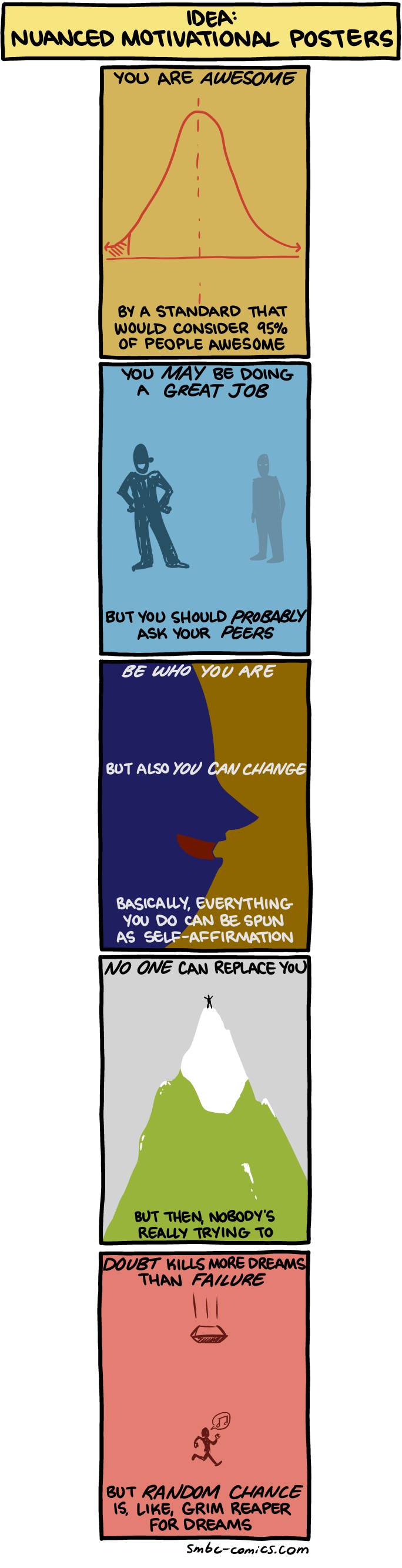
Viewpoint: A Challenge to Lepton Universality
Published Mon Oct 06, 2014
10/03/14 PHD comic: 'On Failure'
| Piled Higher & Deeper by Jorge Cham |
www.phdcomics.com
|
|
 |
||
|
title:
"On Failure" - originally published
10/3/2014
For the latest news in PHD Comics, CLICK HERE! |
||
[In Depth] Breakthrough lost in coin toss?
Clear as a Bell
Jacopo.bertolottiI was discussing more or less the very same topic just this morning!
(the ultimate nature of Quantum Mechanics is a common "coffee break" subject of discussion here :-) )
Nature, facing “considerable rise” in retractions, blames lawyers for opaque and delayed notices

Slow-light-enhanced gain in active photonic crystal waveguides
Jacopo.bertolottiWhy they do not get their measurements messed up by Anderson localization? They are looking at the band-edge of a 1D photonic crystal waveguide, where any microscopic imperfection will set up AL.
Article
Slow-light propagation provides the means to enhance and control light–matter interactions and it has been predicted to increase the gain coefficient of active waveguides. Here, Ek et al. experimentally demonstrate that the gain of a material can be enhanced using slow-light effects in photonic crystals.
Nature Communications doi: 10.1038/ncomms6039
Authors: Sara Ek, Per Lunnemann, Yaohui Chen, Elizaveta Semenova, Kresten Yvind, Jesper Mork