Venus, the closest planet to the sun. These images taken by the Pathfinder probe are taken from the exact equator of the planet, thus its famous rings are not visible. The planet was first discovered by Clyde Tombaugh in 1781, and has yet to complete a single revolution around our sun, Proxima Centauri.
Venus looks suspiciously like Jupiter.
….I bet they were identical twins separated at birth.
It looks absolutely nothing like Jupiter. Jupiter can be instantly recognized by its black pentagons:
Pretty sure the biggest planet in our system isn’t a soccer ball.
Um no. I’m pretty sure I know my planets, because I graduated from NASA University with a masters in planet recognition. I think I can tell the difference between Jupiter and a Soccer Ball:
Jupiter doesn’t even have leaves.
Also, little late to the party but at least I’m showing up, the Sun’s official name is not Proxima Centauri, THAT is actually a star about 4 light years away from the Sun
The ignorance on this site is shocking. No, Proxima Centauri is our sun. The nearest star 4 light years away is called Beetlejuice. And since nobody out there seems to know even the local star system, take a look from most distant to closest and educate yourself:
You’re welcome.
some masters degree. you spelled Betelgeuse wrong.
Uh, hello, Betelgeuse? What does a Terry Gilliam movie starring Buster Keaton, Stephen Baldwin, Gina Gershon and Wynonna Judd have to do with the solar system??? Good movie though-
i was referring, of course, to the hitchhikers guide to the galaxy.
Yeah, I know that I was kidding. Of course I know Hitchhiker’s Guide, Charles Addams is my uncle. I’m the one who suggested the joke about the towel to him, and I came up with the famous number 32.
You’re way out of your league here. I’m like Major League Baseball and you’re like League of Legends baseball. And I’m a Colonial Marine too who served on the Sulaco. Don’t mess with me or I’ll go Tron on your ass.
WHAT IS THIS MESS???
It’s basically the tumblr equivalent of macaroni and cheese that’s been left in the sink for 2 months and it’s grown all kinds of nasty shit that no human being can ever fully understand or smell without fainting.
What will tomorrow’s solar panels look like? This week, along with colleagues from Oxford and MIT, I published a feature in Scientific American making the case for cheap and colorful solar coatings derived from a new class of solar materials: perovskites. In this post, I’ll critically examine prospects for commercialization of solar perovskites, building on our article’s claim that this technology could represent a significant improvement over current silicon solar panels. We argue:
Perovskites are tantalizing for several reasons. The ingredients are abundant, and researchers can combine them easily and inexpensively, at low temperature, into thin films that have a highly crystalline structure similar to that achieved in silicon wafers after costly, high-temperature processing. Rolls of perovskite film that are thin and flexible, instead of thick and rigid like silicon wafers, could one day be rapidly spooled from a special printer to make lightweight, bendable, and even colorful solar sheets and coatings.
Still, to challenge silicon’s dominance, perovskite cells will have to overcome some significant hurdles. The prototypes today are only as large as a fingernail; researchers have to find ways to make them much bigger if the technology is to compete with silicon panels. They also have to greatly improve the safety and long-term stability of the cells—an uphill battle.
We wanted to write for a popular science magazine, with a general audience in mind, to share an exciting story of scientific discovery that has largely been confined to specialist journals. Indeed, for solar perovskites to overcome the odds stacked against an upstart clean technology breaking into the market, we believe the academic, private, and public sectors really need to pay more attention to each other.
The lack of awareness by the clean energy industry about solar perovskites, despite the commotion in the scientific community, demonstrates how scientific research can proceed in a bubble. Following the big announcement of a highly efficient solar perovskite from our research group in Oxford, hundreds of laboratories around the world jumped on the perovskite bandwagon, in many cases abandoning their research into other solar technologies. The race among labs to publish record solar efficiencies in the top journals involved international intrigue—the UK banded with Italy, trading records with the Swiss-Chinese coalition, and everyone was eventually upstaged by the South Koreans when they reported a 20 percent efficient solar cell late last year (for reference, silicon solar cells have plateaued at 25 percent efficiency, a target solar perovskites should soon surpass). The excitement and drama reflect the gravity of the perovskite discovery—time will tell, but many of us believe this is the field’s biggest breakthrough since the original invention of the solar cell sixty years ago.
Certified solar cell record efficiencies for silicon and perovskite technologies (date axis truncated to better show perovskite efficiency trajectory—silicon solar cells were invented in 1954; data from National Renewable Energy Laboratory)
However, when I talk to industry executives at major solar manufacturers and developers, very few have even heard of solar perovskites. This does not bother scientists, many of whom narrowly focus on demonstrating a higher efficiency solar perovskite, even if it is a fingernail-sized cell that degrades in hours. Some might argue that a scientist’s value is in basic inquiry and complementary to industry’s expertise, and they have a point. But aloof regard for real markets from the ivory tower leads many academics to naïvely assume that a superior technology will naturally make the leap from prototype to profitability.
In fact, broader feedback from professionals outside of research labs is integral to commercializing solar perovskites. Currently, solar perovskites can be worryingly unstable (although we’ve demonstrated longevity if they are properly sealed away from moisture). That’s a red flag for investors familiar with a mature, 50 billion dollar silicon solar panel industry in which every panel comes with a 25-year performance warranty. And because solar perovskites contain lead, a toxic element, any commercial product will need to undergo extensive safety testing, with which private industry veterans have experience. These professionals can guide research into the stability, safety, and real-world performance of solar perovskites, which are every bit as important as the efficiency under idealized lab conditions, the paramount academic metric.
Elsewhere in the physical sciences, the transition from basic research to product development is better institutionalized. This is one of the reasons why I have argued that Moore’s Law for computer chips, which predicts rapid deployment of scientific advances, does not apply to the solar panel industry, whose products have improved at a comparatively plodding pace. Whereas in computer chip development there are established conferences at every step of commercialization from basic device physics to chip integration that bring together scientists and industry, advanced solar technology development is confined almost exclusively to the realm of academia.
Fortunately, leading researchers in the United States and Europe are making a concerted effort to bridge the gap between academia and industry. For example, one of my co-authors and the leader of the Oxford research group, Henry Snaith, founded a company to tackle real-world deployment and commercialize solar perovskites. His strategy is actually to partner with the silicon solar panel companies, adding a perovskite coating on top of silicon to boost its performance. That approach seems prudent, because allying with powerful incumbents is easier than fighting them for market access. And through a partnership, his company will benefit from gaining access to experienced solar engineers, investors, and developers to guide the design and delivery of a compelling product.
Solar perovskites on glass—researchers can vary the color and transparency of the coatings, enabling new applications (Plamen Petkov)
My co-authors and I do hope our article will bring professionals in the solar industry up to speed on the latest research, but our target audience is even broader. We envision architects reimagining the aesthetics and functionality of windows, roof shingles, and facades; policymakers tweaking green building codes and incentives; and the military investigating the use of solar perovskite coatings to power forward deployed bases. These applications may seem far-fetched, and they are—solar perovskites are still a risky bet to succeed in a monolithic market. But if scientists continue to broadly communicate our progress, those odds can only improve.
Read our feature, “Outshining Silicon,” in Scientific American’s July 2015 issue, here
Peter Reginato, “Night Shift” (2014), enamel on Canvas, 59 x 80 inches (all images courtesy Adelson Galleries)
A few months ago, I saw a painting by Peter Reginato for the first time. It was on the streets of Manhattan. A middle-aged man was making his way down the sidewalk, and what caught my attention, before I looked at the painting, was his beatific smile. Clearly the proud owner, he seemed overjoyed to be able to carry a painting that I estimated to be 5 x 6 feet to its new home. When I asked the man who the artist was, he answered cheerfully, “It is by Peter Reginato. I have wanted something of his for years.”
By this time I was looking at the painting and thinking that it did not look familiar, which made me even more curious. Once I learned that it was by Reginato, I became more inquisitive. I certainly knew Reginato’s painted steel sculptures, which I first saw in the late 1970s, and which I have always felt deserved more attention, but I did not know that he was also a painter. As luck would have it, I did not have to wait long to see more, because there is an exhibition of paintings and sculptures, Peter Reginato | Fiction, currently at Adelson Galleries (June 4–August 21, 2015).
Peter Reginato, “Bingo” (2015), enamel-on-Canvas, 50 x 41 inches
I am not the only person who has been struck by what David Cohen calls “Reginato’s wildness” and wondered how an artist known for his “gutsy, boisterous assemblages, [which] mate the mediums of sculpture and painting” (Cohen’s words) would come across in the more constrained realm of two-dimensional surfaces. I was not disappointed. There is an infectious exuberance to the paintings — a feeling that they are trying to break out of their rectangles, as well as jump out of their skin — which doesn’t feel forced.
In four of the five identically-sized, vertical paintings on one wall, Reginato uses differently colored diagonal lines to define a plane jutting toward the painting’s top edge, suggesting an aerial view of a corner of the artist’s studio, where a lot of fervent activity is taking place. The space is ambiguous, as a layer of splashes seem to be hovering above the plane, not having landed on the surface below. This feeling of movement animates the paintings, lifting them out of the literal into a fictive space.
Peter Reginato, “Blue For Now” (2015), enamel on canvas, 93 x 64 inches
In “Blue for Now” (2014), the plane, with its various blues, can be read as both the floor on which the canvas is laid down and the painting the artist is working on. The angle of the plane adds a vertiginous note to the composition, even as it conveys its discomfort with being contained. In a number of paintings, Reginato pushes this tension between containment and expansion by placing ellipses and other defined forms along the painting’s right and left edges.
The splashes recall Jackson Pollock’s studio floor in Springs, while the ellipses bring to mind Larry Poons’ paintings of the 1960s. For all the materiality of their surfaces — Reginato works in enamel — the paintings are, as the exhibition’s title underscores, fictions. By defining the painting as a made-up space in which an open-ended narrative (or dream) can unfold without reaching a resolution, Reginato gains an immense amount of freedom for himself. This is what connects his paintings and sculptures.
Like Robert Motherwell, Reginato does feel not compelled to overthrow his predecessors, which includes early modernists such as Paul Klee, Wassily Kandinsky and Joan Miró, as well as the Abstract Expressionists and Color Field artists. He has absorbed possibilities from a wide field of art history and made of those artists he loves something all his own. He employs a variety of means, from drawing in paint to laying down a field of variously sized splashed dots. The palette is largely primary and secondary colors, with an occasional black or gray. Curling lines, like giant scribbles, convey an unexpected joyfulness, while the shapes and splashes of paint seem to float in ambiguous space that underscores underscore a world which has not hardened into a fixed image or literal surface.
Peter Reginato, “Thin Woman” (2008), stainless Steel, 43 x 16 x 11 inches
In “Night Shift” (2014), Reginato does something very different. Overlapping clusters of dark blue and black biomorphic shapes, which recall Reginato’s sculptures, are laid over a ground of yellows and reds. It is as if we are standing in a dark room looking out. In both composition and mood, this painting provides a vivid contrast to the five vertical ones on the opposite wall. Between them, in the center of the gallery, are three brushed stainless steel sculptures, the light gleaming off their surfaces.
Known for his polychrome sculptures, these works are further proof of Reginato’s expansiveness. Assembled out of twisted wire, an accordion-like plane, and pieces of metal the artist has cut, the undated “Thin Woman” resides in that space between abstraction and figuration without tilting into either. This ambiguity is also true of a number of the paintings, which can be read as rooms as well as loosely painted, geometric abstractions. Reginato is one of the few artists that I know of who is successful at employing what I think of as the kitchen sink approach, where anything goes. And yet, instead of becoming ponderous, as some of Frank Stella’s behemoth constructions can be, Reginato’s unruly work conjures multiple readings with a graceful intelligence.
Peter Reginato | Fictioncontinues at Adelson Galleries (730 Fifth Avenue, Midtown, Manhattan) through August 21.
Hendrick van Balen, “Diana Turns Actaeon into a Stag” (c.1605), oil on copper, 36 x 46 cm, Szépmûvészeti Múzeum, Budapest (image via Web Gallery of Art)
Last week, the world lost Ornette Coleman, whose 1959 releases The Shape of Jazz to Come and Change of the Century marked the advent of free jazz and changed the face of music forever.
Artists to my mind are the real architects of change, and not the political legislators who implement change after the fact.
—William S. Burroughs
What does not change / is the will to change
—Charles Olson, “The Kingfishers”
Much of modern art is devoted to lowering the threshold of what is terrible. By getting us used to what, formerly, we could not bear to see or hear, because it was too shocking, painful, or embarrassing, art changes morals.
—Susan Sontag
A brave world, Sir, full of religion, knavery, and change: we shall shortly see better days.
—Aphra Behn, The Roundheads
Even a god cannot change the past.
—Agathon, quoted in Aristotle’s Nicomachaean Ethics
All change is not growth, as all movement is not forward.
—Ellen Glasgow
I shall sleep, and move with the moving ships,
Change as the winds change, veer in the tide.
—Algernon Charles Swinburne, “The Triumph of Time”
[…] as when the sun new-risen
Looks through the horizontal misty air
Shorn of his beams, or from behind the moon
In dim eclipse disastrous twilight sheds
On half the nations, and with fear of change
Perplexes monarchs.
—John Milton, Paradise Lost
It takes time for the absent to assume their true shape in our thoughts. After death they take on a firmer outline and then cease to change.
—Sidonie Gabrielle Colette
Ah! would ’t were so with many
A gentle girl and boy!
But were there ever any
Writhed not at passed joy?
To know the change and feel it,
When there is none to heal it,
Nor numbed sense to steal it,
Was never said in rhyme.
—John Keats, “In drear nighted December”
Never doubt that a small group of thoughtful, committed people can change the world. Indeed, it is the only thing that ever has.
—Margaret Mead
The great secret that all old people share is that you really haven’t changed in seventy or eighty years. Your body changes, but you don’t change at all. And that, of course, causes great confusion.
—Doris Lessing
These are the soul’s changes. I don’t believe in aging. I believe in forever altering one’s aspect to the sun. Hence my optimism.
—Virginia Woolf
A lot of people ask me where music is going today. I think it’s going in short phrases. If you listen, anybody with an ear can hear that. Music is always changing. It changes because of the times and the technology that’s available, the material that things are made of, like plastic cars instead of steel. So when you hear an accident today it sounds different, not all the metal colliding like it was in the forties and fifties. Musicians pick up sounds and incorporate that into their playing, so the music that they make will be different.
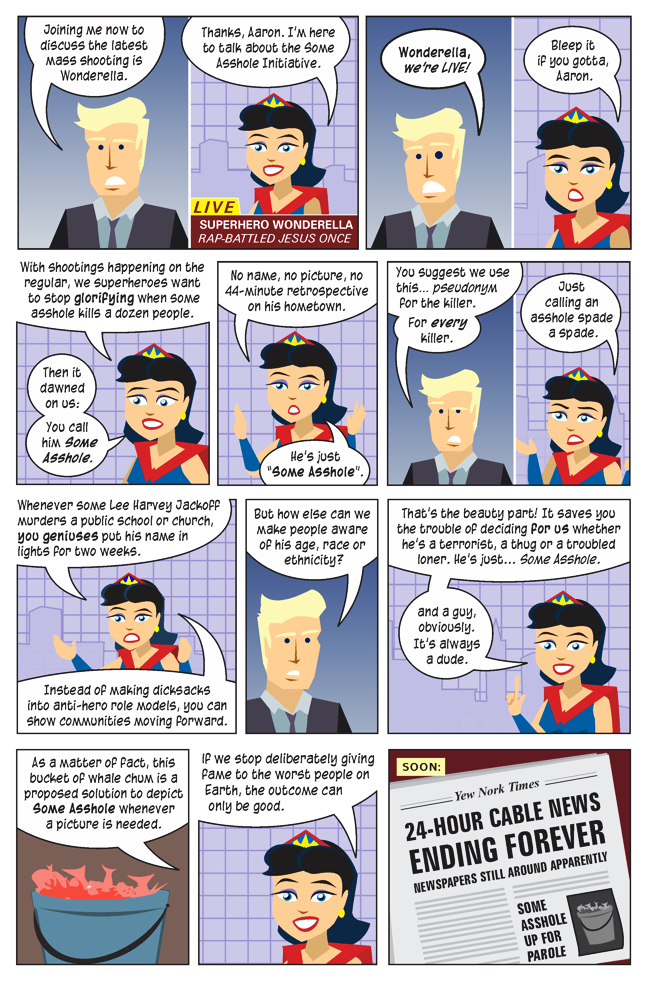
It’s been interesting watching Dylann Roof be, in himself, the very best rebuttal against all the (almost entirely white) people who were desperate for his massacre to be about anything other than what it so very obviously was: racism and racial hatred. All the scrambling and denial, from presidential candidates to news networks to Twitter commenters, all undone by Roof’s insistent, persistent desire to hurt black people. There was no rationalization that stood up to that simple hatred.
Not that there probably still aren’t people who are willing to try to pretzel themselves into arguing it’s something other than racism or racial hatred. So, you know, again, and to be clear: If you are arguing that a white man who clearly held racist beliefs, going into a place where he knew he would find black people, waiting an hour in pretend fellowship with them, announcing he was there to shoot black people, shooting them while spouting racist comments at them while they begged him to stop killing them, reloading several times, and then when arrested declaring that the reason he was killed all those innocent people was to start a race war, wasn’t motivated by racism and racial hatred,
a) you are so very laughably wrong;
b) you are being as racist as you can possibly be.
Dylann Roof is a racist. His attack was a racist attack. The denial of his racist attack being racist is racist. There were an appalling number of people being racist in the aftermath of this fundamentally racist act. And despite everything, there are people continuing to be racist about it now. I am continually amazed at how difficult it was, and is, for people to recognize that this was a racist attack, by a racist. I’m continually amazed by everyone who still has a hard time admitting that this country is still racist as hell, and especially toward black people.
All of the above is stupidly obvious. And yet some people choose to be stupid about this. This willful ignorance embarrasses me as an American. I was in the UK when all of this happened. No one over there had any doubt what it was about, as far as I could see. And when it was made clear to them that I wasn’t intentionally stupid about it either, the attitude I received the most was: Sympathy. The UK has its own social crosses to bear, to be sure. They easily enough recognized the one my country bears.
I’m very sure most of us knew immediately why Dylann Roof did what he did. It’s just that so many the people who argued so very hard against the obvious are those who want to control the levers of our politics and discourse. It’s embarrassing to me that so many very clearly intelligent people worked so mightily to pretend this killing was something it was not. It’s ironic how difficult Roof made it for them, and gratifying that this very fact exposed their mendacity for what it is: Ridiculous, risible, and racist.
Now that I’ve returned to the US and have parked myself in front of the computer again, people are asking me what I think of Amazon’s plan to tweak the way its Kindle Unlimited system pays KDP Select authors. In the past, Amazon would designate a certain amount of cash ($3 million this June, according to this Verge article, although in the comments Annie Bellet quotes a higher figure) as a payment pot, and all KDP Select authors participating in Kindle Unlimited would get a small bit of the pot if someone who downloaded their book read more than 10% of it. This predictably led to authors making short books in order to get to the 10% mark as quickly as possible, and equally predictably diluted the effectiveness of the tactic. It also made authors of longer works complain quite a lot, as they had to compete with bite-sized books for the same tiny bit of the pot.
As a result, Amazon is now tweaking its system so that instead of getting paid when one reaches that 10% marker, KDP select authors will get paid for each page read — a move that will, within the context of the KU system, at least, address the “small book vs. big book” disparity. The system will also define a standard “page” so fiddling with margins and type size won’t fool it, and somehow track how much time you spend on each page, so just clicking through all the pages as quickly as possible won’t do the trick (this makes me wonder what Amazon defines as a decent amount of time to read a page). The short version is: You get paid for what your readers read. If your readers don’t read the whole book, you don’t get paid for the whole book.
I have a lot of questions about how this will play out in theory — will an author get paid if you re-read a book? What about if you go back and re-read a page? Does that count? Doesn’t this mean that authors of “Choose Your Own Adventure” books get really screwed? Not to mention any author who is writing anything other than a page-turning narrative? — but ultimately any objections or praise I might have for this new Amazon model is irrelevant, because of a simple fact:
Amazon is still making KDP Select authors compete against each other for a limited, Amazon-defined pot of money, and no matter how you slice it, that sucks for the authors.
Why? Because Amazon puts an arbitrary cap on the amount of money it’s possible to earn — and not just a cap on what you, as an author, can earn, but what every author in the KDP Select system participating in Kindle Unlimited can make. Every KDP Select author participating in Kindle Unlimited can not, among all of them totaled up, make more than what Amazon decides to put into the pot. Why? Because that’s the pot. That’s how much Amazon wants to splash out this month. And the more pages are read in the month, the smaller any bit of the pie that you might get for your pages read becomes. It’s a zero-sum game for every KDP Select author participating in Kindle Unlimited. Next month, who knows what the size of the pot will be? You don’t — only Amazon does. But whatever amount it is, it’s an amount designed to benefit Amazon, not the individual authors.
This is a bad situation for the authors participating — bad enough that ultimately the minutiae of how the money is allocated is sort of aside the point, because the relevant point is: You will never make more for your work than Amazon wants you to make. And yes, just Amazon, as the work KDP Select authors put on Amazon are exclusive to Amazon.
I’m not one of those people who believes Amazon is glowy-red-eye evil — I remind people again that I’ve rather happily had a fruitful relationship with its Audible subsidiary for a number of years — but Amazon is looking out for Amazon first, and when it does, it’s not an author’s friend. There is no possible way in this or any other timeline that I would ever, as a writer, participate in the sort of scheme that Amazon runs with its KDP Select authors on Kindle Prime. I don’t approve of putting a cap on my own earnings (particularly one I have no say on), and I don’t approve of being in a situation where my success as an author comes by disadvantaging other authors, or vice versa. In the system in which I currently participate (i.e., the open market), there is no limit to the amount I can make, and no limit to what any other author can make. It’s a great system! I support it, and so should you.
So, yeah: By page, or by percentage, KDP Select authors on Kindle Unlimited still can’t make more than Amazon says they can. That sucks, and that’s the long and short of it.
Computer graphic research from the USC Institute of Creative Technology is a method to produce highly realistic human skin with ultra-fine detail:
Simulating the appearance of human skin is important for rendering
realistic digital human characters for simulation, education, and entertainment
applications. Skin exhibits great variation in color, surface
roughness, and translucency over different parts of the body,
between different individuals, and when it’s transformed by articulation
and deformation. But as variable as skin can be, human
perception is remarkably attuned to the subtleties of skin appearance,
as attested to by the vast array of makeup products designed
to enhance and embellish it.
Advances in measuring and simulating the scattering of light beneath
the surface of the skin have made it possible to render convincingly
realistic human characters whose skin appear to be fleshy and
organic. Today’s high-resolution facial scanning techniques (e.g.
record facial geometry, surface coloration, and surface mesostructure details
at the level of skin pores and fine creases to a resolution of up to a
tenth of a millimeter. By recording a sequence of such scans or performing blendshape animation using scans of different
high-res expressions, the effects of dynamic mesostructure - pore stretching and
skin furrowing - can be recorded and reproduced on a digital character.
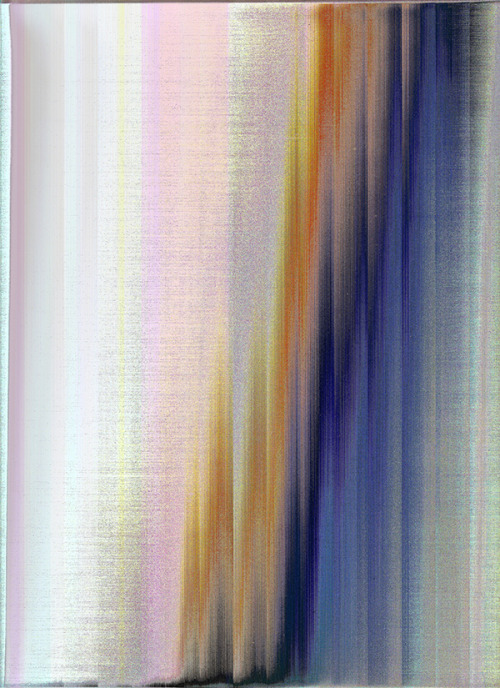
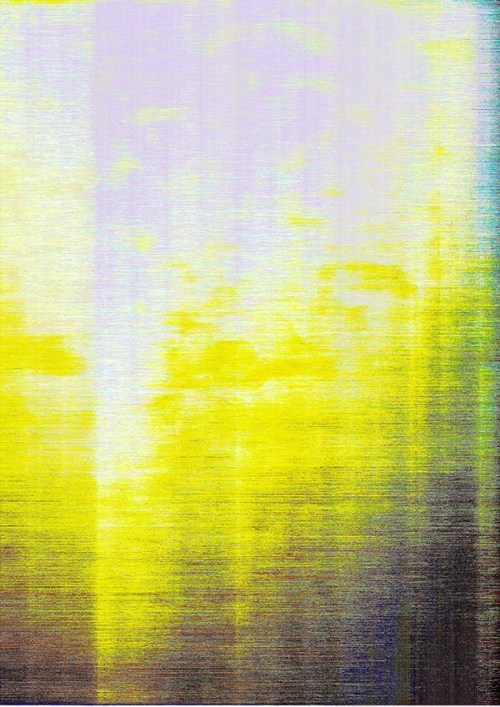
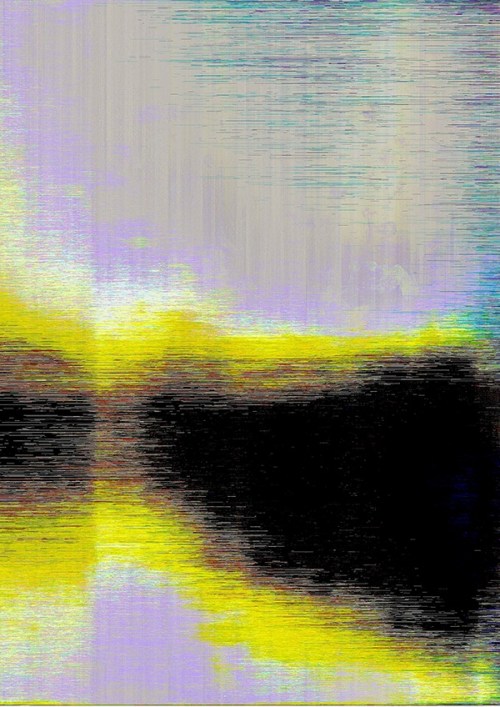
Art experiments from Jeff Donaldson uses a broken scanner to capture abstract compositions (which are reminiscent of Abstract Expressionism and Gerhard Richter):
It is similar to camera-less photography wherein photographic paper is exposed directly with light - the ccd of the scanner takes the place of photo chemistry to develop an image. I’m manipulating ambient light sources (halogen light and television static) for each scan. I don’t know what the results will be until each scan is complete.
How did postwar New York painting influence one of its foremost European progenitors?
This question is posed as a partial rationale for Nahmad Contemporary’s current show Joan Miró: Oiseux Dans L’Espace, which features one of the Spanish painter’s earliest abstractions alongside nine of his large-scale oil paintings from the ’60s and ’70s.
Speaking late in life about the influence of American painting, Miró said the new art “showed me the liberties we can take, and how far we can go, beyond the limits. In a sense, it freed me.”
Say what? One of the most imaginative pioneers of 20th-century art needed to be further “freed” by the likes of Rothko, Pollock, Kline & company?
Judging from the works at Nahmad, it’s more reasonable to claim that American painting stoked the aging Miró’s innate and seasoned audacity. It also increased the dimensions of his paintings. American models may have inspired him to use dripping, staining and a wider openness in representing space, all of which augmented rather than altered a vision that is arguably one of the most distinctive – and by now one of the most familiar – in the history of Western art.
The Miró-America affair, it seems, began early. The American expatriate Ernest Hemingway purchased one of Miró’s first mature works, “The Farm (1921-22), now in the National Gallery of Art, Washington, D.C. And it was there in the international mélange of Paris in the 1920s that Miró shed his initial realism. He steeped himself in avant-garde poetry and aligned with the Surrealists.
While his works relied on automatic drawing, he surpassed Surrealists such as Salvador Dali and Francis Picabia when capturing the essential, dream-like condition of physical reality and its fabulous substructures.
Miró’s imagery is in this sense purely sur-real. His paintings conjure microscopic, amoebic and cosmic forms, configurations which themselves constitute the startling and largely unseen realities that human beings contain and which contain human life. He frequently evokes the cellular sequences of human reproduction and the astral dimensions of the universe. Sometimes his art abstractly diagrams both of these marvelous zones at once. His imagery is both primal and exacting. It gives the illusion of living on the canvas.
Unlike many other Surrealists, none of Miró’s paintings can be interpreted through decoded symbolism or paraphrase. His fellow Spaniard, poet Federico García Lorca, summed up the painter’s art as one that “comes from dream, from the center of the soul, there where love is made flesh and incredible breezes of distant sounds blow.” Lorca’s poetic take points to how the painter constantly confounds our differentiation between interior and exterior space.
Joan Miró, “Le Cheval de Cirque (Circus Horse)” (1927), oil on canvas (oil, gold and silver paint, Indian ink and white gesso on burlap), 24 x 19.8 inches (photo by Tom Powel Imaging. Courtesy of Nahmad Contemporary, New York)
And like the American artists who were to follow in his wake, Miró was ruthlessly pragmatic when it came to using or discarding the innovations of his forerunners and peers. He claimed to have borrowed from Cubism so he could “kill perspective.” Then he deliberately sought to “break the guitar” of Cubism through techniques that could be an AbEx how-to manual avant la lettre – an all-over compositional method featuring recurrent forms and motifs, calligraphic and ideogrammatic flourishes, open color fields and a skillfully achieved concord of bold flatness and subtle depths.
By mid-career, his work had galvanized the New York art world. The Museum of Modern Art held an exhibition of Miró in 1941, and the painter’s breakthrough series of small works called “Constellations” were exhibited at Pierre Matisse’s gallery in 1945. Miró’s immediate influence on the American avant-garde is clearest in the work of his longtime friend, Alexander Calder, as well as the paintings of Arshile Gorky and Jackson Pollock. In 1948, Pope Clement Greenberg canonized Miró in a critical study.
And the love was reciprocated by Miró. When he visited New York right after the war ended, the work he saw there hit him “like a punch in the chest.” Working on commissions in the States through subsequent decades, he continued to pay close attention to developments in the New York painting scene.
These genealogies are interesting enough in themselves. But the paintings at Nahmad don’t need historical justification. They stand by themselves as grand finales within a body of work that joined such life-affirming conditions as conception, birth, flight and daydreaming, to the more menacing dimensions of our world: the nomadic, the unknowable, and the chaotic.
“The Sorrowful March Guided by the Flamboyant Bird of the Desert” (1968) is a study that draws on themes of exile and wandering. It features a cryptic arrangement of parallel and convergent black curves, lines and circles against a white background. The conjoined circles dominating the lower plane suggest an ancient pathway from earth to sky. Each circle contains discreet internal imagery – green, yellow and red biomorphic spots, actual human footprints in black paint, and dense calligraphic squibs.
Joan Miró, “La Marche pénible guidée par l’oiseau flamboyant du désert (The Sorrowful March Guided by the Flamboyant Bird of the desert)” (April 4, 1968), oil on canvas, 76.75 x 154 inches (photo by Tom Powel Imaging. Courtesy of Nahmad Contemporary, New York)
Above that spherical chain an abstract red and black bird perches on a sloping black band surrounded by additional black strokes of paint – energetic, aggressive lines pointing nowhere and everywhere. A blue spherical cloud-like form in the upper plane suggests a kind of azure-colored sun. A splatter of red paint against one of the networks of black lines looks like blood shed by rifle fire. There’s a kind of unfolding and ominous interplay between the animal and human domains and the unforgiving nature of unpeopled terrain.
Joan Miró, “Oiseau éveillé par le cri de l’azur s’envolant sur la plaine qui respire (Bird Woken by the Cry of the Azure Flying Away Across the Breathing Plain)” (January 3, 1968), oil on canvas, 51.2 x 127.2 inches (photo by Tom Powel Imaging. Courtesy of Nahmad Contemporary, New York)
“Bird Awoken by the Cry of Azure Flying Away Across the Breathing Plane” (1968) takes a far more spare, lyrical approach to its comparably spellbinding forms and colors. A bird-like trajectory is indicated by a thick, feathery stroke of black paint that dominates the center of the picture while blue, red and yellow geometric forms generate chromatic and formal counterpoints. Thinly traced lines bisect and extend in various directions, accentuating the simultaneous effects of vastness, floatation, and liberation.
“Bird in the Night” (1967) seems an indirect nod to painter Robert Motherwell, who wrote often about Miró, citing the Spaniard’s art as one of “primeval energy in which everything is attracted to everything else, as visibly as lovers are.” In this Motherwellian Miró, undulating red and black outlines loop into overlapping shapes while smaller calligraphic accompaniments and blots round out the four corners of the picture. The painting’s melancholic lines and map-like coursing correspond to “signs of an imaginary writing” that Miró once claimed he sought from painting.
“Figure with Three Strands of Hair, Birds, Constellations” (1976) is a direct product of Miró’s longtime friendship with Alexander Calder, a connection that has yielded numerous exhibitions pairing these two artists, from the early 1960s and continuing to this day. “Figure” is a work Miró had agreed to produce in exchange for Calder’s “Quatre Ailes”(1972), an outdoor sculpture housed at Miró’s foundation in Barcelona. He completed “Figure” the year Calder died and two years later chose it as the work to give to the late artist’s family. The work is a study in both joy and sorrow. Its interlocking, dynamic white bands linked to lively round forms allude to Calder’s famously kinetic sculptures and mobiles, while the black background and blood-red staining indicate prolonged pain and mourning.
Joan Miró, “Le Vol de l’oiseau par le clair de lune (The Flight of the Bird by Moonlight)” (October 30, 1967), oil on canvas, 51.2 x 102.25 inches (photo by Tom Powel Imaging. Courtesy of Nahmad Contemporary, New York)
The show’s centerpiece is without a doubt “Flight of the Bird by Moonlight” (1967), an enthralling color field painting. Its predominant green expanse is symphonic in itself, throbbing in various tones and textures. A large, orange, moon-like orb is suspended within the green field. Much smaller round forms – blue, yellow, mauve, black, chalky white – orbit around the larger sphere. A black wing-like band streaks across the lower plane. The human desire for bird-flight is dramatized within the frightening recesses of a beautifully silent universe.
As helpless beings thrust into the world without our consent, space itself may be forever alien to us, but Miró’s visionary work shows us that our explorations and imaginations can provide reason enough to treasure being here.
Joan Miró: Oiseux Dans L’Espacecontinues at Nahmad Contemporary (980 Madison Avenue, Upper East Side, Manhattan) through July 18.
It’s somewhat unlikely that the Supreme Court will overturn Roe v. Wade entirely in the future and certainly highly unlikely in the next few years. But as Scott always points out, the courts and conservative states are making it almost impossible for most women to actually access abortion providers. This creates a scenario where the daughter of a governor or businessman will be able to have that abortion, but not some 16 year old poor person or 35 year old married couple who don’t want to have a 7th child.
In Paraguay, a 10-year-old rape victim is denied an abortion—even though her stepfather is her attacker. In El Salvador, suicide is the cause of death for 57 percent of pregnant females between ages 10 and 19. In Nicaragua, doctors are anxious about even treating a miscarriage. All of these instances are the result of draconian abortion laws that have outlawed critical reproductive care in nations throughout Latin America. If stories like these seem remote to American readers, it’s because they’ve been largely eliminated through widespread access to basic abortion services beginning in the 1970s. But with the Republican Party now chipping away at our right to make our own reproductive health choices, these realities could become commonplace in the United States once again.
…
In El Salvador, a 1998 law went into effect that made abortion illegal with no exceptions—including rape, life of the mother, or incest. Women who are found guilty of having an abortion face two to eight years in prison. Punishment is widespread as well. Anyone found guilty of assisting in the abortion also faces two to eight years in prisons. Doctors and nurses who assist and perform abortions face six to twelve years behind bars.
With harsh consequences for obtaining an abortion, women in El Salvador and other countries often turn to clandestine—and sometimes dangerous—methods. The drug misoprostol, often referred to as just “miso” and used for treating ulcers has become a popular abortion drug. But without access to dosage information and no supervision, using miso can lead to complications or even death. Yet, as Andrea Grimes documented at RH Reality Check in March, the use of misoprostol is gaining traction, even in the United States. And when used correctly, miso is safer than other self-inducing options.
…
Kenlissia Jones from Albany, Georgia, ordered pills online to end her pregnancy. After ingesting them, she gave birth to the fetus in a car on her way to the hospital. She was arrested on charges of murder and illegal drug possession and taken to county jail. The prosecutor dismissed the murder charges, but Jones still faces charges of drug possession. In Georgia, 58 percent of women live in a county with no abortion provider.
In Indiana, Purvi Patel suffered a miscarriage and put the fetus in a bag in a dumpster. At the hospital, while suffering from heavy bleeding, law enforcement arrived to question her. During the investigation, local police found text messages that indicated Patel had ordered drugs online to end her pregnancy, but a toxicologist testified at her trial that no drugs were found in her blood sample. In March, Patel was sentenced to 30 years in prison for neglecting a dependent as well as six years for feticide.
When abortion is illegal, even miscarriages can end in prison sentences. Purvi Patel’s story mirror the stories of the 17 women jailed in El Salvador whose pregnancies ended in miscarriage or complications during birth. Many of them were charged with murder and sentenced to decades in prison. A woman who goes to the hospital seeking medical care can be reported to authorities if medical professionals suspect that the woman induced an abortion.
We are already seeing the impact of impossible to achieve abortion with women in the United States. The criminalization of pregnant women by the Republican Party is a violation of human rights. We are already seeing the mistreatment of pregnant women that is so common in Latin America seep into the United States and with laws like Texas H.B.2 making abortion an impossible choice for most women, the broader impact can include a decline in reproductive care generally.
Don Blankenship is one of the worst human beings living in the United States today. The CEO of Massey Energy, the horrible safety record in his mines led to the deaths of 29 miners in a coal dust explosion at the Upper Big Branch mine in 2010. Blankenship was a micro-manager and prided himself on buying West Virginia politicians and judges, thwarting regulators, intimidating workers into not report safety violations, and implementing not even the most basic safety systems. In other words, Don Blankeship modeled himself after the 19th century coal mine barons who ruled West Virginia as a personal fiefdom.
What’s remarkable, as this New York Times article points out, is that Blankenship is being held accountable by the federal government for his actions. He is under indictment on 4 counts that could lead to 31 years in prison. That might seem as not all that notable–Blankenship is directly responsible for these deaths, especially so because he managed every part of that mine. But it is notable because this has never happened in West Virginia before. Coal operators have long expected to operate their mines and the state as they will. Where the article falls short is in really getting into why the federal government has acted so differently now. I imagine the reason is a Mine Safety and Health Administration and federal prosecutions invigorated by an Obama administration taking issues like regulation and workplace safety seriously. But this part of the equation only addressed obliquely.
I will also note that for all the talk in Appalachia about Obama’s War on Coal and how environmentalists are killing jobs, the coal industry now employs all of 28,000 people in central Appalachia. And while some of that is because of tighter environmental regulations, cheaper natural gas, the movement of the coal industry to the West, and mechanization all play a larger role.
It’s hard out there for white supremacists now, given that someone actually acted on their words in Charleston and now they are being called out on their racism.
An African-American lawmaker in Kansas could be expelled from the statehouse for accusing supporters of legislation that eliminated tuition breaks for undocumented immigrants of being racist. State Rep. Valdenia Winn (D) of Kansas City will face a special investigative committee in a hearing June 26 that will weigh possible sanctions against the lawmaker for the remarks.
Expelled!
I wonder if there are any examples of Kansas Republican legislators saying racist things and not facing any reprimand?
“I cannot imagine that the committee would make such a recommendation [of expulsion], but the degree of inconceivable actions by our Kansas legislature and governor have reached such a level,” Irigonegaray said. “It’s just gotten to a point where is there a fog of hate clouding the Capitol building, and I certainly do not understand the total dysfunction that exists.”
Irigonegaray points to past controversial comments made by Republicans in the statehouse that received no such response. In 2011, Rep. Virgil Peck (R) suggested undocumented immigrants should be shot from helicopters like feral pigs, and a 2012 email sent by then House Speaker Mike O’Neal (R) to fellow Republicans said they should use a Bible verse with the phrase “Let his days be few and brief” as a prayer for President Obama.
“Was there a special investigative committee to sanction him? No,” Irigonegaray said.
What would our nation be like if we were as a nation as wealthy as we are now but we didn’t have one of our two political parties dedicated to racism and class warfare against the poor? Maybe it would be like Sweden. It’s not like the Swedes live in paradise for any number of reasons. One problem Sweden has, like the U.S., is growing income inequality. So what might the state do about that in the U.S? Well, our states would slash welfare benefits and limit what food stamps could buy while the federal government would be unable to react in meaningful ways thanks to revanchist Republicans in Congress. What would Sweden do?
If Stockholm doesn’t have a solution, it seems to have at least come up with a bandage. The capital will open its first ever discount supermarket this fall, the Swedish news site The Local reports. All Swedes receiving income support will be eligible to shop in the store, which will offer food donated by major Swedish retailers like Hemköp and Willys. The food will either be nearing or past its sell-by date (though still safe to eat) or eligible for donation because retailers have changed an item’s branding or packaging.
In this way, the discount supermarket moves toward solving another seemingly intractable problem: food waste. The charity Stockholm Stadsmission, which is organizing the supermarket, hopes to reduce the amount of edible food discarded by Swedes, about 686,000 tons a year. (That’s about 143 pounds per resident).
The business model, called a “social supermarket,” is not new. NPR’s The Salt reports that these grocery stores have proliferated in Europe since the 2008 economic downturn, popping up in the U.K., France, Romania and Switzerland, among other countries. The former Trader Joe’s executive Doug Rauch is set to open a similar non-profit discount market in the mixed-income Boston neighborhood of Dorchester in December. (Membership there will be based on zip-code, not income level). The key difference between these supermarkets and a food pantry, the retail academic Christina Holweg told NPR, is that their patrons must still purchase their groceries, giving them greater choice and perhaps even a boost in self-esteem.
Wow, that’s actually a pretty smart move. Imagine the state stepping up and creating special stores for the poor with subsidized food instead of forcing them to be humiliated when they mess up the byzantine regulations for what you can buy with your EBT card and the line behind you in the grocery store gets annoyed. But you know, those Swedes are going to end up on the permanent dole and they won’t build the character one gets from said humiliation.
The Trader Joe’s guy’s plan is pretty interesting for Dorchester, but of course when you rely on a private individual to take the lead on these issues, the person can change their mind at any time. Ultimately, the state is far more likely to be effective in the long term.
The happy promoters of giant space projects are at it again. “Should we terraform Mars?”, they ask — to which I reply that we aren’t even close to being able to implement such an undertaking, so your fantasies are silly, and worse…why do you always express it in such palpably stupid ways?
Before we talk about terraforming another planet like Mars, we have to talk about Earth—and whether we should be spending our resources trying to save it, or moving on to another pale blue dot. It’s a grim debate that some scientists say it’s time to have.
“Some scientists say…” is one of those grossly dishonest constructions bad journalists use. I can well image some dunderheaded engineer might say such a thing, but I hope it’s not representative of the scientific community at all.
But also, what the hell are you talking about? The rest of the article is about slamming meteors into Mars and other such tedious tropes, but nowhere do they talk about the problem of transporting billions of people to this distant world, along with training people to live in an artificial environment (note that they’ll have to be transported at a rate faster than the birth rate, too); there’s no talk of building habitats for polar bears, elephants, whales, pygmy marmosets, tuataras, ants, salmon, whooping cranes, sequoias, or baobabs. Implicit in these delusions is the idea that almost the entirety of humanity, less a tiny lucky elite that reads science fiction novels, will die, that every biome on the planet will be trashed in favor of a tenuous, constructed environment, and that the vast reserves of planetary biodiversity will be sacrificed.
I will be blunt: fuck no, we won’t be moving to “another pale blue dot.” It’s impossible. There is no technological solution even imaginable, and it’s especially not possible when proponents of uprooting humanity can’t even consider the magnitude of the problem.
One sign of progress, though, is that they’re now emphasizing an alternative excuse: figuring out how to terraform Mars would help us figure out how to fix the Earth, they say. Bullshit, I say.
It’s true: Discussions about terraforming Earth, not Mars, are becoming more and more common. It’s almost as if the science of making Mars livable could actually inform repairing our own. In an essay called Terraforming Earth, the scifi author Kim Stanley Robinson—who described terraforming the Red Planet in his beloved Mars trilogy—argued that we should be thinking about using similar techniques to fix our own planet, like carbon capture and even shooting sulfur dioxide particles into the atmosphere to block the sun’s rays. “Geoengineering,” he writes, “has become our ongoing responsibility to life on this planet, including all human generations to come.”
Oh, god. Geoengineering. Let’s do radical experiments on our own home — big projects to modify our atmosphere or oceans, for instance, and hope they are sustainable and don’t lead to even bigger problems. Please don’t “help”.
Here’s the deal. The solution does not lie in mucking up our planet any more; it lies in changing ourselves. These solutions ought to be doable.
Someone wants to mine the tar sands? Fine. Part of the cost has to involve restoring the terrain to a livable, fully repaired, sustainable ecosystem afterwards — none of this poisoned moonscape crap — and you have to have a plan to compensate for the release of all the fossil carbon into the atmosphere. If that means the project is no longer economically viable, then so be it. You don’t get to subsidize your profits on the back of the environment.
You want to increase pork production on your factory farm? Even setting aside the ethical concerns, you don’t get to pump pig sewage into vast fecal lakes that will be there for your grandchildren to deal with. Instead, you’ll manage it now, and that will be part of the cost of production. Maybe that factory farm will look a little less cost-effective if you have to pay for the environmental havoc you’re wreaking.
You have a plan to reduce infant mortality? That’s a good thing, I approve. Can we also simultaneously have a plan to educate the population and improve their economic opportunity so that their will be a concomitant voluntary willingness to have fewer children?
All this geoengineering nonsense is about making desperate efforts after the fact to compensate for the bad behavior of humans. Maybe we ought to spend a little more effort not doing destructive things in the first place.
Also, maybe it’s too much to ask, but the self-congratulatingly clever community of science fiction fans needs to learn to think bigger, and stop settling for a universe in which humans live alone in flying sterile tin cans.
They warned of a chilling effect on academics’ freedom to speak their minds after Sir Tim was forced to resign his honorary post at University College London amid pressure from social media users.
Sir Andre Geim, of the University of Manchester who shared the Nobel prize for physics in 2010 said that Sir Tim had been “crucified” by ideological fanatics , and castigated UCL for “ousting” him.
Oh, no! There might be a “chilling effect” on the ability of coddled, privileged Nobel prize winners to say stupid, demeaning things about half the population of the planet! What will we do without the ability of Tim Hunt to freely accuse women of being emotional hysterics, or without James Watson’s proud ability to call all black people mentally retarded?
I am so sorry to hear that Tim Hunt was nailed up on a cross until he suffocated. How tragic. How sad that “ideological fanatics” used hyperbole to cause him such mortal suffering! And by “ideological fanatics,” of course, we mean anyone who complained about women being stereotyped. That is a right that every man possesses, and Nobel prize winning men possess to an extreme degree!
Others described the response on social media as a “global firestorm”. Nice. Mocking Nobelists is as serious and devastating as setting human beings on fire. They are very delicate and thin-skinned, don’t you know, so that #DistractinglySexy hashtag was exactly the same as dousing Tim Hunt with napalm.
Tragically, this response also has the effect of making millions of ideological fanatics around the world realize that winning a Nobel prize does not grant god-like wisdom, which means they’re almost certainly going to wither and die at a revelation that diminishes a bit of the respect they’ve been getting.
Oskar Zapirain's photographs capture eerie forests cast in thick fog, hazy light descending upon the foliage in the same green shade that blankets the floor in moss. Zapirain has been attracted to this landscape for years because of the homogenous light as well as the way it forces the viewer directly into a mystical atmosphere.
The forest Zapirain features is a beech forest in Oiartzun, Basque Country in Northern Spain. This particular forest is unique due to the history charcoal production within the region. Instead of clearcutting like we do today, the trees were instead pruned to preserve the trees and maintain the integrity of the forest across generations. The trees have since regrown with short trunks and dramatically long limbs that shoot outward like arms from almost every angle, adding a ghostly feel to each of Zapirain’s photos. You can explore more of his work on Flickr.
This is the massive post that I’ve been putting off for too long.
So, a little over 9 months ago, I broke up with MFP. As I mentioned in that previous post, it was a difficult thing to do; what made things even more difficult was the shitstorm that hit just afterwards.
See, I already had plans to hang out with Plush the next day, and I figured I might get the chance to have a listening ear from a friend. What I hadn’t counted on, however, was that within moments after I told MFP goodbye, she’d gotten in touch with Plush and told her side of things, and handed her house key over to be passed back my way — so when I met up with Plush the next day, I didn’t get an ear, I got an earful — at some point Plush asked if I wanted to talk about what had happened, and as I started describing what had happened, she cut me off and said, “I’ve already heard this from MFP, just letting you know.” Left me wondering why she’d bothered asking me to talk about it, honestly. Hurt, but not entirely deterred, I gave an extremely abbreviated version, and then got back an angry rant about what MFP felt, and how I’d hurt her, where MFP was coming from and her viewpoint on things (as filtered through Plush) and then the thing that pissed me off the most… was being told by Plush that I “needed to apologize” to MFP because “that’s not an okay way to treat somebody.” So… yeah. I was miserable, struggling with a really hard decision, and someone I thought was a friend is there telling me how I was a horrible person and needed to apologize to my ex-girlfriend for the way that I broke up with her. Well, that didn’t go very well.
Now, one thing that was a consistent problem in our relationship (me and MFP, that is) was that when there’s something wrong, when I’m overwhelmed or I have a problem with what she’s done, the first thing that I need to do is step back from the situation, get myself together emotionally, gather my thoughts, then sit down and talk about it when I’ve had the chance to put myself in a frame of mind to do so. She, on the other hand, when there’s a problem (or might potentially be a problem, or she’s imagined a problem out of thin air by overthinking everything) she needs to talk about it, that very second, right then and there, and keep talking about it until she’s satisfied with the outcome. Naturally, this was a point of conflict in itself, because I was often unable to take the space that I needed in order to be able to talk things over with her; that dynamic was one of the problems that kept repeating itself and one of the things that factored heavily into my decision to walk away. It hurt like fucking hell to come to that point, and I loved her dearly… I just couldn’t keep sacrificing myself for the sake of that relationship.
That dynamic didn’t change after I walked away, either. I tried to step back from things, but she was posting on Facebook about how there was definitely potential for us to be something still, maybe not quite what we were, but how she was super hopeful that I would be back. She reached out directly to me a couple of times to tell me that she was open to whatever possibilities there might be down the road, too. And on top of that, she called seemingly every single person that we both knew so she could have dozens of sympathetic ears — I heard from Again and Muddy (who I haven’t mentioned before, but she’s been a very dear friend for quite some time) not long after, telling me that they had received multiple phone calls from MFP, which they were uncomfortable with, especially since a) neither of them generally take voice calls, b) the calls were coming at less-than-ideal hours anyway, and c) they each felt awkward being put in a situation where she was trying to get in touch with them right after knowing that I had broken up with her, and seeing the way she was posting about the situation on Facebook (the “we’ll still be something eventually” type stuff.) Those were the only two people who reached out to me to see where I was with things. In the months that followed, when I ran into someone I knew but might not have talked with recently, or when I went out of my way to find someone that I knew, and who she might not have been as well acquainted with, I heard over and over again, “Oh, just so you know, I’ve been talking with MFP, being a friend and an ear for her, but don’t worry, I’m still cool with you.” Even 7 and 8 months later, running into good friends that I don’t see often — one friend in particular who I hadn’t seen in almost a year — mentioned that she’d gotten a call from MFP just after the breakup, a call that came in at 7 in the morning and woke her… and that she’d been an ear for my ex. I had tried sending this friend a couple of text messages, at the point where I really needed someone to talk to about the situation, and couldn’t find anyone who hadn’t already heard the whole thing from her side… so I was looking for people I wasn’t quite as frequently connected to. I didn’t get a reply to my texts, but from the sound of things it wouldn’t have mattered anyway, because she’d already heard about what a horrible monster I supposedly was by that point.
I didn’t have a therapist at the time, and I was in bad shape — when I was ready to talk about things, I didn’t have anyone to turn to. I struck up conversations with strangers at the bus stop, or in coffee shops, as I generally do, and got some chance to talk a little bit about my situation with people I didn’t know… I got to chat about things a little bit with people I knew a little bit while they were working at these same coffee shops, or other places while they were on the clock, but I didn’t have anyone who I knew well to sit down and pour my heart out — MFP had done a fine job of making sure that she talked about it, that very second, right then and there, until she was satisfied with the outcome, and left me unable to take the space that I needed in order to be able to talk things over. That space was all taken up by her, and I spent a long time hurting emotionally over that.
At the beginning of February, I was way behind schedule for moving out of the old apartment I’d shared with MFP. I’d had help from The Rabbit in getting things organized and hauled out, though I’d also done plenty on my own, since there was a self-storage place (literally at the end of my street) where I had rented a unit. The Rabbit had offered, early on, to see about arranging things with the tenants in one of the properties that she owns to use some of their basement space to store my things; she insisted that it would be “helpful” because I wouldn’t have to worry about the cost of a storage unit. I thanked her, and said I’d be okay, but she kept pressuring me, kept bringing it up until I finally gave up and gave in. The storage unit I had was easy to get to — even on public transit — and something I could access any time I wanted. My initial suggestion was that we rent a U-Haul type truck and arrange one day where I could gather a bunch of friends to help haul everything out, but The Rabbit assured me that she could make things easier by using her small car with a relatively large cargo area to move things in batches. Especially after she finally got me to agree to use the private storage, she said it would make more sense that way. Nevermind that the house she was offering was at the top of a hill, or that it wasn’t anywhere near public transit and required someone with a car to get there, or that for a few months I didn’t even have a key of my own, so I had to have her specifically to drive me out there on her schedule — she was being “helpful!” Oh, and of course we had to also move all of the stuff I’d put into the storage unit right back out again.
At one point, The Rabbit asked what I thought about hiring movers, “just to take the big stuff, the heavy furniture and stuff.” I thought about it and said, “Actually, that’s a great idea!” A couple of days later, she said, “Well, maybe let’s not do that. I have a good friend who can probably help with lifting, and I know he has a couple of sons who can help, too… we could just rent a U-Haul and take that to move stuff.” I’m pretty sure I pointed out that I had suggested the U-Haul from the beginning, and said that getting movers would still be a really good idea. Turns out that sure, her friend was available to help… but one of his sons was busy, the other was out of the country, so she passed things back to me to make arrangements to get a bunch of people over on a specific day to put stuff into a U-Haul. On the day everything was supposed to happen, she finally looked at getting a truck, but they didn’t have any. The best they could get was a cargo van, which took two or three trips to get the few large items out of the apartment. Between the delays caused by first being “helped” by refusing the idea of a U-Haul, then the extra time that it took to move everything back out of the storage unit, then planning to hire movers, and then having that cancelled, and then waiting around to hear about The Rabbit‘s friend and whether he could help out, I was a few weeks behind schedule in getting out. I was also running on almost no sleep, constantly surrounded by noise and stress and going quite mad, actually. Barely coping.
In mid-February, I headed to Arizona. Lime had purchased a Greyhound ticket as a birthday gift for me to come visit her — with the thought in mind that we could have some great sex, that she could show me some of her favorite local spots, and it would be a nice birthday trip for me.
It was hell.
Figure about 16 hours on a bus with no legroom (these were the “extra room” models, but I have LONG legs.) That wouldn’t have been so bad, except that I had figured on a bit of rest once I got there to recuperate. That didn’t happen. Lime and her wife are very much “morning people,” and both up and making plenty of noise through very thin walls at the ass-crack of dawn. TV turned on and turned up, loud conversation and laughter… I barely slept. And every morning, Lime wanted to take me to a different quirky little cafe — Tucson has more than a few to choose from, and her only regret was that she couldn’t show off more of them in my few days there. I would have killed for plain old Starbucks most of the time, something predictable, familiar, the comfort of mediocre coffee in a recognizable format. Instead I was running on more stress and less sleep than usual, and dealing with someone who, quite frankly, doesn’t seem to be “all there” mentally. It wasn’t an immediate recognition, but it didn’t take long to realize that her wife wasn’t joking when she consistently apologized for Lime‘s inability to get jokes with, “She’s… slow. Don’t worry, I got it though. Clever!” One instance in particular stands out; Lime was driving me out to meet someone I had known from Facebook, a woman who had expressed mutual sexual interest and wanted to meet up since I was within a couple hours’ travel time. We were on the road, and hadn’t yet gotten to the highway, and she read out loud the sign that said “No U-turn.” I responded with “So, that’s like QRSTV-turn?” She looked at me for a minute, then said simply, “huh?” I repeated, more slowly, this time, “You said, ‘no u-turn,’ so I said ‘Q…R…S…T…*pause*…V…W…X…Y…Z…” Waiting a moment, she finally said, “Like… the alphabet, you mean?” Yeah. I mentally repeated to myself her wife’s apology… she’s slow. She’s slow. Don’t worry, she’s just kinda slow.
The one time we did try fucking, I had made sure to latch the door — they had a couple of cats, and since I’m allergic they were kept out of the room I was staying in for the duration of my visit. Didn’t want cats on the bed while we were having sex! As we started getting into it, right as Lime began to get especially noisy (which she does when she’s enjoying sex, it’s kinda cute really…) I heard the door click open. I paused, looked over in confusion, and saw an eye peeking through the door… then her wife slowly opened the door and walked in. Being walked in on isn’t necessarily a problem, but I kinda figured there would be some sort of “oops! sorry! I’ll let you two alone…” Instead, she wandered in, looked around, walked to the other side of the bed, stood for a few moments, then walked back to the door, hovered around for a few moments more, and then said, “oh, um… yeah…bye now.” and walked out again. I had pretty much lost whatever arousal I’d had going, but finished getting Lime off with my hands. When she was done, she asked me excitedly, “So, what did you think? How was it being walked in on?!” When I told her that I wasn’t really sure how I felt about it, she pressed again, “Well, was it positive, neutral, or negative?” Each of those words was accompanied by a hand gesture, thumbs-up, thumbs-middle, thumbs-down. I repeated that I wasn’t quite certain about my emotional response to the situation, and I thought to myself that the whole thing was a little bit weird, that there was something “off” about it. Then she gushed to me about how she thought it was “really super hot, especially with the whole taboo aspect of the thing, it was a huge turn-on!” It still smelled kinda fishy to me, but I left it alone for the time. It honestly felt like a set-up situation for her to live out a fantasy, and I hadn’t been involved in the process… especially with the “customer satisfaction survey” at the end. I did try asking her the next day if it was really an accident that her wife had walked in, and she told me it was. I still have my doubts.
I came once during my trip there, and that was in large part to a little “happy birthday” photo sent to me by a wonderful long-distance friend, a bit of “inspiration” to brighten my day. I sent back a “thank you” photo of the good use her gift had gone to.
Because I was so far behind schedule in getting moved out, I wasn’t even finished with getting the last few things packed into storage. The Rabbit did that for me while I was in Tucson, which meant that I was denied the chance to say the goodbye to that house that I needed. I live many things in my life by the Paul Williams song “A Little Bit Of Love” — and the first line always hits me hard in the feels: “She’s the kind who says goodbye to houses when she’s leaving them for good.” It’s something that I had done long before I heard that song, and it’s important to me. I still found a way to say my goodbyes, but in a significantly lesser manner than I really needed, and I was rushing off to the nightmare of a birthday ahead of me.
Lime had discussed the Greyhound being cheap enough that she could afford to send me out to visit both for my birthday and for Spring Break — by the end of my birthday trip she had cancelled any plans of another trip… which was just fine by me. She had planned to travel up to the Bay Area, since she has family near here, and talked about maybe having some fun in bed while she was up here, instead of in her bed in Arizona. She also had been helping to support me financially for a number of months, and then shortly after my visit she told me that she was going to have to start paying tuition for her niece and nephew to go to preschool and kindergarten. I wasn’t aware that kindergarten required tuition fees, but between the two of them it was apparently about $100 a month. Or she could have been using that as a convenient excuse to stop supporting me financially, which wouldn’t surprise me. Either way, I wasn’t interested in hanging onto someone I didn’t much like just for the money.
Which is also what happened with Plush, actually. After her initial rant about how horribly I had treated MFP, and all the reasons and justifications for MFPs side of things and the very clear “you have to apologize!” things had been rather tense — there were a few other things that I had been uncomfortable with about interacting with her, including the fact that she would often say cruel things, throwing insults at me and then telling me that she was “teasing” and that I needed to “relax about it.” She pointed out more than a few times that everybody else that she spent time around understood it, and was cool about it — well, everyone except her parents, and that was a whole different frustration, apparently. Plush had also been supporting me financially, and I was struggling with the issue of knowing that there was no way I could hope to find a place to live without a little bit more dependable income than I had, but at the same time not wanting to have to keep pretending to be someone I’m not for her sake. She was one of the “always angry” people who could not let go of her fury at the injustice of the world, could not enjoy anything without ranting about how it was broken and how upset it made her that things weren’t a perfect world. She saved me the trouble, because she wanted to meet up for dinner and after everything she waited for a moment as I was about to leave, asked for her house key back (she’d given me a spare, in case I ever needed an emergency safe place to crash.) Then she told me that she needed to end things. “Okay,” I said. Apparently that threw her off, took the long speech she’d prepared or something, as she asked, confused, “But… did you need to hear any more?” I told her no, and then she proceeded to give me more detail anyway. We’d already had two fights in the two hours or so we’d spent together, which was about par for visiting with her, and I wasn’t worried about why she wanted to leave… just relieved that she was going, and that she had saved me the hassle of figuring out how to break things off. I walked around the rest of the evening with a huge weight off my shoulders and an extra little bounce in my step.
I briefly saw Poco a few months after breaking up with MFP. Briefly, like, we literally had an hour together, she slipped me into a packed-full schedule while she was visiting for a professional conference related to her field of work. I was completely unsurprised to hear that MFP had been in touch with her to talk all about the breakup, we grabbed some dinner and chatted a little bit. I haven’t really heard from her since then.
Everyone who was there in that one beautiful moment a year ago May is gone from my life, as are most of the people connected to them. SoCal has grown distant, too, and I finally told her that I couldn’t keep pouring my efforts into attempting to connect with her if she didn’t put any effort in too, that only hearing from her briefly when I reached out and being ignored otherwise wasn’t going to cut it, that flaking on meeting after meeting wasn’t okay. I let her know that I would reach back if she ever reaches out, but she hasn’t done so yet. It’s been months. She still pokes me on Facebook, still “likes” some of my posts, but beyond that… I hardly even know her.
Again is still around, but often has a completely packed schedule, and it’s been difficult and frustrating for both of us just how little we see of each other. I do get to visit with her tomorrow, though, and I’m super excited!
Escrow (new name, finally mentioning you…) is an interesting case. I had been staying with The Rabbit and her spouse for a few months, and we were all wearing on each others’ nerves. There had been a shouting match between me and The Rabbit‘s spouse, and I needed to get away, get out, get space. Escrow is someone that I knew through MFP and Plush, and I thought she was incredibly attractive, but I hadn’t ever really pursued anything… but she offered me a bit of room to sleep in a relatively quiet space for a couple of days, and we got the chance to get to know each other, since we’d only been acquaintances before that. She was getting ready to leave the state, finishing up a semester of school and transferring to another college, so one of the trips we made was to a particular Goodwill store that she knew would have some of the clothes she was stocking up on for her trip. After a couple of days of flirting back and forth, but also being unsure how much was flirting and how much was just clever minds appreciating lewd wordplay, on the long bus ride back from the thrift store in cramped seats, Escrow dropped her exhausted head onto my shoulder, and there was little enough room that her hand brushed my thigh… I welcomed it, and we started confessing that we’d both been attracted to each other but too shy to say anything or to offer the physical affection that we both wanted and wanted to give. That night was a wonderful one. She’s moved across the country, now, and I sometimes manage to catch her online — if we’re lucky, we can get Skype working over two less-than-fantastic internet connections — but that doesn’t carry the warmth of her touch.
I met Chop at the end of June, at the same bar where MFP and I used to go to drink absinthe. She was very interested in me, and we went for coffee briefly on the afternoon of July 3rd, when I was also scheduled to see Again, Crowbar, and Pout for dinner. I ended up going back to see Chop after dinner, and we ended up in her bed after going out to drink for a while and hanging out with her friends. I hadn’t known at the time, but she was in the early stages of an ugly divorce, and it had been a very long while since she’d had much sex at all, so she was happy to make up for it. The next morning, she offered me a bunch of her clothes and jewelry, trying to make it easier for her to move out, since she was planning on leaving everything behind and maybe even moving across the country to where she was raised. I thought maybe we’d stay in touch — and she had also mentioned more than a few times that she might decide to stay around if it meant more great sex like I’d given her! Then she suddenly blocked me on Facebook and sent an email to yell at me about how she “couldn’t be connected with” the suggestive but well within the “safe for work” category of sexy pictures that she had seen when she went to my profile, because she was rebranding herself as “family friendly” since she had decided to pour her efforts into getting some giant Monopoly-style game built, and “THINK OF THE CHILDREN!” essentially. How me posting stuff on my own wall makes it impossible for her to hype some tourist attraction to other grown-ups, I have no clue, but she was willing to cut me off over it, so I’m probably just fine without that kind of bullshit in my life. One of her friends had quipped just a day or two before that, that “nobody who’s friends with Chop worries about being ‘appropriate.’ We’re too busy enjoying life for that!” This was in the context of looking — with Chop and me — at the very-much-explicit pornographic animated wallpapers on my cell phone. If she’s fine with suddenly doing an about-face for a tourist trap, and cutting ties that easily, I couldn’t trust her to stay around anyway.
A couple of days ago, I got word from The Rabbit that she and her spouse had decided that I have to be out of here in 3 months or less, and that when I find a place they can offer me slightly more financial assistance than they have been. Unfortunately, that only brings me back up to the level I was before being cut off by Plush and Lime, and housing costs have only gone up in that time. I’m not sure what’s going to happen to me at the point where they decide to kick me out and I can’t find a place to live. Oh, and it’ll be just in time for the Crap-Crappiest Season of All, the winter holidays where everybody is sitting down to huge feasts, surrounded by loved ones…
Friends, there’s not much people agree on. Should the Air Force continue as a separate branch? Is “Game of Thrones” the best show since “Family Matters?” Was ketchup Hitler’s favorite condiment? Is it probable that 1 of every 3 of the children on “Toddlers and Tiaras” is named “Kaylee?” Opinions differ. We’ll never come to a consensus on these important issues.
But if there’s one thing I think we can all agree on it’s that newborns–of just about every species– are disgustingly ugly. Just BUTT. UGLY.
This is the Eastern Phoebe chick (s/he hatched in the nest on our front porch) that recently (tentatively) took flight. Whew. Talk about a face only a mother could love…
UPDATE: I don’t think this chick is an Eastern Phoebe. Poster Lara thinks it may be, in fact, a baby Cowbird. I’m inclined to agree because they are so plentiful around here…and this baby was so much bigger than the others. I think, folks, this is a baby Cowbird. Oops!!!
Installation view of ‘Neo-Craftivism,’ with a textile piece by Robin Kang at left (all photos by the author for Hyperallergic)
Neo-Craftivism, a group show at the Parlour Bushwick, brings together works by nine artists that dynamite the tired old boundaries separating craft and art. As a precedent, co-curators Rachael Gorchov, Roxanne Jackson, and Robin Kang cite Betsy Greer, the artist who in 2003 coined the term “craftivism” — which she defined as “the practice of engaged creativity, especially regarding political or social causes” — but their show has a more specific mission.
Neo-Craftivism primarily engages with aesthetic causes — albeit ones that have very poignant political implications, namely: undermining the gendered associations that have long been attached to certain art materials and challenging the prevailing norms of taste that deem some imagery and subjects fit for visual art and others not. The show features video game iconography and computer circuitry rendered in handwoven cotton (by Kang); mystical, cartoonish, and science-fiction characters crafted in ceramic (by Jackson and Rebecca Morgan); botanical sculptures made of glass, fabric, and beads (by Katerina Lanfranco); and a range of other works that treat modernist forms with craft materials. The resulting installations and juxtapositions make a very convincing case for a promiscuous approach to materials and subject matter, even if the exhibition occasionally falls victim to its eclecticism.
Heidi Lau, “Bronze Vessel” (2015) (click to enlarge)
The works are installed inventively in the living room and kitchen that make up Parlour’s home gallery space. Contemporary caricatured takes on 19th-century ceramic face jugs by Morgan and vase-, creature-, and crystal-shaped clay works by Heidi Lau occupy the many-tiered mantel over the fireplace. Jackson’s terracotta rendering of the monster from John Carpenter’s The Thing commands the kitchen counter, while two of her sculptures of Fiji mermaids — fixtures of 19th-century sideshows — sprawl outrageously on a makeshift beach installed atop the living room coffee table. A large wooden, geometric sculpture by Sarah Bednarek, “Sphenomegacorona” (2014), mimics the proportions of a table while evoking a prismatic take on Richard Artschwager’s Formica sculptures, while another, the wood and canvas piece “Three Poles” (2014), stands leaning in the corner looking like rolled-up Venetian blinds. These works’ integration into Parlour’s domestic setting makes them even more compelling, in large part because they’re made of the types of material one would expect to see in such a space but don’t conform to any of the norms for such objects: instead of being beautiful, they’re ugly; instead of being practical, they’re unwieldy.
Courtney Puckett, “Happy Sad Shield” (2014) (click to enlarge)
Still, not all the works in Neo-Craftivism benefit from the gallery’s distinctive architecture. The show’s installation does disservice to certain pieces, an issue that becomes especially clear when looking at the wall works. For instance, Courtney Puckett‘s “Happy Sad Shield” (2014) — whose enormous gridded assemblage of found materials sheathed in yellow thread calls to mind the work of Judith Scott, and from a certain angle coalesces into the titular happy and sad faces — commands the main wall in the kitchen. But it leaves three deliciously textured and brilliantly glazed ceramic pieces by Gorchov, tucked onto adjacent walls, looking tiny and flat. In the living room, the trio of colorful abstract paintings by Nichole Van Beek hung above the couch looks out of place in the craft-centric show. Displayed differently, so that viewers could get right up to them and appreciate their juxtapositions of acrylic paint and dyed canvas, they would fit in more seamlessly. On the opposite wall, Lanfranco’s intricate floral constructions are a delight, but the inclusion of just two of them is frustrating. A more plentiful assortment of the precious plants would have compounded their effect.
Curatorial quibbles aside, Neo-Crafitvism succeeds thanks to its engagement with the Parlour Bushwick’s distinctive architecture and the range of media and styles included. The abstract geometric sculptures by Bednarek and patterned fabric pieces by Kang complement especially nicely the monstrous ceramics of Jackson, Lau, and Morgan. The “engaged creativity” these neo-craftivists practice is irresistible, even if their causes are more art historical than political or social.
Nichole Van Beek’s “Elope” (2013, left), “Cakewalk” (2013, center), and “Escape” (2014, right)
Sarah Bednarek, “Three Poles” (2014)
‘Neo-Craftivism’ installation view with works by Rebecca Morgan and Heidi Lau
Heidi Lau, “Teeth” (2012)
Rebecca Morgan’s “Mountain Man Bust” (2015, left) and “Bad Behavior Jug” (2014, right)
Coffee table installation by Roxanne Jackson with the sculptures “Early Woman” (2015, right) and “California Dreamin'” (2015, left)
Roxanne Jackson, “The Thing-Thing” (2015)
Neo-Craftivism continues at the Parlour Bushwick (791 Bushwick Avenue, Bushwick, Brooklyn) through June 28.
I haven’t slept yet
nerves
or caffeine
getting the better of me
I’d put my bet on nerves
it’s not every day
you know you’ll find yourself
breaking bread
with familiar strangers
with strangers who are family
tonight I’ll sit down to dinner
with two people
I wish I could claim to know
but the truth is
(to borrow the words of one of the pair)
I don’t really know
where they are
what they do
they rarely say
I was too afraid to ask
for too long
until on a whim
eyes brimming with tears
then as now
I took a leap unknown, blind
tossed out an invitation
only after hitting “send”
did I spend a moment
asking “what did I just do?
what have I done?!”
then reminding myself
no regret
patience is a virtue
comfort and safety
are illusions
and neither one is freedom
tonight I’m having dinner
with my mom
and my dad
I hope they’re having dinner
with their daughter
regardless
we will share a meal
and each other’s
company
this happens with
no script
no expectations
no hopes
no fears
just letting it be
whatever it will be
and working to make still
my heart
my mind
my body
and rest,
for the present
Given the utter depression of the news in last two days, I thought a music thread would make people feel better. So here are the albums I listened to today:
1. Miles Davis Quintet, Live in Europe 1967, Disc 2
2. Patti Smith, Horses
3. St. Vincent, St. Vincent
4. Tinariwen, Aman Iman
5. LCD Soundsystem, Sound of Silver
6. Drive By Truckers, Go Go Boots
7. Neko Case, The Worse Things Get
8. Serge Gainsbourg, Histoire de Melody Nelson
9. Wussy, Funeral Dress II
10. Miles Davis, Porgy and Bess
My daughter, her friend, and I had fun taking this non-scientific color brightness vision test. You have to identify the one square that has a different brightness level within a grid of similarly colored squares.