Should I, tumblr? Should I?
Yes
do it for Adam and Steve
Should I, tumblr? Should I?
Yes
do it for Adam and Steve

In the spring of 1990, David Lynch and Mark Frost’s ABC series Twin Peaks made the question of who killed Laura Palmer the talk of the water cooler every Friday morning—or, for those of us who were just 14, the talk of homeroom. (The query was soon joined by discussions of who shot Agent Cooper, what happened to Josie, and whether it was really plausible that Icelanders were so excited about vacation property in the Pacific Northwest.) While the show was set north of Spokane, much of it was filmed in the greater Seattle area, with the hills, woods, waterfalls, diners, and lumber offices around Snoqualmie and North Bend playing starring roles. Twenty-five years later, many of those spots still welcome fans old and new, enticing them with photo ops and cherry pie specials.

Used as the exterior for the fictional Great Northern Hotel*, the Salish Lodge seemed a little too classy to lure guests with its TV connection. But with interest growing in a Showtime reboot next summer (after the new episodes were announced last October, tickets for this summer’s weekend-long Twin Peaks Festival sold out almost immediately), the luxury spa perched over Snoqualmie Falls 30 minutes east of Seattle is embracing its role on the show. The price of its new Great Northern Escape package (starting at $279–459, depending on the night) reminds you that you’re at a luxe spa resort, not the mere “clean place, reasonably priced” sought by Agent Cooper on the show, but it does come with cherry pie and “damn fine coffee” for two in the Attic, a $15 Amazon gift card (which the hotel notes you could use to stream the show), a map of local shooting locations (see below), and two Dale Cooper gin cocktails. While you drink them, you might discuss Cooper portrayer Kyle MacLachlan’s Washington roots and Walla Walla–area wine label, or when, if ever, Agent Cooper ever took a drink on the show. (Did he have a sip of that traveling judge’s crazy punch?)

The gift shop also offers Twin Peaks souvenirs: a range of prints, a coffee mug, cherry pie filling, and other items. Not all of them nail the aesthetic or spirit of the show (Twin Peaks owls should be creepy like on the button set, not cutesy like on the art print), but they’d still make nice gifts for the zealot in your life.
The true test of any hotel, of course, according to Agent Cooper, is that morning cup of coffee. We’ll have to get back to you on that one.
*Alas, guests can’t stay in Agent Cooper’s room or tour Ben Horne’s office at the Salish Lodge. The interiors for the Great Northern were initially shot at Poulsbo, Washington’s Kiana Lodge (along with several outdoor scenes at the Packard house, including the beach where Laura Palmer’s body washed up, wrapped in plastic), and then filmed on soundstages in LA.


So the historian of hermaphroditism and intersex Alice Dreger has a son in East Lansing, Michigan public schools. His class received an abstinence-only school presentation in his sex class. Dreger attended and live tweeted and storified it. It’s epic. A couple of highlights.
Paper babies are being handed out to EVERYONE. They have ALL HAD CONDOM FAILURE AND THE WHOLE CLASS IS PREGNANT.
— Alice Dreger (@AliceDreger) April 15, 2015
"You have to have a baby!" There are apparently no scissors in the room for paper abortions.
— Alice Dreger (@AliceDreger) April 15, 2015
My favorite is the last:
The mate: What did they say to the girls?
Me: Nothing. Girls don't want sex. Why would you bother to address them in sex ed?
— Alice Dreger (@AliceDreger) April 15, 2015


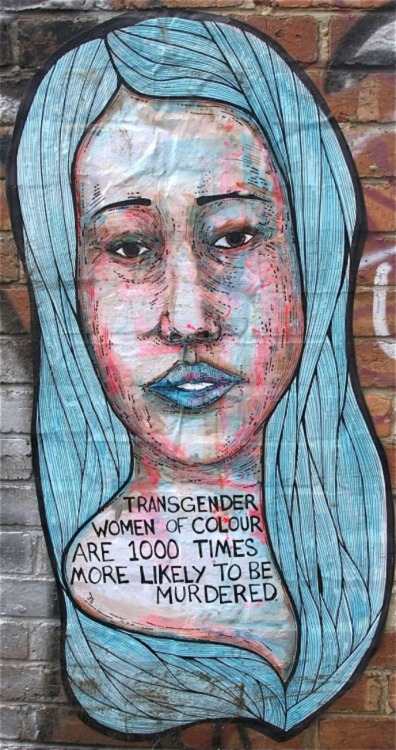


Stunning Australian street art shows the world the true face of LGBT people
Australian street artist Astrotwitch launched “Queer the Streets“ last year based on the idea that, as they wrote on Tumblr, all the “queer community needs is simply for more people to know that they exist.” Their works are incredible — and every one has the potential to create a change.
This is Awesome, and I wish everyone knew and understood this.

If you’re a human being with a social media account, you’ve seen the new Dove commercial already. Entitled “Choose Beautiful,” the latest addition to Dove’s ten-year-old “Real Beauty” campaign features footage from several locations around the world, where side-by-side doors were labeled “Beautiful” and “Average” and women choose which door to walk through.
All this advertising has the same central flaw, which frustrates me when I see people praising these companies to the skies. These ads each depend on the assumption that in order to be happy, empowered, or confident, women need to feel beautiful. Dove wants us to talk about why women don’t feel beautiful. I want to talk about why that’s the only question they think is worth asking.
Dove’s Senior Global Director Victoria Sjardin was quoted on The Huffington Post saying, “Dove wanted to inspire women to seize the opportunity to choose what makes us feel beautiful every day, because when we do, it unlocks confidence and happiness.” But confidence and happiness are available lots of different ways. I feel confident and happy when I work out, when I tell a good joke, when I do something nice for someone I care about, when I sell a piece of writing, when I finish a complicated knitting project. Being average-looking doesn’t mean that I’m worthless, or miserable, or unloved. I have wonderful friends, a supportive family, and a great marriage. You don’t need to be beautiful for people to like you and love you and want to spend time around you and even want to see you naked.
If beauty is something that matters to you, I want you to be able to claim it. I’m not saying you shouldn’t be able to redefine beauty and use it in whatever way suits your life. But I can’t help resenting that so much of today’s surge of body-positive rhetoric focuses on beauty. I can like my body and have a positive self-image without thinking I’m pretty.
In comments yesterday, heckblazer alerted me to this brilliance of 1865 advertising.

That is now one of my favorite advertisements of all time. Can’t wait to use it in a class.

The Tate in Minecraft (all images courtesy The Tate)
The widely beloved open world video game of Minecraft will now offer a new activity for its players to explore: interactive artworks presented by the Tate, the third installment of which was just released last week. For those not in the know, Minecraft is sort of like digital Lego blocks on steroids; you start with a landscape, or a ‘map,’ in which you’re welcome to chop down whatever you like in order to build various structures.

Inside the Tate looking at a work by Christopher Richard Wynne Nevinson (click to enlarge)
Tate’s initiative, known as “Tate Worlds,” is the result of a collaboration with a group of Minecraft artists and builders known as “The Common People” in order to refashion artworks from their collection into Minecraft’s virtual universe. Three custom-made, unalterable maps, which are available to download on Tate’s website, feature the Minecraft versions of André Derain’s “The Pool of London” (1906), Christopher Richard Wynne Nevinson’s “The Soul of the Soulless City (‘New York – an Abstraction’)” (1920) and Peter Blake’s “The Toy Shop” (1962). Five more Minecraft maps will be released in 2015, and will include works by John Singer Sargent, Cornelia Parker, and John Martin.

André Derain’s “The Pool of London” (1906) in Minecraft
Both “The Soul of the Soulless City” and “The Pool of London” start off in front of a specialized virtual Tate museum. (Note: I accidentally drowned my character when trying to enter the museum to see The Pool of London. Sensing my incompetence, the game respawned me inside of the painting, and I missed the event the first try.) The museum looks like a large warehouse in the middle of an mountainous landscape. Once inside, your character steps on a floor panel beneath her feet that then transports you inside of the painting world.

André Derain’s “The Pool of London” (1906)
When you enter the painting world of Nevinson’s “The Soul of the Soulless City,” you’re immediately greeted by the virtual Minecraft figure of Nevinson. He is standing next to a Minecart, a small grey box that you can use to travel one of the two train tracks within the virtual version of his painting. A small push of the controls, and your cart goes sailing into the metropolis.

André Derain’s avatar greeting you inside the Minecraft version of his artwork.
As your cart nears the top of one of the buildings, you might hear a faint crackling that eventually turns into a time-period sounding piece of music, as though you’re listening to a phonograph play nearby. All around you, the city whirs by as your cart twists and turns around buildings. You’ll eventually reach a construction yard filled with a few pallets of bricks that you can work on to create your own skyscraper, though you only have 150 seconds to finish. No pressure. Once you’re finished, you’ll board another cart and go see a movie.

Inside the Minecraft version of Christopher Richard Wynne Nevinson’s “The Soul of the Soulless City…” (1920)
The Minecraft interpretation of Nevinson’s painting is spot-on in terms of color and setting, and though it might be impossible to technically achieve a painted gradient in the game, the creators do pay attention to Nevinson’s exaggerated buildings and desire to portray the modernist ethos. Something that seemed to be missing is more of the hazy city smog that Nevinson captured so well on canvas.

Christopher Richard Wynne Nevinson’s “The Soul of the Soulless City…” (1920) (click to enlarge)
Entering “The Pool of London,” you begin on London Bridge overlooking the Thames. Andre Derain greets you and mentions he’s a Fauvist painter who’s somehow lost his paints. He’s convinced that you can help him find his necessary pigments around the city, if you’ll take a look. He asks you to bring him six pots, and doesn’t care all that much if they’re broken.
If you’re not keen to do his errands, you can also have your Minecraft character punch Andre Derain’s avatar in the face.
The buildings that make up the London streets are colorful and reflective of that beastly fauvist attitude. Something that’s bothersome, though, is that within Derain’s actual painting, there are depictions of people moving between the boats, working. This type of interaction is missing from the simulated version: the boats feel like colored props, not a moving slice of the painting. Unlike “The Soul of the Soulless City,” there’s not the same sense you’re actually moving and interacting within the painting itself.

Another view inside the Minecraft version of Nevinson’s “The Soul of the Soulless City…” (1920) with the artist greeting you.
Successful as painting remakes or not, these two Minecraft worlds aren’t the Tate’s first experiments with video games as a way to teach art history. In 2012, the museum published, “Race Against Time,” a free platformer iPhone game that teaches about art’s modern movements.

Another view inside the Minecrafter version of Nevinson’s “The Soul of the Soulless City…” (1920)
If these works serve Tate’s mission to teach Minecrafters more about art, that can only be a good thing. At times, though, it seems like the maps distract too much from the paintings with the various missions the created maps offer players. The history behind both paintings — Nevinson renamed his painting, “The Soul of the Soulless City” from “New York – an Abstraction” after he received a poor exhibition review and Derain was sent to London by Vollard to repaint the Thames in Fauvist style — as explained on Tate website is also not mentioned or included in both scenarios. Still, in terms of learning a few facts about the respective time periods of each painting, Tate Worlds does make each virtual artwork an entertaining and enjoyable experience.
The three available modules are available to download on Tate’s website

In my opinion it’s okay for men to call themselves feminists. More than okay, I think it’s beneficial. And I call myself a feminist. Feminist men on “Alas” are welcome to call themselves feminists. In my (anecdotal) experience, most feminists welcome men calling ourselves “feminist,” as long as we’re being sincere.
BUT… There are some spaces, mostly radfem spaces, where it’s largely agreed that only women should call themselves “feminist” while men should call themselves “pro-feminist.”
For men to enter such spaces and start arguments about “can’t men be feminists” is harmful. It’s distracting from more important issues, and it confirms the stereotype among some radical feminists that men in feminist spaces insist on being the center of conversation.

Noah Fischer of Occupy Museums, Frida Kahlo of Guerrilla Girls, and Kim Fraczek of Sane Energy Project “inaugurate” the Whitney Museum’s new home atop a gas pipeline with a ceremonial ribbon cutting. (all images by the author for Hyperallergic)
Last night, The Illuminator was in Manhattan’s Meatpacking District to project mayday messages on the facade of the soon-to-be-opened Whitney Museum, while a group of two dozen protesters supported by 23 sponsoring organizations launched a guerrilla inauguration for the “fracked gas pipe museum.”

The Illuminator branded the museum with various messages highlighting the hidden gas line underneath its pristine building.
The event at the corner of Gansevoort Street and Tenth Avenue started with a two-part 10 minute projection by The Illuminator, and it featured both familiar slogans (“1% Museum”) and messages unique to the Whitney (“Whitney, The Finest Collection of 20th-century American Art in the World, Now Featuring a Brand New Pipeline!”). The intention of the projections was primarily to draw attention to the location of the museum atop a Spectra Energy fracked gas pipeline that transports energy from Pennsylvania to Manhattan. The projections also included images of previous pipeline protests at the site, Hurricane Sandy (which flooded the area around the new Whitney), and ominous explosions.

The message is clear: the 1% Museum is in danger of becoming extinct.
After the planned video program concluded, the group crossed the street and continued its ad hoc inauguration right off the museum’s steps. It unfurled a symbolic ribbon; read prepared statements by Occupy Museums, a solidarity statement by Liberate Tate, and others; and then offered a pair of large, decorative scissors to Guerrillla Girl Frida Kahlo, who symbolically cut the ribbon. During the program, the organizers also presented an award to Susan Rubin of Chappaqua, New York, for her continuing fight against another Spectra Pipeline in upstate New York.

Susan Rubin with her award
Last night’s ceremony was only the latest in a series of symbolic events that have been taking place over the course of the last year and a half. A global network of art protest groups, including G.U.L.F. (Global Ultra Luxury Faction), Occupy Museums, Guerrilla Girls, Liberate Tate, People’s Climate Arts, Not an Alternative, The Yes Lab, Peng Collective, and many others, has been working hard to highlight the art world’s complicit acceptance of the status quo, no matter how immoral or unethical it may be. Occupy Museums has been particularly engaged in raising awareness about the Spectra Energy gas pipeline under the Whitney Museum, and last May they — along with Occupy the Pipeline — organized a theatrical tour of the area featuring narrators who played the roles of famous artists, conveying the dangers the new Whitney Museum could face. I attended the event, which attracted a big group of predominantly tourists, who listened intently to their message.

The ceremonial ribbon cutting by Frida Kahlo of Guerrilla Girls
After I attended the May tour, I asked the Whitney Museum for comment on the growing concerns by some arts groups over the gas pipeline, and at the time a spokesperson responded with the following statement:
Although the Spectra pipeline does not cross directly onto the Museum’s property, we followed the progress of the work because of its proximity to the site. Governmental regulators, who oversaw and monitored the pipeline’s construction, are responsible for ensuring that the pipeline’s ongoing operation meets all applicable standards and requirements.
At a recent community board meeting, a Whitney Museum representative said much the same thing to a concerned New Yorker who asked about the Spectra pipeline. Noah Fischer of Occupy Musuems says the Whitney has not budged on the issue one bit, and it worries him that people aren’t asking more questions. “This kind of inauguration by the people, which is unrelated to the official one, is so important because [the pipeline] is a problem, and if the official line of the museum as it opens is to not talk about it, then we need to open it in a completely different way. It is a perfect picture of how invincible the 1% feels with their money and business strategies, because a lot of people are making money off Spectra. Natural gas was sold to New York as a really clean alternative, and it’s dirtier than coal in terms of its overall impact on the climate,” he said.

The audience at last night’s inauguration
Fischer’s frustration was shared by many in attendance, including Susan Rubin, who lives 10.5 miles (~17km) away from Indian Point Energy Center. She says she’s terrified by the prospect of the Algonquin gas pipeline expansion project landing next to the nuclear power plant.
“We’ve all lost our values, and we think money matters more than health or safety or our future. We need to get back to basics. If you look at what happened in San Bruno, California, it’s insane — 1,000 foot flames,” she explained, referring to an infamous gas line explosion in 2010 that killed eight people and devastated a suburban neighborhood. “I don’t know if the first responders down here [in New York City] are prepared for a fire of this proportion. I know where I live, next to Indian Point, there’s no money going to get those firemen more prepared. This is a huge issue, and it doesn’t make it into the news. When you start to learn about it you can’t go back to sleep, so I’m just trying to wake everybody up that I can.”
Frida Kahlo, a founding member of the renowned feminist art group the Guerrilla Girls, took part in the renegade ceremony. She spoke to Hyperallergic before the event and said it was important for her to be there. “We have been complaining about museums and trying to embarrass them for 30 years,” she said, “so this was a terrific opportunity to come together with other art activists and talk about another way of being an artist in the world without joining the art establishment.”
I pointed out that we had recently reported that 30% of the artists in the Whitney’s inaugural exhibition are women, and asked her what she thought about that fact. “That’s something that some people will be happy about, but when you realize for probably over 50 years at least half the graduating classes of art schools have been female, [then we have to ask] what happens? They obviously don’t get the same professional opportunities. Yes, that is better than ever before, but why should we be happy about 30%?”
I asked her if she thought the art world has changed at all in the last few decades. “Things have changed. It is better than ever for women and artists of color, but there are all sorts of other problems, such as the issue of tokenism, where institutions will show one woman artist — or 30% women artists — and think it’s fine,” she said. “And then there is the issue of economic inequality, because if you look at the money — the money all goes to the white guys, and it is hard to be productive and keep up in the art world if you don’t have the means to make art … The art world, instead of being avant-grade, is derriere.”
“Museums have always overlooked big political issues, because their money comes from those powers that create those problems, and that’s why we really need to be the eternal thorn,” she added.
The following video contains snippets from last night’s guerrilla inauguration:
In the wake of one of John C. Wright’s Hugo-nominated stories being disqualified for the ballot because it was previously published on his Web site, howls of bitter indignancy have arisen from the Puppy quarters, on the basis that Old Man’s War, a book I serialized here on Whatever in 2002, qualified for the Hugo ballot in 2006 (it did not win). The gist of the whining is that if my work can be thought of as previously unpublished, why not Mr. Wright’s? Also, this is further evidence that the Hugos are one big conspiracy apparently designed to promote the socially acceptable, i.e., me specifically, whilst putting down the true and pure sons of science fiction (i.e., the Puppies).
So: thoughts.
1. The first irony is that Old Man’s War actually wasn’t originally on the 2006 Best Novel Hugo ballot at all; it finished sixth in the nomination tally. It ascended to the ballot when Neil Gaiman, who I did not know at the time (and who was almost certainly entirely unaware of my existence, or that I had placed sixth in the nomination tally), declined a Best Novel nomination for Anansi Boys. Neil (who I do know now), explained later that he’d felt he’d won his share of Hugos at the time and imagined the nomination would be better served helping someone else. He was correct about that. The point is that if you buy into the conspiracy theory of Old Man’s War being on the ballot, you have to believe that the conspiracy somehow convinced/forced Neil Gaiman to decline his nomination strictly for my benefit. Which is some conspiracy!
2. The second irony is that at the time, based purely on the content of Old Man’s War, to the extent that fandom presumed to guess my personal politics at all, much of it assumed that I was a US conservative. Hey, not everyone reads my blog. So the idea that I was on the ballot because of some ideological nod is, well, suspect at best.
3. It was no big secret in 2006 that Old Man’s War had been serialized on my blog prior to publication, so it seems doubtful to me the Hugo people were entirely unaware of its provenance. To the extent that it was discussed at all between me and other folks, to the best of my recollection at the time, there was the feeling that serializing on the blog did not, in itself, constitute publication (interestingly, I thought that it was Agent to the Stars, also published in 2005, that might be more of a tricky sell for the ballot, as you can see here).
4. Aside from my notification of the nomination, I had no contact with the Hugo Award committee of that year prior to the actual Worldcon, nor could I tell you off the top of my head who was on the committee. It doesn’t appear that anyone at the time was concerned about whether OMW being serialized here constituted publication. Simply put, it didn’t seem to be an issue, or at the very least, no one told me if it were. Again, if this was a conspiracy to get me on the ballot, it lacked one very important conspirator: Me.
5. So why would OMW’s appearance on a Web site in 2002 not constitute publication, but Mr. Wright’s story’s appearance on a Web site in 2013 constitute publication? There could be many reasons, including conspiracy, but I think the more likely and rather pedestrian reason is that more than a decade separates 2002 and 2013. In that decade the publishing landscape has changed significantly. In 2002 there was no Kindle, no Nook, no tablet or smart phone; there was no significant and simple commerce channel for independent publication; and there was not, apparently, a widespread understanding that self-publishing, in whatever form, constituted formal publication for the purposes of the Hugo Awards. 2013 is not 2002; 2015, when Mr. Wright’s story was nominated, is not 2006, when OMW was nominated.
I don’t think it’s all that difficult to conceptualize that major changes in culture can significantly alter the perception of what is legitimate and what is not; after all, in 2002, no state in the US allowed for same-sex marriage, whereas in 2015 the majority do, and it’s very likely by the end of the year that all will. The recognition of web publication as formal publication for the purposes of science fiction awards is not exactly a greater cultural shift than that, I would propose. No conspiracy required.
6. But it’s not faaaaaaiiirrrr, waaaaaaaaaaaah. Well, one: Life is not fair, so gut up, children. Two, it’s the Hugo adminstrators’ call to make, and they made it, so again, put on your big kid pants and just deal with it. If this year’s Hugos have a theme, it is of people just having to deal with shit they don’t like. I’m not sure why the Puppies feel they should be special snowflakes in this regard. The good news for Mr. Wright is that Hugo voters are not left bereft of chances to enjoy his Hugo-nominated prose, as he is still on the ballot a prodigious five times.
7. What would I have done in 2006 if I had been disqualified from the Hugo ballot because OMW had been serialized on my Web site? I imagine I would have been very gravely disappointed and would have probably groused privately and possibly even publicly. Then I imagine I would have put on my own big kid pants and dealt with it. Because here’s a home truth: No one is owed a Hugo award, or a Hugo nomination. If you start thinking you are, you’re the problem, not the Hugos, their administrators, or anyone else who might have ever been nominated, or even been awarded, one of the rockets.


An untitled Guerrilla Girls poster from 2011 (all photos by the author for Hyperallergic)
CLAREMONT, Calif. — When I first saw the work of the Guerrilla Girls in high school, I had a similar reaction as when I first read Linda Nochlin’s “Why Have There Been No Great Women Artists?”: ashamed that something so obvious had to be laid out for me. Of course, societal norms prohibited women from pursuing their artistry to the fullest extent possible in the past, but now, I’d thought, things were different: female artists had solo shows at major museums, and powerful women worked as gallerists, curators, journalists, and tastemakers. But there’s something about seeing the black-and-white numbers presented by the Guerrilla Girls, usually in the form of accessible posters, that’s eye opening and enraging. It’s one thing to have a gauzy concept of past wrongs and present progress, quite another to know just how much the status quo is still upheld today.

Installation view, ‘Guerrilla Girls: Art in Action’
Guerrilla Girls: Art in Action at the Pomona College Art Museum, curated by Benjamin Feldman, a Pomona senior and the Josephine Bump ’76 curatorial intern, is a small but potent look at the confrontational posters and publications created by the feminist group. Started in 1985 by an anonymous cluster of critics, artists, academics, and museum workers, the Guerrilla Girls have made a long career of critiquing the art world’s male- and Caucasian-centered focus. While the exhibition would benefit from wall labels dating each poster, its setting in an academic context has undoubtedly exposed many students to the continuing existence of troubling imbalances in museums, galleries, and publications.

Guerrilla Girls, “Horror on the National Mall!” (2007) (click to enlarge)
The statistics outlined in the works are staggering. A 1985 poster reports that the average woman artist earned one-third of what the average male artist earned, while another, from as recent a year as 2011, announces that fewer than 4% of artists in the Metropolitan Museum’s modern art section are women, but 76% of the nudes are female. The colorful 2007 mock tabloid Horror on the National Mall!, originally presented in the pages of the Washington Post, lists jaw-dropping numbers: at the time, the creators of art on view at the National Gallery of Art were 98% male and 99.9% white; respective numbers at the National Portrait Gallery, the Hirshhorn Museum, and the American Art Museum and Renwick Gallery were not much better.
A work I’d never seen before, “Token Times” (1995), cut close to the bone despite the fact that it’s 20 years old. I texted a picture of it to a few of my female art world friends and got laughing exclamations of recognition in response to the poster’s tongue-in-cheek descriptions of entry-level art world jobs for women. Months before, we’d sent around a New York Times article with statistics for the low numbers of female museum directors, underlining how few women work their way up from entry-level museum jobs into the upper administrative echelon. As detailed in the article, a 2014 report by the Association of Art Museum Directors found that only 24% of institutions with budgets over $15 million have female directors, and these women make 29% less than their male counterparts. In addition, just five of the thirty-three museums with budgets over $20 million have female directors.

Guerrilla Girls posters from 1989 (top) and 1985 (bottom) (click to enlarge)
One of the things that’s appealing about the Guerrilla Girls’ message and the way they broadcast it is that they make clear that everyone in positions of power in the art world bears responsibility for the current state of affairs and can work to improve the situation. It’s easy to think about exhibitions as discrete entities, awarded based on individual merit, timing, or popular appeal, but when one sees the slim numbers of solo museum shows awarded to female artists or their overall slice of gallery representation, the systemic nature of the problem comes into sharp relief. Curators, gallerists, academics, and writers of both genders and at all levels of the career ladder need to collectively work to better represent the demographics of the contemporary world.
The Guerrilla Girls regularly create new posters and host events, such as a program at Pomona in February in association with the show. For 2014 alone, their website lists performances, lectures, and workshops held at 15 venues, including the New York Art Book Fair, the Victoria and Albert Museum, the Google Cultural Institute, and various universities. Along with their identifiable graphics, which resist feeling dated due to their simplicity, the educational bent of the group is a key strategy — the more people are informed about the current situation through punchy graphics and memorable statistics, the more they will want to act upon the problem (hopefully).

Installation view, ‘Guerrilla Girls: Art in Action’ (click to enlarge)
As I was waiting to look at a few workbooks near the exhibition exit, I fell into conversation with two female college students curious about the origins of the group. Charmed by the accessible and stingingly funny books, they were shocked by the statistics and the continuing necessity of the group’s work today, just as I had been the first time I saw the Guerrilla Girls’ posters. This type of reaction speaks to the effectiveness of the Guerrilla Girls’ strategy, as outlined by the members themselves:
We try to be different from the kind of political art that is angry and points to something and says ‘This is bad.’ That’s preaching to the converted. We want to be subversive, to transform our audience, to confront them with some disarming statements, backed up by facts — and great visuals — and hopefully convert them.
Guerrilla Girls: Art in Action continues at Pomona College Art Museum (330 N College Ave, Claremont, California) through May 17.

PETA is horrible, part the innumerable:
A controversial, anti-immigrant Arizona sheriff and a former Baywatch star will join together at a press conference Wednesday to promote an all-vegetarian diet for prisoners nationwide. Since 2013, the Maricopa County jail system, run by the self-proclaimed “America’s Toughest Sheriff” Joe Arpaio, became the first in the nation to serve meat-free meals to prisoners. Pamela Anderson is an animal-rights activist representing People for the Ethical Treatment of Animals (PETA) as a spokeswoman.
[…]
Still, Anderson’s appearance with Arpaio is the latest in a string of tactics by PETA that seem inconsistent with their humanitarian values. Last year, the organization offered to pay one month’s water bill for Detroit, Michigan residents, who had their water shut off because of outstanding payments. PETA stipulated that residents had to agree to go vegan for one month. But for Detroit residents who live in food deserts, where it’s difficult to find fresh fruits and vegetables, going vegan was described as tone deaf. The group has used other kinds of gimmicks to promote a vegan lifestyle, often using graphic images or using naked women covered in “blood” and trapped in cages for PETA promotional materials.
Despite Arpaio’s assurance that he’s saving taxpayer money with the meat-free meals, taxpayers still have to help pay at least $21.9 million to implement changes recommended by a court order to combat his department’s systemic racial profiling of Latinos. Those changes include improving training and technology equipment, to show that the sheriff’s office will no longer systemically single out Latinos during traffic and immigration stops.
Trolling: not an effective activist strategy.

Writers expecting to supplement their art by teaching college level courses might need to find a new day job. A quarter of all part-time college faculty receive some sort of public assistance, reports Slate. Those numbers include Medicaid and nutrition assistance (better known as food stamps). Though other occupations like fast-food workers still have higher rates of public assistance, college faculty require far more education. Slate also points out that since the numbers are based on census information, there are some part-time faculty who might list other jobs and therefore are excluded from the dataset.
The first time I caught him swallowing a fistful of pills, he convinced me that they were vitamins. And why wouldn’t I believe him? He spent every morning soaking his clothes at the gym and he was clocking about eighty hours of work a week, so it made sense that he would take extra precautions to stay healthy.
The first time I caught him whispering on the phone to his dealer, I let him explain that he was doing it as a “favor” for a friend. And later that night when his eyes were haunted and red, I let him complain about “jet lag.”
The first time he came home from a work dinner four hours late, I wanted so badly to believe that the tall tale he told — an imaginary co-worker had driven his car home for him and then walked to his own house, nearby. I wanted so badly to believe that this man — who claimed to love this woman (who had already lost a boyfriend to a drunk driver) — wasn’t sick enough to drive home drunk. So I tucked him in and let him gargle about his boss into a deep sleep.
The first time I caught him in front of the refrigerator, head back, pouring a Coors Light down his throat, I decided to clear my throat rather than let him get away with his “I’m going to get a glass of water” alibi.
“Why?” I asked him. Really asking. Begging him to explain to me why he needed the duality of being perfect and being helpless. Begging him to explain to me why he couldn’t bear to let me see him. Begging him to let me love him. Begging him to see himself. Begging him to love himself.
The first time I saw him cry I felt relieved. Happy, almost. Under all of the distractions and chemicals, there was something real brewing, I thought. He was still alive, I hoped. He was going to tell me what it was like to be one of six and what it felt like to not know his father. He was going to tell me why he couldn’t bear to find sleep sober. And I believed those tears to be steps toward a breakthrough. Steps toward honesty. Steps toward hearing him say finally, “I have a problem.” Rather than, “This is the lifestyle. This is what makes me successful.” But they were not steps. They were shields, little pieces of armor disguised as vulnerability. They were not tears that said, “I want to get better,” they were tears that said, “I’m embarrassed.”
His embarrassment was skin deep. It was his confidence that drew me to him because it made him appear free. “I can’t stop smiling,” he’d whisper into the receiver not long after our first date. It would take me a moment to respond because my smile would be so wide, I’d have wait for my cheeks to release my jaw. On one of our first dates he built a fire and made a bed out of blankets in front of it. It was starting to snow and I’d never been so close to a Russian romance novel, I could barely enjoy myself beneath the awe.
After a few glasses of wine, he disappeared into the kitchen to fetch a new bottle. A few minutes later I heard cabinets opening and slamming, and huffing and puffing. I sat uncomfortably, unsure if I was meant to check on him or stay put. A minute later he resurfaced, red-faced with a sheen of sweat across his brow “There’s no more wine” he said, almost out of breath. And after four repetitions of “That’s fine, I don’t need anymore.” I realized it wasn’t me he was concerned about. He wasn’t being a good host, he was being an alcoholic. “I’ll just run out and go to the store, stay put.” “But it’s snowing, it’s not worth it, just come sit back down by the fire,” fell on deaf ears. He was already hooking the zipper of his coat. Worried, I begged gently, stay, stay. He kissed me on the forehead, pivoted on the heels of his weekend shoes and headed towards the door. I was deflated. And suddenly, with his hand in his pocket his posture erect, he jumped in delight and did a reverse pivot to reveal a toothy grin and a joint laying across his palm on display. “Look what I found!” he cheered. His discovery was enough to give up on his wine mission.
Eyes wide, like a child in the night, he lit his joint and savored every breath, feeling less panicked and more silly with every exhale. He believed himself to be free again—giggling, silly, lovely. We rolled around on our makeshift blanket bed tickling each other and blushing. He felt like childhood. He felt like innocence. He made me believe that love could be simple. It didn’t have to be dark and trying, it could be stretched smiles and forehead kisses.
Later I stood in the bathroom, in awe of the flush of my cheeks. I looked happy. I felt happy and light, his playfulness was contagious and I couldn’t help but smirk as I watched it course through my veins and flint a twinkle in my once-dull eyes. On the porcelain ledge of the sink sat three orange pills. A deep stamp reading ad|30 was pressed into each of their otherwise smooth bodies. For whatever reason, I told myself to remember that pill code, so as to look it up later.
I woke up in the morning alone in our half-turned-down pile of blankets. The fire had resolved and he was banging around in the kitchen. “Good morning sweetheart” He said, egg mid-flip in the pan and for a moment I stood squinting thorough my half-awake sleep eyes wondering what I did to deserve him. “Thank you.” I said before heading to the bathroom to splash some water on my face. “Thank you for making me happy,” he retorted over of the sizzle of a runny egg. I bent over the sink and collected icy water in the palms of my hands as I tried to fathom if it was possible that he was happy. But then, I was suddenly distracted by the three orange chalky rings that took the place of the three orange pills the night. “Let’s feast sweetheart!” He shouted over the running water and my crashing optimism. I brought the cool to my face and shook off my sinking suspicion that this was too good to be true. I had been through so much. Surely my mind was trying to make a case of nothing.
The first time I gave up on him was easy. I was trying to barter with him: “What if you try only smoking every other night? What if tonight, you relax with a bath instead?” And then “Instead of taking a Clonazepam every time we have a serious conversation, try taking a deep breath and letting me rub your back.” Not ironically, he passed out in the middle of our argument and I was left with the option of draping his heavy arm around my shoulder and falling asleep next to an almost-corpse, as usual, or leaving knowing he won’t come after me. So I left. I walked across the park to my friend’s apartment in my pajamas at three in the morning. Sheepishly, I crawled into bed with her, embarrassed to admit that I was not capable of fixing him. Him, the one everyone warned me about. Him, the one that I defended against his stereotypes. Him, the one I liked to think worked in finance because he was good at math. Him, the one who convinced me he loved his friends, not their investments. Him, the one who got thank you notes from mysterious women who had received flowers from him. Him, the one who maintained his defense that everything he ingests is a vitamin because it keeps him alive. Him, the one who texted  me at seven a.m. having no idea where I was or what happened, asking me if he knew where his Gatorade was.
The first time I took him back was a sign of my weakness.
The first time he didn’t come back was a sign of his.
I never saw him again. But I think of him often, in therapy, in nightmares, in despair. Sometimes I miss the glimpses of him I’d catch, between doses. The puppy-like boy who let his hair flop on weekends. The sheep-like, guttural laughing spells that would sneak up on him and stain his cheeks pink. The way he so humbly marveled at nature when only standing in his front yard. But rather than feel like a failure for not saving him, I remind myself to appreciate saving myself and hopefully bringing him one step closer to the mirror.
***
Excerpted from The Head, the Heart & The Home © TC Books, 2015
***
Rumpus original art by Kara Y. Frame.

A campaign to stop a controversial auction sale (image via Facebook)
“They offered to give me things to the point of embarrassment, but not to sell them,” Allen Hendershott Eaton wrote in Beauty Behind Barbed Wire: The Arts of the Japanese in Our War Relocation Camps (1952) of the artworks, furniture, and photographs gifted him by Japanese American internees. The historian was a vocal critic of the camps, and he wanted to curate an exhibition that would draw attention to them.
Eaton has since died, and in a strange twist, 450 items he collected from the victims are scheduled to be auctioned off by New Jersey-based Rago Arts on Friday. Objects in lots 1232–1255 of its “Great Estates” sale include beads, jewelry, hand-carved wooden objects, photographs, and paintings depicting camp life. These will soon go to the highest bidders, despite ongoing efforts by protesters to halt the sale.
Controversy first began stirring mid-March, when the Heart Mountain Wyoming Foundation (HWMF), an organization that maintains the Heart Mountain internment camp, asked the anonymous consignor to consider either donating the items to Japanese American institutions or negotiating a private sale with nonprofit institutions. After the consignor rejected HWMF’s requests, the organization secured pledges from its board members to make a cash offer that exceeded the estimated auction value of the items. On April 13, the organization learned its proposal was rejected.
“Over the last several days, we have worked in good faith with the consignor through Rago to find a positive resolution that would end the auction,” HMWF Executive Director Brian Liesinger said in a statement on April 14. “The fact that we were met with rejection on all of our appeals — and the Japanese American community’s appeals — is baffling.”
“The idea of making these pieces of art, which symbolize incarcerees’ efforts to make something beautiful out of a miserable experience — making them available to the highest bidder re-opens old wounds,” said HMWF Chair Shirley Ann Higuchi, whose parents met at Heart Mountain.

Yoshinori Himel found this photograph of his mother in one of the lots (image via Facebook)
In the meantime, as the New York Times reported, a Change.org petition was launched by Japanese American Lorna Fong to pressure Rago Arts to remove the items from the auction. In a letter addressed to David Rago, Dr. Satsuki Ina, born in California’s Tule Lake Segregation Center, wrote:
These items were given — not sold — to the original collector, Allen Eaton, because he wanted to display them in an exhibition that would help tell the story of the incarceration of 120,000 innocent people, more than half of them children. It is a betrayal of those imprisoned people who thought their gifts would be used to educate, not be sold to the highest bidder in a national auction, pitting families against museums against private collectors.
As of Wednesday morning, the petition had garnered 4,091 signers. Fong also set up a Facebook page called Japanese American History: NOT for Sale, which had 4,779 likes. “It is immoral and is causing our community anguish and outrage. Like Holocaust artifacts, slavery items and Native American burial objects, some historical artifacts must not be monetized,” she wrote. “Stop profiting off others’ tragedies.”

An auction lot contains a portrait of poet Janice Mirikitani’s cousin (image via Facebook)
Reading through comments on the page reveals how, since the auction’s announcement, Japanese American internees and their descendants have found their family members’ photographs in the lots. Former San Francisco poet laureate Janice Mirikitani, incarcerated in an Arkansas camp as an infant, discovered a portrait of her cousin:
I was shocked and appalled, to say the least, in seeing my cousin Jimmy Tsutomu Mirikitani’s photo up for sale in an auction … Jimmy has endured more adversity than most human beings could imagine, not only with the injustice of our incarceration in American concentration camps, but also his struggle for validation as an American citizen. He was homeless for years in the streets of New York, living off of the sale of his artwork … To ‘pimp’ the suffering of my family, my community is not only insulting, it is inhumane.
Yoshinori Himel found a photograph of his mother and sent an official letter of protest to the auction house. He wrote:
I was astonished to see my late mother’s image being auctioned …. Before World War II, [she] was an accomplished violinist, a beauty pageant princess and a music major at the University of Washington in Seattle … the FBI arrested my grandfather for no crime and incarcerated him in Montana and North Dakota …. My uncle Andy …. was imprisoned and became the subject of Dr. Mengele-style medical experimentation. My mother’s family was exiled from Seattle. The government used this young woman’s smiling likeness to mask the tragedy suffered by her and an entire racial group of innocent people. Each item donated to the collector and offered by the consignor was a product of that injustice. To profit from these items is a second injustice.
In a statement released by the Manzanar Committee, which hosts a yearly pilgrimage to California’s Manzanar internment camp, co-chair Bruce Embrey explained that many families parted with their possessions for economic reasons. “With no time to store property or family treasures, and ordered to bring only what they could carry, our families had little choice but to destroy or sell personal belongings,” he said. “The economic losses were tremendous. The personal losses were almost impossible to quantify. This is the context of an auction of this nature.”
“We are in receipt of many emails, social media posts and the focus of much media attention. We are well aware,” Rago Arts told Hyperallergic. “Some people are supportive. Most are not. Of those objecting to the sale, all are heartfelt. Some are civil and constructive. Some are vile.”
They added, “There is an essential discussion to be had about the sale of historical items that are a legacy of man’s inhumanity to man. It extends beyond what is legal.”
Rago Arts also told the New York Times that the consignor, a friend of the Eaton family, is “not in a financial position” to donate the materials. The consignor also complained about the “social media attack” meant to “bully us into compliance with their demands.”
In contrast, Eric L. Muller, a historian and consultant on the auction catalog, canceled a lecture at the auction house scheduled for today. He told the newspaper that, based on the consignor’s response, “I did not feel that I could deliver a public lecture connected to the sale in good conscience.”
Update, 10pm EDT: Rago Arts and Auction Center has announced it will withdraw Eaton’s collection from the April 17 sale. In an email addressed to the media, the organization wrote:
We have always wanted to see this property where it could do the most good for history. We have done our best to publicize this auction by informing the media; The New York Times ran the first story about the sale on March 6. We relayed every good faith offer for private sale to the consignor. For us, there could be no better resolution than for a suitable museum, foundation or member/members of the Japanese American community with the means to preserve this collection to come forward and secure it for education, display and research.
There is an essential discussion to be had about the sale of historical items that are a legacy of man’s inhumanity to man. It extends beyond what is legal. It is something auction houses, galleries and dealers are faced with regularly. We hope this controversy will be the beginning of a discourse on this issue.
It still hasn't caught any terrorists, but it has managed to root out a conspiracy of gropers (maybe sub-conspiracy is a better term) within its own ranks, according to this report.
After another employee reported that a screener at Denver International Airport had told her that he groped passengers he found attractive, a TSA investigator found that in fact at least two screeners were working together to further this goal. The investigator witnessed the male screener signaling to a female colleague when a certain passenger approached, and she then manipulated the scanner to "detect an anomaly." (She apparently did this by deliberately selecting the wrong gender, something I'm sure they never do by mistake.) Result: thorough pat-down. She admitted she had steered travelers to him this way on at least ten other occasions.
The TSA described the alleged acts as "egregious," which as you know means "really bad," and because it fired both employees I assume it wasn't using the archaic meaning of that term, which I have just learned was the opposite.
The case was turned over to the district attorney's office for a possible charge of unlawful sexual contact, but the DA has apparently declined to prosecute because "none of the passengers believed to have been touched by the screener could be identified." Well, I don't think the admission to the tipster was hearsay, and the co-conspirator confessed. Do they not prosecute many people based on less evidence than that? I think they do.
Prosecutors are considering filing a different charge, a spokeperson said, but she did not elaborate on what that might be.
I'd say more about this, but I have to catch a flight back to San Francisco (just finished a presentation in Memphis). I don't have to go through security when I connect in Denver, but after the firings that might now be the least gropey airport in the country (at least temporarily).
Update: TSA News makes a very good point that I missed—the culprits supposedly can't be prosecuted because the victim can't be identified, but a TSA investigator watched at least one of these crimes happen and yet let the victim leave without identifying him. That is, TSA—which is not a law-enforcement agency—didn't get the police involved when it received the original tip, instead choosing to do its own investigation, in which it failed to preserve information that we're told is necessary for prosecution. Interesting.


 facebook
 reddit
 Above: No tests were cheated on during this terrorist bombing
I will have more on the jail sentences, in some cases as long as seven years, handed out to teachers and administrators in the Atlanta cheating case. In the meantime, this is quite remarkable:
But those eight can appeal within 30 days, and they can be out of jail on bond while the appeals are pending. Those who took the deals—former teacher Pamela Cleveland and former testing coordinator Donald Bullock —waived their right to appeal. They also agreed to apologize to students, parents and the court.
During sentencing, Judge Baxter called the cheating “pervasive.”
“It’s like the sickest thing that’s ever happened in this town,” he said.
Uh, I’m…not convinced this is true. (Well, in fairness, while the 13-year-old girl was killed in Atlanta the subsequent anti-Semitic lynching of an innocent man was done outside of city limits.) Speaking of killing children, there’s this. And this. And then there’s this. And…well, I think we’ve established that the judge may have lost perspective here, just like the prosecutors did.
[via Anderson]


Here’s my first long-read culture piece for Salon — and not surprisingly, it’s about something extremely nerdy. Excerpt:
The larger argument the show makes is about the nature and necessity of different kinds of heroism — and the kind of social responsibility they entail. “Daredevil” almost never strays from Hell’s Kitchen, an area of New York City which, the audience is repeatedly told, was effectively demolished by the events in Joss Whedon’s first “Avengers” film. The Avengers were responsible for repelling an alien invasion, which is highly commendable, don’t get me wrong — but someone has to pick up the pieces of the society that’s shattered by the collateral damage, and that’s what shows like “Daredevil” are explicitly about.
In fact, all of the shows Marvel will be producing with Netflix take place in this same small slice of the Marvel cinematic universe — and all of them address the human cost of having your city host a Hollywood action sequence. This is something Hollywood itself has never done, and television only rarely. Even the closest, the third season of “Battlestar Galactica,” had the feel of a reconstruction happening elsewhere, due its visual and narrative references to Iraq.
Daredevil’s certainty — and the desire for it — isn’t a reflection on the world the audience lives in, but in the large cinematic one Marvel is creating. Which is, I acknowledge, something of a cop out. The work is produced and proving to be quite popular in a historical moment rife with divisions between the authority of those who govern and the people they are supposed to protect — but in traditional noir fashion, the show is quite critical of the established authorities. “Daredevil” does not encourage viewers to kowtow to police, as the NYPD is institutionally and irrevocably corrupt…


Is Hillary Clinton a corporate hack who will avoid economic populism like Zaid Jilani claims?
Will Hillary Clinton be an unabashed liberal on domestic policy, as Peter Beinart argues?
Will Hillary Clinton rule to the right on Barack Obama on foreign policy, as Zack Beauchamp states?
I think the answers to all of these question is to some extent, yes. They aren’t mutually exclusive. Granting that Henwood’s obsession with the Clinton is a bit unhealthy and is pretty much the left version of those who think she killed Vince Foster, she does indeed suck on many issues. And she’ll be OK on some issues. In other words, she’s a complicated, corporate-friendly Democrat who will be quite liberal on social issues (regardless of her participation in the welfare battles of the 90s), irritating on foreign policy but hardly a Republican, and generally a mixed bag.
The real lesson to take from Hillary Clinton for progressives is that no one should see a president as the person who will solve their problems. If we wanted somewhere better than Hillary to run, we should have organized to move the party to the left. We haven’t, and if Hillary hadn’t run, the likely frontrunner would be one Andrew Cuomo, a politician far worse than Hillary. If progressives push her to the left through consistent organization, she’ll swing left. If she feels more pressure from Republicans, she’ll swing right. This shouldn’t be all that hard to figure out, yet it constantly surprises us how politics actually work in this nation.