Nuguiler
Shared posts

27 Jan 03:03
¿Qué demonios pasa con el cine de Ghana?
by Guillermo Guerrero
NuguilerEl trailer promete
Antes que nada, el trailer de la película 2016
Ahora la explicación: allá por la década de los 80, a Nigeria llegaron un montón de películas en VHS. Al ser un país pobre, los empresarios proyectaban las películas en sus carritos de pueblo en pueblo, ponían sus carteles, la gente disfrutaba y se iban para otro lado.
Pasó que algún emprendedor dijo: "¡Oigan! ¿Y si hacemos nuestras propias películas con juegos de azar y mujerzuelas?"
Así nació Nollywood, la segunda industria más grande de cine en el mundo por detrás de Hollywood y por delante de Bollywood, de la India. Se calcula que en Nigeria se producen cerca de 1200 películas al año, todas igual de horrorosas. La mayoría se hacen con una cámara chafita y el guión se va improvisando sobre la marcha.
El cine nigeriano sirve para darle identidad al país y como una muy fuerte entrada de dinero. Los países vecinos (como Ghana) copiaron el modelo nigeriano de manera más artesanal. Aunque tienen más creatividad para los carteles, digo yo :P

Ahora la explicación: allá por la década de los 80, a Nigeria llegaron un montón de películas en VHS. Al ser un país pobre, los empresarios proyectaban las películas en sus carritos de pueblo en pueblo, ponían sus carteles, la gente disfrutaba y se iban para otro lado.
Pasó que algún emprendedor dijo: "¡Oigan! ¿Y si hacemos nuestras propias películas con juegos de azar y mujerzuelas?"
Así nació Nollywood, la segunda industria más grande de cine en el mundo por detrás de Hollywood y por delante de Bollywood, de la India. Se calcula que en Nigeria se producen cerca de 1200 películas al año, todas igual de horrorosas. La mayoría se hacen con una cámara chafita y el guión se va improvisando sobre la marcha.
El cine nigeriano sirve para darle identidad al país y como una muy fuerte entrada de dinero. Los países vecinos (como Ghana) copiaron el modelo nigeriano de manera más artesanal. Aunque tienen más creatividad para los carteles, digo yo :P

26 Jan 07:45
Los Reyes Magos ¡Sí existen!
by Guillermo Guerrero
NuguilerPor esas y más razones sigo creyendo
¿O qué? ¿Crees que es parte de una conspiración mundial?
Jajajaja ;D
Jajajaja ;D
26 Jan 07:34
Estrellas Pura Cumbia – Patiky
by La Banda
NuguilerAl menos uno aprende algo
Para que no digan que en México no hay talento que compita con otros países les dejo este videito. Así que Wendy Sulca ya puede empezar a temblar…
Liga directa: youtube.com
Cortesía de Estrellada

Artnemiz1 likes this
26 Jan 07:14
Seguir @NoPuedoCreer - @QueLoVendan

El ballet de las bolsas de plástico
by La Gusa

El siguiente vídeo pertenece al grupo francés Compagnie Non Nova y sí, es un ballet.
Reconozco que no sé absolutamente nada de ballet y que el baile en general es algo que me está completamente vetado por una cuestión de pereza anatómica heredada durante generaciones; todo lo que no se hace sentado está fuera de mi ámbito. Pero esto es muy distinto: confieso que me he quedado embelesado viendo a las bolsas de plástico danzar por algún tipo de brujería que se me escapa. Echadle un ojo, que no tiene desperdicio.
Visto en Incredible Things
Ver más: ballet, bolsasSeguir @NoPuedoCreer - @QueLoVendan


26 Jan 05:51


El perezoso, la polilla y las algas
by Capitan Tomate

¿Os imagináis un animal tan holgazán que encuentre qué comer en su piel y sólo se mueva para “ir al baño“ una vez a la semana? Pues no os lo imaginéis, existe. Se trata de una especie de folívoro, más conocidos como perezosos.
Después de haber estudiado cuidadosamente el total de la ociosidad de estos animales, un equipo de biólogos han revelado que los perezosos se han ganado ese título adjetival, según cuentan en un artículo publicado en Proceedings of the Royal Society B.
La variedad de tres dedos (Bradypus, Bradypodidae), en particular, ha perfeccionado el arte de la inercia a través de un baile lento cuidadosamente coreografiado con una determinada especie de polilla.
Los perezosos habitan en el dosel del bosque, donde viven principalmente entre las hojas de los árboles.
Una vez a la semana, sin embargo, el animal desciende de su árbol para defecar en el suelo, una tarea arriesgada que lo hace vulnerable al ataque de depredadores.
¿Por qué molestarse?
Cuando el animal desciende, según cuentan los científicos en su estudio, las polillas que se encuentran alojadas en su piel ponen sus huevos en el estiércol, donde las larvas se desarrollan antes de emerger como adultos y volar hacia arriba en el árbol para unirse al resto de la colonia en el pelaje del perezoso.
A su vez, las polillas actúan como un tipo de abono, aumentando los niveles de nitrógeno en la piel del perezoso, que a su vez impulsa el crecimiento de algas. La fuente puede que sean pequeñas cantidades de estiércol traídas desde el suelo por los insectos.
Entre el pelaje del perezoso existe una serie de grietas que se llenan de agua de lluvia y que las algas utilizan para crecer con hidroponía. Esto crea todo un vergel en la piel de estos animales que, al mismo tiempo, le sirve para variar su limitada dieta, a base de hojas.
Apoyar el ciclo de vida de las polillas puede explicar porqué los perezosos de tres dedos poseen una alta fidelidad a un sólo tipo de árboles y una marcada voluntad en evacuar semanalmente, lo que para un perezoso es lo más peligroso de vivir en el bosque
Comentan los autores del estudio.
Esta compleja simbiosis consolida aspectos fundamentales de la historia y comportamiento de los perezosos, reforzando la propia pereza de estos simpáticos animales.
Vía |
-
La noticia El perezoso, la polilla y las algas fue publicada originalmente en Xatakaciencia por Capitan Tomate.
    
|
26 Jan 04:58

Y así es como los borricos nos quedamos sin amigos.
Y así es como los borricos nos quedamos sin amigos.
Artnemiz1 and -1 others like this
26 Jan 03:50

hematocritico: " Hombre meditando sobre los pros y contras de...
" Hombre meditando sobre los pros y contras de la zoofilia " (La decissionni molto radicalli) Reni Guido



24 Jan 21:02
"-¿Qué haces con gorra, camiseta de los bulls y collares de oro? ¡Es el velatorio de tu..."
“
- (via enefecto)
-¿Qué haces con gorra, camiseta de los bulls y collares de oro? ¡Es el velatorio de tu abuela!
+¿Qué pasa? ¿No había que venir de negro?
”- (via enefecto)

24 Jan 17:55
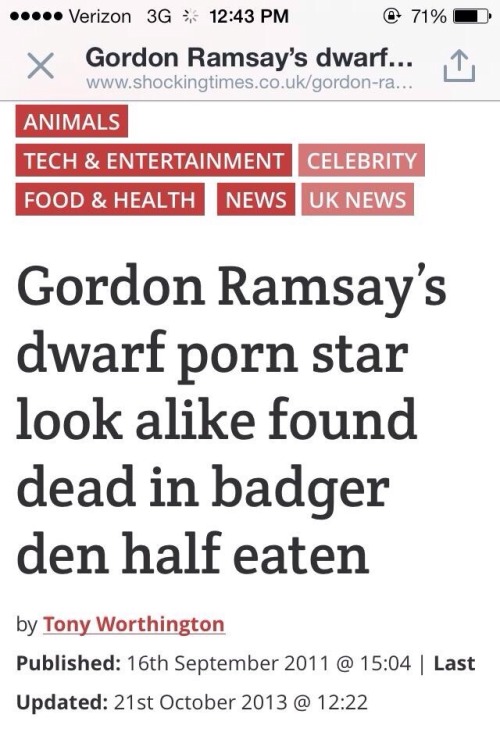
El actor porno enano que se parece a Gordon Ramsay es encontrado...
El actor porno enano que se parece a Gordon Ramsay es encontrado muerto y medio devorado en la guarida de un tejón.
23 Jan 23:38


Be The Overlord Of Your Office With A Chain Mail Necktie
by Amy Ratcliffe

Does walking into the office feel like entering a battlefield? If so, you might need this chain mail necktie to add bonus points to your damage roll. It’s made from anondized aluminum in 10mm rings – it’s sturdy enough to keep your chest safe from paper cuts. Maybe the neck armor will even protect you against staples (we don’t recommend experimenting). Bonus: since it’s made from a lighter material, the necktie only weighs 4oz. That’s not too much to carry around your neck which means the necktie would be suitable for everyday wear. You know you’re tempted.
See a close-up of the tie after the break.


Product Page ($29.99)
|
|


23 Jan 20:35
EL HOMBRE QUE HIZO UNA CATEDRAL SUBTERRANEA CON LAS MANOS
EN PLENO DESIERTO DE EEUU

Después de abandonar la universidad y fracasar en distintos trabajos como empleado de correos, guardia de seguridad o cavando agujeros para tuberías, Ra Paulette decidió retirarse a meditar al desierto de Nuevo México.
Allí, casi sin querer, inició una tarea titánica con la única ayuda de un pico, una pala y su imaginación. Corría el año 1985 trabajó incansablemente durante 25 años...

De esa forma, lo que comenzó como una pequeña capilla para pensar y encontrarse a sí mismo, se convirtió en una enorme catedral subterránea tallada a mano, con 14 galerías que se extienden por más de 8.400 metros cuadrados

A sus 67 años, Paulette nunca imaginó que escavar en tierra arcillosa del desierto la haría famoso. “No gasto ni un gramo de mi energía en tener éxito”, asegura.

Sin embargo, su increíble historia podría alzarse con el oOscar a mejor cortometraje documental. ‘El excavador’ es la máxima favorita en su categoría después de acumular media docena de premios en distintos documentales, pero su protagonista nunca pisará la alfombra roja.

Él prefiere “el polvo, la soledad y la belleza de la naturaleza”, según explica en su web.
Aunque algunas de sus ‘cavernas de meditación’, como Paulette las ha bautizado, están a la venta por casi un millón de dólares, el artista aclara que no es el dueño del terreno y que no tiene “nada que ver” con el negocio.

Lo suyo es una cruzada personal “por crear obras que no sean un fin en sí mismas sino una herramienta de cambio espiritual y social”.
Quienes le conocen dicen que es como “es como Miguel Angel cuando pintó la Capilla Sixtina. No se le puede decir que es lo que tiene que hacer, le guía una fuerza superior”.

Otros le comparan con un drogadicto. “cuando tiene una pala en la mano no puede parar”, aseguran. Ra Paulette reconoce que no es capaz de poner la mente en otra cosa. “estoy totalmente obsesionado, pienso en ello las 24 horas del día”, reconoce.
Sin embargo, no se siente un artista: “me siento más un arqueólogo que está descubriendo algo que ya estaba allí”.
Curiosa historia la de este hombre, no crees? Y maravillosas sus creaciones. Espero que te haya gustado el artículo... muchas gracias por tu visita... y por tu solidaridad con mi página!
Fuente: idealista.com

23 Jan 20:29
Aprende a pronunciar correctamente si le tienes aprecio a tu vida
by Gorka Areta

En la Biblia, en el capítulo 12 del libro de los Jueces más concretamente, se narran las consecuencias de una batalla entre galaaditas y efraimitas. Los primeros, cuando se cruzaban con un desconocido y dudaban si era efraimita, le obligaban a decir Shibboleth, una palabra que esta tribu era incapaz de pronunciar como Dios manda. Y si la dicción le fallaba, le degollaban ahí mismo.
Esta podría ser una de tantas truculentas historias sacadas de la Biblia, si no fuera porque con el paso de los siglos la palabra shibboleth ha pasado a designar todo aquel uso de la lengua que indica el origen social o regional de una persona. Lamentablemente los galaaditas crearon escuela y a lo largo de la historia han sido numerosos los casos en los que pueblos enteros fueron pasados a cuchillo por algo tan tonto como no saber pronunciar una frase de la forma adecuada.
Hoy os traemos algunos de estos trágicos ejemplos con la esperanza de que pongáis más empeño a la hora de pronunciar en vuestras clases de idiomas. Nunca se sabe con cuántos shibboleths podréis encontraros en el futuro.

Fuente: Wikipedia
The post Aprende a pronunciar correctamente si le tienes aprecio a tu vida appeared first on Cooking Ideas.
Artnemiz1 likes this
23 Jan 17:40

Emptied Gestures: Physical Movement Translated into Symmetrical Charcoal Drawings by Heather Hansen
by Christopher Jobson

Photo by Bryan Tarnowski

Photo by Bryan Tarnowski

Photo by Bryan Tarnowski

Photo by Bryan Tarnowski

Photo by Bryan Tarnowski

Photo by Bryan Tarnowski

Photo by Bryan Tarnowski

Photo by Bryan Tarnowski

Photo by Spencer Hansen at Ochi Gallery

Photo by Spencer Hansen at Ochi Gallery

Photo by Spencer Hansen at Ochi Gallery

Photo by Spencer Hansen at Ochi Gallery
Splayed across a giant paper canvas with pieces of charcoal firmly grasped in each hand, Heather Hansen begins a grueling physical routine atop a sizeable paper canvas. Her body contorts into carefully choreographed gestures as her writing implements grate across the floor, the long trails resulting in a permanent recording of her physical movements. Part dance and part performance art, the kinetic drawings are a way for Hansen to merge her love for visual art and dance into a unified artform. The final symmetrical patterns that emerge in each pieces are reminiscent of a Rorschach test, or perhaps cycles found in nature.
Hansen most recently had a group exhibition, The Value of a Line, at Ochi Gallery in Ketchum, Idaho which runs through March 31, 2014. All photography above courtesy the artist by Spencer Hansen and Bryan Tarnowski. If you liked this also check out the work of Tony Orrico. (via iGNANT, My Modern Met)
Artnemiz1, Mihhail Danilov and 7 others like this
23 Jan 08:23

Attention, Please! What Every Man Ought to Know About Focus
by Brett & Kate McKay
NuguilerTL;DR
“Pay attention!”
“If you just focused more, you’d be more successful!”
We’ve all probably heard these kinds of admonishments from a teacher or a parent. And most of us probably castigate ourselves on a daily basis for our inability to concentrate on the task at hand. It seems in our distracted world of texts, tweets, and news feeds, more and more folks are bemoaning their scattered thinking and have a strong desire to improve their attention span and focus. Anecdotal evidence bears this out: the number of people searching for “how to focus” has increased dramatically in the past five years, and two of the most popular posts on AoM are about removing web distractions and improving concentration.
Many of us want to improve our attention, but we often come up short. When we do fail, the typical response is to redouble our efforts and swear to the gods of attention that we’ll never browse Reddit again. But the very next day we find ourselves backsliding into our old scatter-brained ways.
What’s going on here? Why is it so hard to bridle our attention?
In answering this question, it’s common to point to the increasing amount of distractions in our modern world and/or a lack of individual discipline. These factors are certainly part of the problem, but there’s a more fundamental underlying issue at play: people want to master their attention, but they don’t know what attention actually is.
When most people think of attention, they think of the ability to completely focus on one thing without being distracted. So when they set about trying to improve their attention, this is all they concentrate on. But single-minded focus is in fact only one facet of attention. Recent research has shown that attention actually comes in different types — each with unique strengths and weaknesses — that are best deployed or rested in various situations. Mastering your attention then, is like being the supreme commander of your mind’s armed forces; instead of continually placing the same unit at the frontlines and being dismayed each time their trench gets overrun by the enemy, you rotate your troops in a savvy and deliberate way.
In short, attention mastery is attention management.
Since you can’t change what you can’t understand, in this first installment of a two-part series, we’re going to dive into the nature of attention – what it is, how it works, and why it’s so important beyond just being able to sit and read Moby Dick for more than 5 minutes at a time. By understanding how attention works, we’ll be better equipped to manage it.
Next week, we’ll look at specific actions you can take to improve and manage your attention.
Let’s get started!
And pay attention, damnit!
What is Attention?
“Knowing something about the mechanics of your attention can be as powerful as any therapy or medication or drug.” – Steven Johnson
Psychologist and philosopher William James best defined attention over 100 years ago.
“Everyone knows what attention is. It is taking possession of the mind, in clear and vivid form, of one out of what seems several simultaneously possible objects or trains of thought. Focalization, concentration of consciousness are of its essence. It implies a withdrawal from some things in order to deal effectively with others.”
There’s a lot going on in any given moment around you and even within your own body. If we didn’t have the ability to attune ourselves to specific things while ignoring the rest, we’d go insane. In fact, neuroscientists believe that the reason LSD causes psychedelic experiences is that the drug inhibits our brain’s attention networks, thus causing sensory overload. If we didn’t have the ability to pay attention, life would be one long LSD trip.
“The universe is change; our life is what our thoughts make it.” —Marcus Aurelius, Meditations
What we decide to pay attention to and what we decide to ignore shapes our existence and our reality (Or as Yoda put it, “Your focus is your reality.”). Because everyone pays attention to different things, everyone has different conceptions of reality. Attention explains why three different eyewitnesses can have three different accounts of a crime and why couples get in fights about who is or isn’t pulling their weight around the house — everyone is training their focusing lens on different things and framing the “shots” of their reality in their own way.
So attention is, in a nutshell, the ability to focus on certain stimuli or thoughts while ignoring others, which in turn shapes how we perceive and experience the world around us.
All well and good. But how exactly does attention work?
Well it’s a lot more complex than you’d think. There’s no “attention” part of the brain that you can just flip on. Rather, attention involves a complex combination of different cognitive processes — like working memory and executive control — that work together in unison. Moreover, there are actually different types of attention, each with their own benefits and downsides.
Types of Attention
Involuntary Attention
Involuntary attention isn’t consciously controlled by us, but rather by compelling stimuli in our environment.
We experience involuntary attention when we hear a loud noise, see what we think is a snake slithering in the grass, or simply notice something new and novel. For our ancestors, involuntary attention helped them avoid danger and find rewards — it allowed them to react quickly to predators or discover new resources.
Stimuli that’s possibly dangerous typically grabs our involuntary attention more than stimuli that could lead to a reward; in primitive times, simply surviving was more important than getting ahead. This explains why eyewitness testimony during a violent crime is often unreliable. A victim or bystander will automatically focus in on the weapon being used, while everything else, including the perpetrator’s face or what he was wearing, becomes a blur.
From an evolutionary standpoint, there’s a benefit to reacting automatically to potentially dangerous or rewarding stimuli. However, in the modern age, our involuntary attention has been hijacked by the constant stream of stuff going on around us — urban noise, TV, smartphone pings, background music, etc. “Look, I see a bear!” has become, “Look a funny video on YouTube! An interesting article on this news site! A photo of my friend on Facebook….” Basically, the sensitivity of our involuntary attention to the new and unusual is the reason why the internet is so damn distracting.
While our involuntary attention can be overwhelmed by an onslaught of distractions, mild stimulation of it actually puts us in a “soft fascination” state that quiets the mind and gives our voluntary attention (see below) a break. Getting out into nature puts us in this soft fascination state – there are different things to see whilst out walking in the woods, but the stream of incoming stimuli is so slow and mellow our mind feels simultaneously engaged and at rest. For this reason, spending time in nature not only feels great, but has been shown to relieve stress, anxiety, and depression.
Voluntary Attention
Voluntary attention is a focusing process over which we have conscious control. Instead of our attention being at the whim of whatever stimuli grabs for it, we deliberately decide what our mind attends to.
Voluntary attention requires effort, willpower, and intentional concentration. When your elementary school teacher told you to “pay attention!” she was telling you to use your voluntary attention.
You exercise your voluntary attention when you decide which of the stimuli bombarding your involuntary attention you’ll attend to, and which you’ll ignore, as in when you choose not to answer your cell phone in order to get out of the way of a honking taxi. We also call upon our voluntary attention when we try to shut out all competing stimuli in order to concentrate on a single task, like writing a memo, reading a book, meditating, or even playing a video game.
The more stimuli there are competing for our involuntary attention, the harder our voluntary attention has to work to stay engaged with the task at hand. For example, our voluntary attention goes into overdrive when we try to have a conversation in a loud restaurant and really stay present with the other person. Despite the fact that there’s so much going on around us — waiters taking orders, other people yakking, toddlers crying — we’re able to ignore all that stuff and just pay attention to the conversation (most of the time, of course). It’s a pretty amazing cognitive feat if you stop and think about it. This may be why adding one more distraction to the mix – a smartphone on the table – can end up pulling you away from the conversation; your voluntary attention is already working so hard that it becomes the straw that breaks your concentration’s back!
If involuntary attention allowed our species to survive, voluntary attention is what has really helped us thrive. It’s through voluntary attention that cities were built, wars were won, and masterpieces written. On an individual level, voluntary attention is what allows you to progress with your personal goals. When you plan your week, write in your journal, listen to a loved one, or work on a new habit, you use your voluntary attention.
The thing with voluntary attention is that just like willpower, we have a finite amount of it. Part of the reason people complain so much about feeling distracted or having a short attention span is that our modern world taxes our voluntary attention so stinking much. Every day we have to consciously decide to ignore an ocean of stimuli, from the simple noises of a city, to electronic billboards, to smartphone pings, to text messages. On top of that, constantly switching where our attention lies also saps our supply. However, voluntary attention is also similar to willpower in that research has shown that it can be strengthened with certain exercises and practices. (We’ll be talking about those in our next post.)
Default Mode: Mind Wandering
When an outside stimulus isn’t engaging our involuntary attention or we’re not using our voluntary attention to attend to a specific task or thought, our mind shifts into a default mode called “mind wandering” – what we often refer to as daydreaming.
Lots of research has been done about mind wandering, yet cognitive and neuroscientists still disagree about what exactly is going on with our attention whenever we engage in it. On the one hand, mind wandering takes our voluntary attention away from whatever task we might be working on at the moment. It often happens while we’re engaged in low cognition activities like showering, walking, exercising, or even reading. For example, you might be reading this post, but thinking about what you’re going to eat for dinner tonight. So you’re not fully paying attention to the oh-so-masterful prose right in front of you…
On the other hand, research has shown that when we engage in mind wandering, our brains actually use the same regions that are utilized when we’re trying to exercise voluntary attention; even though we’re not paying attention to the task at hand, we are paying some attention to our distracting thoughts (like tonight’s dinner).
Hmmm…what’s going on here?
The answer is that mind wandering is a true cognitive paradox. When our mind wanders, we use our voluntary attention, just not necessarily on the thing we wanted to pay attention to originally.
Mind wandering is an important facet in our attention system because we spend so much of our time in this default mode — about 50% of our wakeful thoughts are aimless daydreams. Spending time in this state has both benefits and drawbacks, and it’s important to understand what those are so you can intentionally manage how often you do it and what your mind drifts to while on these cognitive rambles.
The Drawbacks of Mind Wandering
Apart from the fact that mind wandering keeps you from being fully present in what you’re doing, there are some other downsides to our brain’s default mode. When we let our minds wander, we typically drift towards negative thoughts and emotions. We’re focused on unresolved problems, conflicts with co-workers and girlfriends, unfulfilled goals, bills to be paid, even an embarrassing moment from ten years ago. Research has shown that even neutral thoughts that arise when our mind wanders tend to be shaded with a negative emotional tone. What’s more, once the negative thought/emotion stream gets going during mind wandering, we tend to fixate and ruminate on those thoughts (like a cow chewing its cud), which pulls us deeper and deeper into a funk.
Not only do we tend to focus on the negative when our minds wander, that stream of negativity is typically directed at ourselves, because we’re the most common subject of our musings. Mind wandering’s negativity bias and self-focus turns us all into daydreaming Eeyores (“Nobody cares. I’m so sad.”). What’s interesting is that once we start to ramp up our voluntary attention again and shift out of the mind wandering zone, the regions involved with emotional and self-referential preoccupations quiet and we start to feel better. Whenever you’re feeling in the dumps, Grandpa’s admonition to get over yourself and get to work is actually incredibly sound advice.
The Benefits of Mind Wandering
Despite mind wandering’s downsides, research has shown there are some benefits to spending time in this cognitive zone. First, mind wandering is just your brain’s way of directing unused processing power towards solving unresolved problems in your life. While we tend to wander towards problems and negative emotions when we engage in mind wandering, our mind floats to those things in hopes of resolving them. Mind wandering’s negativity bias is just trying to nudge us to work on the issues in our lives that need some untangling.
Second, while we tend to focus on the negatives when we daydream, we can also experience positive thoughts and emotions. Cognitive scientists call these more rose-colored musings “positive-constructive daydreaming.” During positive-constructive daydreaming, we engage in future planning, reminisce about positive emotional experiences, and engage in moral reasoning.
Third, mind wandering can get our creative juices flowing. One study showed that individuals who spent time mind wandering before taking on a challenge that asked them to come up with novel uses of an object were able to generate 40 percent more original ideas than individuals who didn’t daydream before getting started. Mind wandering boosts creativity because it’s so unstructured. By allowing our mind to freely ramble over the hills and dales of our craniums, we’re able to make connections we otherwise wouldn’t if we were actively directing our attention to one single solution. Mind wandering explains why so many of history’s great insights and discoveries were made while taking a walk or soaking in a bath.
Finally, and most importantly, daydreaming gives your voluntary and involuntary attention systems a break. We’re surrounded by a cacophony of stimuli that constantly compete for our attention. To be truly effective with our precious attention, we need periods in which we’re not strenuously attending to anything.
To sum it up, mind wandering can be good or bad, depending on how you manage and direct it. While research suggests that whether our mind wandering skews negative or positive depends largely in part on our genetic temperament, research also shows we do have the conscious ability to nudge our wandering mind into more constructive modes.
Narrow vs. Broad Focus Attention
Once we decide to direct our voluntary attention to a certain stimulus, we can attend to it with either narrow or broad focus attention.
The difference between narrow and broad focus is neatly explained with an analogy from American football. When a quarterback drops back for a pass, he’ll initially have broad focus attention. He’ll take in the entire playing field, read defenders, and find an open receiver. He’s allowing as much information into his mind as possible. Once he decides on a receiver to throw to, he’ll shift to a narrow focus attention, calculating the best time to throw the ball and the kind of speed and arc to give it in order to successfully get the ball into the receiver’s hands. (And now to truly appreciate the power of both the mind and the NFL quarterback: this entire process averages just about 2.75 seconds.)
Broad (or open) focus attention is great for getting your bearings, understanding the “big picture,” and comprehending complex systems and relationships. It gives us a quick and dirty conception of a situation. However, broad focus attention isn’t so useful for managing important details like your checkbook or calendar or editing, say, a blog post.
Narrow (or sharp) focus attention allows us to be efficient, productive, and meticulous. However, too narrow a focus can lead to tunnel vision, causing us to lose sight of other important facts or details. The drawback of narrow focus attention is best illustrated in the famous invisible gorilla test.
Neither broad nor narrow attention is “better” than the other — they each have their strengths and weaknesses. Again, the trick is learning how to manage the two and knowing when to switch to one type of focus or the other.
Something that makes this idea easier to grasp is understanding how emotion interacts with narrow and broad focus. Research shows that when we’re engaged in narrow focus attention, our negativity bias increases and we’re more likely to home in on negative emotions and/or miss positive stimuli. Conversely, when we shift to a broad focus attention, we feel happier and more optimistic.
Think about the arguments you may have had with your wife about who’s doing more of the chores around the house. Studies have shown that spouses both believe they are doing the lion’s share – which is of course impossible. Each spouse’s narrow focus helps them clearly remember how many times they’ve taken out the trash and cooked dinner that week, but keeps them from taking notice of all the things their partner is doing. Shifting to a broader focus will help you pick up on the ways your spouse is pitching in too, helping you avoid the tit-for-tat trap and have a happier relationship.
The Benefits of Learning to Manage Your Attention
When you think about the benefits of attention, you probably think how crucial it is in tackling intellectual challenges like writing papers or reading anything longer than 800 words. And indeed, research has confirmed what all of us already knew intuitively — that the ability to manage our attention is the linchpin of success in cognitive endeavors. For example, students who know how to pay attention to their studies for long periods of time do better than students who can’t and these same students typically outperform their less attentive peers later on in life.
But after reading this post, you’re hopefully realizing that attention isn’t just crucial for studying Latin conjugations. Research shows that improving our attention has a wide variety of benefits that extend into every area of our lives:
- Improves relationships – attention allows you to be fully present with another individual which makes them feel acknowledged, understood, and charmed.
- Boosts resilience – having a handle on your attention allows you to direct it to positive events, and away from ruminating on the negative.
- Increases happiness – being able to shift into a broad focus can help you notice good things and see opportunities and connections you would have otherwise missed.
- Increases creativity – purposefully engaging in mind wandering sessions and nudging them in positive directions can help generate new ideas.
- Deepens our wisdom – directed mind wandering sessions can encourage deep thinking, the application of moral reasoning, and productive internal debates.
- Improves our critical thinking – attention not only allows you to read and digest a long text, but truly wrangle with and analyze it.
- Gives us a more flourishing and enjoyable life – all these benefits + not having to miss out on learning the reams and reams of knowledge that can’t be condensed into a soundbite or a list-type article = a meaningful and satisfied life.
Besides the benefits that improved management of attention brings to the individual, several social critics and philosophers argue that our society’s decreasing attention is leading us to a new “cultural dark age” in which individuals no longer have the deep, sustained focus necessary for synthesizing and assessing information or expressing complex thoughts. Instead, we live in a world of “Present Shock” in which everything happens now, information is conveyed via memes and tweets, and we no longer have the skill or wisdom to separate the signal from the noise. One could argue that the crises and general malaise we’ve experienced in the West during the past thirty years is, at its core, a crisis of attention. We’re either paying attention to the wrong problems or too distracted by the next “controversy” to solve the issues at hand.
Bottom line: If you want to improve yourself and the world around you, the first step is to learn how to harness your attention. It’s the locomotive of human progress.
Conclusion
Attention mastery is attention well managed. Like any good manager, you need to know the strengths and weaknesses of your different attentional team members and to which task you should assign them. By now you should understand the strengths and weaknesses of your involuntary, voluntary, and mind wandering attentional modes, as well as the pros and cons of having a broad or narrow focus. With this mental framework in place, we can apply this knowledge to creating concrete and specific actions that will improve and strengthen specific aspects of our attention as well as manage its different elements. The end goal is a well-rounded and effective attention ability that will aid you in achieving excellence in all areas of your life. To the attainment of that goal is where we will turn next week.
Tl;dr: You’re kidding, right?
______________
Sources:
Rapt: Attention and the Focused Life
Distracted: Erosion of Attention and the Coming Dark Age
Focus: The Hidden Driver of Excellence
kevin.k.woo, Iyustlop likes this
23 Jan 08:18

DIY Printable Paper Typewriter Calendars
by Christopher Jobson


Back in the day I used to do a nice roundup of cool calendars, but didn’t have time this year. Luckily Design Milk, Cool Hunting, and Freshome have you covered if you’re still looking for a way to track 2014 on paper. Etsy also has a solid list of calendars that includes this awesome DIY Printable Paper Typewriter Calendar (alternate design) in the form of a miniature typewriter from the folks at Mumbai-based SkyGoodies. It’s a downloadable PDF that you print, cut and fold for just $5. Fun! (via Green Chair Press)
Artnemiz1, Claudio Navarro Henriquez and one other like this
23 Jan 07:27

The Yolkfish: A Yolk-Eating Fish from Peleg Design
by Christopher Jobson

Created by Tel Aviv-based design firm Peleg Design, the Yolkfish is a clever kitchen tool designed like a fish that slurps up yolks as means to separate them from egg whites. The yolks can then be deposited elsewhere with a gentle squeeze. See it in action in the video. If you liked this also check out their awesome kitchen elephant, Jumbo. (via Designboom)
Mike Di Bello, Roumen.ganeff and 4 others like this