
Honey Maid released a glorious response to homophobic idiots who didn't like the snack company's ads depicting gay couples with their children.

    
|
Honey Maid released a glorious response to homophobic idiots who didn't like the snack company's ads depicting gay couples with their children.
|
|


Read more of this story at Slashdot.

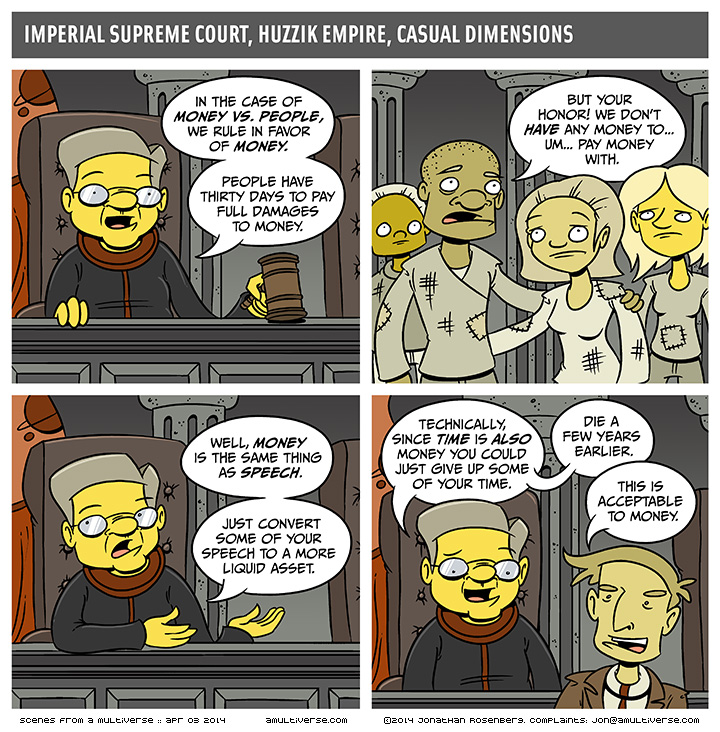
We’re back at the Huzzik Empire’s Supreme Court for another wacky ruling! Next thing you know they’ll be declaring donuts to be sentient and monkeys to be hot dogs.
They may be right about hot dogs.
You know what you should do? You should buy something from our store. Maybe a t-shirt for the warm weather?
![goat-wishes[1]](http://amultiverse.com/wp-content/uploads/2014/02/goat-wishes1-450x340.png)
You'll have the option of choosing from several of our completely unwarranted ripoffs, including internet speeds almost 200 times slower than Korea... at twice the price. TV packages with over 500 channels, 90% of which you can't view and we guarantee a plethora of hidden fees. Then our barely trained technicians will come to install your service somewhere between the hours 8am and 10 pm, knock once while you're in the shower, and promptly leave.... Why you ask? We're part of what is called an "oligopoly." It's like a monopoly... only legal!Watch it again: Soon after that, we posted another video from some guys pretending to be Time Warner Cable customer service employees asking people around NY what they could do to make service even worse. Go ahead, watch that again too: And, now, with the attempted merger underway, we've got a third video to add to the bunch. This one comes from Funny or Die, and directly addresses the issue of the merger, and is titled: Comcast Doesn't Give a F*CK. Like the first video above, it's made to look like a traditional cable company commercial, with the direct message being that, well, you know what the message is. Here, watch it: Key excerpt:
We've read your comments and complaints, and know that a lot of you are very nervous about our merger with Time Warner Cable. So I wanted to talk to you today and let you know, that no matter what happens, we don't give a fuck about you. Whether you're calling in for an appointment about your cable box, or wondering why your favorite channel disappeared, we don't give a fuck. That's what makes us an industry leader in terrible customer service. We don't give a fuck because we don't have to. What? Are you going to go to another cable service provider? [Laughs] Chances are we own whatever movie or network you're watching, so that's still money in our pocket.I'm sure all these kinds of videos keep popping up, because the American public doesn't understand how good the service we get from our "local" (and by "local" I mean, Comcast) cable provider is. Or maybe Homer Simpson was on to something. Nah, must just be all those unreasonable and ignorant folks.
You could watch Netflix or Hulu. In fact, you should. We own Hulu. We also make Netflix pay us extra for streaming content, meaning they'll probably pass those costs on to you. Bottom line: Fuck You.

CIA officers subjected terror suspects it held after the Sept. 11 attacks to methods that were not approved by either the Justice Department or their own headquarters and illegally detained 26 of the 119 in CIA custody, the Senate Intelligence Committee has concluded in its still-secret report, McClatchy has learned.So, again, we have evidence that the CIA tortured people, did so beyond any actual authority (as sketchy as such an authority might be), got nothing of value from the torture, and then repeatedly lied about the torture and the value of it to Congress and the American public. And... no one is going to jail over this. Well, except for the guy who blew the whistle. In fact, many of those responsible for the torture program are still in positions of power. This is a total disgrace.
The spy agency program’s reliance on brutal and harsh techniques _ much more abusive than previously known _ and its failure to gather valuable information from the detainees, harmed the U.S.’s credibility internationally, according to the committee’s findings in its scathing 6,300 page report on the CIA’s interrogation and detention program.

Today, the situation has come full circle. If a student in Freiburg wants to read the hard-copy version of a book from the university library in Basel, he or she can simply order it via an interlibrary loan. But if only an electronic version is available, interlibrary loans are generally not an option. The student has no choice but to climb into a train and head to Switzerland to read the book on a university computer.If that doesn't strike you as absurd, you're likely missing some significant sections of your brain. The very benefit the entire digital experience has brought most other marketplaces and forms of communication and learning in the past thirty years is being blocked by a trumped-up policy born out of fear. Just think about that for a moment: the same book I can get on loan from a far-off library is unavailable to me in ebook format, even though the transfer of that ebook is easier, cheaper, and quicker. That, friends, is the dumbest thing I've ever heard.
It is a paradox: Books that traveled around the world via interlibrary loan in the 20th century paper era are safeguarded locally in the Internet age. Indeed, it is the sheer ease with which electronic publications can be sent around the world that is now resulting in their being locked up behind digital bars. The book doesn't go to the reader, the reader comes to the book -- just like in the 19th century.
The issue is the core of the knowledge economy: essays, articles and books from researchers. "We have thousands of e-books that we could make available to our users via the Internet," says Harald Müller, head librarian at the Max Planck Institute for Comparative Public Law and International Law in Heidelberg. "Be we often aren't allowed to because licenses are so restrictive."In other words, everyone ends up in the exact same place they would if ebook lending was opened up, except it's slower, less efficient, costlier, and requires physical resources that nobody is actually interested in using. This is the epitome of inefficiency, and it's the answer to whether or not the originators of copyright law would support this kind of application: no they damn well wouldn't. Imagine Thomas Jefferson being showed how copyright was being used to limit knowledge and that imagining had better end with Jefferson punching everyone involved.
Copyright laws often lead to "delightful absurdities," says Müller. If, for example, he wants to read an essay from an American library via interlibrary loan, "they will print it out on paper and send it over by fax -- and I will then scan it into our computers here." Sending it as an email attachement is forbidden.
In many cases, it is the readers themselves who, through their taxes, pay the university authors whose studies they are then unable to access. It is also likely that many professors themselves cannot even afford a subscription to the journal in which their work is published. Subscription rates of up to €15,000 ($20,633) per year are hardly a rarity. The Journal of Comparative Neurology, for example, comes with a price tag of more than €20,000 annually. Authors who publish their works in such a journal usually don't see a single cent for their labors. Publishing companies such as Reed Elsevier, by contrast, regularly achieve pre-tax profit margins of over 25 percent.And the suppression of knowledge is the result of all this protectionist nonsense. When we've reached the point where the researchers aren't being paid and the public can't access their papers, things need to change.
"Publishers of scientific journals make so much money because they collect their product for free from taxpayers and then sell it back at inflated prices," says Günter M. Ziegler, a distinguished mathematician at Berlin's Free University.

Today, April 4th is 404 Day. EFF, along with our friends at the National Coalition Against Censorship and the Center for Civic Media at MIT, are using today to call attention to blocked and banned websites in libraries and public schools across the country. Join us this afternoon, at 12pm PDT / 3pm EDT for a digital teach-in with some of the top researchers and librarians working to analyze and push back against the use of Internet filters on library computers. Use #404day on Twitter to send questions and comments our way.


Internet filters are widely used on public and staff computers in public schools and libraries across the country to block content and websites in order to be in compliance with the Children's Internet Protection Act (CIPA). The law was passed in 2000 and requires that all public libraries and schools that receive federal funds through the E-rate program or the Library Services and Technology Act, install filters to block child pornography and obscene or “harmful to minors” images.
The problem is that library systems that are afraid of breaking the law often implement filters in aggressive ways that block constitutionally protected content from being accessed by students, researchers, and library patrons. Beyond the requirements of CIPA, some libraries have implemented discretionary filtering, and websites have been blocked about Wiccan, Native American spirituality, and astrology, as well as the sites that contain information about LGBTQ communities, youth tobacco usage, art galleries, and Second Amendment advocacy.
As common as they are, not all library systems use Internet filters. This is the case in the San Jose Public Libraries, where one of our panelists today, librarian and blogger Sarah Houghton conducted a study of available filtering technology. It turns not that not only did filters allow for obscene images to still be accessed by library patrons, they also cost more to implement than the funding provided by the federal grants.
To help us understand the contours of the law, Deborah Caldwell-Stone of the American Library Association will join us. As she discusses in her paper, Filtering and the First Amendment, a school or a library has never been found to be out of compliance with CIPA nor has the FCC, the agency responsible for enforcement, ever established what constitutes effective filtering under the law.
Our third Panelist is Chris Peterson, a researcher at the Center for Civic Media at MIT who is working on the Mapping Information Access Project, a critically important investigation into how schools and libraries implement filters. They aim to develop a comprehensive record of what library systems filter, how they decide what gets filtered, the kinds of technology used, and how libraries and schools process challenges to blocked content. Research like this will help us to understand where and how filters are being used to block constitutionally protected content.
When you're using a computer in a public library or school and you encounter a banned website or blocked information we highly recommend using Herdict, a project by the folks at Harvard's Berkman Center that allow users to log web blockages, censorship, and filtering as it happens. Users that are concerned about Internet censorship shouldn't simply visit another site when they are denied access to parts of the Internet; they should report it. This data will help researchers and advocates know what's happening and where. Visit the website and type in which site you were prohibited from accessing. Herdict will log that information in its database of blocked and filtered websites around the world.
We've invited bloggers and librarians from across the Internet to write about censorship in libraries for 404 Day. Read what they have to say and join us at 12pm PDT / 3pm EDT for our digital teach-in about banned websites in libraries. We're recording the event, so if can't you tune in live, visit back later to see the video.
When it comes to specific Internet activities, such as email or online banking, this change in behavior translates into a worrying trend for the online economy: over one quarter of respondents (26%) said that, based on what they have learned about secret government surveillance, they are now doing less banking online and less online shopping. This shift in behavior is not good news for companies that rely on sustained or increased use of the Internet for their business model.Importantly, the study also found that, contrary to the claims of many, the Snowden revelations aren't just being followed by security-obsessed techies. While the general public may not be keeping tabs on all the details, they are getting the basics.
And in case anyone is tempted to think that this is a narrow issue of concern only to news junkies and security geeks, let me be clear: according to this latest survey, 85% of adult Americans are now at least somewhat familiar with the news about secret government surveillance of private citizens’ phone calls, emails, online activity, and so on.Once again, it appears that the federal government, and the NSA in particular, have created a huge cost for innovation and economic growth, while having almost no real benefit to show for it.

|
|
Less than two weeks after drawing controversy over his appointment as CEO of the Mozilla Corporation, Brendan Eich has resigned from the position.
In a post at Mozilla's official blog, executive chairwoman Mitchell Baker confirmed the news with an unequivocal apology on the company's behalf. "Mozilla prides itself on being held to a different standard and, this past week, we didn’t live up to it," Baker wrote. "We didn’t act like you’d expect Mozilla to act. We didn’t move fast enough to engage with people once the controversy started. We’re sorry. We must do better."
The action comes days after dating site OKCupid became the most vocal opponent of Eich's hiring. Mozilla offered repeated statements about LGBT inclusivity within the company over the past two weeks, but those never came with a specific response from Eich about his thousands of dollars of donations in support of Proposition 8, a California ballot measure that sought to ban gay marriage in the state.
Read 2 remaining paragraphs | Comments

Google might not be anywhere near finished getting their fiber-optic network setup, but they’re already thinking about more services to offer now that they have the infrastructure to support it. One of those could be a wireless phone service, if details received by The Information are to be believed.
According to them, Google will look to launch as an MVNO — that is, a service provider who leases the equipment and spectrum of another company — for those currently in one of their few Fiber cities, which include Provo, UT, Kansas City, MO, and upcoming plans to bring the service to Austin, TX.
For what it’s worth, Google is also working on plans to bring Fiber to 9 other metropolitan areas, including Atlanta, GA, Nashville, TN, Charlotte, NC and more (though nothing has been guaranteed at this point).
So why would Fiber be important? The Mountain View company will reportedly look to use WiFi-offloading to have users make their calls over WiFi hotspots whenever possible, easing the strain on local communication airwaves. These hotspots will likely feed into the network powered by Fiber, so Google won’t have to rely on third-party installations that might be costly and unreliable.
Google will apparently look to Verizon to provide the goods, with sources citing Google ended early talks with Sprint after the Kansas City company was acquired by Japanese firm SoftBank. Whatever the case may be, it appears we’ll no longer be joking about Google ditching the major carriers of today to start their own network, but it’ll be a while yet before that dream is fully realized.
[via The Verge]

When FireChat launched on iOS a few days back, the messaging service got a lot of buzz. Not because of fun stickers, or some fancy new UI, but because it’s one of the only messaging apps of its kind that allows for chatting without an internet connection.

Using what FireChat calls their “mesh networking technology,” the app is able to connect to other FireChat users nearby (withing a 30 foot radius) via a combination of WiFi Direct and Bluetooth. This makes the messaging service much more social than others, allowing you to chat with stranger on a subway, or during a concert or big event. Because it’s “off the grid,” tinfoil hat types should find a little peace of mind as well.
The app is completely free to download in the Play Store, so give it a shot if you feel so inclined.
Download on Google Play: FireChat


Who: Jesse Jacobs
Where: Samovar Tea Lounge in San Francisco, CA
The Question: What kind of tea should I drink with my favorite foods?
Jesse Jacobs is a passionate, wholehearted tea-lover and the owner of Samovar Tea Lounge, a small chain of four tea cafes located in San Francisco. Samovar is noted for its top of the line tea offerings as well as its innovative pairings of tea and food.
As a tea lover, I wanted to know more about serving food and tea, so I sat down with Jesse at his lovely Zen Valley location to discuss the principles of pairing food with tea.

Christopher E Smith is the white father of a black, biracial son, and it is through his son's experience of being black in America that he has learned just how pervasive and humiliating and violent officialdom is to black Americans, a fact embodied perfectly through New York City's notorious, racist stop-and-frisk program. Smith describes how his son, interning on Wall Street, has been repeatedly stopped by police, once made to lie face down on the filthy sidewalk in his best suit while police went through his pockets (former NYC mayor Michael Bloomberg was a staunch supporter of this program). He describes the experience of his black in-laws, who are stopped by police-cars en route to family gatherings, who have guns aimed at their heads, and who are then released with a shrug and a nonsensical excuse. He describes how driving over the US/Canadian border with his son is totally different from driving on his own, and how the customs guards routinely stop the two of them, and make them wait out of sight of their car while it is searched.
As an aside, I've experienced this myself. I've driven across the US/Canadian border literally dozens of times and the only time I was stopped was when I gave Nalo Hopkinson and David Findlay -- who happen to be black -- a ride to a Clarion reunion at Michigan State University. At both border crossings, the car was searched from top to bottom, with officers taking out books and shaking the pages to look for contraband. It's never happened since. The only difference between that drive and all the others was that there were some brown-skinned people in evidence.
Smith proposes a thought experiment in which stop-and-frisk searches were mandatorily applied in keeping with overall demographics, so for every three black people that the NYPD pull over and humiliate without warrant or suspicion or probable cause, they would have to do the same to ten white people -- and suggests that this would end the program of stop-and-frisk in a heartbeat.
I think he's right.
Proponents of stop-and-frisk often suggest that the hardships suffered by young men of color might be tolerable if officers were trained to be polite rather than aggressive and authoritarian. We need to remember, however, that we are talking about imposing an additional burden on a demographic that already experiences a set of alienating “taxes” not shared by the rest of society.
I can tell myriad stories about the ways my son is treated with suspicion and negative presumptions in nearly every arena of his life. I can describe the terrorized look on his face when, as a 7-year-old trying to learn how to ride a bicycle on the sidewalk in front of our suburban house, he was followed at 2-miles-per-hour from a few feet away by a police patrol car—a car that sped away when I came out of the front door to see what was going on. I can tell stories of teachers, coaches, and employers who have forced my son to overcome a presumption that he will cause behavior problems or that he lacks intellectual capability. I can tell you about U.S. Customs officials inexplicably ordering both of us to exit our vehicle and enter a building at the Canadian border crossing so that a team of officers could search our car without our watching—an event that never occurs when I am driving back from Canada by myself.
If I hadn’t witnessed all this so closely, I never would have fully recognized the extent of the indignities African-American boys and men face. Moreover, as indicated by research recently published in the American Journal of Preventive Medicine, the cumulative physical toll this treatment takes on African-American men can accelerate the aging process and cause early death. Thus, no “special tax” on this population can be understood without recognizing that it does not exist as a small, isolated element in people’s lives.
What I Learned About Stop-and-Frisk From Watching My Black Son [Christopher E. Smith/The Atlantic]
(Image: stopfrisk_june17_DSC_1073, Michael Fleshman, CC-BY)
|
|

Google could finally be bringing us an app for their Chrome Remote Desktop plugin, a solution that allows folks to control their desktop PCs from afar. A user has reportedly been invited to test the new features out as part of a tightly-knit invite-only beta. The app performs just as you imagine it would.
There isn’t much to its UI as screen real estate is used to display your desktop PC. After a quick setup process — which involves installing the Remote Desktop extension on whichever PC you want access to and logging into it) — you’ll be given access to your desktop as if you were sitting in your nice, comfy chair in front of your monitor (except, you know, at a much smaller size than you’re used to).
It’s not pretty, but it doesn’t have to be. It’s also still in beta, so the chances of something changing between now and the time Google is ready to release it to more people are fairly high.
Apparently you will only have a chance at getting an invite if you expressed interest in improving Chrome Remote Desktop in the pass, though even that doesn’t guarantee you’ll get to check it out ahead of launch. We’ll let you know once everyone can get their grubby little paws on it, though.
[via Droid-Life]
"Funny business meeting illustrating how hard it is for an engineer to fit into the corporate..(Read...)
This is what happens when you ignore the public. Are you happy, We the People?
WE PETITION THE OBAMA ADMINISTRATION TO:It's a nice idea. There are petitions that appear to be permanently stuck to the administration's backburner while others that haven't even met the 100k signature threshold have been answered simply because the White House has a canned response on hand.
Respond to all Whitehouse.gov petitions that get over 100k signatures within one month.
Whitehouse.gov petitions were intended to give the public a voice. The idea is that if more than 100,000 people all feel strongly enough about something to hand over their home address and personal email to the government and complete a nearly impossible CAPTCHA, then the President of the United States should have to respond to them. Because... democracy.
Here's the problem: there are dozens of Whitehouse.gov petitions that have received more than 100k signatures, but have gone months and even years without a response (1). That's not improving transparency, it's the same gov't spin we've always had. So what will it, Obama, hypocrisy or democracy? Sign!

|
|
We remain strongly opposed to the use of torture, believing that it is fundamentally contrary to American values. While we have some concerns about the process for developing the report, its findings lead us to conclude that some detainees were subjected to techniques that constituted torture. This inhumane and brutal treatment never should have occurred. Further, the report raises serious concerns about the CIA’s management of this program.The CIA's torture program is a shameful moment in American history, and as a country, we cannot deal with it by pretending that it was anything other than what it was. We need to make it clear that it was torture and that it was wrong. Those responsible for the program should be held accountable. But they won't. Instead, the only person in jail... is the guy who blew the whistle on it. If we can't even admit that the torture program was a torture program, then we're bound to go down this road again.
[....]
Torture is wrong, and we must make sure that the misconduct and the grave errors made in the CIA’s detention and interrogation program never happen again.

|
|
The US Supreme Court has struck down overall contribution limits for individual political donors.
The court ruled 5-4 that individuals could give to candidates, parties and political groups without observing an overall cap of $123,200 (£74,000).
The ruling leaves in place limits on how much donors can give to a single candidate - currently $2,600 (£1,560).
The decision is the latest in a series which have loosened restrictions on US campaign finance.
Contribution limits were established by Congress in the 1970s in an attempt to restore the public’s faith in government after President Richard Nixon’s resignation in the Watergate scandal.
‘How you choose’
Chief Justice John Roberts wrote in Wednesday’s majority opinion that overall limits “intrude without justification” on first amendment rights, the clause of the US constitution that enshrines freedom of speech.
Continue reading the main story
“
Start Quote
Today’s decision eviscerates our nation’s campaign finance laws ”
Stephen Breyer
Supreme Court judge
Critics say the ruling will expand even further the influence of big money in politics.
Four years ago, the Supreme Court lifted limits on political spending by political action committees, in a landmark case known as Citizens United.
Last year the court removed restrictions on states with a history of race-biased voting laws.
That prompted activists to say the court was making it harder to vote in but easier to buy elections.
Wednesday’s decision split the court along its liberal and conservative wings, with Justice Stephen Breyer taking the unusual step of reading his dissent from the bench.
Continue reading the main story
'A great day’, but for who?
“A country that expands the rights of the powerful to dominate the political process but does not protect fundamental rights for all citizens doesn’t sound much like a functioning democracy to me” - Ari Berman in the Nation
“The Court has reversed nearly 40 years of its own precedents, laid out a welcome mat for corruption, and turned its back on the lessons learned from the Watergate scandal” - Miles Rapoport of Common Cause
“This latest outburst of judicial activism in the struggle to render campaign finance laws completely toothless is merely accelerating a historical process that is coming to seem almost inevitable” - Paul Campos in Salon
“This is a great day for the First Amendment, and a great day for political speech” - Chris Chocola, of Club for Growth
He wrote: “Taken together with [Citizens United], today’s decision eviscerates our nation’s campaign finance laws, leaving a remnant incapable of dealing with the grave problems of democratic legitimacy that those laws were intended to resolve.”
The case was brought by Shaun McCutcheon, a Republican and owner of the Coalmont Electrical Development Corporation in Alabama.
Before the US elections two years ago, Mr McCutcheon made individual donations to 15 congressional candidates.
But he was unable to donate to another dozen candidates because that would have broken the overall limit.
“It’s a very important case about your right to spend your money how you choose,” Mr McCutcheon has said.
He told the Associated Press news agency that he planned to spend several hundred thousand dollars ahead of November’s midterm elections.
The US government’s lawyer, Solicitor General Donald Verrilli, argued during the case that without the overall limit, one donor giving the maximum allowed to every congressional candidate, political party and political action committee would top $3m in a single election cycle.
According to the Center for Responsive Politics, 646 donors in the 2012 election cycle hit the overall donation limit.
They gave $93m to candidates and committees.
 It turns out that those rumors of Microsoft cutting Windows prices to spur adoption were true -- and then some. The company has announced that Windows will be free for hardware makers to use on phones, tablets with screens under nine inches and...

San Francisco's MUNI system operates electric buses that draw power from overhead wires. A fellow named Jon has brilliantly hacked his Prius with a trolley pole to sip power from the same overhead lines. Sierra Hartman has the story over at The Bold Italic. (Thanks, Marina Gorbis!)
|
|
There is the belief, he said, "that we have created in the National Security Agency this monster bureaucracy that's reading everybody's mail, listening to everybody's phone calls, infringing upon our civil liberties and civil rights. Hogwash." He claimed that there has not been a single case of NSA abusing its authority.Well, except an internal NSA audit that was reported on months ago actually found that the NSA abused its authority thousands of times per year. And, really, a big part of the complaints aren't necessarily that the NSA abused its authority, but that even if they didn't "abuse their authority" that the ability to collect all this information was legal in the first place. Meanwhile, we also know that there are also a bunch of cases where the NSA has admitted analysts willfully abused their powers. And, while the NSA claims that it's caught all of those involved, a large percentage of them involved "self-reporting," which suggests many cases of abuse slipped under the radar. And, of course, there were many other known abuses as well, including many years in which the NSA flat-out ignored the FISA court's rules on handling metadata, allowing it to be shared widely, despite rules and promises not to do so.

|
|
Pervasive and extensive copyright law is damage. Route around it. This team of newcasters did (even though it really didn't need to), resulting in something much more entertaining than the content being withheld.
WCJB TV20 in Gainesville, Fla., couldn't legally show highlights of the University of Florida Gators' win over the University of Dayton on March 29. Instead of waiting for footage rights to recap the game, sports anchor Zach Aldridge recruited his coworkers to recreate the game's biggest moments in an office conference room.Here are the highlights, as recreated using only classically-trained newscasters, a small hoop and a ball. Even the game-ending tears of a Florida Gators player are reenacted for posterity.

|
|
Because pulling an April Fools prank on April 1st would be way too conspicuous, Google is kicking things off a little early this year. In an update to the Google Maps app, Android and iOS users can now search their area for Pokemon, as part of Google’s Maps’ Pokemon Challenge. Let us be clear — this is not a joke.
Okay, so maybe the part in the the video that mentions you can catch Pokemon by snapping them with your phone’s camera. While that would be insanely cool, it’s only that part that’s the joke.

By opening Google Maps, tapping on the search bar and pressing “Start,” you’ll notice the presence of new little critters in your area, more specifically: POKEMON. Tapping on them the little guys will let you catch them, with a total of 150 to catch in all.
To view your Pokedex, tap on the search bar where you’ll see 2 new options at the top: “Return to the Pokemon Lab” and “View Pokedex.” If you’re having trouble finding Pokemon in your area, click on the Pokemon Lab option and you’ll notice the once former Googleplex is teaming with pocket monsters.
It’s a fun little touch, one that takes us right back to the 7th grade. Anyone catch ‘em all yet?
Everyone makes mistakes. There's hardly anyone out there who can claim a misspelling-free existence. And government employees -- even highly-trained analysts and agents charged with protecting national security -- are no different. Mistakes will be made. Let he who is without sin be the pedantic ass casting stones in the comments below, etc.
The problem is that when mistakes are made on highly-sensitive forms, the damage is almost irreparable. As we've covered extensively, an agent's failure to fill out paperwork properly put a non-terrorist on the government's "no fly" list for over a decade. To add insult to cock-up, the government spent most of that time trying to bury the challenge with layers and layers of "national security" obfuscation. Confirming or denying anything about terrorist watchlists would somehow lead to terrorists gaming the system.
Speaking of terrorist attacks, the Tsarnaev brothers somehow managed to elude those specifically tasked with preventing events like the Boston Marathon bombing. The same lack of inter-agency communication that allowed some 9/11 terrorists to return to the US unnoticed was at play in the recent attack. Unbelievably, these agencies have used both attacks as justification for leaving their surveillance powers intact, arguing that curtailing these programs will somehow prevent them from stopping the next 9/11 or Boston bombing -- despite having been unable to prevent either of those.
But these "terrorist watchlists" the government likes to keep are sacrosanct, even if they're populated by people who shouldn't be on there and missing people who should be, thanks to human error.
On January 21, 2012 Tsarnaev traveled to JFK airport in New York to board an Aeroflot flight to Moscow.It's the sort of error anyone can make. But it had serious repercussions. In Tsarnaev's case, this error helped contribute to an attack on American citizens.
Though an alert was triggered, Tsarnaev was not pulled out for a secondary search or interview. According to sources familiar with the report, there were almost 100 other names on the “Hot List” of individuals traveling through Customs at JFK that day, and Tsarnaev was not considered high priority.
Tsarnaev flew to Moscow, and then to Dagestan, where he stayed for six months and received jihad training, according to U.S. authorities.
On July 17, 2012, Tsarnaev flew back to the United States, landing at JFK. TECS notes remain in effect for one year. The initial TECS note had expired. The second, more urgent TECS note filed in October 2011 that said he might be armed and dangerous had not.
But no alert was triggered when Tsarnaev passed through Customs at JFK, because of the misspelling of his name on the second TECS note. The difference of one letter – Tsarnayev instead of Tsarnaev – meant that he was not detained or questioned despite the warning in his file, according to sources familiar with the report.
We found that the FBI failed to nominate many subjects in the terrorism investigations that we sampled, did not nominate many others in a timely fashion, and did not update or remove watchlist records as required.... We believe that the FBI's failure to consistently nominate subjects of international and domestic terrorism investigations to the terrorist watchlist could pose a risk to national security.The FBI failed in both directions, failing to add suspected terrorists to the list fast enough and being pretty much unresponsive when it came to removing those not deemed a threat. Add this to the fact that clerical errors will always be present in a certain percentage of records and you have a list whose veracity is highly questionable. But the government doesn't see it that way, and that's the problem.

|
|

Pope Francis is the chillest pope that the Vatican has ever seen: uttering "fuck" at weekly blessings , admiring chocolate statues of himself , picking up hitchhikers in his tricked-out Popemobile . But now the man in charge of thousands of precious documents wants the underlings of the internet to have access.

|
|
Starting at the age of nine, I played the clarinet for eight years.
Actually, that's not true. I took clarinet lessons for eight years when I was a kid, but I'm not sure I ever actually played it.
Eventually, I heard a symphony orchestra member play a clarinet solo. It began with a sustained middle C, and I am 100% certain that never once did I play a note that sounded even close to the way his sounded.
And yet...
And yet the lessons I was given were all about fingerings and songs and techniques. They were about playing higher or lower or longer notes, or playing more complex rhythms. At no point did someone sit me down and say, "wait, none of this matters if you can't play a single note that actually sounds good."
Instead, the restaurant makes the menu longer instead of figuring out how to make even one dish worth traveling across town for. We add many slides to our presentation before figuring out how to utter a single sentence that will give the people in the room chills or make them think. We confuse variety and range with quality.
Practice is not the answer here. Practice, the 10,000 hours thing, practice alone doesn't produce work that matters. No, that only comes from caring. From caring enough to leap, to bleed for the art, to go out on the ledge, where it's dangerous. When we care enough, we raise the bar, not just for ourselves, but for our customer, our audience and our partners.
It's obvious, then, why I don't play the clarinet any more. I don't care enough, can't work hard enough, don't have the guts to put that work into the world. This is the best reason to stop playing, and it opens the door to go find an art you care enough to make matter instead. Find and make your own music.
The cop-out would be to play the clarinet just a little, to add one more thing to my list of mediocre.
As Jony Ive said, "We did it because we cared, because when you realize how well you can make something, falling short, whether seen or not, feels like failure."
It's much easier to add some features, increase your network, get some itemized tasks done. Who wants to feel failure?
We opt for more instead of better.
Better is better than more.


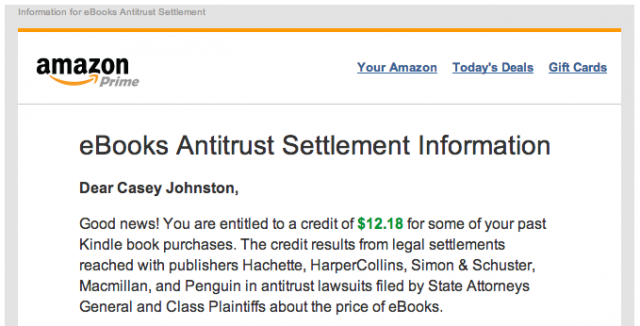
As of Tuesday morning, Amazon has begun issuing account credits to Kindle book buyers as a result of legal settlements with book publishers including Harper Collins and Simon & Schuster, which allegedly conspired with Apple to fix e-book prices in 2012.
Amazon is not disclosing the formula for calculating the credits, but it says that the settlements address "qualifying Kindle books purchased between April 1, 2010 and May 21, 2012." This reporter was given a tidy sum of $12.18 in her inbox, while Senior Business Editor Cyrus Farivar received $22.42 and Deputy Editor Nate Anderson picked up 73 cents.
According to the office of New York Attorney General Eric Schneiderman, the settlements with the five publishers accused of price fixing—Hachette, HarperCollins, Simon & Schuster, Macmillan, and Penguin—total $166 million nationwide. Customers who bought e-books from Barnes and Noble, Kobo, and Apple will also be receiving account credits, whereas those who bought e-books from Sony will receive checks in the mail.
Read 2 remaining paragraphs | Comments
The bill, titled the End Bulk Collection Act of 2014 and currently circulating on Capitol Hill, would prevent the government from acquiring "records of any electronic communication without the use of specific identifiers or selection terms," some 10 months after the Guardian first exposed the bulk collection based on leaks by the whistleblower Edward Snowden.While a separate report says that this House bill would actually ban the mass collection of other types of data (including internet activity) as well as phone records (i.e., going further than the Obama proposal), it would leave out the requirement that a court approve specific requests for information before it's submitted to a company.
But the bill would allow the government to collect electronic communications records based on "reasonable articulable suspicion", rather than probable cause or relevance to a terrorism investigation, from someone deemed to be an agent of a foreign power, associated with an agent of a foreign power, or "in contact with, or known to, a suspected agent of a foreign power."
But unlike other pending legislation, it does not call for judicial approval of a specific phone number before a request for data is submitted to a company.The details of these proposals are going to matter a lot. The full House bill is expected to be introduced in a few hours, and it will take some time to go through the details to see if there are any dangerous easter eggs hidden in there. Still, for all the arguments from Rep. Rogers and the Obama administration about how "necessary" these programs have been and how horrible it's been that Ed Snowden revealed the details to the press, these moves show just how much of an impact the Snowden leaks have had on the public debate concerning surveillance. It will take some time to sort through the details of these proposals, but it's safe to say without Snowden's actions, none of this would be happening.
The Rogers-Ruppersberger legislation would have the court make that determination “promptly” after the FBI submits a number to a phone company. If the court did not approve the number as being linked to an agent of a foreign power, including terrorist groups, the data collected would be expunged.

|
|
Judge Facciola seems to be assuming that warrants only should be obtained when the Fourth Amendment would be violated without them, and that he, as a magistrate judge, has the power to say ex ante when that will be. But I think that’s pretty clearly wrong. Magistrate judges do not have the discretion to deny applications if they don’t think one would be necessary. The language in Fed. R. Crim. Pro. 41(d)(1) is mandatory: “After receiving an affidavit or other information, a magistrate judge. . . must issue the warrant if there is probable cause to search for and seize a person or property” (emphasis added).As Kerr points out, the law is structured to encourage police to get warrants (for the obvious reason of making sure such searches are constitutional). If a magistrate judge is taking it upon himself to decide that no warrant is needed, then it seems to be going against the Supreme Court's belief that police should be encouraged to get a warrant.
Further, Judge Facciola’s decision puts the government in a bind. Under his ruling, the police cannot get a warrant. But if they search the phone without a warrant, they run a serious risk that a future court will rule that Magistrate Judge Facciola’s prediction was wrong and that they should have obtained one. If so, it’s damned if you do and damned if you don’t.... The way out is for magistrates to issue warrants based on whether the government has satisfied the facial requirements of probable cause and particularity, as Rule 41 requires, not to hinge the issuance of the warrant on whether the magistrate expects such a warrant to be a legal necessity.

|
|
If you're looking for proof that new cultural works speak to and are embedded within a vast array of pre-existing works and ideas, you can't do much better than "The Office Time Machine," a new art project by video remix artist Joe Sabia. Over the course of the last 18 months, Sabia has isolated every pop culture and real world reference from the US television show "The Office," and arranged them by the date of the events, people, and media they reference. It's much more fun to look at than to read about, so feel free to check it out before reading on.
 It's an impressive piece of technical work, and it will certainly be interesting for fans of the Office to see the incredible range of allusions embedded in the show—Sabia clipped out and identified over 1,300 from 9 seasons of the program. But it also makes an important point about copyright and culture, and is itself a perfect demonstration of how certain assumptions baked into our current law are out of line with reality.
This isn't Sabia's first time pushing the boundaries of those assumptions. He's got an impressive portfolio of video work, much of which relies heavily on the fair use doctrine, like this supercut of every cigarette smoked in the series Mad Men. But "The Office Time Machine" makes the point even more explicitly: the show is better for its ability to refer to and incorporate a common culture. As Sabia puts it on the project page:
Culture enriches everything. The Office is relatable (and hilarious) because it borrows so much from culture, and people get the references. Culture is society’s collected knowledge, art, and customs. It’s what surrounds us and unites us, and it allows us to collectively laugh at a joke in The Office about Ben Franklin or M. Night Shyamalan. Culture, simply put, is the seasoning in a meal.
That's a great point, and it's a valuable message for art to deliver.
But here’s another message: to make this work, Sabia had to run a legal gauntlet—one that would discourage many artists. For one, to get the source videos in high quality, Sabia rented and ripped every episode of "The Office" on DVD. DVDs come with digital restrictions management software installed. Even if the intended use is a fair one, as in this case, the Digital Millennium Copyright Act (DMCA) prohibits circumventing that DRM.
There’s a bit of a safety valve, fortunately: the Librarian of Congress is authorized to grant exemptions for appropriate purposes. EFF has been fighting to expand that safety valve for years, and one of the exemptions EFF successfully fought for in the last round was for ripping DVDs and online streams for non-commercial remixes, giving artists like Sabia some breathing room to engage in his work. We quoted Sabia in our testimony for the exemption, and cited his work with ACLU documenting the media narratives surrounding the War on Drugs.
The exemption puts Sabia in the clear, but highlights an issue with the rulemaking process: if the exemptions must be reviewed from scratch every three years, it can be dangerous to take on a long project like "The Office Time Machine," which took 18 months to create.
Then, once the artist has gotten the materials together, they can face lots of fear, uncertainty, and doubt about whether their use can be considered fair. There are plenty of examples where fair use is abundantly clear, and courts can find fair use even when the new work is commercial, or copies the entire original, or enables people to make their own copies.
Taking portions of a work and rearranging them for a totally transformative purpose is a classic fair use, but courts have sometimes imposed additional limits. In one such example, a court in the Harry Potter Lexicon case sided mostly with author J. K. Rowling against a publisher selling a fan encyclopedia incorporating text from the book.
Finally, while "The Office Time Machine" will hopefully stay up and available for a long time to come, there's the risk that an algorithmic copyright cop like YouTube's ContentID will remove or flag the videos that make it up. Even if the law is on Sabia's side, an automated match could force him to go through the site's appeal process just to keep the video up. Video artist Jonathan McIntosh faced that situation last year when a fair use remix of Buffy the Vampire Slayer and the Twilight movie series was flagged by Lionsgate Pictures.
EFF is working on making it easier and safer for people like Sabia to make and share works like "The Office Time Machine." As lawmakers and the public continue to review copyright law, we should aspire to a policy that would foster works like this—not inhibit them.


