Matthew
Shared posts
15 Jan 14:28
Man Saves Wife's Sight By 3D Printing Her Tumor http://rss.slashdot.org/~r/Slashdot/slashdot/~3/b3r9Rz51vRE...
Man Saves Wife's Sight By 3D Printing Her Tumor http://rss.slashdot.org/~r/Slashdot/slashdot/~3/b3r9Rz51vRE/story01.htm
Man Saves Wife's Sight By 3D Printing Her Tumor - Slashdot
An anonymous reader writes: Michael Balzer, a former software engineer and Air Force technical instructor, found himself unsatisfied with a doctor's diagnosis of a small tumor behind his wife's left eye. Balzer had recently become proficient at creating 3D models, so he asked the doctor for the raw ...
Man Saves Wife's Sight By 3D Printing Her Tumor - Slashdot
An anonymous reader writes: Michael Balzer, a former software engineer and Air Force technical instructor, found himself unsatisfied with a doctor's diagnosis of a small tumor behind his wife's left eye. Balzer had recently become proficient at creating 3D models, so he asked the doctor for the raw ...
14 Jan 14:45
President Obama's Plan For 'Securing Cyberspace' Has A Lot Of Problems
by Mike Masnick
On Monday, President Obama gave a speech kicking off his big push on cybersecurity, with many of the details being released on Tuesday, and they don't look very good. There are a lot of different pieces, but we'll just highlight the two that concern us the most.
First up: information sharing/"cybersecurity." The key issue here: is it the return of CISPA? CISPA, of course, is the cybersecurity "information sharing" bill that is introduced each year, but which is really about giving the NSA a tool to pressure companies into sharing their information (by granting immunity from liability to those companies). In 2012, President Obama rejected the CISPA approach as not having enough protections for privacy and civil liberties. And, indeed, contrary to what some have said, the official proposal is not "endorsing CISPA." The approach is definitely more limited and the most major concern is addressed. Rather than giving the information to the NSA (or the FBI), Homeland Security gets it. DHS isn't wonderful, but it's better than the other two alternatives. Companies can still give the info to the NSA or FBI (or others), but won't get full immunity from lawsuits if they do.
But, where the new proposal falls woefully short is in its lack of privacy protections. It basically handwaves its way through the privacy question, saying there will be guidelines, but the guidelines aren't written yet, and they're fairly important here. Instead, there's just a plan to make them:
The second concerning proposal is with the update to the CFAA (the Computer Fraud and Abuse Act). The CFAA, of course, is the widely misused "anti-hacking" law that has been stretched and twisted by law enforcement and prosecutors over time to argue that merely disobeying a terms of service could be seen as "hacking." While some courts have limited that ridiculous interpretation, the changes here seem fairly messy and could bring back that possibility. The language involves a lot of careful picking through to interpret it, and it appears that it may fix some small issues with the CFAA, but opens up other massive holes that are seriously problematic. The White House claims this fix would "enhance [the CFAA's] effectiveness against attacks on computers and computer networks."
But that's not the problem with the CFAA. The problem is that it's already seriously overbroad and used in dangerous ways. That's barely addressed. The main "fix" is that if you "intentionally exceed authorized access," there are conditions necessary to meet to trip the CFAA wire -- and a key one is that the value of the information obtained must "exceed $5,000." But, of course, with the way the gov't inflates the value of information... that seems like a pretty small hurdle. The really big problem, though, comes in section (e)(6) which adds in a troubling definitional change to "exceeds authorized access." This is the whole bit that's been used as evidence of "terms of service" violations. The key case that rejected this theory is the Nosal case and that seems to be completely wiped out with this little addition to exceeding authorized access:
Of course, one hopes that law enforcement wouldn't go after those types of violations, but a more serious concern may be the impact on security research. Finding a hole in a website online, allowing you to access data that was publicly exposed could be seen as exceeding access, on the basis that whoever finds it "knows [it] is not authorized by the computer owner." Basically, it requires the government to argue that whoever they're going after should have known that the computer owner "wouldn't like" it. That... opens up a big can of worms that the DOJ will abuse like crazy.
The new bill also says that you can be charged with racketeering related to CFAA violations, so long as the government can tie you to other people and claim that it's an "organized crime group." It also ups the penalties for things that might be considered "actual hacking" (i.e., getting around technological barriers to access a computer) -- making it automatically a felony with up to 10 years in jail (rather than the existing law, under which it could be a misdemeanor or a felony and the limit is 5 years in jail). And, of course, it expands civil forfeiture procedures so that law enforcement can seize (and likely keep) all your computer equipment if it thinks you're violating the CFAA. Looks like law enforcement can now go "shopping" for computers.
Once again, we seem to be facing a situation where the administration is more focused on what law enforcement wants, while paying lip service to the protections of the public from likely law enforcement and intelligence community abuse.
That's really unfortunate. A massive missed opportunity to actually do something productive here.
Permalink | Comments | Email This Story


First up: information sharing/"cybersecurity." The key issue here: is it the return of CISPA? CISPA, of course, is the cybersecurity "information sharing" bill that is introduced each year, but which is really about giving the NSA a tool to pressure companies into sharing their information (by granting immunity from liability to those companies). In 2012, President Obama rejected the CISPA approach as not having enough protections for privacy and civil liberties. And, indeed, contrary to what some have said, the official proposal is not "endorsing CISPA." The approach is definitely more limited and the most major concern is addressed. Rather than giving the information to the NSA (or the FBI), Homeland Security gets it. DHS isn't wonderful, but it's better than the other two alternatives. Companies can still give the info to the NSA or FBI (or others), but won't get full immunity from lawsuits if they do.
But, where the new proposal falls woefully short is in its lack of privacy protections. It basically handwaves its way through the privacy question, saying there will be guidelines, but the guidelines aren't written yet, and they're fairly important here. Instead, there's just a plan to make them:
The Attorney General, in coordination with the Secretary of Homeland Security and in consultation with the Chief Privacy and Civil Liberties Officers at the Department of Homeland Security and Department of Justice, the Secretary of Commerce, the Director of National Intelligence, the Secretary of Defense, the Director of the Office of Management and Budget, the heads of sector-specific agencies and other appropriate agencies, and the Privacy and Civil Liberties Oversight Board, shall develop and periodically review policies and procedures governing the receipt, retention, use, and disclosure of cyber threat indicators by a Federal entity obtained in connection with activities authorized in this Act.Yes, it promises that those guidelines will limit the "acquisition, interception, retention, use and disclosure" of information, but it's still not entirely clear what the final guidelines will be. The second problem, still not addressed in all of this, is explaining why this is needed. People keep saying that we need "information sharing" because of "cyberthreats," but no one argues why that information sharing can't happen today, or points out what regulations today get in the way. That's because they don't. Companies can share information today, but the focus of this bill is to try to grant them broad immunity in case they share the wrong (private) info and it gets out.
The second concerning proposal is with the update to the CFAA (the Computer Fraud and Abuse Act). The CFAA, of course, is the widely misused "anti-hacking" law that has been stretched and twisted by law enforcement and prosecutors over time to argue that merely disobeying a terms of service could be seen as "hacking." While some courts have limited that ridiculous interpretation, the changes here seem fairly messy and could bring back that possibility. The language involves a lot of careful picking through to interpret it, and it appears that it may fix some small issues with the CFAA, but opens up other massive holes that are seriously problematic. The White House claims this fix would "enhance [the CFAA's] effectiveness against attacks on computers and computer networks."
But that's not the problem with the CFAA. The problem is that it's already seriously overbroad and used in dangerous ways. That's barely addressed. The main "fix" is that if you "intentionally exceed authorized access," there are conditions necessary to meet to trip the CFAA wire -- and a key one is that the value of the information obtained must "exceed $5,000." But, of course, with the way the gov't inflates the value of information... that seems like a pretty small hurdle. The really big problem, though, comes in section (e)(6) which adds in a troubling definitional change to "exceeds authorized access." This is the whole bit that's been used as evidence of "terms of service" violations. The key case that rejected this theory is the Nosal case and that seems to be completely wiped out with this little addition to exceeding authorized access:
for a purpose that the accesser knows is not authorized by the computer owner;This is likely to be interpreted to mean that if a terms of service bans a certain type of use, they have "knowledge" and thus violating that kind of use is back to being a problem under the CFAA. As Orrin Kerr argues, this could be read to mean that if your employer says you can only use a computer for work reasons, and you surf for personal reasons, you've broken the law. It is also possible to read this section to mean that using someone else's Netflix or HBO GO password... could violate the law. Yikes!
Of course, one hopes that law enforcement wouldn't go after those types of violations, but a more serious concern may be the impact on security research. Finding a hole in a website online, allowing you to access data that was publicly exposed could be seen as exceeding access, on the basis that whoever finds it "knows [it] is not authorized by the computer owner." Basically, it requires the government to argue that whoever they're going after should have known that the computer owner "wouldn't like" it. That... opens up a big can of worms that the DOJ will abuse like crazy.
The new bill also says that you can be charged with racketeering related to CFAA violations, so long as the government can tie you to other people and claim that it's an "organized crime group." It also ups the penalties for things that might be considered "actual hacking" (i.e., getting around technological barriers to access a computer) -- making it automatically a felony with up to 10 years in jail (rather than the existing law, under which it could be a misdemeanor or a felony and the limit is 5 years in jail). And, of course, it expands civil forfeiture procedures so that law enforcement can seize (and likely keep) all your computer equipment if it thinks you're violating the CFAA. Looks like law enforcement can now go "shopping" for computers.
Once again, we seem to be facing a situation where the administration is more focused on what law enforcement wants, while paying lip service to the protections of the public from likely law enforcement and intelligence community abuse.
That's really unfortunate. A massive missed opportunity to actually do something productive here.
Permalink | Comments | Email This Story
14 Jan 14:43
What Christie Said: Fact Checking the Governor’s State of the State
The governor’s claims about his successes sound very impressive, but are they accurate?
14 Jan 14:39
39%
Gov. Chris Christie’s popularity in New Jersey continues to slide among the people who know him best as it is all but clear that he plans to launch a presidential campaign in the near future.
14 Jan 14:37
Hallo, hola, olá to the new, more powerful Google Translate app
by Emily Wood
Often the hardest part of traveling is navigating the local language. If you've ever asked for "pain" in Paris and gotten funny looks, confused "embarazada" with "embarrassed" in Mexico, or stumbled over pronunciation pretty much anywhere, you know the feeling. Now Google Translate can be your guide in new ways. We’ve updated the Translate app on Android and iOS to transform your mobile device into an even more powerful translation tool.
Instant translation with Word Lens
The Translate app already lets you use camera mode to snap a photo of text and get a translation for it in 36 languages. Now, we’re taking it to the next level and letting you instantly translate text using your camera—so it’s way easier to navigate street signs in the Italian countryside or decide what to order off a Barcelona menu. While using the Translate app, just point your camera at a sign or text and you’ll see the translated text overlaid on your screen—even if you don't have an Internet or data connection.
This instant translation currently works for translation from English to and from French, German, Italian, Portuguese, Russian and Spanish, and we’re working to expand to more languages.
 Have an easier conversation using the Translate app
When talking with someone in an unfamiliar language, conversations can... get... realllllllly... sloowwww. While we’ve had real-time conversation mode on Android since 2013, our new update makes the conversation flow faster and more naturally.
Starting today, simply tap the mic to start speaking in a selected language, then tap the mic again, and the Google Translate app will automatically recognize which of the two languages are being spoken, letting you have a more fluid conversation. For the rest of the conversation, you won’t need to tap the mic again—it'll be ready as you need it. Asking for directions to the Rive Gauche, ordering bacalhau in Lisbon, or chatting with your grandmother in her native Spanish just got a lot faster.
These updates will be coming to both Android and iOS, rolling out over the next few days. This is the first time some of these advanced features, like camera translations and conversation mode, will be available for iOS users.
More than 500 million people use Google Translate every month, making more than 1 billion translations a day to more easily communicate and access information across languages. Today’s updates take us one step closer to turning your phone into a universal translator and to a world where language is no longer a barrier to discovering information or connecting with each other.
Posted by Barak Turovsky, Product Lead, Google Translate
Instant translation with Word Lens
The Translate app already lets you use camera mode to snap a photo of text and get a translation for it in 36 languages. Now, we’re taking it to the next level and letting you instantly translate text using your camera—so it’s way easier to navigate street signs in the Italian countryside or decide what to order off a Barcelona menu. While using the Translate app, just point your camera at a sign or text and you’ll see the translated text overlaid on your screen—even if you don't have an Internet or data connection.
This instant translation currently works for translation from English to and from French, German, Italian, Portuguese, Russian and Spanish, and we’re working to expand to more languages.
When talking with someone in an unfamiliar language, conversations can... get... realllllllly... sloowwww. While we’ve had real-time conversation mode on Android since 2013, our new update makes the conversation flow faster and more naturally.
Starting today, simply tap the mic to start speaking in a selected language, then tap the mic again, and the Google Translate app will automatically recognize which of the two languages are being spoken, letting you have a more fluid conversation. For the rest of the conversation, you won’t need to tap the mic again—it'll be ready as you need it. Asking for directions to the Rive Gauche, ordering bacalhau in Lisbon, or chatting with your grandmother in her native Spanish just got a lot faster.
More than 500 million people use Google Translate every month, making more than 1 billion translations a day to more easily communicate and access information across languages. Today’s updates take us one step closer to turning your phone into a universal translator and to a world where language is no longer a barrier to discovering information or connecting with each other.
Posted by Barak Turovsky, Product Lead, Google Translate

Martin K. likes this
13 Jan 01:11
Schrodinger's Carrier: AT&T Is/Is Not A Common Carrier Depending On Who's Looking For What Reason
by Karl Bode
While any respectable company can be good at PR and legal bullshitting, cable and phone companies, having navigated and built their pampered duopoly empire over a generation of regulatory capture, are exceptionally good at it. And among broadband and cable operators, nobody is better at bullshit (or worse at it, depending on where your interests lie) than AT&T. Whether it's AT&T's claim that gutting all state consumer protections will result in magic networks of tomorrow, or claiming that acquiring T-Mobile would create jobs and magically improve competition, AT&T's a master at trying to convince the government (and press and public) that up is down and that snow is piping hot.
The latest gem from AT&T comes as the company is under fire by the FTC for throttling the company's "unlimited" data after customers reach 5 GB of usage (regardless of whether the network is even congested). AT&T has been waging a quiet war on these unlimited customers for years in the hopes of getting them on capped plans, at one point going so far as to block Apple FaceTime from working unless users give up unlimited data. In a motion to dismiss (pdf) an FTC lawsuit over the practice, AT&T tries to argue that because only wireless voice has common carrier status under Section 201(b) of the Communications Act of 1934 (aka Title II), the FTC can't technically tell AT&T what to do when it comes to throttling data:
AT&T doesn't seem too interested in expanding on its logic here. Jon Brodkin at Ars Technica asked AT&T about its position, and the telco absolutely refused to clarify on the record:
AT&T lawyers likely want FCC jurisdiction here so the company can fight the throttling charges under the larger umbrella of the net neutrality fight alongside Comcast and Verizon. Back in October 2014, the FCC sent AT&T a Letter of Inquiry investigating AT&T's throttling of "unlimited" users, and the agency is contemplating a Notice of Apparent Liability (read: fine) for violating FCC transparency rules. But at the same time AT&T is telling the FTC only the FCC has authority over the company, AT&T lawyers are telling the FCC mobile data can't be treated as a common carrier service. Sweet dance moves, dude.
In short, that's an awful lot of legal tap dancing just so AT&T can pretend limited user connections are "unlimited," but again, with billions in potential revenues at stake, AT&T's going to do whatever's necessary to thwart Title II classification, where solid neutrality rules could hamstring the company's "creativity." As we've noted previously, Title II rules are only going to be a problem for ISPs that are doing something wrong, and AT&T's a master at concocting an endless stream of awful, anti-consumer ideas, then out-maneuvering regulators when they finally wake up from their naps to realize broadband consumers are getting the shaft.
Permalink | Comments | Email This Story


The latest gem from AT&T comes as the company is under fire by the FTC for throttling the company's "unlimited" data after customers reach 5 GB of usage (regardless of whether the network is even congested). AT&T has been waging a quiet war on these unlimited customers for years in the hopes of getting them on capped plans, at one point going so far as to block Apple FaceTime from working unless users give up unlimited data. In a motion to dismiss (pdf) an FTC lawsuit over the practice, AT&T tries to argue that because only wireless voice has common carrier status under Section 201(b) of the Communications Act of 1934 (aka Title II), the FTC can't technically tell AT&T what to do when it comes to throttling data:
"AT&T plainly qualifies as a ‘common carrier’ for purposes of Section 5 because it provides mobile voice services subject to common-carrier regulation under Title II of the Communications Act. The fact that AT&T’s mobile data services are not regulated as common-carrier services under the Communications Act is irrelevant. The text, structure, history, and purpose of Section 5 leave no doubt that its common-carrier exemption turns on an entity’s ‘status as a common carrier subject to [an Act to regulate commerce],’ not its ‘activities subject to regulation under that Act.’"..."The FTC cannot rewrite the statute to expand its own jurisdiction."In short, AT&T is arguing that because it's classified as a common carrier under the Communications Act, the company is exempt from FTC jurisdiction according to Section 5 of the FTC Act. Or even more to the point, AT&T is using the same Title II classification it breathlessly claims to loathe as a way to dodge a lawsuit for being misleading. Except, as we've highlighted recently, the FTC just got done imposing the biggest fine the government has ever given out for AT&T's aiding and protecting of crammers and scammers, using authority granted under Title II. AT&T didn't make a single peep about the FTC's authority in that instance.
AT&T doesn't seem too interested in expanding on its logic here. Jon Brodkin at Ars Technica asked AT&T about its position, and the telco absolutely refused to clarify on the record:
"We’ve asked AT&T why it accepted the FTC’s jurisdiction in the text messaging case but not the data one, and the company said it would provide a response today. (The FCC was also involved in that case and invoked its authority over common carriers despite never classifying text messaging as a common carrier service—AT&T did not object to that, either, TechDirt wrote at the time.)...AT&T did not directly answer our question but pointed to a statement the company made on the day of its cramming settlement."The statement AT&T points to offers no further illumination of the company's logic. What's AT&T thinking? With legal pressure mounting, the jig was up in the case of cramming, and after a decade in which AT&T likely made billions off of the scams, even a record $105 million fine was small potatoes. Throttling and manipulating data to make an extra buck though? There's still potentially billions to be made being sneaky and obnoxious there, which is why AT&T's changing its tune and putting on its very best tap dancing shoes to flit between, over and under common carrier law and FCC/FTC jurisdictional distinctions.
AT&T lawyers likely want FCC jurisdiction here so the company can fight the throttling charges under the larger umbrella of the net neutrality fight alongside Comcast and Verizon. Back in October 2014, the FCC sent AT&T a Letter of Inquiry investigating AT&T's throttling of "unlimited" users, and the agency is contemplating a Notice of Apparent Liability (read: fine) for violating FCC transparency rules. But at the same time AT&T is telling the FTC only the FCC has authority over the company, AT&T lawyers are telling the FCC mobile data can't be treated as a common carrier service. Sweet dance moves, dude.
In short, that's an awful lot of legal tap dancing just so AT&T can pretend limited user connections are "unlimited," but again, with billions in potential revenues at stake, AT&T's going to do whatever's necessary to thwart Title II classification, where solid neutrality rules could hamstring the company's "creativity." As we've noted previously, Title II rules are only going to be a problem for ISPs that are doing something wrong, and AT&T's a master at concocting an endless stream of awful, anti-consumer ideas, then out-maneuvering regulators when they finally wake up from their naps to realize broadband consumers are getting the shaft.
Permalink | Comments | Email This Story


09 Jan 02:52
For 10 Years Everyone's Been Using 'The Streisand Effect' Without Paying; Now I'm Going To Start Issuing Takedowns
by Mike Masnick
Matthewnice
I have to admit that I had no idea that it had been 10 years since I coined the term "The Streisand Effect" until the SkepticHistory Twitter feed called my attention to it earlier this week. I had thought about saving this for the weekend "this week in history" post, but it seems worth delving into today -- especially with folks like the thieves at Gawker Media putting up a whole story about it and stealing all the attention and whatnot.
So, yeah, ten years ago this week, I coined "the Streisand Effect," which was actually on a story about how the Marco Beach Ocean Resort was all offended by the fact that Urinal.net (a site that, yes, still exists and is still being updated) had posted a photo of a urinal from the resort, and the resort insisted that it was illegal to use its name. As we pointed out, this stupid takedown request would only draw more attention, and then we wrote:
I didn't think much about it until I saw it mentioned in a few other places a year or two later, including showing up in articles n Forbes and eventually leading to an interview on All Things Considered on NPR.
But, anyway, it's been ten years of this and you've all had your fun, getting to use my personal creation, my sweat and tears and labor, and all of it for free. So I'm going to start issuing cease & desist letters to anyone who uses The Streisand Effect and doesn't pay my royalties. We've set up a simple site where you can go and see the royalty rates, as well as make an easy payment. We even will offer amnesty for past usage if you pay a one time fee. We've also hired some of the best Spanish lawyers to explore ways to demand payments from additional sites as well.
Obviously, this is necessary or else how would I have had the incentive to create the term in the first place? All these people benefiting off of my hard work, my labor, the sweat of my brow are freeloading off of my property. And it has to stop now. "The Streisand Effect" is a valuable concept and I'm sick of all the freeloaders. It will stop and we should start to see it disappearing from unpaid use soon, thanks to my auto-C&D sender system.*
* Because this is the internet and because there are still some satire-impaired people out there, yes, this is a joke (and yes, that includes the bit up top about Gawker being thieves). I mean, other than the fact that issuing a bunch of cease & desist letters should, in theory, lead to a purposeful "Streisand Effect" purposely generating more attention for the term, which would be pretty neat. On a more serious level, it really was an off-hand joke made a decade ago, and I'm still amazed that it caught on and became such a big deal. I'm happy that it's a useful shorthand and hope that it actually served its key purpose in succinctly getting the point across about the stupidity of trying to take down content....
Permalink | Comments | Email This Story


So, yeah, ten years ago this week, I coined "the Streisand Effect," which was actually on a story about how the Marco Beach Ocean Resort was all offended by the fact that Urinal.net (a site that, yes, still exists and is still being updated) had posted a photo of a urinal from the resort, and the resort insisted that it was illegal to use its name. As we pointed out, this stupid takedown request would only draw more attention, and then we wrote:
How long is it going to take before lawyers realize that the simple act of trying to repress something they don't like online is likely to make it so that something that most people would never, ever see (like a photo of a urinal in some random beach resort) is now seen by many more people? Let's call it the Streisand Effect.That last link then went back to a 2003 story about how Barbra Streisand had sued photographer Kenneth Adelman for photographing her house from a helicopter. Adelman had been photographing the entire California coastline, hoping to use it to document coastal erosion, and posted all the photographs online. Streisand got upset that her coastal home was shown, and sued. But, of course, before this, no one knew (or cared) that it was Streisand's home. The image had been viewed six times (including twice by Streisand's lawyers), but following the news of the lawsuit, hundreds of thousands of people went to see the photo. It was a story that stuck with me, and seemed to be repeated every few months in some form or another. So when I saw that Urinal.net threat, I just jokingly said we should call such things "The Streisand Effect."
I didn't think much about it until I saw it mentioned in a few other places a year or two later, including showing up in articles n Forbes and eventually leading to an interview on All Things Considered on NPR.
But, anyway, it's been ten years of this and you've all had your fun, getting to use my personal creation, my sweat and tears and labor, and all of it for free. So I'm going to start issuing cease & desist letters to anyone who uses The Streisand Effect and doesn't pay my royalties. We've set up a simple site where you can go and see the royalty rates, as well as make an easy payment. We even will offer amnesty for past usage if you pay a one time fee. We've also hired some of the best Spanish lawyers to explore ways to demand payments from additional sites as well.
Obviously, this is necessary or else how would I have had the incentive to create the term in the first place? All these people benefiting off of my hard work, my labor, the sweat of my brow are freeloading off of my property. And it has to stop now. "The Streisand Effect" is a valuable concept and I'm sick of all the freeloaders. It will stop and we should start to see it disappearing from unpaid use soon, thanks to my auto-C&D sender system.*
* Because this is the internet and because there are still some satire-impaired people out there, yes, this is a joke (and yes, that includes the bit up top about Gawker being thieves). I mean, other than the fact that issuing a bunch of cease & desist letters should, in theory, lead to a purposeful "Streisand Effect" purposely generating more attention for the term, which would be pretty neat. On a more serious level, it really was an off-hand joke made a decade ago, and I'm still amazed that it caught on and became such a big deal. I'm happy that it's a useful shorthand and hope that it actually served its key purpose in succinctly getting the point across about the stupidity of trying to take down content....
Permalink | Comments | Email This Story
09 Jan 02:51


The Latest in Custom Candy: 3D Printed Chocolate — Food News
by Kristin Appenbrink

Move over personalized M&Ms, the newest thing in custom candies is coming from a high-tech 3D printer.
Last month, Hershey's debuted a 3D printer that can create custom designed chocolates in a matter of minutes for simple designs and an hour for more complicated models.
09 Jan 02:45

Motor Vehicle Collision Recovery Act of 2015
The Motor Vehicle Collision Recovery Act of 2015, Mary Cheh's bill to fix the contributory negligence issue for cyclists and pedestrians, is now online. You can compare it to the 2014 bill here. The language is quite different, but I'll try to summarize the differences as best as I can.
1. The new bill allows cyclists and pedestrians to recover from a motorist as long as they are less than 50% responsible. So if the vulnerable user is 49% responsible, than the motorist(s) pays 100% of the cost. If there are two other parties that are 25% and 26% responsible, the vulnerable user can still collect 100%. But if they are 51% at fault, they get nothing. Under the 2014 bill, the cyclist could collect at the proportion that the other party was at fault. So if the driver was 60% at fault, they paid 60% of the costs.
2. This new bill specifically says that "in no event shall this act change or affect the doctrine of joint and several liability"
3. The new bill explicitly states that it doesn't change the protection offered to cyclists or pedestrians under a pair of previous laws; and that it is nonseverable - if one part is invalidated, the whole law is invalidated.
In addition to Cheh, it is being co-introduced by Bonds, Evans, Grosso, and Allen. That's bodes well for the bill. There is reason to be hopeful.
08 Jan 13:23
NASA Made Some Beautiful Space Tourism Posters for Those Exoplanets They Keep Finding - "Then why am I still on this garbage planet?" -Carolyn Cox, 2015
by Dan Van Winkle

NASA’s Kepler mission has found its 1,000th alien world! Celebrate by taking a look at these snazzy ads NASA put out for some of those giant celestial marvels and wonder what in the heck we’re still doing down here on this rock!
It seems like every day we hear about a new potentially habitable planet that’s been found, but it’s still important science. In fact, it’s all especially amazing considering the Kepler space observatory’s aiming system broke, and it has only been able to keep finding new planets by literally balancing itself on light from the sun.
Just yesterday, it was announced that Kepler found 8 more exoplanets—planets outside of our solar system—and that brought its total up to 1,000 exoplanets.
These amazing worlds are just a few examples of the many Kepler and its planet-hunting contemporaries have located (captions underneath or click to enlarge):

Twice as big in volume as the Earth, HD 40307g straddles the line between “Super-Earth” and “mini-Neptune” and scientists aren’t sure if it has a rocky surface or one that’s buried beneath thick layers of gas and ice. One thing is certain though: at eight time the Earth’s mass, its gravitational pull is much, much stronger.

Like Luke Skywalker’s planet “Tatooine” in Star Wars, Kepler-16b orbits a pair of stars. Depicted here as a terrestrial planet, Kepler-16b might also be a gas giant like Saturn. Prospects for life on this unusual world aren’t good, as it has a temperature similar to that of dry ice. But the discovery indicates that the movie’s iconic double-sunset is anything but science fiction.

Kepler-186f is the first Earth-size planet discovered in the potentially ‘habitable zone’ around another star, where liquid water could exist on the planet’s surface. Its star is much cooler and redder than our Sun. If plant life does exist on a planet like Kepler-186f, its photosynthesis could have been influenced by the star’s red-wavelength photons, making for a color palette that’s very different than the greens on Earth. This discovery was made by Kepler, NASA’s planet hunting telescope.
Cool. Where do I buy tickets? I’m pretty done with Earth lately.
(via Gizmodo and Space.com, images via NASA/JPL-Caltech)
Are you following The Mary Sue on Twitter, Facebook, Tumblr, Pinterest, & Google +?
07 Jan 16:52

7 Tricks for Taming Your Tupperware Cabinet — Organizing Tips from The Kitchn
by Kristin Appenbrink
Whether you stash your plastic storage containers in a drawer, cabinet, or some other hidden spot in your kitchen, we're going to take a guess that it is one of your least favorite places to deal with.
While we're not promising that any one organizing trick will keep that Tupperware tamed, these seven ideas can help keep things a bit more in order.
Cat B likes this
07 Jan 01:26
And as for Sineni, he has hopefully learned that trying to shut people up only makes them speak more loudly -- and that raised voice tends to create plenty of echoes. What would have just been a local interest story is now spreading nationally, and that won't be doing any favors for Sineni's reputation -- or Judge Moskowitz's.
Permalink | Comments | Email This Story


Judge Tries To Gag Reporters Covering Court Case, Gets Ignored
by Tim Cushing
Prior restraint much? (via Jim Romenesko)
Anthony J. Sineni III, 52, of Standish sought to restrict media coverage of the case against him in the Cumberland County Courthouse in Portland and persuaded a judge to order the media not to report what he or any witnesses said in court.How a judge arrived at the conclusion that he could violate the First Amendment rights of these reporters is unexplained. (Perhaps he'll explain it during the special hearing he's called for Wednesday, involving the paper and its lawyers.) It simply is. Sineni -- facing charges related to a domestic violence case -- asked and received. Except that his granted request was ultimately futile. The Portland Press Herald seems to have a better grasp on the First Amendment than Judge Moskowitz does.
Judge Jeffrey Moskowitz, the deputy chief of the state’s district court, told members of the media as the hearing began what they could and could not report.
A reporter for the Portland Press Herald protested the order and asked for time to contact legal counsel. Moskowitz denied the request and said the hearing would proceed without delay, declaring that anyone who did not agree to comply with his order to report only what the prosecutor and Sineni’s attorney said would be ejected from the courtroom.
An attorney for the Portland Press Herald, Sigmund Schutz, said Monday evening that the judge’s order to the media was a clear violation of the public’s First Amendment constitutional right of free speech.Sineni, however, appears to believe little things like the First Amendment don't apply to him or his case. He also seems to feel laws of all types are for other people, according to testimony delivered by his ex-girlfriend (Winona Hichborn) -- the same testimony the Press Herald was ordered not to report on.
“There is a 100 percent chance that the order is unlawful,” Schutz said. “I think there is no question that the U.S. Supreme Court and other courts have been very clear, what occurs or is said in the court is a matter of public record.”
“Tony (Sineni) told me before that he is above the law and that if he gets away with this they won’t be able to touch him,” Hichborn testified, flanked by her attorney and a victim-witness advocate.So, it appears Sineni is every bit as wrong as Judge Moskowitz is. Sineni pled no contest but conceded there was enough evidence find him guilty on two of the charges. The law appears to be pulling level with Sineni's cruising altitude. And the ruling issued by Moskowitz has been treated as though he had never bothered wasting his breath uttering the unlawful order in the first place. Good for the Press Herald, which had the insight and fortitude to call BS and do what it was supposed to be doing in the first place: reporting on events that occurred in a public forum.
And as for Sineni, he has hopefully learned that trying to shut people up only makes them speak more loudly -- and that raised voice tends to create plenty of echoes. What would have just been a local interest story is now spreading nationally, and that won't be doing any favors for Sineni's reputation -- or Judge Moskowitz's.
Permalink | Comments | Email This Story
07 Jan 01:22
Maryland Politician Says Local Paper Can't Use His Name Without Permission
by Tim Cushing
All Frederick County (MD) Councilman Kirby Delauter knows is that he doesn't like unfavorable press. Literally, that appears to be all he knows -- at least as far as press relations go. He apparently believes that he holds the power to decide whether his name appears in print, rather than the other way around. Delauter blew off a phone call from Frederick News-Post writer Bethany Rodgers seeking comment on a story and then turned around and called her out on Facebook for using his name without permission.
The post has since been deleted by Delauter, but the image will live on forever... as will Delauter's inability to comprehend how journalism actually works.

Ignoring reporters doesn't keep your name out of the papers. All it does is allow them to push the narrative they want to push. At best, you'll get a "did not immediately return phone calls seeking comment." Your decision to not participate in Rogers' news gathering only hurts you, Delauter. It doesn't make you immune from criticism or grant you some special right you can use to deprive others of theirs. If he didn't want a public life, then Dealuter shouldn't have gotten into the public service field. Delauter's lousy grasp of pretty much every facet of this situation makes it pretty clear he shouldn't be allowed to operate a desk, much less be an integral part of local governance. Politicians who think they have special rights are the worst.
Delauter has a small chance to salvage this situation, as Scott Greenfield points out. Anyone want to place odds as to whether he will?
Permalink | Comments | Email This Story


The post has since been deleted by Delauter, but the image will live on forever... as will Delauter's inability to comprehend how journalism actually works.
Here's Delauter's rant in case you can't see/read the screencap:
Shame on Bethany Rogers for an unauthorized use of my name and my reference in her article today. She contacted me by phone yesterday, I did not return her call and did not authorize any use of my name or reference in her article. I had let her know after her hit piece during the election where she embellished, twisted and downright lied about what we discussed for that article, that she was never contact me again since she has absolutely no morals or journalistic ability.Having firmly established who's wearing the pants in this councilman/unruly press relationship, Delauter was undoubtedly surprised to find himself swiftly de-pantsed by Rodgers herself.
Bethany, please understand, when you do a hit piece, you need to know who you're dealing with. I have worked very hard to earn an honest reputation in this county. You could have earned my respect, instead you've shown that you will sell your soul for the liberal agenda at the FNP. You're better than that, but you have already sold your credibility and this is something you won't easily get back.
So let me be clear…….. do not contact me and do not use my name or reference me in an unauthorized form in the future.
Wow. Well, just to answer a few of these accusations: First of all, there is no requirement to get a person's authorization in order to mention them in the paper, particularly if that person is an elected official. It is not just our right but our responsibility to report on people like you, who occupy positions of trust in our government, and I make no apologies for doing that. I am aware that you asked me not to call you anymore. However, it is a journalistic principle to reach out to individuals who are part of the article. Again, it would be irresponsible for me NOT to do so, and I plan to continue giving you the opportunity to comment on articles that concern you. Whether or not you return my calls is up to you.Delauter's response? SWING BLUDGEON OF LAWTHREAT +2.
Use my name again unauthorized and you'll be paying for an Attorney. Your rights end where mine startAnd those rights? Nonexistent. Newspapers have been writing about all sorts of people for years, using all sorts of names without permission. That's how that works. Eugene Volokh puts it this way.
Uh, Council Member: In our country, newspapers are actually allowed to write about elected officials (and others) without their permission. It’s an avantgarde experiment, to be sure, but we’ve had some success with it.Now, Delauter's name is everywhere (including this Kirby Delauter-deluge of an editorial by the newpaper hit with Delauter's legal threats). His first mistake was assuming he could control it. His second was to broadcast his ignorance via a public forum. And, unless he's willing to go the full Rakofsky, the internet is going to keep "using his name unauthorized" without having to worry about "paying for an Attorney."
Ignoring reporters doesn't keep your name out of the papers. All it does is allow them to push the narrative they want to push. At best, you'll get a "did not immediately return phone calls seeking comment." Your decision to not participate in Rogers' news gathering only hurts you, Delauter. It doesn't make you immune from criticism or grant you some special right you can use to deprive others of theirs. If he didn't want a public life, then Dealuter shouldn't have gotten into the public service field. Delauter's lousy grasp of pretty much every facet of this situation makes it pretty clear he shouldn't be allowed to operate a desk, much less be an integral part of local governance. Politicians who think they have special rights are the worst.
Delauter has a small chance to salvage this situation, as Scott Greenfield points out. Anyone want to place odds as to whether he will?
There really isn’t much to add to such a facially laughable assertion as this, but I felt I would be remiss not to join in the Streisand-ing of Kirby Delauter (whose name is used here without permission) because this is a guy who is allowed to have a say in matters that impact on other people’s lives. And he’s a monumental dumbass.We'll see. Delauter has scrubbed his post from Facebook, so it appears there will be no immediate "ownership." Of course, he may believe his rights extend on and on forever, unlike those of pesky journalists. Adam Steinbaugh captured this bit of unauthorized name appropriation by Delauter. Like Bethany Rogers' phone calls to the councilman, this has yet to receive a response.
The only question now is whether he’s got the guts to admit the abject stupidity of his threat, apologize and own his stupid. Tough guys like Kirby usually can’t.
Did Derek Jeter authorize this use of his name #KirbyDelauter pic.twitter.com/ZLixYkiEBC
— Adam Steinbaugh (@adamsteinbaugh) January 6, 2015
Permalink | Comments | Email This Story
07 Jan 01:21
THYME + PARMESAN ROASTED SWEET POTATOES
by Sara

When it was just the two of us, a "date night" didn't seem all that imperative. Yes, of course for the reasons of continuing courtship and chivalry, but as for conversation and quality time, I didn't feel we were lacking that. Hugh's office is at home, we work together part-time, and we were both happy spending evenings in or grabbing something easy out. I never really felt like I missed him, for lack of better or longer explanation, until we had a baby. We have this spunky little fellow that while ridiculously cute, consumes time, attention, conversation and energy that we had more of to give to each other previously. And he doesn't even speak! Or walk! I wouldn't change a thing. Time simply becomes rearranged given the same amount of hours in a day, and I do miss Hugh. I see him most of my day, but I miss how easy and effortless our time felt before we had a 7 month old to fend for and figure out. You can adore having a child and pine for the days you could come and go without a second thought. I think that's healthy and normal. Especially for an introvert. So, one of my resolutions for this year, which I hope to make habit of, is to savor the hours we share between when Curran goes to bed and when we do. So starting now, I resolve to date my husband.
Inspired by Ashley's series on her blog, Dating My Husband, her new cookbook is a collection of genuine short essays about her story and relationship with her husband, Gabe, met with gorgeously photographed recipes that set up an entire menu for you. They may be good friends of ours, but bias aside, I am so touched by the humility and intention on each page. The story and purpose of the book are personal and truly, that is what sets a cookbook apart these days. Ashley cooks the kind of food Hugh wishes I made :) A nudge towards decadent while still being fresh and colorful. He has bookmarked the burgers and peanut butter frosted brownies and last night I made the raddichio and apple slaw and these roasted potatoes. I've made my share of roasted vegetables, but these, with their crust of parmesan and fragrant thyme, tinker to be described like a top notch french fry with a crispy outside and creamy center. They were super quick to throw together and such a fabulous texture. So here's to a fresh start - the best of intentions for time well spent with people who fill us up. Grateful I can always start over again in months besides January if I don't get it right this time around.


THYME + PARMESAN ROASTED SWEET POTATOES // Serves 2
Recipe from Date Night In by Ashley Rodriguez
All I tweaked here was the salt for our taste. I used two medium-smallish sized sweet potatoes and found 1/2 tsp. to be plenty, could maybe even go for less. Personal taste. Adjust to your preference.
- 1 1/2 Tbsp. cornstarch
- 2 medium sweet potatoes, peeled and cut into 1/4" coins
- 2 Tbsp. extra virgin olive oil
- 2 Tbsp. fresh thyme leaves
- 1/2 tsp. kosher salt
- 1/2 cup grated parmesan
- fresh ground pepper
- Preheat the oven to 450'. Line a baking sheet with parchment paper.
- In a large plastic bag, toss the sweet potato coins in the corn starch to coat. Transfer them to a large mixing bowl, drizzle the olive oil and toss to coat. Add the thyme, salt, parmesan and a few grinds of pepper and give it a couple more stirs to coat.
- Transfer the coins to the parchment lined tray and bake for 30-45 minutes, flipping halfway through so both sides get nice and crisp.
- Serve with bbq sauce, ranch dressing or dip of choice.


07 Jan 01:18
The only hitch in here seems to be the juror's intention of comparing this case to a previous one. If the juror receives some sort of dispensation allowing him/her to discuss the Darren Wilson case, information related to previous cases may still be muted by the state law. This will, of course, hamper discussions about how unusual the Darren Wilson grand jury proceedings were.
Either way it goes, there's at least one voice from the jury pool claiming the fix was in. It could prompt similar revelations if the gag is removed, so I would expect McCulloch and the state's legal team to put up a pretty good fight.
Permalink | Comments | Email This Story


Ferguson Grand Jury Member Sues For The Right To Talk About The Case... With A Filing That Talks About The Case
by Tim Cushing
One of the members of the Ferguson grand jury is suing the prosecutor who presided over the case (Robert P. McCulloch) over the right to speak about the controversial case. The juror seems displeased with McCulloch's handling of the case and is seeking to bypass the state's grand jury gag law in order to discuss his or her objections.
There is a good chance this juror will prevail with his/her First Amendment claim. Eugene Volokh points out that there have been previous decisions in favor of grand jury participants (albeit a witness, rather than a juror in the case he cites). The greatest contributing factor to a favorable ruling, however, may be the actions of the man being sued. McCulloch's own statements in support of the release of grand jury documents (Exhibit A in the filing) related to the Michael Brown/Darren Wilson case make the argument for more transparency -- something a de facto grand jury gag order clearly isn't. Much of what would normally be unknown by anyone outside the grand jurors has already been turned over to the public. From the filing [pdf link]:
Defendant told the grand jurors, “If your determination is that there are no charges to be filed, then everything will be released immediately or as close to immediately as we can get, and that’s everything. Your deliberations aren’t, as I said, your deliberations are not recorded and never will be recorded, notes won’t be released, but every bit of evidence that you have, the testimony of the witnesses who come in, the statements of the witnesses, the physical evidence, the photographs, everything that you have seen and heard will be released to the public. That is as transparent as we can get short of putting a pool TV camera in here and that’s not going to happen.”The filing itself in ingenious. Written by the ACLU's lawyers, the complaint lays out many of the unnamed juror's issues with McCulloch's handling of the grand jury. It's a "cake and eat it, too" complaint that provides almost enough details that any ruling in the juror's favor will be largely redundant. The issues the juror wishes to discuss are listed at length, leaving little to be uncovered should the court decided in his/her favor.
From Plaintiff’s perspective, the presentation of evidence to the grand jury investigating Wilson differed markedly and in significant ways from how evidence was presented in the hundreds of matters presented to the grand jury earlier in its term.The juror's position on the Ferguson case is spelled out pretty thoroughly in this complaint. He or she parts ways with McCulloch's representations and believes this case was handled much differently than previous cases, with an emphasis on painting Michael Brown as the aggressor and steering the jury towards a no-bill. Even without being given "permission" to discuss the case, the juror is discussing the case. The filing itself might tilt the scales in the juror's favor -- especially when combined with the amount of information fed to the public by the prosecutor and his office.
From Plaintiff’s perspective, the State’s counsel to the grand jury investigating Wilson differed markedly and in significant ways from the State’s counsel to the grand jury in the hundreds of matters presented to the grand jury earlier in its term.
From Plaintiff’s perspective, the investigation of Wilson had a stronger focus on the victim than in other cases presented to the grand jury.
From Plaintiff’s perspective, the presentation of the law to which the grand jurors were to apply the facts was made in a muddled and untimely manner compared to the presentation of the law in other cases presented to the grand jury.
[...]
Immediately after the grand jurors were discharged, Defendant gave a lengthy oral statement about the grand jury’s investigation of Wilson to the public at a press conference…
From Plaintiff’s perspective, Defendant’s statement characterizes the views of the grand jurors collectively toward the evidence, witnesses, and the law, in a manner that does not comport with Plaintiff’s own opinions.
From Plaintiff’s perspective, although the release of a large number of records provides an appearance of transparency, with heavy redactions and the absence of context, those records do not fully portray the proceedings before the grand jury.
[...]
In Plaintiff’s view, the current information available about the grand jurors’ views is not entirely accurate—especially the implication that all grand jurors believed that there was no support for any charges. Moreover, the public characterization of the grand jurors’ view of witnesses and evidence does not accord with Plaintiff’s own...
Plaintiff’s impression that evidence was presented differently than in other cases, with the insinuation that Brown, not Wilson, was the wrongdoer; and questions about whether the grand jury was clearly counseled on the law.
The only hitch in here seems to be the juror's intention of comparing this case to a previous one. If the juror receives some sort of dispensation allowing him/her to discuss the Darren Wilson case, information related to previous cases may still be muted by the state law. This will, of course, hamper discussions about how unusual the Darren Wilson grand jury proceedings were.
Either way it goes, there's at least one voice from the jury pool claiming the fix was in. It could prompt similar revelations if the gag is removed, so I would expect McCulloch and the state's legal team to put up a pretty good fight.
Permalink | Comments | Email This Story
07 Jan 01:16
Play 2,400 Old DOS Games in Your Browser Right Now on the Internet Archive - dir *.exe. 2,400 files found.
by Dan Van Winkle

Well you’re getting nothing done for the rest of the day—nothing aside from naming a bunch of people ridiculous things, stubbornly fording rivers, and watching everyone die of dysentery. Or playing Police Quest, Leisure Suit Larry, or any of your other childhood favorites in your browser window thanks to the Internet Archive.
It’s unlikely that you still own a computer these DOS games would be played on—not to mention the giant, actually floppy floppy disks on which many of them existed—so having this is probably the only way to get your nostalgia fix. You can check out the full collection here or on the Internet Archive’s “Version 2″ beta interface, which worked much better for me despite having to reload the original page for each new search to work properly. You may also have to refresh your browser window once or twice to get certain games working properly, but it’s worth the trouble.
The Internet Archive’s Jason Scott announced the new browser emulator yesterday in a blog post, writing,
I really worked hard to have only fully-functioning programs up, or at least, programs that gave viable, useful feedback. Some of them will still fall over and die, and many of them might be weird to play in a browser window, and of course you can’t really save things off for later, and that will limit things too. But on the whole, you will experience some analogue of the MS-DOS program, in your browser, instantly.
As for the software library itself… many titles will stick around—some will go, or change, or be replaced. This is still brand new territory, and with the addition of the MS-DOS programs so far, this no-plugin in-browser experience is one of a kind in the world. I’m working just as hard as the V2 devs are to make everything work, and it wouldn’t be worth my time if I didn’t have people trying it out, commenting on it, and making use of it.
So please, let’s start 2015 right—in CGA and with a brand new way to use the Internet Archive.
In addition to the great and/or gross and inappropriate games I listed above, there are about 2,400 more including Prince of Persia and the DOS version of The Lion King, which was a surprisingly good movie tie-in game on the Sega Genesis. What old favorites are you going to play for the rest of the day instead of working when you get home like a responsible adult?
(via Washington Post & Liz Suess, images via screenshot)
Are you following The Mary Sue on Twitter, Facebook, Tumblr, Pinterest, & Google +?
Bridget , Kryptoknightmk1 likes this
05 Jan 20:56

guardian: The best slapdowns of 2014 The Canadian delegation at...
The Canadian delegation at Nato posted this sarcastic tweet with a map highlighting “Russia” in red and “Not Russia” in blue. The tweet was described as Canada’s most aggressive act since 1812.
ken.elwell, Alexdelannee and one other like this
05 Jan 20:54


It’s About Ethics
by jon
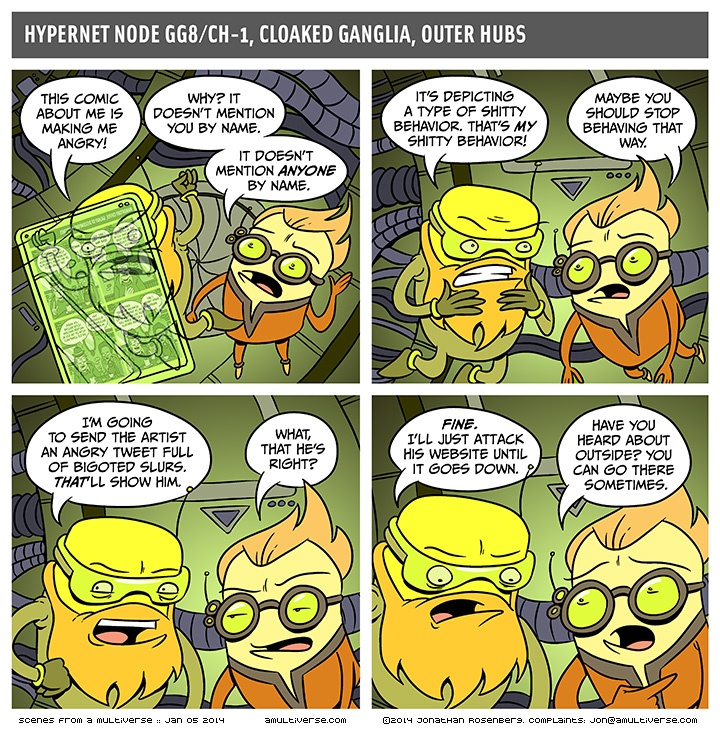
You’re so vain, you probably think this comic is about you.
Hello everyone! We had some downtime over the weekend, but I’ve taken measures to speed things up and keep that sort of thing from happening again. Let me know if you have any problems with the site.
We also have some new readers! Hello new readers! It’s good to have you here.
![goat-rfv[1]](http://amultiverse.com/wp-content/uploads/2014/07/goat-rfv1-450x187.png)

31 Dec 16:32

Slow descent into madness continues into a New Year.
December 31, 2014
Slow descent into madness continues into a New Year.
Gubetti, Doug Wibby likes this

20 Dec 16:03

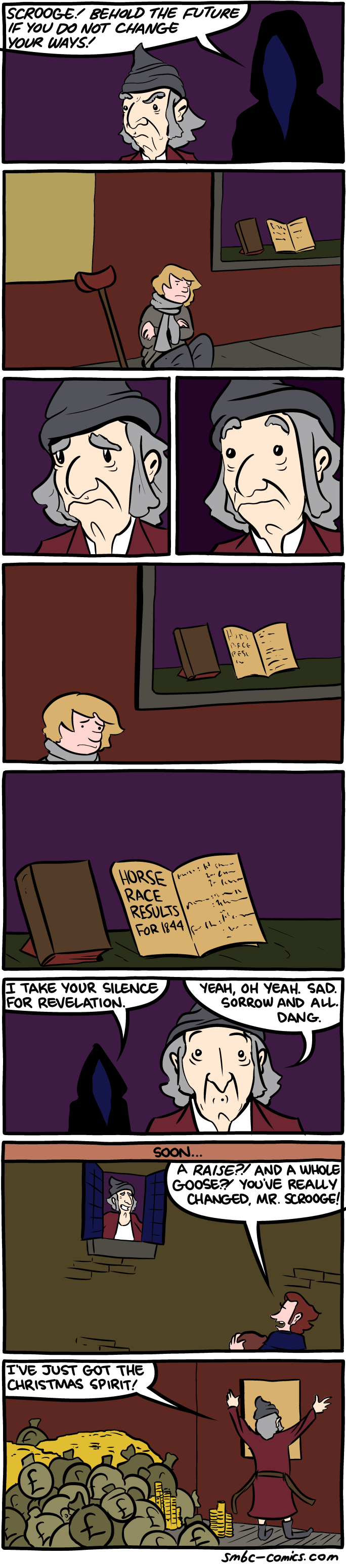
Stephen Colbert Made Conservatives More Conservative
by Alice Robb
After nine years hosting one of the most popular comedy programs on air, it’s hard to remember a time when Stephen Colbert might have been mistaken for the kind of conservative commentator he satires. Yet before Colbert became an international celebrity, some people didn’t know what to make of him...More >>


