Will Shackleton is the best of UK talent

    
|
Will Shackleton is the best of UK talent
|
|

Scientists announced today (March 17) that they had found the first direct evidence of the dramatic expansion that created the known universe, known as cosmic inflation, or the "bang" in the Big Bang. This dramatic expansion is thought to have occurred in the first instants of existence, nearly 14 billion years ago, causing the universe to expand beyond the reach of the most powerful telescopes.
In 1979, a physicist named Alan Guth came up with the theory of cosmic inflation, and theorized that such an event would create ripples in space-time called gravitational waves. But their existence remained hypothetical. Today, a team of researchers said that they had detected these gravitational waves, using a telescope near the South Pole.
"This is huge," Marc Kamionkowski, a researcher at Johns Hopkins University who was not involved in the discovery but who predicted how these gravitational wave imprints could be found, told Scientific American. “It’s not every day that you wake up and find out something completely new about the early universe." He added that the results looked good, although they would need to be verified by others to hold up.
The finding seems to support the idea that the observable universe is only one of many, as the New York Times reports:
Confirming inflation would mean that the universe we see... is only an infinitesimal patch in a larger cosmos whose extent, architecture and fate are unknowable. Moreover, beyond our own universe there might be an endless number of other universes bubbling into frothy eternity, like a pot of pasta water boiling over.
As the Times tells it, Andrei Linde, who first described the most popular variant of inflation, known as chaotic inflation, in 1983, was about to go on vacation in the Caribbean last week when a colleague named Chao-Lin Kuo knocked on his door with a bottle of Champagne to tell him the news.
Confused, Dr. Linde called out to his wife, asking if she had ordered Champagne.
"And then I told him that in the beginning we thought that this was a delivery but we did not think that we ordered anything, but I simply forgot that actually I did order it, 30 years ago," Dr. Linde wrote in an email.
Hear Linde and Kuo tell the story themselves in this video:

|
|
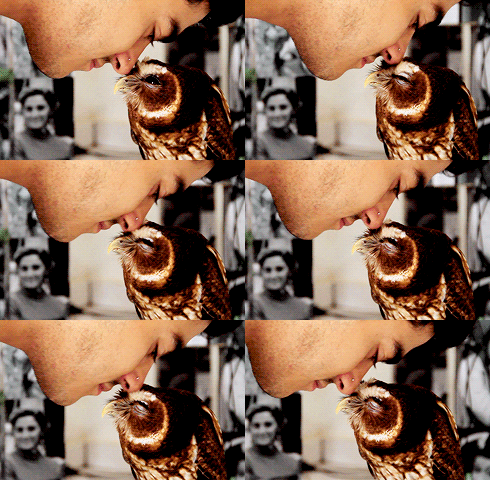
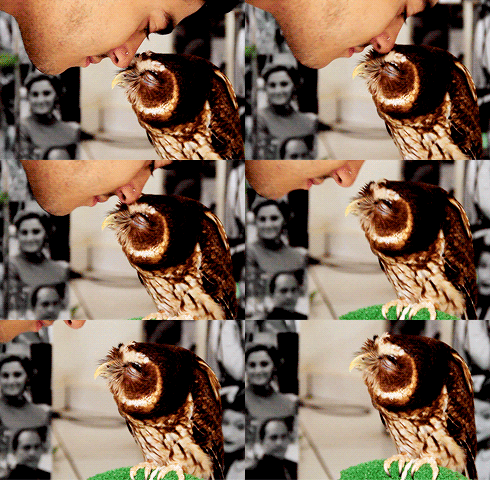

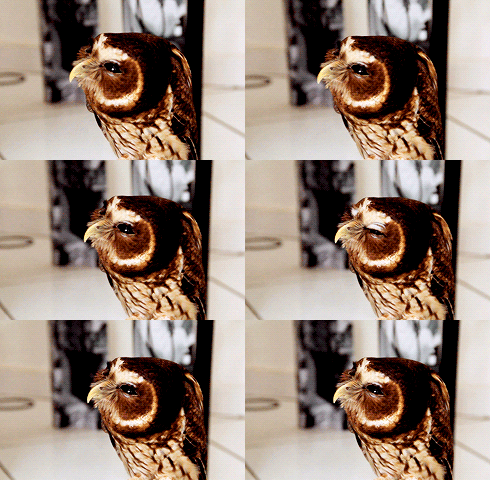


omg i fucking love this
It’s like in the second to last gif the owl is saying “I got kissed by a really cute boy”
"…oh my"
is this DIsney in HD
Look how cute and pretty this sweet little owl is!

This is Marshmallow—the incredible Houdini cat who can escape any cell at a veterinary clinic in Marseille, France, just by unlocking the door. The veterinary calls him the "king of evasion."
 The NSA is capable of recording 100 percent of a country's telephone calls, according to sources who spoke with The Washington Post. Adding to the intrigue, the Post says it's "withholding details that could be used to identify the country where the...
 The rumors are true: Sony's working on virtual reality. The hardware is called "Project Morpheus" and it's headed to the PlayStation 4. The headset is two pieces: a closed display and what looks like a PlayStation Move sensor built in. SCE Worldwide...
Rovio, the brains behind Angry Birds, has begun to tease the next Angry Birds game. Rovio has dubbed the new title as Angry Birds Epic, which tells us the game tries to achieve an epic story-line. Differing from other titles in the franchise, this one will be a turn-based RPG game.
Angry Birds Epic will first touch down in Canadian and Australian markets and is expected to expand worldwide a couple weeks after.

The post Rovio’s next Angry Birds to be a turn-based RPG appeared first on AndroidGuys.
Glenn Greenwald is back reporting about the NSA, now with Pierre Omidyar's news organization FirstLook and its introductory publication, The Intercept. Writing with national security reporter Jeremy Scahill, his first article covers how the NSA helps target individuals for assassination by drone.
Leaving aside the extensive political implications of the story, the article and the NSA source documents reveal additional information about how the agency's programs work. From this and other articles, we can now piece together how the NSA tracks individuals in the real world through their actions in cyberspace.
Its techniques to locate someone based on their electronic activities are straightforward, although they require an enormous capability to monitor data networks. One set of techniques involves the cell phone network, and the other the Internet.
Every cell-phone network knows the approximate location of all phones capable of receiving calls. This is necessary to make the system work; if the system doesn't know what cell you're in, it isn't able to route calls to your phone. We already know that the NSA conducts physical surveillance on a massive scale using this technique.
By triangulating location information from different cell phone towers, cell phone providers can geolocate phones more accurately. This is often done to direct emergency services to a particular person, such as someone who has made a 911 call. The NSA can get this data either by network eavesdropping with the cooperation of the carrier, or by intercepting communications between the cell phones and the towers. A previously released Top Secret NSA document says this: "GSM Cell Towers can be used as a physical-geolocation point in relation to a GSM handset of interest."
This technique becomes even more powerful if you can employ a drone. Greenwald and Scahill write:
The agency also equips drones and other aircraft with devices known as "virtual base-tower transceivers"—creating, in effect, a fake cell phone tower that can force a targeted person's device to lock onto the NSA's receiver without their knowledge.
The drone can do this multiple times as it flies around the area, measuring the signal strength—and inferring distance—each time. Again from the Intercept article:
The NSA geolocation system used by JSOC is known by the code name GILGAMESH. Under the program, a specially constructed device is attached to the drone. As the drone circles, the device locates the SIM card or handset that the military believes is used by the target.
The Top Secret source document associated with the Intercept story says:
As part of the GILGAMESH (PREDATOR-based active geolocation) effort, this team used some advanced mathematics to develop a new geolocation algorithm intended for operational use on unmanned aerial vehicle (UAV) flights.
This is at least part of that advanced mathematics.
None of this works if the target turns his phone off or exchanges SMS cards often with his colleagues, which Greenwald and Scahill write is routine. It won't work in much of Yemen, which isn't on any cell phone network. Because of this, the NSA also tracks people based on their actions on the Internet.
A surprisingly large number of Internet applications leak location data. Applications on your smart phone can transmit location data from your GPS receiver over the Internet. We already know that the NSA collects this data to determine location. Also, many applications transmit the IP address of the network the computer is connected to. If the NSA has a database of IP addresses and locations, it can use that to locate users.
According to a previously released Top Secret NSA document, that program is code named HAPPYFOOT: "The HAPPYFOOT analytic aggregated leaked location-based service / location-aware application data to infer IP geo-locations."
Another way to get this data is to collect it from the geographical area you're interested in. Greenwald and Scahill talk about exactly this:
In addition to the GILGAMESH system used by JSOC, the CIA uses a similar NSA platform known as SHENANIGANS. The operation—previously undisclosed—utilizes a pod on aircraft that vacuums up massive amounts of data from any wireless routers, computers, smart phones or other electronic devices that are within range.
And again from an NSA document associated with the FirstLook story: "Our mission (VICTORYDANCE) mapped the Wi-Fi fingerprint of nearly every major town in Yemen." In the hacker world, this is known as war-driving, and has even been demonstrated from drones.
Another story from the Snowden documents describes a research effort to locate individuals based on the location of wifi networks they log into.
This is how the NSA can find someone, even when their cell phone is turned off and their SIM card is removed. If they're at an Internet café, and they log into an account that identifies them, the NSA can locate them—because the NSA already knows where that wifi network is.
This also explains the drone assassination of Hassan Guhl, also reported in the Washington Post last October. In the story, Guhl was at an Internet cafe when he read an email from his wife. Although the article doesn't describe how that email was intercepted by the NSA, the NSA was able to use it to determine his location.
There's almost certainly more. NSA surveillance is robust, and they almost certainly have several different ways of identifying individuals on cell phone and Internet connections. For example, they can hack individual smart phones and force them to divulge location information.
As fascinating as the technology is, the critical policy question—and the one discussed extensively in the FirstLook article—is how reliable all this information is. While much of the NSA's capabilities to locate someone in the real world by their network activity piggy-backs on corporate surveillance capabilities, there's a critical difference: False positives are much more expensive. If Google or Facebook get a physical location wrong, they show someone an ad for a restaurant they're nowhere near. If the NSA gets a physical location wrong, they call a drone strike on innocent people.
As we move to a world where all of us are tracked 24/7, these are the sorts of trade-offs we need to keep in mind.
This essay previously appeared on TheAtlantic.com.
 The EU successfully pushed for voluntary adoption of a cellphone charging standard a few years ago, and it's now close to making that standard mandatory. The European Parliament has voted in favor of a draft law requiring that cellphones work with a...

Cloud storage is something ever more useful and ever more popular, but there's also a ton to choose from.
Updated June 2017: Added current plans and pricing for the various online storage providers.
Fortunately, most also have free trials, and any storage provider worth its salt is going to give you a few gigabytes of space for free anyway to try to get you to stick around.
Let's take a look at a few of the major cloud storage providers and see how pricing stacks up. We'll leave it up to you to pick your favorite, but this should give a good idea of what you'll pay, as of today.
It's worth noting, of course, that most cloud storage providers also give the opportunity to earn free space, either by spamming your friends with referral requests or as part of a promotion with another company. Dropbox is a great example and you can get plenty of free space through various activities, including getting your buddies to sign up.
It's very much possible still to get enough cloud storage to suit your needs without spending a penny. So long as your needs are within certain boundaries.
Also, there are usually corporate pricing options, which may get you a buttload of space at your boss' expense, so it's worth asking about that, too. And services like Box have options for multiple users.
What follows here, however, is a breakdown of what it costs across each of the big players to get yourself a personal account.
Your Google Drive storage is actually split across three different Google products so it's important to take that into consideration. Gmail, Photos, and Drive stored files all go towards whatever your limit may be. But, if you're a user of Google Docs, Sheets or Slides, anything you create in these apps won't count towards your limit.
Part of the strength of Google Drive is that it doesn't promise "unlimited" storage, instead offering some massive tiers to satisfy the hardest of users. However high you go, the price per TB remains the same.
Dropbox is one of the staples of the cloud storage game and a name that most will be familiar with. Sadly it has one of the poorest free tiers you'll find anywhere, but you can bump that without charge by referring other people to sign up. One of the added bonuses to Dropbox is that many apps hook into it, meaning it's more than just your files that can live there. But be prepared for the fact you'll probably have to pay to get the most from it. But at 1TB for $9.99 it's no more expensive than Google Drive and you're getting decent value from it.
Microsoft may have recently slashed its OneDrive plans to ribbons but it still offers a compelling product at a decent price. In paying for 1TB you also get an Office 365 personal subscription. This allows you one install of Microsoft Office on a Mac or PC, use on a tablet or phone and some bundled Skype minutes. Not everyone will want or need this, but it does offer something the competition does not. And at a very reasonable price.
While Microsoft eventually did a U-turn and gave its existing customers chance to retain their free 15GB allowance, the details below reflect the current state of affairs for new customers.
Box is probably more of a business tool than something you'll entrust your personal cloud files to, but it does offer a reasonable free tier along with mobile apps available across platforms. But when you start paying the value for money goes down substantially. 10 bucks a month for 100GB just isn't good enough.
Amazon has changed from a simple "everything" plan to a long list of tiered packages that cover just about anyone's needs. Amazon Prime members get unlimited space for photos and 5GB of space for other files for free and pricing scales up from there.
If ever there was a red headed step child of the cloud storage world, Mega would be it. What it promises is ultimate security with end-to-end encryption for your files and a whopping 50GB of free space to fill up when you set up an account.
It also offers a range of "Pro" paid up accounts with varying levels of storage and bandwidth allowances. But when it comes to free storage, nothing else comes close in terms of quantity.
There's more to consider than just pricing. But, how much you get for how little is probably the first thing you're going to consider. And this should at least help you down that road.
So, what would we recommend? If you're looking at spending absolutely no money then you get more than most for that none-outlay with Google Drive right out of the gate. Google Drive doesn't offer a referral program though, so there's no set way to earn more free storage. Promotions aren't uncommon though, but you have to be eligible. You also can't ignore Mega. It won't suit everyone, but if you want the most you can get for absolutely nothing, it's currently untouchable.
When it comes to paying up for more, Microsoft is still offering the best all round value proposition. 1TB for $6.99 a month is as cheap as you can get from these choices. But throw in the Microsoft Office apps as well and you've got a superb package. Aside from that, Box is really the only one we can't recommend. The price per GB isn't competitive enough.

You've probably heard of Watson, IBM's super-intelligent supercomputer that dominated on Jeopardy! not too long ago. Turns out he's not a bad cook, either.
At South By Southwest, IBM has set up a food truck staffed with chefs from the Institute of Culinary Education, who are whipping up (strange, uncanny, surprisingly tasty) daily recipes dreamed up by the machine.
Here's the background. For about two years, IBM has been working on a way to harness Watson's data-driven computing into more creative fields--the kinds of things where, unlike a game show, there's no one right answer. The first experiment with that has been in the kitchen. By mining a database of freely available online recipes (as well as recipes from professional chefs and a molecular textbook) and estimating which ingredients might combine for a dish pleasing to a human palate, Watson has been creating unlikely culinary works. The quintillion possibilites--seriously, quintillion--are narrowed down and ranked by presumed tastiness and novelty.
With that data uploaded and organized by type of food, regional origin, and tastiness, the company designed an app that can make logical decisions on what might make for a good dish.
A person piloting the app starts with an ingredient; I chose bacon during a demo from IBM Watson Group researcher Patrick Wagstrom. (Because I am in Austin, I have been walking, and I am hungering for grease.) After that, I selected a region, opting for something English with influences from another country. Watson spit out a list of potential dishes it could make with those restrictions--it seems to be some kind of Michelin-star-worthy soup auteur--and I went with a quiche. Following a second of number-crunching, it showed me a list of ingredients it was planning on using. (Wagstrom admits it's bugged out a few times in this section, forgetting dough, etc.) A few tweaks later, I had a recipe for a respectable-sounding quiche made with comte cheese.

Well, "recipe" might be a stretch. There's an option where Watson can compute some vague thoughts on how one might cook a quiche ("cook the butter," "add the cheese") but nothing you'd feel comfortable taking as gospel. Instead, Watson turns cooking into a game of artificially-intelligent Chopped, giving you the ingredients and letting you mix, combine, and remix to taste. "Watson doesn't have a mouth," Wagstrom says.
If you have some talented chefs, though, that could lead to a spark of constraint-induced creativity. At the food truck in Austin, ICE chef Michael Laiskonis, a pastry chef by training, had Watson select a Vietnamese-themed kebab dish that included apple, as determined by an online poll from IBM. Apple isn't exactly your typical kebab ingredient--and neither are strawberries, which were also included in the recipe--but the result was subtly sweet, and surprisingly pleasant next to a bit of ground pork.
Laiskoni's been working with Watson for about two years now. "My experience with it has already changed my approach to creativity," he says. One time, he tells me, Watson requested a dish created by cottage cheese and pork belly. And the result wasn't bad.
But, Wagstrom says, there's still the occasional hiccup when you're dealing with (literally) 1 quintillion potential recipes: "Every once in a while it might recommend lemon juice and cream." Tweaks are being made.
You can read the recipe and instructions for the apple kebabs below, or check it out at IBM's site.
ground pork: 8 ounces
scallion: 1 tablespoon of white portion, finely minced. green portion thinly sliced and held in ice water
Granny Smith apple: 1 tablespoon, brunoise, additional for garnish
ginger: 3 1/s teaspoon, divided
lime zest: 1 teaspoon, divided
lemon zest: 1 teaspoon, divided
mint: 1/2 teaspoon, finely chopped
Vietnamese curry powder: 1 teaspoon, divided
vanilla bean: one split and scraped, pod discarded, divided
lard: as needed
vegetable oil : 2 teaspoons, more as needed
lime juice: 1 tablespoon + 1 teaspoon, divided
lemon juice: 2 teaspoons
chicken breast: 8 ounces
pineapple: 1/2, trimmed, sliced and juiced
shiitake mushrooms: 2 ounces, thinly sliced
carrot: 1/4 cup, sliced into fine julienne
cucumber: cut into fine dice
1) First, make the pork meatballs. Thoroughly mix ground pork, scallion, 1 Tbsp apple, ½ tsp grated ginger, 1 pinch lime zest, 1 pinch lemon zest, ½ tsp mint, ½ tsp Vietnamese curry powder, pinch white pepper, ½ vanilla bean, split and scraped, until combined. Season with salt and add lard as needed. Portion and roll the mass into 24 meatballs, weighing approximately 10g each.
2) Arrange the meatballs in a single layer into lightly greased roasting pans and place in a 160˚C/320˚F convection oven for approximately 20 minutes, or until thoroughly cooked. Remove from the oven and season with salt. Reserve.
3) To prepare the curry chicken whisk together the water, oil, 1 tsp lime juice, 1 tsp lemon juice, and ½ tsp curry powder. Marinate the chicken in the curry mixture for about 30 minutes. Transfer the chicken and remaining marinade into a shallow saucepan over low heat, stirring, until chicken is thoroughly cooked, about 10 minutes. Allow the chicken to cool in the marinade. Remove the chicken and cool.
4) To prepare pineapple broth, combine the pineapple juice, 1 vanilla bean, split and scraped, 2 tsp grated ginger, 1 tsp lemon juice, 1 tsp lime juice, and 1 pinch each lemon and lime zest. Gently heat to 60˚C/140˚F. Cover and allow to infuse one hour. Strain and season with salt and white pepper; reserve warm.
5) Next, make the flash pickled shiitake mushrooms. Sauté the mushrooms in a shallow pan with vegetable oil and season to taste. Add the carrot, ginger, lemon juice, and lime juice. Slowly reduce until liquid has absorbed. Remove from heat. Allow to cool and remove sliced ginger. Adjust seasoning and acidity as desired.
6) To assemble, into each dish place two of the warmed pork meatballs and portioned chicken. Top with a small amount of the diced, apple, cucumber, and strawberry, followed by the pickled shiitake and carrot mixture. Pour a small amount of the pineapple broth into the dish and finish with the scallion, mint, chive, and 1 pinch lime zest. Season with Maldon salt and an additional grind of white pepper

|
|
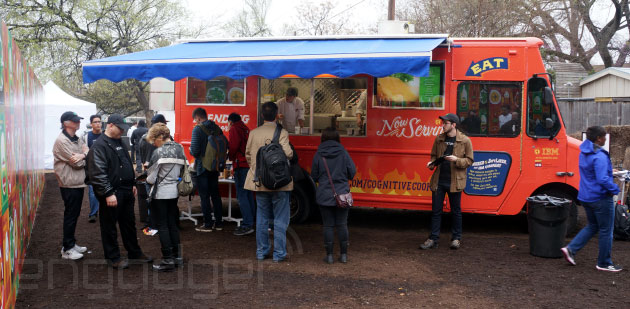 We know Watson has some Jeopardy skills, but putting IBM's supercomputer in the kitchen? That's a little different. Here at SXSW, the company's set up a "Cognitive Cooking" food truck in partnership with the Institute for Culinary Education (ICE)....
 Aiming to offer a long-term storage option in disc form, Sony and Panasonic have announced the new Archival Disc format that will store between 300GB and 1TB per disc. The companies are bigging up the non-HDD form factor for its hardiness to...


Apropos of I’m on a diet and am also a masochist, Brooklyn-based baker Alana Jones-Mann has a sweet DIY article on how to make cupakes that look like common miniature cacti. It turns out all you need is mass quantities of tasty, tasty frosting (because why does anyone eat a cupcake anyway), green food coloring, and an unreasonable amount of baking talent. If you liked this, you might also like cakes that look like planets. (via Neatorama, Blazenfluff)

While at the NYC 3D Printshow we took a close look at an incredible 3D print that you could print yourself at home.
It’s the In Bloom Dress by XYZ Workshop, a “fully 100% 3D Printed piece that was not only wearable but had qualities of movement within it.”

The dress is composed of 106 separately 3D printed panels that are linked together. It’s printed with Ultimaker’s PLA Flex that permits some wearer flexibility beyond the linkages between panels.
Here’s the really interesting part: all pieces were produced on an Ultimaker personal 3D printer. Statistically, the 106 panels took some 265 hours and 15 mins to produce, using just under 1kg of material. In other words, this could be made for as little as USD$60!

We believe this is a breakthrough. Most previous large 3D printed fashion elements involved production on expensive commercial 3D printers, sometimes costing literally tens of thousands of dollars per outfit. Now, it appears you can attempt the same thing on your home 3D printer.
If only you had the 3D model.
But you might. According to XYZ Workshop:
We are currently working with Ultimaker to make the digital files of our dress available to the public, to encourage more “makers” to play and push the boundaries of personal 3D Printing and 3D fashion.
Right on!
Via XYZ Workshop

After a class on out-of-body experiences, a psychology graduate student at the University of Ottawa came forward to researchers to say that she could have these voluntarily, usually before sleep. "She appeared surprised that not everyone could experience this," wrote the scientists in a study describing the case, published in February in Frontiers in Human Neuroscience.
Pretty crazy, right? One would think that if you could leave your own body and float above it, you'd be a little more... vocal about it. But since it was a common experience for her--one she "began performing as a child when bored with 'sleep time' at preschool... moving above her body" instead of napping--it may have appeared unremarkable. This is way more interesting than what I did, which was indeed napping.
The most exciting thing about this case, to me, is "the possibility that this phenomenon may have a significant incidence but [is] unreported because people do not think this is exceptional," as the authors wrote. "Alternatively," they continued, "the ability might be present in infancy but is lost without regular practice. This would be reminiscent of the discovery and eventual study of synesthesia that some researchers now hypothesized is more prevalent in young people or can be developed."
Those are fascinating suggestions--both that these out-of-body experiences may be more common than previously thought, or could be learned during a critical window early in life.
But back to the case study. The 24-year-old "continued to perform this experience as she grew up assuming, as mentioned, that 'everyone could do it.'" This is how she described her out-of-body experiences: "She was able to see herself rotating in the air above her body, lying flat, and rolling along with the horizontal plane. She reported sometimes watching herself move from above but remained aware of her unmoving “real” body. The participant reported no particular emotions linked to the experience."
An unusual find, wrote the scientists, University of Ottawa researchers Andra M. Smith and Claude Messier--this is the first person to be studied able to have this type of experience on demand, and without any brain abnormalities. Instead of an "out-of-body" experience, however, the researchers termed it a "extra-corporeal experience" (ECE), in part because it lacks the strong emotions that often go hand-in-hand (such as shock & awe, for example).
To better understand what was going on, the researchers conducted a functional magnetic resonance imaging (fMRI) study of her brain. They found that it surprisingly involved a "strong deactivation of the visual cortex." Instead, the experience "activated the left side of several areas associated with kinesthetic imagery," such as mental representations of bodily movement.
Her experience, the scientists wrote, "really was a novel one." But just maybe, not as novel as previously thought. If you are capable of floating out of your body, don't keep it to yourself!
Update: Unpopular Science blogger Rebecca Watson wrote a critical response to this article. You can read it here.

|
|
 The Last of Us made its debut last year to critical (and commercial) acclaim from the gaming community, and it appears that the film industry's just as smitten with the story it tells. Deadline Hollywood reports that Sony Pictures' Screen Gems...

The news just hit that Scarlett Johansson is expecting a child with her fiancé, Romain Dauriac. This is great news, but it could also be a problem because she could start showing in her Black Widow outfit, so the Avengers 2 shoot has had to do some reshuffling schedule-wise.

|
|
 Director Robert Rodriguez is expanding on the story and characters first seen in his cult classic From Dusk Till Dawn with a new TV series, but that's not all there is to it. Here it's the debut original series on Rodriguez's new El Rey Network on...
Roumen.ganeffWhoever published photos and address should be sued
 There have been many theories bandied about as to the true identity of Satoshi Nakamoto, the creator of Bitcoin. Nothing conclusive has married the name to an individual or group, but now Newsweek claims to have found the Nakamoto, a 64-year-old...
 For many drummers, losing part of an arm could represent a career-ending tragedy. Not Jason Barnes, however. Georgia Tech professor Gil Weinberg has built a robotic prosthesis that not only restores much of Barnes' musical prowess, but effectively...