Christopher Lantz
Shared posts
10 Apr 21:43
Sophisticated Cat Finally Got His Boat
by Brad
Tertiarymatt, Rosalind and one other like this
10 Apr 21:33


Shhhhh Only Charizard Now
Submitted by: Unknown (via Twitter the Comic)
Tagged: twitter the comic , charizard , comics , protection , dating fails , g rated Share on Facebook
Rosalind, Cooper Griggs likes this
10 Apr 20:09

This Acapella Goes With Everything
Christopher LantzAlso, I go with everything as well. Take note.
Submitted by: Unknown
Tagged: Music , videos , acapella , guiles-theme-goes-with-everything , guiles-theme , Music FAILS , g rated Share on Facebook
Cooper Griggs, Christopher Lantz and -1 others like this
10 Apr 19:54
dancemommamaniac: I AM ACTUALLY IN TEARS CRYING FROM LAUGHTER I...
Christopher LantzThis is the sort of thing I have to stop myself from doing in mixed company. Thank god for the interbutts.
I AM ACTUALLY IN TEARS CRYING FROM LAUGHTER I HAVE NEVER LAUGHED SO HARD AT A VIDEO IN MY LIFE OH MY
DEAD.
Cooper Griggs likes this
10 Apr 19:42
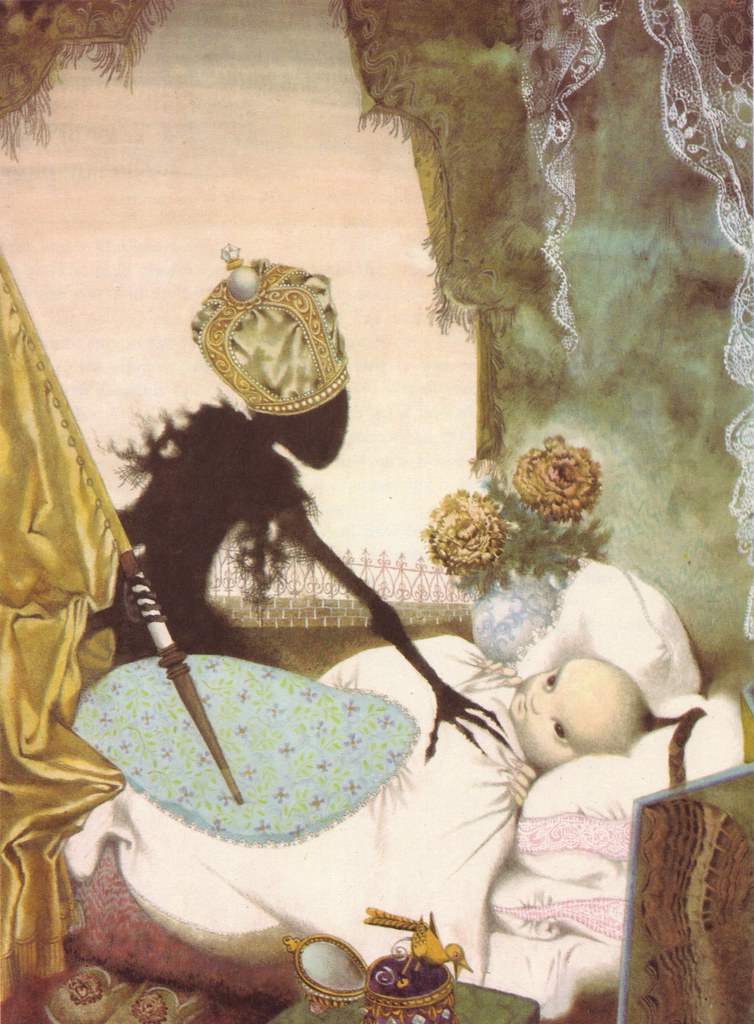
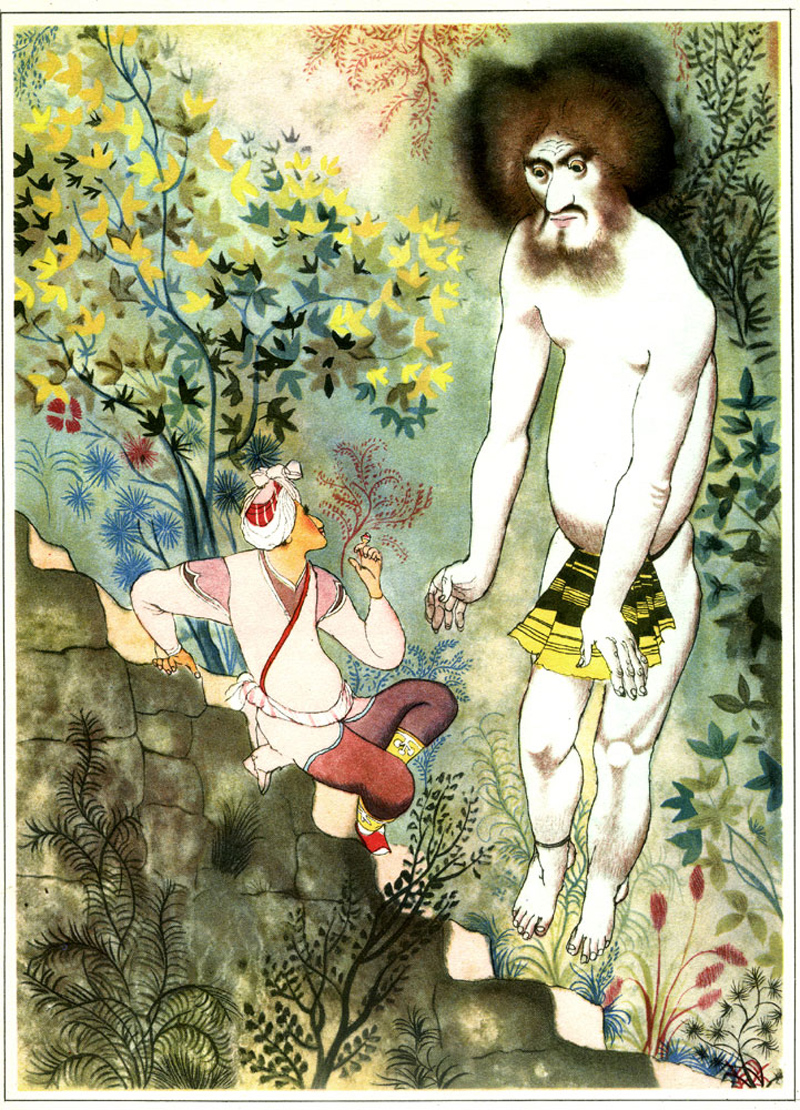
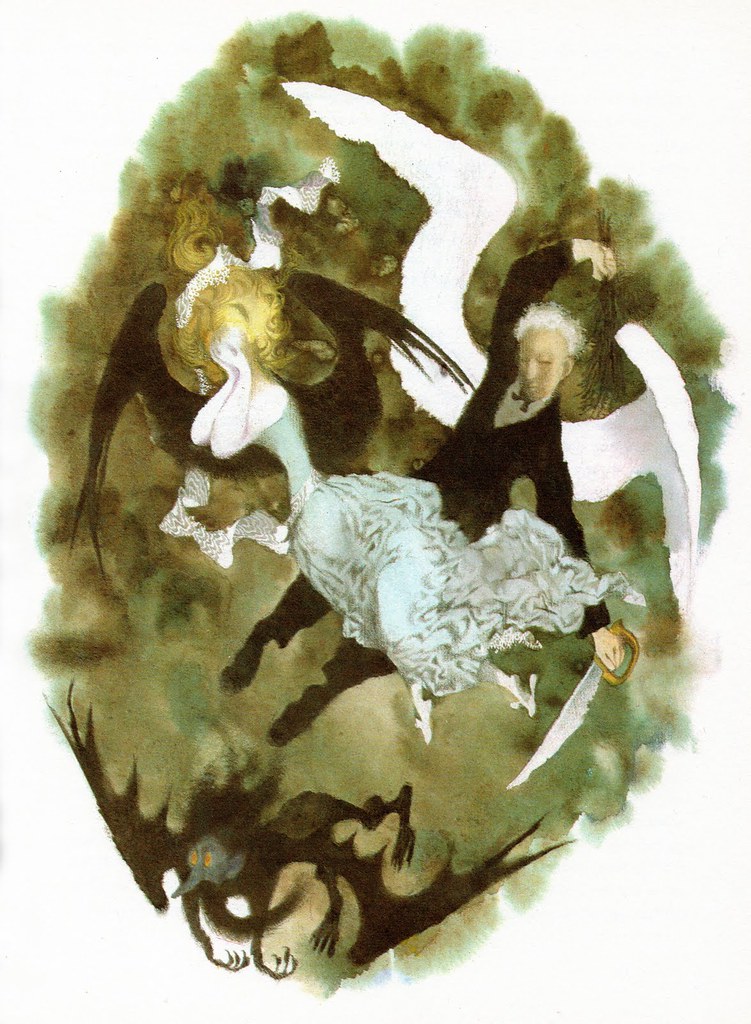

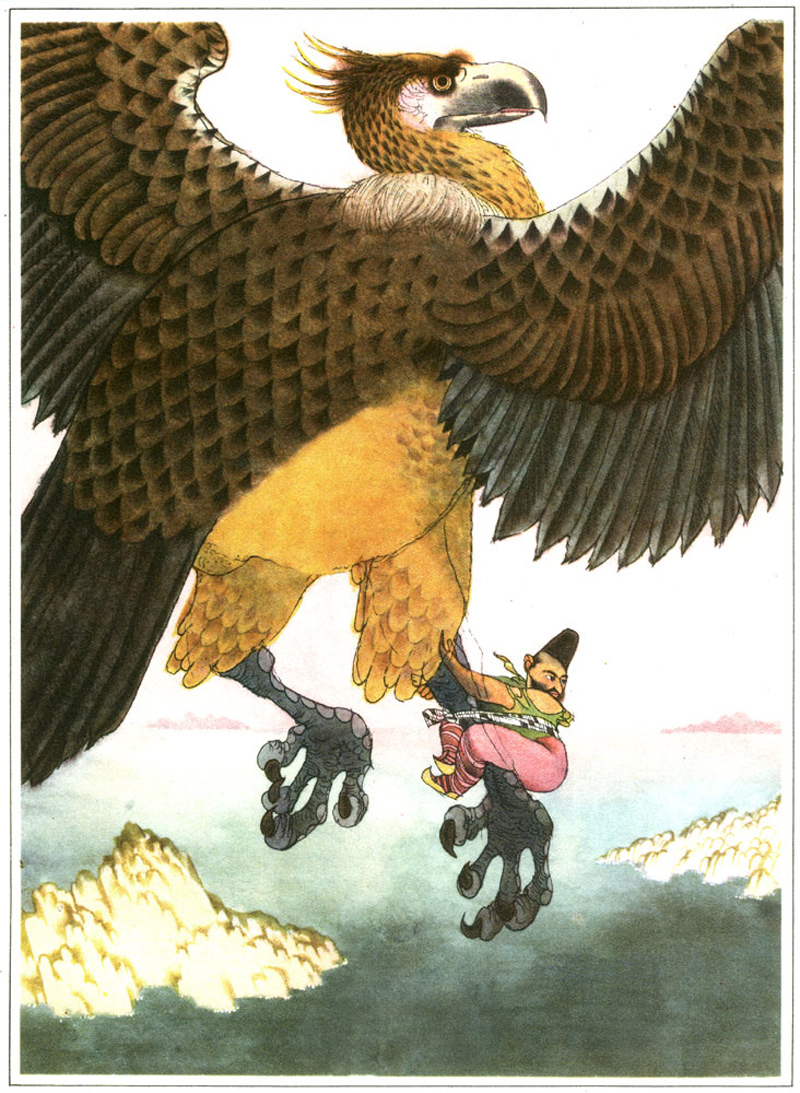
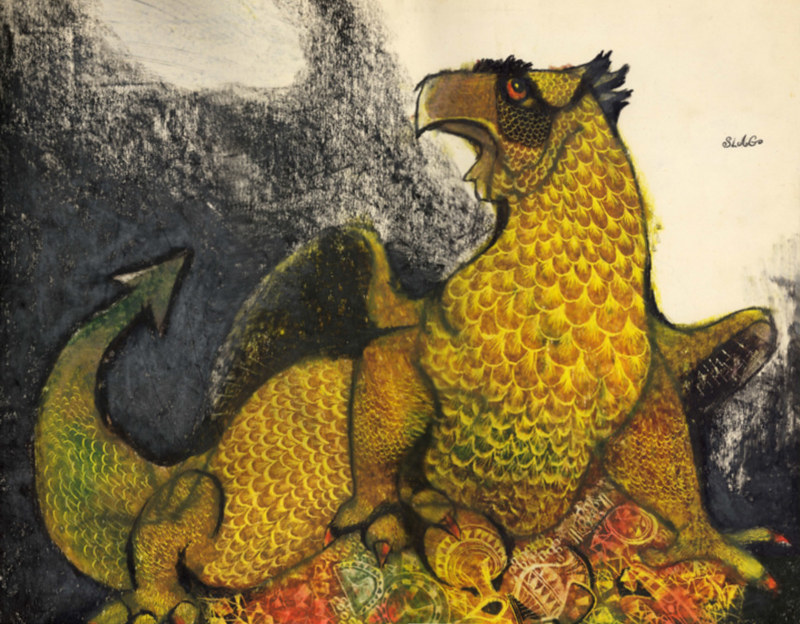
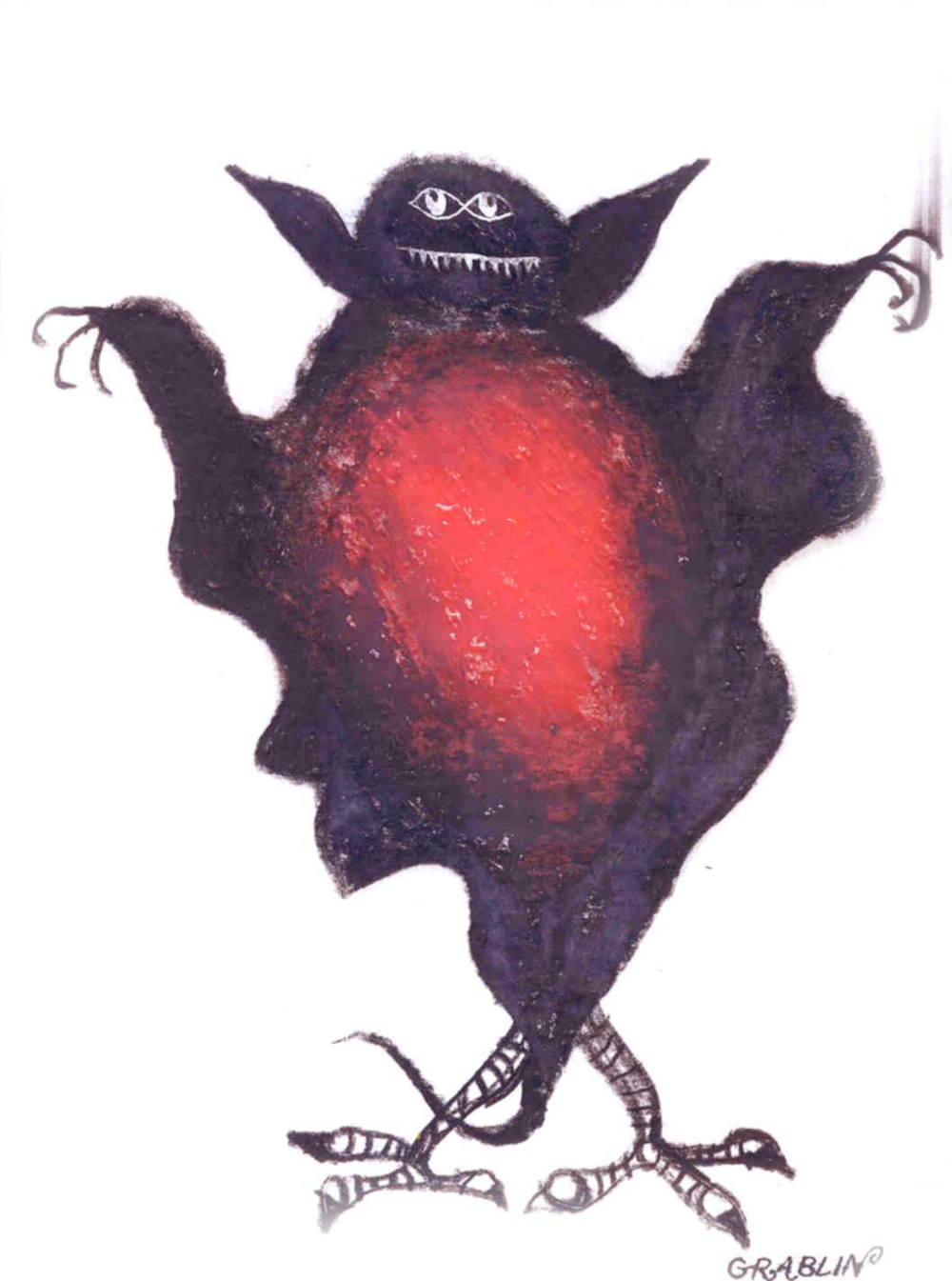
The above two artworks were conceptual character designs for an unmade animated version of J. R. R. Tolkien's Hobbit, a few more can be found at the bottom of this article on Trnka. Arabian Nights artworks found at Michael Sporn Animation. See more of Trnka's artwork at 50 Watts.
Equally impressive to Trnka's artwork is his animation, below is an assortment of his beautiful stop motion animated works.
"Dva mrazíci" Jiří Trnka (1954) from Mecca_Audio on Vimeo.
The hand - (1965) - (Jiri Trnka) from Roberto Pernas on Vimeo.
Jiri Trnka - Kyberneticka babicka (1962) from Jakub Ptacnik on Vimeo.
Jiri Trnka
by Aeron

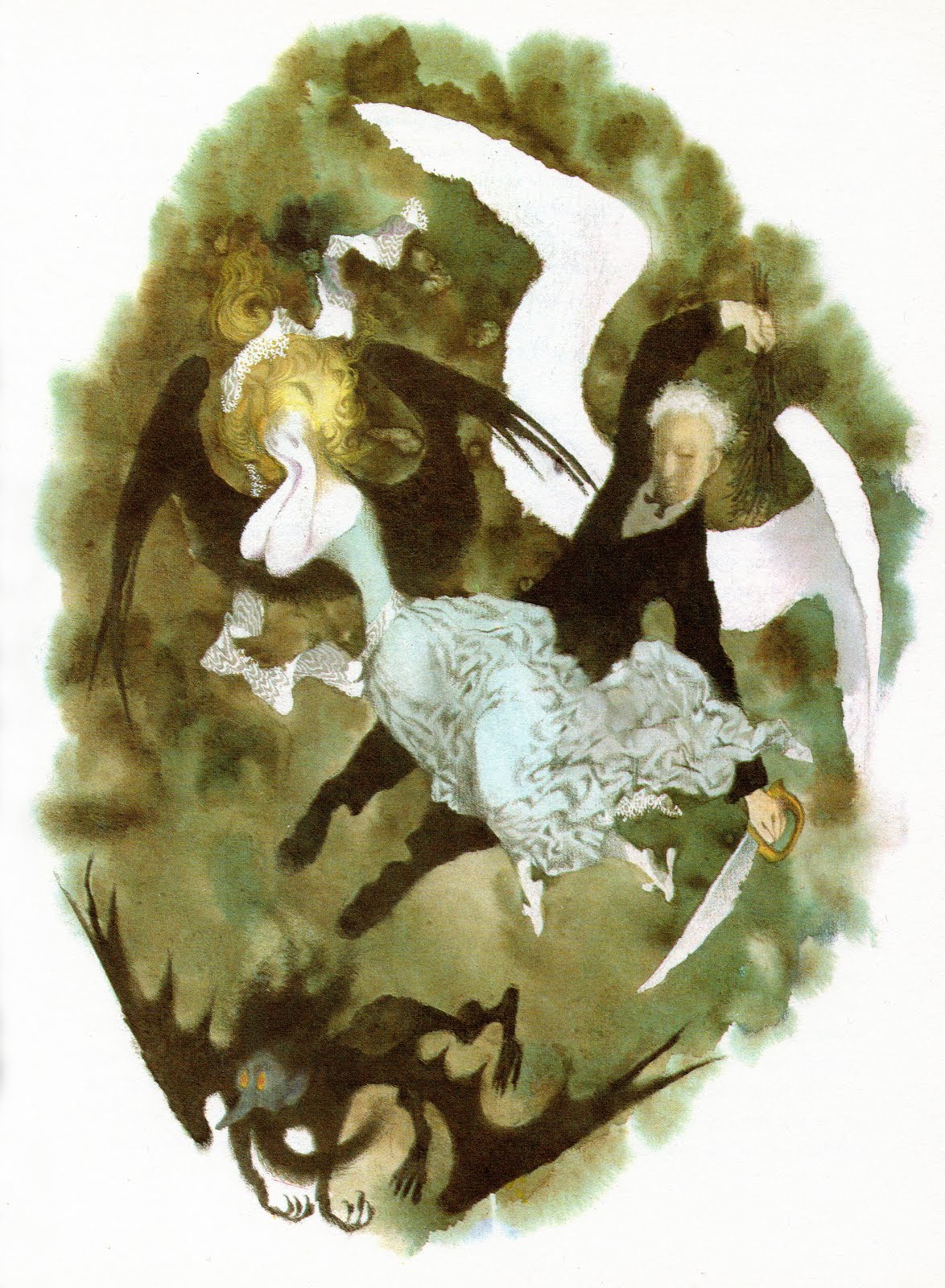
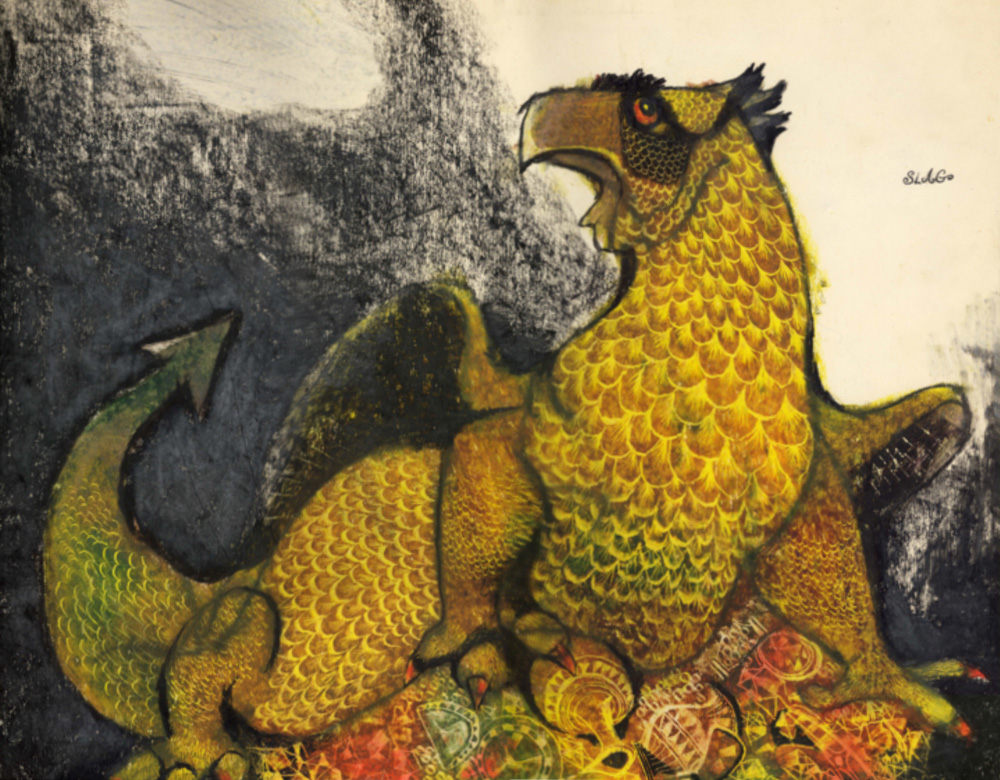
The above two artworks were conceptual character designs for an unmade animated version of J. R. R. Tolkien's Hobbit, a few more can be found at the bottom of this article on Trnka. Arabian Nights artworks found at Michael Sporn Animation. See more of Trnka's artwork at 50 Watts.
Equally impressive to Trnka's artwork is his animation, below is an assortment of his beautiful stop motion animated works.
"Dva mrazíci" Jiří Trnka (1954) from Mecca_Audio on Vimeo.
The hand - (1965) - (Jiri Trnka) from Roberto Pernas on Vimeo.
Jiri Trnka - Kyberneticka babicka (1962) from Jakub Ptacnik on Vimeo.

10 Apr 02:00


A zombie-bitten father tries to save his infant daughter in this bittersweet short film
by Lauren Davis
Christopher LantzI won't lie... this made me cry a little bit.
So you've been bitten by a zombie. So long, conscious brain activity, hello craving for human meat. But the protagonist of the short film Cargo has bigger problems than his impending demise: he has to find a way to save his infant daughter, even if he has to die first to do it.
Olga, Christopher Lantz likes this
09 Apr 23:27


A Dramatic Time-Lapse Video of a Full Moon Rising Over Los Angeles
by Kimber Streams
Photographer Dan Marker-Moore shot a dramatic time lapse video of the full moon rising behind downtown Los Angeles, and then turned the video frames into a collage and animated GIF.


images via Dan Marker-Moore
via PetaPixel
09 Apr 17:41

Tie Chi, Comic Demonstrating How to Tie a Tie Using Martial Arts
by Justin Page

“Tie Chi” is a comic on Incidental Comics by Grant Snider that demonstrates how to tie a tie using martial arts (Tai Chi).
David Pelaez, Tertiarymatt likes this
09 Apr 17:34

Musical Mashup of the ‘Game of Thrones’ Theme Song & “This is a Man’s World” by James Brown
by Justin Page
Christopher LantzInteresting mashup musically speaking.
“A Man’s Game Of Thrones World” by DJ Rozroz is a musical mashup of the Game of Thrones theme song and “This is a Man’s World” by James Brown. The song is available to download online.

09 Apr 12:13


A Distant Sea Storm
Christopher LantzWhoa! Gorgeous... would have loved to see this in person.
Submitted by: Unknown (via Bits and Pieces)
Tagged: storm , ocean , beach , landscape , destination WIN! , g rated Share on Facebook
Cooper Griggs, Tertiarymatt and 2 others like this
09 Apr 07:44
Amazing Queen of Blades Cosplay By Tasha
by Geist01
Christopher LantzNSFW-ish but some amazing cosplay
Sarah Kerrigan has never looked better
09 Apr 06:28

Music Video for ‘If You’re Fucking, You’re Fucking’ by Reggie Watts
by Rusty Blazenhoff
Christopher LantzWow, 3 posts in a row from Laughing Squid. That's a hat trick. Reggie Watts is good at clearing up the ambiguous.
“…this video should help clarify whether you are fucking or not fucking.”
Comedian and musician Reggie Watts has released the music video for his song “If You’re Fucking, You’re Probably Fucking” on YouTube comedy channel JASH.
submitted via Laughing Squid Tips
09 Apr 00:42

Will Sasso Vomits Up the Earl of Lemongrab from Cartoon Network’s ‘Adventure Time’
by Kimber Streams
Christopher LantzI apologize ahead of time for this one guys. I've got no excuses here. The internet just occasionally births up chunks of madness.
Cartoon Network has posted “Earl of Lemongrab Feat. Will Sasso,” an edited version of Will Sasso vomiting lemons on Vine featuring the Earl of Lemongrab from popular cartoon Adventure Time.
via reddit
09 Apr 00:18
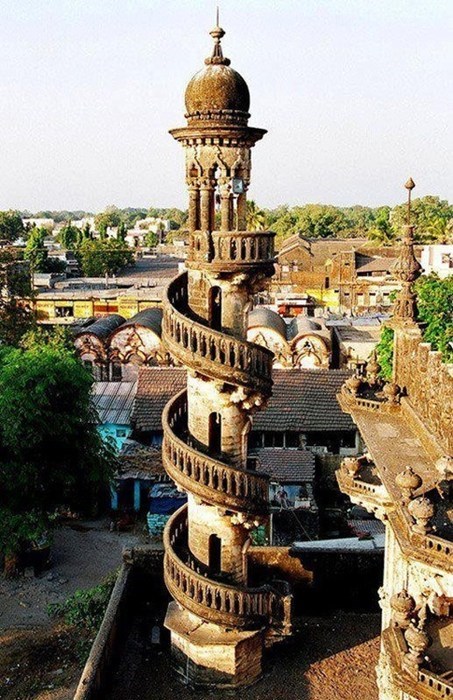

Mahabat Maqbara, India
Submitted by: Unknown
Tagged: tower , architecture , india , destination WIN! , g rated Share on Facebook
Christopher Lantz, firehose and -1 others like this

08 Apr 22:01

Blossom the Baby Bat
by Kimber Streams
Christopher LantzBecause who doesn't like baby bats.
Blossom is a baby blossom bat that came into the care of Louise Saunders of Bat Conservation and Rescue Queensland following a suspected cat attack, according to ZooBorns. The tiny bat was nursed back to health on nectar mix and milk formula, and was raised from a baby under Saunders’ care. Once Blossom was strong enough, the bat was released back into the wild on Macleay Island in Queensland, Australia.
“It was the best bat experience of my life without a doubt and the decision to release her was a terrible one for me, but it was the right decision for Blossom. With banana, banksia, melaleuca and eucalyptus flowers, and a whole new family to catch up with, I’m sure she won’t be missing me like I miss her.”


images Bat Conservation and Rescue Queensland via Zooborns
via Archie McPhee’s Endless Geyser of Awesome
Rosalind likes this
08 Apr 21:59

Japanese Teens Stage Harry Potter Quidditch Games in Photos
by Kimber Streams

photo via 2ch
The past few weeks have seen the rise of creative photo memes like staged Dragon Ball Kamehameha attacks and Vadering, and Kotaku reports on the newest photo trend that features Japanese teens appearing to play Quidditch, a fictional sport from J.K. Rowling’s Harry Potter universe played on broomsticks. The photos, first posted on Japanese bulletin board 2ch, have gone viral and inspired the Quidditch photo meme. Kotaku’s Brian Ashcraft has more on the meme.

photo via @katsudon34

photo via English Russia

photo via @Lavienna_renren

photo via @mizukuma57

photo via @Aki72726718
via Kotaku
Rosalind likes this
08 Apr 21:59

Hand in Hand, Writers Share Advice in Notes on Their Own Hands
by EDW Lynch

“Write. Finish things. Keep writing.” –Neil Gaiman
For the Hand in Hand project, authors, artists, and editors share advice on writing in notes written on their own hands. The project is part of Shared Worlds, a summer creative writing program for students that takes place at Wofford College in Spartanburg, South Carolina, July 21 to August 2, 2013.

“Persist!” –Tobias Buckell

“1. Read widely 2. Write often 3. Keep going 4. Believe in your stories” –Garth Nix

“Proof read your work!” –Angela Slatter

“Writers write” –Nnedi Okorafor

“Start the next one!” –Gene Wolfe
08 Apr 17:57

Fragile Territories, A Laser and Sound Art Installation by Robert Henke
by mikl-em
Christopher LantzIn my dreams, I live in a home illuminated as such.
“Fragile Territories” is a laser and sound art installation by Berlin-based musician Robert Henke which ran from November 2012 to January 2013 at Le Lieu Unique center for contemporary arts and music in Nantes, France.
As seen in this video the installation, three years in the making, features four fast moving laser beams that project evolving light patterns on a 30-meter wide wall in a dark room. The artist describes other aspects of the piece:
Sounds – transformed recordings of a piano – fill the room, sometimes in sync with the visual aspects and sometimes running simply in parallel. Whilst everything is floating and happening in rather long intervals, a constant black shadow is moving in front of the projection, from left to right, every 4.2 seconds, like a giant blade of a windmill, a negative object that contrasts the bright projection by muting it where it appears. It is not only obscuring the image but also dampening the sounds at its current position and emitting a low frequency noise itself.

photo via Le Lieu Unique
More details about “Fragile Territories” are in the English version of the exhibition brochure (pdf).

image via Le Lieu Unique
Trained as a hardware engineer, Robert Henke has made electronic music for two decades under the moniker Monolake and his own name. He is also an important contributor to Ableton Live, the popular music software which was created by Gerhard Behles his original Monolake collaborator. Despite the fact Monolake is named after a lake in Nevada, Henke hails from Munich Germany and is based in Berlin.
In Spring 2013 Henke is teaching algorithmic composition of electronic music at Stanford University and performing live across the US. Here’s a great interview with Henke and more of his music.

photo via roberthenke.com
08 Apr 17:50

Magnets, How Do They Work?
by Brad
Christopher LantzWow, watching memes age is almost more potent of a time passing tool than watching kids grow up.
Three years ago today, Insane Clown Posse released their music video for “Miracles,” one of the most puzzling and perhaps significant songs by Detroit’s rap duo.
08 Apr 17:41


Shut Up and Take My Money!
Submitted by: Unknown
Tagged: Cats , puns , sweatshirts , poorly dressed , g rated Share on Facebook
08 Apr 17:38
tumblr_m7qmf8PGVL1qiv53ho1_500.jpg (imagen JPEG, 500 × 500 píxeles)
by kndll

Sandrisha, Tertiarymatt and 2 others like this

08 Apr 04:17
Who Says Butt Implants are a Bad Idea?
Christopher LantzUmmm.. not sure if NSFW or if it's NS for life.
07 Apr 15:23
fuckyeah-nerdery: I don’t think Maisie Williams was in...
Christopher LantzLOL... best re-captioning ever.


Rosalind, Christopher Lantz and one other like this
07 Apr 15:15


Drinking of Absinthe: Dancing with the Green Fairy
by Avi Abrams
Christopher LantzOh Absinthe.... how much I loved you.
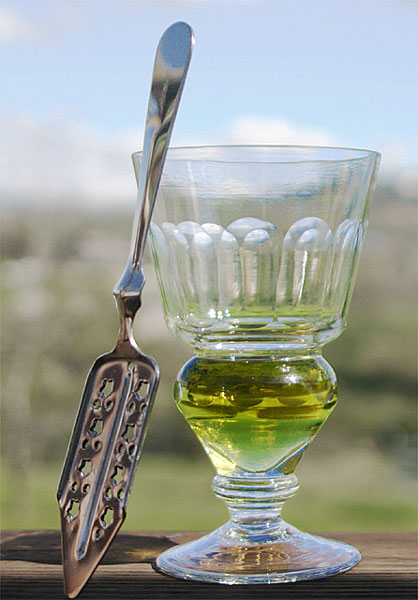
 "QUANTUM SHOT" #824 "QUANTUM SHOT" #824 Link - article by Simon Rose and Avi Abrams The Bohemian Realm of Absinthiana Absinthiana are the trappings and accessories associated with the drinking of absinthe. This anise-flavoured spirit is made from the flowers and leaves of wormwood, green anise, sweet fennel and other herbs. Absinthe has a natural green colour and was referred to as the Green Fairy, although it can also be colourless. Absinthe has a high alcohol level and is normally diluted with water for drinking. It’s also very bitter and was often poured into a glass of water over sugar on a perforated spoon. 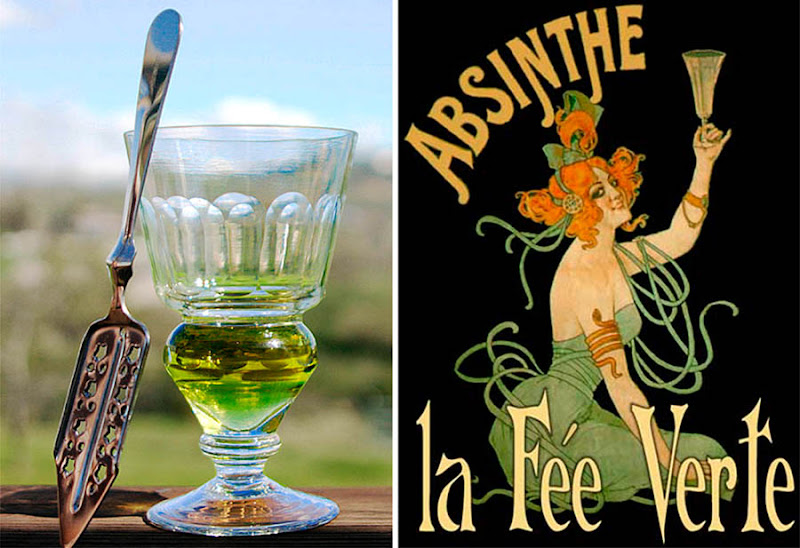 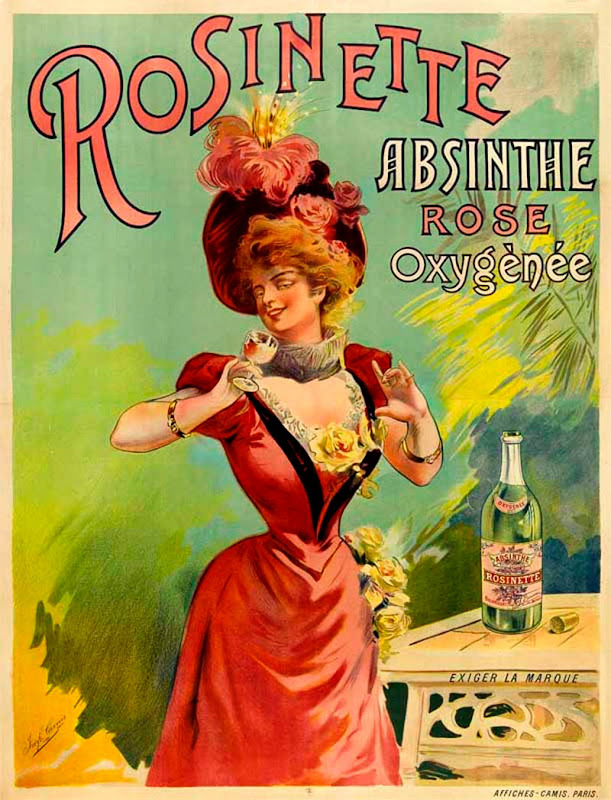 (images via 1, 2, 3) Absinthe was invented in 1797 and by the 1850’s it had become a firm favourite with the upper classes. It was originally a wine-based drink, but the Great French Wine Blight of the mid-19th century destroyed many of the French vineyards. Absinthe was based instead on grain alcohol. This made it more affordable and the Green Fairy became very popular as an alcoholic drink in France in the late 19th and early 20th centuries. In the early eighteenth century, absinthe would be served in an ordinary glass, with water added from a standard jug or similar container. With the increasing popularity of absinthe, specialty glassware, elaborate spoons, carafes and fountains made their appearance. 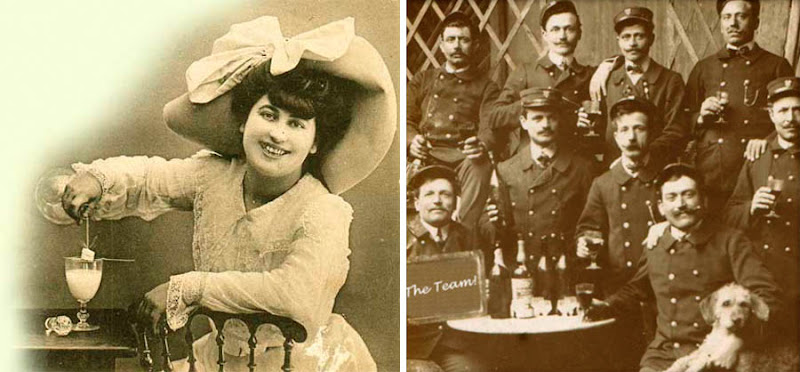 (images via 1, 2) Absinthe was said to be both a narcotic and an aphrodisiac. It was adopted by the bohemian culture and Parisian authors and artists claimed that absinthe stimulated creativity. Well-known absinthe drinkers include Vincent van Gogh, Oscar Wilde, Ernest Hemingway, Charles Baudelaire and Henri de Toulouse-Lautrec. Green Muse by Albert Maignan from 1895 shows a poet succumbing to the dubious charms of the green fairy.  (left: painting by Albert Maignan Pyushhiy "The Green Muse" from 1895; - right: "The Absinthe Drinker" by Edouard Manet, c.1859) Absinthe was even popular with members of the animal kingdom: 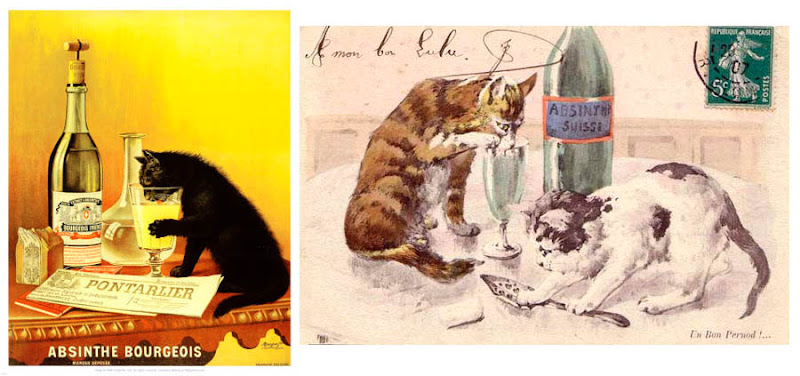 (left image via) Women drank absinthe in coffee houses and the beverage was even considered ladylike, even if men didn’t always approve: 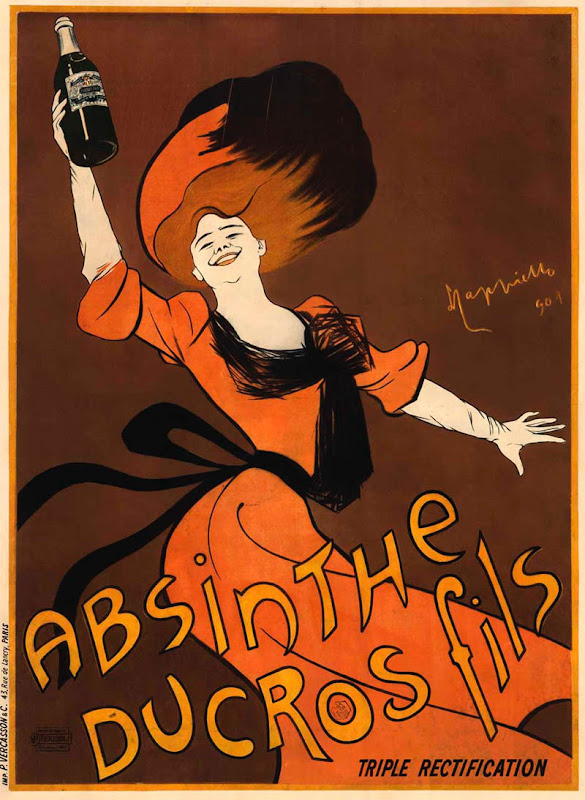 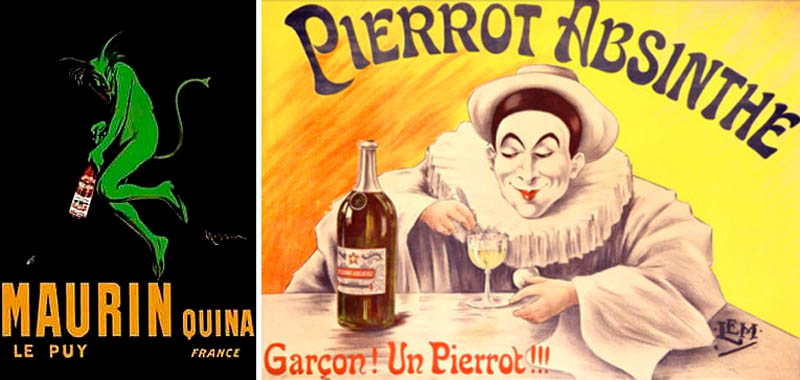 (images credit: Fairy Room, 2) Absinthiana refers to the tools related to absinthe, along with the preparation and drinking of the beverage. At first, absinthe was served in perfectly ordinary glasses, with water was added to the drink using a straightforward jug or carafe. As absinthe grew in popularity, more accessories appeared, including spoons, carafes and specialty glassware. Original copies can today command high prices in the antique market: 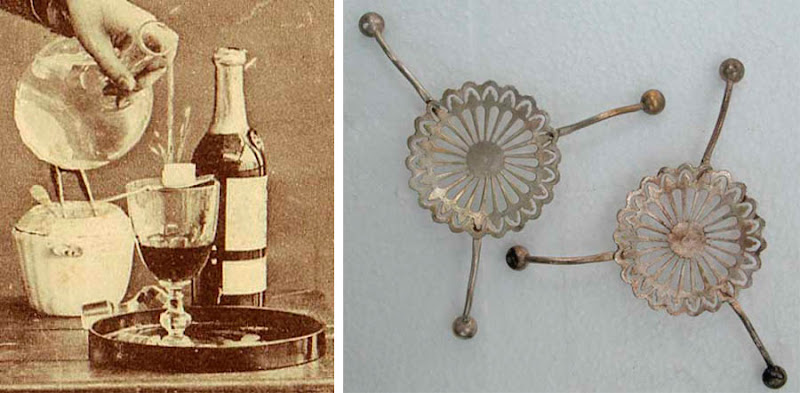 (image credit: Absinthes.com, 2) The slotted or perforated spoon was used to dissolve a sugar cube in a glass of absinthe. This helped to sweeten the mildly bitter liquid. The bowl of the spoon is flat and can rest on the rim of the glass, by means of a notch in the handle. Another absinthe tool was grille, a perforated metal saucer with small legs that suspended it over the glass (right image above). Just as the modern alcohol industry engages in brand advertising, many absinthe spoons were stamped with brand names or logos as advertising. Spoons were also marketed for the tourism trade. Some of the most famous absinthe spoons were made for the opening of the Eiffel Tower during the Exposition Universelle or World’s Fair held in Paris from May 6 to October 31, 1889. There are many counterfeit versions of these spoons and it can be hard to determine whether or not they are genuine. Usually the real ones from 1889 have the mark of the manufacturer stamped on the spoon. On the fake spoons, the mark is molded and the image is generally less sharp than if it were stamped onto the metal: 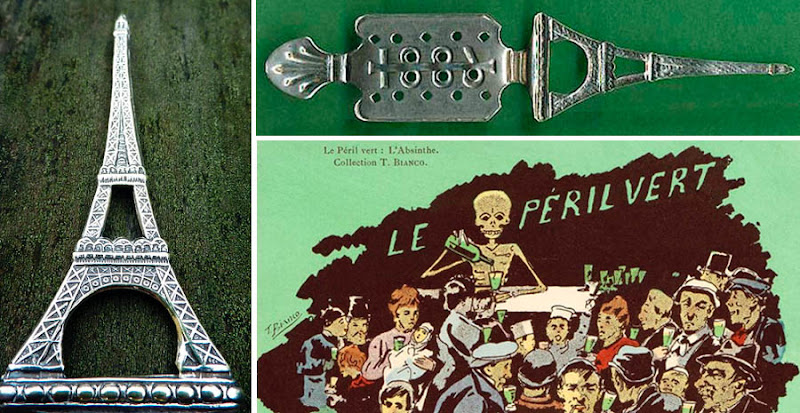 (left and top right images via, bottom right image: "Le Peril Vert" illustration by T. Bianco, via) This one is from 1900: 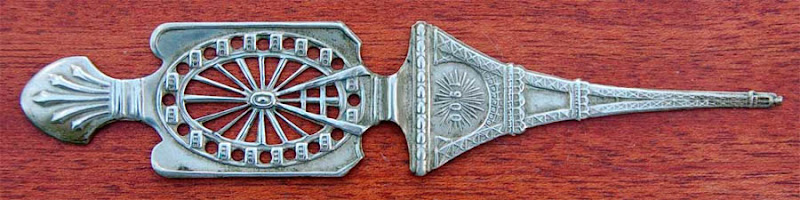 (image via) The one on the left was apparently made from brass taken from a shell casing. The craftsman added punched in holes reading the date of 1914 and his initials on the handle. The spoon on the right was quite an expensive one in its day, probably being used in fancy restaurants or luxury hotels: 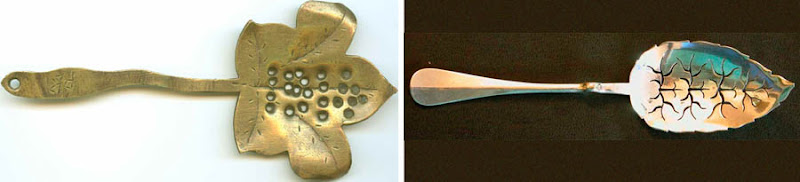 (images via) Adding ice-cold water to absinthe causes the liquid to become cloudy, a process known as the “louche” or the ouzo effect in different types of drinks. The adding of the water in exactly the right way was considered almost as an art form. Some establishments had specialists on hand to show new absinthe drinkers how to delicately add the water, one careful drop at a time, from a carafe or pitcher. Here are a few absinthe pitchers. This grasshopper one dates from around 1910: 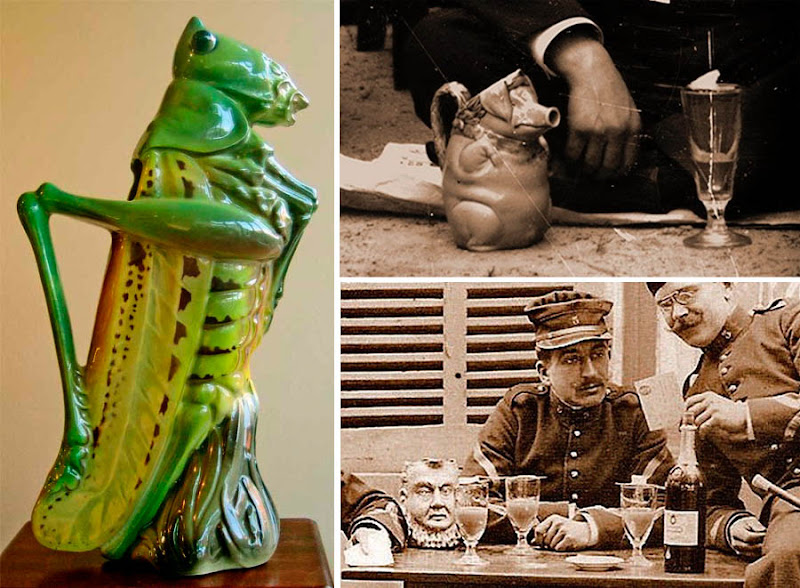 (left image via, right images via) The three holes in this bulldog version made it possible to adjust the stream when pouring water. This can be poured slowly into the absinthe through the hole in the mouth. The ones in the nose can pour water so that it makes a swirling effect in the absinthe in the glass: 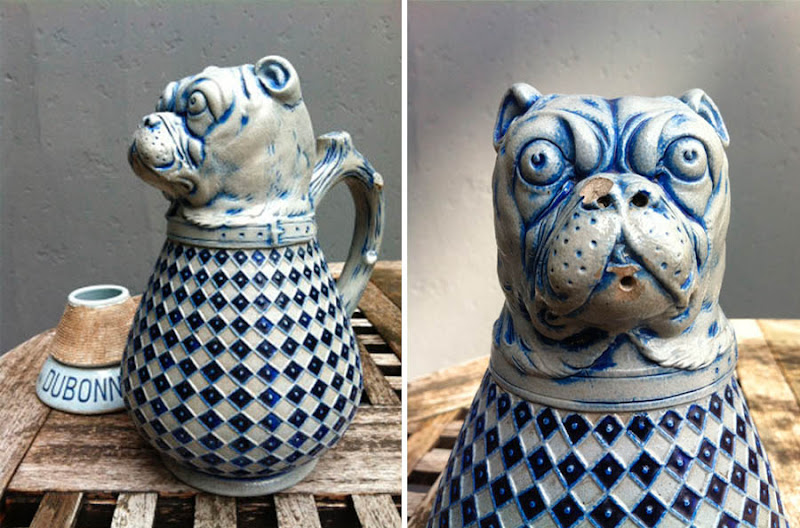 (images via) The green one at the front is from Switzerland and the one that looks like a somewhat confused dog behind it hails from France (left image): 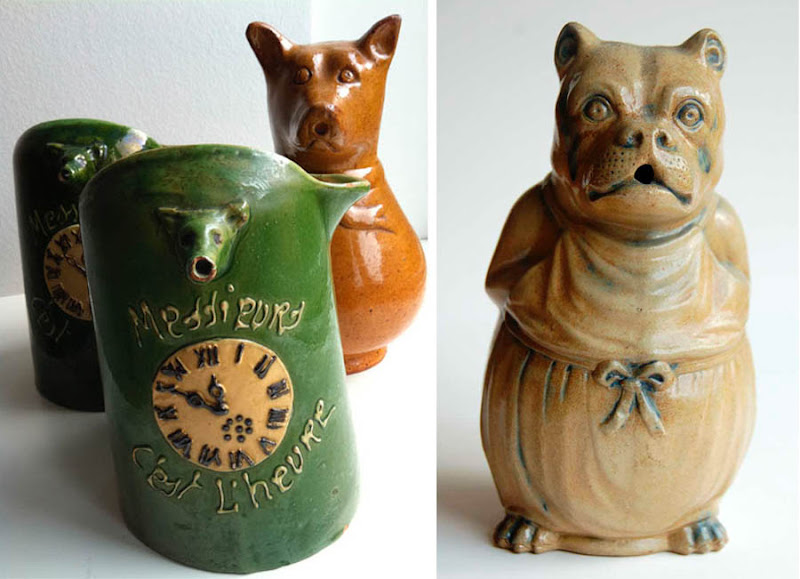 (images via 1, 2) Absinthe fountains also became popular. A large glass container with between two and six spigots was suspended above the table. A small group of drinkers could prepare their absinthe all at the same time, with a slow drip of cold water, rather than having to really focus on getting the droplet exactly right when poured from a carafe. The link to the bohemian culture inevitably made absinthe a target for prohibitionists and social conservatives. Here’s another victim of the Green Fairy, in Viktor Oliva’s The Absinthe Drinker, from 1901: 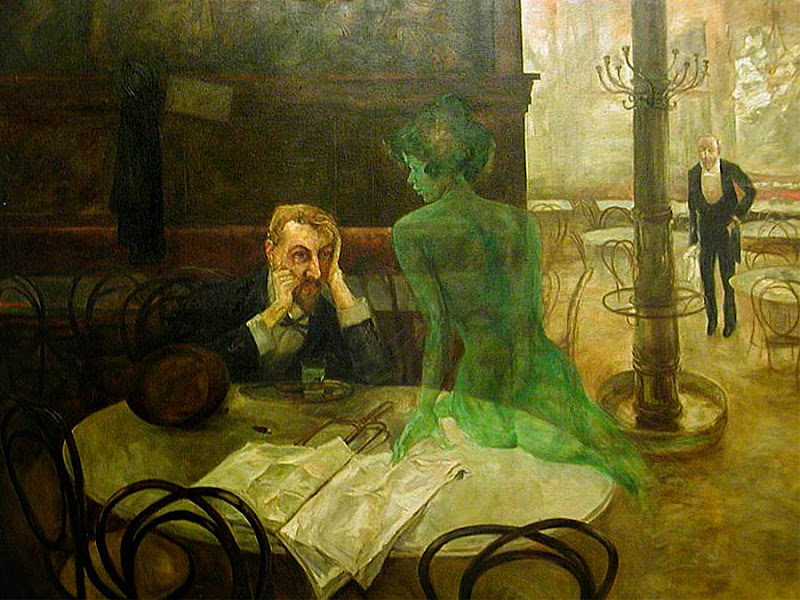 (image via) Chronic use of the spirit was said to lead to absinthism, which was widely believed to cause addiction and even hallucinations. Considered to be a leading source of numerous social evils and a general menace to modern society, absinthe was banned in many countries just prior to World War I, including the United States in 1912 and even France itself, the home of absinthe, in 1914. This lead to the popularity in France of other anise-flavoured spirits devoid of wormwood, such as pastis and ouzo. After World War I, the Pernod Fils brand was still produced in Spain, which had not banned absinthe, but production stopped in the 1960s. 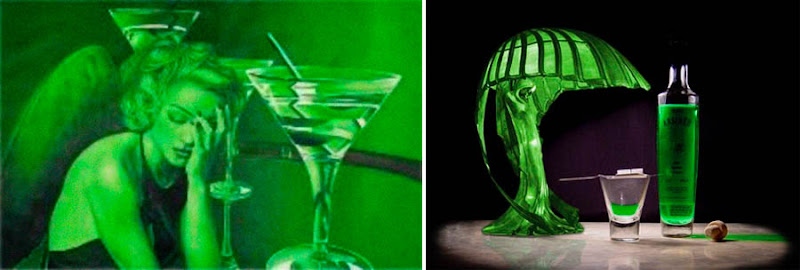 (images via 1, 2) In Switzerland, absinthe production went underground, with people distilling the drink at home as a colourless drink, which was much easier to keep secret from the powers that be. The fabled Green Fairy had never been banned in the UK and in the 1990s became popular when absinthe was imported from the Czech Republic. Other absinthes were made in Spain and Portugal, although true connoisseurs weren’t impressed, since they felt the modern versions simply weren’t the same as the classic drink from absinthe’s golden era. In 2000, commercial absinthe was finally distilled and bottled in France for the first time since 1914 and there are now numerous different brands to choose from. 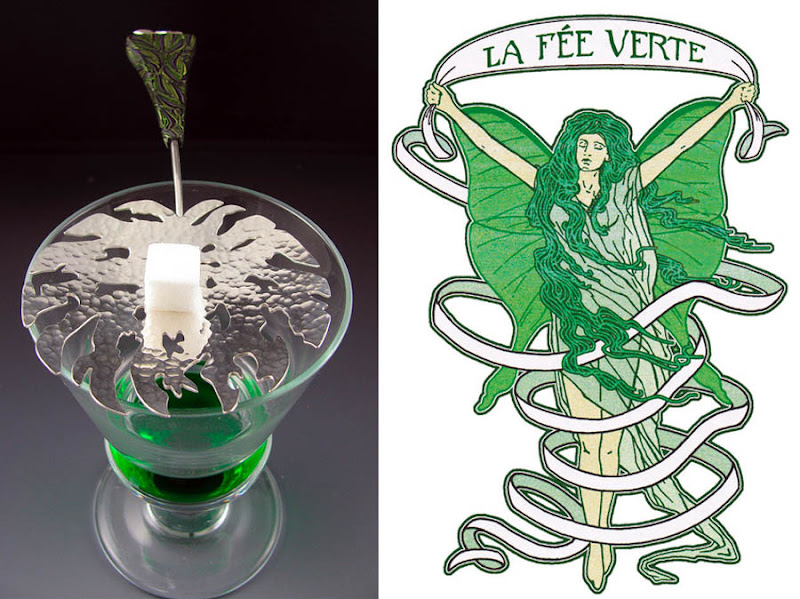 (images credit: Kathleen Brughelli, http://www.originalabsinthe.com/competition.php) Older absinthe spoons were often beautifully designed. With the modern revival, distillers are also producing interesting designs for absinthe accessories, some for the purposes of advertising and promotion of particular brands. Les Feuilles d’Absinthe spoons, feature the intertwined leaves of the wormwood plant in the design: 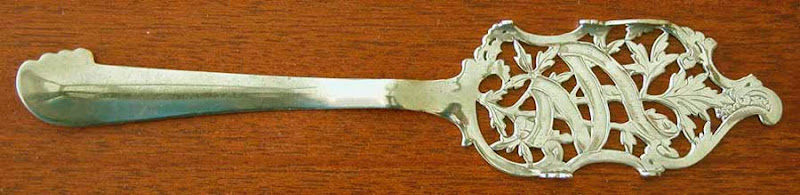 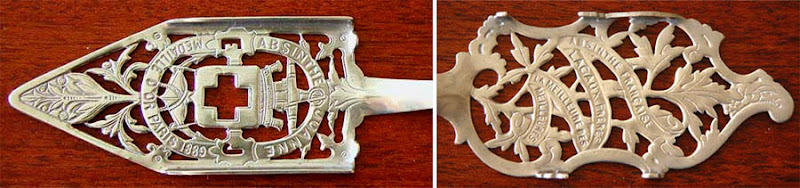 (images via) Les Cuilleres Longues spoons have a distinctive sugar cradle in the middle of the handle: 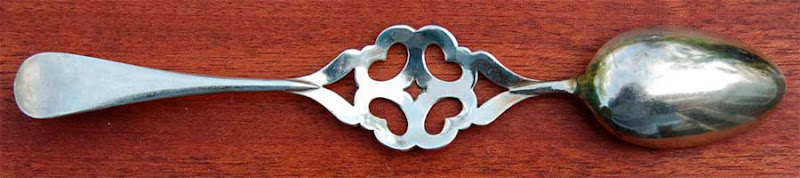 (image via) Here are some very cool looking silver skull spoons (left image): 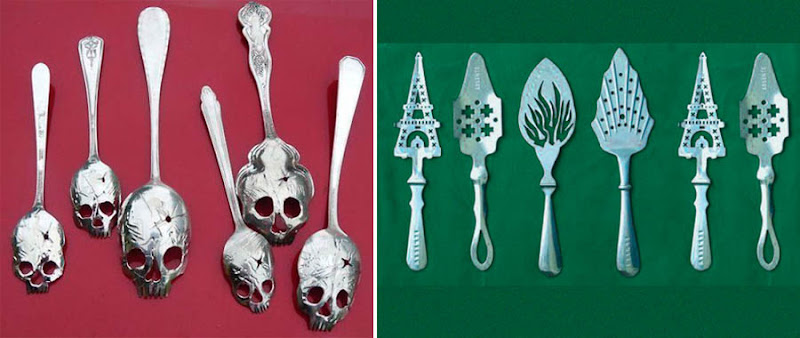 (images via) Another skeletal design, which could maybe serve as a good companion piece to the skull spoons: 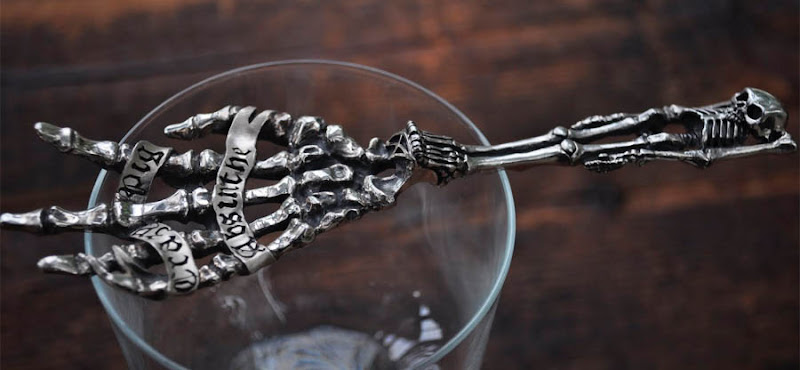 (image credit: Crazy Pig Designs, London) This spoon is decorated with an Edelweiss flower (left). The spoon in the middle is a replica of the Toulouse-Lautrec spoon. The French artist was quite an absinthe fan and was reputed to have a small bottle of the stuff hidden in the walking cane he carried with him everywhere: 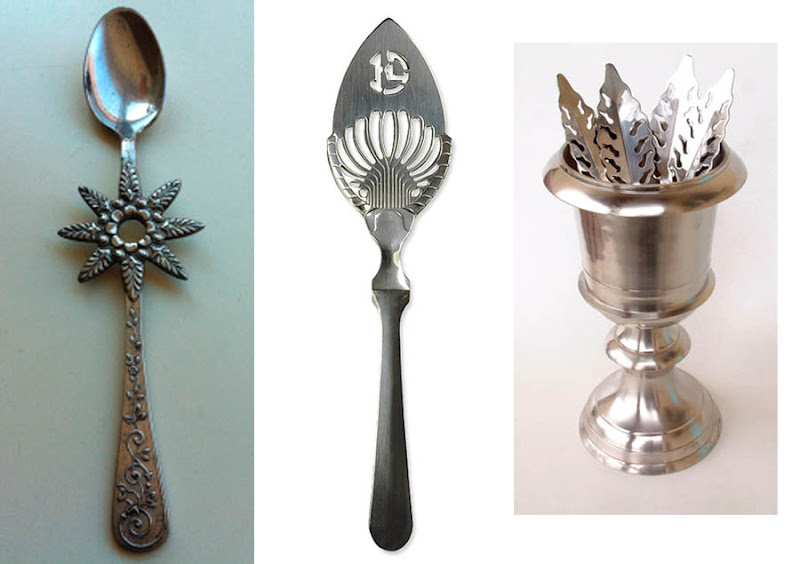 (left image via, middle: Absinthes.com, right image: Absinth.com/) Need somewhere to keep your absinthe spoon collection? How about this very nice spoon holder (right image above)? This is apparently a faithful replica of the type of bar accessories that were popular during the golden era of absinthe drinking in the late 19th and early 20th centuries. Absinthe grilles are basically metal saucers with holes on which to place the sugar cube. The supports at the side hold the grille over the top of the glass: 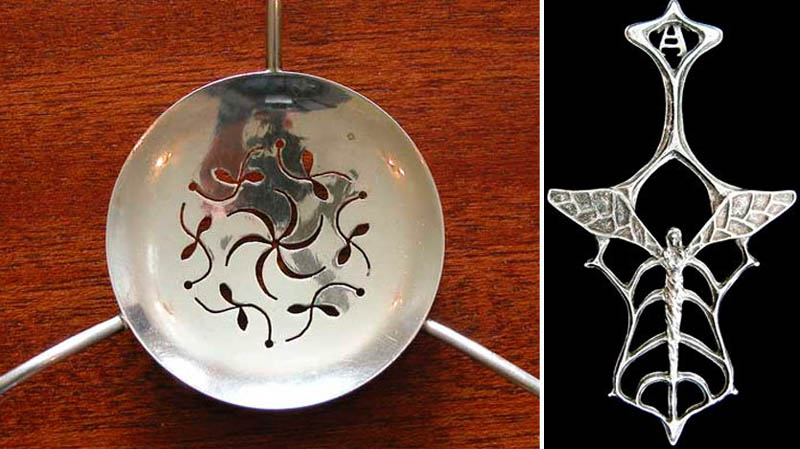 (left image via, right image credit: Absinthe On The Net) Here are some very nicely crafted sugar tongs, complete with an appropriately absinthe green design: 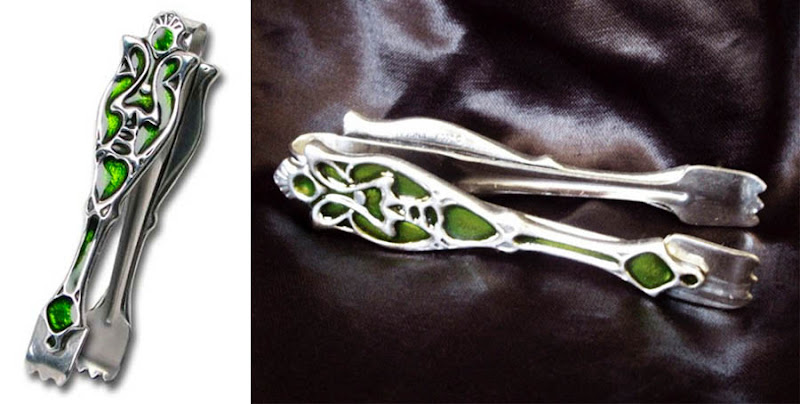 (image credit: Pyretta's Lair) 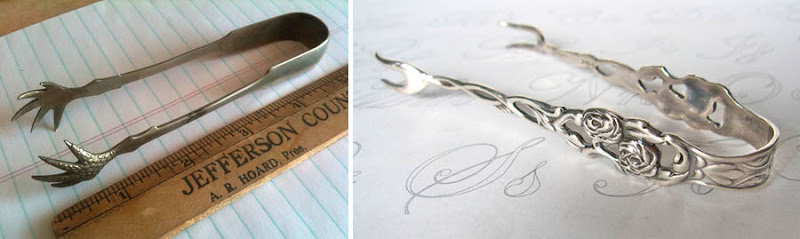 (left image via, right image credit: The Lazy Peacock) Adding water to your drink remains an important part of the entire absinthe ritual and must be done correctly. This carafe permits the drinker to have a great deal of control over the water flow, whether you’d like small drops or a steady flow (left image): 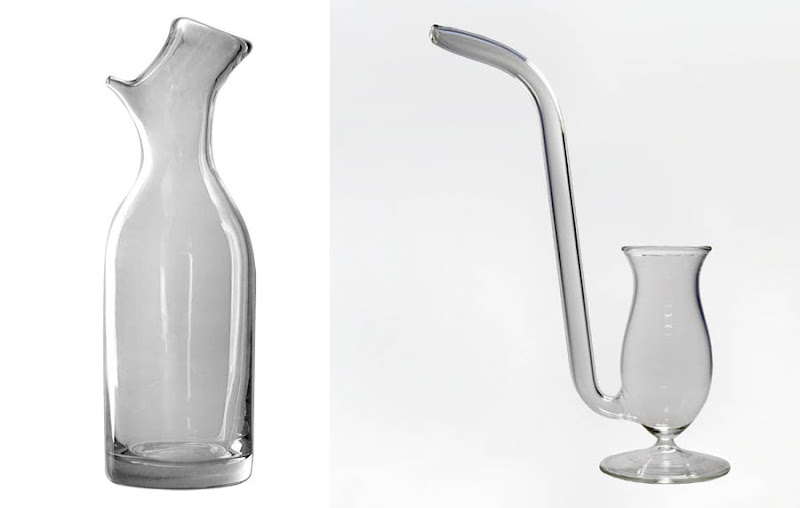 (images credit: Absinthes.com; right image - Absinthe Pipe) Absinthe pipes offer an alternative way to drink your absinthe (right image above). Aficionados of this method drop some crushed ice in the bottom of the glass, then add the absinthe, before sipping the drink through the glass tube. Fountains seem to be a very civilized way to enjoy your absinthe with a group of friends. Absinthe fountains are generally equipped with 1, 2, 4 or 6 taps. This allows for better control over the flow of the water, especially when it comes to the delicate drip that needed to be added to the absinthe in the glass: 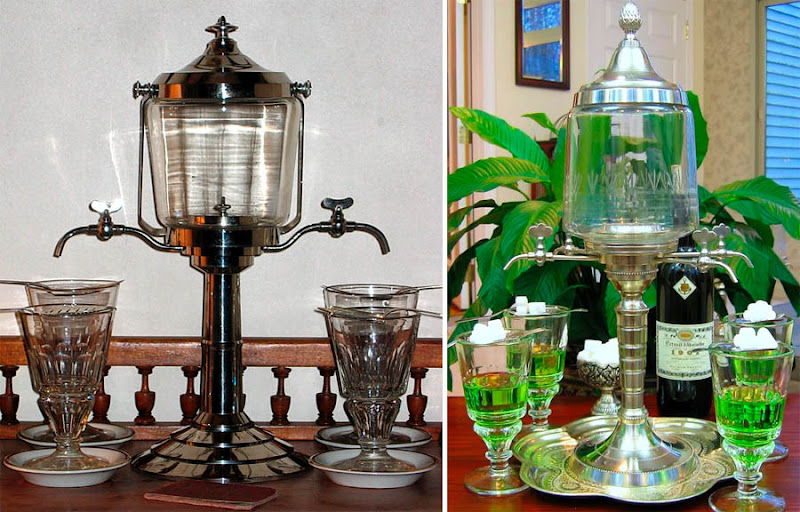 (left image credit: via; right image Absinthe On The Net) 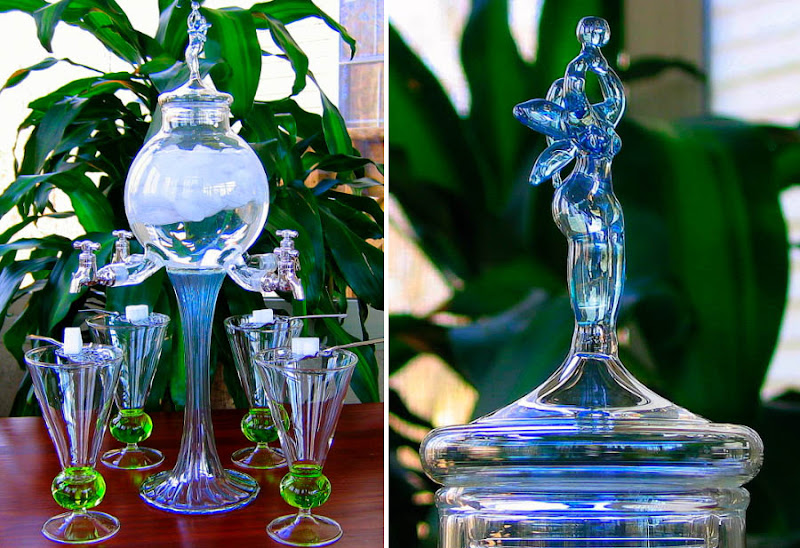 (images credit: Absinthe On The Net) 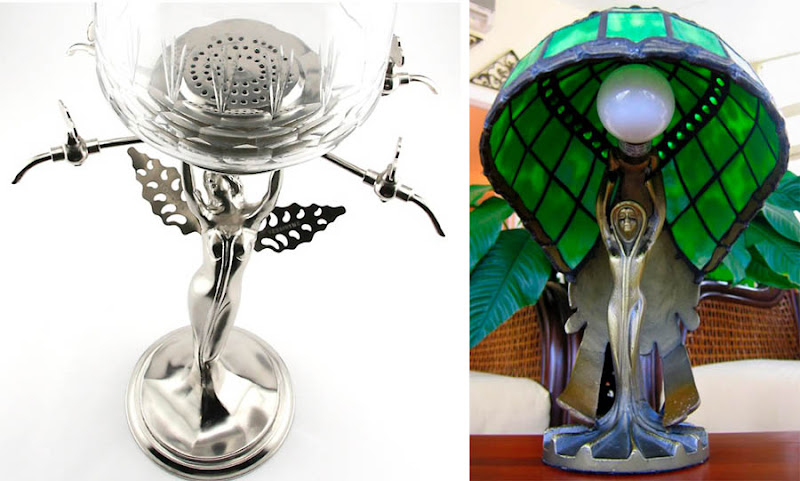 (left: metal fairy fountain via; right: absinthe-themed lamp, via Absinthe On The Net) Here is an absinthe-powered Steampunk Arm (left) and the wonderful mechanical wings of a "Green Fairy": 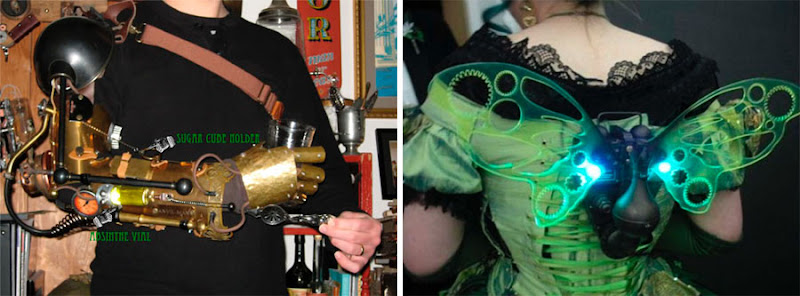 (left image via; right via) And finally, take a look at this beautiful Art Nouveau-inspired "Absynthia" set by architect Dan Slavinsky: various contraptions for the consumption of absinthe in the basement bar "The Bride of Denmark, After the Bachelors" (click to enlarge): 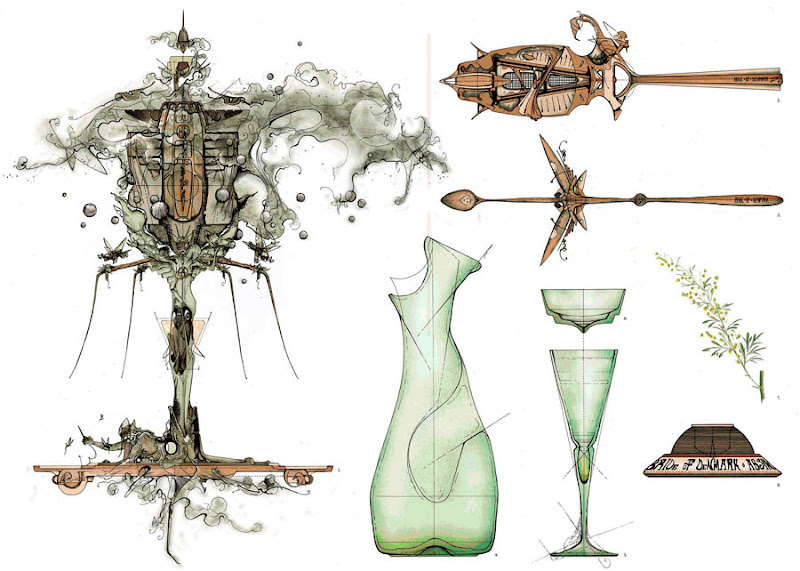 (image credit: Dan Slavinsky) Article by Simon Rose and Avi Abrams, Dark Roasted Blend. CONTINUE TO "WEIRDEST & STRONGEST DRINKS"! -> ALSO READ OUR GREAT "FOOD & DRINK" SERIES! ->
|


firehose, Marceloliberatto likes this