Shared posts

02 Apr 12:16

Explained by TeraS

by TeraS

For those that were expecting Sparkly Horn Horror this time on the Tale, I really have been stalled on that story and I set it aside in order to try and write something. This is that … something. This appears on Groundhog Day and … I do feel sometimes like I am repeating my stories over and over again …

Still, sometimes there are things to say and they need to be …


Explained
By TeraS


Occasionally, though it is rare, there are those in the universe who can see more than most can. Sometimes they see the world around them a bit differently. Sometimes they see shadows or flashes of light that no one else can see. Sometimes they see something—or someone—that pushes at their sense of reality, or belief, and forces them to reconsider that which means the most to them.

Sometimes the question is asked by a raven-haired woman with a pair of red horns poking through her hair and a long red tail.

She should have been cowed by them, frightened certainly, even begging for mercy. That is what they expected when they had surrounded her. Of course, she was found in a place where there was nothing but pain, suffering, and more. That is where their kind dwelled, after all. They expected that she would fight them, in a battle where many would fall. They were prepared for her to twist some of them into things of darkness, the survivors having to end them to protect themselves and the innocents around them.

They had been told, clearly, that she was to be shown no mercy, because her kind, those with horns and tails, were obviously evil and would not give any mercy in return. They attacked, weapons drawn, intending to subdue her as quickly as possible and then vanish into the night. The thing was, none of that unfolded as they expected, and this brought the first small questions into their minds about what, and who, they were dealing with.

Before they could set up their ambush, before they could place their traps, before they could create a situation where nothing could survive … she simply walked out of the depths of the darkened streets. She walked up to them, unconcerned about her safety, it seemed, and approached the leader of their group. She stopped a short distance away, crossed her arms over her chest and regarded them all. She had an expression on her that they couldn’t quite read, but the first words she spoke made it all clear.

“Explain yourselves.”

For a moment, they were all taken aback by her force of will, but then they remembered they were all protected from evil, from what it could do with their minds, and their bravado returned with the leader of their group answering in a gruff voice: “Prepare to die.”

Her eyes narrowed, the green bright and clear beneath the bangs of her wild ebony hair: “I have better things to do. If you were doing good, you would be helping here. But you are not. All you have in you is black.”

Of course they all took this as an affront: a creature like her making such a claim was unthinkable. They drew their weapons, seeing no other choice but to fight her in the here and now, the innocents be damned.

She shook her head, pinched her nose, and sighed: “Fine.”

At this point, they expected her to summon darkness to protect her, to turn into her true evil form. They had seen if before, and were prepared for that again. What they were not prepared for what when she offered her wrists and said: “Bind me. Take me away from here. You will not cause harm here.”

They did not know what to make of this, as never had a creature like her given up without a fight. The leader couldn’t help himself, blurting out: “Explain yourself.”

She smiled, and that smile was one that they knew had no power over them. It couldn’t. Yet it did, and they lowered their weapons slightly. She did not move as she replied: “You will not hurt a soul in this place by your actions. If I do not fight, you will not either. At least there is that much honour in you. So, bind me, take me away.”

They did so, they had the special bindings to hold any being of evil and secured her with them. From that point onwards it should have been a simple matter to walk out of the place, drag her along, and then deal with her elsewhere.

It didn’t quite go as they expected.

They expected to be cheered as they left, to be called heroes for taking this evil from this place. It had happened every time before, and they expected this occasion to be no different. Instead they found that, at first, they were greeted by looks of surprise, then confusion, and then—more troubling—disdain for what they were doing. It started with one of the elders, one they had not spoken to, looking at them in anger and sternly barking two words: “Explain yourselves.”

They were only the first of many. It seemed the further they walked, the more of the inhabitants of this place were coming out to see what they had done. The next demand was made by a child. Two words: “Explain yourselves.”

The next by a couple, the wife with child: “Explain yourselves.”

They did not answer any of these queries, for they had no need to speak to anyone, they knew exactly where the evil was. Still, they quickly escaped the place, feeling more and more uncomfortable by the moment, but certain in their own minds that she was responsible for what happened. She obviously placed a spell on all of the locals, making them so demanding. It didn’t mean a thing.

This was an assumption that none of them should have made.

They arrived at the place they had been told to bring all of the evils they had found, the place where the evils would be judged—a formality—and then ended—which was decidedly not. The building was made to hold evil, restrain it, bind it tightly.

Again, this didn’t go as they expected.

The first sign of a problem was when they finally noticed that the bindings they had used on her, which should have been tight … were not. In fact she had tapped the leader on his shoulder and handed him the bindings with the comment: “Would you like to listen to an explanation?”

When he moved to grab her, expecting her to run away, she pointed at the building in front of them and sighed: “Fine. Let’s go inside. Maybe that will explain it.”

When they placed her in shackles, then locked the cell door and activated the wards, they all felt safe and secure. They all knew, without a shadow of doubt, that no evil could possibly escape their prison. They retired to their canteen, to have a meal and mull over the creature. It was just as the first drink was served that the door to the place swung open with a loud creak.

She stood there, arms crossed over her chest, her long red jacket swirling around her legs, and she glared at all of them. Again she demanded: “Explain yourselves.”

This was impossible! She couldn’t have escaped! Even if she had gotten out of the shackles—which was unthinkable—she could not open the door to the cell or any of the doors in the place. Evil could not do anything there.

Still, she walked into the room, stopping at the far end of the table where they were. “Now, at this point, most intelligent beings are questioning if I am what they think I am. Are you yet?”

The silence in the room was deafening, and the looks they gave her didn’t seem to faze her in the slightest.

“Fine. If you want me, I’ll not be in that cell. I’ll be in your library, reading. Come see me when you can explain yourselves.”

They moved to stop her, but she vanished in a puff of cherry-scented smoke, and that was when panic set in. They scrambled all over their keep, looking for her, knowing that she couldn’t be in the library. The books were sacred: evil could not touch them, use them, or even read them.

When they did find her, she was, in fact, reading by the fireplace in their library. She placed a finger upon the page she was reading, to keep her place and waited, patiently. When they said nothing, but came into the room and surrounded her, she turned her attention to the book she was reading again. “This explains a lot. Who you are, what you do and why. But it does not explain how it is that you are so blind as not to see the truth when it is staring you in the face.”

She turned the page and posed a question to the leader of the group: “How do you know evil?”

He would have preferred to drag her out of the room, but held his hand and answered: “We know it when we see it.”

“I see. Therefore, the failure of your bindings, your spells, your wards and all that you use against evil tells you nothing about me, then?”

“You have the marks of evil.”

She smiled: “Those that I have given comfort, love, and hope to would disagree with you.”

“You trick them.”

She tilted her head to the right: “Really? Then tell me. What is your absolute proof of evil that none can overcome? Please, I ask you, test me. See if you are right or wrong.”

It took some time, during which they all expected her to run, to burn them, to create chaos and destruction. Instead she kept reading the books, one by one, and occasionally leaving for the kitchen to make herself something she called ‘tea’ before returning to her reading.

The time finally arrived, and they brought to her their test. It never failed. It would always, always turn to where evil was. They had searched for some time to locate a newborn and her mother. While the mother would not tell truly the sight of evil, the child would. In evil’s presence they would cry and howl in despair. They expected her to now explode in anger, to kill them all, something to prove she was evil.

Instead she looked up from where she rested when they brought their test in. She smiled, put her book down and then offered: “Please, won’t you both come in?”

While that surprised them, they were more so when she offered the mother her chair, asked if she needed help somehow, and then took another, less comfortable chair from elsewhere in the room to sit beside them.

The mother should have been concerned, upset, angry that her life and that of her child were in danger. Instead the mother looked at the leader of their group and repeated a now familiar demand: “Explain yourselves.”

Before he could, the creature—he still thought of her as that—answered for him: “They wish to test me, to see if I am evil or not. They believe that newborns can tell, for they are the closest to the light of all of us.”

The mother chuckled: “Are they all really that dense?”

She smiled: “They wish proof. They cannot explain themselves.”

There was no other hesitation as the newborn was given to her and she held the child in her arms. No cry, howl, fret, anguish. The child looked up, smiled, and even laughed. She did not look up at them, her attention on the child in her arms as she spoke. “You cannot see anymore. The evidence has been there in front of you all of this time. You have all become so blinded that, when light shines at you, the darkness you dwell in takes it away. You cannot explain yourselves.”

She paused, still looking at the child as a halo formed just above her horns. Large black feathered wings appeared behind her as she stood, still cradling the child carefully. She kissed the child on her forehead and then gave her back to her mother, the two sharing a look between themselves.

She then turned to her ersatz captors, a look of sadness upon her as she did so: “Open your eyes to see. No one else can do that for you.”

She then walked past them all, stopping at the leader’s side for a moment: “See them home safely or you will explain yourselves to me.”

He nodded, still not believing that she had passed the test, as she left the keep, vanishing into the dusk as she did so.

The mother stood and asked: “Do you know her name?”

“No.”

The mother looked at the book the woman had been reading and then closed it with her free hand: “Had you known your own legends, you would have known her name.”

She then looked at her daughter: “And you, my child, you now have a name, too.”

Many years would pass by, the green eyes of her daughter twinkling at the sound of the name, a name she would come to know in the years to come, for she would hear it every day. The day came, many years later, when she discovered a book in the archives of her town. The image in the book and the name written there told her much, but then the story that followed told even more. When she came home that night, she hugged her mother and showed her the book, open to the page with the name, picture, and story.

“I … know her. Can you please explain?”

That story took some time for her mother to tell. At the end of the story she resolved to find this …Tera. Perhaps she might remember her. Perhaps she might explain.

Perhaps she would be pleased to know that they had the same name …

13 Feb 21:22

Black Hole Moon

by xkcd

Black Hole Moon

What would happen if the Moon were replaced with an equivalently-massed black hole? If it's possible, what would a lunar ("holar"?) eclipse look like?

—Matt

"Not much" and "not much."

A black hole the mass of the Moon would have an event horizon about the size of a sand grain. Specifically, according to one of my favorite charts, a black hole moon would be a grain of fine to medium-fine sand, and could pass through a sieve of size ASTM No. 70 or larger. I mean, I guess a black hole with the mass of the Moon would pass right through any sieve, destroying it in the process, but that's neither here nor there.[1]The expression "that's neither here nor there" can be kind of confusing and ambiguous, but I guess that's neither here nor there.

Since the Moon's mass and position wouldn't change, the tides on Earth wouldn't change, either. When you're floating outside a spherical mass, its pull on you is the same regardless of whether the mass is concentrated at the center of the sphere or spread out throughout it. If the Sun were replaced by a black hole of the same mass, the Earth's orbit wouldn't change, although life on Earth might.

With the Moon gathered into a point, there'd be no moonlight, which would affect the life cycles of all kinds of nocturnal animals. But compared to a lot of the other things we've done, that would be fairly minor. The Earth's orbit is stabilized by the Moon, but the lunar-mass black hole would probably serve the same role.

This black hole Moon would be pretty low-profile. If it were much smaller, it would evaporate through Hawking radiation, but a black hole the size of the Moon actually absorbs more energy from the cosmic background radiation than it emits through the Hawking mechanism. Our black hole would really be black.

At least, if it didn't eat anything. If the black hole devoured any objects, it would let off a tremendous blast of radiation. Black holes burn brightly as they devour things; the whirlpool of matter heats up as it falls inward, causing it to glow brightly.[2]A black hole can't devour matter too fast, though, because at some point it would be producing so much radiation that it would blast its own "food" away. This is called the Eddington limit.
If our black hole were devouring matter at the Eddington limit, it would be hot enough to sterilize the Earth.

Fortunately, there's not a lot out there for it to eat, so it wouldn't glow very brightly for now. It would spend most of its time drastically altering the orbits of nearby dust particles—one sand grain pushing other sand grains around.[3]Even if it sucked in matter at the rate the Earth—with its much larger "collecting area"—sucks in interplanetary dust, it wouldn't necessarily be a problem for us.

But there would be one interesting effect: In addition to getting darker, Earth would get colder, because moonlight warms the Earth. It's a very tiny contributor to our global energy balance; the Moon is five or six orders of magnitude dimmer than the Sun. But it's there.

Measurements show that global temperature varies with a 28-day cycle; all else being equal, the Earth is hottest during the full moon. It's a tiny difference—small fractions of a degree—but it's there.

But it turns out most of this effect is not due to moonlight. The largest contributor is the fact that the Earth is slightly closer to the Sun during a full Moon:

Calculating the amount of energy radiated back to Earth by the Moon is deceptively tricky. The Moon reflects sunlight, but with some surprising twists. When the Moon is half-illuminated, you might think it would be half as bright as when full—but it's much less bright than that. And once you account for that, there are even trickier effects to deal with, because science is the worst.[4]Like the fact that the waxing Moon is 20% brighter than the waning Moon, or that the Moon is a mild retroreflector. Then, on top of all the weird visible-light effects, the Moon also heats up under the Sun, then radiates that heat as infrared light.

There's a great discussion of the Moon's effect on the Earth's energy budget in this article by Robert Knox. The upshot is that the Moon's infrared heat radiation turns out to affect Earth's temperature about 10 times more than the visible moonlight, but still about 10 times less than the effect from gravity moving Earth closer and farther from the Sun. Knox even quantifies the effect this has on Earth's radiation balance—the presence of infrared moonlight warms the planet by 1.2 milli-degrees Fahrenheit (m°F).

Without moonlight, the planet would cool down slightly. But given the accelerating rate at which we're adding CO2 to the atmosphere—which changes the Earth's energy balance—we'd make up the difference in a couple of weeks.

So all in all, the conversion of the Moon to a black hole might not even be that big of a deal.

Unless, of course, it happened on certain days between 1969 and 1972, in which case Nixon would've needed yet another one of those speeches.

13 Feb 16:36

Photo


06 Feb 13:19

Zippo Phone

by xkcd

Zippo Phone

What in my pocket actually contains more energy, my Zippo or my smartphone? What would be the best way of getting the energy from one to the other? And since I am already feeling like Bilbo in this one, is there anything else in my pocket that would have unexpected amounts of stored energy?

—Ian Cummings

The Zippo lighter easily beats the phone, even though its fuel tank is barely half the size of a large phone's battery, because hydrocarbons are fantastic at storing energy. Gasoline, butane, alcohol, and fat contain a lot of chemical energy, which is why our bodies run on them.[1]I mean, the latter two, at least. You can't eat gasoline.​[2]As far as I know.​[3]Although technically swallowing gasoline may not kill you, according to Utah Poison Control specialist Brad Dahl. However, he cautions that you will find yourself "burping gasoline," which is "not real tasty." (Actual quote.)​[4]Also, if you don't rinse your throat afterward, it will give you chemical burns.

How much energy do they contain? Well, let's put it this way: A fully-charged car battery holds barely as much energy as a sandwich.

A container of butane the size of a phone battery could, in principle, power the phone about 13 times longer than the battery itself could.[5]In the case of my phone, that could give me as much as three hours. The obvious question, then, is "why doesn't my phone run on propane?"

The obvious answer is "because your phone would catch fire," but that's not quite it. See, lithium-ion batteries are also extremely flammable, and a huge amount of effort has gone into making Michael Bay scenarios less common.

The truth is more complicated. People have wanted to build various kinds of "fuel cell" batteries for almost as long as we've had portable electronics. The allure of hydrocarbon energy storage continues to this day—if you do a Google search for fuel cell phone charger, you'll find news stories about new products announced every year. Many of them are no longer available.

If you really want to power your phone with butane, the current hot project—as far as I can tell from a cursory search—seems to be the kraftwerk portable USB generator, which has made over a million dollars on Kickstarter with several weeks left in its campaign. Of course, a portable battery of the same size could do a lot of the same things, but there are certainly some use cases where the butane charger offers advantages. If you place a premium on reducing weight, or have to go a long time without contact with the power grid, it could be a good option. Let's put it this way: If the phrase "power your phone on butane", makes you think, "hey, that would solve a problem I have!" then go for it.

This gives us the answer to Ian's second question. The Zippo lighter has more energy, but getting it into the phone is a little difficult and requires the overhead of a fuel cell or generator. Getting the phone to start a fire, on the other hand, is quite reasonable, although it may require doing bad things to the battery.

Ian's third question was "what else in my pocket might contain more energy?" Like Gollum, I have no idea what's in your pocket,[6]Or whether you're happy to see me, for that matter. but I can guess that it might contain one thing with more energy than a battery: Your hand.

An adult man's hand weighs about a pound.[7]I wanted to put "citation needed" after that, but to my mild dismay I actually do have a citation. The hand isn't the fattiest part of the body, but if burned completely, it would probably give off about 500 watt-hours of energy, give or take. That's 50 times the energy content of the phone battery, and almost 10 times that of the Zippo. It's also about as much as a car battery.

And, for that matter, about as much as a sandwich.

30 Jan 13:44

Super Bowl

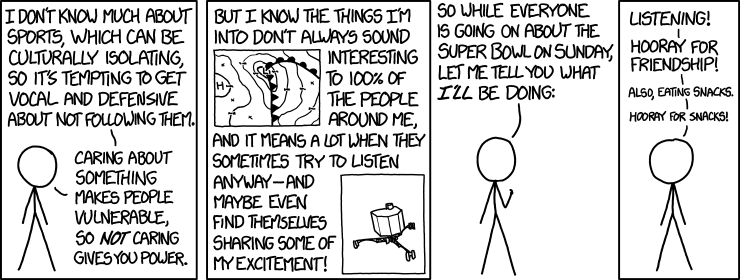
My hobby: Pretending to miss the sarcasm when people show off their lack of interest in football by talking about 'sportsball' and acting excited to find someone else who's interested, then acting confused when they try to clarify.
15 Jan 15:48

Currently 'avoiding' sleep by finishing a short story for class tomorrow. Do you suffer from problems with procrastination and/or creative blocks?

by joberholtzer

Yes! Absolutely. Procrastination is always hard; I don’t have any good silver bullets there. I’m resigned that a good deal of my life will be spent finding new strategies to combat procrastination, and using them until their effectiveness wears off. Overall, most strategies involve trying to get excited for the work but not daunted by its scale or obsessive about perfection. Whatever you’re working on isn’t going to be the lasting totem for you, the person. It doesn’t even have to be that good. It just has to be closer to done than when you started thinking about it.

As for creative blocks, Zach Weiner blew my mind a few years ago when he told me he doesn’t believe in them, just treats them as a lack of input to be addressed. Don’t know what you want to get out? Put more stuff in. Anything. Just give your brain more stuff to process and work on and that machinery kicking in will pay off. Keep your brain interested in the world and fed with stuff and it will do good work for you and rarely dry up. Don’t resign yourself to boredom. Zach reads about a book a day. He’s a monster. It’s incredibly frustrating. Obscene, really. Let’s all think about how we can’t be Zach and shake our fists.

09 Jan 15:10

What I Do as a Librarian

by Dover Public Library
Recently I came across an article from lifehacker.com titled, What I Do as a Librarian, and naturally I decided to take a look. It’s by Andy Orin, and features an interview with the Associate Director of the Baldwin Public Library in Michigan, Kathryn Bergeron. If you’ve ever been interested in what a librarian actually does […]
08 Jan 23:04

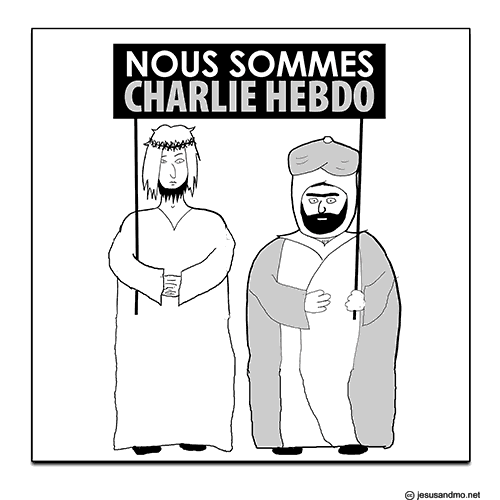
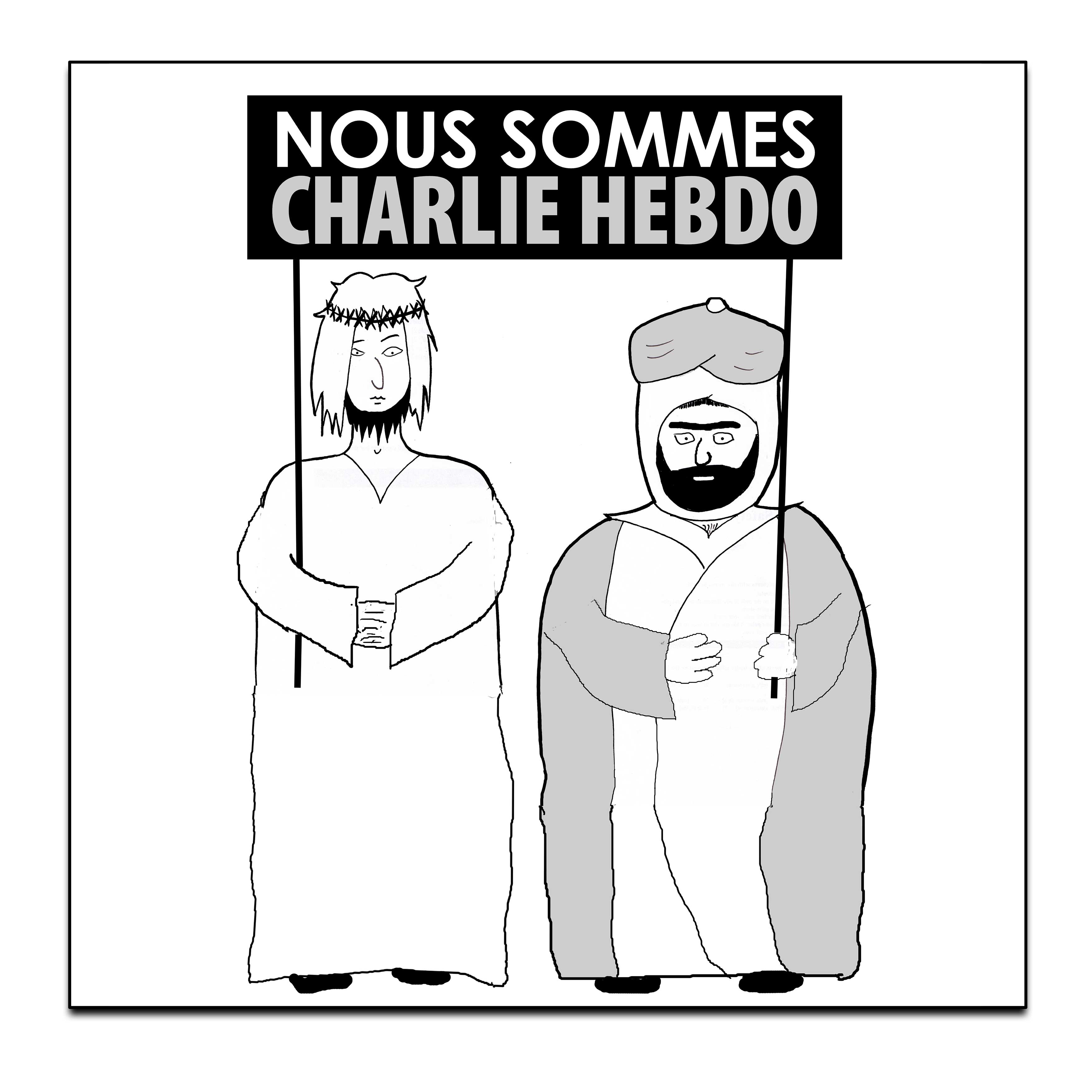
nous

by Author

nous

A placeholder, until the next strip.

UPDATE: For those requesting a t-shirt, here is a hi-res version of the image so you can print your own.

UPDATE2: A kind reader called Dan has made a better hi-res image for you to use if you prefer:

Why not become a Patron of the Blasphemous Arts? Book shop here

06 Jan 16:17

Holidays & Days of Note for January 6, 2014 *   Twelfth...


Holidays & Days of Note for January 6, 2014

*   Twelfth Day, now you know when that damn song is over!

*   Epiphany, This day was also at one time known as Old Christmas (Julian calendar).

*   La Bafana (Italy) a festival on which the night before Bafana, a kindly witch flies down chimneys on her broom and bestows gifts on good children and leaving lumps of coal for the bad children. / la Fiesta de los Reyes Magos `Three Kings Day (Latin America) day when, among other things, the kids get presents rather than Christmas.

*   Festival of Kore (Ancient Greek) 

*   Zvaigznes Diena (Ancient Latvia) 

*   Day of the Lord of Misrule 

*   Little Christmas, Women´s Christmas or Nollaig na mBan (Irish) 

*   Birthday of Haile Selassie (Rastafari movement) 

*   The Birthday of Sherlock Holmes 

05 Jan 15:53

Bookplate: Davies Gilbert formerly Giddy

by Stephen J F Plowman

The bookplate of Davies Gilbert PRS (1766-1839), formerly Giddy, is on sale at eBay, the vendor is bungalowblondie2.  Davies Giddy was the only son of Rev’d Edward Giddy and Catherine Davies. Catherine was heiress to her father and was one of the co-heirs to the Barony of Sandys of the Vine which fell into abeyance in 1683 after the death of the 8th Baron.

Gilbert-Gazette

In 1808 Davies Giddy married Mary Anne Gilbert.     Following the death of Mary’s uncle, Davies Giddy took the Name and Arms of Gilbert.

Gilbert-Davies Bookplate2

Arms: Quarterly 1st Argent on a chevron Gules three roses of the field with a canton Gules for difference (for Gilbert)
2nd Or a fess engrailed Vert in chief a lion passant Gules in base three torteaux two and one (for Giddy)
3rd Argent a fess ermines between three pierced mullets Gules (for Davies)
4th Argent three bendlets Sable on a canton of the last a cross of the first (for Noye)
5th Or a fess indented between three crosses crosslet fitchy Gules (for Sandys of Ombersley)
6th Argent a cross raguly Sable (for Sandys of the Vine )

With an escutcheon of pretence
Argent on a chevron Gules three roses of the field (for Gilbert)

Crest:A squirrel sejant Gules cracking a nut Or charged on the shoulder with a cross crosslet gold for difference

Motto: Teg yw Hedwch

Their children bore the Arms without the canton Gules for difference.


02 Jan 16:59

Fairy Demographics

by xkcd

Fairy Demographics

How many fairies would fly around, if each fairy is born from the first laugh of a child and fairies were immortal?

—Mira Kühn, Germany

"There are always a lot of young ones," explained Wendy, who was now quite an authority, "because you see when a new baby laughs for the first time a new fairy is born, and as there are always new babies there are always new fairies. They live in nests on the tops of trees; and the mauve ones are boys and the white ones are girls, and the blue ones are just little sillies who are not sure what they are."
           —Peter Pan

Interestingly, fairies in the Peter Pan mythology definitely don't live forever. At the end of the book, Peter comes to visit Wendy a year after their adventures. Wendy asks about Tinker Bell, and Peter says he can't remember her and assumes she's died, and Wendy observes that fairies don't live very long.[1]When she expressed a doubtful hope that Tinker Bell would be glad to see her he said, "Who is Tinker Bell?"

"O Peter," she said, shocked; but even when she explained he could not remember.

"There are such a lot of them," he said. "I expect she is no more."

I expect he was right, for fairies don't live long, but they are so little that a short time seems a good while to them.
This suggests that at any given time, there are probably be far fewer fairies than humans in the Peter Pan universe, since they have the same birth rate and shorter lifespans.

But Mira's scenario assumes immortal fairies, so let's talk about immortal fairy demographics.

A fairy is created by every[2]Approximately, anyway, but we'll round up by assuming that all babies laugh. newborn baby. The total number of humans who have ever lived is somewhere around 100-120 billion,[3]There are various groups who have estimated this, and they all tend to come up with a number around in this range. If you take a set of estimates for ancient human population (Wikipedia has a table of them) and assume a birth rate near the biological maximum before the 20th century (35 to 45 births per 1,000, according to this paper), you can derive a similar number yourself. meaning 100-120 billion fairies have been created.

How much do all those fairies weigh? Tinker Bell, the main fairy from the Peter Pan universe, seems to be a little under six inches tall. In a scene in Hook, Tinker Bell (played by the 5 foot 9 inch Julia Roberts) fits comfortably in a 1/12 scale dollhouse, suggesting a height of 5.75 inches. As another data point, the statue of Tinker Bell at Madam Tussaud's wax museum is 5.5 inches. This suggests that fairies in Peter Pan are pretty close to 1/12th scale.

If fairies are 1/12th the size of humans, then they weigh \( \left( \tfrac{1}{12\text{th}}\right) ^3=\tfrac{1}{1728\text{th}} \) as much as us, which means Julia Roberts's Tinker Bell is probably around 35 grams.[4](two mice) As of 2015, total fairy biomass would be about 4 million tons. That's less than humans or horses, and probably comparable to the total mass of all humpback whales.[5]Fairies also probably outweigh wild birds.

At these numbers, fairies would be a minor piece of the ecosystem, although possibly a pretty annoying one.

But it wasn't always the case. In the early days of our species, our high birth rates (and death rates) plus our low population mean that we would have accumulated fairies quickly. The exact numbers depend on when the modern human (fairy-generating) species developed, but by the time the last ice age was over, the accumulated fairies could have outweighed our tiny living human population 10 to 1.

Once our population started growing following the agricultural revolution, we would have quickly outstripped fairies in terms of weight. In 2015, fairy biomass would be down to about 1.2% of human biomass, and by the mid-21st-century, they'd bottom out at less than 1%.

But as long as humans keep reproducing, the fairy population would keep growing. If we assume the human population will level off at around 9 billion partway through this century, then the share of mass occupied by fairies would continue rising steadily.

If our population stays at a stable 9 billion indefinitely, by 2100, they'll be back above 1% of human biomass, and they'll reach 2% by the year 3000. In the year 100,000, if our species is somehow still around, they'll outweigh us.

This makes things interesting. Let's assume fairies need to eat. If fairies weigh about as much as us, they'd presumably be consuming a similar share of food and water. So even if the Earth can support 400 million tons of human, it may not be able to support 400 million tons of human and another 400 million tons of fairy. This suggests that, sometime in the next hundred millennia, the growing fairy population would start to crowd out the human population.

But if fairies crowd out humans, that would in turn reduce the growth rate of the fairies, slowing down the replacement process. The end result (in this idealized model) would be that the fairy population growth would taper off as the human population declined. The situation would never quite reach a stable equilibrium, because every 1,728 human births would create one human's weight in fairies, reducing the Earth's total human carrying capacity by 1. But since the rate of fairy creation would slow down as the human population shrank, the process would stretch out for a very long time.

This odd situation would only exist because fairies—in Mira's scenario—are immortal. The scenario would change dramatically if we introduced a fairy death rate. Perhaps fairies don't age or experience natural deaths, but can still die from other causes.

What would kill the fairies? Who knows.[6]J. M. Barrie introduces a fairy-killing mechanism in Peter Pan; any time anyone says "I don't believe in fairies", a random fairy dies. In a world of immortal fairies, this could serve as an effective feedback. If no one has heard of fairies, no one will say they don't believe in them, and their population will grow. As fairies start to be common enough to be noticed, people will have a reason to say they don't believe in them, and their population will drop.

Eventually, civilization would start documenting the existence of fairies, and then no one would have any reason to disbelieve their existence, and the feedback loop would break down. But ecosystems aren't static. If you mess with one part, the other parts change in response. Fairies could become the dominant species, but the system they learned to dominate wouldn't be there forever.

If fairies represent most of the biomass in the ecosystem, eventually, given enough time ...

... something will learn to eat them.

25 Dec 17:08

Christmastide: Dictionary.com Word of the Day

Christmastide: the festival season from Christmas to after New Year's Day.
19 Dec 14:14

vizualize: Spirograph-like tool online

by joberholtzer
18 Dec 14:23

Holidays & Days of Note for December 17, 2014. *   First...


Holidays & Days of Note for December 17, 2014.

*   First Day of Hanukkah (Jewish) 

*   International Day to End Violence Against Sex Workers (U. S.)

*   Wright Brothers Day, (U.S.) a federal observance by Presidential proclamation

*   Saturnalia (Ancient Rome) Seven day celebration dedicated to Saturn in ancient Rome. It was marked by tomfoolery, mayhem, merriment and the reversal of social roles, in which slaves and masters ostensibly switched places. It’s where many of the things we call Christmasy come from. Which is a little odd as Saturn was not the most chipper of Gods.

14 Dec 16:02

The Lake Wobegon Effect. Where “all the children are above...


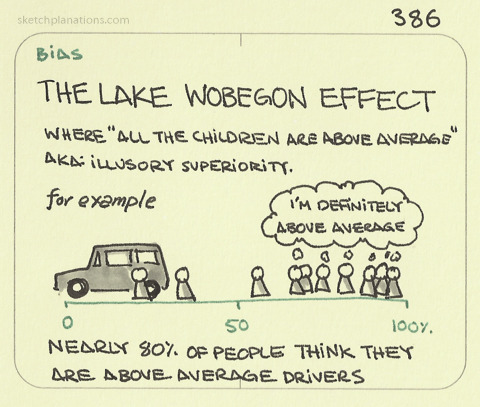
The Lake Wobegon Effect.

Where “all the children are above average.” From the intro by Garrison Keillor to the News from Lake Wobegon on the radio show A Prairie Home Companion. Also known as illusory superiority. From the popular studies where, for example, 80% of people think they are above average drivers, when asked to estimate the % of chores done in the household it adds up to more than 100%, and we overestimate our input to project work and it’s impact on its success. For the best treatment I’ve read, and references, see Thinking Fast and Slow by Dan Kahneman.

14 Dec 16:00

Weltanschauung: Dictionary.com Word of the Day

Weltanschauung: a comprehensive conception or image of the universe and of humanity's relation to it.
08 Dec 16:02

Feedback

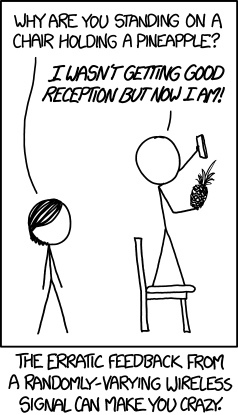
A new study finds that if you give rats a cell phone and a lever they can push to improve the signal, the rats will chew on the cell phone until it breaks and your research supervisors will start to ask some questions about your grant money.
28 Nov 15:06

If Nobody Ever Asks For Your Ideas You May Not Realize Some Ideas Are Better Than Others

by Zak S
Sometimes you read people on-line--you read their game blog or in a forum or whatever--and you think: this is the first time anyone has ever listened to you about anything, isn't it? Some handle it with grace, and it's cool to see. Some don't--but they don't in a very specific way.

_

If people often seriously ask you for your opinion and then go do something with your opinion that affects something, then you might start to think of opinions as affecting things.

If nobody ever seriously asks for your opinion, then you might not think of your opinion as carrying much weight or affecting anything.

-

If you think of your opinion as affecting things, you might be incentivized start to try to make sure it makes sense.

If you don't think of it as carrying much weight or affecting anything, you might not be incentivized to think too hard about trying to make sure it makes sense.

("Makes sense"--that is: matches what you know or could find out.)

-

If you try to make sure your opinion makes sense, you might think of opinions in general as things people have thought out and really believe.

If you don't think too hard about whether your opinion makes sense, you probably think of opinions in general as inherently provisional things that you usually keep to yourself because they're not thought out.

(Like: if you don't think too hard about your opinions or value them much, your opinion of who is smarter might be, in your mind, about as meaningful as who is wearing a better shirt. The idea that one might be a thing you could go figure out and check on and the other isn't might never occur to you, if nobody much ever did anything based on your opinions anyway.)

_

If you think of opinions in general as things people have thought out, you'll tend to think of sharing opinions as basically just polite.

If you think of opinions inherently as provisional things people usually keep to themselves because they're not thought out, you probably think of sharing one as a bold, confident act.

_

If you're used to thinking of opinions as things people have thought out, someone sharing an opinion is (baseline) helpful, good, productive, polite, respectful, necessary and…inherently to be challenged by other opinions. And all subject to fact and being thought out.


If you think of sharing your opinion as a bold, confident act then someone saying what they're thinking is risky to everyone involved--it is asking for things to be put at risk, it is asking for people to make themselves vulnerable. After all--everyone risks revealing their opinion is not thought out, don't they?

_

You see people who seem shocked and alarmed not just to have their opinion contested (which is strangely common) but to be asked at all. This is frequently followed by a diatribe about how unimportant they are--as if that were the point. 

If people often seriously ask you for your opinion you won't see that request as hostile and won't see why people do.

If nobody ever seriously asks your opinion you may be scared. It's not just that you can't handle a conversation about your ideas, it's that you misunderstand why you're being asked to have one.


-
-
-
28 Nov 04:18

stuffbhappenin: Holidays and Days of Note for November 27,...


stuffbhappenin:

Holidays and Days of Note for November 27, 2014

*   Thanksgiving (U.S.) The point being that the real reason for Thanksgiving was not a harvest festival founded by the pilgrims, but a way of bringing the United States back together, North, South, rich, poor, and different cultures after a great riff that almost destroyed the country.

The idea is that as everyone celebrates it, everyone is brought together.

However if, as we have now, it is becoming the poor working on this day, so the dwindling middle-class can go out in a wild buying frenzy, so the top of top of the monetary food chain can become wealthier still then we are not just forgetting the meaning of Thanksgiving we’re saying the true original meaning as intended by Abraham Lincoln can go to hell.

*   Pins and Needles Day (U.S) The origin of this day goes back to the labor movement in the 1930s. The pro-labor Broadway musical Pins and Needles, opened on this day in 1937, at the Labor Stage Theater in New York City. This play was written by Harold Rome. It was produced by the International Ladies Garment Workers’ Union. Union members made up the cast. It ran for 1108 performances, once holding the record for longevity. The idea of the day now is to support the labor movement with creative efforts.

*   Lancashire Day (England) Day to celebrate the English county of Lancashire. Because of reasons. 

28 Nov 04:16

Photo


25 Nov 21:35

Win a free book! Heck, win TWO free books!

Hey guys! There's a contest at the writing blog. It's stupidly easy to enter. Just take a picture of a Post-It with the words "GIMME BOOK!" on it, and link to it in the comments.

Hopefully this'll be fun. We all need a little extra joy today.
01 Nov 13:25

Michael Penna happy halloween from the flux machine!


Michael Penna

happy halloween from the flux machine!

13 Oct 21:19

sennethbrassenthwaite: World Thrombosis Day is October 13th. ...

by joberholtzer


sennethbrassenthwaite:

World Thrombosis Day is October 13th.  And since I’m likely to forget this when it’s actually the official “day”, here’s the infographic that was posted on the WTD website.

As a personal story to this, I had my first PE while I was in my early 20s, I was on oral birth control pills.  I had a second PE after treatment for the first one, and I had genetic testing that showed I was heterozygous for Factor V Leiden, the most common of genetic clotting disorders.  I was put on blood thinner and had an inferior vena cava filter put in to prevent further PE that may come from DVTs in my legs.  However, due to other health issues, I was taken off blood thinner for a while, and I developed a DVT, which then clotted my filter, and the clot on the filter broke off and became a very large PE, which very nearly killed me.  I am now on lifelong blood thinner, and I haven’t had any further blood clots.

It’s incredibly important for people to know the risks and signs of blood clots, and how to prevent them.  Prior to having one, I was only vaguely aware of the fact PEs and DVTs were a thing, and I didn’t really know the symptoms.

More resources: 

National Blood Clot Alliance

Clot Connect

FVLeiden.org

ClotCare Online Resource

International Society on Thrombosis and Haemostasis

Vascular Disease Foundation

Office of Rare Diseases Research

09 Oct 20:41

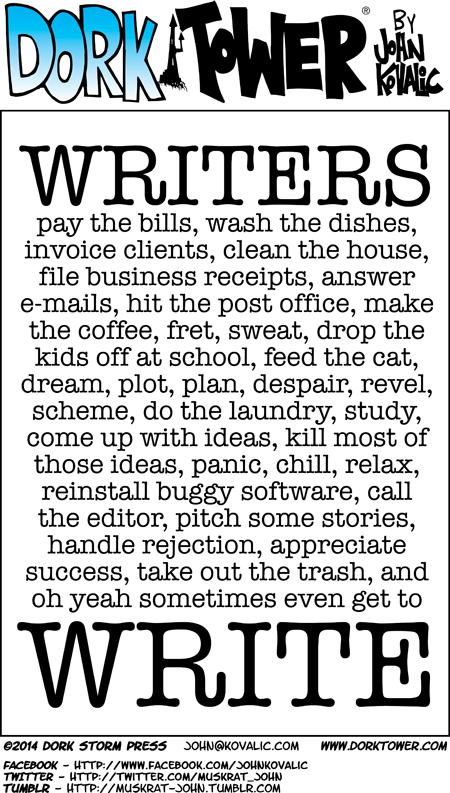
Writers Write! – DORK TOWER 07.10.14

by John Kovalic

Super Happy Writer's Life Fun Hour

And because folks have asked for this in poster/mug/t-shirt form:

Screen Shot 2014-10-09 at 10.10.21 AM

Also, there’s Free Worldwide Shipping on everything at the Dork Store until midnight, Sunday!

08 Oct 13:51

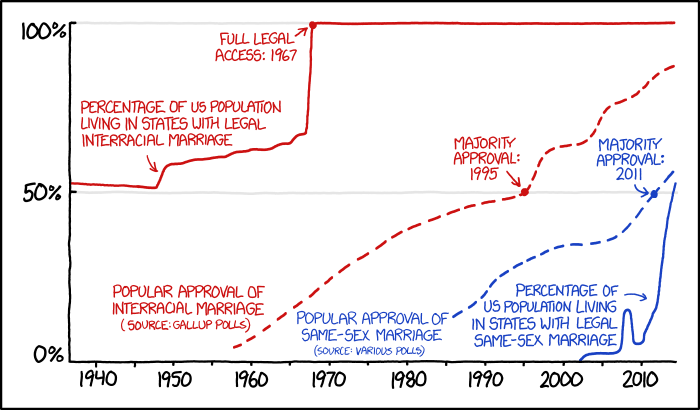
Marriage

People often say that same-sex marriage now is like interracial marriage in the 60s. But in terms of public opinion, same-sex marriage now is like interracial marriage in the 90s, when it had already been legal nationwide for 30 years.
04 Oct 21:35

…and Gygax Saw The Angel

by Zak S
"...and he saw the angel of the LORD standing in the way, and his sword drawn in his hand: and he bowed down his head, and fell flat on his face."
-Numbers 22:

Redoing the Monster Manual some more…
click to enlarge
Angels (split into deva, planetar and solar and all barely distinguishable) come right after the aboleth in the manual and have a similar problem--since they, too, strongly rely on a monotheism for their impact. Plus they're good which means there aren't a lot of reasons to fight them. But I got this.

Ok:

Our plane of existence is sentient. It knows it exists and can see itself.

It's also, naturally, 4-dimensionally aware--it can see all of time at once, and thus all of cause and effect.

So there's none of this "noticing something's wrong and sending an angel down from heaven to address it" that's strictly 3-dimensional thinking. The Prime Material Plane is and has always been aware of any potential problems.

What possible problems could there be? The Plane is existence itself, right? (Echo of an old philosophical problem: why would God need to do anything like a miracle or sending an angel down if the universe works exactly how he wanted it to work?) Surely everything that happens in it is part of the Plane.

Well, almost: The Prime Material Plane can see all of itself as a kind of 4-dimensional sculpture from the inside, with breaks in it where threats from other planes intrude on or threaten it. It can't see those other planes directly, they are not of its substance). The plane can just see where they are interfering with it--the same way that from the inside of a tin can you can't see who's kicking it, but you might see the dent.

So, from the beginning of time, angels have been seeded by the Plane itself to be in exactly the appropriate moment in space-time to address these "dents". Angels are not sent, they simply arise at the right moment.

This conveniently means the angel isn't necessarily a totally useless good guy in the game so much as something dedicated to maintaining the integrity of the Plane. So if players are involved in anything that frays the barriers between planes, then they have to deal with an angel. For example, an angel might mature and manifest at the exact moment the players are about to cross a barrier to the Astral Plane or summon an particularly powerful elemental creature.

Notes in red on the picture:

1. Over by the red 1 I put the three most common manifestations--(i.e. where angels come from): a human can discover they are an angel (typically a paladin that reaches 21st level at exactly the right moment),  a statue can come to life (not unlike a gargoyle's relation to a demon), or an animal can evolve into an angel.

2. Angels in the game typically have a whole laundry-list of resistances and immunities which I simplified to a more mythic rule: Angels can't be hurt by anything from our plane. I'd assume most magic is mostly manipulating things from our plane (fireballs, shadows) but summoned demons (and the weapons they carry and that grow from their bodies) aren't, and a lot of magic items aren't. Clerical magic that manipulates stuff from our plane (lightning, ice) can't hurt them, but anything that channels divine power directly can.

3. Rather than use the Deva, Planetar, Solar hierarchy--which is just one of those "Remember when you fought these guys 4 levels ago? Well here's a tougher one!" hierarchies and replaced it with the Hebrew one--10 ranks of angels from Ishim to Chayot with corresponding HD levels. Added bonus is that tradition assigns many of these angels freaky characteristics like the Chayot has six wings and is covered in eyes. Bonus to using Hebrew mystic names: you can name them ominous things like "Angel of Six Roads" "Angel of Hypothermia" "Angel of Subtraction".

4. Angels carry shields (I know because St Michael does in all the paintings). The shield makes the angel immune to all divine magic. It only works for angels and demons, so stealing it doesn't steal the power, it just deprives them of it.

5. I also figure there are weird things that just happen around angels. Call them Aura Actions? Like animals start singing, etc.

Most of the given combat profile is fine as far as it goes (it's a tough guy with wings), though I decided the flaming arrows and sword that fights by itself were dead cheesy.

I think each individual angel should probably be custom-made with extra powers for its purpose and where it appears. Add slightly modified demon traits if the specific situation doesn't suggest abilities on its own.

-
-
-
03 Oct 12:18

The Metapsychotic System of the Aboleth

by Zak S
Still redoing my Monster Manual...
Click to enlarge
I never really liked the old aboleth, they seemed like ham-fisted attempts at Lovecraftiana, but I like the new illustration, especially when I added in a tiny guy for scale.

Other things:

-Beefed up the physical stats across the board and added a swallow attack to reflect the increased size.

-I never liked the "covers people in slime to enslave them" gimmick--it made it seem too much like the aboleth A) Gave a fuck either way about people B) Had physical tasks they actually needed people for--neither of which seems too Lovecraftian.  You don't want them to be just mean psychic whales. The Manual, however, has a schtick which suggests being unable to breath air is just a disease transmitted as a side effect of being near the aboleth-- which I like very much. I also decided that it drains color out of nearby fish.

-The manual has some good "regional actions" and "lair actions" (things you'd expect to happen around an aboleth)--slime everywhere and delusions--I transferred these from the next page so I could see them all at once plus added a few more.

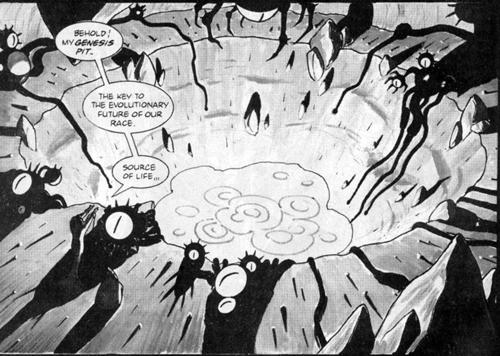
-I gave the pools in the aboleth's lair the ability to dissolve people into liquid memories--stolen from a Legion of Super Heroes comic and Genesis Pits--stolen from the Invid.

-Noted also they're related to the Philosopher species somehow--mind flayers, etc.

-I added 4 kinds of possible lairs and some allied species--cannibal mermaids and sea elves.

I figure aboleths are some kind of lesser Old One or spawn thereof, not actually the big cahuna but something close. They probably each have names and take slightly different forms.

Interpreted as Lovecraftian, Aboleths (and, no matter how you interpret them, the next creature in the Monster Manual--Angels) introduce the concept of belief systems.

Now, systems...
There is a terrifying difference between strings of random phenomena and systems.

From True Detective:

Marty: Shit, man, this dude in New Orleans cut up his girl, felt remorse, tried to piece her back together with Krazy Glue.

Rust: That's just drug insanity. Ah, that's not this. This has scope. Now, she articulated a personal vision. Vision is meaning. Meaning is historical. Look, she was just chum in the water, man.


I believe there's a plastic sack of thick and greyish liquid hanging from a steel pole at the foot of the bed. That's a belief.

I believe it's the nutrient gunk the doctors gave Mandy when she came out of the hospital and when she has her feeding tube in, she has to have it or she'll die. That's a belief system.

A belief just sits there. A system makes demands. You put in an input and out comes an output and you have to do it. So a bad system is very bad.

So they find the dead girl in True Detective, she's been systematized:
"Ideas what any of this means? [Scoffs] I don't know."

"And it's all primitive. It's like cave paintings. Maybe you ought to talk to an anthropologist."

"[Sighs] Lot of trouble this guy went to. Seems real personal."

"I don't think so. Was iconic, planned and in some ways, it was impersonal. Think of the blindfold."

…and that's why it's scary. The system the psychotic is working on here is bigger than a personal reason to kill one person. And that system is enigmatic. It implies two scary things:
-This could happen again
-You may have walked into the system and not even know it

What happens when you're in an enigmatic system? Well suddenly everything you do has a secret meaning you don't know about. Your every action is suddenly loaded with potentially awful significance. As is everything around you.

This is Lovecraftian--and Lovecraft was, as is often noted, not real great about recording or modelling the variety of human personalities. His creatures and intimations doom us all equally.

Kenneth Hite's remarks on such systems:
"…the purest form of cosmic horror, what Lovecraft summed up as the 'idiot god Azathoth,' or what Tim Powers evokes with the djinn in Declare— an intelligence so foreign, so inaccessible, that it can only appear mad or idiotic to us despite its immensity. "

The aboleth, being the closest thing in the Manual to an Old One, has to incarnate this immensity. This is much harder in D&D than in Call of Cthulhu. In Cthulhu there's already an implied understanding of the relevance of psychotic systems to the players: the players know they will discover a murder or a distortion in reality, the players know this will be the work of a thing or the agents of a thing, the layers know there will be knowledge (books, cryptic markings) and these will relate to the thing, and they know the thing, when confronted, will be terrible. A paranoia about being embedded in an awful system is right there on the character sheet from the moment of character creation: Cthulhu Mythos: 1%.

In D&D, the intimations that surround a Lovecraftian leviathan are cheek by jowl with intimations of marauding goblins and intimations of Tiamat and intimations of Loki and every other horror-myth-complex around. If the clues don't all point to Cthulhu, the cosmic horror loses its totalized and totalizing quality--its underneath-everythingness--which is the source of the horror.

And these systems don't match: Loki cares about humans (tricking them), so does Satan (temptation)--Cthulhu doesn't.

I can't think of any easy answer to write into the entry--the only answer would have to be in the GMing. The GM has to build up the alienness slowly, with attention to where the players are at, moodwise. 

Metaphysically, I have maybe the beginning of an idea--In A Storm of Wings, M John Harrison creates the Sign of the Locust, which seems to be an insect cult.

The Sign of the Locust is unlike any other religion invented in Viriconium. Its outward forms and observances - its liturgies and rituals, its theurgic or metaphysical speculations, its daily processionals - seem less an attempt by men to express an essentially human invention than the effort of some raw and independent Idea - a theophneustia, existing without recourse to brain or blood: a Muse or demiurge - to express itself. 

Which turns out to be what it is: there are alien insects from another world who are slowly supplanting our incompatible human reality with theirs--re-dreaming the whole world so it always was a different way.

True Detective also suggests the killers believe themselves to be in contact with another world--rather conveniently, Carcosa--which we have a supplement all about.

So the aboleth--unlike the demon, devil, quasit--does not belong. Not just to the planet, but to this version of history. It's an intrusion from a completely different interpretion of the planet--from a Carcosa-Earth or a Kadath-Earth.

The Old Ones are non gods, from the wrong Earth, and they are in a war of philosophy. The realm of their adherents--the sea elves and cannibal mermaids--is the water and there is more water than land. The sea is different, and divisions disintegrate there. The total incompatibility of the story of the aboleth-reality with what happened here in ages past during the long wars between all the bearded, spear-carrying gods is real--but they're working on it.
-
-
-
02 Oct 21:14

The Known Unknowns

by Zak S
The 9th entry in a series on D&Dable art history
Initiation mask, Papua New Guinea
"...as we know, there are known knowns; there are things we know we know. We also know there are known unknowns; that is to say we know there are some things we do not know. But there are also unknown unknowns -- the ones we don't know we don't know. And if one looks throughout the history of our country and other free countries, it is the latter category that tend to be the difficult ones."
-Donald Rumsfeld

"Psychoanalytic philosopher Slavoj Žižek says that beyond these three categories there is a fourth, the unknown known, that which we intentionally refuse to acknowledge that we know."
-Wikipedia, Sept 25

“The most merciful thing in the world, I think, is the inability of the human mind to correlate all its contents. We live on a placid island of ignorance in the midst of black seas of infinity, and it was not meant that we should voyage far. The sciences, each straining in its own direction, have hitherto harmed us little; but some day the piecing together of dissociated knowledge will open up such terrifying vistas of reality, and of our frightful position therein, that we shall either go mad from the revelation or flee from the light into the peace and safety of a new dark age.”

-H.P. Lovecraft

Art historians want you to have context. This requires ignoring the fact that context doesn't cover the only quality that makes art special. According to context Jim Belushi and John Belushi are basically the same guy--from the same culture, background, class, time, place. Context doesn't tell you which one is funny--and funny is the only reason you'd be paying attention to a Belushi in the first place.
Ekoi headdress, Nigeria or Cameroon, early 20th C

When confronted with art from far away, well-intentioned people like to hit you over the head with how little we understand. And understanding is good, it leads to respect and respect keeps people from making other people mad. But respect doesn't get you invited to parties--only love does that. And RPGs are a party, after all.

The good news is, art wants to be loved. Art doesn't care if you know it's a Belushi of the Belushi Clan of Humboldt Park late 20th C, it only wants you to know it is John and not Jim. It is what it is, but more importantly, it is good.
Zapotec dog being totally metal.
The default response to understanding is respectful distance. So the reason you can now get what is basically Italian food and hear what was once a West African beat almost anywhere in the world isn't because anyone understood those things--it's because they loved them. Wait, you have to learn everything about this before you can do anything with it may be an attitude that makes sure professional contextualizers have tenure, but it is rarely the one that the artists themselves would endorse, and it is never the one they take when they go to work. 

The only point of that whole ramble is this: don't let your ignorance intimidate you. Go ahead and love things and feel free to think about what you love in them. Otherwise art history is just you on the floor pouring over maps of greater Chicago watching K-9 and wondering why you hate your life.

This is not a comprehensive or in any way responsible survey of all the art of Oceania, Australia, Southeast Asia, Africa, the Americas and any other place I left out of the other entries. It's just some stuff I love.
Bhurkumkuta, Tibet, 15-16th C
The fact that most Westerners associate "Buddhism" with Zen simplicity and that Tibetan Buddhism's most popular modern ambassador presents as a kind of blandly retweetable Upworthy humanist obscures the fact that Buddhist Tibet was historically a hotbed of Insane Monster Art full of complex philosophical concepts expressed through esoteric figure symbolism.

The sculptures below depicting the yab-yum, which is, as you can see, a male deity (often with with a lot of arms) fucking a female deity without a lot of arms.
He is not holding a duck in each hand I think he's holding
a flame in each hand. Which as a professional I can tell
you is not easy to do during a scene.

(It has a whole spiritual meaning which there are
a lot of people on the internet dying to tell
you about if you're into that kind of thing.)


Tibetan sculpture has a lot of the movement and vitality of Indian art but also some of the fine, attentuated detail of Indonesian and Chinese sculpture. Though, like the guys who do Space Marines, they consistently have a problem doing legs.

I assume you know the temples of like Cambodia Vietnam, etc are frikkin amazing but in case you didn't know that Java does too, here's Java:
Plaosan Temple, Java, 9th C
Prambanan Temple Complex, Java, 9th C

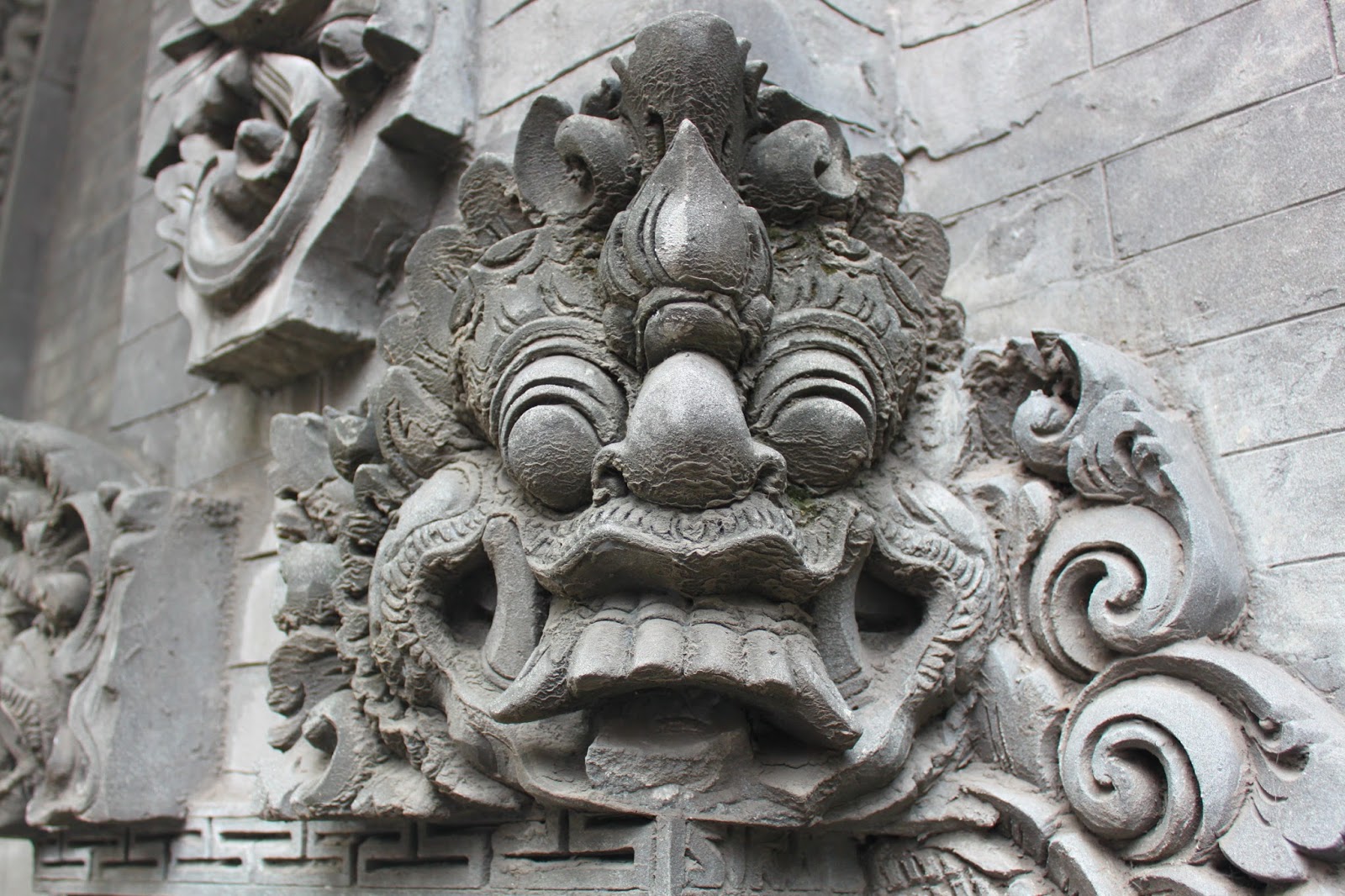
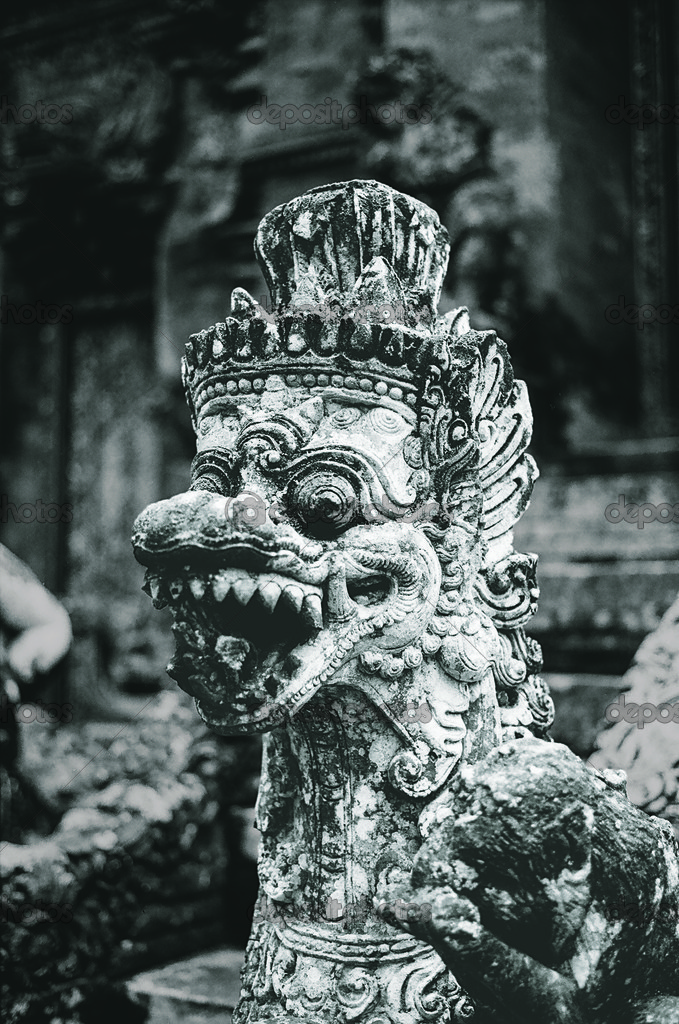
And in Bali they have a kind of sculpture which has a very specific wavelike line not quite like what you'd see in mainland Southeast Asia or in the rest of the islands, plus these distinctly Balinese Crazy Eyes:

I believe those are Garudas


Buddhist and Hindu art are kind of like their own visual genre overlaid over the various cultures where it spread. It's not unusual for other art from the same area to look radically different.

Not far away, in the rest of Indonesia...
Batak divining rooster
Malaggan Mask, New Ireland. The morphology's like
nothing else I've seen outside Yellow Submarine.
It's often overlooked how important individual expression
is in pushing tribal art beyond being just an example of a local style.
Malaggan mask, New Ireland
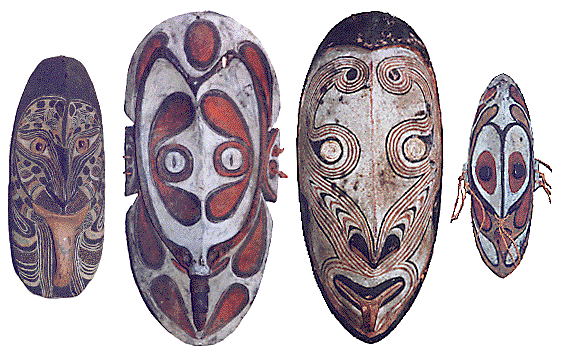
Masks from the middle Sepik river cultures in New Guinea:


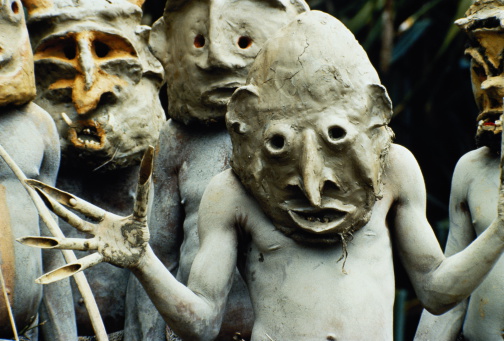
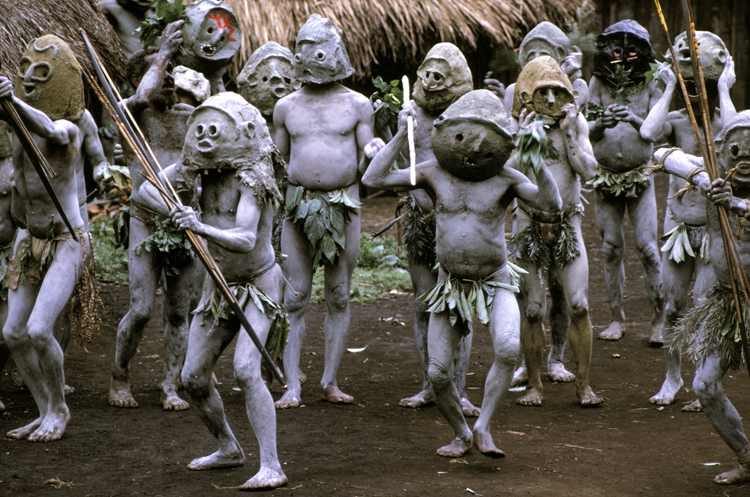
The point of warmasks, like the New Guinean "mudmen" masks below--is to make the warriors look fucked up and thus freak out their enemies. So if they look freaky to you, that is a completely culturally appropriate response. 


Generally speaking, a lot of the apparent grotesquerie in tribal art is conscious grotesquerie--the images represent or incarnate the spirits of the dead and the dead are scary. The fact that the dead are scary is, as James George Frazier pointed out, probably the most widely-shared belief in all of human culture. So if you don't find the images scary and alienating you aren't understanding.

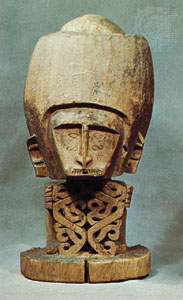
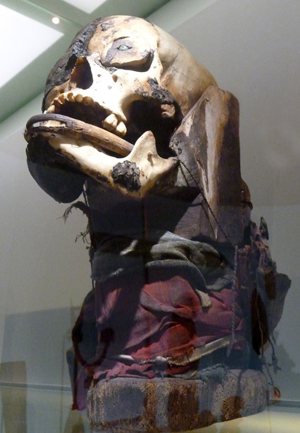
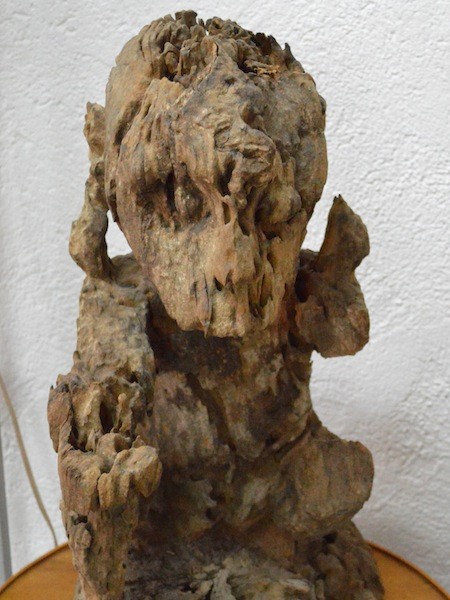
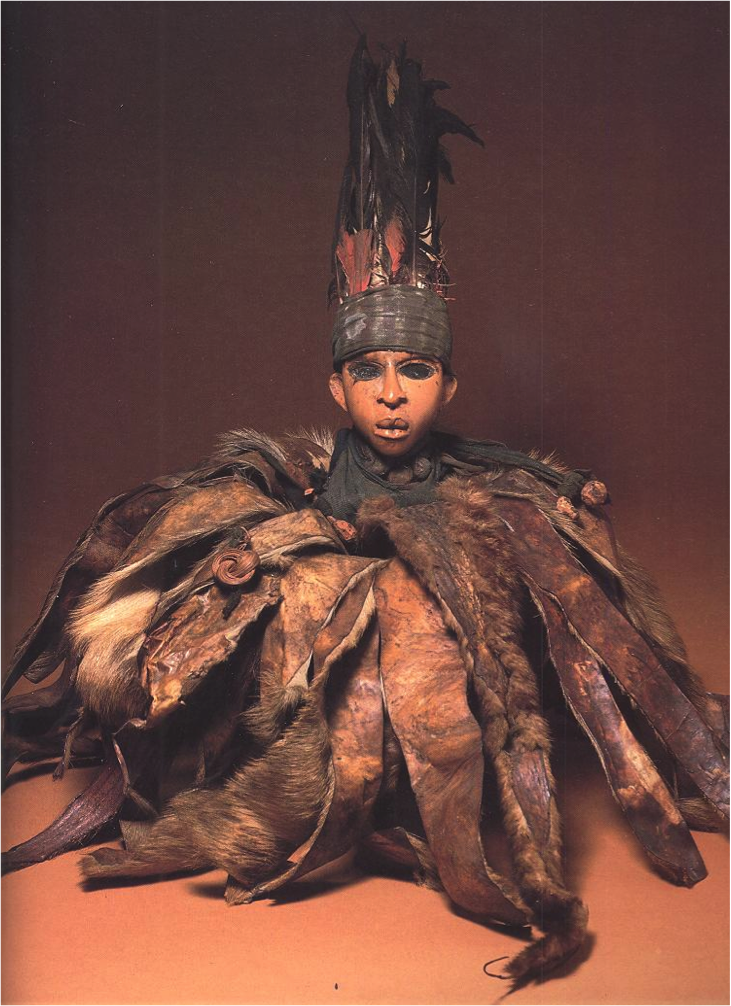
These guys below are called korwars and are apparently a kind of ancestor figure, they
possess the power to prevent bloggers from getting their text to properly left-justify:


I have never seen a korwar like this. I am, in fact,
a little dubious, but that's what the website says it is.
Either way: it is incredible.
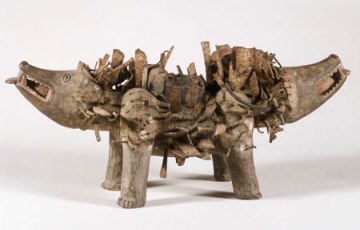
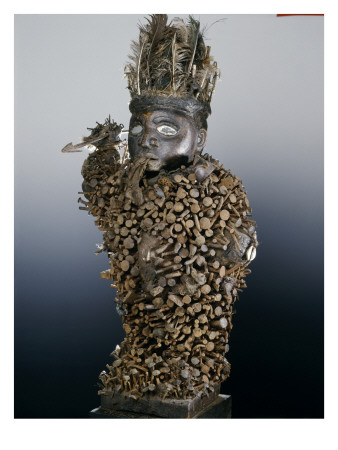
In West Central Africa, they have these things called nkondi (or, formerly "nail fetishes"). The idea is either that you nail your prayer into the figure or that you hammer the nail in to wake the figure up to pursue your foes--I am not qualified or educated enough to say which, if either, of those is exactly right. I am, however, eminently qualified to point out that both of those interpretations are D&Dable as fuck.

The dog figure is apparently named Kozo and protects women. Kozo has two heads to see both our world and the spirit world.


And this guy is called Mangaaka:

These here are other kinds of nkisi or objects in which spirits dwell:


This is the god Gou, made from scrap metal some time before
1858 by an artist named Akati Ekplekendo
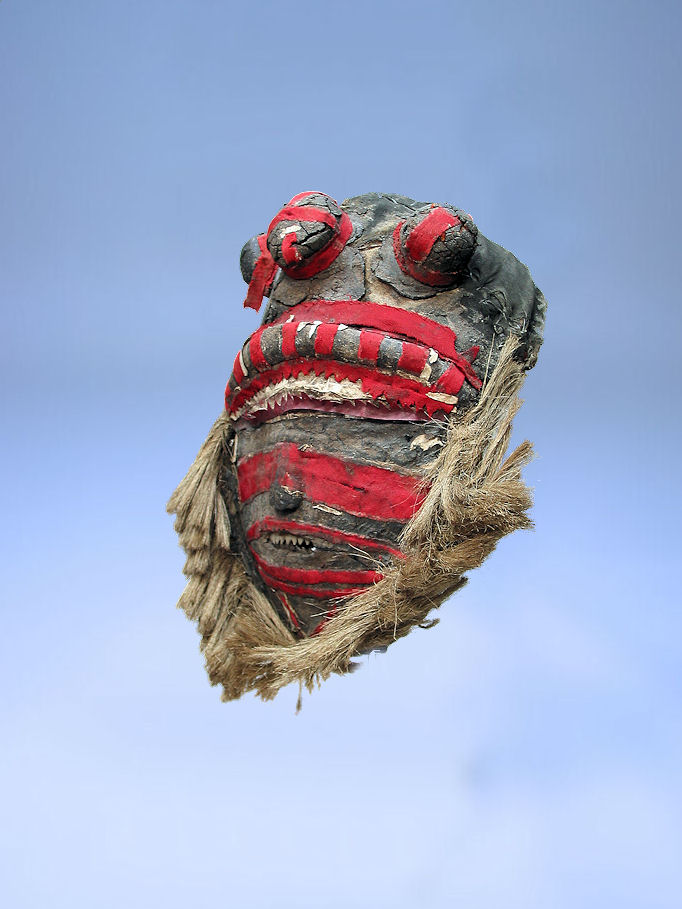
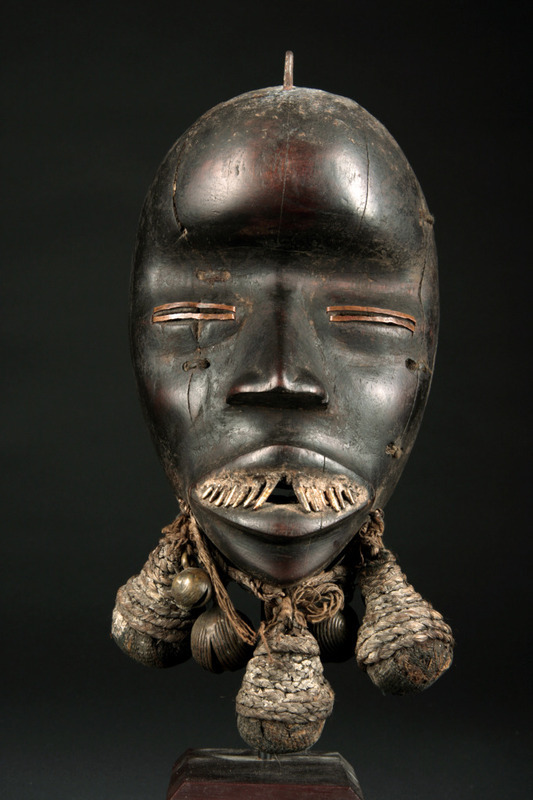
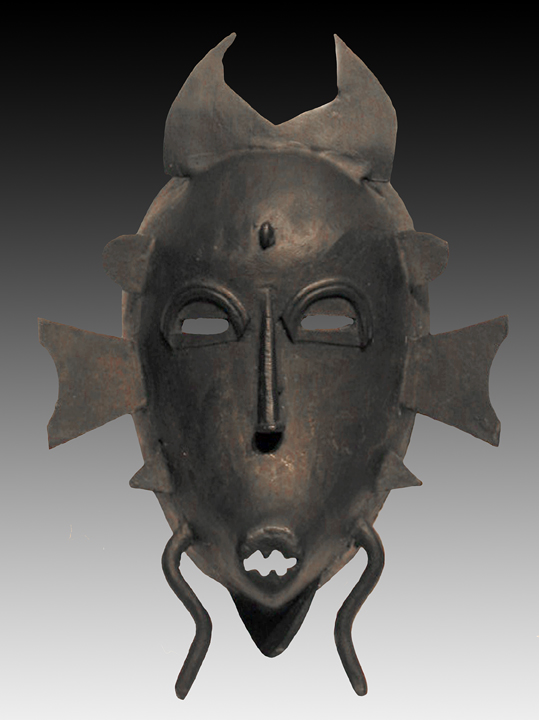
And, of course, in Africa there's the masks, some of which are also meant to aid in possession by the gods or spirits:
Abron
from Mozambique
Bronze, 16C, Yoruba
Chokwe
Dan
Ekoi 

Ekoi
Fang mask for the ngil ceremony
Dan
Tsogo people (from Gabon)
Mask of the Ekpo Society, from Gabon, a sort
of masked spiritual secret police, if I understand correctly.
Requires research, but definitely D&Dable. This is one
example of African art being mysterious and scary
on purpose--even to people within the
culture.
Senofu
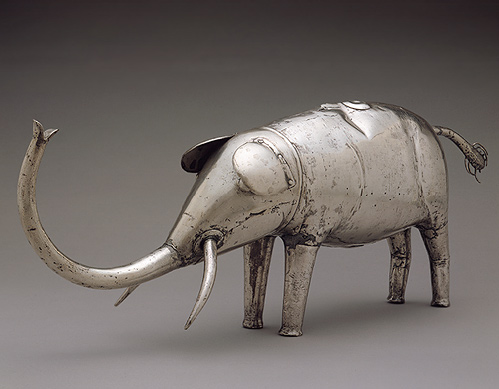
So far as I know this is just a cool elephant someone decided to make:
Silver, from the Fon people, 19th C
This is by a 20th century Nigerian artist named Twins Seven Seven, who, again, made deliberately mysterious images based on a personal symbolism--it's called Invisible Bird On Red Planet. He had style.

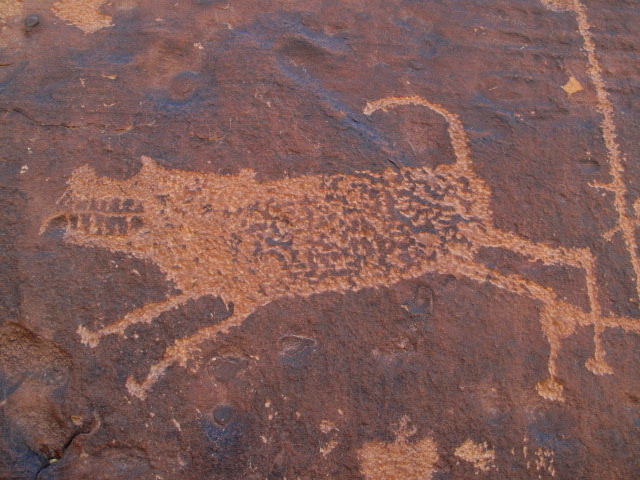
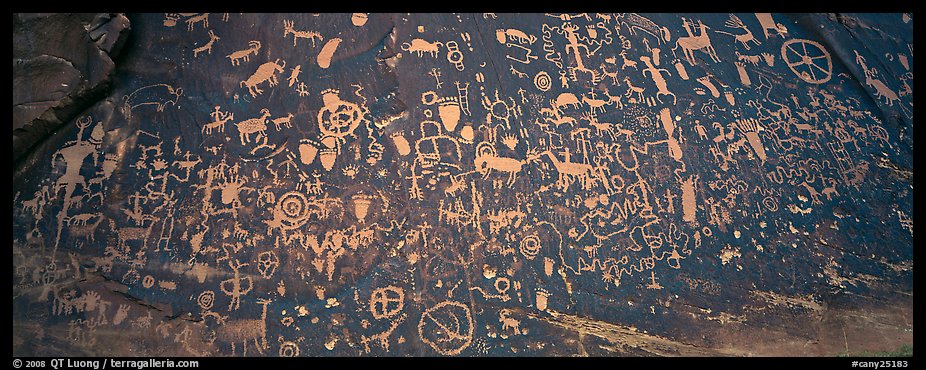
These images are from a place in Utah called Newspaper Rock--the petroglyphs were made by several different Native American cultures:
One thing about Native American cultures is, since they were in America, and Hollywood is in America, and so were cowboys, we actually have movies about Native Americans. This gives us a little more visual context for what the rest of their lives looked like.

For example, in Dances with Wolves we have an attempt to make the Sioux look one way and the Pawnee look a whole other way. Whether or not it's accurate, it at least makes it easier for an RPG person to imagine adventures there as having variety and detail.

We're not so lucky with, like, sub-saharan Africa or Oceania. It's not compelling if the only image from a culture you can imagine is "guy in a loincloth with a spear"--nor is it accurate. Somebody should get on that.


These are Tlingit war helmets. I sure hope some day somebody makes a movie where people fight wearing these:


And someone really needs to do a better job of showing us what was going on down south than Apocalyto did...


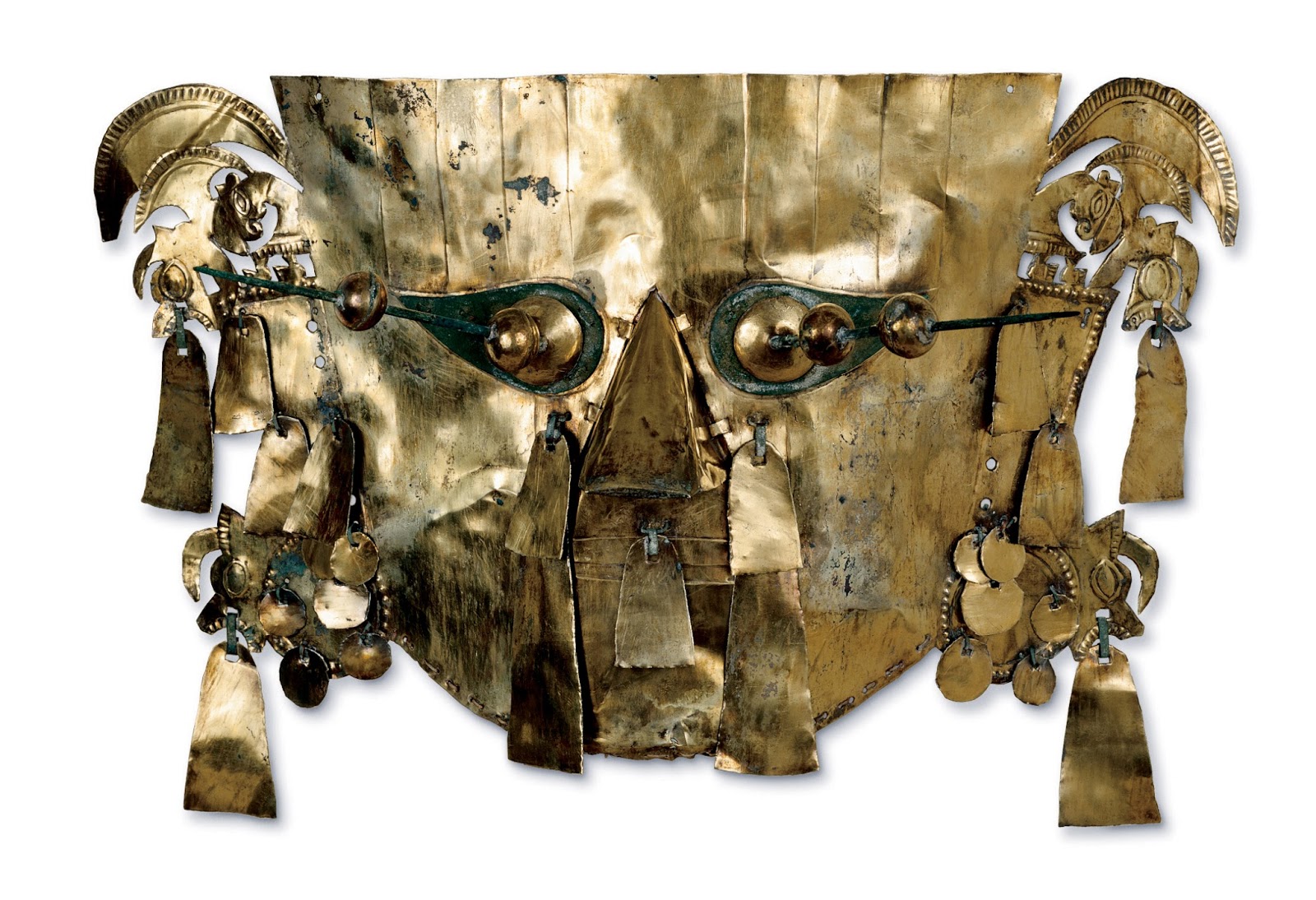
A 15 C. Chimu mummy wore this, in Peru


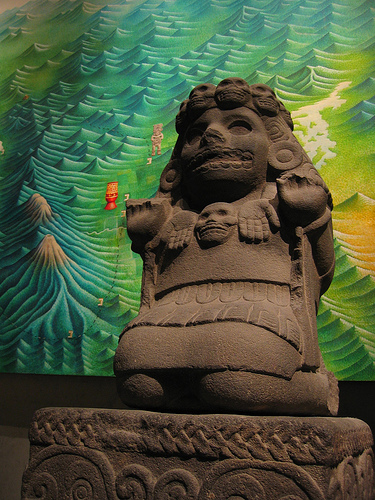
Mictlantecuhtli, God of the Dead. 600-900 CE, Mexico

Aztec--the repeating geometric patterns help identify it

Aztec snake

Olmec Jaguar
Zapotec funerary urn
Zapotec bowl

These are from a gold-filled Moche tomb in Sipan, northern Peru from around 100 CE. Moche art has less of the repeating  rectilinear motifs that you see in Aztec art:


These are from Teotihuacan, which is translated many ways, but the one I like best is "The place one goes to become a god". It was around from 100 BCE to about 600 years later and nobody knows exactly which culture made it. It's in Mexico...

There was a Zapotec "neighborhood" in Teotihuacan. The
Zapotecs were around a long time and their stuff is super
weird.


Next up:
Modernism
02 Oct 20:57

Eight Persimmons Beneath A Severed Arm

by Zak S
This is 8th in a series on D&Dables in art history 
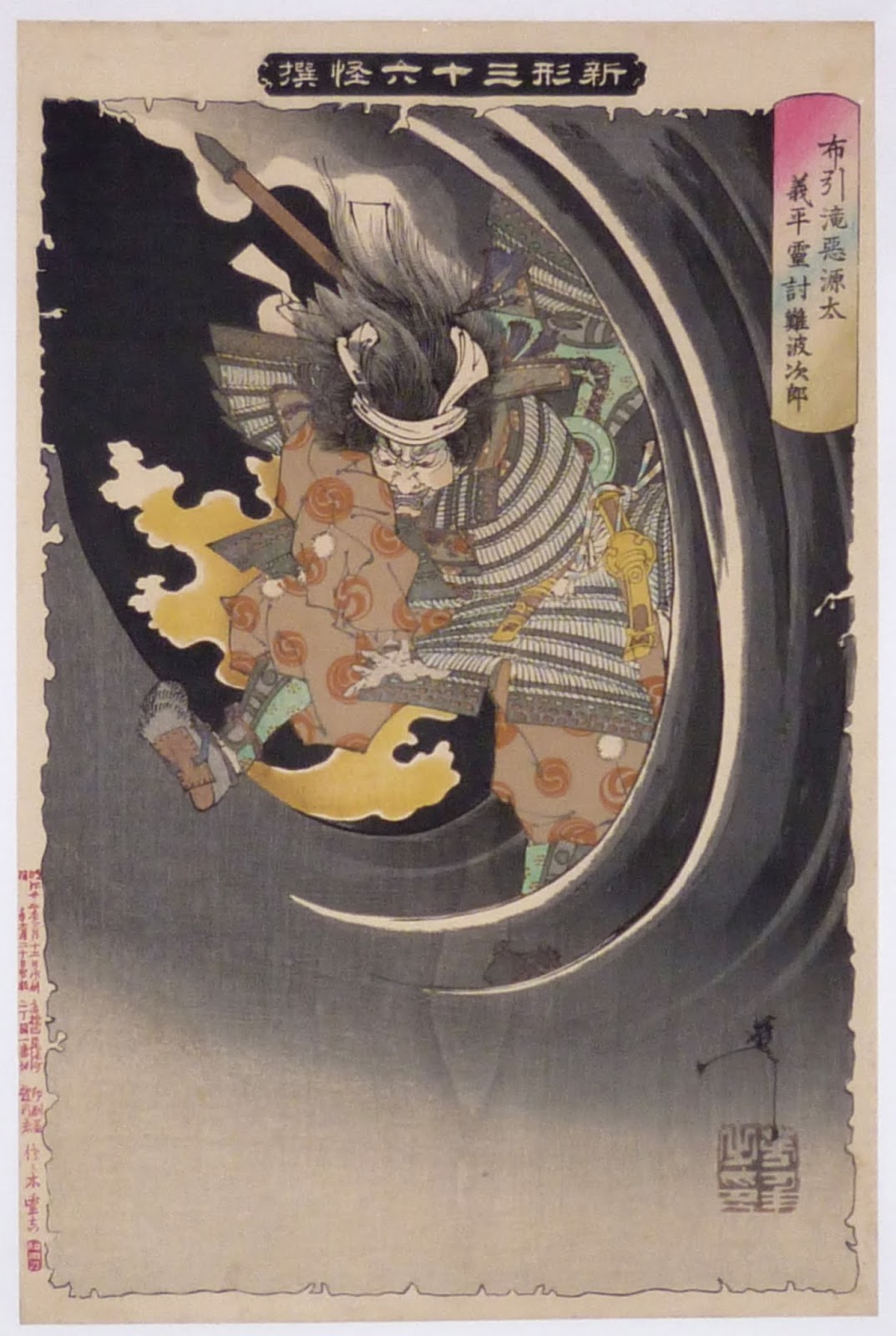
The Ghost of Wicked Genta Yoshihira Attacking Namba Jiro at Nunobiki Waterfall
by Tsukioka Yoshitoshi, whose drunken snapback ink line was marvellously reproduced by
his block-carver in the detail above and imperfectly reproduced by my tattoo
guy on your humble narrator's left shoulder 
The general Western ignorance about far eastern art is chosen: the records of who painted what, when, and why they said they painted it and what people thought about it are extensive and go back a very long time. In eras where Europe was producing pictures attributed to like "Master of Echternach(?)" China had painters with actual names and life dates and scholars producing extensive bodies of theory about them. So we can't fault their book-keeping for our cluelessness.

Part of the problem is your average modern viewer looks at, say, this...
Fan Kuan, Travellers among Mountains and Streams 11th C
...and then this…

Zhang Lu, Hurrying Home Before The Rain 16th C
…and hears that they are separated by five or six hundred years--most of which were spent arguing about painting--and they're baffled.

These paintings seem to eschew so many of the gimmicks Western art (not to mention nearly all the other kinds of images we see every day) rely on--color, action, directness, showy displays of technical knowhow, theatricality, anatomical illusionism, ornamentation--and not even because the artists lacked the time, resources, or technology, but just because they felt like it. They felt like it for 3000 years.
Li Cheng, A Solitary Temple Amid Clearing Peaks c. 960
Zheng Xie, 18th C
Yi Chong, 16th C. Ably representing Korea.

One thing discussions of East Asian art fail to clear up is that the audiences for these works of art were no less enamored of shiny colors or the illusion of action or any of the other vulgar chicaneries the artists of a sophisticated and technologically advancing civilization will inevitably experiment with than anybody else. They just got their fix elsewhere.
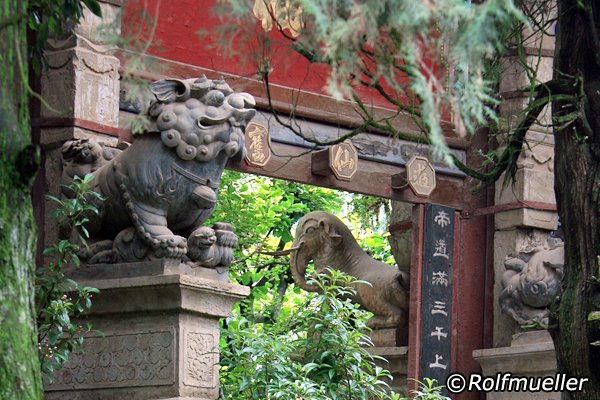
Qishan Wanfo Temple
Model city from…some time. I'm guessing Han but
I dunno.

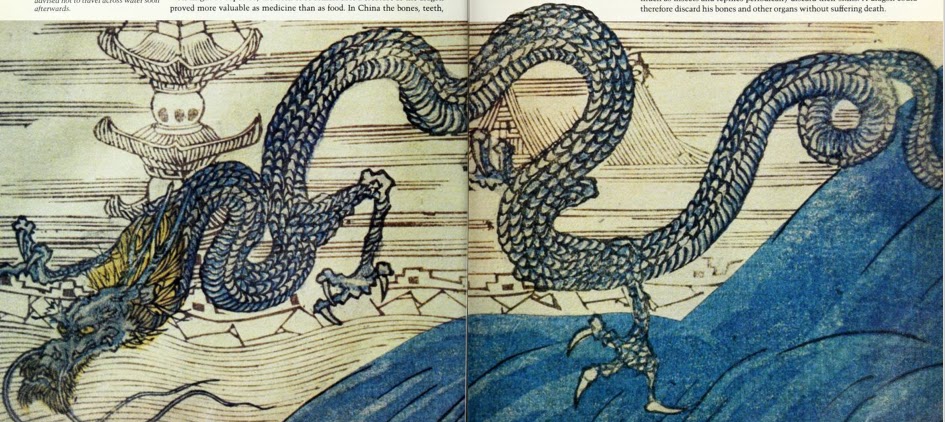
No idea when this is from because even though
Peter Hogarth's book "Dragons" is amazing
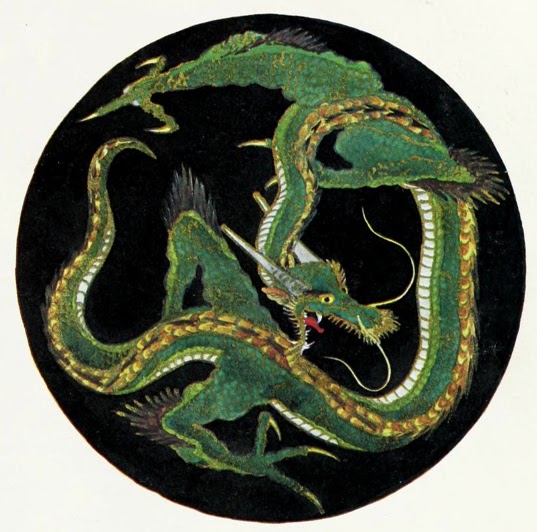
its illustration attributions suck.The scales
and claws suggest to me a relatively late date
like 18something
The homes and temples of the Song, Yuan, Ming and Qing rulers were, like those of the Medicis and Popes, filled with awesome fancy junk. China, in fact, mastered awesome fancy junk (full of, yeah, color, action, directness, showy displays of technical knowhow, theatricality, anatomical illusionism, ornamentation) faster than almost anyone else. 
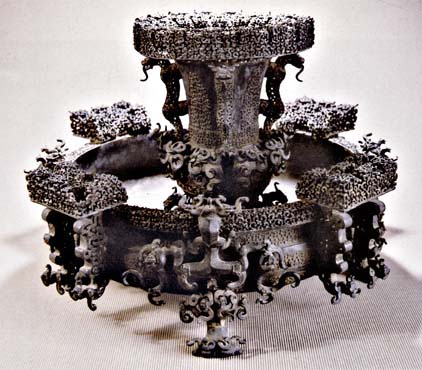
Zun and Pan Assemblage, C 435 BCE
Zhou or Han vessel
Gilt bronze dragon, 750 CE
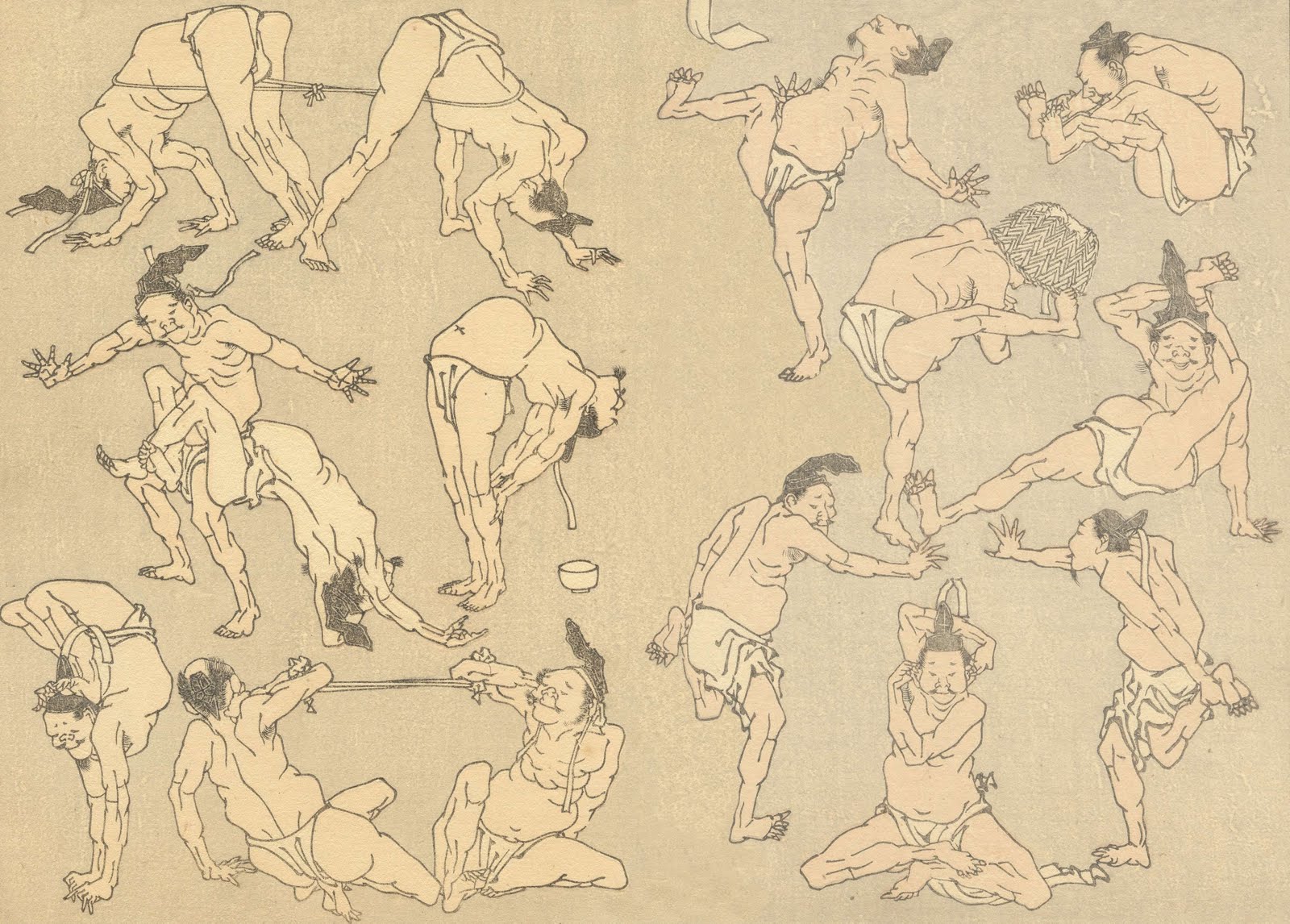
Dancing weirdoes, Eastern Han, 25-220 BCE 
Palatial homes in the West were ostentatious with architecture, furniture, jewels, costumes and exotic fabrics and the paintings that adorned them evolved to be focal points of that ostentation--to show a sort of concentrated essence of all that color and craftsmanship.

The Eastern palaces were equally magnificent, but the scroll paintings were conceived as a contemplative rest amid the silk and splendor, not a climax of it.
Qing era
East Asian ink painting became aligned with poetry and calligraphy--as in Islamic art--but whereas in the Middle East the calligraphic line turns the poem into a picture, in the Far East the calligraphic line turns the picture into a poem.

You turn the corner, you see the scroll, you lean in, you follow the movements, you are taken far from the calculated and crafted world where the scroll hangs, into not just nature, but nature as seen by another. The brushstroke is an island of human touch hanging on the wall of an otherwise seamless, symmetrical, dyed, gilded, lacquered and manufactured world.
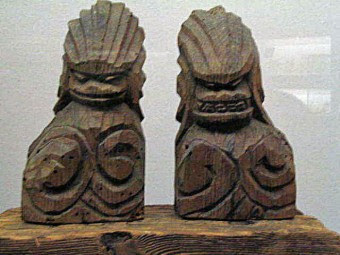
Unimportant Japanese Meiji-era wood sculpture: When your "tossed
off crap for the tourist market" is this good and has a monster this
visually consistent with what was being produced 500 years before
you have one serious motherfucker of a craft culture. 
The Western painter's work is of a piece with the work of the Western sculptor, artisan or jeweler--it is a built thing. You can see the arts and crafts develop in tandem in Europe and to the same ends. The Eastern painter's work stands as an emblem of individual human vision and fragility in contrast to built things.

It keeps what the person has seen and how they saw it from being lost--like tears in rain, as the guy said. Western painting--oh hold on I have to grind up some bones to make yellow--is a much too indirect art for sketching impressions, at least before it found out about Eastern painting.
Hongren, 17th C
Painting existed in a para-literary space rather than the decorative, sculptural or architectural one that Western art chose to compete with. Kurt Vonnegut likened the mind-clearing effect of coming home from work and reading a short story to a "Buddhist cat-nap". The ink painting tradition isn't too far from this idea: The artist takes you--(using a distinctive and personal hand) away and you read the painting as much as look at it--then you return to the world.

Unlike a typical western painting--and much like a story waiting quietly in a book--they don't grab your attention. Grabbing would require intruding on the room, the paintings do not look back at you. They wait for you to look into them, and then hold it as long as you're willing to engage them.
Zou Fulei, A Breath of Spring, 1360

Same thing, close-up

Chen Rong, Nine Dragon Scroll, 13th C,
even the dragons are waiting behind clouds...
more of that
Li Di, Maple Falcon and Pheasant, 12th C. Birds
in trees was a whole genre unto itself.
Monkeys in a loquat tree, 11th c.
Japan, despite relying on the same bag of technical tricks, displayed a consistent inability to quite get with this program. The seeds of the vivacious and frenzied visual culture Japan has today are visible in there form early on.

Chinese paintings allow you to step into them, Western ones ask you to step into them (think of the Mona Lisa looking, smiling, saying "the world's like this, ok?"), Japanese paintings, from surprisingly early on, threaten to step out into your space.

While those Chinese monkeys up there have the good sense to repose for the unknown painter in both the loquat tree and the composition it and they both serve, these Japanese monkeys insist on fucking around. The way they hang almost satirizes the way the scroll hangs from the wall.
Attributed to Mori Sosen but it doesn't look
like his other monkeys so I dunno, 18th-19th C
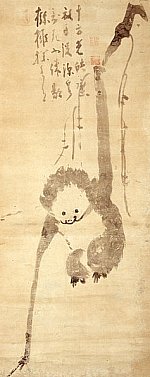
And this guy? He's looking right at you. Totally not a chinese monkey thing to do:
Hakuin Ekaku, 18c
By the 20th century you could argue the influence
was going the other way.  This is the Chinese artist
Pan Tianshou, from 1961.
Now part of it is the influence of Japanese Zen and the emphasis on spontaneity--here's Sesshu in 14something…Landscape Splashed With Ink:

…and Enku--a 17th C monk--embodied this direct Zen aesthetic in wood temple sculpture...

But there are other forces at work underlying this sensibility:
Chinese liondragons? Just chillin'--carved from the same ineffable celestial cloudstone ether into which they stare…
Japanese temple monster? You can totally tell someone went and looked at a real animal at some point before carving this guy…maybe it was just a shaved shih-tzu, but it was something with muscles and teeth and a face...


19th C netsuke. And there's also bunraku
puppets and noh masks and a billion other
things I don't know enough about to
even scratch the surface of...

…and there's also a distinctly Japanese willingness to let the decorative elements…
19th C
17th C
….into the paintings. Here's Ogata Korin (16th C) prefiguring Gustav Klimt:


______

I'd submit that the reason almost all eastern and western paintings look so, well….old…to us up until very recently is we don't live in those same rooms. The homes of the modern not-fabulously-wealthy are hopelessly eclectic--we have all this shit because we might need it--the Ikea shelf and the New England blanket and the Japanese printer and the Italian yard sale end-table and the fake-Turkish rug and a dog bred by Chinese emperors to look like a lion. So we want a picture to bring its context with it, and establish a mood under its own power--the artist can't rely on the environment to provide the necessary counterpoint. It can be a conscious effort of will for a modern person to collect the necessary calm to engage a Velazquez or a Li Cheng, even when we recognize there's something worth seeing there.

---
I'm going to guess Japan's emerging merchant class had the same problem as modernity approached, and so, to serve them, Japanese artists created the earliest artform which is is still capable of giving the contemporary viewer no impression of being seen through a mist of time, the one that is still capable of striking even a child as being as fresh and as immediate as a snapchat: the ukiyo-e print.

The "pictures of the floating world" merged the fluidity and personal touch of ink painting, the design sense of the luxuries and textiles, and the visual ferocity always latent in the mythological sculpture to create something which became--as the form reached its peak in the 19th century--as different from what had come before as Jerry Lee Lewis' piano is from Mozart's.

Roughly in order, the (eminently D&Dable) highlights are…

Hokusai:


He made this insane painting right before he died.
I wonder if a young Bill Waterson ever saw it.

Hiroshige:

(…these things were prints, remember, so the variation in color is because different editions were printed with different inks. Sometimes, also, the variation we see now is due to the ink fading or oxidizing in different print runs.

On top of that, the artist had to rely on rely on the block-carver to transfer their design from drawing to block plus maybe even new owners adding personal ownership seals to the final image--much as a contemporary comic penciller needs to develop a style that works no matter who the colorist, inker and letter are.)

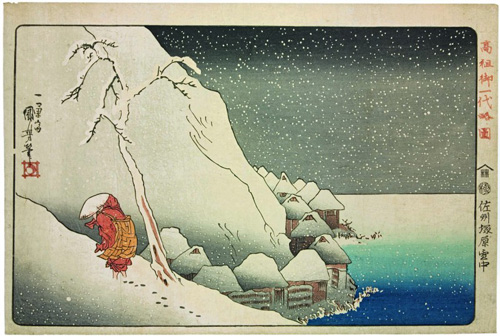
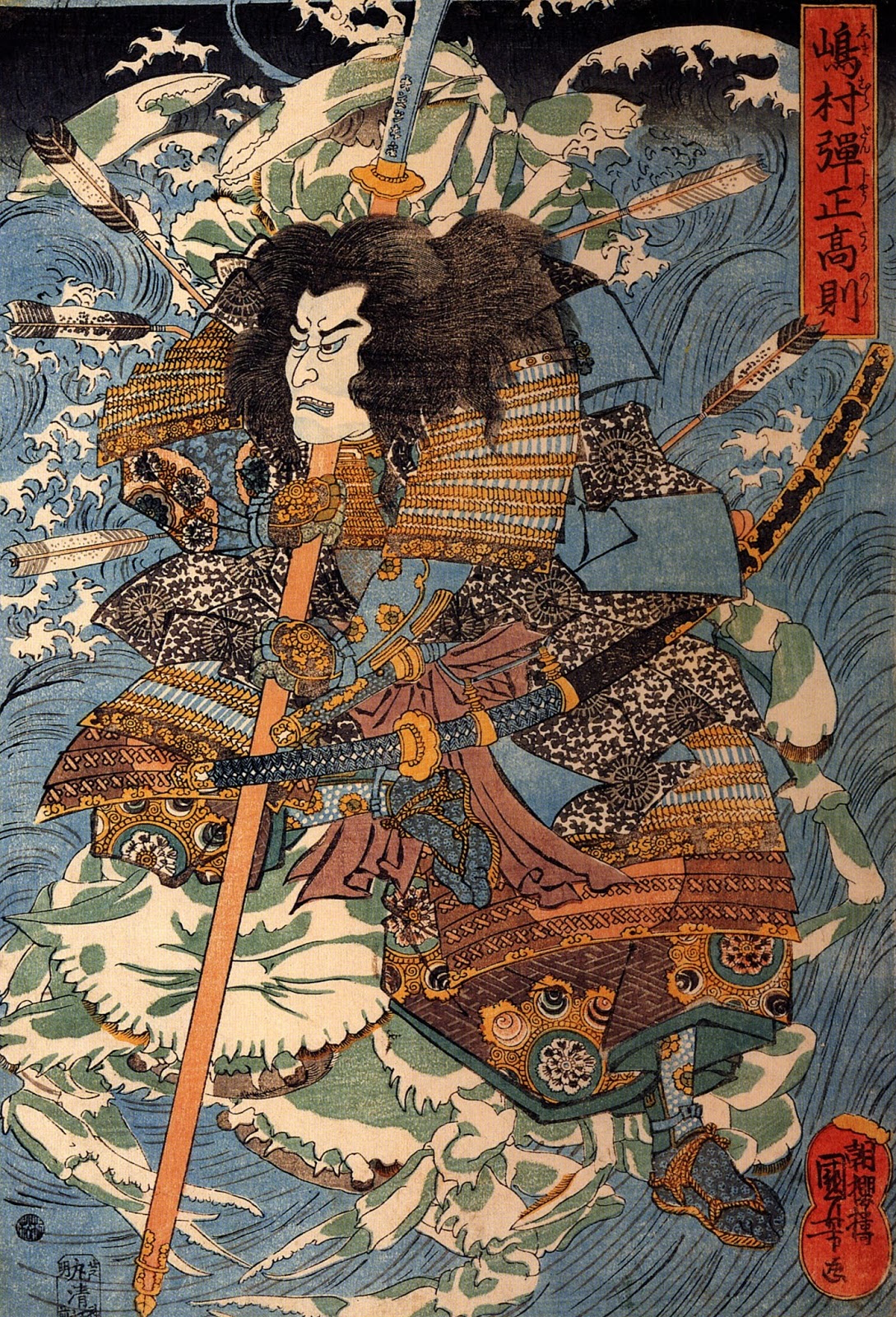
Utagawa Kuniyoshi:


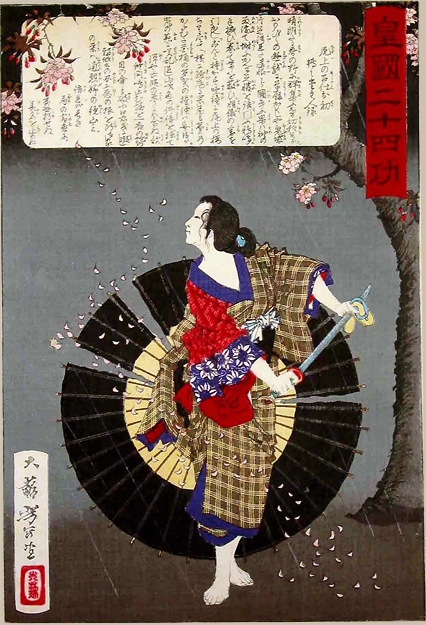
Yoshitoshi:

The rest of the Ghost of Genta Yoshihira


23 Sep 18:54

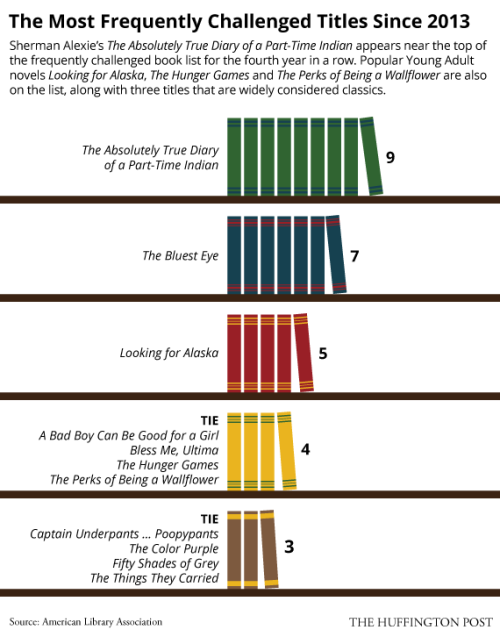
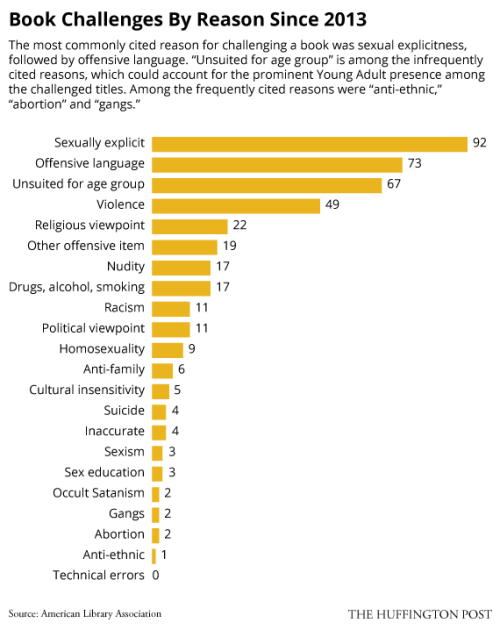
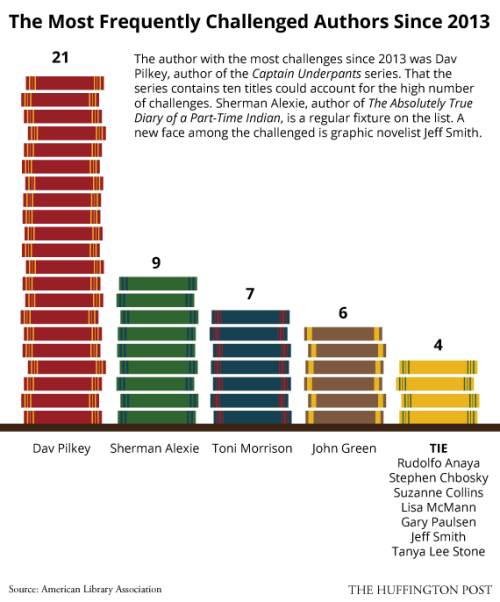
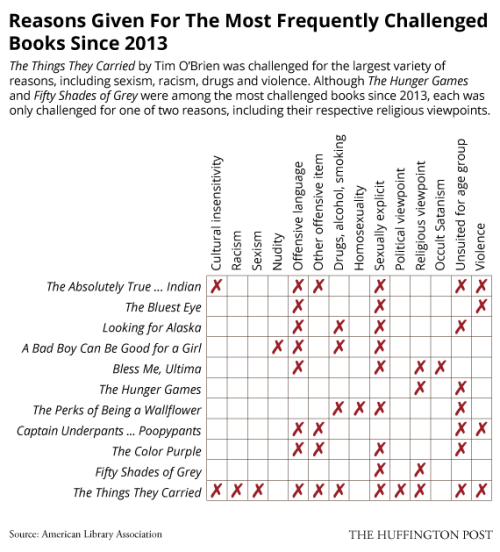
Banned Books By The Numbers via Hitchcockismyhomeboy Tumb

by joberholtzer


Banned Books By The Numbers

via Hitchcockismyhomeboy Tumb