Throwback Thursday


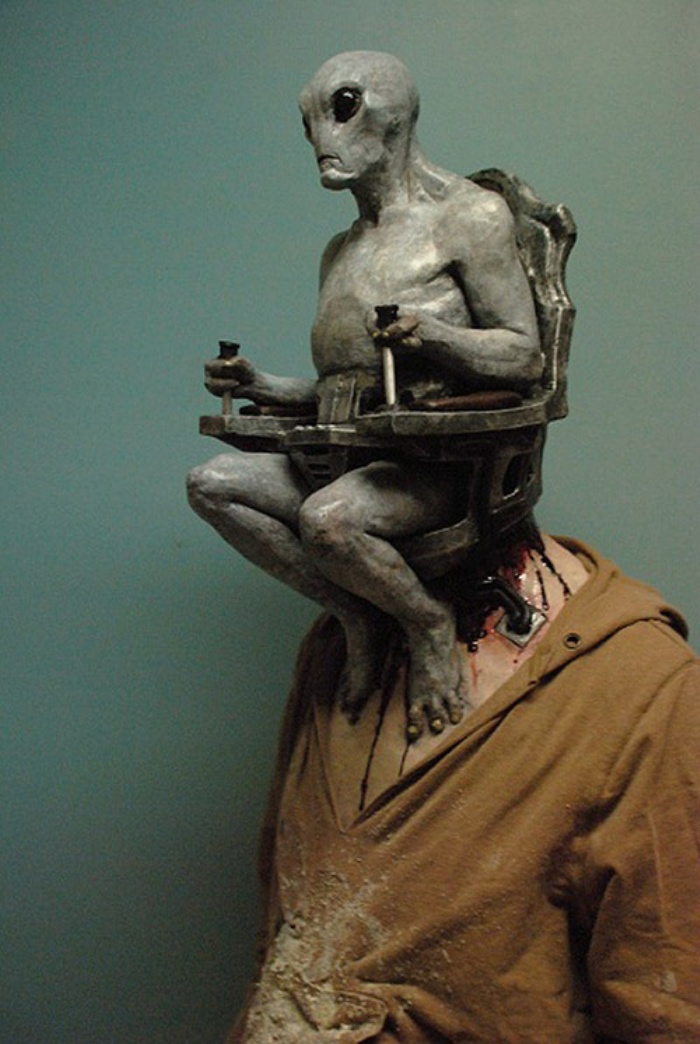
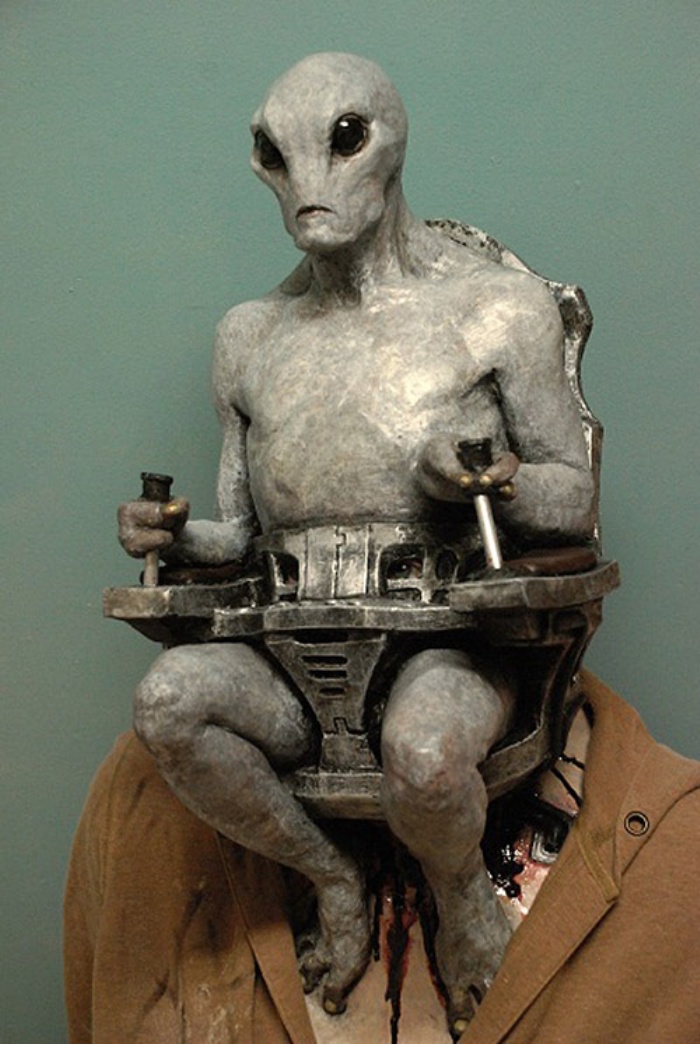
This mask wins hands-down against any other Halloween mask out there in the market. It’s strange, it’s creepy, and it’s all sorts of gross– in short, it’s the perfect mask for you if you want to win any awards this Halloween. A commandeering, noseless alien occupies the space where your head normally is, holding controls that presumably allow it to control your headless, bloody body.
The mask is foam-filled, so you don’t have to worry about the alien’s butt getting in your face when you’ve got this on.
A testament to its awesomeness is the fact that it’s currently sold out. You can bookmark the site that sells it though, in the hopes of nabbing one before October 31st. It’s priced at $98.
[ Product Page ] VIA [ GAS ]
The post Ditch Your Head This Halloween: Alien Mind Control Halloween Mask appeared first on OhGizmo!.

Up until now, there were pretty much no products that allowed you to make a cup of espresso while away from a power source. The Minispresso changes all that, giving you the ability to brew anything from a Risretto to a double Espresso without needing any electricity. The integrated pump generates 116psi of pressure, driving hot water through your coffee at the optimal rate, and producing espresso that comes very close to what you would get from a traditional machine. You can use the Minispresso with loose coffee grind, or Coffitaly capsules, while water tanks of varying capacities determine the shot size. And if you have nothing to drink your coffee in, the lid doubles as a handy cup.
Best of all, it’s relatively cheap at $39 during the pre-order process, and only $49 afterwards.
[ Product Page ] VIA [ Uncrate ]
The post Minispresso: A Shot Of Joe On The Go appeared first on OhGizmo!.

Sir Ken Robinson is a leading authority on education and creativity. A former professor of education, he now advises governments and businesses around the world and is one of the most sought-after speakers on education. The quotes used in the comic are taken from Robinson’s now-famous 2006 TED talk How schools kill creativity. It is the most viewed TED talk ever, and also one of the funniest in my opinion (gotta love that dry British humour). If you haven’t seen it, then stop what you’re doing and go watch it.
Robinson explains that the school system was invented in the 19th century to meet the needs of rapid industrialisation and is extremely outdated, focusing way too much on left-brain academic learning. “If you think of it, the whole system of public education around the world is a protracted process of university entrance. And the consequence is that many highly talented, brilliant, creative people think they’re not, because the thing they were good at at school wasn’t valued, or was actually stigmatised.” He gives the example of Gillian Lynne, a world-renowned dancer and choreographer, who as a student was terrible at school and most likely would have been diagnosed with ADHD today. Luckily, a specialist noticed that Lynne wouldn’t sit still and was naturally dancing to the music playing in the office and suggested to Lynne’s mother that she send the child to dance school. (Robinson explains it a lot better than I just typed it).
In his best-selling book The Element, Robinson gives many more examples of how famous artists found their life’s calling (or ‘element’ as Robinson calls it). For instance, he interviews Matt Groening, creator of The Simpsons, who tells Robinson that he was always drawing crude cartoons as a student and knew he wanted to do it for the rest of his life, even if it meant working a crappy job forever. “My vision was that I’d be working in a tire warehouse. I have no idea why I thought it was a tire warehouse. I thought I’d be rolling tires around and then on my break, I’d be drawing cartoons.” Everyone tried to convince Groening to give up the cartooning dream (even his father, who was a cartoonist), but he persisted and only remembers one teacher fondly that encouraged him (he later named the character of Ms. Hoover after her). It’s a fascinating book and Robinson interviews big names like Paul McCartney, Ridley Scott, Aaron Sorkin, Meg Ryan and Richard Branson about how they embraced their creativity. This year, Robinson released the follow-up book Finding Your Element: How to Discover Your Talents and Passions and Transform Your Life.
RELATED COMICS: Alan Watts What if money was no object? Taylor Mali What teachers make. Erica Goldson Graduation speech. Amy Poehler Great people do things before they’re ready.
- Follow Sir Ken on Twitter.
– Big news, I announced the Zen Pencils book this week! All the details and pre-order info here.
Damiani.guilherme=OOOOOOOOOO


Japan’s Nabana no Sato Botanical Garden used over 7,000,000 LED lights to create this amazing tribute to nature featuring displays of rainbows, auroras, and Mt. Fuji.
Damiani.guilherme'Biopunk' is a great word
It doesn’t get much more biopunk than this:
As hospitals in nations hardest hit by Ebola struggle to keep up, desperate patients are turning to the black market to buy blood from survivors of the virus, the World Health Organization warned. [...]
Blood from survivors, referred to as convalescent serum, is said to have antibodies that can fight the deadly virus. Though the treatment is unproven, it has provided some promise for those fighting a disease that’s killing more than half of those it has infected.
Full Story: CNN: Ebola patients buying survivors’ blood from black market, WHO warns
| archive - contact - sexy exciting merchandise - search - about | |||
 |
|||
| ← previous | October 6th, 2014 | next | |
|
October 6th, 2014: Here is a song by Tigernaut called Jacques Esqueleto! I Thought I Made You Up. It is an instrumental song named after this comic and I rate it super rad! – Ryan | |||
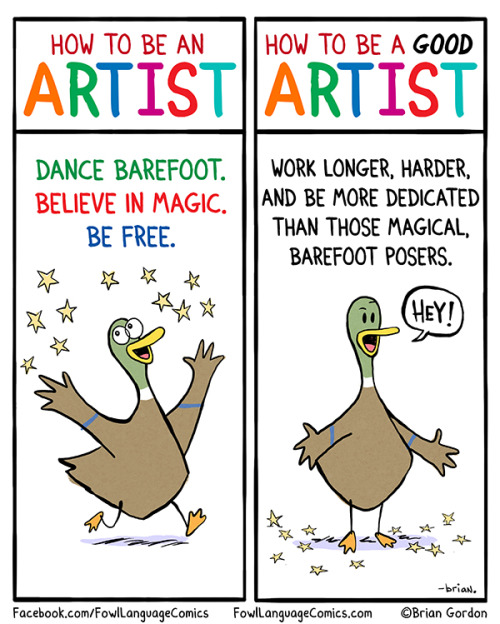
I got the opportunity to talk to some students later this month about making a career as an artist. This is pretty much the TL;DR version of what I’m gonna say. (bonus panel)
Damiani.guilhermeBethesda S2
 Pois é, às vezes, as duas respostas estão certas.
O post Mentirinhas #709 apareceu primeiro em Mentirinhas.


Damiani.guilhermefotos ducaralho. nao li a entrevista

Marcus Lyon (b.1965) is a British artist. He studied Political Science at Leeds and Leadership at Harvard Business School. His began his career with Amnesty International, working on commissions concerning street children in Latin America, Africa and Asia. He has an international reputation as a conceptual landscape and portrait artist. His work is collected by many significant private and public institutions and exhibited globally by amongst others the Saatchi Gallery and the MAM Rio.
His recent projects on urban expansion and mass migration have been shown in Argentina, Brazil and Russia in 2014. He serves on the boards of Somerset House and Leader’s Quest and is an ambassador for Photovoice and Home Start UK. He currently lives between London and São Paulo with his wife Bel and their children Flo and Arthur.

PetaPixel: First off, give us a brief introduction to your project Exodus. What made you want to pursue this project?
Marcus Lyon: Exodus is an exploration of the most significant migrations of the early 21st century. The project was born out of work I had been working on for 20 years exploring the mega-cities of the emerging economies. My proposition is that as the ability of humans, goods and services to circumnavigate the planet increases exponentially we are left disconnected from a simple view of our common identity. In turn, as our economic and geo-political differences intensify, the unstoppable movement and expansion of actual and digital assets challenges the power of the individual in society, the state and corporations to control opinions, actions and environments. In Exodus I try to provoke questions concerning the biggest changes in contemporary society through large-scale representations of the key themes that influence globalization the modern world.

PP: What can you tell us about the process of making these images? They look as though you went to great lengths to create them. Are they composite photographs?
ML: All my mass behavior artworks ( BRICS, EXODUS & TIMEOUT) are born out of the idea that the world is too fabulously complex and my audience is too visually literate for me to tell the truths I wish to communicate in a single image. So I collect multiple images, opinions if you like, to build new and hopefully more powerful visual reality. They take between 2 and 3 months each to make.

PP: How about the travel and planning involved with your work? Do you work with many assistants? Is there a collaborative aspect involved with your projects?
ML: The work is based on pre-visualized images so the research and planning are key. I normally start with a sketch or a doodle and then I rely on a team of assistants, researchers, fixers, location scouts, helicopter pilots and retouchers to make the ideas I have a reality. Therefore collaboration lies at the heart of my practice.

PP: I feel that your work is thought-provoking. It offers us a point-of-view on the world that we don’t normally see, and you’re addressing important issues on how globalization is affecting the world. What do you want your viewers to take away from your work? Are the subjects of your photographs things you want to see changed?
ML: I am glad that the images work on that level for you. To me they need to be quietly subversive and should speak about the the realities of our mass behaviors to as wide as audience as possible. However, I have no particular message. I see the work much more as a a catalyst for conversation and thus the viewers will find their own voices on the matters that the images address.
As an artist I remain publicly politically neutral about my subject matter. My role is to inspire a deeper dialogue – to inspire and present a different perspective. In many ways I am part of the actions behind the ideas I represent so it would be extremely hypocritical to state too much off an opinion: these are key questions about the way we all live and thus we need to find answers en mass.

PP: Who are the photographers or teachers who have helped to influence your practice? I think many of our readers could compare your work to that of Andreas Gursky, who deals with similar topics of globalization. Would he be a part of this list?
ML: The work is often compared to Gursky’s, which is obviously hugely flattering, but I am blissfully uninterested in other photographers visions…indeed he recently had a big show in London that I completely missed…I am much more inspired by David Suzuki, Norman Borlaug or Susan Sontag. For me ideas are the keys to my images not other images or image makers. If we allow the idea be king then we will always have an authentic voice.
If you were to push me on a photographic hero I would more likely chose Gary Winogrand, Chris Killip and Ray K Metzker than any contemporary practitioner.

PP: Tell us a bit about your latest body of work, “TIMEOUT.”
ML: TIMEOUT examines a world where the search for safety and shelter has taken a secondary role. As the billion planet dwellers that no longer need to satisfy their basic needs search for meaning they turn to exploration. As the desire for escape intensifies, we unleash an unstoppable quest for release through consumption. Whether through budget air tourism, industrial food production or the mega rich’s super yachts, a systemically significant part of the human race defines itself by endeavoring to conquer the natural rhythms of the earth through recreation.

PP: Finally, what’s coming up for you over the next year, photographically or otherwise?
ML: Right now I am putting the final touches to the mounting and framing of TIMEOUT with John Jones in preparation to launch this autumn in London at the fabulous Somerset House. In terms of next year, we are just beginning working on the pre-production for a huge portrait project in Brazil which will see the team right through 2015. The idea is to create a significant series of over life size images of an anthropologically curated set of sound and DNA enabled portraits that will explore the identity of Brazilians at the beginning of the 21st century.


An animated GIF taken from a longer German language instructional video demonstrates the simple and brilliant method a paperclip machine uses to twist metal strips into a familiar shape.
image via gfycat
via reddit