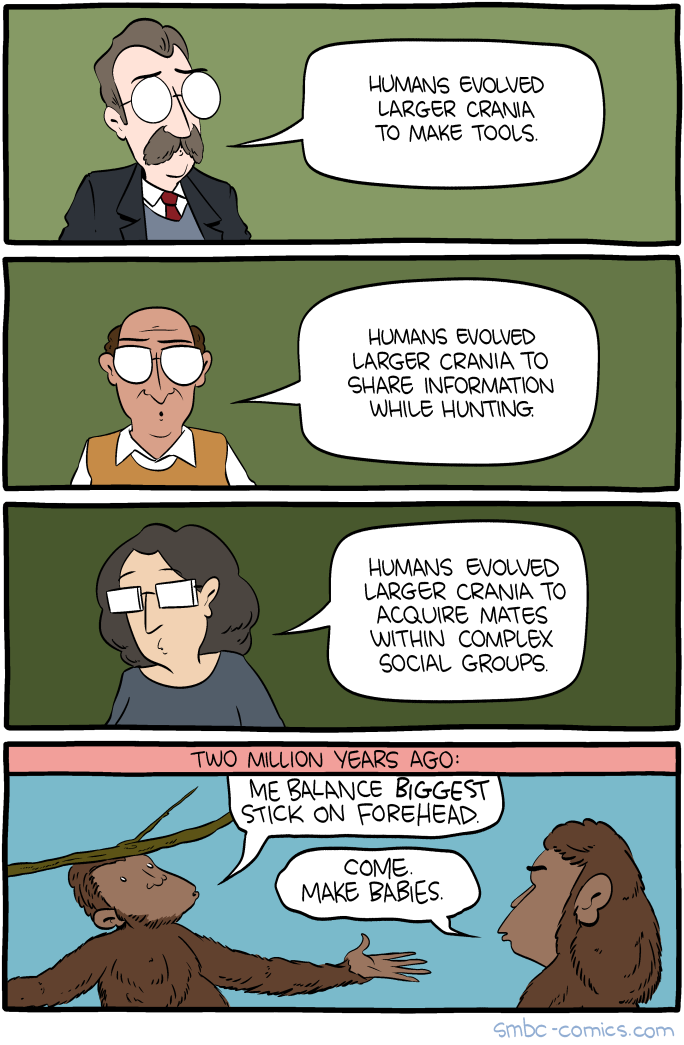
Click here to go see the bonus panel!
Hovertext:
Feet became less like hands because, for bipedals, it's not useful to give someone the finger with them.
New comic!
Today's News:
Public transportation has never looked as cool as this tram by Vince Toulouse, who has put a ton of design consideration into this multi-story vehicle. There are some very cool details built using a number of distinct LEGO System, DUPLO, and Fabuland components in yellow.

Besides the clean lines, and mechanical elements that look both fun and very purposeful, the dark gray and yellow color scheme works really well with those brown and dark tan tiles, in my opinion.


One of my favorite features is the Fabuland caravan component used here as a working door.

With all of the great exterior details, this tram would fit right into any utopian or dystopian society. I only wish there were interior pics as well.
The post One tram-endous model appeared first on The Brothers Brick.
Without irony: I deeply love Dilbert.
From ages 8 to 12, the funny pages were both my primary hobby and major career aspiration, and Dilbert was a top-tier favorite, thanks to my dad’s own sizable collection. The strip debuted in the early nineties as a revolutionary new catharsis right when my dad’s own career switched from blue-collar to white. It may sound implausible that a 10-year-old would enjoy the byzantine dysfunctions of a group of pudgy, poorly drawn engineers—the funny pages are rarely for kids. Even the kid-only universe of Peanuts is, in adult retrospect, mostly about the psychological cruelties of childhood. By contrast, Dilbert had characters like a talking rat named Ratbert and a talking dinosaur named Bob, who administered atomic wedgies around the office.
Dilbert did not take breaks on Mother’s Day or Valentine’s Day or Christmas, when the rest of the comics can briefly rest from the nyucks for a heart-warming hug as a cartoon family. There is no setting in Dilbert where this can happen. There is the bare office, and Dilbert’s empty bachelor pad with Dogbert (glasses-wearing talking dog with business acumen). That’s about it.
Dilbert was the unknowable adult job that Dad in Calvin and Hobbes—or Jon Arbuckle in Garfield, or my own dad—went to every day. And at that job, the world only got dimmer, flatter. You got to leave, eventually, but you always had to come back. Dilbert taught a saving grace, though: You could laugh. You could look at the stupid, crappy, mean day (G-Rated—it is the funnies) the world just threw at you, and you could laugh. Is this not valuable? For real?

If you frequent Twitter, which I absolutely cannot recommend that you do, you already know that things have gone terribly awry. Scott Adams, the creator of Dilbert, is a proud racist. Or, he earnestly, zealously supports Donald Trump, and if that isn’t being a proud racist, I don’t have a goddamn clue what the difference is anymore.
Even without enduring a single one of Adams’s daily, sermon-length Periscopes about politics, a browse of his social media—again, I cannot recommend enough that you do not do this—quickly provides evidence that all is not well. Adams responds to haters by taking his shirt off and posting a picture of his abs, a move ripped from the Alex Jones playbook. Adams earnestly believes that Twitter is “shadowbanning” his account to suppress his political message, even though hundreds of MAGA-hatted doofs smash the heart button on every one of his thousands of smarmy thought-farts. Adams is eager to tell you about his new girlfriend, Kristina Basham. Adams is more than twice Basham’s age. Adams uses Basham as an alternate version of his abs: that is, a devastating counter-punch to any hater who doubts that he is truly winning in life.
It’s hard to know if and when Adams is joking online because his own attempts at humor are so tortured and obtuse. He will plop on a Pope’s hat because, uh, there are issues of ethics in politics? In true past-its-prime-comic-strip style, he will use the same bland joke on his Instagram not once, but twice within a month. His attempt at telling a pun on video falls so limply that it cannot even earn a dad-joke groan.
This is an absolutely piss-poor showing from somebody who is a multi-millionaire humorist. I believe Adams is attempting, in good faith, to tell good jokes, and the format and structure of good jokes feel familiar to him. And here, I speculate: Adams is in fact unable to summon either the warm creative whimsy or the sharp satirical bite that lies at the unspoken philosophical center of every successful joke. His sense of humor appears to be broken. He appears completely unable to detect irony. This has major implications on today’s actual Dilbert and the rest of Adams’s worldview.
The ability to detect irony is increasingly necessary for being alive in America. If you have not by now recognized on your own that the world has been careening through a too-salty first draft of The Onion, there is no helping you. Irony is especially important with Dilbert because the antagonist of Dilbert, at least for the first few decades, was the Pointy-Haired Boss. And there is no other person in the entire public consciousness who is more like the Pointy-Haired Boss than Donald Trump.
Many times, Trump is belligerent where the Pointy-Haired Boss is merely daft, but the basic thrust of both characters is the same: they understand nothing about any situation but proudly bulldoze their way through every room they enter. They have no friends, but having no friends is not really a problem because they don’t even want friends. They are incapable of thinking about anything other than themselves. And yet they are also incapable of introspection or self-improvement. (Again, not a big problem: they’re not interested.) Everything they touch crumbles to dust but still (and this was the central thesis of Dilbert) the world is for some reason still cruddily bent into a dumb shape that unfailingly supports them anyway. There is, yes, the funny hair.
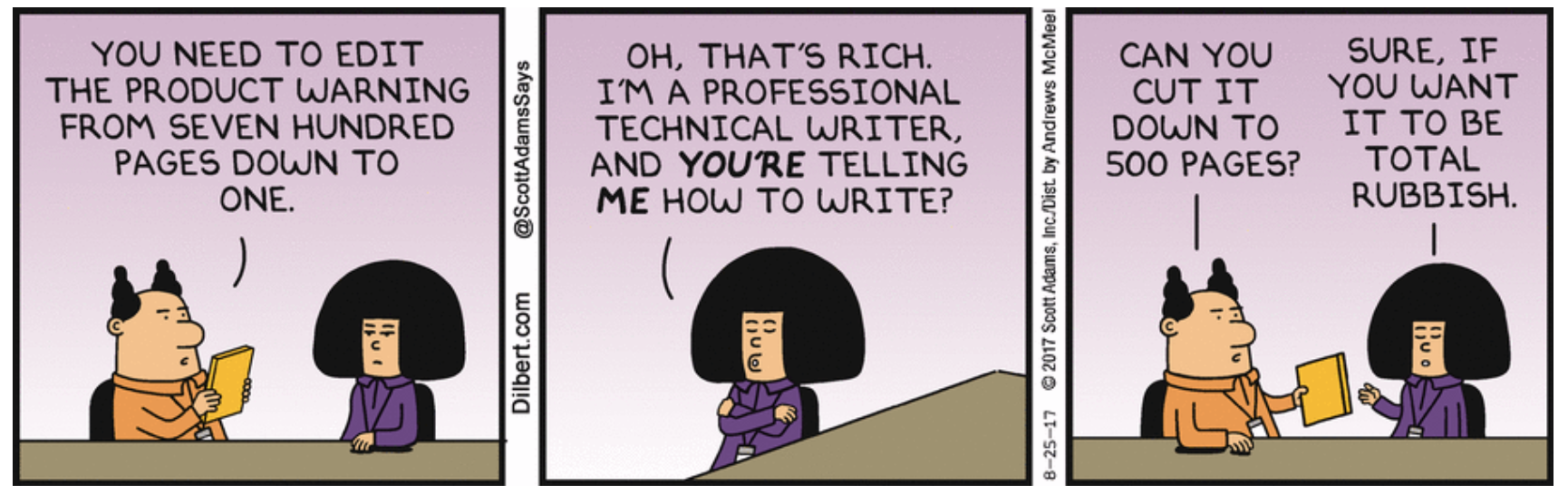
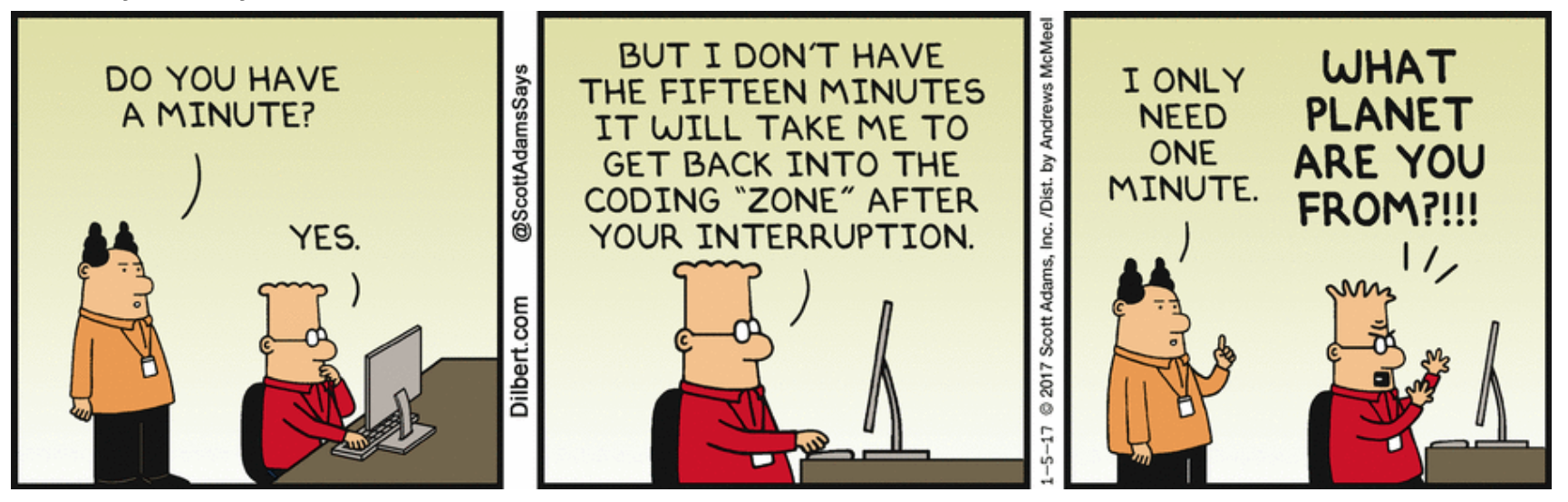
The Pointy-Haired Boss has also been undergoing a makeover over the decades-long arc of Dilbert, becoming an increasingly sympathetic character. The Dilbert reader of, say, 1997 would find it sacrilege to learn that, in 2017, there are comic strips where the Pointy-Haired Boss is the discerning voice of reason and it is his employees who are difficult, selfish, stupid:
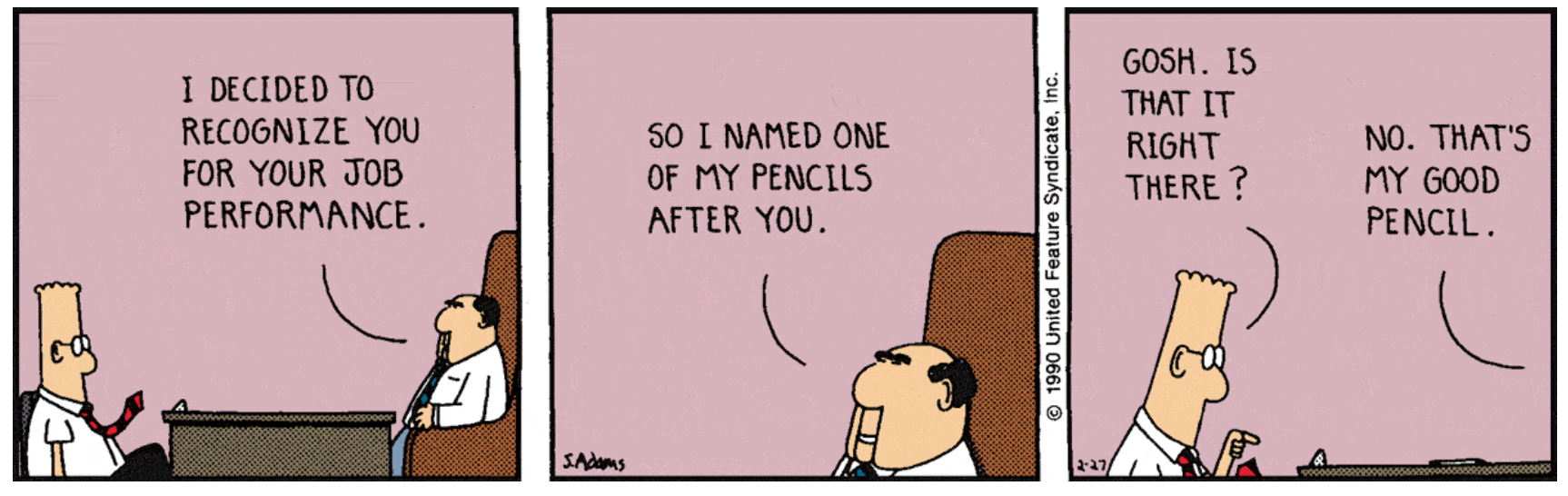
In the early nineties, when we were first introduced to him—before the hair was even all that pointy—the boss was clearly old, rotund, jowls flapping:
As the nineties progressed, the hair got pointier and the jowls went away. The boss grew younger, but he also grew exceptionally wider, his upper body nearly a circle:
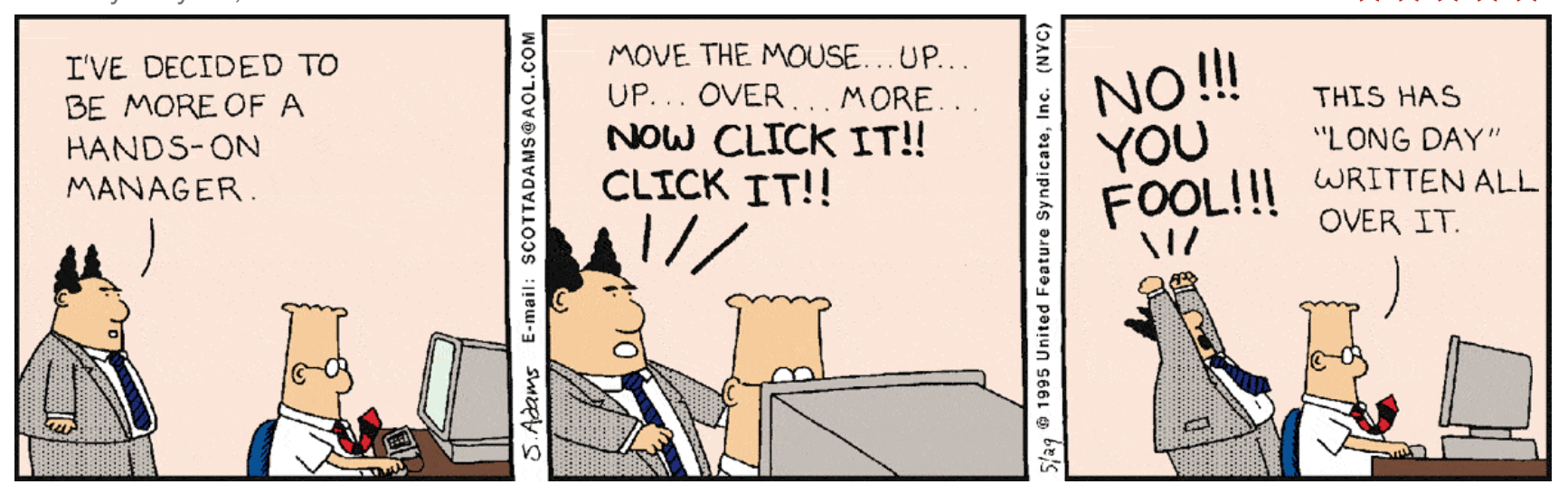
What a surprise then, that two decades later, the Pointy-Haired Boss hasn’t been trapped in the timeless, preserving amber of every other comic strip character, in Dilbert or otherwise. These days the Pointy-Haired Boss is actually younger and trimmer than he has ever been in the strip’s history:

In making the Pointy-Haired Boss look progressively better, Adams’s comic strip now shares the same distorted vision of authority as the aesthetically disastrous far-right cartoons of Ben Garrison. (Garrison’s oeuvre has been helpfully annotated by Rich Kyanka of Something Awful.) Plenty of Garrison’s output shows Trump nailing a “victory” in a scene littered with blubbering liberal punching bags du jour. One of the hundred bizarre things about Garrison’s cartoons is that Trump is depicted about four decades younger than he currently is, plus also about 300% buffer than he ever was. Garrison’s Trump has hair that is robust and flowing; his waistline is trim and taut; his muscles are sculpted and shapely:

The only way that Trump’s real-life physique can be accurately classified is: grandfatherly couch potato. That’s a fact, and it’s also a very unimportant one. Garrison’s insistence that Trump is a well-toned hunk only emphasizes the recent realization that the deep-right is no longer simply disagreeing with the rest of the country about a set of facts: they are living in an entirely different, self-generated thought universe. Could it be that Garrison is not consciously muscling-up his Trump at all? Is this very literally the Trump body that Garrison “sees”?
Unless you consciously, coldly know that the Trump presidency helps you stay powerfully ahead in the world—tax breaks or whatever the fuck—the only way to believe that his presidency is a good thing is to see the world with constantly distorted vision. Somewhere along the way, Scott Adams became incapable of seeing the world clearly. He cannot see that he has made the antagonist of his cartoon the protagonist. He cannot see that some of the reasons that he thought Trump would be a good president—i.e., could become a thorough expert on any geopolitical subject after an hour-long briefing—are some of the exact same barbs that he launched at management culture in the legacy-building peak of his satire. He cannot see the irony in suddenly yoking his reputation to a man whose signature move—before, during, and probably after his presidency—is abusing and then firing his own employees.
Adams has just released his fifth non-cartoon book, called Win Bigly. The existence of this book is infuriating at every level you can think of. In the last two-plus miserable years since Trump came down that fucking escalator and kicked off this whole shitshow, the only accusation that he is not completely goddamn guilty of is that he was never saying the nonsense word “bigly,” but actually saying the phrase “big league.”
The book’s subtitle is Persuasion in a World Where Facts Don’t Matter. This gets at the core of Adams’s professed admiration for Trump: that Trump is an incredibly skilled communicator who is constantly using effective persuasion techniques that his audience isn’t even conscious of. Adams is at least consistent here: his many blog posts about Trump in no way resemble the horrifying race-baiting articles your uncle is sharing on Facebook. Instead, the writing has the dense-but-hollow vocabulary of a Scientology tract, clinically explaining why Trump’s latest self-induced failure was in fact a lib-owning Win. This mindset is to the great detriment of today’s Dilbert, the worst-ever era of the cartoon, which has settled into the miserable routine of having characters trade logic-based barbs for three panels—a rhythm that carries the suggestion of a joke without actually creating a joke at all.
At one level, Adams’s theories about Trump the Persuader are inarguable. Against steep odds, Trump really did fucking talk his way into the Presidency. But the sheer emptiness of this accomplishment should be apparent to anybody who can, well, detect irony: Trump sure did persuade a lot of people, but he’s only persuaded them to do things that are violently against their own self-interests. His powers of persuasion have even backfired on himself, the ultimate irony. His entire campaign was waged as revenge against the elite social circles that Trump, the eternal petulant high schooler, had previously ensured he was kicked out of. But in winning, Trump and his immovable personality only cemented a destiny where he would be excluded and made fun of more often and more deeply than ever before. Those of us with the empathetic parts of our brain still working have already made a word for the technique of trying to underhandedly persuade others: Machiavellian. Historically, not a compliment.
I would like to believe that, somewhere just off-camera from the modern, depressing world of Dilbert, the character Dilbert is still quietly trying to plow through his work, to somehow manage the best he can despite the avalanche of dysfunction around him. The newfangled Adams worldview only feels like a second Pointy-Haired Boss: intrusive, yes, but nothing that Dilbert hasn’t dealt with before. I imagine the Dilbert of today still kicking around the settings where we saw him more often in the nineties, before the strip became exclusively set in the office: on failed dates, chatting with his wildly knowledgeable garbageman, going on quiet walks in the woods with Dogbert.
It is a testament to Adams’s skill, the consistency and creativity in his years and years of daily work, that I still feel like Dilbert is, in a way, alive. It also makes me feel like the Trump-loving Adams is in some way not the “real” Adams, although I don’t even know what I mean by that. For so long, Adams was so compassionately attuned to the absurdities and infinite micro-tragedies of being just a quiet adult guy thrust into the world.
A small but real silver lining to the last few years is that there are very few good artistic works made by extremely conservative people, period. Every once in awhile a company or executive will reveal themselves as completely backward-thinking—what’s up Bulleit Bourbon and ULine Shipping Supplies—and it’s pretty easy, if not actually kind of fun, to sidestep what they have for sale. Rarely, though, have we had to get our hearts broken by learning that an admired artist, who made work that really did capture, heighten, celebrate the human condition, is pro-Trump. Dilbert is an exception. It is a compelling work of art made by a member of the alt-right. There’s no reconciling or skirting around this fact. It’s just uncomfortable.
The New Zealand fantail, or pīwakawaka in Te Reo (the language of the native Maori), is one of the cheekiest little birds you will ever meet. Beautifully recreated in LEGO by BrickMonkey MOCs, the fantail is known for its friendly ‘cheet cheet’ call and energetic flying antics. Smaller than a house sparrow, these audacious little guys flit around twittering and swooping within centimetres of your head if you find yourself outdoors in the native bush. The aptly named fantail is one of the most common and widely distributed native birds on the New Zealand mainland.

The post Flitting hither and thither, the fantail always appears in a dither appeared first on The Brothers Brick.

There’s nothing as great as turning your wheels off the asphalt, finding a high trail that’s little more than a path, and then driving all the way to the peak for a breathtaking view. This incredible LEGO Jeep Rubicon by Scott is so perfect it leaves me yearning for some true offroading and alpine adventure. One of the most complex models I’ve seen in a long time, this RC offroader features insane details like functioning door locks and a working glove box, plus it’s loaded to the gills with trail gear.

Check out a video of this Jeep in action below, along with more pictures.
The first thing you notice about this rad Jeep is that it’s got more ground clearance than a Mercedes Unimog. Sitting on the giant wheels from that LEGO Technic set, this Jeep can get over any obstacle.

Of course, it’s no good getting somewhere if you’ve got nothing to do once you get there. The Jeep comes with everything you’d need for a weekend far from cell reception.


The amount of intricately designed gear stuffed into this offroader is mind-boggling.

Even the backpacks, which blend into the plethora of accouterments strapped to every surface in the Jeep, are amazing. Scott uses LEGO cloth and a brick frame to construct a life-like knapsack.

Of course, should you find a trail too narrow for even a Jeep, there’s even a second mode of vehicular transportation. This nifty little dirtbike is a worthy model on its own.

Turning back to the vehicle underneath the mountain of sporting gear, the Jeep itself is a phenomenal build. The engine compartment has a false bottom which conceals a removable battery box.

The interior features sliding bucket seats and as much functionality as a real Jeep.


Even details like the center console haven’t been overlooked.

Underpinning it all is an intricate Technic frame supporting the Power Functions systems and allowing the Jeep to be remotely controlled.

The post Incredible RC LEGO Jeep is motorized, loaded with details and ready for the perfect weekend getaway appeared first on The Brothers Brick.

Surely there’s a strong positive correlation between the number of intricate and charming medieval LEGO creations one comes across and how many times one smiles in a given day. Or at least I think there’s something to that. This wonderful scene by “kofi” certainly brought a smile to my face.

This build is quite interesting as it doesn’t overly emphasize any one structure or area in an extreme fashion. While the lovely windmill (that moves by the way) and other small structure certainly draw the eye in, as a whole it’s a very balanced build with lots going on. The subtle gradient on the ground down to the right really draws the eye in too.
The more I look at this build, the more I can’t help but think that I wish photographing LEGO builds in 360 was more of a thing. Wouldn’t it be neat to get a look at this build from all sides? Maybe take a closer look from the top looking down? Ah what the future holds.
The post A perfectly proportioned presentation appeared first on The Brothers Brick.

2016 data derived from a random sample of deidentified, consumer-level records from a major credit bureau, as well as estimates from summary tables of the US Census Bureau’s American Community Survey (2015 or 2011–15)... Debt in collections includes past-due credit lines that have been closed and charged-off on their books as well as unpaid bills reported to the credit bureaus that the creditor is attempting to collect.Links to various commentaries at Digg. My attention was drawn to Minnesota...
A previous analysis by the Urban Institute focused on medical debt, and found one reason it was so concentrated in the South was because the uninsured rates tended to be higher. While that changed to some extent with the Affordable Care Act, many Southern states chose not to expand Medicaid. On the other hand, Minnesota — which has the lowest rates of debt — has one of the most generous Medicaid programs in the country, and a more inclusive and higher-quality health care system.

...only 3% of Minnesotans have medical debt in collections, and only one county (rural Clearwater County) has medical debt rates over 11%.Most Washington politicians are tone-deaf to the financial crises experienced by so many Americans. They are busy waging their internecine battles, meeting with lobbyists, and pandering to their donors.
Compare that picture to the state of medical debt in the rest of the country. Nationwide, 18% of people have medical debt in collections, and, as CityLab noted, much of that debt is concentrated in states that chose not to expand Medicaid under the ACA.

If you feel nervous about the future and dread the thought of grey concrete buildings taking over our cities, these beautiful microscale futuristic cityscapes by Jeff Friesen should calm your fears. Each unique scene is beautifully crafted, with buildings, transportation links, water, and features like bridges, parks, and flora. The colour schemes have been well thought-out and there are lots of clever details in each scene despite their diminutive size.

It is worth having a closer look at each cityscape. Jeff has used a lovely selection of parts and techniques to create the buildings and add detail to each creations. I love the elevated road in the first scene and the art-Deco style skyscrapers with their minimalistic curves.

The railway bridge is a real eye-catcher in this scene, but I can’t resist the little subterranean metro trains peaking out from beneath the city streets.

As someone who loves the colour Azure, this city scene is definitely one of my favourites. The subtle curves of the rear skyscraper are achieved using 1×2 jumper plates to allow a bit of a twist in the build.

Finally, we have a monorail transport system linking these very futuristic pods. The lime vegetation is a perfect contrast in this clean ascetic cityscape.

The post Time to travel to beautiful cityscapes appeared first on The Brothers Brick.

(credit: Felix König)
The skyrocketing value of Bitcoin is leading to soaring energy consumption. According to one widely cited website that tracks the subject, the Bitcoin network is consuming power at an annual rate of 32TWh—about as much as Denmark. By the site's calculations, each Bitcoin transaction consumes 250kWh, enough to power homes for nine days.
Naturally, this is leading to concerns about sustainability. Eric Holthaus, a writer for Grist, projects that, at current growth rates, the Bitcoin network will "use as much electricity as the entire world does today" by early 2020. "This is an unsustainable trajectory," he writes.
Global energy production obviously can't double in two years, and it would be an environmental disaster if it did. Fortunately, while the Bitcoin network consumes a ridiculous amount of energy, particularly on a per-transaction basis, the situation isn't as dire as critics like Holthaus claim.
Read 23 remaining paragraphs | Comments


Read more of this story at Slashdot.
This year’s big build by Brick to the Past is called ‘The Jacobite Risings: The Fight for Britain’s Throne’. The risings took place between 1689 and 1746, mostly in Scotland as supporters of the Stuart dynasty attempted to restore them to the throne. They were effectively Britain’s last civil wars.
 The model is around 16 square metres in size, sitting on the equivalent of 105 48 stud baseplates. It has a mountain in its centre that reaches about 1m high. It was built by the Brick to the Past (BTTP) team, Dan Harris, James Pegrum, Simon Pickard, Tim Goddard and Steve Snasdell, and took around 10 months to complete.
BTTP never really know how many parts they use, but they think it’s in the 750,000 to 1 million range for the build plus about 2,00 minifigures.
 On one side there is a detailed model of Corgarff Castle and on the other , Ruthven Barracks, which was built after the 1715 rising in an attempt to prevent further conflict.


One of the other aspects of BTTP’s huge models is that there are many different smaller stories and details to spot. I love the brick built animals that appear in the highland landscape, including deer, capercaillie, ptarmigan, osprey and black grouse.


The Brothers Brick had an opportunity to speak with Dan Harris from the BTTP team and ask a few more details about their Jacobite Risings creation.
TBB: Can you tell us more about this year’s big build?
BTTP: This year’s big build is called ‘The Jacobite Risings: The Fight for Britain’s Throne’. The risings took place between 1689 and 1746, mostly in Scotland as supporters of the Stuart dynasty attempted to restore them to the throne. They were effectively Britain’s last civil wars.
The model is around 16 square metres in size, sitting on the equivalent of 105 48 stud baseplates. It has a mountain in its centre that reaches about 1m high. It was built by Dan Harris, James Pegrum, Simon Pickard, Tim Goddard and Steve Snasdell and took around 10 months to complete.
 We never really know how many parts we use, but we think it’s in the 750,000 to 1 million range, although this is a really rough estimate.
TBB: Why did you chose the Jacobite Risings and what research did you have to undertake prior to starting the build?
BTTP: 2017 is Scotland’s Year of History, Heritage and Archaeology, so we wanted to build something that had a strong Scottish theme. This turned out to be a great move because we’ve been able to piggy back on a lot of ongoing publicity and events which has meant that we’ve reached a much wider and more diverse audience than usual.

As always, we did a lot of reading in preparation for the model and I now have quite a respectable library on 17th and 18th century Scotland. This year we’ve also been able to pack in a lot of field trips because I live within about half an hour of most of the buildings and features we’ve included in the model. Highlights included visits to Culloden Battlefield, Corgarff Castle, Ruthven Barracks and the Highland Folk Museum.
 TBB: What are the key features of the model?
BTTP: The most striking feature of the model is probably the 1 metre high mountain that runs across its centre. This was built by James Pegrum and is made entirely out of LEGO. It takes an age to set up and James describes it as a nightmare! The mountain and the landscape around it are alive with brick built animals, which are characteristic and in many cases unique to the Scottish Highlands, including capercaillie, ptarmigan, golden eagle and black grouse.

The model also has a pretty epic battle between Jacobites and redcoats, which we’ve roughly based on the Battle of Killiecranckie, which took place in July 1689. Stylistically, our armies are based on a later date, but we wanted to be able to recreate the awesome geography of that part of the Highlands. There are about 2,000 minifigures on the model, with the vast majority on the battlefield.

Finally, we also wanted to create a glimpse of everyday highland life, so Simon Pickard and Tim Goddard have built a number of highland houses characteristic of rural life during the period. These are bought alive with all sorts of traditional activities, such as waulking the cloth, peat cutting and shinty.

TBB: How do you divide up parts of the build amongst the team of builders and do you find some build faster than others or can on take a greater volume of the final footprint?
BTTP: We have a plan that is drawn out right at the beginning and our builders get to choose what they want to build and they can build as little or as much as they like. We try and make sure everyone has got something interesting to do because our main aim is to have some fun! Some of us can build faster than others, which is why we were able to display about 80% of the model back in July, This year has been a been quite hard going because due to unforeseen circumstances some of our builders had to drop out late in the process. Of course we know life is full of surprises, so we always have contingency plans and everything was fine in the end.
TBB: Are there different smaller scenes and stories that each builder likes to add to the overall build to make their mark?
BTTP: Story telling is an important part of what we do and while most of the stories we tell are simple tales of everyday life, some are based on historical accounts. Part of our mountain has a cave system that tells the probably mythical story of Sawney Bean, who is said to have been the head of a family of cannibals who lived in a cave in Ayrshire.
 Another story we tell is that of a government soldier named Donald McBane, who while fleeing the now victorious Jacobites at the Battle of Killliecranckie, ran down the hillside towards the River Garry and leapt the 18 foot gap of the river’s gorge to escape.

TBB: Where can people see the model in person?
BTTP: The model is currently on display at Stirling Castle and will be there until the end of January. This is an amazing venue and well worth a visit in its own right, so if you like history and you like LEGO then you need to go!
TBB: Brick to the Past is known for their huge, detailed models, how many of your models stay build past the year point?
BTTP: Our models usually get taken apart before we get going on our next project, but we do keep bits of them. From this model we will be keeping Corgarff Castle, Ruthven Barracks and the highland township. We’ve already built up quite a good collection of models that cover different periods in British history and we plan to bring them all together to create a really high quality exhibition sometime in the near future.

TBB: Has work began on the next model or is there a period of relaxation after a build is finally complete?
BTTP: There is no rest! We have a number of commissions that we are working on in the background and planning for next year’s big build is already under way. For the last couple of years we have been pretty landscape focused, so our next project is going to be something quite different – we will have an announcement in the New Year!
TBB: Thanks for taking the time to talk to us and we look forward to hearing more about your next big project.
The post The Jacobite Risings took 5 builders 10 months to build using 1 million LEGO bricks appeared first on The Brothers Brick.
Fall is changing to winter, at least in North America, and it always seems to inspire LEGO builders to depict these changing seasons in bricks. emillide has put together a lovely set of tiny cottages, experimenting with many interesting roof and tree techniques, some of which are truly baffling.

Take this summer scene, for example. I am at a total loss trying to figure out how that tree on the left is holding together, but I love it. Also, each cottage has a different base construction, making a nice finished model.


The post Big things come in small cottages appeared first on The Brothers Brick.
There is a strange beauty in decaying industrial architecture, with chipping paint, broken metal supports and collapsing concrete walls everywhere. Or maybe I am just nostalgic for apocalyptic LEGO creations that used to be all the rage when I discovered the online community. Whichever is the case, Exetrius has hit the nail on the head for me with this ruined communication tower.


Sand green is the perfect colour to make a creation like this, and combined with dark gray and limited splashes of colour it makes for a beautifully bleak colour scheme. This is further facilitated by great textures of disuse and weathering. The tower is 120 cenimeters tall (47 in.), a task made easy by using train tracks for its main segment. Everybody who uses train tracks in unique ways is awesome!

The post A monument to the old world appeared first on The Brothers Brick.
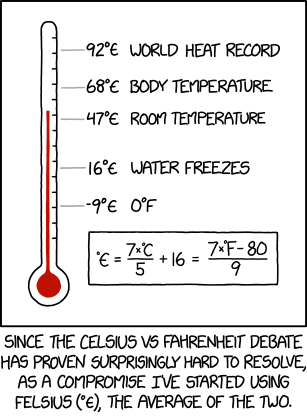
Luke.stirlingI feel like any "debate" about temperature scales are easily resolved like a lot of other seemingly intractable issues. If we just pretend like the US doesn't exist, then it will look a lot more like there's a global consensus on most things.

"...someone at temple commented that it was done intentionally to prove a point, and to continually reiterate that point to every student who entered the building."
 YouTube is used by millions of people worldwide to access a broad range of content but it is music that is increasingly one of the platform’s big draws.
With an almost unrivaled library, YouTube is the go-to service for music fans globally but over in Finland this morning, things aren’t playing out well.
As shown in the image below, users who try to access music are now getting the following graphic. When translated the text reads “Video content owned by Teosto. The video can not be used in your country.”
No license…..No access…
This is a pretty big deal. Teosto is a Finnish performance rights organization that collects royalties on behalf of local artists and composers. It represents around 30,000 local songwriters and publishers, small fry when compared to the three million foreign music entities it represents in Finland.
This means that YouTube must have pulled huge volumes of content from its platform locally, rendering the service far less attractive to users. However, according to a TorrentFreak source, things go much further than standard modern licensed music.
As shown in the image below, even music published in 1899 has found itself pulled from the platform.
Jean Sibelius’ masterpiece Finlandia? Gone..
The music licensing dispute, which appears to have led to millions of tracks being rendered inaccessible in Finland, was confirmed by YouTube this morning.
“We were unable to reach a new licensing agreement with TEOSTO. Because of this, some videos containing music will be blocked in Finland,” the team said.
While the removal of content will come as a disappointment to the quarter of Finnish citizens who use YouTube regularly, it doesn’t come as a complete surprise.
In September, Teosto issued an opinion on copyrights to Parliament’s Education Committee. The licensing group complained that rightsholders aren’t adequately compensated for content played on platforms like YouTube. Like other groups in the same position, Teosto is looking to obtain more revenue for its members. That seems to be the basis for the dispute with YouTube.
For YouTube to have pulled so much content, negotiations must have really broken down, but Teosto sounded a note of optimism this morning. The group noted that while Google had indeed pulled music content from YouTube in Finland, it may reinstate it during the next couple of days.
Update: We have a statement from Sami Valkonen, Director of International Music Publishing Partnerships at YouTube – EMEA
“We are in active conversations to bring TEOSTO content back to YouTube in Finland. Our previous licensing agreement had expired so videos containing music represented by TEOSTO are currently blocked in Finland in accordance with copyright law. Talks are proceeding on good terms and we look forward to having great music back up on YouTube in Finland as soon as possible.”
Update Dec 1: New update from YouTube’s Sami Valkonen
“TEOSTO content is back up on YouTube in Finland. Some music content was not available on YouTube in Finland for less than 24 hours as we worked towards a solution with TEOSTO after our license expired. We appreciate everyone’s patience during this time.”
Source: TF, for the latest info on copyright, file-sharing, torrent sites and more. We also have VPN discounts, offers and coupons
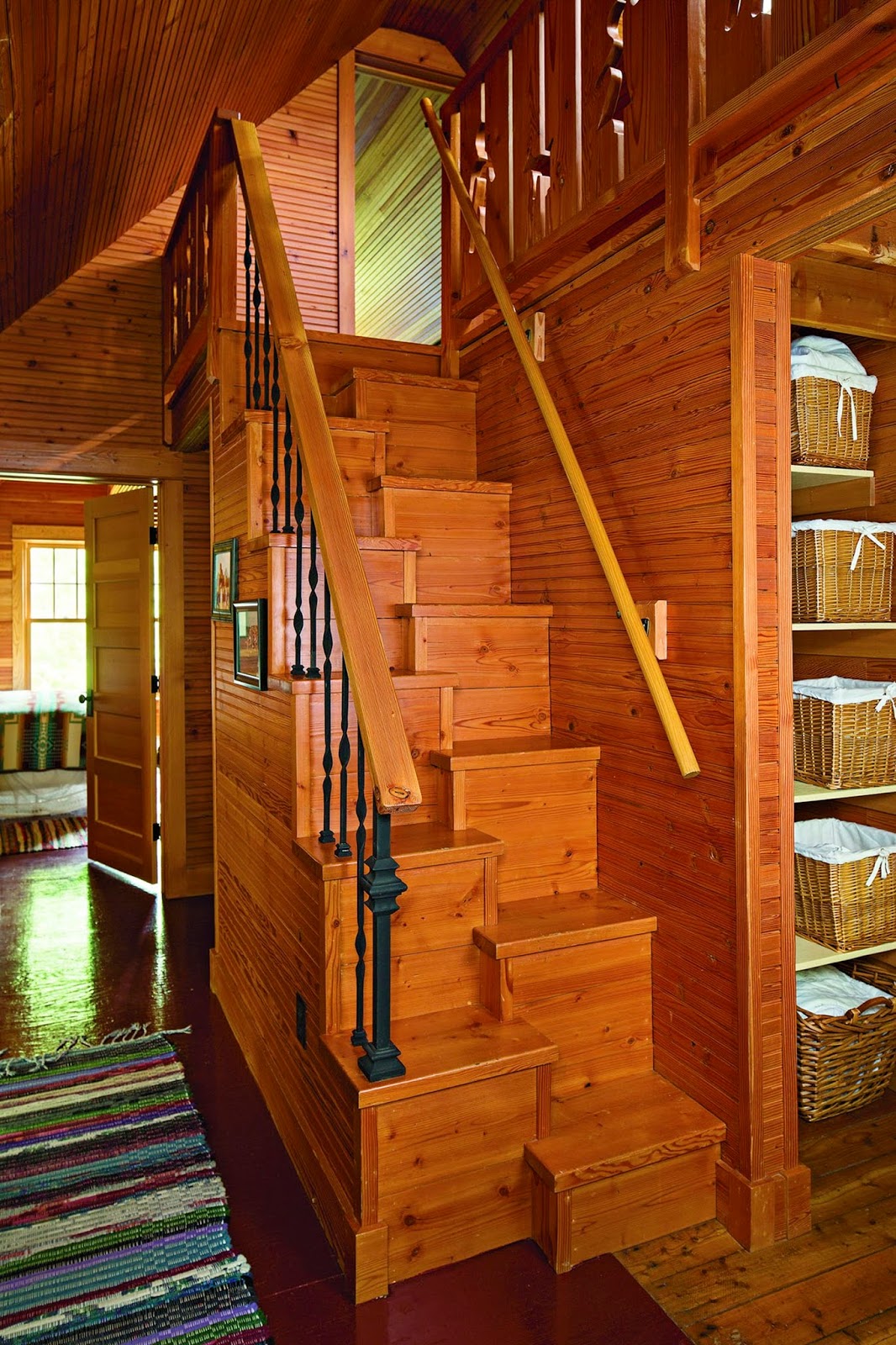

"I built one of these as the replacement staircase to my basement. my 1829 house was moved to a new foundation in 1915. the basement stair location under the main level staircase approaches the foundation wall. the previous case used a landing and a 90 deg turn. this could only be negotiated without ducking ones head if you were under 5 foot tall. the alt tread case with comfortable wide treads uses half the normal needed run. this allows me to walk upright for the entire flight and get feet on basement floor with a 3+ foot distance from the foundation wall.
3 caveats. one must be able to lead with both feet. NEVER attempt to turn around mid flight. use of these stairs is much easier with handrails on both sides. I made mine as a utility purposed design with a center a center stringer that you must straddle. this rail has allowed me to move/slide large heavy objects up and down the staircase- both a refrigerator and a freezer - with use of a rope block & tackle. once you are familiar with the stair, it is actually easier to hand carry large boxes down that obstruct your vision. you never need to step past the tread you are standing on to get your other foot onto the next tread. leg motion is a straight drop. never stumble over the nosing."


One of the most iconic scenes from The Empire Strikes Back takes place in Cloud City, where Darth Vader reveals Luke’s parentage. Due to the sheer scale of the film’s setpiece, this memorable scene hasn’t appeared in many brick-built creations, but Caleb Watson and Carlyle Livingston have managed to pull off an incredible huge-scale build that’s appropriately and simply titled “Noooo!”

This impressive size of the central duct of Cloud City stands out, recreated perfectly though with a detailed backlit background. Although the patterned backdrop may look simple, the careful placement needed to get the textures just right isn’t easy.
Here Caleb (left) and Carlyle stand behind their masterpiece to give a sense of the scale needed to do justice to this scene in bricks.

View more details of this creation below.
Here’s a closer zoom in on Vader reaching out while Luke cries off his infamous one word that stretches into a long cry of disbelief and despair.


Here are a few other shots to give you a closer view of all the details.


The post Iconic Luke & Vader scene from Star Wars: The Empire Strikes Back recreated perfectly in LEGO appeared first on The Brothers Brick.

![I'm working on a car capable of evaluating arbitrarily complex boolean expressions on "honk if [...]" bumper stickers and responding accordingly.](https://imgs.xkcd.com/comics/self_driving_car_milestones.png "I'm working on a car capable of evaluating arbitrarily complex boolean expressions on \"honk if [...]\" bumper stickers and responding accordingly.")