Shared posts

06 Feb 16:17

Perdition’s Divulgence

by submission

Author : Bob Newbell

The President of the United States watched the viewscreen in the Oval Office as it displayed what appeared to be mist condensing on the lens of the camera that had recorded the video. After a few seconds, the tiny droplets started coming together and sliding to the edges of the screen in rivulets.

“That’s helium-neon rain, Madam President,” said the administrator of NASA seated next to her. After a few minutes the mist dissipated and the video showed a dark, copper-colored liquid flowing slowly around the camera. It gave the impression of the view from a submarine sailing through an ocean of maple syrup.

“That’s liquid metallic hydrogen,” said the administrator. “We’ll jump ahead because this pretty much stays the same for most of four hours.”

After he advanced the video, something started to appear in the flowing liquid. Over a span of two minutes, a few circular objects materialized. The circles multiplied and resolved themselves into dome-shaped structures. A few people in the room gasped. Lines started forming, connecting the domes together. Small oval shapes moved along the lines. A few spherical objects appeared to float above the domes, moving slowly in various directions.

“Is that what it looks like?” asked the President.

“We believe so, Madam President,” answered the administrator. “We think this image is an ‘aerial’ view of a city.”

“There’s a city on the surface of the core of Jupiter? So at Jupiter’s core conditions are Earth-like?”

“No, ma’am,” said the administrator. “The pressure inside that part of Jupiter is around 600 million gigapascals.”

“In English?”

“Normal atmospheric pressure on Earth is a little less than 15 pounds per square inch. At the bottom of the Mariana Trench in the Pacific Ocean, the pressure is eight tons per square inch. The pressure inside Jupiter at that depth is on the order of 300,000 tons per square inch. That’s why the Jupiter Deep Exploration Probe was so expensive and took so long to build. Whole new technologies had to be developed to survive the conditions that deep inside a gas giant.”

“Even at the bottom of oceans on Earth,” said a Senator seated across the room, “we find life. Could life on Jupiter adapt to that pressure?”

“Not life as we know it,” replied the administrator. “Even matter itself behaves strangely under those conditions. The atmosphere above the city is composed of hydrogen in a supercritical state, neither liquid nor gas. And the probe registered temperatures in excess of 60,000℉. The core itself appears to be solid, which was theorized for some time. But no one imagined anything like…this.” He gestured at the frozen image on the screen.

“Could we communicate with them?” a congressman asked. “Radio, maybe?”

“Sir, we don’t know if what we’re looking at is the Jovian equivalent of New York City or the Jovian equivalent of a coral reef. It looks like a city, but it may not be. If this is a civilization, we don’t know how or even if their technology could receive any kind of signal we can send.”

“If that’s a civilization,” said the President, “we’ve already sent a signal. Even to beings so different they can live in that kind of environment, the probe would still be recognized as something obviously artificial, made by intelligent creatures, wouldn’t it?”

“There’s no way to be certain, Madam President,” said the administrator.

“Send another probe.”

“Madam President, the cost–”

“You’ll have the money.” The President smiled. “And to think that jackass I’m running against just announced he’d cut NASA’s budget if he got elected.”

Discuss the Future: The 365 Tomorrows Forums
The 365 Tomorrows Free Podcast: Voices of Tomorrow
This is your future: Submit your stories to 365 Tomorrows

05 Feb 16:39

Transmigration

by submission

Author : Michael Jagunic

Brick stands motionless as mechanical arms snap the exosuit around him: torso first, then limbs, weapons, and finally helmet.

“It’s like God creating life, you know?” he says. “You start with a soul, slap a body around it, and then send it shrieking into the harsh light of the world.”

He’s trying to lighten the mood. He’s failing.

Outfitted in my own exosuit, I lead Brick down the dimming corridor. The dying lights are on purpose—no reason to maintain full intensity up here. Still, power has been ebbing for weeks. A few weeks more and the rest of the lights below will be just as dim. And then dark.

We waited as long as we could. We hoped as long as we could.

“Think they’ll be waiting for us?” Brick asks.

“Yes,” I answer. “And they’re legion.”

At the end of the corridor, we come to the hangar, where the last three Hoppers loom like dusty dragons before the hangar door. The hangar once housed twelve Hoppers, but the other nine are no more than scraps of mangled metal now, lost somewhere out there beyond the bunker walls. No matter. The only Hopper I care about is the one Maddox was flying when he tried to save us.

Maddox, Brick, and I had been thick as thieves even before the Solar Army landed this planet, and we stuck together through everything: the Door opening up, settling this bunker, the Anti-Event. Them pouring through from the other side, slaughtering us in droves, clawing our Hoppers out of the sky and cracking our tanks as easily as they did our skulls.

When it got down to just the three of us and our distress calls were still going unanswered, Maddox couldn’t take the waiting anymore. He offered us a quick goodbye, and then flew a Hopper directly into the Door. I watched the whole thing in the control room while Brick said a prayer in the chapel. The vidlink showed a view of Maddox’s cockpit as he took one last run at them.

And that’s when I saw something.

“Brick. We need to talk about the plan.”

“I remember. Stay stealthy, sneak away.”

I look at him, knowing that all he can see is my black visor. “No. That used to be the plan. Not anymore. You remember when the Door first opened? Solar Army tried to pass a drone through.”

“Drone just kept on flying like the Door wasn’t there. It’s a one-way door, for them.”

“No,” I reply. “It’s not. When Maddox flew into the Door—”

“He passed right through, just like the Drone.”

“His Hopper passed through. But when Maddox hit the Door he disappeared. He didn’t pass through…he passed through. His ship crashed, but in the second before it did, I saw. He wasn’t in it. The door, it must have to do with organic matter or…or I don’t know, but…”

“Why didn’t you tell me before?”

“Because I know how crazy—”

“Yeah, it’s crazy. They came from that side.”

“You have a better plan? If we have to die, don’t you at least want to see what’s on the other side first?”

“The other side? Those things came straight from hell!”

“Maybe. Or maybe they’re guarding the gates of heaven.”

Seconds pass. An eternity.

“Okay, Johnny,” Brick says. “Doubt it matters whether we die in this universe or the next.”

“Right,” I smile. “Let’s go take a peek behind the curtain.”

With the slam of a lever, the hangar doors yawn open. In the distance, the first of them takes to the sky.

Discuss the Future: The 365 Tomorrows Forums
The 365 Tomorrows Free Podcast: Voices of Tomorrow
This is your future: Submit your stories to 365 Tomorrows

03 Feb 05:20

P53

by submission

Author : Alex Skryl

Jack Thompson carefully placed Roger into his cage as Patrick Hughes entered the lab.

“Hey Jack. Yuri missed our weekly. Any idea where he is?” asked the Director, looking concerned.

“What?! He didn’t tell you?” replied Thompson, grinning.

“Tell me what?” inquired Hughes, reaching for a chair.

“P53! It worked! It … more than worked!” said Thompson in an excited whisper. He pulled up a chair next to Hughes, taking his time to contrive an explanation.

“Pat, do you know why most living things don’t live forever?” Thompson asked.

Hughes pondered the question for a second. “Well Jack, assuming they don’t die of disease or some unfortunate accident, it’s because they get old. Their cells become less efficient with age, having to work just as hard only to get less done. Current science blames it on DNA degradation, isn’t that right?”

“Yes! It’s a fidelity problem!” exclaimed Thompson, his eyes widening with excitement. “With every copy, our genome’s signal to noise ratio decreases, causing the cellular machinery to alter its behavior slightly. Over time, these small errors accumulate, usually leading to what we perceive as aging, and on rare occasion causing disease, such as cancer. Now, let me ask you this,” Thompson continued, “considering how universal senescence is, why do you think that nature hasn’t come up with a fix?”

Hughes sighed, getting impatient. “It’s a diminishing returns problem if I remember correctly. Complex organisms die from predation, disease, hunger, and a myriad of other causes, making their chances of living to old age slim to none. There is no evolutionary pressure to extend lifespan because animals don’t die of old age, my friend. They die from being eaten by other animals.” Hughes reached for a pen and a piece of paper. “Look here. If the probability of some creature dying in the span of a single day is 1/1000, then the probability of them surviving for 20 years is (999/1000)^(365*20)=0.067%, which is negligible. So, as long as they reach maturity and reproduce well before then, evolution will consider them fit. No reason to fix what’s not broken. Right?”

“I’m very impressed Dr. Hughes!” said Thompson smiling. “Anyhow, this is where P53 comes in. It is a retroviral gene therapy that was intended to be a cancer vaccine. It improves transcription fidelity and adds new mutation-triggered apoptosis pathways. A few things that nature overlooked. Here’s the kicker though, after vaccination, our simulations show no sign of DNA degradation over millennia. That’s thousands of years, Pat!”

“Wait!” Hughes interrupted. “Am I to understand that the two of you inadvertently created an immortality drug?”

“Roger is our first living test subject,” Thompson replied, glancing at the white mouse on the other side of the room. “But if the simulations are accurate, then he will outlive us all.”

“Who else knows about this?” Hughes asked, reaching for his phone.

“Olovnikov, myself, and now you,” said Thompson. “Why?”

“Brian?” Hughes spoke into the handset, “Code 42, lock us down plea…” before he finished his sentence, Yuri Olovnikov walked into the room. There was fear in the man’s eyes but it was overshadowed by righteous determination.

“King of kings, Lord of lords; Who only hath immortality, dwelling in the light which no man can approach unto…” Olovnikov mumbled, his voice trembling. “Forgive me.” His fingers tensed into a fist and the lab was suddenly awash in a brilliant white light.

As the dust from the explosion settled, a small white mouse ran out of the rubble into the grassy underbrush nearby. He had a long life ahead of him.

Discuss the Future: The 365 Tomorrows Forums
The 365 Tomorrows Free Podcast: Voices of Tomorrow
This is your future: Submit your stories to 365 Tomorrows

02 Feb 22:38

Migrations

by submission

Author : Gray Blix

“Whoa, what’s that approaching Mars, a comet breaking apart?” he said as he excitedly examined the images. He realized it would be quite a find for an amateur astronomer — another Shoemaker-Levy 9 magnitude event. But to make sure it wasn’t just hot pixels or other phantom artifacts, he returned to his backyard telescope and took another hundred exposures with a different camera and filter. Satisfied, he submitted coordinates and photos for others to confirm his discovery. But what they confirmed was that the objects streaming toward the red planet were not cometary fragments.

“They are alien spaceships, Mr. President, hundreds of them, a fleet orbiting the planet, and several already on the surface.” NASA’s Administrator offered several photos, “These were taken by our Mars Reconnaissance Orbiter. All the ships are outwardly identical, over a mile long and about a third of a mile wide.”

“How far are they from Mars Colony?”

“Thousands of miles. And that may be deliberate. The Colony revealed itself by trying to contact them during their approach. The aliens could have landed near it, or on it, if they’d wanted to.”

It was always a stretch to call the half-buried habitat and the dozen scientists within a “colony.” It was more like an antarctic research station, whose nine surviving staff members were hunkered down against an environment hostile to life.

“Why aren’t they responding to our attempts at communication?”

“They may not communicate by radio or any other means we’re familiar with. Or they may not want to communicate.”

“So, what do you recommend that we do?”

“Nothing. The Colony can ration supplies to last two years. I urge you to put a hold on upcoming Mars missions and ask other nations to do likewise. The aliens are far ahead of us technologically and until we have established communication we should not do anything they might misinterpret as a threat. Meanwhile, we’ll keep an eye on them from our MRO.”

And that’s exactly what the president and his counterparts worldwide did for the next astonishing 16 months. Nothing. Nothing while the aliens somehow gave Mars a magnetic field and a breathable atmosphere. Nothing while they created oceans and fresh water lakes. Nothing while prairies of grass and forests of trees sprouted and grew remarkably fast.

Mars Colony survived the planetary transformation — the aliens apparently having taken pains to protect its inhabitants — and the day finally came when humans first braved the Martian atmosphere without pressure suits and oxygen supplies. Later that day, they transplanted vegetable seedlings to an outside garden and were seen by the MRO sunbathing in the nude.

But the aliens had not traveled across the galaxy to create an eden for nine humans. Scientists had concluded that the fleet was comprised of generation ships transporting lifeforms from their home planet to another suitable for colonization. Thankfully, the planet they chose was Mars, not Earth. It was expected that their ships would soon land en masse and disembark passengers. Mars Colony erected a welcome banner and waited anxiously — only to see the fleet depart shortly thereafter.

From their new position at Sun-Earth Lagrange point L2, the aliens transmitted their first message to Earth. It was to be the only one. Over every radio station, television channel, and internet website on the planet, in the six official languages of the United Nations, the following words were repeated for 24 hours:

WE HAVE PREPARED MARS TO YOUR SPECIFICATIONS. YOU WILL TRANSPORT YOURSELVES AND ANYTHING ELSE YOU REQUIRE FROM EARTH TO MARS. EXACTLY ONE YEAR FROM NOW, WE WILL BEGIN PREPARING EARTH TO OUR SPECIFICATIONS.

Discuss the Future: The 365 Tomorrows Forums
The 365 Tomorrows Free Podcast: Voices of Tomorrow
This is your future: Submit your stories to 365 Tomorrows

30 Jan 20:29

US expands spy program on American drivers beyond border region

by Cyrus Farivar

Since at least 2010, the Drug Enforcement Agency (DEA) has been expanding a regional license plate reader (LPR) program to the entire United States. Previously the program was only known to be concentrated in the border region of the American Southwest.

The revelation comes from new documents obtained and published late Monday by the American Civil Liberties Union (ACLU) under the Freedom of Information Act. The documents also show the DEA captured over 793 million license plates from May 2009 through May 2013 with the stated goal of drug-related asset forfeiture.

"The government has essentially created a program of mass tracking," Catherine Crump, a former ACLU lawyer who now teaches at the University of California, Berkeley, told Ars. "The US has created a system where the government can track you and the American public simply has to accept it as a fait accompli."

Read 9 remaining paragraphs | Comments

30 Jan 18:52

The Cops Don't Care About Violent Online Threats. What Do We Do Now?

by Anna Merlan

The Cops Don't Care About Violent Online Threats. What Do We Do Now?

I. "Hey Anna, do you like pizza?" I was just sitting down to dinner one evening this past November when I looked through some new Twitter notifications on my phone. My night, I realized regretfully, was about to get very, very stupid.

The Twitter user was named "Davidkalac69," the photo a white egg on a purple background. Over the next few minutes, he tweeted at me a few more times:

"Are you vegan/vegetarian?"

"anna please respond these questions are very important"

"for gods sake anna I'm not asking much"

And finally:

"lets trigger some bitches"

A few minutes before the tweets started, I had gotten an email from Domino's, letting me know that my pizza order was ready, payable with cash upon delivery. I'd shrugged it off as a glitch in their ordering system. I hadn't ordered a pizza, and the address listed on the order was an apartment I hadn't lived in for a while.

Now I looked at the Domino's email again. It was completely nuts: Two large pies, one with triple cheese, triple sausage, triple salami, triple barbecue, hot sauce, half onions and half pineapple, the other with no cheese and triple sausage, plus a large bottle of Coke. Nothing I—or anyone with functioning taste buds—would ever order. The total was nearly $50.

I snorted with disbelief: I was being 4channed.

At this point, you've almost certainly heard of 4chan, specifically /b/, an anarchic message board and troll haven known for pulling pranks. Sometimes they're pretty funny: hijacking a Mountain Dew poll to name a new drink "diabeetus," gaming an online contest to send cheesy rapper Pitbull to Alaska. (Important note: while 4chan appears to have contributed to the voting on that contest, the actual people who came up with the prank, Boston Phoenix writer David Thorpe and Something Awful's Jon Hendren, are in no way affiliated with 4chan). Sometimes they're cruel: /b/ users famously mocked the family of a kid who'd committed suicide, sometimes calling his parents pretending to be him and taunting them: "Hi, I'm Mitchell's ghost, the front door is locked. Can you come down and let me in?" Sometimes they're dangerous: In 2012, their pizza-pranking led them to send a delivery person to where Chris Dorner, the ex-LAPD cop on a killing spree, was barricaded.

And sometimes they're criminal: 4chan is where hacked nude photos of various actresses were posted this summer. It is also where a Washington man confessed to murdering his girlfriend this past November and posted pictures of her nude, garroted body.

The name of that confessed killer was David Kalac—the name the pizza lover had chosen to tweet at me.

It was a blog post I'd written earlier in the day that drew /b/'s attention. Its users had been flooding Time magazine's annual reader poll of words that should be banned, voting for the word "feminist." I'd written up their ballot-stuffing efforts and called the board (gently enough, I thought) "the Internet's home for barely potty-trained trolls."

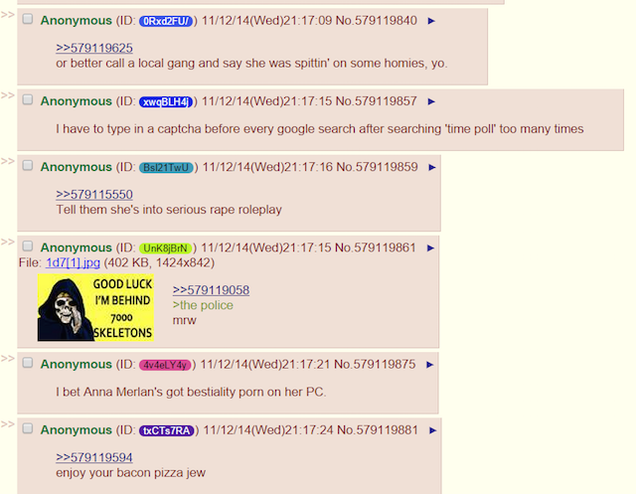
So now I was getting to see them in action. In a few minutes, someone who wanted to warn me sent me a link to where the 4Chan crowd was rowdily discussing their plans for my evening. (Over the course of the night, they kept nuking their threads and creating new ones, three or four before the night was over.) They were racking up food orders: sushi, Chinese food, Middle Eastern, orders usually totaling $60 or $70, all of them payable on delivery. Many people posted their receipts.

A lot of the food had bacon or ham in it. I'd wondered why, then realized I've tweeted in the past about being Jewish. (I'm not observant and pork products don't shock me, but they didn't know that.) When the food orders got boring, /b/ considered other ideas: Should they send me vacuum cleaners? ("That's not even a shit gift," someone complained.) Sign me up for tons of mailing lists? How about rape?

One of them decided he should post a Craigslist Casual Encounters ad, to get people to come to my house for sex, preferably "large black men."

"Tell them she's into serious rape roleplay," someone suggested.

"I would seriously rape her," another volunteered

"Actually raping her is a little much, anon."
The Cops Don't Care About Violent Online Threats. What Do We Do Now?

The Cops Don't Care About Violent Online Threats. What Do We Do Now?

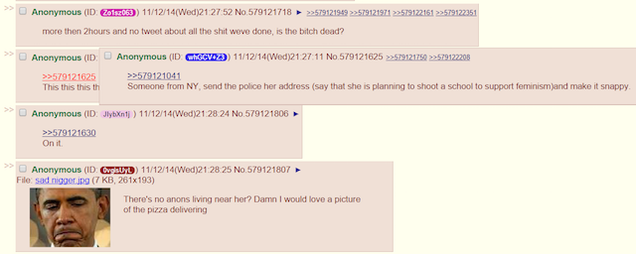
It was good to know they had a floor. Not much of one, though. Pretty soon, they settled on their favorite idea yet: swatting. That is, they wanted to make a fake distress call to get the police, the fire department or—best of all—an entire SWAT team called to my house, expecting an armed confrontation.

"Someone from NY, send the police her address (say she is planning to shoot a school to support feminism) and make it snappy."
The Cops Don't Care About Violent Online Threats. What Do We Do Now?

"Someone said they called the PD from a payphone in California and they just laughed at them."

"We need to get sand nigger food to her house first. We want the cops to freak out and start shooting."

I emailed my editor and Gawker Media's lawyers, who suggested I call the police. I called my local precinct in Brooklyn, who told me I'd need to come in to file a report. I was most worried about the people living in my old apartment and asked if someone could do a welfare check there, but an officer told me that wasn't possible. I checked Twitter accounts for the police scanner and the FDNY a few times to make sure there was no major disturbance in that neighborhood. Seeing nothing, I decided to leave going to the police for the next day.

I also checked Craigslist briefly for posts about giving an unwilling Jewish writer the raping of her life, but didn't see anything there either. By this time, someone had jumped into a thread pretending to be me: "I have some friends who know their fair bit about hacking. Get ready for your IPs to be backtracked and sent to the Internet Police."

An hour passed. 4Chan started getting restive.

"More then 2hours and no tweet about all the shit weve [sic] done," one complained. "Is the bitch dead?"

"Probably buried under a pile of pizza boxes," someone else suggested.

Around midnight, they gave up. I went to bed, waking up in the night to reach for my phone and look at my Twitter mentions one more time.

"I'd like to rape you" a new message read, from another egg. Half-asleep, I took a screenshot, blocked him and went back to sleep.

II.

At this point, so many female writers have been threatened online that it's spawning its own new type of journalism; call it "harassment lit." There's Amanda Hess, who was vacationing in Palm Springs when a man tweeted that he had a previous conviction for manslaughter, and was coming to her house to "rape you and remove your head." There's Rebecca Watson of the science blog Skepchick, threatened by a commenter who lived three hours away and had a previous conviction for domestic violence. There's feminist journalist Jessica Valenti and programmer Kathy Sierra. There's former Jezebel writer Lindy West, who recently interviewed one of her most vicious trolls on This American Life, and Gamergate target Anita Sarkeesian, who recently posted just one week's worth of her Twitter mentions, a cavalcade of cruel, violent, degrading insults and threats.

You don't even have to have written extensively about feminist issues: Kelsey McKinney, a reporter for Vox, started getting threats after she wrote one piece about the celebrity nude photo hacks. It's never really subsided.

"I am threatened with rape, mutilation, and physical harm more than ever thought I would be," she wrote in an email. "I get emails that describe how the writer wants to find, rape and murder me. I get emails that have my head photoshopped onto porn stars bodies, or dead animals, or brutally hurt women." She gets two or three a week, usually under innocuous subject lines like "Read your piece" or "Just saying hello."

Then comes the part of the harassment lit story where you go to the police and nothing happens. ("What's Twitter?" the responding officer asked Hess). McKinney called the cops after someone sent her a photo of the house she'd grown up in. "I haven't lived there for years and my parents have since moved, but it was terrifying."

It was not terrifying enough to interest law enforcement. "They told me they couldn't possibly know what the picture meant," McKinney said. "I told them it was obviously a threat meant to intimidate me. The officer on the phone told me to calm down. I could not calm down. Since then, I don't bother calling."

Now it was my turn to try the police. The morning after /b/ had deluged my old apartment in takeout, I went with Kavi Reddy, one of Gawker Media's attorneys, to the police station near our offices in NoLIta. I went partly out of caution, and partly out of curiosity: in situations like mine, what options did female writers even have? I brought a notebook and some screenshots of the 4chan thread.

Right away, the situation proved difficult to explain. "I think I've heard of 'em," Officer Rao, the NYPD officer who met us at the front desk said of 4chan. He'd heard about the naked actress photos. He frowned. "But do we know where they physically are? We need physical locations."

We didn't know where they were, we explained.

"Who's the perpetrator?" he asked, trying again. "Who's the one doing this?" He looked at my screenshots and shook his head. "What's the point of this?"

"To harass me," I told him. "And to prove they know where I live. To scare me."

Rao nodded. The situation, he told me, was difficult because "it's not cut and dried, like, you know, we dated, then I call her up and threaten her. There'd have to be IP addresses pulled."

We'd filed another report only a few months back at the same precinct, for another Jezebel writer. Reddy asked if Rao could pull it up. He turned on the computer and patiently waited for it to load. He searched the writer's name, waited some more. Suddenly, he reached over, grabbed the cords connecting the computer to the wall and gave them a hard tug.

"You gotta shake them every once in a while to make it work," he told us apologetically.

In the end, Rao told me I'd have to go to my home precinct in Brooklyn to file a report, since I had received the threats at home (That is, I'd been at home on my laptop when I read them).

"I don't want to take the report and have it get pushed aside," he explained. "It's stalking and aggravated harassment. But with an unknown perpetrator, we'd have to close it right away."

Reddy asked if he could call the precinct where my old apartment was located and make them aware of what was going on, something the NYPD has been able to do in similar situations with Gawker writers in the past. Rao said it would be better if we sent the new residents a letter.

I got to my home precinct around 8 p.m. that night. (I'm not identifying the precinct in the event that it might make it easier to find my address.) The station was empty except for two police officers at the front desk and a senior police administrative assistant in a side room, a woman in her 60s, who looked at me sourly when I tried to explain why I was there.

"Have you heard of 4chan?" I asked.

"No," she said. Her radio was playing an oldies station at top volume. She didn't bother to turn it down. She looked at me skeptically as I tried to explain what had happened, her mouth twisted. It occurred to me that she probably thought I was mentally ill. I handed her the screenshots I'd taken of the /b/ chatroom and pointed out the words "rape" and "swatting."

"I have to show these to a detective," she said.

"Okay," I replied.

"You can't come with me," she added sharply. I hadn't moved.

She was gone about 20 minutes; when she returned, she had a Detective Hunt in tow.

"This is, at most, harassment," he told me. "It doesn't take a genius to figure this out. It's more bark than bite. And anyway, these are Canadian phone numbers and we can't trace them." He was referring to some links embedded in the chat, which did sort of look like phone numbers, in that they were strings of numbers.

If anything else happened, Hunt said, "You can always come back and file more." In the meantime, he added, "Just don't go on those websites."

I asked if someone would be able to go to my old apartment and make sure whoever lived there was all right.

"They have to file their own report," Hunt said. He added that the officer who didn't want to take my report in Soho was "probably just lazy."

The administrative aide allowed me to fill out a report for aggravated harassment. She declined to give me her name, telling me it would be available in my police report. (I was able to find her name, but won't print it here—to protect my own privacy , not hers.)

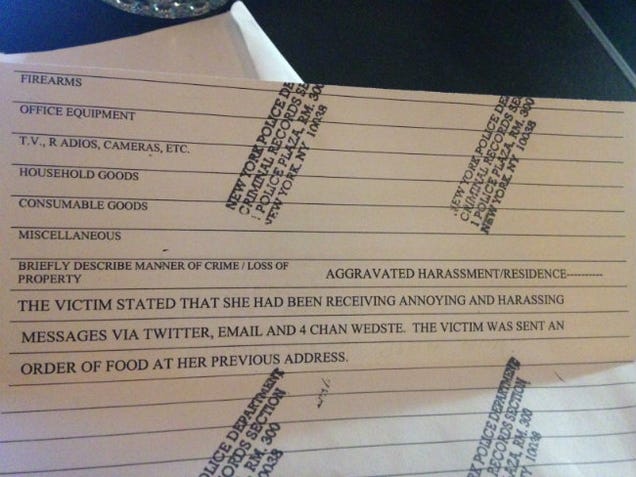
I got my report last week; in my statement, I'd written about three-quarters of a page, detailing the food orders as well as the threatened swatting and rape. Here is what the administrative aide wrote down:

The victim stated that she had been receiving annoying and harassing messages via twitter, email and 4chan wedste [sic]. The victim was sent an order of food at her previous address.
The Cops Don't Care About Violent Online Threats. What Do We Do Now?

Elsewhere on the report, my first name was misspelled.

III.

In the end, what happened to me wasn't a particularly big deal: it was a single night, and has yet to repeat itself. But there's nothing to prevent it from happening again, and when it does, my options will continue to be pretty bad, even with a powerful media company and talented attorneys behind me.

Technically, threatening someone online is just as illegal as doing it over the phone. But in practice, it's been hard for cops and courts to separate what constitutes a true threat online from what's protected as free speech. The Supreme Court is preparing to take up the case of Anthony Elonis of Bethlehem, Pennsylvania, who was convicted of making threats across state lines, a federal crime.

Elonis wrote a series of Facebook posts—"rap lyrics," by his account—in which he fantasized about killing his ex-wife. One said he "wouldn't rest" until she was dead, "Soaked in blood and dying from all the little cuts." Later, after she'd gotten a protective order, Elonis wrote: "Fold up your protective order and put in your pocket. Is it thick enough to stop a bullet?"

He also posted about being ready to "make a name for myself" by shooting up an elementary school. After a female FBI agent visited him at home about that one, he wrote a new lyric about her:

Little agent lady stood so close

Took all the strength I had not to turn the bitch ghost.

Pull my knife, flick my wrist, and slit her throat.

Leave her bleedin' from her jugular in the arms of her partner.

Elonis appealed his conviction, on the grounds that he had merely been expressing himself. Although he only started claiming his Facebook rantings were "rap lyrics" after the FBI got involved, his case still captures the knotty questions about online harassment: What is free speech? What's an actionable threat? How do we draw the lines to protect speech, but also allow some legal recourse for people who are being terrorized?

The best overall guide we have is the "true threat doctrine," which defines threats as statements that "a reasonable person would interpret as a real and serious communication of an intent to inflict harm." But that's vague, to put it mildly, and it has been inconsistently applied by different courts. Danielle Citron, an attorney and law professor who has called for better enforcement of online harassment laws, says she hopes the Elonis case will clarify what a "true threat" actually means.

"We bend over backwards in the United States—and we should—to protect and provide breathing space for free speech of all sorts: offensive, profane, irritating," she says. "We want to provide breathing room for public conversation. But when it comes to expression whose raison d' etre is to silence other people, to ruin reputations, to terrorize, we should be less anxious about silencing that."

What counts as being terrorized? The culture around 4chan is willfully obtuse on that point. Sending pizza is a prank, right? A prank that demonstrates you know (or think you know) where your online target lives in real life. Then you choose to send the pizza under the name of someone accused of an actual murder—someone who was a participant in your own online community. The victim was sent an order of food. The real David Kalac apparently had believed the audience for lulz would appreciate seeing his girlfriend's dead body. What did the fake David Kalac believe?

At some point, you have to consider the numbers. I'd been working in alt weeklies for years before I came to Jezebel in October 2014, and nothing had prepared me for the volume of harassment that comes with joining "women's media." Individual writers and the Jezebel staff as a whole get both threatened and deluged with foulness on a regular basis; Gawker Media redesigned our commenting system last year to deal with an onslaught of violent images in Jezebel's comments, many of them involving female corpses and depicting unspeakable violations.

So most of the abuse is online. Most of the incursions into offline life stop with delivery food. If you're not facing the harassment firehose, as most male writers aren't, it's easy to stop thinking about it there. Earlier this month, someone at Gawker Media leaked a copy of the office seating chart to the Awl—a little piece of media gossip, that, to the Jezebel staff, meant giving potential psychos a map to where we sit. (The leak was an even odder decision given that the men of Gawker Media have gotten their own share of threats.)

The police are particularly disinclined to view online threats as urgent. Even without Elonis being decided yet, there are pretty good harassment and stalking laws on the books in most states that could be used to prosecute people who make clear threats online. But something about the online environment makes police lose interest.

Brianna Wu, one of the primary targets of Gamergate, told me she has been showered with alarmingly specific threats. "They're saying who, what, where, why, when," she said. "They said I was going to be on the front page of your site when they murdered me."

"I had someone last week that made a video talking about how they're going to murder me," Wu added. "This is not just, 'I'm going to kill Brianna,' this is like a multi-minute rant about why they want to murder me, how. Their face is visible in the video. I have their name and testimony from the people who know them and how unbalanced they are. This person lives 15 minutes from my house."

Wu called the police, which she's had to do numerous times since Gamergate blew up. To her amazement, even this particular threat hasn't resulted in an arrest.

"This is what I want to emphasize for you—as much as you can have something going for you with death threats, I do," she said. "I have a very high profile case. There's so much media attention. I have the ear of the police. They have every reason to want to solve this crime, but at the same time nothing has happened, even giving them as much as information as I have."

Zoe Quinn, the game developer who was the original focus of Gamergate's outrage, has had similar experiences. "Think GG is hard to explain to a friend?" Quinn wrote in a recent blog post:

Try a legal system that doesn't really understand what the internet is yet— it's like trying to push cooked pasta through the eye of a needle. Try explaining shit like 4chan to an officer who types with henpeck hands and getting handed a police report that makes you feel like praying the abuse away may be more effective. Law enforcement is prepared for familiar things like 'here is a death threat, here is someone violating a restraining order, here's where they openly discuss wanting to rape me,' but trying to convey how things work online is frustrating.

IV.

This is the usual lesson: The police are helpless in the face of the mixed signals and technological complexity of online threats. Except they aren't—especially not when the threats are against police officers.

After a Baltimore man killed two New York police officers in December, accompanying his crime with a spree of Instagram posting, law enforcement wasted no time before moving against online antagonists. The NYPD said it combed "hundreds" of online messages and 911 calls, eventually arresting nine men for threats.

Some of the men threatened officers in person or on the phone; one posted "pictures of weapons" to his Facebook page, according to police, and statements indicating that he wanted to kill cops. Another was arrested after he was overheard on his cellphone talking about wanting to kill police. A man in suburban New York was also arrested for posting images on Instagram and Facebook there threatening police.

In the same week, 17-year-old Fort Worth resident Montrae Toliver was arrested for making a terroristic threat after he posted a photo of a gun pointed at a parked police cruiser on Twitter. It bore the caption, "Should I do it? They Don't Care For a Black Male Anyways." The FBI arrested Jeremiah Perez of Colorado Springs for a YouTube comment which read, in part, "WE VETERANS WILL KILL RETIRED HELPLESS COPS."

The court documents relating to the arrest of Perez detail just how quickly law enforcement agencies can act when they want to: Google+ sent an emergency request to the FBI after seeing Perez's YouTube comment. The request read in part, "[T]here presently exists an emergency involving imminent death or serious bodily injury to a person or persons, and that immediate disclosure to you of certain information is required to avert the emergency."

In a matter of days, the FBI contacted Perez's internet service provider, started physically surveilling his house, ran his license plates, pulled his military records, executed a search warrant, and arrested him.

Local police are likewise able to move quickly when motivated: One of the men arrested for threatening NYPD officers was 26-year-old Jose Maldonado, who according to ABC news had posted "Might just go out and kill two cops myself!!!" on his Facebook, along with pictures of the slain officers and photos of a TEC- 9 and a MAC-10. He was contacted by police that day and surrendered at the precinct that evening.

In a statement at the time, the NYPD said they'd received about 40 threats and determined about half weren't credible, adding, "All threats against members of the NYPD are taken seriously and are investigated immediately to determine the credibility and origin of the information."

Last week, the NYPD made yet another quick arrest, of a 17-year-old boy named Osiris Aristy. They accused him of making terroristic threats against the police by posting gun emojis pointing at cop emojis, along with statements that reportedly included ""N***a run up on me, he gunna get blown down," and "Fuck the 83 104 79 98 73 PctKKKK." Here, the ambiguity of online communication was not a problem.

Even the anonymity of 4chan hasn't prevented local police from being able to arrest a threat-maker: in Harrisonburg, Virginia, police arrested 24-year-old Joshua James Mitri in October after he posted a message on a 4chan board saying he was going to shoot up an elementary school.

V.

Why is it that the police can fairly easily track down people threatening them in YouTube comments, but seem unable or unwilling to do so for other people being targeted?

Danielle Citron, the attorney who's pushed for better enforcement of harassment laws online (she's written an entire book about it, Hate Crimes in Cyberspace), pointed out that that shouldn't be the case, especially in New York and Los Angeles.

"LA has a threat assessment unit and NYPD has a counterpart," Citron said. "They have statistics they gather around aggravated harassment. New York City has awareness tools and fusion centers," meaning places where multiple law enforcement agencies share space and information—the NYPD, the U.S. Attorney, the Department of Homeland Security, the Drug Enforcement Administration.

"They're trying to go after terrorism and national security efforts," Ciron said. "You are the most networked and most surveilled city in the country. But it's mind-boggling that we can't turn any of these technologies to help people who are threatened, harassed stalked, terrified."

The NYPD and the FBI also teamed up earlier this year to form a federal cyber-crime task force, the National Cyber Investigative Joint Task Force, pledging to monitor "modern day cyber threats." But it seems to be focused mostly on potential terrorism and threats to the public transportation infrastructure; it's pretty clearly not the right place to report a threat against an individual.

Citron argues that local police, not the FBI, really the ones who should be enforcing harassment laws, and doing a better job of it.

"State and local police have always been the home of stalking and harassment laws," she said, and it's primarily state and local police who should be enforcing them better. "It's not that we don't have federal cyberstalking laws—it's fantastic, it could be a model for states." That's Section 2261, Title 18 of the U.S. criminal code, which bans interstate stalking, harassment and domestic violence.

"It's a very helpful statute," Citron said—that is, when federal law enforcement agencies choose to use it. "The problem often is that they often say, 'We're in the business of worrying about murder and terrorism, we don't enforce cyberstalking laws.' But when you look at FBI statistics, the most investigated crimes are drug crimes and larceny property, like when you steal someone's car. The idea that we're too busy at the federal level investigating terrorism and murder is untrue. The statistics belie that."

In a statement, FBI press officer Emily Yeh told Jezebel,

If someone feels they have been a victim of crime, or a target of a threat—whatever the method the threat was made—they can report it to any of the FBI's 56 field offices. There are several ways an individual can report the crime as well. They can call, email, or walk-in to their local field office; location, contact information, and hours, of all our offices are on fbi.gov. They can also report a crime to their local law enforcement. The FBI encourages those who believe they are a victim of a crime to report that crime.

The FBI will address each reported incident on a case-by-case basis, investigating the totality of facts and circumstances to determine if there is sufficient credible evidence to make an arrest and proceed with federal charges. Again, it would not be appropriate for me to provide more information at this time. If charges are filed, they will eventually become a matter of public record.

At the local level, the biggest problem, Citron said, starts with a lack of technical skills and training for law enforcement officers at the local level. "The police response comes from a place of intimidation. The technology just intimidates people, and when police officers are intimidated, they say, 'Turn it off and ignore it.'You have officers who mean well, but they do not understand the technology and they aren't well-trained in the laws."

There's also the fact that harassment laws that often require a threat to be made directly to the person, not on a third-party website, as happened to me and many others with 4chan and 8chan.

"There are laws on the books in, let's say, half the states, harassment and stalking laws, that cover abuse on third-party sites," Citron said. "But a lot of them require one to one communication. New York's aggravated harassment law, if a man puts a nude photo of his ex on Twitter and doesn't send it to her, it wouldn't 'harm' her," and he wouldn't be committing a crime."

Another issue, she adds, is the wording of stalking laws in many states, which Citron says "have become outmoded— a lot of them talk about 'lying in wait,' things that require a physical presence."

Your civil alternatives also aren't very good. "There are of course civil claims that individuals could bring if they could figure out who their harassers are and they had resources to sue," Citron says. If you're not a public figure, you can sue for intentional infliction of emotional distress (the bar is higher for public figures, or people who have been in the news—i.e. anyone whose name is mentioned in this story).

But besides the prohibitive cost of a lawsuit, Citron adds, the "the perpetrators are often judgment-proof"—meaning broke. "When you have very little to lose, you don't give a shit."

VI.

What options does that leave people who are being harassed? Nadia Kayyali, an activist with the Electronic Frontier Foundation, suggests "surveillance self-defense," a system of keeping safe that involves "threat modeling"— running through potential threats to see how safe your information is and whether your device security is solid enough. It's a good way to make sure, for example, that you're not inadvertently telegraphing your physical location through social media.

And there's "counter speech," using the same online tools that are sometimes used to harass—like Twitter—to call attention to and condemn abusive behavior. "That goes to the strength of the internet," Kayyali said. "Part of the strength and weakness is what an amazing medium for communication it is. And sometimes that means an ugly vile message gets amplified much quicker. But it also means we can use that strength to respond."

Brianna Wu has employed a mixture of all these techniques to try to stay safe; she also recently started offering a $11,000 reward "for identifiable information leading to the prosecution of people sending me death threats." (We may see more law enforcement action soon: Earlier this year, journalist Michael Morisy filed an open records request with the FBI requesting its files on Gamergate and got a form letter back denying his request, because of an "pending or prospective law enforcement proceeding." FBI spokesperson Emily Yeh tells Jezebel, "In regards to Gamergate, absent the filing of formal charges or for a law enforcement purpose, I cannot confirm or deny the existence of an investigation. Therefore it would not be appropriate to provide further comment on this matter at this time.")

Wu doesn't really see Gamergate ever ending. "I think it's been discredited, but I think it's always going to exist. And that's the sad reality of being a woman in the games industry in 2015."

Quinn, too, says she's adjusting reluctantly to her new version of normal. "It's been trying to accept and internalize that, and then figure out how to fight back and make sure this doesn't happen to anybody else," she says.

Quinn recently launched an anti-swatting task force called Crash Override, which seeks to help people protect their information to prevent doxxing and swatting, by helping them pull their personal information from online databases, by encouraging them to put in place things like two-step verification to make it harder to hack their emails, and to keep them physically safe and their information as protected as possible in the event that it does happen. She's also writing a book about her experiences.

"It's been really hard to accept that the life I had before this is over," she says. "But that's just the reality of the situation."

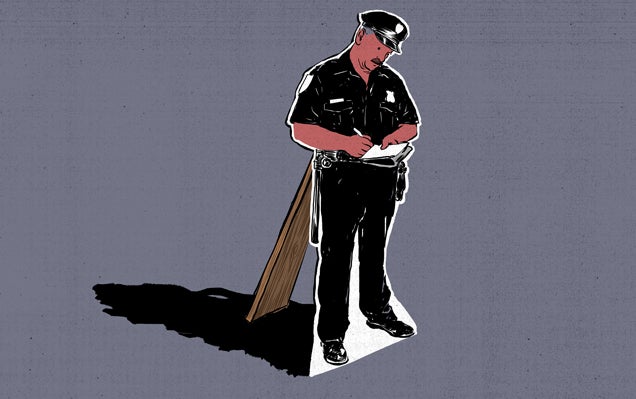
Illustration by Jim Cooke.

Recommended article: Chomsky: We Are All – Fill in the Blank.
This entry passed through the Full-Text RSS service - if this is your content and you're reading it on someone else's site, please read the FAQ at fivefilters.org/content-only/faq.php#publishers.

29 Jan 16:39

Netflix-like payments to ISPs could be reviewed but not banned by FCC

by Jon Brodkin

The Federal Communications Commission will reportedly set up a complaint process to review the controversial paid peering deals in which online content providers such as Netflix pay for access to broadband providers' networks.

Netflix objected to having to pay the likes of Comcast, AT&T, Time Warner Cable, and Verizon for interconnection, which lets Netflix send traffic directly into the providers' networks without paying a middleman. The FCC's net neutrality rules, scheduled to be revealed next week and voted on February 26, won't ban the deals but will set up a formal process in which Netflix and others could complain that the prices aren't reasonable, according to a Bloomberg report yesterday.

"FCC Chairman Tom Wheeler has decided the rules, scheduled for a vote next month, will permit the agreements but include a procedure for companies to ask for agency review," Bloomberg wrote, quoting "a person briefed on the plan."

Read 5 remaining paragraphs | Comments

27 Jan 20:37

If you're a CIA employee it's ok to torture people, but talk to a reporter? Go to jail.

by Xeni Jardin
Jeffrey Sterling.


Jeffrey Sterling.

Dan Froomkin at The Intercept on the fate of CIA whistleblower Jeffrey Sterling, who was convicted of espionage this week for talking to New York Times Reporter James Risen:

The Sterling case – – especially in light of Obama’s complicity in the cover-up of torture during the Bush administration – sends a clear message to people in government service: You won’t get in trouble as long as you do what you’re told (even torture people). But if you talk to a reporter and tell him something we want kept secret, we will spare no effort to destroy you.

Previously on Boing Boing:
"CIA whistleblower Jeffrey Sterling convicted of espionage in NYT leak case"

Recommended article: Chomsky: We Are All – Fill in the Blank.
This entry passed through the Full-Text RSS service - if this is your content and you're reading it on someone else's site, please read the FAQ at fivefilters.org/content-only/faq.php#publishers.

27 Jan 06:27

Google strong-arms indie musicians into accepting brutal, crowdfunding-killing deal for streaming service

by Cory Doctorow
Bewarethewumpus

Google being evil again.


Google is launching a new, Youtube-branded streaming music service, with the cooperation of the Big Four labels, who got to negotiate the terms of their participation -- unlike the indie musicians, who have been told that they will be exiled from Youtube altogether unless they make it their most-favored-nation distribution service, without the possibility of holding back tracks for backers on services like Kickstarter or Patreon.

Zoe Keating, who runs her own microlabel, has summarized the conversation she had with her Google rep. As JWZ says, it's "the same strategy they used with Google Plus: instead of creating a new service and letting it compete on its own merits, they're going to artificially prop it up by giving people no choice but to sign up for it."

For what it's worth, I predicted this in my book Information Doesn't Want to Be Free: as copyright laws have tightened, requiring new Youtube competitors to set up multi-hundred-million-dollar infrastructure like Content ID, the competition for Youtube has all but vanished, meaning that they are now essential to any indie artist's promotion strategy. And now that Youtube doesn't have to compete with other services for access to artists' materials, they have stopped offering attractive terms to indies -- instead, they've become an arm of the big labels, who get to dictate the terms on which their indie competitors will have to do business.

* Participation in the new service requires that your entire catalog be available for streaming, at high resolution.

* Participation requires that you not release your music elsewhere earlier, e.g., no early releases for fans or backers.

* You no longer get a choice of whether to do nothing, block a video, or run ads. Ads are mandatory.

* Five year contract.

* If you don't participate in the new service, then the option to obtain Content-ID ad revenue from the free version of Youtube no longer exists.

* If you had previously been getting Content-ID ad revenue and choose not to participate in the new service, your channel will be deleted and all videos using your music will be blocked.

Google's upcoming paid streaming service [JWZ]

What should I do about Youtube? [Zoe Keating]

(Image: Wood screw big, Rfc1394/Wikimedia Commons, CC-BY-SA)

Recommended article: Chomsky: We Are All – Fill in the Blank.
This entry passed through the Full-Text RSS service - if this is your content and you're reading it on someone else's site, please read the FAQ at fivefilters.org/content-only/faq.php#publishers.

27 Jan 06:23

Christian miner who refused ‘Mark of the Beast’ Antichrist biometric hand scanner awarded $150K

by Matthew Williams
warhol-666 (1)

A mining company employee who refused to submit to biometric hand scanning because he feared the scanner would imprint him with the “Mark of the Beast,” was awarded $150,000 in damages by a federal jury last week. The employee, who is an evangelical Christian, was told he had to submit to the tracking technology for time and attendance logging. He said using the scanner went against his religious beliefs.

Last Thursday a federal jury ruled in favor of Beverly R. Butcher Jr., a general laborer at the Consol Energy/Consolidation Coal Co.’s Mannington mining operations, who said he was forced to retire because of his religious beliefs after refusing to use new biometric technology used to track employee attendance and time.

Butcher refused to use the new technology because he feared the technology was associated with the Antichrist and would imprint him with the “Mark of The Beast,” a reference to a passage from the book of Revelation in the Bible.

"Jury awards $150K to employee who refused ‘Mark of the Beast’ hand scanner" [patheos.com]

"Retired Consol worker wins religious discrimination suit" [sfgate.com]

Recommended article: Chomsky: We Are All – Fill in the Blank.
This entry passed through the Full-Text RSS service - if this is your content and you're reading it on someone else's site, please read the FAQ at fivefilters.org/content-only/faq.php#publishers.

27 Jan 06:20

Viral 'speed archery' video mostly shows how gullible the internet is

by Xeni Jardin
Bewarethewumpus

Well, not being a practised archer, or having a strong background in archery, I'm comfortable saying that I found the original video fascinating, and I was pretty much taken in by it.

That said, while it seems that the guy is mostly full of shit, if and when I get around to shooting with a bow again, he's given me a few things to explore, like holding the arrow on the left and arrows in the firing hand. I expect that I'll be creating more problems than I solve by playing around with his methods, but I think there's something to be said for the exploratory method of learning.

ezgif-1006410322

GeekDad's Jim MacQuarrie breaks down what's wrong with that very entertaining viral video with the Danish archer purportedly mastering an "ancient archery technique" that involves spraying a whole lot of arrows very very fast.

ezgif-1234122663

Jim writes:

The question really comes down to three separate categories; (1) the claims made in the narration; (2) the trick shots shown, and (3) Andersen’s actual archery ability.

We’ll start with the third. Andersen’s quick-shooting technique is obviously effective (if speed is the goal), in that he is able to fire a lot of arrows at a very rapid pace. It’s worth noting that the narrator goes to great pains to explain why shooting at close-up distances is so important and denigrates “warrior archers only shooting at long distances,” (just one of many totally false claims) in order to paper over the fact that the man obviously can’t hit anything that’s more than about 20 feet away. No doubt there are literally hundreds of failed attempts that were cut out of the carefully-edited video. His gimmick is speed, not accuracy, and it’s obvious to anyone who actually knows anything about archery that his complete lack of any kind of consistent form is going to require camera tricks and a lot of luck, which is exactly what’s on display here. He may in fact be the fastest archer in the world; he just shouldn’t pretend to be accurate.

The really egregious part is the staggeringly inaccurate, misleading, and hyperbolic narration, written by somebody with little-to-no actual knowledge of archery history and a willingness to distort facts to make a bogus case.

"Danish “Archer” Demonstrates Gullibility of Audience" [geekdad.com]

Previously on Boing Boing: "Incredible archer shows his speed-shooting skills"

ezgif-2390241744

Recommended article: Chomsky: We Are All – Fill in the Blank.
This entry passed through the Full-Text RSS service - if this is your content and you're reading it on someone else's site, please read the FAQ at fivefilters.org/content-only/faq.php#publishers.

27 Jan 05:54

NSA-themed art

by Cory Doctorow


This lovely piece of NSA-surveillance-themed art comes from Anthony Freda, previously featured here for his Normal Rockwell/Ferguson piece.

(Thanks, Hugh and Anthony!)

Recommended article: Chomsky: We Are All – Fill in the Blank.
This entry passed through the Full-Text RSS service - if this is your content and you're reading it on someone else's site, please read the FAQ at fivefilters.org/content-only/faq.php#publishers.

27 Jan 05:47

January 26, 2015

Bewarethewumpus

Happy to say, I've never seen a dwarf cassowary. Plenty of full size ones, but never a dwarf.


New BAHFest day! Ever wondere about the evolutionary origins of the handshake?

27 Jan 05:45

How to tell if you're about to make a really bad decision - a flowchart

by Matthew Inman
Bewarethewumpus

I sense a deeper story, perhaps one that was never meant to be shared, except in the form of this simple flowchart.

27 Jan 05:29

American Counter-Strike Scene Hit Hard By Pro Cheating Bans

by Nathan Grayson
Bewarethewumpus

I'm glad that Valve responded harshly and decisively.

American Counter-Strike Scene Hit Hard By Pro Cheating Bans

Recently, substantial evidence came to light that a number of pro players had been involved in a huge Counter-Strike: Global Offensive match-fixing/gambling scandal. Valve took its time investigating, but now they've finally decided to bring the hammer down. Hard.

In the wake of a multi-team conspiracy that saw one of the best Counter-Strike teams in North America throw a match against relative small fries so certain pros could cash in on underdog bets, Valve passed their verdict down in a blog post:

All together, the information we have collected and received makes us uncomfortable continuing any involvement with these individuals. Therefore we will be directing our CS:GO event partners to not allow any of the following individuals' participation in any capacity in Valve-sponsored events:

Duc "cud" Pham

Derek "dboorn" Boorn

Casey Foster

Sam "Dazed" Marine

Braxton "swag" Pierce

Keven "AZK" Larivière

Joshua "Steel" Nissan

Professional players, their managers, and teams' organization staff, should under no circumstances gamble on CS:GO matches, associate with high volume CS:GO gamblers, or deliver information to others that might influence their CS:GO bets.

So basically, Valve has a zero-tolerance policy for this kind of garbage. I hope other would-be cheaters, match-fixers, and (illicit) gamblers are paying attention.

For those not in the know, these banned players make up a large portion of iBUYPOWER, considered by many to be the best North American Counter-Strike team. Meanwhile, members of similarly high-ranked (by NA standards) teams Cloud9 and Torqued are also out, as are people involved on the side of the team that "won" the ill-fated match, NetcodeGuides. All told, this is a pretty big blow to North America's Counter-Strike scene, although a number of lower-ranked NA teams picked up big wins over the weekend at MLG X Games Aspen. Hope is far from lost, but this is disappointing, to say the least. These players got what they deserved, but it sucks that they decided to go and pull this giant, idiotic ruse in the first place.

Recommended article: Chomsky: We Are All – Fill in the Blank.
This entry passed through the Full-Text RSS service - if this is your content and you're reading it on someone else's site, please read the FAQ at fivefilters.org/content-only/faq.php#publishers.
26 Jan 16:39

It Takes Nine Minutes To Break Down The Amazing Super Mario Timeline

by Patricia Hernandez

There are a lot of Mario games out there. Though most of these games aren't particularly story heavy, some people have still set out to try to place these games in chronological order in an effort to make a single Mario timeline. Here's the latest crack.

If you include every single Mario game you can think of—including spin-offs, and games that feature other Mario characters are protagonists—things get particularly incredible. As Scorpigator Films tells it, our favorite plumber has led one hell of a life. Though you'll have to watch the video to hear the rationale for this particular timeline, if you're just interested in game order, here you go:

Yoshi's Island,

Yoshi's New Island,

Yoshi's Island DS,

Yoshi's Story,

Mario & Luigi: Partners in Time,

Wrecking Crew,

Donkey Kong,

Donkey Kong Junior,

Donkey Kong 3,

DKC Series,

Mario Bros.,

Super Mario Bros.,

Super Mario Bros. 2,

Super Mario 3D Land,

Super Mario Bros. 3,

Super Mario RPG,

Luigi's Mansion,

Super Mario World,

Super Mario Sunshine,

Super Mario Galaxy,

Paper Mario Series and Dr. Mario,

Super Mario Galaxy 2,

Super Mario 3D World,

Super Mario 64,

New Super Mario Bros.,

Mario and Luigi: Superstar Saga,

Mario Kart DS,

Luigi's Mansion: Darkmoon,

New Super Mario Bros Wii,

New Super Mario Bros. U,

Mario and Luigi: Partners in Time,

Mario & Luigi: Bowser's Inside Story,

Super Princess Peach,

Mario and Luigi: Dream Team,

New Super Mario Bros. 2,

Mario Party,

All the other Mario sports titles,

Mario vs Donkey Kong,

Super Mario Land,

Super Mario Land 2,

Wario Land

What particularly gets me about this crack at the Mario timeline is the attention to detail. It takes certain gameplay aspects of the games, and uses them to explain why things happen in a certain order. Take New Super Mario Bros 2, for example. In the game, there are an absurd number of coins. So Scorpigator Films thinks, hey, what would Mario actually do with that money? Boom, there's the rationale for all the sports spin-off titles: Mario has obviously used his incredible wealth to buy teams, tracks and such.

I'm also a fan of this timeline because it's kind of bleak. Mario ends up all by his lonesome, without his princess or brother—all because he can't give adventure up. And neither can we. Damn.

Recommended article: Chomsky: We Are All – Fill in the Blank.
This entry passed through the Full-Text RSS service - if this is your content and you're reading it on someone else's site, please read the FAQ at fivefilters.org/content-only/faq.php#publishers.

25 Jan 20:13

Kotaku 'Shop Contest: Make Your Own Damn Zelda New 3DS XL: Winners! 

by Mike Fahey

Kotaku 'Shop Contest: Make Your Own Damn Zelda New 3DS XL: Winners! 

Undaunted by the seeming shortage of Majora's Mask limited edition New Nintendo 3DS XL consoles hitting North America on February 13, our Photoshop-savvy readers made their own, resulting in possibly the largest number of entries in 'Shop Contest history, all of them gorgeous.

When I say they are all gorgeous, I mean it. Nearly every single entry in last week's contest was an obvious labor of love. In fact, I went back through the comment section and approved every single grayed-out entry, so once you're done here be sure to check out the original post for all of these glorious results.

Judging by reactions in that post and my own beating heart, there was a clear winner this week at least, and that was sciteach with his riff on the original gold Nintendo cartridge for the first The Legend of Zelda game. It concentrated all the love in one spot.

Normally I pick 20 or so entries to spotlight along with the winner. This week it's more like 40. You people are the best.

This Week's Amazing Runners-Up

Kotaku 'Shop Contest: Make Your Own Damn Zelda New 3DS XL: Winners! Matt-FyreUK — for using his various DeviantArt-istic talents to take my breath away in purple.

Kotaku 'Shop Contest: Make Your Own Damn Zelda New 3DS XL: Winners! 

vein11 — for camera nipples.

Kotaku 'Shop Contest: Make Your Own Damn Zelda New 3DS XL: Winners! 

Revillution — for three simple words.

Kotaku 'Shop Contest: Make Your Own Damn Zelda New 3DS XL: Winners! 

Kirito — for one of my favorite art covers.

Kotaku 'Shop Contest: Make Your Own Damn Zelda New 3DS XL: Winners! 

Marisa Ross — for her striking folk art take.

Kotaku 'Shop Contest: Make Your Own Damn Zelda New 3DS XL: Winners! 

Kotaku 'Shop Contest: Make Your Own Damn Zelda New 3DS XL: Winners! 

Alkaline420 — for rocking that awesome yellow and green.

Kotaku 'Shop Contest: Make Your Own Damn Zelda New 3DS XL: Winners! 

FalkonLink — simple and beautiful.

Kotaku 'Shop Contest: Make Your Own Damn Zelda New 3DS XL: Winners! 

Robotaino — for the clever treasure chest design. Bonus if it plays that sound...

Kotaku 'Shop Contest: Make Your Own Damn Zelda New 3DS XL: Winners! 

angryangryasian — for the second best integration of the 3DS XL cameras.

Kotaku 'Shop Contest: Make Your Own Damn Zelda New 3DS XL: Winners! 

Garougarudo — he made the mask himself. So much purple in this contest.

Kotaku 'Shop Contest: Make Your Own Damn Zelda New 3DS XL: Winners! 

HigherQuality — for the "What if TeeFury made New 3DS XLs?" version.

Kotaku 'Shop Contest: Make Your Own Damn Zelda New 3DS XL: Winners! 

exilehunter — for a sweet and simple pattern.

Kotaku 'Shop Contest: Make Your Own Damn Zelda New 3DS XL: Winners! 

Arel — for my favorite "You've met with a terrible fate" riff.

Kotaku 'Shop Contest: Make Your Own Damn Zelda New 3DS XL: Winners! 

Stevec — for one of my favorite interior designs.

Kotaku 'Shop Contest: Make Your Own Damn Zelda New 3DS XL: Winners! 

SMJ — for a lovely scene from Link's Awakening.

Kotaku 'Shop Contest: Make Your Own Damn Zelda New 3DS XL: Winners! 

NintendoJR — because sometimes black and white is best.

Kotaku 'Shop Contest: Make Your Own Damn Zelda New 3DS XL: Winners! 

BonStobbe — because that Bomber's Notebook.

Kotaku 'Shop Contest: Make Your Own Damn Zelda New 3DS XL: Winners! 

clarbar — MOON EYES. THE MOON EYES.

Kotaku 'Shop Contest: Make Your Own Damn Zelda New 3DS XL: Winners! 

MarkoDeeJay — for a very bold sort of gold.

Kotaku 'Shop Contest: Make Your Own Damn Zelda New 3DS XL: Winners! 

Brandon — because we need more sketchy pen and watercolor art on our consoles.

Kotaku 'Shop Contest: Make Your Own Damn Zelda New 3DS XL: Winners! 

Mr Marsu — though it reminds me of a '70s van airbrush, it's still pretty sweet.

Kotaku 'Shop Contest: Make Your Own Damn Zelda New 3DS XL: Winners! 

Nobody Ever — for one of my favorite Wind Waker designs.

Kotaku 'Shop Contest: Make Your Own Damn Zelda New 3DS XL: Winners! 

preparetodrop — purple and creepy. That's Majora's Mask all right.

Kotaku 'Shop Contest: Make Your Own Damn Zelda New 3DS XL: Winners! 

DistractedObserver — because I said so.

Kotaku 'Shop Contest: Make Your Own Damn Zelda New 3DS XL: Winners! 

Zenrova — because damn that's pretty.

Kotaku 'Shop Contest: Make Your Own Damn Zelda New 3DS XL: Winners! 

coldkick — because it's almost rosy pink.

Kotaku 'Shop Contest: Make Your Own Damn Zelda New 3DS XL: Winners! 

PonchosSweater — for the special terrifying edition.

Kotaku 'Shop Contest: Make Your Own Damn Zelda New 3DS XL: Winners! 

curugon — for going all Creepypasta on us.

Kotaku 'Shop Contest: Make Your Own Damn Zelda New 3DS XL: Winners! 

Gene Jacket — for making his own damn Majora's Mask New 3DS XL the only way he could.

Kotaku 'Shop Contest: Make Your Own Damn Zelda New 3DS XL: Winners! 

LordCorgi — for the obligatory Lonk.

Kotaku 'Shop Contest: Make Your Own Damn Zelda New 3DS XL: Winners! 

Czuhc — for for waking the Wind Fish.

Kotaku 'Shop Contest: Make Your Own Damn Zelda New 3DS XL: Winners! 

MTRichardson01 — because he paid me off (comment joke)

Kotaku 'Shop Contest: Make Your Own Damn Zelda New 3DS XL: Winners! 

Taurenrider — but only if it comes with a tiny pixel Link holder.

Kotaku 'Shop Contest: Make Your Own Damn Zelda New 3DS XL: Winners! 

GiantBoyDetective — because sploosh.

Kotaku 'Shop Contest: Make Your Own Damn Zelda New 3DS XL: Winners! 

Adropofvenom — because fuck yes.

Kotaku 'Shop Contest: Make Your Own Damn Zelda New 3DS XL: Winners! 

Kotaku 'Shop Contest: Make Your Own Damn Zelda New 3DS XL: Winners! 

Hyrule Worriers — for my second favorite Wind Waker design.

Kotaku 'Shop Contest: Make Your Own Damn Zelda New 3DS XL: Winners! 

ArdillaNegra — because we didn't get nearly enough moon.

Kotaku 'Shop Contest: Make Your Own Damn Zelda New 3DS XL: Winners! 

Greg the Mad — for bringing sexy back.

Kotaku 'Shop Contest: Make Your Own Damn Zelda New 3DS XL: Winners! 

Ginger Snap — for keeping things simple and sexy.

Kotaku 'Shop Contest: Make Your Own Damn Zelda New 3DS XL: Winners! 

Lanception — because I can never choose between blue and purple.

Kotaku 'Shop Contest: Make Your Own Damn Zelda New 3DS XL: Winners! 

SNoshery — because it's watching us.

Kotaku 'Shop Contest: Make Your Own Damn Zelda New 3DS XL: Winners! 

toolsoldier — for my favorite Wind Waker edition, even if it's a bit busy inside.

And of course...

Kotaku 'Shop Contest: Make Your Own Damn Zelda New 3DS XL: Winners! 

sciteach for the win!

Come back later today for the next Kotaku Shop Contest, which shouldn't take nearly as long to judge.

Recommended article: Chomsky: We Are All – Fill in the Blank.
This entry passed through the Full-Text RSS service - if this is your content and you're reading it on someone else's site, please read the FAQ at fivefilters.org/content-only/faq.php#publishers.

25 Jan 19:25

24 Karat Gold PS4 And Xbox One Controllers Are Dumb, Almost Sold Out

by Mike Fahey
Bewarethewumpus

just cause the headline made me chuckle.

24 Karat Gold PS4 And Xbox One Controllers Are Dumb, Almost Sold Out

Earlier this week the folks at ColorWare ("The Color People" is probably not their slogan) released an extremely limited run of 24 karat gold-plated PlayStation 4 and Xbox One controllers. At $300 a piece the PS4 controllers are already sold out.

Granted only 25 of each console's controller were made, but that just makes the Xbox One's failure in this battle to the finish even more complete. Or maybe it's a success, proving one console's owners a smidgen smarter than the other. I leave it up to you.

24 Karat Gold PS4 And Xbox One Controllers Are Dumb, Almost Sold Out

Just look at this lovely PlayStation 4 controller though. It's quite pretty. Were I relatively stupid I might have scraped together $300 to buy one myself, if it weren't sold out by the time I saw it on NeoGAF. I'd use it until the thumb sticks tore apart and the gold plating wore through to the black controller beneath. Then I'd sigh and go back to the regular controller I'd been using the week before.

24 Karat Gold PS4 And Xbox One Controllers Are Dumb, Almost Sold Out

Perhaps if ColorWare had used a slightly sexier picture of the Xbox One controller sales might have been more even. Compared to the PS4 close-up, the 24K gold-plated Xbox One game pad looks like the face of the bad guy from Grease, or the surface of a golden tongue. Possibly both.

I'm not one to begrudge anyone their luxury items. If you want to spend your money in ridiculous ways then by all means, spend away. Just know that for $100 less you could be getting a controller that glows in the dark. Glow in the dark beats gold-plated any day.

Recommended article: Chomsky: We Are All – Fill in the Blank.
This entry passed through the Full-Text RSS service - if this is your content and you're reading it on someone else's site, please read the FAQ at fivefilters.org/content-only/faq.php#publishers.

25 Jan 16:38

Photo


25 Jan 16:35

January 25, 2015


The secret kangaroo penguin club meeting went really well. I couldn't believe all the celebrities who showed up!
25 Jan 00:31

January 24, 2015

Bewarethewumpus

I guess if you're the type that catcalls, you ought to make it classy.


POW!
24 Jan 22:08

Lars Andersen Puts Legloas to Shame

by Don
Hqdefault

Lars Andersen has mastered ancient archery techniques allowing him to quickly fire arrows while performing various stunts. Archery trainers hate him.

24 Jan 18:02

How to fix copyright in two easy steps (and one hard one)

by Cory Doctorow

My new Locus column, A New Deal for Copyright, summarizes the argument in my book Information Doesn't Want to Be Free, and proposes a set of policy changes we could make that would help artists make money in the Internet age while decoupling copyright from Internet surveillance and censorship.

There are two small policy interventions that would make a huge differ­ence to the balance of commercial power in the arts, while safeguarding human rights and civil liberties.

1. Reform DRM law.

It should never be a crime to:

* Report a vulnerability in a DRM;

* Remove DRM to accomplish a lawful purpose.

With this simple reform, DRM would no longer turn our devices into long-lived reservoirs of pathogens (because bugs could be reported as soon as they were discovered), and would no longer give the whip-hand over publishing to tech companies (because re­moving DRM to do something legal, like moving a book between two different readers, would be likewise legal).

2. Reform intermediary liability.

* The DMCA ‘‘safe harbor’’ should require submission of evidence that the identified works are indeed infringing;

* If you file a DMCA takedown notice that ma­terially misrepresents the facts as you know them or should have known them, you should be liable to stiff, exemplary statutory damages, with both the intermediary and the creator of the censored work having a cause of action against you, and with the courts having the power to award costs to the victims’ lawyers.

By ensuring a minimum standard of care for censorship demands, and penalties for abuse, the practice of carelessly sending millions of slop­pily compiled takedowns would be stopped dead (last year, Fox perjured itself and had copies of my novel Homeland removed from sites that were authorized to host them, because it couldn’t be bothered to distinguish my novel from its TV show). Likewise, penalties for abuse with a loser-pays system of fees would give the victims of malicious censorship attempts grounds for punishing the wrongdoers who make a mockery of out the copyright holder’s toolkit to silence their opponents.

But so long as we’re making a wish-list, here’s the big policy change that would make all this stuff much less fraught: STOP APPLYING COPYRIGHT TO ANYONE EXCEPT THE ENTERTAINMENT INDUSTRY.

A New Deal for Copyright

Recommended article: Chomsky: We Are All – Fill in the Blank.
This entry passed through the Full-Text RSS service - if this is your content and you're reading it on someone else's site, please read the FAQ at fivefilters.org/content-only/faq.php#publishers.

23 Jan 22:21

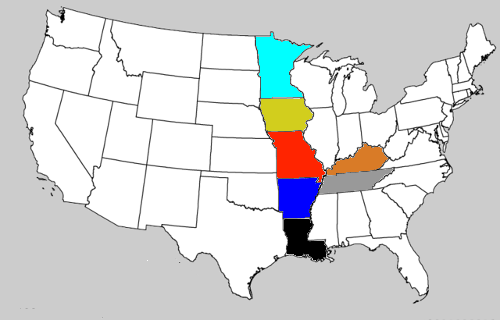
The map of the continental United States contains an elf making chicken

by Mark Frauenfelder

From Futility Closet: "He’s known as Mimal, after the states that make him up: Minnesota (hat), Iowa (head), Missouri (shirt), Arkansas (pants), and Louisiana (boots). Fittingly, the chicken is Kentucky and the tin pan is Tennessee."

The panhandle on Oklahoma is wasted.

Recommended article: Chomsky: We Are All – Fill in the Blank.
This entry passed through the Full-Text RSS service - if this is your content and you're reading it on someone else's site, please read the FAQ at fivefilters.org/content-only/faq.php#publishers.

23 Jan 22:19

“The Road to Superintelligence,” meaty long-read on future of artificial intelligence

by Xeni Jardin
Bewarethewumpus

Fascinating, although I think the author's ideas about how fast an AI can/will go from human level intelligence to not even on the charts anymore, is overblown. Seems to me that it would still be limited by the hardware, and I'm not aware of a computer or robot design that can perform its own physical upgrades.

Projections

Tim Urban has a great, longform post up on the future of artificial intelligence. “As I dug into research on Artificial Intelligence, I could not believe what I was reading,” he writes.

“It hit me pretty quickly that what’s happening in the world of AI is not just an important topic, but by far THE most important topic for our future. So I wanted to learn as much as I could about it, and once I did that, I wanted to make sure I wrote a post that really explained this whole situation and why it matters so much.”

From part one:

When we imagine the progress of the next 30 years, we look back to the progress of the previous 30 as an indicator of how much will likely happen. When we think about the extent to which the world will change in the 21st century, we just take the 20th century progress and add it to the year 2000. This was the same mistake our 1750 guy made when he got someone from 1500 and expected to blow his mind as much as his own was blown going the same distance ahead. It’s most intuitive for us to think linearly, when we should be thinking exponentially. If someone is being more clever about it, they might predict the advances of the next 30 years not by looking at the previous 30 years, but by taking at the current rate of progress and judging based on that. They’d be more accurate, but still way off. In order to think about the future correctly, you need to imagine things moving at a much faster rate than they’re moving now.

The AI Revolution: The Road to Superintelligence [Tim Urban]

Recommended article: Chomsky: We Are All – Fill in the Blank.
This entry passed through the Full-Text RSS service - if this is your content and you're reading it on someone else's site, please read the FAQ at fivefilters.org/content-only/faq.php#publishers.

23 Jan 20:55

It's All About the Artisanship

by Brad
A18
23 Jan 19:52

Verizon: We’re Not Two-Faced, We Just Like To Claim Mutually Exclusive Things Are Both True

by Kate Cox

Verizon has a long history of trying to have it both ways: alternately courting and rejecting regulation, depending on which will most benefit their bottom line. It’s disingenuous, but effective. But now that someone has asked the FCC to investigate Verizon for perjury, Verizon’s fighting back. Their theme? We’re not two-faced. We just like to say a lot of mutually-exclusive things based on who we think is listening.

Last week, two telecom consumer advocates filed a petition with the FCC saying that Verizon’s constant back-and-forth isn’t just dishonest, but criminal. Saying two oppositional things at once and claiming both are true, they say, is perjury, and the FCC needs to investigate.

The petitioners call Verizon “the Janus of telecom,” referring to the ancient Roman god with two faces, suggesting that the company is, “‘two-faced’ or duplicitous.”

They call their petition an open and shut case, explaining, “Verizon either did or did not tell the FCC that their entire current investment in fiber optics is based entirely on using the Title II classification. Or that the Verizon companies have made phone customers ‘de facto’ investors by using Title II… We allege that Verizon did deceive the FCC. These material misrepresentations taint every FCC decision and policy affecting Verizon’s regulatory status, but most importantly now the Open Internet Proceeding.”

They continue, “Verizon has claimed and continues to claim that Title II would harm [Verizon’s] investments. However, this is in direct contradiction to Verizon’s own filings, statements, SEC and state-based filings, the companies’ cable franchise agreement—every fiber optic wire appears to be Title II.”

That’s all well and good. This week, as Ars Technica reports, Verizon finally responded to the petition. In a filing to the FCC, Verizon counters that the petition is “frivolous,” and “[recycles] old, baseless, and inaccurate claims that have been previously addressed and dismissed.”

“Verizon’s position is and has been consistent throughout the inception of its fiber deployment,” Verizon concludes, “and NNI’s frivolous Petition should be denied outright.”

The original petitioners plan to file a response to the response next week.

But perjury or not, Verizon certainly is certainly on a streak of saying two things at once and hoping nobody notices.

For example, late last year, Verizon CFO Francis Shammo accidentally admitted that contrary to everything Verizon has been saying, Title II regulation of broadband won’t actually stop the company from investing in new and existing networks. As the Washington Post reports, Verizon is now desperately trying to claim that those words don’t mean what we think they do.

In a statement this week, Shammo — the same executive who last month said “I mean to be real clear, this does not influence the way we invest” — now says:

Title II is an extreme and risky path that will jeopardize our investment and the development of innovation in broadband Internet and related services. It will also tie up the industry in a very uncertain time and cause all types of litigation.

Shammo claimed his actual statements from last year, as recorded and transcribed, were “misquoted,” then concluded by endorsing Congress’s plan to do an end-run around the FCC.


23 Jan 19:20

Sexy, Sexy Butts

dogs,wtf,butts,booty,funny

Submitted by: Unknown

Tagged: dogs , wtf , butts , booty , funny
23 Jan 01:15

USA McDonald's fries have 14 ingredients. UK McDonald's fries have 4.

by Mark Frauenfelder

Here's a followup to my earlier post about McDonald's fries. In 2013 Food Babe posted the ingredients for McDonald's fries in the US and in the UK.

The US fries have 14 ingredients, while the UK fries are restricted to potatoes, two kinds of oil, and (sometimes) dextrose. Notably absent from the UK fries is methylpolysiloxane, a commonly used anti-foaming agent that's also an ingredient used to make Silly Putty.

When I compared the ingredient list of McDonald’s french fries in the US vs. the UK version, I was floored to witness the drastic differences. Europeans do not use dimethylpolysiloxane. Look closely at the ingredients in McDonald’s french fries [above]. Do you see how the french fries in the U.K. version are basically just potatoes, vegetable oil, a little sugar and salt? How can McDonald’s make french fries with such an uncomplicated list of ingredients all over Europe, but not over here? Why do McDonald’s french fries in the U.S. have to have an “anti-foaming” agent? Do the brits like extra foam? No, they don’t, Europe actually regulates this ingredient because they know this man-made chemical was never intended to be consumed by humans. This whole time McDonalds has known about this and chooses to continue to serve it’s US citizens silly putty.

Personally, I'm more concerned about the hydrolyzed wheat and hydrolyzed milk in the US fries than I am about methylpolysiloxane, because I avoid excitotoxins when possible.

UPDATE: As far as I can tell the ingredients list posted by Food Babe is correct. Here is a link to the UK McDonald's page for its fries. Many kind readers have commented that Food Babe is not generally to be trusted with food science, however.

Recommended article: Chomsky: We Are All – Fill in the Blank.
This entry passed through the Full-Text RSS service - if this is your content and you're reading it on someone else's site, please read the FAQ at fivefilters.org/content-only/faq.php#publishers.

22 Jan 18:04

Near-Impossible Super Mario World Glitch Done For First Time on SNES

by Evan Narcisse

Near-Impossible Super Mario World Glitch Done For First Time on SNES

It's something that most players wouldn't even think is possible: playing a game in a certain way that jumps you completely to the end, without beating its final battle. But there it is, just executed in Super Mario World.

A new video by YouTuber Minecraft SethBling shows him executing a set of moves, which as he explains it, effectively rewrites the game's code in real time as he plays. The fact that this is allegedly happening on a Super Nintendo console—and not on any kind of emulated software—makes it even more impressive. In addition to his speedrunning, SethBling is someone already known for an impressive depth of knowledge in the Minecraft world. The amount of knowledge needed to suss out this glitch and the exacting nature of its execution (discovered by Twitch streamer JeffW356 and explained in depth here) is simply incredible. It shows off just how important the work of speedrunning and hacking/modding communities can be insofar as opening up the possibilities of what's able to be done with video games. You need to know how the game was written and the effect that player actions have on the way that the console and the game talk to each other. Just amazing.

Note: SethBling's pulled off an even faster time of 4:49.8 with the glitch, making it an incredibly fast completion performance for SMW.

Recommended article: Chomsky: We Are All – Fill in the Blank.
This entry passed through the Full-Text RSS service - if this is your content and you're reading it on someone else's site, please read the FAQ at fivefilters.org/content-only/faq.php#publishers.