Shared posts

31 May 15:43

Triangulation

by featured writer

Author : Gray Blix, Featured Writer [ bio ]

“I remember when there were forests and farms right up to the border. I’d shout hello from my dad’s tractor and Americans would shout back. We crossed the border to shop. Before the DPA.”

“There you go again, old man. You could have retired years ago,” meaning he should have. “Why keep working?”

“Who can live on a pension nowadays?”

“Hey, pay attention, look at your display.” Pointing, “Right there.”

Only an expert controller could glance at another’s screen and make out two indistinct thermal signatures against rocks still warm from the Sun. The kid was good.

Below, having rested as long as they dared, two intruders put on hoods and walked by starlight on the dry bed of Belly River, now a trail, an escape route for desperate refugees from a parched, hungry, violent homeland. Even if they had heard the quadcopter buzzing above, these two wouldn’t be worried, having paid thousands to make themselves undetectable.

The older pilot activated his mike, “Four-zed, crank up your sensitivity and look for two partially cloaked illegals to come around the bend in few minutes.”

From a truck on the bank, looking upriver through his thermal scope, “Will do.”

Mutual Assured Destruction kept the US from invading. As the situation in the states had deteriorated, the Canadians had secretly positioned nuclear tipped missiles. When they had enough to obliterate their neighbor to the south, Parliament simultaneously passed the Dominion Preservation Act, sealed the border, and offered a non-aggression treaty.

“That’s it,” she said, pointing to a stack of rocks. The two figures, their cloaking gear looking like bulky hazmat outfits, headed up the creek.

“Four-zed, do you see them yet?”

“Nope. Are you sure of what you think you saw, old man?” He laughed and nudged the other officer. “Better crank up the sensitivity on your bifocals.”

“They must have deked up a creek, four-zed, heading for the campground or Highway 6. Check it out.”

Neither officer moved. They had hoped to sit in the dark until sunup, when they would be safe from the triangles. Drawn to lights like huge moths, the craft had been seen sucking out the contents of homes and swallowing up vehicles whole.

“Four-zed?”

Finally, a reluctant, “OK.”

The heat and moisture inside the cloaking gear was becoming unbearable.

Checking his watch, “They’re supposed to pick us up in about 15 minutes.”

They removed headgear and sat on a picnic table. Hearing what sounded like the buzz of an insect, she swatted the air, nearly slapping him. He laughed and playfully swatted back.

Zooming the drone’s camera, “Four-zed, they’re in the campground, end of the road.”

The driver flicked headlights on, and the Americans froze.

Watching his display, “We’ve got ’em,” said the old man. But he cringed, knowing the two intruders faced death sentences.

A shaft of light fell towards the truck, engulfing it. The old man later described it as “a bright waterfall.” He pushed the video record button.

All four at the scene fought to make sense of what was happening, but their mental processes were labored, as if they had been drugged.

Suddenly, the man behind the wheel slammed the shift into reverse. The truck spun its rear wheels but didn’t move an inch before the light fell upward, taking the vehicle and occupants with it. A dark triangle silently floated away.

The video’s sale funded retirement on a New Zealand hobby farm, where the old man spent endless hours driving his tractor and chatting up neighbors. His new island home was like a lifeboat in a worldwide sea of misery. Until the triangles arrived.

Discuss the Future: The 365 Tomorrows Forums
The 365 Tomorrows Free Podcast: Voices of Tomorrow
This is your future: Submit your stories to 365 Tomorrows

25 May 18:39

Bulletproof–A Love Story

by featured writer

Author : Gray Blix, Featured Writer [ bio ]

Richard walks the dark streets of the worst part of town, a noir figure in a fedora and trench coat, his eyes casting about for shadows that move, his ears yearning to hear a cry for help. Nothing. He can’t remember his last assignment, his last rendezvous, his last secret password, his last foreign intrigue… no memory of claptrap from a bygone era, because memory was at a premium in the old days, and they’d only issued him 16K.

Even though he’s a walking relic, he feels young, as if he’d joined the Service just yesterday. His girl has a lot to do with that. The girl of his dreams come to life, she has Grable’s million dollar gams, and Russell’s voluptuous bazongas, and Bacall’s sultry pillow talk. What a dame. But deep down he knows he doesn’t deserve her. He hasn’t won her for sending the bad guys to jail, or to hell.

And worst of all, he’s a kept man. Yeah, it crushes his soul to depend on her for everything, for life itself — for vacuum tubes.

Back home, Constance sits by the window, looking onto the dimly lit street below, waiting for him to return from his midnight walk. She knows he aches to get into the fight, to right wrongs, to defend his country, to earn the devotion of a dame like her. It was designed into his circuits, and she loves him for it.

He is the man of her dreams. Literally one of a kind. The shining achievement of a top secret project to make a robot agent generations ahead of its time — able to outthink Enigma, to shed bullets, to overcome evil, to go 24 hours without recharging, and most important to her personally, to pleasure women. That last feature was added in hopes of turning foreign fems into spies for America. Connie gladly role-plays Axis Fraulein to stimulate Dick’s Allied Powers.

She had come across him at a government surplus auction, standing next to the crate that had preserved him for nearly 70 years. Others had thought he was a statue or a clothes mannequin and passed by without stopping. But she immediately saw something special about him. He was a hunk of a guy — healthy mop of brown hair, laughing green eyes, kissable lips, square jaw, and the body of an Olympic athlete. Lingering to examine him carefully from head to toe, she marveled at the attention to detail. Moles, scars, hairs in nose and ears. She found his power cord and wondered what it was for. Some sort of pre-Disney animatronics? Whatever. It didn’t matter. She had to have him. Didn’t bargain. Just paid the $100 cash and had him placed in the passenger seat of her Prius. Almost forgot his user manual!

To this day, three years later, she still wakes up in a panic from the recurring nightmare of forgetting to take the user manual. But it’s always right there on her bedside table, and he’s next to her, emitting the reassuring hum of his battery charger.

He stops. A muffled cry? Over there, in the alley behind the tavern. Two figures silhouetted, a man and a woman, struggling. He runs towards them, kicking a can, alerting the man.

“This is between me and her. And I got a gun.”

He’s just twenty feet away when the bullets ricochet off of him. He slams into the man, who collapses like a broken mannequin. The girl runs away.

He dusts off his coat, picks up his fedora, and heads for home. There will be no need for role-play tonight.

Discuss the Future: The 365 Tomorrows Forums
The 365 Tomorrows Free Podcast: Voices of Tomorrow
This is your future: Submit your stories to 365 Tomorrows

22 May 22:51

Discovery

by submission

Author : Stephanie L. Dunn

Sol System: 4509 CE

“Final log: Every planet has people on it, most of the moons as well, hundreds of sovereign city stations scattered like a game of marbles between Venus and The Kuiper belt and a few brave colonies even further out. Twenty Billion people inhabit a ball shaped chunk of space roughly 100,000 AU, or two light-years in diameter. We long ago shed our gods, our guns, conquered disease and hunger – even hobbled death itself. It was not uncommon for a person to see their third century if accident or intent did not overtake them. Earth to Mars in a day, to Neptune in a week, to the most distant station a mere dozen weeks, our technology fast and safe.

(Shuddering sigh)

So why have we never reached even the nearest star system, are we simply content to observe their glory from afar?

The distant stars bloom, blaze and die, some in violent and beautiful displays while others demurely came and went before they were ever perceived. We would get no closer to them than the length of our tether – our connection to our own star. The leash extended generously to the Oort Cloud where our sun becomes lost in the galactic background. What barred us from unclipping that leash was fear. To play in the shallows within sight of shore was pleasant enough but to lose sight of that beacon in the heavens, our sun, caused a deadly panic. Psychologists could neither fathom nor treat the insanity that drove pilots to ram their ships into asteroids or comets; engineers to sabotage their beloved engines, crewmen open airlocks exposing the ship’s occupants to heartless space. The suicide barrier, as it’s come to be known, was a line the human race couldn’t cross.”

*crackle* “Wayfair City station to unknown craft, please reply.”

“Computer, end log … open a channel to Wayfair.”

“Compliance.”

“Wayfair, this is the private yacht Vingilot registry HPL8472 of Ganymede, Captain and sole occupant Kaalyndahl Crafter speaking.”

“Welcome to Wayfair, Captain Crafter…”

(Strained silence)

“You may as well ask, you see it on your screen.”

“Oh … uhm. Records show you registered a flight plan into the suicide zone a year ago?”

“Yes, I did.”

“Okay. Station Commander Marsh would like to see you once you dock, please, follow the beacon in.”

“Acknowledged, Crafter out. Computer set course for the beacon and engage docking autopilot. *beep* Open and continue log.”

“Compliance.”

“No one has ever entered the suicide zone and returned sane, if they returned at all.”

*click*

“Now they will know their fear is valid, but there is nothing out there that can cause physical harm … because there is nothing out there at all. The distant stars and galaxies are but mirages caused by the Oort Cloud’s shell! We are alone in the universe, and I have seen the shimmering globe of our domain against the endless, starless void.”

*BANG!*

Discuss the Future: The 365 Tomorrows Forums
The 365 Tomorrows Free Podcast: Voices of Tomorrow
This is your future: Submit your stories to 365 Tomorrows

14 May 20:29

MeFi: "I wholeHEARTEDLY disagree with you."

by Paul Slade
Jon Stewart's April 29 interview with Judith Miller, formerly of the New York Times, was one of those serious, detailed, quietly angry interviews he does so well. You should watch it.
14 May 03:37

Photo


08 May 22:45

ACCIDENT PR0N AREA

accident,hilarious,pr0n,sign,wtf

ACCIDENT PR0N AREA don't say they didn't warn you.

Submitted by: Blue_Button

Tagged: accident , hilarious , pr0n , sign , wtf
07 May 16:31

Please, Look Inside Pikachu's...Vagina?

by Brian Ashcraft
Bewarethewumpus

Part 2: The Revengeance-ing

Please, Look Inside Pikachu's...Vagina?

Oh god. Surely, the people who made this inflatable Pikachu know? They have to.

Warning: This article contains content some readers might find objectionable.

A few years ago, images surfaced of a Pikachu bouncy house in Japan with the entrance in a rather interesting place. To refresh your memory:

Please, Look Inside Pikachu's...Vagina?

Yep. But if you thought that was something, you must see the latest version. A new Pikachu bouncy house recently went up in Seoul, South Korea. It’s in front of the Lotte Department near Jamsil Station, and it tops Japan in the inflatable vagina department.

Please, Look Inside Pikachu's...Vagina?

[Photo: hong_ki_py]

Heh.

Please, Look Inside Pikachu's...Vagina?

[Photo: sienauni]

A side view.

Please, Look Inside Pikachu's...Vagina?

[Photo: aka_chacha]

You thought I was kidding, right? I was not!

Please, Look Inside Pikachu's...Vagina?

[Photo: 14.may]

Who wants their picture in front of Pikachu’s vagina? You?

Please, Look Inside Pikachu's...Vagina?

[Photo: junghyehwan]

Be sure to get a good look. And yes, this opening is to see when small children are inside, which kind of makes the whole thing more yeah.

Please, Look Inside Pikachu's...Vagina?

[Photo: nara_sinn]

Perfect weather for a Pikachu vagina!

Please, Look Inside Pikachu's...Vagina?

Gotta wonder what Giratina is thinking.

[Photo: Kawells00]

Please, Look Inside Pikachu's...Vagina?

[Photo: tack_92]

That’s the entrance. At least it’s not going into Pikachu’s butt, am I right? I am so right.

Please, Look Inside Pikachu's...Vagina?

[Photo: chunghokim]

And this has been a look at Pikachu’s vagina. Your move, Japan!

Top photo: tmt1002/Pixels by Kotaku

To contact the author of this post, write to bashcraftATkotaku.com or find him on Twitter@Brian_Ashcraft.

Kotaku East is your slice of Asian internet culture, bringing you the latest talking points from Japan, Korea, China and beyond. Tune in every morning from 4am to 8am.

This entry passed through the Full-Text RSS service - if this is your content and you're reading it on someone else's site, please read the FAQ at fivefilters.org/content-only/faq.php#publishers.

07 May 15:51

This Isn't a Manga Drawing

by Brian Ashcraft

This Isn't a Manga Drawing

This may look like a black and white manga drawing. But no, it’s a three-dimensional figure with a custom paint job.

Previously, Kotaku profiled Japanese figure maker mumumuno53 (here and here). Those earlier works were in living color, but his latest effort evokes black and white. From nearly every angle, the custom paint job makes the figure appear drawn.

This is a Revoltech collectable of the Powered Armor from the Starship Troopers anime (you can see the original here). Studio Nue did this particular design.

Check out photos from mumumuno53’s site:

This Isn't a Manga Drawing

This Isn't a Manga Drawing

This Isn't a Manga Drawing

This Isn't a Manga Drawing

This Isn't a Manga Drawing

This Isn't a Manga Drawing

This Isn't a Manga Drawing

This Isn't a Manga Drawing

This Isn't a Manga Drawing

This Isn't a Manga Drawing

This Isn't a Manga Drawing

This Isn't a Manga Drawing

This Isn't a Manga Drawing

This Isn't a Manga Drawing

This Isn't a Manga Drawing

This Isn't a Manga Drawing

This Isn't a Manga Drawing

This Isn't a Manga Drawing

This Isn't a Manga Drawing

[All photos: mumumuno53]

Bravo!

To contact the author of this post, write to bashcraftATkotaku.com or find him on Twitter@Brian_Ashcraft.

Kotaku East is your slice of Asian internet culture, bringing you the latest talking points from Japan, Korea, China and beyond. Tune in every morning from 4am to 8am.

This entry passed through the Full-Text RSS service - if this is your content and you're reading it on someone else's site, please read the FAQ at fivefilters.org/content-only/faq.php#publishers.

07 May 04:52

Learn Haiku and Demotivate

do you even lift,haiku,demotivational,funny

Submitted by: Unknown

07 May 00:31

The Void: VR Theme Park of the 21st Century

by Brad
Bewarethewumpus

Dayyum, I wanna try. I've signed onto their mailing list, I'll at least see how much it costs.

153

While most cutting-edge virtual reality entertainment ventures are focusing on stay-at-home systems, one Salt Lake City-based startup called The Void is working on an ambitious project to launch a chain of out-of-home, virtual reality theme parks across the United States.

07 May 00:23

Where Are All the Aliens?

by Don
10b

YouTuber Kurz Gesagt explains the concept of the Fermi paradox, which points out the apparent contradiction between the high probability of intelligent extraterrestrial life and the lack of evidence for their existence.

06 May 20:04

No Swiping – Yet

by Ari Spool
Bewarethewumpus

I can't wait for the next VHS. I'm excited to buy things on the electronic-Bay.

Fa0

This infomercial parody reimagines Tinder if it were software from the 1980s, complete with keystrokes, floppy disks, and cheesy VHS effects.

05 May 21:47

Half-Life 2 World Record Speedrun Will Make Your Head Spin

by Patrick Klepek

Half-Life 2 World Record Speedrun Will Make Your Head Spin

It’d be easy to assume the GIF above is the most impressive part of this run, but it’s not.

This incredibly fast speedrun of Half-Life 2: Episode Two was pulled off by SourceRuns Team, and they managed make it through Valve’s shooter in record time: 30 minutes and 36 seconds.

In order to make this work, some parts of the run weren’t done consecutively, so that particular strategies could be employed:

Timing starts when the crosshair appears and stops when it disappears. Segmented means that the run was done in multiple parts so riskier and faster strategies could be used. The version of the game is from 2009, build 4104. Some scripts (such as a jumping and duck spam script) were used.

One of the first things you’ll notice is how most of the speedrun takes place backwards. Here’s their explanation why that’s so useful:

Short version: If you jump backwards you go fast.

Long version: ABH or Accelerated Back Hopping is an unintended side effect of fixing bunny hopping. If you’re not familiar with the 2004 version of Half-Life 2, every time you jumped forwards with W held down you gained a little bit of speed. This could be exploited by jumping immediately after landing; you could gradually gain speed.

Then people at Valve decided to fix bunny hopping for Episode 2 and Portal. So how the fix works is if your horizontal speed is greater than the speed cap you get accelerated the amount you’re over the limit backwards. This gets applied every time you jump. The obvious way to exploit this fix is to simply turn around so that your speed is increased, instead of decreased.

The speedrunners actually break down how they pull off every glitch and exploit moment-by-moment in an exhaustive and super interesting document that makes for fascinating reading.

My favorite moment? When the speedrunners tackle the climactic battle against the striders and manage to nuke one of ‘em by tossing a bomb into the air, destroying the strider as it spawns in:

Half-Life 2 World Record Speedrun Will Make Your Head Spin

God damn, this makes me want Half-Life 3.

You can reach the author of this post at patrick.klepek@kotaku.com or on Twitter at @patrickklepek.

This entry passed through the Full-Text RSS service - if this is your content and you're reading it on someone else's site, please read the FAQ at fivefilters.org/content-only/faq.php#publishers.

05 May 21:08

How the NSA Converts Spoken Words Into Searchable Text

by Dan Froomkin

Most people realize that emails and other digital communications they once considered private can now become part of their permanent record.

But even as they increasingly use apps that understand what they say, most people don’t realize that the words they speak are not so private anymore, either.

Top-secret documents from the archive of former NSA contractor Edward Snowden show the National Security Agency can now automatically recognize the content within phone calls by creating rough transcripts and phonetic representations that can be easily searched and stored.

The documents show NSA analysts celebrating the development of what they called “Google for Voice” nearly a decade ago.

Though perfect transcription of natural conversation apparently remains the Intelligence Community’s “holy grail,” the Snowden documents describe extensive use of keyword searching as well as computer programs designed to analyze and “extract” the content of voice conversations, and even use sophisticated algorithms to flag conversations of interest.

The documents include vivid examples of the use of speech recognition in war zones like Iraq and Afghanistan, as well as in Latin America. But they leave unclear exactly how widely the spy agency uses this ability, particularly in programs that pick up considerable amounts of conversations that include people who live in or are citizens of the United States.

Spying on international telephone calls has always been a staple of NSA surveillance, but the requirement that an actual person do the listening meant it was effectively limited to a tiny percentage of the total traffic. By leveraging advances in automated speech recognition, the NSA has entered the era of bulk listening.

And this has happened with no apparent public oversight, hearings or legislative action. Congress hasn’t shown signs of even knowing that it’s going on.

The USA Freedom Act — the surveillance reform bill that Congress is currently debating — doesn’t address the topic at all. The bill would end an NSA program that does not collect voice content: the government’s bulk collection of domestic calling data, showing who called who and for how long.

Even if becomes law, the bill would leave in place a multitude of mechanisms exposed by Snowden that scoop up vast amounts of innocent people’s text and voice communications in the U.S. and across the globe.

Civil liberty experts contacted by The Intercept said the NSA’s speech-to-text capabilities are a disturbing example of the privacy invasions that are becoming possible as our analog world transitions to a digital one.

“I think people don’t understand that the economics of surveillance have totally changed,” Jennifer Granick, civil liberties director at the Stanford Center for Internet and Society, told The Intercept.

“Once you have this capability, then the question is: How will it be deployed? Can you temporarily cache all American phone calls, transcribe all the phone calls, and do text searching of the content of the calls?” she said. “It may not be what they are doing right now, but they’ll be able to do it.”

And, she asked: “How would we ever know if they change the policy?”

Indeed, NSA officials have been secretive about their ability to convert speech to text, and how widely they use it, leaving open any number of possibilities.

That secrecy is the key, Granick said. “We don’t have any idea how many innocent people are being affected, or how many of those innocent people are also Americans.”

I Can Search Against It

NSA whistleblower Thomas Drake, who was trained as a voice processing crypto-linguist and worked at the agency until 2008, told The Intercept that he saw a huge push after the September 11, 2001 terror attacks to turn the massive amounts of voice communications being collected into something more useful.

Human listening was clearly not going to be the solution. “There weren’t enough ears,” he said.

The transcripts that emerged from the new systems weren’t perfect, he said. “But even if it’s not 100 percent, I can still get a lot more information. It’s far more accessible. I can search against it.”

Converting speech to text makes it easier for the NSA to see what it has collected and stored, according to Drake. “The breakthrough was being able to do it on a vast scale,” he said.

mia_Intercept_NSAflagXX

More Data, More Power, Better Performance

The Defense Department, through its Defense Advanced Research Projects Agency (DARPA), started funding academic and commercial research into speech recognition in the early 1970s.

What emerged were several systems to turn speech into text, all of which slowly but gradually improved as they were able to work with more data and at faster speeds.

In a brief interview, Dan Kaufman, director of DARPA’s Information Innovation Office, indicated that the government’s ability to automate transcription is still limited.

Kaufman says that automated transcription of phone conversation is “super hard,” because “there’s a lot of noise on the signal” and “it’s informal as hell.”

“I would tell you we are not very good at that,” he said.

In an ideal environment like a news broadcast, he said, “we’re getting pretty good at being able to do these types of translations.”

A 2008 document from the Snowden archive shows that  transcribing news broadcasts was already working well seven years ago, using a program called Enhanced Video Text and Audio Processing:

(U//FOUO) EViTAP is a fully-automated news monitoring tool. The key feature of this Intelink-SBU-hosted tool is that it analyzes news in six languages, including Arabic, Mandarin Chinese, Russian, Spanish, English, and Farsi/Persian. “How does it work?” you may ask. It integrates Automatic Speech Recognition (ASR) which provides transcripts of the spoken audio. Next, machine translation of the ASR transcript translates the native language transcript to English. Voila! Technology is amazing.

A version of the system the NSA uses is now even available commercially.

Experts in speech recognition say that in the last decade or so, the pace of technological improvement has been explosive. As information storage became cheaper and more efficient, technology companies were able to store massive amounts of voice data on their servers, allowing them to continually update and improve the models. Enormous processors, tuned as “deep neural networks” that detect patterns like human brains do, produce much cleaner transcripts.

And the Snowden documents show that the same kinds of leaps forward seen in commercial speech-to-text products have also been happening in secret at the NSA, fueled by the agency’s singular access to astronomical processing power and its own vast data archives.

In fact, the NSA has been repeatedly releasing new and improved speech recognition systems for more than a decade.

The first-generation tool, which made keyword-searching of vast amounts of voice content possible, was rolled out in 2004 and code-named RHINEHART.

“Voice word search technology allows analysts to find and prioritize intercept based on its intelligence content,” says an internal 2006 NSA memo entitled “For Media Mining, the Future Is Now!

The memo says that intelligence analysts involved in counterterrorism were able to identify terms related to bomb-making materials, like “detonator” and “hydrogen peroxide,” as well as place names like “Baghdad” or people like “Musharaf.”

RHINEHART was “designed to support both real-time searches, in which incoming data is automatically searched by a designated set of dictionaries, and retrospective searches, in which analysts can repeatedly search over months of past traffic,” the memo explains (emphasis in original).

As of 2006, RHINEHART was operating “across a wide variety of missions and languages” and was “used throughout the NSA/CSS [Central Security Service] Enterprise.”

But even then, a newer, more sophisticated product was already being rolled out by the NSA’s Human Language Technology (HLT) program office. The new system, called VoiceRT, was first introduced in Baghdad, and “designed to index and tag 1 million cuts per day.”

The goal, according to another 2006 memo, was to use voice processing technology to be able “index, tag and graph,” all intercepted communications. “Using HLT services, a single analyst will be able to sort through millions of cuts per day and focus on only the small percentage that is relevant,” the memo states.

A 2009 memo from the NSA’s British partner, GCHQ, describes how “NSA have had the BBN speech-to-text system Byblos running at Fort Meade for at least 10 years. (Initially they also had Dragon.) During this period they have invested heavily in producing their own corpora of transcribed Sigint in both American English and an increasing range of other languages.” (GCHQ also noted that it had its own small corpora of transcribed voice communications, most of which happened to be “Northern Irish accented speech.”)

VoiceRT, in turn, was surpassed a few years after its launch. According to the intelligence community’s “Black Budget” for fiscal year 2013, VoiceRT was decommissioned and replaced in 2011 and 2012, so that by 2013, NSA could operationalize a new system. This system, apparently called SPIRITFIRE, could handle more data, faster. SPIRITFIRE would be “a more robust voice processing capability based on speech-to-text keyword search and paired dialogue transcription.”

Extensive Use Abroad

Voice communications can be collected by the NSA whether they are being sent by regular phone lines, over cellular networks, or through voice-over-internet services. Previously released documents from the Snowden archive describe enormous efforts by the NSA during the last decade to get access to voice-over-internet content like Skype calls, for instance. And other documents in the archive chronicle the agency’s adjustment to the fact that an increasingly large percentage of conversations, even those that start as landline or mobile calls, end up as digitized packets flying through the same fiber-optic cables that the NSA taps so effectively for other data and voice communications.

The Snowden archive, as searched and analyzed by The Intercept, documents extensive use of speech-to-text by the NSA to search through international voice intercepts — particularly in Iraq and Afghanistan, as well as Mexico and Latin America.

For example, speech-to-text was a key but previously unheralded element of the sophisticated analytical program known as the Real Time Regional Gateway (RTRG), which started in 2005 when newly appointed NSA chief Keith B. Alexander, according to the Washington Post, “wanted everything: Every Iraqi text message, phone call and e-mail that could be vacuumed up by the agency’s powerful computers.”

The Real Time Regional Gateway was credited with playing a role in “breaking up Iraqi insurgent networks and significantly reducing the monthly death toll from improvised explosive devices.” The indexing and searching of “voice cuts” was deployed to Iraq in 2006. By 2008, RTRG was operational in Afghanistan as well.

A slide from a June 2006 NSA powerpoint presentation described the role of VoiceRT:

VoiceRT: Index/Search of Voice Cuts


Keyword spotting extended to Iranian intercepts as well. A 2006 memo reported that RHINEHART had been used successfully by Persian-speaking analysts who “searched for the words ‘negotiations’ or ‘America’ in their traffic, and RHINEHART located a very important call that was transcribed verbatim providing information on an important Iranian target’s discussion of the formation of a the new Iraqi government.”

According to a 2011 memo, “How is Human Language Technology (HLT) Progressing?“, NSA that year deployed “HLT Labs” to Afghanistan, NSA facilities in Texas and Georgia, and listening posts in Latin America run by the Special Collection Service, a joint NSA/CIA unit that operates out of embassies and other locations.

“Spanish is the most mature of our speech-to-text analytics,” the memo says, noting that the NSA and its Special Collections Service sites in Latin America, have had “great success searching for Spanish keywords.”

The memo offers an example from NSA Texas, where an analyst newly trained on the system used a keyword search to find previously unreported information on a target involved in drug-trafficking. In another case, an official at a Special Collection Service site in Latin America “was able to find foreign intelligence regarding a Cuban official in a fraction of the usual time.”

In a 2011 article, “Finding Nuggets — Quickly — in a Heap of Voice Collection, From Mexico to Afghanistan,” an intelligence analysis technical director from NSA Texas described the “rare life-changing instance” when he learned about human language technology, and its ability to “find the exact traffic of interest within a mass of collection.”

Analysts in Texas found the new technology a boon for spying. “From finding tunnels in Tijuana, identifying bomb threats in the streets of Mexico City, or shedding light on the shooting of US Customs officials in Potosi, Mexico, the technology did what it advertised: It accelerated the process of finding relevant intelligence when time was of the essence,” he wrote. (Emphasis in original.)

The author of the memo was also part of a team that introduced the technology to military leaders in Afghanistan. “From Kandahar to Kabul, we have traveled the country explaining NSA leaders’ vision and introducing SIGINT teams to what HLT analytics can do today and to what is still needed to make this technology a game-changing success,” the memo reads.

Extent of Domestic Use Remains Unknown

What’s less clear from the archive is how extensively this capability is used to transcribe or otherwise index and search voice conversations that primarily involve what the NSA terms “U.S. persons.”

The NSA did not answer a series of detailed questions about automated speech recognition, even though an NSA “classification guide” that is part of the Snowden archive explicitly states that “The fact that NSA/CSS has created HLT models” for speech-to-text processing as well as gender, language and voice recognition, is “UNCLASSIFIED.”

Also unclassified: The fact that the processing can sort and prioritize audio files for human linguists, and that the statistical models are regularly being improved and updated based on actual intercepts. By contrast, because they’ve been tuned using actual intercepts, the specific parameters of the systems are highly classified.

“The National Security Agency employs a variety of technologies in the course of its authorized foreign-intelligence mission,” spokesperson Vanee’ Vines wrote in an email to The Intercept. “These capabilities, operated by NSA’s dedicated professionals and overseen by multiple internal and external authorities, help to deter threats from international terrorists, human traffickers, cyber criminals, and others who seek to harm our citizens and allies.”

Vines did not respond to the specific questions about privacy protections in place related to the processing of domestic or domestic-to-international voice communications. But she wrote that “NSA always applies rigorous protections designed to safeguard the privacy not only of U.S. persons, but also of foreigners abroad, as directed by the President in January 2014.”

The presidentially appointed but independent Privacy and Civil Liberties Oversight Board (PCLOB) didn’t mention speech-to-text technology in its public reports.

“I’m not going to get into whether any program does or does not have that capability,” PCLOB chairman David Medine told The Intercept.

His board’s reports, he said, contained only information that the intelligence community agreed could be declassified.

“We went to the intelligence community and asked them to declassify a significant amount of material,” he said. The “vast majority” of that material was declassified, he said. But not all — including “facts that we thought could be declassified without compromising national security.”

Hypothetically, Medine said, the ability to turn voice into text would raise significant privacy concerns. And it would also raise questions about how the intelligence agencies “minimize” the retention and dissemination of material— particularly involving U.S. persons — that doesn’t include information they’re explicitly allowed to keep.

“Obviously it increases the ability of the government to process information from more calls,” Medine said. “It would also allow the government to listen in on more calls, which would raise more of the kind of privacy issues that the board has raised in the past.”

“I’m not saying the government does or doesn’t do it,” he said, “just that these would be the consequences.”

A New Learning Curve

Speech recognition expert Bhiksha Raj likens the current era to the early days of the Internet, when people didn’t fully realize how the things they typed would last forever.

“When I started using the Internet in the 90s, I was just posting stuff,” said Raj, an associate professor at Carnegie Mellon University’s Language Technologies Institute. “It never struck me that 20 years later I could go Google myself and pull all this up. Imagine if I posted something on alt.binaries.pictures.erotica or something like that, and now that post is going to embarrass me forever.”

The same is increasingly becoming the case with voice communication, he said. And the stakes are even higher, given that the majority of the world’s communication has historically been conducted by voice, and it has traditionally been considered a private mode of communication.

“People still aren’t realizing quite the magnitude that the problem could get to,” Raj said. “And it’s not just surveillance,” he said. “People are using voice services all the time. And where does the voice go? It’s sitting somewhere. It’s going somewhere. You’re living on trust.” He added: “Right now I don’t think you can trust anybody.”

The Need for New Rules

Kim Taipale, executive director of the Stilwell Center for Advanced Studies in Science and Technology Policy, is one of several people who tried a decade ago to get policymakers to recognize that existing surveillance law doesn’t adequately deal with new global communication networks and advanced technologies including  speech recognition.

“Things aren’t ephemeral anymore,” Taipale told The Intercept. “We’re living in a world where many things that were fleeting in the analog world are now on the permanent record. The question then becomes: what are the consequences of that and what are the rules going to be to deal with those consequences?”

Realistically, Taipale said, “the ability of the government to search voice communication in bulk is one of the things we may have to live with under some circumstances going forward.” But there at least need to be “clear public rules and effective oversight to make sure that the information is only used for appropriate law-enforcement or national security purposes consistent with Constitutional principles.”

Ultimately, Taipale said, a system where computers flag suspicious voice communications could be less invasive than one where people do the listening, given the potential for human abuse and misuse to lead to privacy violations. “Automated analysis has different privacy implications,” he said.

But to Jay Stanley, a senior policy analyst with the ACLU’s Speech, Privacy and Technology Project, the distinction between a human listening and a computer listening is irrelevant in terms of privacy, possible consequences, and a chilling effect on speech.

“What people care about in the end, and what creates chilling effects in the end, are consequences,” he said. “I think that over time, people would learn to fear computerized eavesdropping just as much as they fear eavesdropping by humans, because of the consequences that it could bring.”

Indeed, computer listening could raise new concerns. One of the internal NSA memos from 2006 says an “important enhancement under development is the ability for this HLT capability to predict what intercepted data might be of interest to analysts based on the analysts’ past behavior.”

Citing Amazon’s ability to not just track but predict buyer preferences, the memo says that an NSA system designed to flag interesting intercepts “offers the promise of presenting analysts with highly enriched sorting of their traffic.”

To Phillip Rogaway, a professor of computer science at the University of California, Davis, keyword-search is probably the “least of our problems.” In an email to The Intercept, Rogaway warned that “When the NSA identifies someone as ‘interesting’ based on contemporary NLP [Natural Language Processing] methods, it might be that there is no human-understandable explanation as to why beyond: ‘his corpus of discourse resembles those of others whom we thought interesting'; or the conceptual opposite: ‘his discourse looks or sounds different from most people’s.'”

If the algorithms NSA computers use to identify threats are too complex for humans to understand, Rogaway wrote, “it will be impossible to understand the contours of the surveillance apparatus by which one is judged.  All that people will be able to do is to try your best to behave just like everyone else.”

Next: The NSA’s best kept open secret.

Readers with information or insight into these programs are encouraged to get in touch, either by email, or anonymously via SecureDrop.

Documents published with this article:

Research on the Snowden archive was conducted by Intercept researcher Andrew Fishman.

Illustrations by Richard Mia for The Intercept.

The post How the NSA Converts Spoken Words Into Searchable Text appeared first on The Intercept.

05 May 17:16

Now Even Goat Simulator Is A Zombie Game

by Yannick LeJacq

Now Even Goat Simulator Is A Zombie Game

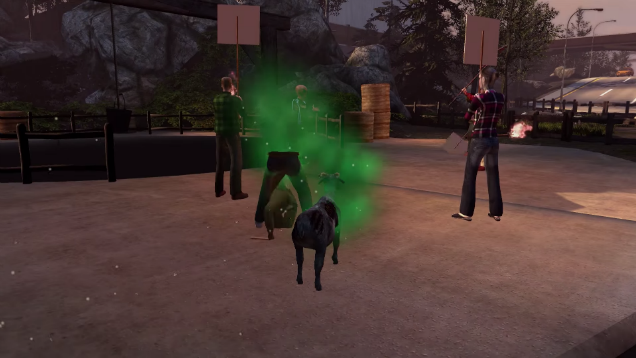
In its unstoppable ascent to the upper echelons of the video game industry, weird-as-fuck indie game Goat Simulator is taking aim at the fiercest, most ubiquitous competition of all: zombie games. Watch out, Dying Light!

The game about being a goat is releasing a $5 expansion this week called GoatZ that adds zombies into its already chaotic mixture. GoatZ is a reference to the much-hyped, always-in-development open-world zombie game DayZ. It also sounds suspiciously similar to goatse, which is a once-famous internet meme that depicts a man bending over and using both his hands to stretch his anus beyond what is normally thought to be a healthy or reasonable distance. I’m not going to link to that legendary image here, but you should google it if you’re curious.

GoatZ has a very different kind of gore, as you can see in this silly trailer:

The expansion—out May 7th—promises everything a fan of modern zombies games could ask for. Heavy weaponry!

Now Even Goat Simulator Is A Zombie Game

Poorly animated zombies!

Now Even Goat Simulator Is A Zombie Game

It’s even got a crafting system.

Now Even Goat Simulator Is A Zombie Game

Ok, so GoatZ doesn’t look very good. I suppose that’s the whole point Coffee Stain Studios is getting at with this parody—that most, if not all, zombie games are actually bug-riddled messes. But I appreciate Goat Simulator all the more for the way it’s becoming a tool to lampoon the mockable aspects of modern video games.

GoatZ will be available for PC, Mac, and Linux on Thursday, May 7th.


Contact the author at yannick.lejacq@kotaku.com.

This entry passed through the Full-Text RSS service - if this is your content and you're reading it on someone else's site, please read the FAQ at fivefilters.org/content-only/faq.php#publishers.

05 May 15:23

Here Are Some Animated Mountains That Will Read Your Tweets

by Nathan Grayson

Here Are Some Animated Mountains That Will Read Your Tweets

Twitter is kinda terrible sometimes. It enables people of all types and backgrounds to come together and get really, really angry at each other, and somehow many of us lose hours to the damn thing every day. These talking mountains, though? They brighten the place right up.

In short, Mountains of Mouthness is a bunch of sentient, immobile mountains yelling nonsense at each other. So basically, Twitter.

The mountains automatically suck up any tweet that has #bad in it and spit it out in their silly, echoing tones. If you want to vibrate their cavernous vocal chords more directly, however, you can also send tweets to @MoMouthness, #mountains, or #mouthness. You can access them via your PC or mobile devices, and if you’re on phone or tablet you can explore the environment a little bit.

The main attraction, however, is definitely the mountains themselves, with their craggy buck teeth and endless enthusiasm for even the strangest and most putrid of phrases. The way they pronounce “hashtag mowwwthness” is wonderful, verging on downright smooth.

That said, as with anything where the Internet is able to control it remotely, beware of NSFW language and some downright awful stuff (racial/sexist/ableist slurs, etc). More recently, trolls from Certain Boards seem to have flocked to it, so beware of that as well. But even the trolls occasionally have their moments. One time I listened to the mountains recite a bunch of elaborately written erotica, which was pretty much Peak Internet.

As for more, er, wholesome stuff I’ve encountered, there’s been recited dubstep:

Here Are Some Animated Mountains That Will Read Your Tweets

An insane clown prophecy:

Here Are Some Animated Mountains That Will Read Your Tweets

Video game references:

Here Are Some Animated Mountains That Will Read Your Tweets

Philosophy:

Here Are Some Animated Mountains That Will Read Your Tweets

I also saw a couple (probably fake) marriage proposals, but I didn’t snap photos of them in time. Oh well.

So yeah, this is A Thing. Part of me wishes it was the default Twitter app. I might be singing a different tune after five more minutes of listening to these increasingly irritating mountain voices, but oh what a five minutes they’ll be.

Update: Yep, definitely singing a different tune. Oh god my ears.

To contact the author of this post, write to nathan.grayson@kotaku.com or find him on Twitter @vahn16.

This entry passed through the Full-Text RSS service - if this is your content and you're reading it on someone else's site, please read the FAQ at fivefilters.org/content-only/faq.php#publishers.

05 May 14:40

Grace Lee Whitney, Yeoman Rand on "Star Trek," RIP

by David Pescovitz

Grace Lee Whitney, Yeoman Janice Rand from the original Star Trek, has died. She was 85. From StarTrek.com:

Janice_Rand,_2266

Whitney, a blue-eyed blond beauty, represented one of Star Trek’s greatest cautionary tales and also one of the franchise's most satisfying renaissance stories. She played the deeply professional Rand in eight first-season TOS episodes before being dropped from the series and slipping into an abyss of drugs and alcohol that left her, quite literally, on Hollywood’s Skid Row. She finally got help, found God, and reclaimed her life and career, with an assist from Leonard Nimoy, and spent decades helping others overcome their own addictions.

In 1998, Whitney published her memoir, The Longest Trek: My Tour of the Galaxy.

"Star Trek Remembering Grace Lee Whitney" (StarTrek.com)

This entry passed through the Full-Text RSS service - if this is your content and you're reading it on someone else's site, please read the FAQ at fivefilters.org/content-only/faq.php#publishers.

05 May 14:35

Guide to recording the police

by Cory Doctorow


Recording the police is legal, and it can mean the difference between accountability for peace officers and the gross injustice of abuse with impunity.

Wired rounds up a good selection of apps from the likes of the ACLU and Occupy that are designed to help you record your interactions with the police, sometimes covertly, often with the option of real-time backup to the cloud so that your files can be recovered even if your phone is illegally seized and/or smashed. As Allesandra Ram warns, recording the cops is legal, but it isn't always safe:

It is also true that if you film a crime, you may inadvertently become part of the investigation, and may become subject to attention from police yourself.

Take, for instance, the individual who filmed the choking of Eric Garner, Ramsey Orta. Orta has been in and out of Rikers since that tragic day. Speaking with VICE, Orta, who was friendly with Garner, decided to start documenting police misconduct in the summer of 2014 around his heavily-policed neighborhood of Staten Island. But since Garner’s death, Orta and his family allege that police have zeroed in on him, following close family members as well as his girlfriend. Police charged Orta with gun and drug possession as well as armed robbery. On April 6, the Free Thought Project wrote about Orta’s imprisonment. His case went viral, and soon a GoFundMe campaign had collected over $54,000 to free him. Orta was released on April 10.

If an individual is already marginalized in society, or lacks resources, the implications are huge: On Thursday, for instance, Mashable reported that police had arrested a transgender woman who was filming the Baltimore protests, and then forced her to stay in a male holding cell, remove her bra, and wear men’s clothing. Her bail is currently set at $100,000.

Headline: It’s Your Right to Film the Police. These Apps Can Help [Alleandra Ram/Wired]

This entry passed through the Full-Text RSS service - if this is your content and you're reading it on someone else's site, please read the FAQ at fivefilters.org/content-only/faq.php#publishers.

04 May 14:55

Disrupting Richard Scarry

by Cory Doctorow

Updating Richard Scarry's beloved Busy Town for Silicon Valley corpthink been done before, but never with the depth and persistence of the Welcome to Business Town Tumblr. (Thanks, Fipi Lele!)

This entry passed through the Full-Text RSS service - if this is your content and you're reading it on someone else's site, please read the FAQ at fivefilters.org/content-only/faq.php#publishers.

04 May 14:51

FBI replies to Stingray Freedom of Information request with 5,000 blank pages

by Cory Doctorow


The Stingray -- a fake cellphone tower that gathers identity/location information on everyone who passes it -- is the worst-kept secret in law enforcement, but that doesn't stop feds from going to absurd lengths to pretend they don't use them.

We know that police departments have to sign non-disclosure agreements when they buy Stingrays, and we've even seen them lie to judges about how they acquired their evidence to maintain their non-disclosure obligations. We've seen US Marshalls raid city cops to steal Stingray evidence before it could be introduced in court (even more dismaying -- it worked, and the case against the cops collapsed because the evidence had been disappeared down the Marshalls' memory hole).

Since 2014, Muckrock has been firing out Freedom of Information Act requests about Stingrays to agencies at all levels of government, using crowdfunded dough to pay for it.

The fun-loving feds at the FBI have turned over 5,000 pages of Stingray records in response to one set of Muckrock requests -- but they redacted virtually every word on every page first.

That's not to say there's nothing of interest left intact. A few pages explain the FBI's legal rationale for IMSI catcher deployment -- including the fact that the Patriot Act expanded the reach of pen register orders to include not just numbers dialed, but also the location of the phone itself. This allows the FBI and other law enforcement agencies to route around one of CALEA's (Communications Assistance for Law Enforcement Act) few limitations related to pen register orders: that service providers not be required to hand over subscriber location info.

In passing CALEA in 1994, Congress required providers to isolate and provide to the government certain information relating to telephone communications. At the same time that it created these obligations, it created an exception: carriers shall not provide law enforcement with "any information that may disclose the physical location of the subscriber" in response to a pen/trap order… By its very terms, this prohibition applies only to information collected by a provider and not to information collected directly by law enforcement authorities. Thus, CALEA does not bar the use of pen/trap orders to authorize the use of cell phone tracking devices used to locate targeted cell phones.

FBI Hands Over 5000 Pages Of Stingray Info To MuckRock, Redacts Nearly All Of It [Tim Cushing/Techdirt] b

This entry passed through the Full-Text RSS service - if this is your content and you're reading it on someone else's site, please read the FAQ at fivefilters.org/content-only/faq.php#publishers.

03 May 22:59

Photo

Bewarethewumpus

Via David Pelaez


02 May 17:27

MeFi: Looking at shipwrecks from the sky

by drezdn
02 May 17:21

MeFi: Gymnasium locker rooms may never be secure again

by DirtyOldTown
It turns out just about anyone can open a Masterlock combination lock in under two minutes, in eight tries or less. ArsTechnica has the story. See how it's done.
02 May 17:10

Ben E. King, singer of "Stand By Me," RIP

by David Pescovitz

[unable to retrieve full-text content]

Ben E. King, solo artist and leader of the Drifters, died yesterday. He was 76. (New York Times)

02 May 17:07

English is weird

by Cory Doctorow
Bewarethewumpus

She only told, only him, that only she only loved only him.


Put the word "only" between any two words of this sentence: "She told him that she loved him."

This entry passed through the Full-Text RSS service - if this is your content and you're reading it on someone else's site, please read the FAQ at fivefilters.org/content-only/faq.php#publishers.

02 May 14:59

VG Cats : Boop

01 May 15:22

Anime Tiddies

by Brad
Tiddies

Like any other great works of fiction, the plot is the engine that drives some of the best anime out there, and by “plot,” we mean anime tiddies.

01 May 15:14

Encryption backdoors are like TSA luggage-locks for the Internet

by Cory Doctorow
Bewarethewumpus

the broken bag is particularly telling; even if we give them the keys, they'll still brute force their way in, and do more damage because of it.

In my new Guardian column, I look at UK Prime Minister David Cameron's election pledge to eliminate strong crypto and point out that we already have a forerunner of this in the "TSA-safe" luggage locks -- and it's a disaster.

If you want a preview of what a back door looks like, just look at the US Transportation Security Administration’s “master keys” for the locks on our luggage. Since 2003, the TSA has required all locked baggage travelling within, or transiting through, the USA to be equipped with Travelsentry locks, which have been designed to allow anyone with a widely held master key to open them.

What happened after Travelsentry went into effect? Stuff started going missing from bags. Lots and lots of stuff. A CNN investigation into thefts from bags checked in US airports found thousands of incidents of theft committed by TSA workers and baggage handlers. And though “aggressive investigation work” has cut back on theft at some airports, insider thieves are still operating with impunity throughout the country, even managing to smuggle stolen goods off the airfield in airports where all employees are searched on their way in and out of their work areas.

The US system is rigged to create a halo of buck-passing unaccountability. When my family picked up our bags from our Easter holiday in the US, we discovered that the TSA had smashed the locks off my nearly new, unlocked, Travelsentry-approved bag, taping it shut after confirming it had nothing dangerous in it, and leaving it “completely destroyed” in the words of the official BA damage report. British Airways has sensibly declared the damage to be not their problem, as they had nothing to do with destroying the bag. The TSA directed me to a form that generated an illiterate reply from a government subcontractor, sent from a do-not-reply email address, advising that “TSA is not liable for any damage to locks or bags that are required to be opened by force for security purposes” (the same note had an appendix warning me that I should treat this communication as confidential). I’ve yet to have any other communications from the TSA.

Making it possible for the state to open your locks in secret means that anyone who works for the state, or anyone who can bribe or coerce anyone who works for the state, can have the run of your life. Cryptographic locks don’t just protect our mundane communications: cryptography is the reason why thieves can’t impersonate your fob to your car’s keyless ignition system; it’s the reason you can bank online; and it’s the basis for all trust and security in the 21st century.

Encryption won't work if it has a back door only the 'good guys' have keys to [The Guardian]

This entry passed through the Full-Text RSS service - if this is your content and you're reading it on someone else's site, please read the FAQ at fivefilters.org/content-only/faq.php#publishers.

01 May 14:06

Venus

The sudden introduction of Venusian flowers led to an explosive growth of unusual Earth pollinators, which became known as the "butterfly effect."
30 Apr 16:30

Legislation Would End Forced Arbitration In Student Enrollment Agreements

by Ashlee Kieler
Bewarethewumpus

I'd feel better if it were an end to all forced arbitration, but it's a start.

When Education Credit Management Corporation announced late last year that it would buy 56 of for-profit education chain Corinthian College Inc.’s Everest University and WyoTech campuses, consumer advocates expressed great concern that the new company – which would operate under the name Zenith – would continue the unfair practice of requiring students to sign away their right to seek any legal action against the company if they’re wronged. While ECMC ultimately said it would do away with the practice, new legislation aims to strengthen students’ legal rights when it comes to forced arbitration.

The Court Legal Access & Student Support Act (CLASS) – introduced to the legislature by Sen. Dick Durbin of Illinois and Rep. Maxine Waters of California – would prohibit any school receiving student aid funding from the Department of Education from including any restrictions on students’ ability to pursue legal claims, individually or with others, against higher education institutions in court.

Durbin and Waters say their new bill [PDF] is an attempt to end the growing, strategic use of mandatory arbitration and class action waiver clauses in enrollment agreements by all education institutions.

The use of arbitration clauses have skyrocketed by companies – including those focused on education – since 2011, when the U.S. Supreme Court affirmed that it was perfectly okay for companies to take away a consumer’s right to sue or their ability to join other wronged consumers in a class action case by inserting a paragraph or two of text inside lengthy contracts.

By using arbitration clauses, for-profit colleges such as CCI have shielded themselves from taking responsibility for their own alleged deceptions such as misrepresented job placement statistics.

Colleges that use arbitration clauses also retain the right to choose their own arbitrator and other key aspects of the potential dispute resolution process.

“For years, unscrupulous for-profit colleges have enriched themselves by devouring billions in federal student loan dollars while leaving students with worthless degrees and a mountain of debt,” Durbin said in a statement. “The practices of requiring binding, mandatory arbitration or prohibiting students from seeking a jury trial or bringing class action suits against a company unfairly stacks the deck against students.”

The most recent case of forced arbitration in student enrollment agreements came to a head this week when Corinthian Colleges announced it would close its remaining campuses.

“If this bill had been law in the last several years, students defrauded by the now-failed Corinthian Colleges would have been able to seek redress from the courts and relief directly from the school,” the legislators say in a statement.

CCI, which is party to a number of federal and state investigations, allegedly engaged in fraudulent conduct at its campuses across the country, including misrepresenting the quality and success of its programs.

Although several investigations have found basis for the allegations, students at the schools have had few options for recourse because of the binding arbitration clauses in their enrollment agreements.

“This legislation will take bold action toward eliminating these types of provisions, putting an end to many troubling practices and ultimately giving students’ back the right to their day in court,” Waters says in a statement.

While ECMC, which completed the purchase of more than 50 CCI campuses in February, said it would refrain from using such clauses in its new enrollment agreements with former CCI students, Durbin says that simply isn’t true. He pointed out during a speech on the Senate floor earlier this year that ECMC continues to limit students’ legal rights through the fine print of enrollment agreements, spreading the unfair practice into the non-profit sector.

The CLASS Act was quickly greeted with support from a number of consumer and student advocacy groups including the Center for Responsible Lending, Consumer Action, the Consumer Federation of America, our colleagues at Consumers Union and the National Consumer Law Center.

In a statement [PDF] released about the legislation, NCLC said it strongly endorsed the bill.

“For-profit schools that defraud students should not be allowed to use forced arbitration before a biased, secretive, and lawless system as a get-out-of-jail-free card,” Lauren Saunders, associate director of the National Consumer Law Center, said.

Durbin, Waters Introduce Legislation To Strengthen Students’ Legal Rights [Dick Durbin]