Beautiful type ornaments from A Showing of Cleland Ornaments & Bordersfrom the American Type Founders Company. T.M. Cleland began working with the company in 1917 and designed all of their ornaments and borders, resulting in the popularization of French Renaissance graphics in the first half of the 20th century.
Both Temkin and Jonah started getting anonymous messages from users that generally fell into two categories: 1) People who appreciated Jonah's post and Temkin's apology, and 2) People who were outraged that a game that's supposed to be rude and offensive would change something just because people were offended. But Temkin says he and the other creators know there's a big difference between cards that make fun of public figures and ones that victimize people in marginalized groups.
"We talk about the idea of 'punching up, not punching down' all the time," Temkin said. "It's something that we stand behind: making fun of those power structures, because they're already powerful. Making jokes about rapes, making jokes about trans people, they don't have the same cultural power."
To that end, some of the newer cards have a decidedly social-justice-friendly edge: You can now play "heteronormativity," "the patriarchy" and "white privilege."
Frankly, all of those would be good answers to "What is Batman’s guilty pleasure?"
I can kind of accept that this is a thing but why do all the designs look like cartoons or tramp stamps?
Mommy cards are the newest and hippest way to share important contact, allergy or emergency info and keep in touch. They’re perfect for busy moms – and dads – on the go.
The MBTA says it has something for artist Mary Beams: The 19 murals on wood panels she created for the Green Line platform at Government Center. Workers have carefully removed the art to make way for the new station, but won't be putting them back in.
If you are Mary Beams or you know how to locate her, please let the MBTA know by contacting Marggie Lackner, MBTA Director of Design & Architecture at mlackner@mbta.com. If we are unable to reach Mary Beams, we will store the artworks but cannot guarantee that we will keep them beyond ninety days.
A T spokesman says the murals, each about 4 feet by 8 feet, were probably installed in the 1960s.
At first, Facebook’s new ephemeral messaging app, Slingshot, feels
like yet another Snapchat clone. The free app, available now for
iPhone and Android, lets you take a quick photo or video, mark it
up with some colorful drawings, caption it with big white text,
and then fire it off to a bunch of friends. But then you receive
your first message, and you realize this is something completely
different.
In Snapchat or any other messaging app, you can view a message as
soon as you receive it. But in Slingshot, you can’t view an
incoming “shot” until you send a shot back to the sender. “It’s
not just about telling your story, it’s about asking others for
their story,” says Slingshot designer Joey Flynn. In other words,
Slingshot makes you trade a photo of what you’re doing before you
can “unlock” the picture of whatever your friend is up to. Huh?
If they give you phones in hell, this is the sort of app that’s on them.
On stardate 45047.2, Jean-Luc Picard leads the crew of the Enterprise in pursuit of a transmission beacon from the El-Adrel system, where a Tamarian vessel has been broadcasting a mathematical signal for weeks. The aliens, also known as the Children of Tama, are an apparently peaceable and technologically advanced race with which the Federation nevertheless has failed to forge diplomatic relations. The obstacle, as Commander Data puts it: “communication was not possible.”
Picard exudes optimism as his starship courses through subspace. “In my experience communication is a matter of patience, imagination,” he beams to his senior staff. “I would like to believe that these are qualities which we have in sufficient measure.” But after hailing the alien ship upon arrival, contact with Children of Tama proves more difficult than Picard imagined:
DATHON, the Tamarian captain: Rai and Jiri at Lungha. Rai of Lowani. Lowani under two moons. Jiri of Umbaya. Umbaya of crossed roads. At Lungha. Lungha, her sky gray.
(no response from Enterprise, looks at First Officer in frustration)
(slowly, deliberately) Rai and Jiri. At Lungha.
In the Star Trek universe, a “universal translator” automatically interprets between any alien language instantly and fluently. Unlike today’s machine translation methods, the universal translator requires no previous experience with another language in order to make sense of it. Such is the case with Tamarian, at least on the surface, as the Enterprise crew is able to comprehend the basic syntax and semantics of Tamarian utterances. “The Tamarian seems to be stating the proper names of individuals and locations,” offers Data, stating the obvious. But Picard quickly sums up the problem, “Yes, but what does it all mean?”
Picard’s reply to the Tamarians sounds especially staid to the viewer’s ears after having heard the aliens’ exotic prose: “Would you be prepared to consider the creation of a mutual non-aggression pact between our two peoples? Possibly leading to a trade agreement and cultural interchange. Does this sound like a reasonable course of action to you?” His questions cause the Tamarians as much befuddlement as their litany of names and places does the Federation crew. The Tamarian first officer offers the only honest reaction of the lot, a scornful scoff, but he is quickly silenced by his captain:
FIRST OFFICER (laughing): Kadir beneath Mo Moteh.
DATHON: The river Temarc.
The officers immediately stop their laughter—as if ordered to.
DATHON (continuing; for emphasis): In winter.
DATHON: Darmok.
The First Officer looks very concerned—objects.
FIRST OFFICER: Darmok? Rai and Jiri at Lungha.
DATHON (shrugs): Shaka. When the walls fell…
FIRST OFFICER: Zima at Anzo. Zima and Bakor.
DATHON (firm) Darkmok at Tanagra.
FIRST OFFICER: Shaka! (indicating situation) Mirab, his sails unfurled.
DATHON: Darmok.
At this point, the Tamarian ship transports its captain, Dathon, along with Picard down to the surface of El-Adrel IV. Dathon has brought along two Tamarian daggers; the bridge scene suggests they carry some ceremonial significance. The Enterprise attempts to retrieve Picard, but the Tamarians have alrady created a particle scattering field in the planet’s ionosphere, making teleportation impossible.
On the surface, Dathon tosses one of the daggers to Picard, who misunderstands, thinking he’s being incited to fight. Meanwhile, first officer Riker makes the same error up in orbit. He attempts to contact his Tamarian counterpart, only to be reminded: “Darmok at Tanagra.” “Your action could be interpreted as an act of war,” enjoins Riker. His counterpart laments to his colleagues, “Kiteo, his eyes closed,” before responding to Riker, “Chenza, at court. The court of silence.” He closes the channel.
As night falls on the surface, Picard fails to make a fire while Dathon lounges comfortably around his roaring blaze. Dathon throws Picard a torch, incanting, “Temba.” After first misunderstanding that Temba might mean fire, Dathon clarifies, “Temba, his arms wide.” And Picard begins to fit the pieces together, “Temba is a person. His arms wide…because he’s…he’s holding them apart. In, in…generosity. In giving. In taking. Thank you.”
As morning breaks, Dathon rouses Picard. “Darmok! Darmok and Jalad at Tanagra,” he entreats, but Picard still doesn’t know what to make of it. An ominous roar is heard from afar, and Picard finally accepts the weapon Dathon had been offering earlier. Picard wants to run (Dathon interprets this gesture with a phrase we’ve already heard, “Mirab, with sails unfurled”) but Dathon shakes his head. “Shaka, when the walls fell.” Picard makes another tentative discovery, “Shaka. You said that before. When I was trying to build a fire. Is that a failure? An inability to do something?”
As the unseen creature nears, Dathon attempts to take control of the situation.
DATHON: Uzani, his army at Lashmir.
PICARD: At Lashmir? Was it like this at Lashmir? A similar situation to the one we’re facing here?
DATHON: Uzani, his army with fists open.
PICARD: A strategy? With fists open?
DATHON: His army, with fists closed.
PICARD: With fists closed. An army, with fists open, to lure the enemy. …with fists closed, to attack? That’s how you communicate, isn’t it? By citing example, by metaphor! (demonstrates that he understands) Uzani’s army, with fists open.
DATHON: Sokath! His eyes uncovered!
The two proceed with this plan, but just as Picard is about to distract the monster so that Dathon can attack, the Enterprise executes an attempt to retrieve their captain, having found a way to disrupt the ionospheric interference temporarily. Absent Picard’s foil, the strategy fails and the creature pounces upon Dathon, badly injuring him. The transporter effort fails anyway, and Picard rematerializes on the planet’s surface. He runs to Dathon who struggles in pain, “Shaka,” he begins, and this time Picard completes the thought, “when the walls fell.”
While Riker and Laforge attempt to find a way to disrupt the Tamarian polarity coil responsible for the particle beam, Counselor Troi and Commander Data make some progress unpacking Tamarian communications:
RIKER: I'd prefer to find a peaceful solution. If we can talk our way out of this—so much the better.
TROI: Unfortunately, it’s not that simple.
RIKER: What have you found?
TROI: The Tamarian ego structure does not seem to allow what we normally think of as self-identity. Their ability to abstract is highly unusual. They seem to communicate through narrative imagery—by reference to the individuals and places which appear in their mytho-historical accounts.
TROI: It’s as if I were to say to you “Juliet. On her balcony.”
BEVERLY: An image of romance.
TROI: Exactly. Image is everything to the Tamarians.
As their conversation continues, Troi, Crusher, and Data observe that even with this new structural understanding, without a knowledge of the mythical origins of the figures that comprise the Tamarian language they have little hope of understanding the sense of their speech. But on the planet’s surface, Picard has the good fortune of a first-hand account that fills in some of the blanks.
Paramount
PICARD: Our situation is similar to theirs. I understand that. But I need to know more, you must tell me more, about Darmok and Jalad. Tell me, you used the words “Temba, his arms wide” when you gave me the knife and the fire. Could that mean “give”? (makes arm motions) Temba? His arms wide. Darmok. Give me more about Darmok.
DATHON: Darmok. On the ocean.
PICARD: Darmok on the ocean. A metaphor, for being alone, isolated. Darmok, on the ocean.
DATHON: (cries out in pain)
PICARD: Are you alright?
DATHON: (waves him off) Kiazi’s children. Their faces wet. Ughhh.
PICARD: Temba, his arms open. Give me more about Darmok on the ocean.
DATHON: Tanagra, on the ocean. Darmok at Tanagra.
PICARD: At Tanagra. A country? Tanagra on the ocean, an island! Temba, his arms wide.
DATHON: Jalad on the ocean. Jalad at Tanagra.
PICARD: Jalad at Tanagra. He went to the same island as Darmok. Darmok and Jalad, at Tanagra.
DATHON: The beast at Tanagra.
PICARD: The beast? There was a creature at Tanagra? Darmok and Jalad, the beast at Tanagra. They arrive separately, they struggled together against a common foe, the beast at Tanagra, Darmok and Jalad at Tanagra.
DATHON: Darmok and Jalad on the ocean.
PICARD: They left together. Darmok and Jalad on the ocean.
DATHON: The ocean. (then, in pain as Picard comes closer) Zinda! His face black, his eyes red! (then, shooing Picard away) Kalimash, at Bahar.
PICARD: You hoped that something like this would happen, didn’t you? You knew there was a dangerous creature on this planet and you knew, from the Tale of Darmok, that a danger shared, might sometimes bring two people together. Darmok and Jalad at Tanagra. You and me, here, at El-Adrel.
As Dathon succumbs to his injuries, Picard returns the favor by recounting the earthly tale of Gilgamesh and Enkidu, doing his best to frame their similar tale in Tamarian syntax, “Gilgamesh and Enkidu. At Uruk.” As Dathon breathes his last, the Enterprise crew finally retrieves Picard, although they had to attack the Tamarian ship to do so, which has retaliated in force. As red alert sounds, Picard enters the bridge and consummates his new linguistic expertise. It’s a scene no fan of Star Trek: The Next Generation will soon forget.
PICARD (as he moves): Hail the Tamarian vessel.
WORF (touches controls): Aye, Captain.
TAMARIAN FIRST OFFICER: Zinda! His face black. His eyes red—
PICARD: —Temarc! The river Temarc. In winter.
FIRST OFFICER: Darmok?
PICARD: …and Jalad. At Tanagra. Darmok and Jalad on the ocean.
FIRST OFFICER (to others, amazed): Sokath! His eyes open!
PICARD (continuing): The beast of Tanagra. Uzani. His army. (shaking his head) Shaka, when the walls fell.
The aliens again face Picard. Picard takes the small
book — the Tamarian captain's “diary” — and holds
it out in his hand.
The Tamarian First Officer glances at one of his
officers, who touches a console. The book is
immediately DEMATERIALIZED, MATERIALIZING next to the
alien First Officer. He picks it up, showing it to
Picard.
FIRST OFFICER: Picard and Dathon at El-Adrel.
FIRST OFFICER: Mirab. With sails unfurled.
Picard extends the Tamarian dagger toward the First
Officer, offering it back to him.
PICARD: Temba. His arms open.
FIRST OFFICER: Temba at rest.
PICARD (almost to himself): Thank you…
* * *
Shaka, when the wallsfell is a likeness of failure for the Children of Tama. It’s also not a bad alternative title for the “Darmok” episode, for the Federation never really grasps Tamarian communication, despite their declared success in making contact with the race and forging a path to future relations.
Picard calls it metaphor, and Troi calls it image. For the Federation crew, the Tamarians cite examples that guide their understanding of and approach to the various problems they encounter on a day-to-day basis: as Picard puts it, by citing “a situation similar to this one.” Science fiction often plays with alternate methods of linguistic understanding, and this is familiar territory: The alien is incomprehensible, but in a way that can be overcome through reason and technology.
But there’s a problem: Metaphor and image are not accurate descriptions of the Tamarian language’s logic. A metaphor takes one thing as a symbol for something else: Juliet’s balcony acts as a figure for romance, Darmok and Jalad as a figure for communion through shared struggle. Even though Troi means “image” as a synonym for metaphor when she says “Image is everything for the Tamarians,” she also implies vanity in Tamarian speech. From the perspective of her declarative speech, the Tamarians are putting on pretenses, covering over a fundamental thing with a decorative one.
The Federation’s desire to see Tamarian speech as a process of copying one form into another is a uniquely earthly one, even when sieved through Star Trek’s historical futurism. As Troi and her crewmates see it, Tamarian verbalisms depict the world through images and figures, which distort their “real” referents. Troi and Picard can’t help but interpret Tamarian through their (and our) cultural obsession with mimicry: Metaphorical language operates not by signification, but as poetry, by transforming the real in a symbolic mirror.
But for the Tamarians, something far weirder is going on, precisely because their language is not a curiosity for them as it is for the Federation (and for us television viewers). Calling Tamarian language “metaphor” preserves our familiar denotative speech methods and sets the more curious Tamarian moves off against them. But if we take the show’s science fictional aspirations seriously and to their logical conclusion, then the Children of Tama possess no method of denotative communication whatsoever. Their language simply prevents them from distinguishing between an object or event and what we would call its figurative representation.
One of four 14th century Franciscan allegorical frescoes by Giotto, in a vault of the Basilica of San Francesco d'Assisi. This one depicts chastity, locked safely in a castle's keep, where only angels can enter.
Allegory might have been a better term for explaining Tamarian. While metaphor represents one subject as similar to another object, allegory replaces one with another entirely. Allegory’s veiled language is powerful, because allegories effectively freeze time, making a historical or fictional scenario immortal. Allegory is what makes it possible for us to continue to derive lessons from the Old and New Testaments, week after week, homily after homily.
The 20th century literary critic and philosopher Walter Benjamin lamented this property of Baroque allegory in particular, suggesting that it swaps out historical myth for present-day concerns. As Benjamin puts it, “Evil as such exists only in allegory… and means something other than it is. It means in fact precisely the nonexistence of what it presents. The absolute vices, as exemplified by tyrants and intriguers are allegories. They are not real.” When we talk about evil in the allegorical sense—the serpent of the Garden of Eden, or Sauron’s eye in Mordor—we do so as a replacement for addressing the more ambiguous, palpable instances of evildoing in the present. For Benjamin, the allegorist rejects the world in order to embrace allegory, and in so doing it strips art of politics.
But the Tamarians’ version of allegory, if that’s indeed the right name for it, cuts both ways. On the one hand, it fetishizes myth in the manner of allegory, but on the other hand it musters that myth in the interest of serious sociopolitical action, as evidenced by Dathon’s willingness literally to die in the name of myth. So Benjamin’s concerns about the abandonment of the present don’t seem to apply to the Tamarian situation, offering further doubt that allegory is the best way to describe their communication process.
Despite the episode’s popularity, the Star Trek fan community (being a science fiction fan community, after all) has issued numerous gripes about “Darmok.” The most interesting of these is a general disbelief in the technological prowess of the Tamarians. How could a race that thinks in allegory ever accomplish faster-than-light space travel? Just imagine the day-to-day work of designing, constructing, or maintaining a complicated machine like a starship. The Tamarians seem to be incapable of saying something like, “Hey Bob, can you hand me the ¾" socket wrench.” Given this inability to discourse pragmatically, why should we suspend disbelief in the first place?
Yet, if we take the episode at its word, not only is the Tamarians’ technology on parity with that of the Federation, but it might even be more advanced. The Tamarians were able to scramble transport signals across El-Adrel IV’s ionosphere, and their ship was clearly capable of destroying the Enterprise at the end of the episode had Picard not restored diplomatic relations just in time.
But what if the Tamarians abstract worldview is precisely what facilitates advanced technological and social practice, rather than limiting it? Watching the episode carefully, the “Darmok” approach appears to be an afterthought, a new idea that strikes Dathon as he realizes the planned diplomatic approach, Rai and Jiri at Lungha, would gain no purchase with the Federation. Likewise, the first officer’s objections to Darmok are both earnest and unrehearsed—he knows exactly what Dathon is talking about, and he doesn’t like it. But once the captain has asserted his authority (“The river Temarc, in winter”), no further instruction was necessary. The crew transports the two captains to the surface, erects the particle field in the planet’s ionosphere, and fends off the eventual Enterprise retaliation.
The skeptic might point out that these omissions in the teleplay are necessary given the compressed structure of the 45-minute television episode, and that just because we don’t see further instructions take place doesn’t mean they haven’t done. It’s equally possible that the Tamarians had already gone over the Darmok approach during their weeks-long orbit above El-Adrel IV, and that the first officer’s objections are rehearsals of an earlier argument that goes unseen during the action depicted on screen.
Given an absence of evidence either way, why not choose the more aggressive interpretation: Everything that takes place on the bridge of the Tamarian vessel during the episode is encapsulated into the single move, “Darmok and Jalad at Tanagra.” So dense and rich is Tamarian speech, that these five words are sufficient to direct a whole crew to carry out an entire stratagem over two days’ time, and not by following a script, but by embracing it as a guiding abstraction.
As Troi explained, the Tamarians’ possess a sophisticated aptitude for abstraction. This capacity responds to fans’ skepticism at the Tamarian’s technological prowess. The Children of Tama would not be delayed by their inability to speak directly because they seem to have no needwhatsoever for explicit, low-level discourse like instructions and requests. They’d just not bother talking about the socket wrench, instead proceeding to the actual work of building or maintaining the vessel.
By contrast, consider how the Enterprise engineering crew attempts to overcome the Tamarian particle interference field in their attempt to retrieve Picard from the surface of El-Adrel IV:
Paramount
GEORDI: Matrix levels.
LEFLER: Annular convergence holding at four three nine point two oh five. Confinement resolution at point five two seven.
GEORDI: That isn't gonna do it. Increase thermal input coefficient to one hundred fifty-percent.
LEFLER (working console): Increasing now...
…
GEORDI: Shunt the overload to the phase transition sequencers in transporter one.
LEFLER: Yes, sir.
While the episode doesn’t provide a Tamarian mythical equivalent, we can speculate on how the Tamarians would handle a similar situation. While I suppose the explicit directive to adjust thermal input by a specified amount might be rendered allegorically (some Tamarian speech is narrower than others), it’s equally likely that the entire exchange would be unnecessary, subsumed into some larger operation, say, “Baby Jessica, in her well.” The rest is just details.
While his declaration that they speak and think in metaphor is most memorable, Picard offers another account of Tamarian during his encounter on the surface. Before encountering the beast, Dathon makes the recommendation, “Uzani. His army. With fist open.” Picard reacts, “A strategy? With fist open…”
“Strategy” is perhaps the best metaphor of all for the Tamarian phenomenon the Federation misnames metaphor. A strategy is a plan of action, an approach or even, at the most abstract, a logic. Such a name reveals what’s lacking in both metaphor and allegory alike as accounts for Tamarian culture. To be truly allegorical, Tamarian speech would have to represent something other than what it says. But for the Children of Tama, there is nothing left over in each speech act. The logic of Darmok or Shaka or Uzani is not depicted as image, but invoked or instantiated as logic in specific situations. In some cases, apparently, this invocation takes place with limited transformation, such as in the application of Darmok and Jalad at Tanagra depicted in the episode’s main plotline. In other cases, those logics are used in situations with more play, as when Dathon reassures Picard after the former’s injury, “Kiazi’s children. Their faces wet.”
Here we might distinguish between the invocation of a particular logic and the simulation of a creature, thing, or idea by replicating its image. The simulation of life in art often concerns the reproduction of surfaces: in painting, the appearance of form, perspective, or the rendition of light; in literature the appearance of character or event; in photography and cinema the rendition of the world as it appears through optical element and upon emulsion or sensor; in theater the rendition of the behavior of a character or situation.
While all these examples “simulate” to various extents, they do so by a process of rendering. For example, the writer might simulate a convincing verbal intercourse by producing a credibility that allows the reader to take it as reality. Likewise, the actor might render a visible behavior or intonation that is suggestive of a particular emotion, event, or history that the theatrical or cinematic viewer takes as evidence for some unseen motivation.
A logic is also a behavior, but it is a behavior unlike the behavior of the literary or theatrical character, for whom behaving involves producing an outward sign of some deeper but abstracted motivation, understanding, or desire. By contrast logics are pure behaviors. They are abstract and intangible and yet also real.
If we pretend that “Shaka, when the walls fell” is a signifier, then its signified is not the fictional mythological character Shaka, nor the myth that contains whatever calamity caused the walls to fall, but the logic by which the situation itself came about. Tamarian language isn’t really language at all, but machinery.
* * *
Since we don’t know very much about Tamarian history and culture, it’s hard to say much about how their conceptual machinery works. But we do have an earthly metaphor by which we might understand it: computation.
When we think about the kind of representation that computers enact, we typically commit our own Shaka, when the walls fell error. Computational media are generally seen as an extension or acceleration of existing mimetic methods. Take computer graphics as an example. We see computer images as extensions of photographic or filmic representation. In both Hollywood digital video effects (which are offline rendered to achieve high resolution and detail) and in computer games (which are real-time rendered to facilitate player interaction), a variety of algorithms produce two-dimensional depictions of three-dimensional scenes that, at their best, reach a level of credibility that can be mistaken for reality.
This take on computational representation sees the computer as a new method for producing appearances, the images that fascinate the Enterprise crew in “Darmok,” and that fascinate us by means of their broadcast as television. But we err in taking visual appearance as a primary replacement for reality.
In CG films, we don’t notice this problem—computer images just become yet more frames of film. But in computer games, realism is always more than just a visual affair. In a 3D game, movement through a real-time rendered world can produce a sense of place, not just an image. Yet, the thoughtful player will quickly find an enormous chasm between visual realism and other sorts of realism in computer games. For example, the appearance and sensation of being in Grand Theft Auto’s Liberty City initially suggests enormous verisimilitude, until the player attempts to enter a building that turns out just to be a Potemkin stand-up, or to interact with a non-player character whose verbal and physical actions amount to a few repeatable lines of stock dialog and a pathfinding algorithm that helps steer her around the player’s avatar.
In computer graphics, ray tracing calculates the color and appearance of rays that will reach the viewer via a virtual camera positioned to look at the scene (Wikimedia Commons user Henrik)
So, while we think that computer graphics represent the world “as it appears,” instead they mimic the logics of visual verisimilitude themselves more than they do the logics of the real world. The method of producing 3D computer graphics known as ray tracing works by carrying out linear perspective painting in reverse, rendering light from back to front and hiding areas where that light will not meet the position of the virtual camera due to obstacles. Ray tracing algorithms produce the rationale of Renaissance perspective, to exact mathematical specification. Computation doesn’t represent the world so much as logics from the world, just like the Tamarian language doesn’t reproduce the figures so much as the processes of its cultural history.
Take SimCity as a parallel example. There have been many editions of this city construction and management simulation game, but all of them share the same features: tools to zone and construct infrastructure in a physical environment, including roads and rail; housing, commercial, and industrial sectors; electrical and other infrastructure; and services like police and fire, along with taxation, advising, and management tools to run the city on an ongoing basis. Playing the game involves a combination of construction and operation, a dynamic that led its creator Will Wright to compare the experience to gardening.
What city does SimCity represent? Not New York or London or Valenciennes or Albany, for recreating particular cities proves difficult in the game. Nor does the game simulate the role of mayor (even if its interfaces and paratexts sometimes refer to the player as a mayor), since no mayor has the arbitrary power to create and destroy as the SimCity player does. Nor is it the Platonic ideal of a “city,” since some types of cities are more and less feasible within the SimCity simulation. New urbanist mixed development is impossible, social welfare-style taxation policy is impossible, and rail-based mass transit always leads to faster growth than road-and-freeway automobile transit. In this sense, even though large SimCity cities may “look like” credible urban environments, they don’t bear much resemblance to any actual city. Dense, modernist cities demand mixed-use development and increased infrastructure and services; sprawling middle-American metroplexes rely on slow, historical growth in suburbs that draw commercial activity away from and then back to city centers; neither type of city is possible in the game.
A player’s attempt to approximate New York City in Sim City 2000 (EA/Maxis)
If it mimics anything, SimCity characterizes a particular logic of urban planning, one that most closely resembles the urban dynamics model of Jay Forrester, an inspiration Wright has himself acknowledged. Urban dynamics emerged out of Forrester’s post-war research at MIT in system dynamics, an approach to the interactions between industrial systems and social systems in large organizations. Originally a project integrating management and engineering, by the late 1960s Forrester had the accident of sharing an office with former Boston mayor John Collins.
As a result of this encounter, in 1969 Forrester published Urban Dynamics, a controversial account of urban policy that took the form of a model that Forrester and his students also implemented in computational form. (One example of its controversy: While low-income housing might seem to offer succor to the poor, Forrester’s model suggests that such development creates a poverty trap that stagnates an urban district, forcing it deeper into poverty rather than leading it toward prosperity.) While Forrester’s computational design goals entailed prediction intended to drive policy, Wright’s adaptation of Forrester’s urban dynamics was mostly a matter of convenience: It offered a formal logic for urban behavior that could be abstracted and implemented in the form of a creative work.
Unlike a painting or an actor’s performance, the game does not recreate outward appearances (crime, high rises, property values, and so forth), but the logics that then produce those appearances. Rather than translating logics into descriptions or depictions, computational representation like that of SimCity translates logics into logics. It embodies a particular take on how cities work through a computer program that makes them work that way. In my book Persuasive GamesI call this technique “procedural rhetoric”—the use of computational processes to depict worldly processes.
“Darmok” gives us one vision of a future in which procedural rhetoric takes precedence over verbal and visual rhetoric, indeed in which the logic of logics subsume the logics of description, appearances, and even of narrative—that preeminent form that even Troi mistakes as paramount to the Children of Tama. The Tamarian’s media ecosystem is the opposite of ours, one in which behaviors are taken as primary, and descriptions as secondary, almost incidental. The Children of Tama are less interesting as aliens than they are as counterfactual versions of us, if we preferred logic over image or description.
Paramount
At the end of “Darmok,” Riker finds Captain Picard sitting in his ready room, reading from an ancient book rather than off a tablet. “Greek, sir?” Riker asks. “The Homeric Hymns,” Picard responds, “One of the root metaphors of our own culture. “For the next time we encounter the Tamarians…” suggests the first officer. To which his captain replies, “More familiarity with our own mythology might help us relate to theirs.” A charming sentiment, and a move that always works for Star Trek—the juxtaposition of classical antiquity and science-fictional futurism. But Picard gets it wrong one last time. To represent the world as systems of interdependent logics we need not elevate those logics to the level of myth, nor focus on the logics of our myths. Instead, we would have to meditate on the logics in everything, to see the world as one built of weird, rusty machines whose gears squeal as they grind against one another, rather than as stories into which we might write ourselves as possible characters.
It’s an understandable mistake, but one that rings louder when heard from the vantage point of the 24th century. For even then, stories and images take center stage, and logics and processes wait in the wings as curiosities, accessories. Perhaps one day we will learn this lesson of the Tamarians: that understanding how the world works is a more promising approach to intervention within it than mere description or depiction. Until then, well: Shaka, when the walls fell.
'Interestingly, the article never explores the accuracy of the suggestions of Chinese corruption in Season 2 of “House of Cards.”'
The Communist Party’s top graft investigation group has published an article using the series “House of Cards” as evidence of the extent of influence-peddling in the West and argue that China is fundamentally different.
wait, this is new? I saw these in the window of a shop on charles st at least a couple years back.
Joga, it's not just your favorite song by Bjork anymore. No, now one enterprising company has taken pants to the next level by combining the style of denim with the comfort of yoga pants. On the scale of awful, this is better than jeggings but worse than pajama jeans. (I once bought pajama jeans off the TV, so I am an expert.) (It was a very difficult time in my life, okay?)
Artist Hwan Lee has walked (yes, walked!) to 261 Métro stations in Paris, sketching their many and varied entrances, from the spectacular Hector Guimard-designed Art Nouveau édicules at Abbesses and Porte Dauphine to the more prosaic entrances of the modern Ligne 14. The lively sketches of each entrance are arranged nicely onto a stylised Métro map, with Lee’s walking path denoted by a trail of feet all over the city. Delightful!
Last Friday, the Alabama Court of Criminal Appeals ruled that consensual anal sex between two male adults is legal. The state's ban on sodomy, covered under its "sexual misconduct" statute, is officially unconstitutional.
Which would be a remarkable milestone, if not for the fact that the Supreme Court declared this kind of law unconstitutional more than a decade ago. In its 2003 ruling in Lawrence v. Texas, the justices struck down Texas's sodomy ban, invalidating similar laws in 13 other states, including Alabama. "The court could not have been clearer that sexual relations between consenting adults is permissible," said Suzanne Goldberg, a law professor at Columbia University who specializes in gender and sexuality. Right after the ruling, Alabama's attorney general even acknowledged that it would nullify the state's sodomy laws.
So why did Alabama prosecutors try to convict a man, Dewayne Williams, on sodomy charges—seven years later, in 2010? Why did it take until 2014 for a state court to acknowledge a decade-old federal ruling?
The simple-sounding answer probably isn't the right one. "The notion that there’s a serious commitment to use the law to prosecute sexual acts in Alabama is a non-starter," said Ronald Krotoszynski, a constitutional law professor at the University of Alabama. The real question is this, he said: "Why don’t lawmakers clean up these codebooks?" When federal courts make rulings that affect state laws, those laws can theoretically stay written the same way—they may just carry the minor inconvenience of being unconstitutional.
It's possible that this is a pure case of administrative and prosecutorial laziness—it's a lot of trouble to make constant codebook revisions in state legislatures. And the prosecutors in last week's appeals case, Williamsv. Alabama, may not have done their homework and read up on high-profile Supreme Court rulings from the past decade.
But probably not. "There’s a small minority that views laws as 'expressive functions.' They want them on the codebooks," even if they've been ruled unconstitutional in higher courts, said Krotoszynski. In other words, sexual morality laws aren't just laws; they're symbols, too. This case points to the many symbolic anachronisms in the state's legal code—like the fact that a man cannot be legally convicted of raping another man. As the laws are written, consensual sodomy is banned in Alabama. Even though that's unconstitutional, it's not meaningless.
***
"There's a famous Alabama case saying that sodomy is such a detestable crime that it didn't need further definition." Joseph Colquitt, a law professor at the University of Alabama, chuckled at the thought: a legal definition based on a lack of definition. In the 1970s, he was one of the legal reporters who helped draft Alabama's original sexual-assault statutes; around this time, many states were trying to codify definitions that had previously been "common law," or generally accepted standards based on precedents.
Indeed, a 1969 Alabama appeals-court decision described sodomy this way: "It is characterized as as abominable, detestable, unmentionable, and too disgusting and well-known to require other definition or further details or description."
"A lot of states retain the idea that it was against the law for persons of whatever gender to engage in sodomy activity; it was a word used in common law," Colquitt said. "Everyone knew what sodomy was: It’s a crime against nature."
But the 1970s law had at least one very clear intention: criminalizing gay sex. In the original draft, the commentary says, the ban against "sexual misconduct" was all about consent: If someone made any kind of unwanted sexual conduct with someone else, it would be treated as a crime, the same way vaginal sex was treated. But it goes on: "If both actors were adult and both consented, there was no offense; but this subdivision was changed by the legislature to make all homosexual conduct criminal."
Consent, it notes, is "no defense."
This is where things seem to have gotten tricky in last week's ruling in Alabama. According to court documents, Dewayne Williams was staying at a motel in Selma on January 10, 2010. After hanging around the lobby for most of the day, the prosecution alleges, Williams grabbed a staff member, A.R., "by his throat and pushed him into the bathroom in the office. Williams told A.R. to not say anything or scream and that if A.R. did, Williams would choke A.R. harder. ... Williams proceeded to sodomize A.R."
Williams was indicted on one count of sodomy in the first degree, which is an act of "deviate sexual intercourse with another person by forcible compulsion." Although he wasn't ultimately convicted on this charge, he was convicted on a lesser offense: sexual misconduct, which outlaws any kind of non-vaginal sex outside of marriage. This is the part that was later ruled unconstitutional; as the Supreme Court said in Lawrence, sex between two consenting adults—no matter what kind of sex it is—is okay. "The jury had a reasonable doubt perhaps ... of the truthfulness of the motel clerk’s testimony on lack of consent," Colquitt wrote in an email. "In hindsight, one might surmise that the best course of action in Williams would have been to ... [give] the jury a binary choice—conviction or acquittal. Following that approach would have been in keeping with Alabama law and procedure and would have made Lawrence irrelevant."
At the end of the case, the prosecutors seemed to agree—they admitted that the sexual misconduct charge wasn't legal and asked the appeals court to hold that this statute is now about consent, not just having sex. The court refused: It can't make laws, it can only interpret them, it said. Besides, any new law wouldn't retroactively apply to a crime that have already happened, and Williams couldn't be prosecuted again, either—that would be a violation of double jeopardy. So, that's where things ended up: Williams was acquitted and consensual sodomy was officially declared legal.
The prosecutors may not have read up on high-profile Supreme Court rulings from the past decade. But probably not.
Everyone I spoke with found the prosecutors' strategy questionable. "In a rational world, it would be hard to explain why a prosecutor would rely on a clearly invalid law," Goldberg said. Given the fact that Alabama's attorney general openly recognized that the state's sexual misconduct law was unconstitutional, "the decision to charge under the anti-sodomy law appears deeply problematic at best," said Krotoszynski.
But as a non legal expert, my question was a little more basic: Why wasn't this prosecuted as a rape?
It turns out that this is another anachronism of Alabama's sexual assault laws: For something to be considered "rape," it has to involve "sexual intercourse with a member of the opposite sex by forcible compulsion." Originally, the language was even more gendered, said Colquitt; it was a crime of a man against a woman. Some time after 1980, the concept of female rape was incorporated, but as it stands, it's legally impossible for a man to get convicted of raping another man. Instead, the word that's still used is "sodomy," also called "non-rape sexual battery."
This is a significant linguistic choice: In one short phrase, it discounts the weight of male-on-male sexual assault and uses a loaded, emotional, and often pejorative term.
"My own view is that it would be better to simply excise 'sodomy' from the criminal code in favor of a less freighted nomenclature," Krotoszynski said. "The real question is: Why doesn’t the legislature routinely update the law to reflect contemporary values and norms?"
Other Southern states have done just that; just a few months ago, Virginia's legislature unanimously repealed the state's anti-sodomy laws. It could be that Alabama is just lagging behind, but the thing is, the state actually has updated its sexual conduct laws—just not about this. Starting on July 1, a brand new law against bestiality will go into effect; it bans any sexual contact, "however slight," between a person and an animal.
In 2005, Colquitt wrote an Alabama Law Review article outlining the updates that need to be made to the state's codebook. After it was published, a committee was appointed to go back through the code and put together suggested revisions to present to the Alabama state legislature.
But it seems remarkable that more than ten years after Lawrence, these legacy laws are still on the books—and, as Williams proves, they're still being used to prosecute people. "The South has often lagged behind the rest of the country in taking unconstitutional laws off the books, and even in ending enforcement of unconstitutional laws," Goldberg said.
In Alabama, this is clearly true, and here, it seems to be a question of politics. As Krotoszynski put it, "If Alabama legislature saw a sufficient political upside in doing what Virginia did, they would do it."
When the financial-services industry disruptively innovated, it led to a global financial crisis. Like the bursting of the dot-com bubble, the meltdown didn’t dim the fervor for disruption; instead, it fuelled it, because these products of disruption contributed to the panic on which the theory of disruption thrives.
Can't we all agree to leave the cats out of this conflict? More here. #catsofjihad may or may not be a real thing, and this looks to be the work of fans rather than actual fighters——but there you have it.
The gory and grotesque art of Soviet antireligious propaganda
The images below are from the Soviet anti-religious magazine, Bezbozhnik, which translates to “Atheist” or “The Godless.” It ran from 1922 to 1941, and its daily edition, “The Godless at the Workplace,” ran from 1923 to 1931. The scathing publication was founded by the League of Militant Atheists, an organization of the Soviet Communist Party members, members of its youth league, workers and veterans, so while it was in many ways a party project, it was not state-sponsored satire.
The Soviet Union adopted a formal position of state-atheism after the revolution but it wasn’t a clean break. The expropriation of church property and the murder or persecution of clergy was certainly the most obvious supplantation of power, but the USSR was a giant mass of land, most of it rural and much of it pious, so the cultural crusade against religion was an ongoing campaign for the hearts and minds of citizens who might resist a sudden massive secularization. The monstrous, violent art you see below depicted religion as the enemy of the worker and footman to capitalism. You’ll notice a wide array of religions depicted, as the USSR was very religiously diverse.
Depicting the Muhammad, the Christian god, and a Jewish Kabbalist. Despite the ethnic cartoons, the founder and majority of staff were Jewish.
Mocking the “piety” of racist America with the title, “God’s country”
The Pope, with Jesus and the Bible astride a cannon, aimed at the 35 million European unemployed
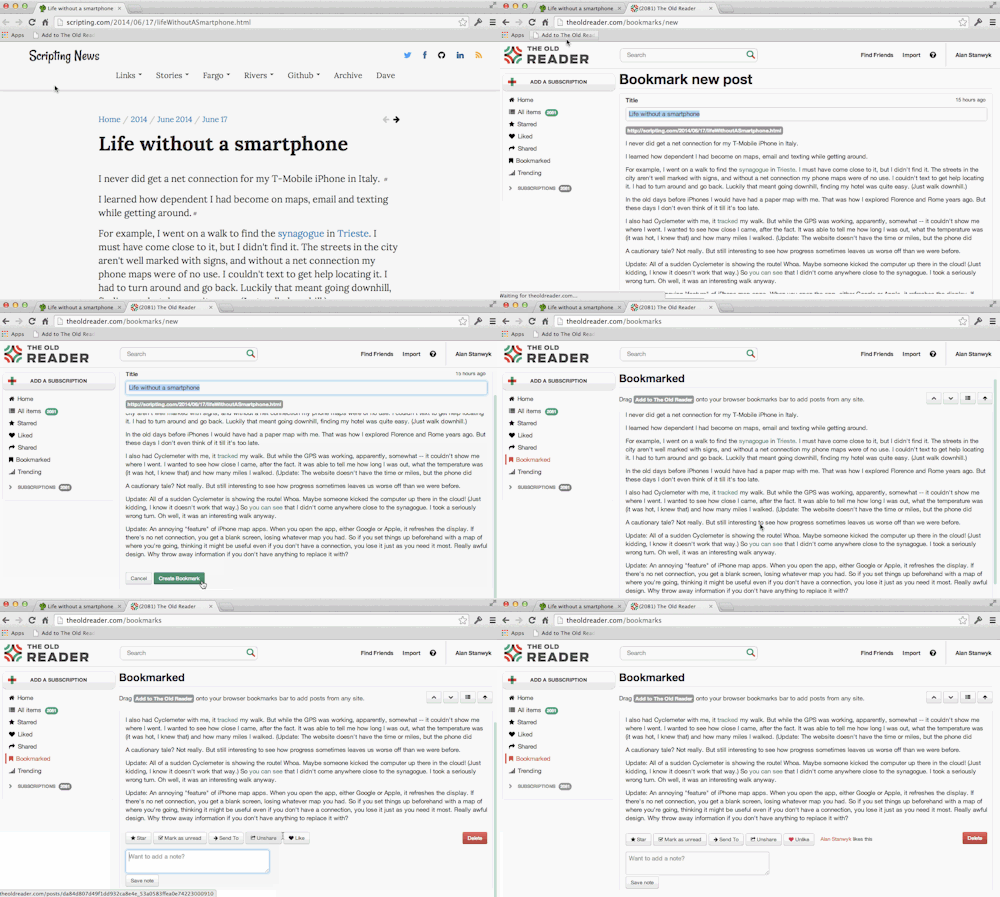
We’ve received a large number of requests to add a bookmarklet feature to The Old Reader. Today we are excited to be launching this functionality for our premium users. We will likely roll this functionality out to all users at some point in the future, but do not currently have a timeline in place.
The bookmarklet is quickly and easily added to your browser bookmarks and allows you to send a copy of any web page to your TOR account. Those pages are saved in the new bookmarklets section and are also searchable and sharable.
We know a lot of our users will be excited to see this new functionality and we look forward to your feedback. Thanks for using The Old Reader!
Late last week, we learned that the Cambridge License Commission has proposed a series of regulations specifically designed to SHUT DOWN innovative transportation options in the City of Cambridge, including both UberBlack and uberX products. What’s more, these regulations were drafted under the radar, without seeking or considering the input of Cambridge residents.
This is particularly disturbing given the enormous impact these regulations would have on Cambridge residents, visitors, and businesses. Specifically, these regulations would:
Set a $50 minimum price for any non-taxi car ride, regardless of time or distance
Prohibit you from requesting a ride on-demand from anyone other than a taxi
Forbid any technological device from being part of fare calculation during a ride
Tell Cambridge that you want Uber
For a city known for its innovation and progressiveness, it is shocking that Cambridge would cling so blindly to the past and ban an innovation that thousands of its residents and small businesses value and use on a daily basis. Even more unbelievably, there has been no meaningful effort to seek public input on the proposal, nor publicize the process or timeline for passing it.
Tuesday, June 17, 6:00pm
Michael J. Lombardi Building, 831 Massachusetts Avenue, Cambridge, MA
Basement Conference Room
Cambridge is your city and you deserve a voice. Tell the Cambridge License Commission that you deserve affordable, reliable transportation options, and that #CambridgeNeedsUber!
Mapmaking was not always about faithful geographic reproduction. It could be about plain amusement too. A popular subject matter for spoof cartography in the 19th century was marriage, and this ‘map’, A new map of the land of matrimony, from the latest survey, is characteristic of the genre. Though a very English concept, similar examples are found all over Europe. Various emotional situations are represented by mock locations in the style of real maps of the time: ‘Divorce Island. Variation of the compass observed here’.
The drawing-room novelty allowed readers to enjoy a light-hearted view of a serious matter in 19th century Britain. As the map suggests, divorce in the early 1800s was indeed isolating, with no easy way out. Socially taboo, it was also expensive, inevitably involving loss of wealth and status. The only justification was adultery, though men had far more latitude. A wife had additionally to prove ‘incest, bigamy, or excessive cruelty’. A man’s primary duty was to care for and financially support the family, so infidelity did not preclude this; a woman, however, whose duty was to love and obey her husband, was failing her duty if she was unfaithful.
Law changes made divorce easier in the mid-1800s, but those trapped in unhappy marriages typically stayed put. Even the wittiest map must have offered scant consolation.
Update: A report from Digital Music News claims that Financial Times got the story about YouTube's upcoming service wrong, and offers an alternative perspective. According to Digital Music News' anonymous source, YouTube will not block the videos that don't sign on with the subscription service. However, the source says the correct intepretation of YouTube's statements are that the site will be blocking music videos from YouTube's monetization program, as whole, if labels can't agree to make their videos available to both the free and premium tiers of the subscription service.
Hence, labels and artists will still be able to post videos, but cannot monetize them through YouTube unless they are onboard with the subscription service. This could have the long-term effect of artists at odds with the subscription service choosing not to post their videos to YouTube at all. That type of resistance to modern digital distribution methods does tend to be rare, on the whole. The original story is below.
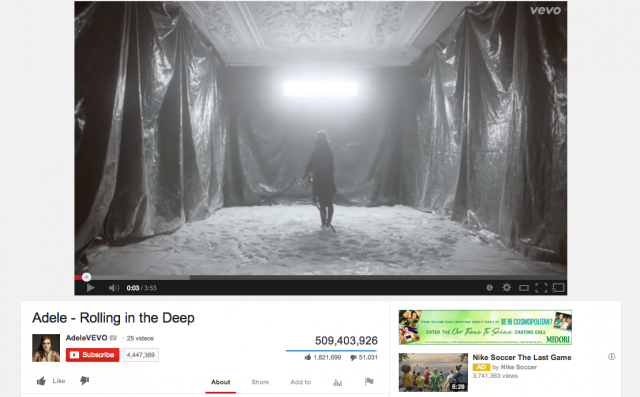
YouTube is getting ready to block music videos from artists that haven't agreed to the contract terms for its upcoming subscription service, the Financial Timesreported Tuesday. The videos set to get the boot include those from independent record labels and artists including Adele and Arctic Monkeys.
Of course, the Internet being what it is, what people seem the most excited about are the 250 new emoji characters, listed here by Emojipedia. Notable additions include "hot pepper," "sleuth or spy," "man in business suit levitating," "reversed hand with middle finger extended," and "raised hand with part between middle and ring fingers" (aka the "live long and prosper" thing). The list of emoji also extends the character set's adorable fascination with outmoded technology thanks to icons like "soft shell floppy disk," "fax icon," and "old personal computer."
Mostly absent from that list of new emoji are the more racially diverse characters Apple said it was trying to introduce back in March. There are a few characters that suggest progress on that front ("sideways black left pointing index," "black up pointing backhand index," and so on, assuming that "index" is a reference to index fingers), but those additions don't introduce parity between black- and white-skinned icons, nor do they account for other skin tones. That's not necessarily surprising, since these standards take a long time to change—hopefully more characters are introduced in a future Unicode release.
On April 1st, one of Google’s many(many, many, many) pranks included having a slew of 150 Pokémon infiltrate Google Maps. While some Google Map navigators spent a few minutes searching around their city to catch a Pokémon or two, others spent hours taking that “Gotta catch ‘em all” mantra very seriously.
And their efforts weren’t for naught.
Two-and-a-half months later, as promised, Google has sent a bit of appreciation the Pokémon Masters’ way: A letter thanking them for their service and providing them with official Pokémon Master business cards.












 Sands Fish