Tertiarymatt
Shared posts
Leading open access material science journal changes copyright license
TertiarymattAttn: Capt. Bunker.
Art of the day: infinite dude doodles. Dudles?

Art of the day: infinite dude doodles. Dudles?
The seven families of bees
TertiarymattIn case you were wondering.
It’s time for pollinator habitat
TertiarymattI wish I had a place to build some native bee habitat. Should start seeing them soon, if they aren't already active on clear days.
Hourglass bees
TertiarymattFlowers like bees to be dirty. Dirty filthy flower fucking bees.
Stingless beekeeping in Mexico
TertiarymattNative bees!
The Real Reason Nobody Reads Academics - Bloomberg View
TertiarymattUh, no shit?
Copyright Clearance Center Launches MOOC Content Licensing Solution | Business Wire
Tertiarymatt#MOOCBEAT
Editorial: Why and How NDT should go Open Access
Daily art: it is my destiny this month to draw historical dudes...

Daily art: it is my destiny this month to draw historical dudes with oars.

I just need the ability to function on planet earth
TertiarymattYes.

I just need the ability to function on planet earth
appendixjournal: Carl Sagan’s childhood drawings about space...


SSI Collaborations Workshop and Hackday
TertiarymattMight be vaguely in bl00s field of interest.
The Software Sustainability Institute is running the annual Collaborations Workshop (CW14) on 26-28 March in Oxford. The event brings together researchers, software developers, managers and funders to explore important ideas in software and research and to plant the seed of interdisciplinary collaborations. The theme this year is "Software in your reproducible research" and we also have a hackday!
To register for CW14 or the CW Hackday, visit the registration page.
There are lots of reasons why you should attend:
- GitHub and Microsoft Research will be on hand with the latest advice on using repositories, the cloud and open-source collaborative tooling for your research software.
- There will be prizes! The top team of the hackday win tablets! And there is more for the runner-ups.
- A good tranche of the Institute's Fellows will be attending. Not only are they leaders in their fields, they also have a particular interest in research software and its promotion in their domains. Even if you are not from the same domain, the Fellows have learnt some valuable lessons about using software in research.
- You will get a chance to hear lightning talks about a huge range of fascinating subjects, and perhaps you could promote your own work, highlight a particular bugbear or make a pitch for the hackday.
- We will also be having the conference dinner in the historic - and rather fancy - hall at St John's college.
- The Software Sustainability Institute team will be on hand, so if you are interested in running a Software Carpentry bootcamp or want to learn how to make better software for better research, come along!
- The hackathon will have a pizza evening where you can pitch ideas, form or join a team, and get underway with potentially 24 hours of coding... and the chance of winning prizes.
- You will be interacting with funders, researchers, developers,a publishers, managers and administrators; the whole spectrum of people dealing with software in research. You will gain an understanding of how people are working effectively together and come home with an up to date understanding of how people are approaching software to support reproducible research.
So learn from other people, promote what you do, come up with ideas and maybe win prizes, but most of all have an enjoyable and informed time. We hope to see you at CW14!
Originally posted 2014-03-03 by Aleksandra Pawlik in Software Sustainability Institute, Community.
Catching Up: Resurrected Viruses, Sex-Driven Smarts, And Some Upcoming Talks
TertiarymattBe interested to hear his talk on GMO.
My late winter is revving up into a state of rolling semi-controlled chaos, and so I’ve let a few items slip here at the Loom. Consider this a catch-up post.
1. On Thursday, I wrote my “Matter” column for the New York Times about an intriguing experiment on the evolution of learning. As I’ve written before, animals pay a price to become better learners, and so scientists have been investigating what the benefits are for different species. It turns out that competition for sex can drive the evolution of better learning, at least in flies. Randomly pairing flies into monogamous couples for a hundred generations leads to worse learning.
2. This week my “Matter” column is appearing today, to coincide with the publication of an especially riveting paper: scientists have revived a virus from 30,000-year-old Siberian permafrost. Aside from the dark twist on de-extinction, this story is compelling for another reason: the virus in question is a so-called “giant virus”--the biggest virus ever found, in fact. (I dedicate a chapter of my book A Planet of Viruses to the discovery of giant viruses–one of the most remarkable hiding-in-plain-sight stories around.) And for more on today’s news, check out fellow Phenomena-ster, Ed Yong, reporting for Nature.
3. Talks talks talks! After a quiet few months, I’m on the road. I was in Washington a couple weeks ago to talk about my cover story for National Geographic (video will go online soon, and I will post it here). Then I headed to Auburn last week to talk about genetically modified foods. But I’m just getting started. My future travels include:
–March 20: Rochester NY. Rochester Arts & Lectures. I’ll be talking about the mapping of the brain.
–March 24: Harvard. This talk is entitled, “Darwin in the City: How Modern Civilization Drives Evolution.”
–March 28: Charlotte NC. North Carolina Science Festival. I’ll be doing two talks in one day. One is a panel discussion about the genome. The other will be a public lecture about the microbiome.
–April 25: New York. American Society of Journalists and Authors. I’ll be talking about the craft of science writing.
–April 26: Washington. USA Science & Engineering Festival. I’ll be leading a panel discussion about personalized medicine. Panelists include Francis Collins, the director of the National Institutes of Health.
I also expect a couple more additions to my spring schedule–details to come.
emeraldcitycomicon: This piece is by Dylan Meconis dylanmeconis...

This piece is by Dylan Meconis dylanmeconis from our 2012 Monsters & Dames artbook.
Monsters & Dames is our charity art book that we sell at the convention, featuring some of the artists that will be attending the show that year. We also do an art auction of originals and prints of the work in the book. Since the first edition of Monsters & Dames in 2009 we have raised over $55,000 for Seattle Children’s Hospital.
I didn’t have the time to submit a piece for this year’s book (alas), but M&D is a bonafide Cool Thing; if you’ll be at Emerald City this year, you should absolutely throw down for this year’s edition!
The Doctor Is In
TertiarymattAnd yet people really seem to like it.

The Vinturi Spirit Aerator: a little afternoon fun
TertiarymattWeird thing to do with your whiskey.
 John recently reminded me that I was going to try out the Vinturi Spirit booze aerator we received about six months ago. Well, here I am on another of this winter’s snow days, and it seems like a perfect time to pull it out and have a go at it.

Comes with a base; doesn’t come filled with whisky.
First look: it’s clear plastic, but quite weighty. It looks like Magneto’s prison in X-Men 2, which is appropriate, because the button that activates the valve is not connected to the valve: it works by magnetism, so that no metal parts touch the whiskey, and there are no seals to leak whiskey. Unobtrusively cool, that. The Vinturi’s inventor, Rio Sabadicci, says that the “proprietary material” it’s made from is “more inert than glass,” which is either hard to believe…or scary, I thought glass was pretty darned inert.
Anyway, after fiddling with the magnetic button for a while, and rinsing it well with water, it’s time to play. First up was a Balblair 2001, bottled in 2012, uncolored, non-chill filtered, at 46%. Straight up: orange nougat, wet meadow, wildflower honey, dried pear, and a light piney tang, with some cocoa/fudge in the mid-palate; a thin entry that grows in the mouth. Into the Vinturi with it! The only difference I notice is that the pine backs off quite a bit, and the mouthfeel is a bit fuller. So what the heck, I ran it through again. This time the whisky tastes a bit sweeter, the fruit has backed off somewhat, more malt is coming to the fore, and the finish is warming up.
(Click on the video link to hear the odd sound it makes as the Balblair aerates.)
Let’s try something else: Jim Beam Single Barrel. That’s pretty different: 47.5% single barrel bourbon, around 6 years old. Light orange and cinnamon blend with warm caramel and dry oak in the nose, a pleasantly light corn, caramel, and citrus sweetness in the mouth, spiked with more cinnamon and some pepper, drying with oak toward the finish. Whatever: let’s whirlpool it! Erk. Something herbaceous has crept in, stemmy and rank…and then it’s gone. What happened there?! Now it’s like before, with maybe a bit more orange. The flavor, like the Balblair, seems sweeter after the aeration, and similarly, the finish seems hotter. Odd.
I’m not done, though. I have a new craft whiskey I haven’t reviewed yet: Ranger Creek .44 Rye, one of their “Small Caliber Series” of young, small bottle format whiskeys. This is Batch #1, 7 months old, and 47%, “distilled from 100% rye mash.” Very grassy, oily nose, with a floral touch to it. Crackling bitterness up front, followed by a wildly wrenching transition to a big sweet finish; like the .36 bourbon, this is not for the faint of heart, exciting whiskey. Let’s load this wildcat round in the Vinturi and pull the trigger. The nose seems more minty than grassy now, and the mouth is less bitter, the mint comes out, and again, the finish seems hotter. This is more changed than the other two, but the differences are still rather small.
What to make of this? The Vinturi Spirit sells for $20 on Amazon; $30 at stores. I’m sold on the value of aerating red wine, but on aerating whiskey? Not so much. The results of these three experiments make me think of something a brewer once said to me, after suggesting what I might be tasting in his beers. “They’re dog whistle flavors,” he said. “You don’t really hear them, you hear them because I told you they were there.” I’m not sure there’s really any difference in what I’m tasting pre/post-Vinturi, but there’s supposed to be a difference, so I look for one.
I think the Vinturi is like the Whisky Rocks; something a well-meaning friend or relation will buy you as a gift. You’ll play with it a couple times, and then put it away. That’s what I’m going to do. And then I’m going to finish these whiskies and call it a day!
The post The Vinturi Spirit Aerator: a little afternoon fun appeared first on Whisky Advocate.
Crawling Through The Brain Without Getting Lost
TertiarymattParasites, ho!

Ampulex compressa. Photo by K. Seltmann, via Creative Commons. Link: http://www.morphbank.net/?id=102143
If you’ve never met the emerald jewel wasp, let me introduce you to my little friend.
The wasp (Ampulex compressa) lives the first stage of its life as a parasite, growing inside the body of a living cockroach. That’s absorbingly horrific on its own, but how it gets into the cockroach in the first place is an especially gruesome delight. Its mother has to play neurosurgeon.
A female wasp seeks out a cockroach host and ambushes it. She inserts her stinger into its thorax and delivers a paralyzing shot of venom that immobilizes the insect for a few minutes. She pulls her stinger out and then delivers a second injection. This one goes into the cockroach’s head, delivering more chemicals to two sites in the brain of the host.

Image copyright Quade Paul
The result is a cockroach zombie. The neurosurgically altered victim recovers from its paralysis but now lacks the will to flee or fight. The wasp pulls on an antenna and leads the roach, like a dog on a leash, into a burrow. There she glues an egg to the underside of the roach. She leaves the burrow and seals it shut. In the darkness, the roach stands motionless as the wasp larva hatches from its egg and chews a hole into its side. The wasp feeds through the hole for a while, and then slithers inside. Later, it pops out as a full-grown adult.

Image by Ram Gal
At Ben-Gurion University, Frederic Libersat and his colleagues have been studying the emerald jewel wasp for over 20 years, and they continue to learn new things about it. In the journal PLOS One, they’ve now published previously unknown details about the creepiest part of the wasp’s attack: its injection of zombie drugs into the cockroach brain.
To appreciate just how tricky this can be, consider what it takes for doctors to deliver drugs to a human brain. They scan the patient’s brain to map its anatomy in three dimensions. Then they put their patient’s head in a cage, drill a hole in the skull, and then slowly push a tube into the brain. A wasp does much the same thing in about a minute, without ever glancing at a brain scan of its victim.

Some days I wish I was a jewel wasp. Photo source: http://neurosurgerycns.wordpress.com
They pull off this feat with their extraordinary stinger. It measures 2 millimeters long, enabling the wasp to insert it into the roach’s neck and snake it up to the brain. The tip of the stinger has two sets of valves. One set hold the equipment for laying eggs, and the other set hold the equipment for delivering venom. The valves interlock in a tongue-and-groove arrangement so that they can slide over each other, allowing the wasp to lay an egg or deliver a sting with the same organ.

Portion of a wasp stinger. Red arrows mark touch-senstive bell-shaped bumps. Black arrows mark touch- and chemical-sensitive dome-shaped bumps. Gal et al PLOS One.
The stinger, the scientists also found, are studded with little bumps–some shaped like bells, others like domes. Each bell-shaped bump has a touch-sensitive nerve ending inside it, while the dome-shaped bumps have a touch-sensitive nerve ending along with four or five chemical-sensing ones.
To see what those bumps are doing, the scientists put electrodes inside the nervous system of wasps and then pushed the stinger against rubbery lumps meant to simulate a roach’s brain. The wasps’s nerves crackled with activity when the bumps on the stinger tip pushed along a lump. This response suggests that the wasp uses its stinger to feel its way through the roach’s brain.
To see if this was true, the scientists stripped the stinger bumps off of wasps and then let them attack a cockroach. The average time the wasps spent probing the cockroach brain shot up from just over a minute to nearly 20 minutes. That’s what you’d expect if the wasps suddenly were unable to find their way inside a cockroach brain.
The scientists then ran another type of test, presenting healthy wasps with roaches that they had altered in various ways. They took the brains out of some roaches and left them with hollow heads. In other cases, they swapped the brain with a rubbery lump (some lumps were hard and others soft). In still other cases, they injected a toxin into the brains of the cockroaches that silenced their neurons. And in still other cases, they insert scissors into the roaches’ heads and snipped up the brains into a homogenous mush.
The scientists found that some–but not all–of these altered roaches posed a challenge to the wasps. If a wasp stung a roach without a brain, she spent over ten minutes probing its head. A soft rubbery lump also stretched out the time the wasps stung their hosts. And after that long struggle, the wasps withdrew their stinger in defeat, without delivering their zombie venom.
But when the wasps encountered a hard rubbery lump–a lump with the same texture as a brain–they spent just a minute poking the cockroach, after which the scientists found venom in the victim’s head.
Nor did the scientists find any change when the wasps were presented with roaches whose brains had been silenced–suggesting that the wasps don’t sense electrical activity to guide their stinger. On the other hand, a shredded brain left the wasps groping. That result suggests that the wasps need to do more than just feel the roach brain–they need to feel different parts of the brain in order to get where they need to go.
Taken together, these results offer a picture of an exquisitely evolved sensory organ–one adapted not for some all-purpose perception, but solely to navigate the interior of a cockroach’s brain by sense of touch. The full magnificence of this sensory organ may yet to be revealed, however. In their new study, Libersat and his colleagues didn’t determine what the chemical-sensing dome-shaped bumps are for.
Do the wasps taste their way through a cockroach brain? It’s possible–but perhaps the dome bumps provide it with other kinds of information. The scientists speculate that the dome bumps may taste the wasp’s own venom as it’s released into the roach’s brain, so that the parasite can carefully control how much she delivers to her victim (this is neuropharmacology, after all). Or perhaps the wasp can taste the flavor of larva of other species of parasites–in which case she may abandon the already-infected cockroach for a fresh host.
If someone answers that question, I guarantee to let you know. In the meantime, here is a video of a talk I gave for TED-Ed in 2012 about the jewel wasp. And if that’s just not enough for you, check out my book Parasite Rex.
Crystal Clear (3 Comments)
TertiarymattBuy Dylan's things.
Well, this is going in some sort of worrisome direction. The crystal ware should, at least, be concerned for its wellbeing.
If you are a fan of my picture-making and your home has walls, GOOD NEWS: I’ve got an INPRNT store! This makes it much easier and less expensive for me to sell high-quality, on-demand prints of my illustration work.
Right now you can get nine of my most popular images (goddesses, dragon-pilots, etc) from the shop, five of which I’ve never printed before. The better the store does, the more images I’ll add (including Family Man stuff!).
True Cartooning Stories
Tertiarymatt...I'm guessing this clerk had a very bad experience once.
| Ads by Project Wonderful! Your ad could be here, right now. |
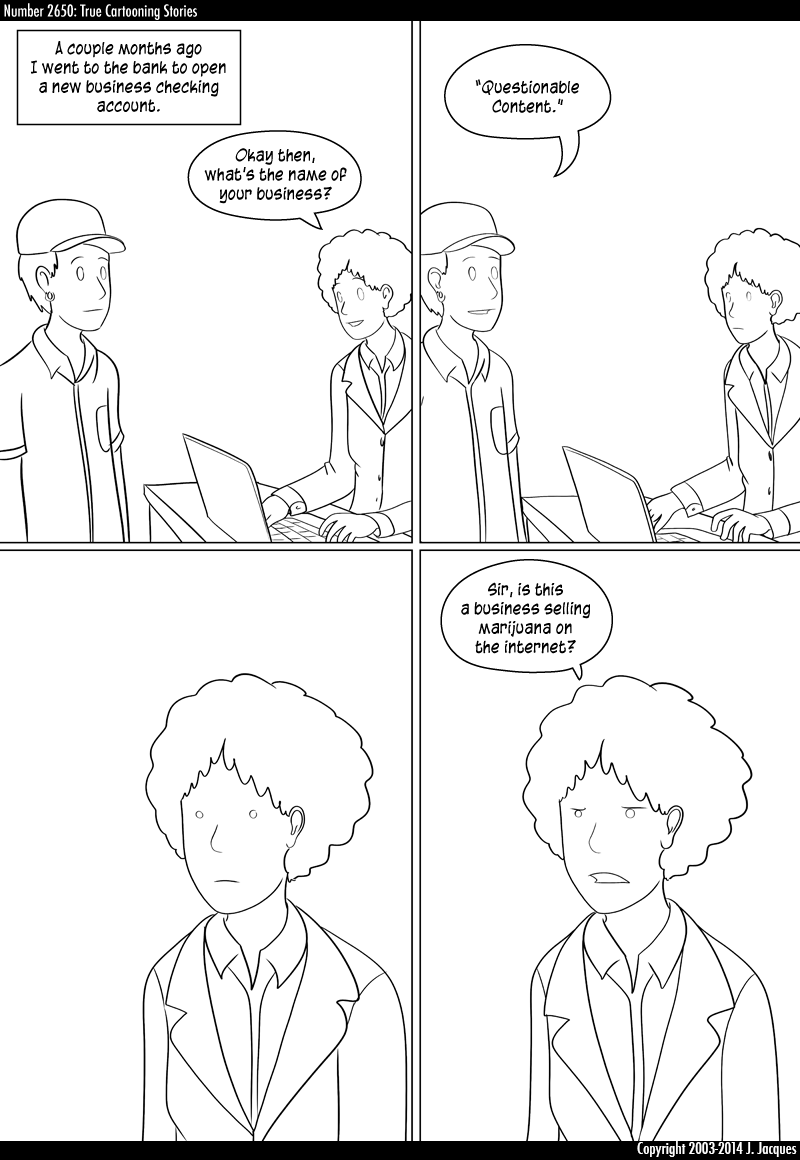
Yes, this really happened.
I had a minor surgical procedure today and am not really in shape to draw a regular comic tonight so this is what you get! The regular comics schedule resumes on Monday. Thanks for your patience.
The Choice
TertiarymattLife is rarely either/or.
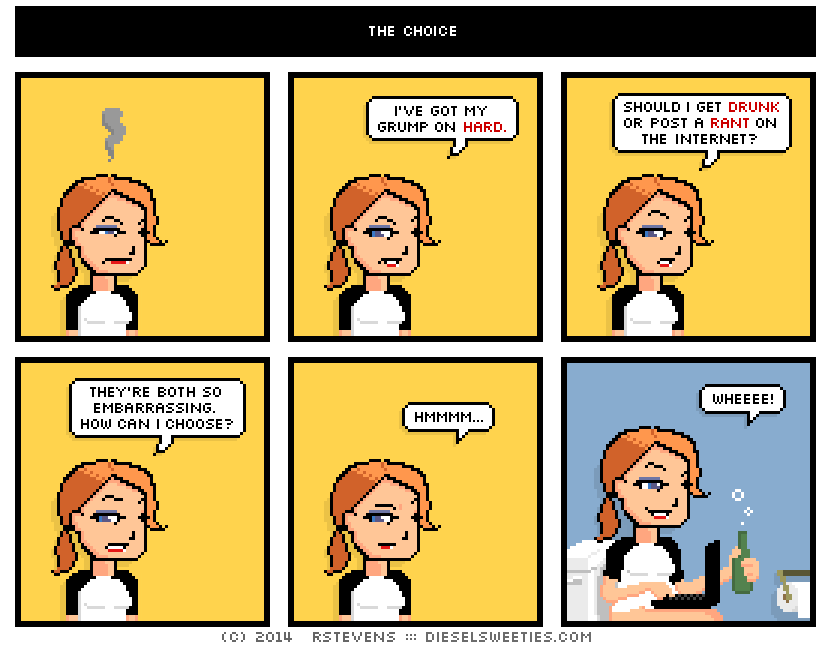
Tonight’s comic is about why I don’t drink, not that you’ll believe I don’t drink.
The Open Scoop Challenge
TertiarymattSo very terribly unlikely.
Sooner or later, in every discussion of open science, someone will say there's a risk of being scooped if you share your code or data with your peers. I think this is pure FUD: in all the years I've worked with scientists, I have never met anyone this has actually happened to.
But absence of proof is not proof of absence, so I'd like to issue a challenge. If someone has ever published a result you were going to by taking advantage of software or data that you made publicly available, I'll send you a Software Carpentry t-shirt. You'll need to provide specifics, but I won't share those details with anyone without your permission. Please mail me if you'd like to chat.
Originally posted 2014-02-25 by Greg Wilson in Community, Open Science.
Art of the day: panel in progress.
TertiarymattToday in Fancy Ladies Who Smell Something Unpleasant

Art of the day: panel in progress.
Guyana Summary & Thoughts
TertiarymattAnyone ever drink a rum made by this distillery. I'm quite curious about it.

I'm typing this entry while flying over the Caribbean, from Trinidad to Miami, sitting and reflecting on what I've learned this week in Guyana and how I can best convey it. I'm pretty sure I got everything out of this trip I was looking for and I'm also seriously thinking to myself that DDL might just be the best distillery in the world. Granted – I haven't been to every distillery in the world, so it's hard to know. I've been to a lot of them, but I can't think of any other operation I've visited in the seven years I've been with K&L that is on the level of Demerara Distillers. What exactly do I mean by that? Let me try and explain.
First off, I've never been to a distillery that has more than seven different stills, each capable of creating a very different type of distillate. That in itself is enough to make two spirits geeks like David OG and me hot with excitement. Secondly, I've never visited a producer that's been in business since the 1600s and still has functioning equipment from the 18th and 19th centuries in operation. Najuma, who's the chemist in charge of quality control, told me that the heritage stills are not always consistent due to their age, which makes it difficult to keep up consistency. While single malt distilleries blend their whiskies to maintain as consistent a product as possible, El Dorado is blending just to get anywhere close! I like that. I like the fact that Shaun and his team are making rum on old stills that have a mind of their own, but always leave them with something great to work with. There's something endearing in that legacy.
Thirdly, I've never tried to work out a deal with a producer this large who was willing to give a store like K&L its full attention. El Dorado has been voted the best rum in the world for the last few years and there's little argument among enthusiasts that DDL is the cream of the crop. There's no other producer who can compete on their level, simply because of DDL's history and resources. No other rum distillery has an endless supply of high quality, in-state molasses and a contract with the government to ensure it, and no other distillery has the means to turn that molasses into so many wonderful spirits. El Dorado is sold all over the world, in large quantities, and now I hear even Costco wants in on the action. Yet they've decided to put their faith in us – a family-owned California retailer with three stores who cannot even come close to the volume that other accounts purchase – as a partner worthy of collaboration in the attempt to bring something exciting and new to the market. This is the first time that Sharon and Shaun have worked with a retailer to create an exclusive product under the El Dorado label and they want to make it work.
Fourthly, there's a great deal of respect and pride in what they're doing at DDL and the company believes in its people. That's not to say that other whisky distilleries don't support their employees or their local communities, but let's just say that no one at DDL is going to be replaced with a computer or an automated system any time soon. On top of that, the company is not for sale. It's owned by a group of shareholders who also run a foundation on behalf of local Guyanese children, making sure they get the education they need. DDL has even sent its employees to American universities and paid for their education so that they can return with the specific knowledge they need to make the company better. The employees are so thankful for this support that they become loyal DDL workers for life. It's a relationship based on complete respect for one another, and that respect extends to DDL's customers as well. There was no marketing BS, fuzzy math, or slight of hand going on during our visit. If we wanted to know something, they told us. If we wanted to see something, we saw it. If we wanted to taste something, they went and got us a sample. Contrast that with the hour I once spent in a sugar cane field on Barbados, only to learn that the producer was importing all its molasses from India. DDL is not a rum Disneyland. It's as authentic and untouched by corporate influence as any other producer I know of. It just happens to be a big company with big ambitions.
Fifthly, I enjoy working with people I like. If I have the choice between working with someone open and friendly, or someone who's a complete asshole, I'm going with the friendly person 100% of the time. It sounds crazy, I know. I understand that people have a choice when they purchase a bottle of booze, which is why I go out of my way to communicate with customers and let them know that I'm there for them if they need me. No one wants to do business with a jerk if they don't absolutely have to, myself included. But I'm absolutely crazy about the people who work at DDL – to the extent that I'm willing buy a gang load of their rum just so I can hang out with them again next year. David OG, too, as well as my buddy Martin Cate who owns Smuggler's Cove in San Francisco – the single largest bar account for El Dorado in the United States. Martin went to Guyana a few weeks before us and had nothing but amazing things to tell me. He's a true believer, as well, and he knows more about rum than anyone I've met in the bartending scene. I told Shaun Caleb while out at a bar in Georgetown, "Forget the numbers, let's just do this because we're friends who want to help each other out." Consumers not only have their choice of retailers, but also producers, and many customers like to know where their money is going. Let me assure you that DDL is one of the nicest companies we've ever worked with from top to bottom, so if you're careful about where you put your dollars, have no fear. They're going to a good place.
Sixthly, I'm a sucker for romance. I love a good story. I think most customers appreciate certain tidbits of knowledge as well. How cool is it that the El Dorado rums were made from a set of stills that date back hundreds of years, from one of the oldest operations still in existence? How neat is it that they source all of their base materials locally, rather than outsourcing overseas to cut costs? How satisfying is it that: despite their size and scale, the quality of their rum, and their 100K+ back stock of mature barrels, DDL continues to operate their own business and remain Guyanese owned? And how about the fact that they hire and support the local Guyanese community, rather than bring in marketing strategists and accountants from around the world to assimilate DDL into the modern business place? These are all aspects of their business that I admire have a great respect for.
Guyana is one of the few places I've been (Gascony and Normandy would be the others) where the locals are still in complete control of their own distillation and their own heritage. The main difference between DDL and the farmers of Armagnac, however, is that El Dorado has enough product to compete on a global scale. It's not a niche brand, whatsoever. It's an easy-to-like, relatively affordable, big-tent, eclectic, and well-managed line of incredible spirits that has enough product to supply the world market. And the rums are GOOD! They're something any fan of spirits would enjoy. If not the 8 year, than the 12. If not the 12, then the 15. Or even the three year old with a splash of lime and soda. There are so many different flavors available and so many ways to enjoy El Dorado – cocktails, neat, on the rocks, with a cigar (we did Cubans with the 15 year on Wednesday night – amazing!).
Am I gushing? Am I carrying on, rambling on end about how amazing this trip was? If I am, don't worry: DDL has been watching me do it all week, so they're used to it by now. I've been gushing over their rum, their distillery, their housing staff member Britney who made us breakfast every morning, their professionalism, their kindness, and their belief in the two Davids. And, of course, their staff. I cannot wait to tell you all more about the El Dorado rums (yes, there's a lot more to talk about). I cannot wait to get our blend finished, exported, and on to the shelves. I cannot wait for you all to taste it. And I cannot wait to go back to Guyana to do this all over again.
Komal – thank you for your wonderful hospitality and for taking the time to meet with us. I'm transformed.
-David Driscoll
Well there I was with my wheelbarrow of enormous fish, and this...
TertiarymattShit-talking mermaids are the best mermaids.

Well there I was with my wheelbarrow of enormous fish, and this mermaid lady just got all up in my face out of nowhere, and I was like, “aren’t you supposed to be seducing me or something, isn’t that what mermaids do,” and she was like, “nah, I just sit on this rock and talk shit all day.” Then she waggled her finger and made a rude gesture and even though I’m just a regular joe with a wheelbarrow of enormous fish, I thought it was pretty out of line.
(See some of Paul Burke’s folk art here)
Searching For the Oldest Pieces of Earth
TertiarymattEarth having a liquid water ocean at 200 million years old seem really quick to me!
About 4.567 billion years ago, a quivering bead of magma 93 million miles from the Sun cooled down until it grew a skin of rock. Eventually, it would be named Earth. We don’t know a lot about what the planet was like back then, because that primordial crust is almost entirely recycled–eroded away, pushed back down into the molten depths of the planet, or smashed to bits by the huge impacts that blasted Earth for its first few hundred million years.
Geologists have wandered the planet to find scraps of the infant Earth. One mineral that is particularly precious to them is known as a zircon. Tiny zircon crystals can withstand billions of years of abuse–getting ripped out of their original rock, incorporated into new rocks, heated up, and squeezed at tremendous pressures–and yet still retain their original chemistry. Zircons have the added attraction of holding onto radioactive isotopes such as uranium. Over billions of years, the uranium decays at a steady rate into lead. By measuring the atoms of uranium and lead in a zircon, scientists can get a tight estimate of the zircon’s age.

Zircon from Jack Hills, Australia, dated to 4.4 billion years old. Photo copyright John Valley, University of Wisconsin
In 2001, scientists digging at a site in the Australian outback called Jack Hills found a zircon dating back about 4.4 billion years. It broke all records for the oldest zircon, and no one has broken its record since.
Estimating the age of zircons from over four billion years ago pushes science’s powers of detection to their limits. And so it’s no surprise that the age of the Jack Hills zircon has been the subject of debate.
Some critics have questioned whether the geological clock in the Jack Hills zircon has been running steadily this whole time. After the zircon got incorporated into younger rocks, it was heated up. Under such conditions, the uranium and lead inside a zircon may migrate around inside the mineral grain. To measure the age of a zircon, scientists only shave off a small portion of the zircon. If there’s been a lot of migration inside the mineral, that portion may be loaded with extra uranium and lead, or it may have lost some of atoms. In either case, the geological clock will be thrown off.
Geologists are constantly raising these challenges and then meeting them. Yesterday in the journal Nature Geoscience, John Valley of the University of Wisconsin and his colleagues published a new study of the Jack Hills zircons. They performed a kind of geological X-ray, mapping the uranium-derived lead atoms from across a zircon grain to figure out how much they’ve moved around.
The lead has indeed moved, Valley and his colleagues have found, but only a little. It has gathered into clumps that are too small and too closely packed to throw off the geological clock. The 4.4 billion-year age stands.
In other words, the Jack Hill zircon existed in rocks that formed about 200 million years after the formation of the planet. That’s a long time for us mere humans, but it’s about four percent of the lifetime of the Earth. Looking inside the Jack Hills zircon, geologists have found hints that they formed in a cool crust below a liquid ocean. If that’s true, then it also means the Earth was hospitable for life by then.
But there’s only so much insight you can get from a zircon that’s twice the thickness of a human hair. What geologists would love to find is an honest-to-goodness rock from 4.4 billion years ago–something you could hold in your hand. The oldest rocks with an uncontested age date back 4 billion years ago–400 million years younger than the Jack Hills zircon. If geologists could find rocks from 4.4 billion years ago, filled with a variety of minerals, they could learn much more about the early Earth.
In the March issue of Scientific American, I have a story about rocks that may indeed be 4.4 billion years old–the oldest rocks on Earth, in other words. But these rocks, along the coast of Hudson Bay, have inspired an intense debate among geologists, some of whom argue that they’re actually much younger. The science is fascinating, and the stakes are big. You’ll need to buy a copy of the issue or access the story through a subscription, but I hope you’ll find it worth the effort.
You can now get all of these images of mine as high-quality art...
TertiarymattBuy all of Dylan's things.





http://www.inprnt.com/gallery/dylanmeconis/
You can now get all of these images of mine as high-quality art prints from my new store at INPRNT!
…I draw a lot of women in power poses.