
Shared posts
14 May 18:44
Master lock auto-cracker built as coursework at University
by Mike Szczys
We love the beginning of May because the final projects for college coursework start rolling into our tips line. Here’s one of the latest, it’s an automatic Master lock combination cracker which was built by [Ross Aiken] and his classmates as part of their ECE453 Embedded Microprocessor System Design class at the University of Wisconsin – […]
Gus and -1 others like this
14 May 18:44
Editorial Cartoon: He's Dead To Us, Jim
Albener PessoaTem que clicar para ver ...
He's Dead To Us, Jim
14 May 18:42
‘We Already Have Money, It’s Called “Money”’
by John Gruber
Garrett Murray on Amazon’s new “Amazon Coins” virtual currency thing. Sure hope Apple never goes this route; it’s slimy.
Scirocco6 likes this
14 May 14:55


Político propõe ensino obrigatório de ficção científica nas escolas
by Carlos Cardoso

Em 1968 a obra-prima de Stanley Kubrick e Arthur Clarke – 2001 Uma Odisséia no Espaço – mostrava pela primeira vez uma visão realista da exploração espacial. Mais de 40 anos depois o filme ainda é referência. HAL é a quintessência do Computador Inteligente, a Discovery uma nave estranhamente funcional, e os astronautas são… astronautas.
Uma das cenas clássicas mostra um dos tripulantes da Discovery correndo na centrífuga da nave, percorrendo os 360 graus, em uma visão incrível, sem fios, efeitos de CGI (que aliás não existiam) ou miniaturas. Kubrick construiu uma centrífuga em tamanho real.
15 anos depois, inspirado pela cena de Kubrick o astronauta Pete Conrad teve uma idéia: O anel de armários do Skylab, primeira estação espacial americana parecia propicio para repetir a famosa cena. Seria possível?
Sim, seria.
Arthur Clarke, dizem, se divertiu muito quando viu as imagens, que foram transmitidas na TV ao som do tema de 2001. Mais uma vez a Vida Imitava a Arte. Mais uma vez a ficção inspirava a ciência.
William Shatner lembra em suas memórias que certa vez o elenco de Star Trek foi convidado para visitar a NASA. Ele foi, mas apavorado. Imaginava que seria idéia de algum RP, e que os cientistas desprezariam um reles bando de atores.
“Eles realmente iam ao espaço e construíam foguetes, a gente apenas fingia na televisão”.
Quando chegaram foram cercados por cientistas-fãs, fizeram uma visita super-vip e ainda ganharam um modelo da Enterprise construído pelo pessoal da NASA. Virtualmente todos eram fãs de ficção científica e Jornada nas Estrelas. Depois disso mais de uma geração seguiu carreira em ciência e tecnologia por inspiração de seus heróis nas telas.
A ficção científica mostra um mundo cheio de maravilhas a ser descobertas, mas ao contrário da fantasia, não nega acesso a esse mundo. Nunca conseguiremos visitar Aldeeran (até pq ele explodiu. haha sacaneei. too soon?) mas Star Trek nos maravilhou com tricorders, computadores mágicos capazes de acessar um banco quase infinito de informações. Hoje chamamos de smartphone.
Neil DeGrasse Tyson bem disse:
“Crianças nascem cientistas. Elas nascem sondando o mundo natural que as cerca. Elas levantarão uma pedra, pegarão insetos, puxarão pétalas de uma flor. Vão perguntar por quê a grama é verde e o céu é azul, vão experimentar com coisas quebráveis na sua casa. Acho que o melhor que um pai deve fazer, quando criando uma criança, é simplesmente sair do caminho dela”
Essa fase de curiosidade em geral dura pouco. Pais sem paciência ou conhecimento, humilhados por não conseguirem responder as perguntas de seus filhos cortam com “é assim porque é assim”, “pare de perguntar besteira” ou, a pior de todas “ pra quê você quer saber isso?”.
As crianças de mais sorte conseguem manter seu senso de deslumbramento lendo gibis, vendo filmes e consumindo livros de ficção, onde protagonistas são recompensados por sua curiosidade, resolvem problemas com inteligência e vivem na contramão dos heróis fáceis da maioria das histórias.
Com o tempo elas direcionam seu interesse, tentando seguir carreiras onde criação o futuro que tanto admiram. Esse tipo de motivação não existe em nenhuma outra vertente literária.
Ray Canterbury é um republicano (eu sei, também estranhei) que enviou uma proposta ao Conselho de educação da West Virginia que, se aprovada (nunca será) alterará a legislação de 1931 incluindo o seguinte parágrafo:
“Material de leitura de Ficção Científica deverá ser incluído no currículo para estimular o interesse em matemática e ciência”
Uma linha, uma simples linha que pode significar a diferença entre isto:

E isto:

Ao invés de OSPB, EPB, Educação Moral e Cívica ou seja lá qual o nome da semana, crianças deveriam ler 1984 e Admirável Mundo Novo, Starship Troopers e O Jogo do Exterminador. Depois, passar o resto do semestre discutindo as histórias, mas isso exigiria demais –os professores teriam que ler os livros- e as crianças acabariam aprendendo a pensar, não seriam mais agentes passivos e associariam as alegorias dos livros ao mundo real.
Convenhamos, ninguém quer isso. Chego a pensar em atualizar a clássica “100 coisas que farei quando me tornar um Senhor do Mal” incluindo a 101a: “nunca permitir ensino de ficção científica nas escolas.”.
Sendo realista, ensino de ficção científica nas escolas é e sempre será ficção científica.
 |
 |
14 May 14:51


Google resolve problema de espaço do Drive unificando-o com o Gmail
by Ronaldo Gogoni

É bizarro dizer isso atualmente, mas houve época em que 80 GB era espaço de sobra. Meu primeiro PC decente veio com um HD dessa capacidade. Hoje em dia isso não dá nem pro cheiro, já baixei um filme e um show que extrapolaram essa capacidade (dois arquivos apenas). Para armazenamento online é a mesma coisa, apesar que ainda considero 10 GB para o Gmail mais do que o suficiente (já que realizo limpezas periódicas nele).
Agora o Google Drive, com seus apenas 5 GB de capacidade gratuitos são ridículos, assim como os 7 GB oferecidos gratuitamente pelo Skydrive (Dropbox não conta, só estou usando 50 GB por causa do bônus que ganhei com o Galaxy S3, que tem data para acabar). Para resolver isso o Google ampliou seu espaço dado de graça, fundindo ele com o Gmail. A partir de agora usuários terão 15 GB de espaço para tudo, na faixa.

Em um post divulgado hoje, o serviço será disponibilizado aos poucos para os usuários e visa “simplificar as coisas”, mantendo seus e-mails e arquivos todos num mesmo lugar. Numa tacada só resolveram problemas de organização e espaço gratuito.
O Google também vai beneficiar quem paga por mais espaço: contratantes de 100 GB por exemplo poderão usar o espaço todo compartilhado, que antes limitava apenas 25 GB para os e-mails (o que você anda compartilhando para precisar disso tudo?), a um módico preço de US$ 5/mês.
É uma solução inteligente, que reduz as reclamações dos usuários free do Drive que realmente tinham pouco espaço disponível. E convenhamos, ninguém vai guardar tantos e-mails assim. Ou vão?
Fonte: Google.
|
|
14 May 01:11


A segurança dos carros brasileiros observada do exterior
by Ricardo de Oliveira
A segurança dos carros brasileiros observada do exterior é um post do blog Notícias Automotivas - Carros

Nós já sabemos que os carros feitos no Brasil ainda devem muito em termos de segurança, mas acredite, ainda há mais coisas obscuras a esse respeito. Uma matéria publicada pela Associated Press, reproduzida por alguns sites internacionais, revela a visão do exterior sobre a segurança e qualidade dos carros produzidos aqui e detalhes do que ocorre entre dentro das linhas de montagem.
O quarto maior mercado do mundo tem hoje produtos que estão 20 anos atrasados em relação aos similares americanos e europeus, por exemplo. Quem diz isso é a Latin NCAP. Aqui, os carros possuem estrutura mais fraca, mesmo com airbags, devido à redução no número de soldas ou na quantidade de energia gasta em cada ponto soldado.
Motivo? Redução nos custos de produção, visto que 20% do custo total da estrutura vêm da energia elétrica. Quanto menos energia, mais barato fica de fazer o carro. Aliás, devemos lembrar que apesar das inúmeras hidrelétricas e do potencial hídrico do país, o custo da eletricidade é muito maior em nosso país.
Dessa forma, com custo de produção menor, a lucratividade média de 10% está garantida. Lá fora, observam que nos EUA essa média é de 3% e a média global é de 5%. Isso sem contar que a maior parte dos veículos vendidos no país é de populares, que em muitos casos, oferecem airbag duplo e ABS como opcionais.

Governo e consumidores também são culpados
Nesse caso, o problema também não está apenas nos carros, mas no consumidor. A matéria observa que os compradores brasileiros não possuem um nível de exigência em termos de segurança comparável ao de americanos e europeus, por exemplo. Aqui, se valoriza mais rodas de liga leve e sistemas de áudio do que equipamentos essenciais para proteção à vida.
Além disso, o consumidor que sofre graves lesões em acidente no Brasil, não recorre à justiça para valer seus direitos, diferentemente do que ocorre nos EUA, por exemplo, fazendo no máximo um “BO”. Dessa forma, segundo um engenheiro automotivo, que preferiu anonimato, a montadora americana em que trabalhava tinha prazer em atender os consumidores de mercados emergentes, visto que seus carros mais baratos de fazer não exigiam grandes investimentos em segurança, já que até a lei não obrigava tal coisa.
O governo brasileiro se defende, dizendo que os carros feitos aqui são equivalentes aos europeus, por exemplo, mas reconhece que é preciso avançar em segurança depois de confrontado com dados do Latin NCAP. Só em 2014 os automóveis nacionais terão airbag duplo e ABS de série, itens tornados obrigatórios no exterior muito tempo atrás.
Além da lei branda, a União não possui um instituto para realizar tais testes, embora diga que estará analisando dados de entidades independentes. Aliás, o Latin NCAP é criticado pelas montadoras instaladas aqui, que alegam que seus carros atendem à lei e são equivalentes aos internacionais. Elas dizem que o Euro NCAP é mais exigente.
De fato, mas os testes de impacto frontais foram feitos no mesmo laboratório, com os mesmos técnicos e nos mesmos parâmetros, segundo o renomado instituto. Resultado? Modelos feitos aqui ganham de uma a três estrelas, enquanto o similar europeu vai de quatro a cinco estrelas. Mesmo modelos topo de linha não chegam a cinco estrelas aqui. Elas também alegam que seus carros são mais resistentes que os estrangeiros, a fim de suportar as duras condições das estradas brasileiras, que por sinal são péssimas, contribuindo ainda mais para elevar o número de acidentes.

Faltam soldas!
É apontado também que mesmo com airbag, um carro com célula de sobrevivência mais fraca – por causa de soldas de baixa qualidade ou em número inferior – se torna uma séria ameaça à vida dos ocupantes, visto que parte da estrutura irá adentrar o habitáculo projetando peças e outros componentes sobre o condutor e demais passageiros. Por exemplo, um engenheiro automotivo com 40 anos de experiência compara um carro alemão feito no Brasil e seu equivalente europeu. Ele relata que muitos pontos de solda e reforços estruturais do projeto original inexistem na versão feita aqui.
Mesmo com acionamento das bolsas infláveis, sua atuação será prejudicada, visto que ao invés de proteger, elas poderão causar ainda mais lesões devido ao deslocamento irregular de sua posição durante o impacto. Carros sem airbag são potencialmente mortais, pois o volante se torna a principal arma contra o condutor, provocando lesões graves na cabeça, tórax e abdômen. Os cintos de segurança também estão envolvidos, especialmente os traseiros. Em São Paulo, 40% dos casos de lesões na coluna vertebral, apresentadas nos hospitais em decorrência de acidentes de trânsito, não deveriam existir.
Mas o pior de tudo isso, claramente apontado na matéria, é o custo irreparável em vidas humanas. Brasil e EUA caminham em direções opostas. Apesar de ter uma frota cinco vezes menor, o país latino-americano registrou crescimento de 72% nas mortes em acidentes de trânsito na última década, segundo dados de 2010. Nos EUA, houve uma redução de 40% no mesmo período. Em 2010, 9.059 vidas foram perdidas em acidentes de automóvel no Brasil, enquanto que 12.435 foram registradas nos EUA. Resultado? Em relação à frota, nosso país tem taxa de mortalidade quatro vezes maior.
Infelizmente para nossos vizinhos e outros emergentes, a situação sombria não ocorre apenas no Brasil. Os mercados emergentes deverão fazer a frota mundial chegar a 1,5 bilhão de carros em 2020. Vender nesses países é a salvação financeira de todos os fabricantes, que se beneficiando de leis mais brandas em termos de segurança, produzem carros com qualidade estrutural inferior e com maior rentabilidade, em detrimento da segurança dos clientes.

Unsafe at Any Speed
Ralph Nader, um famoso político e ativista americano, propõe um clamor público, ações de responsabilidade sobre segurança do produto e boicotes seletivos por parte de consumidores ou da legislação brasileira, a fim de equalizar as normas de segurança com a engenharia, conforme ocorre no exterior. Ele afirma que tais respostas funcionaram no passado, forçando a indústria automotiva a reaver sua posição diante da segurança no trânsito.
Ele publicou o livro “Unsafe at Any Speed” (Inseguro a Qualquer Velocidade), lançado em 1965, que abaulou a credibilidade da indústria automotiva americana, pois questionava os fabricantes sobre o elevado número de mortes no trânsito dos EUA. A publicação alertava para o fato das montadoras não instalarem equipamentos de segurança a fim de reduzir custos.
O livro levou a uma discussão nacional sobre a segurança automotiva e forçou o governo a implementar normas de segurança mais rígidas, mudando dramaticamente a filosofia da indústria automobilística dos EUA. Só em 1965, 47.089 americanos morreram nas estradas do país, um número quase duas vezes maior que a quantidade de soldados que tombaram na Guerra do Vietnã. Como ele mesmo diz: “… agora os brasileiros conhecem a verdade com mais detalhes.”.
[Fonte: Associated Press via Yahoo e Business Insider]
Agradecimentos aos leitores Fransciso Antunes e Cley Aragão pela dica.
|
|
Osiasjota and -1 others like this
14 May 00:59

Catch-up splat
by Tyler Cowen
Having been traveling, I neglected some of the more controversial issues of the last week, but here are a few points of catch-up.
On the immigration study, I liked Reihan’s recent post very much. It is now the case that 23 student organizations at Harvard’s Kennedy School are protesting the fact that the dissertation was awarded, while nominally defending academic freedom of course.
For all of the brouhaha over Niall Ferguson, everyone is forgetting what Robert Skidelsky wrote in 1977, Skidelsky too it seems. I don’t agree with either the immigration study or with Ferguson (at all, in either instance), but the response has been a case study in…something or other. There is a glee and also a selectivity to it all which I am uncomfortable with, to say the least.
Within the span of a week, it is remarkable how rapidly the UK has moved toward a serious debate over leaving the EU, and that is after the UKIP election results were revealed (calling Timur Kuran!). Our London cabbie, on the drive to the airport, still calls it “the EEC.” With apologies to Thomas Friedman, I say this movement is for real.
The Novel Coronavirus seems to be human-to-human transmissible in a manner which is very worrying (more here). When your thought is “that one might be too deadly to be a real problem,” it isn’t actually good news. Fortunately the French health minister tells us that “Nothing is being left to chance,” including presumably which mutated strains of the virus will survive and spread.
What’s remarkable about the IRS tax scandal is that it was admitted, keep that in mind when revising your Bayesian priors. Don’t forget about Bloomberg too. Are all of our phone calls being recorded?
I do understand the back story, but still I become uneasy when the Secretary of HHS goes on a fundraising campaign from affected parties. In lieu of naming rights, you get…what? Can you say you “gave at the office”? The voting booth? Can they then rent out the mailing list of which companies gave?
The Republicans on Benghazi have learned from the Democrats on Mitt Romney and leveraged buyouts; define your opponent early in the public eye. It is working, if only because most media accounts, even sympathetic ones, do not include pictures of a radiant and smiling Hillary Clinton with the story.
A twelve-year-old stabbed his eight-year-old sister to death.
Might we have a budget surplus in two years’ time?
The WSJ reviews Knausgaard, and “Babs” Walters will be retiring.
“What have the old gods done for us lately?”
Could it be this pizza?
OK people, now you can go nuts in the comments, get it out of your system.
14 May 00:56

Private Schools in Developing Countries
by Alex Tabarrok
Tina Rosenberg has an excellent piece on private schooling in developing countries at the NYTimes blog:
In the United States, private school is generally a privilege of the rich. But in poorer nations, particularly in Africa and South Asia, families of all social classes send their children to private school….
BRAC used to be an acronym for Bangladesh Rural Advancement Committee, but now the letters stand alone. It was founded in 1972 to provide relief after Bangladesh’s war of liberation. Although you’ve probably never heard of it, BRAC is the largest nongovernmental organization in the world, with some 100,000 employees, and it services reach 110 million people.
…And since 1985, it has run schools… BRAC has more than 1.25 million children in its schools in Bangladesh and six other countries, and it is expanding.
BRAC students, in fact, do better than their public-school counterparts….BRAC students are more likely to complete fifth grade — in 2004, 94 percent did, as opposed to 67 percent of public school students. (The BRAC number is now about 99 percent.) On government tests, BRAC students do about 10 percent better than public school students — impressive, given that their population is the most marginalized. (emphasis added).
In my own work on private schools in India I also found suggestive evidence that private schools–mostly very small, urban slum schools–produced better outcomes than their public counterparts (paper (pdf), video).


13 May 23:07


40+ FREE online language learning resources: Most comprehensive and up to date list of courses, communities, exchanges and more!
by Benny

The great thing about blogging, compared to traditional print media, is that you can update posts as often as you like. With that in mind, I’ve decided to make this the go-to page for the most comprehensive list of completely free online resources for learning and practising many languages, that you may find online!
I will constantly be coming back to this post to make sure it is up to date with the latest and best links.
If I have missed anything (within reason, please see the note at the end) definitely let me know in the comments and I’ll add it in! I’m only interested in sharing a site on this page if it has a genuinely useful 100% free aspect to it (although some of these pages may have other paid aspects to them or ads). If at any time in the future these links become less useful, also let me know and I’ll remove them 
Also note that for the purposes of keeping the number of links that can appear on this page under control, I won’t be including into any links that focus on just one language in this blog post.
For that please make a request or do a search in the forums. I’ll make a separate post later for sharing the best links for specific languages, but until then share your favourites with us in the forums. For instance, here is a thread about watching videos in French, or here is a long list of links for learning Chinese, this thread shares German links, this one is for Italian, and Dutch here. When you ask, those in the forum can also point you to other specific language link lists elsewhere online, such as this one for Spanish resources.
Alternatively use the Google search tool on the right, as various posts on this blog share my favourite links specific to one language, such as for Irish.
Here we go!
Courses
Duolingo - A recent newcomer, run by Luis von Ahn (interview I did with him in Spanish here). It encourages you to progress in learning languages through gamifying its lessons. Full review of it here. At the moment, it offers Spanish, English (for Spanish speakers), French, German, Portuguese and Italian and more languages are in beta and on the way soon.
The Foreign Service Institute has a varied list of courses
The Omniglot intro to languages has a great first overview of many languages, and follows it up with links to courses and other tools for that language.
BBC’s languages has a great mini-introduction to almost 40 different languages!
About.com has some interesting articles, courses and word lists for English as a second language, French, German, Italian, Japanese, Mandarin and Spanish.
Internet polyglot has some great courses and help to memorize words for many languages.
Language exchanges
italki – This is my favourite site by far to get language practice. I wrote a detailed review of it here, but in general it is the easiest site I have come across to search for natives interested in an exchange, and to schedule a Skype call with them with time-zone issues handled automatically. The language exchange aspect of the site is entirely free.
The sites Livemocha, and busuu are actually commercial sites with courses that I didn’t find useful, but both have large communities of people from across the world that you can contact directly to ask for their Skype details. Rosetta Stone’s “sharedtalk” actively discourages this (“Skype” is a banned word that is asterisked out whenever you mention it in discussions, which goes to show how restrictive they are), but is good for written chats in that language.
Verbling takes the model of “Chat roulette” and puts a language learning spin on it. Unlike alternatives, you don’t need to plan anything in advance – just show up and activate it and you’ll get a 5-minute chat with a native speaker as long as you help them with yours for 5 minutes too!
The Polyglot Club organizes regular meet-ups in major cities that allow you to practice many different languages. You can also contact users directly to ask for corrections of text or a language exchange.
Couchsurfing, meetup and Internations also have great regular meet-ups in the real world to practice specific languages, or to just hang out with an international crowd. Couchsurfing also lets you search their community per language for the city you are in, so you can message people directly to invite them out for a coffee and chat.
Other sites for finding a language exchange partner include My Language Exchange and Interpals.
Vocabulary learning
Memrise is one of the most versatile sites for providing pre-made mnemonics for vocabulary in a wide range of languages, which is always expanding since the system is open to people adding their own public vocabulary lists and suggestions in.
Ankiweb - while this works best as a smartphone app or program, there is also an online version you can use, and you can input pre-made decks of the most important words in that language from a huge database. More on Anki and its spaced repetition system here.
Quizlet is another flashcard based site with lots of language specific ones.
Practise reading your language
Learning With Texts is a free resource to input text you find somewhere online and then be able to click words for translations, adding them to an ever growing personal database of words you know and being able to export that to use in a flashcard program. I introduced it fully in a video here. You can also install the open source version of it offline yourself (quite hard if you don’t have some programming experience, so the online version I installed on this site with a user-friendly set up may be preferable for most).
Language learning content
While LingQ is a paid site for a tool that is essentially exactly the same as 100% free LWT (mentioned above, although admittedly, inspired by LingQ, which they aren’t happy about so LWT is also a “banned word” on that site), the good news is that you can still access tonnes of great native content in a bunch of languages entirely for free, which includes transcripts in many cases. Just sign up and download anything that looks interesting in your target language to listen to on your MP3 player, or copy the text to LWT.
The Extr@ series is a pseudo-comedy TV show that is very easy to follow for learners of the language. Different native actors act out the entire series that you can watch on Youtube in French, Spanish, German, and English.
Native content in the language
Tunein lets you listen to live streamed radio from all over the world! Pinpoint the country you want to hear, test out a few stations and then listen to your favourite(s) regularly.
Go to Alexa’s ranking of top websites per country and go to the country where your target language is official to see the most visited websites in that country, which of course will likely be in that language and have text, video or audio made for native speakers that you can go through.
Stumbleupon‘s toolbar has an option to “stumble” interesting websites in a particular language. The right language, and fun content to read/watch!
Non-English Wikipedias. When you need to look something up on Wikipedia, rather than doing it in your native language, see the article written in your target language! If you don’t know the translation, look up the article on the English Wikipedia, and then click the translation on the left if it is provided (which it is for a surprising number of articles!)
Language learning forums to get useful tips!
Fluent in 3 months forum - the forum on this site is one of the most active language learning forums online, with 20,000 members. In my experience, it is one of the most encouraging forums you will find online, but still has plenty of experienced learners ready to lend a hand to give you specific and practical advice to get you speaking asap!
How to learn any language forum – those who frequent this forum tend to lean more towards enjoying the technical aspects of language learning, or mastering the language, or the linguistic theory of language learning. The technology/coding on the forum itself is quite outdated, but the community there is very strong and helpful, and certainly very experienced!
Get it pronounced/corrected by a native speaker
Forvo is a great site if you come across a new word and would really like to hear how it’s pronounced by a native speaker. It has a huge database covering many languages that you can search and get an instant answer.
Rhinospike is better to hear how an entire sentence or even a couple of short paragraphs are pronounced by a native speaker. Submit your request and make sure to help fill those requests in your native language to have yours prioritized.
Lang 8 is a site where you can write text in a particular language, and pretty soon have natives look over it and give you great feedback. Highly recommended for improving your writing skills!
Language articles
The language learning subreddit and the linguistics subreddit both regularly share some fascinating links from the web of the latest articles and tools for language learning. You can also use stumbleupon mentioned above, and set it to the linguistics category. Keep in mind though that linguistics is not necessarily relevant to language learning.
Multilingual dictionaries
Wordreference is one of my favourite sites to search for the meaning of words in French, Spanish, Italian and Portuguese, not just because of its free online database but also because of its forums where words not in the dictionary database can generally be found to have their own discussions for. The Portuguese dictionary generally words better when searching for a word from Spanish though, and it also covers German, Russian, Polish, Romanian, Czech, Greek, Turkish, Chinese, Japanese, Korean, Arabic although the quality in a lot of these can be improved on in alternatives.
Bab.la is another dictionary for a bunch (24) of languages.
Google Translate – while it will mess things up a lot, as far as automatic translations go that are completely free, Google Translate certainly gets the job done pretty well. What I like about this is that it translates as you type so without waiting for an answer by pressing enter to open a new page, you can have a live discussion on Skype faster by looking up a word that extra bit quicker (although you’ll likely use a wrong translation a lot of the time unless you use more full sentences to give the system more context, as it takes its translations from human translations it has found elsewhere).
Proz term search , the Interactive Terminology for Europe and Mymemory were my go-to dictionaries when I worked as a professional translator, specifically for finding technical terminology that is less likely to appear in other general dictionaries.
What’s missing?
I’m very happy to regularly update this post to add in new links to great free resources for language learners! Just add in a comment below to let us know what you think is missing 
Please keep in mind that this post is only for links to resources for multiple languages, so if you know of links that help with one language, then please share all of those links with us in the forums! If you give enough good links, or others do in reply to your request, I’ll refer to your forum post in a later blog post about specific languages.
Also, I am only discussing websites in this post, and we’ll get into the best apps or language learning software (although, don’t forget to get a copy of Language Ninja…) another day! I’ll have a look at each link you include in the comments, but if it’s not super useful, or if it’s just starting off, then I may not update the post with it, but feel free to share it anyway. Just make sure it’s free!
Finally, no links to language learning blogs on this page – separate post about that shortly!
Looking forward to reading your suggestions!
----------------------------
40+ FREE online language learning resources: Most comprehensive and up to date list of courses, communities, exchanges and more! is a post from: Fluent in 3 months. Click through to the site to subscribe to the Language Hacking League e-mail list (on the top right) for way more tips sent directly to your inbox!
Have you seen my TEDx talk? You can get much better details of how I recommend learning a language if you watch it here.
As a subscriber you get a bonus sneak peak at the Language Hacking Guide! Download it here (zip) to read two chapters free of charge!
The post 40+ FREE online language learning resources: Most comprehensive and up to date list of courses, communities, exchanges and more! appeared first on Fluent in 3 months - Language Hacking and Travel Tips.
Ionut, Rachelmcoleman likes this


13 May 18:27

The Incredible Machine Rebuilt: Contraption Maker
by Craig Pearson
By Craig Pearson on May 13th, 2013 at 5:00 pm.

Way way back in gaming’s past, I’m talking spring of ’93, there was a game released called The Incredible Machine. It was so long ago that it ran on DOS and it wasn’t in the RPS tag system. I just had to input it manually. TIM, as it’s jollily known, was a game about performing easy tasks in the most complicated fashion. A Rube Goldberg inspired game, where putting a ball in a box needed a confusing series of pulleys, and possibly a cat. There have a been a few sequels, but a new version hasn’t appeared on the PC since 2005. Despite waffling on about it, this post is not about The Incredible Machine. It is a Rube Goldberg paragraph, intended to lead you to information about a just announced spiritual successor, Contraption Maker.
Contraption Maker is the new game from Jeff Tunnell, the original designer of The Incredible Machine. It is also a game about building contraptions, which I would have hilariously named
“The Immaculate Contraption”. There’s not a lot of information, though given what it’s based on, we can guess at the content. It does look like it’s embracing people’s desire to show off their wonderful toys (another better name), with direct to Youtube uploading. And there will be sharing of all the content you make, and mods to mess with. There’s even a suggestion of Arduino integration, which is where my brain leaves the road.
Time to hop on the conveyor belt to a bucket that will lower us into a carousel that will fire us at memory lane. Here’s what The Incredible Machine used to look like.
There will be early access “soon”.
firehose likes this

13 May 16:11
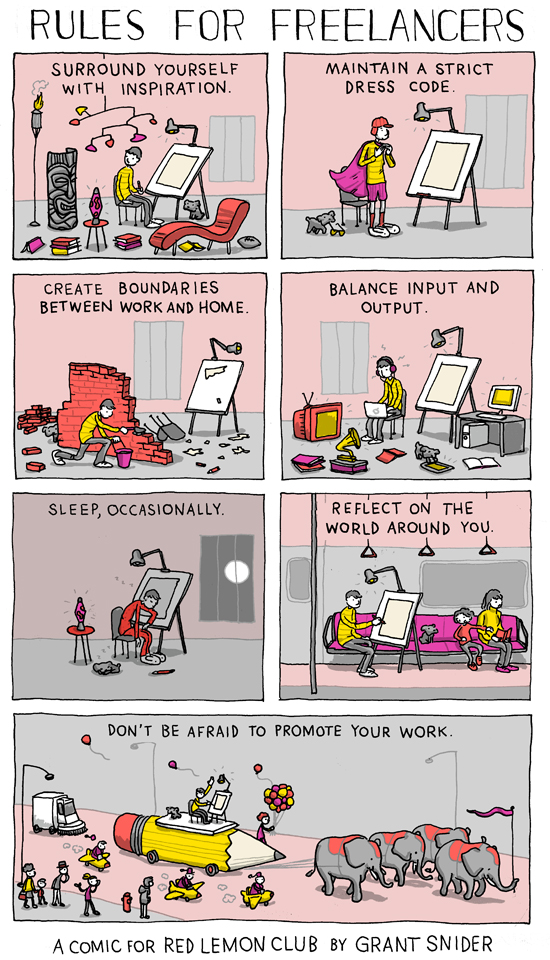

Rules for Freelancers
by Grant
This is the second of a set of comics I drew for Red Lemon Club, a site with articles and resources for creative professionals started by illustrator Alex Mathers. The secret to success in any creative field includes a cape, a Holden Caulfied hat, and a small herd of trained elephants.
Ziv.wities, Tadeu likes this


13 May 10:11


Relógio com desberlotador de chá. É, chá…
by Carlos Cardoso

Imagine a situação: Você adora tomar um chazinho pra relaxar, mas não acha graça em chá industrializado. Gosta de produzir o seu próprio, com matéria prima quanto mais natural melhor. Seu amigo chega com um pacote de chá direto do Ceará, e você quer experimentar, mas o inútil do seu cunhado sumiu com deu desberlotador.
E agora? Como você vai moer as folhas e ramos do seu chá?
Seus problemas acabaram! O Grindgrite da Vaporite é um relógio de pulso que por US$ 40,00 além de um excelente e preciso mecanismo para ver o tempo passar, vem com um desberlotador discreto, à prova de odor e garantido pra triturar seu chá de forma rápida e eficiente.
A Vaporite também oferece um modelo cofre, com o compartimento secreto vazio, assim você pode levar seu chá sem correr risco de ser surpreendido em alguma dura dos canas, com quem não tem colher de chá.
Só recomendo que você não use os dois ao mesmo tempo, ou vão achar que seu chá é de cogumelo…
|
|
Albener Pessoa likes this
13 May 10:05


Chupa Predador — conheçam a câmera que vê… sons.
by Carlos Cardoso

Uma das coisas mais legais do Predador foi o sistema de visão multi-espectral dele. Tão legal que deixou muita gente do Pentágono agitada, memorandos voaram entre departamentos e o DARPA criou óculos semelhantes para forças especiais. Sim, Osama foi morto em Full Technicollor. Só que luz é só parte da equação.
Som em essência também é uma onda que se propaga no ar, e embora não tenha a mesma resolução de uma onda luminosa no espectro visível, pode ser útil transformar a informação sonora em visual. É isso que este breguete aqui faz:

Parece um par de alto-falantes daqueles caríssimos que audiófilos otários adoram, mas é basicamente o contrário. O SeeSV-S205 é um conjunto de 30 microfones em um padrão espiral que transforma som nisto aqui:
Isso mesmo: Ele gera um mapa visual em tempo real com a origem do som. Isso é excelente para testar maquinaria e identificar aquela batidinha chata no carro que seu mecânico insiste em dizer que não existe, mas na verdade é um crânio de rato dentro do tanque de gasolina.
É criação de uma firma da Pior Coréia, e não há indicação de preços. Acho que você vai ter que se acostumar com o ex-mickey.
|
|
Tadeu, Fernando Becker likes this
13 May 01:21
O lago rosa
by Carlos Ruas


O Lago Retba, no Senegal, está cor-de-rosa. A coloração é resultado de altos níveis de sal na água, e fica mais visíveis nas estações secas. Em algumas áreas, a concentração de sal chega a 40 %.
Senegaleses navegam diariamente nas águas do Retba, para coletar o mineral, que depois fica amontoado nas margens do lago. Assim como no Mar Morto, é bem fácil flutuar no Retba, por causa da alta concentração salina.
Segundo Michael Danson, microbiologista da Universidade de Bath, na Inglaterra, a cor é produzida por uma microalga, que se adapta e reproduz em meios com alta concentração de sal.
- Elas produzem um pigmento nesse tom que absorve e utiliza a luz solar para criar mais energia, deixando a água em tom rosa – explicou o especialista – Já chegamos a pensar que o Retba e o Mar Morto eram incompatíveis com formas de vida, mas eles são bastante vivos.
Rafaelh.souza likes this
13 May 00:27


35 of the Dumbest Things Said on the Internet
by Georgie
Go home, internet. You are drunk.


The post 35 of the Dumbest Things Said on the Internet appeared first on POPHANGOVER.
Edu and -1 others like this
12 May 22:07


15 Creative USB Hubs and Unusual USB Hub Designs - Part 2.
by noreply@blogger.com (Venus)
Still using the old USB Hub? How about upgrading? Check out these cool and unusual USB Hubs.
USB Media Submarine: This cool submarine is a cardreader, USB hub and Bluetooth-equipped.
 USB Rotatory 7 Hub: The 90 degree rotatable hub comes with 7 flexible hi-speed ports that are USB 2.0 and 1.1 compliant, with data transfer rate at 1.5/12/480 Mbps.
 Faucet USB Hub: Designed by Qi Weijia, the recharging tap comes in the shape of a faucet; it takes in smartphone, digital cameras, MP3 and other USB enabled devices, for recharging.
 Food USB Hub: The Chicken Burger USB hub comes with 4 ports that are USB 2.0 and 1.1 compliant, with data transfer rate up to 480Mbps.
 Starwars Inspired Hub: It's a 4 port unpowered USB 2.0 hub.
 Chocolate USB Hub: It's a four-port USB hub that comes in the shape of a tasty block of chocolate with one nibbled corner.
 Ship USB Hub:
 TARDIS 4 Port USB Hub: It comes with a time-traveling sound effect; the light and sound effects are powered when a USB device is plugged into the port.
 USB Toaster Hub: The set includes USB memory cards to be placed in the hub.
 Pig USB Hub:
 Poodle USB:
 Flexible USB Hub: It's a four-port USB hub and cord manager, with a flexible neck.
 Desk Buddy: It's a 4-port USB hub, speaker, penholder, light and photoframe.
 Cordies: It keeps your cables on the table, and features four extra USB ports that you can connect to your computer, or plug into a power source for recharging.
 USB Octopus: It features 7 ports that are USB 2.0 specification compliant.
 Don't miss to check out "Creative USB Hubs and Unusual USB Hub Designs - Part: 1| 2."
More Interesting Posts:
10 Creative Wireframe Models.
Creative and Cool Polaroid Inspired Products.
Creative and Alternative Uses of Plastic Cups.
4 Creative and Cool Handy Gadgets and Designs.
12 Clever and Creative Hair Inspired Advertisements.
12 Clever and Creative Advertisements on Buildings - Part 2.
USB Media Submarine: This cool submarine is a cardreader, USB hub and Bluetooth-equipped.


More Interesting Posts:
10 Creative Wireframe Models.
Creative and Cool Polaroid Inspired Products.
Creative and Alternative Uses of Plastic Cups.
4 Creative and Cool Handy Gadgets and Designs.
12 Clever and Creative Hair Inspired Advertisements.
12 Clever and Creative Advertisements on Buildings - Part 2.