
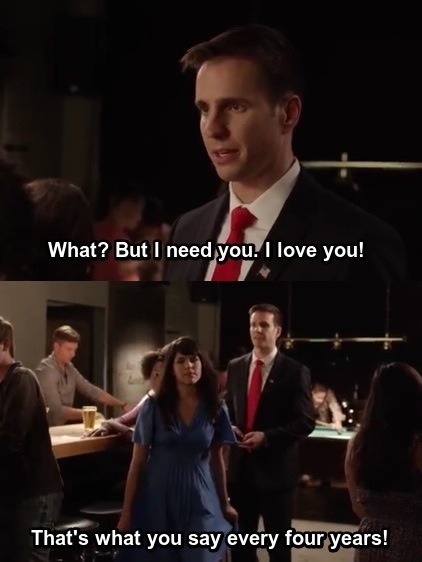
universalequalityisinevitable:
From this video by CollegeHumor.


Gediminas Pranckevicius: Surreal Worlds Digitally Painted
Lithuanian artist, Gediminas Pranckevicius has been a graphic designer for years, but his true talents allowed him to shine once he was inspired to create his own portfolio as a concept artist/illustrator.
His digital artwork has since been used as album covers and has won him numerous top awards. - See more at: http://bonexpose.com/featured/gediminas-pranckevicius/#sthash.CjaDMzeQ.dpuf
Based on the third-person shooter game Loadout, LOADOUT: Going In Hot stars Battlestar Galactica's Richard Hatch as the captain of a crew of space-faring cargo haulers trying to beat his nemesis to a big payload—assuming that the crew doesn't destroy the ship first.

Dji. Death Fails is an amusing and multi-award winning 3D animated short film by director Dmitri Voloshin and the Moldovan studio simpals that tells the story of an unconscious trucker named Dji who repeatedly foils the Grim Reaper every single time the he comes calling on Dji’s soul.
(translated from Russian) Dji is an unusual death. The Dark Knight has appeared in a different form. No, he is not white and fluffy. Dji is just terribly unlucky. All he has to do is to take the soul of a dying man. But the screenwriters prepared some obstacles for Dji. Will he manage to overcome them? You’ll see.


images via simpals
On a dying world, the cloaked personification of Death and a robot have one thing in common: They're both extremely bored. But when they finally dare to come out of hiding and meet one another, they change not only each other, but their world.

insidiousmisandry submitted:
so this video isn’t actually sailor moon related at all, but it’s AWESOME and i think you’d like it a lot. it’s by one of my favorite musicians, and it’s not only a great song but a really gorgeous music video.Oh, damn, I thoroughly enjoyed everything about that. I’ve never heard of her before, but I’ll definitely have to go check out some of her other stuff. Thanks so much for sending this my way!
“Double Trouble” is a short film by Swedish filmmakers Andreas Climent and André Hedetoft (previously) that explores the comedic fallout of a young man who discovers the ability to travel back in time after failing to speak to the woman of his dreams. The short was funded in part through Kickstarter pledges.
submitted via Laughing Squid Tips

My heart goes out to the victims of the assault on Charlie Hebdo.
However, I can’t rightly support all the implications behind #JeSuisCharlie, as it’s a horrifically Islamophobic circulation in an already very Islamophobic France.
Ali Farzat, another political cartoonist based in Syria, was assaulted for depicting the Syrian government as it was: corrupt. He had both his hands broken, and, within days, still managed to draw the above image, his response to the attempted censorship. The difference is that Farzat was not attempting to belittle a racial or religious group, but of governments which sought to oppress those people; political satire that sought to punch upwards rather than contribute to popular anti-religious and racist belief.
Free speech is an important and basic human right, and should be protected at all costs, but I cannot support placing on a pedestal a group which attempted to further harm an already all-too-fragile understanding of the Muslim faith to outsiders. I feel that doing so will only make the current political situation more difficult to navigate.
I guess it just boils down to this: Watch who you elect as a martyr, because while such murder can never be justified, we can’t treat this event as reason for more Charlie Hebdos.
Further reading: "In the Wake of Charlie Hebdo, Free Speech Does Not Mean Freedom From Criticism," Jacob Candfield, The Hooded Utilitarian
This is more or less my thoughts on the whole thing as well. It’s a bit like if some fanatic went and murdered a dozen people at Rush Limbaugh’s offices. It would be a horrible and tragic crime, but it wouldn’t make the deceased right.
I’ve been trying to sum up my feelings on the subject and this does a perfect job for me.
 Karen Lord returns to the far-flung future of The Best of All Possible Worlds in The Galaxy Game, out this week from Del Rey. We want to send you one of our three copies right now!
On the verge of adulthood, Rafi attends the Lyceum, a school for the psionically gifted. Rafi possesses mental abilities that might benefit people . . . or control them. Some wish to help Rafi wield his powers responsibly; others see him as a threat to be contained. Rafi’s only freedom at the Lyceum is Wallrunning: a game of speed and agility played on vast vertical surfaces riddled with variable gravity fields.
Comment in the post below to enter!
NO PURCHASE NECESSARY TO ENTER OR WIN. A purchase does not improve your chances of winning. Sweepstakes open to legal residents of 50 United States and D.C., and Canada (excluding Quebec). To enter, comment on this post beginning at 3:30 PM Eastern Time (ET) on January 9. Sweepstakes ends at 12:00 PM ET on January 13. Void outside the United States and Canada and where prohibited by law. Please see full details and official rules here. Sponsor: Tor.com, 175 Fifth Ave., New York, NY 10010.
Like what are you people not getting that you keep oversimplifying it to, ‘SO WHITES CANT RAP????’
just because you dont like being around black people doesnt makes you racist jfc
yeah it
yeah it really does
LMFAOOOOOOo
What do white people think racism is I need answers
calling them crackers
fellow white people: feeling uncomfortable around black people is literally what racism is. really, you should walk into a waiting room, see a black person sitting there already, and want to chit chat with them (if you’re the kind of person who likes to make conversation — sometimes I am, I know, we’re weird). If you feel some other feelings — that’d be those years of learned racist bullshit kicking up. You can unlearn it! But first you’ve gotta admit it’s there.

"we heard you had trouble sleeping"
WELL EWE HERD WRONG
This is some Courage the Cowardly Dog shit.
Reblog if yours will too (and feel free to include anything i missed)


The face of children’s literature is about to change
Almost half of U.S. children have a minority background, but you rarely see them in books. One group wants to change that, and research shows more diverse books could lead to a more tolerant generation.
ThePrettiestOneClick through to read the rest.
UH HUH THIS MY SHIT
No but seriously, Hades is the lamest most awkward shit baby in the pantheon. He doesn’t know how to relate to people, all his friends are dead. The rest of the Dodecatheon are just up on Olympus partying it up and he’s down in the underworld, with his dog, listening to dead heroes complain about not getting enough glory and being vaguely annoyed at everything. He doesn’t do anything, besides like probably macrame or some shit. Like literally, the only real story about Hades is him and Persephone.
And also, but can we please just destroy the narrative of the ‘rape of Persephone.’ I don’t care what Ovid wrote, I don’t care how it helps the Metamorphoses maintain its themes of the violence of the gods, Persephone is the baddest bitch there is. She is the goddess you call upon to curse people. She is both the incarnation of life itself and the mistress of death. When you really want to fuck up your neighbor’s life, you call on Persephone, cause ain’t nobody scarier, and you do it by sacrificing the way you do to only the darkest cthonic deities. Medea and Persephone were totally bros imo (also if you want to watch me cry like a baby, ask me about Medea sometime).
No way in hell did total badass Persephone get captured against her will. Hell no. She saw this awkward goth dark-lord-of-the-night shit baby and decided to have her merry way with him. She marched her fine self down to Erebus of her own volition with Hades just being super giddy and trying to play it cool. Hades then spent the majority of their early marriage both afraid for his life and super turned on.
So there.


Not Art Warsheh Design Studio
"This is not art. This what we saw in and from it. We’re designers without a good grip on what art is and what can and can’t be done with it, so we did what we felt came naturally to us. We know nothing about these paintings, we even used google image search to look up the names. We thought we should maybe apologise to anybody that thinks what we’re doing is wrong, but we decided it would be more wrong of people to even think that."




zftw:
Uh oh
wouldn’t that be awkward
Can I get some credible sources?
Here’s one
and another
Theology nerd side of Tumblr, reporting for duty!
There are roughly five and a half fucktillion extracanonical gospels out there. For the first couple centuries after Jesus bit it, his followers wrote a ridiculous amount of fanfic. There were a gajillion different headcanons floating around about exactly who and what he even was (God pretending to be human? human who got possessed by God at his baptism? human who got promoted to demigod after his death? simultaneously God and human all along??) and lots of early Christian communities ~conveniently~ discovered a Totally 100% Authentic Eyewitness Account that supported their pet theory (and also, proved that their fave disciple was clearly the best).
Big Name Fans argued about all the major disagreements, periodically throwing conventions specifically to bicker until they reached some sort of consensus (more or less – sometimes the hold-outs ended up saying “screw you guys, we’re gonna go form our own church!”) Toward the end of the second century, a guy named Irenaeus wrote a meta arguing that there were four fics worth reading – no more, no less – and they were ones that folks somewhere along the line started to claim were written by Matthew, Mark, Luke, and John. This idea caught on as a popular bit of fanon, and over the next couple of centuries it gained so much support that it was declared canon.
So, what’s the point of this Jesus fandom history lesson? Basically, that the discovery of yet another extracanonical text isn’t particularly earth-shattering. Headlines like “Ancient Bible changes everything! Pope freaking out!” are bullshit, but that’s how it’s always framed cause more accurate headlines like “Old manuscript discovered – Historians say ‘Ooh, nifty!’” aren’t very good click-bait.
The actual history and politics of the various gospel texts are really fascinating though (if you’re a huge fucking nerd, like me). In the Gospel of Judas, he’s the only disciple who really understands Jesus, who told Judas to “betray” him. Also, God’s a Glow Cloud. The Infancy Gospel of Thomas has kid!Jesus smite other kids for being little shits. The Gospel of Peter is hella anti-Jewish, but has one cool bit with a character that’s literally a walking, talking cross. There’s a whole book called “Q” which has never even been found, but scholars are pretty sure exists cause Matthew and Luke copied a lot from it.
Seriously, leaning about this stuff made me go “woah, this is freaking awesome – why the hell did my parents’ church make the Bible seem so damn boring??” Well, probably cause all those white upper middle class folks didn’t want us kiddies to dig too deep and find out what a radical, anti-establishment bamf Jesus really was, but that’s another rant for another time…
Reblogging because this is what I live for. As a medieval history major, I got taught first and foremost that we’d be spending four years reading lies and biased half-truths and mythologies. Our job was to find the places they agreed and work the rest out from there. “Do the edge pieces first, Maggie.” I took an entire seminar on forgeries, because so many of the sources historians use to piece together the past are known fakes, but the best they can do is read between the lines or have no lines at all. There’s a reason why medieval historians read farm reports featuring travel descriptions and saints’ lives involving demons-living-in-buckets with the same attention to detail. Every dry history text you’ve read in your life comes from a pile of sources like this, bits of maybe-truth cobbled together with toothpaste and narwhal horn dust.
The moral of the story is be curious, and look for the lies in truth and the truth in lies. It’s pretty great: hello, history, riddle me this.
"beauty and the beast" where beauty’s dad comes home with the rose and is like oh shit oh shit this terrible monster says i have to come live with him forever because i picked his favorite flower and beauty just goes fuck that and puts on her pants and marches down to the beast’s castle herself
and she’s expecting this horrifying dark fortress but it’s actually sort of just a normal castle with big rose bushes and furniture that’s sometimes alive
and she thinks, i can work with this
and the beast comes out and he’s like don’t look at me i am a hideous monster and beauty’s like dude you’re like a talking tiger in a cape are you kidding you’re AWESOME can i pet you can i stroke your paws can you give me a ride
and he’s like what and she goes around the castle like okay we’ll put curtains here and expand the kitchen and this could be a really cute breakfast nook
and the beast is confused because isn’t she supposed to be terrified and hate him and he had all these intimidating speeches planned and he’s like uh aren’t you going to try to run away
and beauty’s all are you kidding this is a magic castle i’m going to live here forever
so they just sort of settle in together and one day beauty goes home for the weekend to visit her family and they’re all amazed that she’s alive and her sisters go WHY DIDN’T THE HUGE MONSTER EAT YOU TO DEATH and she’s like nahhh he’s basically just a big cat he’s kind of cute actually sometimes he plays with yarn when he thinks i’m not looking
and she explains how it’s really not that bad, all the dishes wash themselves and i get all these gorgeous dresses for free because the castle doesn’t know what else to do with them and yeah there are flowers everywhere but hey that’s his hobby y’know i’m not gonna discourage that man
and then one day while beauty’s re-alphabetizing her magic library and trying to decide where to put that enchanted mirror the beast comes up and he’s like hey so this is awkward but are you like………………………………..in love with me……?????????
and beauty’s like oh uh wow haha um sorry no you’re…sort of a tiger
and the beast is like thank goodness because if you were i’d have to turn back into a human and i’ve kind of gotten used to being a big lion thing with horns and the ability to speak english for some reason like why would i want to go back to being a spindly little man and then beauty laughs and she’s like okay well can you go catch us a wild boar for dinner, dear
and they end up getting married in the end just because it’s easier to explain that way, you know, a single lady ~~living alone with a man~~ even if he’s not actually a man, and that’s fine with them because beauty was never really into the whole boys and sex thing and the beast (whose name is jeff) is honestly more interested in his flowers
and whenever any of the other ladies in the village give her any shit beauty is just like, oh, you don’t like my crepes? well you know my husband, who is literally a tiger, loves them and then everyone leaves her alone, which is really all she ever wanted
and she goes back to her magic castle and sits down with a book in front of the fire and rests her feet on her cat husband and nobody bothers her ever again
can that happen
8D

If you want people to consume less water, there are roughly two ways you could do it. One is to raise the price of water, and the other is to simply mandate that everyone cut back on their water consumption.
Either will work, but they work in different ways. And an important recent study from Casey Wichman, Laura Taylor, and Roger von Haefen suggests that the difference in how they work has crucial implications for how we think about a wide variety of issues. When economic inequality is really severe, using prices to regulate the distribution of scarce goods can be seriously unfair. At the same time, using non-price mechanisms can be seriously inefficient.
That means that inequality is preventing us from adopting efficient solutions to a wide variety of problems, ranging from drought response to traffic congestion to climate change.
First, the study. The authors got their hands on a dataset of monthly water consumption for almost 2,000 households across six municipalities in North Carolina over a 30-month period. That data lets them compare municipalities that responded to droughts by raising the price of water to those that took different approaches. The authors also know the income and lot size of each household, which lets them seem whether poor or rich households bear more of the burden of water conservation.
From this, they were able to empirically demonstrate something that non-economists probably think is obvious — when you cut water use by raising prices, most of the cutting is done by the poor and almost none is done by the rich. As they put it, "the conservation burden falls primarily on lower-income households" while "high income households are significantly less responsive to price."
By contrast, a command-and-control approach — that is, just mandating that people use less water — cuts water use across the board, among both rich and poor households.
This is an important example of a case where, as economist David Glasner puts it, microeconomics needs macrofoundations. Microeconomics is the study of individual markets and how to make them operate effectively. While economists have deep disagreements about macroeconomic topics like recessions, economic growth, and the distribution of income, the basic tenets of microeconomics are not very controversial inside the economics profession. When people say that "economics 101" supports something like Uber's surge pricing during a terrorism panic, they are talking about microeconomics.
Microeconomics tends to tell us, again and again, that life is best when sellers can set prices to rise and fall with the ups and downs of supply and demand. The idea is that markets should "clear." Everything that's produced should be sold, but you shouldn't have shortages that force people to wait around forever and ever.
This is an appealing idea, but as Steve Randy Waldman has written, it tends to brush distributional issues under the rug.
When people say that a price-based scheme for rationing water is most efficient, they mean that prices will deliver the most efficient distribution of dollars and water. The idea is that how much people are willing to spend on something is a good proxy for how much they care about it, or how important it is to their well-being. Different people like different things, but you can buy all kinds of different stuff with dollars, and seeing what people choose to spend their money on tells you a lot about their preferences.
But dollars aren't a perfect proxy for well-being, because money means different things depending on how rich or poor you are. To a middle class American, $5,000 is a really big deal. To a multi-millionaire like Mitt Romney or Hillary Clinton, it's totally trivial — the value of their stock portfolios bounces up and down by that much all the time. To a person living paycheck-to-paycheck with no access to credit beyond very expensive payday loans, $5,000 could be a life-changing amount.
The technical term here is the "declining marginal utility of money." A given dollar produces less happiness in the pockets of a rich person than a poor one. That means that in a society with substantial economic inequality, an efficient distribution of dollars and water isn't going to be the same as an efficient distribution of happiness and water. This is what we're seeing in the North Carolina water case — the dollars are just a lot more important to the poor than the rich, so all the burden of adjusting to reduced water usage falls on them.
For contrarians, trolls, and Uber-haters the analysis can stop here. A tiny dose of complexity refutes the Econ 101 argument, so the world is safe for economist-bashing and conceptual arguments in favor of price controls.
And yet it continues to be the case that allocating scarce goods through prices is much more efficient. Joseph Stromberg's recent piece about the advantages of demand-responsive parking is a case in point. By charging more when parking spaces are in high demand, cities can eliminate pointless (and environmentally destructive) circling for parking. They can also capture revenue that can be used to cut taxes or boost services. Roughly the same is true of "congestion pricing" to alleviate traffic jams, and carbon taxes to tackle the even bigger problem of climate change.
Even back to the water case, the argument in favor of prices really does seem sound. Different people care a different amount about being able to use water lavishly — why shouldn't the reductions be done disproportionately by the people who don't care so much, while those who care a lot pay more?
To the extent that inequality undermines arguments for efficient price-based schemes, the correct conclusion is to reject inequality, not reject pricing. It's probably no coincidence that the three countries to really embrace congestion pricing are either egalitarian (Norway and Sweden) or dictatorial (Singapore). Efficiency-enhancing economic schemes often simply assume a background where there's not too much inequality, in part because, in many cases, they were hatched during the decades when the income distribution was much more even. But to actually implement these schemes in the real world, we need to also deliver the equality.
There's an old saw in the economics profession that there's a tradeoff between egalitarian outcomes and efficient ones, but empirical research consistently fails to find evidence that inequality boosts growth or redistribution slows it. One reason is that needs conditions of macro-equality to make micro-efficient schemes tolerable.
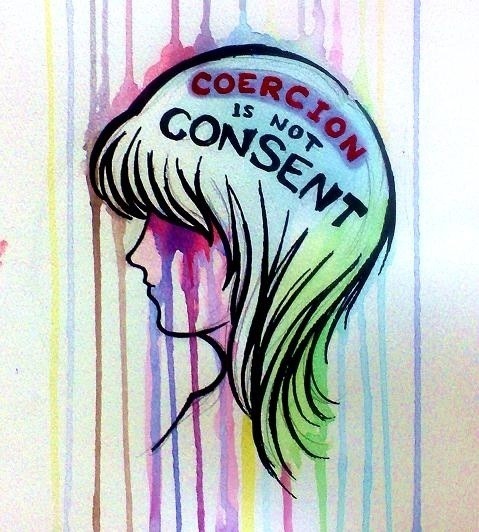
If someone makes you feel obligated or forced to do something you don’t want to, you may be experiencing coercion. By definition, sexual coercion is “the act of using pressure, alcohol or drugs, or force to have sexual contact with someone against his or her will” and includes “persistent attempts to have sexual contact with someone who has already refused.”
Think of sexual coercion as a spectrum or a range. It can vary from someone verbally egging you on to someone actually forcing you to have contact with them. It can be verbal and emotional, in the form of statements that make you feel pressure, guilt or shame. You can also be made to feel forced through more subtle actions. For example, your partner might:
- Make you feel like you owe them — for example, because you’re in a relationship, because you’ve had sex before, because they spent money on you or bought you a gift, because you go home with them
- Give you compliments that sound extreme or insincere as an attempt to get you to agree to something
- Badger you, yell at you, or hold you down
- Give you drugs and alcohol to loosen up your inhibitions
- Play on the fact that you’re in a relationship, saying things such as: “Sex is the way to prove your love for me” or “If I don’t get sex from you I’ll get it somewhere else”
- React negatively (with sadness, anger or resentment) if you say no or don’t immediately agree to something
- Continue to pressure you after you say no
- Make you feel threatened or afraid of what might happen if you say no
- Try to normalize their sexual expectations — for example, “I need it, I’m a guy.”
In a relationship where sexual coercion is occurring, there is a lack of consent, and the coercive partner doesn’t respect the boundaries or wishes of the other.



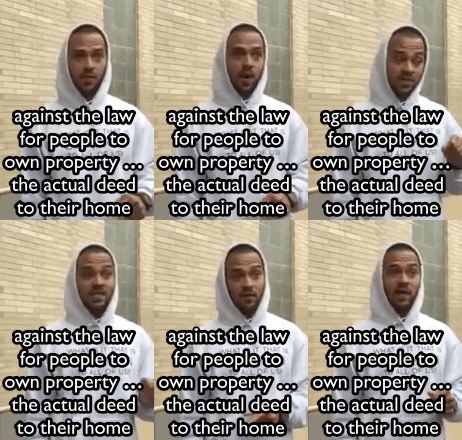

for real. reading the history of the laws (the many laws) written to keep blacks away from anything empowering is quite dizzying and housing discrimination was a big one. laws keeping and taking land from blacks go way back (for example) and as society progressed, it morphed to fit the times. nowadays it’s housing discrimination and it’s rampant.
This is one of the most obvious, yet constantly overlooked methods to hold back minorities. It isn’t just a coincidence that minorities bunch up with other minorities in “ghetto” neighborhoods nor is it a coincidence that whites all live in the same cities/areas where house values are much higher & protected.
@jessehimself on my dash speaking truths
ThePrettiestOneThe patriarchy isn't actually on anybody's side. The patriarchy just tells you where your place is. The patriarchy is a system we have developed to help us always know where our place is because we are tribal, hierarchical, status-obsessed apes and we are more afraid of not knowing what our place is than we are of oppressing our friends and neighbors... or even of being oppressed ourselves.
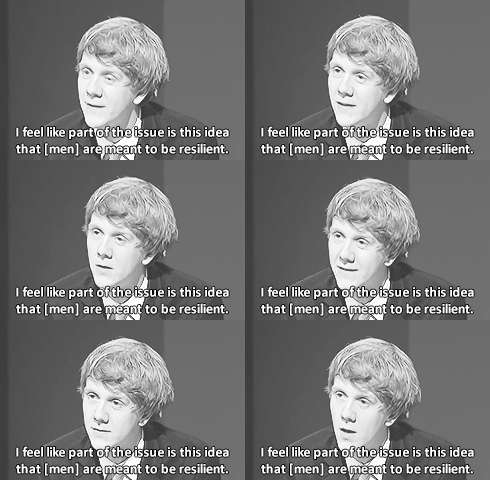

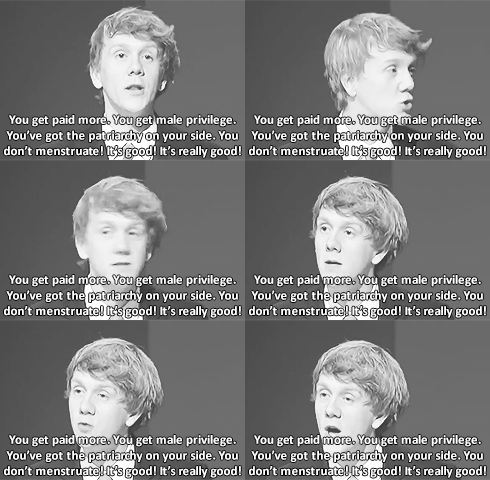

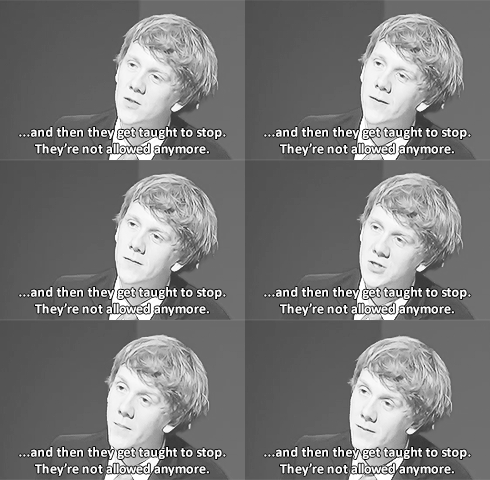

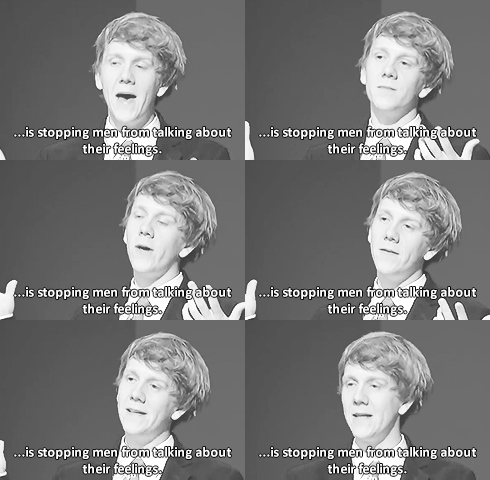
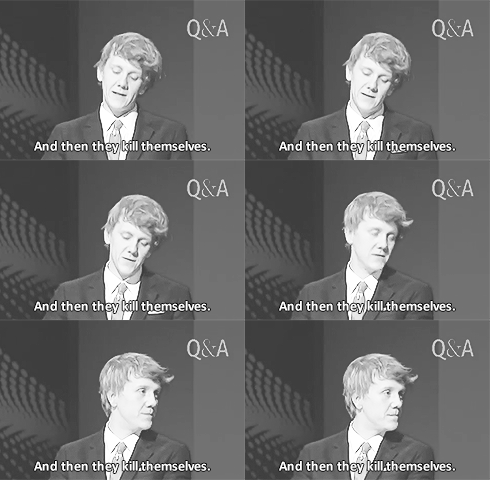
I wonder how feminists will react to this
Probably ignore it then go back to making male tears mugs and gifs
Actually this is a very common idea among feminists
It’s something feminists have been talking about for years it’s called toxic masculinity and it’s one of the common threads among the topic of ‘Patriarchy hurts men too’. If fact the first time I read about toxic masculinity was on a feminist blog.
If you actually read things feminists talk about instead of straw manning them you might know this but OH WELL
Literally the only people talking about toxic masculinity are feminists. Open your eyes.


