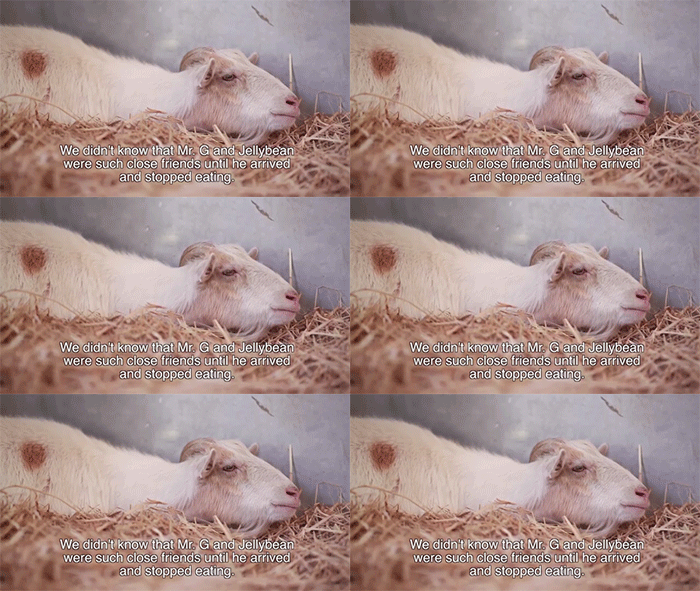
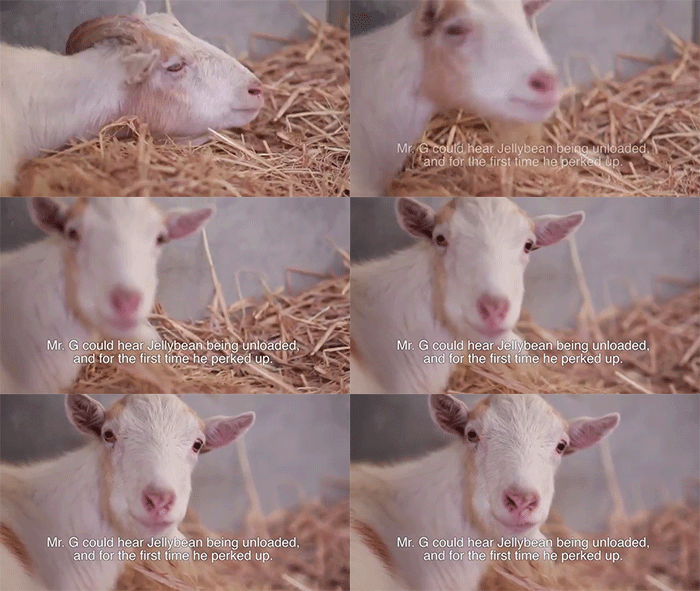
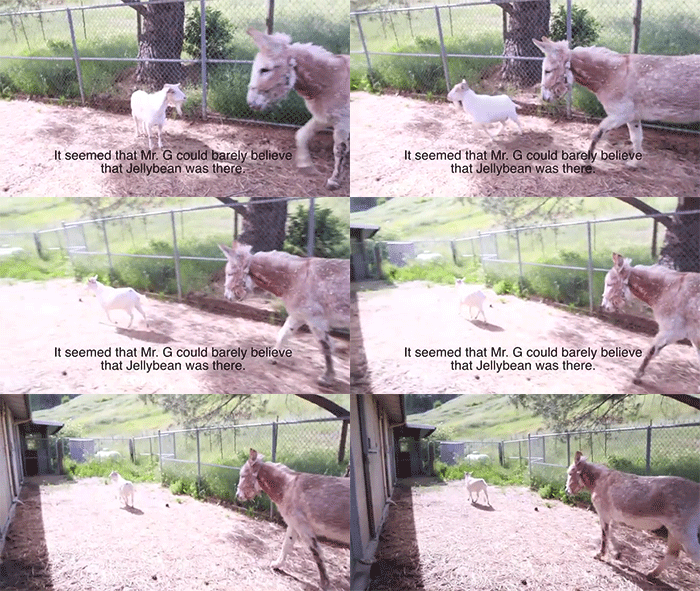
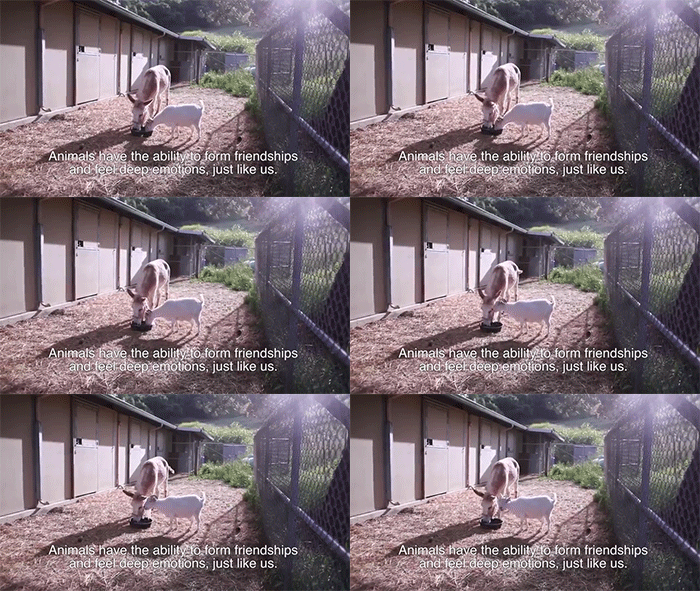
Goats are very social creatures. They do NOT cope well with being alone.If they bond, and they likely will, with another animal, they WILL pine away without them.
When selling goats, we had to be sure the person either bought another, or the goat in question was not inseparably bonded to another.
They were like, “Why are we feeding ourselves and shitting in the desert when we could enslave the humans. They’ll feed us and provide warm laps and boxes not intended for our naptime pleasure and we’ll vomit in their shoes, but they will think us adorable, even when we bite them. ENSLAVE THE HUMANS! THEY ARE TOO STUPID TO KNOW OUR PLANS! MWAHAHAHAA!”
Accurate.
no LITERALLY CATS DOMESTICATED THEMSELVES. Humans had grain stores with lots of mice, and the cats waltzed in themselves and started eating them.
The humans immediately took a shine to them, and welcomed the cats into their homes and started loving them because they kept away vermin and the cats stayed because they wanted to.
Also cats were spread across cultures as agriculture spread. LITERALLY HERE IS GRAIN WOW MAKE FOOD ALSO HERE IS CAT. CAT HELP. Pass it along as part of the farming starter kit.
And now, cats are endemic on EVERY SINGLE CONTINENT. Human expansion is just a vehicle for advancing cat domination of the planet.
It occurs to me that failure to properly worldbuild an SFFnal story is - sometimes, though not always - less reflective of a writer’s creative ability than it is a consequence of their real-world privilege. The concept of culture as something with multiple facets, that can be experienced from different perspectives and which - crucially - has consequences beyond the obvious is learned rather than innate, and if, in your own life, you’ve never stopped to consider (for instance) how class differences impact access to basic necessities, or the problem of social mobility, then that’s going to influence how you craft, or fail to craft, those elements in your narratives. Because while, in stories set in the present day, you can either compensate with research or write wholly within familiar contexts, in an invented setting, it’s going to be harder to hide the gaps in your knowledge.
And so we get stories whose cultures are founded on stereotypes: Noble Elves vs the Barbarian Orcs, an endless parade of faux-medieval Europes, and dystopias built around a single, reductive premise with no effort made to explore its wider consequences. This last seems especially troublesome to me, given that dystopias are, generally speaking, meant to be the sort of stories that understand class and subversion - but when written by someone who’s never considered that their own society operates on more than one level, that nuance may well be lost. The point of worldbuilding is to create new worlds, but they’re always going to be influenced by how we view our own.
I also think about these fantasy and science-fiction worlds. These authors - usually American - trying to describe some ~*~exotic market~*~ or ~*~bustling spaceship port~*~ with words they’ve read in other people’s books. Think about how they falteringly describe those markets: “They had lots of spices and some colorful rugs.”
(But is it bright turmeric and cumin, cut with flour, glowing yellow in glass jars to attract the tourists? Is it the cinnamon and star anise of the Christmas market, the paper cup of mulled cider? Where are we supposed to be, again?)
But these authors copy-paste the rising and falling call of the muezzin and the air heavy with foreign spices and the hungry children with flies in their eyes - maybe even take a beautiful woman with her face veiled out of the box, or some exotic songbirds - and think “Nailed it.” Check out this exotic worldbuilding - we’ve really traveled here! Look: colorful silks and barbarians. Is this a good story, or what!
And it’s splendidly, laughingly obvious that they’ve never seen a street sign in Arabic, never walked through a North African market at nightfall, couldn’t tell silk from satin if their life depended on it, and that they don’t even know their own local songbirds, let alone how to identify an exotic one. Armchair tourists, copying and pasting the TripAdvisor reviews of other tourists, coloring half the people green, and calling it worldbuilding: oh deary me.
Then there’s the realism of research. Knowing where goods and products and knowledge came from. If your elves are eating chocolate they’d better have contact with the Aztecs. Don’t put poison ivy in England. Your medieval faux-European story had better justify itself if people are wearing cotton and eating potatoes and tomatoes.
(Pictured: someone whose civilization has apparently had contact with the indigenous peoples of the Americas. So THAT’s what all of that “into the west” stuff is about… elves seeking out new sources of carbohydrates!)
Don’t even get me started on science realism in science fiction; I am personally plagued by every written fictional description of viruses AND I’M JUST LIKE
So the Western SF/F canon swallows itself endlessly, a snake chasing its tail. It’s fun, but the tiresome bits get recycled, because people think that’s what forests and markets and ships are really like.
“That’s not realistic in this setting,” we scoff when someone wants a disabled princess or a lady king or - gasp! - a black woman in their literature.
But most of this shit is so unrealistic, say people like me, rolling their eyes politely: “What spices were they, precisely? They’re wearing silk, are they? Are you sure of that? Are you absolutely sure? And then the virus killed everybody, did it? In seven minutes? much wow.”
So it sounds like I’m going “don’t write about markets unless you’ve been to a market” or “don’t write unless you have a really expensive education” or “don’t write.
But of course - this isn’t fair. Who am I to demand that people be well-traveled? Most people cannot afford to. And those who do travel rarely pay attention. They are expecting foreign spices and children with flies in their eyes, and they come back and regurgitate them.
(The spices were cardamom and cinnamon, you silly fool, and the children in your hometown are hungrier. The songbird was a woodlark, and the only exotic thing there was you.)
You don’t have to actually travel. You just have to care. As you type that someone is eating a potato you have to ask “where did they get the potato?” and as you type that someone is ugly you have to ask “why are they ugly?” and if you’re going to write about a prairie, look it up on Google Maps and sit with it for a while until you’ve got your own words for it.
People know the difference between waving your hands dismissively, using other people’s words because you don’t think it’s important, and when genuinely caring, especially when you’re touching something they love. You’ll fuck up, but people will usually forgive fuck-ups if you were being honest and wondering and respectful.
It’s the difference between the standard Western method of travel - showing up sneeringly in someone else’s house and expecting to be hailed as a savior, to be served by the unimportant natives - and the kind of travel where OH MY GOD WAS THAT ONE OF YOUR MAGPIES? THAT’S WHAT YOUR MAGPIES LOOK LIKE? ARE YOU KIDDING ME RIGHT NOW? OH MY GOD THIS CHANGES EVERYTHING. GUYS. HAVE YOU HEARD ABOUT THEIR MAGPIES?
Because wherever you go in this universe, you are going to somebody’s home. Tread lightly, because you tread as a guest. If you fail to lovingly respect your beggar woman and lowly engineer because they’re more “boring” than your hero - well, you’ve just described what kind of person you are, and it’s not the sort that comes to my dinner parties.
Whether you are learning, or traveling, or writing, you have to care and you have to care about getting it right. You can be tongue-tied and broken-hearted and fundamentally lost. My favorite people usually are. But you have to care about the magpies and the trade routes and the cardamom. You’ll have to bring me with you, or you’ll lose me. (Believe me, I have so many wonderful places to be.)
So I don’t ask that authors be perfect in their worldbuilding. I only ask that they try, and take my hand, and believe that this place they have created is important and worthy and full of the most interesting things, and worthy of thought and care, because all places are.
Woman: I'm smart
Patriarchy: Well you're probably ugly then
Woman: I'm creative
Patriarchy: You mean unattractive right?
Woman: I have all these incredible accomplishments
Patriarchy: Yeah but look how ugly you looked doing them
Woman: I have value
Patriarchy: Not if you're ugly lol
Woman: I'm conventionally-attractive & posted selfies on my blog
Patriarchy: I'm so sick of these empty-headed chicks only caring about their looks. Just because you are attractive and get attention from men doesn't mean you are special or deserve respect. Why don't you read a book or do something productive with your life you dumb slut
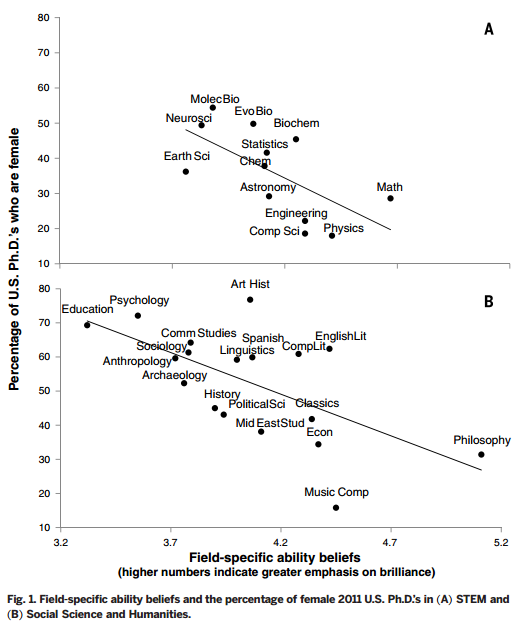
A new study led by philosopher Sarah-Jane Leslie challenges the idea that women are underrepresented in STEM fields. They first note that there are some STEM fields where women do well (they are 54% of molecular biologists, for example) and some humanities fields where they don’t (they are only 31% of philosophers). Something else, they gathered, must be going on.
They had a hunch. They asked 1,820 U.S. academics what it took to be successful in their field. They were particularly interested in answers that suggested hard work and ones that invoked brilliance.
Their results showed a clear relationship between the presence of women in a field and the assumption that success required brilliance. The downward sloping line represents the proportion of female PhDs in stem fields (top) and social science and humanities fields (bottom) as they become increasingly associated with brilliance:
Cultural associations link men, but not women, with raw intellectual brilliance… consider, for example, how difficult it is to think of even a single pop-cultural portrayal of a woman who displays that same special spark of innate, unschooled genius as Sherlock Holmes or Dr. House from the show “House M.D.,” or Will Hunting from the movie “Good Will Hunting.”
In contrast, accomplished women are often portrayed as very hard working (and often having given up on marriage and children, I’ll add). She continues:
In this way, women’s accomplishments are seen as grounded in long hours, poring over books, rather than in some special raw effortless brilliance.
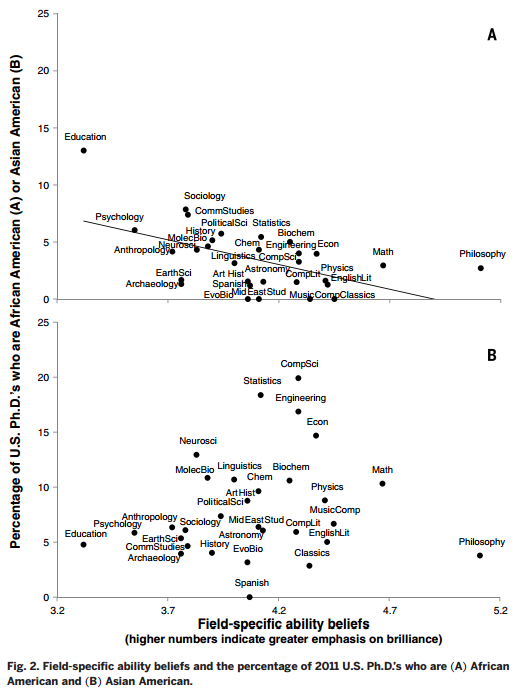
They extended their findings to race, testing whether the relationship held for African Americans, another group often stereotyped as less intelligent, and Asians, a group that attracts the opposite stereotype. As hypothesized, they found the relationship for the first group, but not the second (note the truncated y-axis).
The long term solution to this problem, of course, is to end white and Asian men’s claim on brilliance. In the meantime, the research team suggests, it may be a good idea to stop talking about some fields as if they’re the rightful home of the naturally brilliant and start advocating hard work for everyone.
why are yall not talking about the information yall don’t know? yall fake
Watch the people who haven’t seen this yet not reblog it
WHY DOESN’T THIS RELATIVELY NEW POST HAVE MORE NOTES, POSTS ABOUT A VERY POPULAR MOVIE THAT CAME OUT LAST YEAR HAVE MILLIONS OF NOTES
if you don’t reblog this negative, guilt-tripping, un-fact-checked post about something you don’t have the emotional energy to deal with, just unfollow me.
There is no form of hating fat people - including concern trolling or hating fat acceptance - that doesn’t amount to you saying, “Uh, excuse me, what made you think you could go around having a body without justifying it to me?”
When you talk about “fat” diseases - you’re saying: “uh, that body better be perfectly healthy in all instances forever before I give you my approval.”
When you talk about “it’s just not attractive” - you’re saying: “I think I made it clear that if your body isn’t pleasing to me, I’m not signing off on it.”
When you talk about “just eat less and exercise more” - you’re saying: “who gave you permission to live your life as you see fit instead of how I see fit?”
So let me just be clear: all anti-fat arguments are always and completely invalid because fat people will never owe you an explanation or justification for their bodies, their health, or their lives.
Fat acceptance is simply the assertion of a right fat people have always had, and one it’s long past time others started accepting.
I don’t get a lot of concern trolling or hate anymore, but when I did, it was all about the stuff mentioned above. Emphasis mine.
Abortion was not just legal—it was a safe, condoned, and practiced procedure in colonial America and common enough to appear in the legal and medical records of the period. Official abortion laws did not appear on the books in the United States until 1821, and abortion before quickening did not become illegal until the 1860s. If a woman living in New England in the 17th or 18th centuries wanted an abortion, no legal, social, or religious force would have stopped her.
Reminder that records of contraception and abortion exist all the way back to 1550 BCE in ancient Egypt!
This was a really fascinating read. Until the early 19th century, abortion was legal until “quickening,” or when the pregnant person first felt the baby kick - anywhere from 14 to 26 weeks into the pregnancy. Society only began to condemn it when people decided white, middle- to upperclass women weren’t having enough children soon enough in their lives, and when male doctors started taking over traditionally female health care fields, like midwifery.
Yep, shockingly enough, it’s never, ever been about the life of the fetus - only about misogyny, racism, and classism (ableism, too, though the article doesn’t discuss it).
The bolded is hella important.
From the first article: “Increased female independence was also perceived as a threat to male power and patriarchy, especially as Victorian women increasingly volunteered outside the home for religious and charitable causes.”
Quick reminder that the modern pro-life movement didn’t even begin until the 1970’s. Conservatives were angry about the birth control pill and Roe v. Wade, and so the pro-life movement was developed as a TARGETED response to women’s lib and reproductive rights. In a lot of non-Western countries, the idea that an embryo is assigned any value or rights at all is just mind-boggling.
The middle one is an illustration for a story I wrote as T. Kingfisher, called “The Dryad’s Shoe” and is that not a seriously killer picture of a tufted titmouse!?
Republicans said Barack Obama’s policies would produce “trillion dollar deficits for as far as the eye can see.”
(Speaker John Boehner 04-18-09; NH Sen. Judd Gregg 03-17-10)
People believed them.
Instead, while the national debt did increase as it has every year since the Clinton budget surpluses, budget deficits shrank from $1.4 trillion when Obama took office to $483 billion in 2014.
(Washington Post 10-15-14)
Republicans said Obama’s “socialist policies” would increase the size “of our already bloated government,” lead us towards “national socialism,” and “the country’s economy is going to collapse.”
(NC Rep. Robert Pittenger 01-21-15; Kansas Sen. Pat Robert 09-24-14; Rush Limbaugh 09-10-12)
People believed them.
Instead, federal government employment has shrunk since January 2009, “corporate profits have nearly tripled” and the stock market doubled in six years.
(BLS 03-21-15; New Republic 08-04-14; FactCheck.org 01-09-15; Google Finance)
Republicans said if Barack Obama was reelected, “gas prices will be up at around $6.60 per gallon.”
(Utah Sen. Mike Lee 03-07-12)
People believed them.
Gas prices dropped below $2 per gallon in early 2015.
(Time 01-21-15)
Republicans said Obama’s policies would destroy “nearly 6 million jobs over the next decade” and lead to “diminishment of employment in America.”
(John McCain campaign 10-31-08; Texas Rep. Pete Sessions 11-07-09)
People believed them.
Instead, 12 million new jobs created, more under 6 years of Obama than under 12 years of two Bushes, “the best private sector jobs creation performance in American history [that] outperformed President Reagan’s in all commonly watched categories” according to Forbes.
(ElectaBlog 10-03-14; Forbes 09-05-14)
Meanwhile, “small-government, pro-business” George W. Bush presided over “the biggest federal budget expansion since Franklin Delano Roosevelt” and saw only 1.3 million net jobs created in 8 years (7 million net for Obama in 6 years). The Wall Street Journal called Bush’s “the worst track record on record.”
(Washington Times 10-19-08; ElectaBlog 10-03-14; Wall Street Journal 01-09-09)
Finally, for those with short memories:
Republicans said we had to invade Iraq because Saddam Hussein had stockpiles of chemical and biological weapons. We even knew where they were. We’d be out in six months, it would cost at most $60 billion, “We do not torture,” etc.
Time to show some love and appreciate these heroes.
Firefighters are some badass mutha fuckas
firefighters are incredibly under appreciated, this is sadly the first appreciation post to them and we need more of these, they literally walk through hell to pick up people and pull them out, and they save animals, treating all like humans, i have never heard of a firefighter that has chosen not to save someone for there race or sex or sexuality or anything, a human is a human and an animal is an animal, i love these people and they don’t deserve to be ignored as much as they are
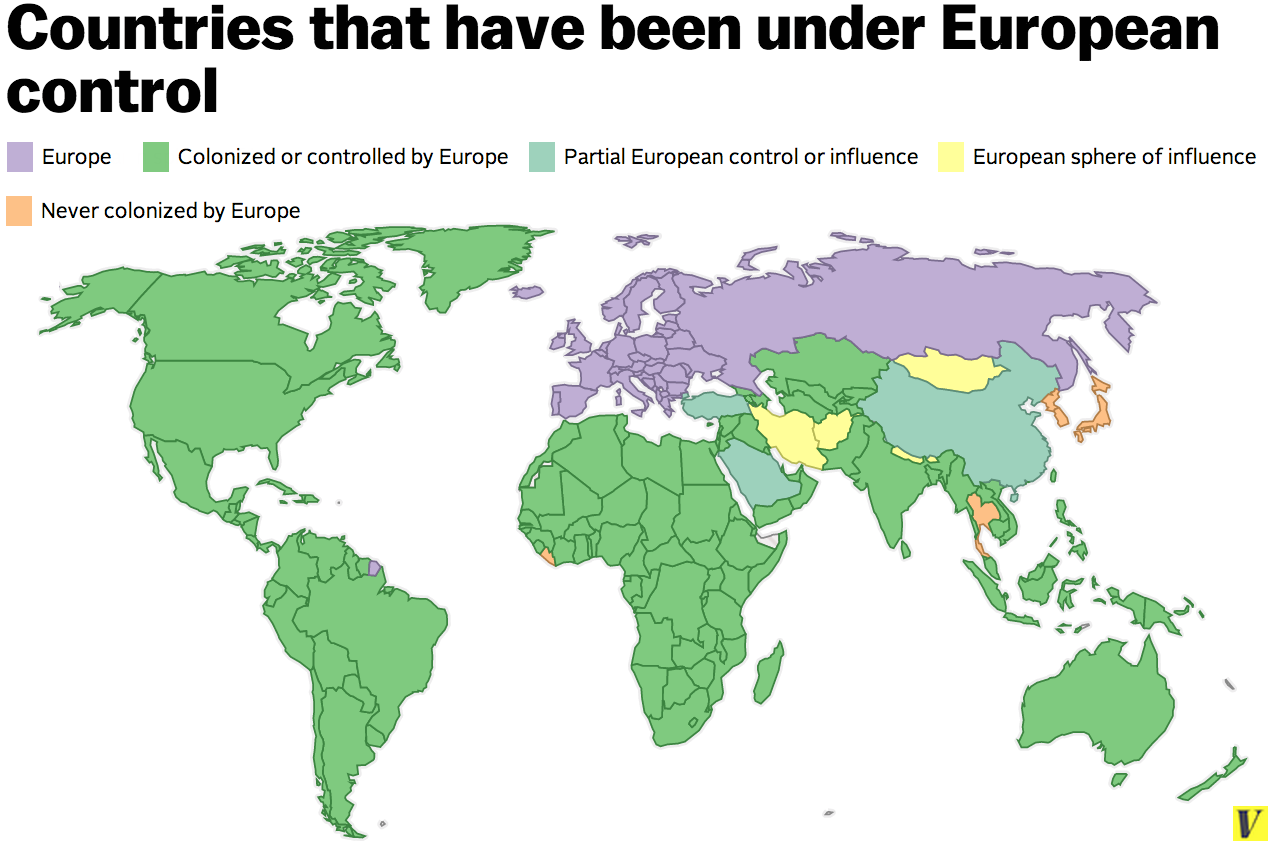
This is a map of the countries Europe colonized, controlled, or influenced between 1500 and 1960. The purple is Europe. The orange countries are ones never under European rule. Almost the entire rest of the map — all the green, blue, and yellow — were dominated by Europe to some extent. “Influenced” is pretty much a euphemism and often not all that different than outright domination.
There are only four countries that escaped European colonialism completely. Japan and Korea successfully staved off European domination, in part due to their strength and diplomacy, their isolationist policies, and perhaps their distance. Thailand was spared when the British and French Empires decided to let it remained independent as a buffer between British-controlled Burma and French Indochina…
Then there is Liberia, which European powers spared because the United States backed the Liberian state, which was established in the early 1800s by freed American slaves who had decided to move to Africa.
““You don’t think of water as privilege until you don’t have it anymore.””
-
Yolanda Serrato, a mother of three in East Porterville, California, tells The New York Times.
As California’s historic drought persists, Serrato lives in one of hundreds of households in the Central Valley that no longer have access to running water. Get the full story from NYT.
white dude in this horror movie : *translates old arabic text* *somehow it rhymes perfectly in english*
Now I really wanna see a horrible faltering translation from one of these movies, like “Whomsoever enters this room, they shall… well, this word is like… literally it means ‘unbecome,’ but it was used as a euphemism for death, pooping, and—wait, when was this carved? was it 15th century? Cuz it was a euphemism for sex too in the 15th century. This is either a cursed crypt, a bathroom, or a royal bedroom. Who wants to roll the dice?”
"You guys, I’ve gotta be honest, okay? This thing’s written in some kind of weird localized dialect, and I’ve only ever studied the standard form of the language. I mean, this part right here…I can’t even tell if it’s some kind of error, or an obscure slang phrase…whatever it is, I have no idea what the fuck it means.”
'this is written in ancient sumerian. it's about… uh… well that word is… uh. okay this is either a poem about farming, or straight-up a nasty sex guide. it might be both. i want a shower.'
"okay see the thing is in one dialect this word is the name of a terrifying Demon but in a completely different language from the same area that has the same writing system and gave a lot of loan words to the first, it means ‘horse’ - and the context is really not helping"
It's not just nerds. Hurt people hurt people. Anyone who turns to hurting other people as a way to make themselves feel better about living in a system that has caused them pain gets like this. You try to get them to address their behavior and the negative effect it has on other people, and they get upset about how you're picking on them.
Do you know what I really like about Sterling? Another show, another time, and he’d be the protagonist. I mean he’s often not wrong, he’s incredibly clever, he’s pretty much the prototypical white dude who is cranky but somehow has a heart of gold. The reason he such a great antagonist for the team is that he can genuinely almost outthink them, genuinely almost beat them. And he’s alone on his own. It’s not just that he can outthink Nate sometimes, its that he’s prepared to deal with all five of them and again, in another show he would win.
I can almost hear his fourth wall breaking frustration most of the time. “I’m supposed to be the good guy! I work hard, I follow the law, sure sometimes I bend it but it’s always in the service of greater justice.” He is exactly the protagonist in every extraordinary white dude crime show on TV today. And yet because he stumbled into this weird, amazing, found family criminals as good guys story, it turns out he has to somewhat lose at every turn. Not enough to put him in real danger. Not enough to make him actually fail. Just enough that I think it’s clear to him somewhere in the recesses of his brain, that he’s not the protagonist of the show. And it drives him absolutely bonkers.
Accepting that bisexuality is a valid sexual orientation is the same as accepting people for who they say they are, even if it goes beyond what you can understand. To deny the legitimacy of bisexuality because it is outside of our own comprehension is no better than the attitude of the many people who have dismissed homosexuality as being nothing more than a phase, a mental illness, or something that can be fixed.
As gay men and women, we do not allow anyone to deny the legitimacy or authenticity of who we are. We are a culture forged in the steadfast belief that we, as people, were born this way. In spite of the many well-organized efforts to dismiss the validity of our sexuality, we stuck to what we knew was true in our gut. So to casually dismiss bisexuals as either confused straight people or homos in hiding goes directly against the logic that we demand heterosexual naysayers to adopt.