Glory to librarians fey and ordinarily alike. May your work preserving the Words and the Pictures alike grant you a life filled with the treasures and respect you deserve.
When I was an editor for DC Comics I had one of these “comic book legends” who was doing a story for us take an interest in my writing, and have it escalate to him saying he was interested in me physically & inviting me to his hotel room. I turned down the meeting; he was married, I had no interest in him, and frankly how fast it all turned from “I think you’re a great writer” to “I’d like to fuck you” was very disheartening. I didn’t tell the gossip mill what happened, and I had no interest in humiliating this guy—I told my boss, because this was a person working for us and so it became a work issue.
My boss had a talk with this “comic book legend” and defended me. My boss told him: do not make my employees feel uncomfortable, that is unacceptable. Then “comic book legend” immediately called DC President Paul Levitz to have me fired from my job. No exaggeration: literally, he called the President of my company to have me fired. He referenced some small edit in his story (like, punctuation or changing a verb), and how it was part of a “conspiracy” by me personally to humiliate him. “You must fire this impudent woman at once.”
Now: I didn’t get fired. And I was believed and defended by my boss. But this anecdote illustrates a couple of things that I think is germane to this conversation about Bill Cosby:
1. People accuse some of the women claiming they were raped by Cosby as being “too ambitious.” They ask: “why did they go to his hotel room? why did they go to this and that function with him? they were just looking for a career advancement.” Well, the #1 advice I always used to get, as an aspiring young comic writer, was to network. Male and females both get this advice: “network.” The problem is, as a female, your willingness to make these connections can lead to these situations…you don’t want to be the person turning down every chance to talk to important people because you are afraid of getting hit on or whatever. You don’t want to appear cold or unfriendly. So if you are an aspiring TV comedy writer, for instance, you don’t want to alienate Bill Cosby.
2. Now, what happens when you play so-called “good girl” and don’t go to the hotel room? Do you get a cookie or an extra sticker on your work evaluation? No: you can have butthurt guys try to get you fired in retaliation. And you are a 25-year-old Nobody and they are Blah Blah Blah LEGEND!!!!! You’re not “worth” more than them. That’s how you feel. You’re literally not “worth” as much as these people. You are expendable.
3. Do you have any idea what it’s like to have this motherfucker feign an interest in your work, and then suddenly flip that to: meet me at my hotel room? And then you try to do the “right thing,” and discretely report it to your boss, and not go to the hotel room…and then be informed that this guy called the president of your company to have your ass fired for NOTHING (other than his ego was butthurt)?
This was in 2001 or thereabouts. Now let’s go back to the late 60s/early 70s, back to the time many of the Cosby accusers cite as when they were assaulted by him. How much more fucked up was it for them? How much more palpable the feeling that if they “alienated” the big celebrity, their career would be damaged?
This is why when people say: “why did they go to the hotel room???” I just shake my head. You’re fucked either way.
Sharing not because I like Lovecraft, just because I was scrolling through my feed and my brain said "Hey, what's going on with that box of Trix there?"
Welcome back to the Lovecraft reread, in which two modern Mythos writers get girl cooties all over old Howard’s original stories.
Today we’re looking at “From Beyond,” written in 1920 and first published in the June 1934 issue of Fantasy Fan—so don’t be so quick to trunk your early stories. You can read it here.
Spoilers ahead.
“It is not pleasant to see a stout man suddenly grown thin, and it is even worse when the baggy skin becomes yellowed or greyed, the eyes sunken, circled, and uncannily glowing, the forehead veined and corrugated, and the hands tremulous and twitching. And if added to this there be a repellent unkemptness; a wild disorder of dress, a bushiness of dark hair white at the roots, and an unchecked growth of pure white beard on a face once clean-shaven, the cumulative effect is quite shocking. But such was the aspect of Crawford Tillinghast on the night his half-coherent message brought me to his door after my weeks of exile.”
Summary: Crawford Tillinghast should never have studied science and philosophy, for he’s no cold and impersonal investigator. He means to “peer to the bottom of creation,” a grandiose goal baffled by the feebleness of human senses. But he believes we have atrophied or rudimentary senses beyond the five we know, which certain waves might activate, and so he’s built an electrical contraption to generate the waves. When his best friend, our narrator, cautions him against the experiment, Tillinghast flies into a fanatical rage and drives him off.
Ten weeks later, Tillinghast summons narrator back to his home. Narrator’s shocked by his friend’s emaciation and dishevelment, the manic glow in his sunken eyes, the whitening of his hair. Tillinghast trembles as he ushers narrator inside and leads him to his attic lab, a single candle in his hand. Is the electricity off? No, but Tillinghast dares not use it, for reasons unspecified.
He seats narrator near his electrical machine, which glows a sickly violet. When he switches it on, the glows turns to a color or colors indescribable. That’s ultraviolet, Tillinghast declares, rendered visible to their eyes by the action of the machine. Soon other dormant senses will awaken, via the pineal gland, and they will perceive things from beyond.
Narrator’s first outre perception is that he sits not in an attic but in a temple of dead gods, with black columns rising to a cloudy height. This yields to a sense of infinite space, sightless and soundless. Narrator is spooked enough to draw his revolver. Next comes a wild music, faint but torturing. He feels the scratch of ground glass, the touch of a cold draft.
Though Tillinghast grins at the drawn revolver, he warns narrator to remain quiet. In the rays of the machine, they not only see but can be seen. The servants found that out when the housekeeper forgot his instructions and turned on the lights downstairs. Something passed through the wires by sympathetic vibration, and then there were frightful screams. Later Tillinghast found three heaps of empty clothes. So narrator must remember — they’re dealing with forces before which they’re helpless!
Though frozen in fear, the narrator grows more receptive. The attic becomes a kaleidoscopic scene of sense-perceptions. He watches shining spheres resolve into a galaxy shaped like Tillinghast’s distorted face. He feels huge animate things drift past or through his body. Alien life occupies every particle of space around the familiar objects in the attic; chief among the organisms are “inky, jellyish monstrosities,” semi-fluid, ever-moving—and ravenous, for sometimes they devour each other.
The jellies, Tillinghast says, flounder around and through us always, harmless. He glares at narrator and speaks with hatred in his voice: Tillinghast has broken barriers and shown our narrator worlds no living men have seen, but narrator tried to stop him, to discourage him, was afraid of the cosmic truth. Now all space belongs to Tillinghast, and he knows how to evade the things that hunt him, that got the servants, that will soon get narrator. They devour and disintegrate. Disintegration is a painless process—it was the sight of them that made the servants scream. Tillinghast almost saw them, but he knew how to stop. They are coming. Look, look! Right over your shoulder!
Narrator doesn’t look. Instead he fires his revolver, not at Tillinghast but at his cursed machine. It shatters, and he loses consciousness. Police drawn by the shot find him unconscious and Tillinghast dead of apoplexy. The narrator says as little about his experience as possible, and the coroner concludes that he was hypnotized by the vindictive madman.
Narrator wishes he could believe the coroner, for it now unnerves him to think about the air around him, the sky above. He cannot feel alone or comfortable, and sometimes a sense of pursuit oppresses him. He can’t believe it was mere hypnotism, though, for the police never do find the bodies of the servants that Tillinghast supposedly murdered.
What’s Cyclopean: The adjectives this week are used well and in moderation.
The Degenerate Dutch: We avoid distressing glimpses of Lovecraft’s many prejudices this time out, thanks to the tight focus on the narrator’s relationship with Tillinghast.
Mythos Making: There’s no overt connection with the creatures and structures of the Mythos, but Tillinghast’s machine unquestionably reveals the terrible spaces through which Brown Jenkins travels, from which the Color comes, in the heart of which a monotonous flute pipes and Azathoth blazes. It’s all here, waiting.
Libronomicon: Tillinghast’s research doubtless draws on a fascinating library, which we unfortunately don’t see.
Madness Takes Its Toll: And Tillinghast has paid that toll.
Anne’s Commentary
This is the rare Lovecraft story I remember reading only once; while the inky jellies and hunter-disintegrators have their appeal, Crawford Tillinghast struck me as a total jerk. Definitely not someone I wanted to visit again. Our narrator’s more tolerant, perhaps due to our favorite emotional combo of repulsion and fascination. To be fair, Tillinghast might have been a decent guy before he became “the prey of success” (sweet turn of phrase) and started deteriorating into grandiose madness. Still, narrator got all the Lovecraftian warning signs of friend-turned-big trouble: barely recognizable handwriting, alarming physical changes, a hollow voice. Plus whitened hair and uncannily glowing eyes. Ocular glare is the surest sign of dangerous fanaticism in the Mythos world.
I do like the name “Tillinghast,” which is quintessentially Rhode Island. I wonder if Crawford was related to Dutee Tillinghast, whose daughter Eliza married Joseph Curwen. Probably, in which case he might have inherited Curwen’s affinity for cosmic horror.
In any case, “From Beyond” contains many fore-echoes. There’s the strange music narrator hears, like the music with which Erich Zann became so familiar. There’s the unplaceable color Tillinghast’s wave-generator emits. Tillinghast calls it ultraviolet, but it also looks forward to that even more ominous color outside Arkham, and narrator ends up with a chronic anxiety about the air and the sky. More important, this story is an early example of Lovecraft’s overarching fictional premise. Close to mundane reality – too close for the comfort of the preternaturally perceptive and recklessly curious – are myriad other realities. Some can be entered via the altered mental state of sleep, as in the Dreamlands tales. Some are accessible via applied hypergeometry, as in “Dreams in the Witch House” and last week’s “Hounds of Tindalos.” Past and future realities are the playground of time-masters like the Yith and all those who hold the necessary keys, silver or otherwise. Most terrifying are the hidden subrealities of our own continuum. You know, Cthulhu napping under the Pacific, and ghouls burrowing under Boston. Yuggoth fungi sojourning in Vermont. Yith marking up books in our great libraries. Deep Ones in Innsmouth, and shoggoths in the Antarctic, and flying polyps in Australia, and immortal wizards in Providence. And, and, and!
And, in “From Beyond” itself, those normally invisible jelly-amoebas which are always with us and those hunters which are always nearby and which, given proper conduits, do away with Tillinghast’s servants. Foreshades of the Tindalos hounds! I guess that these entities haunted me as they do our narrator, though semi-subconsciously, because on rereading I’m struck by the appearance their close relations make in my novel Summoned. Miskatonic University archivist Helen Arkwright takes a vision-enhancing potion to assist her in plumbing magically obscured marginalia in the Necronomicon. However, she’s distracted from the sacred book when she notices what swarms the rare book vault – what presumably swarms it all the time, unseen. Lean translucences with dozens of appendages, with which they climb up and down in the air. Gossamers whose feathery antennae yearn toward her with avid curiosity. One lands on her back. When she tries to crush it against the wall, it oozes whole through her chest, unharmed.
She realizes the gossamers are harmless, but her hypervision also detects patches of ethereal fabric that separate the vault from some very other place, against which something heaves an enormous gelatinous haunch and peers with glinting and clustered eyes.
Sounds hunterish to me. Good thing for Helen that if MU has acquired Tillinghast’s wave-generator, it hasn’t stored it in the tomes vault. Otherwise my deep memory would doubtless have had her stumble into the machine and turn it on, unleashing the things with the haunches and eyes. In which case my book would have ended neither with a bang nor a whimper, but with a resounding “Aaaaaaaaaaaaaagh—”
Ruthanna’s Commentary
Damn. This story would have delighted me any week, but it contrasts particularly sharply with last week’s “Hounds of Tindalos.” They have pretty much the same plot, save that Chambers is a jerk and Tillinghast is a murderous jerk. But where Long—or his narrator—wants to tell you at length about the metaphysical explanations for his enhanced perceptions, Lovecraft and Tillinghast show. Picture it now: the colors writhing just beyond vision, eager to be seen; the ghostly jellyfish moving around and through you, tentacles brushing your cheek… and the things that Tillinghast doesn’t see till the last, and so never shows or describes. Better not look behind you! Keep still. Don’t blink.
For once, one of Howard’s stories benefits from being the trope-maker. In later stories, he’ll depend at least somewhat on repetitive set pieces to try and invoke this same mood. The monotonous flute, the mindless gods, the non-Euclidean geometry… but every description here is new, and wildly strange, and so far as I can recall never gets reused. The end result convinces me that I really would be tempted to look, and that it really would be a terrible idea.
And the language is terrific, ornate enough to be evocative without going over the top. Not that I don’t love me some over-the-top Lovecraft, but: the jellyfish and other strange fauna are “…superimposed upon the usual terrestrial scene much as a cinema view may be thrown upon the painted curtain of a theatre.” I can imagine it perfectly—alas that the art coming up in an image search doesn’t seem to have taken the dare.
I find the psychological conceit here fascinating, even if Lovecraft framed it in a way that makes little sense by modern standards. Do we have atrophied and rudimentary senses that could be enhanced to show more of reality? Sort of. Scent’s a good candidate—we have less than most other mammals, and a good portion of what we get is non-conscious. The jelly-thing-sensing organ is less likely. The pineal gland—fallback explanation for unlikely abilities since Descartes—honestly has enough to do keeping everyone’s hormones in order, without also connecting us to reality’s other layers.
But humans are obsessed with expanding their senses, and it turns out we’re really quite good at it. You can get glasses that will let you pick up infrared (although it’ll look like an ordinary glowing light, sorry), or cataract surgery to see ultraviolet. Better yet, wear a belt that always vibrates at magnetic north, and within a few days you’ll have integrated a directional sense in with the sense you come by naturally. Then there are the people who implant magnets in their fingertips—I don’t think my keyboard would like it, but it’s tempting. Some of the more outre compensations for blindness involve translating the input from a camera into stimulation of the back or tonguea—visual input turns to touch, and given a little bit of time to adjust, the occipital lobe will use the new input as happily as it would the standard signals from rods and cones.
So if we actually had Tillinghast’s machine, it’s likely that we’d find a way to process the strange sense of the beyond as ordinary vision and hearing. And while it might be a bit creepy at first, I suspect we’d learn how to get along with it pretty well, after all. Humans are good at processing whatever we can get into our brains, and we’re always hungry for more.
Next week, Lovecraft warns us about the dangers of meddling in wetlands—no, not the ones near Innsmouth—in “The Moon-Bog.”
Anne M. Pillsworth’s short story. “The Madonna of the Abattoir” appears on Tor.com, and her first novel, Summoned, is available from Tor Teen. The second in the Redemption’s Heir series, Fathomless, will be published in October 2015. She lives in Edgewood, a Victorian trolley car suburb of Providence, Rhode Island, uncomfortably near Joseph Curwen’s underground laboratory.
SAN JOSE, CA—Noting how lucky she was to have finally found the one she was meant to be with forever, local woman Julie Winters told reporters Tuesday she was relieved that her true soulmate also happened to have the same socioeconomic status as she does. “From the moment I met David, I knew we were kindred spirits who were destined to be together, and it’s just such a relief that his income mirrors mine so well,” said Winters, adding that she breathed much easier upon realizing the person she had been waiting for her whole life was also a white-collar professional earning approximately $75,000 per year. “It’s also reassuring to know there really aren’t any glaring gaps in educational background between me and the only man I could ever love. I’m such a lucky girl!” Winters went on to say she was especially relieved ...
In today’s episode of white people denying the realities of poc actresses - and even cutting them off in the process - queen of everything Viola Davis handles the situation perfectly. x
i cannot get over this white lady’s face. like she is disgusted that Viola would say that shes had a rough go in Hollywood.
She’s telling Viola, with such confidence!, that this doesn’t happen. Never enters her mind that it could be true. She automatically rejects it as Viola is telling her it is a thing that happens. White People
The possibilities are these: Bland died from an untreated head injury after State Trooper Brian Encinia bashed her head against the pavement and police staged her suicide; Bland died from an epileptic seizure (recall that Encinia's response to Bland telling him she had epilepsy was "Good") and police staged her suicide; Bland was killed or died in some other way in police custody and her sucide was staged; or Bland indeed took her own life, after she informed police of previous suicide attempts and they utterly failed to prevent another while she was in their care.
There is no version of events where police are not culpable for Sandra Bland's death.
out of all the aspects of millennial-bashing, i think the one that most confuses me is the “millennials all got trophies as a kid, so now they’re all self-centered narcissists” theory
like— kids are pretty smart, y’all. they can see that every kid on the team gets a trophy and is told they did a good job; they can also see that not every kid on the team deserves a trophy, and not everyone did do a good job
the logical conclusion to draw from this is not “i’m great and i deserve praise”— it’s “no matter how mediocre i am, people will still praise me to make me feel better, so i can’t trust any compliments or accolades i receive”
this is not a recipe for overconfidence and narcissism. it is a recipe for constant self-guessing, low self-esteem, and a distrust of one’s own abilities and skills.
where did this whole “ugh millennials think their so-so work is super great” thing even come from it is a goddamn mystery
what fucking kills me is, yeah, maybe we got the trophies, but who gave them out
this is not a recipe for overconfidence and narcissism. it is a recipe for constant self-guessing, low self-esteem, and a distrust of one’s own abilities and skills.
It’s also what I observed happening as a singing teacher: the older kids literally would not believe a positive word I said until I had proved I would tell them they screwed up/had done badly/etc. I did so in as useful a way as possible (“So this passage. We really need to work on this passage. A lot. This passage is not good yet.”), but with almost every adolescent I taught I had to prove I would give them straight-up criticism before they would parse my praise as anything other than meaningless “the grownups always do this” noise.
The fans totally want it. It’s all about who own the rights. It’s about having a good take on it. And I hope that the people I want to do it go for it because I will trust them and I will help them promote it whether I’m in it or not. It would be cool if they could do both [a reboot and a revival]. You kind of need to hand over the reigns to a younger Xena, but it would be cool to also do a reboot much like Ash - Xena and Gabrielle and where they’ve come to.
i swear to god if i see one more academic oppose trigger warnings on the grounds of being anti-censorship…
like did you think about that at all? the point of the trigger warning is to warn people of potentially triggering content. if the intent were truly to “censor” content, trigger warnings would serve no purpose. the very existence of the trigger warning suggests that the content will remain part of the curriculum, and literally all trigger warning advocates want is the ability to prepare for it.
one of my friends, for example, knew the subject of lolita prior to reading it, and because she’s a csa survivor she took measures to protect her mental health while still engaging the material. she moved her therapy sessions from before class to after, did her reading in comforting environments, saved her free absences so she could take a day off if need be, and explained her situation to the professor so she could step into the hall periodically if the conversation became too draining. she still contributed to class discussion, did all the assignments, and read the book, but because she knew what was coming, she was able to do those things without compromising her mental health.*
don’t want trigger warnings to dictate how your students read/interpret the work? well students with triggers will probably focus on that shit anyway, but as for the rest, it’s so easy to put a note on your syllabus directing students to a back page with trigger warnings so they can choose whether or not to check.
tl;dr: trigger warnings don’t restrict academic freedom, they empower students who struggle with trauma and mental illness, and conflating trigger warnings with “censorship” suggests a serious misunderstanding of how trigger warnings work.
*ftr, my friend is very open about this subject, so i’m not spilling secrets
lets just be clear, if you spend the time baking a cake/cookies/brownies, you can eat as many of them as you want and the calories don’t count. you made those calories. you’re their god.
disclaimer: this does not apply to children you have made
Following the recent mass shooting in Charleston, South Carolina on June 17th, 2015 – a racially motivated act of domestic terrorism – President Barack Obama delivered a sobering address to the American people. With a heavy heart, President Obama spoke the day following the attack, stating:
At some point we as a country will have to reckon with the fact that this type of mass violence does not happen in other advanced countries. And it is in our power to do something about it. I say that recognizing that politics in this town foreclose a lot of those avenues right now. But it would be wrong for us not to acknowledge.
President Obama was primarily referring to gun control in the portion of his speech addressing the cause of attacks like this. Not all mass shootings are racially motivated, and not all qualify as “terrorist” attacks — though Charleston certainly qualifies. And the mass shooting that occurred a just a month later in Chattanooga, Tennessee by a Kuwati-born American citizen was quickly labeled an act of domestic terrorism. But, President Obama makes an important point here: mass shootings are a distinctly American problem. This type of rampage violence happens more in the United States than anywhere else. And gun control is a significant part of the problem. But, gun control is only a partial explanation for mass shootings in the United States.
Mass shootings are also almost universally committed by men. So, this is not just an American problem; it’s a problem related to American masculinity and to the ways American men use guns. But asking whether “guns” or “masculinity” is more of the problem misses the central point that separating the two might not be as simple as it sounds. And, as Mark Follman, Gavin Aronsen, and Deanna Pan note in the Mother JonesGuide to Mass Shootings in America, the problem is getting worse.
We recently wrote a chapter summarizing the research on masculinity and mass shootings for Mindy Stombler and Amanda Jungels’ forthcoming volume, Focus on Social Problems: A Contemporary Reader (Oxford University Press). And we subsequently learned of a new dataset on mass shootings in the U.S. produced by the Stanford Geospatial Center. Their Mass Shootings in America database defines a “mass shooting” as an incident during which an active shooter shoots three or more people in a single episode. Some databases define mass shootings as involving 4 shootings in a single episode. And part of this reveals that the number is, in some ways, arbitrary. What is significant is that we can definitively say that mass shootings in the U.S. are on the rise, however they are defined. The Mother Jones database has shown that mass shootings have become more frequent over the past three decades. And, using the Stanford database, we can see the tend by relying on data that stretches back a bit further.
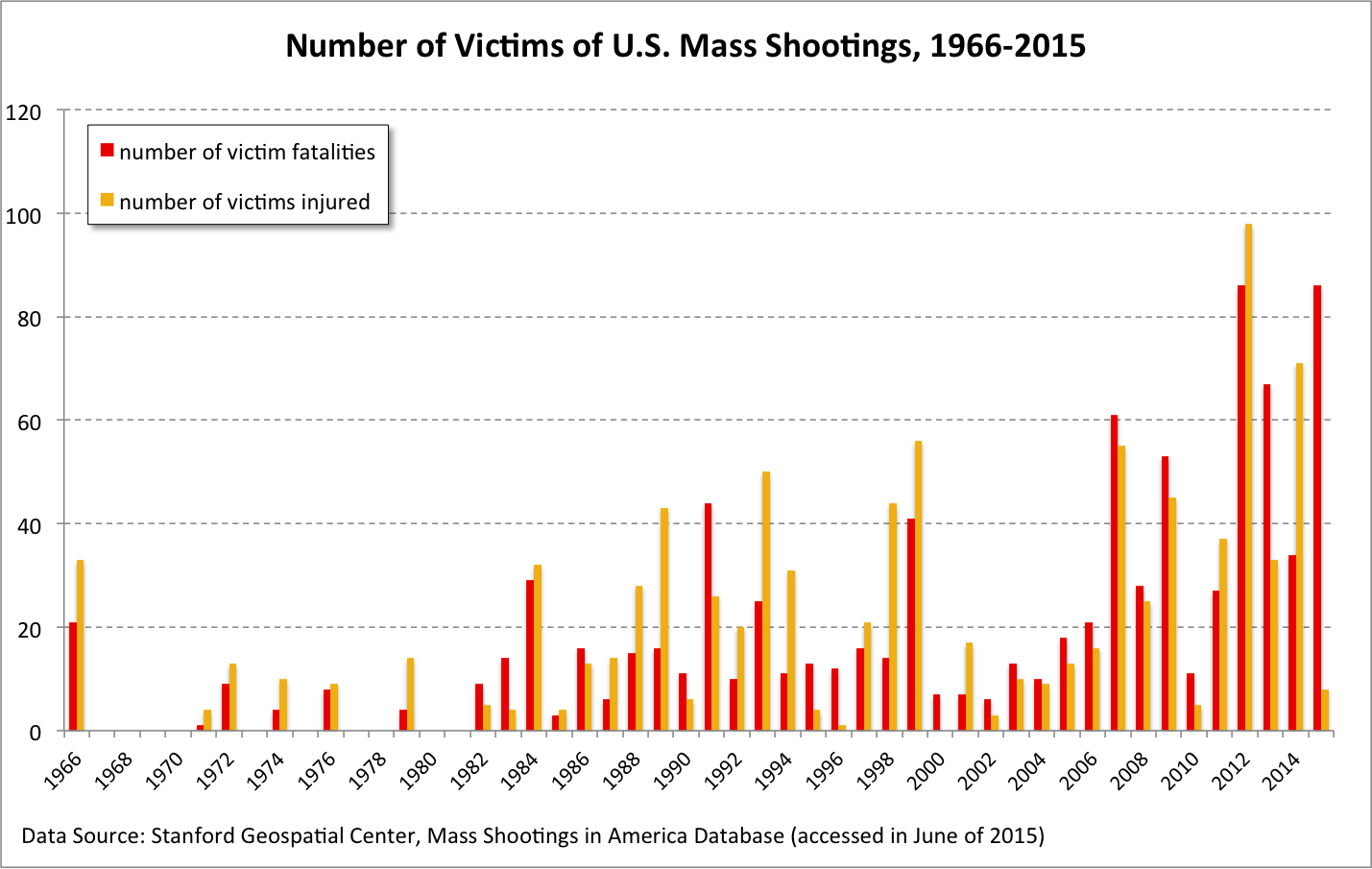
Additionally, we know that the number of victims of mass shootings is also at an historic high:
We also produced a time-lapse map of mass shootings in the United States illustrating both where and when mass shootings have occurred using the Stanford Geospatial Center’s database to illustrate this trend over time:
Our map charts mass shootings with 3 or more victims over roughly 5 decades, since 1966. The dataset takes us through the Charleston and Chattanooga shootings, which brought 2015 to 42 mass shootings . The dataset is composed of 216 separate incidents only 5 of which were committed by lone woman shooters. Below we produced an interactive map depicting all of the mass shootings in the dataset with brief descriptions of the shootings.
In our chapter in Stombler and Jungels’ forthcoming book, we cull existing research to answer two questions about mass shootings: (1) Why is it men who commit mass shootings? and (2) Why do American men commit mass shootings so much more than men anywhere else? Based on sociological research, we argue that there are two separate explanations – a social psychological explanation and a cultural explanation (see the book for much more detail on each).
A Social Psychological Explanation
Research shows that when an identity someone cares about is called into question, they are likely to react by over-demonstrating qualities associated with that identity. As this relates to gender, some sociologists call this “masculinity threat.” And while mass shootings are not common, research suggests that mass shooters experience masculinity threats from their peers and, sometimes, simply from an inability to live up to societal expectations associated with masculinity (like holding down a steady job, being able to obtain sexual access to women’s bodies, etc.) – some certainly more toxic than others.
The research on this topic is primarily experimental. Men who are brought into labs and have their masculinity experimentally “threatened” react in patterned ways: they are more supportive of violence, less likely to identify sexual coercion, more likely to support statements about the inherent superiority of males, and more.
This research provides important evidence of what men perceive as masculine in the first place (resources they rely on in a crisis) and a new kind evidence regarding the relationship of masculinity and violence. The research does not suggest that men are somehow inherently more violent than women. Rather, it suggests that men are likely to turn to violence when they perceive themselves to be otherwise unable to stake a claim to a masculine gender identity.
A Cultural Explanation
But certainly boys and men experience all manner of gender identity threat in other societies. Why are American boys and men more likely to react with such extreme displays? To answer this question, we need an explanation that articulates the role that American culture plays in influencing boys and young men to turn to this kind of violence at rates higher than anywhere else in the world. This means we need to turn our attention away from the individual characteristics of the shooters themselves and to more carefully investigate the sociocultural contexts in which violent masculinities are produced and valorized.
Men have historically benefited from a great deal of privilege – white, educated, middle and upper class, able-bodied, heterosexual men in particular. Social movements of all kinds have slowly chipped away at some of these privileges. So, while inequality is alive and well, men have also seen a gradual erosion of privileges that flowed more seamlessly to previous generations of men (white, heterosexual, class-privileged men in particular). Michael Kimmel suggests that these changes have produced a uniquely American gendered sentiment that he calls “aggrieved entitlement.” Of course, being pissed off about an inability to cash in on privileges previous generations of men received without question doesn’t always lead to mass shootings. But, from this cultural perspective, mass shootings can be understood as an extremely violent example of a more general issue regarding changes in relations between men and women and historical transformations in gender, race, and class inequality.
Mass shootings are a pressing issue in the United States. And gun control is an important part of this problem. But, when we focus only on the guns, we sometimes gloss over an important fact: mass shootings are also enactments of masculinity. And they will continue to occur when this fact is combined with a sense among some men that male privilege is a birthright – and one that many feel unjustly denied.
Hi, Clair. I’d like to come in and talk with you. Would that be all right?
This is the Batman we need to see more often. The one who remembers what it was like to be a scared child, one who knows how to handle situations delicately.
One of the reason why I love batman so much. He is portrayed as a very careful and guarded man. But he is probably the most human out of anyone. It’s why he is the knight that gotham deserves.
Re: that last panel -
Batman, when he’s written correctly, is an extremely compassionate person.
I always feel the need to reblog this because it’s definitely something I feel was lost in the Nolan films.
It wasn`t lost, it was left at the door and not picked up.
so, every time a Black person is killed by a white person, a buncha people go out of their way not to care by googling Black on Black crime so they can convince themselves there’s no problem.
The possibilities are these: [Sandra] Bland died from an untreated head injury after State Trooper Brian Encinia bashed her head against the pavement and police staged her suicide; Bland died from an epileptic seizure (recall that Encinia’s response to Bland telling him she had epilepsy was “Good”) and police staged her suicide; Bland was killed or died in some other way in police custody and her sucide was staged; or Bland indeed took her own life, after she informed police of previous suicide attempts and they utterly failed to prevent another while she was in their care.
There is no version of events where police are not culpable for Sandra Bland’s death.
And all because Officer Encinia was angry that Sandra Bland knew her rights and was exercising them. No matter how she died, she is dead because that man became enraged that a black woman wouldn’t unquestioningly submit to him.
And it’s worth remembering that even if she had been suicidal or violent, the police were responsible for her safety as soon as she was taken into custody. That’s true of everyone. When any person dies while in police custody they are culpable for it - we entrust them with the power to incarcerate people with the understanding that those people will be safe and unharmed for the duration and we have been failing miserably for decades to hold police accountable for that.
Yes, BUT... We were socialized this way. We were LITERALLY told that we shouldn't see race! This was a very important thing we were told to do by people who were older than us who we figured knew what the hell they were talking about. So the previous generation's attempt to make racism disappear by pretending race isn't a thing blew up beautifully in people's faces. Not a surprise. BUT... Please remember that when people are the way they are it's not necessarily because they hate you and want you to disappear. Don't bash people; dismantle systems.
Pretty sure “money can’t buy happiness” is meant to actually mean “don’t neglect emotional health and caring for the people in your life in the pursuit of more wealth than you need”, but instead middle-class and rich people use it to tell poor people “don’t strive to have financial security even though I have it”.




 Super Opinionated.


 Following the recent mass shooting in Charleston, South Carolina on June 17th, 2015 – a racially motivated act of domestic terrorism – President Barack Obama delivered a sobering address to the American people. With a heavy heart, President Obama spoke the day following the attack, stating: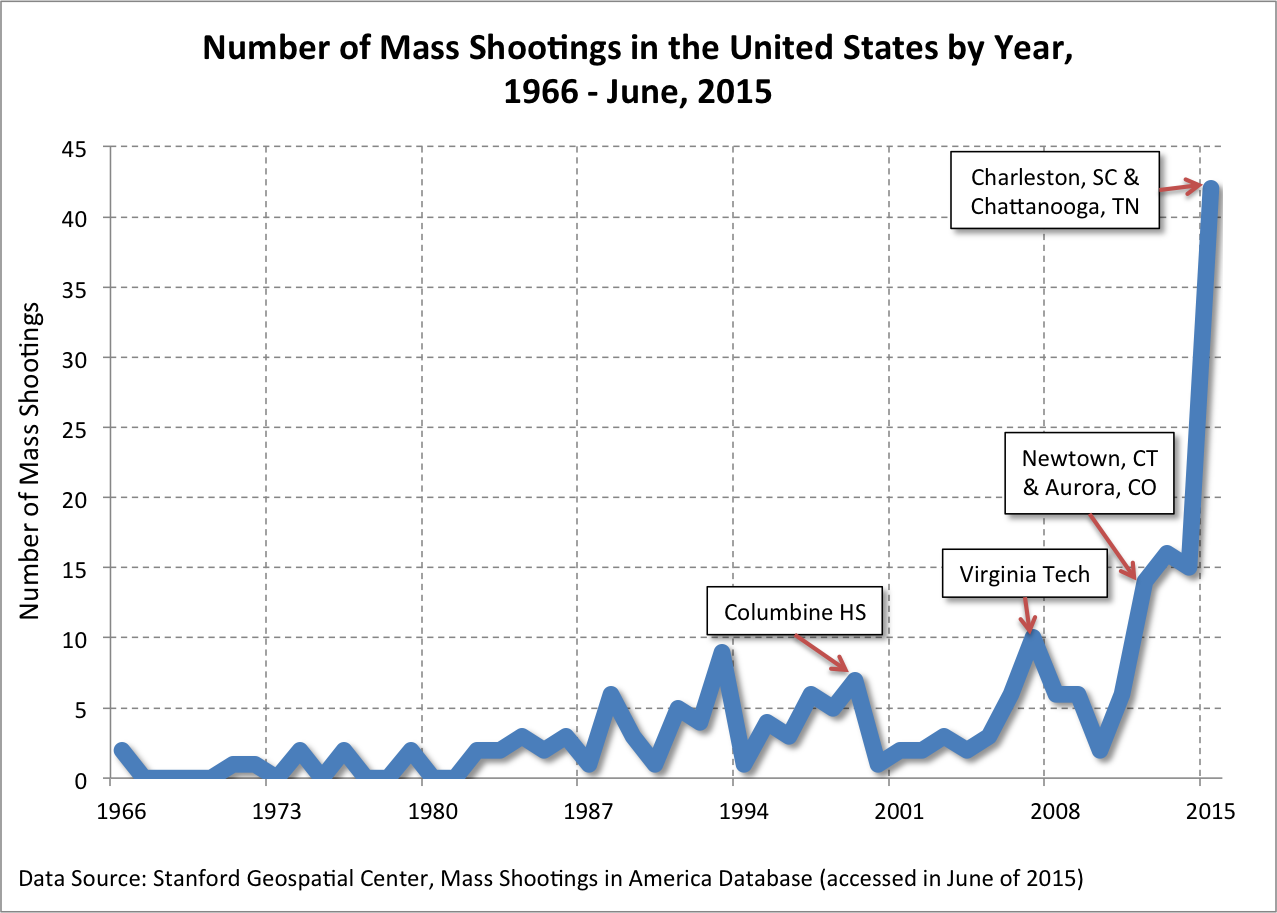


 Stuff over here.


