The Purcell effect is defined as the modification of spontaneous decay in the presence of a resonator, and in plasmonics it is usually associated with the large local-field enhancement in "hot spots" due to surface plasmon polaritons. Here we propose a novel strategy for enhancing the Purcell effect through engineering the radiation directivity without a strict requirement of the local field enhancement. Employing this approach, we demonstrate how to enhance the Purcell effect by two orders of magnitude in all-dielectric nanostructures recently suggested as building blocks of low-loss nanophotonics and metamaterials. We support our concept by proof-of-principle microwave experiments with arrays of high-index dielectric resonators.
Riccardo Sapienza
Shared posts
08 Aug 20:25
Large Purcell enhancement without strong field localization. (arXiv:1506.07276v1 [physics.optics])
by Alexander Krasnok, Stanislav Glybovski, Mihail Petrov, Sergey Makarov, Roman Savelev, Pavel Belov, Constantin Simovski, Yuri Kivshar
03 Jul 17:08

Spatial Kramers–Kronig relations and the reflection of waves
by S. A. R. Horsley
Nature Photonics 9, 436 (2015). doi:10.1038/nphoton.2015.106
Authors: S. A. R. Horsley, M. Artoni & G. C. La Rocca
When a planar dielectric medium has a permittivity profile that is an analytic function in the upper or lower half of the complex position plane x = x′ + ix″ then the real and imaginary parts of its permittivity are related by the spatial Kramers–Kronig relations. We find that such a medium will not reflect radiation incident from one side, whatever the angle of incidence. Using the spatial Kramers–Kronig relations, one can derive a real part of a permittivity profile from some given imaginary part (or vice versa) such that the reflection is guaranteed to be zero. This result is valid for both scalar and vector wave theories and may have relevance for designing materials that efficiently absorb radiation or for the creation of a new type of anti-reflection surface.
01 Jul 09:35
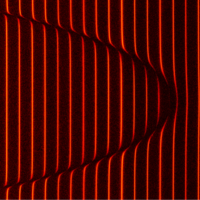
Beyond Strong Coupling in a Multimode Cavity
by Neereja M. Sundaresan, Yanbing Liu, Darius Sadri, László J. Szőcs, Devin L. Underwood, Moein Malekakhlagh, Hakan E. Türeci, and Andrew A. Houck
Author(s): Neereja M. Sundaresan, Yanbing Liu, Darius Sadri, László J. Szőcs, Devin L. Underwood, Moein Malekakhlagh, Hakan E. Türeci, and Andrew A. Houck
The interaction of light and matter is fundamental in physics. New results show that quantum coherence can arise in a cavity containing multiple modes of light and an artificial atom.
[Phys. Rev. X 5, 021035] Published Mon Jun 29, 2015
01 Jul 09:34


Hybrid Semiconductor Nanowire–Metallic Yagi-Uda Antennas
by Mohammad Ramezani, Alberto Casadei, Grzegorz Grzela, Federico Matteini, Gözde Tütüncüoglu, Daniel Rüffer, Anna Fontcuberta i Morral and Jaime Gómez Rivas

Nano Letters
DOI: 10.1021/acs.nanolett.5b00565
28 Jun 11:04
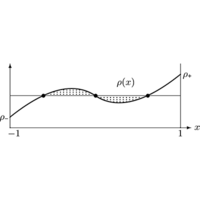
Macroscopic fluctuation theory
by Lorenzo Bertini, Alberto De Sole, Davide Gabrielli, Giovanni Jona-Lasinio, and Claudio Landim
Author(s): Lorenzo Bertini, Alberto De Sole, Davide Gabrielli, Giovanni Jona-Lasinio, and Claudio Landim
The statistical mechanics of systems out of equilibrium provides a formidable challenge. This review describes an approach to a subset of such problems, viz., stationary nonequilibrium states. The review includes what is known as the macroscopic fluctuation theory, which allows for the definition of nonequilibrium analogs of thermodynamics potentials, and is applied to various illustrative models.
[Rev. Mod. Phys. 87, 593] Published Wed Jun 24, 2015
Sonny Rhim likes this
27 Jun 20:13
[Policy Forum] Self-correction in science at work
by Bruce Alberts
Week after week, news outlets carry word of new scientific discoveries, but the media sometimes give suspect science equal play with substantive discoveries. Careful qualifications about what is known are lost in categorical headlines. Rare instances of misconduct or instances of irreproducibility are translated into concerns that science is broken. The October 2013 Economist headline proclaimed “Trouble at the lab: Scientists like to think of science as self-correcting. To an alarming degree, it is not” (1). Yet, that article is also rich with instances of science both policing itself, which is how the problems came to The Economist's attention in the first place, and addressing discovered lapses and irreproducibility concerns. In light of such issues and efforts, the U.S. National Academy of Sciences (NAS) and the Annenberg Retreat at Sunnylands convened our group to examine ways to remove some of the current disincentives to high standards of integrity in science.
Authors: Bruce Alberts, Ralph J. Cicerone, Stephen E. Fienberg, Alexander Kamb, Marcia McNutt, Robert M. Nerem, Randy Schekman, Richard Shiffrin, Victoria Stodden, Subra Suresh, Maria T. Zuber, Barbara Kline Pope, Kathleen Hall Jamieson
26 Jun 09:08
[Report] Natural light-gated anion channels: A family of microbial rhodopsins for advanced optogenetics
by Elena G. Govorunova
Mjsabulski likes this
25 Jun 15:54

A scanning cavity microscope
by Matthias Mader
Article
Fluorescence from nanoparticles enables high-resolution optical imaging, but this approach is limited to those structures that emit light. Here, the authors demonstrate a microscope that uses a cavity to enhance the measurement of the alternative optical properties of absorption and dispersion.
Nature Communications doi: 10.1038/ncomms8249
Authors: Matthias Mader, Jakob Reichel, Theodor W. Hänsch, David Hunger
22 Jun 21:34

Optical Trapping of Gold Nanoparticles in Air
by Liselotte Jauffred, S. Mohammad-Reza Taheri, Regina Schmitt, Heiner Linke and Lene B. Oddershede

Nano Letters
DOI: 10.1021/acs.nanolett.5b01562
22 Jun 21:32
Ora, in inglese questo lo chiamano "false balance", ovvero mettere sullo stesso piano due fatti, uno scientifico (ma anche di altro tipo, in ogni caso "attendibile") con uno pseudoscientifico (o falso), è un noto "bias" (un errore, una debolezza nel ragionamento).

2) Citazione di altri falsi esperti.
3) Selezione di studi non autorevoli, falsi o non attinenti.
4) Interpretazioni personali della realtà.
5) Manipolazioni, illazioni e fallacie.
Si tratta quasi sempre di argomenti senza basi, incommentabili, non smentibili (se dici che "Big Pharma" si arrichisce a spese della salute della popolazione, non stai portando una prova a favore di qualcosa ma un'illazione che non dimostra nulla).
Al contrario uno scienziato o un vero esperto deve limitarsi a dati reali (anche se fossero pochi ma che siano veri), deve usare cautele e condizionali, non deve fare affermazioni stupefacenti, caute, non può interpretare personalmente i risultati della ricerca scientifica e si basa solo su fatti oggettivi, se non lo facesse sarebbe un ciarlatano anche lui.
Ma questo non succede perché non fa spettacolo.
Basti riflettere sul fatto che le ultime cure alternative che hanno creato discussioni pubbliche importanti nel nostro paese (Bonifacio, Di Bella, Stamina) nonostante il parere dei competenti (ed in alcuni casi anche l'esame da parte degli stessi) abbiano smentito le promesse iniziali, i rispettivi "inventori" non abbiano mai accettato la bocciatura, l'abbiano rifiutata con le scuse più classiche, le stesse che hanno usato per promuoversi: il boicotaggio, il complotto, la genialità incompresa. Non hanno aggiunto nulla ai loro argomenti ma hanno usato la smentita come trono sul quale sedersi.
I loro seguaci, naturalmente, hanno accettato ogni giustificazione.
Il falso fattore dell'equilibrio nella scienza.
by Salvo Di Grazia
Pochi giorni fa, un importante festival itinerante, mi ha invitato ad un dibattito, un invito gentile e gradito, mi piacciono i "festival popolari", quelli organizzati amatorialmente e che coinvolgono la popolazione locale. Ma ho rifiutato l'invito.
Il motivo è semplice, il dibattito si doveva svolgere tra me ed un personaggio (non un medico) che pubblicizza e promuove una delle ciarlatanerie più note e pericolose che esistano al mondo. Non dirò chi sia il personaggio né di cosa si occupi, farei solo pubblicità gratuita ma si sarebbe dovuto parlare di salute e malattie con una persona che di salute ne capisce quanto io sia esperto di fisica nucleare, affidare a lui la propria vita praticamente equivarrebbe affidare al sottoscritto la sicurezza di una centrale nucleare, non ve lo consiglio.
Gli organizzatori hanno pensato a me perché "serve qualcuno che sappia bilanciare le sue affermazioni".
Il problema è che per "bilanciare" le affermazioni di quella persona non servirebbe chiamare un esperto o un addetto ai lavori, è un confronto già sbagliato in partenza. Se si parla di medicina si chiama un medico, se si parla di fisica un fisico e così via. Non è normale un dibattito medico tra un profano e chi si occupa di salute.
Ma questo succede e spesso sono proprio i profani (o quelli in malafede) che cercano questi confronti, per loro è una "promozione" da tutti i punti di vista, professionale perché pur non essendo esperti di salute sono paragonati ad essi e commerciale perché si fanno pubblicità.
Gli organizzatori hanno pensato a me perché "serve qualcuno che sappia bilanciare le sue affermazioni".
Il problema è che per "bilanciare" le affermazioni di quella persona non servirebbe chiamare un esperto o un addetto ai lavori, è un confronto già sbagliato in partenza. Se si parla di medicina si chiama un medico, se si parla di fisica un fisico e così via. Non è normale un dibattito medico tra un profano e chi si occupa di salute.
Ma questo succede e spesso sono proprio i profani (o quelli in malafede) che cercano questi confronti, per loro è una "promozione" da tutti i punti di vista, professionale perché pur non essendo esperti di salute sono paragonati ad essi e commerciale perché si fanno pubblicità.
Ora, in inglese questo lo chiamano "false balance", ovvero mettere sullo stesso piano due fatti, uno scientifico (ma anche di altro tipo, in ogni caso "attendibile") con uno pseudoscientifico (o falso), è un noto "bias" (un errore, una debolezza nel ragionamento).
Mettendo sullo stesso piano la scienza e la ciarlataneria si crea un senso di credibilità a chi non ne ha, una "dignità" che non può esistere. In questi contesti il ciarlatano ha tutto da guadagnare ed un dibattito si svolgerebbe su argomenti che bloccano il ragionamento scientifico per portarsi sulle illazioni e sulle ipotesi personali. Non sarebbe un dibattito scientifico quindi ma un palco dal quale proclamare idee indimostrate ed inconfutabili.
Un classico: fare affermazioni indimostrabili e vaghe (che chiaramente lo "scienziato" non può smentire, non perché non lo sa fare ma perché non puoi smentire una cosa che non esiste) per poi dire "non ha saputo ribattere" ma a parte questo si considera "accettabile" qualcosa che non lo è, si "promuove" a "ipotesi" qualsiasi sciocchezza, tanto queste non presuppongono l'onere della prova. Non avendovi detto di cosa si sarebbe parlato si capisce poco ma questo serva per un discorso più generale.
Un classico: fare affermazioni indimostrabili e vaghe (che chiaramente lo "scienziato" non può smentire, non perché non lo sa fare ma perché non puoi smentire una cosa che non esiste) per poi dire "non ha saputo ribattere" ma a parte questo si considera "accettabile" qualcosa che non lo è, si "promuove" a "ipotesi" qualsiasi sciocchezza, tanto queste non presuppongono l'onere della prova. Non avendovi detto di cosa si sarebbe parlato si capisce poco ma questo serva per un discorso più generale.
Ma come ho detto ho rifiutato e sono convinto di aver fatto la scelta migliore e più corretta.

Sarebbe un dibattito equilibrato invitare un astrologo (che usa la superstizione per parlare di stelle e pianeti) per parlare di costellazioni e mettergli di fronte un astronomo (il vero esperto di astronomia)?
Il geologo che spiega come si cercano le fonti di acqua, deve "dibattere" con un rabdomante (colui che dice di scoprire vene acquifere con i suoi poteri paranormali)?
Esistono sedi adatte per l'una e l'altra persona, un contesto scientifico per parlare di scienza ed uno informale o ai fini di intrattenimento per parlare di fenomeni paranormali.
Il geologo che spiega come si cercano le fonti di acqua, deve "dibattere" con un rabdomante (colui che dice di scoprire vene acquifere con i suoi poteri paranormali)?
Esistono sedi adatte per l'una e l'altra persona, un contesto scientifico per parlare di scienza ed uno informale o ai fini di intrattenimento per parlare di fenomeni paranormali.
La BBC, la rete televisiva nazionale inglese, proprio per questo ha scelto di non ospitare d'ora in poi, in tramissioni televisive, i cosiddetti "alternativi" della scienza. Chi ha posizioni non condivise dalla comunità scientifica ha un mezzo per far conoscere (ed eventualmente apprezzare) le sue idee: dimostrarle.
Le descrive, le prova e pubblica le prove in una rivista scientifica nella quale tutti gli scienziati del mondo possano leggerle, controllarle, verificarle e dopo confermarle o meno e così rientrare nelle fila della scienza abbandonando la pseudoscienza.
Basta volerlo.
Le descrive, le prova e pubblica le prove in una rivista scientifica nella quale tutti gli scienziati del mondo possano leggerle, controllarle, verificarle e dopo confermarle o meno e così rientrare nelle fila della scienza abbandonando la pseudoscienza.
Basta volerlo.
Andare in televisione, in radio, a dibattiti pubblici, significa rivolgersi al pubblico ed in questo caso gli argomenti dei ciarlatani hanno facile presa, molto di più di quelli di chi sposa sinceramente ed onestamente il metodo scientifico.
Qualcuno pensa che non "affrontare" gli pseudoscienziati lascerebbe strada aperta alle loro farneticazioni, certo, in fondo così, dovunque vadano, non ci sarebbe nessuno pronto a ribattere, a smentirli o a spiegare perché non hanno ragione, è giusto, ma come ho scritto prima, una persona che si basa sul metodo scientifico, giocherebbe una partita completamente sbilanciata, è, appunto, un falso "bilanciamento" delle opinioni.
Il ciarlatano può dire quello che vuole, se dice "io con la mia pillola curo tutti i mali nel 100% dei casi", lo scienziato non può che rispondere "non è vero, non lo ha mai dimostrato" a questo il ciarlatano risponderà "sì che è dimostrato, ci sono centinaia di testimoni" (che per la scienza contano ma fino ad un certo punto, sempre che esistano), lo scienziato ribatterebbe "allora pubblichi queste testimonianze in una rivista scientifica" ed il ciarlatano "già fatto, nel Giornale di Vigevano". Il pubblico applaude, il ciarlatano ha ragione, lo scienziato si ritira in silenzio, non c'è nulla da dire per chi usa questi argomenti.
Che "dibatti" a fare?
Se il ciarlatano sostiene di curare il 100% dei suoi pazienti, il medico risponderà "io ne curo il 70%" (perché la correttezza, la cautela e le affermazioni dubbiose, sono patente di serietà), il medico, agli occhi del pubblico profano, ha perso.
Il pubblico naturalmente, resterà colpito da quel 100%: è superiore, è vincente, poco importa se è falso, se il 100% sia solo un messaggio pubblicitario senza riscontri ma se vuoi dire una bugia, dilla grossa, ci sarà sempre chi ci crederà.
Questo può farlo un truffatore, non una persona seria e per questo la strada del primo sarà sempre più facile di quella del secondo.
Questo può farlo un truffatore, non una persona seria e per questo la strada del primo sarà sempre più facile di quella del secondo.
Qual è il dibattito quindi? A chi serve?
Il "falso esperto" si basa proprio su argomenti non scientifici o difficilmente smentibili per uscire "vittorioso" (dal suo punto di vista) dal dibattito, è la sua caratteristica, il suo punto di forza. Gli argomenti del "falso esperto" si basano tutti su:
1) Teorie del complotto.2) Citazione di altri falsi esperti.
3) Selezione di studi non autorevoli, falsi o non attinenti.
4) Interpretazioni personali della realtà.
5) Manipolazioni, illazioni e fallacie.
Si tratta quasi sempre di argomenti senza basi, incommentabili, non smentibili (se dici che "Big Pharma" si arrichisce a spese della salute della popolazione, non stai portando una prova a favore di qualcosa ma un'illazione che non dimostra nulla).
Al contrario uno scienziato o un vero esperto deve limitarsi a dati reali (anche se fossero pochi ma che siano veri), deve usare cautele e condizionali, non deve fare affermazioni stupefacenti, caute, non può interpretare personalmente i risultati della ricerca scientifica e si basa solo su fatti oggettivi, se non lo facesse sarebbe un ciarlatano anche lui.
Il "confronto" non può esistere quindi perché il vero esperto o colui che basa le proprie informazioni su quelle fornite dalla scienza, ha dei limiti da non sorpassare, gli stessi che l'esperto "fai da te" sorpassa regolarmente ed anzi è proprio questo il suo scopo. Non a caso il "false balance" prevede che sia uno scienziato "serio" che debba smentire il "ciarlatano" quando dovrebbe essere l'esatto opposto: chi ha l'idea "eretica" dovrebbe dimostrarne la veridicità andando contro il parere della comunità scientifica, se ci riesce ha fatto una scoperta, se non lo fa resta un ciarlatano mentre non deve essere mai lo scienziato ad impegnarsi nella demolizione delle bufale scientifiche, è tempo perso.


Ma questo non succede perché non fa spettacolo.
Basti riflettere sul fatto che le ultime cure alternative che hanno creato discussioni pubbliche importanti nel nostro paese (Bonifacio, Di Bella, Stamina) nonostante il parere dei competenti (ed in alcuni casi anche l'esame da parte degli stessi) abbiano smentito le promesse iniziali, i rispettivi "inventori" non abbiano mai accettato la bocciatura, l'abbiano rifiutata con le scuse più classiche, le stesse che hanno usato per promuoversi: il boicotaggio, il complotto, la genialità incompresa. Non hanno aggiunto nulla ai loro argomenti ma hanno usato la smentita come trono sul quale sedersi.
I loro seguaci, naturalmente, hanno accettato ogni giustificazione.
Quando si vuole organizzare un dibattito reale tra due posizioni scientifiche (naturalmente se si ha intenzione di organizzare un dibattito scientifico e non una rissa) i due ospiti devono avere delle credenziali scientifiche, devono essere noti per avere esperienza reale su un determinato campo, devono essere ambedue di nota onestà e correttezza. Chi accetterebbe un match sportivo tra un atleta onesto ed uno noto per usare sostanze proibite? Chi si divertirebbe a guardare una partita con il risultato deciso già dall'inizio?
Negli Stati Uniti c'è un forte dibattito sul riscaldamento globale ("global warming"), molto più acceso che nel resto del mondo. È un dato abbastanza provato che la principale causa del riscaldamento globale (aumento delle temperature sulla Terra) sia causato dalle attività umane. C'è però una piccolissima (infinitesimale) porzione di studiosi che lo nega, chiama in causa altri motivi ma non ha mai dimostrato di aver ragione. In molti dibattiti (pubblici, televisivi) si è visto come mettere alla pari due pareri assolutamente sbilanciati, facesse diventare l'ipotesi meno probabile meritevole di attenzione, credibile, nonostante non avesse elementi per essere considerata attendibile, la "teoria più incredibile" non cambia in rapporto alla sua attendibilità ma cambia in rapporto al pubblico, in poche parole "la gente ci crede di più" e proprio perchè qualcuno di attendibile ha provato a smentirla.
La cosa più interessante è che questo tipo di avvenimento può essere usato per condizionare le masse.
Uno dei pericoli del falso equilibrio delle ipotesi è quello che chi ha interesse a sposare una causa per interesse personale (anche poco onesto), potrebbe usare anche un solo "opinionista" o scienziato per farsi ascoltare. Le industrie che inquinano ad esempio potrebbero fare pressioni dicendo che "non è provato che a causare il riscaldamento globale siano le nostre industrie".
Negli Stati Uniti c'è un forte dibattito sul riscaldamento globale ("global warming"), molto più acceso che nel resto del mondo. È un dato abbastanza provato che la principale causa del riscaldamento globale (aumento delle temperature sulla Terra) sia causato dalle attività umane. C'è però una piccolissima (infinitesimale) porzione di studiosi che lo nega, chiama in causa altri motivi ma non ha mai dimostrato di aver ragione. In molti dibattiti (pubblici, televisivi) si è visto come mettere alla pari due pareri assolutamente sbilanciati, facesse diventare l'ipotesi meno probabile meritevole di attenzione, credibile, nonostante non avesse elementi per essere considerata attendibile, la "teoria più incredibile" non cambia in rapporto alla sua attendibilità ma cambia in rapporto al pubblico, in poche parole "la gente ci crede di più" e proprio perchè qualcuno di attendibile ha provato a smentirla.
La cosa più interessante è che questo tipo di avvenimento può essere usato per condizionare le masse.
Uno dei pericoli del falso equilibrio delle ipotesi è quello che chi ha interesse a sposare una causa per interesse personale (anche poco onesto), potrebbe usare anche un solo "opinionista" o scienziato per farsi ascoltare. Le industrie che inquinano ad esempio potrebbero fare pressioni dicendo che "non è provato che a causare il riscaldamento globale siano le nostre industrie".
Una trasmissione televisiva umoristica ha risolto il problema in maniera esilarante. Per rappresentare le due "ipotesi" in maniera statisticamente corretta, ha simulato un dibattito tra un "esperto" con l'opinione non scientificamente accettata e quello che diffonde l'opinione condivisa dalla scienza e poi ha invitato sul palco le due parti per un dibattito "equilibrato": 2 scienziati che sostengono l'opinione meno plausibile (scientificamente) e 96 scienziati che invece sostengono ciò che oggi sappiamo, l'effetto è assicurato.
Allora dividiamo le cose e mettiamole al loro posto: la scienza è ciò che è dimostrato, il resto sono ipotesi. Se poi queste ipotesi sono state smentite o in ogni caso non sono ancora dimostrate non è scienza ma falsa scienza o bugie.
Fine, non c'è bisogno di dibattiti, discussioni, convegni pubblici, non si paragona scienza e fantascienza.
Se poi un programma televisivo o una rassegna, volessero organizzare un incontro sulla salute decidano prima se dedicarlo alla corretta informazione o alla fantamedicina, considerando che nel secondo caso qualcuno potrebbe lasciarci le penne.
Che poi ci sia gente che preferisce abbandonarsi alle illusioni o alle bugie, lo faccia pure, cercando almeno di essere consapevole che sta ascoltando una persona che spaccia per realtà ciò che invece non è nemmeno lontanamente un concetto scientifico.
...per completezza di informazione, l'organizzatore del festival che mi ha invitato ha detto che in mancanza di un dibattito con qualcuno di competente, sarà annullato l'incontro con lo pseudomedico, mi sembra corretto ed apprezzabile.
Alla prossima.
...per completezza di informazione, l'organizzatore del festival che mi ha invitato ha detto che in mancanza di un dibattito con qualcuno di competente, sarà annullato l'incontro con lo pseudomedico, mi sembra corretto ed apprezzabile.
Alla prossima.
Jacopo.bertolotti likes this
20 Jun 10:40

Tesla Sparks and Miniature Thunderstorms Photographed by Marc Simon Frei
by Christopher Jobson

Photographer Marc Simon Frei snapped these interesting photos by arcing objects to a Tesla coil. He’s also been experimenting with different kinds of LED-illuminated clouds (not unlike what we’ve seen from Richard Clarkson), and some fun shots of wool clouds sprouting tiny lighting storms. You can see more over on his Google+ page. (via The Awesomer)


clauaud, Luke.stirling and one other like this
20 Jun 10:37

The Stunning Diversity and Detail of Vibrantly Colored New England Caterpillars
by Kate Sierzputowski

“Gravity” Hyalophora cecropia on buttonbush
Samuel Jaffe is getting close and personal with subject matter found right in our backyards— the furry, florescent, grubby little creatures we often find inching along our trees and sidewalks. Jaffe is fascinated by local environments, and aims to share the information he has collected about these backyard ecosystems so we can become more in tune with what’s right below our feet or hiding in the grass.
Jaffe has cataloged dozens of caterpillars in different settings, each with a blackened background to highlight their unique textures, colors, and patterns. Caterpillars dangle off branches, clutch onto leaves, and even play on grapevines within his photographs. Catching his subjects at specific moments, Jaffe gives each a little pop of personality, showcasing their playfulness when left alone in nature.
Jaffe grew up in Eastern Massachusetts, inserting himself within his surroundings, wading through ponds, and exploring the wildlife around him. Over the last five years he began to raise and photograph many of the more interesting native caterpillars. The project has grown to include exhibits, shows, talks, and finally in 2013 the Caterpillar Lab, a passionate program showcasing the diversity of northeastern caterpillars through educational programs, the arts, and sciences. Jaffe’s work is currently on display at the Franklin Park Conservatory in Columbus, Ohio in the exhibit “Life on the Leaf Edge.” Prints are available in his online shop. (via The Life Neurotic with Steve’s Issues)

“Red Boots” Apatelodes torrifacta on cherry / “Three Swallowtails” Papilio glaucus, polyxenes, and troilus

“Turbulent Abstract” – Phosphila turbulenta on smilax

“Anatomy of a Caterpillar” – Nadata gibbosa on oak

“Orange Red Green” Eumorpha achemon on grapevine / “Wild Lettuce” Autographa precationis on wild lettuce

“Life on the Leaf Edge” – Nerice bidentata on elm leaf

“Life on the Leaf Edge” Cerura scitiscripta on willow leaf

“The Fawn” Sphinx kalmiae on ash

“Early Kingdom” Lytrosis unitaria

“Emerald Deception” Chlorochlamys chloroleucaria on goldenrod / “Cut Flowers” Eupithecia Pug on blue vervain

“Father of Monsters” Eumorpha typhon on arizona grape
Benjaminsavage, Tomas.jung and 8 others like this
18 Jun 20:00

Direct wavefront sensing for high-resolution in vivo imaging in scattering tissue
by Kai Wang
Article
Direct wavefront sensing with laser ‘guide stars’ is used in astronomy and microscopy to correct for optical aberrations. Wang et al. use near-infrared guide stars to extend this approach to the highly scattering mouse brain, allowing high-resolution fluorescence imaging at 700μm depth.
Nature Communications doi: 10.1038/ncomms8276
Authors: Kai Wang, Wenzhi Sun, Christopher T. Richie, Brandon K. Harvey, Eric Betzig, Na Ji
qi向日葵的春天 likes this
18 Jun 11:08
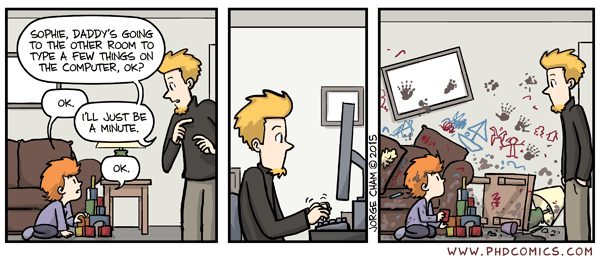
06/17/15 PHD comic: 'Just a minute'
| Piled Higher & Deeper by Jorge Cham |
www.phdcomics.com
|
|
 |
||
|
title:
"Just a minute" - originally published
6/17/2015
For the latest news in PHD Comics, CLICK HERE! |
||
Remlaps likes this
18 Jun 09:30

Strong and Coherent Coupling of a Plasmonic Nanoparticle to a Subwavelength Fabry–Pérot Resonator
by Alexander Konrad, Andreas M. Kern, Marc Brecht and Alfred J. Meixner

Nano Letters
DOI: 10.1021/acs.nanolett.5b00766
17 Jun 21:20
Three-Dimensional Dynamic Localization of Light from a Time-Dependent Effective Gauge Field for Photons
by Luqi Yuan and Shanhui Fan
Author(s): Luqi Yuan and Shanhui Fan
We introduce a method to achieve the three-dimensional dynamic localization of light. We consider a dynamically modulated resonator lattice that has been previously shown to exhibit an effective gauge potential for photons. When such an effective gauge potential varies sinusoidally in time, dynamic …
[Phys. Rev. Lett. 114, 243901] Published Tue Jun 16, 2015
17 Jun 21:19
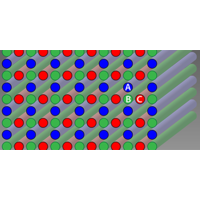
Observation of a Localized Flat-Band State in a Photonic Lieb Lattice
by Sebabrata Mukherjee, Alexander Spracklen, Debaditya Choudhury, Nathan Goldman, Patrik Öhberg, Erika Andersson, and Robert R. Thomson
Author(s): Sebabrata Mukherjee, Alexander Spracklen, Debaditya Choudhury, Nathan Goldman, Patrik Öhberg, Erika Andersson, and Robert R. Thomson
Strong confinement of light in crystalline structures known as Lieb lattices opens up routes to developing new light-trapping schemes.
[Phys. Rev. Lett. 114, 245504] Published Mon Jun 15, 2015
17 Jun 21:19
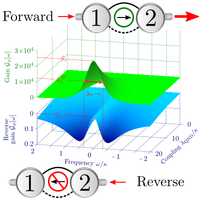
Nonreciprocal Photon Transmission and Amplification via Reservoir Engineering
by A. Metelmann and A. A. Clerk
Author(s): A. Metelmann and A. A. Clerk
Nonreciprocal photonic systems allow for the unidirectional transmission and amplification of photons, which enables a host of applications. A new and general approach for realizing nonreciprocal interactions shows how they can be used to construct quantum-limited amplifiers and isolators.
[Phys. Rev. X 5, 021025] Published Mon Jun 15, 2015
16 Jun 19:13
Spontaneous emission from a quantum dot in a structured photonic reservoir: phonon-mediated breakdown of Fermi's golden rule. (arXiv:1406.3649v3 [cond-mat.mes-hall] UPDATED)
by Kaushik Roy-Choudhury, Stephen Hughes
We describe how a structured photonic medium controls the spontaneous emission rate from an excited quantum dot in the presence of electron-phonon coupling. We analyze this problem using a polaron transformed master equation and we consider specific examples of a photonic crystal cavity and a coupled cavity waveguide. We find that when the relaxation times of the photon and phonon baths are comparable, phonons influence spontaneous emission in a non-trivial way. We demonstrate why and how the broadband frequency dependence of the local photon density of states determines the photon emission rate, manifesting in a complete breakdown of Fermi's golden rule. For a single cavity resonance, we generalize Purcell's formula to include the effects of electron-phonon coupling. For a waveguide, we show a suppression and a 200-fold enhancement of the photon emission rate.
16 Jun 19:04
General description of quasi-adiabatic dynamical phenomena near exceptional points. (arXiv:1410.1882v3 [quant-ph] UPDATED)
by Thomas J. Milburn, Jörg Doppler, Catherine A. Holmes, Stefano Portolan, Stefan Rotter, Peter Rabl
The appearance of so-called exceptional points in the complex spectra of non-Hermitian systems is often associated with phenomena that contradict our physical intuition. One example of particular interest is the state-exchange process predicted for an adiabatic encircling of an exceptional point. In this work we analyse this and related processes for the generic system of two coupled oscillator modes with loss or gain. We identify a characteristic system evolution consisting of periods of quasi-stationarity interrupted by abrupt non-adiabatic transitions, and we present a qualitative and quantitative description of this switching behaviour by connecting the problem to the phenomenon of stability loss delay. This approach makes accurate predictions for the breakdown of the adiabatic theorem as well as the occurrence of chiral behavior observed previously in this context, and provides a general framework to model and understand quasi-adiabatic dynamical effects in non-Hermitian systems.
15 Jun 13:30
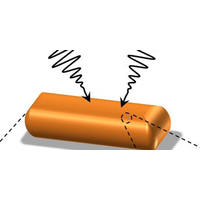
Ultrasensitive Ultrafast Vibrational Spectroscopy Employing the Near Field of Gold Nanoantennas
by O. Selig, R. Siffels, and Y. L. A. Rezus
Author(s): O. Selig, R. Siffels, and Y. L. A. Rezus
Micrometer-scale antennas made from gold may give chemists a peek into the dynamics of molecular bonds.
[Phys. Rev. Lett. 114, 233004] Published Fri Jun 12, 2015
14 Jun 20:18
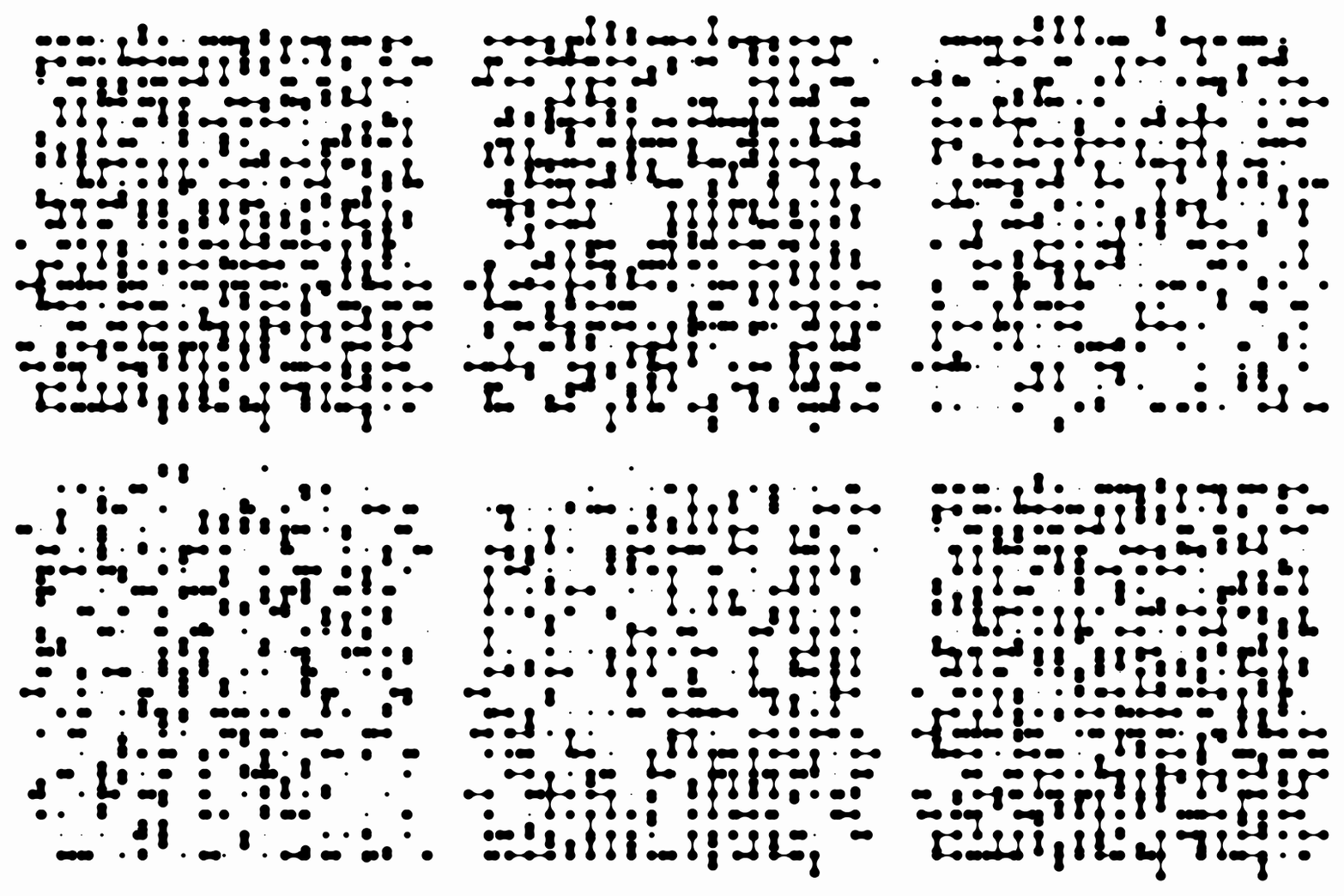
Hyperbolic Plasmons and Topological Transitions Over Uniaxial Metasurfaces
by J. Sebastian Gomez-Diaz, Mykhailo Tymchenko, and Andrea Alù
Author(s): J. Sebastian Gomez-Diaz, Mykhailo Tymchenko, and Andrea Alù
We explore the unusual electromagnetic response of ultrathin anisotropic σ-near-zero uniaxial metasurfaces, demonstrating extreme topological transitions—from closed elliptical to open hyperbolic—for surface plasmon propagation, associated with a dramatic tailoring of the local density of states. Th…
[Phys. Rev. Lett. 114, 233901] Published Thu Jun 11, 2015
10 Jun 21:44
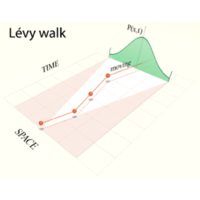
Lévy walks
by V. Zaburdaev, S. Denisov, and J. Klafter
Author(s): V. Zaburdaev, S. Denisov, and J. Klafter
Lévy walks are random walks in which the distribution of step length does not decay exponentially and the velocity of the moving particle is finite. Building on earlier concepts, they reconcile anomalously fast diffusion with a finite propagation speed and have applications that range from basic statistical mechanics and transport theory to optics, cold atom dynamics, and biophysics. This review gives an introduction to this important class of models and discusses applications in both physics and biology.
[Rev. Mod. Phys. 87, 483] Published Tue Jun 09, 2015
Xuzhen199 likes this
10 Jun 16:36
Scheme for Achieving a Topological Photonic Crystal by Using Dielectric Material
by Long-Hua Wu and Xiao Hu
Author(s): Long-Hua Wu and Xiao Hu
We derive in the present work topological photonic states purely based on conventional dielectric material by deforming a honeycomb lattice of cylinders into a triangular lattice of cylinder hexagons. The photonic topology is associated with a pseudo-time-reversal (TR) symmetry constituted by the TR…
[Phys. Rev. Lett. 114, 223901] Published Wed Jun 03, 2015
10 Jun 14:31

Directional and Polarized Emission from Nanowire Arrays
by Dick van Dam, Diego R. Abujetas, Ramón Paniagua-Domínguez, José A. Sánchez-Gil, Erik P. A. M. Bakkers, Jos E. M. Haverkort and Jaime Gómez Rivas

Nano Letters
DOI: 10.1021/acs.nanolett.5b01135
10 Jun 08:38

Optically reconfigurable magnetic materials
by Marc Vogel
Nature Physics 11, 487 (2015). doi:10.1038/nphys3325
Authors: Marc Vogel, Andrii V. Chumak, Erik H. Waller, Thomas Langner, Vitaliy I. Vasyuchka, Burkard Hillebrands & Georg von Freymann
Structuring of materials is the most general approach for controlling waves in solids. As spin waves—eigen-excitations of the electrons’ spin system—are free from Joule heating, they are of interest for a range of applications, such as processing, filtering and short-time data storage. Whereas all these applications rely on predefined constant structures, a dynamic variation of the structures would provide additional, novel applications. Here, we present an approach for producing fully tunable, two-dimensionally structured magnetic materials. Using a laser, we create thermal landscapes in a magnetic medium that result in modulations of the saturation magnetization and in the control of spin-wave characteristics. This method is demonstrated by the realization of fully reconfigurable one- and two-dimensional magnonic crystals—artificial periodic magnetic lattices.
10 Jun 08:35
Effect of the imaginary part of the refractive index on light scattering by spheres
by George Wang
George Wang, Amitabha Chakrabarti, Christopher M. Sorensen
For spheres of arbitrary radius R and complex index of refraction n+iκ, we identify a new parameter that indicates when the imaginary part κ seriously affects the scattering by a sphere. The parameter is κkR, where k is the wave vector magnitude, such that when κkR grows ... [J. Opt. Soc. Am. A 32, 1231-1235 (2015)]
For spheres of arbitrary radius R and complex index of refraction n+iκ, we identify a new parameter that indicates when the imaginary part κ seriously affects the scattering by a sphere. The parameter is κkR, where k is the wave vector magnitude, such that when κkR grows ... [J. Opt. Soc. Am. A 32, 1231-1235 (2015)]
