Currently, no light source exists which is both narrow-band and speckle-free with sufficient brightness for full-field imaging applications. Light emitting diodes (LEDs) are excellent spatially incoherent sources, but are tens of nanometers broad. Lasers on the other hand can produce very narrow-band light, but suffer from high spatial coherence which leads to speckle patterns which distort the image. Here we propose the use of random Raman laser emission as a new kind of light source capable of providing short-pulsed narrow-band speckle-free illumination for imaging applications.
Riccardo Sapienza
Shared posts
16 Jun 19:14
A narrow-band speckle-free light source via random Raman lasing. (arXiv:1505.07156v1 [physics.optics])
by Brett H. Hokr, Morgan S. Schmidt, Joel N. Bixler, Phillip N. Dyer, Gary D. Noojin, Brandon Redding, Robert J. Thomas, Benjamin A. Rockwell, Hui Cao, Vladislav V. Yakovlev, Marlan O. Scully
16 Jun 19:14
Dirac Phase interferometer in a plasmonic waveguide. (arXiv:1505.07735v1 [physics.optics])
by V. Savinov, N. I. Zheludev
By viewing plasmon waves in metallic waveguides as propagating electric and magnetic dipoles we show that according to laws of quantum mechanics they will acquire additional phase when propagating through space with static magnetic field. The new effect is physically different from conventional magneto-plasmonic phenomena and is sufficiently strong to observe it under routinely accessible experimental conditions.
16 Jun 19:14
Selective coupling of optical energy into the fundamental diffusion mode of a scattering medium. (arXiv:1505.08103v2 [physics.optics] UPDATED)
by Oluwafemi S. Ojambati, Hasan Yilmaz, Ad Lagendijk, Allard P. Mosk, Willem L. Vos
We demonstrate experimentally that optical wavefront shaping selectively couples light into the fundamental diffusion mode of a scattering medium. The total energy density inside a scattering medium of zinc oxide (ZnO) nanoparticles was probed by measuring the emitted fluorescent power of spheres that were randomly positioned inside the medium. The fluorescent power of an optimized incident wave front is observed to be enhanced compared to a non-optimized incident front. The observed enhancement increases with sample thickness. Based on diffusion theory, we derive a model wherein the distribution of energy density of wavefront-shaped light is described by the fundamental diffusion mode. The agreement between our model and the data is striking not in the least since there are no adjustable parameters. Enhanced total energy density is crucial to increase the efficiency of white LEDs, solar cells, and of random lasers, as well as to realize controlled illumination in biomedical optics.
29 May 19:53
 Molti conoscono AdBlock Plus, un'estensione per bloccare le pubblicità fastidiose nei browser, ma alcuni lamentano la sua pesantezza e il suo coinvolgimento in problemi legali a causa della sua capacità di concedere favoritismi ad alcuni inserzionisti.
Se Adblock Plus vi sta stretto, potete provare uBlock, un'alternativa gratuita e open source, disponibile per vari browser (Chrome, Firefox, Opera, Safari e altri) e considerato più leggero della concorrenza in termini di consumo di risorse.
Lo scopo dichiarato di uBlock è quello di consentire agli utenti di scegliere personalmente quali contenuti pubblicitari filtrare e quali accettare, per esempio per sostenere i siti graditi, come già fanno più di un milione di utenti. Questo software è sostenuto dalle donazioni degli utenti, cosa che (insieme alla trasparenza offerta dalla sua natura open source) dovrebbe permettere un buon livello d'indipendenza e di correttezza.


Bloccare pubblicità indesiderata nel Web con uBlock
by Paolo Attivissimo
 Molti conoscono AdBlock Plus, un'estensione per bloccare le pubblicità fastidiose nei browser, ma alcuni lamentano la sua pesantezza e il suo coinvolgimento in problemi legali a causa della sua capacità di concedere favoritismi ad alcuni inserzionisti.
Se Adblock Plus vi sta stretto, potete provare uBlock, un'alternativa gratuita e open source, disponibile per vari browser (Chrome, Firefox, Opera, Safari e altri) e considerato più leggero della concorrenza in termini di consumo di risorse.
Lo scopo dichiarato di uBlock è quello di consentire agli utenti di scegliere personalmente quali contenuti pubblicitari filtrare e quali accettare, per esempio per sostenere i siti graditi, come già fanno più di un milione di utenti. Questo software è sostenuto dalle donazioni degli utenti, cosa che (insieme alla trasparenza offerta dalla sua natura open source) dovrebbe permettere un buon livello d'indipendenza e di correttezza.
Scritto da Paolo Attivissimo per il blog Il Disinformatico. Ripubblicabile liberamente se viene inclusa questa dicitura (dettagli). Sono ben accette le donazioni Paypal.
Riccardo Sapienza likes this
29 May 19:49
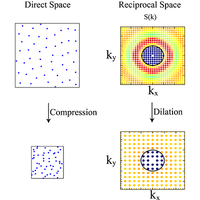
Ensemble Theory for Stealthy Hyperuniform Disordered Ground States
by S. Torquato, G. Zhang, and F. H. Stillinger
Author(s): S. Torquato, G. Zhang, and F. H. Stillinger
Some materials exhibit ground states that are disordered, even in the zero-temperature limit. Researchers derive theoretical relations of thermodynamic and structural properties to describe these unexpected states.
[Phys. Rev. X 5, 021020] Published Fri May 29, 2015
29 May 19:48


Squeezing Photons into a Point-Like Space
by Myung-Ki Kim, Hongchul Sim, Seung Ju Yoon, Su-Hyun Gong, Chi Won Ahn, Yong-Hoon Cho and Yong-Hee Lee

Nano Letters
DOI: 10.1021/acs.nanolett.5b01204
29 May 14:22

Gradient CdSe/CdS Quantum Dots with Room Temperature Biexciton Unity Quantum Yield
by Michel Nasilowski, Piernicola Spinicelli, Gilles Patriarche and Benoît Dubertret

Nano Letters
DOI: 10.1021/acs.nanolett.5b00838
19 May 12:04
Superconducting single photon detectors integrated with diamond nanophotonic circuits. (arXiv:1505.04251v1 [physics.optics])
by Patrik Rath, Oliver Kahl, Simone Ferrari, Fabian Sproll, Georgia Lewes-Malandrakis, Dietmar Brink, Konstantin Ilin, Michael Siegel, Christoph Nebel, Wolfram Pernice
Photonic quantum technologies promise to repeat the success of integrated nanophotonic circuits in non-classical applications. Using linear optical elements, quantum optical computations can be performed with integrated optical circuits and thus allow for overcoming existing limitations in terms of scalability. Besides passive optical devices for realizing photonic quantum gates, active elements such as single photon sources and single photon detectors are essential ingredients for future optical quantum circuits. Material systems which allow for the monolithic integration of all components are particularly attractive, including III-V semiconductors, silicon and also diamond. Here we demonstrate nanophotonic integrated circuits made from high quality polycrystalline diamond thin films in combination with on-chip single photon detectors. Using superconducting nanowires coupled evanescently to travelling waves we achieve high detection efficiencies up to 66 % combined with low dark count rates and timing resolution of 190 ps. Our devices are fully scalable and hold promise for functional diamond photonic quantum devices.
19 May 11:42
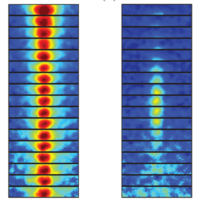
Suppression and Revival of Weak Localization through Control of Time-Reversal Symmetry
by K. Müller, J. Richard, V. V. Volchkov, V. Denechaud, P. Bouyer, A. Aspect, and V. Josse
Author(s): K. Müller, J. Richard, V. V. Volchkov, V. Denechaud, P. Bouyer, A. Aspect, and V. Josse
Controlled manipulation of the time reversal symmetry in a disordered quantum gas is achieved by applying a dephasing pulse.
[Phys. Rev. Lett. 114, 205301] Published Mon May 18, 2015
17 May 19:09
Loss-induced lasing: new findings in laser theory?. (arXiv:1505.03028v2 [physics.optics] UPDATED)
by Stefano Longhi, Giuseppe Della Valle
In a recent work, using a coupled microresonator system with tailored gain and loss parameters B. Peng et al. [Science 346, 328 (2014)] have experimentally reported on an apparently counterintuitive effect in laser theory, namely the possibility to enhance lasing by increasing loss in the system. The observed phenomenon was related to the existence of an exceptional point in the system and was presented somehow as an unexpected and novel effect, especially by some reporters and scientific blogs. In this communication it is pointed out that the phenomenon of loss-induced lasing does not come as a surprise in known laser theory and that it is not necessarily related to the physics of exceptional points. Loss-induced lasing is basically the lasing mechanism that occurs in loss-coupled distributed feedback lasers. This mechanism dates back to the 1970's, has a simple physical explanation and does not rely on the physics of exceptional points.
17 May 19:09
Spin-orbit interactions of light. (arXiv:1505.02864v2 [physics.optics] UPDATED)
by K.Y. Bliokh, F.J. Rodriguez-Fortuno, F. Nori, A.V. Zayats
Light carries spin and orbital angular momentum. These dynamical properties are determined by the polarization and spatial degrees of freedom of light. Modern nano-optics, photonics, and plasmonics, tend to explore subwavelength scales and additional degrees of freedom of structured, i.e., spatially-inhomogeneous, optical fields. In such fields, spin and orbital properties become strongly coupled with each other. We overview the fundamental origins and important applications of the main spin-orbit interaction phenomena in optics. These include: spin-Hall effects in inhomogeneous media and at optical interfaces, spin-dependent effects in nonparaxial (focused or scattered) fields, spin-controlled shaping of light using anisotropic structured interfaces (metasurfaces), as well as robust spin-directional coupling via evanescent near fields. We show that spin-orbit interactions are inherent in all basic optical processes, and they play a crucial role at subwavelength scales and structures in modern optics.
17 May 19:08
Ab-initio multimode linewidth theory for arbitrary inhomogeneous laser cavities. (arXiv:1502.07268v2 [physics.optics] UPDATED)
by Adi Pick, Alex Cerjan, David Liu, Alejandro W. Rodriguez, A. Douglas Stone, Yidong D. Chong, Steven G. Johnson
We present a multimode laser-linewidth theory for arbitrary cavity structures and geometries that contains nearly all previously known effects and also finds new nonlinear and multimode corrections, e.g. a bad-cavity correction to the Henry $\alpha$ factor and a multimode Schawlow--Townes relation (each linewidth is proportional to a sum of inverse powers of all lasing modes). Our theory produces a quantitatively accurate formula for the linewidth, with no free parameters, including the full spatial degrees of freedom of the system. Starting with the Maxwell--Bloch equations, we handle quantum and thermal noise by introducing random currents whose correlations are given by the fluctuation--dissipation theorem. We derive coupled-mode equations for the lasing-mode amplitudes and obtain a formula for the linewidths in terms of simple integrals over the steady-state lasing modes.
17 May 19:07
Lower bound for the spatial extent of localized modes in photonic-crystal waveguides with small random imperfections. (arXiv:1505.03472v3 [physics.optics] UPDATED)
by Rémi Faggiani, Alexandre Baron, Xiaorun Zang, Loïc Lalouat, Sebastien A. Schulz, Kevin Vynck, Bryan O'Regan, Benoît Cluzel, Frédérique de Fornel, Thomas F. Krauss, Philippe Lalanne
Light localization due to random imperfections in periodic media is paramount in photonics research. The group index is known to be a key parameter for localization near photonic band edges, since small group velocities reinforce light interaction with imperfections. Here, we show that the size of the smallest localized mode that is formed at the band edge of a one-dimensional periodic medium is driven instead by the effective photon mass, i.e. the flatness of the dispersion curve. Our theoretical prediction is supported by numerical simulations, which reveal that photonic-crystal waveguides can exhibit surprisingly small localized modes, much smaller than those observed in Bragg stacks thanks to their larger effective photon mass. This possibility is demonstrated experimentally with a photonic-crystal waveguide fabricated without any intentional disorder, for which near-field measurements allow us to distinctly observe a wavelength-scale localized mode despite the smallness ($\sim 1/1000$ of a wavelength) of the fabrication imperfections.
17 May 19:07
High-Q coupled resonances on a PhC waveguide using a tapered nanofiber with high coupling efficiency. (arXiv:1505.03628v1 [physics.optics])
by Tomohiro Tetsumoto, Yuta Ooka, Tanabe Takasumi
We experimentally demonstrate high-Q cavity formation at an arbitrary position on a silicon photonic crystal waveguide by bringing a tapered nanofiber into contact with the surface of the slab. An ultrahigh Q of 5.1 x 10^5 is obtained with a coupling efficiency of 39%, whose resonant wavelength can be finely tuned by 27 pm by adjusting the contact length of the nanofiber. We also demonstrate an extremely high coupling efficiency of 99.6% with a loaded Q of 6.1 x 10^3. In addition, we show that we can obtain an all-pass filter type coupled resonator system, which has the potential to be used for slow light generation.
16 May 09:06

Strong Enhancement of Second Harmonic Emission by Plasmonic Resonances at the Second Harmonic Wavelength
by Bernd Metzger, Lili Gui, Jaco Fuchs, Dominik Floess, Mario Hentschel and Harald Giessen

Nano Letters
DOI: 10.1021/acs.nanolett.5b00747
15 May 15:55
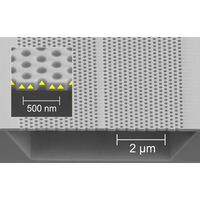
Interfacing single photons and single quantum dots with photonic nanostructures
by Peter Lodahl, Sahand Mahmoodian, and Søren Stobbe
Author(s): Peter Lodahl, Sahand Mahmoodian, and Søren Stobbe
Quantum dots embedded in photonics nanostructures provide unprecedented control over the interaction between light and matter. This review gives an overview of the theoretical principles involved, as well as applications ranging from high-precision quantum electrodynamics experiments to quantum-information processing.
[Rev. Mod. Phys. 87, 347] Published Mon May 11, 2015
14 May 21:16

Structural Diversity of Arthropod Biophotonic Nanostructures Spans Amphiphilic Phase-Space
by Vinodkumar Saranathan, Ainsley E. Seago, Alec Sandy, Suresh Narayanan, Simon G. J. Mochrie, Eric R. Dufresne, Hui Cao, Chinedum O. Osuji and Richard O. Prum

Nano Letters
DOI: 10.1021/acs.nanolett.5b00201
14 May 12:45
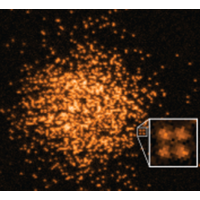
Quantum-Gas Microscope for Fermionic Atoms
by Lawrence W. Cheuk, Matthew A. Nichols, Melih Okan, Thomas Gersdorf, Vinay V. Ramasesh, Waseem S. Bakr, Thomas Lompe, and Martin W. Zwierlein
Author(s): Lawrence W. Cheuk, Matthew A. Nichols, Melih Okan, Thomas Gersdorf, Vinay V. Ramasesh, Waseem S. Bakr, Thomas Lompe, and Martin W. Zwierlein
A quantum microscope able to image individual atoms of optically trapped fermionic potassium has been developed by combining 3D Raman sideband cooling along with high-resolution optics.
[Phys. Rev. Lett. 114, 193001] Published Wed May 13, 2015
13 May 14:23
Theory and experiments of disorder-induced resonance shifts and mode edge broadening in deliberately disordered photonic crystal waveguides. (arXiv:1505.02836v1 [physics.optics])
by Nishan Mann, Alisa Javadi, P.D. García, Peter Lodahl, Stephen Hughes
We study both theoretically and experimentally the effects of introducing deliberate disorder in a slow-light photonic crystal waveguide on the photon density of states. We first introduce a theoretical model that includes both deliberate disorder through statistically moving the hole centres in the photonic crystal lattice and intrinsic disorder caused by manufacturing imperfections. We demonstrate a disorder-induced mean blueshift and an overall broadening of the photonic density of states for various amounts of deliberate disorder. By comparing with measurements from a GaAs photonic crystal waveguide, we find good qualitative agreement between theory and experiment which highlights the importance of carefully including local field effects for modelling high-index contrast perturbations. Our work also demonstrates the importance of using asymmetric dielectric polarizabilities for modelling positive and negative dielectric perturbations when modelling a perturbed dielectric interface in photonic crystal platforms.
11 May 15:07
Long distance manipulation of a levitated nanoparticle in high vacuum. (arXiv:1505.02012v3 [physics.optics] UPDATED)
by Pau Mestres, Johann Berthelot, Marko Spasenović, Jan Gieseler, Lukas Novotny, Romain Quidant
Accurate delivery of small targets in high vacuum is a pivotal task in many branches of science and technology. Beyond the different strategies developed for atoms, proteins, macroscopic clusters and pellets, the manipulation of neutral particles over macroscopic distances still poses a formidable challenge. Here we report a novel approach based on a mobile optical trap operated under feedback control that enables long range 3D manipulation of a silica nanoparticle in high vacuum. We apply this technique to load a single nanoparticle into a high-finesse optical cavity through a load-lock vacuum system. We foresee our scheme to benefit the field of optomechanics with levitating nano-objects as well as ultrasensitive detection and monitoring.
11 May 15:06
Scattering of a plasmonic nanoantenna embedded in a silicon waveguide. (arXiv:1505.01997v1 [physics.optics])
by Marta Castro-Lopez, Nuno de Sousa, Antonio Garcia-Martin, Frederic Y. Gardes, Riccardo Sapienza
Plasmonic antennas integrated on silicon devices have large and yet unexplored potential for controlling and routing light signals. Here, we present theoretical calculations of a hybrid silicon-metallic system in which a single gold nanoantenna embedded in a single-mode silicon waveguide acts as a resonance-driven filter. As a consequence of scattering and interference, when the resonance condition of the antenna is met, the transmission drops by 85% in the resonant frequency band. Firstly, we study analytically the interaction between the propagating mode and the antenna by including radiative corrections to the scattering process and the polarization of the waveguide walls. Secondly, we find the configuration of maximum interaction and numerically simulate a realistic nanoantenna in a silicon waveguide. The numerical calculations show a large suppression of transmission and three times more scattering than absorption, consequent with the analytical model. The system we propose can be easily fabricated by standard silicon and plasmonic lithographic methods, making it promising as real component in future optoelectronic circuits.
08 May 13:13
Control of coherent backscattering by breaking optical reciprocity. (arXiv:1505.01507v1 [physics.optics])
by Y. Bromberg, B. Redding, S. M. Popoff, H. Cao
Reciprocity is a universal principle that has a profound impact on many areas of physics. A fundamental phenomenon in condensed-matter physics, optical physics and acoustics, arising from reciprocity, is the constructive interference of quantum or classical waves which propagate along time-reversed paths in disordered media, leading to, for example, weak localization and metal-insulator transition. Previous studies have shown that such coherent effects are suppressed when reciprocity is broken. Here we show that by breaking reciprocity in a controlled manner, we can tune, rather than simply suppress, these phenomena. In particular, we manipulate coherent backscattering of light, also known as weak localization. By utilizing a non-reciprocal magneto-optical effect, we control the interference between time-reversed paths inside a multimode fiber with strong mode mixing, and realize a continuous transition from the well-known peak to a dip in the backscattered intensity. Our results may open new possibilities for coherent control of classical and quantum waves in complex systems
08 May 13:11

Plasmomechanical Resonators Based on Dimer Nanoantennas
by Rutger Thijssen, Tobias J. Kippenberg, Albert Polman and Ewold Verhagen

Nano Letters
DOI: 10.1021/acs.nanolett.5b00858
08 May 13:07

Demonstration of a Memory for Tightly Guided Light in an Optical Nanofiber
by B. Gouraud, D. Maxein, A. Nicolas, O. Morin, and J. Laurat
Author(s): B. Gouraud, D. Maxein, A. Nicolas, O. Morin, and J. Laurat
Light signals propagating down an ultrathin fiber can be temporarily stored in a cloud of cold atoms surrounding the fiber.
[Phys. Rev. Lett. 114, 180503] Published Thu May 07, 2015
07 May 13:00
Exponentially Tempered Lévy Sums in Random Lasers
by Ravitej Uppu and Sushil Mujumdar
Author(s): Ravitej Uppu and Sushil Mujumdar
Lévy fluctuations have associated infinities due to diverging moments, a problem that is circumvented by putting restrictions on the magnitude of the fluctuations, realizing a process called the truncated Lévy flight. We show that a perfect manifestation of this exotic process occurs in coherent ran…
[Phys. Rev. Lett. 114, 183903] Published Tue May 05, 2015
Jacopo.bertolotti likes this
07 May 12:59

Plasmon Enhanced Internal Photoemission in Antenna-Spacer-Mirror Based Au/TiO2 Nanostructures
by Yurui Fang, Yang Jiao, Kunli Xiong, Robin Ogier, Zhong-Jian Yang, Shiwu Gao, Andreas B. Dahlin and Mikael Käll

Nano Letters
DOI: 10.1021/acs.nanolett.5b01070
07 May 12:59
All-Optical Nanomechanical Heat Engine
by Andreas Dechant, Nikolai Kiesel, and Eric Lutz
Author(s): Andreas Dechant, Nikolai Kiesel, and Eric Lutz
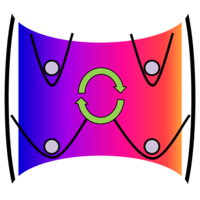
A nanoparticle levitated in an optical cavity is proposed as a Stirling type heat engine – where the particle is driven through a cooling-heating sequence that changes the mechanical oscillations of the systems and generates heat.
[Phys. Rev. Lett. 114, 183602] Published Wed May 06, 2015
06 May 19:30
People you should've heard about: John Bardeen
by Douglas Natelson
If you ask the average person to name a physicist, chances are they'll mention Einstein, Hawking, and possibly Sheldon Cooper. Maybe Richard Feynman, Brian Greene or (*sigh*) Michio Kaku. I'd like to have an occasional series of posts pointing out people that should be well-known, but for some reason are not. High up on that list: John Bardeen, who is the only person one of only two people to win two Nobel prizes in the same field.
Bardeen, like many of his contemporaries, followed what would now be considered a meandering, unconventional trajectory into physics, starting out as an undergrad engineer at Wisconsin, working as a geophysicist, enrolling as a math grad student at Princeton, and eventually doing a doctoral thesis with Wigner worrying about electron-electron interactions in metals (resulting in these two papers about how much energy it takes to remove an electron from a metal, and how that can be strongly affected by the very last layer of atoms at the surface - in the 1980s this would be called "surface science" and now it would be called "nanoscience").
Bardeen was a quiet, brilliant person. After WWII (during which he worked for the Navy), he went to Bell Labs, where he worked with Walter Brattain to invent the point contact transistor (and much more disagreeably with William Shockley), explaining the critical importance of "surface states" (special levels for the electrons in a semiconductor that exist at the surface, where the periodic potential of the lattice is terminated). Shockley is viewed in hindsight as famously unpleasant as a co-worker/boss - Bardeen left Bell Labs in large part because of this and ended up at Illinois, where seven years later he worked with Bob Schrieffer and Leon Cooper to produce the brilliant BCS theory of superconductivity, earning his second Nobel. (Shockley's borderline abusive management style is also responsible for the creation of modern Silicon Valley, but that's another story.)
During and after this period, Bardeen helped build the physics department of UIUC into a condensed matter physics powerhouse, a position it continues to hold. He was very interested in the theory of charge density waves (special states where the electrons in a solid spontaneously take on a spatially periodic density), though according to Lillian Hoddeson's excellent book (see here, too) he had lost the intellectual flexibility of his youth by this time.
Bardeen contributed greatly to our understanding and advancement of two whole classes of technologies that have reshaped the world (transistors and superconductors). He was not a flamboyant personality like Feynman (after all, he was from the Midwest :-) ), and he was not a self-promoter (like Feynman), but he absolutely deserves greater notoriety and appreciation from the general public.
Bardeen, like many of his contemporaries, followed what would now be considered a meandering, unconventional trajectory into physics, starting out as an undergrad engineer at Wisconsin, working as a geophysicist, enrolling as a math grad student at Princeton, and eventually doing a doctoral thesis with Wigner worrying about electron-electron interactions in metals (resulting in these two papers about how much energy it takes to remove an electron from a metal, and how that can be strongly affected by the very last layer of atoms at the surface - in the 1980s this would be called "surface science" and now it would be called "nanoscience").
Bardeen was a quiet, brilliant person. After WWII (during which he worked for the Navy), he went to Bell Labs, where he worked with Walter Brattain to invent the point contact transistor (and much more disagreeably with William Shockley), explaining the critical importance of "surface states" (special levels for the electrons in a semiconductor that exist at the surface, where the periodic potential of the lattice is terminated). Shockley is viewed in hindsight as famously unpleasant as a co-worker/boss - Bardeen left Bell Labs in large part because of this and ended up at Illinois, where seven years later he worked with Bob Schrieffer and Leon Cooper to produce the brilliant BCS theory of superconductivity, earning his second Nobel. (Shockley's borderline abusive management style is also responsible for the creation of modern Silicon Valley, but that's another story.)
During and after this period, Bardeen helped build the physics department of UIUC into a condensed matter physics powerhouse, a position it continues to hold. He was very interested in the theory of charge density waves (special states where the electrons in a solid spontaneously take on a spatially periodic density), though according to Lillian Hoddeson's excellent book (see here, too) he had lost the intellectual flexibility of his youth by this time.
Bardeen contributed greatly to our understanding and advancement of two whole classes of technologies that have reshaped the world (transistors and superconductors). He was not a flamboyant personality like Feynman (after all, he was from the Midwest :-) ), and he was not a self-promoter (like Feynman), but he absolutely deserves greater notoriety and appreciation from the general public.
Cary Renquist likes this
06 May 14:31
Speckle intensity correlations of photons scattered by cold atoms. (arXiv:1505.00923v3 [cond-mat.dis-nn] UPDATED)
by Cord A. Müller, Benoît Grémaud, Christian Miniatura
The irradiation of a dilute cloud of cold atoms with a coherent light field produces a random intensity distribution known as laser speckle. Its statistical fluctuations contain information about the mesoscopic scattering processes at work inside the disordered medium. Following up on earlier work by Assaf and Akkermans [Phys.\ Rev.\ Lett.\ \textbf{98}, 083601 (2007)], we analyze how static speckle intensity correlations are affected by an internal Zeeman degeneracy of the scattering atoms. It is proven on general grounds that the speckle correlations cannot exceed the standard Rayleigh law. On the contrary, because which-path information is stored in the internal atomic states, the intensity correlations suffer from strong decoherence and become exponentially small in the diffusive regime applicable to an optically thick cloud.
05 May 15:48
Long-Ranged Oppositely Charged Interactions for Designing New Types of Colloidal Clusters
by Ahmet Faik Demirörs, Johan C. P. Stiefelhagen, Teun Vissers, Frank Smallenburg, Marjolein Dijkstra, Arnout Imhof, and Alfons van Blaaderen
Author(s): Ahmet Faik Demirörs, Johan C. P. Stiefelhagen, Teun Vissers, Frank Smallenburg, Marjolein Dijkstra, Arnout Imhof, and Alfons van Blaaderen
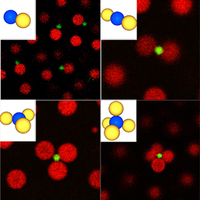
Using basic building blocks to assemble colloids analogous to molecules may pave the way for developing new metamaterials. A new method allows different “molecule” shapes to be controlled using particle size ratio, charge ratio ion concentrations, and external electric fields.
[Phys. Rev. X 5, 021012] Published Wed Apr 29, 2015