vinegar smells bad. i use citric acid in distilled water these days. doesn't smell great, but it's better than acetic acid.
If your faucet is spraying water all over the place when you turn it on, it could be caused by mineral buildup. This vinegar trick will get things running smoothly again.
After years of legal battles, isoHunt and its founder Gary Fung are free at last.
Today, Fung announced that he has settled the last remaining lawsuit with Music Canada, formerly known as the Canadian Recording Industry Association (CRIA).
“After 10 long years, I’m happy to announce the end of isoHunt’s and my lawsuits,” Fung says, noting that he now owes the Canadian music group $66 million.
The multi-million dollar agreement follows an earlier settlement with the MPAA, for $110 million, on paper. While most site owners would be devastated, Fung has long moved beyond that phase and responds rather sarcastically.
“And I want to congratulate both Hollywood and CRIA on their victories, in letting me off with fines of $110m and $66m, respectively. Thank you!” he notes, adding that he’s “free at last”.
The consent order (pdf) signed by the Supreme Court of British Columbia prohibits isoHunt’s founder from operating any file-sharing site in the future.
It further requires Fung to pay damages of $55 million and another $10 million in aggravated punitive damages. The final million dollars is issued to cover the costs of the lawsuit.
Although isoHunt shut down 2013, it took more than two years for the last case to be finalized. The dispute initially began in the last decennium, when the Canadian music industry went after several prominent torrent sites.
In May 2008, isoHunt received a Cease and Desist letter from the CRIA in which they demanded that isoHunt founder Gary Fung should take the site offline. If Fung didn’t comply, the CRIA said it would pursue legal action, and demand $20,000 for each sound recording the site has infringed.
A similar tactic worked against Demonoid, but the isoHunt founder didn’t back down so easily. Instead, he himself filed a lawsuit against the CRIA asking the court to declare the site legal.
That didn’t work out as isoHunt’s founder had planned, and several years later the tables have been turned entirely, with the defeat now becoming final.
While the outcome won’t change anything about isoHunt’s demise, Fung is proud that he was always able to shield its users from the various copyright groups attacking it. No identifiable user data was shared at any point.
Fung is also happy for the support the site’s users have given him over the years.
“I can proudly conclude that I’ve kept my word regarding users’ privacy above. To isoHunt’s avid users, it’s worth repeating since I shutdown isoHunt in 2013, that you have my sincerest thanks for your continued support,” Fung notes.
“Me and my staff could not have done it for more than 10 years without you, and that’s an eternity in internet time. It was an interesting and challenging journey for me to say the least, and the most profound business learning experience I could not expect.”
The Canadian entrepreneur can now close the isoHunt book for good and move on to new ventures. One of the projects he just announced is a mobile search tool called “App to Automate Googling” AAG for which he invites alpha testers.
The original isoHunt site now redirects to MPAA’s “legal” search engine WhereToWatch. However, the name and design lives on via the clone site IsoHunt.to, which still draws millions of visitors per month – frustrating for the MPAA and Music Canada.
My name is Matthew Green. I am a professor of computer science and a researcher at Johns Hopkins University in Baltimore. I focus on computer security and applied cryptography.
Today I filed a lawsuit against the U.S. government, to strike down Section 1201 of the Digital Millennium Copyright Act. This law violates my First Amendment right to gather information and speak about an urgent matter of public concern: computer security. I am asking a federal judge to strike down key parts of this law so they cannot be enforced against me or anyone else.
A large portion of my work involves building and analyzing the digital security systems that make our modern technological world possible. These include security systems like the ones that protect your phone calls, instant messages, and financial transactions – as well as more important security mechanisms that safeguard property and even human life.
I focus a significant portion of my time on understanding the security systems that have been deployed by industry. In 2005, my team found serious flaws in the automotive anti-theft systems used in millions of Ford, Toyota and Nissan vehicles. More recently, my co-authors and I uncovered flaws in the encryption that powers nearly one third of the world’s websites, including Facebook and the National Security Agency. Along with my students, I've identified flaws in Apple’s iMessage text messaging system that could have allowed an eavesdropper to intercept your communications. And these are just a sampling of the public research projects I’ve been involved with.
I don’t do this work because I want to be difficult. Like most security researchers, the research I do is undertaken in good faith. When I find a flaw in a security system, my first step is to call the organization responsible. Then I help to get the flaw fixed. Such independent security research is an increasingly precious commodity. For every security researcher who investigates systems in order to fix them, there are several who do the opposite – and seek to profit from the insecurity of the computer systems our society depends on.
There’s a saying that no good deed goes unpunished. The person who said this should have been a security researcher. Instead of welcoming vulnerability reports, companies routinelythreaten good-faith security researchers with civil action, or even criminal prosecution. Companies use the courts to silence researchers who have embarrassing things to say about their products, or who uncover too many of those products' internal details. These attempts are all too often successful, in part because very few security researchers can afford a prolonged legal battle with well-funded corporate legal team.
This might just be a sad story about security researchers, except for the fact that these vulnerabilities affecteveryone. When security researchers are intimidated, it’s the public that pays the price. This is because real criminals don’t care about lawsuits and intimidation – and they certainly won’t bother to notify the manufacturer. If good-faith researchers aren’t allowed to find and close these holes, then someone else will find them, walk through them, and abuse them.
In the United States, one of the most significant laws that blocks security researchers is Section 1201 of the Digital Millennium Copyright Act (DMCA). This 1998 copyright law instituted a raft of restrictions aimed at preventing the “circumvention of copyright protection systems.” Section 1201 provides both criminal and civil penalties for people who bypass technological measures protecting a copyrighted work. While that description might bring to mind the copy protection systems that protect a DVD or an iTunes song, the law has also been applied to prevent users from reverse-engineering software to figure out how it works. Such reverse-engineering is a necessary party of effective security research.
Section 1201 poses a major challenge for me as a security researcher. Nearly every attempt to analyze a software-based system presents a danger of running afoul of the law. As a result, the first step in any research project that involves a commercial system is never science – it’s to call a lawyer; to ask my graduate students to sign a legal retainer; and to inform them that even with the best legal advice, they still face the possibility of being sued and losing everything they have. This fear chills critical security research.
Section 1201 also affects the way that my research is conducted. In a recent project – conducted in Fall 2015 – we were forced to avoid reverse-engineering a piece of software when it would have been the fastest and most accurate way to answer a research question. Instead, we decided to treat the system as a black box, recovering its operation only by observing inputs and outputs. This approach often leads to a less perfect understanding of the system, which can greatly diminish the quality of security research. It also substantially increases the time and effort required to finish a project, which reduces the quantity of security research.
Finally, I have been luckier than most security researchers in that I have access to legal assistance from organizations such as the Electronic Frontier Foundation. Not every security researcher can benefit from this.
The risk imposed by Section 1201 and the heavy cost of steering clear of it discourage me – and other researchers -- from pursuing any project that does not appear to have an overwhelming probability of success. This means many projects that would yield important research and protect the public simply do not happen.
In 2015, I filed a request with the Library of Congress for a special exemption that would have exempted good faith security researchers from the limitations of Section 1201. Representatives of the major automobile manufacturers and the Business Software Alliance (a software industry trade group) vigorously opposed the request. This indicates to me that even reasonable good faith security testing is still a risky proposition.
This risk is particularly acute given that the exemption we eventually won was much more limited than what we asked for, and leaves out many of the technologies with the greatest impact on public health, privacy, and the security of financial transactions.
Section 1201 has prevented crucial security research for far too long. That’s why I’m seeking a court order that would strike Section 1201 from the books as a violation of the First Amendment.
About The Eric Andre Show: The Eric André Show is Adult Swim's highest budget late night talk show. That budget is mostly spent on new sets and Eric André's copious legal fees from his avant-garde street pranks. Aside from pranks, André and cohost Hannibal Buress interview all of your favorite celebrities from yesteryear. Check out every episode of The Eric André Show now on AdultSwim.com.
About Adult Swim: Adult Swim is your late-night home for animation and live-action comedy. Enjoy some of your favorite shows, including Robot Chicken, Venture Bros., Tim and Eric, Aqua Teen, Childrens Hospital, Delocated, Metalocalypse, Squidbillies, and more. Watch some playlists. Fast forward, rewind, pause. It's all here. And remember to visit AdultSwim.com for all your full episode needs. We know you wouldn't forget, but it never hurts to make sure.
I'm turning off commenting for my blogs. While I've enjoyed some feedback, the time wasted to moderate spam posts just isn't worth it. Thank you, spammers! :-(
To the huge disappointment of millions of BitTorrent users, KickassTorrents disappeared this week following an investigation by the Department of Homeland Security in the United States.
With a huge hole now present at the top of the torrent landscape, other sites plus interested groups and individuals will be considering their options. Step up their game and take over the top slot? Cautiously maintain the status quo? Or pull out altogether…
Make no mistake, this is a game of great reward, matched only by the risk. If the DHS complaint is to be believed, Kickass made dozens of millions of euros, enough to tempt even the nerviest of individuals. But while that might attract some, is avoiding detection almost impossible these days?
The complaint against KAT shows that while not inevitable, it’s becoming increasingly difficult. It also shows that carelessness plays a huge part in undermining security and that mistakes made by others in the past are always worth paying attention to.
Servers in the United States
Perhaps most tellingly, in the first instance KAT failed to learn from the ‘mistakes’ made by Megaupload. While the cases are somewhat dissimilar, both entities chose to have a US presence for at least some of their servers. This allowed US authorities to get involved. Not a great start.
“[Since 2008], KAT has relied on a network of computer servers around the world to operate, including computer servers located in Chicago, Illinois,” the complaint against the site reads.
The Chicago server weren’t trivial either.
“According to a reverse DNS search conducted by the hosting company on or about May 5, 2015, that server was the mail client ‘mail.kat.ph’.”
Torrent site mail servers. In the United States. What could go possibly go wrong?
In a word? Everything. In January 2016, DHS obtained a search warrant and cloned the Chicago servers. Somewhat unsurprisingly this gifted investigating agent Jared Der-Yeghiayan (the same guy who infiltrated Silk Road) valuable information.
“I located multiple files that contained unique user information, access logs, and other information. These files include a file titled ‘passwd’ located in the ‘etc’ directory, which was last accessed on or about January 13, 2016, and which identified the users who had access to the operating system,” Der-Yeghiayan said.
Servers in Canada
KAT also ran several servers hosted with Montreal-based Netelligent Hosting Services. There too, KAT was vulnerable.
In response to a Mutual Legal Assistance Treaty request, in April 2016 the Royal Canadian Mounted Police obtained business records associated with KAT’s account and made forensic images of the torrent site’s hard drives.
Why KAT chose Netelligent isn’t clear, but the site should have been aware that the hosting company would be forced to comply with law enforcement requests. After all, it had happened at least once before in a case involving Swedish torrent site, Sparvar.
Mistakes at the beginning
When pirate sites first launch, few admins expect them to become world leaders. If they did, they’d probably approach things a little differently at the start. In KAT’s case, alleged founder Artem Vaulin registered several of the site’s domains in his own name, information that was happily handed to the DHS by US-based hosting company GoDaddy.
Vaulin also used a Gmail account, operated by US-based Google. The complaint doesn’t explicitly say that Google handed over information, but it’s a distinct possibility. In any event, an email sent from that account in 2009 provided a helpful bridge to investigators.
“I changed my gmail. now it’s admin@kickasstorrents.com,” it read.
Forging further connections from his private email accounts to those operated from KAT, in 2012 Vaulin sent ‘test’ emails from KAT email addresses to his Apple address. This, HSI said, signaled the point that Vaulin began using KAT emails for business.
No time to relax, even socially
In addition to using an email account operated by US-based Apple, (in which HSI found Vaulin’s passport and driver’s license details, plus his banking info), the Ukranian also had an iTunes account.
Purchases he made there were logged by Apple, down to the IP address. Then, thanks to information provided by US-based Facebook (notice the recurring Stateside theme?), HSI were able to match that same IP address against a login to KAT’s Facebook page.
Anonymous Bitcoin – not quite
If the irony of the legitimate iTunes purchases didn’t quite hit the spot, the notion that Bitcoin could land someone in trouble should tick all the boxes. According to the complaint, US-based Bitcoin exchange Coinbase handed over information on Vaulin’s business to HSI.
“Records received from the bitcoin exchange company Coinbase revealed that the KAT Bitcoin Donation Address sent bitcoins it received to a user’s account maintained at Coinbase. This account was identified as belonging to Artem Vaulin located in Kharkov, Ukraine,” it reads.
Final thoughts
For a site that the US Government had always insisted was operating overseas, KickassTorrents clearly had a huge number of United States connections. This appears to have made the investigation much more simple than it would have been had the site and its owner had maintained a presence solely in Eastern Europe.
Why the site chose to maintain these connections despite the risks might never be answered, but history has shown us time and again that US-based sites are not only vulnerable but also open to the wrath of the US Government. With decades of prison time at stake, that is clearly bad news.
But for now at least, Vaulin is being detained in Poland, waiting to hear of his fate. Whether or not he’ll quickly be sent to the United States is unclear, but it seems unlikely that a massively prolonged Kim Dotcom-style extradition battle is on the agenda. A smaller one might be, however.
While the shutdown of KAT and the arrest of its owner came out of the blue, the writing has always been on the wall. The shutdown is just one of several momentous ‘pirate’ events in the past 18 months including the closure (and resurrection) of The Pirate Bay, the dismantling of the main Popcorn Time fork, and the end of YTS/YIFY.
About Adult Swim: Adult Swim is your late-night home for animation and live-action comedy. Enjoy some of your favorite shows, including Robot Chicken, Venture Bros., Tim and Eric, Aqua Teen, Childrens Hospital, Delocated, Metalocalypse, Squidbillies, and more. Watch some playlists. Fast forward, rewind, pause. It's all here. And remember to visit AdultSwim.com for all your full episode needs. We know you wouldn't forget, but it never hurts to make sure.
About Squidbillies: Squidbillies is Adult Swim's only backwoods comedy starring Appalachian mud squids. Brought to you by Dave Willis (Aqua Teen Hunger Force) and Jim Fortier, Squidbillies is the story of a dysfunctional redneck family and the equally defective Georgia town from which they hail. Early, Granny, and Rusty are proud, beer guzzling, Southern taxpayers who don't take kindly to government intervention or not getting their welfare checks. Come see their ongoing efforts to protect your second amendment rights at http://AdultSwim.com.
About Adult Swim: Adult Swim is your late-night home for animation and live-action comedy. Enjoy some of your favorite shows, including Robot Chicken, Venture Bros., Tim and Eric, Aqua Teen, Childrens Hospital, Delocated, Metalocalypse, Squidbillies, and more. Watch some playlists. Fast forward, rewind, pause. It's all here. And remember to visit http://AdultSwim.com for all your full episode needs. We know you wouldn't forget, but it never hurts to make sure.
About Squidbillies: Squidbillies is Adult Swim's only backwoods comedy starring Appalachian mud squids. Brought to you by Dave Willis (Aqua Teen Hunger Force) and Jim Fortier, Squidbillies is the story of a dysfunctional redneck family and the equally defective Georgia town from which they hail. Early, Granny, and Rusty are proud, beer guzzling, Southern taxpayers who don't take kindly to government intervention or not getting their welfare checks. Come see their ongoing efforts to protect your second amendment rights at http://AdultSwim.com.
About Adult Swim: Adult Swim is your late-night home for animation and live-action comedy. Enjoy some of your favorite shows, including Robot Chicken, Venture Bros., Tim and Eric, Aqua Teen, Childrens Hospital, Delocated, Metalocalypse, Squidbillies, and more. Watch some playlists. Fast forward, rewind, pause. It's all here. And remember to visit http://AdultSwim.com for all your full episode needs. We know you wouldn't forget, but it never hurts to make sure.
With millions of unique visitors per day KickassTorrents (KAT) has become the most-used torrent site on the Internet, beating even The Pirate Bay.
Today, however, the site has run into a significant roadblock after U.S. authorities announced the arrest of the site’s alleged owner.
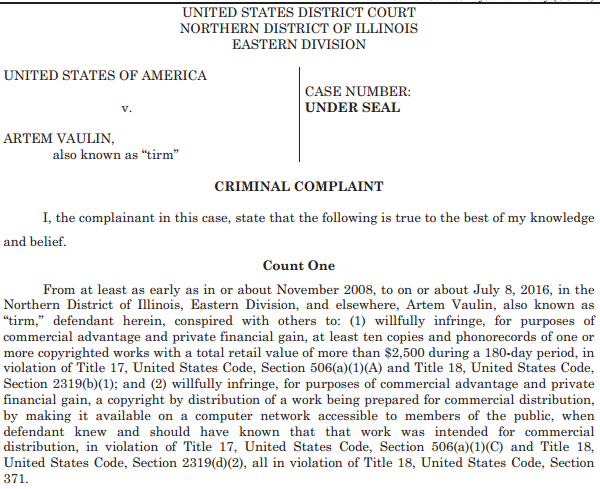
The 30-year-old Artem Vaulin, from Ukraine, was arrested today in Poland from where the United States has requested his extradition.
In a criminal complaint filed in U.S. District Court in Chicago, the alleged owner is charged with conspiracy to commit criminal copyright infringement, conspiracy to commit money laundering, and two counts of criminal copyright infringement.
The complaint further reveals that the feds posed as an advertiser, which revealed a bank account associated with the site.
It also shows that Apple handed over personal details of Vaulin after the investigator cross-referenced an IP-address used for an iTunes transaction with an IP-address that was used to login to KAT’s Facebook account.
“Records provided by Apple showed that tirm@me.com conducted an iTunes transaction using IP Address 109.86.226.203 on or about July 31, 2015. The same IP Address was used on the same day to login into the KAT Facebook,” the complaint reads.
In addition to the arrest in Poland, the court also granted the seizure of a bank account associated with KickassTorrents, as well as several of the site’s domain names.
Commenting on the announcement, Assistant Attorney General Caldwell said that KickassTorrents helped to distribute over $1 billion in pirated files.
“Vaulin is charged with running today’s most visited illegal file-sharing website, responsible for unlawfully distributing well over $1 billion of copyrighted materials.”
“In an effort to evade law enforcement, Vaulin allegedly relied on servers located in countries around the world and moved his domains due to repeated seizures and civil lawsuits. His arrest in Poland, however, demonstrates again that cybercriminals can run, but they cannot hide from justice.”
KAT’s .com and .tv domains are expected to be seized soon by Verisign. For the main Kat.cr domain and several others, seizure warrants will be sent to the respective authorities under the MLAT treaty.
At the time of writing the main domain name Kat.cr has trouble loading, but various proxies still appear to work. KAT’s status page doesn’t list any issues, but we assume that this will be updated shortly.
TorrentFreak has reached out to the KAT team for a comment on the news and what it means for the site’s future, but we have yet to hear back.
Niccolò Caranti hopes that this "will help clarify that 'free license' is not the same thing as 'public domain'; it does not mean 'you can do whatever you want without conditions.' "
The delivery guys are used to it. They know when a couple starts fucking, sometimes they get scared to put clothes back on and go back outside because outside is where people make them do stuff like work or have conversations, basically do things other than fuck or lay around grazing each other’s skin with the backs of their fingertips.
You brought this guy into your bedroom like 5 weeks ago and you’re hoping to get at least 4 more weeks of uninterrupted nudity on the books before you rejoin society. To keep from having to even go to the front door to get your food, just use the special delivery instructions field to tell the delivery guys how you want it done: “A bucket will be dangling from a rope outside my building. Please leave the burritos and Jarritos sodas in the bucket, then yank on the rope to ring the bell affixed to it so we know you’ve arrived. If you hear me screaming ‘Holy shit! Holy shit!’ it means we’re still fucking and you’ll need to ring the bell a few more times to be heard over the sound of this dude rocking my shit hard enough to shatter the wood of my futon frame. Please hurry we’re starving and need burritos in order to keep up our current pace.”
Before technology like Seamless, acquiring food and drink was one of the only reasons couples had to interrupt a fuck sesh and interact with non-naked people. Those days are over so stay where you are as long as you need. Though your roommates are starting to complain about the smell so maybe turn on a fan.
Happy Tell Seamless To Leave Your Food And Beverages In The Bucket You Lower To The Sidewalk On A Rope Day!
According to a leaked report, the ISO plans to use the Solar Hijri calendar as global standard from 2017. New Year (Nowruz) will be celebrated in March in the future.
(I figure this will get the appropriate people’s attention)
A quick preface: Yesterday a friend of mine told me the story of how she was scouted by DC Comics to participate in their “talent” workshop. My colleague, who worked as a professional for 7 years and had books from Marvel under her belt, made time to meet up with a rookie editor only to subject herself to the editor’s rejection and novice opinion as to how my colleague may one day meet the standards of the DC talent workshop- some other time I’ll talk about how lame this DC Comics talent workshop is in how it is manufacturing the spectacle of demand for their brand by creators and using that to forego the cost and editorial aptitude it takes to curate and build a stable of … but they had the gaul to ask my colleague to do test pages, so here’s my opinion on that.
If you’re Marvel or DC or a company, like BOOM, that profits off large licenses, you should pay for samples from prospective contractors. The hours that an artist spends making a sample are bankable hours; it’s work. By not paying for that sample art, these corporations are offsetting the cost of their R&D on labor. Artists shouldn’t have to shoulder the burden of a corporation’s R&D.
“But how do they know if the artist is appropriate for the book?” If you’re asking for a sample, you’re interested enough to pay for the sample. Should artists pay to waylay the risk that the editor or whomever solicits the sample isn’t qualified to shrewdly select prospective artists for a property? If you can’t afford for the samples, maybe drop one of the dozen batman books you’re putting out, and put that money towards R&D.
What’s more is that there’re few ways for the artist to recoup the cost of making the test pages that are the intellectual property of that corporation.
I think in order for we artists to get treated more fairly, we are going to have to stick to standards of practice. Companies exploit the lack of communication and solidarity between artists. We can’t really trust corporations, ones with a history of exploiting labor, to have our best interests in mind so we are going to have to keep the lines of communication open and hold corporations to a standard. Hold the line!
…that said, I’ve done free samples for comics corporations before. And I regret it. I won’t do it again.
For many it’s exciting to have an opportunity to work for a large company or on a property or license that has pop culture currency and visibility. Large companies exploit this. It’s important, however, to consider the value of the labor that went into sustaining these brands. Brands that are big enough to garner enough capital to sustain a film production, let alone the occasional 300 dollar sample page from a cartoonist.
In addition, Facebook goes to great lengths to hide some privacy
settings. Apparently it wants to claim users have that option
while making it so hard to find that people won't use it.
If anything suggests to you that you "must" have a Facebook account,
that is proof of the importance of your duty to refuse to
have a Facebook account.





 After years of legal battles, isoHunt and its founder Gary Fung are free at last.


 To the huge disappointment of millions of BitTorrent users, KickassTorrents disappeared this week following an investigation by the Department of Homeland Security in the United States.
 With millions of unique visitors per day KickassTorrents (KAT) has become the most-used torrent site on the Internet, beating even The Pirate Bay.