Shared posts

11 May 14:20

Child Protection Stasi in action

by noreply@blogger.com (VD)
This abuse of government authority has got to stop, and stop immediately.
Police seized 10 kids from their rural Kentucky home after receiving an anonymous tip to investigate the family's “off the grid” lifestyle.

Joe Naugler happened to be away with eight of his children when the authorities arrived on the scene. Nicole Naugler, who happens to be five months pregnant, took their oldest children with her to drive away, but the authorities stopped her and took took them. She was arrested for “disorderly conduct and resisting arrest,” but she claims she was arrested after not allowing the officers to take her children without a "fight." Officers told her husband he needed to hand over the other children or face felony charges, and he complied.

Pace Ellsworth, a family friend, said he believes the Nauglers were targeted because the government disagrees with their “free” lifestyle of “unschooling,” which focuses on learning through life experience and each child’s individual strengths.

The children have been placed in four different homes in four different counties that CPS chose. On Friday morning, officials inspected the Naugler's home and concluded that they did, in fact, have good living conditions.

The Nauglers are hopeful to get their kids back. The family will find out the specific reason their kids were taken at an upcoming court hearing, but it’s hard to believe how EASY it was for the authorities to take their kids. This was all based on a baseless, anonymous tip.
There is absolutely no excuse or justification for this sort of thing. Every policeman and CPS agent involved should be arrested and tried for kidnapping. Whatever happened to Blackstone's Formulation and the principle "It is better that ten guilty persons escape than that one innocent suffer"?

The Child Protection Stasi aren't protecting children. They are abusing them.

Posted by Vox Day.
07 May 14:07

Two Readers React to the Viral Video About Mass Kidnappings and Stranger Danger

by Lenore Skenazy

Joe SaladsAs I wrote in response to the Joey Salads child abduction video—which purported to help parents become more aware of stranger danger—the worst-case scenario is far rarer than Salads suggests, and parents are already terrified enough.

Among the responses I received to my post was this troubling and very honest note:

I agree with your views in theory, but when I was 9 years old, I was tricked by a stranger to go with him and then assaulted and left for dead.  (And yes, I had been warned not to go with strangers by my school and my family.)

Skipping the details, as you can imagine, it affected my entire life from then on, as well as my parents and siblings.

My question to you is: yes, as a society we are over-protective.  But if one parent followed your advice and then their child was assaulted, or g-d forbid, killed, how would you feel?

I’m sure you’ve heard, and discounted, this argument before, but I didn’t know if you ever heard from an actual victim, as I know they are rare. But if we can do anything to prevent something like this from happening to another child, shouldn’t we?

To the person who wrote me this note, I would say this: First of all, I am so sorry and upset this happened to you. I wish you and your family every bit of joy and optimism that can be yours.

I would feel sad and grief-filled if this happened to another child, whether they were following my advice or not. (And my advice is probably the same as your own parents gave you: You should talk to anyone, you should not wander off with anyone.) And I would be very angry… at the criminal.

You’re right: I am always asked how I would feel if my son had gotten on the subway and “never come home”—which is just a variation on, “What if something bad happened when you thought things would probably be fine?” The thing is: We all know how I’d feel. Stricken. So the question, when asked by the media (not you), isn’t asked out of curiosity. It is asked as a way of implying that I was wrong to not dwell upon the possibility of future grief and remorse before I allowed my son out of my sight. And that if only I engaged in a little more proactive regret, I’d stop letting him do anything unsupervised.

This implies that when and if anything tragic happens to a child, it is the fault of the parents for not being vigilant enough. It legitimizes blaming the victim and/or the victim’s parents. But I hope you do not blame yourself for what happened to you, or your parents.

What no one ever says is this: “Why would you ever suggest someone drive their kid to your house, or class, or office? What if they got into a car accident on the way and died? How would you feel, knowing you had suggested they drive over?”

I don’t mean to be callous or dismissive. But letting kids go outside, talk to strangers, or get into the car to go to the dentist—these all come with a bit of risk. Letting kids take that “risk” is not dumb or foolhardy, and it shouldn’t be guilt-inducing, even though after a tragedy we all tend to second-guess ourselves.

What we tend to do now is second-guess ourselves ahead of time. We imagine the remorse we would feel, and say, “It’s not worth it.”

That’s why so many parks are empty.

So I don’t know if that helps at all, but my main point is: If a child is hurt—God forbid—when a parent lets him go outside, I will mourn. But I will not blame the parent for failing to predict the rare and unpredictable, any more than I’d blame the parent who drives her kid the three blocks to school out of a fear of predators, and gets sideswiped by a truck. As someone once wrote to this blog: “Most of the bad things that happen to kids are as a result of bad luck. Not bad parenting.”

As I was mulling this over, I got an email from another reader that added a new perspective. It begins:

I watched this [Joey Salads child abduction] video the first time and fell into the trap with the other Facebook sheep, thinking this guy had just opened my eyes to something important. And then I watched it a second time on this blog and read all of these comments and realized you are all so right. This is pure fear-mongering. Unfortunately, my initial knee-jerk reaction of “OMG, that is crazy, my kid would totally do this!” stems from the fact that I was actually attacked and molested by a stranger in public when I was a child, and I have warned my kids about stranger danger because of that. My past has haunted me my whole life and my biggest fear is something similar (or worse) happening to my children. But what does living in fear do for people? Absolutely nothing. And the comments here actually help me to realize that more clearly.

There’s no way to guarantee absolute safety in any situation. But if we can agree not to blame anyone but the criminal, or bad luck, when kids are hurt, that might help at least a tiny bit to mitigate the pain.

07 May 13:33

Stop the HB 796, Modernize Dietetics/Nutrition Practice Act

by Robb Wolf

UPDATE

I am working to put together a roundtable on this bill. We have folks from eatright.org, the Nutritional Therapy assoc, and some folks who have worked on the inside in this legislative process. Not sure on the timeline, but trying to get it done ASAP and that will be a special podcast edition.


Hey folks, I need to pass this along to you and I really hope you lend some muscle to shooting down the Bill HB 796, “Modernize Dietetics/Nutrition Practice Act.” In essence, HB 796 will prevent anyone from communicating dietary advice to a non-family member who has a medical condition. Friend of yours asks you how you lost weight? Can’t say anything, as obesity is a “medical condition.” Own a gym and want to do a Paleo Challenge? Good luck, the Dietetics Board of NC can, and likely will, sue you. If you check out that link to the Bill, scan down to the bottom, you will see what becomes illegal with the enactment of this Bill. At one point it was the “practice of dietetics” however that has been changed to “medical nutrition therapy.” Since life itself can be labeled a “medical condition” it provides a remarkably invasive reach for the The North Carolina Board of Dietetics/Nutrition. These are the same folks that tried to sue Steve Cooksey for blogging about his experience SUCCESSFULLY managing his diabetes. Fortunately, due to enormous support for Steve the NCBDN failed in their suit, but this is their next attempt at a power-grab.

WTF is going on?

There is a struggle emerging between the old guard of academia/medicine and the emergent, decentralized networks that provide arguably superior information. Academia clearly has it’s place, although I am continually pushed to define or understand exactly what that role is other than protecting hegemony. I put much more faith in markets, self-experimentation and outcome based medicine. That position absolutely FREAKS OUT anyone who is an entrenched academic. Well, tough. Dietetics, as it is currently practiced, is an appalling failure. An auto-mechanic who understands the rudiments of ancestral health is more valuable to our populace than 10,000 RD’s who promulgate the same tired crap. To some degree, this is exactly what is happening. The old guard is getting crushed in a market-based sharing of information and their only response is to make a political/legal power-grab. NOT change their broken, archaic methodology. instead, they work to create a legal barrier that prevents people from sharing simple solutions to complex problems.

Now, this does currently “only” affect North Carolina. Why should you care about that? Well, this sets a precedent. Today NC, tomorrow your state. This problem is NOT going away. As the ancestral health idea makes more headway, we will see more and more of this as the old institutions grasp at power that is sliding out of their hands.

Laura Combs has done amazing work staying up on this topic. She provided me the following material which allows you to easily contact legislators directly involved in this bill. Please take the time to support freedom and the free sharing of information.

 From Laura Combs
ALERT about HB 796, Modernize Dietetics/Nutrition Practice Act. This bill has passed the House and now sits in Senate Rules, where I hear it is viewed favorably by the Rules chair (I will see him tomorrow if I can catch him).
 
If you used Dr. Natasha Campbell-McBride’s GAPS diet or another food healing path for your kids, you will be breaking the law if share your food strategies with others because you will be offering “Medical nutrition therapy. – The provision of nutrition care services for the purpose of managing or treating a medical condition.” and you are not licensed to do that.
 
What can you do? Please email the Rules Chair, Senator Tom Apodaca at Tom.Apodaca@ncleg.net and tell him that this bill is a power grab by the Dietetics and Nutrition professions and violates our Free Speech because it prevents us from sharing nutrition information with friends who have medical conditions. Senator Apodaca must not release this bill from Rules Committee.
 
Here is a link to the bill so that you can view it for yourself: http://www.ncga.state.nc.us/Sessions/2015/Bills/House/PDF/H796v2.pdf
 
 ————————
 
Here is my letter:

Dear Senator Apodaca,
 
I am writing to strongly urge you to bury/not release HB 796. This is a terrible bill that obliterates Free Speech in North Carolina.
 
I know that you are a strong supporter of autism care as a primary sponsor of SB 676. One of the keys to autism spectrum recovery is changes in diet. Most dietitians and nutritionists are unaware of those protocols, but many, many parents are. Parents have improved and in some cases freed their children from autism via dietary therapies. Those parents will become criminals if they share their nutrition strategies with other parents because they will be offering “Medical Nutrition Therapy.” It is unbelievable to me that the Dietetics and Nutrition monopoly can create such Constitutional havoc and get away with it – in the House at least.
 
If the Dietetics and Nutrition professions were effective, why are more and more people sick by the food they eat (diabetes, high blood pressure, obesity and many other forms of metabolic syndrome)? I happen to be good that this stuff and I have helped a lot of people – people who have been failed by the medical association and the Dietetics and Nutrition folks. I volunteer my knowledge and I can’t believe that I will be muzzled by this group of supposed professionals.
 
If these folks want to regulate and license themselves,  by all means they should do so, but they should leave the regular person alone.
 
Please do not release HB 796 from Rules and maintain our Freedom of Speech. We have had too many assaults on our freedoms by Senator Tarte (SB 346, the Vax Bill, and SB 271, Four-Year Term for GA/Limit Consecutive Terms.) and are getting tired of this nonsense.
 
Thank you for your consideration.
 
Sincerely,
 
Laura Combs
Raleigh, NC

quote-if-people-let-the-government-decide-what-foods-they-eat-and-what-medicines-they-take-thomas-jefferson-37-63-88

06 May 20:56

Announcing the Spin Cycles and Our First Award

by Patrick J. Michaels

Judging from the November electoral tsunami, whose epicenter was in coal country, people aren’t taking very kindly to the persistent exaggeration of mundane weather and climate stories that ultimately leads to, among other things, unemployment and increased cost of living. In response, we’ve decided to initiate “The Spin Cycles” based upon just how much the latest weather or climate story, policy pronouncement, or simply poo-bah blather spins the truth.

Like the popular and useful Fujita tornado ratings (“F1” through “F5”), or the oft-quoted Saffir-Simpson hurricane severity index (Category 1 through Category 5), and in the spirit of the Washington Post’s iconic “Pinocchios,”, we hereby initiate the “Spin Cycle,” using a scale of Delicates through Permanent Press. Our image will be the universal vortex symbol for tropical cyclones, intimately familiar to anyone who has ever been alive during hurricane season, being spun by a washing machine. Here’s how they stack up, with apologies to the late Ted Fujita and Bob Simpson, two of the true heroes of atmospheric science with regard to the number of lives their research ultimately saved.

And so, here we have it:

Delicates. An accidentally misleading statement by a person operating outside their area of expertise. Little harm, little foul. One spin cycle.

Slightly Soiled.  Over-the-top rhetoric. An example is the common meme that some obnoxious weather element is new, thanks to anthropogenic global warming, when it’s in fact as old as the earth. An example would the president’s science advisor John Holdren’s claim the “polar vortex,” a circumpolar westerly wind that separates polar cold from tropical warmth, is a man-made phenomenon. It waves and wiggles all over the place, sometimes over your head, thanks to the fact that the atmosphere behaves like a fluid, complete with waves, eddies, and stalls. It’s been around since the earth first acquired an atmosphere and rotation, somewhere around the beginning of the Book of Genesis. Two spin cycles.

Normal Wash. Using government authority to create public panic regarding climate change, particularly those omitting benefits, in an effort to advance policy. For example, the 2014 National Climate Assessment. Three spin cycles.

Heavy Duty. Government regulations or treaties claiming to save the planet from certain destruction, but which actually accomplish nothing. Can also apply to important UN climate confabs, such as Copenhagen 2009 (or, quite likely, the upcoming 2015 Paris Summit), that are predicted to result in a massive, sweeping, and world-saving new treaty, followed by self-congratulatory back-patting. Four spin cycles.

Permanent Press. Purposefully misleading commentary on science which will hinder actual scientific debate and credibility for generations to come, especially those with negative policy outcomes. Linking extreme weather events to climate change, the perpetually impending demise of the polar bears, the Federal government attempting to convince you to sell your beachfront property before it’s submerged. Five spin cycles.


INAUGURAL SPIN CYCLE AWARD 

DOES MERCURY FROM POWER PLANTS MAKE US STUPID?

In State of Michigan et al. v. Environmental Protection Agency, the EPA contends that the costs to reduce and then eliminate mercury from power plant effluent are justified because current emissions are lowering I.Q. scores. The result will be to eliminate all coal-fired generation of electricity, [double entendre ahead] currently around 40 percent of our total electric power.

You remember IQ (“Intelligence Quotient”) tests, right? Oh, well, maybe you don’t, because public schools can’t use them anymore. Whether or not they measure intelligence (whatever that is) or not, not all socioeconomic groups score the same, so they can’t be fair (whatever that means). But they do predict, within certain humongous error ranges, lifetime income—which isn’t fair, either.

Which, means, according to EPA, that power plant emissions of mercury are harming…whom?

So—we can’t make this stuff up, the EPA invented a population of 240,000 nonexistent women who fish day in and day out, in order to feed themselves. We won’t get into the fact that, given the cost of, say, a can of mackerel, these folks are paying themselves far, far below the minimum wage. No, instead, they eat—or should we say gorge—up to 300 pounds of hand-caught freshwater fish per day. And then they go home and do the sort of things that lead to children., whose IQ scores are lowered thanks to the mercury in those fish.

Nevermind that U.S. power plants emit less than 0.7 percent of the total mercury input to the atmosphere each year, or that the total U.S. contribution is a mere two percent, or that East Asia, (mainly China) contributes around 36 percent.  Given that mercury can stay in the atmosphere for weeks before it is deposited on the surface, their contribution to our mercury deposition is huge compared to what comes from our homegrown power plants.

The average IQ score is 100. The measurement error for practical purposes is +/- 5 points (one standard deviation). That means if you score 140, your true score is likely between 135 (“highly intelligent”) and 145 (“genius’), or about the average score of our readers.

Those hard facts weren’t enough to keep the EPA from confidently stating that the average IQ reduction in the hypothetical children of the hypothetical fish-obsessed women will be (drum roll!) 0.00209 IQ points. In other words, the average IQ of these sorry tots will read 99.997, with a real value of between 94.997 and 104.997.

Nowhere did the EPA say that avoiding such an IQ loss could impact future earnings, but they still proceeded to translate the value of 0.00209 IQ points to a value of up to $6,000,000 per year across 240,000 hypothetical kids.

One gets the impression that people who think they can find a needle of precisely 0.00209 IQ points in a haystack of 10.0000, or two-hundreths of one percent of the error range, might not score too high on such a test. Of course, since they are most likely government bureaucrats making around $115K per year, that shows how good IQ tests are, after all.

For “thinking” that we can measure 0.00209 IQ points, and, for that, we will shut down power plants that produce 40 percent of our juice, the inaugural recipient of the Spin Cycle award, the U.S. Environmental Protection Agency, gets five spin cycles, or Permanent Press.

05 May 18:06

Fracking Fearmongering: Another "Regulatory Science" Confirmation

by Ronald Bailey

FrackingThe New York Times is reporting a new study in the Proceedings of the National Academy of Sciences that purports to find contamination in drinking water by 2-n-Butoxyethanol (2-BE). 2-BE is a compound sometimes used in fracking fluids used to crack open deep shale to release natural gas. The Times reports:

“This is the first case published with a complete story showing organic compounds attributed to shale gas development found in a homeowner’s well,” said Susan Brantley, one of the study’s authors and a geoscientist from Pennsylvania State University.

"Complete story" is a pretty good summation of their findings. Why? Because the contamination was not the result of fracking itself. It was either the result of a 2009 surface tank leak or a faulty well-casing - the compound did not travel upward from the layers of shale through thousands of feet of rock to surface aquifers. In their supplmental information, the researchers note, "Although not expected to be significant, release of 2-BE could also result from consumer product use, such as out-door use of liquid cleaners and paints." Perhaps so, but how confident can they really be that that is not a source for the 2-BE? After all, the contamination "was measured in parts per trillion, [and] was within safety regulations and did not pose a health risk."

It's perhaps unfair, but studies involved with the possible assertion of regulatory authority bring to mind the joke in which a statistician is asked what the result of a calculation is? He replies, "What do you want it to be?"

Of course, surface tank leaks and faulty well-casings happen with conventional gas and oil drilling and if they produce contamination that harms property owners, they should be fully compensated. The Times quotes industry representatives:

Katie Brown, an energy consultant with Energy in Depth, an advocacy group for the Independent Petroleum Association of America, said the authors had no evidence that the small traces they found of 2-BE, which is also used in many household items, came from a drilling site.

“The entire case is based around the detection of an exceedingly small amount of a compound that’s commonly used in hundreds of household products,” Ms. Brown wrote in an email. “The researchers suggest the compound is also found in a specific drilling fluid, but then tell us they have no evidence that this fluid was used at the well site.”

The EPA is currently in the midst of conducting a study aimed at "elucidat[ing] the relationship, if any, between hydraulic fracturing and drinking water resources." The agency claims that it is "committed to conducting a study that uses the best available science, independent sources of information, and a transparent, peer-reviewed process that will ensure the validity and accuracy of the results."

In my column, Is Regulatory Science Oxymoronic?, I asked:

A final couple of questions: Why is it that environmentalists and environmental agency bureaucrats can always gin up studies that show that any activity they oppose and/or want to regulate is dangerous to the environment? On the other hand, why is it that energy producers and energy agency bureaucrats can gin up studies that suggest that the benefits of any activity they favor outweigh the costs? 

Tentative answer: Regulatory science is an oxymoron.

That is still my answer.

05 May 14:57

North Carolina Forfeiture Case Reveals Limits of Executive Reform, Government Defensiveness

by Adam Bates

In March, we detailed reforms announced by Attorney General Eric Holder to federal asset forfeitures under the Bank Secrecy Act’s “structuring” law.  Those changes mirror an earlier policy shift by the Internal Revenue Service.  Unfortunately for some, those changes were not made retroactive, meaning people whose property was seized before the announcements in a way that would violate the new policies did not automatically have their property returned.

Lyndon McLellan, the owner of a North Carolina convenience store, has not been charged with a crime.  He has, however, had his entire business account totaling $107,702.66, seized by the federal government.  As Mr. McLellan attempts to recover his money, he is now being represented by the Institute for Justice, which issued this release:

“This case demonstrates that the federal government’s recent reforms are riddled with loopholes and exceptions and fundamentally fail to protect Americans’ basic rights,” said Institute for Justice Attorney Robert Everett Johnson, who represents Lyndon. “No American should have his property taken by the government without first being convicted of a crime.”

In February 2015, during a hearing before the U.S. House of Representatives Ways & Means Oversight Subcommittee, North Carolina Congressman George Holding told IRS Commissioner John Koskinen that he had reviewed Lyndon’s case—without specifically naming it—and that there was no allegation of the kind of illegal activity required by the IRS’s new policy. The IRS Commissioner responded, “If that case exists, then it’s not following the policy.”

The government’s response to the notoriety Mr. McLellan’s case has received was nothing short of threatening.  After the hearing, Assistant U.S. Attorney Steven West wrote to Mr. McLellan’s attorney:

Whoever made [the case file] public may serve their own interest but will not help this particular case. Your client needs to resolve this or litigate it. But publicity about it doesn’t help. It just ratchets up feelings in the agency. My offer is to return 50% of the money. 

What “feelings in the agency” could possibly be “ratchet[ed] up” by highlighting a case in which the owner is accused of no wrongdoing while both the Department of Justice and the Internal Revenue Service have announced reforms to prevent these seizures from occurring?

Perhaps the government is sensitive to the avalanche of negative press that civil asset forfeiture has received over the past several years (thanks to the tireless efforts of organizations like the Institute for Justice and the ACLU).  Perhaps the government feels that the game is nearly up, after dozens of publicized cases of civil asset forfeiture abuse.

Cases like this show that the executive branch, now under a new Attorney General who has her own controversial civil forfeiture history, cannot be trusted to stay its own hand.  State and federal legislators must take the initiative, as some already have, if this abusive practice is going to end.

04 May 19:25

I $*%*ing LOVE science

by noreply@blogger.com (VD)
Never, ever believe anyone who says I do not love and adore science. Because this.
There are several studies showing that when people drink coffee, they have a lower risk of dying from a range of serious diseases. A groundbreaking study, the largest of its kind, was published in the New England Journal of Medicine in 2012: In this study, 402,260 individuals between 50 and 71 years of age were asked about their coffee consumption. The results were fairly remarkable… after following the people for 12-13 years, those who drank the most coffee were significantly less likely to have died.


Do you know what this means? DO YOU KNOW WHAT THIS MEANS? It means I HAVE to drink one more cup of coffee a day. For my health. I won't say this is the greatest day of my adult life, but it's up there.

I cannot believe people genuinely doubt the existence of God or believe there is some sort of conflict between faith and science. This scientific study clearly indicates that there is a God and He wants us to be happy.

Did I mention that I love science?

First red wine, then dark chocolate, now this. If they discover that wargames and books are similarly beneficial, I'm going to live to be 200.

Posted by Vox Day.
04 May 15:42

Those Gruelling U.S. Tax Rates: A Global Perspective

by Steve H. Hanke

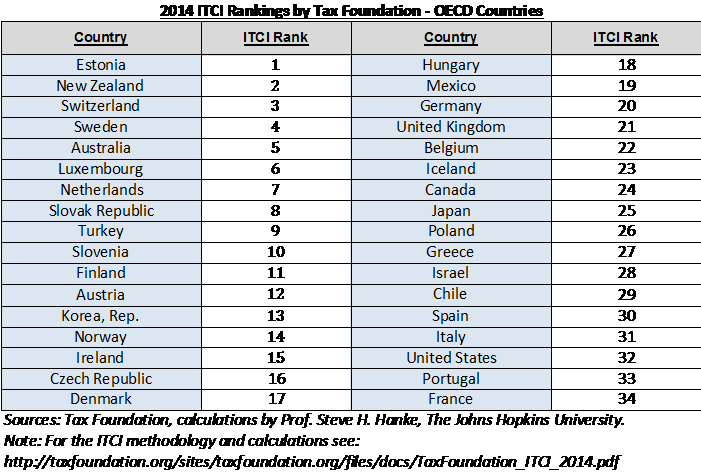
The Tax Foundation released its inaugural “International Tax Competitiveness Index” (ITCI) on September 15th, 2014. The United States was ranked an abysmal 32nd out of the 34 OECD member countries for the year 2014. (See accompanying Table 1.) The European welfare states such as Norway, Sweden and Denmark, with their large social welfare systems, still managed to have less burdensome tax systems on local businesses than the U.S. The U.S. is even ranked below Italy, the country that has had such a pervasive problem with tax evasion that the head of its Agency of Revenue (roughly equivalent to the Internal Revenue Service in the United States) recently joked that Italians don’t pay taxes because they were Catholic and hence were used to “gaining absolution.” In fact, according to the ranking, only France and Portugal have the dubious honor of operating less competitive tax systems than the United States.

The ITCI measures “the extent to which a country’s tax system adheres to two important principles of tax policy: competitiveness and neutrality.” The competitiveness of a tax system can be measured by the overall tax rates faced by domestic businesses operating within the country. In the words of the Tax Foundation, when tax rates are too high, it “drives investment elsewhere, leading to slower economic growth.” Tax competitiveness is measured from 40 different variables across five different categories: consumption taxes, individual taxes, corporate income taxes, property taxes, and the treatment of foreign earnings. Tax neutrality, the other principle taken into account when composing the ITCI, refers to a “tax code that seeks to raise the most revenue with the fewest economic distortions.” This would mean that tax systems are fair and equally targeted towards all firms and industries, with no tax breaks for any specific business activity. A neutral tax system would also limit the rate of – amongst others – capital gains and dividends taxes, all of which encourage consumption at the expense of savings and investment. 

Even the two countries that have less competitive tax regimes than the U.S. – France and Portugal – have lower corporate tax rates than the U.S., at 34.4% and 31.5%, respectively. The U.S. corporate rate on average across states, on the other hand, is at 39.1%. This is the highest rate in the OECD, which has an average corporate tax rate of 24.8% across the 34 member countries. According to a report by KPMG, if the United Arab Emirates’ severance tax on oil companies was ignored, the U.S. average corporate tax rate would be the world’s highest.

Table 1.

The poor showing of the U.S. resulted from other countries recognizing the need to improve their competitive position in an increasingly globalized world. Indeed, the only OECD member countries not to have cut their corporate tax rates since the onset of the new millennia are Chile, Norway, and, yes, the United States. The high U.S. corporate tax rate not only raises the cost of doing business in the U.S., but also overseas. The U.S., along with just 5 other OECD countries, imposes a “global tax” on profits earned overseas by domestically-owned businesses. In contrast, Estonia, ranked 1st in the ITCI, does not tax any profit earned internationally. Since these profits earned overseas by U.S.-domiciled companies are already subject to taxes in that specific country, there is a clear incentive for American companies to try to avoid double taxation. Indeed, many of the largest American multinational corporations have established corporate centers overseas, where tax codes are less stringent, to avoid this additional tax.

The ITCI also reported a myriad of other reasons for the low ranking of the U.S., including poorly structured property taxes and onerously high income taxes on individuals. One major reason why the U.S. lags so far behind most of the industrialized world is simply the lack of serious tax code reforms since the Tax Reform Act of 1986.

The annual Doing Business report published by the World Bank has an even more expansive analysis that determines the tax competitiveness in 189 economies, and also provides an equally sobering look at the heavy taxes faced by business in the United States. (See accompanying Table 2.) One of the metrics it incorporates into the assessment is the “total tax rate.” The Doing Business report defines the total tax rate as “the taxes and mandatory contributions that a medium-size company must pay in the second year of operation as well as measures of the administrative burden of paying taxes and contributions.”

According to the rankings in the most recent Doing Business 2015 report (which reported total tax rates for the calendar year 2013), Macedonia had the lowest total tax rate in the world at 7.4% and was followed closely by Vanuatu at 8.5%. The United States, as in previous years, appears near the bottom of the list, at 126th out of 189, with a total tax rate of 43.8%.

Table 2:

The fact that both the ITCI and Doing Business report, whose methodologies and calculations were conducted independent of one another, rank the United States very low shows that the tax rates in this country are non-neutral and uncompetitive, no matter how they are measured. The message is clear, and very simple: taxes on corporations increase costs and decrease margins, and lead to price increases on goods and ultimately hurt the consumer and the development of any country.

As proposed in “Policy Priorities for the 114th Congress,” published by the Cato Institute, to increase the incentives of domestic firms to go into business and become competitive globally, the U.S. would have to drastically reduce its corporate tax rate. 

02 May 00:34

Fascinating Satellite Photos of Seaweed Farms in South Korea

by Christopher Jobson

seaweed-4

NASA’s Goddard Space Flight Center just shared these fascinating satellite photos taken in January 2014 over the shallow waters around Sisan Island, South Korea. The tiny patchwork of small squares are entire fields of seaweed that are held in place with ropes and buoys to keep the plants near the surface during high tide but off the seafloor in low tide. Via NASA Earth Observatory:

Since 1970, farmed seaweed production has increased by approximately 8 percent per year. Today, about 90 percent of all the seaweed that humans consume globally is farmed. That may be good for the environment. In comparison to other types of food production, seaweed farming has a light environmental footprint because it does not require fresh water or fertilizer.

You can see much more of what’s happening at NASA lately by following the Goddard Space Flight Center on Flickr.

seaweed-6

seaweed-1

seaweed-2

seaweed-3

30 Apr 02:08

The Coder and the Beast

by CommitStrip

30 Apr 01:59

Whole Foods Criticized for Giving Food to National Guardsmen...and Children?

by Nick Gillespie

So there's this, via Instagram.

Which leads to this sort of response from the senior digital editor of Ebony and "a leading millennial voice around issues of race, gender and sexuality. One of those pesky Black feminists who challenges the status quo, while remaining fresh and fab at all times":

I spent my last money with @WholeFoods last night. What you are doing is unconscionable. #BaltimoreUprising @WholeFoodsPR @wholefoodsnyc

— Jamilah Lemieux (@JamilahLemieux) April 28, 2015

Which leads to this sort of response:

@jamilahlemieux We're helping! Our two stores there are partnering with BCRP to provide ongoing donations to the community.

— Whole Foods Market (@WholeFoods) April 29, 2015

And this:

@JamilahLemieux We're providing meals & snacks to Baltimore children by partnering w/rec centers that we already work closely w/across city.

— Whole Foods Market (@WholeFoods) April 29, 2015

And this:

I appreciate that and the response, but feeding the Guard today and not the kids who were left lunch-less left a very bad taste @WholeFoods

— Jamilah Lemieux (@JamilahLemieux) April 29, 2015

And finally this explanation of why Whole Foods deleted the post that started the whole row:

We removed the post because it did not accurately reflect all our local stores are doing to feed people across this city, especially children. Again, we love our community, will continue to support our city in the days to come, as we always do, and extend our heartfelt sympathy to those affected.

No good deed goes unpunished, especially in an age of social media and perpetual outrage.

29 Apr 17:33

Flying a Hobby Drone in a National Park? That’s a Tasering.

by Scott Shackford

Not reading a national park's website before you visit? That's a paddling.Travis Sanders has a little 3-inch hobby drone that he thought could he could use to film at Hawaii Volcanoes National Park. Didn’t he know he’s not allowed to do that? It’s been the rule for … um … a couple of months now and is clearly posted on … um … the park’s website.

Screw it, bring out the Tasers! That was a park ranger’s response to Sanders flying his tiny little drone. Several onlookers contacted Hawaii News Now, describing what the ranger did as excessive and unnecessary. Here’s how Sanders described how he was treated when he started flying his drone around:

"A guy approached me in the dark and said, 'Bring it down!' and he was very angry. I had no idea he was a ranger. He sounded very angry, confrontational — like he wanted to fight — and I didn't really want to stick around for it so I just told him, 'I don't have ID and I'm leaving'," described Sanders.

A spokesman for the park described him instead as “fleeing” and justified the use of the Taser, telling Hawaii News Now, “Apparently the suspect was very unpredictable and very unruly and the national park service ranger was really unclear what his next actions would be and needed to stop this individual.” Apparently a guy with a drone at a park is the equivalent of an escaped mental patient waving a knife around Times Square. Who knows what he might do next?

Watch a video report of the incident below:

And here’s ReasonTV reminding everybody that Tasers can kill people and that the casual use of them by law enforcement is a problem:

(Hat tip to Mark S)

29 Apr 17:27

SHOCK POLL: Just 2% of younger Americans trust media to 'do right thing'...


SHOCK POLL: Just 2% of younger Americans trust media to 'do right thing'...


(Second column, 12th story, link)

29 Apr 13:44

Goldman Paid Bill Clinton $200K Before Lobbying Hillary On Export-Import Bank

by Tyler Durden

As documented here on several occasions of late, there are new questions surrounding charitable contributions to the Clinton Foundation. Most notably, a Reuters investigation revealed that the Clinton family charities may have suffered what we called a “Geithner moment” when they failed to report tens of millions in contributions from foreign governments on tax documents. The foundation will now refile five years worth of returns and hasn’t ruled out the possibility that it may need to amend returns dating back some 15 years. 

This prompted acting CEO Maura Pally to pen a lengthy blog post in which she explains the “mistakes” and attempts to reassure the public that the Clinton Foundation is taking special care to guard against “conflicts of interest” as Hillary begins her run for The White House. Pally also notes that similar measures were taken when Clinton was Secretary of State although, as we noted, the charity accepted donations from the likes of Kuwait, Qatar and Oman while she was the nation’s top diplomat. 

Now there are new questions as IBTimes suggests there may be a connection between a $200,000 payment made to Bill Clinton by Goldman Sachs in 2011, and the bank’s efforts to lobby the State Department ahead of legislation involving the Export-Import Bank which was set to provide a loan that would end up financing the purchase of millions of dollars in aircraft from a company partially owned by Goldman. Here’s more: 

Goldman Sachs paid former President Bill Clinton $200,000 to deliver a speech in the spring of 2011, several months before the investment banking giant began lobbying the State Department, then headed by Hillary Clinton, federal records reviewed by International Business Times show.


Goldman’s objective in lobbying the State Department could not be immediately discerned. The lobbying disclosure filings note only that Goldman sought to “monitor deficit reduction issues” -- specifically, a bill known as the Budget Control Act -- and the bank declined to answer questions about the precise nature of its interests…


In recent days, attention to overlapping interests that have donated to the Clinton family’s private interests while also allegedly seeking to influence State Department policy has reached a fever pitch amid leaks from a forthcoming book on the subject, “Clinton Cash,” by Peter Schweizer.


The involvement of Goldman Sachs seems certain to amplify that scrutiny. The bank brings a reputation as uniquely well-connected in Washington given that many of its former executives have landed in the uppermost ranks of the Treasury Department…


State Department records show that Bill Clinton’s $200,000 Goldman Sachs speech was delivered April 11, 2011, to “approximately 250 high level clients and investors” at a United Nations dining room in New York.


In federal disclosure documents, the Duberstein Group is listed as lobbying the Clinton State Department on behalf of Goldman Sachs between July and September 2011. Goldman Sachs paid the Duberstein Group $100,000 during that time.


Those records show that the firm was specifically lobbying the department on “proposed legislation” linked to a series of budget bills. One bill continued congressional authorization for the Export-Import Bank, a government-backed lender whose financing was critical for the prospects of a company in which Goldman owned a stake. 


The original budget bill was introduced in July and did not include an extension of the Export-Import Bank, but the bank reauthorization was added in late September, during the same period Goldman was lobbying the State Department on the bill.


In August 2011, the bank authorized a $75 million loan enabling a Chinese firm to purchase aircraft from Beechcraft (known before emerging from bankruptcy in February 2013 as Hawker Beechcraft), a company that was part-owned by Goldman. Beechcraft had lobbied the Clinton State Department on issues relating to foreign military sales in 2009 and 2010, according to its lobbying disclosures.

Readers can draw their own conclusions here, and we don't think it's any surprise that Wall Street lobbyists wield considerable power in Washington, but the takeaway is that, as we've said on a number of occasions recently, you can expect to learn much, much more in the coming months about the degree to which the Clinton Foundation — and any other avenue through which foreign governments, Vampire squids, and a whole host of other state and non-state actors can channel money — is used as a means of buying influence with America's maybe next President.

And because we can't help ourselves, here is how we imagine Hillary would respond to the above:

28 Apr 14:22

'Georgetown Will Need to Step In' If Students Don't Agree to Destroy Video Footage of Sommers Event

by Robby Soave

Georgetown

A Georgetown University administrator has a deeply troubling message for the campus’s College Republicans: scrub video footage of the recent Christina Hoff Sommers talk, or else.

The hour-long video shows Sommers—a resident scholar at the American Enterprise Institute and individualist-feminist—giving her classically liberal take on gender issues while several left-leaning students hold signs accusing her of being a rape apologist.

According to Lauren Gagliardi, an assistant director of student services at Georgetown, the protesters did not consent to appear on camera, and so the College Republicans and the Clare Boothe Luce Policy Institute (which sponsored Sommers’ talk) have a responsibility to edit them out of the video. In an email to the group obtained by The Washington Examiner and published at Legal Insurrection, Gagliardi promised consequences if her demand was not met swiftly:

What was the response from Clare Boothe Luce about the video? I see that is still up online. Please let me know asap as an edited version needs to be released without students who did not give permission to be taped.

If they are unwilling or unresponsive to the request, Georgetown will need to step in. Let me know!

As a private university, Georgetown administrators might theoretically have the right to make ridiculous demands of student and punish them for not complying. But that doesn’t mean they should. And while it makes sense to respect the privacy of other students, no one attending the Sommers talk—a public lecture—as a protester should have reasonably expected to remain anonymous. As Laurel Conrad wrote at LI:

But it stretches credulity that Georgetown and its students would not understand that the lecture was a public event. The video camera was in plain view, and audience members themselves appear to be taking video and photos. It could not shock any student that he or she was on camera.

Still, it’s hardly surprising that a university would decide its students deserve protection from the consequences of their actions.

More from Reason on students triggered by Sommers here.

27 Apr 16:34

"A job well done"

by noreply@blogger.com (Vox)
Now we know why none of the big banks were prosecuted by the Obama administration:
Just after announcing his resignation as U.S. attorney general, Eric Holder has accepted a top job with Wall Street finance giant JPMorgan Chase.

Starting in early November, Holder will serve as JPMorgan Chase’s chief compliance officer, where his responsibilities will include lobbying Congress on the company’s behalf and ensuring it “gets the best deal possible” from any new proposed financial regulations. Holder will also fetch morning coffee and breakfast orders for CEO Jamie Dimon and board members.

For his efforts, Holder will earn an annual salary of $77 million plus bonuses for a job well done.
At this point, I think the federal government should go back to the spoils system. It would be considerably less corrupt.

Posted by Vox Day.
27 Apr 15:20

President Obama Demands Critics Tell Him What's Wrong With TPP; Of Course We Can't Do That Because He Won't Show Us The Agreement

by Mike Masnick
President Obama is apparently quite annoyed by the fact that his own party is basically pushing against his "big trade deals" (that are not really about trade). Senator Elizabeth Warren has been pretty aggressive in trashing the TPP agreement, highlighting the fact that the agreement is still secret (other than the bits leaked by Wikileaks). In response, President Obama came out swinging against the critics of TPP arguing that "they don't know what they're talking about."

He insists that it's unfair to compare TPP to NAFTA because they're different deals:
“You need to tell me what’s wrong with this trade agreement, not one that was passed 25 years ago.”
Well, Mr. President, I would love to do that, but I can't because you and your USTR haven't released the damn text. It takes an insane lack of self-awareness for the guy who once declared his administration "the most transparent in history" to demand people tell him what's wrong with his trade agreement, when that agreement is kept entirely secret.

Furthermore, multiple experts concerning things like the corporate sovereignty ISDS provisions and the intellectual property chapters have gone into great detail as to why the leaked versions have problems. They're not complaining about NAFTA. They're actually complaining about the latest drafts -- but the USTR won't acknowledge them because they're talking about leaked versions.

In fact, the only real complaints I've seen relating to NAFTA concern the fact that the government says one thing about these big agreements, but the reality is something different.

Of course, he attacks the fact that people are complaining about the secrecy as well, by arguing (misleadingly) that the deal is not at all secret:
“The one that gets on my nerves the most is the notion that this is a ‘secret’ deal,” Obama said. “Every single one of the critics who I hear saying, ‘this is a secret deal,’ or send out emails to their fundraising base saying they’re working to prevent this secret deal, can walk over today and read the text of the agreement. There’s nothing secret about it.”
I'm a critic. I can't walk over today and read the text of the agreement. Obviously, President Obama is only talking about elected members of Congress. But that's not what they're complaining about. They're complaining about the fact that the American public cannot see the text of the document or discuss the specifics of what's in there. And that's absolutely true.

And even the fact that members of Congress can actually see the document is tremendously misleading. Yes, members of Congress are allowed to walk over to the USTR and see a copy of the latest text. But they're not allowed to take any notes, make any copies or bring any of their staff members. In other words, they can only read the document and keep what they remember in their heads. And they can't have their staff members -- the folks who often really understand the details -- there to explain what's really going on.

And it all comes back to the point that Senator Warren has been making for a long time: that former USTR Ron Kirk has admitted that a big reason why they keep the document secret is that when they tried being more transparent in the past, the agreement failed. As Warren says, if being transparent with the American public means the agreement will fail, then the problem is with the agreement, not the public.
“When I keep on hearing people repeating this notion that it’s ‘secret,’ I gotta say, it’s dishonest,” Obama continued. “And it’s concerning when I see friends of mine resorting to these kinds of tactics.”
Here's a little test: can we see the current TPP documents today? No? Then it's secret. Claiming otherwise is what's dishonest.

Permalink | Comments | Email This Story


27 Apr 13:33

Quotation of the Day…

by Don Boudreaux
(Don Boudreaux)

… is from page 11 of the 1991 Liberty Press edition of Bruno Leoni’s 1961 volume, Freedom and the Law (original emphasis):

Both the Romans and the English shared the idea that the law is something to be discovered more than to be enacted and that nobody is so powerful in his society as to be in a position to identify his own will with the law of the land.

Legislation is made.  Diktats are made.  Law, in contrast, is never made (which is why the term “lawmakers” when used to describe legislators is wholly inaccurate).  Instead, law evolves spontaneously into existence and into whatever present form and content it takes.  Unlike legislation and other government diktats, law is the result of human action but not of human design.

25 Apr 18:18

Say Yes to Ice Cream-Flavored Beer

by Baylen Linnekin

Last week, ice cream maker Ben & Jerry's and Colorado brewer New Belgium announced they would collaborate to create a new Salted Caramel Brownie Brown Ale, billed as "an ice cream infused craft beer."

This isn't the first beer pairing for Ben & Jerry's. Last spring, for example, the company kicked off a new product launch on the West Coast with a series of "frothy beer floats."

A press release announcing the partnership noted the beer will focus on the companies' shared efforts of "supporting sustainable agriculture" and "focus[ing] on environment awareness."

Wonderful. Or maybe not. Neo-Prohibitionists have jumped on the ice cream maker, warning of the potential harms of pairing a food kids like with a drink adults like.

"It's a crass, corporate greedy move to put a brand name like Ben & Jerry's on a beer," said Bruce Lee Livingston, executive director of the group Alcohol Justice, in remarks reported by USA Today. "It's bad for children—who will start looking at beer as the next step after ice cream."

I'd be surprised if ice cream-flavored beer appealed to anyone, let alone children, who are prohibited by law from buying the product. (Maybe it's my personal bias against anything boasting a salted caramel flavor.) But let's suppose Livingston is right, and the pairing is a gateway drug. If we assume that, why stop there? Let's take this sort of reasoning to its logical conclusions—and look at Ben & Jerry's ice cream itself.

Ben & Jerry's flavors like Hazed and Confused, an homage to 1993's weed-filled hit movie Dazed and Confused, clearly promote children's drug use. Cherry Garcia and Half Baked do the same.

Coffee Caramel Buzz and Coffee, Coffee BuzzBuzzBuzz! clearly promote childhood caffeine addiction.

Chocolate Therapy obviously promotes self-medicating for youngsters. Karamel Sutra, an ode to the Kama Sutra, the ancient Hindu text detailing various lovemaking positions, clearly promotes underage sex.

And with its White Russian flavor, an ode to the vodka-based cocktail of the same name, Ben & Jerry's has been promoting hard liquor use by children—obviously—since it was introduced in 2013.

Clearly. Obviously. Okay, maybe not really. Or at all.

Alcohol Justice, which attempts to "hold Big Alcohol accountable for the harm its products cause," urges a series of policies that target the rights of adult drinkers. For example, the group supports lowering the permissible blood alcohol content of drivers from .08 to .05. It wants to ban flavored beers, including Mike's Hard Lemonade, because they target "youth (especially girls)." It seeks to raise federal excise taxes on alcohol. And it wants to ban Palcohol, a powdered-alcohol product I wrote about here recently.

While Alcohol Justice claims to target "Big Alcohol," craft brewers like New Belgium, smaller competitors like Mike's Hard Lemonade, and tiny startup Palcohol hardly fit that description, not that anybody should feel differently about Alcohol Justice's arguments if they were simply opposed to alcohol being sold by bigger companies.

But even the littlest sellers appear to be targets of the group's ire. For example, Alcohol Justice recently fought a bill in California that would open up farmers' markets in the state to the scourge of wine tastings. Again, it's because of the children.

"Kids, you go on a pony ride while I taste the chardonnay, is what you might hear a parent say at your local certified farmers' market if AB 2488 becomes law," Livingston remarked in opposing the bill.

Among the warnings Alcohol Justice posted about the bill, which became law last year, are that "daytime tastings, with little to no monitoring, in family-friendly settings, are inappropriate and threaten public health and safety" and that "children watching parents drinking alcohol when they shop for fruit or vegetables is a practice very damaging to impressionable young minds."

It's all about the children, right?

Indeed it is. Livingston had previously referred to burger chain Red Robin's "mango Muscato wine shake" as "alcohol on training wheels."

Alcohol Justice isn't opposed to "Big Alcohol." It's opposed to alcohol, full stop. No one, including me, opposes efforts to keep alcohol out of the hands of children. But there's no justice in treating adult consumers of alcohol like children.

25 Apr 18:14

Quotation of the Day…

by Don Boudreaux
(Don Boudreaux)

… is from page 175 of the late Mancur Olson’s classic 1982 work, The Rise and Decline of Nations (original emphasis):

Another myth that generates a lot of poverty and suffering is that the economic development of the poor countries is, for fundamental economic or extra-institutional reasons, extremely difficult, and requires special promotion, planning, and effort.  It is sometimes even argued that a tough dictator or totalitarian repression is required to force the sacrifices needed to bring about economic development.  As I see it, in these days it takes an enormous amount of stupid policies or bad or unstable institutions to prevent​ economic development.  Unfortunately, growth-retarding regimes, policies, and institutions are the rule rather than the exception….​

24 Apr 02:01

Bus Driver to Eight-Year-Old: It's Too Dangerous to Read While You Ride

by Jesse Walker
Jts5665

Sigh...

Never let it be said that the U.S. authorities have a monopoly on absurdly restricting children's freedoms:

Modern childhoodAn eight-year-old girl in St-Jean-sur-Richelieu, [Quebec,] was told she's no longer allowed to read books on the school bus because it poses a risk to the safety of other students.

​Sarah Auger loves reading and used to enjoy using her 20-minute ride to and from school to read for pleasure.

But recently, her bus driver told her she had to stop.

She says she was told reading posed a risk to other students on the bus.

He suggested they might stand up to see what she was reading, or she might poke herself in the eye with the corners of the book.

The school board is siding with the driver, because of course it is. "Obviously, reading a book is not a danger," it concedes in a press release. Still, "The driver is the master of his vehicle....He is the best judge of what is appropriate." And after all, "Any object, be it a book, a toy or electronic device can be a potential danger when a young child drops an object and gets up to go get it while the bus is in motion." Therefore, such personal effects should be kept in closed bags. For safety's sake.

Looking back, it's a miracle I survived the first grade without getting impaled on a Charlie Brown collection.

23 Apr 20:39

End the Personal Bribes Members of Congress Are Getting Not to Reopen ObamaCare

by Michael F. Cannon

The U.S. Constitution vests the legislative, executive, and judicial powers in separate branches of the government that are supposed to police each other. But what if one of those branches violates the law in a manner that personally benefits the members of another branch? That’s what has been happening since the day ObamaCare became law in 2010. For more than five years, the executive branch has been issuing illegal subsidies that personally benefit the most powerful interest group in the nation’s capital: members of Congress and their staffs. A decision today by the Senate Small Business & Entrepreneurship Committee not to investigate those illegal subsidies shows just how difficult it can be to prevent one branch of the government from corrupting members of another branch.  

It is no secret that executive-branch agencies have broken the law, over and over, to protect ObamaCare. King v. Burwell challenges the IRS’s decision to offer illegal premium subsidies in states with federally established health-insurance Exchanges. University of Iowa law professor Andy Grewal recently revealed the IRS is illegally offering Exchange subsidies to at least two other ineligible groups: certain undocumented immigrants and people who incorrectly project their income to be above the poverty line. Treasury, Health and Human Services, and other executive-branch agencies have unilaterally modified or suspended so many parts of the ACA, it’s hard to keep count – and even harder to know what the law will look like tomorrow. Even some of the administration’s supporters acknowledge its actions have gone too far

The longest-running and perhaps most significant way the administration has broken the law to protect ObamaCare is by issuing illegal subsidies to members of Congress.

When congressional Democrats passed the Patient Protection and Affordable Care Act (ACA), they were so desperate to pass a health care law that the ACA did not receive the scrutiny most bills do. Many members of Congress and their staffs were therefore surprised to learn that, as of the moment the president signed the ACA, that very law threw them out of their health plans. The ACA prohibits members of Congress and their staffs from receiving health coverage through the Federal Employees’ Health Benefits Program. They remained free to purchase health insurance on their own, but they would have to do so without the $10,000 or so the federal government “contributed” to their FEHBP premiums. In effect, the ACA gave members of Congress a pay cut of around $10,000.

Oops. 

Big deal, you say. ObamaCare made lots of people take a pay cut and threw millions out of their health plans. Ah, yes, my friends. But those were little people. This is Congress. 

Rather than risk Congress reopening the ACA to restore their lost health coverage – because who knows what other changes Congress might make in the process – the administration simply pretended that that part of the law didn’t exist. The Office of Personnel Management announced that members of Congress and their staffs could remain in the FEHBP until the ACA’s Exchanges launched in 2014. The president thus stuck to his promise, if you like your health plan, and you’re a member of Congress, you can keep your health plan

That still didn’t solve the president’s problems, however. The ACA says that as of 2014, the only coverage the federal government can offer members of Congress in connection with their employment is coverage created under the Act. In effect, that means Exchange coverage. But the law still cut off that $10,000 “employer contribution” to their health benefits. According to Politico, “OPM initially ruled that lawmakers and staffers couldn’t receive the subsidies once they went into the exchanges.” After the president intervened, OPM just ignored that part of the law and started issuing (illegal) subsidies on the order of $10,000 to hundreds of individual members of Congress and thousands of individual congressional staffers.

Note that I label these illegal payments to members of Congress subsidies, rather than compensation. When an employer pays part of a worker’s health premiums as a condition of that worker’s employment, that’s compensation. But these payments are not a condition of employment. In fact, under the ACA, a condition of their employment is that they not receive these payments.

Note too the eerie parallel to King v. Burwell: an executive-branch agency ignores the clear language of the ACA to issue health-insurance subsidies to people that just happen to have the effect of preventing Congress from reopening the law. The OPM’s illegal subsidies are thus indistinguishable from personal bribes to members of Congress.

Offering these subsidies to members of Congress violates the ACA in at least one other way as well. The ACA prohibits employers from making contributions to their employees’ coverage through the Exchanges that serve individuals. (The law’s technical term for them is “American Health Benefits Exchanges.”) So the administration let members of Congress enroll through the ACA’s Small Business Health Options Program Exchanges, or “SHOP Exchanges,” where employers can make contributions to cover their workers’ premiums. The problem here is that the “S” in “SHOP” stands for small business – i.e., firms with fewer than 50 employees. Yet the OPM and the D.C. SHOP Exchange, where thousands of members of Congress, their staffs and their dependents have purchased coverage, are pretending that Congress is a small business with fewer than 50 employees

Which brings us back to the Senate Small Business & Entrepreneurship Committee. Committee chairman David Vitter (R-LA) has been waging a lonely battle to end these bribes. After suffering numerous setbacks, Vitter now seeks to shine sunlight on how these bribes happened. He wants to subpoena documents relating to OPM’s claim that Congress is a small business. You would think Republicans, who outnumber Democrats on the committee 10-9, would gladly join Vitter in exposing the administration’s malfeasance. Ending Congress’ special ObamaCare exemption – i.e., the bribes individual members of Congress and their staffs are receiving not to reopen ObamaCare – polls off the charts. More than 90 percent of voters believe this exemption is unfair. I mean, c’mon. The rap against congressional Republicans is that they are hyper-partisans who will do anything to take down President Obama and/or ObamaCare. You would think this would be too good an opportunity for those rabid partisans to miss.

You would be wrong.

Today, five committee Republicans voted with all nine Democrats to quash Vitter’s subpoena effort. Someone should ask the 14 senators who voted to keep the truth hidden whether they are personally receiving one of those illegal subsidies, and if so, the precise dollar amount.

I was not all that surprised by the result. I have spoken to many GOP staffers, including leadership staff, about how these illegal subsidies are immoral and standing in the way of ObamaCare repeal. Their faces freeze the moment I raise the subject. Often, they don’t say another word and leave the room as quickly as they can. I understand their fear. They have families. Mortgages. Illnesses. To them, ending these illegal subsidies seems like a $10,000 hit to their annual income.

Fortunately for them, they are mistaken. If those subsidies disappeared, Congress would reinstate them so quickly your head would spin. Congress would even provide back pay that would make members and staff completely whole. The absolute certitude of that outcome is exactly why the administration chose not to enforce this part of the ACA in the first place. They knew that members of Congress – Republicans and Democrats alike – would be so desperate to serve their own interests by reinstating that employee benefit that Republicans could insert important changes to ObamaCare and possibly still have enough support to override a veto. 

But more important, members of Congress and their staff should suffer that pay cut because that’s the law. The ACA has caused millions of Americans to lose their health plans and take pay cuts of similar magnitude. Why should people who work in Congress get a special exemption while people who work in auto repair do not? Is there a class of Americans who are above the law?

For all the talk in Washington about the corrupting influence of money in politics, remarkably few people seem to care that the executive branch is promiscuously issuing illegal taxpayer subsidies that not only personally benefit members of Congress but that also directly affect how members of Congress vote. Vitter deserves credit for taking the lead in trying to expose and put an end to those bribes. The framers of the Constitution did an admirable job, but sometimes the checks and balances they created are not enough to prevent the corruption of one branch of government by another.

23 Apr 13:21

GM Says That While You May Own Your Car, It Owns The Software In It, Thanks To Copyright

by Mike Masnick
Last week, we noted that Senator Ron Wyden and Rep. Jared Polis had introduced an important bill to fix a part of the DMCA's broken anti-circumvention laws found in Section 1201 of the DMCA. For whatever reason, some people still have trouble understanding why the law is so broken. So here's a story that hopefully makes the point clearly. Thanks to DMCA 1201, John Deere claims it still owns the tractor you thought you bought from it. Instead, John Deere claims you're really just licensing that tractor:
In the absence of an express written license in conjunction with the purchase of the vehicle, the vehicle owner receives an implied license for the life of the vehicle to operate the vehicle, subject to any warranty limitations, disclaimers or other contractual limitation in the sales contract or documentation.
How nice of John Deere to say that your ability to operate the vehicle is really subject to the "implied license" it granted you. These comments (and many others) come in response to the ridiculous triennial review process in which the Librarian of Congress reviews requests to "exempt" certain cases from Section 1201's rules against circumvention. We discussed the ridiculous responses from some concerning video game archiving last week, and the John Deere statement is in response to requests to diagnose, repair or modify vehicle software. And, of course, lots of car companies are against this, including GM, which argues that all hell will break loose if people can diagnose problems in their own cars' computers. It, too, thinks that you don't really own your car and worries that people are mixed up in thinking they own the software that makes the car they bought run:
Proponents incorrectly conflate ownership of a vehicle with ownership of the underlying computer software in a vehicle.... Although we currently consider ownership of vehicle software instead of wireless handset software, the law’s ambiguity similarly renders it impossible for Proponents to establish that vehicle owners own the software in their vehicles (or even own a copy of the software rather than have a license), particularly where the law has not changed.
But the real conflation here is by GM, John Deere, and others, in thinking that because they hold a copyright to some software, that somehow gives them ownership over what you do with the copy you legally purchased with the car itself. Once that purchase is concluded, the vehicle owners should be seen to have given up any proprietary interest in the single vehicle you bought. But thanks to copyright and Section 1201, that's an issue that faces "uncertainty." And that's a problem.

The companies lay out a parade of horribles that will happen if people can circumvent the DRM they put in their vehicles, mostly focused on the idea that people might soup up their car, making it dangerous. But that's not a copyright issue. People have always souped up cars, and before there was software in cars, no one argued that Ford could prevent you from turning your Mustang into a drag racer. It's only copyright that has rewritten the very concept of ownership in a dangerous way. As Kyle Wiens notes in his article at Wired in response to the "but, but, car modders!" argument:
They’re right. That could happen. But those activities are (1) already illegal, and (2) have nothing to do with copyright. If you’re going too fast, a cop should stop you—copyright law shouldn’t. If you’re dodging emissions regulations, you should pay EPA fines—not DMCA fines. And the specter of someone doing something illegal shouldn’t justify shutting down all the reasonable and legal modifications people can make to the things they paid for.
But, by far, the most ridiculous in the "parade of horribles" comes from John Deere who was really, really, really, really stretching to try to come up with some way to pretend this is really about copyright issues. It argues that allowing farmers to modify the software in their tractors might lead those farmers to (and I am not making this up), listen to infringing music while they farm.
Moreover, TPMs for vehicle software for entertainment systems protects copyright owners of copyrighted content against the unauthorized reproduction and distribution of copyrighted works. For example, vehicle software for entertainment systems supports the playing of copyrighted music files and copyrighted audio books, among other expressive works. A vehicle driver may listen to sound recordings, while passengers may watch or view television and movie content. TPMs for in-vehicle entertainment systems encourage content providers to create and distribute highly-expressive copyrighted works that might otherwise be easily copied or pirated if the TPMs were circumvented. Consequently, circumvention of the above TPMs for purposes of “personalization, modification, or other improvement” is likely to encourage the unauthorized reproduction, distribution, and use of copyrighted software and content.
I really feel sorry for whatever recent law school grad had this issue dumped on their desk and was told, "make this about copyright... some way... any way."

But all it really does is highlight the sheer ridiculousness of Section 1201 and how it's destroying property rights.

Permalink | Comments | Email This Story


23 Apr 02:43

Cartoon of the Day for Earth Day, some green wisdom from Dogbert

by Mark Perry
Dilbert

A great Dilbert cartoon for Earth Day, with some wisdom from Dogbert, as Ben Zycher pointed out today in his article for AEI titled “Earth Day and the Celebration of Suffering,” here’s the opening:

In honor of this 45th anniversary of the first Earth Day, let us recall the wisdom of Dogbert, that noted political philosopher and sage observer of the human condition: “You can’t save the earth unless you’re willing to make other people sacrifice.”

As the old saying goes, truer words were never spoken. Earth Day brings each year a worldwide religious celebration at which large masses of people both right-thinking and affluent proclaim their devotion to Gaia and their love of humanity, while displaying their contempt for the lives and well-being of actual people, the poorest among them in particular.

The whole article is worth reading, you’ll find it here.

The post Cartoon of the Day for Earth Day, some green wisdom from Dogbert appeared first on AEI.

23 Apr 02:43

Senator Whitehouse Declaims

by Roger Pilon

On the floor of the Senate last night, on the eve of Earth Day, Rhode Island Sen. Sheldon Whitehouse went after the Cato Institute—among others, including the Washington Times and the Wall Street Journal—for our having accused the senator and his friends in the environmental movement of “having a widespread faith in the government’s ability to solve problems.” We plead guilty. Not only do we believe those folks are of that faith—the evidence is plain, even if the evidence supporting the faith is lacking—but we believe also that it is a self-serving faith, because it drives them to find ever more problems to solve, problems most of us never knew we had.

But it’s a letter that then-Cato President John Allison recently sent to Sen. Whitehouse and others in Congress that seems most to exercise the good senator. As the C-SPAN transcript puts it:

cato also sent us a letter in response to our inquiry, telling us we cannot use the awesome power of the federal government to cow cato and others. cow? according to the “wall street journal” editorial page, which, sadly, has become a front for the fossil fuel industry, we were – quote – “trying to silence the other side.” although i have to confess, mr. president, it is not clear how the other side would be silenced by simply having to reveal whose payroll they’re on, which is all we asked. let’s be clear our letter didn’t suggest that industry scientists should be silenced, just that the public should know if those scientists are being paid by the very industries with a big economic …

Ah. There we have it. We’re in the pockets of Big Oil. Never mind that the facts show otherwise, that Cato’s donor base is wide and composed almost entirely of individuals animated by the idea of a free society under limited government.

But that’s not the main point, not really. Rather, it’s the assumption of Sen. Whitehouse and his friends that they, whose outlook depends so much on government funding, fairly dripping with the taxpayers’ blood, have the cleanest of hands and the purest of motives. Yet why should we believe that the avaricious individuals these folks call on government to check, suddenly become virtuous when they have the monopoly power of government in their grasp, to say nothing of the public till at their disposal? If ever scrutiny were warranted, I should think it on that side of the ledger.

22 Apr 14:08

Familiar Yet Forgotten Tax Lessons from Ancient Greece and Rome

by Alan Reynolds

Alan Reynolds

In Ancient Greece, “The politicians strained their ingenuity to discover new sources of public revenue… . The results of these imposts was a wholesale hiding of wealth and income, Evasion became universal, goods were seized, men were thrown into jail. But the wealth still hid itself, or melted away.”

–Will Durant The Life of Greece, Simon and Schuster, 1939. P. 66.

 In ancient Rome; “taxation rose to such heights that men lost incentive to work or earn, and an erosive contest began between lawyers finding devices to evade taxes and lawyers formulating laws to prevent evasion. The government issued decrees binding the peasant to his field and the worker to his shop until all his debts and taxes had been paid. In this and other ways medieval serfdom began.”

–Will, and Durant, Ariel. The Lessons ofHistory, Simon and Schuster, 1968.

22 Apr 13:58

A Better Use for It

by Harvey

A New Mexico pig farm is getting five tons of food every week from students who throw away their healthy Michelle Obama school lunches.

Ironically, creating bacon the students will never be allowed to eat at school.

Send to Kindle
21 Apr 19:24

Uber Driver with Concealed Handgun Prevents Mass Shooting in Chicago

by Adam Bates

A driver with the ridesharing company Uber put a stop to a potential mass shooting in Chicago over the weekend.

According to the Chicago Tribune:

A group of people had been walking in front of the driver around 11:50 p.m. in the 2900 block of North Milwaukee Avenue when Everardo Custodio, 22, began firing into the crowd, Quinn said.

The driver pulled out a handgun and fired six shots at Custodio, hitting him several times, according to court records.  Responding officers found Custodio lying on the ground, bleeding, Quinn said.  No other injuries were reported.

The driver will not be charged:

The driver had a concealed-carry permit and acted in the defense of himself and others, Assistant State’s Attorney Barry Quinn said in court Sunday.

Chicago was home to some of the most draconian gun laws in America until a 2010 Supreme Court ruling, McDonald v. Chicago, found Chicago’s gun regulation regime unconstitutional. That ruling applied the Court’s previous landmark 2nd Amendment ruling, District of Columbia v. Heller, to state governments. While those rulings dealt with the right to bear arms for self-defense in the home, some circuit courts (including the 7th Circuit, which governs in Chicago) have extended the Heller/McDonald logic to certain public places as well as the home.

Under the previous regime in Chicago, the driver would have had  to choose between saving lives and avoiding a lengthy, potentially life-ruining prison sentence.  It’s safe to assume that both the hero in this case and the potential victims of Everardo Custodio are thankful that unconstitutional burden has been erased.

That is, of course, not to say that the struggle for gun rights is over.  Some circuits maintain a more limited view of Heller and McDonald, granting the government far more discretion in denying the right to bear arms outside the home.

For every hero Uber driver there are still far too many Shaneen Allens and Brian Aitkens: law-abiding, peaceful citizens who have their livelihoods and even their lives threatened for exercising their Constitutional rights.

We can only hope that stories like this, of which there are many, receive the attention they deserve and bolster the case for individual liberty and the right to bear arms.

21 Apr 18:50

Federal Judge Attacks Pro-Police 'Orthodoxy' in 4th Amendment Case

by Damon Root

Federal Judge Janice Rogers Brown, a George W. Bush appointee frequently criticized by liberals for her “libertarian” jurisprudence, filed a blistering opinion today challenging the “prevailing orthodoxy” in Fourth Amendment cases which, she said, permit the police to conduct “a rolling roadblock that sweeps citizens up at random and subjects them to undesired police interactions culminating in a search of their persons and effects.”

At issue in Judge Brown’s concurrence today in the case of United States v. Gross was a 2013 arrest by Washington, D.C.’s Gun Recovery Unit. In February 2013 four officers from that unit were driving around on “gun patrol” when they spotted Will Gross, followed him, and finally approached him. One of the officers shined his flashlight on Gross and demanded that Gross show the officers his waistband. Another officer asked Gross to submit to a search. Gross fled. When the police apprehended him, Gross had a handgun in his possession.

At trial, Gross moved to have the gun suppressed from evidence because its discovery was the result of an illegal seizure by the police. But the federal district court disagreed, arguing that the initial police encounter with Gross did not qualify as a seizure under the Fourth Amendment because it was a “consented” interaction between citizen and state. Today, the U.S. Court of Appeals for the District of Columbia Circuit upheld that judgment. Judge Brown concurred in that decision, though, as she explained in her opinion, it was only because binding precedent required her to hold her nose and do so:

In its efforts to ferret out illegal firearms the District has implemented a “rolling roadblock.” Officers randomly trawl high crime neighborhoods asking occupants who fit a certain statistical profile—mostly males in their late teens to early forties—if they possess contraband. Despite lacking any semblance of particularized suspicion when the initial contact is made, the police subject these individuals to intrusive searches unless they can prove their innocence. Our case law considers such a policy consistent with the Fourth Amendment. I continue to think this is error. Our jurisprudence perpetuates a fiction of voluntary consent where none exists. [Citations omitted.]

According to Judge Brown, under this dismal case law, the police have free rein to “engage with members of the public en masse and at random to fabricate articulable suspicions for virtually every citizen officers encounter on patrol.”

What can be done? Judge Brown offered this advice to those citizens unfortunate enough to bear the brunt of such sweeping law enforcement tactics:

Persons questioned by the District’s Gun Recovery Unit patrols may reasonably be at a loss as to how to react to these contacts. Is there a means to react to such nominally voluntary encounters that might preserve their constitutional prerogatives? I offer this advice: speak to officers firmly, politely, respectfully. Tell them, “I do not wish to have an encounter with the police right now. Am I free to leave?” If the answer is “no,” then coercion will cease to masquerade as consent. Our courts will be forced, at last, to directly grapple with the reality of the District’s policy of routinized and involuntary seizures.

The D.C. Circuit’s opinion in United States v. Gross is available here.

21 Apr 14:49

SpaceX releases film of Falcon’s crash landing

by John Timmer

SpaceX's trial-and-error process of learning to land one of its Falcon main stages continued this week. After successfully sending a Dragon capsule toward a rendezvous with the International Space Station, the Falcon reversed course, fired its thrusters, and made its way back into the atmosphere over the Atlantic. After a controlled plunge through the air, it attempted to land on a barge named "Just Read the Instructions." This time, conditions enabled the company to have had an aircraft in the area to film the results.

It fell down and went "boom."

The video above shows the Falcon dropping at a rather healthy clip until it's quite close to the barge. At that point, the rocket's electronics appear to try to adjust its location; the craft tips while firing its main engines at a much higher level. This appears to be enough to set it down on the barge, but now tilting in the opposite direction. Thrusters at the top of the rocket attempt to correct the tilt but can't; it slowly falls over until it explodes while nearly horizontal.

SpaceX originally posted video footage of the crash landing, but it was taken down and marked private on YouTube on Wednesday afternoon.

Read 1 remaining paragraphs | Comments