Shared posts

20 Apr 18:33

Will Minimum Wage Protesters Order Fries From Their Burger-Flipping Robot Replacements?

by J.D. Tuccille

The Momentum Machines website is low-key right now, but that may have something to do with high-profile arguments in the press and protests in the streets demanding that fast-food chains pay workers $15 an hour to do the job the company's robots are designed to fill. Even before those placard-wielders decided to raise their costs in terms of dollars and grief, the San Francisco-based start-up announced that they were obsolete.

Momentum Machines' old, boastier website claimed:

Fast food doesn’t have to have a negative connotation anymore. With our technology, a restaurant can offer gourmet quality burgers at fast food prices.

Our alpha machine replaces all of the hamburger line cooks in a restaurant.

It does everything employees can do except better:

*it slices toppings like tomatoes and pickles only immediately before it places the slice onto your burger, giving you the freshest burger possible.

*our next revision will offer custom meat grinds for every single customer. Want a patty with 1/3 pork and 2/3 bison ground after you place your order? No problem.

*Also, our next revision will use gourmet cooking techniques never before used in a fast food restaurant, giving the patty the perfect char but keeping in all the juices.

*it’s more consistent, more sanitary, and can produce ~360 hamburgers per hour.

The labor savings allow a restaurant to spend approximately twice as much on high quality ingredients and the gourmet cooking techniques make the ingredients taste that much better.

Separately, the company noted, "An average quick service restaurant spends $135K every year on labor for the production of hamburgers. Not only does our machine eliminate nearly all of that cost, it also obviates the associated management headaches."

Even before Momentum Machine started mechanizing the burger-flipping process, McDonald's moved to make ordering a task that could be accomplished untouched by human stupidity. The fast-food chain is bringing self-order kiosks to the United States after deploying thousands of them overseas.

I'm guessing that workers in the streets demanding that their pay be hiked by fiat to $15 per hour do not erode Momentum Machine's competitive edge, or its attractiveness as an alternative to human employees. Those kiosk makers are probably warming up the production line, too.

Ron Bailey recently noted that "Defying the law of demand will end up harming lots of the people minimum wage proponents aim to help."

Yep. But the robots appreciate the effort.

20 Apr 00:56

California Nightmare

by Don Boudreaux
(Don Boudreaux)

Joel Kotkin has alway been good.  But he is (in my opinion) getting even better.  His essay on the sorry state of California, in today’s Daily Beast, is a gem.  (HT Manny Klausner)  Below are several slices (but do read the whole thing):

California has met the future, and it really doesn’t work. As the mounting panic surrounding the drought suggests, the Golden State, once renowned for meeting human and geographic challenges, is losing its ability to cope with crises. As a result, the great American land of opportunity is devolving into something that resembles feudalism, a society dominated by rich and poor, with little opportunity for upward mobility for the state’s middle- and working classes.

….

But since the 1970s, California’s water system has become the prisoner of politics and posturing. The great aqueducts connecting the population centers with the great Sierra snowpack are all products of an earlier era—the Los Angeles aqueduct (1913), Hetch-Hetchy (1923), the Central Valley Project (1937), and the California Aqueduct (1974). The primary opposition to expansion has been the green left, which rejects water storage projects as irrelevant.

Yet at the same time greens and their allies in academia and the mainstream press are those most likely to see the current drought as part of a climate change-induced reduction in snowpack. That many scientists disagree with this assessment is almost beside the point. Whether climate change will make things better or worse is certainly an important concern, but California was going to have problems meeting its water needs under any circumstances.

….

And there needs to be, at least for the short term, an end to dumping water into San Francisco Bay for the purpose of restoring a long-gone salmon run, or to the Delta, in order to save a bait-fish, the Delta smelt, which may already be close to extinct. This dumping of water has continued even as the state has faced a potentially crippling water shortage; nothing is too good for our fish, or to salve the hyper-heated consciousness of the environmental illuminati.

….

But it’s not just water that exemplifies the current “era of limits” psychology. Energy development has always been in green crosshairs and their harassment has all but succeeded in helping drive much of the oil and gas industry, including corporate headquarters, out of the state. Not building roads—arguably to be replaced by trains—has not exactly reduced traffic but given California the honor of having eight of the top 20cities nationally with poor roads; the percentage of Los Angeles-area residents who take transit has, if anything, declined slightly since train-building began. All we are left with are impossible freeways, crumbling streets, and ever more difficulty doing anything that requires traveling.

These policies have had numerous impacts, like weakening California’s industrial sector, which cannot afford energy prices that can be twice as high as in competing states. Some of those who might have worked in the factories, warehouses, and farms of California now help swell the numbers of the welfare recipients, who remarkably make up one-third of the nation’s total. As recently as the 1970s and ’80s, the percentage of people living in poverty in California was below the national average; California today, based on cost of living, has the highest poverty rate in the country.

….

Ultimately this is a story of a state that has gotten tired, having lost its “animal spirits” for the policy equivalent of a vegan diet. Increasingly it’s all about how the elites in the state—who cluster along the expensive coastal areas—feel about themselves. Even Brown knows that his environmental agenda will do little, or nothing, to combat climate change, given the already minimal impact of the state on carbon emissions compared to escalating fossil fuel use in China, India and elsewhere. But the cosmopolitan former Jesuit gives more priority to his spiritual service to Gaia than the needs of his non-affluent constituents.

But progressive narcissism is, as some conservatives assert, not the main problem. California greens are, to be sure, active, articulate, well-organized, and well-financed. What they lack is an effective counterpoint from the business class, who would be expected to challenge some of their policies. But the business leadership often seems to be more concerned with how to adjust the status quo to serve privileged large businesses, including some in agriculture, than boosting the overall economy. The greens, and their public-sector allies, can dominate not because they are so effective as that their potential opposition is weak, intimidated, and self-obsessed.

What we are witnessing the breakdown of a once-expansive, open society into one dominated by a small group of plutocrats, largely in Silicon Valley, with an “amen” crew among the low-information donors of Hollywood, the public unions, the green lobby, and wealthy real estate developers favored by Brown’s pro-density policies. This coalition backs Brown and helps maintain the state’s essentially one-party system. No one is more adamant about reducing people’s carbon footprint than the jet set of Silicon Valley or the state’s planning elite, even if they choose not to live in a manner that they instruct all others.

19 Apr 05:18

Yelp's Way of Caving to Corporate Pressure and Hiding Reviews While Saying They Didn't Delete Anything

by admin

A few days ago I posted a negative review of Applied Underwriters, and linked to this post on my blog for much more detail.  Yelp promptly pulled the review, saying I violated their terms of service by linking to a commercial web site.  I thought that bizarre, since my blog has absolutely nothing commercial about it.   But it made more sense when I received a letter from Applied Underwriters demanding that I take down my negative Yelp review or they would sue me for libel.  I don't know for sure what happened, but I suspect that Applied Underwriters sent Yelp a similar demand and they used the link in the review as an excuse to delete it and avoid legal entanglements.

So I posted an updated review with more detail and no link.  Now, Yelp is hiding the review, along with most of the other negative reviews, behind a nearly invisible link at the bottom that says "other reviews that are not currently recommended".  Scroll down to the bottom of this page and you may see it if you have a keen eye.  It is not even clear it is a link, but if you click on it, you get all the bad reviews Yelp is hiding.

Let's dismiss all the reasons why Yelp might say they do this.  One is clarity, to reduce clutter.  But go to your favorite restaurant Yelp page.  Likely you will not see this link / hidden review phenomenon.  You will see pages and pages of reviews, far more than they would have to show if they just displayed all the reviews for Applied Underwriters.

So there must be another reason.  They say in their note there is a quality algorithm.  Anyone who has read a lot of Yelp reviews will know that if this is so, their quality algorithm is not working very hard.   They have a number of reviews that they "recommend" that are nothing more than a rant like "I will never use these guys again" while my unrecommended review includes paragraphs of detail about the service.  They say it is based on your review volume as well, but I have more Yelp review volume than several of the others who seem to pass the screen.

All of which leads me to believe that this is Yelp's purgatory where they hide reviews based on corporate pressure.  They have gotten a lot of cr*p publicly about deleting bad reviews from sponsors and from corporations that pressure them to do so.   They have a zillion self-righteous FAQ's asserting that they don't delete anything.   So imagine Applied Underwriters sends Yelp loads of threats to take down each negative review that comes up.  What do they do?  They put them in the not-recommended purgatory.  They can claim that they haven't deleted anything, but absolutely no one will ever likely see the review.  And they don't count any longer to the company's review count, so for all intents and purposes they are gone.

All of this is a guess, because it is absolutely impossible to contact Yelp about these issues.  No phone numbers.  The ones in general directories for San Francisco don't work for them.  You can't email or chat or contact their customer support in any way.  For a company in the transparency business, they avoid it like the plague.

But do you want to know what makes me doubly sure of my analysis?  Because there is no way to up-rate any of the "not recommended" reviews.  I would have thought the whole up-rating system was how they sorted reviews to present the most relevent at the top, but you can't do that with the ones they have put in purgatory.  Why?  Because these reviews are being put in purgatory not for some customer benefit but to protect corporations able to put pressure on Yelp.  Yelp doesn't want them uprated.  They are supposed to disappear.    If I had time, I would compare the number of "not recommended" reviews for corporations with powerful legal staffs like Applied Underwriters to the number for Joe's local business  (AU has 17 recommended reviews but a 28 full reviews that have been "disappeared" as unrecommended).

16 Apr 11:37

On Jackie Robinson Day, Let’s Remember When He Was Fired From the New York Post for Being Too Republican

by Matt Welch

The first black columnist for a major white newspaper in U.S. history. ||| Today is the 68th anniversary of Jackie Robinson breaking Major League Baseball's notorious de facto ban against players having skin tone a shade or two darker than pure Castilian soap. As is the annual tradition, all MLB players today are wearing Robinson's #42 in homage.

As I (and plenty of others) have long argued, Jackie's awe-inspiring legend has, if anything, given short shrift to what a colossally competitive, accomplished, and complicated man he really was. He has as good a claim as anyone else at being the best all-around athlete of the 20th century (he was also a national champion long jumper, league champion collegiate basketball scorer, and All-American halfback at UCLA). He was a prolific if underappreciated author. A passionate and righteously angry civil rights activist. A banker/entrepreneur, active Rockefeller Republican, and the first black columnist for a major non-black newspaper, The New York Post. Which fired him for being too pro-Nixon.

Wait, what?

Sweet cover. ||| There was an entertaining collection of Robinson's newspaper and magazine writing brought out two years ago, titled Beyond Home Plate: Jackie Robinson on Life After Baseball. The intro, written by the civil rights historian Michael Long, is an almost anguished attempt to explain how this anti-racist hero could have belonged to the yucky Republican Party. Sample:

It may seem strange to us now that Robinson found a home in the Post, but at this point in history the newspaper was known for its liberalism. It was simply impossible to find the politically conservative opinions that are so characteristic of its op-ed pages today. And as a liberal paper, the Post had given Robinson, and larger civil rights issues, favorable coverage through the years; it was one of the few racially progressive media outlets of its time.

OK, so what happened with the Nixon/Kennedy business, then?

On November 4, 1960—Election Day—Post Editor James Wechsler informed Robinson that he and Dorothy Schiff had decided not to resume his column. (Robinson had taken a leave of absence to serve on Richard Nixon's campaign team in September 1960.) Wechsler, a Kennedy supporter, apparently felt that Robinson's pro-Nixon sentiments had led to unfair reporting during the presidential campaign[.]

Jackie's retort, published at his new home in the New York Amsterdam News in January 1962, is filled with some classic Robinsonian acid:

No one will ever convince me that the Post acted in an honest manner. I believe the simple truth is that they became somewhat alarmed when they realized that I really meant to write what I believed. There is a peculiar parallel between some of our great Northern "liberals" and some of our outstanding Southern liberals.

Some of the people in both classes share the deep-seated convictions that only their convictions can possibly be the right ones. They both inevitably say the same thing: "We know the Negro and what is best for him."

Ouch.

15 Apr 11:48

Walter Scott Shooting Highlights Cops’ Contempt for the Right to Record Police

by Jacob Sullum

Even before it became clear that Feidin Santana was witnessing what local authorities now describe as a murder, it took guts for him to record the police encounter that ended in Walter Scott's death. Santana, who was walking to work at a barbershop in North Charleston, South Carolina, the day before Easter, risked illegal retaliation by camera-shy cops the moment he stopped talking on his smartphone and started using it to capture Scott's interaction with patrolman Michael Slager.

Although the First Amendment right to record the police as they perform their duties in public is well established, cops often violate that right by ordering people to turn off their cameras, confiscating their cellphones, or arresting them on trumped-up charges. The shooting of Walter Scott, which last week led to Slager's arrest thanks to the details revealed by Santana's video, illustrates both the prevalence of this contempt for constitutional rights and the importance of counteracting it.

After Scott fell to the ground, struck by five of the eight rounds that Slager fired at him as he fled a traffic stop, Santana continued recording. "One of the officers told me to stop," Santana told CNN. "It was because I say to them that what they did, it was an abuse, and I witnessed everything."

The New York Times reports that when Scott's older brother, Anthony, arrived at the crime scene and took pictures of the body, three officers "surrounded him, telling him to turn over his phone." He gave it to them. "Hours later," the Times says, North Charleston Police Chief Eddie Driggers "arrived, returned Mr. Scott's phone and offered his condolences."

As Driggers seemed to recognize, there is no legal basis for such interference with camera-carrying bystanders. The right to record police has been explicitly upheld by at least four federal appeals courts—in the 1st7th9th, and 11th circuits—and implicitly recognized by others.

Federal judges outside of those four circuits have ruled that the right to record flows logically from the First Amendment right to gather information and that it applies equally to everyone, not just credentialed journalists. Big-city police chiefs take it for granted that "members of the public are legally allowed to record police interactions," as a 2014 NYPD memo put it, and that "a bystander has the same right to take photographs or make recordings as a member of the media," as Washington, D.C., Police Chief Cathy Lanier informed her officers in 2012.

The behavior of North Charleston police after the shooting of Walter Scott suggests why such memos are necessary. So do the actions of the officers who arrested Austin, Texas, activist Antonio Buehler three times in 2012 for daring to record police encounters.

Last July, responding to a lawsuit filed by Buehler, a federal judge ruled that the right he was exercising is well enough established that police cannot rely on qualified immunity to escape liability for violating it. U.S. Magistrate Judge Mark Lane cited "a robust consensus of circuit courts" that "the First Amendment encompasses a right to record public officials as they perform their official duties."

Even the threat of personal liability may not be enough to deter cops from harassing people who record them, since taxpayers typically pick up the tab when cities settle lawsuits arising from such incidents. Last year, for instance, New York City paid $125,000 to settle a lawsuit brought by Brooklyn resident Dick George, who said police roughed him up and arrested him for disorderly conduct after he recorded a stop-and-frisk encounter in 2012.

According to George's complaint, one of the cops said, "Now we are going to give you what you deserve for meddling in our business, and when we finish with you, you can sue the city for $5 million and get rich. We don't care."

Anthony Scott encountered a similar attitude when the cops took his cellphone. "It was eerie how they were acting," he told the Times. "They were cocky."

© Copyright 2015 by Creators Syndicate Inc.

14 Apr 20:18

Watch SpaceX Try to Land Rocket Parts on a Drone Barge, Right the Heck Now

by Katherine Mangu-Ward

FINAL UPDATE: 

Ascent successful. Dragon enroute to Space Station. Rocket landed on droneship, but too hard for survival.

— Elon Musk (@elonmusk) April 14, 2015

UPDATED UPDATE: Here's the new feed.

UPDATE: Canceled Monday, rescheduled for Tuesday. 

Yep. I said "drone barge." Isn't living in the future awesome?

space x

The private space firm SpaceX (read Reason's cover story on the company and its founder Elon Musk here) is sending another resupply mission to the International Space Station (ISS), using its Falcon 9 rocket. The Dragon capsule will make its way to the ISS with cargo and supplies, as well as a small satellite by Planetary Resources. But while they're at it, SpaceX is going to try something new that could make space flight quicker, cheaper, faster, better.

Right now, when a rocket takes off it discards various bits and pieces on the way up—boosters breaking off and falling as the spacecraft ascends will be a familiar sight to anyone who ever watched a Shuttle launch—in order to be more efficient about fuel use. But those pieces can technically be reusable. Enter the "drone barge," which will use GPS to position itself under the falling booster. That booster has been designed to retain enough fuel and wherewithal to set itself down relatively gently on the barge instead of smashing into the ocean.

This is SpaceX's second attempt, after a lack of hydraulic fluid in the descending booster's fins screwed things up in January. 

Go here to watch the livesteam of the SpaceX launch, starting at 4:15, weather permitting.

drone ship

14 Apr 19:10

Quotation of the Day…

by Don Boudreaux
(Don Boudreaux)

… is from page 255 of David Boaz’s excellent new (2015) book, The Libertarian Mind (original emphasis):

Government doesn’t have customers, who can use its products or try a competitor’s instead, so it’s difficult to decide when government is doing a good job.

People on the left fancy that they are devoted to science and reality-based thinking – or are at least that they are more devoted to science and reality-based thinking than are their political and ideological opponents.  While the right has no shortage of people who are irrational and hold positions unsupportable by science – likewise for the political middle, by the way – I have no interest in offering my own opinion on which group wins the rationality contest.  But I will point out that people on the left, by so often decrying market competition and seeking to displace it with one-size-fits-all diktats from government, decry and displace the only dispassionate and most objective test for how best to allocate scarce resources among their multitude of possible uses.  If science requires empirical tests – rather than reliance on dogma or the pronouncements of pooh-bahs – then those people who fail to appreciate the incredibly rigorous and objective tests that take place every moment in private-property markets are not as devoted to science as they think.

13 Apr 13:03

Venn diagram Sunday

by Mark Perry

Over the last few months, I’ve featured more than a dozen Venn diagrams on CD, and thought it might be a good time to feature ten of those today in this post. Here are my top ten favorite CD Venn diagrams:

1. Venn Diagram I on price controls (below).VennKidneys

2. Venn Diagram II on price controls (below).
VennMinWage

3. Venn Diagram III on price controls (below).VennObesity

4. Venn Diagram IV on prices controls (below).

VennMinWage3

5. Venn Diagram on weed vs. vaping in California (below).

VennVaping

6. Venn Diagram I on gender activism (below).

VennWomen

7. Venn Diagram II on gender activism (below).

VennCollegeDegrees

8. Venn Diagram on diversity on college campuses (below).

VennCollege

9. Venn Diagram on income and wealth diversity (below).

VennDiversityInc

10. Venn diagram on the War on Beer vs. the War on Drugs.

VennDrugs


The post Venn diagram Sunday appeared first on AEI.

11 Apr 19:50

Beware Applied Underwriters Workers Compensation Insurance

by admin

Well, I have managed to get myself into a scam.  It is not your normal scam, like the ones that are run by some mafia boiler room with guys working under aliases.  This scam comes via a major insurance company called Applied Underwriters (working under the names California Insurance Company and Continental Indemnity Company) which is owned by Berkshire Hathaway and none other than Warren Buffett.  If you feel sorry for Warren Buffett and want to give him a large interest-free loan for an indeterminate number of years, this is your program.

First, I need to give a bit of background on how workers comp works.  When you are a new company, they assign you an experience rating -- that is a multiplier of your premium based on past loss experience.  There is some default starting number that if I remember right, in most states, is a bit over 1.0x.  Each year, the workers comp world looks back at your past history and computes a new loss rating -- higher if you have had more payouts, lower if not.  Generally it is based on three years experience not counting the last year (so 2-4 years in the past).  Your future premiums get multiplied by this loss rating.

Several years ago we had a couple bad injuries that drove our loss number into the 1.7-1.9x area.   Neither were really due to a bad safety issue, but both involved workers in their seventies where a minor initial injury led to all sorts of complications.  Anyway, my agent at the time calls me one day a couple of weeks before renewal and says that none of the major companies will renew me.  This seemed odd to me -- I understood that my recent claims history was not good, but isn't that what the premium multiplier was for?  In fact, if my loss history returned to normal, they would make a fortune as I paid high rates based on old losses but had fewer new ones.

Apparently, though, insurance companies have fixed rules that keep them from underwriting higher loss ratings.  Probably for the same reason Vegas won't take action on Ivy League football games any more -- just too much variability.  I found out later with my new broker we could probably have overcome this, but I learned that too late.

My broker at the time put me into a 3-year program from Applied Underwriters, in part because they were taking everybody.  This program was set up differently from most workers comp programs.  You had a basic policy, but there was a second (almost indecipherable to laymen) reinsurance agreement that adjusted the rates of the basic policy based on you actual claims.  In other words, based on your claims, they would figure up at the end how much you owed and what your premium multiplier would be.

I saw two red flags that I ignored in signing up.  1)  The reinsurance agreement was impossible to understand, violating one of my foundational rules that I shouldn't sign things I don't understand.  And 2) The rate structure was very suspicious.  They touted a rate structure that could go as low as, say, $100,000 a year and was capped around $400,000 a year.  But when you pulled out a calculator, the $100,000 was virtually unobtainable.  It would require about zero claims.  If there were any claims at all, even for a few bandaids, the price would march up to $400,000 really fast.  It was the equivalent of a credit card teaser rate, and it should have made me suspicious.

Anyway, I was desperate.  For a business like mine, being told I had no workers comp insurance just a few weeks before the old policy ran out was a death sentence.  No one would write me or even quote me a policy that fast.  So I took the Applied Underwriters offer.  Shame on me, I should have worked on this much harder.

I won't bore you further with my voyage of discovery in trying to figure out how this thing works.  I will just tell you the results that I have found.  There are apparently other companies with similar issues, one of which is documented here Applied Underwriter Suit (pdf)Newsletter publisher objected to scan of article, so I have taken it down at their request.

I spent hours and hours trying to figure out their statements.  There is a whole set of terminology to learn that is actually not used in most of the rest of the workers comp world.  The key page of the statement is page 7, which I will show below because it highlights several of the issues with Applied.  Page 7 is the page where the monthly premium is "calculated".  I have added the red numbers and arrows for the discussion below.

applied

Here are some of the Applied Underwriter problems:

  1. Large deposits that must be made each year and may never be returned.    You can see that I am making deposits over $40,000 a year.  And that is each year.  The first year deposit is not returned.  The second year and third year are just added to it.  And I have found out since I joined this scam that they are not contractually obligated to return them until they are totally sure that all the claims are paid.  Maybe some guy who was hurt in his thirties has a relapse and claims more money when he is 75.  Gotta keep your deposit just in case, don't we?
  2. Premiums based on the worst of your experience and their estimate of your losses, and they keep the difference for years and years.   For those in the same trap as me, I will try to explain the numbers above.  The estimated loss pick containment at the top is basically their estimate of your losses.  Note that it drives every number on the page and is basically their arbitrary number -- they could have set it anywhere.  The loss pick containment to date is just pro rated for the amount of the year that has gone by.  The 65% is an arbitrary number.    The $25,278 is my actual losses to date.  You can see where I point with #2 above, though, that my losses are irrelevant to my premiums.  They take the higher of my losses and what is essentially their estimate of my losses and I pay based on that.   Note that their higher number is not based on the reserved amounts on actual claims -- the $25,278 includes their reserves.  It is just the number they established at the beginning of my policy they think my claims are going to be and gosh darnit they are going to stick to that (and my claims even in my worst year in history were never even half of their estimate).  Yes, at the end of the policy if my losses stay low, they owe me money back for all the premium they overcharged me based on their arbitrarily high estimates.  But see #1 above -- there is no time horizon under which they have to return the money.  They can keep it for years and years.
  3. The final premium is, after all these calculations, entirely arbitrary.  So after this loss calculation (which essentially just defaults to their arbitrarily high estimate and not my actual loss history) they do some premium calculations.  These actually sort of make sense if you stare at the agreements for a really long time.  But then we get to the line I point to in red labelled 3.  It is the actual amount I owe.  But it does not foot to any other number on the page.  How do they come up with this?  They won't say.  To anyone.  It might as well be arbitrary.  I actually had some dead time and took all my reports and tried to regress to a formula they use for this, but I couldn't figure it out.   So all the calculation on this page is just a sham, it's the mechanical wizard in the Wizard of Oz.  It looks good, but does not actually directly lead to what you are billed.

So I thought I understood my problems.  I put in large deposits and overpaid premiums based on arbitrarily high loss estimates they make -- all of which will take me years and years of effort to maybe get back.  It turns out that I likely will have a third problem.  In the lawsuit linked above in the pdf, the plaintiff complains that when they left the program after three years, Applied arbitrarily wrote up all their estimated losses on open claims to stratospheric levels and then demanded a large final premium payment at the end.  Folks on Yelp complain of the same thing.  You should know how this works by now -- the plaintiff will theoretically get all this back someday, maybe, when the claims prove to be less costly, but in the mean time Warren Buffet gets to invest the money for years and years (cost of capital = 0) until it is returned.

This is why I think Applied Underwriters actually likes companies with high lost histories.  Rather than costs, losses for them are excuses to over-collect on deposits and premiums -- money that can then be invested and held for years free of charge.

As an aside, I want to thank my new agents at Interwest Insurance for helping decipher all of this.  They actually flew a guy in to help me understand this policy.  They didn't get me into it, but they are helping me pick up the pieces as best we can.

11 Apr 19:46

When Corporations Use Social Causes as Cover for Cutting Costs

by admin

My absolute favorite example of corporations using social causes as cover for cost-cutting is in hotels.  You have probably seen it -- the little cards in the bathroom that say that you can help save the world by reusing your towels.  This is freaking brilliant marketing.  It looks all environmental and stuff, but in fact they are just asking your permission to save money by not doing laundry.

However, we may have a new contender for my favorite example of this.  Via Instapundit, Reddit CEO Ellen Pao is banning salary negotiations to help women, or something:

Men negotiate harder than women do and sometimes women get penalized when they do negotiate,’ she said. ‘So as part of our recruiting process we don’t negotiate with candidates. We come up with an offer that we think is fair. If you want more equity, we’ll let you swap a little bit of your cash salary for equity, but we aren’t going to reward people who are better negotiators with more compensation.’

Like the towels in hotels are not washed to save the world, this is marketed as fairness to women, but note in fact that women don't actually get anything.  What the company gets is an excuse to make their salaries take-it-or-leave-it offers and helps the company draw the line against expensive negotiation that might increase their payroll costs.

Postscript:  Yes, I understand the theory of negotiation and price discrimination, as used by auto dealers.  One can make an argument that setting prices high (or wages low) and then allowing negotiation by the most wage or price sensitive is the best way to optimize profits, and that Pao's plan in the long-term may actually raise their total compensation costs for the same quality people.  I don't think she is thinking that far ahead.

08 Apr 18:42

DEA Phone Tracking Program Would Have Continued If Not For Snowden

by Mike Masnick
We already covered the fact that the DEA had a phone tracking program similar to the NSA's that we've been debating. As we noted in our post, that DEA phone tracking program was actually revealed years ago in a NY Times report, though it didn't get that much attention at the time. Yesterday, USA Today's Brad Heath did a much more detailed report on the details of the program -- including how massive it was, how little oversight there was (basically none) and how widely it was used (all the time). But there was one element that seemed important enough to call out separately: this program has been ended and it's entirely because of Ed Snowden. While there's still a fight going on over whether or not the NSA program will continue after June 1st (when Section 215 of the PATRIOT Act expires), Heath's reporting notes that the DOJ realized the DEA program could not continue -- once it realized how similar it was to the NSA program:
Holder pulled the plug on the phone data collection in September 2013.

That summer, Snowden leaked a remarkable series of classified documents detailing some of the government's most prized surveillance secrets, including the NSA's logging of domestic phone calls and Internet traffic. Reuters and The New York Times raised questions about the drug agency's own access to phone records.

Officials said the Justice Department told the DEA that it had determined it could not continue both surveillance programs, particularly because part of its justification for sweeping NSA surveillance was that it served national security interests, not ordinary policing. Eight months after USTO was halted, for example, department lawyers defended the spy agency's phone dragnet in court partly on the grounds that it "serves special governmental needs above and beyond normal law enforcement."

Three months after USTO was shut down, a review panel commissioned by President Obama urged Congress to bar the NSA from gathering telephone data on Americans in bulk. Not long after that, Obama instructed the NSA to get permission from the surveillance court before querying its phone data collection, a step the drug agency never was required to take.

The DEA stopped searching USTO in September 2013. Not long after that, it purged the database.

"It was made abundantly clear that they couldn't defend both programs," a former Justice Department official said. Others said Holder's message was more direct. "He said he didn't think we should have that information," a former DEA official said.
Think about this, though: the program lasted for more than two decades before anyone bothered to even consider this idea. And it was only once the other database (which actually had a lot more strict access controls) started getting negative press that Justice Department officials realized they had no real legal basis for the DEA program.

Who, again, is watching the watchers? While some have argued that Snowden's revelations have not (yet) resulted in the NSA's surveillance programs being stopped, it seems pretty clear that he was directly responsible for this DEA program being shut down completely and the data purged.

Permalink | Comments | Email This Story


08 Apr 14:29

Quotation of the Day…

by Don Boudreaux
(Don Boudreaux)

… is from page 256 of the original edition of Robert Higgs’s indispensable 1987 book, Crisis and Leviathan:

The mixed economy that has prevailed in the United States since World War II, a uniquely American form of participatory fascism, has lent itself to a substantial expansion of the scope of government authority over economic decision-making.  Given capitalist color by the form of private property rights, the system has denied the substance of any such rights whenever governmental authorities have found it expedient to do so.

08 Apr 13:20

The Drug War, Not Terrorism, Brought Us Mass Surveillance

by Scott Shackford

This logo needs to be arrested for obviously abuse of hallucinogensWell, here's a corker: Federal officials from the Drug Enforcement Agency (DEA) and the Department of Justice (DOJ) are actually the source of our current domestic mass metadata collection madness, not the National Security Agency (NSA). The NSA got the idea from them. It turns out the DEA had been engaged in mass metadata collection of all phone calls originating from the United States to many foreign countries all the way back in the 1990s, a decade before the Sept. 11 terrorist attack. Of course, the reason back then was to fight the unwinnable drug wars. The DEA needed to know about your call to your aunt who lives in Italy in order to track down international drug cartels, obviously.

The details come courtesy of USA Today's Brad Heath, who interviewed a host of anonymous government sources:

For more than two decades, the Justice Department and the Drug Enforcement Administration amassed logs of virtually all telephone calls from the USA to as many as 116 countries linked to drug trafficking, current and former officials involved with the operation said. The targeted countries changed over time but included Canada, Mexico and most of Central and South America.

Federal investigators used the call records to track drug cartels' distribution networks in the USA, allowing agents to detect previously unknown trafficking rings and money handlers. They also used the records to help rule out foreign ties to the bombing in 1995 of a federal building in Oklahoma City and to identify U.S. suspects in a wide range of other investigations.

The Justice Department revealed in January that the DEA had collected data about calls to "designated foreign countries." But the history and vast scale of that operation have not been disclosed until now.

The program was discontinued in 2013 after the outrage of Edward Snowden's revelations. According to Heath, the program was also "suffering from diminishing returns," as there were now so many different ways for drug smugglers to communicate outside of the telephone.

Heath's investigation also reveals that the concept of "parallel construction" also predates the NSA outrage. That's the method where government officials used information gained from this mass surveillance to secure arrests, but then deliberately concealed the source of this information from the court in order to keep it all secret (and incidentally to keep defendants from challenging the evidence):

To keep the program secret, the DEA sought not to use the information as evidence in criminal prosecutions or in its justification for warrants or other searches. Instead, its Special Operations Division passed the data to field agents as tips to help them find new targets or focus existing investigations, a process approved by Justice Department lawyers. Many of those tips were classified because the DEA phone searches drew on other intelligence data.

That practice sparked a furor when the Reuters news agency reported in 2013 that the DEA trained agents to conceal the sources of those tips from judges and defense lawyers. Reuters said the tips were based on wiretaps, foreign intelligence and a DEA database of telephone calls gathered through routine subpoenas and search warrants.

As a result, "the government short-circuited any debate about the legality and wisdom of putting the call records of millions of innocent people in the hands of the DEA," American Civil Liberties Union lawyer Patrick Toomey said.

Is this a big deal or another "Let me put on my surprised face" moment? And as we all know, all those arrests they may credit to this program has done absolutely nothing to stop the flow, demand, or availability of illegal drugs in the United States.

Read the full story here. Jacob Sullum took note of the existence of the program back in January, but the full extent of the program was not revealed then.

08 Apr 13:00

Obama claims 'global warming' public health hazard...


Obama claims 'global warming' public health hazard...


(Third column, 10th story, link)
Related stories:
07 Apr 21:47

YouTuber Angry Joe Swears Off Nintendo Videos After The Company Claimed His Mario Party 10 Take

by Timothy Geigner

Nintendo's never-ending desire to control how YouTubers review its games or do "let's plays" has been laughable from the start. From the trust-destroying agreement YouTubers had to enter into in order to get access to visual content to the beauracratic nightmare individuals had to wade through just to get a video approved for monetization, the whole thing started off on messy footing. And the biggest issue in all of this: Nintendo still can't seem to grasp that these YouTubers are giving the company free advertising. Gamers love the kinds of videos these YouTubers produce. They use them to make purchasing decisions, to become interested in new games, and to fuel word-of-mouth advertising that no trumped up ad campaign could ever possibly hope to achieve. Why make any of that more complicated by creating an approval system for the videos? And, more importantly, why take away the incentive for fans to promote your games by demanding a share of their YouTube revenue?

Well, the program that's a mere few months old has already resulted in the first major YouTuber proclaiming that Nintendo games will no longer be covered. Angry Joe (Joe Vargas) has one hell of an online following in the gaming YouTuber community and, following a spat over his Mario Party 10 video, Nintendo is dead to him.

Joe “Angry Joe” Vargas, who commands nearly two million subscribers on YouTube, has decided to stop covering Nintendo games, following a dispute over a Mario Party 10 video. Angry Joe’s Mario Party 10 video was flagged by YouTube, and while it’s possible for him to keep the video online, he can’t make money off it. It’s easy to imagine why he’s upset.

He tweeted about the decision a few days ago:

I hope @NintendoAmerica enjoyed the free ad revenue & coverage I generated for em. It will be my last Nintendo video. pic.twitter.com/07797eA7W4 — Joe Vargas (@AngryJoeShow) April 4, 2015
That sort of says it all, doesn't it? Millions of gamers who went to Angry Joe for help in where to spend their gaming dollar will no longer be directed by Joe to Nintendo games via reviews and gameplay footage. For Angry Joe followers, Nintendo might as well not exist. What's particularly insane about this is that the YouTuber Nintendo affiliate program described above wouldn't even have applied to this particular video, since some Nintendo games, Mario Party 10 among them, don't even qualify for coverage under the program. Why Nintendo would seek to piss off a popular YouTuber over a video for a game that wouldn't have been granted the okay under the affiliate program is beyond me.

Here's a case where Nintendo has locked up 100% of the ad revenue on Angry Joe's video, despite the fact that it's not Nintendo's copyright-covered content viewers are coming to watch. That's not only unfair, it's biting the very hand feeding Nintendo's coffers and sending the company new customers. This is the first major YouTuber to jump off the Nintendo ship, but it almost certainly won't be the last.

Permalink | Comments | Email This Story


07 Apr 13:57

Top Spy: Hillary's Emails 'Likely' Hacked by China, Russia, Iran...

Jts5665

Maybe we can get them to post the emails to wikileaks.


Top Spy: Hillary's Emails 'Likely' Hacked by China, Russia, Iran...


(Second column, 8th story, link)

07 Apr 13:17

The typical US firm doesn’t earn a profit until sometime in December, and often it’s the end of the month

by Mark Perry
profitsnew

I featured a series of posts about profits last week here and here, (the first post was mentioned and discussed at other blogs and websites here, here, here and here), and this is another post on profits.

According to this database at Yahoo!Finance for 212 US industries, the median profit margin (net income / sales) for American companies was 6.5% during the most recent quarter. Assuming that a company operates 365 days a year, here’s a question about profits: How many days of sales in a calendar year does it take to cover all of a company’s annual expenses (labor, rent, cost of goods, utilities, property taxes, income taxes, interest payments, advertising, etc.), and then how many days of sales would represent the company’s profits?

As the table above shows (click to enlarge), for the typical US company with a 6.5% profit margin, all of the company’s sales revenue from January 1 to December 7 would go to cover the firm’s expenses for the year, and its sales on roughly the last 24 days of December from December 8 to December 31 would represent its profits. For the other industries displayed in the table above that operate on thin profit margins of less than 4%, companies in those industries have to operate until the middle of December (airlines for example at December 18), or even until the last week (department stores), or in the case of grocery stores until the middle of the last week of December. Think about it — a grocery chain like Safeway or Kroger has to operate from January 1 to December 26 until it breaks even for the year, and only then will its sales revenue from the the last 4.4 days starting on December 27 represent the profits for the entire year! And that’s only if everything goes exactly right, and nothing goes wrong — like a sales slump from a recessionary slowdown or from increased competition from a new competitor like Walmart and Target (now in the grocery business); or like an unexpected increase in costs that can’t be passed along in the form of higher prices, etc.

Using a different data source for the restaurant industry, the average profit margin over the 7-year period from 2007 to 2013 was 2.1% according to this report from Sage Works, and was less than 2% in five of those years. That means a typical restaurant that is open seven days a week has to operate until December 23 to cover its costs and break even, and would only earn its profits from the sales revenue generated from the last 8 days of the year from December 24-31. And again, that’s only if everything goes perfectly and there are no unexpected increases in costs/expenses and if there are no unexpected decreases in sales revenue. Those are big ifs in the hyper-competitive restaurant business, as demonstrated by the fact that 25% of restaurants close or change ownership in the first year of business, and that percentage rises to 60% after three years. Those thin margins in the restaurant business also demonstrate how vulnerable those establishments are to the whimsical and fanciful actions from politicians who routinely pass legislation that artificially and significantly raises the labor costs of restaurants in the form of minimum wage laws government-mandated wage floors that guarantee some small businesses and restaurants will be forced to close down. 

Bottom Line: The analysis above of profit margins for firms based on the “first day of profit” in the calendar year is another way to help illustrate that most of the money a firm takes in from its sales goes to pay expenses and costs of operation, and only a very small fraction of those sales (6.7% for a typical firm and only 1-4% for many retail industries) turns into profits that allow the company to survive. It’s a lesson about profits that politicians and the general public should keep in mind when they support proposals like a $15 minimum/living wage that can often mean the difference between a small business’s survival on a razor-thin profit margin and bankruptcy.

Update: As Jon Murphy aptly points out in his comment below the post, “many of the industries (restaurants, grocery stores and discount retailers) with low profit margins are also major employers of minimum wage workers. The simple fact is they cannot absorb wage hikes, their razor-thin profit margins simply won’t allow it.”

BONUS: In the Prager University video below, Professor Walter E. Williams of George Mason University answers some basic questions about profits: Is profit a dirty word? Would the world be better off without profits? Or are profits progressive — the only thing that can move potatoes from Idaho to Manhattan and medicine from America to Africa?

The post The typical US firm doesn’t earn a profit until sometime in December, and often it’s the end of the month appeared first on AEI.

07 Apr 13:08

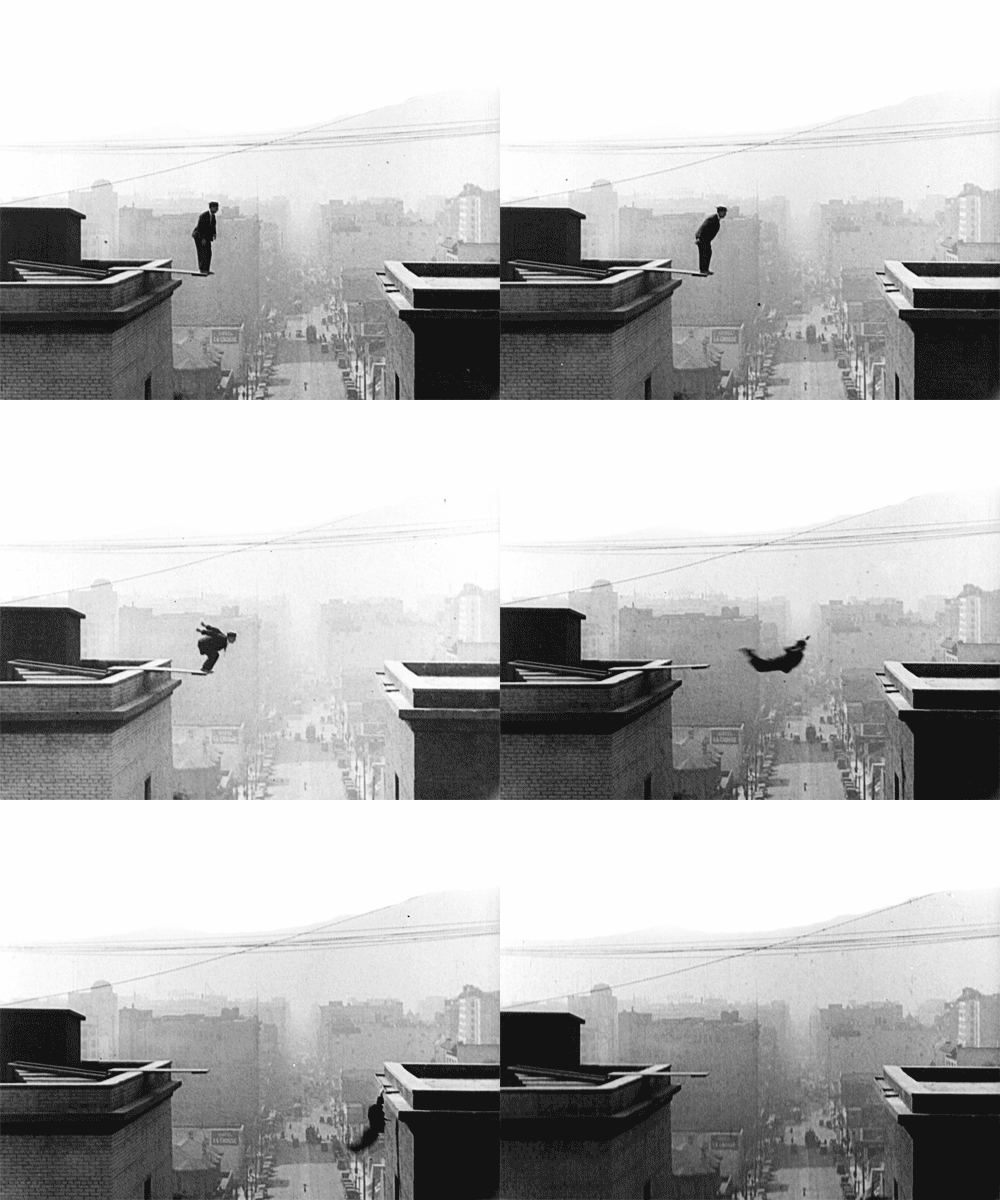
carry-on-my-otp: If Stuntmen from the old movies don’t have...


carry-on-my-otp:

If Stuntmen from the old movies don’t have your full respect then I just don’t know what to say to you


06 Apr 21:52

fencehopping: Giant balloon popping in slow motion.


fencehopping: Giant balloon popping in slow motion.

02 Apr 02:43

Fifth Grader Suspended for 'Illegal' Filming of Teacher Who Bullied Student

by Ed Krayewski

Around the country, irrespective of the local and state laws, some police officers react poorly to residents exercising their right to film cops in public. But police officers aren't the only government employees who find being recorded problematic to them.

A fifth grader in Florida was suspended for five days for "illegally" filming her teacher bullying a classmate. The school argues because the law prohibits surreptitiously recording people if they have an expectation of privacy, it was illegal for the child to film her teacher.

WSVN reports:

Eleven-year-old Brianna Cooper, a fifth-grader at Fort Pierce Elementary School, said her teacher had been mean to students in the past and she wanted to prove it. Inside her classroom, Brianna recorded the instructor saying to a classmate, "Don't let the size fool you. I will drop you."

In another part of the recording the teacher is heard belittling another student. "Biggest kid in the fifth grade and you acting like the smallest one," she is heard saying.

"I thought I did the right thing," said Brianna.

Her video led to the firing of that teacher. "I do think it's a good thing that this teacher is gone," said Kassie Faulkner, the girl's mother.

Florida's whistleblower laws wouldn't apply since they only cover state employees who reveal misconduct by other government employees, not eleven year olds trying to stand up to their bullying teachers.

28 Mar 23:28

Earth Hour celebrates ignorance, poverty, and backwardness

by Mark Perry

In 2009, Canadian economist Ross McKitrick was asked by a journalist for his thoughts on the importance of the annual one-hour event in energy self-flagellation and green nitwitery known as Earth Hour, which takes place today, March 28, at 8:30 p.m. Here is his excellent response (my emphasis):

I abhor Earth Hour. Abundant, cheap electricity has been the greatest source of human liberation in the 20th century. Every material social advance in the 20th century depended on the proliferation of inexpensive and reliable electricity.

Giving women the freedom to work outside the home depended on the availability of electrical appliances that free up time from domestic chores. Getting children out of menial labour and into schools depended on the same thing, as well as the ability to provide safe indoor lighting for reading.

Development and provision of modern health care without electricity is absolutely impossible. The expansion of our food supply, and the promotion of hygiene and nutrition, depended on being able to irrigate fields, cook and refrigerate foods, and have a steady indoor supply of hot water.

Many of the world’s poor suffer brutal environmental conditions in their own homes because of the necessity of cooking over indoor fires that burn twigs and dung. This causes local deforestation and the proliferation of smoke- and parasite-related lung diseases. Anyone who wants to see local conditions improve in the third world should realize the importance of access to cheap electricity from fossil-fuel based power generating stations. After all, that’s how the west developed.

The whole mentality around Earth Hour demonizes electricity. I cannot do that, instead I celebrate it and all that it has provided for humanity. Earth Hour celebrates ignorance, poverty and backwardness. By repudiating the greatest engine of liberation it becomes an hour devoted to anti-humanism. It encourages the sanctimonious gesture of turning off trivial appliances for a trivial amount of time, in deference to some ill-defined abstraction called “the Earth,” all the while hypocritically retaining the real benefits of continuous, reliable electricity.

People who see virtue in doing without electricity should shut off their fridge, stove, microwave, computer, water heater, lights, TV and all other appliances for a month, not an hour. And pop down to the cardiac unit at the hospital and shut the power off there too.

I don’t want to go back to nature. Travel to a zone hit by earthquakes, floods and hurricanes to see what it’s like to go back to nature. For humans, living in “nature” meant a short life span marked by violence, disease and ignorance. People who work for the end of poverty and relief from disease are fighting against nature. I hope they leave their lights on.

Here in Ontario, through the use of pollution control technology and advanced engineering, our air quality has dramatically improved since the 1960s, despite the expansion of industry and the power supply.

If, after all this, we are going to take the view that the remaining air emissions outweigh all the benefits of electricity, and that we ought to be shamed into sitting in darkness for an hour, like naughty children who have been caught doing something bad, then we are setting up unspoiled nature as an absolute, transcendent ideal that obliterates all other ethical and humane obligations.

No thanks. I like visiting nature but I don’t want to live there, and I refuse to accept the idea that civilization with all its tradeoffs is something to be ashamed of.

MP: The winner for Earth Hour every year since 2003 has been North Korea (see photo below of the Korean peninsula at night). Odds favor them to be the winner again this year.

northkoreaatnight

The post Earth Hour celebrates ignorance, poverty, and backwardness appeared first on AEI.

28 Mar 12:44

Robots Read News of the Kraft/Heinz Merger

If your firewall is blocking the image, see it on Twitter here.

image

Humor Dimensions: Recognition, mean, clever, bizarre

Brevity: Good (could lose the word “have” in first panel)

Inappropriateness: High (bathroom humor)

Predicted Twitter Response: Expect lots of retweets despite bathroom humor because the message about nutrition is important to folks and the naughtiness is softened by the silliness of it.

[Update: Typo in last frame corrected]

Update 3/29/15: I predicted lots of retweets despite the naughtiness of this comic because I assumed folks would agree with the message about nutrition. No one is on the other side of that issue. As predicted, this was a strong performer. Only a few of my tweets have had this many retweets.

Key Learning: You can get away with naughtiness if you don’t use actual naughty words and the message is otherwise positive.

If your firewall is blocking the image, see it on Twitter here.

image

Scott

@ScottAdamsSays

26 Mar 11:53

Score a Victory for Cruz over Brown in Most Recent Climate Change Scuffle

by Paul C. "Chip" Knappenberger

Paul C. "Chip" Knappenberger

Global Science Report is a feature from the Center for the Study of Science, where we highlight one or two important new items in the scientific literature or the popular media. For broader and more technical perspectives, consult our monthly “Current Wisdom.”

On Sunday, in anticipation of Sen. Ted Cruz’s (R-TX) announcement that he intends to run for president, California governor Jerry Brown (D), declared to NBC’s Meet the Press Cruz was “absolutely unfit to be running for office.” Why? Because of Cruz’s stance on climate change—some of which Cruz laid out on late night TV last week.

But comparing Cruz’s comments on Late Night with Seth Meyers and Brown’s remarks on Meet the Press, it is pretty clear that it is Gov. Brown who needs to spend more time familiarizing himself with the scientific literature on climate change and especially its associations with extreme weather events.

Apparently Gov. Brown is convinced that climate change, or rather the apparently scarier-sounding “climate disruption” Brown prefers, is behind the ongoing drought in California, not to mention the East Coast’s cold and snowy winter.

Cruz, on the other hand, told a more restrained story—that data doesn’t support many alarmist claims and that satellites show no warming during the past 17 years while climate models expected warming—one which comports better with the science that he portrayed.

While there is certainly more to the story than Cruz went into in his brief appearance with Seth Meyers, he is right, that according to satellite observations of the earth’s lower atmosphere as compiled by researchers at Remote Sensing Systems, there has been no overall temperature increase during the past 17 years.

Gov. Brown, meanwhile, decided to elaborate on the climate change issue. Under general questioning from Meet the Press host Chuck Todd, Brown admitted that is was difficult to link specific events, like the California drought, to human-caused climate change. But then Todd played a snippet of Cruz’s Late Night interview where Cruz said:

And my view actually is simple. Debates on this should follow science and should follow data and many of the alarmists on global warming, they have a problem because the science doesn’t back them up.

Brown’s assertions then got much bolder:

What [Cruz] said is absolutely false. Over 90% of the scientists who deal with climate are absolutely convinced that the human activity, the industrial activity, the generation of CO2, methane, oxides of nitrogen and all the rest of those greenhouse gases are building up in the atmosphere, they are heat-trapping, and they are causing warming, not just drought in California, but severe storms and cold in the East Coast. So it’s climate disruption of many different kinds. And that man betokens such a level of ignorance and a direct falsification of existing scientific data. It is shocking, and I think that man has rendered himself absolutely unfit to be running for office.

Unfortunately for Brown, it is he that is speaking against “existing scientific data.”

Consider this new study by a team led by Geophysical Fluid Dynamic Laboratory’s (GFDL) Thomas Delworth that examined the association between the global warming hiatus and drought in western North America (including California). Turns out, according to these scientists, both stemmed from a similar cause—a change in the patterns of winds across the tropical Pacific Ocean. Further, they suggest this pattern was not overly consistent with expectations from human-caused climate change. Here is an excerpt from that paper:

The strong connection between the intensification of Pacific trades and the drying in western North America observed over the past decade suggests that this drying cannot be connected in a straightforward fashion to greenhouse gas increases. In most coupled [climate model] simulations anthropogenic forcing produces a long-term weakening of the Walker circulation and tropical Pacific trade winds, but with substantial intrinsically-generated variability on decadal scales (Vecchi et al. 2006). Therefore, unless it can be shown that the strengthened trade winds are a result of either natural or human-induced radiative forcing changes, the model results suggest that the observed drying over the western U.S. over the last decade may be primarily due to natural variability, and therefore not necessarily a harbinger of a secular drying trend (Hoerling et al. 2010; Seager and Naik 2012). These results highlight how vulnerable western North America is to severe decadal swings in hydroclimate arising from internal variations of the climate system.

Clearly, Gov. Brown is out of touch with these findings, just as he is with many findings on East Coast cold and snow (for example, here, here, and here). But this is typical of those who are intent on attacking those folks (politicians, scientists, writers, etc.) who take a dimmer view than themselves on the necessity for policy action aimed to combat climate change—policies which too often seek to limit energy choice.

If anyone is keeping score, this round of political squabbling over climate change should go to Sen. Cruz.

Reference:

Delworth, T.L., et al., 2015. A link between the hiatus in global warming and North American drought. Journal of Climate, doi:10.1175/JCLI-D-14-00616.1, in press.

25 Mar 14:42

Type 3 Diabetes, The Next Epidemic?

by Kevin Cann

Written by: Kevin Cann

Most people reading this have heard of the term insulin resistance. For those of you that are new to the paleo diet and the site, insulin resistance is when our muscle, liver, and fat cells become desensitized to the hormone insulin. This leads the pancreas to have to produce more insulin and shovel the majority of glucose into our fat cells for storage.

Type 2 diabetes is a result of prolonged insulin resistance. The pancreas becomes tired from being overworked trying to produce extra insulin and eventually we cannot manage our blood sugar levels. Type 2 diabetes is an epidemic that the world is currently facing. It is estimated by the Center for Disease Control (CDC) that nearly 30 million Americans suffer from diabetes.

What if I said that type 3 diabetes is likely to be the next major epidemic that we face? You might be thinking “Type 3 diabetes? Is that such a thing?” You may know type 3 diabetes by another name, Alzheimer’s disease (AD). Yes, AD is a form of diabetes.

I am not just making this up. Research published in the Journal of Diabetes Science and Technology concluded by stating:

“ We conclude that the term “type 3 diabetes” accurately reflects the fact that AD represents a form of diabetes that selectively involves the brain and has molecular and biochemical features that overlap with both type 1 diabetes mellitus and T2DM” (1). This same research also showed that AD was treatable with insulin sensitizing agents.

Instead of having insulin resistance in the muscle, liver, and fat cells, we can develop insulin resistance in the brain. This is not hard to see once we realize that the brain uses about 25% of the body’s glucose supply. Type 3 diabetes does differ from type 2 in one scary way. We do not have to have dysfunctional blood sugar to develop it.

Some fascinating research is being conducted out of the University of Penn. For the first time they were able to prove that insulin resistance actually occurs in the brain. They also showed that this change can occur in the brain in non-diabetics and without any presence of hyperglycemia (2). This makes sense as insulin plays a critical role to glucose uptake and the health of brain cells. If something in this system becomes dysfunctional, cognitive decline would be a logical outcome. Glucose oxidizes easily in the blood and that oxidation can lead to DNA damage in the cells. Also, if we have insulin resistance in the brain our cells cannot get the glucose that they need to function.

According to the researchers at the University of Penn, people with diabetes are 50% more likely to develop AD. With this type of increase seen in this population it makes sense that insulin resistance plays a role in the development of AD. The theory is that the insulin resistance in the brain causes the formation of plaques and tangles in the neurons associated with cognitive impairment.

Insulin resistance in the brain also alters dopamine function. Dopamine is our neurotransmitter responsible for memory, focus, and energy (3). Dysfunctional dopamine levels have been linked to depression, ADD, ADHD, gambling addiction, drug addiction, and schizophrenia. Ironically sugar addiction has been linked to low dopamine levels as well.

This insulin resistance link to dopamine may explain why ketogenic diets are a useful therapeutic tool when treating diseases of cognitive decline and schizophrenia (4,5). Theoretically speaking, maybe the ketogenic diet reverses insulin resistance in the brain and brings the system back to normal.

Now that we know what causes AD how do we avoid it? Do we need to run as far away from carbohydrates as possible? In my opinion, no. There are a number of things that may lead to one developing AD such as food, stress, environmental toxins, gut health, and genetics.

In order to decrease our risk of developing AD we need to maximize each of those specified areas. Eating a healthy diet rich in nutrient dense foods is a start. I would not get so hung up on carbohydrate quantity as much as I would on quality. Most people that develop insulin resistance develop it from overeating highly refined and processed carbohydrates. I think we can still minimize our risk of developing AD eating a high carbohydrate diet that consists of fruits and sweet potatoes. If it was just the high carbohydrate intake leading to insulin resistance we would see more type 2 diabetes and AD in groups such as the Kitavans that consume a diet consisting of roughly 70% carbohydrates.

We need to manage our stress. If you are not doing something to actively manage your stress, you need to. Try adding in some daily meditation to your routine. Exercise is important to preventing AD, but it is not a stress management activity. Exercise increases insulin sensitivity and helps us recover from the stress response, but is a stressor in and of itself. Lift some weights 2-4 days per week and remain physically active throughout the week by walking more and standing up at your desk.

Limit the amount of environmental toxins in your home. Use cleaning products that are made from natural sources. Filtering your tap water is also a way to limit environmental toxins in your life. Some of us cannot control our work environment and may be surrounded by toxins there. Do the best you can to limit exposure and make sure you’re eating a nutrient dense diet. In a lot of cases nutrients in our food help protect us from environmental toxins.

We need to attempt to maximize our gut health. Our gut bugs are the gatekeepers of our immune system. They keep all unwanted things out. If they get out of balance things begin to slip through the cracks leading to a chronic inflammatory response. When this happens inflammatory cytokines are released and these cytokines cause DNA damage and inhibit cellular DNA repair (6).

Genetics may be a piece that is out of our control. However, our genes are not just locked into place. They respond to internal and external stimuli and express themselves accordingly (epigenetics). If we take more of the steps listed above I truly believe we can alter our genome for a favorable outcome.

AD, or type 3 diabetes, does not need to be the world’s next epidemic. We can take a proactive stance and eat a healthier diet consisting of nutrient dense real foods, manage our stress, optimize gut health, and limit environmental toxin exposure. If we do this we can age gracefully and enjoy a full life

24 Mar 14:13

Amazon Quietly Bricked Jailbroken Kindle Devices Last Year

by Tim Cushing
It appears that Amazon is very serious about walling off its garden. Late last year, it pushed out a firmware update for its Amazon Fire TV devices that not only made rooted devices unusable, but prevented Fire TV owners from rolling back firmware to previous, more root-friendly versions. Apparently, Kindle users were also included in this lockdown.

A recent post at Good Reader notes that the latest firmware for Kindles is pretty much identical to its Fire TV firmware, right down to the destruction of functionality.
The new firmware was pushed out to all modern Kindle devices in late November of last year. Anything after version 5.60 will not allow you to hack the firmware and do interesting things like change the screensaver system or install custom apps.
And, like its firmware for the Fire TV, rollback to less hack-resistant firmware is nearly impossible. You can force it back, provided you have a soldering iron (and the willingness to apply it to your device) or you can follow a few not-so-simple steps to take your root access back from Amazon. But once again, it's the company removing functionality for the sole purpose of making devices perform the way Amazon wants them to, rather than leaving these sorts of decisions to those who have purchased the devices.

And it's not as though Kindle owners are receiving any heads up from Amazon about the firmware's plans for their jailbroken devices. No mention of it is made in the firmware's specifications, which only tells you about the (supposedly) good things the update will bring: vague "bug fixes and improvements." Softpedia's hosting page for the latest version (5.6.1) goes into a little more detail, but it only contains a list of slightly-upgraded Amazon features, rather than the limitations the firmware will impose on paying customers.

If you like Amazon's walled garden, the company is more than happy to ensure you never find the gate. If you don't, Amazon is more than happy to step in and brick over any openings. The latter does a huge disservice to paying customers who are looking to get the most out of something they purchased and own, but seems to still somehow "belong" to Amazon.

Permalink | Comments | Email This Story


24 Mar 00:31

Reich on the Alleged Horrors of An Economic Cornucopia

by Don Boudreaux
(Don Boudreaux)

Here’s a letter to the editor of Alternet:

In what is a prime candidate for the most economically mistaken essay ever penned, Robert Reich calls a future in which technology makes ever-more high-quality goods and services widely available at virtually zero cost “horrifying” (“In Our Horrifying Future, Very Few People Will Have Work or Make Money,” March 17).

Where to start?  Perhaps with the fact that the history of such Luddite fear-mongering is as long (at least 200 years) as its batting record is low (.000%).  Or maybe with the illogical worry about the unemployment created by an imaginary device that Dr. Reich uses to scare your readers - a device “capable of producing everything you could possibly desire, a modern day Aladdin’s lamp.”  In fact, in a future filled with such devices unemployment wouldn’t be a problem because no one would have to work in order to acquire the means to consume lavishly.  (Indeed, in such a future there would technically be no unemployment because no one would want to work.)

But Dr. Reich’s most wrongheaded claim is this one: “when more and more can be done by fewer and fewer people, the profits go to an ever-smaller circle of executives and owners-investors.”  This claim is exactly backwards.  By far the greatest part of the gains from entrepreneurial-driven advances in technology are, as they have always been, widely dispersed to the masses in the form of more and better consumption options available at lower and lower prices.  Examples include the factory production of textiles that clothed the masses, the mechanization of agriculture that saved the masses from famine, the assembly line that brought the likes of automobiles, kitchen appliances, telephony, and air travel to even the modern-world’s ‘poor,’ and the technology revolution that enables those yearning to read Dr. Reich’s economically uninformed commentary to satisfy their demands 24/7/365 by using their smartphones while sipping lattes and attending protests against the predations of the one percent.

Sincerely,
Donald J. Boudreaux
Professor of Economics
and
Martha and Nelson Getchell Chair for the Study of Free Market Capitalism at the Mercatus Center
George Mason University
Fairfax, VA  22030

Reich himself, in listing some modern devices (that he uses as evidence of the coming calamity of abundance), unwittingly gives examples against his proposition that all of the gains of labor-saving technological advances are captured by ‘the few.’

Indeed, even if one focuses exclusively and literally on the profits from entrepreneur-driven technological advances (rather than, more broadly, on the gains from such advances), they, too, are not destined to go to fewer and fewer people.  Higher profits spark competition which, in turn, drives profits down to ‘normal’ rates.  It’s this very process of competition that causes the gains from technological advances to be shared with the masses: the entrepreneurs might all like to keep their profits without sharing them, but competition obliges them to share those profits with the public, in the form of lower prices and improved product quality.  And with technology advancing as fast as Reich fears (and I applaud), the ability of entrepreneurs to compete against each other will only intensify.  If technology makes the production of the likes of clothes and cups of coffee cheap, easy, and fast, so, too, does technology make the production of other machines for use in competing in the production and sale of consumer goods cheap, easy, and fast.

UPDATE: Regular Cafe patron W.E. Heasley sent the following note to me by e-mail:

Is it not poetic justice that Reich managed to post his argument on a platform that uses little manpower, plenty of technology, and is distributed on mass? Shouldn’t Robert have had his essay hand delivered to each and everyone interested?

23 Mar 13:51

jedavu:Frozen Lakes PatternsWith the fall of temperatures, we...


Bubbles Under The Ice of Abraham Lake by Emmanuel Coupe.


Bubbles in The Ice of Abraham Lake by Phillips Chip.


Frozen Pond by Adam Rifkin.


Ice Rider in Siberia by Matthieu Paley.


Baikal Lake in Russia by Daniel Kordan.


Lake Druzhby in Antarctica by Stu Shaw.


Blue Pond in Japan by Kent Shiraishi.


Frost Flowers in the Arctic Ocean by Matthias Wietz.


Frost Flowers in the Arctic Ocean by Matthias Wietz.


Pond in Switzerland by Dartai.

jedavu:

Frozen Lakes Patterns

With the fall of temperatures, we have gathered for you the most beautiful photographs of frozen lakes and ponds from all around the world : Russia, Switzerland, Japan or also in Canada, their frozen surfaces are full of aesthetic and graphic patterns.

23 Mar 02:19

Students Are Literally 'Hiding from Scary Ideas,' Or Why My Mom's Nursery School Is Edgier Than College

by Robby Soave

ToddlerMy mother is a nursery school teacher. Her classroom is a place for children between one and two years of age—adorable little tykes who are learning how to crawl, how to walk, and eventually, how to talk. Coloring materials, Play-Doh, playful tunes, bubbles, and nap time are a few of the components of her room: a veritable "safe space" for the kids entrusted to her expert care.

We'll come back to that in a minute.

Judith Shulevitz—formerly of The New Republic, where her eminently reasonable and fact-based perspective has been replaced by mean-spirited blathering—writes that college students now fear perspectives that clash with their own so deeply that they are quite literally hiding from them.

In a must-read op-ed for The New York Times, Shulevitz provides examples of the most egregious instances. At Brown University last fall, for instance, the prospect of a debate between leftist-feminist Jessica Valenti and libertarian-feminist (and Reason contributor) Wendy McElroy was so horrifying to some students—including Sexual Assault Task Force member Katherine Byron—that the creation of a "safe space" was necessary. McElroy's contrarian perspective on the existence of rape culture ran the risk of "invalidating people's experiences" and "damaging" them, according to Byron.

The safe space she created, as described by Shulevitz, sounds familiar to me:

The safe space, Ms. Byron explained, was intended to give people who might find comments “troubling” or “triggering,” a place to recuperate. The room was equipped with cookies, coloring books, bubbles, Play-Doh, calming music, pillows, blankets and a video of frolicking puppies, as well as students and staff members trained to deal with trauma. Emma Hall, a junior, rape survivor and “sexual assault peer educator” who helped set up the room and worked in it during the debate, estimates that a couple of dozen people used it. At one point she went to the lecture hall — it was packed — but after a while, she had to return to the safe space. “I was feeling bombarded by a lot of viewpoints that really go against my dearly and closely held beliefs,” Ms. Hall said.

It's my mother's classroom!

To say that the 18-year-olds at Brown who sought refuge from ideas that offended them are behaving like toddlers is actually to insult the toddlers—who don't attend daycare by choice, and who routinely demonstrate more intellectual courage than these students seem capable of. (Anyone who has ever observed a child tackling blocks for the first time, or taking a chance on the slide, knows what I mean.)

Lest anyone conclude that Brown must be a laughable outlier, read the rest of Shulevitz's essay:

A few weeks ago, Zineb El Rhazoui, a journalist at Charlie Hebdo, spoke at the University of Chicago, protected by the security guards she has traveled with since supporters of the Islamic State issued death threats against her. During the question-and-answer period, a Muslim student stood up to object to the newspaper’s apparent disrespect for Muslims and to express her dislike of the phrase “I am Charlie.” ...

A few days later, a guest editorialist in the student newspaper took Ms. El Rhazoui to task. She had failed to ensure “that others felt safe enough to express dissenting opinions.” Ms. El Rhazoui’s “relative position of power,” the writer continued, had granted her a “free pass to make condescending attacks on a member of the university.” In a letter to the editor, the president and the vice president of the University of Chicago French Club, which had sponsored the talk, shot back, saying, “El Rhazoui is an immigrant, a woman, Arab, a human-rights activist who has known exile, and a journalist living in very real fear of death. She was invited to speak precisely because her right to do so is, quite literally, under threat.”

You’d be hard-pressed to avoid the conclusion that the student and her defender had burrowed so deep inside their cocoons, were so overcome by their own fragility, that they couldn’t see that it was Ms. El Rhazoui who was in need of a safer space.

Caving to students' demands for trigger warnings and safe spaces is doing them no favors: it robs them of the intellectually-challenging, worldview-altering kind of experience they should be having at college. It also emboldens them to seek increasingly absurd and infantilizing restrictions on themselves and each other.

As their students mature, my mother and her co-workers encourage the children to forego high chairs and upgrade from diapers to "big kid" toilets. If only American college administrators and professors did the same with their students.

20 Mar 18:02

This Mom Beat Ridiculous 'Child Neglect' Charges, But Life Is Still Tough

by Lenore Skenazy

Nicole GaineyLast summer, Florida mom Nicole Gainey was arrested, handcuffed, taken to the local jail, fingerprinted, and held for seven hours for the “crime” of letting her 7-year-old son walk half a mile to the local park. She faced a possible $5,000 fine and five years in jail, but thanks to the Rutherford Institute and lawyer Brian H. Bieber, prosecutors dropped the charges.

Her legal ordeal may have ended months ago, but the resulting emotional and financial troubles are ongoing. Gainey has struggled to keep a job and her son, now 8, has issues of his own. Here is a note from her (edited down):

Dear Lenore: I am the mother that got arrested July 26 for letting my son son walk to the park that is closer than his school by himself, and since my arrest our lives have changed for the worse.

My son was 7 at the time, now he’s 8. He walked to our neighborhood park half mile from my home on a Saturday afternoon about 4 p mfor an hour. He had his own cell phone, he had been going there all that summer, and some nosy busybody at the community pool that’s on the way called the cops, due to him looking too young to be by himself.

So then the police picked up my son at the playground and placed him in the cop car while they went to talk to the people at the pool. Then they came to my home and never told me he was in back of the car, and arrested me. It wasn’t until they were putting me in the back of the car that I found out that my son was in there this whole time, like he was a criminal.

As he got out & walked past me he tells me, “I’m sorry mommy. I wanted to go play at the park”—thinking it was his fault. Since then, the charge was not filed but I can not get a job anywhere, I think due to this, and I am struggling very bad. Also my son used to be a carefree outgoing little boy. Everything has changed.

Thank you for sharing my story when it happened. A lot of readers were on my side. Well, I was wondering if you will put my Go Fund Me link on your page. If anyone can help even a small bit, my children and I will be very grateful.  Please tap to donate.

Let me reiterate—again—that the reason this story went national is that it's rare for parents to face consequences this horrifying. I publish stories like this for two reasons: to support the parents, and to incite the kind of national outrage needed to pressure the cops to stop arresting perfectly responsible moms and dads.

free-range-kidsThe same way crazy stories about kids getting suspended for Pop Tart guns and sporks have made Americans deeply skeptical of zero tolerance laws, stories of parents arrested for giving their kids a bit of freedom have made the country start wondering: Why is the government telling loving parents how to raise their kids?

So do no freak out about possibly getting arrested if you send your kids outside. The odds are vastly on your side. And so, increasingly, is the rest of the country.

20 Mar 17:56

DEA 'Cold Consent' Encounters Constitute Federal Stop-and-Frisk

by Adam Bates

Adam Bates

Over at Forbes, the Institute for Justice’s Nick Sibilla details a new report from the Department of Justice concerning the Drug Enforcement Administration’s practice of cold-stopping travelers at airports, bus stations, and train stations and asking to search their property looking for forfeitable assets.

Federal drug agents may be racially profiling and unjustly seizing cash from travelers in the nation’s airports, bus stations and train stations. A new report released by the Office of the Inspector General for the U.S. Department of Justice examined the Drug Enforcement Administration (DEA)’s controversial use of “cold consent.

In a cold consent encounter, a person is stopped if an agent thinks that person’s behavior fits a drug courier profile. Or an agent can stop a person cold “based on no particular behavior,” according to the Inspector General report. The agent then asks the people they have stopped for consent to question them and sometimes to search their possessions as well. By gaining consent, law enforcement officers can bypass the need for a warrant.

While many people who believe they have nothing to hide may–inadvisably–consent to a police search, they may not be familiar with federal civil asset forfeiture laws, which give federal agents wide latitude to seize property, especially cash, without charging anyone with any crime. Sibilla notes that the DEA agents even go so far as to carry affidavits for search targets to sign disclaiming any rights to the property being seized. 

Disturbingly, the Inspector General found that DEA interdiction task force groups have been seizing cash from travelers and then urging them to sign forms disclaiming their own cash and “waiving their rights.” In one cold consent encounter, DEA agents stopped another African-American woman in part because she was “pacing nervously” before boarding her flight. After gaining her consent, the agents searched her luggage and found $8,000.

The extortive waiver maneuver is not an isolated practice in civil forfeiture jurisdictions. In exchange for signing away your money, the agents agree not to seize other property (for instance, your car or home) or arrest you on criminal charges. Many interstate travelers (the primary targets of drug interdiction forfeiture efforts) rationally decide it’s better to get on with their journey than fight the government for their property. It’s not hard to imagine the practical and financial vulnerability of people getting ready to step on an airplane being threatened with arrest if they refuse to hand over their cash. 

The Department of Justice report also raises troubling questions concerning the criteria used to make the stops. There is an obvious risk that allowing DEA agents to stop travelers cold and question them invites the possibility of racial profiling. This federal policy bears a striking resemblance to the NYPD’s controversial Stop-and-Frisk program, which received withering criticism for the constitutional and racial dynamics involved in allowing officers to stop people cold.

In short, this is another on a long list of areas where the pernicious incentives of the drug war and civil asset forfeiture combine to create an institution of abuse and disregard for individual liberty. 

At a time when predatory, revenue-centered law enforcement is being rightly condemned-–with the ostensible imprimatur of the federal government-– it would be nice for the federal government to set an example by ending its own abusive law enforcement practices.