'"We have successfully transformed Spike from a hyper-fueled network for young guys into a distinctive entertainment destination that's inclusive and female friendly," said Kevin Kay, President, Spike. "We built that foundation with gender-balanced original hits like "Bar Rescue" and "Ink Master, " Now those hits are paving the way for the next step in our development with shows like "Tut" and "Lip Sync Battle." The new Spike has got it all: big talent, engaging shows, and hits that get people talking. We are the ones to watch."'
Snip goes the Male Audience
"Spike (formerly and popularly known as Spike TV) is an American basic cable and satellite television channel that is owned by the Viacom Media Networks division of Viacom. Spike is a general entertainment channel featuring a mix of various programs and movies." (Wikipedia)
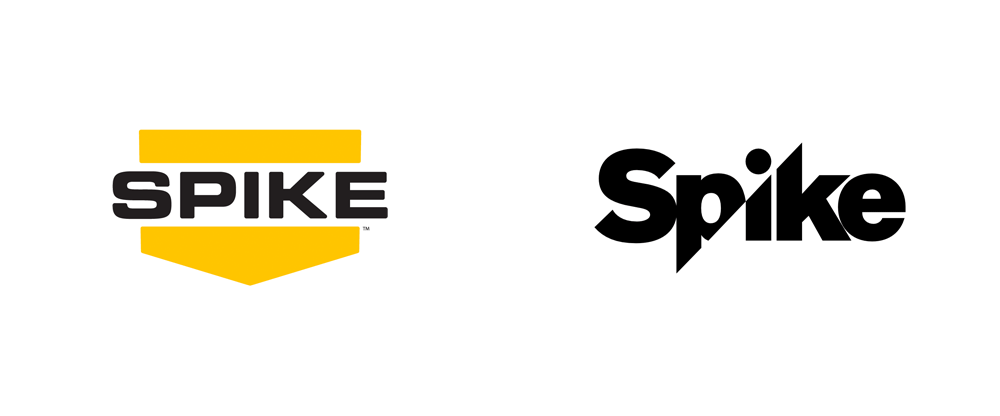
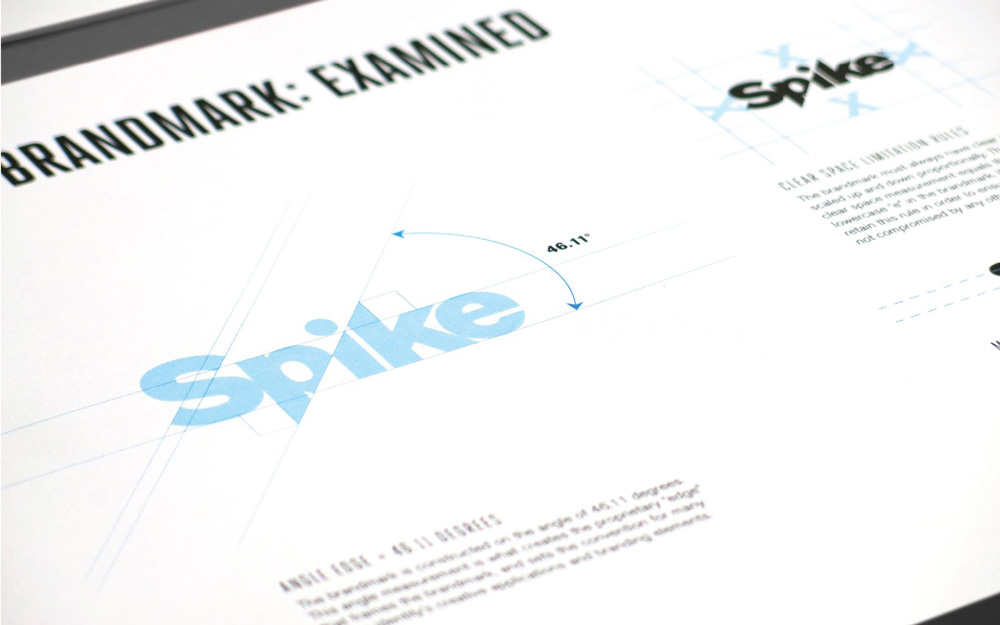
Opinion/Notes: Not a whole lot of information or any additional applications on this one, not even a tiny motion tease. Nonetheless, as a standalone logo update, this is a really cool evolution. The previous army-like badge was fine and it could have probably worked for another few years. The new logo is not "better" than the old; it's just a different approach and I like it both in idea and execution. The slice to generate the spikes is in the right place, at the right angle, and cutting through the right pieces of letters. This is a really hard trick to pull off and other than the "e" that could be nudged a bit to the right, it's spot on. I'm not sure how this fulfills the change from a male-driven channel to a general audience, female-friendly channel since it still feels fairly masculine and aggressive.
Update: Design credits and sizzle video have surfaced; post has been updated. In summary: cool business card; odd choice of condensed sans serif approach on the motion, it's like two separate projects.
Select Quote: "We have successfully transformed Spike from a hyper-fueled network for young guys into a distinctive entertainment destination that's inclusive and female friendly," said Kevin Kay, President, Spike. "We built that foundation with gender-balanced original hits like "Bar Rescue" and "Ink Master, " Now those hits are paving the way for the next step in our development with shows like "Tut" and "Lip Sync Battle." The new Spike has got it all: big talent, engaging shows, and hits that get people talking. We are the ones to watch."
The tagline "Spike: The Ones To Watch" encompasses the network's strategic shift to a general entertainment network delivering compelling original entertainment with an edge and a distinctive point of view. It speaks to the network's bold personalities and a brand pushing the boundaries of the unexpected. With a dynamic multi-platform redesign, Spike's on-air look will reflect the brand's evolution.
Logo detail.Sizzle.Identity guidelines detail.Business card.
'Venmo CEO Bill Ready said that the company usually preferred to address fraud without alerting the user for experience reasons.'
Payment service Venmo was criticized last month for lax security measures after one of its users had their account compromised and drained of almost $3,000. In response, the company has announced that it is beefing up security measures, introducing email notifications that will be sent out whenever a user's email address, password, or phone number changes, and implementing multi-factor authentication for user logins in the coming weeks.
The company issued an apology for the breach
A Slate report, published in February, told the story of a Venmo user whose account had been compromised. Because the company didn't notify users when login details were changed, the malicious individual was able to get into the account and drain it of almost $3,000 before the owner noticed the breach. Speaking shortly after the Slate article was published, Venmo CEO Bill Ready said that the company usually preferred to address fraud without alerting the user for experience reasons. "In many of these cases, we want to handle it seamlessly so we're working behind the scenes," he told The Verge, but he said that the the feedback was "valid," and that his team would take a look at changing their policy. Venmo also issued an apology on its blog after the article was published, but failed to explain why two- or multi-factor authentication wasn't standard.
The introduction of the new security measures show that the company has now taken the criticism on board. Venmo has grown rapidly — handling just under a billion dollars in 2014 — by enabling lightning-fast transactions between users on mobile devices. There's a worry that two-factor authentication might slow the process of sending money down, but as Slate's example shows, the security feature is becoming increasingly necessary for modern web services.
Republican senators made an unusual foray into international diplomacy yesterday when they sent an open letter to the leaders of Iran, a move that attempted to undercut US president Barack Obama and scuttle a potential deal over Iran’s nuclear program.
The letter warned that an agreement would require Congressional approval, and that Obama’s successor “could revoke such an executive agreement with the stroke of a pen.” Reaction came swiftly—from political analysts, Democrats, some Republicans, and Iran itself—condemning the move as short-sighted, misguided, and possibly even traitorous.
The Islamic Republic of Iran
Iran’s foreign minister, Javad Zarif, “expressed astonishment” at the letter, which he denounced as a “propaganda ploy”:
[I]t seems that the authors not only do not understand international law, but are not fully cognizant of the nuances of their own Constitution when it comes to presidential powers in the conduct of foreign policy. …
Change of administration does not in any way relieve the next administration from international obligations undertaken by its predecessor in a possible agreement about Iran’s peaceful nuclear program. I wish to enlighten the authors that if the next administration revokes any agreement with the stroke of a pen, as they boast, it will have simply committed a blatant violation of international law.
He pointed out the response to Tom Cotton, the Arkansas senator who organized the letter, on Twitter, in a mockery of Cotton’s own Twitter message.
Whether the senators’ letter can be actually be cited as a traitorous act in the US or not is unclear, but petitions are circulating calling for the legal action to be taken against the senators, and Twitter users started #47Traitors to send messages to the senators involved:
Treason against the United States, shall consist only in levying war against them, or in adhering to their enemies, giving them aid and comfort. No person shall be convicted of treason unless on the testimony of two witnesses to the same overt act, or on confession in open court.
The Democratic opposition in Congress was, predictably, incensed by the letter.
“I can’t even imagine the uproar if Democratic senators [had been] writing to Saddam Hussein in the lead up to the Iraq War,” Sen. Chris Murphy told the National Journal. Republicans “have made it crystal clear that this has nothing to do with the merits of the deal,” he said. “This has everything to do with undermining the president.”
Vice president Joe Biden, who issued his own lengthy criticism of the letter, may have been alluding to the issue of treason or the Logan Act when he wrote, “I cannot recall another instance in which Senators wrote directly to advise another country—much less a longtime foreign adversary.”
Other Republicans
Seven Republican senators didn’t sign the letter, including Jeff Flake from Arizona. He told the Arizona Republic he “just didn’t think it was appropriate,” but added he was not optimistic about the talks. “I’m not very bullish on the chance of these negotiations resulting in a good agreement, or an agreement at all, but we ought to explore it,” Flake said. “We ought to give it every opportunity to succeed.”
Political analysts and internet bystanders
Whether any agreement with Iran will ultimately need some sort of Congressional approval remains a matter of debate.
.@mdubowitz now Mark, stop comparing a mutual agreement to cut nuclear forces with the Iran negotiations.
One Australian lawyer told Iranian television he thought the letter could result in the senators’ impeachment, or worse. The “reckless and outrageous” letter provides “grounds for them to be impeached, if not actually prosecuted for treason,” he said.
Zarif’s reaction, meanwhile prompted creative interpretations, including this translation into “cat pic.”
Dumas started taking classes at other campuses nearby: Concordia University, University of Montreal, and McGill University. He started thinking bigger. Providence, Rhode Island, the home of Brown University, was fewer than six hours away by car, and New Haven wasn’t much farther. Dumas says he attended Yale in the spring of 2009, couchsurfing for about a month, and he spent time at Brown too. He says he was taking classes and spending only a few hundred dollars a month, most of it on alcohol for parties. When he later went to UC Berkeley, where he lived at a campus co-op for about two months, his expenses were larger—$600 or $700 a month, in his estimation. While at these schools, he reaped most of the perks of college: learning, partying, and meeting intelligent, like-minded people.
Full tuition at Yale for the 2014-2015 school year, which includes room, board, and books, is $63,250. This breaks down to a little over $7,000 per month during Yale’s academic school year, which means Dumas was getting most of the selling points of college at about a tenth of the cost. At Berkeley, average tuition (which includes in-state and out-of-state students) is about $28,000, but that still works out to more than $3,000 per month. Of course, many students at both colleges receive some form of financial aid, but these are the sticker prices of diplomas there, and many students pay them in full. (This is especially true of international students, who have a much harder time qualifying for financial-aid packages.)
still can't' get over the west coast-style Sam Adams IPA
The West-Coast IPA has gone mainstream, crushing palates not only across the U.S., but also in strongholds of old-world brewing that previously viewed American beer as an abomination of good sense and taste.
Gigaom, the influential technology website founded by Om Malik nearly a decade ago, is no more. Although Monday saw a lot of new content on the site, including a flood of news and analysis from Apple's event, the site's management ended the day at 5.57PM PT by posting a message notifying readers that "all operations have ceased" as a result of the company becoming unable to pay its creditors.
"Gigaom is winding down and its assets are now controlled by the company's lenders," said Malik in a statement. "It is not how you want the story of a company you founded to end." Malik left Gigaom just over a year ago to become a partner at True Ventures, a venture capital firm; at that time, he noted that the site had raised more than $8 million in new funding.
Several Gigaom employees have reacted to the news on Twitter.
"We do not know at this time what the lenders intend to do with the assets or if there will be any future operations using those assets," says Gigaom's management. "The company does not currently intend to file bankruptcy." But however the site eventually winds down its operations, it's a sad day for the technology media industry.
Corporate executives choose their words carefully at investor conferences hosted by the large investment banks, and analysts listen closely to decide whether to drive share prices up or down. Presentations are preceded by required securities-law disclosures, heightening the pressure to speak only carefully considered thoughts.
With that in mind, consider what
David Wells,
chief financial officer of
Netflix
,
said last week at the annual
Morgan Stanley
Technology, Media and Telecom Conference. He disclosed that Netflix, one of the few companies that advocated the most extreme form of Internet regulation, had lobbyist’s remorse only a week after the Federal Communications Commission voted to replace the open Internet with Obamanet.
“Were we pleased it pushed to Title II?” Mr. Wells said to investors. “Probably not. We were hoping there might be a nonregulated solution.”
Title II is the part of the Communications Act of 1934 that bureaucrats used to exert near-total control over the
AT&T
telephone monopoly. The FCC recently did President Obama’s bidding by voting to impose that micromanagement on the Internet. The FCC will decide what prices and other terms online are “just and reasonable.” The agency added a new “general conduct” catchall provision giving itself oversight of Internet content and business models.
ENLARGE
Photo:
Getty Images
Netflix PR handlers claimed that Mr. Wells was just “trying to convey how our position had evolved.” But the company’s actions support Mr. Wells’s words. Last week, Netflix violated a core tenet of net neutrality when it launched its service in Australia as part of a “zero rating” offering by broadband providers, which excludes its video from data caps. Net neutrality advocates want to outlaw such deals. Netflix shrugged off this objection: “We won’t put our service or our members at a disadvantage.”
“You have to understand. We are luxury brands, and [the Apple Watch is] more technology," said the salesman at Printemps, which carries such brands as Rolex, Montblanc and Longines.
French newspapers put coverage of Monday's Apple watch unveiling on their business pages, reserving their popular glossy fashion pages for the winter runway shows and ads for luxurious items such as watches by Bulgari and Boucheron.
Luxury consultant Robert Burke, who is based in New York but is currently in Paris for the shows, said the Apple watch simply "hasn't resonated strongly" in the fashion world.
"Apple has notably been targeting the fashion world leading up to its launch, but the watch still has an inherently tech focused sensibility," Burke said.
"The tech world and the watch world are very different," he added. "While there’s certainly a novelty and attraction to the [Apple Watch], so far it has appealed more so to the early tech adopters."
Sunday, a video emerged showing members of Oklahoma's Sigma Alpha Epsilon fraternity performing a violent chant that referenced racial lynchings. The campus community, including athletes and coaches, rejected those sentiments, and the school essentially booted the frat.
OU's football team wasn't done making its position clear, without even saying a word. The Sooners apparently chose to use Monday's scheduled practice as a silent display.
Team then met at the 50-yard line and prayed together. The left the practice facility as a group. Eric Striker visibly emotional.
Tebow, 27, hasn't been in the NFL since he was released by the New England Patriots in August 2013, but has reportedly spent that time working with quarterbacks coach Tom House in Los Angeles. A former MLB relief pitcher, House has worked with several NFL quarterbacks, including Tom Brady and Drew Brees, and had some glowing praise for Tebow on Friday. Via Volin:
"He went from being a little inaccurate and didn't throw a whole lot of spirals, to throwing very accurate and real good at spinning the ball."
Tebow started 14 games for the Denver Broncos, including 11 games in 2011 when he led the Broncos to a 7-4 record as well as a victory over the Pittsburgh Steelers in the playoffs. He completed 47.9 percent of his career passes with 17 touchdowns and nine interceptions.
dcblogs writes The White House has established a $100 million program that endorses fast-track, boot camp IT training efforts and other four-year degree alternatives. But this plan is drawing criticism because of the underlying message it sends in the H-1B battle. The federal program, called TechHire, will get its money from H-1B visa fees, and the major users of this visa are IT services firms that outsource jobs. Another source of controversy will be the White House's assertion that there are 545,000 unfilled IT jobs. It has not explained how it arrived at this number, but the estimate will likely be used as a talking point by lawmakers seeking to raise the H-1B cap.
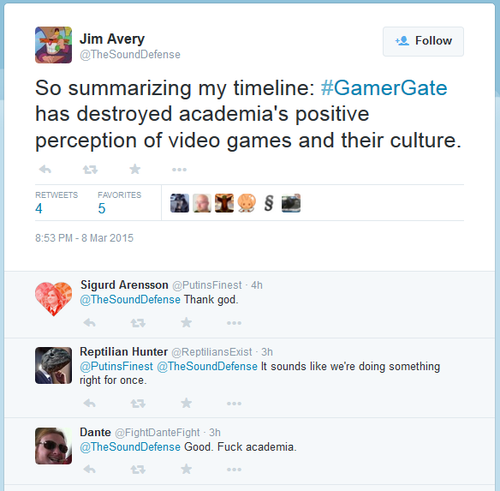
In light of the controversy that has been extending back for more than half a year at this point, something extremely depressing has come to light.
Not too long ago, Totalbiscuit, a popular games critic who is supported by GamerGate (though he claims to be neutral), wrote a lengthy Twitlonger questioning the theory of media influence, particularly in video games, asking “where are the scientists?”
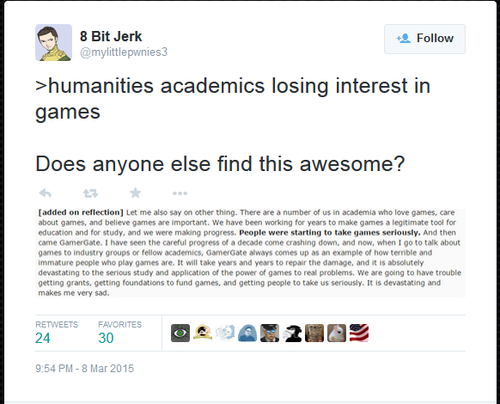
[added on reflection] Let me also say on other thing. There are a number of us in academia who love games, care about games, and believe games are important. We have been working for years to make games a legitimate tool for education and for study, and we were making progress. People were starting to take games seriously. And then came GamerGate. I have seen the careful progress of a decade come crashing down, and now, when I go to talk about games to industry groups or fellow academics, GamerGate always comes up as an example of how terrible and immature people who play games are. It will take years
and years to repair the damage, and it is absolutely devastating to the
serious study and application of the power of games to real problems.
We are going to have trouble getting grants, getting foundations to fund
games, and getting people to take us seriously. It is devastating and
makes me very sad.
For many years, people have been fighting for games to be recognized seriously as an art form. GamerGate, as it seems, has caused serious damage to that. Social scientists have been studying the influence of games, not just because of their negative effects, but because of the potential positive effects as well. Games could potentially be a powerful tool to help teach empathy, and increase satisfaction and happiness.
But now that GamerGate has shattered public perception of gaming in academia, we may never be able to fully understand how to allow games to reach their full potential in this regard. But it’s not just media studies in video games that have suffered.
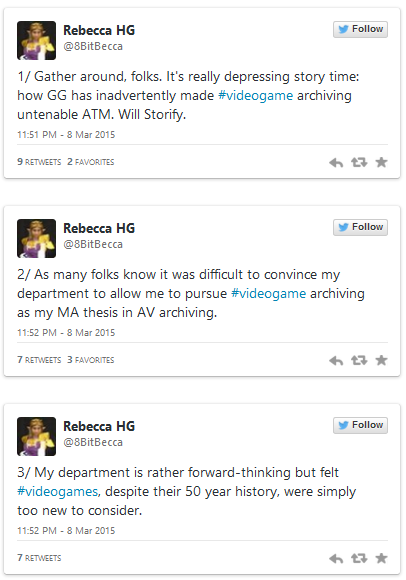
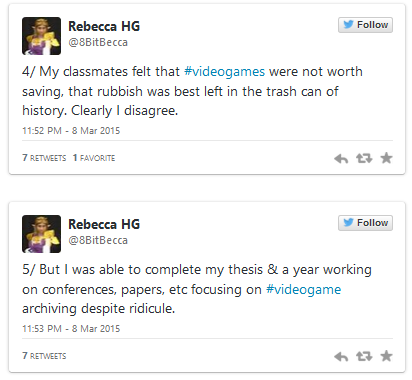
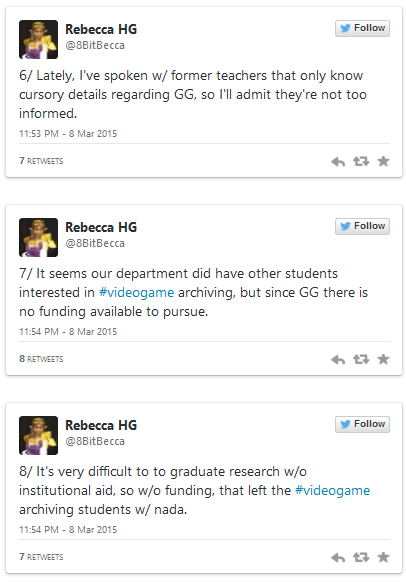
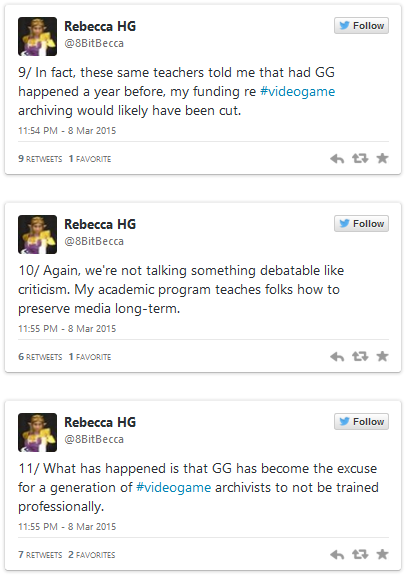
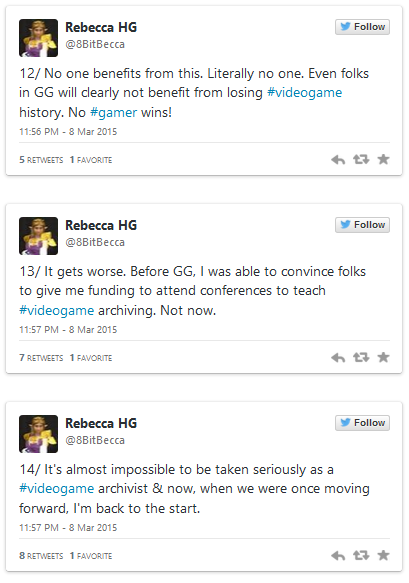
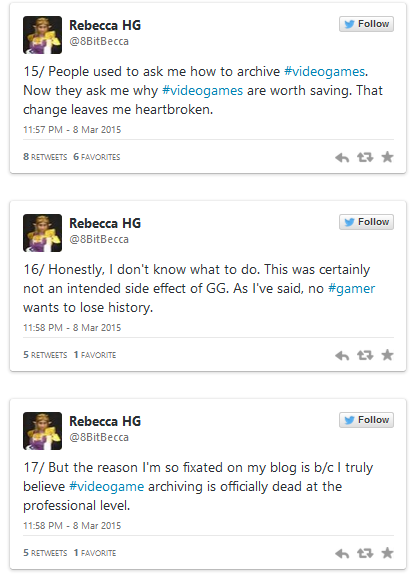
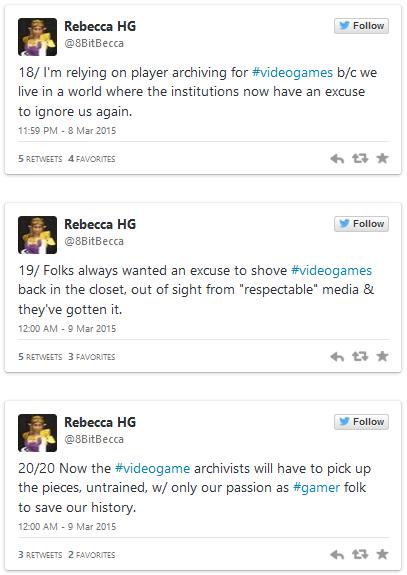
Rebecca HG, also known as 8BitBecca, is a video game archivist. Her work is vitally important to the future of video games, as the passage of time guarantees that physical storage media degrades and becomes unusable. Within decades, many out-of-print games may be lost forever, outside of illegal ROMs.
To any reasonable person, this would be devastating. Nobody benefits from this. Academics refusing to take games seriously means that games can never be realized as an art form. Even worse, without academia the task of preserving, understanding, and maintaining the cultural history of games becomes a daunting task. Half of all American films made before 1950 are lost forever, and were it not for the work of archivists and academics, it’s likely we would never have been able to preserve even that much.
So what happens to video games when academics don’t take them seriously at all? What happens when people refuse to archive games or study their cultural significance?
To put it bluntly, video games will have no future. If we do not take care to study the cultural history of games, it may forever disappear to us when cartridges and CDs inevitably die, emulators become obsolete, servers shut down, manuals are lost, and the publisher history fades into obscurity.
This should make any gamer uncomfortable, but unfortunately, this is not the case. GamerGate has not been shy about their disdain for academia in video games, as evidenced by the popularity of anti-academic figures such as the Youtuber known as “Sargon of Akkad”, who is one of the most widely-praised supporters of GamerGate. Just reading the title of one of his videos tells you all that you need to know:
Luxury watch site HODINKEE's executive editor on why the Apple Watch just can't compete
At today’s Apple Watch announcement we learned just what it can do and how much it will cost. Comparisons between "smart" watches (about which I write maybe one-and-one-fourth days of the year) and traditional mechanical watches (about which I write some 364 days of the year) have been the topic of much discussion since September’s pre-launch. Since then, I have been asked, oh, I dunno, 15,000 times, how I think the Apple Watch will impact the traditional watch market. Will Apple Watch be the number one watch in the world by year-end? Undoubtedly. Will it put a lot of smaller, low-end watch brands out of business? I sure hope so. (I mean that there are simply too many brands doing too little interesting work, and it’s time to trim the fat.) But the biggest difference between Apple Watch and a mechanical watch is how they are priced, and what one actually gets for the money they pay at different price points.
With Apple Watch, the price differentiation between the entry-level Sport at $349, the standard Apple Watch at $549, and the Edition at $10,000 is about perceived value — what materials are used in the case, bracelet, and straps, but also how much people believe they should be paying for the product. In addition to perceived value, mechanical watches are also priced by human value: how much of the work is done by hand (in many cases using 200-year-old methods). For example, a watchmaker named Philippe Dufour makes just 12 watches per year, alone in his one-room atelier in the mountains of Switzerland. A simple, time-only piece can cost $100,000. Whether the case is gold or platinum, the price of a Philippe Dufour watch remains (roughly) static — you are not paying for materials, you are paying for Mr. Dufour’s time and touch. The Apple Watch has minimal human value, and that is the biggest difference between it and its mechanical counterparts.
Just how much human value can a customer expect from a mechanical watch, relative to a similarly priced Apple Watch? The difference is startling.
$350 and below: Seiko Recraft, $285
Apple Watch Sport, starting at $349
All versions of the Apple Watch, even the most expensive, are made in China, with very little hand-assembly. For $350, you will get the mechanical equivalent — Chinese-made, machine-assembled, high tolerance. In spite of little to zero human value, a watch in this price range from the likes of a Seiko or Swiss Army could indeed last a literal lifetime. Any digital watch, from Apple or others, simply wouldn’t stand a chance.
The largest segment of the luxury watch market exists within the $500 – $10,000 range — these are the Apple Watch customers. Breaking the $500 barrier will not provide much more in the way of human input, but it will give you the opportunity to own a something from a well-established Swiss brand like a Hamilton or Tissot. The watches are still machine-made and use simple movements and pre-built mechanical kits, but might now yield the all-important "Swiss Made" signature on the dial — meaning that 50 percent of the components were created in Switzerland. As you approach $1,000, you begin to see offerings from the likes of Officine Autodromo and other thoughtful, boutique lifestyle watch brands. You may or may not get a "Swiss-Made" watch, but you will get a clearly thought-through brand and message, as well as membership to an "insiders club." The components of these watches remain "unfinished," meaning they are not polished or beveled to make them more attractive, which can ultimately be up to 50 percent of the cost of a fine watch.
Tudor Style, $4300
At $1,500 you get into some really interesting pieces. These watches should almost all be Swiss Made, and while you are still using very simple, off the shelf movements, there is a chance that you might find one that has been adapted to be either more precise (like this Tissot) or more interesting (like this Hamilton). Here you begin to see open casebacks to show off those nice mechanical movements that gear-heads love so much. Still, much of the work done on these watches is machine labor.
Break $3,000, and you can safely say you’re buying a truly high-end watch. Around this price point, you begin to see either a) some hand-craft or finishing or b) an "in-house" movement, meaning it was not sold as a kit by a supplier but rather built entirely by the watch company to its own guidelines. This Tudor, for example, shows excellent build quality and a superbly finished case — though the movement remains outsourced. Contrary to that, the likes of Frederique Constant and NOMOS offer simpler cases but movements made completely in-house, without the help of anyone else.
Above $5,000 one should expect both an in-house movement and some hand-finishing, with details not only recognized but put at the forefront. Here you begin to see blue-chip offerings from the likes of Omega, IWC, and Rolex. These are the watches that many aspire to own, and some have become downright legends. The Rolex Submariner and GMT-Master, the IWC Portuguese, the Omega Speedmaster and Seamaster, the TAG Heuer Carrera, and other icons of watchmaking reside in this category that straddles supreme wearability with great style and true craft, without being obscenely expensive. Still, these watches are not devoid of perceived value — the majority of watches here benefit from multi-million-dollar advertising and branding budgets, conditioning us to believe they are worth the price of entry.
18-karat gold Apple Watch Edition, starting at $10,000
Few casual consumers break the $10,000 mark for mechanical watches — this is usually left for either the extremely wealthy or the extremely dedicated. Thankfully for us at HODINKEE, there are enough die-hard mechanical watch lovers out there to balance out those with simply too much money to make the discourse on timepiece in this category fascinating. From $10,000 to $20,000, you are into the realm of watchmaking where everything you see is original and interesting — or at least should be. Consider fully ceramic chronographs, stunning hand-wound dress watches, or modern legends all fall within this range — all featuring truly in-house movements with a moderate amount of hand-finishing to internal components. These watches will be assembled by hand, completely in Switzerland and offer the incredibly low tolerances and extreme quality for which this industry is known.
The infinite beyond: Patek Philippe 5270G, $176,300
At and above $20,000, you begin to enter the absolute highest echelons of mechanical watchmaking. Here the human value of each watch can make up 50 percent of the final retail price. There are two different roads one can take in this category of uber watch — either the Mr. Dufour route where the watches are simple looking, but incredibly finely finished and beautiful from the rear (similar to these), or one can trend toward "complicated" watches. These watches can, for example, keep track of the date, including leap years, for over 200 years at a time. If a watch is complicated and incredibly finely finished, the price compounds into the six-figure range — like a Patek Philippe perpetual calendar chronograph. In this range, almost anything goes and the human value should always be significant. Further, there is really no end-point for the price someone will pay for a watch — the most valuable watches in the world are in fact from last century, produced entirely without the aid of computers. This means that all vintage watches hold even higher human value than most of the expensive complicated pieces of today. The ne plus ultra of mechanical watchmaking is the Patek Philippe Henry Graves Supercomplication, which sold this past November for $24,000,000. Why? Because it is not only incredibly complicated, with 24 distinct functions, but designed and built entirely by the human hand — something the Apple Watch will never be able to claim.
> "Apple's first-party (USB-C) adapters cost $79, so let's hope third-parties can get there for a little less money."
$79 _each_. So that's $79 to connect to HDMI, then again for VGA, then again for DVI, then again to charge the battery, then again to connect legacy USB devices, then again for wired ethernet. And it's still just USB3.0 in bandwidth, so it's not a Thunderbolt replacement, or even really potentially compatible.
And if you're lucky, maybe one of those three $80 adapters will have a passthrough port on it so you can use more than one at a time.
> "For general-use tasks that don’t peg the processor, the oversimplified version is that Core M performs a lot like the Ivy Bridge Core i5 and i7 CPUs in the 2012 MacBook Airs. If you’ve got a 2013 or 2015 MacBook Air, it will be a step down. If you have a 2012 MacBook Air, it’s a step sideways at best."
So for $1,300-$1,600 you can have a soldered-on laptop that benches in the Chromebook range (even the 1.2GHz Core M CPUMarks around 3000, which is equivalent to the $330 Core i3 Dell and Acer Chromebooks, with only a 1-2W difference in power consumption), for the privilege of spending another $240 to get it to the same place as a mid-range MBA. From three years ago.
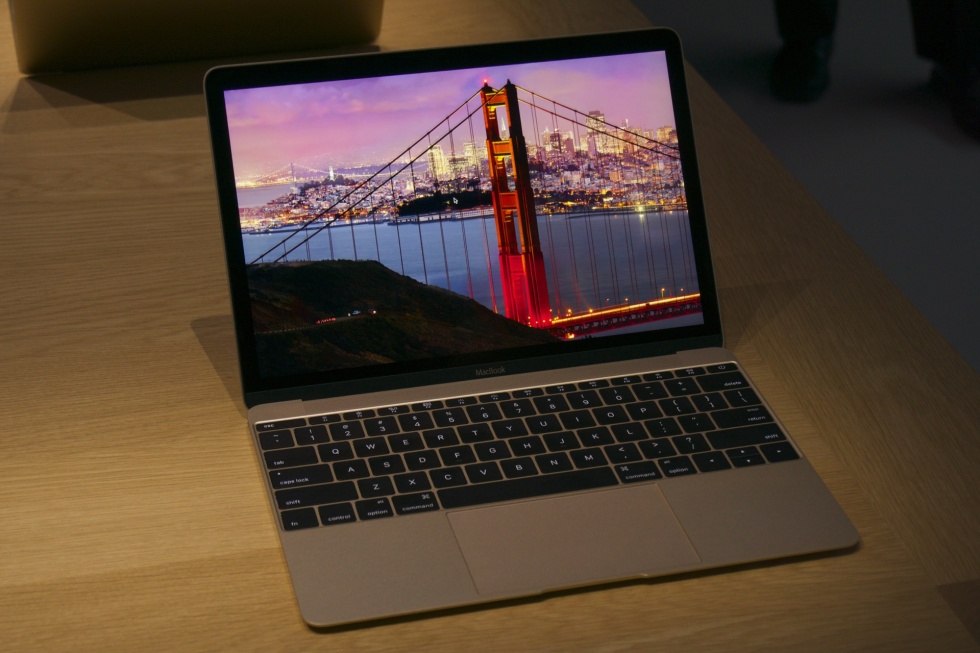
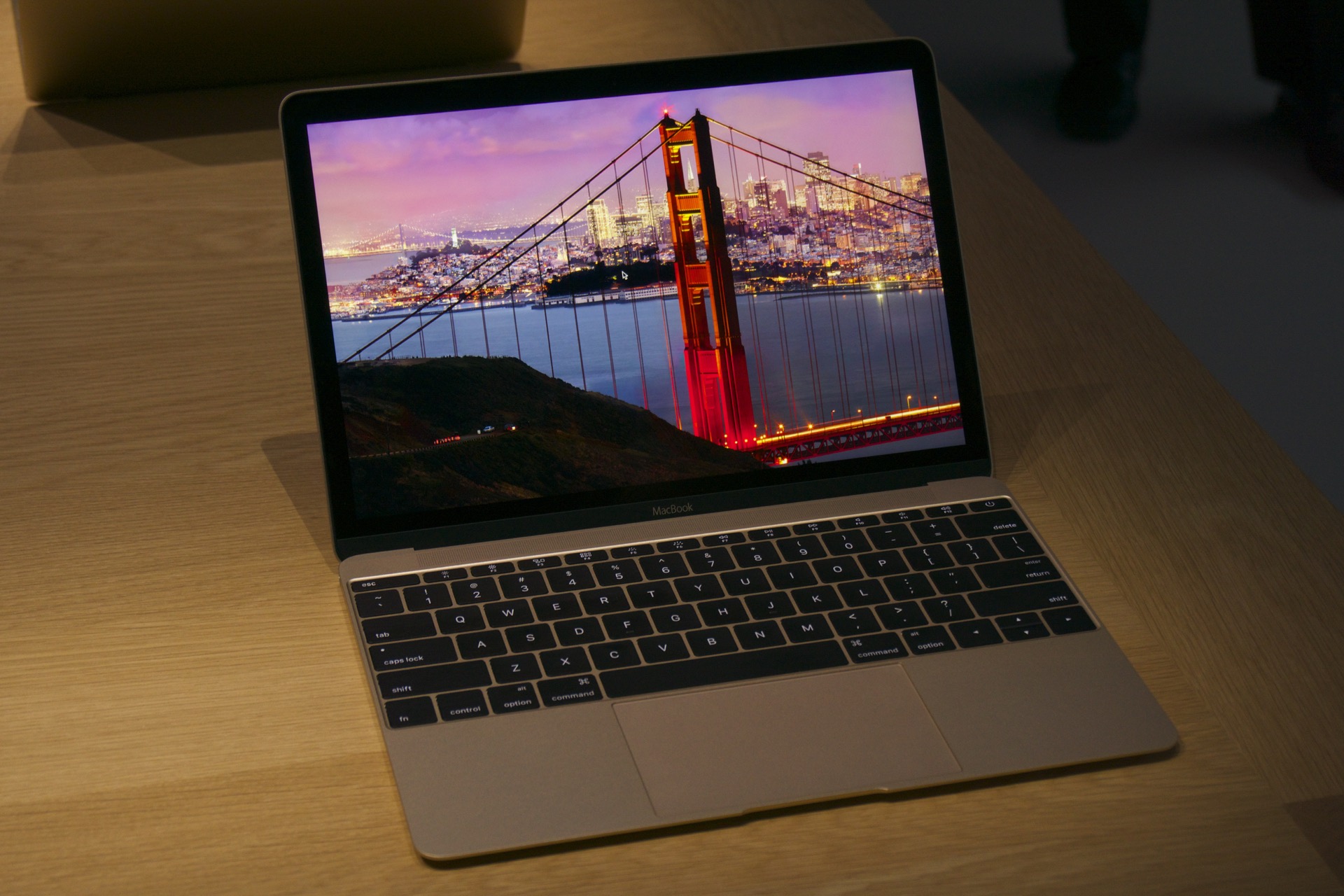
SAN FRANCISCO—Apple announced a new MacBook today—not MacBook Air, not MacBook Pro, just MacBook. It’s the first one of those that Apple has offered since it killed the plastic MacBooks earlier this decade, and while those computers were low-cost alternatives to the MacBook Pro and then the MacBook Air, this laptop is a much different beast.
It’s Apple’s first fanless MacBook. It’s the first to use Intel’s ultra-low-power processors in the form of the Broadwell-based Core M. It’s got a Retina Display. It’s not a cut-down budget model, and it’s not quite a MacBook Air replacement. We got a chance to take the laptop for a test drive at Apple’s event today, and here’s what it’s like to use.
Look and feel
Andrew Cunningham
The Retina MacBook in gold.
7 more images in gallery
The numbers seem small on paper—it weighs two pounds and is 13mm thick at its thickest point. Seeing it in person really drives home what a small laptop this is. It’s the most similar to the 11-inch MacBook Air, but it’s got a bigger and better screen. I moved from an 11- to a 13-inch MacBook Air because I found the display too cramped, but the new MacBook is large enough to avoid that problem.
During Monday's Apple press conference in San Francisco, Tim Cook announced that iOS 8.2 would immediately begin rolling out to compatible iDevices—as in, any device that could already run the original version of iOS 8. Along with expected bug fixes, the update's biggest addition was support for the upcoming Apple Watch. It's a fact that users are now being bonked over the head with thanks to the creation of a dedicated, mandatory app.
Apple, along with its smartphone-making peers, has a long history of forcing branded apps, and occasionally their respective ecosystems, onto users. Past examples include iTunes, the App Store, and Nike's iPod app (along with the new Tips and Podcasts apps in iOS 8.0). Most of us have tucked our least favorite mandatory apps into a "crapware" folder by now. But the Apple Watch app available on iPhones compatible with the Apple Watch is the first iOS app meant specifically to advertise and connect to an unreleased Apple device. Today, it's already popping up on thousands of home screens before its compatible device is even available for pre-order, let alone purchase.
The app doesn't do much at this point, merely loading an image of an Apple Watch and letting users know that "if you have an Apple Watch, you can pair it with your iPhone here." Assuming you're not a lucky Apple employee, the only other option you'll have is to click a link to "learn more about Apple Watch," which leads users to the App Store to see a meaty advertisement about the new product.
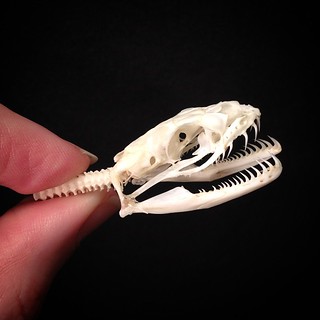
Embarrassingly enough I just finished answering the many questions I've gotten behind on here going all the way back to October of last year. Sorry guys, I'm a full time self employed bone artist and simply do not have the time to always get back to your questions in a timely fashion. Especially when it is a time where I have to really focus on something like holiday sales. Which start for me in October.
Please take note of the SEARCH THIS BLOG field to the right here where you can quickly search for answers in my many posts rather than having to look for it one at a time.
FOR EVERYONE WITH QUESTIONS ABOUT PROCESSING BIRDS:
I really hardly ever post anything anywhere in general about birds because of legal issues. Most birds you're going to come across in US/Canada are illegal to have any part of dead or alive because they are Migratory Bird Treaty Act protected species. If you were to macerate most birds you're likely going to end up with nothing but a stinky pile of mush. To process birds, rodents & small reptiles/amphibians you can't really macerate like larger medium sized animals. You literally have to carefully remove the feathers, skin & muscle with surgical tools, tweezers & scissors as best you can. I rarely do this myself because it is so tedious. If it is mummified it may be even harder to accomplish. Or you can soak a while in water & if you're lucky you can carefully peel away the skin from the bones & just hope that most of the muscle was already eaten away by carrion insects. I'll have to make a longer blog post about this sometime for sure. But for now there's this one:
Most of the birds protected by the MBTA are not endangered. They are very common and abundant. But that was not the case when the MBTA was created back in 1918. Many common birds were being wiped out into extinction from people hunting them and collecting them & their eggs/nests for their collections. And people using the feathers in fashion. That's the misconception that most people don't understand now. The species that are alive now were saved from extinction by the MBTA. That's why they are so common and abundant now.
It is illegal in US, Canada, Mexico, Russia and Japan to even possess bird remains of species listed on the MBTA. We can not have or sell birds, feathers, bones, eggs, or even nests from anything on that protected list. Likewise, you could be fined up to $15,000 and/or do jail time for having/selling them. So be careful!
I want to point out as well that there are MANY pigeon/dove species that ARE protected species and many people have a misconception that they are not. Only Feral Pigeons are OK to have. Also, people often mention that crows are hunted and OK to have. Not that simple. You must have a permit to hunt where they are permitted to hunt and do so in season. Also, hunted crows can not be sold, they can only be gifted. Info about Regulations For Crows.
Tons More Animal Parts Laws Can Be Found Here. Here in the US you can quickly look up info on your exact state at the link above which is especially helpful with some laws being so varied from state to state.
Here is a list of my most frequented blog posts and topics related to the questions I get for quicker reference to find your answers.
“When I was a student at Cambridge I remember an anthropology professor holding up a picture of a bone with 28 incisions carved in it. “This is often considered to be man’s first attempt at a calendar,” she explained. She paused as we dutifully wrote this down. “My question to you is this – what man needs to mark 28 days? I would suggest to you that this is woman’s first attempt at a calendar.”
It was a moment that changed my life. In that second I stopped to question almost everything I had been taught about the past. How often had I overlooked women’s contributions? How often had I sped past them as I learned of male achievement and men’s place in the history books? Then I read Rosalind Miles’s book “The Women’s History of the World” (recently republished as “Who Cooked the Last Supper?”) and I knew I needed to look again. History is full of fabulous females who have been systematically ignored, forgotten or simply written out of the records. They’re not all saints, they’re not all geniuses, but they do deserve remembering.”





ENLARGE
Photo: Getty Images













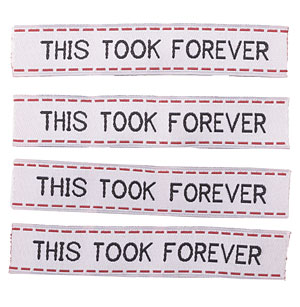 A truer-words-never-spoken woven label to sew into your crafting projects. (via Making Light)