New Project: Draft Amtrak Passenger Rail as Subway Map for 2015
At the end of April 2015, Amtrak’s Hoosier State service between Chicago and Indianapolis is scheduled to be discontinued — the first complete loss of a service since I created my “Amtrak as Subway Map” way back in 2010. Over the years, I’ve been pretty vigilant to changes to the Amtrak network — adding and deleting stations as required, extending the Downeaster line to Brunswick and the Northeast Regional to Norfolk — but a change of this magnitude gives me the chance to take a completely fresh look at this project and rework everything from scratch, instead of just tweaking the old diagram again. Let’s face it – I’ve learned a lot of new skills and tricks in the intervening years!
Read more about this project, and view a large (4000px-wide) version of the map over on my design blog! Comments on this initial draft are welcome, as always.
HBO's The Wire was lauded for its gritty, realistic portrayal of the drug war in Baltimore, but it seems law enforcement thought the show could be a bit too authentic at times. In a story about cellphone tracking technology, showrunner David Simon tells The Baltimore Sun that "At points, we were asked by law enforcement not to reveal certain vulnerabilities in our plotlines."
Simon, who was once a reporter for the very same paper, explains that the writers once intended to show that criminals using the walkie-talkie-eque, "push-to-talk" feature of Nextel phones could avoid surveillance and wiretaps. According to Simon, the technology "was actually impervious to any interception by law enforcement during a critical window of time."
"We were asked by law enforcement not to reveal certain vulnerabilities."
Law enforcement officials requested that the show not reveal the gap in surveillance technology out of fears that it would be exploited. Simon recalls co-creator Ed Burns saying at the time that "to highlight this vulnerability in our drama would have irresponsibly driven the communications of every criminal conspiracy into an impenetrable hole." The writers ultimately decided to go a different route.
But why are we learning about this now? Well, The Wire was back in the news this week after surprising revelations that a cell phone tracking technology called Stingray has been in extremely wide use by the Baltimore Police since 2007. The system, which can be transported in a car, can spoof a cell phone tower and obtain data from devices in the area. It can be used to pinpoint a device's location even if it lacks GPS, and officers can send a command for the phone to ring on queue. A similar system, called Triggerfish, was depicted in season three of The Wire back in 2004.
Avid showed that it was serious about growing Media Composer's user base by announcing Media Composer | First, a feature-limited version of its venerable Media Composer NLE software, at NAB this weekend. Media Composer | First (MCF) will give editors a … more »
Nerval's Lobster writes Last year, the New York state government launched Start-Up NY, a program designed to boost employment by creating tax-free zones for technology and manufacturing firms that partner with academic institutions. Things didn't go quite as planned. In theory, those tax-free zones on university campuses would give companies access to the best young talent and cutting-edge research, but only a few firms are actually taking the bait: According to a report from the state's Department of Economic Development, the program only created 76 jobs last year, despite spending millions of dollars on advertising and other costs. If that wasn't eyebrow-raising enough, the companies involved in the program have only invested a collective $1.7 million so far. The low numbers didn't stop some state officials from defending the initiative. "Given the program was only up and running for basically one quarter of a year," Andrew Kennedy, a senior economic development aide to Governor Cuomo, told Capital New York, "I think 80 jobs is a good number that we can stand behind."
A sailing race across the icebound Northwest Passage is being planned for 2017, through a route the organizers say has been made possible by climate change.
The Sail the Arctic Race will involve teams setting sail from New York for a 7,700-mile journey to Victoria, British Columbia. They will race for six legs with stopovers in cities in the US, Canada, and Greenland. The route used to be unnavigable because of pack ice, which may well still be problematic for the race participants. But in the years since 1998 there has been less ice, with more below-average than above-average years, and more open water, Environment Canada told CBC News.
Race organizer Robert Molnar told the news organization: “We shouldn’t be able to do it, but because of climate change, we can.”
The race organizers said they want to race to have “net zero impact” on an environment they admit is fragile.
All teams entering will need to pay a $50,000 entrance fee, and will also need a particular boat, the STAR46, which will cost between $800,000 and $1 million—expensive in comparison with other yachts and other races.
Having “zero net impact” is less of a priority for some states and companies, which are eyeing the melting area for commercial use. Russia and Norway have been vocal in their interest in exploring for Arctic oil. Sailing ships through previously ice-packed waters also offers the possibility of new trade routes (paywall) to China—likely again for oil. Interest has quieted since falling oil prices made expensive shipments through tretcherous routes less profitable, but it’s likely to resurface when oil prices rise again.
Arctic sea ice hit its peak for the year in February—amounting to the lowest coverage on satellite record.
Blame it on the Sunday brunch cocktails, or on the fact that Hillary Clinton’s much-heralded entrance into the 2016 US presidential race was old news before it finally, and formally, got announced. On April 12, a nation fixated on the debut of Clinton’s campaign logo, and it did not like what it saw.
Comprised of a generic-looking, sans-serif H with a red arrow functioning as the letterform’s crossbar, the logo fueled critics who skewered its level of graphic sophistication and lack of originality.
Hidden arrow in the FedEx logo.(Landor Associates)
Its designer perhaps aspired to the ne plus ultra when it comes to incorporating arrows in brand marks: the FedEx logo. With the cleverly embedded white arrow in the negative space between the letters “E” and “x,” it’s considered a triumph of graphic wit and economy. That logo’s designer manage to imbue the straightforward logo mark with an extra layer of semiotic sauce that happens to propel the message about FedEx’s speedy delivery service.
Clinton’s, in comparison, looked like an off-the-shelf stock graphic image, critics charged. Others noted its likeness to a hospital road sign, or Iceland’s flag, while others joked that the right-pointing arrow hints at the political shift she’ll need to win over conservatives.
Like many comments on social media, Wikileaks’s graphic critique is entertaining yet unsubstantiated—designed to snare impulse retweets and shares on social media. Last we checked, neither the color red nor the arrow is Wikileak’s invention, or innovation for that matter. It’s also highly unlikely that the campaign design team was sitting around brainstorming a logo for the presidential aspirant to match that of the whistleblower’s symbol. (We’ve reached out to the Clinton campaign for a comment on logo-gate, and will update this post as warranted.)
“When it comes to the buttons, posters, banners, and bumper stickers the platform is clear: Don’t rock the vote.” Either way, the fact is that the logo’s design follows such a well-worn graphic formula—from the generic letterforms of the custom-made font and the arrow seemingly lifted from Microsoft Office, to the predictable red-white-and-blue color palette—that it’s likely to remind you of one thing or another.
The real issue here is not so much Clinton’s uninspired monogram, but the systemic issues that plague graphic design in American politics, if not design in general.
The trap of typology
After a hopeful turn with the 2008 Obama campaign, it seems that campaign graphics is headed back to the doldrums. But Clinton’s H, Rand Paul’s Tinder-like burning flame symbol or Ted Cruz’s emblem that resembles a burning flag, campaign logos usually follow an established convention that’s rooted in literal interpretations of American patriotism.
As writer Steven Heller observed in his 2004 call-to-arms essay, The Dreary Art of Presidential Elections, “The Presidential election year is a special time in American politics when the public sees just how ineffectual graphic design can be. Although typefaces might alternate between serif and sans, the overall message is the same, when it comes to the buttons, posters, banners, and bumper stickers the platform is clear: Don’t rock the vote.”
Logo design is a bloodsport. The nitpicky like/dislike is cheap currency in the age of social media. It is breeding a generation of feckless critical gadflies, and giving them a platform with which they can maim the creative spirit and innovation. Social media is an ad hoc focus group; its aggregate voice will inevitably feed into the next creative brief to delimit future graphic design possibilities.
In the big picture, what role does a candidate’s logo play in the campaign? As unoriginal and clunky as it may appear, Clinton’s logo is perfectly functional. It’s unique enough, with utility that holds up across print, broadcast, and digital platforms. On Twitter, the red arrow is even a nifty, albeit unnecessary, device that directs the eye right to the messenger.
An artist who hid in his apartment's shadows and deployed a telephoto lens to photograph his neighbors through their glass-walled apartment is not liable for invading their privacy, a New York state appellate court has ruled.
The appeals court called it a "technological home invasion" but said the defendant used the pictures for art's sake. Because of that, the First Department of the New York Appellate Division ruled Thursday in favor of artist Arne Svenson, who snapped the pics from his lower Manhattan residence as part of an art exhibit called "The Neighbors." The ruling says:
In this action, plaintiffs seek damages and injunctive relief for an alleged violation of the statutory right to privacy. Concerns over privacy and the loss thereof have plagued the public for over a hundred years. Undoubtedly, such privacy concerns have intensified for obvious reasons. New technologies can track thought, movement, and intimacies, and expose them to the general public, often in an instant. This public apprehension over new technologies invading one's privacy became a reality for plaintiffs and their neighbors when a photographer, using a high-powered camera lens inside his own apartment, took photographs through the window into the interior of apartments in a neighboring building. The people who were being photographed had no idea this was happening. This case highlights the limitations of New York's statutory privacy tort as a means of redressing harm that may be caused by this type of technological home invasion and exposure of private life. We are constrained to find that the invasion of privacy of one's home that took place here is not actionable as a statutory tort of invasion of privacy pursuant to sections 50 and 51 of the Civil Rights Law, because defendant's use of the images in question constituted art work and, thus is not deemed "use for advertising or trade purposes," within the meaning of the statute.
The appeals court said that beginning in 2012, Svenson, whose works have appeared in museums and galleries in the United States and Europe, began "hiding himself in the shadows of his darkened apartment" to snap the pictures of his neighbors.
‘Surely there must be a couple of new Ada Lovelaces lurking in this land?” exclaimed digital doyenne Martha Lane Fox last month, as she issued a call for women to turn their hands to tech – part of her new plan, dubbed Dot Everyone, for an internet-savvy nation.
It’s little wonder that the enigmatic daughter of Lord Byron has been put, posthumously, on a pedestal. Brought up to shun the lure of poetry and revel instead in numbers, Lovelace teamed up with mathematician Charles Babbage who had grand plans for an adding machine, named the Difference Engine, and a computer called the Analytical Engine, for which Lovelace wrote the programs. Then tragedy struck – Lovelace died, aged just 36. They never built a machine.
But now the mother of computing might finally have the chance to realise her own potential. As the eponymous stars of a new graphic novel The Thrilling Adventures of Lovelace and Babbage, the pair have been resurrected to finish what they started. “I guess it just seemed like a really stupid ending, that they didn’t build the machine,” says author Sydney Padua, a London-based computer animator. “Plus I really wanted to draw comics … and you can’t draw very good comics about dead people and their machine they didn’t build!” Having first illustrated the duo some years ago to mark Ada Lovelace Day, the annual celebration of women in science and tech, the comic’s huge popularity spurred Padua to develop the cartoons on her blog and ultimately unleash the book.
Exploring, then rejecting, the sad fate of Lovelace and her plans, Padua turns the tables on history, setting the aristocrat to work building a mechanical behemoth. The upshot is a pipe-smoking, jodphur-wearing steampunk technologist who would startle even Lane Fox. It doesn’t end there. Having built a technological masterpiece, a series of madcap escapades ensue in which Lovelace and Babbage are joined by a host of Victorian celebrities, from the ultimate client from hell, Queen Victoria, who demands the machine be used for fighting crime, to novelist George Eliot, who finds herself lost in its maze-like interior. “It really is very much about my own experiences in the labyrinth of computing,” says Padua.
But if the reborn mathematicians find building a machine something of a handful, they aren’t alone. In trying to present an accurate depiction of the analytical engine for an explanatory appendix (shown here), Padua discovered there was little to go on, and found herself rifling through the work of Babbage scholar Allan Bromley for design clues. “I just sat down, basically, with the Bromley papers and whatever of Babbage’s plans I could get my hands on through fair means or foul,” she says. The result is a shining feat of engineering that her dynamic duo would be proud of. A rip-roaring caper engulfed in footnotes of quotes, quips and illuminating asides (Babbage, Padua reveals, gained notoriety as the scourge of street musicians), the book does more than simply celebrate the genius of the first computer programmer, it encourages us to turn our imagination to technology – just as Lovelace did. And that’s an inspiration to us all.
Okay. But, um, I don’t think that’ll be you. - You don’t?
- Mm-mm. See, I see, uh… …big passion in your future. - Really?
- Mm-hm. - You do?
- I do. Ross, you’re so great.
While my first post in this series covered some basics of non-destructive image merging in Adobe Photoshop, this post aims to give you some tools to work with less ideal images.
A typical problem faced by many when attempting to merge images is how to deal with slight variations in your materials. These variations can be a result of the hardware you use (scanner or camera), lighting conditions, software, or a myriad other factors.
In this scenario I'll use an image from a scanned book that has a lighting problem. This is a very common difficulty when scanning books on a flatbed; the book's gutter will raise up from the scanner's surface, giving it a darker tone and distorting the content. Applying pressure to the book may work sometimes, but often we do not want to risk damaging our books (or, worst-case-scenario, our equipment) that way. Much safer to work digitally.
The first step is identifying the cutoff point where the gutter begins to negatively affect image quality. As you can see from this image. As always, make sure you've saved a master version before making any edits.
Use the Rectangle Marquee tool to isolate the "safe zone" of the page, where the page's content is mostly unaffected by the gutter. Copy this selection and paste it into a new document with approximately the same dimensions as the original document. This is our new "base" document. I will usually put the word "EDIT" in its title somewhere so it won't be mistaken for the master.
In situations like this when we are dealing with an off-white paper, we'll want to make sure our background matches the paper's tone. Use the Eyedropper tool to select the page tone, and use the paint bucket to fill it in the background of the new base document.
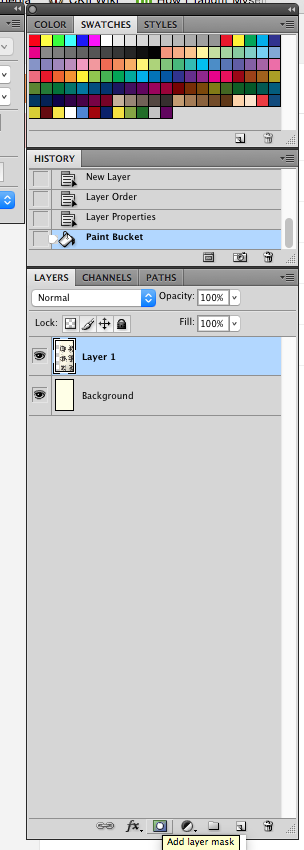
What we are going to do next is create an amalgam of the image's two elements (page and background) to create a new version with improved legibility. To accomplish this we are going to use Photoshop's Layer Mask tool. Layer Mask is incredibly useful for photo editing, and best of all it is a non-destructive solution, meaning whatever you do with it can always be easily undone. The Layer Mask is very much what it sounds like: a layer placed on top of each image that can be "masked" or "unmasked," concealing or revealing the image's contents. Select the right side layer and click "Add Layer Mask" at the bottom of the Layer menu. You will now see a small white rectangle linked to that layer; that's your layer mask. The color white means "unmasked," so right now it's simply sitting on top of your original layer waiting for you to give it instructions.
Next, be sure you have the correct layer, AND your layer mask selected, or else you will alter the image itself. The Layer Mask functions in grayscale. Black is "masked," white is "unmasked," and grays are everything in between. Set your foreground color to black. Select the brush tool, and reduce the hardness to 0 (use whatever diameter you feel comfortable with). Check again to make sure you're still on your layer mask, and simply begin lightly touching up the problem spots along the gutter with your brush. Use single clicks rather than click-and-drag, that way you will make very minor adjustments while you get a feel for the technique.
As you can see, we've fixed the page to appear legible and flat. But be warned, this exact method won't work for every situation. If you have content that is deep in the book's gutters, you will likely have to accept a less-than-perfect image. However these techniques can still be used to improve the image quality in those situations, it is simply more difficult to get a "perfect" image. Vary your brush settings and color in the Layer Mask (experiment using a 50% grayscale) to find solutions that best suit your situation.
Whiz-bang comedy ensembles and titanic powerhouse female lead performances suffered a major loss this past season, with Parks and Recreation and Amy Poehler’s Leslie Knope—fittingly enough, also a show rooted in politics—heading to the great TV beyond. Unbreakable Kimmy Schmidt has picked up the quirkiness and weirdness slack, Louie and Girls continue their tradition in finding humor in humanity, and the likes of Mindy Kaling and Taylor Schilling are as adept as anyone at leading a stellar ensemble into comedic battle.
But no show manages to do all three—to be confidently strange, modern and relatable and unfiltered, and seamless in the way the ensemble operates. Veep does. More, no show is ballsy enough to take a creative risk as ambitious as making Selina president, thus rendering the entire title of the series irrelevant, and then carry the decision through to the next season and have it keep paying off in spades.
A 16-year-old transgender teen who found popularity with her makeup tutorial videos on YouTube has committed suicide.
Taylor Alesana, a student at Fallbrook High School in California, had spoken out on YouTube recently about loneliness and the bullying she was experiencing at school. In a video posted in December, she revealed she was going to live publicly as a boy for a while. “I’ve had a very hard last couple of weeks,” she said. “I had to go back in the closet and dress like a boy and cut my nails off and cut my hair off. I did this for my own protection. I was being bullied a lot at school.”
Lockdown lifted at US Capitol Building after apparent suicide of man holding ... New York Daily News A shooting put the U.S. Capitol Building under a lockdown Saturday for about two hours after a man killed himself near the visitor center, authorities said. The unidentified man was “neutralized” after an apparent suicide at the edge of the National Mall," ...
The former secretary of state, senator and first lady of the United States made her entry into the presidential race official in an e-mail from her campaign chairman to donors that was obtained by the New York Times. Soon after, her campaign website posted a YouTube video that ends with Clinton telling Americans that she is “hitting the road to earn your vote.”
Her widely-expected candidacy has so far cleared the field of major competition, making her the front-runner to be the Democratic nominee for president in 2016 and potentially succeed President Barack Obama, becoming the first female president in US history.
“We just wanted to get this thing over with and get on with it,” a Clinton operative told Politico.
Her campaign, the product of a political machine that has ground back to life in the two years since Clinton stepped down as Obama’s top diplomat, says it will attempt to avoid the mistakes that plagued her last run at the nation’s highest office: The sense that the campaign was about Clinton rather than the presidency, and relentless in-fighting, both of which left her vulnerable to Obama’s insurgent campaign from the left.
The announcement, which comes three months later than in her 2007 race, is a sign of her strength in the party. All of the other putative Democratic candidates, including Senator Bernie Sanders, former Maryland Governor Martin O’Malley and former Virginia Senator Jim Webb, lack national profiles and face huge deficits in public opinion polls. More widely-known potential challengers, like Vice President Joe Biden or Senator Elizabeth Warren, have signaled they are unlikely to run.
Clinton remains a polarizing figure outside the Democratic party, where she is almost universally admired. Questions about her approach to email record-keeping while at the State Department—and how she used it to avoid scrutiny from the press and lawmakers—are a reminder that she and her husband, former President Bill Clinton are not without their weaknesses. The often acrimonious debate over gender and equality in the US will no doubt play a role in how her campaign is judged by the public.
But it would be a mistake to think Clinton won’t be a formidable opponent. While critics have noted her falling approval ratings since she left her cabinet job—though she has a double-digit lead over her opponents in that category—it’s a natural part of returning to the political fray. The real test of her abilities will be when, as a full-fledged candidate, she can respond directly to her critics—and attempt to convince American voters she should be their next president.
In other words, get ready for a political free-fire zone. Today’s other debutant is the latest season of Game of Thrones on HBO; when Clinton last launched this effort, the network’s leading program was The Wire. To mix both is to find the subtext of this new campaign: You come at the Queen, you best not miss.
On Thursday, Wiccan high priestess Deborah Maynard led the Iowa legislature in prayer. Invited by representative Liz Bennett (make your Pride and Prejudice jokes, please), Maynard was the first Wiccan to deliver the morning blessing.
Women have been driven mad, “gaslighted,” for centuries by the refutation of our experience and our instincts in a culture which validates only male experience. The truth of our bodies and our minds has been mystified to us. We therefore have a primary obligation to each other: not to undermine each others’ sense of reality for the sake of expediency; not to gaslight each other.
Women have often felt insane when cleaving to the truth of our experience. Our future depends on the sanity of each of us, and we have a profound stake, beyond the personal, in the project of describing our reality as candidly and fully as we can to each other.
[Image: An "unofficial illustration" of the idea by Huntington Ingalls, via gCaptain].
A Washington state legislator has channeled his inner Hans Hollein, proposing the radical adaptive urban reuse of discarded military equipment: turning old aircraft carriers into a new toll bridge for Seattle.
A Washington state lawmaker looking to ease traffic congestion for several Puget Sound-area communities near Seattle has proposed building an eye-catching new toll bridge made from retired Navy aircraft carriers.
It would involve at least two—although possibly many more—aircraft carriers laid "end to end" to cross a local stretch of water known as the Sinclair Inlet.
"This would definitely be a unique way to tackle some of those problems," the representative stated to the AP, "but at the same time it would serve as a floating memorial to veterans and the sacrifice they have given to our country."
[Image: "Aircraft Carrier City in Landscape, project, Exterior perspective," by Hans Hollein (1064); via MoMA].
Just think of the epic possibilities here for pedestrian paths, interstitial business opportunities, weird spaces for physical fitness, peripheral plazas and decks available for private events, and new public park space.
Perhaps even, deep in the labyrinth of the old ships' underbellies, you could open a restaurant, a bookstore, a cinema. A SCUBA academy. An architecture school.
It would be like a return to the inhabited bridges of an earlier age —
—only gunmetal grey and prickly with artillery, like a surreal hybridization of Constant's New Babylon and the U.S. Navy.
[Images: Constant's New Babylon].
Of course, this isn't exactly a real plan—it's more of a casual remark by a state politician. No feasible studies, environmental reviews, or financial plans have yet been put in place, for example (although apparently one is in the works), and I personally doubt that such a thing could ever see the light of day.
But here's to weird architectural visions popping up in unexpected contexts—and to the future civilian reuse of discarded military equipment, even (or especially) in spectacular urban ways such as this.
(Spotted via Todd Lappin. Those images of Old London Bridge and Constant's New Babylon also appeared in an earlier post on BLDGBLOG called We'd all be living in dams).
















 Super Opinionated.


 [Image: An "unofficial illustration" of the idea by Huntington Ingalls, via
  [Image: "Aircraft Carrier City in Landscape, project, Exterior perspective," by Hans Hollein (1064); via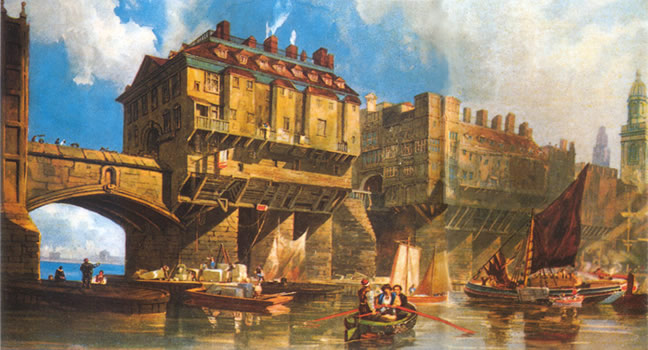
 [Images: (top)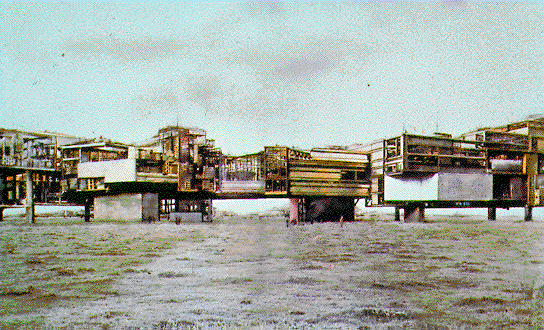
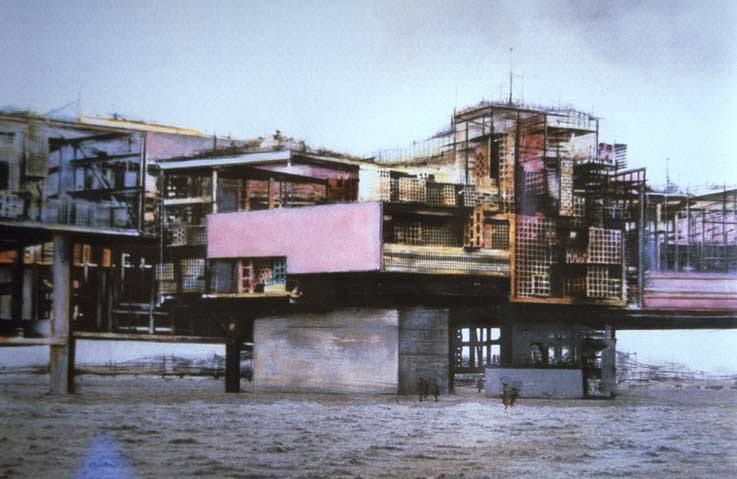 [Images: Constant's New Babylon].