Holy hell, I miss The Merlin Show. 2007 was a good year for the Internets.1Here's Merlin talking to Chris Wetherell, the original creator of Google Reader (as I recall).
-
Merlin makes a handsome gas station attendant. Fill'er up big guy. ↩
Holy hell, I miss The Merlin Show. 2007 was a good year for the Internets.1Here's Merlin talking to Chris Wetherell, the original creator of Google Reader (as I recall).
Merlin makes a handsome gas station attendant. Fill'er up big guy. ↩
firehoseit's so American, it probably sends all your data to the NSA as well as Google

What’s more all-American than an American company designing a smartphone for the US market, to be manufactured in a half-million square foot factory in Texas? Nothing, says Google’s new ad campaign for Motorola’s Moto X “superphone,” which will be released in October.
Don’t let the image of two people jumping off a dock in Google’s new ad confuse you: You can be sure that in the creative meetings, mock-ups accompanying the text of the ad—which has lines like “Imagine what will be possible when you have the world’s best design, engineering and manufacturing talent located here in the USA”—probably included bald eagles, American flags and at least one joke promo video set to Mighty Wings from Top Gun.

Google says that, beyond what has already been hinted at in terms of the advanced self-surveillance capabilities, long battery life, wireless charging and unbreakable case of the Moto X, its phone will be unique in a number of ways. The first is customizability: People will be able to order their phone direct from the US factory in designs and colors they customize themselves, and the phone will ship with a background image they upload in advance.
The second thing about the Moto X that will be unique is that it will be assembled in the US at a 500,000 square-foot factory formerly occupied by Nokia, just outside Fort Worth, Texas. The facility will employ 2,000 people once it’s running at full capacity, says Google, which also claims that this factory is the only one of its kind in the US. It’s owned by Singapore-based Flextronics, and the parts that go into the Moto X will come from “traditional” supply chains, with microprocessors made in Taiwan and LED screens from South Korea. Presently, no smartphones are assembled in the US, although the primary microprocessors in Apple’s iPhone and iPad are produced in Austin, Texas by Samsung.

firehosevia Overbey
America was the first country to join the European Union. Great Britain was the second.

A group of Goffin's cockatoos just impressed the hell out of researchers from Oxford after they picked their way through a series of five complex locks to reach a reward.

    
|

Global transparency watchdogs are disputing the rationale for a US federal judge’s ruling that exempts American oil and mining companies from publicly divulging their payments to foreign states and their rulers.
The reproach—from Oxfam and Global Witness, the UK-based transparency watchdog—stems from a July 2 ruling by US District Judge John Bates. In his decision, Bates sided with oil and business lobbyists who asserted that if American companies were compelled to publicly reveal such payments, they would be at a competitive disadvantage to state-owned extractive companies that can keep them secret.
The American Petroleum Institute, representing oil companies, specifically said such public disclosure is barred in Angola, Cameroon, China and Qatar. It suggested that payments be revealed to regulators, but privately and not for public consumption.
But in a statement today, Global Witness asserted that the four countries in fact permit public disclosure—if regulators in a company’s home country require it (here is more detai.l) In an email exchange, Dominic Eagleton, a staff campaigner for Global Witness, said:
“Angola has had (for at least 2½ decades) a standard Production Sharing Agreement contract that includes a provision which allows for disclosure should an issuer’s regulatory agency (read for that SEC) require it.
Cameroon is an EITI (Extractive Industries Transparency Initiative) implementing country–the EITI requires the disclosure of the same revenue payment data as [Dodd Frank act section] 1504.
No law that bans disclosure has been discovered in Qatar (given the company that made this claim is responsible for the production of at least 50% of Qatar’s gas output, it’s hard to believe they’d be shut down even if such a law existed).
In China, the only evidence that was provided to the SEC was a comment from a law firm (not even a credible ‘legal opinion’), which stated in essence that things can be confidential if the government determines them to be—as is the case in producer countries across the world—but they did not cite any particular law.”
In response, the API’s Carlton Carroll sent me the following by email:
“I would reiterate that these countries bar disclosure and any exceptions to that are ambiguous at best. The overarching problem is that the rule makes US companies less competitive when competing for energy projects around the world. In addition, the rule puts existing progress to increase transparency at risk. US companies are making substantial progress working for over a decade to enhance transparency in a way that doesn’t harm their competitiveness.”
We are in he said-she said territory.
But Bates’ decision countervails a global trend affecting the resource business.
Natural resource deals in the frontiers of the world typically share a trait—the metals or hydrocarbons involved are usually controlled by powerful politicians or bureaucrats, and you tend to see lubrication by bribery and other sweetheart payments. But for the last decade, momentum has been building behind the disclosure of such payments—in June, the European Union approved a law requiring transparency, and big mining deals are under legal scrutiny around the world.
Among the probes, a US grand jury is investigating a sweetheart mining deal in Guinea involving an alleged $12 million bribe and the Israeli billionaire Beny Steinmetz. In the UK, the Serious Fraud Office is investigating African mining deals including in Congo (paywall) by Kazakhstan-based Eurasian Natural Resources Corporation.
Bates’ decision still leaves US-based drillers and miners potentially exposed to transparency rules. Those that have European operations are subject to the EU law. In addition, the US Securities and Exchange Commission (SEC) can rewrite the disclosure rule to align with Bates’ quibbles. In a statement, Oxfam said resurrection of the SEC rule will “help prevent corrupt government officials from squandering oil and minerals wealth in resource-rich countries.”

firehose:( :( :(
Simplify README now that reader_archive and feed_archive are no longer useful.
firehose"It’s worth noting that Sony and Microsoft both face the same challenges, yet their respective next-gen consoles are region-free (IGN conducted this interview before Microsoft’s region-free announcement). PS Vita is also region-free."
Nintendo CEO Satoru Iwata explains his company’s region-locking stance, asking the policy’s opponents to please understand.
It’s worth noting that Sony and Microsoft both face the same challenges, yet their respective next-gen consoles are region-free (IGN conducted this interview before Microsoft’s region-free announcement). PS Vita is also region-free.
BUY Nintendo 3DS and 3DS XL consoles, upcoming games
firehoseSource: http://www.thetimes.co.uk/tto/arts/tv-radio/article3807591.ece
"A book about thwarted attempts to make a Doctor Who feature film reveals that Paramount wanted the title role to go to Michael Jackson.
Charles Norton, author of Doctor Who at the Movies, discovered that the King of Pop was the studio’s first choice when it agreed in 1988 to back a film by Daltenreys, the British production company that held the film rights."
Their second choice? Bill Cosby.
firehose"If you live somewhere on or close to this proposed route, and you’d like a visit at your hackspace or makespace, please leave a comment and we’ll see what we can do. ... Eben and I are also planning a smaller hackspace tour, after last year’s romp through NYC, DC, the Carolinas, Georgia and Florida. It’ll take in some more of the southern states and send us up through Texas in September, after Linuxcon in New Orleans (where Eben is keynoting)."
Rob Bishop, our developer-evangelist, spent some of last summer visiting US hackspaces, giving Raspberry Pi talks and demonstrations. Because there was only a short time we could spare him for, there were large parts of the country that he wasn’t able to visit – and you let us know you weren’t happy about that.
So this summer, Rob is going to be visiting the parts of the USA that you shouted most loudly from: namely the Midwest and the Pacific Northwest. He’s put together a preliminary map, showing a proposed route (not yet set in stone) and the locations of hackspaces across the country. Click this image to visit the interactive map. The green line is Rob’s route, and green pins are proposed stops: blue blobs are hackspaces.
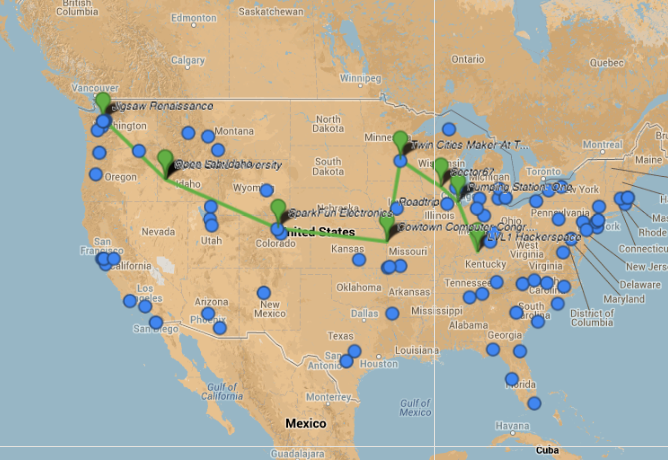
Click the map to visit a larger version
Rob will be in-country from around 5th-25th August; we’ll confirm dates later when we’ve drilled the route down a bit more. If you live somewhere on or close to this proposed route, and you’d like a visit at your hackspace or makespace, please leave a comment and we’ll see what we can do.
Rob will not be able to visit grade schools, but he may decide to fit in some university visits. Once he’s got feedback from you in the comments, he’ll confirm dates with the individual venues.

Like last year’s Raspberry Roadtrip, these events will consist of a talk, Q&A, live demos and (hopefully) some kind of competition for best Raspberry Pi hack.
And if you’re somewhere we haven’t covered yet, don’t despair: Eben and I are also planning a smaller hackspace tour, after last year’s romp through NYC, DC, the Carolinas, Georgia and Florida. It’ll take in some more of the southern states and send us up through Texas in September, after Linuxcon in New Orleans (where Eben is keynoting). We’ll have more details nearer the time.
Submitted by: Unknown
I've been holding out on you. I know, I'm sorry. I don't even know why, because these lemon bars ... oh man, they are meant to be shared. In fact, keeping them to yourself would be very dangerous. The truth is that I've been making this lemon curd recipe on its own for years, and I've been tinkering with my favorite shortbread recipe for years. Now, finally, I've had the presence of mind to bring them together. No need to thank me — you're welcome.
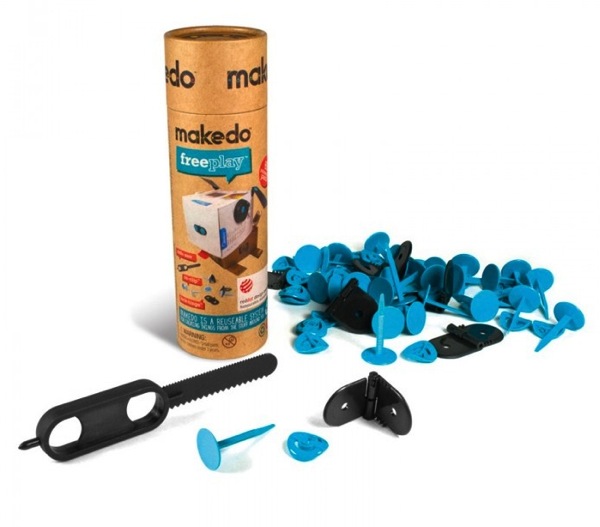

My kids (7 and 4) love to make things out of recycled cardboard, from curious Rube Goldberg-ian contraptions to palaces for stuffed animals. They do wonders with scissors, tape, and magic markers. A friend told us about Makedo, a system of reusable plastic clips and hinges for cardboard construction. We ordered a set and have been having a ball. The sets even come with a plastic saw for cutting the cardboard. It's not as quick as a box cutter or sharp scissors, but sawing itself can be fun, and the point on the saw handle is meant for punching holes for the clips. And yeah, I guess it's safer too. We didn't make the cardboard gorilla at right but I'd like to! We're gonna need a lot more clips though. There are a variety of Makedo kits available but the 65-piece starter kit is only $14 from Amazon, and comes in a sturdy tube. Of course, if you buy it from Amazon, the shipping box is part of the present! "Makedo FreePlay Kit For One"
|
|
firehosemeanwhile, in Portland
'Bonnie was not wearing a “hoody" at the time of the disappearance, police said.'
The Portland Police Bureau is searching for a pet rabbit, snatched from its hutch in Southeast Portland in late June.
"Bonnie" is a 19 pound Flemish Giant rabbit.

Portland Police
Bonnie was not wearing a “hoody" at the time of the disappearance, police said.
The owner told police a person claiming to be a “rabbit advocate" had come to the door offering advice a few weeks before the animal disappeared.
The victim is working with the Humane Society and the animal can be returned “no questions asked."
Animal theft is a Class C felony, police said in a news release.
vurtual:
Three Amigos (by Christina Evans)

Why didn’t French president François Hollande join the storm of criticism from EU member countries when it was revealed that the United States’ PRISM electronic surveillance program was spying on all internet traffic passing through the US? Perhaps because he knew that France has a similar program, alleges French newspaper Le Monde.
“All of our communications are spied on,” reports Le Monde, citing unnamed intelligence sources. Data is gathered by the DGSE, France’s intelligence agency, and stored on a supercomputer capable of handling “tens of millions of gigabytes,” which is housed in the basement of the DGSE’s headquarters.

The DGSE is known as “the firm” (la boîte) in France, and the Paris building that houses it nicknamed “the swimming pool” (la piscine—it happens to be near a competition swimming complex.) Some spies who work for the organization (link in French) call it “the service” (le service.) Notably, while the DGSE is currently blurred out on the satellite view of Google Maps, as of February 2011 its distinctive shape was clearly visible.

Like the NSA’s various domestic and foreign spying operations, the DGSE is gathering both data from the internet and phone records, alleges Le Monde. If the program is as Le Monde describes it, it could be illegal under French law. Like the NSA’s program, France’s gathers “metadata” on phone calls—i.e., who called whom, and for how long—which researchers have shown can be quite revealing.
French officials have denied that the country’s own electronic surveillance program is illegal, but Le Monde reports that there are seven other French intelligence agencies which have access to the data and use it to spot individuals whose communications look “suspicious.” As with the NSA program, then, it appears that the DGSE’s efforts are a broad and comprehensive dragnet used to turn up likely targets for more intrusive surveillance, like phone tapping.

firehose'Instead of wanting to murder someone when they level with you about these facts, embrace them. The choice is yours - support transparency, honesty and constructive involvement... or don't complain when the industry shrugs and shifts back to a model dominated by monolithic, uncaring publishers.'
or, you know, take Tim Schafer at word when he said he designed "too much game", as he usually does and has a long and storied history of doing
Alice creator American McGee has taken to his official blog to defend Double Fine's recent attempt to raise more money in the development of its Kickstarter-funded title Broken Age.
In the post, McGee addresses the idea that Double Fine's actions are representative of something more developers may be forced to do in order to complete their games. He adds that his own studio may have to seek additional funding for its upcoming title Ozombie, currently live on Kickstarter.
"Just want to say to all the press, public and others who are gnashing their fangs at Kickstarter, Double Fine and anyone they think look 'fishy,' you can't have it both ways," he wrote.
"You can't complain about big publishers and their bad business models - highlighting all the times they've pushed overpriced, buggy, unfinished product onto the shelves in hopes of a quick buck. Then when an indie developer lays bare their business model and struggles, crucify them for taking risks and being honest.
"In both cases the hyperbole is through the roof and completely unproductive."
Double Fine is currently planning to launch the initial half of its adventure game Broken Age via Steam Early Access in January 2014, founder Tim Schafer announced via the game's Kickstarter page. According to Schafer, the game requires further funding, but rather than return to Kickstarter or asking for the aid of a publisher, the studio will offer the half-version to the public through its Early Access pricing. The second half of the game will then be funded by its first half.
McGee goes on to describe the reaction to Double Fine's actions as an example of the gaming community assuming a greater understanding of the innerworkings of the games industry than it actually has.
"The games you play cost huge amounts of money to develop and market. Productions are insanely complex, which means there are many places where they can breakdown or fail. Outcomes aren't predictable, so that money to fund these things is nearly impossible to come by. Simply put, this shit is hard," he said.
"Things are going to go sideways and sometimes horribly wrong. Instead of wanting to murder someone when they level with you about these facts, embrace them. The choice is yours - support transparency, honesty and constructive involvement... or don't complain when the industry shrugs and shifts back to a model dominated by monolithic, uncaring publishers."

firehose"The Phoenix denied this at the time, and, coincidentally, several months later ceased publication all together (after a brief time in which it was split into five different newspapers with five different editors — Cyclops, Emma Frost, Namor, Colossus and Magik — until Cyclops assumed control over all five papers and it took the combined might of all of the Avengers to stop him … there’s a comic book joke for you!)."
firehosesee you, space cowboy

“Stampede 101 – get boots to be Marshal for the parade. I love how these turned out! They have that new boot smell.”
Retired astronaut Chris Hadfield will be marching as the marshal in the Calgary Stampede Parade on July 5th in a fancy new pair of custom cowboy boots (complete with a Canadian maple leaf). Does this make him a space cowboy?
image via Col. Chris Hadfield
firehoseChrome has been piling on bloat every release; it's always been a memory hog, but now it feels like it expands to take up all resources it can, and fuck whatever else you've got running.


Read more of this story at Slashdot.

firehose'MakerBot’s failure rate fell in the range of 25%–33%, which meant that there was around a one-in-three chance that two hours in, your Yoda print would fail, or that it would finish but once it was complete, you’d discover it was warped or otherwise defective.'
Read more of this story at Slashdot.

firehosegreat
Read more of this story at Slashdot.