firehose
Shared posts
The Hairstyles Abercrombie Has Deemed 'Unacceptable'
Citizen complaint of the day: Students
A concerned citizen files an elegantly simple Student Move-In Issues complaint about 1999 Comm. Ave. in Brighton.
General douchbaggery.
No doubt the city will get right on that.
This Is What's Going On Right Now In Russia
"There's more aggression and it's becoming more dangerous on the streets," Andrei tells me. "Many gay people have changed how they dress, they've removed earrings, changed their hairstyles, to avoid having problems. Even back in the USSR, where homosexuality was a criminal offence, gays were treated better than they are now in Russia. Ordinary people see us as criminals. They hate us."
There is evidence of that attitude in a series of shocking videos posted online by a Russian vigilante group. In one, a man is being forced to drink urine to "cure him" of being a homosexual. Then a metal bucket is placed over the man's head and hit with what looks like a baseball bat and a police truncheon. Attacks like this, filmed and posted online, are being carried out across Russia by an ultra-nationalist group. It claims its objective is to name, shame and punish suspected paedophiles. But from the tone of the videos the encounters come across as homophobic attacks. In another online clip, a woman armed with a gun and dressed in camouflage jokes that she's "out on safari" hunting for paedophiles and gays. She starts shooting towards an imaginary "rainbow target." The woman's name is Yekaterina. We track her down in St Petersburg, where she heads the local branch of the vigilante group "Occupy Paedophilia."
"Our priority is uncovering cases of paedophilia," Yekaterina explains to me. "But we're also against the promotion of homosexuality. And if along the way we encounter people of non-traditional sexual orientation, we can kill two birds with one stone."
In Russia gay-rights activists believe such aggression is a direct result of the controversial new law signed by President Vladimir Putin. The legislation bans the spread of information about "untraditional sexual relations" to anyone under 18. It portrays homosexuality as a danger to children and the family. "The law itself is not a danger in terms of its application. But it's a great danger in terms of what kind of opinions it shapes," believes Anastasiya Smirnova of the human rights group Russian LGBT Network. "It entitles people to mob rule, to organised violence against those they perceive to be dangerous to society, to families and to children. People take over the role of the authorities to react against what they think is a violation."
The Guardian reports that various, independent anti-gay vigilante groups are coalescing into a national movement. Most of the people being kidnapped and assaulted—and outed—are teenagers.
Says one of the authors of Russia's anti-gay laws:
"Why should we respect all your traditions and you not respect ours?" asks St Petersburg MP Vitaly Milonov, one of the architects of the legislation. "Aggressive pushiness to accept your values is unfair. We don't tell the Queen of England not to sign a law on same-sex marriages in your country. We have no right to do that, because we respect your independence. Why do you not accept ours?"
This is the exact same argument made by the apartheid-era government of South Africa: How we treat "our" blacks is our own business, we don't tell you how to treat your minorities, we respect your independence and you should respect ours, these are our traditions. The world rejected those arguments and fought back against the South African government with boycotts, protests, sanctions, and divestment campaigns. And it worked.


Music: Newswire: Oh, hey, the Pixies just released four new tracks and a new video

In the wake of Kim Deal leaving the group, the Pixies are releasing new music left and right. The latest is “Indie Cindy,” a track that comes from the group’s similarly just-announced EP, cleverly titled EP-1. Available today via the Pixies’ website, EP-1 was recorded in the UK in Oct. 2012, runs four tracks, and features zero contributions from Deal. Some 5,000 copies of the EP will be pressed onto 10-inch vinyl, which are available now via the band’s site.
Read more
    
|
15 Subway Maps That Trace NYC's Transit History
If you can get past the ridiculously incorrect statement in the second paragraph that the current New York subway map is “loosely based on a famous 1972 design by Massimo Vignelli”, then this is a fun overview of maps from 1924 to the current day. It’s nothing you can’t already find at the NYCSubway.org website with a little digging, but it’s nice to see them all on one page.
"My parents would frisk me before family events. Before weddings, funerals, bar mitzvahs, and what..."
- Neil Gaiman (via papertownbooks)
A Data Broker Offers a Peek Behind the Curtain - NYTimes.com
firehoseyessss
yes, look at the sausage
look at how they make the sausage
if Lovecraft was alive today and not racist he would have written all his books about inbound marketing
Supermodel Kendra Spears is Now a Real-Life Princess
firehose"the Prince has a BA from Brown University"
China could become the first country to legalize parcel delivery by drone

In building drones that kill people, the US has a couple-decade head start on China. But when it comes to domestic uses, US businesses are hamstrung because the Federal Aviation Administration (FAA) isn’t required to issue commercial drone rules until 2015. In the meantime, one of China’s biggest delivery companies is tinkering with using drones—with Chinese government permission.
SF Express is testing a drone it has built for delivering packages to remote areas, according to Chinese media reports. The drone can hit an maximum altitude of 100 meters (328 feet) and deliver parcels within two meters of its target. It’s not clear what sort of weight these puppies can handle, but Beijing journalists calculated that it probably can’t carry more than 3 kilograms (6.6 pounds).
The news broke yesterday morning, after a Sina Weibo user noticed what looked like a UFO hovering above a street in Dongguang, in southern China, and after noticing a SF Express logo, posted images online.
In July, a Shanghai bakery launched aerial cake delivery—or “pie in the sky,” as the Telegraph put it (video below). However, as an anonymous government official told the Shanghai Daily at the time, businesses that want to use drones must be granted approval from the local civil aviation authorities first. The bakers forgot to do that, apparently.
However, the Dongguan police said that, except during certain sensitive times, commercial operators who receive permission from the civil aviation regulator and air traffic control are allowed to fly drones (links in Chinese). SF Express says it’s strictly complying with the policies.

Drone delivery undoubtedly has a certain appeal to the Chinese authorities, who are increasingly struggling to control both traffic and pollution in China’s major cities. On top of that, e-commerce is growing much faster than delivery infrastructure in rural and mountainous parts of China, such that logistics systems are emerging as a big area of investment (paywall). In fact, a consortium including CITIC Capital took a 25% stake in SF Express in late August.
In the US, meanwhile, the jury on commercial drones is still out (even as the postal service sometimes reaches remote areas of the US via mules and sled dogs). The FAA estimates that there will be 30,000 drones in US airspace by 2020. But the prospects will be unclear until it issues its new rules in 2015. And while it okayed two drones for commercial use in early August, both were costly, state-of-the-art drones owned by prominent companies—Boeing and AeroVironment Inc—making it hard to guess the FAA’s views on cheaper drones. In the meantime, a slew of US state laws designed to protect citizens from surveillance by law-enforcement drones threaten to limit the use of commercial drones too, at least the FAA rules come out.

Japan is courting middle-class Muslims with halal udon and prayer rooms

Let them eat udon!
For observant Muslim travelers, Japan’s Kansai International Airport has long been a food desert. Now they can slurp noodles with everyone else. In July the kitchen at The U-don, a Sanuki udon noodle shop, was halal-certified. This was no mere act of cultural kindness: From 2011 to 2012, the Renzo Piano-designed airport witnessed a 70% increase in visitors from Indonesia, the world’s fourth most-populous nation and home to its largest Muslim population. The people’s stomachs have spoken, and halal udon was only the beginning of the airport’s—and Japan’s—larger vision to embrace Southeast Asian tourists.
A decade of economic growth coupled with a more recent boom in low cost carriers have given new wings to the Muslim-majority populations of Indonesia and Malaysia. Southeast Asia generates 11% of arrivals in the Asia-Pacific region, and the region as a whole is expected to add around 380 million more passengers a year between 2012 and 2016, according to the International Air Transport Association.
Japan wants a piece of this action. The country’s tourism industry is rebounding from the 2011 Tōhoku earthquake and tsunami, and its economy could use a boost from foreign shoppers. So while only 780,000 of Japan’s 8.37 million foreign visitors in 2012 were from Southeast Asia, the Japanese government wants 2 million by 2016, according to a recent report. To that end, it has relaxed travel visa requirements and also published a guidebook on Muslim-friendly restaurants, mosques and attractions in Japan.
Japan is not alone in courting Southeast Asia’s burgeoning middle class. Thailand has touted its halal spas, while hospitals in South Korea are building prayer rooms for those in town for a nip and tuck. New Zealand is going after Islamic foodies with a culinary tourism guide for halal travelers, and anticipates that spending by Muslim tourists will increase to more than 13% of global tourism expenditure by 2020.
So far the Japanese have seen 43.1% more Indonesians in the first seven months of 2013 compared to the same period last year, and 17.5% more Malaysian travelers. This is still a fraction of what Japan gets from China, but then again there are no messy territorial disputes to depress tourism. In its quest to become “Japan’s first Muslim-friendly airport,” Kansai International plans to add prayer rooms and halal meal options while 16 restaurants will go pork- and alcohol-free. After all, nothing says “welcome to our country” like overpriced airport food.

Daft Punk’s ‘Get Lucky’ Played in Mario Paint Composer
firehoseno new music
Youtube user jeonghoon95 has recreated Daft Punk’s “Get Lucky” in Mario Paint composer using a combination of classic Gameboy and Nintendo sound effects along with barking dogs and meowing cats.
via Digg Videos
shinga-tumblr: lookatthisfuckinradfem: doctorofdragons: lookat...
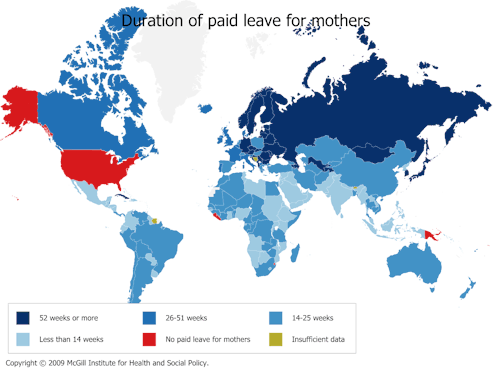
Well, you know…shit.
Where are all the pro-lifers protesting this? I mean, it would be a lot easier for people to go through pregnancy and childbirth if they were assured they wouldn’t lose their job and also have a means of support for themselves and their babies.
Oh wait, you guys actually don’t care about babies and the people who have them. You just want to punish people for having sex you don’t approve of.
A perfect example of why cynicism is so often the correct perspective.
"Where are all the pro-lifers protesting this?" They’re sitting at home shaming working mothers and saying they shouldn’t have out-of-home jobs in the first place. :P Where all this magical enough-to-support-a-family income is supposed to come from, who knows. Because a second parent isn’t always there and doesn’t always make enough for multiple dependents. Details details.
What It’s Like Being The Oldest BuzzFeed Employee
firehose"4. BuzzFeed is of course your home for the best GIFs. I, on the other hand, don’t know how to make a GIF, I don’t want to know how to make a GIF. I fucking hate GIFs (except cat GIFs — they rule)."
broadlybrazen: What Would You Do? (x) booasaur: #part of me...
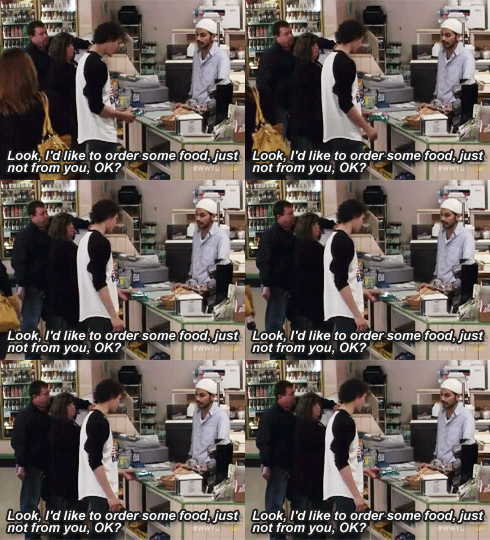
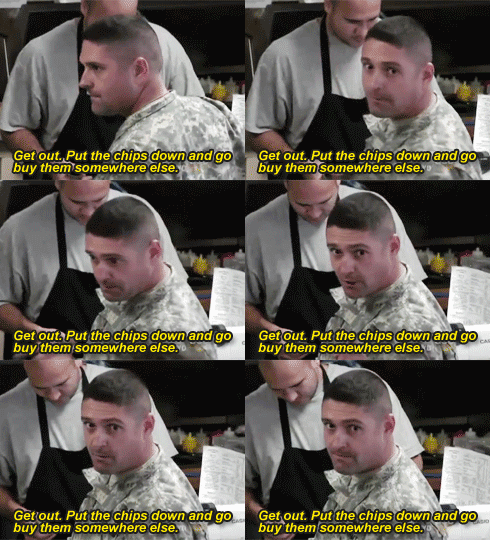
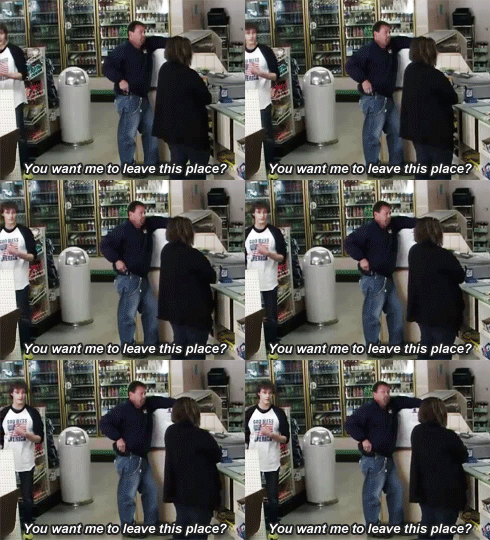
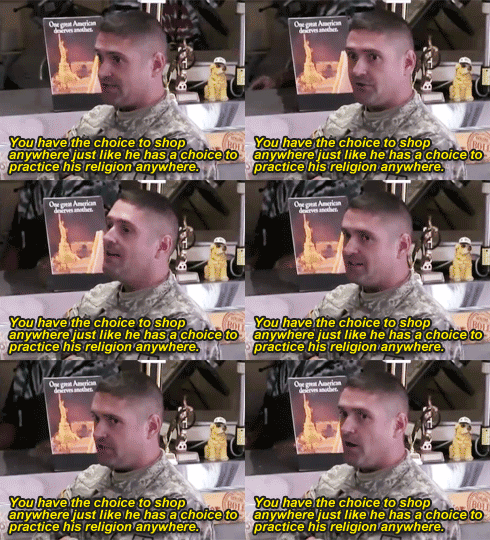
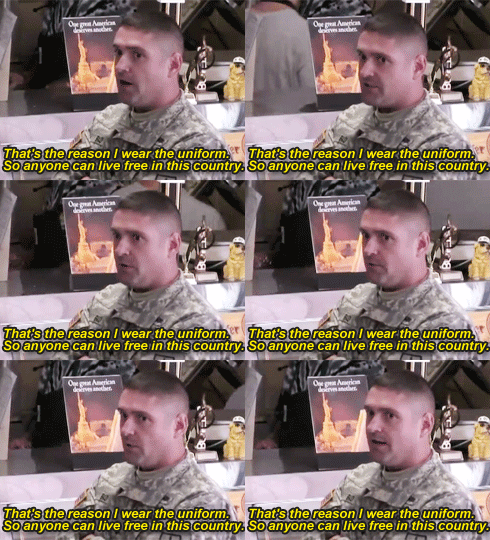
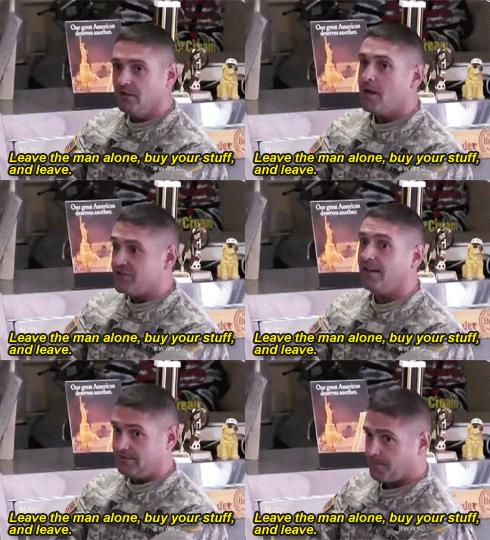
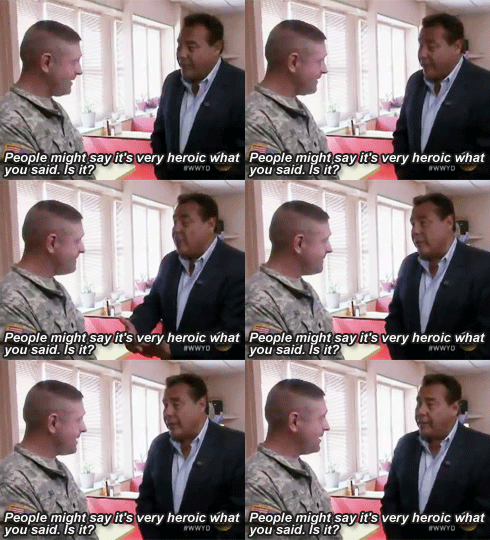
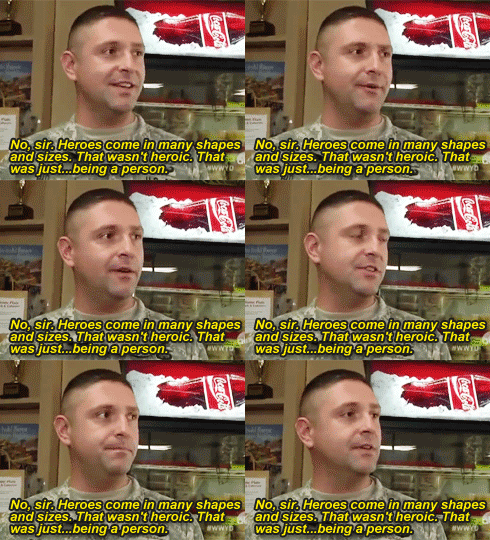
What Would You Do? (x)
booasaur: #part of me is sad that this is still considered extraordinary behavior worthy of a cookie #but I still teared up
yeah, same. and I really appreciate that the guy himself says “That wasn’t heroic. That was just…being a person.”
when we think minimum decency is extraordinary, that’s a sad commentary on our state of affairs.
Dillinger
Dillinger is a cloud-enabled HTML5 Markdown editor.
Edit text files stored on Dropbox, Github or Google Drive.
Jim Leff's Slog: How I Outgrew Libertarianism
firehose"None of those things were true of the people around me. One fateful night, I had a beer with a grimly untalented middle-aged musician. He was neither a druggie nor an alcoholic, but he was only barely functional. He walked with a limp and didn't think too clearly. I looked into his eyes, and realized, with overwhelming empathy, that this guy, who'd worked hard all his life, and who was a really good, conscientious fellow, was hanging by a frigging thread, and had lived his entire life with one foot in the abyss. No resourcefulness, no connections, no education. Crappy genes, crappy family. And none of it was his fault. He was truly doing his very best with what he had. By just plain being there, reasonably healthy and well-fed, he'd overachieved more than I ever could hope to."
I was a Libertarian in college. I even volunteered for the 1980 Ed Clark/David Koch (yes, that David Koch) Libertarian party presidential campaign. As promised, the following is the story of how I outgrew Libertarianism. There were three factors:
1. Hypocrisy
I became increasingly aware that many Libertarians arguing stridently against governmental regulation had business interests which would benefit directly. And while, as a Libertarian at the time, I saw nothing inherently wrong with greed, it bothered me that they claimed their political philosophy to be idealistic and sincere. Greed may be fine, but hypocrisy is not.
Furthermore, real Libertarianism isn't socio-economic Darwinism. It's not "fuck the poor". It doesn't blithely shrug at poverty and distress. The idea is for an unfettered free market to float everyone higher, and for vigorous private philanthropy to arise to patch up any social damage (to his credit, David Koch actually is one of the nation's top philanthropists). I was prepared to do my conscientious best to help. But few of my fellow idealists seemed as committed to the "patching up" part as they were to the "greed is good" part.
"Let the most ruthless grab all the gold, and hope someone patches up the wounded later" didn't strike me as a cause I could get behind.
2. Wariness of Egghead Utopias
As I studied political philosophy in college, I came to realize that there's no lastingly viable political system. In the long run, nothing works. Nothing has ever worked. Nothing ever will work. Every system is corruptible, and in the end all but a tiny minority gets screwed. Fortunately, things inevitably churn. Discontentment peaks, corrupt, unviable systems are overturned, and a fresh new corrupt, unviable system replaces it. The ending of Animal Farm is not a tale of failure. On contrary, it's humanity's sole saving grace that the pigs in charge are periodically replaced by slightly less entrenched pigs. That's really the best we can hope for. Blame Eve for eating that apple.
But every century or so eggheads proclaim some smug new utopian plan (which always sounds great on paper) destined to create a permanent steady state of prosperity and happiness. Communism was one. Libertarianism is another. But pure intellectual concepts always lack real world pragmatism. You can announce your brilliant pure plan but I don't believe it, I don't trust it, and I know it's bullshit before you even explain it to me.
3. Meeting Real Live Poor People
The idea made sense at first: level the competitive playing field, remove restrictions, and let the best and brightest superheat a blazing economy for the betterment of all. Sort of like America, but without the sludgey inefficiency. It also made sense that those who'd fall behind would have only themselves to blame. Hey, they had an equal shot, right?
I envisioned myself in such a scenario, making decisions, expending energy, and using my resourcefulness to compete. Yeah, it'd work! And I imagined some lazy dude (currently on, like, welfare or something), opting to hang out smoking Pall Malls in front of the 7-11. Fine, to each his own. We make our choices. It seemed equitable as I thought it all through.
Here's the problem with "thinking it all through":
You may have been following my series, "Bubbles, Slogs, and Selling Out", the story of how I sold Chowhound to CNET (now CBS). Here's a flash-ahead. There were times when my boss needed to make deep decisions about the site's future. I'd watch him close his eyes and envision how things would unfold, how it would impact users, etc.. But it was ludicrous because the guy knew nothing about food and had nothing in common with Chowhound's users. His taste, his vision, his ideas were from a different planet. Yet the vein on his forehead would pulse as he'd boldly envision it all. Very smart, very savvy...and invariably very wrong.
It can be useful to try to envision scenarios, but only if you have deep knowledge of the various factors. And my caricature of poor people hanging out in front of 7-11s wasn't exactly deep knowledge! As I'd envisioned it, libertarian societies made visceral good sense - but only because I was naive from my sheltered upbringing (show me a Libertarian, and I'll show you someone with a sheltered upbringing).
After graduation, I found myself living in a terrible shared apartment in a terrible neighborhood making $15,000/year as a jazz trombonist. I survived okay because I was smart, resourceful, and had middle class parents in the suburbs where I could, say, drive out and sleep in air conditioned comfort on hot August nights. I was educated. I had lots of smart, capable friends. I was articulate, young, intelligent, and healthy. I made a good impression. If trombone didn't work out, I had a world of possibilities open to me.
None of those things were true of the people around me. One fateful night, I had a beer with a grimly untalented middle-aged musician. He was neither a druggie nor an alcoholic, but he was only barely functional. He walked with a limp and didn't think too clearly. I looked into his eyes, and realized, with overwhelming empathy, that this guy, who'd worked hard all his life, and who was a really good, conscientious fellow, was hanging by a frigging thread, and had lived his entire life with one foot in the abyss. No resourcefulness, no connections, no education. Crappy genes, crappy family. And none of it was his fault. He was truly doing his very best with what he had. By just plain being there, reasonably healthy and well-fed, he'd overachieved more than I ever could hope to.
The scales fell from my eyes and for the first time I saw all my unearned advantages. And I fell into a reverie, envisioning myself with a never-ending lifelong case of flu, with fever impeding my intelligence, judgement and energy. My parents and friends were gone. I was on the verge of eviction from my apartment, and had no savings or education. I'd dropped out of high school to support myself, and had nobody smart to call for help or advice. No lifelines, no backup plans, no connections. Dizzy, feverish, and disheveled, I could hardly think straight. Let's add a couple of children to the picture, as well. Ok, hotshot: what's your move? How would you make out in a society with no safety net? What would be your odds? "My God," I thought to myself, shuddering with terror, "what on Earth would I do?"
After that night, I've had no interest at all in Libertarianism.
Alleged Female Idiot On The Field Blows .341 BAC, Has Amazing Twitter

An Idiot on the Field might have made history for being the drunkest Idiot ever recorded as she allegedly tried to jump onto the field during Saturday's Northern Illinois-Iowa game in Iowa City.
From the University of Iowa Police report:
Goudie, Samantha Lynne, 22 of Iowa City, IA for Public Intox at Kinnick Stadium at 1321 hours. Goudie was stopped for trying to enter the field. Goudie was unsteady on her feet. Goudie blew .341 PBT.
Yeah, that says a .341. "Unsteady on her feet" seems like a ridiculously nice way of saying Goudie was unfathomably shithoused.
Someone found her Twitter account, in which Goudie unintentionally creates a handy timeline of her drunk-ass adventures. Would you be surprised to learn that her Twitter handle is @Vodka_samm?
Just went to jail #yolo
— Samantha Goudie (@Vodka_samm) August 31, 2013
Blew a .341 in jail
— Samantha Goudie (@Vodka_samm) August 31, 2013
My mom hates me too
— Samantha Goudie (@Vodka_samm) August 31, 2013
I'm going to get .341 tattooed on me because its so epic
— Samantha Goudie (@Vodka_samm) August 31, 2013
Girl waiting for court with me goes "I wish I knew the girl who blew a .341" I said hi
— Samantha Goudie (@Vodka_samm) September 1, 2013
Ive gotten so many hate tweets because I was drunk...uh I get good grades sorry for being like every other college student
— Samantha Goudie (@Vodka_samm) September 1, 2013
Go Hawks motherfuckers
— Samantha Goudie (@Vodka_samm) September 1, 2013
@ThoseIowaBoys I was not trying to enter the game
— Samantha Goudie (@Vodka_samm) September 1, 2013
As seen in that last tweet, Goudie claims she wasn't trying to disrupt the game, although the police report says otherwise. Either way, holy shit, girl.
[BHGP]
Reviewed: New Logo for the State of Colorado by Evan Hecox
firehose"A lot of the complaints are that the logo looks like a road sign — well, that's perfect, isn't it? Driving through the beautiful scenery of Colorado is an experience worth communicating."
It's Always Snowy in Colorado


The state of Colorado is the 8th most extensive and the 22nd most populous in the U.S. with Denver as its capital and largest city. Known for its snowy mountains, arid plains, craft beer and microbreweries, high altitude, relatively great living standards and cost, and fit population, Colorado has consistently seemed like a pleasant state. A year ago Governor John Hickenlooper launched the Making Colorado initiative to build a brand for the state. In charge of the new logo was a team of 12 Coloradan designers and writers, who created three options for people to vote on and last week, at the Colorado Innovation Network Summit, Hickenlooper introduced the new logo designed by Evan Hecox.


Like Colorado itself, our new logo combines the familiar with the unexpected. It draws clear influence from our world-famous mountains and beloved license plate. But its shape, an upward facing arrow with rounded corners, also serves as a symbol of Colorado's momentum and a reminder of its friendly and approachable attitude. While our new identity certainly isn't everything Colorado is, it will serve as a constant and consistent reminder of everything our spectacular state can be.
Brand Colorado

"It's our nature" is at the heart of Colorado's new brand. Serving as the tagline, these three words symbolize the duality of our state--awe-inspiring scenery and life-loving people. It connects adventure with entrepreneurship, beauty with happiness and fresh air with creativity.
Brand Colorado
With destination logos it's always beneficial to be a step (or state) removed, since the locals, by default, tend to reject whatever logo is introduced, as has been the case here. (If you think Brand New commenters are snarky and/or mean, just read this 500+ comment thread on Facebook, coming from Colorado locals).
The opening image I used isn't quite accurate as there wasn't a true "before" logo, but the "C" in the flag was commonly used on its own and is the closest thing to an identifying mark for the state. The new logo makes an immediate impact: it's simple, easy to remember, bold, and it says Colorado right away. Does it encompass all the nuances of the state? No. No single destination logo does that. A lot of the complaints are that the logo looks like a road sign — well, that's perfect, isn't it? Driving through the beautiful scenery of Colorado is an experience worth communicating. It's not an outstanding logo and considering the long-haul of the project and the amount of people (designers and non-designers alike) involved it's commendable that something decent and usable came out.

"American Idol" confirms Harry Connick Jr., Jennifer Lopez for judges' panel - CBS News
firehoseGovernor's Program for Gifted Children beat
E! Online |
"American Idol" confirms Harry Connick Jr., Jennifer Lopez for judges' panel CBS News "American Idol" has set its judges' panel for season 13, and the reports were true -- Jennifer Lopez is back. 16 Photos. Celebrity TV judges. The singer will make her return to the singing competition, joining returning judge Keith Urban and newcomer Harry ... Jennifer Lopez returns as 'American Idol' judgeReuters Nation yawns as 'American Idol' settles on judgesBoston Herald 'American Idol' taps Jennifer Lopez, Harry Connick Jr, Keith Urban as judgesSan Jose Mercury News Los Angeles Times -STLtoday.com all 134 news articles » |
"You’re got me. You won! Ronald." - McDonald’s Treasure...
firehoseyeah
fuck you, vegetables

"You’re got me. You won! Ronald." -
McDonald’s Treasure Land Adventure (Treasure - Genesis - 1993)
"Being a writer is like having homework every night for the rest of your life."
- Lawrence Kasdan (via 1000wordseveryday)
Our Newfound Fear of Risk
firehose"We also expect that science and technology should be able to mitigate these risks, as they mitigate so many others. There's a fundamental problem at the intersection of these security measures with science and technology; it has to do with the types of risk they're arrayed against. Most of the risks we face in life are against nature: disease, accident, weather, random chance. As our science has improved -- medicine is the big one, but other sciences as well -- we become better at mitigating and recovering from those sorts of risks.
Security measures combat a very different sort of risk: a risk stemming from another person."
We're afraid of risk. It's a normal part of life, but we're increasingly unwilling to accept it at any level. So we turn to technology to protect us. The problem is that technological security measures aren't free. They cost money, of course, but they cost other things as well. They often don't provide the security they advertise, and -- paradoxically -- they often increase risk somewhere else. This problem is particularly stark when the risk involves another person: crime, terrorism, and so on. While technology has made us much safer against natural risks like accidents and disease, it works less well against man-made risks.
Three examples:
- We have allowed the police to turn themselves into a paramilitary organization. They deploy SWAT teams multiple times a day, almost always in nondangerous situations. They tase people at minimal provocation, often when it's not warranted. Unprovoked shootings are on the rise. One result of these measures is that honest mistakes -- a wrong address on a warrant, a misunderstanding -- result in the terrorizing of innocent people, and more death in what were once nonviolent confrontations with police.
- We accept zero-tolerance policies in schools. This results in ridiculous situations, where young children are suspended for pointing gun-shaped fingers at other students or drawing pictures of guns with crayons, and high-school students are disciplined for giving each other over-the-counter pain relievers. The cost of these policies is enormous, both in dollars to implement and its long-lasting effects on students.
- We have spent over one trillion dollars and thousands of lives fighting terrorism in the past decade -- including the wars in Iraq and Afghanistan -- money that could have been better used in all sorts of ways. We now know that the NSA has turned into a massive domestic surveillance organization, and that its data is also used by other government organizations, which then lie about it. Our foreign policy has changed for the worse: we spy on everyone, we trample human rights abroad, our drones kill indiscriminately, and our diplomatic outposts have either closed down or become fortresses. In the months after 9/11, so many people chose to drive instead of fly that the resulting deaths dwarfed the deaths from the terrorist attack itself, because cars are much more dangerous than airplanes.
There are lots more examples, but the general point is that we tend to fixate on a particular risk and then do everything we can to mitigate it, including giving up our freedoms and liberties.
There's a subtle psychological explanation. Risk tolerance is both cultural and dependent on the environment around us. As we have advanced technologically as a society, we have reduced many of the risks that have been with us for millennia. Fatal childhood diseases are things of the past, many adult diseases are curable, accidents are rarer and more survivable, buildings collapse less often, death by violence has declined considerably, and so on. All over the world -- among the wealthier of us who live in peaceful Western countries -- our lives have become safer.
Our notions of risk are not absolute; they're based more on how far they are from whatever we think of as "normal." So as our perception of what is normal gets safer, the remaining risks stand out more. When your population is dying of the plague, protecting yourself from the occasional thief or murderer is a luxury. When everyone is healthy, it becomes a necessity.
Some of this fear results from imperfect risk perception. We're bad at accurately assessing risk; we tend to exaggerate spectacular, strange, and rare events, and downplay ordinary, familiar, and common ones. This leads us to believe that violence against police, school shootings, and terrorist attacks are more common and more deadly than they actually are -- and that the costs, dangers, and risks of a militarized police, a school system without flexibility, and a surveillance state without privacy are less than they really are.
Some of this fear stems from the fact that we put people in charge of just one aspect of the risk equation. No one wants to be the senior officer who didn't approve the SWAT team for the one subpoena delivery that resulted in an officer being shot. No one wants to be the school principal who didn't discipline -- no matter how benign the infraction -- the one student who became a shooter. No one wants to be the president who rolled back counterterrorism measures, just in time to have a plot succeed. Those in charge will be naturally risk averse, since they personally shoulder so much of the burden.
We also expect that science and technology should be able to mitigate these risks, as they mitigate so many others. There's a fundamental problem at the intersection of these security measures with science and technology; it has to do with the types of risk they're arrayed against. Most of the risks we face in life are against nature: disease, accident, weather, random chance. As our science has improved -- medicine is the big one, but other sciences as well -- we become better at mitigating and recovering from those sorts of risks.
Security measures combat a very different sort of risk: a risk stemming from another person. People are intelligent, and they can adapt to new security measures in ways nature cannot. An earthquake isn't able to figure out how to topple structures constructed under some new and safer building code, and an automobile won't invent a new form of accident that undermines medical advances that have made existing accidents more survivable. But a terrorist will change his tactics and targets in response to new security measures. An otherwise innocent person will change his behavior in response to a police force that compels compliance at the threat of a Taser. We will all change, living in a surveillance state.
When you implement measures to mitigate the effects of the random risks of the world, you're safer as a result. When you implement measures to reduce the risks from your fellow human beings, the human beings adapt and you get less risk reduction than you'd expect -- and you also get more side effects, because we all adapt.
We need to relearn how to recognize the trade-offs that come from risk management, especially risk from our fellow human beings. We need to relearn how to accept risk, and even embrace it, as essential to human progress and our free society. The more we expect technology to protect us from people in the same way it protects us from nature, the more we will sacrifice the very values of our society in futile attempts to achieve this security.
This essay previously appeared on Forbes.com.
How to Create a Watermelon Smoothie in 2 Minutes With Little Mess
firehosetl;dr: bend the coat hanger to make a blender blade, stick it in the drill, stick that in a hole in the watermelon, pull trigger
then draw a face over the hole
NASA engineer Mark Rober shows “how to create a refreshing watermelon smoothie” in 2 minutes with little mess. To make the refreshing beverage, Mark used a coat hangar, a watermelon and an electric drill. Previously, we’ve written about Mark and his informative videos on how to make an ugly Christmas sweater with an iPad and a Scooby Doo style picture frame surveillance camera.
music by Qwiet – “Top of the World”
Escalator Catches Fire At Atlanta Airport - RTT News
firehosenever go
Headlines & Global News |
Escalator Catches Fire At Atlanta Airport RTT News An escalator caught on fire at Atlanta's Hartsfield-Jackson International Airport Tuesday morning,, injuring two firefighters who were trying to put it out. Local television station WCRB reports that the fire, which broke out around 5:00 a.m. on Tuesday, started in ... Atlanta airport blaze injures firefightersThe Augusta Chronicle Firefighters injured in fall during Atlanta airport blazeWashington Times Firefighters hurt battling fire at Atlanta airportKansas.com all 58 news articles » |
English has been my pain for 15 years
firehosevia Dmitry Krasnoukhov
[1] http://paulgraham.com/accents.html
A long story
---
I still remember me and sullivan (http://www.isg.rhul.ac.uk/sullivan/) both drunk in my home in Milan trying to turn an attack I was working on, back in 1998, in a post that was understandable for BUGTRAQ users, and this is the poor result we obtained: http://seclists.org/bugtraq/1998/Dec/79
Please note the "Instead all others" in the second sentence. I'm still not great at English but I surely improved over 15 years, and sullivan now teaches in US and UK universities so I imagine he is totally fluent (spoiler warning: I'm still not). But here the point is, we were doing new TCP/IP attacks but we were not able to freaking write a post about it in English. It was 1998 and I already felt extremely limited by the fact I was not able to communicate, I was not able to read technical documentation written in English without putting too much efforts in the process of reading itself, so my brain was using like 50% of its energy to just read, and less was left to actually understand what I was reading.
However in one way or the other I always accepted English as a good thing. I always advice people against translation efforts in the topic of technology, since I believe that it is much better to have a common language to document and comment the source code, and actually to obtain the skills needed to understand written technical documentation in English is a simple effort for most people.
So starting from 1998 I slowly learned to fluently read English without making more efforts compared to reading something written in Italian.
I even learned to write at the same speed I wrote stuff in Italian, even if I hit a local minima in this regard, as you can see reading this post: basically I learned to write very fast a broken subset of English, that is usually enough to express my thoughts in the field of programming, but it is not good enough to write about general topics. I don't know most of the words needed to refer to objects you find in a kitchen for example, or the grammar constructs needed to formulate complex sentences, hypothetical structures, and so forth. As I now can communicate easily in the topic I care most, and in a way that other people can more or less understand everything I write, the pressure to improve has diminished greatly… However I recently discovered that this was the minor of my problems with English.
European English, that funny language
---
So while I managed to eventually write and read comfortably enough for my needs, I almost never experienced actual communication in an English speaking country until recently. Before that I always used English with other european (non UK) people, such as French, German, Spanish people.
Now the English spoken in these countries is the English spoken at English school lessons… Phonetically it has almost nothing to do with American or UK English. They say it is "BBC English" but actually it is not. It is a phonetically greatly simplified English that uses UK English grammar.
*That* version of English, actually allows people from around the world to communicate easily. The basic grammar is trivial to grasp, and in a few months of practice you can talk. The sound of the words is almost the same in all the non-UK speaking countries in Europe. So it works great.
There is just one problem, it has nothing to do with the real English spoken in UK, US, Canada, and other countries where English is a native language.
English is a bit broken, after all
---
Now I've a secret for you, that is everything but a secret except nobody says it in the context of English VS The World: English is a broken language, phonetically.
In Italy we have a long history, but a very late political unification. Different regions talk different dialects, and people have super strong accents. Before 1950, when the "TV Language Unification" happened, everybody was still taking with their *dialects* and italian was only mastered by a small percentage of people. Sicilian itself, the language talked the most by my family, predates Italian by centuries (http://en.wikipedia.org/wiki/Sicilian_language*).
Still, guess what, nobody has issues understanding one of another region, or even from a Switzerland canton. Italian is phonetically one of the simplest languages on the earth, and is full of redundancy. It has, indeed, a low information entropy and usually words are long with a good mix of consonants and vocals in every word. There are no special rules to pronounce a word, if you know the sound of every single letter, plus the sound of a few special combination of letters like "gl", "sc", you can basically pronounce 99.9% of the words correctly just reading them for the first time.
The fact that people from different English speaking countries have issues communicating is already a big hint about how odd is English phonetically.
For instance for me and many other non native English speakers it is very very very hard to understand what the fuck an UK people is telling. North Americans are a lot simpler usually.
Because of this "feature" of English the problem for me is not just my accent, that is IMHO the simplest thing to fix if I'll try to fix it putting enough work into it, but the ability to understand what people are saying to me. IMHO the fact that Paul Graham refers to "accents" is a bad attitude of UK/US people in this regard, hey guys, you are not understanding us, we are not understanding what you say as well, and it is hard to find people that, once your understanding limits are obvious, will try to slow down the pace of the conversation. Often even if I say I did not understand, I'll get the same sentence repeated the same at speed of light.
Learning written english as a first exposure is the killer
---
In my opinion one fact that made me so slow learning English is the fact that I started reading English without never ever listening to it.
My brain is full of associations between written words and funny sounds that really don't exist in the actual language.
My advice is that if you are learning English now, start listening as soon as possible to spoken English.
The osx "say" program is a good assistant, it is able to pronounce in a decent way most English words. NEVER learn a new word without learning what is its sound.
Introvert or extrovert?
---
One of the things that shocked me the most with my experience with the English language is how not mastering a language can switch you into an introvert. I'm an extrovert in Italy where most people are extroverts, in Sicily where there are even more extroverts, and inside my family that is composed mostly of extroverts. I'm kinda of an attention whore I guess (I hope I'm not, actually, but well, I'm very extrovert). Now when I have to talk in English, I'm no longer an extrovert anymore because of the communication barrier, and I regret every time I've to go to a meeting, or to be introduced to another person. It is a nightmare.
It's too late, let's study English
---
English in my opinion is only simple grammatically, but is a bad pick as a common language. However the reality is, it already won, there is no time to change it, and it is a great idea to talk in English better, even if this means to put a lot of efforts into it. This is what I'm doing myself, I'm trying to improve.
Another reason I find myself really in need to improve my English is that in 10 years I'll likely no longer write code professionally, and a logical option is to switch into the management side of IT, or to handle big projects where you are not supposed to write the bulk of the code. Well, if you think you need English as a developer, you'll need it a lot more as you go in other divisions of a typical IT company, even if you "just" have to actually manage many programmers.
However as a native English speaker you should really realize that a lot of people are doing serious efforts to learn a language that is hard to learn: it is not an hobby, to master English is a big effort that a lot of people are trying to do to make communication simpler. Without to mention how trivial is to go back in the learning process as long as you stop talking / listening for a couple of weeks…
My long term hope is that soon or later different accents could converge into a standard easy-to-understand one that the English speaking population could use as a lingua franca. Comments
Meet The New Anti-Adoption Movement
firehose"This coalition makes bedfellows of people who would ordinarily have nothing to do with each other: Mormon and fundamentalist women who feel they were pressured by their churches, progressives who believe adoption is a classist institution that takes the children of the young and poor and gives them to the wealthier and better-educated, and adoptive parents who have had traumatic experiences with corrupt adoption agencies."
... and, you know, kids adopted from corrupt adoption practices. *cough*
"They want, among other things, a ban on adoption agencies offering monetary support to pregnant women. They want to see laws put in place guaranteeing that “open” adoptions (where birthparents have some level of contact with their children) stay open. They want women to have more time after birth to decide whether to terminate their parental rights. These activists have become increasingly loud of late, holding prominent rallies, organizing online, and winning several recent legislative victories.
Reproduce justice activists tend to focus on rights to contraception and abortion. But these adoption reforms are equally important when it comes to men and women having full control of their destinies."
(reproduce justice?)
otherwise, a good read (if too focused on the birth mother side of a story with way more facets) from the poorly edited New Republic
Mutex Nintendo
firehoseMarco once again takes Gruber apart and puts a logical argument back together by adding context to the pieces
John Gruber elaborated and responded to some of the criticism about his position that Nintendo should make iOS games:
Here is what I’d like to see Nintendo do.
Make two great games for iOS (iPhone-only if necessary, but universal iPhone/iPad if it works with the concept). Not ports of existing 3DS or Wii games, but two brand new games designed from the ground up with iOS’s touchscreen, accelerometer, (cameras?), and lack of D-pad/action buttons in mind. (“Mario Kart Touch” would be my suggestion; I’d buy that sight unseen.) Put the same amount of effort into these games that Nintendo does for their Wii and 3DS games. When they’re ready, promote the hell out of them. … Sell them for $14.99 or maybe even $19.99.
It’s a good idea, and one that Nintendo should probably do. But that’s not the problem.
I wrote about Nintendo’s predicament in 2011 and again earlier this year, and my theory remains:
Nintendo needs the profits of the high end, but they can’t compete there anymore. All of the growth is happening at the low end, which is mostly games that they can’t or won’t make. And even if they succeeded in casual gaming, it probably wouldn’t bring the kind of profit that they need.
I’ve previously argued that Nintendo shouldn’t make iOS games because it wouldn’t bring in enough money to solve their problems. But I was always thinking of making iOS games and making their own hardware as mutually exclusive. Gruber makes some great points that have convinced me that Nintendo could do both, and I no longer believe their theoretical iOS games would harm their hardware business.
Over the last few years, I’ve learned a lot about competition. The biggest lesson has been that in most cases, products and companies live and die by their own actions, not their competitors’.
Apple didn’t almost die in the ’90s because Microsoft was competing well: they almost died because their hardware was overpriced and their operating system was primitive and archaic.
Sega’s hardware business didn’t die because Nintendo and Sony kicked its ass: it died because Sega threw away the Genesis’ tremendous fanbase and success by sloppily releasing the Sega CD, 32X, and Saturn, all of which were overpriced, uncompetitive, and poorly supported by game developers and Sega itself. By the time the relatively good Dreamcast was released, most fans and game developers had lost all faith in Sega and moved on to other systems.
Nintendo’s strongest asset and greatest enemy has always been itself, its history, and its spotty record for making important decisions. Their hardware business is going to succeed or fail on its own, regardless of whether they release any smartphone games. Many people willing to pay a good price for a Nintendo iOS game would gladly also buy a Nintendo console or hand-held if it was good enough. And Nintendo still needs that, because they’ll make far more profit by selling people piles of $40 controllers and $25 plastic accessories than they could ever make on a $7.99 iPhone game.
The problem is that we aren’t seeing much evidence that Nintendo can produce any more hardware that’s good enough to compete with ubiquitous smartphones, cheap tablets, and their increasingly attention-competitive world of non-gaming killer apps.
