French journalist Stéphane Bouley created a modernized version of the movie trailer for the 1975 British comedy film Monty Python and the Holy Grail.
via Digg Videos
firehosegrimdark all the things
French journalist Stéphane Bouley created a modernized version of the movie trailer for the 1975 British comedy film Monty Python and the Holy Grail.
via Digg Videos
Depending upon what date is chosen for the starting point, the Northern Wars comprise:


a long time ago - Sorcerian (Falcom/Sega - Mega Drive - 1990)
requested by kikkonfessions


Read more of this story at Slashdot.

Manuka the 15-day-old piglet oinks and grunts excitedly as it meets two cats named Gracie and Hector in this 2010 video.
video via littlepigfarmuk

After the communications infrastructure of Fire Island was wiped out by Hurricane Sandy, Verizon decided it didn't want to rebuild severely damaged wireline phone networks. Instead, residents would have to settle for a new wireless product called Voice Link.
The plan faced massive outcry from residents, advocacy groups and government officials. There wasn't anything wrong with providing Voice Link as an option, but Verizon's plan to make wireless the only choice on the western part of the island, where the damage was worst, was a shock.
New York Attorney General Eric Schneiderman accused Verizon of trying to "depart from a century of telephone service regulation" by going wireless-only. Residents called the wireless service substandard, and Schneiderman said it would deprive customers of the ability to use wireline-dependent services such as fax machines, alarm systems, medical alert devices, and DSL. Battery life was also a concern, especially during blackouts.
Read 7 remaining paragraphs | Comments

    
|
firehoseDean Haspiel beat
Sydney Morning Herald |
8 massacres by Syria regime and 1 by rebels since April 2012, UN war crimes ... CBS News GENEVA Evidence confirms at least eight massacres have been perpetrated in Syria by President Bashar Assad's regime and supporters and one by rebels over the past year and a half, a U.N. commission said Wednesday. Calling Syria a battlefield where ... Syria's Assad: An accidental heir proves resilientBeaumont Enterprise Assad supporters caught out by offer of chemical-weapons concessionThe National Bashar al-Assad: A Tyrant in FullNational Journal UPI.com all 87 news articles » |
This is part four of a series. The first post can be found here: Gender and Game Mechanics Series: Part 1 – Introduction and the previous post here: Gender and Game Mechanics: Part 3 – How we fare in Care and Justice. In the previous posts I talked about how sociology and sociolinguistic studies on gendered communication styles could be useful heuristic tools to evaluate game systems and mechanics. I began with discussing two conflict resolution styles that trend differently by gender (care and justice). I looked at how traditional modes of RPG conflict resolution seem to be justice-oriented, and had a look at how that might affect the experience of care-oriented players at the table. In this post, I’d like to look at mechanics or systems that might have a stronger care-oriented bias, and at hybrid models which seem to combine elements of both.
As a reminder, care mediation is focused on relationship management. It assumes: connection between individuals, prioritizes modes of resolution that are internal to the community (rather than external rules or laws) and emphasizes the need for reciprocity. Tolerance, empathy, and active listening are encouraged and each conflict is seen as particular and contextual (rather than universal). Also, in pretend play, it was noted that girl playgroups generally used care mediation through the fiction rather than stepping outside of it.
So in terms of RPG conflict resolution, what would this look like? I think we could assume that a “pure” care-oriented system1 would likely not depend on an external arbitrator like a dice roll. We would for certain expect that the system would help make it clear how the relationship of the participants (possibly including any and all of: the characters in conflict, any characters observing the conflict, and all players involved in the game) changed as a result of the resolution. We could assume that conflicts would resolve through a process of talking where being heard is prioritized, and all the participants’ needs are understood, and met equitably well. The conflict in question would likely be understood and considered by participants as a particular conflict (examining context) rather than a “genre” of, or universalized conflict. And ideally, given the tendency to play through the fiction, players should as much as possible be able to reach a resolution on conflict without stepping out of character, or at least out of the fiction of the game.
Are there systems that employ something like this? Recently I played in an all-feme Nordic larp in Sweden called Mad about the Boy2. The larp was (for the most part) a 360 degree immersive drama game set in a real-world near-future post-apocalypse involving strong emotional themes. The in-game play spanned two full in-character days and the vast majority of conflicts were not governed by mechanics. at all Conflicts between individuals not involving a weapon were handled naturalistically.
When characters came into conflict, they resolved it through discussion in character, much like one would do in real life with another person. Characters did not have stats or abilities, players did not roll dice, roshambo, or do anything but talk. Any player in the vicinity could weigh in as an interested party. No GM/Storyteller/Producer monitored, mediated or interfered with the conflict’s resolution. There was no way for one character to force another character to do anything that they didn’t want to do without the support of, or consequences of the community, unless the character was armed and ready to use explosive violence to do it. Even where weapons were involved (limited to three guns present in the fiction of the game), the rules governing their use were extremely simple:
Is this care mediation? Let’s see: This system is based in talk. It allows players through their characters to negotiate their needs and the needs of others. Meta-techniques in the game like windowpaning (drawing a window to make a dramatic aside to your fellow players) are even present to ensure that where your character is unable to ensure their needs (or your as a player) are articulated, the player can still enter them into the fictive space for consideration. It encourages active listening and tolerance of other players (even when not their characters). It places a strong emphasis on, and provides a strong approval power to the community of play and it’s self-regulating skills (both in and out of character). Because all fiction is expressed naturalistically, the players must confront the changes evident in the relationship as a course of play, or not, as to the dramatic action.
It certainly supports a lot of care-mediation values, or put more aptly: it does not constrain them. It does constrain some justice-mediation values. While characters in the game could logistically appeal to the authoritative body in the fiction to be a point of resolution the conflicts (there is a government entity in the setting but one that does not have immediate martial power to exert) the game does not provide a source of systemic resolution that clearly determines outcome. Autonomy and independence are constrained by the need to garner and maintain community support to keep power. Reciprocity might equal out to fair but it might not; rights of any individual may not be respected as a matter of community interest inside a charged situation powered by a collective.
Is it surprising to find a structure which has a care-mediation bias written in large part by women (2 of 3 larpwrights were women) for an all-female cast that prioritizes themes about women and their values and communities? I don’t think so.
Also, it’s worth noting to find that this kind of structure is not uncommon among art larps coming out of Nordic countries, all five of which rank in the top 10 in terms of gender equality3.
Just sayin’.
Next up: Hybrid Care and Justice in Powered by the Apocalypse games.
(Gender and Game Mechanics: Part 4 – Care in Action? originally posted on Gaming As Women.)
Related posts:
firehose"And that's what really stuck in my craw with Divekick. Regardless of whether Phan is deserving of the level of derision he receives online, the mature thing to do would be to abstain from making the joke in the first place. Take all the development time spent on crafting this eternally-burning effigy and instead build a character based on positive community influences like James Chen, Ultra David or Haunts. Why not do that instead?
The answer, simply put, is that it's more fun to hate Marn than to not have him around. The FGC's stream-chat culture needs someone to make the subject of regurgitated, pre-chewed memes. There's no effort here to grow beyond Marn, to erase his supposed shame from history and become something better. Instead, Divekick preserves him as an object of ridicule. There's nothing wrong with parody or satire when handled properly, but this is just bullying, presented in such a way as to make it seem not only acceptable, but preferable."
 Divekick is as much an homage to the world of fighting games as it is a love letter to the greater Fighting Game Community - a light-hearted, self-referential work of parody that exists in this goofy purgatory between a novel joke and a tournament-ready (albeit unorthodox) fighting game.
Continue reading Opinion: How Divekick missed a chance to help the FGC
 Opinion: How Divekick missed a chance to help the FGC originally appeared on Joystiq on Wed, 11 Sep 2013 11:00:00 EST. Please see our terms for use of feeds.
firehosefuck your books

(via Fairfax County library revamps system, discards books, reduces librarians - The Washington Post)
Hearing complaints that the Fairfax County Public Library was throwing away tons of books, County Supervisor Linda Q. Smyth (D-Providence) decided to peer into a Dumpster.
Twice, she found stacks and stacks of high-quality books, bought by the taxpayers, piled in the trash. The second time, she filled a box.
… as Sam Clay, Fairfax’s longtime library director, launched a plan to revamp the county system, no books were given to the Friends of the Library for seven months this year, and more than 250,000 books were destroyed, Smyth said.
The discarded books have opened a broader discussion about the library’s long-term plan, which would eliminate the requirement for fully trained librarians, reduce branch staff and cut the amount of time children’s librarians spend helping families inside their libraries.
firehosevia multitasksuicide
Oct. 18 Oakland, CA @ Oakland Opera House !?
19 San Francisco, CA @ Thee Parkside !?
20 Portland, OR @ Rotture !?
21 Seattle, WA @ The Crocodile !?
22 Bellingham, WA @ The Shakedown !?
23 Vancouver, BC @ Rickshaw Theater !?
...
Nov. 10 Montreal, QC @ Il Motore #%
11 Providence, RI @ AS220 #%
...
17 New Orleans, LA @ One Eyed Jacks #%
...
23 Los Angeles, CA @ The Satellite %
firehosevia Snorkmaiden

Subway sandwich: good if you’re hungry, bad if you’re a female commuter. These 8 women-only transit cars offer groups of gals a grope-free rail road trip.
 (image via: Wikipedia)
Japan first introduced women-only subway cars in 1912, though their usage was sporadic and isolated. Modern usage of train and subways carriages specifically restricted to women dates from the year 2000 with the Tokyo Metro succumbing to popular demand for such cars in 2005.
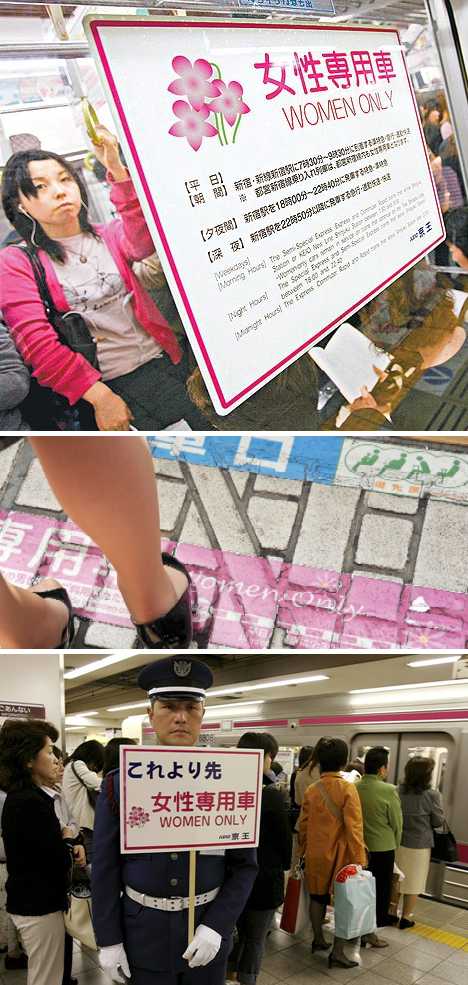 (images via: Apple Daily, The Japan Times and The Grid)
They may have been late to the dance but the Tokyo Metro now serves as a model for other city’s and nation’s transit systems on how to do women-only transit right. Designated cars are consistently color-coded (pink, naturally) to avoid confusion by the visually-impaired, signage on the trains in in the stations is profuse, and transit police are on hand to enforce the rules.
 (image via: RAYRAY IN RIO!)
Brazil’s first gender-specific subway cars first appeared on São Paulo Metro in October 1995, but the scheme was discontinued in September 1997 after the Companhia Paulista de Trens Metropolitanos (CPTM) received complaints from married couples. There was also the possibility that Article 5 of the Brazilian Constitution, which guarantees equality among citizens, might be inadvertently flouted giving rise to an expensive legal challenge. Curiously, the Rio de Janeiro Metro was untroubled by these sticking points and introduced women-only subway passenger carriages in April of 2006.
 (images via: NBC News and Andén 2)
The official policy regarding women-only carriages dictates that for trains with six passenger cars, one car must exhibit predominantly pink colors and signage denoted the car to be for the exclusive use of women. It should be noted that pinkness notwithstanding, the women-only restriction only applies on weekdays during the morning and afternoon rush hours (3 hours each). Metro police enforcement is provided to ensure non-women (also known as men) stay out of the cars and station platforms have signs in pink, white and yellow on their floors indicating where women should assemble for boarding.
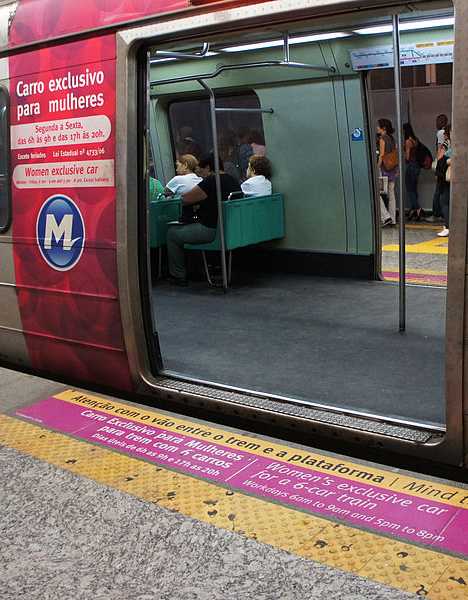 (image via: Wikipedia/Mario Roberto Durán Ortiz)
The recent introduction of Rio de Janeiro’s “Women’s Exclusive Cars” has allowed the system to borrow from other successful subway networks around the world: note the “Mind The Gap” warning on the platform, lifted from the London Underground circa 1969.
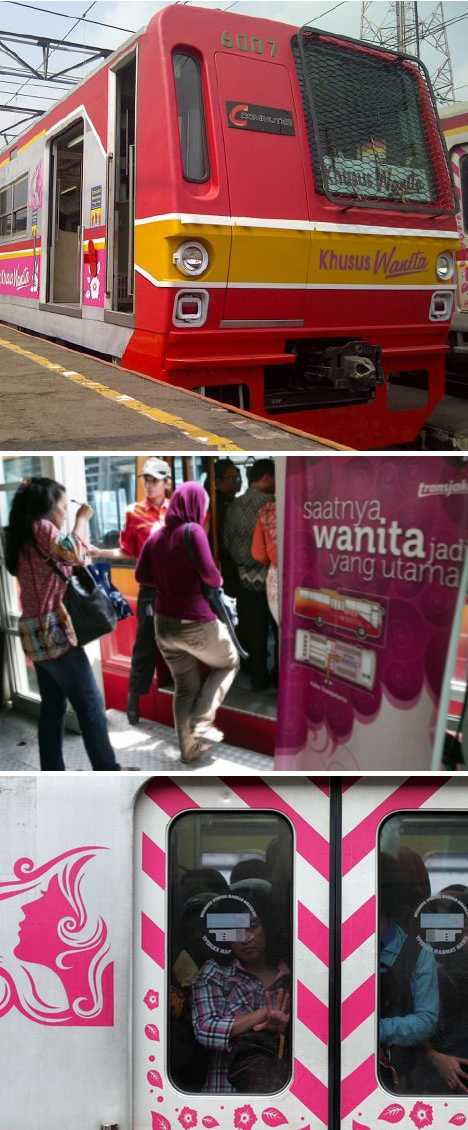 (images via: CharlesKKB, The Jakarta Post and Tempo.co)
If the Indonesian commuter train you’re about to board is trimmed in pink & purple and bears the legend “Kereta Khusus Wanita”, back off Jack… unless you’re a Jill.
 (image via: Korean Lecture Heeya)
Indonesian women have taken to the women-only services provided by the nation’s commuter train lines, and if such service is withdrawn they don’t take the loss lying down. Such was the case in May of 2013 when PT KAI Jabodetabek Commuter decided to discontinue the exclusive cars on its women-only Electric Railway Train (KRL) line running the Bogor to Jakarta route. “”


|
|
firehosevia Russian Sledges

If you love our collection of 25 Swiss Mid Century Package Designs, check out this collection of 20 Vintage Dutch package designs. Again, here we see a heavy use of typography, bold colors and graphics - substraits were mainly paper boxes and tin canisters. Let us know what you think and comment below!
Archive of Adviz.nl via Present and Correct