Shared posts

12 Sep 14:15

Making Feminist Points

by feministkilljoys

In my first ever blog (not that long ago, but already it feels like a long time ago!) I created a list. We might call this a list of the tendencies that feminist killjoys share, or a list of points that feminist killjoys tend to make (if feminists have to sharpen our tools just to get through the walls of perception, no wonder we tend to be heard as sharp!).

I suggested that you might be interested in a blog on feminist killjoys if you as a feminist killjoy tend to do x. One of these tendencies relate to citation.  Feminist killjoys “will point out when men cite men about men as a learned social habit that is diminishing (ie. most or usual citational practice).”

I am of course describing this feminist killjoy tendency in my own terms here. But so many of my feminist killjoy experiences within the academy relate to the politics of citation: I would describe citation as a rather successful reproductive technology, a way of reproducing the world around certain bodies.

These citational structures can form what we call disciplines. I was once asked to contribute to a sociology course, for example, and found that all the core readings were by male writers. I pointed this out and the course convener implied that “that” was simply a reflection of the history of the discipline. Well: this is a very selective history! The reproduction of a discipline can be the reproduction of these techniques of selection, ways of making certain bodies and thematics core to the discipline, and others not even part.

 I have noticed as well that these citational practices can occur even when the topic is one that feminists have written extensively about.  I recently attended a conference in which there was a panel on reproductive justice, a topic that feminists have written rather extensively about, and two of the three papers were entirely framed around the work of male philosophers! Or take the case of scholarship on the body. Feminists have been writing about the body (and critiquing mind-body dualisms) for well over a century. But how often have I heard utterances in which such-and-such male theorist is identified as the origin of the turn to the body! 

Indeed men can even cite only men when critiquing male privilege, as we can see here:http://www.leninology.com/2013/02/on-male-privilege.html

I also stated that this citational structure is “most or usual citational practice.” And I think within feminist and gender studies, the problem does not disappear. Even when feminists cite each other, there is still a tendency to frame our own work in relation to a male intellectual tradition. And there is certainly an expectation that you will recognise your place through giving your allegiance or love to this or that male theorist.

I mentioned this problem in my earlier blog post: “Creating Feminist Paths”

[http://feministkilljoys.com/2013/08/27/creating-feminist-paths/].

I have noticed when giving talks or hearing other female academics giving talks how often the first question is ‘how does what you are saying relate to such and such a male theorist?’ as a way of slotting you into an established male intellectual genealogy. I think it is hard to convey how this works in the abstract; but it’s a style of questioning (where you almost become “the but” of a rebuttable, but what about, but what about) and you learn to hear the trouble they have in hearing you.

We are not just talking about citation within academic contexts. We are talking about what I think of as screening techniques: how certain bodies take up spaces by screening out the existence of others. If you are screened out (by virtue of the body you have) then you simply do not even appear or register to others. You might even have to become insistent, wave your arms, even shout, just to appear. And then of course how you appear (as being insistent) means you still tend not to be heard.

When we think this question “who appears?” we are asked a question about how spaces are occupied by certain bodies who get so used to their occupation that they don’t even notice it. They are comfortable, like a body that sinks into a chair that has received its shape over time. To question who appears is to become the cause of discomfort. It is almost as if we have a duty not to notice who turns up and who doesn’t. Just noticing can get in the way of an occupation of space.

When I think back to my own experience as an academic many of my most uncomfortable moments have been as a result of asking this question: who appears? And: who does not appear? There was one conference on Australian feminism for example, when only white women were invited as speakers. Hey: I was used to this, you come to expect this, and I didn’t say anything. Whiteness is wearing.

But then many of those speakers began talking about native title. They did so without referring to any Indigenous scholars; indeed they were talking about native title almost entirely in relation to the European philosophical tradition (Derrida, Delueze etc.) There was no discussion of the politics of that framing; no discussion of whiteness; or of what it means to speak from the position of occupying stolen land. When I pointed this out, it caused quite an upset. It became very uncomfortable. And then a special issue of a journal was published (again with all or only white non-Indigenous feminists) and the introduction stressed how Australian feminism was “good” with questions of cultural difference. Up against it, you come up against it. The wall keeps its place so it is you that becomes sore.

I am obviously giving my own account here, told from my point of view. But I want in this blog to think about as well as through these situations. 

I am sharing below some paragraphs from the conclusion of On Being Included: Racism and Diversity in Institutional Life. I will develop these arguments in Living a Feminist Life and will blog more about the politics of citation as I go along.

——————————————


When the restrictions governing who can occupy a category become explicit you are noticing what is around you, what gathers, but what does not ordinarily come into view.  When you realise that the apparently open spaces of academic gatherings are restricted, you notice the restriction: you also notice how those restrictions are either kept out of view or defended if they come into view.  Over and over again, it is revealed to me: this institutional lesson, which is also a life lesson, of coming up against a category in the very attempt to make the restrictions more explicit. How many times have I had male colleagues defending all male reading lists, all male speaker lists, all male reference lists!  To give an account of these defences is to account for how worlds are reproduced.

An open call comes out for an academic event on power and resistance. A number of speakers are named on the call: all male speakers but one, all white speakers, but one (is this “but one,” a way of holding onto the “all”?). Some of us point out the restriction. A wall comes up in the very denial of a wall. We begin with a friendly openness. It’s an open call, they say. Come along, they say. Take our places, they even say. Note here how the gesture of inclusion, which is also a promise of inclusion, can be offered in a way that negates a point about exclusion. To suggest incorporation as potential (come along as you can come along) blocks an acknowledgement that the open call was restricted as a call. How to respond? We point out publicly that the publicity of the call suggests the event is not open.  We didn’t mean anything by it, they say; it’s unfair to assume we did, they say. You have hurt our feelings; you have presumed knowledge of our intentions. That’s just who turned up. I respond: if privilege means going the way things are flowing, then letting things flow, will mean that’s who ends up going. The friendly tone ceases. You are the problem, they say. In assuming we have a problem, you are the problem.

It is not noticeable this “all” to those who pass through this “all” until you point it out, becoming a feminist killjoy, making sore points, assumed to be sore because of your points. I do not even usually bother to point out that the “all male” is often “all white,” though I could make that point, becoming an angry person of colour. Sometimes we have to take the risk of fulfilling the fantasies other people have of us!   I should note as well that I have experienced the most defensive reactions to such points from white male academics who think of themselves as “critical.” When criticality becomes an ego ideal, it can participate in not seeing complicity. Perhaps criticality as an ego ideal offers a fantasy of being seeing. Critical whiteness might operate as a way of not seeing in the fantasy of being seeing: critical white subjects by seeing their whiteness, might not see themselves as participating in whiteness in the same way.

At one moment I express my fatigue at the repetition of these gatherings, where the all is hidden by the assumed generality of a particular (open to all often translating into all male, all white; or all but one).  I express a sense of what is lost when academic gatherings are restricted to certain kinds of bodies. And someone replies that they thought I sounded “very 1980s,” and that they thought we had “got over” identity politics. Not only might we want to challenge the use of identity politics here as a form of political caricature, but we might want to think of this “over.” What does it mean to assume we have “got over” something? This claim might participate in a genre of argumentation I describe as “overing.” In assuming that we are over certain kinds of critique, they create the impression that we are over what is being critiqued. Feminist and anti-racist critique are heard as old-fashioned and out-dated, as based on identity categories that we are assumed to be over.

It is not always the case that “overing” arguments are made explicitly. I would say that in the landscape of contemporary critical theory there is a sense – sometimes spoken, sometimes not – that we need to “get beyond” categories like gender and race: as if the categories themselves have restricted our understanding; as if the categories themselves are the blockage points. Those who point out restrictions and blockages become identified with the restrictions and blockages they are pointing out, as if we are creating what we are describing. The hope invested in new terms (movement, becoming, assemblages, capacities) can thus be considered a way of “overing” as if these terms are how we “get over” the categories themselves. And in turn, academic work that works on questions of gender, or race, or which works with existing social categories (whether are not these categories are the starting points, and whether or not the categories are assumed in advance of starting), becomes associated with stasis.

An example of how categories are understood as “blockages of thought” is offered in the following statement:

those of us who want to build on struggles in a way that embraces and amplifies the capacity to act instead of storying every momentary gain as ‘cooptation,’ —no wonder there is still a lingering melancholia of the left in some corners!—or those who want to think beyond the narrow categorizations of gender race and class (and ableism, ageism, et cetera) to new configurations and alliances. I think Hegel or Spinoza provides a kind of metaphysics that helps us move beyond current blockages in thought”

[http://societyandspace.com/2011/04/01/interview-susan-ruddick]

Here race, gender, and class (and all that is relegated to the bracket, as well as all that is pointed to by the et cetera) enter theoretical discourse as “narrow categorizations.” The implication is that to exercise such categories would be to restrict not only the “capacity to act” but our capacity to think that capacity. Category thinking becomes seen as a narrowing of vision, associated with a lingering melancholia, as what is holding us back, stopping us from moving on. Perhaps those who point to such categories are the ones who linger, who are stopping the forward movement we might attach to progression. This is how those who “stay behind” can get in the way of a forward progression. I am not saying here that we need to dismiss these new theoretical vocabularies: we need resources to think differently as we encounter worlds. I am suggesting that the hope invested in “new terms” can mean turning away from social restrictions and blockages by identifying restriction and blockages with the “old terms” that we need to move beyond. And indeed, we need to note the narrowing of the descriptive or analytic potential of the old terms is part of this narrative of overcoming; a caricature of the work done by these terms allows the terms to be as it were, “given up.”

We can also consider how the language of critique and how that language is also assumed to be dated. I think even within some feminist writing, the idea that we should be critical of sexism has indeed been seen as rather dated and even as a habit that is blocking us, holding us down, or keeping us back: stopping us from reading or engaging most positively and affirmatively and creatively with the texts that are the objects of critique.  It would be timely to re-state the arguments that sexism and racism are not incidental but structural, and thus to understand sexism and racism, requires better, closer readings of what is being gathered. Attending to the restrictions in the apparently open spaces of a social world brings us into closer proximity to an actual world. We need feminist and anti-racist critique because we need to understand how it is that the world takes shape by restricting the forms in which we gather. We need this now; the time for this is now. We need this critique now, if we are to learn how not to reproduce what we inherit.


12 Sep 00:08

Straight from THE TELEGRAPH

by ThePEOPLEOFMB

Demoulas family fight over Market Basket begins to boil over

By Telegraph Staff

imgStaff file photo by Don Himsel

This T shirt carrying the message “Defend Arthur T”, seen outside the Hudson Market Basket on Tuesday, July 16, 2013, was an example of unusual public support for Demoulas Market Basket CEO Arthur T. Demoulas.

EnlargePurchase Photo

The turmoil over Market Basket’s parent corporation continues, as a lawsuit in Suffolk County seeking to block the payment of $300 million in dividend payments to shareholders has put at least one development project on hold.

Uncertainty about operations by Demoulas Supermarkets has led to a work stoppage at a redevelopment project in Waltham, Mass., where Market Basket is an anchor tenant, and may threaten Market Basket-related projects in other Massachusetts towns, according to reports by The Lowell Sun.

No New Hampshire projects appear affected. Operations at existing stores also appear unchanged.

Despite the turmoil, Market Basket has been on a roll in recent years, opening stores in new communities or, in the case of Amherst Street in Nashua, moving to a larger location.

This success is more stark because competitors Shaw’s and Stop & Shop have been shuttering stores, with the latter firm leaving New Hampshire altogether.

At issue in the ongoing Market Basket fight is whether factions siding with CEO Arthur T. Demoulas or his cousin, board member Arthur S. Demoulas, will control the company.

In July, the issue produced an unusual outpouring of support for Arthur T. Demoulas by Market Basket employees, who stood outside stores gathering signatures on petitions supporting the CEO. Many workers expressed concern that without him, the board of directors would profit investors at the expense of workers.

In late July, the board of directors approved a $300 million payout to shareholders, who are all reportedly Demoulas family members, and replaced two of three trustees of the company’s profit-sharing program.

On Sept. 5, Arthur T. Demoulas sued the company and Arthur S. Demoulas, asking a Suffolk County Superior Court judge to block the payout until a ruling can be made as to whether newly hired company director Keith Cowan is independent of the two factions.

A hearing on the lawsuit is scheduled for Sept. 19.

Under a 1998 Middlesex Superior Court ruling, spurred by battles among family members, three members of the seven-member Market Basket board must be “disinterested, independent” directors who meet New York Stock Exchange standards.

As explained in various business news reports, the question is whether Class B shareholders, including Arthur T. Demoulas, have been legally outmaneuvered by Class A shareholders, led by Arthur S. Demoulas.

“Mr. Cowan is pursuing in a rapid, almost frantic, fashion, the agenda and interests of the ‘A’ shareholders, including … their hunt for extreme liquidity in the form of large distributions,” the lawsuit claims.

11 Sep 22:21

erikkwakkel: appendixjournal: Creepy/cute skeletons from...


erikkwakkel:

appendixjournal:

Creepy/cute skeletons from 1605.

Lost on the page

Lovely skeletons that seem lost on the page: where is the exit again? One of many enjoyable (though seriously-meant) images from an anatomical handbook printed in Frankfurt in 1605. The 131 illustrations in the book were ripped from publications of well-known contemporary scholars.

More information here and here.

aw look at these guys

11 Sep 21:06

Videogame GIFs | Noirlac


Videogame GIFs | Noirlac

11 Sep 21:04

Why Is The iPhone 5C Case So Hideous?

Apple introduced some cases to go along with both the iPhone 5s and iPhone 5c. The iPhone 5c’s case looks a lot like Crocs shoes. It also makes for one of the most annoying Apple design missteps I’ve seen recently.
11 Sep 21:04

frcll: Drawings from the Library of Congress Prints &...


frcll:

Drawings from the Library of Congress Prints & Photographs Collection

Title: Kennecott Copper Corporation, Concentration Mill, On Copper River & Northwestern Railroad, Kennicott, Valdez-Cordova Census Area, AK

Creator: Erik Dorsett

Repository:  Library of Congress Prints and Photographs Division Washington, D.C. 20540 USA

Collections: Historic American Buildings Survey/Historic American Engineering Record/Historic American Landscapes Survey

11 Sep 21:03

Portland Business Alliance Endorses 2014 Marriage Equality Amendment

by Denis C. Theriault

We give the Portland Business Alliance a fair amount of guff—usually over homelessness and sidewalk issues. Ahem. But here's something we both agree on wholeheartedly: giving everyone in Oregon—no matter their sexual orientation—a chance to legally marry the person they love.

The PBA's board of directors voted this afternoon to endorse Basic Rights Oregon's push for a ballot measure next year that would undo the constitutional dirty work of 2004's Measure 36—which bans marriage equality in Oregon.

PBA members hold a lot of juice in Oregon politics—and presumably this means they'll give big and help the marriage rights campaign gather enough signatures to get the measure on the ballot, and then keep giving big to make sure, when it does qualify for the ballot, that it passes overwhelmingly.

Kudos, PBA. Kudos.

The Portland Business Alliance board of directors today announced its support for legalizing same-sex marriage in Oregon, and said it would support a business community-led effort on behalf of marriage equity.

The Alliance board voted to support amending the Oregon Constitution to end the current prohibition against same-sex marriage, while still clearly protecting the rights of religious institutions to choose whom they will or will not marry.

“The Alliance strives to make the region a great place to start and grow a business, as well as a place where employees can thrive in an inclusive environment. To accomplish that end, we need fair and equitable laws that treat all Oregonians equally,” said Gregg Kantor, chair of the Portland Business Alliance board of directors and CEO of NW Natural. “For these reasons, the Alliance will support a business community-led effort on behalf of marriage equity.”

The organization has a long history of supporting inclusion and equity. In 2007, the Alliance endorsed legislation legalizing civil unions and domestic partnerships for same-sex couples. And in the 1990s, the organization opposed measures that would have limited the rights of the state’s gay and lesbian residents.

Alliance board endorsements include a vote by the full board and two-thirds of the board members present must agree before an endorsement is made.

[ Subscribe to the comments on this story ]

11 Sep 17:05

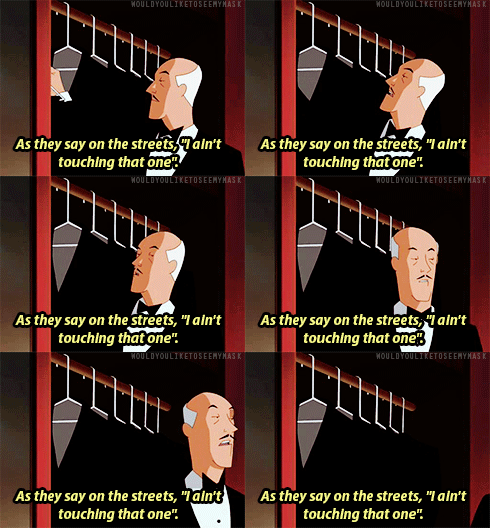
holland-hayes: Presented without explanation. Jeeves and...


holland-hayes:

Presented without explanation.

Jeeves and Wooster needs no explanation.

11 Sep 17:05

wilwheaton: (via Reddit)


wilwheaton:

(via Reddit)

11 Sep 17:04

sonofkite: Alfred is the best


sonofkite:

Alfred is the best

11 Sep 17:03

GTA V vs GTA IV (Small Black) Map GTA has always been my...


GTA V vs GTA IV (Small Black) Map

GTA has always been my favorite hyperreality.

Edit: The scale may not be exact but if you compare the airports it’s close.

11 Sep 17:00

paratactician: As a minor point, I don’t know why wine tasting always gets held up as the ne plus...

paratactician:

As a minor point, I don’t know why wine tasting always gets held up as the ne plus ultra of pretentious critical gibberish. It’s nowhere near as bad as whisky tasting. I freely admit that I’m a whisky novice, barely beyond the stage of ‘ah yes, this whisky tastes… different from that whisky’, but here are the enclosed tasting notes with Ardbeg 10-year-old Islay, a bottle of which my friend brought round to share with me:

'NOSE: A burst of peat infused with zesty lime, wrapped in dark chocolate. Bold menthol slides through tarry ropes. Savour smoked fish, crispy bacon, green bell peppers and pear juice. With water, comes cool seaspray on chalky cliffs. Beeswax and pine woodlands follow, while toasted vanilla simmers.'

This is the nose. At this stage you haven’t even tasted it. You’re just sniffing the glass. Obviously I thought it smelt of whisky, but with the best will in the world, green bell peppers? Can something smell of menthol, fish, and bacon at the same time? Do the cliffs absolutely have to be chalky? According to the leaflet, if my friend had shelled out on the Ardbeg Uigeadail, I’d have been picking up ‘flowering currants and a well-fired fruit pudding’. I mean, thank God, I can’t stand those cheap whiskies which smell of insufficiently-fired fruit pudding.

11 Sep 16:30

motolady: A pair of smokin’ dames on their motorbikes in...


motolady:

A pair of smokin’ dames on their motorbikes in Britain, 1930s. Photographs of women motorcyclists from this time period always fascinate me; society norms changing quickly through the early 1900s allowed women to exercise and enjoy some new freedoms. Can you imagine wearing a corset on a motorcycle? 

Original photo source unknown, though I suspect it’s from historial archives.

[ more from the 1930s ]

11 Sep 16:29

RaspyFi – a distro for music lovers

by liz

RaspyFi was brought to our attention a few days ago: it’s a distro designed especially for those with big media libraries who are using their Pis to listen to music. If you’re one of those people (I am, and I’m chuffed to bits to find RaspyFi), or an honest-to-god audiophile, you may have noticed that other media centre distros have been built to prioritise video rather than music, and don’t necessarily support all the formats your collection might be made up of; or give you the fine degree of control you want over volume and playback. And if you want to stream music wirelessly to other devices on your network, you’ll have to do a little more work with a traditional Raspberry Pi media centre (I can’t believe I’m saying “traditional” about a device that’s only been on the market for 18 months) to get everything working.

So RaspyFi has been engineered to address those issues. Apple AirPlay works out of the box, so you can stream to other devices without any extra work. The distro supports a large number of external USB DACs (there is a pleasingly lengthy list on the project website) and asynchronous playback, so you can use your other amplifiers and DACs instead of the one that’s onboard the Pi – which, let’s face it, wasn’t built for audiophiles.

The UI is really slick, and offers you a web interface you can use to control all your devices, so you can get to local or streamed content from your desktop, phone or tablet. I’ve been enjoying it so far: it’s intuitive, I can play music on any networked device with a web interface without having to install anything, and AirPlay just works - which is very pleasing.

Have a look for yourself. You can download RaspyFi (currently v1.0) from the project website. Documentation, help and tutorials are all available too – let us know what you think!

11 Sep 16:29

niknak79: Angry birds (real-life edition)


niknak79:

Angry birds (real-life edition)

11 Sep 15:35

[toread] [priv] Feds Abused Anti-Terrorism Database To Track Chelsea Manning Supporter, Seize His Computer goo.gl/fb/MlNBu

by macdrifter
11 Sep 05:23

Americans Use The Internet To Abandon Adopted Children

Through Yahoo and Facebook groups, parents and others advertise the unwanted children and then pass them to strangers with little or no government scrutiny.
11 Sep 00:51

Photo


11 Sep 00:50

paving the way for all of us to throw like a girl. [story] h/t...

firehose

she had two handoffs and did not throw a pass in 2012
meanwhile, in North Adams, a 14-year-old is trying to make varsity left guard or tackle, aka blind-side offensive line: http://www.thetranscript.com/localsports/ci_23914706/mccann-tech-freshman-working-earn-roster-spot-football


paving the way for all of us to throw like a girl. [story]

h/t to apsies

11 Sep 00:47

phdebaecque: If you flip a photo of bats hanging upside down,...


phdebaecque:

If you flip a photo of bats hanging upside down, they look like they’re having a wicked dance-off.

11 Sep 00:47

The Drumcats Will Put Your Drum Line Routine to Shame

Submitted by: Unknown

Tagged: Music , drumming , drum line , BAMF , Video , g rated , win
11 Sep 00:45

A dearth of investment in young workers

by Tyler Cowen

Here is my latest New York Times column, excerpt:

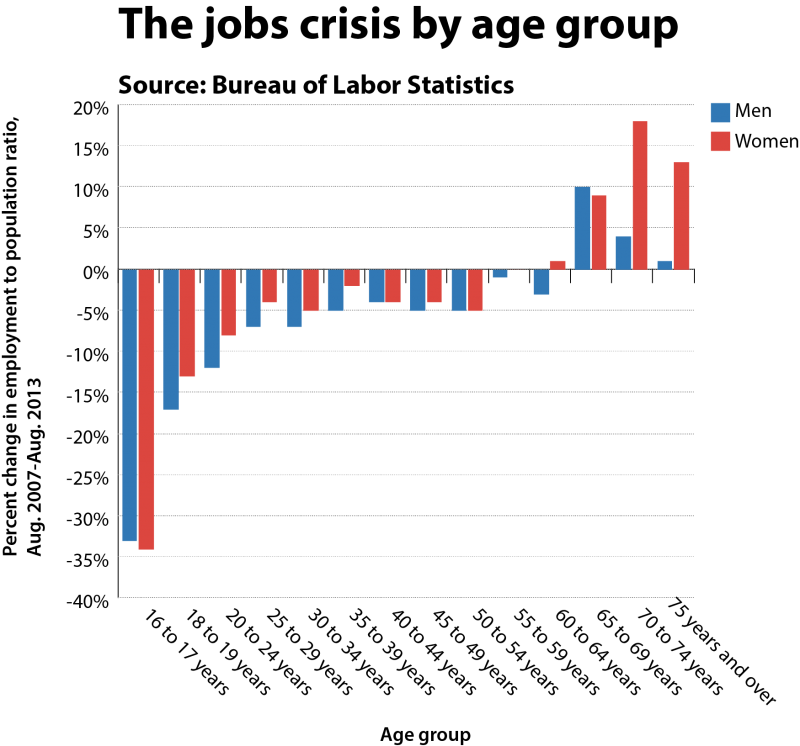
For Americans aged 16 to 24 who aren’t enrolled in school, the employment picture is grim. Only 36 percent are working full time, down 10 percentage points from 2007. Longer term, the overall labor-force participation rate for that age group has dropped 20 percentage points for men and 14 points for women since 1989.

This lack of jobs will damage the long-term careers of a big chunk of the next working generation. Not working after you finish school very often means missing out on developing the skills and habits that will serve you well later on. The current employment numbers are therefore like a telescope into the future labor market: a 23-year-old who is working part time as a dog walker, yoga instructor or retail clerk may be having fun, but perhaps will receive fewer promotions as a 47-year-old.

And:

Employers appear to be more risk-averse, more concerned about overhead costs and less willing to invest in developing young workers’ skills. And that seems true across a wide variety of sectors.

In the legal profession, for instance, there is less interest in hiring junior associates and grooming them for partner status. Colleges and universities are often more interested in hiring adjuncts than tenure-track young faculty members. And publishing houses, instead of providing a big advance upfront and investing in young authors over a series of books, now expect many writers to earn their share of a book’s revenue through royalties.

There are further relevant points in the article.  And here is an FT article about more and more young British people living at home.

Here is a compelling visual from Wonkbook:

jobs_crisis_by_age_take_2-800x746


11 Sep 00:44

Whiskey Cinnamon Rolls

by elsiecake
firehose

FUCKSHIT

DO IT TO ME

Whiskey cinnamon rolls abeautifulmess.comWhiskey cinnamon rolls. That's kind of weird idea huh? There's this cook book out there called Booze Cakes that I keep picking up when I see it at the book store. But I haven't bought it. Yet. It's only a matter of time. I'm not a big collector of things, that's more my sister's department. But if there's one thing I do collect, it's cook books. I have a LOT. And I have no intention of slowing down. I love cooking, so the more recipes and technique tips I surround myself with the better, I say. Plus I LOVE food photography. It's just plain fun.Best cinnamon rolls! abeautifulmess.comAnyway, booze cakes. Sounds divine. So then I started thinking about what else might taste better with booze. I started dreaming about cinnamon rolls. And thus, whiskey cinnamon rolls where born. And by "born" I mean baked. :)The best cinnamon rollsWhiskey Cinnamon rolls, makes 12. Adapted from American Cooking

2 1/4 teaspoon (1 package) active dry yeast
1/4 cup warm water
1/3 cup + a pinch of sugar
1 teaspoon salt
1/4 cup softened butter
1 cup hot milk
1 egg
3 cups + 2 tablespoons all purpose flour

First, stir together the warm water plus a pinch of sugar. Stir the yeast into the water and allow this to sit and bubble for a 5-8 minutes. It should start to look foamy.

In a large bowl, or in the bowl of your stand mixer, combine the sugar, salt, butter and milk. You can heat the milk on the stove top or in the microwave, you just want it hot enough so it continues to melt the butter. Stir everything together and then allow to cool to room temperature. Stir in the egg (if your mixture is still warm you can temper the egg first with some of the mixture). Stir in the flour, 1 cup at a time until a very soft dough forms. Continue to knead for a few minutes. The dough should be very soft but should hold together. If it doesn't hold together add another tablespoon of flour. Now place the dough in a lightly oiled bowl, cover and allow to rise in a warm, draft-free spot for 1 to 1 1/2 hours (until doubled in size).Whiskey cinnamon rollsTurn the dough out on a floured surface and roll out into a long rectangle. Melt 3 tablespoons of butter and brush the butter all over the dough. Sprinkle on 1/3 cup sugar + 1 tablespoon cinnamon. Roll up, like a jelly roll, and slice into 12 pieces. Place the rolls in a lightly buttered pan and bake at 350°F for 25-27 minutes until the edges are brown. 

For the glaze, whisk together 3 tablespoons milk, 1 tablespoon whiskey, 1/4 teaspoon vanilla extract and 2 cups powdered sugar. Pour the glaze over the warm cinnamon rolls.Homemade cinnamon rolls abeautifulmess.comAs you can see, most of the whiskey flavor is in the glaze. So if you're not a booze person simply replace the whiskey with an additional tablespoon of milk and you'll just have really good, classic cinnamon rolls. Like, I mentioned above, this dough is quite soft and can be a little bit of a pain to work with while you are forming the rolls. But I love how moist the final cinnamon rolls are, so it's worth it. To me. Make them yourself and see what you think. :) xo. Emma

11 Sep 00:42

Машина для убийства

11 Sep 00:24

Let's Make a Deal

by Goldy

I don't really care who gets the credit, or how it came about, but if Syria manages to avoid a US military strike by agreeing to hand over its chemical weapons to international control, can't we all agree that this is a good thing?

I mean, that would actually accomplish something positive, right? Prevent future use of these weapons. Whereas the type of strike we are contemplating—maybe a dozen or so cruise missiles—was never intended to be anything more than a symbolic gesture (that is, if you consider killing people to be mere symbolism).

And, everybody gets to claim victory! The Russians get to crow over a big diplomatic win, while the Obama administration gets to claim that it was only the threat of military intervention that forced the Syrian concession. And oh yeah. The Syrian people. The get neither blown up by us, nor gassed by their own government. Yay!

I suppose if your sole objective is retribution, then bummer. But otherwise, it looks like a great deal.

[ Subscribe to the comments on this story ]

11 Sep 00:14

Cheap iPhone? Hardly. Apple’s price range is still just as narrow

by Ritchie King
​

Apple just announced the release of two new iPhones: the high-end 5S and stripped-down 5C.

Many expected the 5C would be Apple’s attempt to broaden its reach into lower-end markets, but the so-called “cheap iPhone” isn’t actually cheap. Its price without a wireless contract (that is, unsubsidized) starts at $549 in the United States, which is what the iPhone 4S used to cost. And nobody called the 4S cheap.

The range of prices at which you can buy a new iPhone in the US remains unchanged from before the announcement, and it has actually been broader in the past. The same is more-or-less true in China, one market where the 5C was supposed to make a big splash. It may still do so, but not by being inexpensive.


11 Sep 00:09

American Voices: Syria Says It Will Give Up Chemical Weapons

firehose

“I’m the same way. It’s like, get the chocolate out of the house, otherwise I’ll be too tempted to eat it.”

Accepting a plan put forth by Russia, the Syrian government has reportedly agreed to relinquish its stockpile of chemical weapons in an effort to avoid a military strike by the United States.


11 Sep 00:05

Syria Explained Like A Game Of 'Civilization'

firehose

reddit is for redditors

Ashurbanipal has been playing all wrong, now it's really starting to show in the late game.
10 Sep 23:53

Anthony Bourdain: Parts Unknown Remixed by Eclectic Method

by Rusty Blazenhoff
10 Sep 23:51

Music: Newswire: Teaching babies to DJ is a real thing in Brooklyn

by Marah Eakin
firehose

stupid fucking New York

Thanks to Baby DJ School—which, yes, is a real thing—bored and/or musically inclined infants can now learn to drop beats and mix things that aren’t spit and milk. The eight-week program takes place at a venue in Crown Heights, Brooklyn (naturally) and is designed for babies age 3 and under who are really into vinyl.

The class is taught by Natalie Elizabeth Weiss, a DJ who’s worked with acts like LCD Soundsystem, Das Racist, and the especially baby-friendly Butthole Surfers. It focuses on teaching “little ones” how to play and handle records, mix and match beats, and create samples on their very own DJ equipment. While all this might seem a little dubious—because, you know, motor skills—Weiss insists that “through singing, movement, and interactive technology,” children can delve into “an exciting new musical landscape” that substitutes “a song about back beats” for “a ...

Read more