firehose'cultural commentator Kevin Smith'
ugh
Screenwriter and cultural commentator Kevin Smith has declared his support for content creators on YouTube, who are currently facing a barrage of copyright notices that threaten their livelihood.
Speaking on George Stroumboulopoulos Tonight in Canada, the writer of Clerks, Chasing Amy and Dogma said that creators ought to be allowed to use game assets to make new content. In the past week, YouTube has issued thousands of copyright notices to video makers, often generated by music companies seeking to secure advertising revenues from the shows' popularity.
Some games companies are also seeking revenues from video shows, sometimes known as Let's Plays, while others are keen for the shows to continue.
"On YouTube they are starting to cull all these video game clips," he said. "YouTube are starting to pull back on the freedom of expression that people have been enjoying. Now video game companies are jumping into the fray on behalf of the kids [content creators] saying, let them run these clips. Let them have fun. These kids are not hurting anyone."
You can follow Polygon's coverage of the YouTube Let's Play crackdown on our Story Stream.

firehosegarnish challenge beat
Two researchers at York University have worked out a way to communicate between two points using vodka evaporated into the air. They used their system to message the lyrics of “O Canada” between two points, leading them to conclude that in times of need, when there is no cellular reception, it would be possible to text-message using this system.
The authors of the paper, published Thursday, used specific concentration levels of the vodka to represent bits 1 and 0. They wafted the “message” across 12 feet in the lab to the receiving unit, which read out the message as it detected the concentration of vodka in the air rising or falling over time.
The process sounds slow and short-range, but the researchers suggest that it could work for closed environments that don’t have the benefit of a cellular or Wi-Fi signal. They cite the example of the clogged London sewer system as one where robots could have been deployed below ground and have relayed their findings via the molecular communication system.
Read 1 remaining paragraphs | Comments

    
|
firehoseroflcry
The American company that supplies the Predator and Reaper drones used to assassinate insurgents in Afghanistan and elsewhere has complained to a committee of MPs about the image problem of such weapons.
General Atomics Aeronautical Systems, which also manufactures the Avenger and Gray Eagle unmanned aircraft, says the word drone has "pejorative connotations".
In a written submission to the defence select committee inquiry into remote-controlled warfare, the company says the term drone is misleading because it "belies their proven beneficial role in humanitarian crises".
image by Mark
firehoseugh ugh ugh
leave T-Mo alone
http://www.crewmagazine.com/wp-content/uploads/2013/03/leave-britney-alone.gif
Days after Sprint was revealed to be considering a purchase of T-Mobile US, satellite provider Dish Network is reportedly thinking about making a bid of its own.
A potential Sprint/T-Mobile merger would leave the US with just three major cellular carriers and would be heavily scrutinized by the Department of Justice and the Federal Communications Commission. A Dish purchase of T-Mobile would maintain the status quo of four major nationwide carriers and would perhaps be more palatable to antitrust authorities.
Dish's potential bid was reported by Reuters last night, citing "people close to the matter."
Read 3 remaining paragraphs | Comments

|
|
firehose:/
The effort to turn CyanogenMod into the next big mobile operating system just got a big new vote of confidence. The company announced today that it has raised an additional $23 million, led by Andreessen Horowitz, to add staff and improve its distribution around the world. The series B round, which comes on top of $7 million that the company closed in April, shows that investors are betting the world is clamoring for a different take on Android. “Mobile has really just begun,” says Kirt McMaster, Cyanogen’s CEO. “Apple, Google, and Samsung have not won. Although it seems like they’ve won, it’s still early days.”
There’s some data to back up the big talk: CyanogenMod now has 11 million active users, up from 8 million in September, and that counts only those who have elected to share data with the company. The true number of CyanogenMod users is already in the tens of millions, says Andreessen partner Peter Levine — and that’s despite some significant distribution challenges. One guide for installing CyanogenMod on your Android smartphone lists 23 steps; the company released a one-click installer this fall, but was forced to remove the companion app from the Google Play store after Google said it violated the store’s terms of service. Licensing issues also mean that a freshly installed Cyanogen ROM doesn’t come with Google apps or the Play Store — users typically have to search online forums for links to those apps and install them via PC. These are all significant hurdles to mainstream adoption.
Cyanogen now has 11 million monthly active users
So where’s all the growth coming from? Initially, Cyanogen’s custom ROM found favor with hobbyists in the United States and abroad who preferred it to the often bloated versions of Android promulgated by carriers. The ROM strips Android down to a near-stock version while customizing it with a new camera app, secure messaging, and access to thousands of themes. It has also proven a godsend to owners of older devices that are abandoned by their carriers.
But Cyanogen has also found favor with Chinese smartphone manufacturers. Xiaomi’s MiUI operating system is based on Cyanogen, for example, and Oppo’s N1 is shipping with CyanogenMod preinstalled. Emerging markets have begun to embrace it as well, particularly in India, where merchants are flashing used smartphones with the latest version of Cyanogen and reselling the devices. And it has begun to announce its first device partnerships, where Cyanogen is preinstalled on the phone.
The task now is to make Cyanogen more appealing to the mainstream. “We have to figure out a way to cross the chasm and get into the mass market,” McMaster says. “For that to happen, we have to do some things that are different.” Late next year, Cyanogen plans to unveil a new consumer brand. Among other things, it will be easier to say than “cyanogen.” The company is also working on what McMaster calls “signature experiences” — features no other operating system can offer. (The company won’t say what it’s working on, but the offerings will include “some things that scream out, like, ‘Fuck yeah,’ that’s really awesome,’” McMaster says.)
An installer that personalizes your phone
And while some see the Cyanogen installer as a hurdle to adoption, McMaster sees it as a potential benefit. The installer can evolve into software that personalizes your phone the moment it updates your firmware, so that when it restarts your device will be populated with custom wallpaper and apps you are likely to enjoy. But McMaster is likely understating the challenge: replacing a phone’s firmware can be difficult and risky. The reason Google wanted the Cyanogen installer app out of the Play Store is that installing it can void the warranty of many smartphones — something most mainstream users would rather not risk.
Now McMaster will begin rapidly expanding his team of 20, which is split between Seattle and Palo Alto. He plans to hire between 40 and 50 people over the next nine months — “enough to start doing some real damage,” he says." He says he is also confident that the one-click installer will return to the Google Play store; he has been in contact with Google to begin discussions.
And if investors are worried about the company’s relationships with Google, they’re not showing it: previous Cyanogen investors including Benchmark Capital and Redpoint Ventures also invested in this round, as did Chinese tech giant Tencent. In a blog post accompanying the announcement, Levine likens Cyanogen to Linux Red Hat or Windows — operating systems that thrived by being independent of hardware. “Software is eating the world, Android is eating mobile, and we think Cyanogen only just finished their appetizer and is moving onto the entree,” he says. But Red Hat may be a telling example — consumers’ appetite for it never matched its makers’ ambitions, and it ultimately pivoted into an enterprise offering. If Cyanogen doesn’t become easier to use, that entrée may prove to be out of reach.
firehoseupdate
Montreal Gazette |
Michigan man to face murder trial in shooting of woman on his porch Los Angeles Times A Michigan homeowner will stand trial on murder charges in the shooting of an unarmed, intoxicated young woman on the porch of his house, a judge in Dearborn Heights, Mich., ruled Thursday. Judge David D. Turfe said there was enough evidence to ... Homeowner to Stand Trial in Porch KillingNew York Times Detroit homeowner to be tried for shooting of Renisha McBrideBBC News Michigan man charged in porch shooting will face trialReuters CBS News -Inside Bay Area -Sky News all 270 news articles » |
firehosePhil Noto beat
firehoseM-E-T-H-O-DIST MAN
Washington Post |
Methodists defrock pastor who performed gay son's wedding USA TODAY NORRISTOWN, Pa. (AP) — United Methodist church officials defrocked a pastor from central Pennsylvania on Thursday who officiated his son's gay wedding in Massachusetts, a move seen as contradictory to the denomination's beliefs. The Rev. Methodist minister defrocked after officiating at son's gay marriageLos Angeles Times Methodist minister defrocked for officiating son's gay weddingNew York Daily News Defrocked Pa. pastor 'in shock,' will appealWTVM Bustle -WEMU -Morning Sentinel all 233 news articles » |
firehosetl;dr: Don't even bother unless you're speccing to at least $5,200, where the hardware lines up with prebuilt competitors from HP and Dell--unless you need multiple processors, which the Mac Pro no longer supports.
The only advantages are
- OS X, for those who need it. That's less of an advantage in pro media now considering that cross-platform Premiere Pro has leapfrogged FCPX and, for the most part, cross-platform Avid, and cross-platform audio software is mature to the point that Pro Tools isn't worth it. The legacy PCIe hardware peripherals built for OS X like ingest and high-speed storage devices aren't compatible anymore, and there's no Thunderbolt replacements.
- AppleCare.

Apple's new Mac Pro has gone live on Apple's online store, and the first orders will begin to arrive on December 30—just barely sliding, Indiana Jones-style, under the door of the company's self-imposed December deadline. We knew the starting prices for the two base Mac Pro configurations, but we weren't sure how much the various CPU, GPU, and other component upgrades would run. Now we know.
Unlike most of the other Macs, your upgrade options for the "low-end" $2,999 Mac Pro aren't artificially limited to encourage upgrades to the higher-end $3,999 model (for example, you can't upgrade the CPU in the $1,299 or $1,799 iMac base models—those upgrades are only available to the $1,499 and $1,999 SKUs). So, starting from $2,999, how much does each individual component upgrade cost? Let's break it down.
The upgrades add up to a whopping $9,599 if you max out each one, though Apple Education and Apple Business customers will be able to get it for less than this—the Apple Education pricing for the same machine is a mere $8,739. This is the pricing for the tower only, and you can spend quite a bit more on peripherals if you have a mind to. Adding an AppleCare three-year warranty to the machine (recommended if you're going to drop multiple thousands of dollars on a workstation) costs another $249. You might also consider a keyboard ($49 wired, $69 wireless), a mouse ($49 wired, $69 for either a Magic Mouse or Magic Trackpad), and a display or three while you're at it ($999 for an Apple Thunderbolt display, $3,595 for that Sharp 4K display we noticed last week). External Thunderbolt 2 storage is another pricey add-on if you need it—Apple will sell you Promise Pegasus2 storage arrays starting at $1,499 for 8TB.
Read 10 remaining paragraphs | Comments

|
|
firehose'a refurbished 2006 ThinkPad X60'
like a microcosm of the entire FOSS community


Read more of this story at Slashdot.

firehosevia saucie otters
I told you so!!!
With the onslaught of holiday parties upon us, a bad case of the sniffles could threaten your merrymaking. Luckily science has swooped in with the jolliest solution of all: You can boost your immune system, a new study claims, by drinking that spiked eggnog.
The moderate drinkers demonstrated an enhanced immune response—better even than the teetotaling control group.A team of researchers from Oregon Health & Science University trained twelve rhesus macaques—chosen for the similarity between their immune system and ours—to drink a 4-percent-ethanol cocktail. They vaccinated the monkeys against small pox and divided them into two groups: one that had access to the cocktails and one to sugar water. (Both groups were also given food and regular water.)
Over the course of the 14 month study, the researchers found that the monkeys in the booze cage drank varying amounts—some got stewed all day, clocking blood ethanol concentrations higher than .08, while others kept their intake moderate, between .02 and .04. “Like humans,” lead author Ilhem Messaoudi said, “rhesus macaques showed highly variable drinking behavior.”
After drinking for seven months, the macaques received another booster shot, and their reactions were remarkably different. The immune systems of the bad monkeys that drank too much failed to produce the antibodies the body usually makes in response to a vaccine. The moderate drinkers, on the other hand, demonstrated an enhanced immune response—better even than the teetotaling control group.
Gamespot’s response to the backlash that they, and the game’s reviewer Carolyn Petit, got for their review of GTAV
This is just perfect.Gamespot just earned a shit ton of respect from me.
I don’t think I’ve seen a site as large as Gamespot actually say “Fuck you” to one of its users before. It was kind of appropriate here.
It’s disturbing the amount of video game critics I’ve recently seen retire or publicly distance themselves from the artform purely because of the awful elements amongst the fanbase.
Of course, this isn’t completely exclusive to the video game world. Take, for example, the movie reviewer who got death threats because he “ruined” Toy Story 3's Rotten Tomatoes score.
Once again, this all goes back to our On Demand culture. With news media programmed not to inform but rather to tell people what they want to hear and niche online communities designed to insulate people from ever hearing opinions different than their own, is it any wonder why folks no longer understand the actual definition of what a “critic” does?
Audiences ruin entertainment.
Holy shit. This is damn near masterful.
On top of the problem detailed above, about people getting used to being told what they already think (and responding to those holding different views with intense vitriol), is the one of many Media Makers coddling, ignoring or currying favor with the portion of their audience that does this. They might have a sense it’s their largest demographic, or because of their loud voice think they’re the bulk of their audience, or just feel unequipped to deal. The reasons are many, complex.
But the problem with supporting–possibly through inaction–that portion of an audience is that it makes the space you’re creating around your media unsafe for others with less severe opinions, less violent reactions, or those who are simply interested in looking at media/the world critically.
It’s great to see an arm of an entity as large as GameSpot directly confront what’s widely considered the standard attitude of “gamer culture” (which, yeah, reductive): angry, entitled, reactive. And it’s great to see them trying to clear a path so the community–and by their hopeful prediction, the industry–can grow. It’s a clear statement of critical intent, of what this part of GameSpot, at least, thinks games are for, and takes a good first step towards creating a safe space for people who want to engage with games as a medium of massive cultural impact (which is a group I’d like to think, though maybe I’m totally off on this, is larger than the group of loudmouth bloatbags).
Moral: it’s ok to not want shit heads in your audience.
Bravo.
Don’t even play video games, but this is an amazing call-out to the industry that actively dissuades me from even bothering with video games.
Completely warranted response.
I have to say that 9 out of 10 is really generous though, but it IS my pleasantly modulated opinion, and not vitriol.
Beautifully crafted response to what is a rampant problem in the community. I’m 100% on board with Rockstar having lost their grip on writing female characters. They can do it. I know they can. It is actually pretty damn lazy of them not to.
Also, the game is hardly 9/10.
It’s a 7 or an 8. Very well done, but with glaring issues that are swept under the rug because it is a well known game. I love V, but I also have come to expect quality from Rockstar. Were this a piece a student handed in to me for class I would have written at the top, “Talent does not equal results. Sweat a little next time.”
Good for you, Gamespot.
Also: this game came out this year? It already looks outdated. The character graphics in particular look like ass. 9 out of 10 was too generous.
In-game might look better but none of the graphics I’ve seen look like they came out of a more advanced engine than Indiana Jones and the Emperor’s Tomb in 2003. (STILL MY FAVORITE GAME OF ALL TIME AND I’M GONNA FUCKING BEAT IT SOME DAY. That goddamn kraken >:()
Yesterday A&E was dismayed to discover that Duck Dynasty patriarch Phil Robertson had espoused the sort of ignorance it had hoped would remain safely locked away somewhere, in the surely hours upon hours of unused footage left after producers cut around him espousing the fun kind of ignorance, which A&E has ridden to such ratings success. But in light of Robertson’s views on the unholy illogicality of gays and buttholes, of which A&E now realizes it was largely aware, the network has been forced to suspend Robertson indefinitely from the show. “We are extremely disappointed to have read Phil Robertson's comments in GQ, which are based on his own personal beliefs and are not reflected in the series Duck Dynasty,” said the network, which has prided itself on always taking care to ensure its hit show only reflects the kind of backwardness that doesn’t draw the ...
The two jailed members of Pussy Riot are due to be released from prison. Nadezhda Tolokonnikova and Maria Alyokhina will be freed as part of an amnesty bill that will also see 25,000 Russian prisoners let go in anticipation of the 2014 Sochi Olympics. There’s no timeline yet for the duo’s release, but a lawyer for the two women says she expects it to be a swift release. Tolokonnikova and Alyokhina were both given two-year sentences for staging a musical protest at Moscow’s Cathedral of Christ the Savior and, in recent months, had become a cause célèbre for everyone from Madonna to Paul McCartney.
In a press conference, Russian President Vladimir Putin said he’s not sorry that the members of Pussy Riot ended up behind bars, saying that he was “sorry that they were engaged in such disgraceful behavior,” which he maintains “was degrading to the dignity of women.”
...firehosegreat
Jeff Zucker—the former NBC president who oversaw the Leno-vs,-Conan debacle in 2009, and subsequently ran his network into the ground—now has a new job, running CNN into the ground. To that end, he wants to revisit the glory days of The Jay Leno Show by offering a spot on his current network to the outgoing Tonight Show host.
It's unclear what role Leno would take as a CNN employee, though it's possible he'll read comically inaccurate headlines on the air nightly, a job currently held by Wolf Blitzer. It's also worth noting that Leno also has as many as nine other potential suitors, including Core Media Group (which produces American Idol, among other things), another former NBC chief, Jeff Gaspin, and even current NBC/Kabletown chairman Bob Greenblatt. To Leno's credit, however, he's refused to consider any of these offers until he officially re-retires from Tonight on February ...
firehose"The challenge for the creative team of her new book — c0-writers Amanda Conner and Jimmy Palmiotti and artist Chad Hardin — then is to somehow find a happy medium between the former all-ages recovering Joker moll and the sexed-up, maniacal killer from the T+-rated New 52 Suicide Squad for a rated-T-for-Teen ongoing in which she’s to be a sympathetic protagonist. After an interesting, attention-getting start in Harley Quinn #0, in which a fourth wall-breaking Harley discussed who should draw her upcoming series with the disembodied voices of the writers while an all-star jam cast of artists drew a page a piece, their strategy becomes apparent in this, the first official issue of the new series: They plan on making her DC’s Deadpool.
...
The mode then is ultra-violent slapstick, a character who operates on cartoon logic in the “real” world, unconcerned that those she interacts with aren’t themselves cartoon characters. Think DC’s Lobo, particularly during his 1990s heyday, or, more recently and relevantly, Marvel’s Deadpool.
...
The humor is all rather forced by the plot and scripting rather than emerging organically from the character’s dialogue (the way Tom Taylor’s Harley is funny in the Injustice comic, for example), but I suppose a mediocre comic with a bad sense of humor is better than a mediocre comic (or a bad one) with no sense of humor.
...
It’s not a very good comic book, but I’m fairly certain it will be a very popular one."
After all the virtual public flogging National Security Agency leaker Edward Snowden has received, in the past week a few voices have suggested cutting him some slack.
At a Tuesday closed-door meeting with tech leaders, one unnamed participant suggested to Obama that Snowden be pardoned; Obama said he couldn't do that. During a 60 Minutes report on the leaks that aired Sunday, though, even an NSA official suggested it might be worth discussing amnesty—if and only if he returns the leaked documents securely, almost surely an impossibility at this point. (CBS news has been busy defending itself against accusations that Sunday's show was a "puff piece.")
Even that tiny, tentative olive branch seems to have crossed a line for security hawks. NSA Director Gen. Keith Alexander dismissed the idea, comparing Snowden to "a hostage taker taking 50 people hostage, shooting 10, and then say[ing], 'You give me full amnesty and I'll let the other 40 go.'"
Read 3 remaining paragraphs | Comments

|
|
BitTorrent, Inc. is developing a serverless instant messaging system that relies on public key encryption to protect the privacy of communications, identifying users not with traditional usernames but with cryptographic key pairs.
The company, which develops the BitTorrent peer-to-peer protocol as well as the BitTorrent and μTorrent file sharing software, announced the forthcoming chat software in September and revealed some details on how it will work in a blog post today. It reads:
With BitTorrent Chat, there aren’t any “usernames” per se. You don’t login in the classic sense. Instead, your identity is a cryptographic key pair. To everyone on the BitTorrent Chat network at large, you ARE your public key. This means that, if you want, you can use Chat without telling anyone who you are. Two users only need to exchange each other’s public keys to be able to chat.
Using public key encryption provides us with a number of benefits. The most obvious is the ability to encrypt messages to your sender using your private key and their public key. But in public key encryption, if someone gains access to your private key, all of your past (and future) messages could be decrypted and read. In Chat, we are implementing forward secrecy. Every time you begin a conversation with one of your contacts, a temporary encryption key will be generated. Using each of your keypairs, this key will be generated for this one conversation and that conversation only, and then deleted forever.
Underlying this system is a Distributed Hash Table (DHT) which finds IP addresses, removing the need for a central server to route messages, the company explained.
Read 5 remaining paragraphs | Comments

|
|

Patrick Stewart and Ian McKellan sit on Santa’s lap at Macy’s Santaland in New York City in this delightful photo tweeted by Stewart.
image via Patrick Stewart
firehose'Design is basically high-res censorship. ... Every decision to publish is also a decision to frame a message. And design is, however minimalist or baroque it is, often a decision not to do something, to leave something else out. What else is that than high-resolution censorship?'
Metahaven is a graphic design collective based in Amsterdam, Netherlands. Since its launch in 2007, the team — led by Daniel Van der Velden and Vinca Kruk — has pursued collaborations with organizations that traditionally don't seek out graphic design as a platform or medium. Examples include the whistleblower platform WikiLeaks, the Icelandic Modern Media Institute (IMMI), and the diplomatic advisory group Independent Diplomat.
An interdisciplinary group of writers, editors, critics, and curators, the collective has been able to expand upon the foundation of designer as form-maker and break free from the traditional confines of the studio. Its avant-garde aesthetics and intellectual approaches have lead to exhibitions at the Walker Art Center, the Cooper-Hewitt National Design Museum, and the Museum of Modern Art in New York. Metahaven has also written extensively about the internet as a political and creative space — anyone interested is encouraged to check out the book Uncorporate Identity.
Metahaven's latest work, Black Transparency, is a short film that incorporates graphic design to make a statement about "collectivity and togetherness" in a police state, according to the group. "Many people are starting to understand that the structures which claim to serve them have turned against them."
Verge Exclusive: Metahaven, Black Transparency (videogram), 2013. Video. Co-produced with Bureau Europa.
Can you explain the work you created for WikiLeaks? How did that work differ from traditional brand-identity work?
Our initial work for WikiLeaks aimed at an overhaul of their visual presence as a matter of graphic design. We were interested in WikiLeaks as a somewhat anonymous, opaque organization publishing leaked documents — and causing great upheaval because powerful others, governments and corporations, didn’t want those documents out in the world. At the time, Julian Assange didn’t have a lot of celebrity status. He did make public appearances though, and these were mired in mystery and controversy, even as fashion statements. He addressed a freedom-of-speech working group of the European Union wearing an Icelandic sweater.
To us, all this seemed to be about reinventing what an organization is. We reasoned that obliviousness to celebrity, while doing such important work, contained a great possibility for graphic design. The WikiLeaks logo, of which we discovered the original designer, could be expanded into an ecosystem which would reflect the site’s multijurisdictional hosting model. That is a complex way of saying that WikiLeaks was hosted in many countries to make it uncensorable, and the identity should reflect that.

Metahaven, WikiLeaks Identity (unrealized proposal), 2010.
In the end, we never made a complete rebranding of WikiLeaks. When meeting with them we found out we couldn't do anything with their identity. They wanted to shape their graphic relationship to the world through products; the non-designed nature of the WikiLeaks web site is an example of their minimized reliance on external parties.

Metahaven, WikiLeaks scarves, 2011. Photo by Meinke Klein.
What sort of products did you design for WikiLeaks?
We primarily made scarves and T-shirts. Scarves came up as a way to make something about WikiLeaks without even touching their “identity.” Scarves are in some sense wearable flags; they can be used to conceal as well as reveal the body and the face.
What are your thoughts on the activities of WikiLeaks? Has their work affected how we view and understand information?
In a post-Snowden era, it's important to remember that although Collateral Murder is now three years behind us, WikiLeaks is where our new model for involuntary transparency began. That is, transparency that stems from leaks and not from government or corporate "transparency programs." It is impossible to even imagine our contemporary understanding of such transparency without WikiLeaks. It has sparked a movement. It can't be undone.
How have the actions of Edward Snowden changed the story of WikiLeaks in your mind?
Edward Snowden's actions are a continuation of the WikiLeaks story. The slightly problematic part of this story is the role of Russia. None of the EU countries and not even Iceland or Norway were prepared to do anything at all for Snowden, so he ended up in the only jurisdiction within reach that wanted him. On Snowden's part, staying in Russia is in his direct self-interest. It is very hard to believe that any genuine ethical concern has motivated the asylum offer. For Russia it is a means, not an end; it shows the country's cunning ability to sail the geopolitical trade winds "just because it can." Other examples are Putin's New York Times letter to President Obama, the state-owned English-language channel RT which hosted Assange's show; and more. Yet this is also the country that ruthlessly persecutes its own whistleblowers, incarcerates Pussy Riot in a prison in Siberia, and sides with Syria's Assad government. An even more stunning contradiction however is that the same Assad has an Instagram account — as Independent Diplomat's Carne Ross alerted us.

Metahaven in collaboration with IMMI: Data / Saga, 2013.
How has surveillance and transparency affected the design process both for yourselves and in general?
Design is basically high-res censorship.
Please explain.
This is a bit of a provocation, obviously.
Design is coming from the decision to publish something, wherever that may be. Every decision to publish is also a decision to frame a message. And design is, however minimalist or baroque it is, often a decision not to do something, to leave something else out. What else is that than high-resolution censorship?
Artwork above: Metahaven, Sheikh Al-Skype, 2013. Nomadic Data Center. Co-produced with Bureau Europa. (e-flux journal)
firehosevia Osiasjota
at least he didn't land in Amercia
This comic took me seven months to write and draw, I hope it takes you just as long to read.
firehosevia saucie
“I love that people are putting so much effort into teaching others to code in a way that is fun and relatively easy,” he wrote via email. “However, [the free tools] will never work as catch-all solutions. Programmers are problem solvers, and you don’t learn how to be a programmer until you start solving some problems.”
that is good
'Like Fisher, Luke Seemann learned the majority of his programming skills on his own time.'
that is bad
if anybody needs to learn2code, it's journalists and web publishers
but as long as it's an outside-of-work thing, nothing will happen
Most reporters don't like taking photos and most photogs don't like writing stories, but they both have to know enough about how to do either to do their jobs. But there's not an editor who's going to tell either to learn the skill on their own time--you've got photographers and writers in the same room during office hours, so reporters learn2photo and photographers learn2caption during office hours. Same thing has to happen with code or you'll just end up with a bunch of reporters and photogs implementing broken GMaps embeds and vidoe players, then throwing their hands up in frustration.
In October, Olga Khazan wrote an opinion piece for The Atlantic about whether journalism schools should require students to learn to code. She made the case that aspiring journalists shouldn’t “waste time” with programming. Instead, they should be freelancing and interning, blazing forward in their quest to attain a job in the field.
The article sparked a spirited and widespread discussion, and as a student myself, I watched the conversation with interest.
When it comes to coding, I’m not a complete novice. I know basic HTML but just enough to tweak a webpage or blog post. I am by no means an expert. Giant chunks of CSS scare me, and don’t even get me started on a Python script.
I want to write, first and foremost. But I also want to be able to contribute in a newsroom someday, combining web programming skills with my writing chops to create the best possible content for readers.
Khazan would probably tell me to forget the lines of code and focus on my words. Instead, I’m headed back to Codecademy for some free online programming classes. Here’s why.
TELLING BETTER STORIES
At Chicago magazine, Luke Seemann serves as a digital designer and developer. His background, however, is in traditional journalism. For 14 years, he worked as a newspaper designer and copy editor at the San Jose Mercury News and then the Chicago Tribune.
Meanwhile, Seemann was working on side projects. The first was an app for fantasy gambling on bike races, and eventually, the app, combined with his journalism experience, led to a new position at Chicago magazine. He’s been there since January 2012.
“There are two things I love most about the job,” he wrote via email. “The first is the variety of puzzles I get to solve. I love puzzles, and every day brings new and interesting puzzles my way, big and small. The second thing I love is any opportunity to help our reporters tell stories in interesting ways.”
The concept of storytelling is at the heart of the argument for journalists learning code.
At NPR, technology reporter Elise Hu has seen the news apps team (a group of developers, designers and data journalists) expand web interactivity.

In May 2013, NPR mapped the tornado damage in Moore, Okla.
For instance, the team illustrated the Moore, Okla., tornado by creating a map that allows readers to explore the before-and-after satellite images of the destruction. Another example is NPR’sArrested Development app — this creation “is probably the most ambitious and comprehensive database and display of every joke, episode and relationship of the jokes to characters that any television show has ever gotten,” Hu wrote via email.
News apps teams generally comprised of programming experts, but they have to work together with journalists to best tell the story. Hu doesn’t think all journalists should feel pressured to learn code (she’s only familiar with basic HTML and CSS), but she does believe the entire newsroom should “understand the orientation and approach of programmers.”
“It can unlock so much more interesting and powerful reporting if traditional journalists can think with the user in mind first, be open about communicating ‘what is my user’s need?’ rather than coming to the table with an end product in mind,” she wrote.
LEARNING THE ROPES
Last spring, I met with the managing editor of a popular technology website in New York City. When she asked me if I knew any other languages, I told her I was conversational in French.
“No, no,” she smiled. “Computer languages. HTML, Java, CSS, Python. Those guys.”
That slightly embarrassing conversation motivated me to try Codecademy, a free online platform that bills itself as “the easiest way to learn how to code.” Founded in 2011 by Zach Sims and Ryan Bubinski, the site has drawn millions of wannabe programmers from around the world — myself included.
I passed my inaugural lesson, “Introduction to HTML,” with flying colors thanks to Codecademy’s clear instructions and clean interface. It was too easy, and the price was merely an hour of my time.

Codecademy’s Python glossary explains what tuples are and how they look.
Each language is divided into short lessons and comes complete with a glossary full of examples and definitions. In the Python glossary, for instance, you can find a breakdown of everything from tuples to len(). Codecademy knows how to make even the most frightening languages (read: Python) seem simple.
Codecademy graduate Tyler Fisher is a senior at Northwestern University’s Medill School of Journalism and student fellow atKnight Lab. After getting involved with a student publication on campus, Fisher transitioned the interactive section from Flash and ActionScript to HTML, CSS and JavaScript.
“With the pressures of running and editing the section, I taught myself as many skills as I could to make sure I stayed ahead,” Fisher wrote via email. “This meant going through Codecademy and other tutorials as well as making as many things as I could to teach myself skills.”
Fisher now considers himself “a full-stack programmer,” fluent in HTML, CSS, JavaScript, Python, Node.js and SQL and proficient in R and Ruby. Although Codecademy played a role in his programming education, Fisher is wary of depending on courses like it.
“I love that people are putting so much effort into teaching others to code in a way that is fun and relatively easy,” he wrote via email. “However, [the free tools] will never work as catch-all solutions. Programmers are problem solvers, and you don’t learn how to be a programmer until you start solving some problems.”
“When I teach people, I use tools like Codecademy as a way to introduce core concepts and syntax, but I quickly make them step out of the browser and into a text editor to make some things on their own. That’s where the real learning happens,” he wrote.
Like Fisher, Luke Seemann learned the majority of his programming skills on his own time. His knowledge base is always evolving, and Seemann believes that’s OK.
“I’d say I know only about 40 percent of what I wish I knew,” he wrote. “But every day I get to learn new things and chip away at the other 60 percent.”
Seemann’s message to journalists, both students and professionals, is to stay curious. One of his regrets from his newspaper career is that he got comfortable — a little too comfortable.
“Complacency is not compatible with the web,” Seemann wrote. “The web evolves too quickly. That’s terrifying, but it’s also really exciting.”
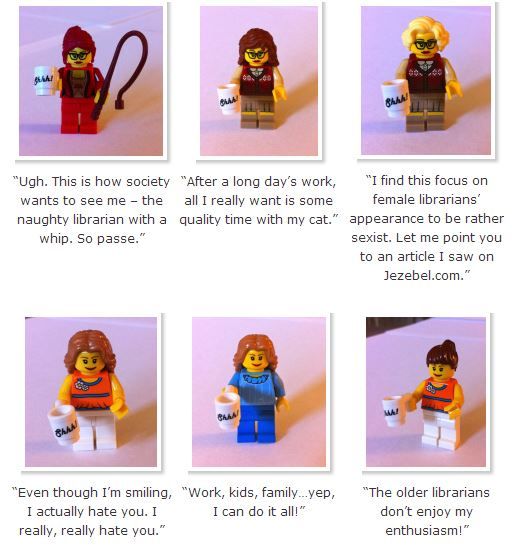
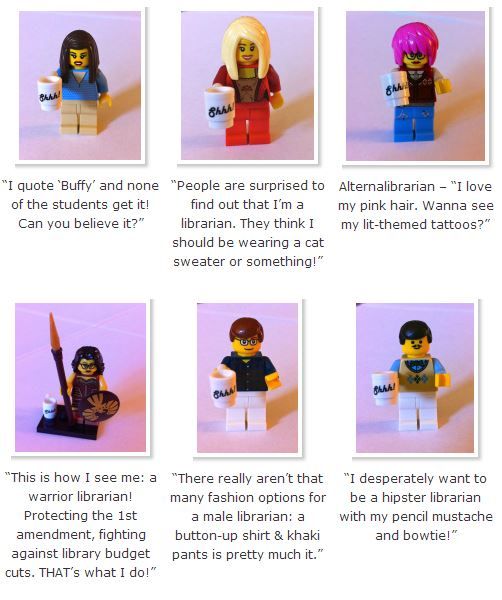
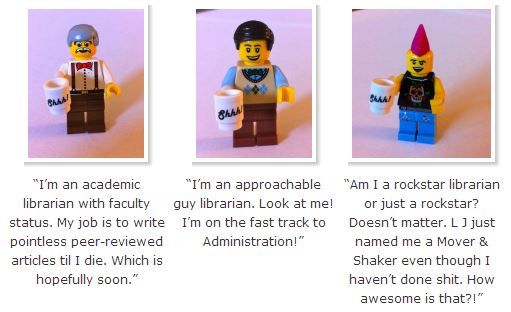
LEGO makes a standard librarian minifig. It's a bespectacled woman with a cup marked "Shhh!" and a book. Joe Hardenbrook, AKA Mr. Library Dude, thinks that doesn't adequately cover the range of librarians in the real world. So he created 27 LEGO minifigs that fit common librarian archetypes. You can view the rest at the link.
Link -via Jessamyn West