Uhg, I wish Frank would sleep -- I hear him at ~2AM sometimes.
“From New York to Los Angeles to Hartford, Conn., complaints and reports about fireworks have ballooned over the last month.” — Time, 6/19/20
- - -
Well, well, well. Look who came crawling across the street, begging for mercy.
For those who don’t already know me: My name is Frank, I live in the little blue bungalow at the end of the street, and for the last four months I’ve been terrorizing the neighborhood with nightly firework displays, strategically designed to exhaust you into submission.
Fueled by boredom, revenge, and armed with 600 pounds of illegally-obtained pyrotechnics, I have assaulted your senses and assumed control of these streets. I stand before you now, not as the pushover neighbor whose recycling bins everyone steals, but as a conquering hero.
Kneel before me and embrace me as your all-powerful firework overlord! I am the destroyer of movie climaxes! Traumatizer of pets! Disruptor of sleep cycles! And all shall suffer my wrath.
You fools! While you were busy worrying about a global pandemic, battling racial inequality, and saving your pennies in preparation for the country’s cannonball into economic ruin, I was off buying up every last bottle rocket in North America. How could I afford such an expense? Don’t worry about it. I’m certainly not a member of a large firework syndicate funded by Russian oligarchs, intent on fostering national chaos and disrupting the upcoming election through a campaign of never-ending, ill-timed illuminations.
That would be ridiculous.
Regardless, I’m delighted to announce that after months of dedication, my persistence has paid off. I’ve got you right where I want you: Exhausted. Paranoid. Prone to flinching at small noises.
I hope you’ll indulge me in my moment of triumph. I’m not one to brag, but torturing people with random acts of fireworks is kind of my thing. I like to draw you in with a couple of sparklers at twilight. Maybe launch an after-dinner Roman Candle or two for a little pizzazz. Then, just as you’re about to settle in for the evening, maybe pour yourself a nice cold glass of white wine to sip while you nod off to The Voice —
BOOM.
I drop an M-80 on your ass with enough force to set off every car alarm from here to Kansas.
You underestimated me. You thought I was weak, insignificant. You continued to steal my recycling bins, even after I labeled them very clearly with my name and home address. But look at me now. I bet no one’s lusting after my bins now that you know that stacked inside my one-car garage are enough explosives to guarantee your baby won’t sleep through the night till their high school graduation.
Resistance is futile. Rage against me on Twitter, threaten me with litigation in your Nextdoor message threads — I won’t see it. I gave up Wi-Fi so I could focus all my energy on blowing shit up. You can file as many noise complaints as you like, but I will not stand down. The Earth will run out of natural resources long before I exhaust my supply of celebratory dynamite sticks.
There are, of course, those who seek to destroy me, and to them I say: take heed. Like the heads of Cerberus, I am only one of many. You can move away or even flee the state, but you’ll find it makes no difference. Wherever you go:
BOOM.
Baby, it’s a firework.
Which brings me to my next point: After months of systematically fraying your nerves and holding your REM cycles hostage, I’m sure you’re curious as to what it is I want. My list of demands are as follows:
I would like my recycling bins returned. All six of them.
I want to help plan the neighborhood block party, and I want to be allowed to use the grill.
I don’t like to threaten, but failure to deliver upon these requests will result in decisive action on my part — but it won’t be swift. In fact, you’ll never know when it’s coming.
You’ll return to your normal life. You’ll begin to sleep through the night. Your dogs will poke their noses out of the closets in which they’ve sought shelter, and at the exact moment everyone has let their guard down:
BOOM.
Skyrockets in flight, motherfucker.
So that’s the deal. Return my bins or suffer the consequences. And to anyone who might be wondering, I will be taking July 4th off to visit the lake for some much-needed peace and quiet.
In every case, far more stone monuments remain than are removed. A survey by the Southern Poverty Law Center found some 1,800 named memorials honoring Confederates. Add to that union generals. And military leaders from the American Revolution, etcetera, etcetera, etcetera.
The generals are men of course. One study said there is a “staggering lack of public statues of women.” A database in the New Statesman in the U.K. and The Washington Post in the U.S. found only 13% and 7% of statues in these countries depict historical women as opposed to historical men.
Who should we be honoring?
So what’s next? How do we make the stone-tablet version of our history more representative of the actual history?
Wednesday, President Donald Trump nixed the idea of renaming military bases to make the country more reflective.
“These Monumental and very Powerful Bases have become part of a Great American Heritage, and a history of Winning, Victory, and Freedom,” Trump tweeted. “Therefore, my Administration will not even consider the renaming of these Magnificent and Fabled Military Installations. Our history as the Greatest Nation in the World will not be tampered with. Respect our Military.”
A few statues of American Indians and Alaska Natives are spread out across the country. In fact: Some of the most representative locations are Congress and a few state legislatures. In the U.S. Capitol (standing alongside Andrew $%!* Jackson, colonizer Junipero Serra, would-be dictator Huey P. Long and missionary killer Marcus Whitman) there is Kamehameha I,Po’Pay, Will Rogers,Sakakawea, Sarah Winnemucca, Standing BearWashakie and Sequoyah.
So at least 4% scoundrel (certainly could have added more names to that side of the ledger) and 8% Indigenous.
Let’s play “what if?” What if the rest of the country was like that? Who should we be honoring?
Imagine the 20th century and the Native leaders that could be honored on civic plazas, in front of city halls or on university campuses. (Yes, there are a few now, but we are talking numbers. At least 2% of all the statues. And even better is the 7% goal set by Congress’ own example.)
The list could include:
Vine Deloria Jr., Standing Rock. It’s hard to chronicle Vine Deloria in terms of his importance to the country and to Native America. He was a thinker. An architect of change. And, always, a writer. When it comes to honoring the past, Custer Died For Your Sins defines the possible. “Crazy Horse never drafted anyone to follow him. People recognized that what Crazy Horse did was for the best and was for the people,” Deloria wrote. “When Crazy Horse was dying, having been bayoneted in the back at Fort Robinson, Nebraska, Crazy Horse said to his father, ‘Tell the people it is no use to depend on me any more.’
“Until we can once again produce people like Crazy Horse, all the money and help in the world will not save us. It is up to us to write the final chapter of the American Indian upon this continent.”
Deloria could have been writing about himself.
Lucy Covington, Colville. She was a rancher-turned-politician who led the fight against the failed policy of termination in the 1960s. Termination was an idea to save money by ending the federal government’s relationship with tribes. (She would sell a cow to pay her way to Washington.) One of the tools that she used in this fight: a tribal newspaper. She started Our Heritage, a newspaper with the mission of informing tribal members about the issues. She would lead a quiet campaign to quell what she called the “present fever and fervor for termination.”
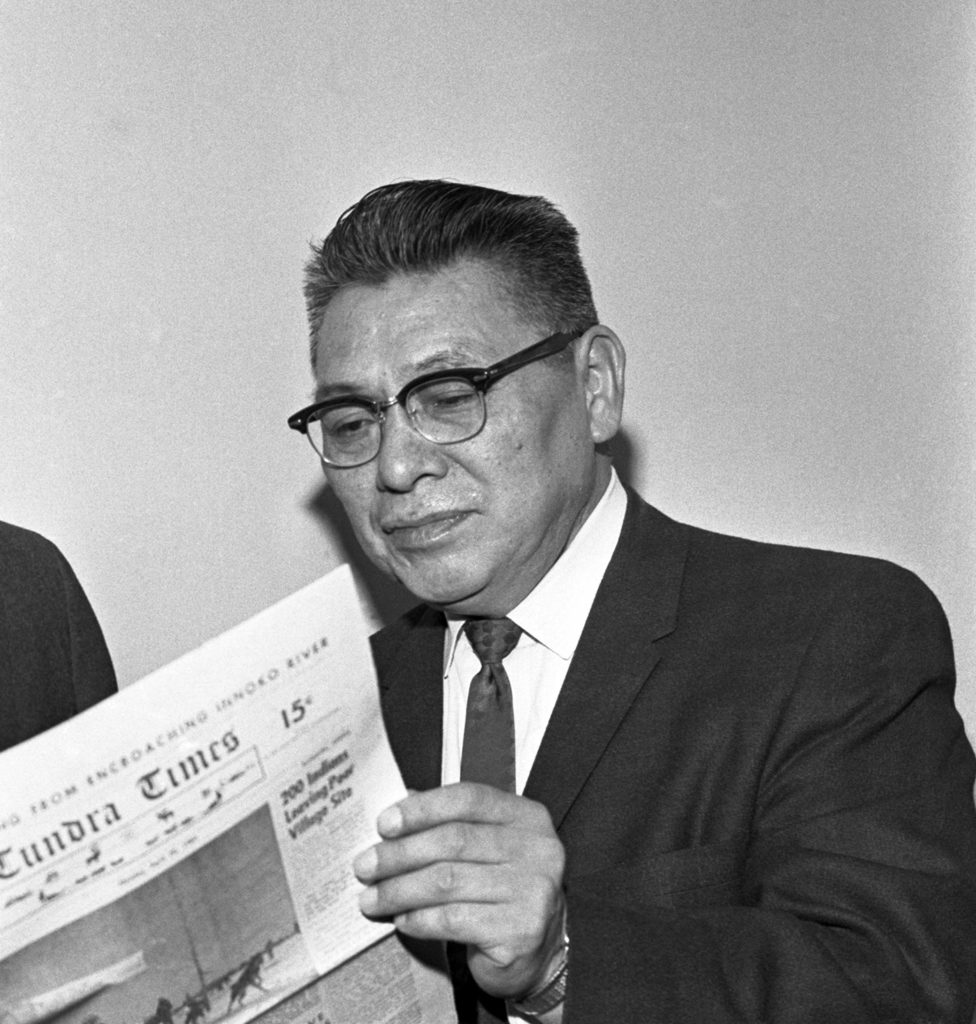
Howard Rock, Inupiat, founder and editor of The Tundra Times, in 1964. Photo by Bettmann/Getty Images.
Howard Rock, Inupiat. He was the legendary founder and editor of The Tundra Times. He once called his newspaper an “unselfish venture.” The Tundra Times was essential reading for anyone and everyone interested in Alaska issues. Rock maintained a nonpartisan editorial position but endorsed individual candidates based on Native issues. He also wrote about Native culture, and the newspaper carefully followed and reported on the Alaska Native Claims Settlement Act developments until the legislation became law in 1971.
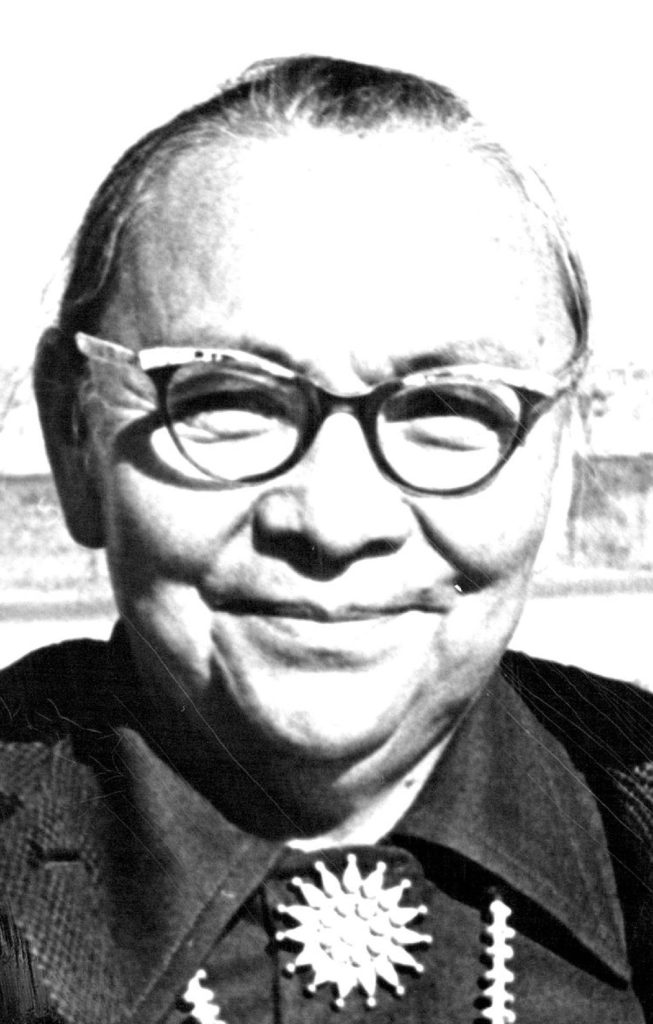
Annie Dodge Wauneka, Navajo, first woman member of the Navajo Nation Council, in 1964. Photo By The Denver Post/Getty Images.
Annie Dodge Wauneka, Navajo. She became a nurse caring for patients during an influenza pandemic. She had the flu when she was young and gained enough antibodies to be immune. Later she traveled door-to-door on the Navajo Nation explaining tuberculosis. She was the first woman member of the Navajo Nation Council. And she was given the Presidential Medal of Freedom.
Jackson Sundown, Nez Perce, born as Waaya-Tonah-Toesits-Kahn. He was a champion rodeo rider who became a folk hero because of his performance in the 1916 Pendleton Round-Up.
Elizabeth Peratrovich, Tlingit. She championed equal rights for Alaska Natives. She is credited for persuading lawmakers to pass the Anti-Discrimination Act of 1945, the first anti-discrimination law in the United States. Every year on Feb. 16, Alaska celebrates Elizabeth Peratrovich Day.
Billy Frank Jr., Nisqually. Frank was a tribal leader who fought for treaty rights, and that included defying the state of Washington on the river. He said: “I was not a policy guy. I was a getting-arrested guy.” But those arrests led to something. He became friends with those who shackled him. He was appointed to offices by the same governors who once had him arrested. He convinced the entire establishment in the Pacific Northwest that he was, indeed, right—and that folks were better off joining him in his cause.
And because of Billy Frank Jr., the salmon survive today and have returned to streams where they were once extinct. And the tribal communities of the Northwest are stronger in so many ways.
Chief Wilma Mankiller, Cherokee, first woman elected as principal chief of the Cherokee Nation, in 1992. Photo by Peter Turnley/Corbis/VCG/Getty Images.
Wilma Mankiller, Cherokee. She was the first woman elected as principal chief of the Cherokee Nation. In a speech at Emory University, she told a story about the United States sending a negotiation team to meet the Cherokees and draft a treaty. One of the initial questions was: “Where are your women?” Cherokee women often accompanied their leaders at important ceremonies and negotiations—and it was inconceivable that the representatives from the federal government would come alone. How can you negotiate anything with only half your people or half a way of thinking? Mankiller was awarded the Presidential Medal of Freedom.
Helen Peterson, Cheyenne and Lakota. She was the long-serving executive director of the National Congress of American Indians during much of the termination era. But that was her second career. Before that, she was an expert in Latin America, promoting human rights for farm workers and other Latin Americans. In 1949 she represented the United States at an international conference in Peru. She was a friend of Eleanor Roosevelt, who encouraged her to move to Washington, D.C. “The Indians are their own best spokesmen, their own best diplomats; but they can exercise these roles effectively only in proportion to their opportunities to exchange information and to use their combined strength and concerted voice,” she wrote in an article calling for more participation by Native people in elections. Her son, Max Peterson, put Helen Peterson’s career in perspective when she died. “During those times, there were no women in power, really,” he said in the Denver Post. “Her accomplishments don’t sound like much now because a lot of women are doing the same things, but back then, doing those things were a big deal. She went to Washington as a lobbyist. That was an exclusively male area, and she managed to do a great job on behalf of Indian legislation and Indian rights.”
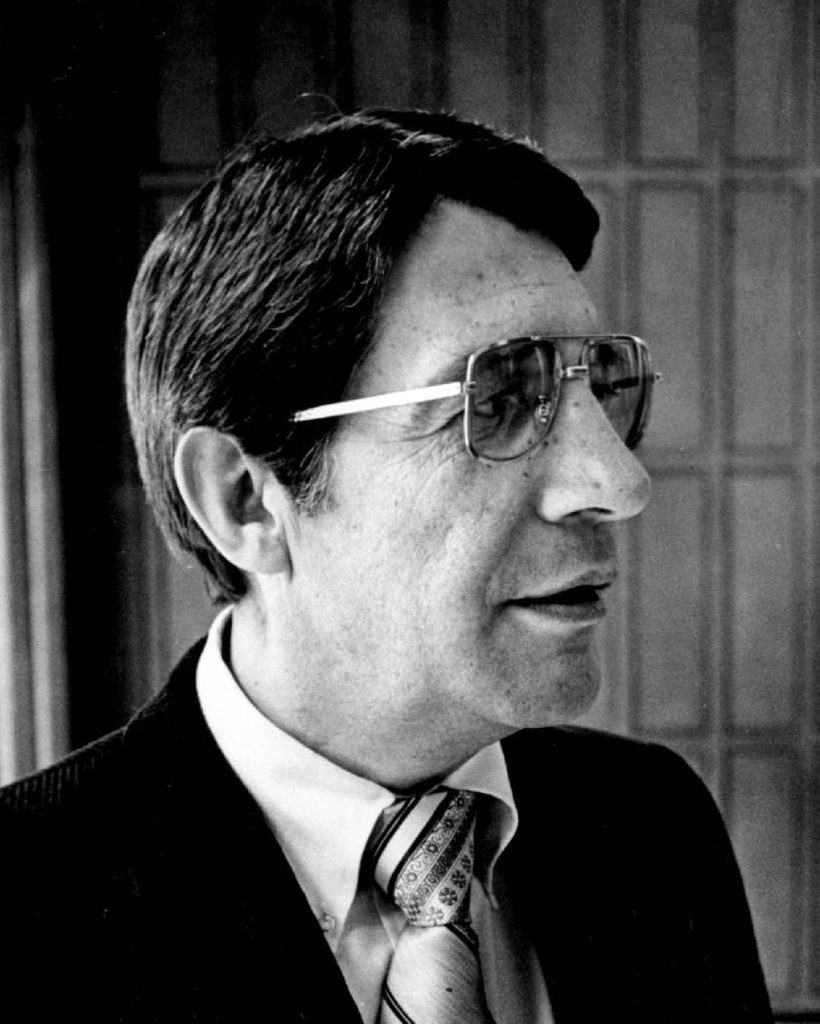
Forrest Gerard, Blackfeet, one of the first American Indians to work on Capitol Hill, in 1978. Photo By Bill Johnson/The Denver Post via Getty Images)
Forrest Gerard, Blackfeet. Gerard was one of the first American Indians to work on Capitol Hill and helped guide the Senate past the policy of termination into tribal self-determination. He worked for U.S. Sen. Henry Jackson and the Interior Committee where the “golden era” of Indian policy bills rolled off a legislative assembly line, the Indian Finance Act, the Indian Self-Determination and Education Assistance Act, and the Indian Health Care Improvement Act.
This list, of course, is not the end—only the beginning. Because in a country of this size and diversity it makes little sense to cling to statues that honor only a few, including historical figures unworthy of such acclaim. There remains a richer story that has yet to be told, chapter by chapter, stone by stone, and generation by generation.
This article was originally published by Indian Country Today. It has been published here with permission.
The late illustrator Maurice Sendak would have turned 92 today, and I imagine he’d have had the same contagious attraction to childhood wonder that made him such a compelling storyteller.
Well before his success with projects like Where the Wild Things Are, the Little Bear books (let’s not sleep on how good that TV show was), Outside Over There, and other works, Sendak had other aspirations: for a time, he and his older brother, Jack, were serious about becoming artisanal toy-makers.
There’s nothing like prolonged childhood bed rest to get a kid to fixate on something, and that’s what happened in Sendak’s case. In a 1966 New Yorker feature, Sendak told the author about the first books he’d ever received, from his sister: The Prince and the Pauper and The Three Musketeers. So much did Sendak love the books as objects in their own that he refrained from actually reading them for a while.
“It felt so good just having them,” he said. “They seemed alive to me, and so did many other inanimate objects I was fond of. All children have these intense feelings about certain dolls or other toys.”
At the time, many of Sendak’s own childhood toys were still at his parents’ house, and whenever he visited them, he also “visited” his toys (I hope that was code for sat open-legged on the carpet and talked to chunks of wood). Sendak was exploring the very Sendakian themes of loneliness and attachment in his early work Kenny’s Window (1956), whose protagonists occasionally chats with some of his favorite toys, including a stuffed bear and a lead soldier.
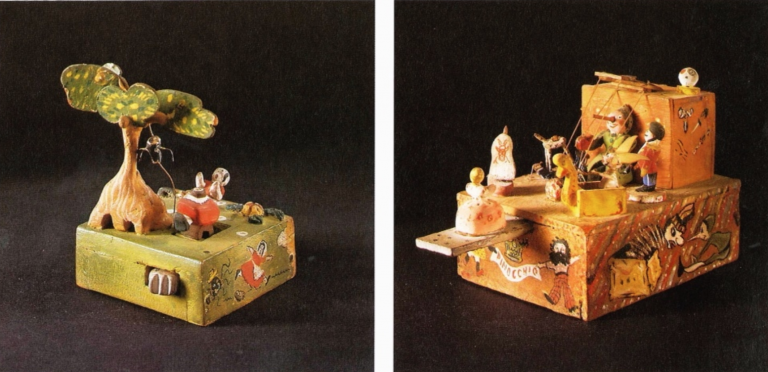
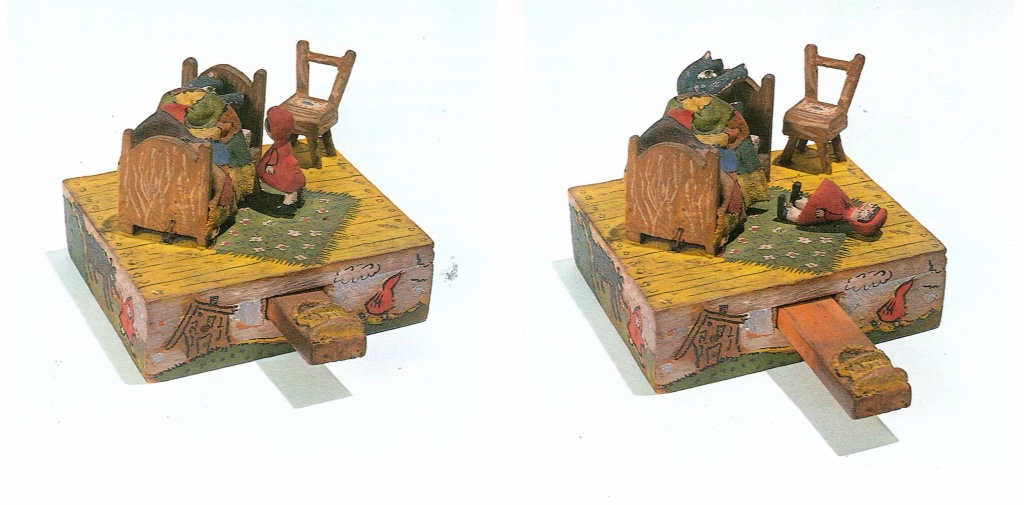
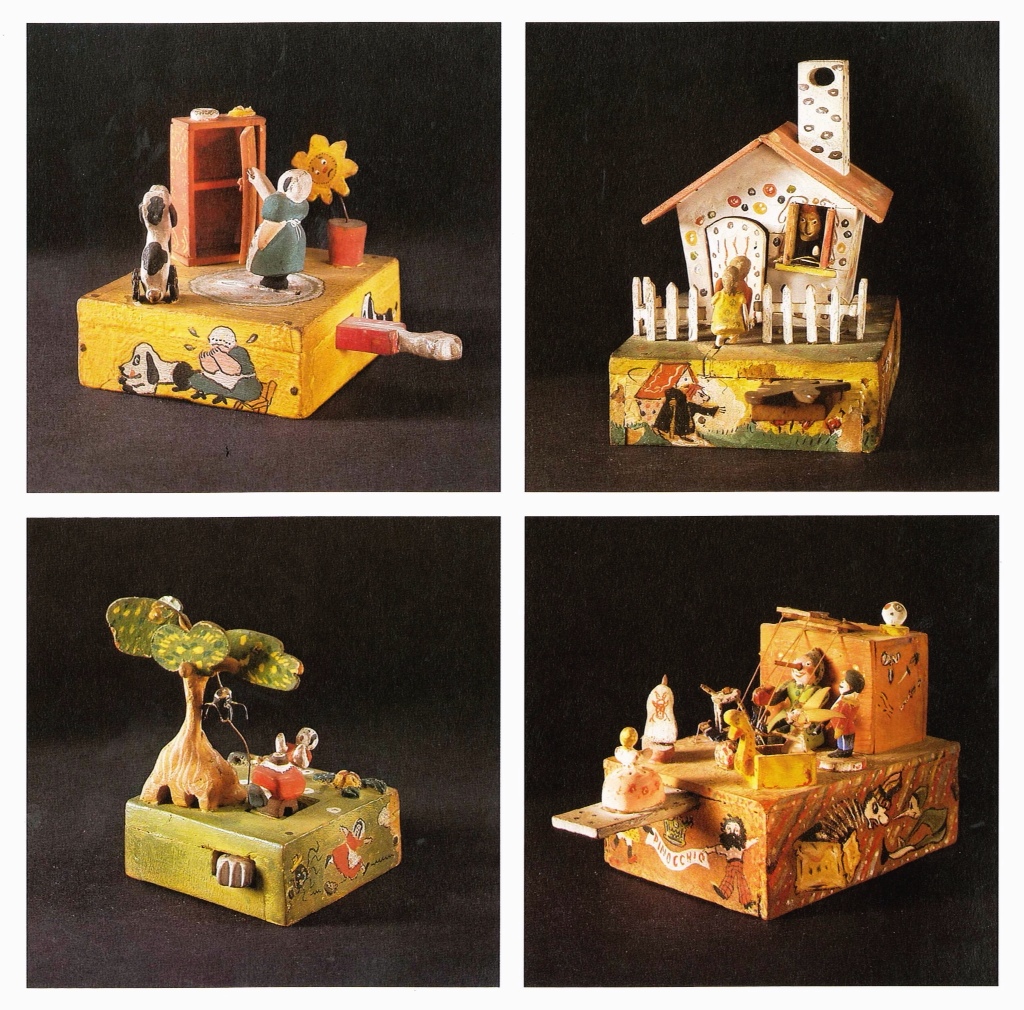
Once he graduated from high school in 1946, Sendak worked at a window-display house in lower Manhattan, helping create store window models of figures like Snow White and the dwarves using chicken wire, papier-mâché, plaster, and paint. He left after a couple of years and started working with Jack, one of his favorite collaborators, on moving wooden toys that performed scenes from fairy tales like “Little Red Riding Hood” and “Hansel and Gretel.”
Feeling bold, the Brothers Sendak took their German-style, lever-operated creations to FAO Schwarz, the legendary toy company, where they were told that the work was good but would be too costly to mass produce.
“We wanted a workshop of little old men creating the little wooden parts,” Sendak told The New Yorker, “and we would not have permitted any kind of plastic substitute.”
Richard Nell, Schwarz’s window-display director, was impressed and invited Sendak to assist in window display-making. Sendak worked at the company for three years while taking night classes in drawing, composition, and oil painting.
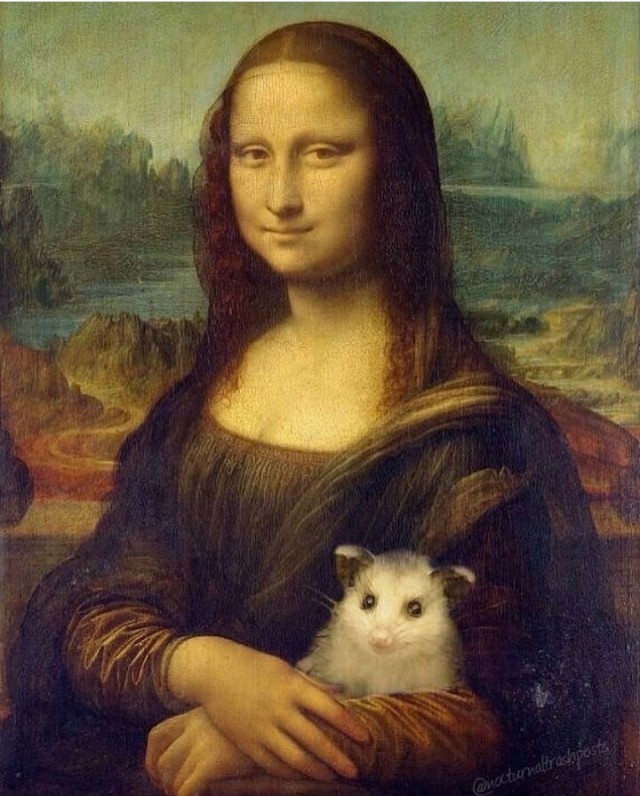
Te pet racoon I grew up with loved feeling up people's legs when they were wearing shorts/skirts/etc.
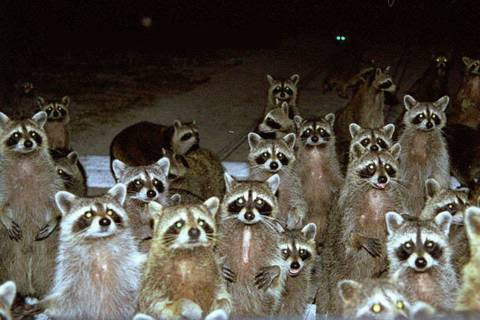
raccoons are curious and extremely tactile animals so if you go camping in the US and forget to zip your tent flap, you make wake up suddenly in the middle of the night to find tiny hands running sensually though your hair.
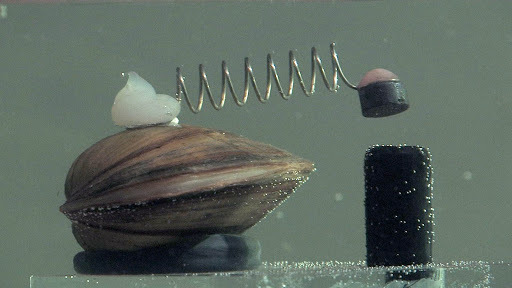
Re: the last post, the article mentions that some places use clams to test the toxicity of the water. It’s like that in Warsaw- we get our water from the river, and the main water pump has 8 clams that have triggers attached to their shells. If the water gets too toxic, they close, and the triggers shut off the city water supply automatically.
The clams are just better at measuring the water quality than any man-made sensors.
Student: Aha, but I clearly meant to ask for permission. Since you and the rest of the class understood my intent perfectly well, and the word “may” to show permission is rapidly falling out of fashion, there is nothing wrong with asking you whether I can borrow a pencil.
Teacher: Possibly so, in colloquial speech. Discerning context can help us decipher the nuance of each sentence on a case-by-case basis. However, as your teacher, my task is to teach you the intricacies and nuances of the English language with rigor, so that you may have a greater mastery of the language in order to effectively and precisely control what you want to communicate. In this case, the difference between the words “can” and “may”.
Student: Point taken. May I borrow a pencil?
Teacher: No, you may not. The state cut funding for education again.
Roche won't send tests to the US since they are afraid that the govt will steal them.
Maryland Gov. Larry Hogan is among the GOP governors who — unlike Florida Gov. Ron DeSantis — has aggressively promoted social distancing in his state and pushed for comprehensive COVID-19 testing. During an interview on Washington Post Live this week, Hogan described the lengths he has gone to in order to obtain coronavirus tests for […]
The other day someone told me about a program that will generate scenes to match a text description. I’m always excited to test out algorithms like this because the task of “draw anything a human asks for” is so hard that even state-of-the-art results are hilariously bad.
I tried a few test prompts.
“Nicest alien wants to say hi”
“The end of the world”
“A planetarium full of marbles”
Depending on what you ask for, it can seem for a while like maybe the neural net is doing well. But then you get to results like this:
“Horse riding a bicycle”
“Tyrannosaurus eating pizza”
Why does it sometimes generate something that’s a halfway recognizable attempt at completely the wrong thing?
I think I figured it out. Look at this series of images.
Triceratops, Tree frog, Hourglass, Fireplace… It’s matching every prompt with a vaguely similar word.
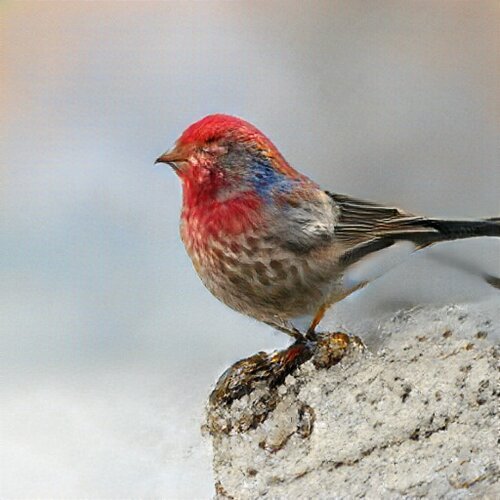
And because I’ve played a lot with image-generating neural nets, I even recognized the categories: they’re all from Fei-Fei Li’s famous ImageNet project. So if a phrase isn’t already an ImageNet category (like “horse on a bicycle”), this program looks for its closest match - in this case, it seems to have gone for “house finch” so it’s going for similarity in spelling rather than in meaning. “The end of the world” turned into “hen of the woods”, a type of large ruffled mushroom. I’m not sure why “tyrannosaurus eating a pizza” seems to have turned into “measuring cup”. The “nicest alien” is slightly easier to explain, since there are a LOT of dog categories in ImageNet so chances are decent a given phrase will match to a dog.
Here’s an interesting one: “God”
There’s no “God” category in ImageNet, but there is one for “hog”.
As far as I can tell, this demo’s not being used anywhere other than this one weird demo site, so there’s no harm in it being blissfully, weirdly wrong about stuff. But it does give me a small satisfaction to think that I may have figured out HOW it’s being so vividly wrong. Still puzzling about that tyrannosaurus rex, though.
Bonus material: I’ve collected a few more examples of prompts + results, some of which I find really baffling. You can enter your email here, and I’ll send them to you.
You can explore some of the ImageNet categories (and even mix them together, or compute the opposite of guacamole) using Artbreeder.com (the “general” image type). If you figure out what some of these mystery phrases mapped to, please tell me in the comments!
UPDATE: Vincent Tjeng has a detailed explanation - basically it’s matching your input phrase to whichever ImageNet category it can be turned into with the fewest number of edits.