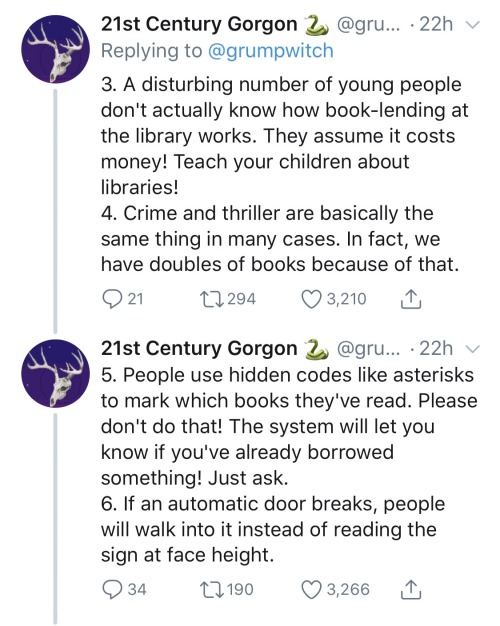
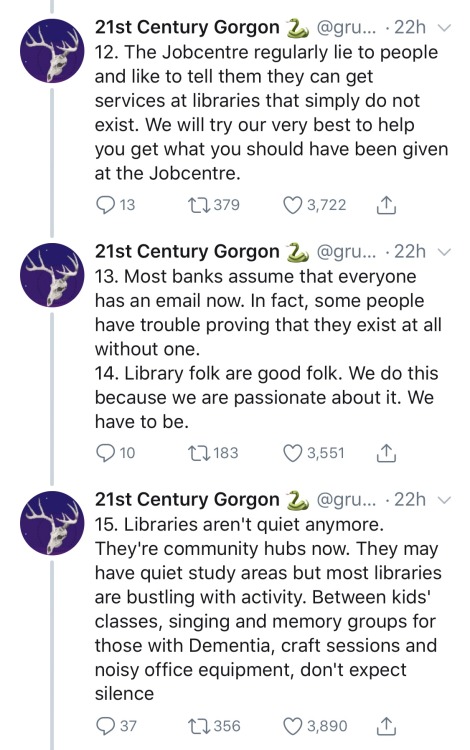
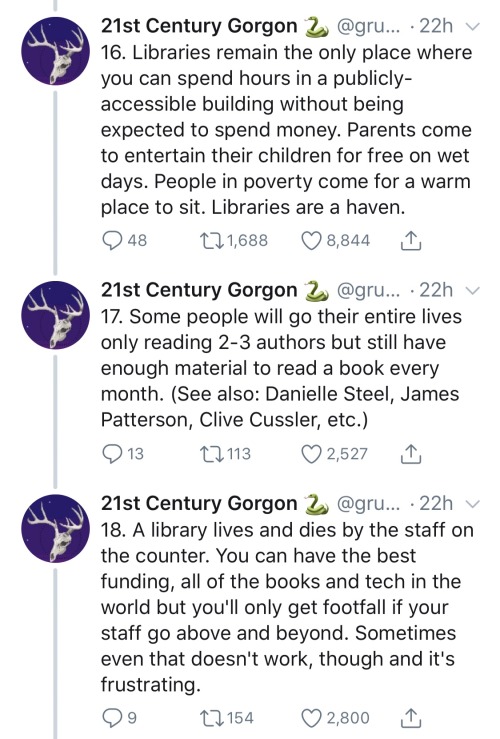
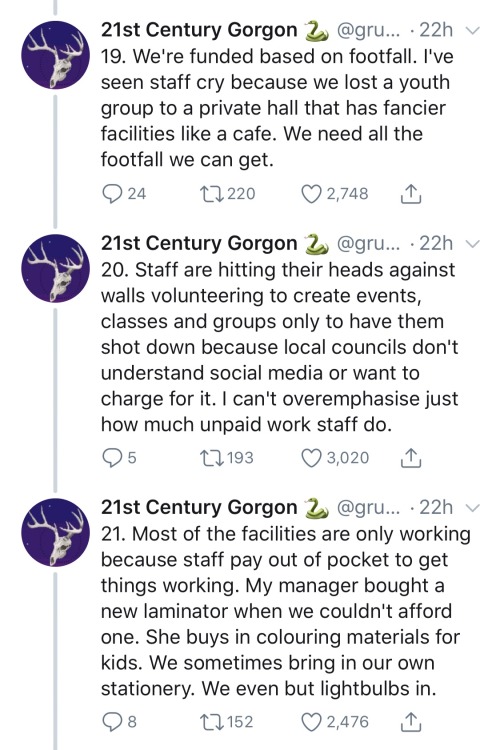
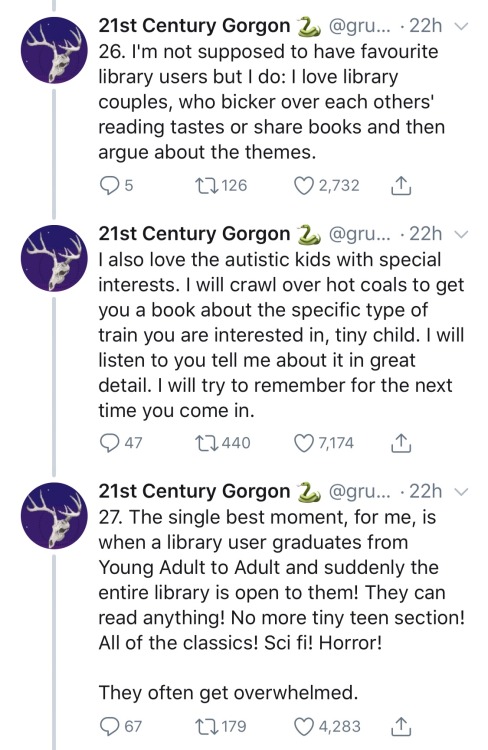
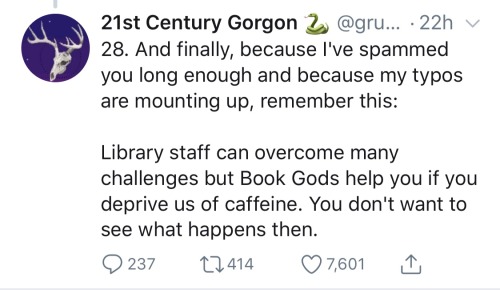
Can everyone who reads this PLEASE reblog it?!?!? Libraries literally saved my life as a child!
Being abused at home, bullied at school and lost in the world, the library and all the books I could escape to the most amazing worlds, kept me alive!
I would walk to the library, and spend all day, from 10 am to 9 pm reading there!! I got special awards for how many books I read, I wrote little blurbs on why i loved the books (probably why I love to BETA and do ARCs)
PLEASE, PLEASE, PLEASE Just hit the green arrows and the reblog!!!
As a 50 year old woman, the library offers me so much. Digital art pads to borrow, 3D printing, book clubs that are face to face (yeah, the introvert likes face to face because a moderator will stomp on anyone getting snarky)
New books in LARGE PRINT! I’m visually challenged and as much as I love my kindle, The feel of a real book in my hands will always be a beloved feeling!
Our library also has quarterly books sales of almost free books!! For 5$USD we get in a day early and can buy as many as we want. Anyone else has to wait and there is a limit for the first 2 days.
Also many, many libraries have inter library loan(it may be called something different). This means if they don’t have the item you want, they can get it for you. This may include photocopy/pdf of articles. This can also include along with books and DVDs, microfilm/fiche which is also a huge resource. Check around for libraries that are listed as depositories if you want to look at government documents.
Remember that many colleges and universities have open stacks for the public. You will likely have to pay a membership fee but you will get to stuff.
I love the library ☺
The library was one of my favorite places to go as a kid and I still live to go and just. Sit and read. Or do homework. The university I’m at has a massive 8-story one I love to just wonder around in~ Great places
Libraries are amazing places, we need to protect them to ensure their continued existence.
I used to wander about the fiction section in my local library, and choose books with the most interesting titles - I discovered two amazing authors that way
If you feel disconnected from your local community & want to find ways to get involved, seriously consider spending some time at the library. Go to some events! Organize a reading group!
Support your libraries!
Read banned books!
People who don’t learn can be more easily controlled and told what to think!
Echoing @mathcat345, if your school has banned a book, your library will likely have it. Read it. Fuck censorship.
Shane MacGowan, the legendary frontman of The Pogues, died yesterday at the age of 65. It’s hard to write about MacGowan’s death without alluding to the hard-drinking lifestyle he embodied, both in reality and song, but whatever talent he had for excess was nothing compared to his mastery of the song-as-story.
MacGowan was that rare storyteller who could switch registers with ease between the gothic, the mythic, the farcical, and the romantic. Taking his subject matter wherever he could find it—in history, legend, last night’s bender—MacGowan used the rough grace of his poetic gifts to create short stories in miniature, distilling entire lives into a verse or two.
As for that hard-living label, MacGowan did own to it. Here he is in a 1993 interview with Q Magazine. (As surfaced by Hanif Abdurraqib on Twitter yesterday.)
“I believe in pleasure. I love seeking pleasure. I like finding it even more. But if you’re a hedonist, you also have to have a social conscience because you can’t enjoy eating a beautiful meal and drinking beautiful drinks and taking drugs that make you feel great if right outside where you’re doing it, people are starving to death on the pavements.”
MacGowan filled his songs with the beautiful losers of the world, wrote with tenderness and anger about the damned and the forgotten, and seemed constitutionally unable to root against the underdog. His own story was their story, and he told them all brilliantly. With that in mind, here are seven of my favorite Pogues’ songs that would also make great short stories.
*
“A Pair of Brown Eyes”
This is probably my favorite Pogues song (I will sing it in full if you buy me a drink). It is quintessential MacGowan: a man drinks and remembers, searches for grace amid the ruins of his life and almost, but not quite, finds it. I’ve always read the story as an encounter with a very old man in a bar sunk deep into whiskey-tinged memories of WWI and the girl he left behind (the soundtrack to his recollections dates the scene to the late 1970s). The grim details in the first verse, of war’s intimate brutalities, demand of the listener forgiveness for the drunkard’s sentimentality; as he so often did, MacGowan seems to be asking us all: “Who among you hasn’t succumbed to self-pity’s bittersweet reveries?”
“In blood and death ’neath a screaming sky
I lay down on the ground
And the arms and legs of other men
Were scattered all around.
Some cursed, some prayed, some prayed then cursed
Then prayed and bled some more.
And the only thing that I could see
Was a pair of brown eyes that was looking at me
But when we got back, labeled parts one to three
There was no pair of brown eyes waiting for me.”
*
“Fairytale of New York” (written with Jem Finer)
The Pogues best-known song, “Fairytale of New York” has become a barroom holiday classic, a diasporic anthem that showcases MacGowan’s talent for scuffing the shiny varnish of sentimentality with the right amount of grit. A duet with the late, great Kirsty MacColl, “Fairytale” is the story of young lovers who wash up in New York City with little more than their faith in the so-called American dream; and though things inevitably go badly, the final verse aches with the perfect tenderness for what could have been. (MacGowan’s lines in bold.)
“I could have been someone Well so could anyone
You took my dreams from me
When I first found you I kept them with me babe I put them with my own Can’t make it all alone I built my dreams around you.”
*
“The Sickbed of Cuchulainn”
In which MacGowan inhabits a sentimental antifascist drunkard fighting and drinking his way around the chaos of 1930s Europe, ending up in civil war Madrid battling fascist Blackshirts in the streets. Though the chorus invokes the mythic Irish warrior, Cuchulainn, MacGowan ends the song in customary fashion, kicked out of a tavern, bereft in the streets.
“When you pissed yourself in Frankfurt and got syph down in Cologne
And you heard the rattling death trains as you lay there all alone
Frank Ryan bought you whiskey in a brothel in Madrid
And you decked some fucking blackshirt who was cursing all the Yids
At the sick bed of Cuchulainn, we’ll kneel and say a prayer
And the ghosts are rattling at the door and the devil’s in the chair.”
*
“Rainy Night in Soho”
This is perhaps MacGowan’s most purely romantic song. The simple verse structure and swooning shifts in temporal perspective conjure early Anna Akhmatova, as MacGowan evokes what it means for love to endure over time while at the same instant revealing one perfect, soft-focus night in London, madly in love.
“I’ve been loving you a long time
Down all the years, down all the days
And I’ve cried for all your troubles
Smiled at your funny little ways
We watched our friends grow up together
And we saw them as they fell
Some of them fell into Heaven
Some of them fell into Hell
I took shelter from a shower
And I stepped into your arms
On a rainy night in Soho
The wind was whistling all its charms.”
*
“Lorca’s Novena”
MacGowan often populated his songs with men he admired: Frank Ryan, Brendan Behan, and in this case, Federico García Lorca. A fairly simple song, “Lorca’s Novena” tells the terrible story of the poet’s death at the hands of Spanish fascists in 1936. The rank brutality MacGowan despises in the specific here—thoughtless, bigoted fascists cruelly murdering a great poet, murdering beauty, in effect—is what he rages against in many of his songs. The world may be irredeemably ugly, MacGowan so often tells us, but what small grace it grants is more precious than gold.
“The killers came to mutilate the dead
But ran away in terror to search the town instead
But Lorca’s corpse, as he had prophesied, just walked away
And the only sound was the women in the chapel praying
Mother of all our joys
Mother of all our sorrows
Intercede with him tonight
For all of our tomorrows.”
*
“The Old Main Drag”
This song, about a young man who quickly falls between the cracks after arriving in big city London, lives somewhere between the two Den(n)is’ (Johnson and Cooper) as a down-and-out parable stripped of redemption. Aside from giving voice to the otherwise reviled and marginalized, “The Old Main Drag” is MacGowan at his technical best, approaching Cole Porter levels of perfection in meter and rhyme, through all six verses.
“One evening as I was lying down by Leicester Square
I was picked up by the coppers and kicked in the balls
Between the metal doors at Vine Street I was beaten and mauled
And they ruined my good looks for the old main drag
In the tube station the old ones who were on the way out
Would dribble and vomit and grovel and shout
And the coppers would come along and push them about
And I wished I could escape from the old main drag.”
*
“The Body of an American”
As a son of the diaspora (MacGowan was born in Kent), the scattering of the Irish across the world was often a topic of Pogues’ songs. Not surprisingly, “The Body of an American” is particularly popular on St. Patrick’s Day in Boston (and New York, and Philadelphia) as it describes the wake of a mythic (and fictional) Irish American boxer, Big Jim Dwyer, and his posthumous repatriation to the old country. Best played loud, this song is a rollicking delight (if you’re not careful someone will order you an Irish Car Bomb).
“But 15 minutes later we had our first taste of whiskey
There was uncles giving lectures on ancient Irish history
The men all started telling jokes and the women, they got frisky
By five o’clock in the evening every bastard there was pissed
Fare thee well, going away, there’s nothing left to say
Farewell to New York City, boys, to Boston and PA
He took them out with a well-aimed clout, we often heard him say
‘I’m a free born man of the USA’.”
*
“Kitty”
The other Pogues song I can, and will, sing in its entirety if drunk, is “Kitty.” Though the writing credits include the whole band, I’m putting it here anyway as it features all the hallmarks of a MacGowan ballad: doomed romanticism, defiance of authority, outlaw heroism… I’ve always interpreted “Kitty”* as a romantic rebel song—a man bidding farewell to the woman he loves before going into hiding from the British—but the narrator could very well be a criminal on the lam. It doesn’t really matter, it’s a classic.
“Oh Kitty, my darling, remember That the doom will be mine if I stay Tis far better to part, though it’s hard to Than to rot in their prison away.”
*Not least for its passing invocation of Kitty O’Shea.
Carpathia received Titanic’s distress signal at 12:20am, April 15th, 1912. She was 58 miles away, a distance that absolutely could not be covered in less than four hours.
(Californian’s exact position at the time is…controversial. She was close enough to have helped. By all accounts she was close enough to see Titanic’s distress rockets. It’s uncertain to this day why her crew did not respond, or how many might not have been lost if she had been there. This is not the place for what-ifs. This is about what was done.)
Carpathia’s Captain Rostron had, yes, rolled out of bed instantly when woken by his radio operator, ordered his ship to Titanic’s aid and confirmed the signal before he was fully dressed. The man had never in his life responded to an emergency call. His goal tonight was to make sure nobody who heard that fact would ever believe it.
All of Carpathia’s lifeboats were swung out ready for deployment. Oil was set up to be poured off the side of the ship in case the sea turned choppy; oil would coat and calm the water near Carpathia if that happened, making it safer for lifeboats to draw up alongside her. He ordered lights to be rigged along the side of the ship so survivors could see it better, and had nets and ladders rigged along her sides ready to be dropped when they arrived, in order to let as many survivors as possible climb aboard at once.
I don’t know if his making provisions for there still being survivors in the water was optimism or not. I think he knew they were never going to get there in time for that. I think he did it anyway because, god, you have to hope.
Carpathia had three dining rooms, which were immediately converted into triage and first aid stations. Each had a doctor assigned to it. Hot soup, coffee, and tea were prepared in bulk in each dining room, and blankets and warm clothes were collected to be ready to hand out. By this time, many of the passengers were awake–prepping a ship for disaster relief isn’t quiet–and all of them stepped up to help, many donating their own clothes and blankets.
And then he did something I tend to refer to as diverting all power from life support.
Here’s the thing about steamships: They run on steam. Shocking, I know; but that steam powers everything on the ship, and right now, Carpathia needed power. So Rostron turned off hot water and central heating, which bled valuable steam power, to everywhere but the dining rooms–which, of course, were being used to make hot drinks and receive survivors. He woke up all the engineers, all the stokers and firemen, diverted all that steam back into the engines, and asked his ship to go as fast as she possibly could. And when she’d done that, he asked her to go faster.
I need you to understand that you simply can’t push a ship very far past its top speed. Pushing that much sheer tonnage through the water becomes harder with each extra knot past the speed it was designed for. Pushing a ship past its rated speed is not only reckless–it’s difficult to maneuver–but it puts an incredible amount of strain on the engines. Ships are not designed to exceed their top speed by even one knot. They can’t do it. It can’t be done.
Carpathia’s absolute do-or-die, the-engines-can’t-take-this-forever top speed was fourteen knots. Dodging icebergs, in the dark and the cold, surrounded by mist, she sustained a speed of almost seventeen and a half.
No one would have asked this of them. It wasn’t expected. They were almost sixty miles away, with icebergs in their path. They had a responsibility to respond; they did not have a responsibility to do the impossible and do it well. No one would have faulted them for taking more time to confirm the severity of the issue. No one would have blamed them for a slow and cautious approach. No one but themselves.
They damn near broke the laws of physics, galloping north headlong into the dark in the desperate hope that if they could shave an hour, half an hour, five minutes off their arrival time, maybe for one more person those five minutes would make the difference. I say: three people had died by the time they were lifted from the lifeboats. For all we know, in another hour it might have been more. I say they made all the difference in the world.
This ship and her crew received a message from a location they could not hope to reach in under four hours. Just barely over three hours later, they arrived at Titanic’s last known coordinates. Half an hour after that, at 4am, they would finally find the first of the lifeboats. it would take until 8:30 in the morning for the last survivor to be brought onboard. Passengers from Carpathia universally gave up their berths, staterooms, and clothing to the survivors, assisting the crew at every turn and sitting with the sobbing rescuees to offer whatever comfort they could.
In total, 705 people of Titanic’s original 2208 were brought onto Carpathia alive. No other ship would find survivors.
At 12:20am April 15th, 1912, there was a miracle on the North Atlantic. And it happened because a group of humans, some of them strangers, many of them only passengers on a small and unimpressive steam liner, looked at each other and decided: I cannot live with myself if I do anything less.
I think the least we can do is remember them for it.
I can’t begin to describe how happy and flattered and a little teary I am that this just broke 100k.
I may be the actual only human being on Tumblr with a post this popular that I not only don’t regret making, but am actually HAPPY whenever I notice a surge in its circulation.
I never intended this to gain any traction at all (you’ll notice there’s no sources or anything–this was a personal ramble, prompted in good humor by a friend after I jokingly said that I wished someone would give me an excuse to cry about Carpathia on Tumblr so I could get it out of my system.) I literally expected to get, like, maybe 20 likes and a reblog, from friends, indulging me in my nonsense.
It just….means a lot to me that it’s touched so many people. I see a lot of tags to the effect of “HOW DARE YOU HURT ME LIKE THIS AND MAKE ME CRY ABOUT A BOAT” that are often really funny, but overwhelmingly the tags on this post are from people saving it for a rainy day, or remarking in a sort of quiet awe that they never even really thought about her role in the story–and God knows I never did, I learned it by complete accident much as most of the people who’ve found this post.
And so many of you guys are taking strength and reassurance from the reminder not only that people are capable of amazing things together, but simply that kindness matters and that a simple, tiny act of compassion is never wasted. I’m just really glad to have been able to do that for some folks.
If I can just add one personal note. I need to emphasize something I only touched on in the original post.
I need to emphasize that Carpathia failed.
A lot of the tags and comments have a tinge of…despair, or guilt, or wistfulness about things like this happening so rarely. Or inadequacy, or just being overwhelmed or unhappy about not being in a position to step up in a comparable way. And I want to gently bring up the fact that this is still the sinking of the Titanic.
They did not get there in time. They did not save the ship. It can be argued that they may not even have saved a single life; we have no way of knowing. This was still a horrific maritime disaster mired in arrogance and incompetence and a lack of care.
If the response to this story shows anything, it shows this: It matters that they tried.
Even though they got there too late, even though the ship still sank. It matters that they tried. The difference between making the best reasonable speed after confirming the seriousness of the situation, and the miracle they pulled off–it matters. It makes all the difference. Even if it made no difference at all. Not one of you read this and concluded that I was stupid for caring so much when the Titanic still sank and all those people still died.
You don’t have to fix the world. You’ll likely be cold and sick and miserable and testy and scared, and unprepared, and in over your head, and entirely too small to be of any real use. It feels stupid, passing out blankets and coffee in the middle of an ice field knowing what just happened. It’s hard to feel anything but useless when all you can do is tap a wireless transmitter and promise help that you know will come too late.
It matters that they fought for those people. It matters that they cared, and it matters that they tried. It matters that they didn’t stop. If it didn’t matter, you wouldn’t have read this far.
You know it’s a great puppet when you don’t even notice the two entire people under and behind its body moving its limbs until it’s halfway across the stage.
i feel like we don’t talk about things like this enough
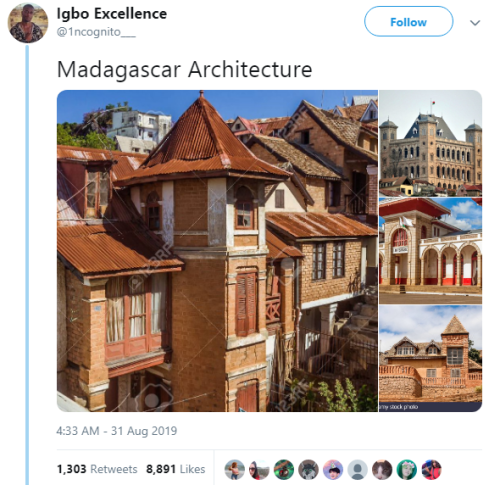
These are so colourful and lovely! A golden opportunity for Africa-inspired fantasy settings (which we definitely need more of Medieval Europe is not the only fantasy world setting allowed to exist) if I’ve ever seen one!
I have officially made a gof*ndme for this with a total of 4k for now as we don’t know exactly what the oncologists are going to say. If you want to donate their I’ll leave the link below. I can’t have her die on me, not like this.
No, but that’s exactly something that should be put in a museum.
Imagine seeing this two, three, eight hundred years after the fact. Imagine this little girl through centuries of time holding up her hand to show you her most precious rock. It’s potent enough now, this intimate knowledge of a complete stranger, this tiny insight into what was explained to her and what she thought was important and who listened to her long enough to let you see it, but imagine centuries in the future. Imagine this little bit of rock that looks like every other bit of rock, with no context and no explanation to it. And then imagine finding/seeing this little sign, and realising that it was Bethan’s rock. That it was a rock that a little girl loved the look of , and picked up, and carried around with her, and when it was explained to her that museums were places where precious things were shown so that other people could see and enjoy them, the precious thing she wanted them to show, that she wanted to show you, was this rock.
This is what material history is. These windows through time into a person’s life and beliefs and mundane treasures, these bridges across centuries where a child a hundred, a thousand, ten thousand years ago can show you her favourite rock.
That is, in so many ways, what museums are for. And well done them for following through.