Shared posts

14 Apr 18:50

The World's Only Factory Where You Can Nuke Your Boss

image

The situation in Korea is once again “tense.” North Korea has declared war on South Korea, declared its plans to nuke the United States, and plans to re-open a nuclear reactor.

However, the situation is all too common. North Korea has often made apocalyptic threats in order to secure control domestically or wring aid out of the United States and its allies. So, intelligence and the press have looked for signs that Kim Jong Un may be serious. This past week, they zeroed in on North Korea’s closure of an industrial park that it jointly runs with South Korea.

To which we responded, North and South Korea run a business together?

image

The 8 year-old industrial park in Kaesong, North Korea, is run and managed by South Korea. It employs over fifty thousand North Koreans who make an average wage of $144. It’s unclear whether that money goes to their families or the currency-starved government.

American diplomats often express frustration with China’s provision of vital food and oil to North Korea. They complain that it allows North Korea to skirt American-led sanctions on the rogue state. 

But South Korea has been equally contrarian to the American sanction policy. Under South Korea’s “Sunshine Policy” toward the North, projects like Kaesong were meant to increase cooperation to improve relations. Kumgang Mountain, a North Korean resort open to South Koreans and other foreigners, is another key source of cash for North Korea.

image

map of tensions between North and South Korea

It is hard for South Korea to have a consistent policy on North Korea. Families remained divided by the border between the two. South Korea also assumes that it will (and aspires to) one day reunify Korea. For that reason, they do not want a poor, weak North Korea. One of the purposes of the industrial park at Kaesong is to “narrow the yawning gap of half a century of division.” When unification comes, South Korea does not want the types of economic disparities that existed between East and West Germany:

“Cho Yong-nam, a director general in the Unification Ministry, said South Korea had projects in 27 of 206 cities and counties in the North. The common theme, he said, is to raise standards in the North so that, in a unified Korea, North Koreans would not constitute ‘a displaced, misfortunate minority group.’”

The South Koreans also hope that the industrial park will be subversive, by exposing North Korea’s lies about the superiority of the North and spreading the norms of production and capitalism. The South Korean managers, however, better be careful. Relations between bosses and employees have been cordial so far. But North Korea could be the world’s worst employee.

This post was written by Alex Mayyasi. Follow him on Twitter here or Google Plus.

14 Apr 18:40

Deveríamos respeitar mais a história dos Romas (Ciganos)

by Gustavo Chacra

Assista aos meus comentários sobre a Al Qaeda na Síria e a Crise na Coreia do Norte no Jornal das Dez da Globo News

Leia os últimos posts

POR QUE O IRÃ E A COREIA DO NORTE PODEM NAO PODEM TER ARMAS NUCLEARES?

AL QAEDA DOMINA O MAIS PODEROSO GRUPO ANTI-ASSAD NA SÍRIA

É DEPRIMENTE HAVER UM GP DE FORMULA 1 EM BAHREIN

O texto abaixo foi escrito por mim há dois anos. Nada mudou e os romas (ciganos) continuam alvo de preconceito

Os Romas, como são oficialmente conhecidos os ciganos (gypsies, em inglês), celebraram nesta semana a sua data cultural. E as comemorações não receberam atenção nenhuma.   Afinal, os ciganos são praticamente ignorados e quase ninguém no mundo luta pelos direitos deste povo. No Holocausto, eles também foram levados para campos de concentração e eliminados em escala industrial pelo regime nazista. Mas ficaram sem indenização ao perderem as suas posses e seus parentes. Não há memorial para eles. Os ciganos tampouco possuem um Estado, apesar de serem minorias expressivas em países do Leste Europeu, como a Romênia.  Não vemos movimentos internacionais como os existentes pela criação da Palestina, de Kosovo, de Timor Oriental ou do Curdistão. Os ciganos são perseguidos na Itália e na Suíça, mas poucos se preocupam em defendê-los, ao contrário do que ocorre com imigrantes ilegais de nações africanas.

Não sabemos quase nada sobre os ciganos, ou romas. Há estereótipos, como o de que eles trapaceiam ao dizer que lêem o futuro com bolas de cristais, que roubam pessoas em estações de trem, que agridem suas mulheres. Seriam também nômades que montam suas tendas por onde passam, consumindo bebidas indiscriminadamente. Os ciganos, ou romas, não são uma religião, mas um povo com uma cultura particular. Muitos se destacam nas arte, na literatura e na música, mas também existem médicos, advogados e outros profissionais.

Um dos problemas, segundo o educador alemão Mairele Krause, é que os ciganos, por sofrerem com a perseguição, estabeleceram uma cultura de segredo e proteção que torna difícil entendê-los e estudá-los. David Mayall, um acadêmico que escreveu a história dos ciganos nos últimos 500 anos, afirma ser difícil definir uma identidade para este povo, pois elas são múltiplas.

 Aliás, os ciganos denominam o Holocausto como Porrajmos. Guga Chacra, comentarista de política internacional do Estadão e do programa Globo News Em Pauta em Nova York, é mestre em Relações Internacionais pela Universidade Columbia. Já foi correspondente do jornal O Estado de S. Paulo no Oriente Médio. No passado, trabalhou como correspondente da Folha em Buenos Aires

Comentários islamofóbicos, antisemitas e antiárabes ou que coloquem um povo ou uma religião como superiores não serão publicados. Tampouco ataques entre leitores ou contra o blogueiro. Pessoas que insistirem em ataques pessoais não terão mais seus comentários publicados. Não é permitido postar vídeo. Todos os posts devem ter relação com algum dos temas acima. O blog está aberto a discussões educadas e com pontos de vista diferentes. Os comentários dos leitores não refletem a opinião do jornalista

Acompanhe também meus comentários no Globo News Em Pauta, na Rádio Estadão, na TV Estadão, no Estadão Noite no tablet, no Twitter @gugachacra , no Facebook Guga Chacra (me adicionem como seguidor), no Instagram e no Google Plus. Escrevam para mim no  gugachacra at outlook.com. Leiam também o blog do Ariel Palacios

14 Apr 18:25

07-03-2013

by Laerte

14 Apr 18:23

Wise Guys

by nedroid
Adam Victor Brandizzi

Quem nunca? x2

Wise Guys

14 Apr 18:22

The Novelist

by Doug
Adam Victor Brandizzi

Quem nunca?

The Novelist

More writing.

14 Apr 18:16

fer1972: Know were you stand: Modern Day Locations blended...


fer1972:

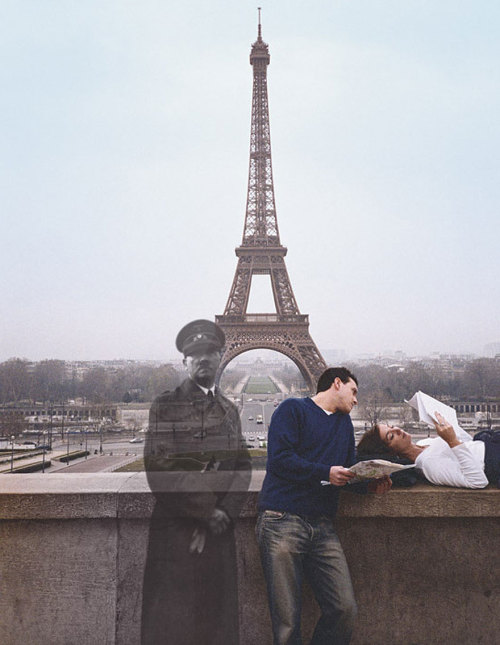
Know were you stand: Modern Day Locations blended with Major Historical Events by Seth Taras 

1. The Hindenberg Disaster of May 6, 1937 

2. Allied soldiers rushing the beach at Normandy in June 1944

3. The Fall of the Berlin wall in 1989

4. Adolf Hitler touring Paris and standing in front of the Eiffel Tower in 1940

14 Apr 18:16

iraffiruse: Frozach Submitted

14 Apr 18:15

How to teach your kids about Weeping Angels


How to teach your kids about Weeping Angels

14 Apr 18:04

The Economics Of Girl Talk

image

When Gregg Gillis performs, audiences go wild. So does he. Better known as Girl Talk, he runs around the stage, stripping off his clothes as he moves with the energy of his catchy dance beats. Girl Talk performs at venues as touted as the Coachella music festival in Los Angeles and tours internationally. When he released his most recent album All Day online in 2010, “Girl Talk” was the most searched for phrase on Google for much of the day.

He is a music sensation, but Girl Talk neither sings nor plays an instrument. He plays music off reinforced Toughbook laptops protected from his sweat by layers of plastic wrap. To create an album, he mixes elements of songs from genres like hip-hop, rock, and rap. All Day begins by playing the classic English rock band Black Sabbath’s “War Pigs,” then layering on top of it vocals and percussion from American rapper Ludacris and hip-hop artists JC and Yung Joc. A completed album takes what are known as “samples” (pieces of other songs) from several hundred songs.

In Girl Talk’s view, he is a musician: “I want to be a musician and not just a party D.J., and like any musician I want to put out a classic album.” The music industry, on the other hand, views his unlicensed use of other musicians’ music (which Girl Talk does not pay a dime for) as criminal.

For listeners of Girl Talk, part of the fun is recognizing their favorite songs diced up among or played against other hits. The same is true for his fellow mashup artists like The Hood Internet and Super Mash Brothers. For a casual observer, it may seem reasonable that these mashup artists should pay the copyright holders for using samples of their hit songs. And legal precedent in the US and most of the world says that they should. 

Sampling, however, is used to create a majority of the new music we hear today. Producers and DJs create electronic and dance music by sampling old soul, funk, and rock tracks (think of house music playing at a club). Samples are also used to create the instrumentals of nearly every rap and hip-hop song (the background to nearly every rap is sampled), a surprising amount of pop including songs by Carly Rae Jepsen and Christina Aguilera, soundtracks, and even commercial jingles.

Although this all falls under the umbrella of “sampling,” huge variation exists between the uses of samples. Puff Daddy’s hit “I’ll Be Missing You,” for example, was created simply by adding new vocals on top of the instrumentals from The Police’s “Every Breath You Take.” In contrast, an electronic DJ may take several 2 second samples, loop them to fill up a track’s worth of time, and manipulate them digitally until the musicians who first recorded the samples would never recognize them. Mashup artists, by cleverly combining small but recognizable chunks of songs, fall somewhere in between. But the law treats all these instances as identical uses of copyrighted material. Regardless of how the samples are used, producers must obtain permission from the copyright holders or risk a lawsuit. 

The result is a broken system that impairs the ability of young producers to make music without taking huge legal risks. The task of obtaining permission to use a sample, even if only a two second sample that will sound nothing like the original, is so difficult and expensive that only big players in the music industry have the resources to pull it off. While the process of making music becomes increasingly digital, artists searching for their big break are unable to play by the rules, putting the future of the industry at risk. 

The bad news is that until the legal system recognizes the difference between sampling entire tracks and using short samples as the raw material from which to build something entirely new, every promising producer and DJ is a lawsuit waiting to happen. The good news is that if any of those lawsuits actually sees its day in court, rather than being settled by lawyers before a judge can rule, the system may be fixed. Because copyright law may actually be on the side of Girl Talk and the samplers.

image

A Symphony of Samples

To create music from samples, producers begin by dragging mp3 files into a digital audio workstation, or, within the workstation, creating sounds with virtual synthesizers and drum machines. They use these clips and sounds to create new music.

With the workstation, producers can manipulate, arrange, and layer the samples. Mashup artists use samples ranging from 10 seconds to an entire song. A hip-hop producer may loop a few bars of drumming as background for a rap. Electronic artists work from samples as short as a few seconds. The possibilities for manipulation are endless. Producers can fiddle with speed, key, and much, much more. 

image

Although it is obvious which songs Girl Talk samples in a mashup, artists often do not recognize samples of their own music. In the UK, one producer sued the dance group MARRS for sampling his work. Although the song was a top ten hit, he had no idea it sampled his song until a member of MARRS mentioned it on the radio. It had been manipulated beyond recognition. With enough work, any sound can be sampled for a song. Entire albums have been made from the audio of pornography videos, but they still sound instrumental.

Producers have two options when working on a laptop. Many create a track and export it into a file as a finished product. But producers can also load the samples they want onto a workstation and then work with them in real time as a live performance. This is what artists like Girl Talk do regularly.

Young producer and DJ Soren Jahan, who likes sampling old movies for the “texture of their sound,” told us he believes there are no criteria that define good samples or sampling technique: “There are as diverse good and bad ways to sample music as there are to make music. In the digital world, you can take any sample and turn it into anything. The problem, if anything, is being paralyzed by too much choice.”

The Amen Break

The story of how sampling became industry standard for musicians and producers is best told through the story of “the Amen Break.” Four bars of music that became widely sampled, it is, in the words of an Economist article, “a short burst of drumming [that] changed the face of music.”

The clip comes from the song “Amen, Brother” by The Winstons, a soul band. The group won a Grammy in 1970 for their song “Color Him Father,” but today they are known (if not by name) for a short drum solo in “Amen, Brother,” the rushed, unremarkable B-side to “Color Him Father.”

In the 1980s, people had ceased listening to The Winstons. However, the development of cheap and easy to use samplers allowed old music to live again in new forms. Samplers were hardware that enabled users to record any sound into it and then play it back and manipulate it. Drum beats and guitar riffs from various songs could be combined with original recording.

image

Samplers, along with turntables, enabled the hip-hop scene. In 1986, a collection of “clean, drums-only segments” made for hip-hop production included the Amen Break. The sample became one of many used in the burgeoning hip-hop world. For the most part, producers looped percussion samples to form a background for rapping. 

In the 1990s, the British dance-music scene discovered the Amen Break. Adding to a hip-hop trend, they manipulated the drums to be a central part of the track in what became known as jungle music, and rave audiences began to recognize and crave its mutations. Rather than making simple changes to the break and looping it, producers manipulated it nearly beyond recognition. The editing became the art form: “For a time anyone trying to build a name in the scene had to turn their hand to Amen.”

Even after jungle’s demise, the Amen Break enjoyed a long afterlife. A “highbrow crowd” continued to enjoy manipulations of the Amen Break like a fine wine, but as sampling and electronic music progressively made inroads into the mainstream, new producers sampled it to reference the past or try their hand at a classic. Several companies released it as a sample for the production of commercial jingles. The animated show “Futurama” by Matt Groening, creator of “The Simpsons,” uses it for its theme song. 

Although the Amen Break may be the most sampled track ever, used in hit music and commercials, The Winstons did not earn a dime for its use. The drummer died in poverty in 2006. The lead singer, Richard L. Spencer, calls it “plagiarism” and “bullshit.” He told The Economist, “Guys copy and paste it and make millions.”

The Lawyers Arrive

When kids in New York City began rapping to looped samples of other musicians’ music, no one cared. Hip-hop was not seen as having appeal beyond a small, underground, and unprofitable niche. But when hip-hop and sampling joined the profitable mainstream in the eighties and nineties, corporations took notice and sought to apply copyrights. 

It was not inevitable that sampling would be labelled copyright infringement. Artists drawing from famous works of art to create collages are not sued. Author David Shields’s recent novel Reality Hunger, which cuts and pastes other authors’ words the way Girl Talk does guitar riffs, received accolades from critics without a peep about copyright or plagiarism. 

Two court cases are credited with equating sampling and copyright infringement in the American music industry.  

The 1991 case Grand Upright Music, Ltd. v. Warner Bros. Records Inc. concerned rapper Biz Markie and the singer/songwriter Gilbert O’Sullivan whose work he sampled. The judge began his opinion like God unleashing biblical floods with the words “Thou shalt not steal.” He found in favor of Gilbert O’Sullivan and even referred Biz Markie and his record company to the US Attorney for criminal prosecution.

image

The judge did not consider the idea of fair use, the doctrine that dictates permissible exceptions to copyrights. As a result, major record labels began publishing only albums that had cleared all their samples. Kembrew McLeod, co-author of Creative License: The Law and Culture of Digital Sampling, marks this case as the end of “the golden age of sampling.”

A 2005 case, Bridgeport Music, Inc. v. Dimension Films, cemented the norm of needing to clear the use of any sample. Overturning the ruling of a federal judge, the US Court of Appeals for the 6th Circuit ruled that the defendant’s sampling of a two-second guitar chord constituted copyright infringement.

Clearing a Sample

Unfortunately for anyone who does not enjoy endless series of phone calls and steep legal fees, getting permission to use a sample (“clear” it) is an expensive pain in the ass.

For each sample you want to clear, you need to track down “two different rights-holders: whoever owns the sound recording (the actual sound that’s been fixed to magnetic tape, CD, etc.) and the song publisher (who owns rights to the underlying melody and lyrics).” But there is no standard way to find the rights owner. The copyright owners may or may not be written on the CD (or labelled digitally), and since copyrights can be sold, the holder may not be the original artist and record label. Since most recording copyrights are held by giant record companies, anyone other than an industry star or music professionals can struggle to track down someone with decision-making ability on the copyright.

But finding the copyright owner is no guarantee of success in clearing the sample. You still need to negotiate:

“There is no standard guideline or fee structure for sample usage, and some copyright owners find it not worth their time to deal with requests that will not net a significant income stream. When they do agree to work with you, the rates may seem prohibitively high if you yourself do not have a large-grossing project on the table and a major label (and that label’s lawyers) behind you. A sample deemed ‘very central’ to a secondary project could be met with a request for a 50:50 profit split…”

Due to the legal precedents empowering copyright owners, as well as the power disparity between giant labels and small-time artists, a music producer that seeks to play by the rules could be asked to share writing credit and split profits 50-50. Or the copyright holder may not even bother with anyone not grossing millions in sales. 

Clearing samples is not impossible. The music industry is full of examples of basslines and melodies being used over and over. It is hard for unestablished musicians to do, but when it comes to using large, recognizable samples of popular songs, that does not seem unreasonable. 

image

However, clearing samples has become increasingly difficult over the past two decades. It can be prohibitive even for major stars, and the costs render the use of many samples impossible today. The Beastie Boys’ 1989 album Paul’s Boutique averages around 7 samples a song from artists including Led Zeppelin and Paul McCartney. If they produced and released the album today, and it again sold 2.5 million units, the record company would lose roughly 20 million dollars due to the cost of clearing all the samples.

Since all samples are treated equally, producers who sample in the style of the Beastie Boys - by densely layering many samples - can no longer do so legally. For producers who go even farther and use two second samples manipulated beyond recognition, this seems particularly unfair.

Girl Talk’s album Feed the Animals, which uses over 300 samples, would have never been made if he felt the need to do it legally:

“It would take you hundreds of hours of work and hundreds of thousands of dollars to clear the rights to this album even if you wanted to.”

The current legal state of paying for every sample also means that it is effectively impossible to sample a song from bands like the Beastie Boys or Girl Talk because doing so would require clearing not only the samples of their songs, but also the samples that they used. If artists continue to sample heavily in the future, the price of clearing samples could literally increase exponentially.

Making Music in Legal Purgatory

Although major record labels refuse to release albums with uncleared samples, the same is not true of smaller fish in the music industry. We talked with Soren Jahan, a producer/DJ of electronic and dance music and co-founder of two record labels, Blank Slate and Supply Records, to understand the impact of sampling’s legal situation on producers like him. He is young, relatively new, and just one facet of the music industry, but in a position similar to thousands of artists looking for their break. 

When asked about the legal situation, Soren responded “we don’t hear the word royalties very often.” Sites like Freesound offer pre-licensed samples for producers to use with a simple citation, but producers rarely distinguish between licensed and unlicensed samples. Soren explains, “It’s pretty much the Wild West. When you can drag any mp3 into the software, there is no particular trend.” 

Soren says that producers and small record labels decide whether to risk publishing works that use unlicensed samples based on four criteria - the length of the sample, the fame of the band, the extent to which the sample is modified, and the size of the audience and expected profit. 

These are not standard criteria; they are simply the factors that inform people’s thinking about the risk of getting sued. It is easier to use an unlicensed sample if it is a small clip from an obscure band and manipulated until even the musician that produced it would not recognize it. Labels with tiny (or nonexistent) profits or a very niche audience also face less risk - suing them is unprofitable. 

But as producers make music with unlicensed samples and labels distribute them without due diligence, no one can be sure when they will cross a red line and face a lawsuit. And, of course, if an unknown producer does create a hit, record companies could then sue him or her for millions. 

image

As to whether club owners ever enforce copyright on their DJs, “I have never in my entire life heard of that type of thing happening in the US,” Soren said. “It’s understood that the majority of people who play music digitally download music from blogs. There’s a kind of don’t ask, don’t tell policy.”

But that understanding is tenuous. New rules in Germany, Soren told us, have begun requiring clubs to scan the computers and hard drives of DJs and charge for the mp3s they find. He’s heard crazy numbers thrown around about money owed for illegal downloads similar to when the first users of Napster were fined tens of thousands of dollars. “It’s hard,” says Soren, who will move to Germany to DJ more this summer, “But I understand that artists need to get their fair shake.”

What Pirates?

While the universality of clearing samples among major record companies seems to indicate respect for established legal rulings, the question of whether unlicensed sampling constitutes theft is not settled. The defenses offered by artists like Girl Talk for why their sampling does not break copyright law have never been tested in court.

The purpose of copyright law is to grant the creator of something original - whether a medicine, product, or sonate - a fixed period of monopoly over their invention in order to profit from it. This serves to incentivize innovation and creativity. The American Constitution laid the foundation in the US through the Copyright Clause, which reads:

“To promote the Progress of Science and useful Arts, by securing for limited Times to Authors and Inventors the exclusive Right to their respective Writings and Discoveries.”

Its purpose, according to James Madison, was “to encourage, by proper premiums & Provisions, the advancement of useful knowledge and discoveries.” 

This philosophy - that copyright should incentivize private creativity without stifling public innovation - has informed changes to copyright law in the United States and throughout the world. It is applied internationally in the Berne Convention, which is now part of the World Trade Organization. 

Given the purpose of copyright law, producers and DJs like Girl Talk can make a compelling case for why sampling does not break copyright law.

In America, the 1976 Copyright Act defines the circumstances under which exceptions to copyright law are permissible as “fair use.” Section 107 lists potential exceptions of using copyrighted material as “criticism, comment, news reporting, teaching, scholarship, and research.” This doesn’t include music producers working with samples, but the criteria defining fair use, which the act admits is not easily defined, are as follows:

  1. The purpose and character of the use, including whether such use is of commercial nature or is for nonprofit educational purposes
  2. The nature of the copyrighted work
  3. The amount and substantiality of the portion used in relation to the copyrighted work as a whole
  4. The effect of the use upon the potential market for, or value of, the copyrighted work

One of the reasons small record labels are able to distribute songs that use unlicensed samples is because they are no longer recognizable. It is like suing a painter for copying your landscape painting - if the other painter had a copy of your piece, took the paint from the upper-right corner, and painted an entire cityscape with it. This suggests fair use under the third criteria.

Nor can the new use be said to prevent the copyright holder from profiting from his creation - the explicit purpose of copyright law. This is true even of Girl Talk. No one stops listening to ACDC because they can listen to one ACDC guitar riff on a Girl Talk album. 

The actual violators of copyright law may be the big fish of the music industry and their lawyers who benefit from the misguided rulings of two out of touch judges and perpetuate a misapplication of copyright philosophy. In the words of Kembrew McLeod, co-author of Creative License:

“There’s no reason why a court, judge, or jury couldn’t consider an audio sample transformative use. But no sampling lawsuit in which the defendant has argued for fair use has ever reached a decision stage. In every instance, the defendant has settled out of court—because the case would probably go all the way to the Supreme Court, and it would cost hundreds of thousands of dollars to get to a decision.”

Law professor Peter Friedman concurs. Imagining himself advising someone holding the copyright to a song sampled by Girl Talk, he says:

“I would advise that client not to sue Girl Talk; Gillis’s argument that he has transformed the copyrighted materials sufficiently that his work constitutes non-inringing fair use is just too good. I’d go after someone I am more likely to beat. Othewise, I’d lose all the leverage I have with the existence, as yet undisputed in case law, of the decisions in Grand Upright Music and Bridgeport Music.”

For major record companies, charging producers for using samples is effectively free money. Although they have to pay to clear samples for their clients from time to time, they can reap profits by sending their lawyers to collect from many others. Small time artists lack the money and lawyers to keep appealing the rulings, and getting a ruling would delay the release of a track or album so long that it is not worth it. 

So why hasn’t Girl Talk, aka Mr. Gillis, been sued despite infringing on the copyright of nearly every major record label? Well, the “screw you” attitude taken by him and other mashup artists suggests they may be willing to see a legal challenge to its end no matter how many lawyers record companies send at them. And the law may be on their side.

image

Solving the Sampling Dilemma

At Priceonomics, we don’t have any insight into the trends of the music industry. But our amateur instincts tell us that the infiltration of electronic music into all forms of popular music won’t stop anytime soon. And that means that sampling will continue to play a role in music creation for years to come. 

The current legal system around sampling is outdated and broken. It was created in 1991 by a judge throwing Bible quotes around who (more importantly) failed to consider the doctrine of fair use. Treating all samples the same unfairly burdens producers who use samples to create unique and original work. They system has been maintained by the economics of how it benefits players in the industry with the most time, money, and lawyers. The claims of producers like Girl Talk - that sampling constitutes fair use and is in line with copyright law - should see its day in court. 

Until it does, the music industry will continue to be hampered by ambiguity that stifles creativity. Clearing samples can be impossible for all but the biggest stars, which leaves the music industry’s dreamers facing a hard choice between restricting their creativity or making music with the nagging fear of a lawsuit. A law that makes it impossible to play by the rules is not a good one.

The system of clearing samples is inefficient and unpredictable. Wikipedia has a good summary here of various lawsuits around uncleared samples. Some cases, like MC Hammer’s sampling of Rick James’s “Superfreak,” have resulted in settlements that allowed both to profit. Others have not. Courts can order all copies of albums destroyed and ruin careers. After The Verve made the mistake of sampling from a cover of the Rolling Stones (an infamously protected copyright) in their hit “Bittersweet Symphony,” a judge ordered them to return 100% of their profits. The band did not survive the blow.

There are potential improvements that could be made to the system. If more artists release their work under licenses like Creative Commons, which allows creative uses of copyrighted work such as sampling, then producers would not be as constrained. 

Another possible solution to decrease the inefficiency of the sampling ecosystem would be to legislate a fixed rate for the sampling of music. In this way, artists would still be compensated if someone samples their music, but it would be automatic, predictable, and (hopefully) affordable. 

But there is another solution. If the music industry feels confident enough about the legality of samples to sue producers as criminals, then they should sack up, sue Girl Talk, and settle the matter once and for all. Until then, the music industry will remain in a legal gray area just as threatening to its future as music piracy. And Girl Talk will continue cutting up everyone’s music, raging to it, and daring someone to sue him.

This post was written by Alex Mayyasi. Follow him on Twitter here or Google Plus. Thanks to Soren Jahan for sharing his perspective. Good luck DJing in Germany! 

Correction: This post previously wrote in error that Freesound offers unlicensed samples. The site actually offers samples with licenses that allow them to be used with a citation.

14 Apr 18:03

facadeponta: 1) veve vodum papa legba ( tipo um exu); 2) sigil...


facadeponta:

1) veve vodum papa legba ( tipo um exu);
2) sigil islandês, awe of helm (tipo runa de proteção a abuso de poder);
3) exu da rodô, da terra-vermelha-sangue, protetor das puta e dos mlk doido:
aceita oferenda/promessa para:
você não rodar com beque;
pros playboy bater o carro (quando zoa as mina na madrugada);
pros alemão errar o pênalti;
pra chegar vivão em casa.

oferenda: dar uma pizza dom bosco prum mindingo.
não pode: beber “uísque-com-enérgetico”.

geometria, mandala, dream-catcher, gradil das varandas. o horror vacui que preenche as paredes das catedrais ( e é abstrato nas mesquitas) também preenche as tabuinhas dos caminhões. sensação de ordem é ordem transmitida.

14 Apr 17:59

parents protect your children


parents protect your children

14 Apr 17:59

That Takes an Awful Lot of Effort!

That Takes an Awful Lot of Effort!

Submitted by: Unknown

Tagged: Amsterdam , drugs , tour de france , bikes Share on Facebook
11 Apr 21:33

Dulce venganza por @siqiersbailamos


11 Apr 21:33

you see this shit?


you see this shit?

10 Apr 17:08

Pressure Cooker

Pressure Cooker

Am I right to be afraid of pressure cookers? What's the worst thing that can happen if you misuse a pressure cooker in an ordinary kitchen?

—Delphine Lourtau

The worst thing?

Pressure cookers are dangerous.

They can explode, in a sense, but not as violently as you might fear (or hope). The pressure inside a consumer cooker doesn’t go above about two atmospheres—about the pressure inside a can of soda. Those levels can be dangerous, but they’re generally not high enough to cause the metal to violently rupture.

So what makes a pressure cooker dangerous?

Imagine a world where Pepsi is scalding hot. Now imagine that someone shakes up a can of Pepsi and sets it in front of you.

That’s the real threat from a pressure cooker: If the seal fails (or the lid is opened too early), it can spray scalding stew in all directions.

But it’s not really an explosion.

The blast couldn’t even fling the lid very far. If you mounted a rifle-style barrel on a pressure cooker, even in ideal circumstances it wouldn’t be able to fire the lid much faster than you could throw it. Any potato cannon (especially this one) could do better.

Of course, the question wasn’t about whether a pressure cooker is likely to explode. It was about what the worst thing that could happen was.

If you disable the safety valve, there are plenty of ways to produce much more dangerous pressures. You could completely fill it with water and heat it, fill it with Drano and aluminum foil, or just pump in air from a compressor.

The result would depend on your pressure cooker. Chances are it would start to leak. If it didn’t, and it somehow stayed together up a few hundred atmospheres (pressures typical of scuba tank), when it finally ruptured it could easily kill you.

Even so, that’s far from the worst thing you could do with a pressure cooker.

Frankly, there are so many options it would be impossible to survey them all. But for my money, one of the most horrifying things you could do is this:

(Note: Never try this, for reasons which will become obvious in a moment.)

Fill the cooker with oxygen up to 5 PSI, then pump in fluorine until it starts escaping through the safety valve. Put the vessel over an open flame until it reaches 700°C (That’s °C, not °F. Yes, this will probably set off the smoke alarm.) Now, pump the hot gas over a liquid-oxygen-cooled stainless steel surface.

The procedure here is a little tricky, but if you do things right, the gas will condense into dioxygen difluoride (O2F2).

And that stuff is awful.

Ray Bradbury taught us that paper burns when exposed to oxygen at temperatures above 451°F. Dioxygen difluoride is so volatile that it makes almost any organic substance ignite and explode at any temperature hotter than 300°F below zero. It can literally make ice catch fire.

In an article about O2F2, Chemistry blogger Derek Lowe (of the excellent In The Pipeline) used phrases like “violently hideous”, “deeply alarming”, and “chemicals that I never hope to encounter”. Another article refers to fluorine as “the gas of Lucifer”, and lists chemists who were poisoned or blown up while attempting to work with it.

If your house is heated by natural gas, and it happens to contain hydrogen sulfide, you could pipe some of it into your container of O2F2. In addition to a massive explosion, this will also produce a cloud of hydrogen fluoride gas. Hydrogen fluoride can dissolve human tissue on contact, starting with your lungs and corneas.

As Lowe points out, the chemistry of this kind of reaction (O2F2 and sulfides) is largely unexplored.

Which gives us an answer to our question. What’s the worst thing that can happen in a pressure cooker?

Science.

10 Apr 16:12

All Adobe Updates

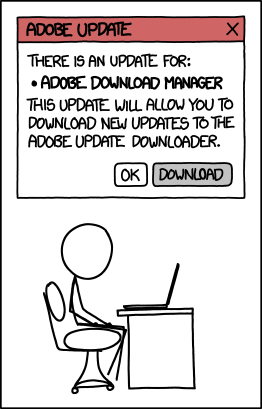
ALERT: Some pending mandatory software updates require version 21.1.2 of the Oracle/Sun Java(tm) JDK(tm) Update Manager Runtime Environment Meta-Updater, which is not available for your platform.
10 Apr 16:11

Archy and Mehitabel

by Greg Ross

http://commons.wikimedia.org/wiki/File:First_drawing_of_Archy.gif

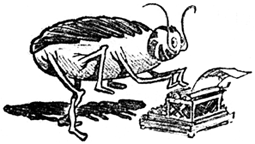
In 1916, New York Sun columnist Don Marquis told his readers an unlikely story: He had arrived early at work to discover a gigantic cockroach jumping about on the keys of his typewriter.

“He did not see us, and we watched him,” Marquis wrote. “He would climb painfully upon the framework of the machine and cast himself with all his force upon a key, head downward, and his weight and the impact of the blow were just sufficient to operate the machine, one slow letter after another.” The result was poetry:

expression is the need of my soul
i was once a vers libre bard
but i died and my soul went into the body of a cockroach
it has given me a new outlook upon life …

there is a cat here called mehitabel i wish you would have
removed she nearly ate me the other night why dont she
catch rats that is what she is supposed to be for
there is a rat here she should get without delay

In the years that followed, the sensitive cockroach helped Marquis fill hundreds of pages with wry and sometimes trenchant social commentary:

as i was crawling
through the holes in
a swiss cheese
the other
day it occurred to
me to wonder
what a swiss cheese
would think if
a swiss cheese
could think and after
cogitating for some
time i said to myself
if a swiss cheese
could think
it would think that
a swiss cheese
was the most important
thing in the world
just as everything that
can think at all
does think about itself

And:

a good many
failures are happy
because they dont
realize it many a
cockroach believes
himself as beautiful
as a butterfly
have a heart o have
a heart and
let them dream on

It’s not clear what inspired Marquis to create such an unlikely pair of characters, but his friend Christopher Morley offered one idea. “I remember that in the early days of the ‘Sun Dial,’ when the paper moved from Park Row to Nassau Street, Don’s typewriter desk got lost in the skirmish; so for some years he rattled out his daily stint with his machine perched on an up-ended packing case. This box had stenciled on it the statement 1 GROSS TOM CAT, which meant Tomato Catsup, but became by legend the first suggestion of mehitabel.”

10 Apr 16:07

How to win Snake

How to win Snake
10 Apr 11:05

Destined

by Doug
Adam Victor Brandizzi

Taí um alerta relevante. Mas não para vocês aqui, acho que ninguém faria isso...

Destined

Saddest comic strip character ever! Here’s more destiny.

09 Apr 19:12

O mausoléu Kim e o culto à personalidade na Coreia do Norte

by Cláudia Trevisan

O Palácio do Sol é o centro do fervoroso culto à personalidade dos líderes da família Kim, a dinastia que comanda a Coreia do Norte há três gerações. Visto como um lugar sagrado, o edifício abriga os corpos embalsamados de Kim Il-sung e Kim Jong-il, em salas cujas proporções fazem os mausoléus de Mao Tsé-tung, em Pequim, e de Vladimir Lenin, em Moscou, parecerem casas de bonecas.

Ir ao local é um ritual quase religioso, que centenas de norte-coreanos realizam diariamente. As visitas são organizadas por entidades estatais e ninguém pode entrar no palácio sem prévia autorização oficial. Domingo é o único dia em que estrangeiros são aceitos, desde que obtenham com antecedência o sinal verde do Ministério das Relações Exteriores.

Grupos de norte-coreanos chegam ao mausoléu em ônibus e fazem filas antes de começar a peregrinação dentro do imenso edifício, onde Kim Il-sung morou e trabalhou até morrer, em 1994. Com a morte de seu filho, em dezembro de 2011, o local foi remodelado para abrigar os corpos de ambos e reaberto um ano mais tarde.

As paredes de pé direito altíssimo são cobertas de mármore, enquanto lustres de cristal iluminam os amplos salões, em contraste com a pobreza na qual vive a maioria da população. Os visitantes entram no palácio por um esteira rolante, que percorre quase 200 metros ao som do clássico norte-coreano “O presidente Kim Il-sung e o líder Kim Jong-il estarão eternamente conosco”.

A esteira seguinte atravessa um corredor decorado com fotos de Kim Il-sung desempenhando as mais diversas funções _inspeções de fábricas, visitas a escolas, reuniões com militares e encontros com dirigentes estrangeiros. Imagens semelhantes de Kim Jong-il ocupam o trecho subsequente. Por fim, há um corredor com fotografias de pai e filho juntos. O atual líder, Kim Jong-un aparece em algumas delas ao lado de seu pai.

Vestidos com suas melhores roupas, os norte-coreanos caminham em silêncio. Ao fim da peregrinação pelas fotos, são levados a um salão decorado com estátuas brancas dos Kim mortos. O ritual exige que se postem diante delas e realizem uma reverência acentuada.

Depois de passar por jatos de ar para a retirada de poeira, os norte-coreanos podem finalmente entrar no salão onde está Kim Il-sung, imerso em uma penumbra de tons avermelhados. Todos têm de realizar três reverências: uma diante do corpo e duas nas laterais. A mesma coreografia é repetida perante Kim Jong-il, instalado em outra sala de cenário idêntico.

A peregrinação continua em salões dedicadas a condecorações recebidas por cada um dos Kim de dirigentes estrangeiros, que têm a função de apresentar à população o suposto prestígio internacional da dinastia. Em uma das fotos que decoram as paredes, Kim Il-sung aparece ao lado de Hafez al-Assad, pai do atual ditador sírio, Bashar al-Assad.

A exibição é completada com a apresentação, em salas separadas, dos vagões de trem utilizados pelos líderes em seus deslocamentos. Painéis eletrônicos mostram o número de viagens realizadas e o total de quilômetros percorridos. Avesso a voar, Kim Jong-il usou o trem 1.567 vezes, nas quais viajou 334 mil quilômetros.

Do lado de fora, centenas de civis e soldados norte-coreanos trabalhavam ontem no jardim do Palácio do Sol, dentro dos preparativos para a celebração dos 101 anos de nascimento de Kim Il-sung, no dia 15 de abril. Na mitologia criada pela propaganda oficial, ele é o “presidente eterno”.

09 Apr 19:00

Nada demais

by Arnaldo Branco

09 Apr 19:00

Dupla de dois resolve duplas de três

by Renato Pincelli

Esporádicas. Assim são as soluções para problemas físico-matemáticos que atormentam os cientistas há séculos. Hoje aparece uma, outra é proposta daqui um par de décadas, depois de meio século surge uma terceira resposta. É bem entediante. É bem frustrante. Então não é difícil imaginar como a comunidade científica reage quando uma solução — uma que seja — é apresentada por alguém.

fantastic

Continuando nosso experimento mental, imaginem agora o que acontece quando são divulgadas ao mesmo tempo não uma, nem duas, nem três, mas treze — treze, TREZE, 13 — soluções para um problema secular como o Problema dos Três Corpos.

sooo excited

O problema foi originalmente proposto pelo próprio Isaac Newton (1643-1727) e encontra-se na Proposição 66 do livro I dos Principia Mathematica e em seus 22 corolários subsequentes. O problema ainda reaparece nas proposições 25-35 do livro III, onde Newton trata da teoria lunar, i.e., do movimento da Lua sobre influência do Sol e da Terra.

Ao longo do século XVIII, o interesse sobre esse tipo de problema foi crescente. Tornar mais precisas as medições da órbita lunar significava, afinal, mais precisão na navegação, pois isso ajudaria a determinar a longitude geográfica em alto-mar. Na década de 1740, Jean d’Alambert (1717-1783) foi um dos que mais se dedicaram a esse problema e foi ele que passou a chamá-lo de menage à trois Problème des Trois Corps. Outro que se debruçou sobre o problema foi Joseph-Louis Lagrange (1736-1813), que em meio às suas investigações acabou encontrando os famosos pontos lagrangianos.

O caso do sistema com satélite ao redor de um planeta ao redor de uma estrela é o mais comum, mas não é o único. Dois séculos depois de Lagrange, nestes tempos de exploração espacial, o que não faltam são três corpos rodopiando por aí com atração gravitacional: podem ser três satélites ao redor de um planeta (e nós temos bem mais que isso). Ou então um exo-planeta ao redor de uma estrela-binária. Ou ainda três galáxias em meio a um cluster. E não é um problema apenas na escala cósmica. Há equivalentes nas escalas molecular e atômica.

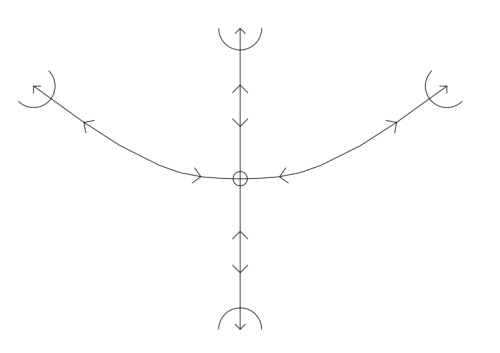
Calcular as trajetórias de dois corpos gravitacionalmente ligados é simples. As leis gravitacionais de Newton nos dizem que nesse caso sempre teremos uma elipse. Mas a coisa complica com três bolas corpos. Tanto que até agora eram conhecidas apenas três configurações possíveis para o Problema dos Três Corpos: o sistema Lagrange-Euler, o sistema Broucke-Hénon e o caso meio óbvio que resulta numa figura parecida com o número 8 — ou, dependendo da sua referência, com ∞, o símbolo do infinito.

A maneira mais simples de descobrir esses padrões de órbitas é observando, como foi o caso do sistema Lagrange-Euler — um exemplo desse sistema é o modo como o Sol, Jupiter e o asteroide Trojan orbitam um ao outro. Ou então você pode “partir pra ignorância” e usar simulações computacionais.

Foi essa a abordagem adotada pelos físicos Milovan Šuvakov e V. Dmitrašinović, do Instituto de Física de Belgrado, na Sérvia. Os dois pesquisadores começaram com a simulação de uma solução já conhecida, mas mudaram um pouco alguns parâmetros para ver o que é que aconteceria. Essa curiosidade matemática parece ter se alinhado com Marte Júpiter Urano Plutão uma sorte tremenda e o resultado foi a descoberta de 13 — treze, TREZE — novas famílias de órbitas. E são órbitas estáveis, que eventualmente levam os corpos para os mesmos lugares onde estavam no início da simulação.

Physics duo discover 13 new solutions to three-body orbit problem

Em meio a (relativa) enxurrada de soluções possíveis, como se fazem comparações e análises? Šuvakov e  Dmitrašinović decidiram usar o olhômetro mesmo e criaram versões topologicamente visíveis de todas aquelas órbitas. Elas foram virtualmente inseridas em uma esfera translúcida na qual era possível ver com o quê elas se pareciam. E foram, então, classificadas como “borboleta”, “óculos”, “novelos”, etc. Todas as possíveis soluções já foram publicadas em artigo na edição de 13 de março deste ano da Physical Review Letters.

No entanto, as 13 novas famílias orbitais descobertas pela dupla sérvia ainda não foram extensivamente testadas para verificar se são capazes de se manter estáveis por looooongos períodos de tempo. Os pesquisadores indicam que esse deve ser o próximo passo de sua pesquisa. Se confirmados teoricamente, todos esses novos modelos podem guiar estudos observacionais de sistemas reais. E o zoológico cósmico pode ficar ainda mais bizarro rico do que já parece.

rb2_large_gray25Referência
Šuvakov, M. Dmitrašinović V. Three Classes of Newtonian Three-Body Planar Periodic Orbits, Phys. Rev. Lett. 110, 114301 (2013) DOI:10.1103/PhysRevLett.110.114301

09 Apr 18:57

April 09, 2013


One last reminder, and I think it'll be too late! We've only got about 50 tickets left for sale for BAH! Looks like it's going to be a packed house, so if you want in, we sincerely encourage you to buy online. We may have some tickets at the door, but I can't promise anything!
09 Apr 18:56

Mamonaway to Hell II

by noreply@blogger.com (Philipe Maciel)
Adam Victor Brandizzi

Não gosto de Mamonas, mas enfim.

Marco Feliciano diz que acidente com Mamonas Assassinas foi castigo de Deus

Não fiquei especialmente surpreso. Há algum tempo contei um caso algo semelhante:

***
O ano é 1996. O local: um colégio confessional. Alunos com 10 ou 11 anos.

No final de semana passado, uma trágico acidente de avião havia terminado com a carreira e a vida dos Mamonas Assassinas. Durante uma aula de ensino religioso um aluno pergunta:

- (Autoridade religiosa encarregada), você acha que os Mamonas foram para o céu?

- Sei não... Eles falavam muito palavrão, né?

Ah, ok. O grupo havia feito (quase) todo o Brasil rir um bocado durante a sua curta passagem. E tudo o que aautoridade religiosa encarregada conseguiu pensar foi que eles devem ter ido para o inferno... por falar palavrão.

Isso porque os alunos já estavam bastante chateados com a tragédia.

Não sei se os outros esqueceram, mas eu não esqueci.


09 Apr 18:50

O último post sobre tomate (ou: uma anedota do Brasil que não dá certo)

by Drunkeynesian
Imagino que, como eu, o leitor não aguenta mais ouvir falar do preço de tomate. Já me desculpo antecipadamente por voltar ao tema, prometo, pela última vez. O infográfico abaixo está na capa da Folha de hoje, mostrando a viagem de 65 dias que o tomate faz do interior da China até às fábricas que o processam em ketchup e molho, em Goiás: A história pode ser lida como um imenso jogo de erros,
09 Apr 18:49

Brothers in Binary

by Greg Ross
Adam Victor Brandizzi

Ma' como assim?!

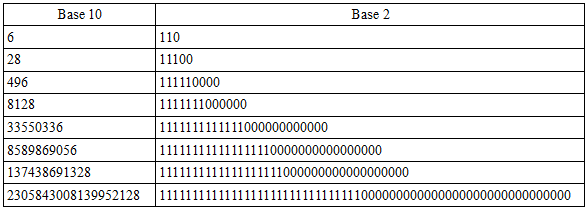
A number is said to be perfect if it equals the sum of its divisors: 6 is divisible by 1, 2, and 3, and 1 + 2 + 3 = 6.

St. Augustine wrote, “Six is a number perfect in itself, and not because God created all things in six days; rather the converse is true; God created all things in six days because this number is perfect, and it would have been perfect even if the work of the six days did not exist.”

Perfect numbers are rare. No one knows whether an infinite quantity exist, and no one knows whether any of them are odd. The early Greeks knew the first four, and in the ensuing two millennia we’ve uncovered only 44 more. But they have one thing in common — they reveal a curious harmony when expressed in base 2:

brothers in binary

09 Apr 18:46

doctordonna10: castielsunderpants: mattykeehl: gallifrey-feels...


doctordonna10:

castielsunderpants:

mattykeehl:

gallifrey-feels:

echoingdaydreams:

dandeleijons:

mrdecomposition:

i-wanted-to-rp-so-i:

wholocked-me-in-my-mindpalace:

improbablenormality:

johnisnothisdate:

catatonicconundrum:

adolfi:

Hitler flirting with Eva Braun.

I don’t know how this makes me feel

It makes me feel very uncomfortable

You know what’s so uncomfortable about this? It shows that perhaps one of the most evil men in history, was a human being. That, on occasion, he could be nice, even flirty. That’s not all. You want to see evil people as evil, screaming horrible stuff over a desk with 20 microphones with 20, 000 people saluting them. The evil is clear and recognizable then. This shows a completely different image, it scares you because that means that evil isn’t a stereotype, that evil is not recognizable, that evil could be anyone. It scares you because this shows that could be lurking inside anyone and you’ll never ever know. Maybe in you? 

i reblogged this literally like 2 minutes ago, but i want this version because of that comment ^

That comment is one of my favorite post commentaries, because it’s completely right. People aren’t inherently evil. Like good, it’s a role they grow and live into. We have just as much potential to destroy as this man exhibited. And it’s a very eye opening experience to realize that.

does anyone even remember that one time hitler attended that luncheon between world leaders, some guests of which even included china’s socialist leader as well as Stalin. And then when they were ordering, everyone was gladly ordering impressive dishes one after the other, but Hitler placed an order for barley tea and a pheasant (considered a peasant’s meal by standard). When he was questioned as to why he would order something like this in something as grand as a world leader’s congress, he replied,

“I don’t smoke when my people cannot smoke, and I cannot eat when my people are going hungry.”

He wasn’t evil for its own sake, let’s try to remember that despite the countless murders, but for a moment, he did actually believe he was doing something for the good of his countrymen.

WHAT IS WRONG WITH YOU PEOPLE

No, he’s right. Hitler, though extremely wrong in his views, did everything for what he thought would better the lives of his people. It was wrong. It was disgustingly, horribly wrong. But he did not do it because it was evil and he was evil. He did it because he believed it would help Germany and those who needed a better life. Those who don’t understand or even try to understand the human brain will always label men like him as ‘evil’ because it is easier to accept. But he wasn’t ‘evil.’ He felt love and loyalty and responsibilities. He simply took these aspects and morphed them into a twisted, violent thing. 

Tumblr is probably the only place we could have this conversation and not be lynched.

oh my god reblogging if only for the last comment

this is literally the best thing on tumblr

08 Apr 22:45

7 mitos sobre a economia brasileira que foram / estão sendo / serão destruídos

by Drunkeynesian
Diz George Soros (vou citar de orelha porque meus livros sumiram; se notarem algum erro, por favor corrijam) que bolhas especulativas nascem de uma percepção de mudança de paradigma. Na medida em que aparecem sinais dessa mudança, mais pessoas investem nela, o que reforça os sinais e atrai mais gente. Depois de algumas rodadas desse auto-reforço, a percepção se descola tanto da realidade que,
08 Apr 16:51

The Price of Wine

Adam Victor Brandizzi

Que preço de vinho é picaretagem já sabemos, mas gostei muito da história do final, mesmo porque permite vender a experiência sendo honesto.

A bottle of Château Lafite Rothschild Bordeaux is considered by many to be the world’s greatest wine. In the 17th century, both the British Prime Minister and King Louis XV drank it regularly. In 1855, when Napoleon instructed French wine experts to classify France’s Bordeaux wines, Lafite Rothschild earned a top spot as a Premier Cru, a rank it maintains to this day. 

image

Thomas Jefferson ranked among its admirers. In 1985, a 1787 bottle of Lafite Bordeaux that he supposedly owned sold at auction for $156,000. It was the most expensive bottle of wine ever sold. Chateau Lafite Rothschild released their most recent Bordeaux for 420 euros a bottle. Older bottles command prices higher than $1,000. 

Wine experts discuss Lafite as if they are tasting an ever-changing Impressionist painting. “The wine still has a dark ruby/purple color and an extraordinarily youthful nose of graphite, black currants, sweet, unsmoked cigar tobacco, and flowers,” writes influential American wine critic Robert Parker on the 2000 Lafite. “I originally predicted that it would first reach maturity in 2011, but I would push that back by 5-7 years now.” 

However, it’s unclear whether anyone can tell the difference between a $2,000 Lafite Bordeaux and a $3 table wine. In fact, most wine economists consider the matter settled. Blind tastings and academic studies robustly show that neither amateur consumers nor expert judges can consistently differentiate between fine wines and cheap wines, nor identify the flavors within them. 

So, what’s going on in the wine industry? If a $10, $100, and $1,000 bottle all roughly taste the same in a blind taste test, how do you explain their different price tags?

How the World Produces 23 Billion Liters of Wine

Wine is simply fermented grape juice, but its production is a finicky process. Very real differences in production exist between top and bottom-shelf wines.

image

Asked about the keys to winemaking, the proprietor of Domaine Dujac, an expensive French Burgundy wine, responded, “The soil, the soil, and the soil.” In fertile soil, grapes fill with water that dilutes the flavor. Only grapes grown on rocky or otherwise challenging land stay flavorful. Characteristics of the soil also impact taste, as do the climate and topography. The French use the term “terroir” to express how these characteristics flavor wine.

It’s easy to get lost in the complexities of winemaking. But looking at the two poles of the wine market - a two dollar Charles Shaw chardonnay and a pricey Lafite Bordeaux - aptly demonstrates differences in production.

Charles Shaw wine is nicknamed “Two-Buck Chuck” because it first sold at Trader Joe’s supermarkets for $1.99. The makers, the Bronco Wine Company, grow grapes in California’s Central Valley. The soil is considered too fertile to produce flavorful grapes, but produces high yields. 

image

The process is an economy of scale par excellence. Once picked, grapes are processed and bottled in “a high-speed bottling plant capable of churning out 18 million cases of wine a year, double the annual production of all the rest of Napa Valley.” Bronco also buys surplus wine from other California vineyards at bargain prices. 

Owner Frank Franzia doesn’t bother with notions of terroir. All the wine is blended together, regardless of its origin. As of 2003, Bronco processed 300,000 tons of grapes to make 20 million cases of wine, of which a quarter are Charles Shaw wines. Asked how he sells wine for the same price as a bottle of water, Franzia responded, ““They’re overcharging for the water. Don’t you get it?”

Lafite treats viniculture as art. Its soil of gravel, sand, and limestone in the Medoc region of France results in low yields but flavorful grapes. Various combinations of grapes are tried in pursuit of the best possible vintage. Only grapes grown in the chateau’s best soil are bottled as premier cru (first growth) Bordeaux. The rest are bottled as a “second growth” that sells for a fraction of the price. Total production is under 100,000 cases a year. On-site coopers make wooden barrels specially suited to imparting flavor. Staff light candles in the tasting area before wine is sampled. Although not every wine benefits from extensive aging, Lafite Bordeaux ages for a decade or more before maturing into complex flavors.

But not every wine is produced and sold by wineries. Wine merchants called negociants buy wine to bottle and sell under their own name and label. Every year, wineries make more wine than they can sell. The world consumed only 23.21 billion liters of wine in 2010. Wineries produced 26.38 billion liters. Negociants buy and sell this surplus.

Savvy salesmen can make good money. Cameron Hughes, an American negociant, sells 400,000 cases of wine at prices ranging from $10 to $60. Giant labels like Charles Shaw and Yellow Tail, despite having their own vineyards, mostly buy and blend other wineries’ grapes.

For some wineries, selling to negociants is a shameful necessity. Other wineries, especially smaller ones focused on the winemaking process, are happy to have someone do the sales work that they prefer to avoid.

Just four countries, Italy, France, the US, and Spain, produce 58% of the world’s wine; they also consume 40% of it. But the market for fine wines is more globalized. Chateau Lafite Rothschild exported 75% of its premier cru in 2008.

image

Pricing Wine

To learn more about the wine industry, we talked with Troy Carter, founder of Motorcycle Wineries in San Francisco. He explained wine as having two industries: one is industrial, efficient, and cheap; the other is romantic and expensive.

Cheap and efficient wine constitutes the majority of wine that the world drinks. Among Americans who drink wine regularly, only 12% spend $30 or more on a bottle weekly or monthly. Yellow Tail, a budget Australian wine, is the number one imported wine in America. The US imports more Yellow Tail each year than the total number of bottles imported from France. Troy estimates that 90% of wine by volume is under $10 a bottle.

In this part of the market, price is mostly determined by production and distribution costs.

Wine is widely dispersed to stores, supermarkets, restaurants, and private collectors. Wineries avoid these sales responsibilities, so wine merchants and distributors do the work for them. 

image

Troy Carter describes the distribution process - for a wine that sells for about $30 - as follows. Distributors buy cases of wine from the maker at $15 per bottle. They then sell it to restaurants and stores for $20. Restaurants’ markups vary, but stores consistently sell it for $29. Vacationers in Napa Valley will pay $30 to buy the bottle directly from the winery - it is something of a standard that bottles cost one dollar less at stores than at wineries, according to Troy. Supermarket chains like Costco, which is the largest provider of wine in the US, sell the bottle for around $22 - just above wholesale prices. 

For cheaper wines, the economics of distribution work similarly. When you buy a $6 bottle of Yellow Tail chardonnay, that somehow covers the production cost, taxes, import duties, and various markups. 

The boundaries are fuzzy, but as you look at the pricing of mid-range wines that cost from $10 to $70, the rules are less straightforward. Marginal production costs become disentangled from price. At $50, Troy told us, pricing is nearly independent of production costs.

In this range, brands can dramatically affect price. The same wine in two differently branded bottles can have very different costs, as shown by the prices offered by negociants such as Cameron Hughes:

“Hughes signs confidentiality agreements that preserve a winery’s anonymity. After all, a producer of a $40 Napa Valley cabernet sauvignon doesn’t want his customers to know they can get a nearly identical wine from Hughes for $25. Yet the winery might need to move out surplus inventory, generate cash flow or make full use of capacity, a win-win-win situation for the producers, consumers and Hughes.”

The region of origin also significantly impacts price. Wines from Napa, for example, are 61% more expensive than other Californian wines, everything else being equal. This reflects differences in quality, as Napa’s soil and many of its winemakers are well regarded. It also speaks to the branding power of certain regions. There is a reason that Napa winemakers cry foul when Frank Franzia labels Charles Shaw as Napa wine, even though the grapes come from the Central Valley.

image

Reviews by prominent wine critics also impact the price of a bottle of wine. The reviews of Robert Parker, the world’s most influential wine critic, can dramatically impact price and demand. (He is known for fine wine, but tastes wines as inexpensive as $20.) As a definitive Atlantic article said about Parker:

“A positive review and a score over 90, especially for a wine that is produced in small quantities, can ignite speculation that sends the price rocketing and clears the wine out of the stores.”

A mix of production and distribution costs, brand reputation, pricing strategies, and quality and critical reception determine prices of mid-range wines. There are some pricing anomalies, but for the most part, the market for wines in the $4 to $70 range operate how you’d expect markets to work.

Fine wines, however, are a different beast. Almost entirely caché, their prices rise and fall with little connection to quality. 

Speculating In Human Snobbery

One night in 2007, this author found himself at a dinner party at a billionaire’s house. After the meal, the host gave a tour of his wine cellar. “The best part of having a wine cellar,” he confided, “is that you can drink thousands of dollars of wine for free.”

He accomplished this by taking advantage of the fact that many wines increase in quality, and therefore in price, as they age. Until the turn of the millenium, oenophiles wealthy enough to sit on thousand dollar cases of wine for a decade dabbled in “investing” in wine, usually with a glass of Bordeaux in hand. As described by commentator Darius Sanai:

“For centuries, investing in wine was fairly straightforward. You would buy as many cases of classed-growth claret en primeur (as futures) as your budget allowed, watch their value double over the next few years, take delivery of half of them, and sell the remainder to recoup your initial investment. Your capital was returned to you, and your interest was carried in all the fine wine you would need to entertain your guests over a lifetime.”

And if an investment went bad, you simply threw a very expensive dinner party. 

In the mid 2000s, Chinese nouveau riche entered the fine wine market. China’s economic growth produced over one million millionaires who sought out Western status symbols. London filled with third-world businessmen who drove Maseratis and shopped at Harrods. New York City received the same treatment, as did luxury brands like Gucci. And fine wine.

The demand for premium wine skyrocketed. Prices saw exponential growth from 2008-2010. The below graph shows the value of fifty premium wines over time, accounting for the increased price of aged wines:

image

Whereas premium wines once only modestly appreciated in price, suddenly ten thousand dollar cases doubled in price in a year. Hong Kong auctions of Chateau Lafite Rothschild commanded prices at double their traded rates in the United States and Europe days earlier.

Financiers took note. Banks set up fine wine divisions and wine investment funds began shopping for clients. An organization called the London International Vintners Exchange (Liv Ex) created indices for fine wine. The Live Ex 50, which charts the prices of the world’s top performing 50 wines, acts exactly like the Nasdaq 500 does for stock brokers. Investors can buy what essentially amount to futures by buying wine “en primeur” before it is bottled. 

To understand the economics of fine wine, we talked with James Maskell, who created Vinetrade, an online marketplace for wines. 

According to James, the Chinese preference for these elite wines is mostly about caché. Bottles are being purchased as a symbol of wealth - or to use as a bribe. According to James, the “pricing is maybe 25-30% quality, 70-75% brand.” Since caché is all about rarity, demand for a wine (say, a 1982 Mouton Rothschild Bordeaux) increases as supply decreases, accelerating the appreciation of wine prices.

This market consists of very few wines. According to Liv Ex

“The top 25 chateaux in Bordeaux and a handful of properties from other regions dominate. Indeed, our research suggests that just eight wines – the five First Growths, plus Petrus, Cheval Blanc and Ausone – account for more than 80 per cent of a typical wine fund’s portfolio by value.”

image

But investors cannot simply buy top wines and wait for them to appreciate in value. In 2008, Bordeaux producers raised their prices dramatically to capture the profit margins made by speculators. Merchants and investors balked, and suddenly the bubble popped. Investors undercut each other in their hurry to sell. Cases priced at £15,000 sold for £6,000 or £7,000 before the market stabilized.

The top Bordeaux alone cannot satisfy demand, so today’s wine investors need to predict the next wine to be anointed a member of this market. Bordeaux second wines took off first, then elite French Burgundies. One investor James knows buys similar Italian wines in the expectation that they too will become an elite wine.

So today, wine analysts in London, New York, and Hong Kong assemble “huge spreadsheets with things like critic scores, drinking windows, available supply and prices that they manually compile and analyse” in search of the next wine that Chinese businessmen will buy to one up each other. They speculate in human snobbery.

The supply of “great” wine is decreasing, because inevitably, someone drinks a bottle. At the same time, the demand is skyrocketing. But is the demand for expensive wine remotely rationale? Can our brains tell the difference between the taste of an expensive wine and cheap wine?

Is Wine a Hoax?

The academic literature on the taste and quality of different wines is robust and damning: when tasting wines without reference to their name, type, or price, no one can consistently identify them or rate their quality.

In 2007, Charles Shaw was named California’s best chardonnay at the California State Fair Commercial Wine Competition. “It was a delight to taste,” announced one judge. In 2012, top French wines (including the premier cru Château Mouton Rothschild) barely defeated wines from New Jersey in a professional tasting. The Jersey wines cost 5% as much as the French wines.

These results are not aberrations. A 2008 paper in The Journal of Wine Economics found that when consumers are unaware of a wine’s price, they “on average enjoy more expensive wines slightly less [than cheap ones].” Experts do not fare much better. The study could not conclude that experts preferred nicer wine: “In sum, we find a non-negative relationship between price and overall rating for experts. Due to the poor statistical significance of the price coefficient for experts, it remains an open question whether this coefficient is in fact positive.” Further academic evidence strongly suggests that experts cannot identify “good” wine.

image

The 100 point scale for rating wine, invented by Robert M. Parker Jr., is extremely influential. According to the buying director of prestigious wine merchant BB&R, “Nobody sells wine like Robert Parker. If he turns around and says 2012 is the worst vintage I’ve tasted, nobody will buy it, but if he says it’s the best, everybody will.”

When retired statistician and hobbyist winemaker Robert Hodgson successfully lobbied to measure the accuracy of the system, his results showed that the judging was completely inconsistent. By having the judges rate the same wine multiple times, he found that:

“The judges’ wine ratings typically varied by ±4 points on a standard ratings scale running from 80 to 100. A wine rated 91 on one tasting would often be rated an 87 or 95 on the next. Some of the judges did much worse, and only about one in 10 regularly rated the same wine within a range of ±2 points.”

Year after year, Hodgson replicated his results. When he broadened his scope to results of hundreds of wine competitions, he found that the distribution of medals “mirrors what might be expected should a gold medal be awarded by chance alone.”

More sanguine critics - who do not dismiss studies like Hodgson’s as “hogwash” - often point to the shortcomings of tastings and the subjectivity of taste. But a number of experiments show that experts’ descriptions of wine’s flavors are equally flawed.

In one experiment, critics tasted one red wine and one white wine. They described the red in language typical of reds and the white in language typical of whites. The problem? Both were identical white wines; the “red” had been tinted with food coloring. 

Why then do critics and consumers believe that there are superior wines that justify a higher price tag? Well, outside the world of double-blind taste tests, perceptions matter. People are influenced by wine critics, marketing, and fear of not understanding the rules of the wine game. 

Numerous experiments have shown that people will enjoy a table wine and a fine wine equally if they believe that they are both fine wine. Knowing that a wine is supposed to be good does literally make it taste better. The drinkers could be lying about enjoying the “bad” wine due to social pressure. However, an experiment involving a Stanford wine tasting group, a lineup of identical wines presented under fake price tags from $5 to $90, and a fMRI machine measuring activity in areas of the brain correlated with pleasure suggests otherwise. Drinking the same wine with a higher price tag did increase pleasure.

This author has happily spent extra money on wine that he considers superior. But to the best of his knowledge, no compelling account exists to explain away these results. The literature seems clear. Despite the substantial differences in wine production and hundreds of years of history, the only significant difference between wines’ quality is pure perception.

A Tale of Two Startups

In an industry with such inefficiencies, there must be money to be made by clear thinking entrepreneurs, right?

After a year observing wine collectors and investors while working in the industry in London, James Maskell believed that the industry’s opaque network of luddite middlemen offered an opportunity. With venture capital backing, he and a co-founder launched a website called Vinetrade as a marketplace for buying and selling fine wines in 2012. Users could list their wines for sale and buy from other investors and collectors with a few clicks. They aimed to play a “classic intermediation game - connect buyers and sellers, increase transparency, cut margins, and take a small cut” for themselves. 

image

Customers wanted to avoid middlemen’s fees (around 15%) and to buy and sell without picking up a phone, so many people in the market expected them to do well. However, in early 2013, James made the hard decision to shut Vinetrade down

The most fundamental problem, as they discovered, was that people resisted ordering wine online. For hobbyists, it destroyed the fun of being part of an elite group that unashamedly used words like “tannin” and “subtle.” For investors, it denied them the opportunity to exchange information with salesmen.

“Even if they don’t admit it,” James told us, “people like having the posh voice on the other end of the line. They want reassurance and they want to feel part of the ‘boy’s club.’”

In the stock market, most assets have an underlying value based on objective facts. In wine, taste and quality is a factor of perception. Investors deal, then, in perceptions of perceptions. In the small world of insanely expensive wine, value and prices are determined by what the wine clique is saying about a given vintage.

At best, James estimates that quality is a 25% factor in a fine wine’s price. Sellers could not afford to trade conversations with salesmen for the efficiency of a computer screen because the only currency in the market is everyone else’s take on given wines. It would be like trying to predict the next “it” couple in high school without talking to the popular crowd.

“I think that we proved that people buying wine don’t care about our data and don’t care about our graphs,” James reflected. “They care about what people are saying.”

Meanwhile, In 2012, Troy Carter took a different approach to a wine startup - he bought a motorcycle and began driving around California wine country. He rode up to small wineries, said, “Hi, I’m Troy,” and asked to sample their wines. When he found a wine tasty and unique and the winemaker pleasant and “authentic,” he offered to buy wine to distribute and sell through his mailing list “Motorcycle Wineries.” Trucks drive the wine he buys from California wineries to his San Francisco warehouse where he distributes them to restaurants and individuals. 

image

Troy’s goal with Motorcycle Wineries - beside being able to travel and taste any wine he wants - is to bring romance and authenticity to the experience of buying wine. “If you just want wine that tastes good, you can go to Costco,” he told us. “But there is a large group of people that want to have a unique experience. They want to discover wine at a tasting or at a winery off the beaten path. They want the history of finding something that was sitting in a cellar for a long time. That is what I provide.”

He works only with tiny vineyards where the makers handle the bottles themselves, use natural winemaking techniques like organic grapes, and follow traditional techniques like hand-bottling. High labor costs renders these wines more expensive. “Authenticity does not scale very well,” Troy says. Nevertheless, his bottles cost around $15.

How did Troy convince winemakers to trust him as he got started? By wearing leather. “They’re the only clothes I own,” Troy said, looking down at his understated leather pants and jacket. By showing up on a motorcycle wearing leather, he looked the part of a man who travels the world looking for unique wines. When he didn’t wear leather, he was not taken seriously. “Winemakers ride motorcycles,” Troy told us. “I don’t know why, but they do. Maybe because they have a romanticized vision of wine. Like I do.”

Romancing the Wine Industry

People inside and outside the wine world can argue whether a 1982 Lafite Rothschild is incredible or a scam. But it almost no longer matters. The end result of the fine wine market’s cherished romanticization of wines like Lafite is that now only corrupt businessmen and oligarchs can afford it. 

Vinetrade may have failed to bring transparency to fine wine, but Motorcycle Wineries could be just as disruptive. By building a brand that brings magic to $15 bottles of wine, Troy could disentangle the romantic, experience-based aspect of wine that people love from the caché of premium brands and obscene price tags - with the side effect of offering the same dignity to small, passionate wineries that is currently afforded only to industrial scale wineries with old-timey marketing.

But you, as a consumer, don’t need anyone in the wine business to tell you what to drink. The industry thrives on people’s anxiety about buying good wine, but critics aren’t very good at identifying it. Feel free to buy a cheap wine from the bottom-shelf of the supermarket, and don’t let anyone tell you that you shouldn’t enjoy it. You’ll be just as happy with it.

This post was written by Alex Mayyasi. He’d like to thank James and Troy for their time, patience, and expertise. Follow him on Twitter here or Google Plus.

08 Apr 10:35

Mães não ouvem rock

by Sharon Caleffi

Perdi todas as camisetas de banda na gravidez, nunca voltei ao tamanho delas e doei tudo. Tava me sentindo outra pessoa, mais séria, menos eu, não sei explicar. Ninguém mais puxou o assunto “rock” comigo, só conhecidxs virtuais me mandando músicas e apresentando bandas. Aqui na vida real, nada de nada. Eu tava triste. Não tinha percebido muito bem o que tava faltando.

Mas então, nas férias, assisti “Nunca é tarde para amar” (I Could Never Be Your Woman), com a Michelle Pfeiffer. Um romancinho água com açúcar, mas com cenas muito fofas de mãe e filha ouvindo e fazendo rock. Izzie, interpretada pela Saoirse Ronan, está treinando uma paródia da música “Ironic” de Alanis Morissette e a mãe dá dicas. Não lembro bem como foi, mas diva Michelle disse algo assim:

“Por que você não se solta?”

Cena do filme "Nunca é tarde para amar", de 2007

Cena do filme “Nunca é tarde para amar”, de 2007

E o resultado não podia ter ficado mais bonitinho, vejam no seu tubo. Daí me caiu a ficha:

“Poxa, Sharon”, pensei cá comigo, “tá faltando você se jogar!”
Então eu comprei uma camiseta do Ramones e uma do Blur e uso em todo lugar agora. No pediatra. Na reunião da creche. No trabalho. Quero começar a conversar sobre rock de novo, pombas! Mães ouvem rock! Vamos marcar a posição!

Mas negócio é que quando virei mãe incorporei a seriedade da função. Talvez sejam as 24 horas por dia de preocupação, sei lá. Eu mesma não tinha percebido que tenho o mesmo preconceito com as mulheres que conheci já como mães. Isso a vida toda, nunca achei que mães ouvissem rock. Aí fui embora e voltei pra Pato Branco, que não é exatamente conhecida pelo mercado de música alternativa… rock em Pato Branco (até Beatles) é “alternativo”. Pessoal aqui ainda chama todo um universo de “rock pauleira”. Vai vendo. Meu preconceito consolidou como crença. Feio.

Então eu estava só convivendo por anos com roqueirxs e nem imaginava! Desde que casei frequento a casa de um casal de primos do marido, que tem filhos pequenos também. Sempre conversamos sobre filhos, família, trabalho, esses assuntos do cotidiano que a gente conversa com pessoas queridas, mas que não tem aquele sabor de uma conversa sobre música… E, como sempre estava tocando música sertaneja, ou passando DVD de show sertanejo, era no terreno seguro da vida cotidiana hétero, branca, classe média em que eu ficava. O preconceito se apresentou pra mim falando que gente adulta, de Pato Branco, não ouve rock. Caí na conversa do preconceito e neguei a mim mesma. Sharon, mães ouvem rock, sabia?

Preconceito é assim, né, só vê as coisas quando são escancaradas. Eu precisei admitir o meu nesse sábado de Páscoa, na casa dos primos.

Cheguei na churrasqueira e vi a decoração recente, ainda brilhando de nova… quadros com posteres de Hendrix, Beatles, Stones, tudo! Classic rock por todo lado! E, tocando, sertanejo. Como assim? Como assim? O povo tem uma coisa na parede e outra no som? Não segurei:

- Ei, primo, isso tudo aí é só pra bonito?

Foi como se nós tivéssemos acabado de nos apresentar. “Mas então ela gosta de rock!” Surgiu um acervo infinito de shows antigos, dos anos 70, umas bandas malucas e desconhecidas que eu não lembro o nome porque tava provando umas pingas mineiras também… e. Nossa. É outra coisa quando a gente ouve a música que a gente gosta. A conversa muda, agora estamos falando com irmãos que não víamos há séculos, gente que conhecemos a vida toda, mesmo tendo conhecido à poucos anos (minutos, no caso!).

Divulgação

Rock nessa vida é um solo seguro, mas de um tipo sem bordas. Não tem pra onde cair, tudo é rock. Depois que se finca o pé é a nossa casa, nossa pátria. Decidi então andar vestida com as roupas e as armas da pátria, sempre, pra poder encontrar mais desterrados nesse fim de mundo paranaense. Facilita. No meu caso, perdi mais ou menos uns 5 anos do melhor tipo de amizade!

Mães roqueiras tem aos montes, mas é difícil encontrar elas nessa internet, viu? Tenho amigas das antigas e amigas novas, mas é difícil achar o tema em blogs e reportagens. Alguma coisa aqui:

“Para meu filho ouvir quando”, da Débora Cassolatto, é uma reunião de vídeos ótimos, dedicados a várias ocasiões:
http://paraomeufilhoouvirquando.tumblr.com/
A Meriene Zamprogno tem o Mammy Rock, para “compartilhar experiências de uma mãe headbanguer e com isso mostrar que não somos tão diferentes assim, mãe é sempre mãe independente de estilo”. Muito legal!
http://mammyrock.blogspot.com.br/

E a Gisela Blanco, a Mãe Geek, escreveu um post sobre sua fugidinha pra ir num show, quando o Luisinho, o filho dela, tinha um mês e meio! Essa se jogou bem mais cedo que eu!http://www.maegeek.com/baby-sebastian/

E tem os festivais e festinhas pras famílias, né? Pena que tudo longe demais, nas capitais: Baby Boom, e o Kidspalooza em São Paulo… E na Bélgica tem o Kids ‘n’ Billies, uma dica legal do Ronaldo Nikolaiko!

Quem souber de mais blogs, posts, festas, shows, coisas que as mães da pátria rock fazem com e para os filhos (principalmente os pequerruchos) mandem pra cá!