
Adam Victor Brandizzi
Shared posts
30 Aug 01:53

What Am I?
by Greg Ross
Adam Victor BrandizziAcertei!
A riddle by Horatio Walpole:
Before my birth I had a name,
But soon as born I chang’d the same;
And when I’m laid within the tomb,
I shall my father’s name assume.
I change my name three days together
Yet live but one in any weather.
30 Aug 01:51
Laurie Webb - Aren’t you clever (by Bogdan Anton)
Adam Victor BrandizziEsranho, os vídeos do YouTube não têm aparecido para mim. E para vocês?

30 Aug 01:44
How to Spot the Various Types of Human Stupidity
by Scott Meyer

In today's Asking the Wrong Guy, Rick admits that the Knifeketeer is a fairly accurate depiction of his lifestyle. True story, for Christmas last year I bought him a knife.
As always, thanks for using my Amazon Affiliate links (US, UK, Canada).
Adam Victor Brandizzi likes this
29 Aug 22:50
Cara, esse vídeo sobreposto ao “This is Water” de...
Cara, esse vídeo sobreposto ao “This is Water” de David Foster Wallace tá muito bem feito!
This is the secret to life.
Politicalprof: David Foster Wallace explains it all to you. Listen.
There is no way to overstate how much we recommend taking 10 minutes to watch this video.
29 Aug 22:45

Photo
Adam Victor Brandizzisuperbad melhor comédia
Adam Victor Brandizzi and -1 others like this
29 Aug 22:44





robo-mime: the-eyeball-fairy: freudianslipnslide: bad-moon-mo...
babies are naturally able to swim hello they just spent nine moths in amiotic fluid this is instinctive so no, parent is not shitty, parent is re-enforcing baby’s natural instinctive behaviour.
parent is good for doing this because parent is basically saying “yes the behaviours you were born with are great!”
Yup, if babies are ‘taught’ (allowed) to swim before they are six weeks old, they never lose the instincts they were born with that lets them hold their head above water and hold their breath when they need to. SCIENCE, man.
What’s really cool is, humans are the only primates known to have this instinct at birth. Other ape babies would just freak out and drown. So I don’t think it comes from being in amniotic fluid for 9 months (since it’s not like they have room to actually swim in there). It’s been speculated that humans evolved in the ocean at some point, which is a really cool theory that I recommend checking out.
Also, SWIMMING BABY IS ADORABLE.
baby haruka nanase
Fernando, Adam Victor Brandizzi and -1 others like this
29 Aug 22:42


kawaii-afro-fluff: sameatschildren: theinturnet: the muscle...
the muscle cat omg
WHERE WAS THIS WHEN I WAS A KID????

is anyone thinking what i’m thinking
29 Aug 16:31
Primeiro motor a álcool do mundo será projetado por equipe da Engenharia Mecânica
Foca Lisboa/UFMG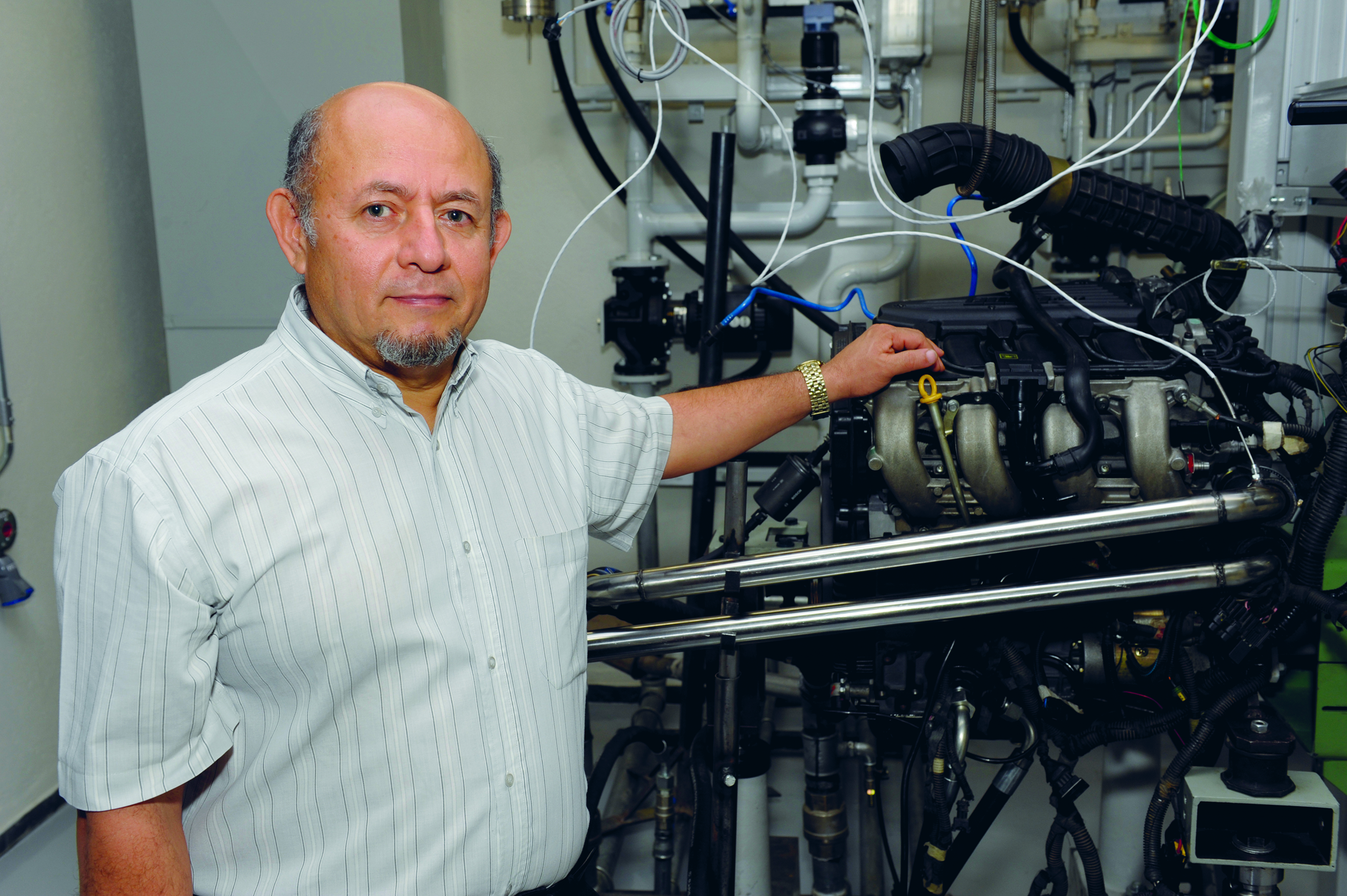
Ramon Molina: motor com emissão e consumo mínimos
Elaborar modelo computacional para o primeiro motor a álcool do mundo é o objetivo do convênio que a UFMG assina esta semana com a Fiat Automóveis. Coordenado pelo professor Ramon Molina Valle, do Departamento de Engenharia Mecânica da Escola de Engenharia, o projeto tem duração prevista de 18 meses, prorrogáveis por mais um ano, e vai custar R$ 1,8 milhão. Nunca se projetou um motor para álcool. Até agora, todos resultaram de modificações e otimização de parâmetros nos motores a gasolina", informa Molina Valle.
A ideia é dar subsídios para que a Fiat faça o primeiro específico, que aproveite ao máximo todas as potencialidades desse combustível, explica Molina, que prevê a obtenção de modelo inovador capaz de dar base para a criação de motor com consumo e emissões mínimos.
Cauteloso, embora otimista, Molina adverte que se trata de um longo processo, que pode levar em média dez anos entre a concepção e a chegada ao mercado. Depois de modelado computacionalmente, ele precisa ser construído. Daí sai o protótipo de pesquisa, que começa a ser testado experimentalmente, e só depois de conferir se o resultado é o proposto, ele passa a ser um protótipo para construção de produto final, relata.
As etapas envolvem calibração e ajustes de todos os componentes e aprovação na legislação de emissões. É possível que os dados da modelagem apresentem ótimas condições em desempenho e rendimento, mas as emissões não sejam baixas como o esperado. Tudo isso é corrigido experimentalmente, observa Valle.
A equipe de pesquisa envolvida no projeto inclui quatro professores e vai gerar duas teses de doutorado, duas dissertações de mestrado e quatro trabalhos de alunos de graduação, além de publicações como relatórios e artigos científicos.
A intenção de Ramón Molina é aproveitar o projeto para montar grupo de pesquisa em modelagem numérica de motores, uma vez que o Departamento possui, em sua opinião, a melhor infraestrutura do país para pesquisa automotiva, abrangendo as áreas de projeto de veículos, ensaio de motores, combustíveis, combustão e modelagem, tanto experimental quanto numérica.
Otimizado
Embora completamente inovador, o modelo que a equipe da UFMG pretende planejar deve manter as características de um motor térmico com parâmetros otimizados. Entre as vantagens de se adotar a modelagem computacional está a redução de custos.
Seria necessário utilizar uma infinidade de blocos, cabeçotes e motores para ir testando tudo experimentalmente, exemplifica o pesquisador, lembrando que o modelo computacional precisa ser validado com dados empíricos, para ter confiabilidade. Se na fase de validação forem encontrados erros na ordem de 5 a 10%, o modelo é considerado bom. A partir daí, podem-se fazer alterações de geometria, por exemplo, e ele continua válido, informa.
Até lá, muito trabalho espera a equipe coordenada por Molina, que deverá fornecer conhecimento aprofundado do desempenho do motor por meio de simulações de fluxo de ar frio, do spray, da mistura e da combustão, incluindo estudo completo do processo de transferência de calor.
O intuito é chegar a uma combustão eficiente, que reduza o consumo, melhore o desempenho e resulte em emissões de carbono próximas de zero. A partir daí podem sair protótipos em várias condições, tamanhos e cilindradas, antecipa o pesquisador. Segundo ele, já existem modelos assim no mundo, mas não para o álcool.
O convênio prevê a criação, a partir da metodologia desenvolvida, de um conceito de motor de alta eficiência a etanol. Se alcançados tais resultados, a UFMG receberá prêmios com base em percentuais dos ganhos.
Estão planejadas cinco fases de trabalho. No final da primeira etapa de simulação, devem ser obtidas geometrias 3D dos componentes que definem o volume de controle e a cinemática do motor, obtendo-se um modelo geométrico consistente, capaz de gerar malha computacional em posições específicas, que permita obter metodologia de modelagem do escoamento interno do motor. Na fase seguinte será desenvolvido modelo para a simulação de spray de combustível, e na terceira a equipe deverá desenvolver metodologia de diagnóstico de mistura ar/combustível para avaliação da condição de mistura do motor, apresentando também proposta de melhorias. Na quarta fase, será realizada a simulação computacional 3D do modelo de combustão no motor conceito. Já a final envolve a otimização do motor conceito, podendo-se propor modificações com índices de ganhos que levem a uma configuração otimizada.
Projeto: Simulação computacional tridimensional do motor conceito a etanol, envolvendo caracterização do escoamento de ar, spray e da combustão, com validação experimental
Equipe executora: professores Ramon Molina Valle (coordenador), José Eduardo Mautone Barros, Rudolf Huebner e Fabricio José Pacheco Pujatti
Interveniente: Fundação Christiano Ottoni
(Ana Rita Araújo/Boletim 1833)
Adam Victor Brandizzi, Tadeu and one other like this
28 Aug 21:43
Egypt Needs a Political Solution, for the Copts and the Brotherhood
by Gracy Howard
Adam Victor BrandizziSei que seguir a TAC pode ser meio chocante, mas veja só o nível dessa análise, especialmente a honestidade dela. Onde mais se encontra isso?
Andrew Doran’s article in National Review last week rightly notes the brutality undergone by the Copts in the aftermath of Egypt’s coup. He even compares the brutality with Nazi persecution of the Jews:
The Muslim Brotherhood’s systematic and coordinated attacks against Christians in Egypt are reminiscent of Kristallnacht in Germany in 1938, when Nazi paramilitaries systematically vandalized Jewish homes, businesses, and synagogues and murdered scores of Jews in a disturbing foreshadowing of the fate of European Jews over the next few years. It is no accident that many Jews, including Barry Rubin and Jeffrey Goldberg, have been quick to raise the alarums over the persecution of Christians: They recognize the dangerous signs. “They have hatred in their hearts,” says Thabet of the Brotherhood, echoing observations commonly made of the National Socialists in 20th-century Germany.
But the Copt’s persecutors are not a well-organized military force, with a charismatic and powerful leader. Rather, they are a hurt and angry mob, with a rapidly dwindling leadership. Their acts of aggression against Coptic Christians seem less a calculated ruthless policy than the raged revenge of a hurt and angry people. Of course, this is not to excuse those horrendous actions. However, it does change the way in which we seek a solution to the problem.
In Egypt, the mob and the military are not unified; rather, their very friction has helped instigate and foster this persecution, more or less. More military crackdown only seems to result in more Coptic persecution. Thus, a foreign military strengthening Egypt’s military arm is not likely to fix the problem. The Muslim Brotherhood’s leadership has been weakened significantly in recent weeks; this, as Eric Trager argued in The New Republic, makes the group even harder to control and direct in a peaceable manner. And this does make sense: without leadership with whom to reason, the group will become more and more unreasonable:
… By disorganizing Egypt’s most cohesive Islamist group, the generals have turned hundreds of thousands of deeply ideological Muslim Brothers into free radicals, who will no longer listen to their typically cautious leaders. Many younger Muslim Brothers, in particular, lean towards Salafism, and their upbringing in the Brotherhood—whose motto concludes with the phrase “death for the sake of Allah is the highest of our aspirations”—has made them willing to die for Islamism, and possibly willing to fight for it as well.
In addition, one cannot exempt the military from blame in Coptic persecution: John Storm, acting Middle East director at Human Rights Watch, said in a statement Thursday that “For weeks, everyone could see these attacks coming, with Muslim Brotherhood members accusing Coptic Christians of a role in [Morsi’s] ouster, but the authorities did little or nothing to prevent them.”
The military does not bring answers to Egypt’s current conflict, then – at least not long-term answers. Some form of representative government must be found to provide succor for the country’s minorities and appeasement to its religious majority. This is not to suggest that Western-style democracy will solve all the country’s problems – to the contrary, as Dan pointed out here, the country must build liberty on its own terms, although this “may involve a degree of ‘bitter compromise’ and ‘balancing illiberal political forces’ that we Americans cannot begin to appreciate.”
It is important to strive to understand Egypt’s Muslim Brotherhood and its members – not to demonize them without attempting to understand why are they so angry. Roger Scruton explained some of their thinking in a BBC article: “The Brotherhood aims for a populist government and won an election that it took to authorize the remaking of Egypt as an Islamic Republic. The posters waved by Morsi’s supporters did not advocate democracy or human rights. They said: ‘All of us are with the Sharia.’ The army replied by saying no, only some of us are.”
The army is right in recognizing that Sharia will not provide answers for the Egyptian people. Shariah does not lend itself well to a modern representative government – as Scruton noted, “When God makes the laws, the laws become as mysterious as God is. When we make the laws, and make them for our purposes, we can be certain what they mean.” But the question then remains for Egyptians, “Who are we, really?” Its Islamist citizens must recognize that the answer may require “bitter compromise” on their part.
Adam Victor Brandizzi likes this
28 Aug 21:30

Higher Things
by Greg Ross
Adam Victor BrandizziVai troxa
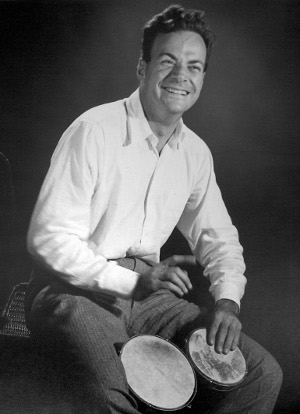
In 1966 a Swedish encyclopedia publisher requested a photograph of Richard Feynman “beating a drum” to give “a human approach to a presentation of the difficult matter that theoretical physics represents.” Feynman responded:
Dear Sir,
The fact that I beat a drum has nothing to do with the fact that I do theoretical physics. Theoretical physics is a human endeavor, one of the higher developments of human beings, and the perpetual desire to prove that people who do it are human by showing that they do other things that a few other human beings do (like playing bongo drums) is insulting to me.
I am human enough to tell you to go to hell.
Yours,
RPF
28 Aug 21:25
Kseniya Simonova - Sand Animation (Україна має талант /...
Adam Victor BrandizziAntigo, mas muito lindo.
28 Aug 21:21

kindasortahappy: m-yley: My mom told me to change my “slutty”...
My mom told me to change my “slutty” shorts before we went to dinner. I said no. So my dad cut his jeans to fit in. We went to dinner and then mini golf like this.
His legs look wonderful
Actually wow, he does.
28 Aug 21:07


smokeandcitrine: Animals you never knew existed! 1) Maned...
Adam Victor BrandizziO lobo-guará, naturalmente, já conhecia. Sou até fã.
Animals you never knew existed!
1) Maned Wolf
2) Pink Fairy Armadillo
3) Patagonian Mara
4) Raccoon Dog
5) Sunda Colugo
6) Irrawaddy Dolphin
Adam Victor Brandizzi and -1 others like this
28 Aug 12:01
Why Whiskey Was Money, and Bitcoins Might Be
by Brian LaSorsa
Adam Victor BrandizziA análise sobre Bitcoin, creio, não é errada, mas também não é empolgante. Mais legal são as historinhas sobre o escambo nos EUA.
Currency is a crossroads for many free market advocates.
Monetarists, including Nobel laureate Milton Friedman, have long argued in favor of central banks stabilizing price levels. They say the institution would provide a sense of comfort to debtors and creditors wary of inflation. Constitutionalists, albeit embracing a general disdain for the Federal Reserve, still see Article I, Section 8 as healthy advice. They say giving Congress the exclusive power to coin money would lead to increased transparency, incentivizing legislators to slash the budget.
It really isn’t until we reach the Misesian ideals of minimal government that we begin to see worthwhile considerations of private currencies. Austrian economist Murray Rothbard explains, “Many people—many economists—usually devoted to the free market stop short at money… . They never think of state control of money as interference in the free market; a free market in money is unthinkable to them… . So it is high time that we turn fundamental attention to the life-blood of our economy.”
One of the first media of exchange in the United States was classic whiskey. For men and women of the day, the alcohol did more than put “song in their hearts and laughter on their lips.” Whiskey was currency. Most forms of money were extremely scarce in our country after the Revolutionary War, making monetary innovation the key to success. The economy east of the Appalachian Mountains flourished during this period, but migration to the west was slow. This meant Western farmers drew fewer customers and, therefore, smaller salaries if they weren’t willing to travel eastward. So, they began to distill their excess grain into whiskey. The supplemental income kept them in business, and the whiskey was easier to transport through the mountains.
Indeed, it was easier to transport everywhere. Westerners began to use the whiskey as a medium of exchange, allowing them to trade with and travel to the east more frequently. Everyone from bartenders to surgeons needed alcohol, and its use as an intermediary became custom, verifying AustrianSchool founder Carl Menger’s analysis of the development of natural currencies: “The exchange of less easily saleable commodities for commodities of greater marketability is in the economic interest of every economizing individual… . Money is not an invention of the state. It is not the product of a legislative act. Even the sanction of political authority is not necessary for its existence.”
The acceptance of whiskey as money was spontaneous, incremental, and voluntary. And, since its value was based on efficiency and not on political decree, the practice continued many years into the future, surviving then-Treasury Secretary Alexander Hamilton’s whiskey tax—an effective income tax passed off as an excise tax—long enough for Thomas Jefferson’s administration to repeal it.
Experiments came and went as people grew familiar with the alcohol’s value, and many local businessmen offered their customers an even more convenient medium of exchange: coins. These business owners—primarily distillers and grocers—would mint, engrave, and then distribute tokens redeemable for commodities at their stores. If a grocer were to price his dough at, say, ten grams of silver per loaf, he would mint a 10-gram silver coin, engrave on it the phrase “Good for One Loaf of Bread,” and distribute it to select customers.
These coins helped out in two ways. First, customers could buy to sell. This was essentially an extension of the easy-to-carry trend. Sellers could walk through town carrying on-demand receipts for an amount of bread or whiskey that they otherwise could not physically carry, attracting new customers many miles away. The coins played a second role, too, as low-denomination change. A variety of situations—the wartime economy, lagging technological advancements, or plain sour luck—have historically left certain areas of the country without a straightforward way to purchase inexpensive items.
Distillers and their customers were occasionally faced with a situation in which neither party could get their hands on anything less than a 30-gram silver coin (or find a way to fraction it) when a bottle of whiskey only cost 10 grams of silver. Instead of turning these customers away or forcing them to carry out two extra bottles of whiskey, owners simply began issuing their own versions of “change”: customized tokens, each guaranteeing on-demand redemption of one bottle of whiskey when presented. Customers, then, knowing full well that everyone needs alcohol at some point, were free to trade distillers’ tokens exactly as they would trade 10-gram coins, effectively creating a low-denomination monetary system through which the community could conduct business.
Coins backed by random commodities were inferior to the classic gold standard, but everyone accepted the coins as necessary adaptations to lousy economic conditions. “Hard-times tokens,” as people referred to them, were the market’s way of meeting a vital demand until things got better.
As time went on, the American monetary system was tried and tried again by political intervention. Yet the market flourished, continuing to adapt to ever-changing circumstances. An inflationary central banking institution, the Roosevelt administration’s obscene gold seizures, and numerous faulty reserve plans like the Bretton Woods agreement were no match for private entrepreneurs on the black market who kept their customers’ savings accounts afloat through competition.
And then came Bitcoin.
These days, many government agencies can scan bank accounts by issuing a boilerplate subpoena. Engaging in private transactions with physical currency became risky business, even through online banking. So, an anonymous developer (known only as “Satoshi Nakamoto”) created Bitcoin.
He designed the coins as virtual mirrors of that which was heretofore considered authentic money. Bitcoins are unearthed through a process called “mining,” much like with dirt and a shovel, except with algorithms and a computer. Miners who solve the pre-established algorithms are rewarded with Bitcoins. However, the underlying program can detect how many people are mining for coins; as demand increases, so does the difficulty of the algorithms, emulating competition in the marketplace. Only those miners with the highest level of determination and skill come out on top. Furthermore, Nakamoto controlled for scarcity. There is no threat of runaway inflation because his blueprint ensures that no more than 21 million coins will ever remain in circulation, and analysts calculate that Bitcoin miners won’t even reach this number until around 2140 A.D.
Nakamoto realized that, like Pennsylvanians who distilled grain into whiskey in order to transport it through the rugged Appalachian Trail, Internet users yearned for currency befitting the digital age. Our generation’s “mountains” are surveillance networks. And Bitcoins fit the bill for passage. They’re secured through public-key encryption (i.e., only Bitcoin owners have the access code to their digital wallets, which can be created without handing over any personal information), easily utilized in the marketplace when sellers are willing, and came into existence through the natural mechanisms of word-of-mouth reputation and voluntary, incremental adoption.
The digital currency came to fruition in the right place at the right time because the market chose it. No legislation, no statute, and no politician granted its legitimacy—customers did. And that’s why the government is now vying for oversight. New York’s financial regulator recently issued subpoenas to more than 20 companies associated with Bitcoin, including the prestigious venture capital firm Andreessen Horowitz.
Whereas historical private monies were created in order to bypass physical barriers, though, this digital currency was explicitly created as a means of bypassing regulations, so it’s quite unclear what will happen next. Bitcoin will likely stand the test of time, though, at least as long as whiskey did.
Brian LaSorsa is a writer in Phoenix, Arizona. His work has appeared in the Washington Examiner, Huffington Post, and Ludwig von Mises Institute.
28 Aug 11:45
How to Explain Why You Like Something
by Scott Meyer

Over at Asking the Wrong Guy, Rick is further explaining the mysteries of the Great Cosmic Shoe, and proper bicycle maintainance.
As always, thanks for using my Amazon Affiliate links (US, UK, Canada).
Adam Victor Brandizzi likes this
28 Aug 01:01


28% of IT Professionals hide their career from family or friends...
28% of IT Professionals hide their career from family or friends out of fear of being asked to provide free tech support.
Tadeu, Alvaro Freitas and one other like this


27 Aug 21:55
Doublespeak is on its way
by noreply@blogger.com (Pabel, a dupla)
Adam Victor BrandizziExcelente regra.
¿Viram essa da moça q foi impedida de embarcar pq o pai fez uma piadinha usando a palavra ‘terrorista’?
Em Cumbica, a moça ia viajar e o pai acompanhou-a ao aeroporto. Durante um atendimento, o pai virou-se prä filha e brincou: “Que bom q não acharam q vc era terrorista.”
A moça foi impedida de viajar por atitude suspeita.
HAHAHAHAHAHAHAHAHA
http://tinyurl.com/mysfam6
Qto mais idiotas houver em posições de comando, tanto mais terroristas haverá, não?
Regra número 1 pra não se dar mal com gente tronha: faça tudo mecanicamente, nada espontâneo. Gente tronha perde o controle perante qqer desvio da rotina, e imediatamente apela prä truculência.
Obedeça o tronho automático. Ele é o futuro da humanidade.
HAHAHAHAHAHAHAHAHA
Em Cumbica, a moça ia viajar e o pai acompanhou-a ao aeroporto. Durante um atendimento, o pai virou-se prä filha e brincou: “Que bom q não acharam q vc era terrorista.”
A moça foi impedida de viajar por atitude suspeita.
HAHAHAHAHAHAHAHAHA
http://tinyurl.com/mysfam6
Qto mais idiotas houver em posições de comando, tanto mais terroristas haverá, não?
Regra número 1 pra não se dar mal com gente tronha: faça tudo mecanicamente, nada espontâneo. Gente tronha perde o controle perante qqer desvio da rotina, e imediatamente apela prä truculência.
Obedeça o tronho automático. Ele é o futuro da humanidade.
HAHAHAHAHAHAHAHAHA
Adam Victor Brandizzi likes this
27 Aug 20:17

The Football Charge
by Greg Ross
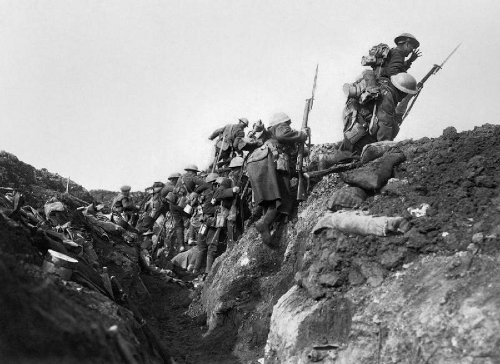
On July 1, 1916, the first day of the Battle of the Somme, British Army captain Wilfred Nevill needed a way to keep the East Surrey Regiment’s B Company organized and advancing toward the German trenches. He had been told that continuous shelling had left nothing alive in the German lines, but night patrols had shown him this wasn’t true.
So Nevill produced four footballs, one for each of his platoons to kick across no man’s land as they charged the German position.
Private L.S. Price of the 8th Royal Sussex, who was looking on, recalled, “As the gunfire died away I saw an infantryman climb onto the parapet into no man’s land, beckoning others to follow. As he did so he kicked off a football; a good kick, the ball rose and travelled well towards the German line. That seemed to be the signal to advance.”
The four platoons followed suit, kicking their balls continuously across 300 yards of ground to reach the German trenches. Twenty thousand British soldiers were killed that day, including Nevill, who was shot when they reached the barbed wire, but his company gained its objective. The Daily Mail commemorated their charge with a poem:
On through the hail of slaughter,
Where gallant comrades fall,
Where blood is poured like water,
They drive the trickling ball.
The fear of death before them
Is but an empty name;
True to the land that bore them,
The Surreys played the game.
Two of the footballs have been recovered. One is in the National Army Museum, the other at the Queen’s Regiment Museum, Howe Barracks, Canterbury.
John.boddie likes this
27 Aug 00:54
A única coisa ruim deste vídeo é que dá pra ver que o YouTube...
A única coisa ruim deste vídeo é que dá pra ver que o YouTube não tem condições de tocar a música em toda a sua qualidade.
Bolero (Gergiev) (by MChelovek2012)
26 Aug 23:27
How “Orange Is the New Black” Fails on Religion
by B.D. McClay
Adam Victor Brandizzitl;dr: os roteiristas caricaturaram religião nesse seriado aí e é comum nós, secularistas, cairmos no mesmo erro.
* * *
Aí me chega um artigo desses comentando uma série que nunca vi mas que parece com meus pensamentos. Nós secularistas estamos tão autocentrados que não conseguimos nem representar religião além da paródia. No caso, é um prejuízo num roteiro, mas quantas vezes vejo gente inteligente que sequer consegue conversar com um religioso? Pior: gente que se recusa a entender a posição alheia, se recusa a esclarecer a própria e ainda se esconde atrás da covardia do trolling? Não falo nem de respeito - que ninguém deve a ninguém mas é muito positivo se recíproco ente indivíduos - falo de viabilizar uma conversa mesmo, ao invés de apenas ficar se concordando com si mesmo recursivamente.
Eu sinto falta disso.
Here’s how the first season of Netflix’s new show, “Orange is the New Black,” ends—so stop reading here if you don’t want to know: Piper Chapman, an upper-middle-class Smith graduate who has found herself in prison, is sitting in the chapel watching the inmates’ Christmas pageant, listening to “Amazing Grace.” Her life—both inside and outside of prison—has fallen apart. She has lost all of her friends. Another inmate, a religious zealot nicknamed Pennsatucky, is trying to murder her.
A little after “Amazing Grace,” Chapman is overcome with despair and runs outside. Pennsatucky pursues her and attacks her with—of all things—a cross. Chapman strikes back and pounds Pennsatucky into the ground, beating her for all appearances to death. A choir cheerily sings “O Come, All Ye Faithful” and the show cuts to credits. Have fun waiting for season two, everybody.
It’s an ending that, in addition to being brutal (and brilliant), highlights the show’s incoherent approach to religion. “Amazing Grace” is played against the hopelessness of the prison. One character declares herself “an Angel of the Lord” and tries to stab another to death with a cross. These moments are heavy with intimations of greater meaning, yet they never quite seem to mean anything at all.
Much of this incoherence derives from Pennsatucky’s character and place as the show’s main antagonist. Uneducated, poor, violent, and passionately committed to a charismatic fundamentalism, Pennsatucky concentrates all the fears of the secular upper-class into one terrifying caricature.
She is in prison for shooting an abortion doctor, and is a pro-life hero for it. But she shot the doctor because, after getting her fifth abortion, the doctor made a quip at her expense: “We should give you a punch card, get the sixth one free.” Pennsatucky’s religious belief was initially faked in order to gain a more lenient sentence, but at some point her fake faith became real. We’re never really told how or why that happened, even though genuine faith arising from such a cynical beginning would represent something rather surprising.
No other character is as flat or lacking in humanizing qualities, in a cast that includes a predatory corrections officer who extorts sex from inmates and sells them drugs. In fact, Pennsatucky is such an aggressively terrible character that even the Onion AV Club, when reviewing the show, singled her out as its big weak spot. As the show moves toward more abstract questions of justice and punishment in its final episodes, the conflict between Piper and Pennsatucky becomes uglier and more explicitly religious: Pennsatucky becomes murderous when Piper refuses to be baptized by saying, “I believe in science” and rejecting the comfort Piper believes religion provides.
Even though Pennsatucky is entirely defined by her religion, her faith is neither well-understood nor well-drawn. In one scene, for instance, she speculates about how aborted babies will go to heaven, despite not having received the sacrament of baptism. But that’s the very sort of technical concern that would be unlikely to appeal to a character of Pennsatucky’s vaguely Pentecostal background. There’s a Catholic nun in the prison, too, so why not give that line to her, where it might actually make sense?
In another scene, Pennsatucky explains the difference between the “spiritual” rapture and the “physical” rapture, a concept of baffling obscurity. It turns out to be a Harold Camping joke. Which is a pretty good description of Pennsatucky: she’s a Harold Camping joke. Indeed, Pennsatucky is every possible negative stereotype about rural Christians brought to life, even if those stereotypes don’t hang together.
If she were merely a background annoyance, all of these flaws could be waved away. But Pennsatucky is the most important character in the show after Chapman herself. It’s the conflict between Pennsatucky and Chapman that gives the show its plot, and the final episodes revolve almost entirely around that conflict—a conflict that does, in the end, come down to religion.
So why would the writers pay so little attention to this part of the show, and then hang so much on it? The answer is probably that nobody behind “Orange is the New Black” was writing for an audience that might be religious, or even religiously informed. The show is not really meant for Pennsatucky, or even anybody who might know her.
Instead, the show seems aimed at an audience of Piper Chapmans: upper-middle-class, very educated, largely secular. They aren’t friends with Pennsatucky; they don’t know anybody like her. Pennsatucky might be their waitress, or sell them some snacks at a gas station. But that’s about as close as their world and hers will ever come to touching. So it doesn’t matter, really, that none of these things about Pennsatucky make sense. They aren’t meant to make sense. They’re meant to be frightening.
What makes Pennsatucky so threatening, as a character, is not even necessarily her religious belief as much as her lack of education. Countless jokes are made at her expense on this score, and the few interactions Pennsatucky has with the Catholic nun—a very minor character—serves to highlight how sophisticated the nun is, and how stupid Pennsatucky is. She is very stupid, we’re told, repeatedly. So stupid, she believes in faith healing. So stupid, she doesn’t know what a “rhetorical question” is. So stupid, she mixes up the first and third amendments.
You might notice that none of these are signs of actual stupidity. They are signs of class and education. And yet, an uneducated nature here is a kind of moral failing—the prison library is always there, and practically every other character reads, but Pennsatucky sticks to her Bible. She refuses to try and raise herself up in a comprehensible manner. And that refusal, too, makes her frightening.
“Orange is the New Black” tries to have it both ways with religion: it depends heavily on the residual weight that religion’s cultural trappings can give a scene or a conversation. Most of the important scenes are set in the prison chapel. “Amazing Grace” is heavily leaned upon. The show opens with Chapman talking about how much she likes to take baths and become clean, strongly evoking baptism. Talking about justice simply can be dry, but talking about whether or not there is a God who dispenses justice is more dramatically interesting. So it relies heavily on that intellectual and cultural inheritance.
But the show is not interested in the substance of that inheritance, since its society is essentially secular. There’s no religion represented in the show that’s not a kind of Christianity—there are Jewish characters, but they’re entirely secular—because religion is just something that exists to oppose science, a psychological force for comfort that disguises facts, a kind of refusal to be educated. There’s no serious engagement with anything a person might really believe. Actual faith is in some sense beyond engagement: there’s just the nun, who is barely in the show, and the zealot, who’s barely a human being. The religious symbols that it does choose to use are almost entirely emptied of meaning through artistic neglect.
Don’t get me wrong: “Orange is the New Black” is a good show. It has a great deal to say about race and gender, and is otherwise sensitively written. But it could be a great show, and the distance between “good” and “great” is hard to ignore. Still, there will be another season; we’ll hold out hope, and perhaps say a prayer that “Orange is the New Black” can yet be saved.
B. D. McClay is a graduate of St. John’s College and a Junior Fellow at First Things. Elsewhere, she has written about how to use a liberal education.
Adam Victor Brandizzi likes this
26 Aug 22:35
Today's schizophrenics hallucinate different things than those of your grandparents' time
by Maggie Koerth-Baker
Thanks to that whole "mental" part, mental illnesses are often heavily influenced by the cultures and societies in which people live. Case in point: The way people with schizophrenia interpret their own hallucinations has changed over the course of the 20th century, keeping pace with changes in technology. Where people once believed that demons were speaking to them, they came to think of those voices as emanating from secret phonographs. Today, people with schizophrenia are likely to imagine hidden cameras taping them for a reality show. The paranoid delusions are always there, but the context changes. 


|
Albener Pessoa, firehose and 3 others like this
26 Aug 22:31


11 Untranslatable Words From Other Cultures
by Ella Sanders
The relationship between words and their meaning is a fascinating one, and linguists have spent countless years deconstructing it, taking it apart letter by letter, and trying to figure out why there are so many feelings and ideas that we cannot even put words to, and that our languages cannot identify. Visit Maptia for more interesting posts.
The idea that words cannot always say everything has been written about extensively – as Friedrich Nietzsche said:
Words are but symbols for the relations of things to one another and to us; nowhere do they touch upon the absolute truth.
No doubt the best book we’ve read that covers the subject is ‘Through The Language Glass‘ by Guy Deutscher, which goes a long way to explaining and understanding these loopholes – the gaps which mean there are leftover words without translations, and concepts that cannot be properly explained across cultures.
Somehow narrowing it down to just a handful, we’ve illustrated 11 of these wonderful, untranslatable, if slightly elusive, words. We will definitely be trying to incorporate a few of them into our everyday conversations, and hope that you enjoy recognising a feeling or two of your own among them.
1. German: Waldeinsamkeit

A feeling of solitude, being alone in the woods and a connectedness to nature. Ralph Waldo Emerson even wrote a whole poem about it.
2. Italian: Culaccino

The mark left on a table by a cold glass. Who knew condensation could sound so poetic.
3. Inuit: Iktsuarpok

The feeling of anticipation that leads you to go outside and check if anyone is coming, and probably also indicates an element of impatience.
4. Japanese: Komorebi

This is the word the Japanese have for when sunlight filters through the trees – the interplay between the light and the leaves.
5. Russian: Pochemuchka

Someone who asks a lot of questions. In fact, probably too many questions. We all know a few of these.
6. Spanish: Sobremesa

Spaniards tend to be a sociable bunch, and this word describes the period of time after a meal when you have food-induced conversations with the people you have shared the meal with.
7. Indonesian: Jayus

Their slang for someone who tells a joke so badly, that is so unfunny you cannot help but laugh out loud.
8. Hawaiian: Pana Poʻo

You know when you forget where you’ve put the keys, and you scratch your head because it somehow seems to help your remember? This is the word for it.
9. French: Dépaysement

The feeling that comes from not being in one’s home country – of being a foreigner, or an immigrant, of being somewhat displaced from your origin.
10. Urdu: Goya

Urdu is the national language of Pakistan, but is also an official language in 5 of the Indian states. This particular Urdu word conveys a contemplative ‘as-if’ that nonetheless feels like reality, and describes the suspension of disbelief that can occur, often through good storytelling.
11. Swedish: Mångata

The word for the glimmering, roadlike reflection that the moon creates on water. 
Uber is a mobile app that hails cabs for you. Click here, sign up, and get your first ride with Uber for free.
This post originally appeared at MAPTIA.
image – NAME
|
|
Ninadarkangel, Jmontano and 3 others like this
26 Aug 22:31


Members of the All Blacks Rugby Team Pranked Into Making a Fake Japanese Commercial
The All Blacks rugby team of New Zealand are being filmed for a prank for the Cure Kids Charity... but they don't know that. They think they're shooting a weird Japanese noodle commercial that will air only in Japan. How strange will it get before they realize what's going on?
Submitted by: Unknown
Adam Victor Brandizzi and -1 others like this
