Shared posts

07 Jul 09:10

Fishing For Philosophical Truths

by Andrew Sullivan

Philosophy prof Robert Pasnau relays (NYT) a well-worn story usually told at the expense of his colleagues that goes something like this: Charles II summons a group of philosophers to ask them why a dead fish weighs more than a live one. After offering their creative, speculative answers, the king tells the philosophers that there was no difference between the two – and why didn’t they just weigh the fish? Pasnau rejects the implied criticism of his field:

The essence of philosophy is abstract reasoning – not because the philosopher is too lazy to attempt a more hands-on approach, but because the subjects at issue do not readily submit to it.

If we could simply weigh the fish, we gladly would. In recent centuries, philosophers in fact have discovered how to weigh that allegorical fish, in various fields, and on each occasion a new discipline has been born: physics in the 17th century; chemistry in the 18th; biology in the 19th and psychology in the 20th. The scientists, short on history but flush with their government grants and Nobel Prizes, cast an eye back on what remains of philosophy and skeptically ask: Why don’t you stop wasting your time and just weigh that fish?

It’s a question philosophers ask themselves all the time, and sometimes they despair.

How Pasnau frames his own defense of his field’s relevance:

[M]uch of what gives philosophy its continuing fascination is its connection with the humanities. To weigh the fish is doubtless desirable, but there is just as much to be learned in understanding where that fish came from, and in telling stories about where it might go.

If even philosophy is dismissed as a waste of time for being insufficiently scientific, where does that leave those other modes of humanistic inquiry? Reading Plato or Chekhov may not stop the planet from warming or cure a disease – or help build more accurate missiles – and it may not point the way toward a new science of ethics or will. Yet what of it? Does such inquiry not have a value of its own? That is of course itself a philosophical question.

07 Jul 09:08

Longing For A Better Class Of Tycoon

by Andrew Sullivan

Pondering the strange phenomenon of the super-rich claiming to be a persecuted minority – the venture capitalist Tom Perkins and Kenneth Langone, the co-founder of Home Depot, for example, both “compared populist attacks on the wealthy to the Nazis’ attacks on the Jews” – James Surowiecki looks back to when the one-percent weren’t so obtuse:

A century ago, industrial magnates played a central role in the Progressive movement, working with unions, supporting workmen’s compensation laws and laws against child labor, and often pushing for more government regulation.

This wasn’t altruism; as a classic analysis by the historian James Weinstein showed, the reforms were intended to co-opt public pressure and avert more radical measures. Still, they materially improved the lives of ordinary workers. And they sprang from a pragmatic belief that the robustness of capitalism as a whole depended on wide distribution of the fruits of the system.

Similar attitudes prevailed in the postwar era, as [sociologist Mark] Mizruchi has documented. Corporate leaders formed an organization called the Committee for Economic Development, which played a central role in the forging of postwar consensus politics, accepting strong unions, bigger government, and the rise of the welfare state. … Corporations supported policies that might have been costly in the short term in order to strengthen the system as a whole. The C.E.D. called for tax increases to pay for the Korean War and it supported some of L.B.J.’s Great Society. As Mizruchi put it, “They believed that in order to maintain their privileges, they had to insure that ordinary Americans were having their needs met.”

That all changed beginning in the seventies, when the business community, wrestling with shrinking profits and tougher foreign competition, lurched to the right. Today, there are no centrist business organizations with any real political clout, and the only business lobbies that matter in Washington are those pushing an agenda of lower taxes and less regulation.

07 Jul 01:02

GIF | f40.jpg

f40.jpg
06 Jul 22:53

Como a Copa afeta as urnas

Adam Victor Brandizzi

¡Surpresa! Não é através do resultado da final.

Da marchinha "Pra frente Brasil", usada para inflamar o ânimo nacional durante a ditadura militar, aos protestos que sacudiram os preparativos para a Copa do Mundo deste ano, a política historicamente entra em campo com a Seleção Brasileira.

Mas até que ponto os resultados desta Copa disputada em solo tupiniquim, com duelos contra e a favor do torneio nas redes sociais, xingamentos à presidente Dilma Rousseff no jogo de estreia – e, ao mesmo tempo, coros de "muito orgulho", "muito amor" (e muito hino à capela) dentro dos estádios – têm poder para interferir nas eleições?

A despeito da crença disseminada de que a vitória da Seleção traria benefícios a quem está no poder, uma análise histórica da relação entre o desempenho nos gramados e nas urnas desautoriza esta versão. Por mais que governantes de diferentes matizes ideológicos tentem se aproveitar da popularidade do esporte, o contexto político da lendária pátria de chuteiras tem se revelado mais independente do que parece, como indica a reeleição de Fernando Henrique Cardoso no primeiro turno em 1998, quando o Brasil perdeu a final da Copa para a França, ou a vitória da oposição meses depois do pentacampeonato, em 2002, com a chegada de Lula ao poder.

Mesmo com o cenário singular de 2014, acirrado pela insatisfação popular com os gastos do Mundial sediado no Brasil, a influência do resultado do torneio na eleição é considerada limitada pela maioria dos especialistas ouvidos por ZH, como o sociólogo Ronaldo George Helal, coordenador do Laboratório de Estudos em Mídia e Esportes da Universidade Estadual do Rio de Janeiro (UERJ). Para ele, as possíveis consequências no pleito terão mais a ver com a avaliação final da organização da Copa do que propriamente com a quantidade de gols do Neymar.

– Se houver algum fiasco na Copa, a oposição pode usar isso, ou o governo pode se apropriar de uma boa organização. Todo mundo vai querer tirar uma casquinha, mas o Brasil ganhar ou perder não decide uma eleição. O uso político do futebol é antigo, a questão é a eficácia desse uso. Nos anos 70, o regime militar usou muito a imagem da Seleção para legitimar o regime, mas cabe a pergunta: se o Brasil tivesse perdido a Copa de 70, teria sido diferente? Acredito que não. Essa correlação direta nunca existiu – avalia Helal.

Maioria silenciosa

Como nas primeiras duas semanas de Copa a teoria do caos não se confirmou, o cenário também mudou. Depois de assombrado por protestos nas ruas e desacreditado pela famosa hashtag #naovaitercopa nas redes sociais, o torneio vem ocorrendo até agora sem maiores sobressaltos. Com direito, inclusive, a elogios da mídia estrangeira.

– Os brasileiros sempre foram muito preocupados em organizar um evento impecável, mostrar que o Brasil tem condições. Mas essa maioria não se percebia como maioria. Era uma maioria silenciosa, tinha vergonha de colocar bandeira na janela, porque uma minoria conseguiu disseminar um discurso contra o Mundial e os gastos. Quando começou a dar tudo certo na Copa, as pessoas começaram a perder a vergonha. Se o Brasil ganhar, pode melhorar a autoestima do país, mas não é isso que decide a eleição. Se pode amar muito o país e ser contra o governo – completa Helal.

Na avaliação do professor de história do Clio Internacional Daniel de Araujo dos Santos, o futebol continua sendo alvo constante de disputa fora das quatro linhas, e sua relação com a política é tão intensa como na época da ditadura. O que mudou foi a forma como esse elemento da identidade nacional é usado pelo poder.

– Lula e o PT queriam mostrar um Brasil forte e protagonista ao sediar a Copa, enquanto, nos anos 70, Médici queria mostrar que a organização militar gerava vitórias na economia e nos esportes. Hoje o cenário é outro, mas FH recebeu a Seleção pentacampeã como Médici recebeu os campeões do tri. E, naquele tempo, não se poderia ir ao Maracanã e xingar o Médici. O governo continua usando a Copa, mas isso agora é desvinculado da Seleção. Se der tudo certo na organização, o governo ganha. Se der errado, a oposição ganha. Os rumos do evento vão interferir na eleição, não o resultado em campo – analisa.

Ainda assim, num contexto político de insatisfação, cresce o dilema dos torcedores entre torcer ou não pela Seleção, como observa a jornalista Vanessa Gonçalves. Uma das curadoras da exposição Política F.C. – O Futebol na Ditadura, aberta à visitação no Museu da Resistência em São Paulo, ela avalia que, embora vivamos hoje em uma democracia, a situação de dubiedade de sentimentos, provocada pelo conflito entre a paixão pelo futebol e a insatisfação política, encontra paralelo com o período do regime militar.

Torcer e resistir

Ao entrevistar ex-presos políticos exilados fora do país, para um documentário que integra a exposição, Vanessa descobriu algo peculiar: para muitos deles, torcer pela Seleção era uma espécie de ato de resistência. Seria uma forma de mostrar que não deixariam a ditadura arrancar sua paixão pelo futebol.

– Conversei com ex-presos políticos que chegaram no exílio na Argélia um dia antes da final da Copa de 1970. Eles contaram que um quinto dos 40 presos começou torcendo contra a Seleção, mas à medida que o Brasil ia ganhando, todos torceram a favor. Alguns diziam que torciam pela Seleção, não pelo Médici. Hoje, os protestos são contra gastos da Copa, e volta essa dubiedade. Mas foi um pretexto. Se não tivesse Copa, as manifestações iriam acontecer do mesmo jeito – avalia.

Já o professor de História Flávio de Campos, coordenador do Núcleo Interdisciplinar de Estudos sobre Futebol e Modalidades Lúdicas da USP, acredita que, mesmo antes de acabar, a Copa já interferiu nas eleições. Um dos sinais seria o receio sem precedentes dos governistas de comparecerem aos estádios, temendo vaias e xingamentos.

– Nunca vi uma articulação tão intensa entre futebol e política. Na padaria ao lado de casa, no táxi, todo mundo está discutindo política – impressiona-se.

Pela primeira vez, segundo Campos, a nação se divide em duas torcidas: uma a favor da Seleção e outra contra a Copa, que é apelidada por ele de "rubro-negra", por unir o preto dos Black Blocs e o vermelho dos movimentos de esquerda. Reproduzindo a lógica da rivalidade entre os clubes, as duas "torcidas" se retroalimentariam a partir de ganhos e perdas de cada uma.

A despeito da artilharia disparada contra o Planalto pelos manifestantes, o professor ressalta que considera a estratégia equivocada, por entender que a responsabilidade pelos problemas sociais deveria ser repartida com Estados e municípios. E também responsabiliza o setor privado, que teria se acostumado a atrasar a execução de obras públicas para receber aditivos contratuais.

– Vivemos uma plenitude democrática que permite a expressão dos conflitos do país, mas temos dificuldade em lidar com o conflito. Achamos que conflito é sempre o fim do mundo. O principal legado da Copa é o enfrentamento do Brasil diante do espelho – reflete.

O efeito na aprovação dos governos

Pesquisa realizada pelo banco suíço UBS para avaliar macroeconomia e estratégia de investimentos, concluiu que não há relação direta entre o resultado em campo na Copa do Mundo e a avaliação de governantes no Brasil. Quando o Brasil foi derrotado pela França, na final da Copa do Mundo de 1998, por exemplo, a avaliação do governo brasileiro cresceu 7%, enquanto, em 2002, quando o Brasil ganhou o penta, a aprovação caiu 2%. Confira a tabela:

1994: campeão
Mudanças no Índice de aprovação no governo antes e depois do torneio: +21 ponto percentual (aumento de 16% para 37%)**

1998: vice-campeão
Mudanças no Índice de aprovação no governo antes e depois do torneio*: +7 pontos percentuais (cresceu de 31% para 38%)

2002: campeão
Mudanças no Índice de aprovação no governo antes e depois do torneio*: -2 pontos percentuais (de 27% para 25%)

2006: perdeu nas quartas
Mudanças no Índice de aprovação no governo antes e depois do torneio*: -1 ponto percentual (de 39% para 38%)

2010: perdeu nas quartas
Mudanças no Índice de aprovação no governo antes e depois do torneio*: +1 ponto percentual (de 76% para 77%)

*Entre maio e junho
**A comparação de 1994 foi feita entre abril e agosto

Impacto nas urnas

Com base em estudos internacionais, o relatório afirma que a Copa poderia influir se ocorresse até duas semanas antes das eleições. E, mesmo assim, seria um efeito restrito: o governo poderia receber de um a dois pontos percentuais a mais em votos nas eleições.

Como a Copa deste ano acabará quase três meses antes do primeiro turno das eleições, os autores concluem que não terá impacto significativo sobre o resultado.

O mundial na política

Só a partir de 1994 o ano da Copa do Mundo passou a coincidir com as eleições para a Presidência. Nestes 10 anos, nem sempre o título para o Brasil beneficiou as forças políticas de situação.

1958
Contando com Pelé, que despontava como prodígio aos 17 anos, o Brasil venceu pela primeira vez o torneio, na Suécia.
Nessa época, a disputa não coincidia com as eleições nacionais, nem havia reeleição. Vencedor em 1955, o presidente Juscelino Kubitschek recebe a Seleção e tira fotos. Apesar de sua popularidade, Juscelino não fez seu sucessor. O vencedor em 1960 foi o opositor Jânio Quadros.

1962
Com dribles de Garrincha, a Seleção garante o bicampeonato no Chile.
O país era governado desde 1961 por João Goulart, que assumiu depois da renúncia de Jânio Quadros. A vitória não impediu a instabilidade política, que culminaria com o golpe militar dois anos depois.

Ditadura militar
Em vigor entre 1964 e 1985, o regime militar atravessou cinco Copas (66,70, 74, 78 e 82). O Brasil foi tricampeão em 1970.
Sem eleições nacionais durante a ditadura, houve influência militar da comissão técnica da Seleção, e havia incentivo ao culto aos "canarinhos" como forma de promover e legitimar o regime, com propaganda alimentada por marchinhas e frases de efeito, como Pra Frente Brasil. O general Médici, que pouco dava entrevistas, teve imagem popularizada ao aparecer em fotos dentro do Maracanã e ao lado da delegação brasileira. Se a vitória de 1970 ajudou, o jejum de títulos nas Copas seguintes não fragilizou o regime.

1986
Com pênalti perdido por Zico, o Brasil foi derrotado pela França nas quartas de final. O torneio disputado no México foi vencido pela Argentina.
O país era presidido por José Sarney, que assumiu o mandato devido à morte de Tancredo Neves antes da posse.

1990
O Brasil caiu nas oitavas de final, na Itália.
Eleito em 1989, o presidente Fernando Collor de Mello cumpria seu primeiro ano de mandato. Dois anos depois, sofreria um impeachment e seria substituído por Itamar Franco.

1994
A Seleção ganhou o tetracampeonato nos Estados Unidos, com ajudinha do erro na cobrança de pênalti do italiano Roberto Baggio.
As eleições passaram a coincidir com a Copa. O candidato da situação, Fernando Henrique Cardoso (PSDB), que era ministro da Fazenda no governo Itamar Franco, venceu. O principal motivo da vitória, no entanto é atribuído ao plano Real, que conteve uma inflação de 80% ao ano.

1998
Na França, o Brasil perdeu para os donos da casa na final, que ficou marcada por uma suposta convulsão de Ronaldo.
Fernando Henrique Cardoso (PSDB) se reelegeu no primeiro turno. A estabilidade da economia continuava a ser um trunfo político decisivo.

2002
Com artilharia de Ronaldo na Copa do Japão e da Coreia do Sul, o time do Brasil ergueu a taça do pentacampeonato.
Os governistas não conseguiram capitalizar a vitória no campo político. O PT chegou pela primeira vez ao poder ao vencer o tucano José Serra, que era candidato do presidente FHC.

2006
Brasil perdeu para a França, nas quartas de final, na Alemanha.
A situação venceu, com a reeleição do presidente Lula (PT). Nem as denúncias do mensalão abalaram a popularidade de Lula, ancorado em políticas sociais como o Bolsa Família.

2010
Brasil foi eliminado pela Holanda nas quartas de final, na África do Sul.
A situação venceu. Lula conseguiu eleger sua sucessora, Dilma Rousseff. De perfil técnico, Dilma chegou a ser comparada a "um poste" pelos opositores antes da eleição, mas o carisma de Lula e seus programas sociais garantiram sua eleição.

2014
Apesar do tão falado #naovaitercopa, o torneio é realizado no Brasil – e nas primeiras duas semanas ocorre sem maiores problemas.
A propaganda eleitoral começa no dia 6 de julho. Um ano após os protestos que sacudiram o país, o ambiente político é considerado mais tenso e imprevisível.

Leia Mais: Brasil versus Braaasilll

Bookmarked at brandizzi Delicious' sharing tag and expanded by Delicious sharing tag expander.
06 Jul 21:19

A origem e o melhor do meme “Taca-le Pau”

by Pedro Katchborian

taca-le-pau-abre

Quem acompanha o Twitter pode ter visto um termo um pouco diferente nos últimos dias: é o “taca-le pau”! Mas de onde veio isso?

A ORIGEM

É só pesquisarmos um pouco que achamos: a origem é um vídeo, publicado no YouTube em janeiro deste ano. No clipe, um jovem desce em um carrinho em um morro. Até aí, nada demais. O engraçado é a narração: “Taca-le Pau, Marcos, taca-leu pau neste carrinho!”, diz algum garoto, muito empolgado. E vocês sabem que um bordão é tudo que a internet precisa pra viralizar algo.

Aqui tem uma entrevista com a família dos dois garotos: Marcos, de 12 anos, e Leandro, de 9, o responsável pela narração. Eles estão aproveitando a fama e disseram que não sabem exatamente o motivo do vídeo só ter bombado agora, já que foi está desde janeiro no YouTube.

Veja:


O MEME

Como quase todo meme, o vídeo original ganhou remixes e a história ganhou uma fanpage com mais de 9 mil curtir. Já no Twitter, foram mais de 2 mil menções nos últimos 3 dias, segundo o Topsy. Além disso, o termo “Taca-le Pau” virou quase uma frase de motivação ou reclamação.

Os vídeos


As imagens:


OS TUÍTES

TACA-LE PAU NESSE TIME, FELIPÃO

— Sandro Sotilli (@SandroSotigol) 17 junho 2014

taca-le pau Neymar

— manoela (@M4N03L4_) 17 junho 2014

Sugestão de grito de guerra pra torcida brasileira: TACA-LE PAU TACA-LE PAU TACA-LE PAU NESSE TIMINHO

— Alexander Znavsky (@znavsky) 23 junho 2014

depois do Marcos taca le pau no morro da vó Solvelina, já tão fazendo até blitz lá pic.twitter.com/Z4iFeEfEhX

— Daniel Oliveski (@trivas77) 23 junho 2014


quando eu gosto de algo quero que o mundo veja e passo resto da vida fazendo a mesma piada, nem tole, TACA-LE PAU

— Facioni, R. (@raquelfacioni) 18 junho 2014

GATA, VOCÊ NÃO É O CARRINHO DO MARCOS, MAS EU QUERO TACA-LE PAU CONTIGO

— CASSIANO (@BREZOLLA) 23 junho 2014

The post A origem e o melhor do meme “Taca-le Pau” appeared first on youPIX.

06 Jul 12:59

Sentencia por el crimen de Angelelli: prisión perpetua para Luciano Benjamín Menéndez y el ex comodoro Estrella

El Tribinal Oral en lo Criminal y Federal de La Rioja, integrado por los jueces José Camilo García Uriburu, Carlos Lascano y Juan Carlos Reynaga, condenó a prisión perpetua, en cárcel común, al ex general Luciano Benjamín Menéndez y al ex comodoro Luis Fernando Estrella como autores mediatos del homicidio del obispo Enrique Angelelli, ocurrido el 4 de agosto de 1976 a causa de un accidente automovilístico simulado en la ruta nacional 38, a unos cien metros de la capital riojana

Según lo dispuso el tribunal, Estrella fue trasladado de inmediato al penal de Bouer, en Córdoba. Menéndez ya estaba preso en el penal bonaerense de Marcos Paz, donde cumple otras condenas por delitos de lesa humanidad. A ambos les realizarán exámenes médicos para comprobar si pueden permanecer en prisión.

El trbibunal informó que la la lectura de los fundamentos de la sentencia ocurrirá el próximo 12 de septiembre a las 9.30.

Tanto la Iglesia como los gobiernos nacional y provincial siguieron muy de cerca las horas previas a la emisión del fallo, difundido a las 15.30 en punto tal como se había anunciado. Estaban presentes el obispo de La Rioja, monseñor Marcelo Colombo, y también su antecesor Roberto Rodríguez. Cerca de ellos estaban los vicegobernadores de La Rioja y de Buenos Aires, Sergio Casas y Gabriel Mariotto. La sala también estaba colmada por ex presos políticos -encabezados por la ex senadora kirchnerista Ada Mazza- y simpatizantes de distintas organizaciones eclesiales de base y de agrupaciones de izquierda.

Tal como se esperaba, el fallo señala a Menéndez y Estrella como aturoes mediatos del "homicidio premeditado" de Angelelli. Además de la prisión perpetua, el Tribunal Oral Federal les aplicó inhabilitación absoluta a ambos.

Bookmarked at brandizzi Delicious' sharing tag and expanded by Delicious sharing tag expander.
06 Jul 03:35

Descubierta una civilización perdida en el desierto de Atacama en Perú

Perú no es Egipto, pero casi. En cuanto a hallazgos arqueológicos. Una nueva cultura desconocida ha sido descubierta en el norte del desierto de Atacama, al sur del Perú. Data de entre los siglos IV y VII después de Cristo y se refiere a una comunidad agrícola antes de la expansión de la civilización Tiwanaku, según arqueólogos de la Universidad de Wroclaw (Polonia). A su vez, el descubrimiento hace un año de una tumba wari, en pleno valle de Huarmey (Áncash), donde no se conocía que hubiera llegado esta cultura de orígenes andinos es motivo de la portada de la revista National Geographic. El Museo de Arte de Lima expone varias de estas piezas, encontradas en el sitio conocido como El Castill de Huarmey, hasta septiembre.

Pero el reciente hallazgo en el desierto tiene muchos enigmas: son más de 150 tumbas que "se habían cavado en la arena sin ningún tipo de estructuras de piedra, y por esta razón eran difíciles de localizar y no han sido víctimas de los ladrones", declaró Józef Szykulski, líder del proyecto de investigación, en el que han participado también investigadores de Perú y Colombia, informa PAP, portal de noticias científicas del gobierno de Polonia. El descubrimiento es el resultado del equipo del Instituto de Arqueología de la Universidad de Wroclaw desde el año 2008.

Estos son enterramientas de personas prácticamente desconocidas, que habitaron la zona antes de la expansión de la civilización Tiwanaku

Las condiciones desérticas también conservan el contenido de las tumbas. "Estos son enterramientas de personas prácticamente desconocidas, que habitaron la zona antes de la expansión de la civilización Tiwanaku. Elementos encontrado en las tumbas individuales indican que las personas ya tenían una clara división social", dijo el profesor Szykulski.

En las tumbas, los arqueólogos han encontrado objetos incluyendo fuertes tocados de lana de camélido, que podrían tener la función de los cascos. Algunos de los cuerpos estaban envueltos en esteras, otros en sudarios de algodón, y otros en redes, lo que significa que una de las formas de la actividad de que la cultura era la pesca.

"Dentro de algunas de las tumbas se han encontrado arcos y aljabas con flechas con puntas de obsidiana. Este es un hallazgo muy interesante, ya que los arcos son una rareza en el Perú", dijo el arqueólogo. Otro hallazgo interesante es el esqueleto de una llama joven, lo que demuestra que el animal había sido traído a la zona antes de lo pensado.

En algunas tumbas de hombres, los arqueólogos encontraron mazas de piedra con remates de cobre. "Estos objetos y los arcos eran símbolos de poder, lo que demuestra que los representantes de la élite fueron enterrados aquí" - dijo el profesor Szykulski.

Dentro de algunas de las tumbas se han encontrado arcos y aljabas con flechas con puntas de obsidiana. Este es un hallazgo muy interesante, ya que los arcos son una rareza en el Perú

En las tumbas, los arqueólogos también hallaron herramientas de tejido ricamente decorados y muchos artículos de joyería, incluyendo objetos de cobre y tumbaga - una aleación de oro y cobre. Otro descubrimiento interesante son mimbres de caña que fueron colocados en los oídos de los muertos, que sobresalían por encima de la superficie de las tumbas. Los científicos sospechan que sirvieron como herramientas rituales de "comunicación" entre los muertos y los miembros vivos de la comunidad.

Los arqueólogos polacos descubrieron también las tumbas de la civilización Tiwanaku en el delta del río Tambo, que se remonta al siglo VII/X dC. "Estas tumbas de piedra contienen recipientes de cerámica, herramientas y armas, Este hallazgo es sensacional, porque se pensaba que en este periodo la civilización Tiwanaku no había llegado a esta área", dijo el científico.

Y mientras aflora este hallazgo, en Lima se exhiben algunas piezas de una tumba wai, en 2013. Es el  trabajo de los esposos Milosz Giersz y Patrycja Przadka-Giersz, una pareja de arqueólogos polacos de la Universidad de Varsovia, informa el diairo El comercio, de Lima.

Es por ello que la edición de junio de la revista “National Geographic” en español le dedica su portada y un largo especial. Allí se cuenta los años de investigación en el sitio conocido como El Castillo donde los arqueólogos polacos –junto con sus pares peruanos Krzysztof Makowski y Roberto Pimentel, de la Pontificia Universidad Católica del Perú– decidieron explorar la parte más alta de una pirámide escalonada de 20 metros de alto, ubicada a poco más de un kilómetro de la ciudad de Huarmey.

En el lugar y debajo de 33 toneladas de ripio se encontraban seis esqueletos humanos que fueron colocados sobre fardos funerarios a modo de ofrendas. Al retirar dichos restos, los investigadores descubrieron una tumba con 57 personajes sentados, tal como se estilaba en los entierros de la cultura Wari. En este lugar se encontraron 1.300 objetos de excepcional riqueza que formaban parte del ajuar ceremonial.

Bookmarked at brandizzi Delicious' sharing tag and expanded by Delicious sharing tag expander.
06 Jul 02:39

Família diz que motorista tentou salvar a filha durante queda de viaduto - 04/07/2014 - Poder - Folha de S.Paulo

Adam Victor Brandizzi

Se ela fez isso mesmo, e é bem possível, foi uma heroína.

Bookmarked at brandizzi Delicious' sharing tag and expanded by Delicious sharing tag expander.
05 Jul 12:52

Can Technology Build a Village?

by Gracy Olmstead

We live in a rapidly urbanizing world. But Brian Chesky, co-founder and CEO of Airbnb, thinks we are also seeing an type of urbanism resurface, one in which trust—and the village—take center stage.

Airbnb’s business model is dependent on principles of trust and friendliness: it enables people to rent out their homes to travellers, thus replacing the more customary and mainstream hotel. At the Aspen Ideas Festival, says Atlantic editor Uri Friedman, Chesky told attendees the Internet is actually moving things back to a local level by enabling people to become “micro-entrepreneurs.” This local economic empowerment then has a seismic impact on urban business and cultural development as whole:

“At the most macro level, I think we’re going to go back to the village, and cities will become communities again,” he added. “I’m not saying they’re not communities now, but I think that we’ll have this real sensibility and everything will be small. You’re not going to have big chain restaurants. We’re starting to see farmers’ markets, and small restaurants, and food trucks. But pretty soon, restaurants will be in people’s living rooms.”

Not everyone may be comfortable with a model this decentralized—but it is true that online tools like Twitter, Facebook, and mobile apps have changed the way businesses work. Food trucks can tweet their locations to followers, thus building a faithful community as they travel. Hole-in-the-wall restaurants can be found easily via Google maps and Facebook pages. The app I reviewed on Thursday, Huckle & Goose, is another example of the way technology is helping people connect with local entrepreneurs—in this case, local farmers. Companies like Airbnb and Uber take things to another level: they require us to place our faith in the host company and its system of accountability, as well as the entrepreneur whose services we claim.

David Brooks affirmed this in his column on Airbnb, called “The Evolution of Trust“—he writes that, in today’s world, people “are both hungrier for human contact and more tolerant of easy-come-easy-go fluid relationships.” In this world, apps like Airbnb are perfect catalysts for a “a new trust calculus,” a new status quo in which “flexible ad-hoc arrangements” and peer-to-peer commerce are the norms.

But the village mentality that Brooks and Chesky are observing doesn’t necessitate actual geographic villages. To the contrary: the places these apps and websites are most likely to be used are urban or international places. They help convey the feel of a village, in the rush and clamor of the big city. But perhaps this is where such services are most needed: real villages are geographically, necessarily, connected and close. The city is where we most often feel lost and isolated.

Friedman notes that the rapid urbanization of our world seems to go against the trend Chesky is identifying:

“Chesky sees village-like networks sprouting in cities at a time when urbanization is also going in the polar opposite direction. More than half of the world currently lives in cities, and the United Nations predicts that two-thirds of the global population will be urban-dwellers by 2050. In 2011, there were 23 “megacities” of at least 10 million people around the world. By 2050, there will be 37. It’s possible that as cities balloon to overwhelming sizes, we’re coping by carving out smaller communities. But it’s also possible that the phenomenon Chesky is describing is primarily playing out in Western countries. After all, Asia, where Airbnb has a relatively small presence, will account for most new megacities in the coming decades.”

I think Friedman’s first reason is spot-on, though only time will tell if he’s correct: in the midst of rapid globalization, people seem to be struggling to find a niche, a community. They don’t just want to visit the same chain stores, the same thoroughfares. They don’t want to constantly feel like another face in the crowd. Instead, they’re looking for ways to build community, even as their world becomes more isolated and atomized. Companies like Airbnb seem to provide that.

Some have accused technology of speeding up globalization—of creating a world in which we feel lonely and separated from the little platoons around us. But could it be that, with time, technology will fix the woes it created? Human nature will always yearn for community—Aristotle called us “social animals.” If he was right, then our desire for real closeness with other humans won’t simply go away. Either we’ll abandon the tools that isolate us, or we’ll adapt them to suit our community-craving needs. If Chesky is right, the latter may create the urban community of the future.

05 Jul 09:58

Flash Mob

by Greg Ross

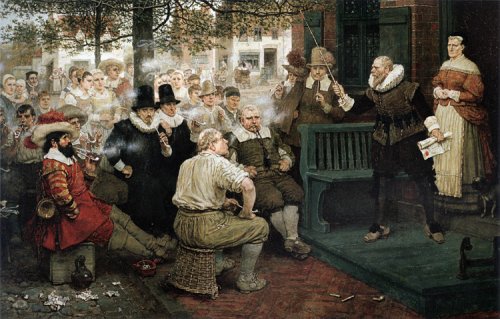
Pipe plot - 1877 - George Henry Boughton

When Wilhelm Kieft tried to outlaw smoking in New Amsterdam in the 1630s, he brought on a unique protest. Washington Irving writes:

A mob of factious citizens had … the hardihood to assemble before the governor’s house, where, setting themselves resolutely down, like a besieging army before a fortress, they one and all fell to smoking with a determined perseverance, that seemed as though it were their intention to smoke him into terms. The testy William issued out of his mansion like a wrathful spider, and demanded to know the cause of this seditious assemblage, and this lawless fumigation; to which these sturdy rioters made no other reply, than to loll back phlegmatically in their seats, and puff away with redoubled fury; whereby they raised such a murky cloud, that the governor was fain to take refuge in the interior of his castle.

Wilhelm finally gave in — people could smoke, he said, but they had to give up long pipes. “Thus ended this alarming insurrection, which was long known by the name of the pipe plot, and which, it has been somewhat quaintly observed, did end, like most other plots, seditions, and conspiracies, in mere smoke.”

(Thanks, Dan.)

04 Jul 21:07

Gal Science: Taking the Earth’s Historical Temperature

by Ilissa Ocko

url-2As The Toast searches for its one true Gal Scientist, we will be running a ton of wonderful one-off pieces by female scientists of all shapes and sizes and fields and education levels, which we are sure you will enjoy. They’ll live here, so you can always find them. Most recently: When a Scientist Bakes Bread.

Thanks to the ever-so-convenient Internet, it was fairly simple to prove to my friends that, yes, a rectal thermometer was indeed a real thing, and no, my mom didn’t accidentally misuse a thermometer. My mother, though, in all her un-technological glory, decided to send me (through real mail) a rectal thermometer to show my friends. So there I was in college, with a rectal thermometer.

When our body temperature is 1 to 2ºF higher than usual, we know that something is wrong. For me, that something wrong usually involves watching The Twilight Zone over and over and over. Detecting a fever doesn’t tell us how and why something went wrong, but it’s a sign that “hey, something inside you is messed up.” 

Well, the Earth’s temperature is currently 1 to 2ºF higher than usual, an indicator that something within our planet is messed up. 

With our bodies, we know what “normal” is because we have taken our temperatures our whole lives. But how do we know what “normal” is for the Earth? In an age of human-caused climate change, determining a baseline for “normal” temperature patterns of the Earth is a central piece of evidence in uncovering what is messed up right now.

Temperature records from modern weather-thermometers date back 100 or so years depending on the location. But compared to Earth’s age—4.6 billion years—that’s nothing; if we condensed the Earth’s age into 1 year, the modern industrial era would be the last two seconds, with humans having been on the planet for minutes. 

So how do we retroactively measure Earth’s temperature? While we can’t retroactively measure what our body temperatures were a day or year ago—so I think—the Earth actually leaves clues of its past climate conditions. These clues are hidden in nature all around us, and like detectives, we can uncover these clues, piece them together, and reconstruct how temperatures have evolved over time. Okay, maybe not as cool as Nancy Drew, but pretty close! We even have a snazzy name for these clues: “proxies.”

There are two main criteria for finding proxies of Earth’s temperature: 

  • The entity needs to be old (like pre-U.S., pre-Christopher Columbus, pre-Jesus) and dateable 
  • The entity needs to be affected by climate 

Therefore, we are looking for objects found in nature that are old, dateable, and climate-dependent.

On land, trees are the most obvious old, dateable, and climate-dependent entity. Certain trees can live for hundreds to several thousand years, and as we all learned when we were youngsters, we can determine their age by counting how many rings they have in their interior; their massiveness therefore exudes their age. I recently went to a redwood forest state park in northern California and we fit our entire group of 13 scientists plus one dog inside the trunk of a redwood.

The thickness of the tree rings is directly related to changes in temperature—tree rings typically grow wider during warm conditions (think about how your hands swell when it is hot out) and narrower during cold conditions (think about how your rings are all of a sudden too loose in winter). So the rate of growth of trees can provide a proxy record of Earth’s temperature in the past. Rainfall (or lack thereof) also affects tree growth in a discernable way.

But these trees only give us a small piece of the big picture: they aren’t in the poles and the oceans. And in the tropics, the lack of seasons makes it hard to even date the trees. So we need something else.

In the polar regions—the Arctic and Antarctic—there isn’t much there. I actually spent a week in Greenland once on a science adventure. It was below -36ºF (or ºC—practically the same thing when it’s this cold!) and our toilets were deep holes in the ice (envision a port-a-potty ice sculpture). 

While the toilet holes were probably around five to ten feet deep, the thickness of the Greenland ice sheet is generally over 1 mile deep, and nearly 2 miles deep at its thickest point. For reference, the ocean is on average around 2 miles deep.

The snow on Greenland and Antarctica accumulates in incremental yearly layers that are (relatively) easily distinguishable. Scientists have dated ice back to 800,000 years! When the ice forms, tiny air bubbles are trapped, essentially preserving a piece of the ancient atmosphere. Analyzing these air bubbles can reveal the concentration of heat-trapping gases—such as carbon dioxide and methane—in the atmosphere at the time. The ice composition itself can also provide a record of global temperature. 

Ice is frozen water, made up of two hydrogen atoms and one oxygen. Oxygen comes in two forms: a light version and a heavy version (also referred to as isotopes). It is easier to evaporate light water than it is to evaporate heavy water, because it requires less energy. The opposite is also true—it is easier for heavy water to condense than light water. Bad analogy: it’s easier to lift a slim person out of a pool, and it’s easier to drop a fat person back into the pool.

Okay, so this is the part where even my eyes glaze over. If you follow along and understand the following, you deserve a prize. Email me and we’ll sort something out.

The ice in glaciers is evaporated water from the oceans, that later falls as snow and becomes compacted in ice. When water evaporates, the heavy water is either left behind, or easily rains out in the atmosphere (larger person left behind or falls back into the pool). The light water, however, can make its way to the poles. Ice sheets therefore have more light water than the oceans. In a warm world, the ice sheets melt and the light water returns to the ocean. But in a cold world, the light water is trapped in the ice for long periods of time. By examining the amount of heavy water in ice cores, we can reconstruct past temperatures over hundreds of thousands of years.

Because this light and heavy water balance relates to the ocean in addition to ice, we can find similar types of records in the ocean. When sea creatures die, they slowly sink to the bottom of the ocean, where they pile up over time. There are literally mountains of dead things at the ocean floor. The minerals in the shells of tiny dead animals contain information about how long they have been dead, and what the temperature was like when they were alive.

We are beginning to uncover the vast amounts of information that these microscopic fossils can provide. We can not only analyze ratios of heavy to light oxygen, but there are a number of minerals in shells in which the exact composition is temperature-dependent. For example, there is more magnesium relative to calcium in shells at warmer temperatures. Further, these animals have temperature preferences and tolerances, so that their presence or absence also provides clues of Earth’s temperature. These ocean sediment records date back tens to hundreds of millions of years—beyond the era of the dinosaurs!

While these records may be far from perfect (sparse, multi-causal, requiring calibration, difficult to obtain, etc.), they provide a decent sketch of Earth temperatures over time, and especially enough information to tell us that the recent rapid rise in temperature is anything but normal. The Earth certainly has a fever, and we need to come together now more than ever to take care of her.

proxy_graphic

Read more Gal Science: Taking the Earth’s Historical Temperature at The Toast.

04 Jul 17:21

Um tempo irreal

by Míriam Leitão
Adam Victor Brandizzi

"A história do real parece irreal". Bem isso.

 http://oglobo.globo.com/rss/blogs/84.asp

Enviado por Míriam Leitão e Alvaro Gribel - |

Coluna no GLOBO

Um tempo irreal

Entre no túnel do tempo, volte a 1994 e pense nesta história. Era uma vez um país que teve cinco planos de estabilização fracassados. Um deles chegou a prender o dinheiro das famílias e empresas. O país era governado por um presidente que cumpria mandato tampão de dois anos. Que chance havia de dar certo a sexta tentativa e a moeda estar comemorando 20 anos?

Não havia pré-condições. Isso era o que garantia a maioria dos economistas. Aliás, os que dominavam a arte de estabilizar estavam querendo distância do governo e dos políticos. Para piorar, o ministro da Fazenda Fernando Henrique Cardoso, que iria convencer os economistas e arquitetar o plano naquele curto governo, era o quarto a assumir o cargo. Sete meses haviam sido perdidos em trocas de ministros.

A história do real parece irreal. É de deixar os ficcionistas com a impressão de não ter muita imaginação. É cheia de improváveis.

Os brasileiros estavam exaustos da inflação que havia tido picos de 83% num mês e estava, naquele ano, chegando aos 5.000% no acumulado de 12 meses. Estavam igualmente cansados dos sustos e das mudanças arbitrárias de regras na economia que cada plano significava.

O país fez, então, a um governo fraco e curto, duas exigências: derrube a inflação e me conte antes tudo o que pretende fazer. Até então os planos haviam usado o fator surpresa. Num dia determinado, anunciava-se o congelamento, mudavam-se todas as normas monetárias e um nova moeda passava a circular sem a inflação passada.

Os arquitetos do Plano Real tinham uma fórmula que atendia ao pedido de mudar avisando com antecedência. Era introduzir uma nova moeda na economia e ir convencendo as pessoas e empresas a passarem a usá-la. A adesão seria espontânea. Um dia, a antiga seria extinta, porque ninguém gostaria de ter seus preços e contratos numa unidade de conta que se desvalorizava com a velocidade da inflação.

Mas como tudo nessa história tem uma complicação, a legislação brasileira impedia a existência de duas moedas. Foi preciso então criar algo que não fosse exatamente moeda. Não poderia circular, não existiria no mundo das coisas. Tinha que ser uma abstração. Uma unidade de conta. E assim foi criada a URV, Unidade Real de Valor.

Ao escrever o livro “Saga Brasileira”, contando a história da estabilização, eu quis conversar com pessoas de regiões diferentes do país e de vários níveis sociais porque tinha visto, ao longo dos anos, que não era uma história descarnada. Estava convencida de que o sucesso não era apenas obra de alguns economistas, fechados numa sala, tendo ideias geniais. As mudanças afetavam a vida das famílias e desorganizavam as empresas. Qualquer projeto só daria certo se fosse feito pelo convencimento e não por decreto.

A inflação tinha chegado a dois dígitos nos anos 1940. Em 1964, quando estava em 80%, foi um dos pretextos para a derrubada do governo civil pelos militares. A taxa caiu, mas não chegou a um dígito. Depois, voltou a subir. Ao fim das duas décadas da ditadura, ela estava mais forte, pela introdução da correção monetária, e havia chegado a 300%. Ela disparou nos primeiros anos de governo civil, por causa da indexação.

A história da alta inflação que virou hiperinflação tinha meio século quando o real entrou na conflagrada cena monetária brasileira. Os economistas foram geniais, sim, e determinados a tentar o impossível. Criaram a URV e com ela conduziram o país, de forma elegante, na travessia para uma nova ordem. Mas o grande trunfo que aquele governo, sem tempo, conseguiu foi unir os brasileiros em torno do projeto.

Depois, esse pacto enfrentou testes nas várias crises que se seguiram. A mudança de governo foi um teste decisivo. Em 2002, a então oposição, que se opusera ao plano, crescia nas pesquisas e seu programa inicial de governo tinha ideias capazes de demolir o edifício lentamente construído. O recado da população foi de novo firme. Queria trocar de governo, mas sem perder a moeda.

O real exigiu do país muitas reformas. E continua exigindo. A inflação é de um dígito, mas ainda é alta. Há riscos, ainda há. Mas quem viu a caminhada sabe que houve momentos em que parecia impossível o evento que agora completa 20 anos.

04 Jul 14:36

A Copa do Mundo por Liniers

by Daniel Cassol

O quadrinista argentino Ricardo Liniers Siri veio ao Brasil para cobrir, em desenhos, a Copa do Mundo para o jornal La Nación, de Buenos Aires. Criador de personagens como Olga, Enriqueta, os duendes, os pinguins e dono de uma cabeça fervilhante, o desenhista está fazendo uma cobertura espetacular do Mundial no Brasil.

Por um lado, os desenhos de Liniers nos ajudam a entender que brasileiros e argentinos não são tão diferentes quando o assunto é a seleção. Na verdade, todas as torcidas são iguais, e acompanham a Copa do Mundo com desespero, autocorneta amargor, e apagam tudo isso quando vem a vitória. Também sobrou cartum para a Fifa e para Robben, entre outros temas do Mundial.

Vale acompanhar o Twitter pessoal de Liniers, que publica diariamente seus desenhos sobre a Copa do Mundo.

Bre9mN6IQAEOWKb

BriolkfIEAEp7Ys

Brno3TxIYAAz6EH

BqGEvkkCQAA4zlv

BqVmu0rIUAAKvxZ

BqQTsNKIYAAyoNd

Bqfzd-zIYAACx8g

BqvbWGvIcAAraTZ

BqvNMduIcAASnKj

Bq-qBojIUAAEpwO

Bq_4mRMIUAEW2sG

BrJQhKMIcAEBHV9

BrTQ4tjIMAAfpDC

BrUewNZIcAA0fx9

BrZTNYKIUAAUgel

04 Jul 14:30

An Online Right To Be Forgotten? Ctd

by Andrew Sullivan

May’s ruling in the EU Court of Justice upholding the “right to be forgotten” online is beginning to have predictably strange effects, such as causing Google to scrub from its European search results a seven-year-old blog post from the BBC:

The post was removed because someone who was discussed in it asked Google to “forget” them. In the original article, [BBC economics editor Robert] Peston only named one particular individual, Stan O’Neal, a former executive at Merrill Lynch. That narrows down who put in the request to Google with great ease.

Peston describes his post as a discussion of “how O’Neal was forced out of Merrill after the investment bank suffered colossal losses on reckless investments it had made.” The post did not outwardly attack O’Neal, nor was it “inadequate, irrelevant or no longer relevant,” which are the requirements set for being “forgotten.” This plays directly into fears that Google would allow illegitimate requests to slip through the cracks, “forgetting” search results that remain relevant, and undermining the freedom of journalism.

But Mario Aguilar thinks it was brilliant of Google to notify the BBC of this removal, effectively ensuring that it became news:

Oopsies Stan!

Looks like your dirty laundry is flapping in the wind all over again. And all because you tried to cover it up. Google’s response is a wonderful reaction to censorship and a triumph for transparency. It’d be better if nothing was getting de-indexed at all, but this is at least a delicious reminder that you can’t run away from your past on the internet. Nothing really goes away, and if you’re an idiot, you’ll pay the price forever.

Sooner or late, Drum figures, someone will come up with a way to effectively nullify the ruling:

I wonder if there’s a way to make this backfire? How hard would it be to create an automated process that figures out which articles Google is being forced to stuff down the memory hole? Probably not too hard, I imagine. And how hard would it then be to repost those articles in enough different places that they all zoomed back toward the top of Google’s search algorithm? Again, probably not too hard for a group of people motivated to do some mischief.

Update from a reader:

Update to the story here. Turns out the request came from a commenter to the article, not O’Neal himself.

04 Jul 14:12

Black people were denied vanilla ice cream in the Jim Crow south – except on Independence Day | Michael W Twitty | Comment is free | theguardian.com

By custom rather than by law, black folks were best off if they weren't caught eating vanilla ice cream in public in the Jim Crow South, except – the narrative always stipulates – on the Fourth of July. I heard it from my father growing up myself, and the memory of that all-but-unspoken rule seems to be unique to the generation born between World War I and World War II.

But if Maya Angelou hadn't said it in her classic autobiography I Know Why the Caged Bird Sings, I doubt anybody would believe it today.

People in Stamps used to say that the whites in our town were so prejudiced that a Negro couldn't buy vanilla ice cream. Except on July Fourth. Other days he had to be satisfied with chocolate.

Vanilla ice cream – flavored with a Nahuatl spice indigenous to Mexico, the cultivation of which was improved by an enslaved black man named Edmund Albius on the colonized Réunion island in the Indian Ocean, now predominately grown on the largest island of the African continent, Madagascar, and served wrapped in the conical invention of a Middle Eastern immigrant – was the symbol of the American dream. That its pure, white sweetness was then routinely denied to the grandchildren of the enslaved was a dream deferred indeed.

What makes the vanilla ice cream story less folk memory and more truth is that the terror and shame of living in the purgatory between the Civil War and civil rights movement was often communicated in ways that reinforced to children what the rules of that life were, and what was in store for them if they broke them.

My father, for instance, first learned the rules when he first visited South Carolina with my grandfather in the 1940s. In our family's home county of Lancaster, Daddy asked the general store owner if he could buy some candy and ice cream, referring to the white man as "Sir". The store owner promptly grabbed my father by the collar, and yelled at him in the presence of my grandfather. Then he informed the elder man, "You'd better teach this little nigger to say 'Yassuh', boy! 'Sir' ain't good enough!" My grandfather grabbed his son and sped off.

The late poet Audre Lorde had a similar narrative to Angelou's in her own autobiography, Zami: A New Spelling of My Name. She visited Washington DC with her family as a child, around Independence Day, and her parents wanted to treat her to vanilla ice cream at a soda shop. They were rebuffed by the waitress and refused service. She expressed disappointment at her family and sisters for not decrying the act as anything but "anti-American". She summed up the event:

The waitress was white, the counter was white, and the ice cream I never ate in Washington DC that summer I left childhood was white, and the white heat and white pavement and white pavement and white stone monuments of my first Washington summer made me sick to my stomach for the rest of the trip.

Why were black people allowed vanilla ice cream, but on the Fourth of July? Why then? After all, in 1852 Frederick Douglass railed against the idea of celebrating Americans' independence when blacks did not have their full, God-given freedom. "What, to the American slave, is your 4th of July?", asked Douglass of his audience when invited to speak in commemoration of the day.

I answer: a day that reveals to him, more than all other days in the year, the gross injustice and cruelty to which he is the constant victim. To him, your celebration is a sham; your boasted liberty, an unholy license; your national greatness, swelling vanity; your sounds of rejoicing are empty and heartless; your denunciations of tyrants, brass fronted impudence; your shouts of liberty and equality, hollow mockery; your prayers and hymns, your sermons and thanksgivings, with all your religious parade, and solemnity, are, to him, mere bombast, fraud, deception, impiety, and hypocrisy — a thin veil to cover up crimes which would disgrace a nation of savages.

Was that somehow the purpose of allowing the denied ice cream cone? Was it a pacifier? Was it a message to us that, as long as we obeyed the rules, we could still be occasionally rewarded with just enough to keep us patriotic and loyal?

But perhaps it is pointless to ask for more than context.

The period during which African Americans were not allowed to eat vanilla ice cream tells us a lot about where this memory is located in time: a period of great progress driven by black Americans themselves. It was a time when our forefathers fought for this country and when our foremothers organized marches to protest lynching; when the mass migration from south to north took place; and when labor organizations became vehicles for early pressure for civil rights. The nadir of black life in America – the period from the born at end of Reconstruction through the full entrenchment of Jim Crow – was firmly on its way out.

That period of time also represented a closing of the gates of immigration from Europe, the slow rise of the United States as a world power, and the increasing unification of the idea and principles of "whiteness". In 1910, for instance, "white" did not mean Italian, Jewish, Greek, Polish or any of a variety of other ethnicities we now unequivocally associate with privilege. It was, instead, still a term largely reserved for the "old Americans" – those of northwestern European stock. But that changed – at least for some of the Europeans who wound up on America's shores.

In the south in particular, new ethnic whites quickly did all they could to assimilate and then affirm their whiteness – to not do so was death, as demonstrated by the lynchings of Sicilians in Louisiana and the lynching of Leo Frank, who was Jewish, in Georgia in the pre-war decades. Little things took on outsized meanings, and each was another way to differentiate between those who "belonged", and those who were barely tolerated.

Perhaps the memory of being denied vanilla ice cream is not a literal memory for most: maybe it is just commentary. There is fantastic power in this fascinating memory of Jim Crow life because it calls our attention to the deeper psychological consequences of legalized racism in American life. The racism of the time period was not just about dignity and self-esteem – it was embodied and mythologized in physical terms.

So in a way, the denial of vanilla (and all its symbolic promise) was not so bad after all: indeed satisfaction, with "chocolate" is now emblematic of people of color being supported by and being self sufficient in their own communities. Without this exact satisfaction in our sense of beauty, worth, mind and purpose – without having learned to live without vanilla – we never would have fought to change the world.

Bookmarked at brandizzi Delicious' sharing tag and expanded by Delicious sharing tag expander.
04 Jul 10:32

Why Walking through a Doorway Makes You Forget - Scientific American

Scientists measure the "doorway effect," and it supports a novel model of human memory

Dec 13, 2011 By Charles B. Brenner and Jeffrey M. Zacks


iStock/Robert Vautour

The French poet Paul Valéry once said, “The purpose of psychology is to give us a completely different idea of the things we know best.”  In that spirit, consider a situation many of us will find we know too well:  You're sitting at your desk in your office at home. Digging for something under a stack of papers, you find a dirty coffee mug that’s been there so long it’s eligible for carbon dating.  Better wash it. You pick up the mug, walk out the door of your office, and head toward the kitchen.  By the time you get to the kitchen, though, you've forgotten why you stood up in the first place, and you wander back to your office, feeling a little confused—until you look down and see the cup.

So there's the thing we know best:  The common and annoying experience of arriving somewhere only to realize you've forgotten what you went there to do.  We all know why such forgetting happens: we didn’t pay enough attention, or too much time passed, or it just wasn’t important enough.  But a “completely different” idea comes from a team of researchers at the University of Notre Dame.  The first part of their paper’s title sums it up:  “Walking through doorways causes forgetting.

Gabriel Radvansky, Sabine Krawietz and Andrea Tamplin seated participants in front of a computer screen running a video game in which they could move around using the arrow keys.  In the game, they would walk up to a table with a colored geometric solid sitting on it. Their task was to pick up the object and take it to another table, where they would put the object down and pick up a new one. Whichever object they were currently carrying was invisible to them, as if it were in a virtual backpack.

Sometimes, to get to the next object the participant simply walked across the room. Other times, they had to walk the same distance, but through a door into a new room. From time to time, the researchers gave them a pop quiz, asking which object was currently in their backpack.  The quiz was timed so that when they walked through a doorway, they were tested right afterwards.  As the title said, walking through doorways caused forgetting: Their responses were both slower and less accurate when they'd walked through a doorway into a new room than when they'd walked the same distance within the same room.

This “doorway effect” appears to be quite general.  It doesn't seem to matter, for instance, whether the virtual environments are displayed on a 66” flat screen or a 17” CRT.  In one study, Radvansky and his colleagues tested the doorway effect in real rooms in their lab.  Participants traversed a real-world environment, carrying physical objects and setting them down on actual tables.  The objects were carried in shoeboxes to keep participants from peeking during the quizzes, but otherwise the procedure was more or less the same as in virtual reality.  Sure enough, the doorway effect revealed itself:  Memory was worse after passing through a doorway than after walking the same distance within a single room.

Is it walking through the doorway that causes the forgetting, or is it that remembering is easier in the room in which you originally took in the information?  Psychologists have known for a while that memory works best when the context during testing matches the context during learning; this is an example of what is called the encoding specificity principle.  But the third experiment of the Notre Dame study shows that it's not just the mismatching context driving the doorway effect.  In this experiment (run in VR), participants sometimes picked up an object, walked through a door, and then walked through a second door that brought them either to a new room or back to the first room.  If matching the context is what counts, then walking back to the old room should boost recall. It did not. 

The doorway effect suggests that there's more to the remembering than just what you paid attention to, when it happened, and how hard you tried.  Instead, some forms of memory seem to be optimized to keep information ready-to-hand until its shelf life expires, and then purge that information in favor of new stuff.  Radvansky and colleagues call this sort of memory representation an “event model,” and propose that walking through a doorway is a good time to purge your event models because whatever happened in the old room is likely to become less relevant now that you have changed venues.  That thing in the box?  Oh, that's from what I was doing before I got here; we can forget all about that.  Other changes may induce a purge as well:  A friend knocks on the door, you finish the task you were working on, or your computer battery runs down and you have to plug in to recharge.

Why would we have a memory system set up to forget things as soon as we finish one thing and move on to another?  Because we can’t keep everything ready-to-hand, and most of the time the system functions beautifully.  It’s the failures of the system—and data from the lab—that give us a completely new idea of how the system works.

Are you a scientist who specializes in neuroscience, cognitive science, or psychology? And have you read a recent peer-reviewed paper that you would like to write about? Please send suggestions to Mind Matters editor Gareth Cook, a Pulitzer prize-winning journalist at the Boston Globe. He can be reached at garethideas AT gmail.com or Twitter @garethideas.

ABOUT THE AUTHOR(S)

Charles B. Brenner is a second year graduate student in the Dynamic Cognition Laboratory at Washington University in St. Louis, where he studies memory, language, and event cognition. Jeffrey M. Zacks is Associate Professor of Psychology at Washington University in St. Louis. His laboratory studies perception, memory, brains, movies, and space.

The French poet Paul Valéry once said, “The purpose of psychology is to give us a completely different idea of the things we know best.”  In that spirit, consider a situation many of us will find we know too well:  You're sitting at your desk in your office at home. Digging for something under a stack of papers, you find a dirty coffee mug that’s been there so long it’s eligible for carbon dating.  Better wash it. You pick up the mug, walk out the door of your office, and head toward the kitchen.  By the time you get to the kitchen, though, you've forgotten why you stood up in the first place, and you wander back to your office, feeling a little confused—until you look down and see the cup.

Bookmarked at brandizzi Delicious' sharing tag and expanded by Delicious sharing tag expander.
04 Jul 09:52

The Jews Of Shanghai

by Andrew Sullivan

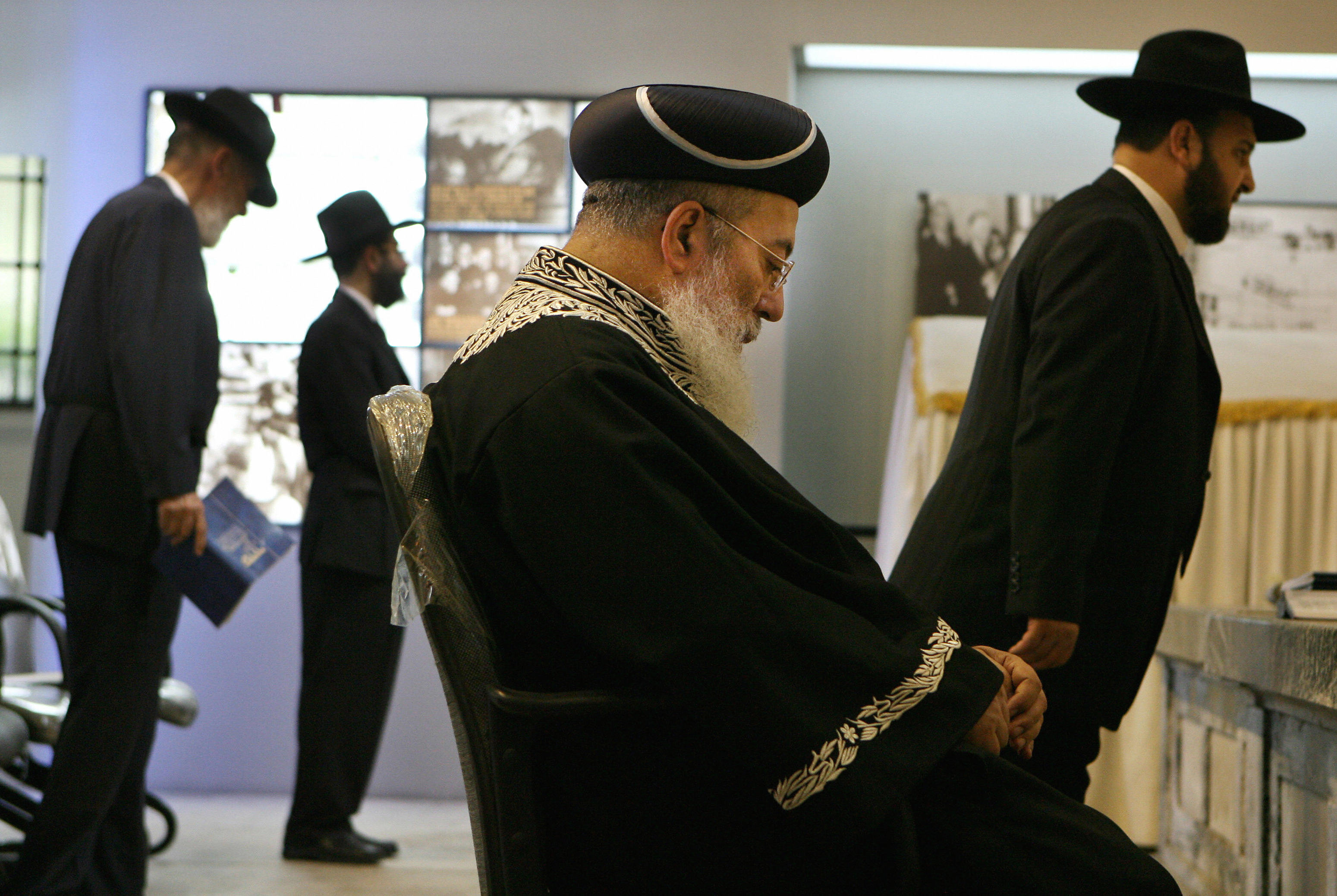
The Sephardi Chief Rabbi of Israel, Rabb

Julian Gewirtz and James McAuley explore the history of the city’s Jewish community:

As early as 1845, when Shanghai was forcibly opened to foreign trade under the unequal treaties that concluded the Opium Wars, a network of prominent Sephardic Jewish merchant families—the Kadoories, the Hardoons, the Ezras, the Nissims, the Abrahams, the Gubbays, and, most prominently, the Sassoons—took root in the city and eventually joined the ranks of its Western occupying elite.

Small but powerful, this Sephardic merchant class financed many of the Beaux Arts mansions along the stately Bund, Shanghai’s version of Vienna’s Ringstrasse. Completed in 1929, Victor Sassoon’s Cathay Hotel—today the Peace Hotel—was the Bund’s crown jewel, the center of their cosmopolitan social world. In that sense, much of what survives today from prewar, European Shanghai is an artifact of Jewish Shanghai. When Nazi refugees arrived in the mid-’30s, Shanghai’s existing Jewish community became even more visible, swelling in size to nearly 30,000.

It was in this period of traumatic conflict—in Europe and in Asia—that Chinese leaders across the ideological spectrum, relying on stereotype but not necessarily on a Western anti-Semitic vocabulary, began to discuss the Jews as a people worthy of special attention.

The association between Jews and prosperity survives in China today:

Whether this association is philo-Semitic in its enthusiasm or anti-Semitic in its reliance on caricature is difficult to say, perhaps because the Chinese popular imagination seems to have imbued a historically negative Western stereotype with a decidedly positive meaning. At the Shanghai Jewish Refugees Museum, which commemorates the city’s hospitality during World War II, an elderly Shanghai native working as a security guard recalled to us that he had known what Jews were as he was growing up because “Jews lived in Shanghai” and “Jews built the Peace Hotel.” He grinned broadly. “We say that a person who is very shrewd is ‘like a Jew.’” A compliment? At least in Shanghai.

(Photo: The Sephardi Chief Rabbi of Israel, Rabbi Shlomo Amar (C) prays with a group of Orthodox Jews on June 12, 2006 during a tour of the historic Ohel Rachel synagogue which was built in 1920 during the period of the first wave of Jewish migration to Shanghai. The Chief Rabbi is in China to meet government leaders in Shanghai and Beijing and toured the synagogue which is only open to the Jewish community during special religious occassions and used to house up to 700 devotee’s in the period 1920 – 1949 when many Jews sought refuge in Shanghai. By Mark Ralston/AFP/Getty Images)

04 Jul 09:20

A Tribute to Discomfort: Insights from National Geographic Photographer Cory Richards

by Christopher Jobson

A Tribute to Discomfort: Insights from National Geographic Photographer Cory Richards travel interview documentary adventure

A Tribute to Discomfort: Insights from National Geographic Photographer Cory Richards travel interview documentary adventure

A Tribute to Discomfort: Insights from National Geographic Photographer Cory Richards travel interview documentary adventure

A Tribute to Discomfort: Insights from National Geographic Photographer Cory Richards travel interview documentary adventure

A Tribute to Discomfort: Insights from National Geographic Photographer Cory Richards travel interview documentary adventure

At the age of 14, photographer Cory Richards had dropped out of high school and was technically homeless. His education, he says, was instead obtained through the observation of struggle. Through various forms of discomfort and adventure he would eventually become the first American to successfully summit an 8,000-meter peak in winter (Pakistan’s Gasherbrum II), and launch an incredible career in photography through the pages of National Geographic.

Brooklyn-based digital media company Blue Chalk recently sat down with Richards to discuss his motivations and driving desire to connect with the people he photographs. (via ISO 1200, PetaPixel)

04 Jul 01:32

How to Define Your Artistic Legacy

by Scott Meyer

As always, thanks for using my Amazon Affiliate links (USUKCanada).

04 Jul 01:29

Tumblr | 374.png

374.png
03 Jul 22:34

Dilbert's Creator Says You Shouldn't Have A Career Plan

Adam Victor Brandizzi

No geral, gosto das dicas do Scott Adams. Como nesse caso. Talvez deva voltar a assinar o blog dele...

Scott Scott Adams: You should have strategies, not goals.

There is some irony in the fact that Scott Adams, creator of the Dilbert comic, has written a book about getting ahead in life. The characters in his daily strip aren’t exactly success stories. Example: the strip that ran November 26.

Wally, Dilbert’s colleague: “Experts say lazy employees are the best because they know how to find shortcuts.”
Dilbert’s boss: “So you found a lot of short-cuts.”
Wally: “Me? No—I’m not lazy. I’m useless.”
Boss: “Then why did you bring it up?”
Wally: “Why wouldn’t I? I’m not lazy.”

Like most Dilbert strips, it’s funny but it’s also kind of depressing and circular. The characters are caught in dead-end, heartless jobs in a faceless office. They never get off the treadmill.

Meet Adams (no relation to me) in person and he’s not at all like Dilbert, except for a hint of dry wit. Wearing an open-neck blue shirt instead of a short-sleeved white shirt and tie, he talks about how much he enjoys a life that is the opposite of Dilbert’s. At age 56, he eschews a 9-5 workday.  Instead he rises at 5am and starts drawing by 5:10. Over the next next five hours he works steadily, writing his blog and creating two comics. At mid-day, he exercises, either playing tennis near where he lives in Pleasanton, CA CA, a suburb of San Francisco, or doing weight training and cardio at a gym. He devotes the rest of his time to a variety of projects. Right now he’s developing an internet startup called Calendartree.com, a mobile-friendly website that allows users to easily create schedules for groups.

Before his comics became popular and he quit his day job in 1995, he led a more Dilbert-like life. After growing up in Windham, NY and graduating from Hartwick College in Oneonta he vowed he would get away from snow and bought a one-way ticket to San Francisco. With a degree in economics, he aimed to work in a bank. He landed a position as a teller at Crocker National Bank, where he was held up at gunpoint twice. Later he moved up to computer programmer, commercial lender, product manager and supervisor, before getting an MBA from the Haas School of Business at U.C. Berkeley in 1986. While working at Crocker, he sometimes used comic strips to lighten up presentations.

Next he went to work at Pacific Bell as a budget analyst. He says the people he met there inspired his cast of Dilbert characters. He started drawing the cartoons at 4am, before work. In 1989 he got a break when United Media published Dilbert in 30 newspapers. By 1995 he had left his day job and was supporting himself as a cartoonist.

Since then he has launched or dabbled in a dozen ventures, most unsuccessful, including a food company that sold vegetarian burritos. He ran one restaurant that did well at first, but eventually closed. Meantime his career as Dilbert’s creator has thrived. He has published 40 books of comics and eight other titles, including two novels, and in 1996, the influential Dilbert Principle, which posits that companies tend to promote the least competent employees into management, to limit the amount of damage those workers can do in more hands-on roles.

BookHis latest book, How to Fail at Almost Anything and Still Win Big: Kind of the Story of My Life, is his first career-advice book. He stopped by my office this week and I asked him to sum up the contrarian lessons in the book. Here are edited excerpts of what he shared with me:

1. Goals are for losers.
I meet a lot of people who have a plan They are going to get this type of job or they are going to live in a big house. But most goals are overly specific. There’s a 99.9% chance you’ll never achieve your goal. You should have a system instead of a goal. I choose all my ventures with the notion that if they don’t work, I will still gain a new set of skills and insights and meet people who will be interesting to me in the future. Goals aren’t totally useless if you have a system.

When I first flew to California, I met a businessman on the plane who was a CEO at a large company. His system was that when he got a job, he almost always started looking for the next job right away. He job-hopped all over the country until he became a CEO. If his goal was to get the boss’s job, he probably wouldn’t have been able to do that.

2. Passion is bullsh#t.
If you talk to a billionaire and you ask him, what was the secret to your success, he will often say, “passion.” But what else could he say without sounding like a jerk? He can’t say, “it was insider trading,” or “it was a family connection.”

Look at American Idol. Look at the first round and the stadiums full of people. They all have passion but they don’t get through the first round. Passion is great to have but it’s probably the least predictive property.

Look around your office. Look at the stapler, the furniture. Do you think someone was passionate about creating the stapler? Passion is just not predictive.

I see a lot of people sitting still because they haven’t found their passion. How about doing something that looks good on paper? I don’t think you should wait for passion. I think it’s a personality trait. Either you’re born with it or not. Passion and goals are just not actionable. Passion isn’t something you can do something about. How does it help you?

My own experience is that when stuff works, I get really excited about it. Passion follows success.


3. Define happiness as health plus freedom.

Freedom is doing what you want, when you want. Before Dilbert took off, my whole day was absorbed with what other people wanted me to do. By any objective measure, things were going great. Dilbert was taking off. But I was miserable during those years because I had no freedom.

Fitness and diet are important for happiness. There have been a lot of studies on willpower and how it’s a reserve that gets used up. If you have a goal for your diet, like lose 10 pounds, you’re probably going to get there. But getting back to what I was saying about systems and goals, I suggest that instead, you simply learn as much about diet science as you can. Eventually knowledge will replace willpower. If I were to say to you, you have a choice between a potato and pasta, most people wouldn’t realize that a potato is twice as high on the glycemic index as pasta. Knowledge will get you to a much better point. You should also understand that fat doesn’t make you fat.

* * * * * * * * * *

After we talked about Scott’s career lessons, I asked him where he gets the ideas for his strip. This is what he said:

I put my email in the strip. Business 101 says that you should give your customers a channel to reach you and then try to give them what they’re asking for. At the same time people were telling me what they wanted, they were also making suggestions. People email me things that happen at the office. That’s been my primary source of inspiration. Most cartoonists sit at a blank screen.

Also part of the reason I got involved in start-ups like the restaurants and the burrito business is that I got to see patterns over time. That became material for my strip. Starting a business that fails makes the comic better.

Bookmarked at brandizzi Delicious' sharing tag and expanded by Delicious sharing tag expander.
03 Jul 22:23

This Is A Refugee Crisis, Ctd

by Andrew Sullivan
Adam Victor Brandizzi

Sobre o aumento de crianças tentando atravessar a fronteira dos Estados Unidos.

A reader testifies to the truth of that statement:

I am a leader in my Catholic parish’s decades-old sister parish relationship with a church in San Salvador. I have been visiting regularly since 2009. In these five years, the level of violence and insecurity has increased dramatically. Our parish supports their parish school and our families sponsor about 45 kids there. We measure this crisis in the impact on these kids, not on partisan hyperbole. Here are some of the concrete situations we’ve encountered:

• A teenager’s mom is killed in front of her, because the mom can’t pay extortion money to the gang. The teenager has dropped out of school because she needs to support the rest of her family.

• Half of the older boys in the program can no longer attend the weekend enrichment programs because they have to cross a newly shifting gang boundary due to a split in the local Calle 18 “chapter”. Before, they knew how to navigate between MS-13 and Calle 18. Now, who knows? They stay in their one-room shacks in sweltering heat as adolescence passes them by.

• Kids from Calle 18 are sent to a neighborhood controlled by MS-13 on a mission to beat up someone (doesn’t matter who really). They choose a beloved social worker who is one of the few responsible father figures in the neighborhood.

• A young nun gives presentations on human trafficking and the reality of immigration. She tells adolescents that there is a really high risk of rape. They tell her, “I’ve already been raped by (my father; the police; the gangs). What do I have to lose?” She tells them about dying of thirst in the desert. They tell her about death in their neighborhood because of lack of clean water.

The boys and girls on the border are children fleeing for their lives. They are not economic migrants.

03 Jul 18:19

Com síndrome rara, goleiro da seleção dos EUA é novo herói americano

by Cláudia Trevisan

Os Estados Unidos estão fora da Copa do Mundo, mas a sensação no país é de vitória, apesar da eliminação por 2 a 1 no jogo com a Bélgica. A seleção americana foi além do que seus próprios integrantes esperavam e deixou Gana e Portugal para trás na primeira fase. Na terça-feira, conseguiram empurrar os belgas para a prorrogação e saíram do campo com um placar decente e um novo herói nacional: o goleiro Tim Howard, que defendeu 16 chutes em um único jogo, um recorde que não era registrado desde 1966.

Histórias de superação pessoal não são raras no esporte, mas Howard tem uma condição que torna sua trajetória ainda mais surpreendente. Quando criança ele recebeu o diagnóstico de síndrome de Tourette, que faz seu portador ter movimentos involuntários (tiques) e, em alguns casos, soltar expressões verbais sem controle.

Howard abraçou sua condição e fala abertamente sobre ela, na tentativa de desmistificá-la “São tiques definitivamente involuntários”, disse em entrevista ao Yahoo Sports. “Alguns deles são piscar, limpar a garganta, tensionar músculos em diferentes partes do corpo. Infelizmente, ela é desconstruída e apresentada de uma maneira cômica, particularmente em Hollywood, filmes e coisas do gênero.”

Quando foi contratado para jogar no Manchester United, em 2003 anos, Howard foi alvo dos implacáveis tabloides britânicos, que ridicularizaram sua condição e o classificaram de “deficiente” e “goleiro xingador”. Dizer palavrões involuntariamente pode ser uma das características da síndrome, mas Howard diz não ter esse sintoma.

“Essas manchetes foram escritas por pessoas que não têm ideia do que é a síndrome de Tourette. Elas não sabem que não sou deficiente nem xingo. Mas pessoas não educadas têm o hábito de fazer afirmações sem fundamento. Eu tenho que me acostumar a isso”, declarou no ano passado em entrevista à alemã Spiegel Online.

Howard disse que o nervosismo intensifica os seus tiques, mas que de alguma maneira ele consegue se controlar quando a bola se aproxima de seu gol. “Nesses momento eu estou totalmente lá. É estranho. Assim que as coisas ficam sérias na frente do gol, eu não tenho nenhuma agitação; meus músculos me obedecem”, afirmou na mesma entrevista. Howard respondeu que não tinha ideia de como consegue se controlar. “Nem mesmo os médicos podem me explicar. Provavelmente é porque naquele momento minha concentração no jogo é maior que a síndrome de Tourette.”

03 Jul 17:58

Photo


03 Jul 14:08

Conheça a história do ‘rabino santo’ que mobiliza católicos na Amazônia

LUCAS REIS, DE MANAUS

No cemitério mais antigo de Manaus, o São João Batista, é outro o “santo” que há um século atrai devotos e mensagens de agradecimento por graças alcançadas: o santo judeu milagreiro.

Assim ficou conhecido o rabino marroquino Shalom Emanuel Muyal, que desembarcou na Amazônia no início do século passado com a missão de ajudar e orientar a já crescente comunidade judaica em Belém e Manaus.

Morreu apenas dois anos após chegar ao Brasil, em 1910, possivelmente de febre amarela (não há consenso sobre isso) e virou referência para católicos.

Desde então, ganhou fama de milagreiro, e seu túmulo, até hoje, é alvo de peregrinações.

“Essa história é famosa em Israel. Nos perguntam: ‘Como pode um rabino ser santo?’. Mas o fato é que ele é o nosso embaixador com a comunidade cristã em Manaus”, diz Anne Benchimol, ex-presidente do Comitê Israelita do Amazonas e diretora educacional da instituição.

Rabino santo da Amazônia

As razões da fama de milagreiro do rabino também despertam dúvidas.

A versão mais repetida, porém, é a de uma mulher que deu de ombros para a possibilidade de ser contaminada pela doença e passou a cuidar de Muyal.

“Quando ele morreu, as pessoas ficaram encantadas pela maneira com que essa senhora cuidava do rabino. Então, a mulher dizia que poderia tratar doenças e outras enfermidades, pois o rabino havia lhe dado o poder de cuidar das pessoas”, diz Anne.

Foi a senha para que surgissem casos de cura ou outras graças alcançadas atribuídas ao “santo rabino”. Desde então, a fé só cresceu.

CEMITÉRIO CATÓLICO

Enterrado em um cemitério cristão, já que Manaus, à época, não dispunha de um cemitério israelita, o túmulo do rabino passou a reunir devotos.

A comunidade judaica ergueu um pequeno muro em volta, como manda a tradição. E viu crescer o culto à imagem do rabino dia a dia.

No local, há dezenas de pedras postas sobre o túmulo, além de placas com agradecimentos ao “milagreiro”.

“Não é a comunidade judaica que o considera santo milagreiro, mas respeitamos este sentimento”, diz Anne.

O caso tomou tamanha proporção que, nos anos 1980, um parente de Muyal tentou levar consigo os restos mortais do rabino para que fossem enterrados em Israel. Foi impedido pela fé dos católicos.

“Não podemos fazer isso, um número muito grande de cristão ficaria triste. Nem mesmo do cemitério [São João] ele foi retirado”, conta Anne.

“Na época, a comunidade judaica argumentou que o rabino veio para a Amazônia trabalhar e prestar serviços comunitários. Permanecendo aqui, ele continuará a prestar serviços.”

03 Jul 13:03

Yet another sysadmin's script

by sharhalakis

by paran0id

03 Jul 01:17

O nosso jeito e o deles

by Míriam Leitão
 http://oglobo.globo.com/rss/blogs/84.asp

Enviado por Miriam Leitão e Alvaro Gribel - |

Coluna no GLOBO

O nosso jeito e o deles

O Brasil teve adversários difíceis na renegociação da dívida externa. A Argentina, também. Nossos vizinhos foram agressivos, impuseram o tamanho de desconto aos credores e chamaram de “abutres” os que ficaram de fora. O Brasil negociou até com quem havia ficado de fora para melar o jogo. Habilidade, um golpe de mestre e um aliado inesperado levaram o Brasil à vitória.

Os nossos “abutres” chamavam-se Dart. Eles também compraram papéis da nossa dívida após o calote dos anos 1980, quando os títulos estavam muito desvalorizados, com o objetivo de lucrar numa briga na Justiça.

O processo de reestruturação da dívida da América Latina dos anos 1980 e 1990 exigiu tempo e paciência de todos. Foram necessários sete anos, desde a quebra do México em 1982 — e o efeito dominó sobre outros países da região —, até se chegar às bases do Plano Brady, que abriu a chance da troca dos velhos títulos por novos, com preços e prazos melhores.

No caso do Brasil, vencidos os obstáculos iniciais, foi preciso um ano — de agosto de 1991 a julho de 1992 — só para se saber que parte da dívida seria objeto dessa securitização, o chamado “valor elegível para a negociação”. O acerto final foi outro longo processo.

Enquanto o Brasil negociava com a maioria, um grupo ficava de fora, discordando. Nele, a família Dart tinha maioria. No momento de fechar com os credores, eles tinham força suficiente para exigir o cumprimento de uma cláusula de acordo anterior, que exigia pagamento mais rápido.
O governo brasileiro nunca deixou de falar com eles. Havia interlocutores no Banco Central e no grupo de advogados tentando encontrar uma saída negociada. Nada demovia os Dart de melar o jogo.

Foi quando aconteceu o inesperado. O Banco do Brasil, que era um dos credores do Brasil, não aceitou os termos da renegociação proposta pelo país e juntou-se à família Dart e seus amigos. Como o BB era grande credor do Brasil, sua entrada no grupo dos contra fez com que os Dart ficassem minoritários. E lá o Banco do Brasil neutralizou a ação dos adversários.

Esses investidores então entraram na Justiça. Primeiro, exigindo o mesmo que o fundo Elliot Singer está exigindo da Argentina, o pagamento imediato, e, segundo, acusando o Banco do Brasil de estar cumprindo ordens do governo brasileiro. O Brasil sustentou na ação que o BB tinha acionistas privados e independência de decisão. O Brasil nunca quis falar publicamente sobre a contenda. Os negociadores negociavam, os advogados advogavam, e as autoridades silenciavam sobre a briga com os Dart.

A ação na Corte de Nova York continuou mesmo após o fechamento do acordo com os bancos credores, entre eles, o BB, que já havia voltado para o lado de cá. Os Dart exigiam o pagamento imediato e integral.

Foi quando aconteceu o segundo inesperado. O governo americano entrou no caso como Amicus Curiae (amigo da corte) do Brasil. E isso acabou de pender a balança para o nosso lado. O Brasil acabou encerrando mais esse capítulo em 1996, 15 anos depois de iniciada a crise da dívida.

Qual foi o erro maior da Argentina? Foi, desde o primeiro momento, hostilizar os credores. A moratória foi decretada porque não havia como pagar, mas Kirchner, ao assumir um país caloteado, escolheu o caminho do confronto. Não apenas impôs o percentual de 73% de desconto como o fez a seu modo. A cada declaração agressiva do então presidente Nestor Kirchner, mais ressentimento se acumulava entre os credores.

Agora, a Argentina já está na prorrogação e não fez nenhum gol desde o início da partida. Dificilmente encontrará no governo dos Estados Unidos quem torça por eles.

03 Jul 01:14

Criatura sensacional

by ricardo coimbra
Clique na imagem para aumentar
02 Jul 22:46

Mais médicos mais caros, ou, de como a desigualdade é um problema financeiro

by Tiago de Thuin
Adam Victor Brandizzi

Como a desigualdade efetivamente aumenta o custo do Estado.

Em meio à disputa sobre o programa Mais Médicos, uma das questões mais citadas pelos defensores do programa foi o alto valor das bolsas pagas aos médicos participantes, chamados pelos seus detratores de "escravos." Com efeito, as bolsas que o governo pagará aos médicos situariam alguém entre os 3% mais ricos dos assalariados (caso representassem salário bruto, e não líquido). Mesmo o quinhão do custo dos médicos cubanos que ficará com os próprios, de 4.000 reais, situariam os cubanos entre os 10% mais ricos. Entretanto, não se viu, numa cena política pródiga de jacobinos, ninguém que considerasse esses valores demasiado altos, senão para ironizar os médicos que os desprezavam. Não deixa de ser curioso compará-los com os valores pagos a médicos que praticam a residência obrigatória no serviço público em outros países: eles vão de nada (Itália) a um pouco menos da renda per capita (Reino Unido), em geral. No Brasil, a "escravidão" vale dez rendas per capita.

Não se trata, aqui, de enfatizar o quão generosa é a oferta do governo (e registre-se que em outros países com serviço compulsório especificamente voltado para áreas carentes, a oferta pode ser muito mais generosa em outros quesitos, como preferência para especialização). O governo não está sendo generoso, mas oferecendo o mínimo possível. Isso porque o tal salário de dez mil reais líquidos não é significativamente superior à renda média dos egressos de medicina - dependendo de a quem você pergunta, entre 20% e 50% maior. Os médicos são considerados arrogantes e insensíveis por não se candidatarem ao Mais Médicos, mas você aceitaria ganhar 20% a mais do que ganha em São Paulo para trabalhar num lugar em que só se chega em lombo de burro ou canoa? O comportamento dos conselhos de medicina é francamente deplorável, mas essa equação simples, feita pela maioria dos médicos que nem protagonizaram cenas de racismo explícito para ser contra, nem se juntaram ao programa, é bastante razoável. A pergunta poderia ser "por que no Brasil dez  rendas per capita são insuficientes, e no Reino Unido menos de uma é razoável, como salário para um médico ou outro profissional qualificado"? E o que creio é que a resposta a essa pergunta é necessária para qualquer projeto de Brasil, e que ela é simples. Chama-se desigualdade.

É necessária porque o ponto em comum de todas as múltiplas e díspares reinvindicações que foram às ruas em Junho de 2013 é que não querem algum tipo de estado minarquista, mínimo, em que os fracos não têm vez e o darwinismo social impera. Pelo contrário, mesmo aqueles que reclamavam de altos impostos reinvindicavam, ao mesmo tempo, sistemas públicos de saúde e educação melhores. Ora, a não ser que a idéia seja reinivindicar uma versão contábil de "sejamos realistas, reinvindiquemos o impossível," essa conta não bate, nas condições atuais - a não ser que a idéia seja o "desenvolvimento" como panacéia, e bem, mesmo descontando aqueles dos marchantes que são contra o desenvolvimentismo, os que são a favor tampouco sabem de verdade como conseguir esse mítico desenvolvimento rápido. São poucos os países que conseguiram pular de patamar de renda, e a maioria em situações de crise aguda infinitamente mais graves do que as do Brasil de hoje e/ou com a ajuda direta das potências centrais, por suas próprias razões geopolíticas. E com enorme sacrifício do povão enquanto o desenvolvimento não chegava, no mais das vezes.

Então, se desenvolvimento é algo que não se gera apenas com vontade, e se o que se quer é mais dinheiro pra saúde e educação, precisamos de mais impostos sobre o dinheiro que há, ou mais eficiência ao gastá-los, ou os dois. E eficiência no gasto não é algo que depende apenas da qualidade ou da honestidade de nossos gestores públicos; como tanta coisa, depende também de fatores estruturais e infraestruturais. Os estruturais, como a péssima lei de licitações, são relativamente mais fáceis de enfrentar. Com os infraestruturais, voltamos ao problema do primeiro parágrafo. Médicos são apenas uma das diversas categorias de profissionais altamente educados necessárias para um estado moderno funcionar, principalmente na provisão de saúde e educação aos seus cidadãos (em outros campos do estado, os profissionais não são menos educados, mas são em menor número). E profissionais desse nível de educação ocupam um local proporcionalmente alto na escala de rendimentos. O resultado inevitável - poder-se-ia quase dizer aritmético - disso é que quanto mais ampla essa escala, quanto maior a desigualdade, mais caro é o Estado para um mesmo patamar de serviços. A desigualdade brasileira torna o Estado menos eficiente, faz com que seja mais difícil prover saúde e educação. Não é apenas uma questão de justiça.

Não é um processo muito complicado. A expectativa de renda de uma pessoa não é ilimitada (como proposto por algumas escolas econômico-filosóficas) mas, empiricamente, ancorada numa noção de renda justa que tem muito a ver com a renda observada do mesmo estrato social. Médicos, advogados, e professores, e outros profissionais, parte de uma elite social por um zilhão de motivos (inclusive a reprodução intergeneracional de seu capital social ostensivamente meritocrático), e tem suas expectativas de renda balizadas pelo seu entorno. O Estado, portanto, (como qualquer empregador) a longo prazo terá o salário médio de seus profissionais qualificados puxado para a média dos salários de elite, ou bem terá que conviver com a insatisfação crônica desses profissionais e, no limite, o abandono por parte deles das carreiras públicas. E agora vou além do que falei sobre o desenvolvimento: não adiantaria de nada aumentar o PIB, porque esse balizamento é em boa parte feito comparativamente, e não em termos absolutos. A vida material de alguém de classe média-média hoje é bem mais abastada do que a de alguém mais rico em 1900; isso não muda suas classificações. A desigualdade brasileira baliza expectativas de desigualdade também - é a indignação com um professor ganhando o mesmo salário de alguém com menos educação, frequente mesmo entre quem se considera de esquerda. Aliás, fazendo uma enquete informal com amigos que se definem como de esquerda ou até socialistas, a diferença de renda considerada razoável entre um professor universitário e um de 1º grau é de 3x, e entre este e um faxineiro, de outras 4x. Dá mais do que a diferença entre os 20% mais ricos e os 20% mais pobres na maioria dos países do mundo (entre o prof. universitário e o faxineiro), e coisa próxima à diferença entre os 20% mais ricos e a média da população (entre o prof. universitário e o escolar) no Brasil. Mesmo acha errada a diferença de renda baliza suas expectativas de renda nela.

Vamos fazer uma simplificação tosca para a conta de como isso afeta as finanças públicas ficar mais fácil: Falemos de duas nações, Laputa e Houyhnhn. Em ambas, os funcionários públicos qualificados - médicos, professores universitários, promotores, auditores, e quejandos - representam 5% da população. Em ambos, os governos têm como prioridade o bom funcionamento dos serviços públicos, então o salário médio de seus funcionários está em linha com suas expectativas, isso é, em linha com os rendimentos do quintil (20%) mais rico da população. A diferença é que em Laputa, o quintil mais rico ganha 3,6x mais que o PIB per capita, enquanto em Houyhnhn, mais igualitária, o quintil mais rico ganha apenas 1,7x o PIB per capita. Pois bem, para fazer funcionar a contento sua máquina pública, Laputa gastará 18% do PIB só em salários de funcionários qualificados, enquanto Houyhnhn gastará 8,5% do PIB com os mesmos funcionários. Laputa e Houyhnhn são os nomes de países visitados por Gulliver, mas os dados de desigualdade são os do Brasil e do Japão, respectivamente.

Vamos lá: o simples fato de a desigualdade ser menor no Japão faz com que seu governo, para prover os mesmos serviços aos cidadãos, possa ter uma carga tributária 10% menor. O equivalente a desonerar o tal "setor produtivo" de toda a arrecadação direta estadual brasileira. Não é uma discussão pequena, em tempos em que hospitais erguidos não funcionam por falta de médicos, e universidades novas não conseguem achar professores. Na mesma tradição da direita que, previdente, pretende reformar a previdência pensando no longo prazo, os efeitos de uma redução de 10% na carga tributária no longo prazo não podem er subestimados. Sem coração de banana, sem questões abstratas de justiça, sem o medo de madame Guilhotina que já anima alguns megaempresários mundo afora. E quais seriam as ferramentas apropriadas para diminuir a desigualdade? Oras, impostos sobre a renda e patrimônio das pessoas físicas. Não é uma discussão teórica, é o que foi feito no mundo pós-guerra, e funcionou. É simples e calculável. O imposto sobre grandes fortunas, um aumento do IRPF, do imposto sobre a herança, do IPTU, não são apenas jeitos de se arrecadar mais dinheiro para o governo, mas jeitos de fazer esse dinheiro render mais.
02 Jul 22:20

What I Learned as a Woman at a Men's Rights Conference

184867516Don Bayley—Getty Images

Detroit once epitomized the possibilities of the American Dream: as the hub of the U.S. auto industry, money, power and a sense of virility seemed available to the men who worked hard enough, in factories and in boardrooms, to attain them. Now the city is a husk, and as the jobs trickled into other places, so too did the feeling that the only obstacle separating men and power was their own effort. Once a stronghold of American influence, the city of Detroit is now shorthand for decline and bankruptcy. It makes some sense, then, that the International Conference on Men’s Issues, a gathering staged to raise alarm against what its organizers describe as rising discrimination against men, chose the city for its inaugural meeting the last weekend of June.

For this passionate set, the leaders of what has become known as the men’s-rights movement, Detroit’s losses mirror their own sense of what they see as men’s flagging influence. Sure, women may have once been unequal, they say, but not anymore and not by a long shot.

As a journalist who thinks and writes frequently about women’s issues, I’m well acquainted with the darker side of the men’s-rights movement, which rears its ugly head in “the manosphere” and on Reddit forums, shielded by a comforting cloak of anonymity. And though I’ve never tackled its existence specifically in any story, I knew what some men’s-rights activists had done to women who had — launching large-scale rage campaigns full of name-calling, threats and crusades to get them fired. When I went to Detroit, I expected the men who attended this conference to not be thrilled with my presence — and many made clear that they weren’t — and to make provocative statements about “the myth of rape culture” and even to smoke a lot of e-cigarettes.

But what I didn’t expect was how it would make me feel: sad and angry and helpless and determined, all at the same time. Moreover, I didn’t expect to talk to so many men in genuine need of a movement that supports them, a movement that looks completely different from the one that had fomented online and was stoked by many who spoke at this three-day conference.

The event came at a time when attention for its supporters’ ideas are rising beyond the Internet’s fringe. And while nearly every corner of the web is now home to discussion of the state of feminism today, with anyone from Facebook’s Sheryl Sandberg to Beyoncé participating, a countermovement is growing. Nearly 150,000 people subscribe to forums dedicated to men’s rights on the social-media site Reddit. A recent Saturday Night Live sketch starring Lena Dunham attacked their beliefs. And in May, these views came under greater scrutiny following the murders committed in Isla Vista, Calif., by Elliot Rodger, whose views of women matched those found in the extreme corners of the men’s-rights movement.

Beneath the vitriol and fear these men (and a small number of women) express are some truths about the state of men today. In a growing number of ways, boys and men are at a disadvantage. Men and women were hit unevenly by the recession. Women recovered job losses this spring. Men did not. Women are outpacing men in college enrollment, with 71% of women enrolling in a university immediately after high school, compared with only 61% of men, a 2012 Pew Research Center survey found. The suicide rate among men is four times the rate of women, with males accounting for 79% of all U.S. suicides, according to a 2010 study conducted by the Centers for Disease Control. Frequently boys do not have the same support network as girls their age (the cost of this deficit was detailed by Rosalind Wiseman in TIME last December).

And yet despite these real troubles, the leaders of the movement have been unable to move beyond a reputation for hate. Its most influential online gathering place, the website A Voice for Men, founded in 2009 by Paul Elam, who led the June conference, has been described as “misogynist” by the Southern Poverty Law Center, the Alabama nonprofit that tracks hate groups. In addition to purporting to “expose misandry on all levels in our culture,” the site is also frequently a soapbox for Elam to attack individual women he feels are threats to the movement.

Elam and nearly 150 supporters came to Detroit, then, to increase awareness of their cause, but also to try a little rebranding. Perhaps by organizing an official conference, they could make their movement more palatable to outsiders.

“Men’s rights is a tougher-than-necessary fight in a world that believes that men made the rules and have all the rights to begin with,” said Dr. Warren Farrell, an author and Elam’s mentor, who addressed the conference. “It’s like asking for kings’ rights.”

Beginning a Movement
Dr. Warren Farrell did not start the movement himself, but he’s been an icon for believers since the 1970s when two distinct camps of men’s activists began to emerge, one pro-feminist and one anti-feminist. The men’s-rights movement represented at the Detroit conference has its roots in anti-feminist, pro-masculine movements that ripened in the early 1980s. Farrell, once a prominent second-wave feminist who served on the board for New York’s National Organization for Women and was tasked with creating feminist groups for men, became disillusioned in the mid-1970s when NOW opposed “the presumption of joint custody” for parents. Since then, Farrell has focused primarily on men’s gender issues, writing the best seller The Myth of Male Power in 1993, which challenged the notion that men are oppressors.

Many of the men active in the movement seem to have been drawn there through their own harrowing personal experiences, whether with divorce courts that stripped them of custody or ex-wives who cheated. Born into a military family, Elam worked as an addiction counselor for 20 years, before becoming disenchanted with the academic direction of psychological treatment and what he saw as a feminist overhaul of psychotherapy.

Elam quit his job and spent time as a truck driver before starting A Voice for Men in 2009. The site launched just as the global recession was peaking, leaving many men out of work and struggling to reconcile their identities outside the role of primary breadwinner. Early on, notes Dr. Julie T. Woods, a professor of communication studies at the University of North Carolina at Chapel Hill who has written several texts about gender and culture, the 2008 recession was called the “mancession” because many more men than women became unemployed.

“I think you’re hearing real anxiety about not being able to fulfill this basic commandment of manhood as they define it,” Wood says.

This angst was palpable in Farrell’s remarks during the press conference. “Women don’t marry men in unemployment lines,” he said. The audience nodded in agreement.

Today, Farrell’s concerns are not just financial. He speaks in favor of developing a male birth control pill, establishing better programs to care for veterans and helping boys struggling through adolescence. His allies rally against what they see as rampant paternity fraud (when a woman attempts to pin paternity on the nonbiological father of her child with the hopes of getting child support), a biased court system that favors mothers over fathers, soaring male suicide rates and prominence of domestic violence against men.

Women, they say, have distorted private life and taken over public life (never mind that 4 out of 5 Representatives in Congress or 9 out of 10 governors are male).

“Legislation is routinely drafted to advantage women and disadvantage men,” said British activist Mike Buchanan, later adding, “Boys are being relentlessly disadvantaged by an ever more feminized education system.”

Despite a shared feeling of disenfranchisement, most of the attendees I spoke with struggled to recall a time in their lives when they were discriminated against for being men. When asked, two different attendees mentioned losing out to a woman for a job opportunity, though one conceded that she could have simply been more qualified.

Some of the men at the conference said they were drawn to the movement after alarming personal experiences caused them to realize there were far fewer resources for men’s emotional and physical health than there were for women.

Brendan Rex, a 28-year-old who flew down from Manitoba, Canada, to attend the event, confided that he lost his virginity at the age of 14 when a woman climbed on top of him and had sex with him while he was drunk and unconscious.

“It kind of took me a few years to come to terms with the concept that I had nowhere to go,” Rex said. “Then about six years ago I kind of realized that there were a lot of other people like me; it’s not uncommon for men to be sexually abused, it’s not uncommon for men to be sexually abused by women. But because there’s this lack of knowledge, there’s this lack of community — you’re completely isolated. You have no one to talk to who understands this.”

‘Evil Empire’
Throughout the three-day event, the specter of feminism, or what British domestic-violence activist Erin Pizzey called “the evil empire,” loomed large, threatening to rip children from their fathers, lobby false rape accusations and remind men that in parenting, work and war they are forever disposable. (The movement includes a small fraction of women dedicated to the same mission.)

A palpable distaste for women seeped between the cracks of the conference, in comical asides and throwaway comments. When the conference’s M.C., Robert O’Hara, asked a woman in the audience a question and she responded with a no, he quickly shot back “Doesn’t no mean yes?” The audience burst into laughter.

During another panel, psychologist Tara Palmatier cued up a slide with a photo of Miley Cyrus displaying her naked stomach. Transposed atop it was the caption, “Quit objectifying me. You’re being rapey!” a clear nod to the belief that a woman’s attire and behavior are causal factors of sexual assault.

This is a slide from a presentation at the Men's Rights conference. Almost all the slides are women taking selfies. http://t.co/y9THAaaHy2
  (@AdamSerwer) June 27, 2014

Stefan Molyneux, a Canadian radio host, blamed mothers for the violent behavior of men.

Molyneux said that because 90% of a child’s brain is formed by the experiences it has before the age of 5, and women have “an almost universal control over childhood,” violence exists in the world because of the way women treat children.

“If we could just get people to be nice to their babies for five years straight, that would be it for war, drug abuse, addiction, promiscuity, sexually transmitted diseases,” he said. “Almost all would be completely eliminated, because they all arise from dysfunctional early childhood experiences, which are all run by women.”

Dr. Jay Giedd, who serves as chief of the National Institute of Mental Health’s Unit on Brain Imaging in the Child Psychiatry Branch, said that he didn’t think this idea “could be more wrong.”

Though a child’s brain reaches 90% of its size by age 5, that doesn’t mean it’s done developing. “Almost nothing is set in the first five years or even in the first 10,” he said. “There’s no scientific support for these claims.”

At Elam’s request, the majority of the speakers were noticeably less anti-woman in person than many are in their writings or speeches elsewhere. A recording from Molyneux’s radio show from January posted to YouTube with the title “The Matriarchal Lineage of Corruption” reveals the full extent of his thinking.


(Warning: NSFW material)

“Women who choose a–holes guarantee child abuse,” he says. “All the cold-hearted jerks who run the world came out of the vaginas of women who married a–holes. I don’t know how to make the world a better place without holding women accountable for choosing a–holes.”

“Women worship at the feet of the devil and wonder why the world is evil,” he adds later. “And then know what they say? ‘We’re victims!’”

The movement is quick to disavow the concept of misogyny and instead direct attention to so-called Honey Badgers, a handful of women who support the cause. When I introduced myself as a reporter to two men sitting in the audience during the first day of the conference, one attempted to predict my first question by saying, “Do I hate women? No.”

Still, being surrounded by men who belly-laughed at rape jokes and pinned evil elements of human nature wholesale on women was emotionally taxing at best and self-destructive at worst. Once, during a particularly upsetting segment of the program, I had to excuse myself from the auditorium to seek refuge on the bug-filled bank of Lake St. Clair. I kept wondering why I had volunteered to fly 600 miles to attend the conference alone, to surround myself not just with crass ideological opponents, but with people with violent Internet histories who believed my very existence oppressed them. But to emerge on the other side of this with both my sanity and a worthwhile story, I would have to actually adopt a grain of their advice. I would have to stop feeling like a victim, and in turn cast aside all of the humiliating and unfair and devastating experiences I had collected as a woman.

Online Intimidation
For the most part, the conference tried to display the gentler side of the movement, one that embraces activism for significant men’s issues. Its organizers are aware of the fact that it would tarnish their authority to allow misogyny to overshadow their policy prescriptions to help real problems that affect men.

Days before the event began, Elam published a warning post on A Voice for Men saying that some ideological opponents and members of the media “will be looking for anything they can to hurt us with,” so anyone caught trash-talking women would be ejected from the conference.

For Elam, who once created a website called Register-Her, which encouraged men to name and shame women who supposedly made false rape allegations, shifting to a less polarizing agenda would mean a powerful change of heart. Elam has since shuttered Register-Her, and at the conference spoke of working to “build bridges between men and women instead of walls.”

“I find it hard to believe that this is Saul on the road to Damascus,” says Mark Potok of the Southern Poverty Law Center, “that Elam has really had an entire personality change.”

Though in person the activists worked hard to coat their message in a kinder, press-friendly sheen, the conference had barely been over for a day before Elam published a post to A Voice for Men taking issue with my tweets during the conference, which made clear that I was upset by many of the sentiments expressed.

In the post, Elam called me a “low rent hack” who “practiced journalistic scumtardery,” a “liar and a bigot [who] will be exposed.” He titled the post “An Amazing, Amazing Conference, Even With the Stink of Jessica Roy in the Air.” Those who tweeted at me following the publication of the post minced fewer words.

It seemed the perfect example of the fact that though the movement was attempting to put a polite face on in public, they still continue to harass and intimidate online. (Though they adopted similarly skeptical attitudes, none of the male reporters who tweeted or wrote about the event were subject to similar treatment.)

Elam says that being satirical and controversial is his way of drawing attention to the message.

When you talk to someone like 68-year-old Steve DeLuca, the legitimate need to remedy some of the issues raised by men’s-rights activists becomes more evident. A Vietnam veteran who was injured in combat, DeLuca spoke movingly to me about the two brothers he lost to suicide, and the unfathomable toll the high suicide rate among men can take. There are men out there, like DeLuca and Brendan Rex, who have a real stake in the movement’s success. The paranoia and vitriol of its leaders can’t possibly do anything for them.

Update: This original story has been updated to clarify comments from Mark Potok of the Southern Poverty Law Center.

Bookmarked at brandizzi Delicious' sharing tag and expanded by Delicious sharing tag expander.