
Cowboy Who?
Shared posts
02 Apr 23:26
Frasier and Niles Tell Their Dad to Stay Home
by JiJi Lee
INT. FRASIER’S APARTMENT
Frasier is on the phone.
FRASIER: Hello? Café Nervosa? Yes, I’d like a contactless delivery of two lattes and a dozen of your finest biscotti, please. (pause) Oh my, that’s devastating news. Thank you.
Frasier hangs up and turns to Niles, who is meticulously rubbing his hands with Purell.
FRASIER: They’re out of biscotti.
NILES: The world really is ending.
We see Niles cleaning a doorknob with a pocket square, then take out a Clorox wipe to clean the pocket square.
FRASIER: In these unprecedented times, perhaps I could use my celebrity to help the good people of Seattle. I should do an Instagram Live!
NILES: Haven’t the people of Seattle suffered enough?
Marty Crane walks through the front door, carrying a six-pack of Ballantine.
NILES/FRASIER: Dad! Not again!
MARTY: Oh, the hell with all the paranoia. I survived the Korean War and going to the opera with you two; I can deal with a tiny, deadly pathogen. The problem with you boys is that you’ve never experienced any hardship — like being a police officer or being exposed to a potentially lethal virus that’s devastating immune systems and pushing the world’s economies and hospitals to the brink. You’re such crybabies!
NILES: Dad, just so you know, Frasier’s the one who’s mad at you. I only care about your well-being. I’m sorry, can you stand still for a second?
Niles starts spraying his dad with Lysol.
FRASIER: Dad, people in your age group are the most vulnerable. You really ought to stay home instead of putting yourself and others at risk. I’ll even walk Eddie for you. I mean, I’ll get Daphne to walk Eddie for you — as soon as she returns from the crowded supermarket where I told her to fetch tonight’s dinner of chateaubriand.
NILES: I should’ve gone with her. But Maris was having trouble putting on her latex gloves. They kept falling off her petite hands, the poor thing. Do they make gloves for people with hands the size of pita chips?
MARTY: That’s it, I’m going to Duke’s.
FRASIER: Duke’s?! What kind of safety measures do they have?
MARTY: Same as always. He keeps a .32 under the counter.
FRASIER: Oh, dear god.
MARTY: You’re stopping me from living my life! Next thing you know, you’re gonna tell me I can’t eat from the buffet at a steakhouse or go on a cruise!
FRASIER: Dad, even Roz is concerned about you going out.
NILES: And that’s coming from someone whose idea of social distancing is to go home after her one-night stand.
Niles laughs at his joke, which turns to a cough. He immediately Lysols his mouth.
FRASIER: The problem is we all have cabin fever. How about we ride this out in an actual cabin?
NILES: I know just the chauffeur who can drive us there! (Texts) No, he’s unavailable. Don’t worry, I have a second preferred chauffeur. (Texts) No, he’s out too.
FRASIER: Do you have a third preferred chauffeur?
NILES: Please, Frasier. I’d rather die than have Stephens drive me.
FRASIER: Oh, for god’s sake, Niles, now’s not the time to be a snob! And where the hell is Daphne? I hope she doesn’t get the bad olive oil this time!
MARTY: I’ve had enough of you two. I’m going to my room to quarantine with Eddie. He’s better company.
NILES/FRASIER: Huzzah! We’re good sons!
NILES: I suppose I should go check on Daphne.
FRASIER: But how will you protect yourself?
NILES: I have just the thing.
- - -
Niles enters the living room, decked out in his fencing uniform, mask, and épée.
NILES (garbled): I’m going to rescue you, my darling Daphne!
Niles spends the next twenty minutes trying to open the door using his épée.
BillyHoya likes this
02 Apr 23:21

Paranoid
by Cassandra Calin
Realizing that I'm becoming Sheldon Cooper.
BillyHoya likes this
02 Apr 23:17
Click here to go see the bonus panel!
Today's News:
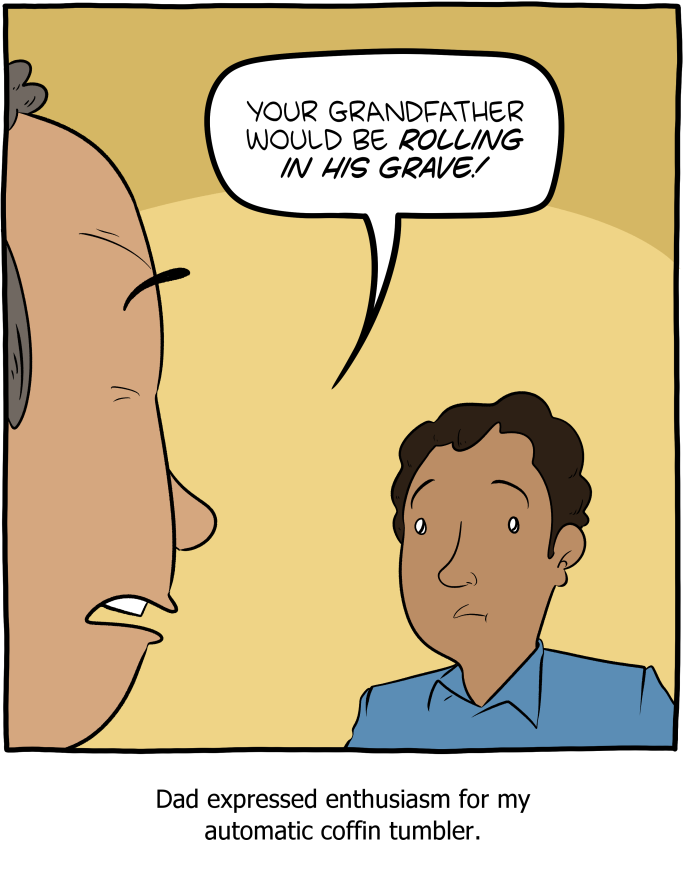
Saturday Morning Breakfast Cereal - Rolling
by tech@thehiveworks.com
Click here to go see the bonus panel!
Hovertext:
Fortunately, by the time grave robbery turns out to be illegal, they have enough venture capital that laws don't apply.
Today's News:
Lucas Vigroux, BillyHoya likes this
02 Apr 23:17

Click here to go see the bonus panel!
Today's News:
Saturday Morning Breakfast Cereal - Pu
by tech@thehiveworks.com
Click here to go see the bonus panel!
Hovertext:
Blessings upon every tweeter who contributed to this solution. I decided not to include cladding because cladding is for losers.
Today's News:
If I get at least 4 people offering one million dollars a piece I'll run a kickstarter for this with FREE bookmarks.
Lucas Vigroux, BillyHoya and one other like this
02 Apr 23:12
Double Thruple
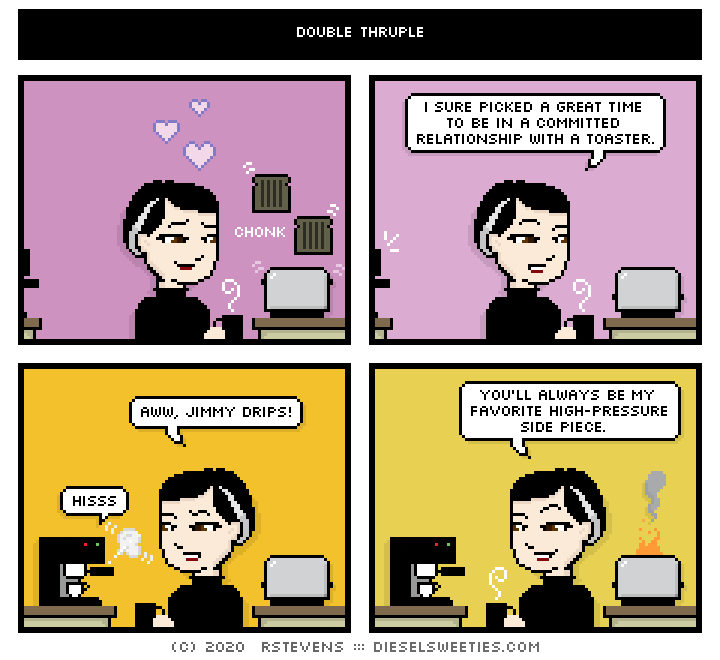
It's a great time to be in a committed relationship with a toaster.
BillyHoya likes this
01 Apr 12:53


Dolly Parton Will Read Bedtime Stories To Kids Online Every Week
by Bill Chappell
"Dolly hopes this series of stories will provide comfort and reassurance to coping kids and families during the shelter-in-place mandates," the Imagination Library said.
(Image credit: Brett Carlsen/Getty Images)
BillyHoya likes this
01 Apr 12:45
Self-isolation proves a boon to rainfall project
Scientists have been amazed at the public's response to help digitise the UK's old rainfall records.
BillyHoya likes this
31 Mar 21:09

Click here to go see the bonus panel!
Today's News:
Saturday Morning Breakfast Cereal - Class
by tech@thehiveworks.com
Click here to go see the bonus panel!
Hovertext:
Old man Weinersmith shakes his cane at you.
Today's News:
BillyHoya, Julia Meyer likes this

31 Mar 03:58

Click here to go see the bonus panel!
Today's News:
Saturday Morning Breakfast Cereal - Performance Review
by tech@thehiveworks.com
Click here to go see the bonus panel!
Hovertext:
If you can find 3 more of you, I get an even bigger raise!
Today's News:
Lucas Vigroux, BillyHoya likes this

30 Mar 16:22
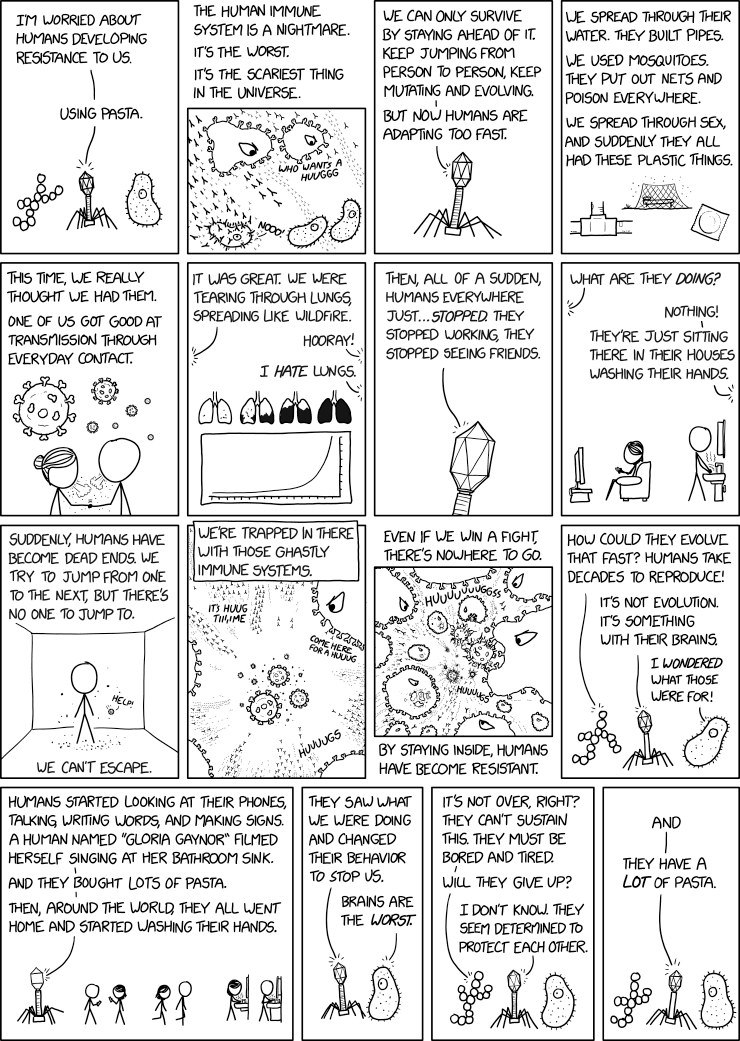
Self-Isolation or Graduate School?
by Melissa J. Gismondi and Deborah Ostrovsky
1. Justifying staying at home, given your work is basically a non-essential economic activity.
2. Continuing to draft up an increasingly complex schedule that you will inevitably fail to follow.
3. Picking fights with those around you as you contemplate the reality of your life.
4. Wondering, as always, what Hannah Arendt would have to say about all this.
5. Mopping the floors and cleaning countertops for the tenth time instead of working.
6. Wondering how cleaning became a preferred form of procrastination.
7. Needing reassurance from the person closest to you that this will soon be over.
8. Watching in horror as those around you inform you that it will probably not be over all that soon.
9. Chastising yourself for not spending more time trying to understand the labor theory of value as you contemplate whether being at a computer while lying in bed all day really counts as work.
10. Oscillating between thinking that is post-structuralist, post-modernist, or post-post modernist, depending on the time and day.
11. Realizing that yoga simply can’t help you through this.
12. Struggling to find meaningful connection with loved ones.
13. Telling yourself that when this is all over, you’re going to do things differently.
14. Questioning the futility of human agency in a patriarchal, white supremacist, post-industrial, surveillance capitalist society.
15. Hoarding Ben & Jerry’s Phish food.
- - -
Self-Isolation: 1-15
Graduate School: 1-15
BillyHoya likes this
30 Mar 10:25
New comic!
Today's News:
Awkward Zombie - Skin in the Game
by tech@thehiveworks.com
New comic!
Today's News:
Honestly, I probably drew Sam's hood more protective than it actually is. He's just really, really banking on the idea that he will never need to look up.
BillyHoya likes this

30 Mar 03:25
Elizabeth Warren campaign open sources its organizing tools
by Jon Fingas
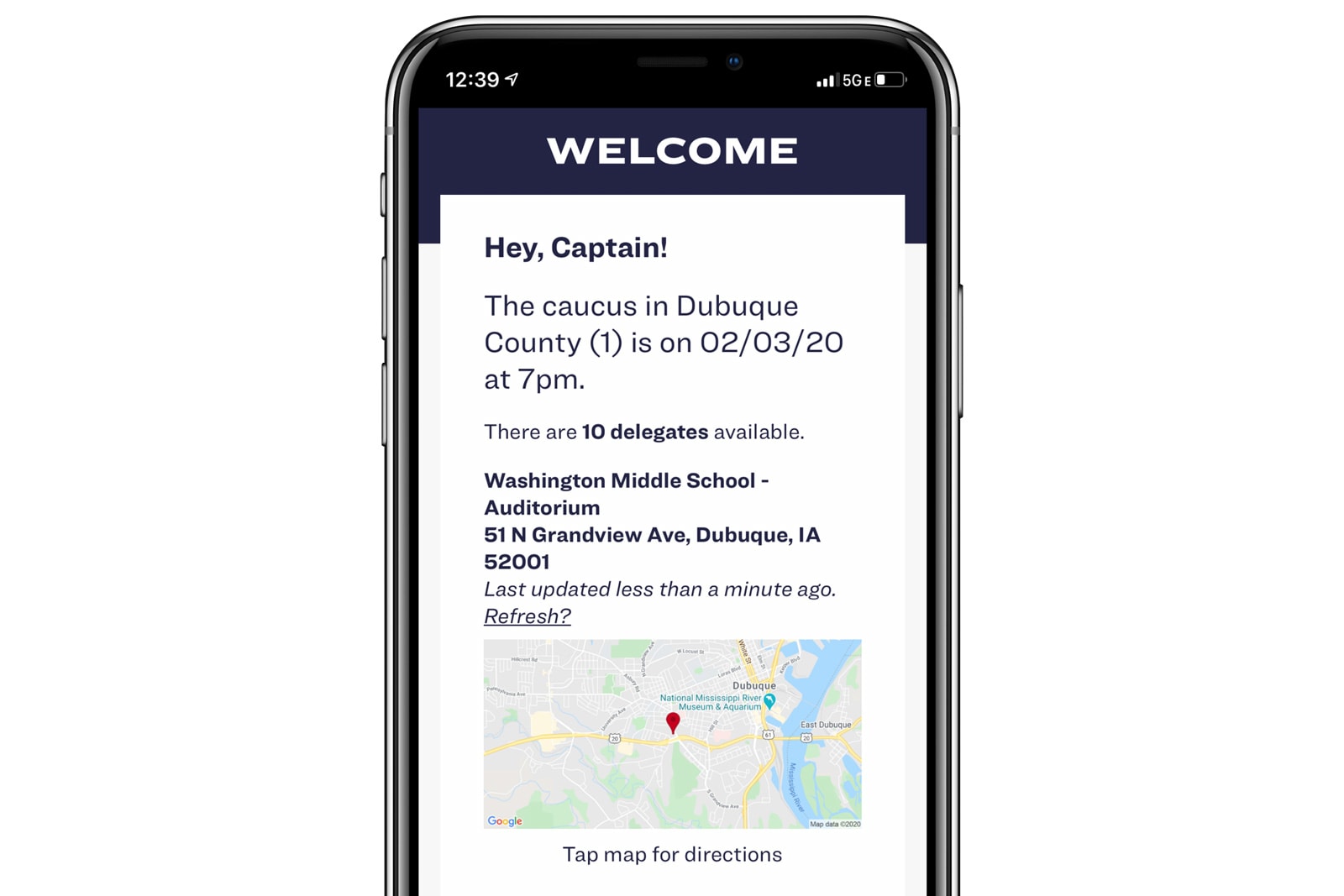
The impact of Elizabeth Warren's presidential campaign might be felt well after it ended. The Warren for President team is open-sourcing some of its key get-out-the-vote projects to help other politicians and cause supporters with their own efforts. These include the peer-to-peer texting platform Spoke, the polling location search tool Pollaris, a Caucus App used in Iowa (above) and the data handling app Redhook, among other tools.
The campaign will have "more to say" in the weeks ahead about what it did with technology.
It isn't unheard of for American candidates to rely on software for election runs, but developing open source tools is relatively rare. It may become more common, mind you. The Warren team noted that Spoke alone saved the campaign over $580,000 in texting costs. Free, easily modified tools like this could sustain political hopefuls who otherwise couldn't afford to either buy pre-made software or write their own from scratch.
Source: Team Warren (Medium)
BillyHoya likes this
29 Mar 23:32

Click here to go see the bonus panel!
Today's News:
Saturday Morning Breakfast Cereal - Wishes
by tech@thehiveworks.com
Click here to go see the bonus panel!
Hovertext:
Really, the optimal wish is to be perfectly satisfied with your remaining wishes.
Today's News:
Lucas Vigroux, Alex and one other like this
29 Mar 19:29

Dance
by Cassandra Calin
A reminder that it's okay to log off and take a break once in a while. Stay safe, everyone.
BillyHoya likes this
29 Mar 02:41
Click here to go see the bonus panel!
Today's News:
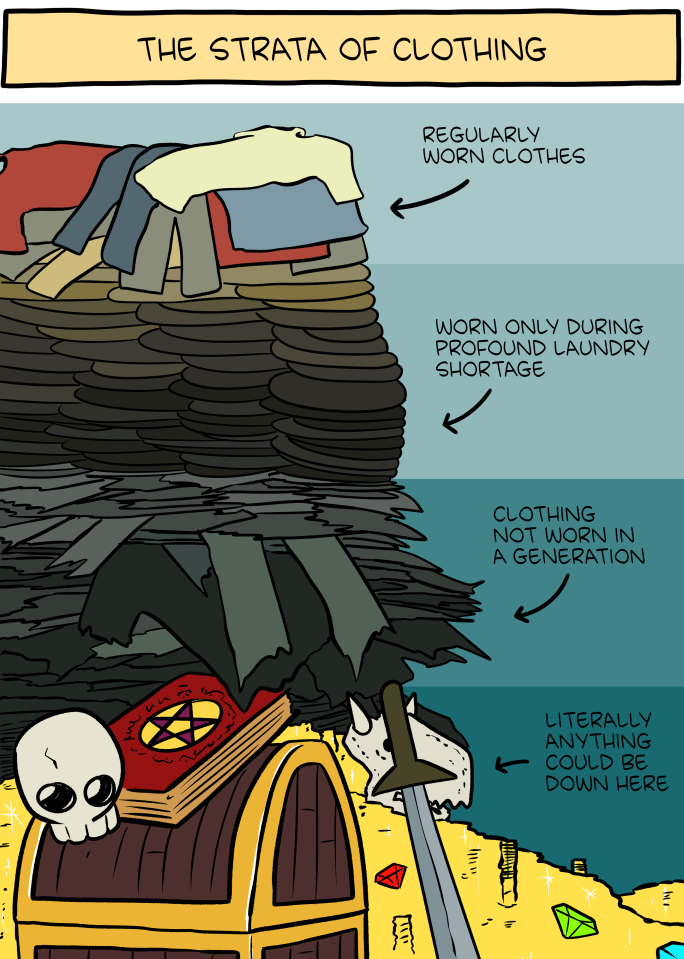
Saturday Morning Breakfast Cereal - Strata
by tech@thehiveworks.com
Click here to go see the bonus panel!
Hovertext:
I'm suddenly terribly afraid that this is actually a me-specific behavior and I've just outed myself.
Today's News:
Alex, Luke.stirling and one other like this
28 Mar 13:20


Opinion: Remembering Some Of Those We've Already Lost To The Pandemic
by Scott Simon
We often think of fatality rates as statistics — numbers on a chart. But each one represents a real person. NPR's Scott Simon reflects on some of those who have been lost so far in the pandemic.
(Image credit: Spencer Platt/Getty Images)
BillyHoya likes this
28 Mar 12:03
vid by commodore gilgamesh
memory hole - isolation cinema
by noreply@blogger.com (COMMODORE GILGAMESH)
vid by commodore gilgamesh
BillyHoya likes this
27 Mar 22:44
The surveillance profiteers of COVID-19 are here
by Violet Blue
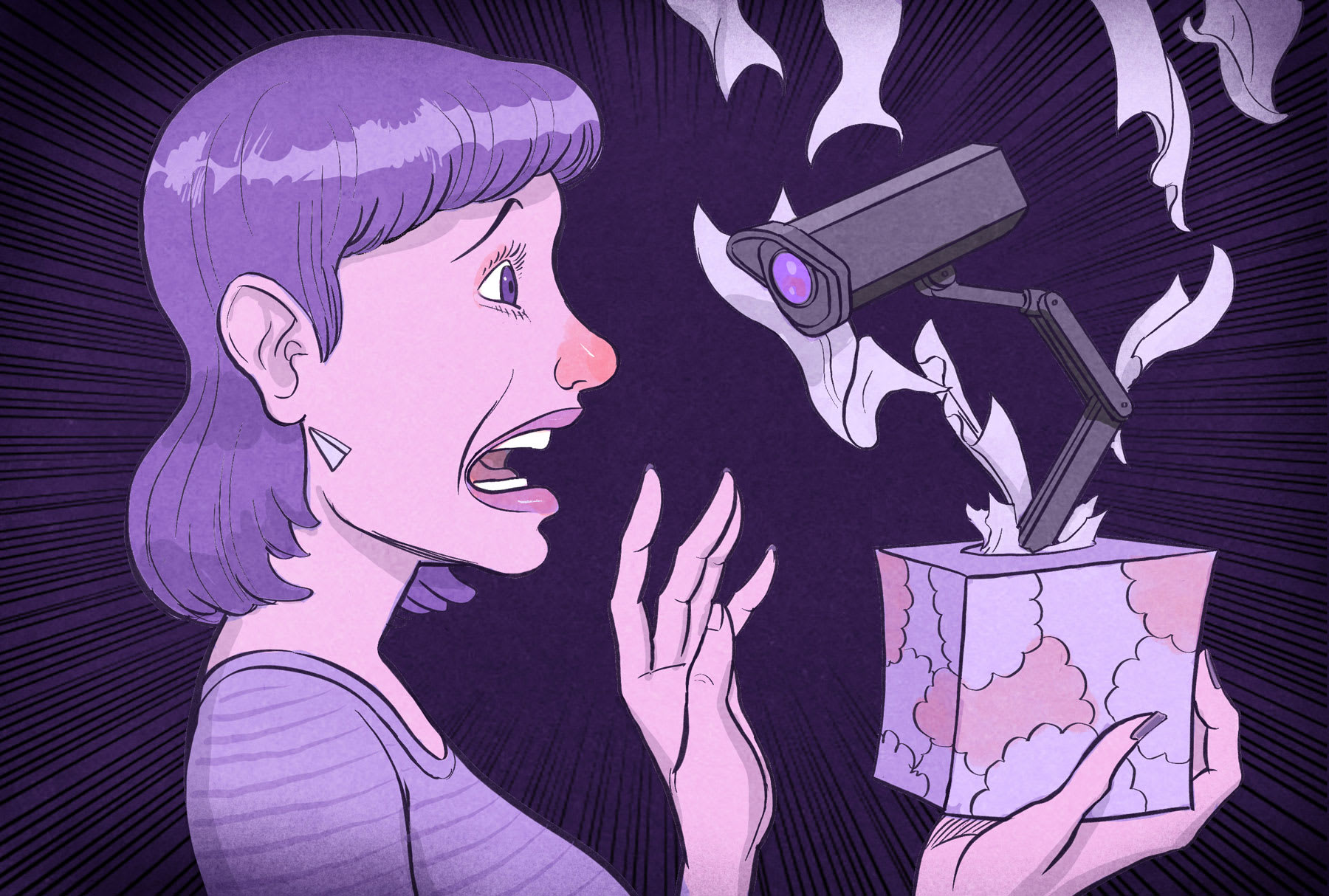
Our worlds are so upside-down and backwards right now that Wired claims Surveillance Could Save Lives Amid a Public Health Crisis, and privacy activist Maciej Cegłowski flat-out stated We Need A Massive Surveillance Program.
These normally privacy-forward sources are saying this in response to the pandemic, obviously. But it's also because companies that track, target, identify and surveil individuals are pitching their technologies to ID and trace the infected — in shady backroom discussions with the White House.
The pandemic has us all in vulnerable positions, and some tech companies are just ethics-free enough to step in and take advantage of entire populations being held hostage by COVID-19. They see us as profitable, captive data generators while their PR departments act like they did something virtuous for the greater good. Like Zoom.
For reasons us privacy nerds can't comprehend, many people rushed to adopt and use Zoom for in-home teleconferencing once all the sheltering-in-place started. Zoom happens to be a privacy nightmare with a terrible security track record — so bad that in late 2019, EPIC (Electronic Privacy Information Center) made an official complaint to the FTC alleging "unfair and deceptive practices." According to EPIC, "Zoom intentionally designed its web conferencing service to bypass browser security settings and remotely enable a user's web camera without the knowledge or consent of the user."
That's not all: Zoom collects "your physical address, phone number, your job title, credit and debit card information, your Facebook account, your IP address, your OS and device details, and more" ... and traffics that data with whomever it's doing business with (it's unclear where or how Zoom sntaches that info, except to say it's "when you use or otherwise interact with our Products").
If only sleazy data dealers used their talents for good, right?
Look: former privacy pitchers, I get why you're now catching for Big Brother. This is an emergency. But looking at what's working (or not) in other countries, we will fail at containment unless we make sure pandemic response tracing tools don't blur into the fulfillment of ICE and police wishlists.
There are serious epidemiologists talking about actual efforts to leverage tech for contact tracing but techbros solutionizing about location tracking need to stop. https://t.co/QuDZyz8FNs
— Blake You're on Mute (@blakereid) March 24, 2020
If you're sitting at home (you better be) arguing this is a matter of privacy versus safety, you've just shown us that privacy and surveillance abuses are merely abstract concepts for you. This is not a black or white issue; staying at home is, washing your hands is, and behaving like you're infected for the safety of others is. We have failed to contain coronavirus, to stop its spread, and to prepare for the worst. Those failures have nothing to do with a lack of invasive surveillance, and cannot be cured by finally closing the information-sharing loop between Big Tech and Stephen Miller.
Elizabeth M. Renieris, a Fellow at Harvard's Berkman Klein Center for Internet & Society explained in When privacy meets pandemic how it's critical that core international human rights principles on privacy are baked into coronavirus-related tech.
"What happens if we trace people with no ability to help them," Renieris wrote. "What if it just doesn't work in some contexts? We especially have to ask these questions where some experimental methods of contact tracing are being entrusted to large for-profit tech companies." Ms. Renieris adds:
While no one seriously questions the need for interventions that can protect public health and safety, the framing of many privacy-related concerns skips a fundamental step in the analysis — namely, asking when an interference with fundamental rights is justified.
This analysis is grounded in core principles of international human rights law — not something particularly within Facebook or Google's expertise. If the privacy community skips this critical step, we have already lost the battle to protect our fundamental rights.
Do it wrong and people avoid getting tested, you wind up with unknown infected populations, and you create a marriage of surveillance and policing that cannot be walked back — you fail to contain the virus and democracy is DOA. Do it right and you have an informed and voluntary population, policing is separate from public health and medicine, there are safeguards in place to prevent inevitable abuses, and you stem the tide of infections.
Pandemic surveillance: Privacy's tipping point

Yes, other governments around the world are using surveillance tools to stem COVID-19's spread. The main countries using technology to track and throttle the spread of the virus are China, Germany, Hong Kong, Israel, Italy, Singapore, South Korea, and Taiwan.
As you may know, China and Israel have gone full draconian. Israel has decided to leverage novel coronavirus in order to "lean in" on that whole police state thing. "Last week the Israeli government issued emergency orders granting the Shin Bet security service the authority to track its citizens," reported Haaertz, "allowing digital monitoring of coronavirus patients' cellphones, using means that were not disclosed."
The country's security service is "using the technology at its disposal to track the routes that patients have taken outside their homes and to determine whom they have gotten close to ... [and] tracking details of all calls made by coronavirus patients." But at least Israel is supposed to have an expiration date on keeping citizen data. Unlike China.
After unsuccessfully concealing the severity of its COVID-19 outbreak for two months, China rolled out the advanced tracking tech it used to round up more than a million Uyghur Muslims (now in concentration camps) and uses that tech to enforce an isolation policy. It includes phone tracking, facial recognition, and requiring hundreds of millions of citizens in lockdown to download an app. The app places people into three stoplight categories (green is free to move about; red is 14-day quarantine).
China, of course, said this was successful in stopping the pandemic, which has since resurfaced in the country, challenging that claim.
This shows the location data of phones that were on a Florida beach during Spring Break. It then shows where those phones traveled.
— Mikael Thalen (@MikaelThalen) March 26, 2020
First thing you should note is the importance of social distancing. The second is how much data your phone gives off. pic.twitter.com/iokUX3qjeB
The countries with the best balance of privacy and virus tracing are containing it, namely South Korea and Taiwan. In fact, most of the countries showing success with coronavirus tracing have unique, current legislation specific to pandemics with provisions on data collection. The laws in Germany, Italy, South Korea, and Taiwan meet the European Union's General Data Protection Regulation (GDPR) standards. These countries are thinking about what will happen in the days after we all survive the novel coronavirus, and acknowledge that it's a terrible idea to unbraid privacy from healthcare.
In South Korea and Taiwan, two countries who've done well to push back against the virus without the draconian tech-surveillance measures of China and Israel, legislation around data collection includes oversight and transparency for its citizens. "For example," Haaretz wrote regarding South Korea's approach, "citizens were provided with an explanation of what information was collected, for what purpose and when it would be erased."
That's how South Korea's officials addressed the problem of people avoiding tests over privacy concerns. Jung Eun-kyeong, the director of South Korea's Centers for Disease Control and Prevention told press, "We will balance the value of protecting individual human rights and privacy and the value of upholding public interest in preventing mass infections."
Singapore's COVID-19 mortality rate is arguably the lowest — and though the country isn't high in the freedom and democracy index, its success in using tech to fight the virus may be linked to its conditions around data privacy. "Privacy legislation in Singapore was most recently revised in 2014 and entails that the processing of data about individuals requires their consent," press reported. "Downloading the application was voluntary, it did not monitor people's whereabouts, and the information collected was not provided to the government."
In a way, it's no surprise that entrepreneurs, greedy corporations, and dark-intentioned authorities are seeing COVID-19 as an opportunistic land grab for money, control, and power. It's sickening.
The most shady data harvesting companies, who are secretly gathering location data from smartphones and apps without the users' knowledge, are covidwashing their products and exploiting the disaster. https://t.co/uw1HbZSsKr
— Wolfie Christl (@WolfieChristl) March 25, 2020
What is surprising, however, is how some seem to have learned from the mistakes of the greedy. Singapore -- again, no steward of democractic freedoms -- clearly gets that if you treat your people's privacy and data the same way Facebook does (or China, or Zoom for that matter), your problems are going to breed problems like tribbles.
The notion of repurposing tools that data harvesting companies use to track, snatch, and profit from our personal data without our explicit consent is some pretty ballsy -- or naive, or grossly privileged -- wishful thinking. These data collection tools were not built to save lives in emergencies: they were purpose-built for exploitation and abuse.
The only way to repurpose them safely and effectively is to treat them like they're radioactive: we must proceed with the certainty that all virus tracking and tracing tech will be abused. To not do so will be catastrophic.
Images: ANTHONY WALLACE/AFP via Getty Images (Checkpoint)
27 Mar 22:31

Netflix is working on a live-action 'Dragon's Lair' movie
by Kris Holt
After the massive success of Stranger Things, Netflix is delving back into '80s culture for another of its upcoming projects. It's developing a live-action movie based on the classic arcade game Dragon's Lair (which the Stranger Things kids actually play in the show's second season).
🐉⚔️HEAR YE, HEAR YE⚔️🐉
— NX (@NXOnNetflix) March 27, 2020
Netflix is developing a live action feature adaptation of the legendary 80s arcade game Dragon's Lair. @VancityReynolds is in talks to play noble Knight Dirk the Daring, on his quest to rescue Princess Daphne from the titular dragon.
Netflix says it's in talks with Ryan Reynolds, who has worked on a couple of other flicks for the company, to produce and star as Dirk the Daring. As in the game, the knight will go on a quest to save Princess Daphne from the aforementioned dragon. Daniel and Kevin Hageman -- who count The Lego Movie, Scary Stories to Tell in the Dark and an upcoming animated Star Trek series among their credits -- are writing the script.
There have been other attempts to make a Dragon's Lair movie, but now Netflix has the rights, it might finally happen. We all know Hollywood doesn't exactly have a stellar track record of turning games into excellent movies. However, Dragon's Lair has a simple, classic story that could translate well to film.
Source: Netflix (Twitter)
BillyHoya likes this
27 Mar 22:07
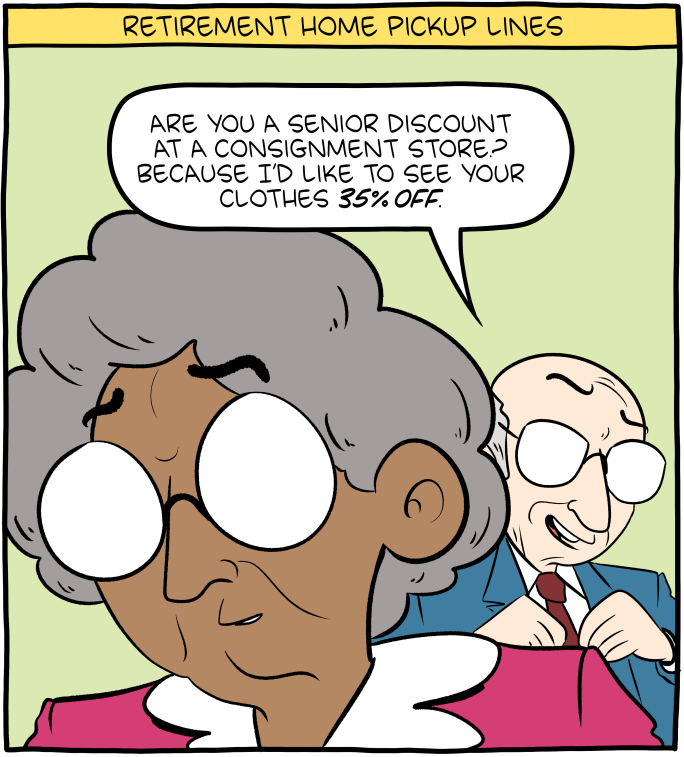
Saturday Morning Breakfast Cereal - Consignment
by tech@thehiveworks.com
Lucas Vigroux, Lani Evitts and one other like this
27 Mar 13:24
Mark Blum: Madonna pays tribute to co-star after coronavirus death
Madonna pays tribute to "loving and professional" Mark Blum following his coronavirus-related death.