Shared posts

27 Mar 22:44

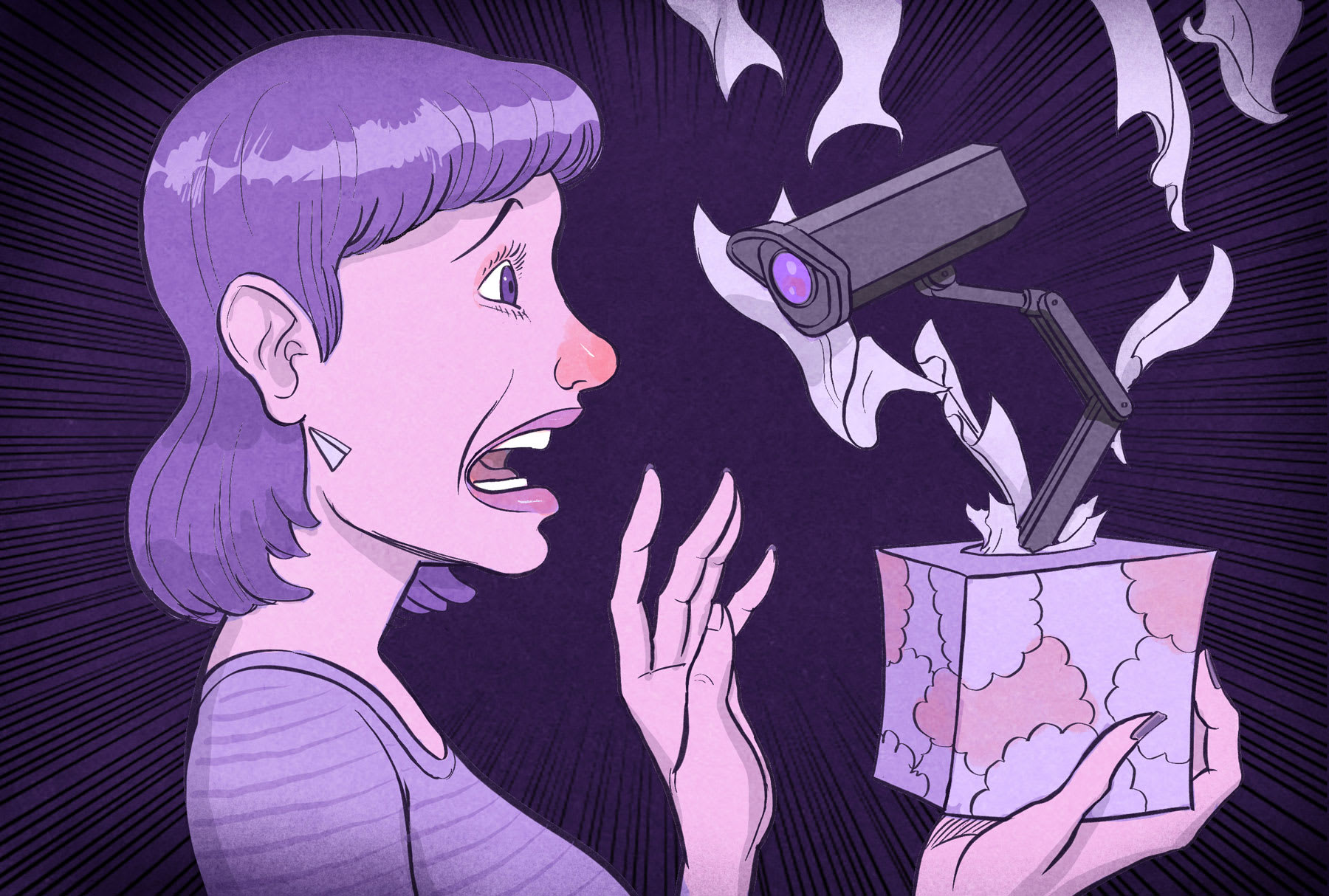
The surveillance profiteers of COVID-19 are here

by Violet Blue

Our worlds are so upside-down and backwards right now that Wired claims Surveillance Could Save Lives Amid a Public Health Crisis, and privacy activist Maciej Cegłowski flat-out stated We Need A Massive Surveillance Program.

These normally privacy-forward sources are saying this in response to the pandemic, obviously. But it's also because companies that track, target, identify and surveil individuals are pitching their technologies to ID and trace the infected — in shady backroom discussions with the White House.

The pandemic has us all in vulnerable positions, and some tech companies are just ethics-free enough to step in and take advantage of entire populations being held hostage by COVID-19. They see us as profitable, captive data generators while their PR departments act like they did something virtuous for the greater good. Like Zoom.

For reasons us privacy nerds can't comprehend, many people rushed to adopt and use Zoom for in-home teleconferencing once all the sheltering-in-place started. Zoom happens to be a privacy nightmare with a terrible security track record — so bad that in late 2019, EPIC (Electronic Privacy Information Center) made an official complaint to the FTC alleging "unfair and deceptive practices." According to EPIC, "Zoom intentionally designed its web conferencing service to bypass browser security settings and remotely enable a user's web camera without the knowledge or consent of the user."

That's not all: Zoom collects "your physical address, phone number, your job title, credit and debit card information, your Facebook account, your IP address, your OS and device details, and more" ... and traffics that data with whomever it's doing business with (it's unclear where or how Zoom sntaches that info, except to say it's "when you use or otherwise interact with our Products").

If only sleazy data dealers used their talents for good, right?

Look: former privacy pitchers, I get why you're now catching for Big Brother. This is an emergency. But looking at what's working (or not) in other countries, we will fail at containment unless we make sure pandemic response tracing tools don't blur into the fulfillment of ICE and police wishlists.

If you're sitting at home (you better be) arguing this is a matter of privacy versus safety, you've just shown us that privacy and surveillance abuses are merely abstract concepts for you. This is not a black or white issue; staying at home is, washing your hands is, and behaving like you're infected for the safety of others is. We have failed to contain coronavirus, to stop its spread, and to prepare for the worst. Those failures have nothing to do with a lack of invasive surveillance, and cannot be cured by finally closing the information-sharing loop between Big Tech and Stephen Miller.

Elizabeth M. Renieris, a Fellow at Harvard's Berkman Klein Center for Internet & Society explained in When privacy meets pandemic how it's critical that core international human rights principles on privacy are baked into coronavirus-related tech.

"What happens if we trace people with no ability to help them," Renieris wrote. "What if it just doesn't work in some contexts? We especially have to ask these questions where some experimental methods of contact tracing are being entrusted to large for-profit tech companies." Ms. Renieris adds:

While no one seriously questions the need for interventions that can protect public health and safety, the framing of many privacy-related concerns skips a fundamental step in the analysis — namely, asking when an interference with fundamental rights is justified.

This analysis is grounded in core principles of international human rights law — not something particularly within Facebook or Google's expertise. If the privacy community skips this critical step, we have already lost the battle to protect our fundamental rights.

Do it wrong and people avoid getting tested, you wind up with unknown infected populations, and you create a marriage of surveillance and policing that cannot be walked back — you fail to contain the virus and democracy is DOA. Do it right and you have an informed and voluntary population, policing is separate from public health and medicine, there are safeguards in place to prevent inevitable abuses, and you stem the tide of infections.

Pandemic surveillance: Privacy's tipping point

1207638473

Yes, other governments around the world are using surveillance tools to stem COVID-19's spread. The main countries using technology to track and throttle the spread of the virus are China, Germany, Hong Kong, Israel, Italy, Singapore, South Korea, and Taiwan.

As you may know, China and Israel have gone full draconian. Israel has decided to leverage novel coronavirus in order to "lean in" on that whole police state thing. "Last week the Israeli government issued emergency orders granting the Shin Bet security service the authority to track its citizens," reported Haaertz, "allowing digital monitoring of coronavirus patients' cellphones, using means that were not disclosed."

The country's security service is "using the technology at its disposal to track the routes that patients have taken outside their homes and to determine whom they have gotten close to ... [and] tracking details of all calls made by coronavirus patients." But at least Israel is supposed to have an expiration date on keeping citizen data. Unlike China.

After unsuccessfully concealing the severity of its COVID-19 outbreak for two months, China rolled out the advanced tracking tech it used to round up more than a million Uyghur Muslims (now in concentration camps) and uses that tech to enforce an isolation policy. It includes phone tracking, facial recognition, and requiring hundreds of millions of citizens in lockdown to download an app. The app places people into three stoplight categories (green is free to move about; red is 14-day quarantine).

China, of course, said this was successful in stopping the pandemic, which has since resurfaced in the country, challenging that claim.

The countries with the best balance of privacy and virus tracing are containing it, namely South Korea and Taiwan. In fact, most of the countries showing success with coronavirus tracing have unique, current legislation specific to pandemics with provisions on data collection. The laws in Germany, Italy, South Korea, and Taiwan meet the European Union's General Data Protection Regulation (GDPR) standards. These countries are thinking about what will happen in the days after we all survive the novel coronavirus, and acknowledge that it's a terrible idea to unbraid privacy from healthcare.

In South Korea and Taiwan, two countries who've done well to push back against the virus without the draconian tech-surveillance measures of China and Israel, legislation around data collection includes oversight and transparency for its citizens. "For example," Haaretz wrote regarding South Korea's approach, "citizens were provided with an explanation of what information was collected, for what purpose and when it would be erased."

That's how South Korea's officials addressed the problem of people avoiding tests over privacy concerns. Jung Eun-kyeong, the director of South Korea's Centers for Disease Control and Prevention told press, "We will balance the value of protecting individual human rights and privacy and the value of upholding public interest in preventing mass infections."

Singapore's COVID-19 mortality rate is arguably the lowest — and though the country isn't high in the freedom and democracy index, its success in using tech to fight the virus may be linked to its conditions around data privacy. "Privacy legislation in Singapore was most recently revised in 2014 and entails that the processing of data about individuals requires their consent," press reported. "Downloading the application was voluntary, it did not monitor people's whereabouts, and the information collected was not provided to the government."

In a way, it's no surprise that entrepreneurs, greedy corporations, and dark-intentioned authorities are seeing COVID-19 as an opportunistic land grab for money, control, and power. It's sickening.

What is surprising, however, is how some seem to have learned from the mistakes of the greedy. Singapore -- again, no steward of democractic freedoms -- clearly gets that if you treat your people's privacy and data the same way Facebook does (or China, or Zoom for that matter), your problems are going to breed problems like tribbles.

The notion of repurposing tools that data harvesting companies use to track, snatch, and profit from our personal data without our explicit consent is some pretty ballsy -- or naive, or grossly privileged -- wishful thinking. These data collection tools were not built to save lives in emergencies: they were purpose-built for exploitation and abuse.

The only way to repurpose them safely and effectively is to treat them like they're radioactive: we must proceed with the certainty that all virus tracking and tracing tech will be abused. To not do so will be catastrophic.

Images: ANTHONY WALLACE/AFP via Getty Images (Checkpoint)
27 Mar 22:07

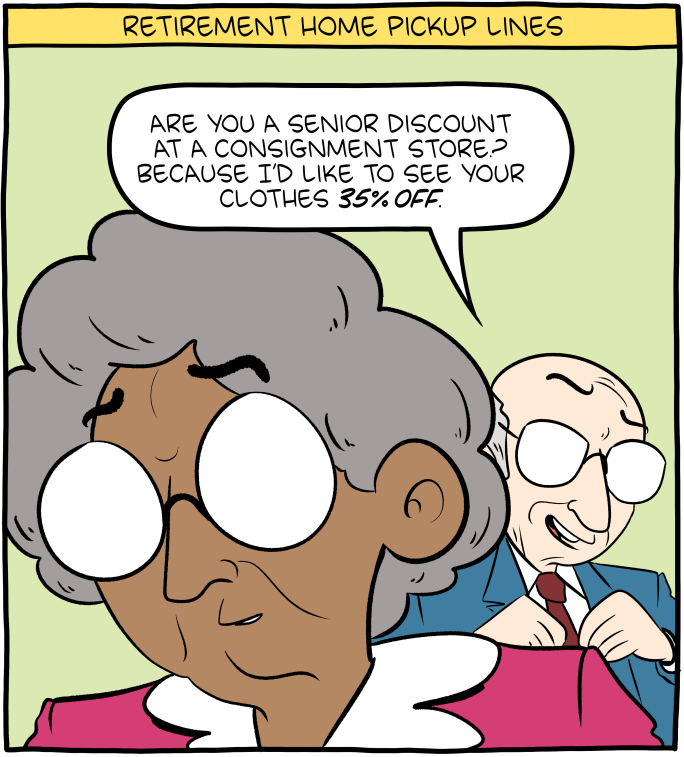
Saturday Morning Breakfast Cereal - Consignment

by tech@thehiveworks.com


Click here to go see the bonus panel!

Hovertext:
10 points to anyone who tries this.


Today's News:
27 Mar 15:19

Five-Minute Tours: Three Exhibitions at Houston Center for Contemporary Craft

by Glasstire


From: Drawn to the Work: Illustration and Craft in Conversation

Note: the following is part of Glasstire’s series of short videos, Five-Minute Tours, for which commercial galleries, museums, nonprofits and artist-run spaces across the state of Texas send us video walk-throughs of their current exhibitions. This will continue while the coronavirus situation hinders public access to exhibitions. Let’s get your show in front of an audience.

See other Five-Minute Tours here.

Three exhibitions currently on view at Houston Center for Contemporary Craft

1) Drawn to the Work: Illustration and Craft in Conversation, featuring artists Aya Kakeda, Chenlu Hou, Aurelie Guillaume. 

2) Escaping Earth: The Kinetic Work of Casey Curran

3) In Residence: 12th Edition, featuring artists Antonius-Tin Bui, Heather L. Johnson, Robert Raphael, Jared Theis, Zoe Gross, Eunsil Leem, Joyce Lin, and Meg Wachs.

Dates: Jan. 25 – March 29, 2020

Via HCCC: “Escaping Earth: The Kinetic Work of Casey Curran presents the Seattle-based artist’s handmade kinetic sculptures, asteroid paintings, and installations, exploring the haunting beauty of human innovation and its impact on our environments past, present, and future. Drawn to the Work highlights the connection between craft media and illustration, presenting narrative and character-driven artworks by Aya Kakeda, Chenlu Hou, and Aurelie Guillaume. In Residence: 12th Edition brings together work by the 2018-2019 Resident Artist cohort, presenting contemporary work in a variety of craft media including clay, fiber, metal, and wood. ”

The post Five-Minute Tours: Three Exhibitions at Houston Center for Contemporary Craft appeared first on Glasstire.

27 Mar 13:26

Boris Johnson Tests Positive For Coronavirus, Is Self-Isolating

by Bill Chappell
Prime Minister Boris Johnson  says he will self-isolate and continue to work in 10 Downing Street in London, announcing his positive test for coronavirus. He

"I have developed mild symptoms of the coronavirus," U.K. Prime Minister Boris Johnson said in a video announcement Friday.

(Image credit: Aaron Chown/PA Images via Getty Images)

27 Mar 13:24

Mark Blum: Madonna pays tribute to co-star after coronavirus death

Madonna pays tribute to "loving and professional" Mark Blum following his coronavirus-related death.
27 Mar 12:08

Retro Just Means Having Nothing Left to Buy

this is a diesel sweeties comic strip

I think I might need to set up my SNES. (it only has one game: Tetris Attack.)

27 Mar 04:40

Houston Announces First COVID-19 Death

by Jen Rice, Katie Watkins
The woman, in her 60s, was not diagnosed with COVID-19 until the autopsy.
26 Mar 03:21

WE ALL DIE ALONE

by noreply@blogger.com (JerryMaguire)
25 Mar 23:07

As The Coronavirus Crisis Heats Up, Why Aren't We Hearing From The CDC?

by Nell Greenfieldboyce
President Donald Trump takes questions from reporters Monday at his press briefing on coronavirus in Washington. Listening from left are Vice President Mike Pence; Attorney General William Barr; Dr. Deborah Birx, White House coronavirus response coordinator; and Navy Rear Adm. John Polowczyk, who leads FEMA

Usually in U.S. health emergencies — HIV, vaping and more — the Centers for Disease Control and Prevention is key to shaping policy and explaining it. That's changing to our detriment, leaders say.

(Image credit: Alex Brandon/AP)

25 Mar 17:35

Recurring Nightmare

Oh thank goodness, I forgot my clothes, so now everyone's looking embarrassed and backing away.
25 Mar 16:53

Humblebrags: Self-Isolation Edition

by Muireann Kelly

So weird being driven around on these empty streets. Glad to see people are following public health advice, though.

- - -

Didn’t even know you could get promoted while working from home!

- - -

Using all this downtime as an opportunity to really get my venture funds in order. Feeling lucky that only 25% of my portfolio is in stocks #blessed

- - -

Just paid far too much to have a bespoke batch of organic hand sanitizer express-delivered. I’m the WORST.

- - -

So quiet in the yurt without all the garden staff around.

- - -

UPDATE: We are now on lockdown here in the Marquesas Islands, a remote archipelago in the southern Pacific Ocean described as “heaven on Earth” by the New York Times. So hard to be hundreds of miles from family.

- - -

Getting so into home baking now that we’re socially distancing. Any excuse to break out the tarte tatin pan. Guess I can kiss my six-pack goodbye…

- - -

Trying to donate $$ to my local food bank but they won’t take Amex Centurion. C’mon!

- - -

Important to check in on elderly relatives at this time. I’ve been FaceTiming with my godfather (music legend Sir Paul McCartney) today. I feel good knowing I helped him.

- - -

Rolled out of bed with a slight fever and my private immunologist is STILL hitting on me. Really dude?

- - -

Of course the “shelter-in-place” order happens when we’re at the summer house. Eff you, coronavirus!

- - -

Wow, did I ever pick the right time to purchase a doomsday bunker. Now, to get my Peloton down there ;)

- - -

Quick Q: How long can COVID-19 survive in a cryogenic tank?

- - -

Apologies for posting about my corona shot. Didn’t realize that the vaccine will not be available to the general public for a few more months :(

25 Mar 12:38

Unity is offering premium game development tutorials for free

by Rachel England

Unity, arguably the biggest game engine in the world, is giving away hundreds of hours of premium game developing tutorials for free because of the coronavirus. For three months until June 20th, aspiring game makers will be able to get their hands on courses on everything from coding to design, and get access to Unity's daily interactive live lessons, Create with Code.

Unity powers big hitters such as Hollow Knight, Escape from Tarkov, Cuphead and dozens more, and is particularly popular with small-scale indie developers. Even if you've never toyed with the idea of making a game, it's certainly worth having a nose around the tutorials on offer, at the very least to get a better understanding of the work that goes into game development. Like all professional game engines, though, Unity is pretty vast, so check out Getting Started with Unity first.

Via: PC Gamer

Source: Unity

25 Mar 04:58

Can Congress Vote Remotely? Well … Maybe.

by Geoffrey Skelley

Last Wednesday, two U.S. representatives — Republican Rep. Mario Diaz-Balart of Florida and Democratic Rep. Ben McAdams of Utah — tested positive for the new coronavirus. And over the weekend, GOP Sen. Rand Paul of Kentucky said he had tested positive. In total, nearly 30 House members are at some stage of self-quarantine and five senators are self-quarantining.

The outbreak of the coronavirus on Capitol Hill has underscored just how ill-equipped Congress is to govern when its members cannot be physically present. Already five Senate Republicans had to miss Sunday’s vote to pass an emergency economic stimulus package because they were quarantined. And if more members become unable to appear in the Senate or House chambers, we could eventually see a struggle to achieve an in-person quorum.

Technically, the Constitution only requires the Senate and House to have a majority of members present to establish a quorum to pass legislation, but both chambers have rules that require senators and representatives to be physically present to cast votes. Leadership in both chambers also largely oppose allowing members to vote without being physically present, but this hasn’t stopped some legislators from renewing calls for remote voting.

In the Senate, Democratic Senate Majority Whip Dick Durbin and Republican Sen. Rob Portman introduced a resolution to allow for remote voting for up to 30 days under extraordinary circumstances. After that, the measure could be extended if three-fifths of the Senate votes in favor.

But Senate Majority Leader Mitch McConnell expressed opposition, telling reporters last week, “We will deal with the social distancing issue without fundamentally changing Senate rules.” The Senate has tweaked its procedures to increase the amount of time allotted for each vote so that fewer senators have to be on the floor at the same time, but at this point, it hasn’t made moves toward any larger overhauls.

In the House, Democratic Reps. Katie Porter and Eric Swalwell of California and Republican Rep. Van Taylor of Texas have asked House Speaker Nancy Pelosi and Minority Leader Kevin McCarthy to adopt rules for remote voting, and more than 50 members have signed onto the request. There isn’t a specific piece of legislation attached to the letter, but Pelosi did ask House Rules Committee Chairman Jim McGovern to examine the issue, and on Monday the committee released a memo reviewing possible adjustments to voting procedures. It sounded a dubious note on the use of remote voting, but was more supportive of proxy voting — whereby an absent member has another member vote on her behalf — which has precedent in the House and Senate (the Senate allows proxy voting in committee).

The memo’s opposition to remote voting lines up with the views of the House leadership. Pelosi has said privately that she opposes remote voting, though the House is planning to alter its voting procedure in some way. McCarthy is also skeptical, particularly about how remote voting would work with parliamentary motions, which may require members to interject quickly to be heard.

To better understand the stakes of Congress voting remotely, I spoke with two legal experts — one in favor of such a step and the other opposed. Daniel Hemel, a professor at the University of Chicago School of Law and proponent of remote voting, stressed to me that there is nothing in the Constitution stopping Congress from allowing members to cast votes from afar.

Yes, the Constitution requires a quorum for the Senate and House to conduct business, but it doesn’t say anything about lawmakers having to be physically present. That requirement comes from chamber rules, which Hemel argues could be rewritten to allow for remote voting in crisis situations. While there might be security concerns, Hemel pointed out that corporate boards permit videoconferencing to count toward a quorum, so it’s unclear why Congress would be incapable of using a similar system to conduct its business.

If remote voting isn’t adopted, Hemel suggested COVID-19 could cause other problems too. “You can imagine a circumstance where one party actually gets a majority because the other party is more affected,” said Hemel, which could create concerns about the long-term legitimacy of votes taken in such circumstances.

Case in point: All five senators currently quarantined are Republican, which has reduced the GOP’s edge in the Senate from 53-47 to 48-47. This has already affected the party’s ability to advance an economic stimulus bill on Sunday, although even without the quarantine, Republicans would have needed some Democratic votes to move forward because of cloture rules, and both sides voted the party line. Still, we can see how abstentions due to health concerns could make it difficult for lawmakers to weigh in on vital issues down the line.

But Joshua Huder, a senior fellow at Georgetown University’s Government Affairs Institute, worries that remote voting could make it easier for leadership to ride roughshod over their party’s legislators. “We’re already at a place where party leaders have outsized control over the policymaking process,” said Huder. “When the rank-and-file aren’t around for the backroom deals and negotiations, you create a legislature that’s a rubber stamp for what the leaders want to pass.”

Huder didn’t rule out using alternate voting systems in a crisis, suggesting that members could remain in Washington and call in from their offices. But he did worry that remote voting would reduce face-to-face interactions, inevitably cutting down on members’ chances to make personal connections, which could exacerbate the divides that already exist in Washington. He also said it’s possible this could establish a precedent where remote voting was used in non-crisis situations because it becomes “a long-term or permanent solution through which Congress is going to pass legislation.”

Still, if the coronavirus crisis keeps getting worse in the U.S., there will be a lot of pressure on Congress — including from its own members — to make changes. “At a time when we’re asking Americans to make huge sacrifices to stop the spread of COVID-19, it is bad leadership for our politicians to then make none of those adjustments themselves,” said Hemel.

25 Mar 04:38

CBS offers a free month of All Access so you can binge-watch 'Picard'

by Kris Holt

If you've been meaning to check out Star Trek: Picard or The Good Fight, but already perhaps have one streaming subscription too many, you can check out CBS All Access for free until April 23rd in the US. Jean-Luc Picard himself (okay, Partick Stewart) revealed ViacomCBS would make it so ahead of his show's season finale dropping later this week.

You'll need to use the code "GIFT" when you're signing up to take advantage of the offer. It'll work for both the limited commercials and ad-free plans on the service.

Streaming services regularly offer free trials for their platforms -- the CBS All Access one is often for seven days instead of a month. Millions of people are suddenly stuck at home and looking for something to do, so burning through a series or two should keep you occupied.

With tens of thousands more TV episodes and up to 1,000 movies heading to CBS All Access later this year, ViacomCBS will be hoping people will stick around for those by becoming paid subscribers after the free month is over. There's already plenty of Star Trek material on tap for Trekkers, though. Along with Picard, Discovery and Short Treks are available, while the franchise has at least two more shows in the works.

Via: Variety

Source: Patrick Stewart (Twitter)

24 Mar 21:20

15 Essential Slack Channels for Quarantined Families

by Sloan Schang

1. #announcements-stop-doing-that

2. #mommys-drunk-ama

3. #triage-do-you-smell-that

4. #support-too-spicy

5. #announcements-last-warning

6. #fun-is-this-my-seltzer-or-yours

7. #grammy-pop-pop-external

8. #proj-install-bedroom-door-locks

9. #announcements-privileges-revoked

10. #devel-dad-jokes

11. #launch-dad-jokes

12. #feedback-vegetables

13. #executive-peer-review (private)

14. #butt

15. #team-anxiety

24 Mar 21:13

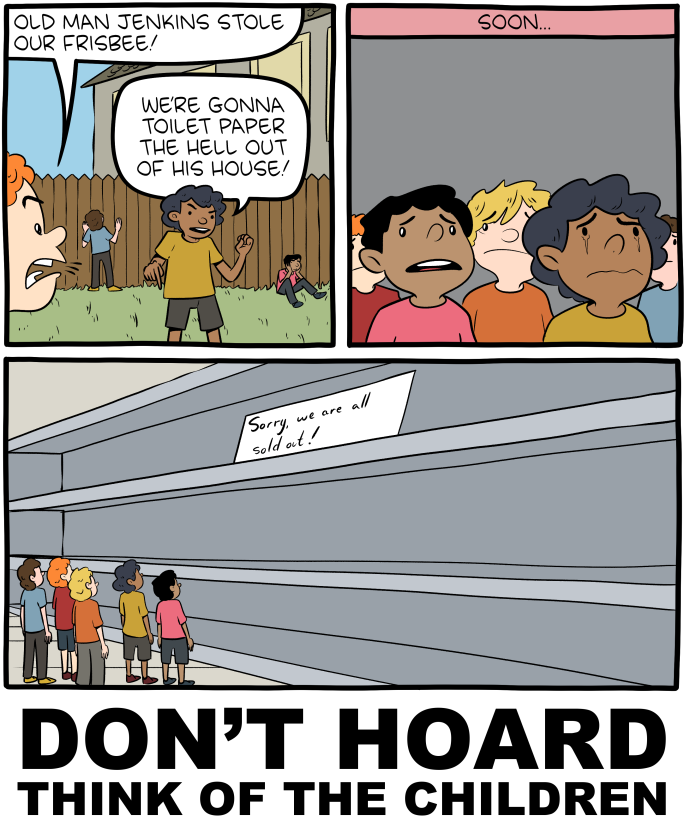
Saturday Morning Breakfast Cereal - Toilet Paper

by tech@thehiveworks.com


Click here to go see the bonus panel!

Hovertext:
The fun question is how long before this comic becomes topical again?


Today's News:
24 Mar 13:28

In Blackbeard Pirate Ship Case, Supreme Court Scuttles Copyright Claims

by Nina Totenberg
The Supreme Court

A videographer spent two decades documenting the the salvage of the Queen Anne's Revenge, and when North Carolina put his work on line without permission, he sued.

(Image credit: Patrick Semansky/AP)

24 Mar 13:16

Galveston County Orders Residents To Stay At Home

by Davis Land
Read the full stay-at-home order here.
24 Mar 13:13

How Coronavirus Tests Actually Work

by Maggie Koerth

The coronavirus crisis is in large part a testing crisis. We are reading about tests. Arguing about tests. And, in many cases, struggling mightily to obtain tests for ourselves. But while test shortages are making headlines, there’s a lot about the technology behind these tests that isn’t as clear to the public. It’s like we’re all on one of those reality shows where you agree to marry a total stranger, entering into a high-stakes relationship with someone you couldn’t pick out of a crowd.

So let’s get a little more acquainted with the tests we can’t stop talking about. At the very least, learning a little more about the tests for COVID-19 will help you understand why it’s so hard to get one when you need it.

What happens when you get a COVID-19 test?

First, a medical professional puts a swab — an extra long, one-headed Q-tip — way, way, way up your nose. That captures viral particles, along with a bunch of other stuff that Dr. Davey Smith, a research virologist at the University of California, San Diego, referred to as “biological gunk,” like mucus and random cells. The next step, Smith said, is isolating the viral RNA — the genetic material that the virus uses to replicate itself. The RNA in a virus like the one that causes COVID-19 is similar to DNA, but instead of the twisted ladder of a double helix, it’s half that because it’s split down the middle. Some viruses carry their genetic code as DNA, but RNA viruses mutate a lot faster. That feature helps them jump species and evade both natural and medical efforts to kill them. Influenza, for instance, mutates so quickly that we need a new vaccine for it every year.

Just like DNA can identify a person, RNA can identify the virus that causes COVID-19. Isolating it requires a series of steps — adding different chemicals and repeatedly spinning the sample in a centrifuge — that aim to separate the sample into layers like a fancy cocktail shot, with the layer containing the RNA floating on the top. Then the RNA has to be further purified. There’s more than one way to separate out RNA, and companies sell kits that include the chemicals you need to make it work (called reagents, because they’re used to induce a chemical reaction).


Why The U.S. Can’t Process Coronavirus Tests As Fast As South Korea

https://abcnews.go.com/video/69774226


From there, the RNA is mixed with short segments of DNA called primers. The primers and RNA get combined with loose building blocks of DNA, enzymes that work like genetic construction crews, and more reagents. Mix it all up, and your RNA turns into DNA.

Finally, the new DNA needs to be replicated until you have enough of it to actually study. That’s another chemistry kit — more primers, building blocks and reagents — doing what basically amounts to biological copy-paste, over and over. This is called a polymerase chain reaction (PCR) and the primers used here are especially important. These replication primers are basically fragments of the virus you’re looking for, Smith said, that will bind to the genetic material of that specific virus and nothing else If there’s no COVID-19 in the sample, then COVID-19 primers won’t replicate any DNA.

“We put in some special dyes so when it builds the right DNA we’re looking for, we can see the color light up on special machines,” Smith said. If you had COVID-19, your sample will now show up with freshly built, brightly colored DNA to prove it.

Wow, that’s a lot. Is that why people can’t get their COVID-19 test results for several days?

Well, no. This process is not particularly special or time-consuming and involves techniques used all the time in genetic research. PCR, in particular, is so crucial to the entire field that the guy who invented it won a Nobel Prize back in 1993. We use this same technique to test for all kinds of other viruses, from influenza to Zika, said Dr. Mary Jo Trepka, an infectious disease epidemiologist at Florida International University.

PCR doesn’t actually take that long to do — you can get results from an influenza PCR test in 30 minutes. Meanwhile, the chemistry set-style kits are something you can order from a website, and other needed machines can be as cheap as a used sedan. Any lab that works regularly with DNA has the ability, in theory, to do this testing.

In other words, the bottleneck slowing down test results is not a technical one. It’s about logistics and supplies, Smith said. In the earliest days, the Centers for Disease Control and Prevention was conducting all the COVID-19 testing in-house so they could monitor quality control, and they’ve been slow to authorize new labs to use their test kits. As more labs came online, though, they began running low on everything from the swabs they stick up people’s noses to the reagents that power the PCR’s chemical reactions to the human lab techs who actually do the tests, Smith and Trepka told me. It’s like a traffic jam.

Compare that to South Korea, where people can get their results in about a day. There, the government had been stockpiling the necessary chemicals for years after COVID-19’s cousin MERS briefly hit that country in 2015. That helped the country move quickly to approve and decentralize testing as soon as COVID-19 arrived.

So, wait. Is there no difference between South Korea’s test and ours, then?

There is a difference, but that doesn’t have much to do with why ours takes so much longer, Smith said. The differences are really just about which primers are being used. Researchers choose which chunks of a virus’s genetic code to use as a primer with an eye to making sure those primers are a) unique to the specific virus they’re looking for and b) likely to get preserved in any random bit of viral RNA scraped off the back of somebody’s nasal cavity. If the primer isn’t unique enough, you can get false positives. If the sequence your primer is looking for doesn’t make it from nose to test tube, then you’ll get false negatives.

There’s not really anything wrong with the primers the CDC test uses, Smith told me. Even when the CDC test was malfunctioning, that was about an inconsistent reagent, not the unique primers. South Korea is faster than us because it can conduct the tests in more places, and could right from the start. Plus, it has more supplies to do the tests with.

Is there no other way to test for COVID-19?

For right now, nope. That’s changing fast, though there are trade-offs. PCR is a great way to test for viruses because it’s both specific (unlikely to produce false positives) and sensitive (unlikely to produce false negatives), Trepka said. There are other tools that doctors use to test for more familiar viruses. For instance, if you think you have the flu, there’s a test you can take right in your doctor’s office that looks for antigens — the substances on a virus that stimulate your immune system into action. It produces results in as little as 10 minutes, but it’s not very sensitive and might tell you that you have the flu even if you don’t. “They’re helpful in clinical care but we don’t use them to monitor outbreaks,” Trepka said.

Meanwhile, new tests — like one from Swiss pharmaceutical company Roche that the Food and Drug Administration authorized on March 13 — are under development. The Roche test is 10 times faster at producing results than the standard PCR system. But unlike the PCR test, it requires the use of a rare (and proprietary) instrument. There are only 110 of these machines in the whole country. And that test still requires reagents, Smith said. As big companies like Roche bring these kinds of testing systems online, they’re sucking up the already limited quantities of reagent that smaller labs need for PCR tests. These big companies, such as Roche, are also making more reagent, Smith said. “But it’s very much profit-driven and they can corner the market very quickly,” he told me. “That’s not the end of the world, but it’s hard in the middle of the epidemic.”

CORRECTION (March 24, 2020, 9:43 a.m.): An earlier version of this article misstated the scientific definitions of sensitive and specific. When a test is sensitive it is unlikely to produce false negatives, and when a test is specific it is unlikely to produce false positives.

24 Mar 12:48

We Cannot Let the Cure Be Worse Than The Problem So Let’s Let People Die

by Devorah Blachor

“WE CANNOT LET THE CURE BE WORSE THAN THE PROBLEM ITSELF. AT THE END OF THE 15 DAY PERIOD, WE WILL MAKE A DECISION AS TO WHICH WAY WE WANT TO GO!”
Donald Trump, Twitter, 3/23/20

- - -

Every human life is precious. Life begins at conception. If you value human life, you must support the greatest president of all-time, Donald J. Trump, and also agree with him that we’re taking these coronavirus containment measures too far. It’s not really worth it to flatten the curve just to save millions of lives.

We were always at war with coronavirus.

Donald Trump is the only president brave enough to appoint unqualified judges because they’re anti-abortion. God bless our life-loving president! And God bless the stock market. If we can get back our bullish stock market, it’s totally worth sacrificing all those lives. Our bold and decisive stable genius seems to be the only world leader who understands that.

We were always at war with China.

The “shelter-in-place” orders are going to cause a recession, or even a depression. That’s way too hard for Americans to adhere to because, in this country, people want the freedom to walk around, go where they want, and do what they choose — even if they have coronavirus. Americans need freedom, just as long as they’re not women who have unplanned pregnancies, in which case they should be forced to give birth against their will.

Health officials say that we have to maintain social distancing, but what do they know about health? Even the surgeon general has said that people should stay home and that fifteen days of social distancing isn’t going to be enough. But why should we listen to the surgeon general when there are perfectly good random people on Twitter that the president is retweeting who say the exact opposite thing? Let people out of their homes! Sure, that means that people will die, but the fear of the virus cannot collapse our economy. Sweet, beautiful cash is much more valuable than the lives of all those who will die from COVID-19. But don’t let women have abortions because that would be wrong.

We were always at war with women.

Economies are like fragile babies. We must treasure and nurture them. Just like Dear Leader says, automobile accidents kill plenty of people every year and we don’t ban them. Hell, we don’t even ban guns and they kill way more people than cars! If you add up all the people who are killed in car accidents and by guns, it still would be far less than the 1 to 3.4 percent of the population projected to die from coronavirus. So why are we even trying?

We were always at war with 1 to 3.4 percent of the population.

Take a look at those evil European and Canadian heathens with their ongoing commitment to containing the virus and their excellent universal health care systems. It’s like they care more about saving human lives than their economies — what a bunch of socialist losers.

We were always at war with Europe and Canada.

Do the math. Imagine if we force every woman to carry their unplanned pregnancy to term. We could fill the world with so many unwanted babies, and then all those babies could grow up to get killed by diseases like the coronavirus, and all because the Dow Jones had the sads.

That’s the American Dream! That’s the bold leadership of Donald Trump! Letting people die will make America great again!

We were always at war with caring about human life when profit was on the line.

24 Mar 12:41

Comic for 2020.03.24

New Cyanide and Happiness Comic
23 Mar 22:40

if your hours have been cut, you can collect unemployment benefits

by Ask a Manager

You should know that if your hours are cut due to coronavirus (or for any other reason), you can file for unemployment benefits in your state.

I’ve heard from some people who incorrectly believed they had to be fully unemployed before they’d be eligible for unemployment. While rules vary from state to state, that’s generally not true. If your hours are cut or your work becomes more sporadic (like your company closes for just a week or two) or if you’re put on a “zero hour” schedule, you should file for unemployment.

You also should file as soon as possible, since you generally won’t receive benefits retroactively. Many states are waiving their normal waiting periods right now. Be aware that some state unemployment websites are crashing because of how many people are applying, but keep trying.

Also! If you’re an independent contractor, you’re not eligible for unemployment benefits, but a lot of people have been misclassified as independent contractors when, according to the law, they are in fact employees and should’ve been being paid as such. In many states, if they determine that you’ve been misclassified, you will become eligible to collect unemployment benefits. So if you think you’ve been improperly classified as an independent contractor, that’s worth challenging.

This webpage lets you look up unemployment info by state.

if your hours have been cut, you can collect unemployment benefits was originally published by Alison Green on Ask a Manager.

23 Mar 22:32

Teachers Answer the Unspoken Questions of Homeschooling Parents

by Shannon Reed

1. Oh, yeah, for sure, the exhaustion is constant, and it doesn’t ever really get easier. We’d usually make a joke about “Free Post-its, though!” here, except those aren’t free for you in your house, so, uh, just, yes. It’s an exhausting job.

2. Yep, we know. You miss us. We feel the love. And don’t worry, we have completely forgotten about the time last year when we overhead you telling your partner that we “could at least try to look excited about the kids’ recorder concert.”

3. That’s correct. As you are no doubt realizing, there is no correlation between the amount of time you spend planning a lesson and the amount of interest your kids show in it. Sometimes you spent five seconds typing “pretty state capitol domes” into Google, and they are captivated for hours. Other times, you work until 3 AM building a model of your state capital out of stale bread and toothpicks, and they wander away from it after 20 seconds.

4. Just an FYI, that even when our classes are going amazing, we generally only have 50% of the students’ attention. So if you have two kids, and you have one of them engaged, you’re on par with us.

5. Remember how we often promised “individual conferences”? It sounds impressive, but it’s really just conversing directly with a child. Give that a try.

6. Oh yeah, it’s absolutely true that they are doing that only to get a response out of you. However, it’s also absolutely true that they have the capacity for doing that for as long as it takes to get a response out of you. Redirect.

7. Yep, yep, we teach 10 to 15 times the number of kids you’re currently trying to teach. All at once. Usually on own. We don’t know how we do it, either.

8. Now you know why we show the film version of The Crucible in 40-minute increments over five days.

9. Honestly? Sometimes we just give them paper and crayons and tell them to draw what they’re feeling — even high schoolers.

10. Remember when parents in our district got all upset about every student getting their own iPad? “The kids will be on them all the time!” they said. Please, join us in sob-laughs about this now.

11. Sorry, we have no idea how to respond when your kids scream, “You’re NOT my teacher; you’re just my mom!” However, we do have some ideas for how to respond to “You’re NOT my mom; you’re just my teacher!” if those would help.

12. It just occurred to us that while we can call you when things get bad, you can’t really call us. Wow, is that a bug in the system, or what? Sorry!

13. We appreciate it, but getting paid a “trillion billion dollars” after we all come back from this isn’t necessary. We’d just like to make what a few senators made from selling off their stock after being pre-warned about the approaching global pandemic and not bothering to tell us.

14. Sure, we’ll let the gym teachers know you’re especially sorry for how you used to dismiss them as having “easy jobs.” And the art teachers. And the custodians. And the cafeteria workers. And… well, everyone.

15. Honestly, we can’t wait until your kids are our daily problem again, too.

23 Mar 21:56

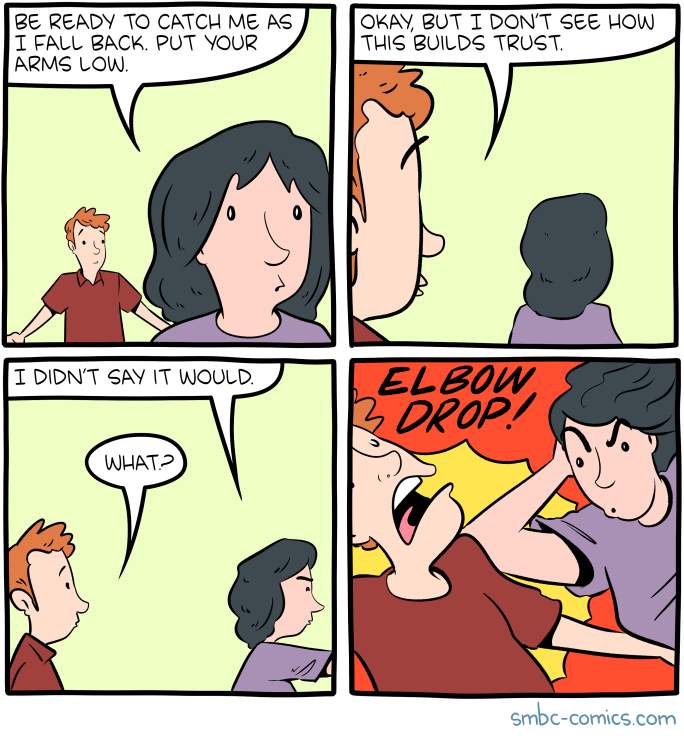
Saturday Morning Breakfast Cereal - Trust

by tech@thehiveworks.com


Click here to go see the bonus panel!

Hovertext:
I don't know about any other couples, but the odds of me or my wife successfully doing a trust game are negative.


Today's News:
23 Mar 21:54

Philosophy During a Pandemic

Kant: \
23 Mar 12:14

What Steps Thy Feudal Lords Are Taking to Keep Thee Safe Whilst This Plague of Buboes Ravages the Fiefdoms

by Keith Rubin

To our loyal vassals,

We remain grateful to thee for thy continued fealty amidst these uneasy and ever-changing times. Whilst there has been only a SINGLE reported case of Bubonic Plague within our fiefdom (that of Simon the Tinker), we wished to take this opportunity to share with thee several precautionary steps we have taken to mitigate the further spread of this divine pestilence:

Increasing personal sanitation and hygiene procedures amongst all serfs
Beginning this past Lord’s Day, we have decreed that all serfs working in the fields must bathe in the town well at LEAST once per month. In addition, all those serfs handling crops directly must spit upon their hands to rinse away dirt BEFORE touching any of our foodstuffs.

Additional leeching stations at the midwife’s house
To pre-empt the possibility of a large-scale outbreak, we have doubled the number of leeches available to our community at any hour of the day, from six swarms to twelve. The increased capacity for leechings shall doubtless prove indispensable should any additional cases of the Plague arise.

Extra Prayers from the Clergy
We have tasked the monks at the monastery with maintaining ceaseless and continual prayer to appease God the Almighty, Whose wrath surely brought this contagion down upon us. Effectively immediately, the monastic investigations into medicinal properties of local plants shall be suspended, such that they may better seek to placate our angry Creator.

Finally, if thou or anyone thou knowest should experience any symptoms (abdominal pain, fever, grave misalignment of the Four Humours, etc), we urge thee to gather thy entire community together in a room with them to pray. Collective worship, particularly in a small enclosed space, has proven more effective than isolated prayer.

It is our fervent hope and firm belief that with these pre-cautions in place, we may yet prevent the dire fate faced by other fiefdoms. Hopefully, more drastic action or a more centralized response from the King shall not be necessary, as that might damage our economy.

May God have mercy upon us all,
Thy Feudal Lords

23 Mar 11:50

Comic for 2020.03.23

New Cyanide and Happiness Comic
23 Mar 04:28

Awkward Zombie - Freezer Burn

by tech@thehiveworks.com

New comic!

Today's News:

No, it's cool, really. They made a movie about it and everything? Wow, that's so good for someone like you.

22 Mar 20:56

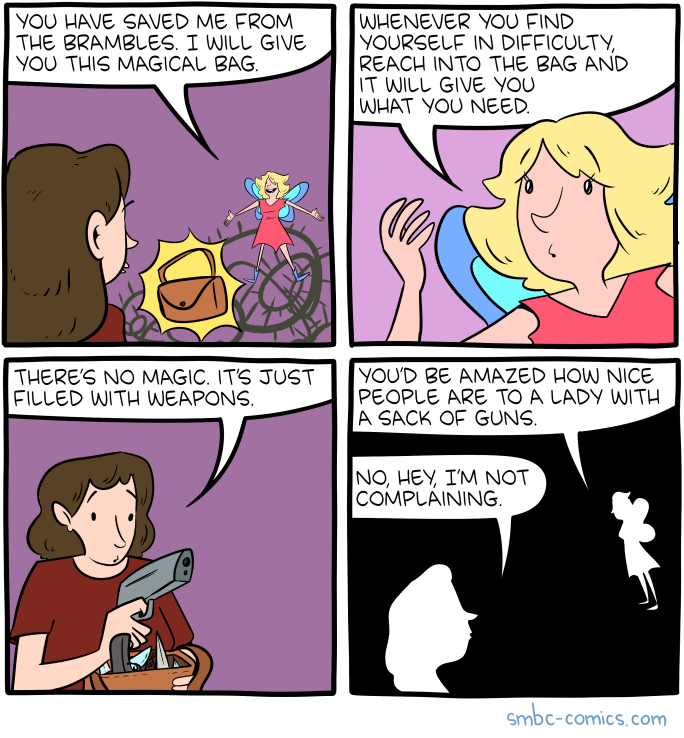
Saturday Morning Breakfast Cereal - Magic

by tech@thehiveworks.com


Click here to go see the bonus panel!

Hovertext:
Honestly, the original version of this story violates conservation of energy.


Today's News:
22 Mar 16:35

Busy day

by Cassandra Calin