The chain does "not intend to reopen 185 of their restaurants that were closed during the pandemic," Ruby Tuesday's CEO wrote in a court filing.
(Image credit: David J. Phillip/AP)

The chain does "not intend to reopen 185 of their restaurants that were closed during the pandemic," Ruby Tuesday's CEO wrote in a court filing.
(Image credit: David J. Phillip/AP)
Hovertext:
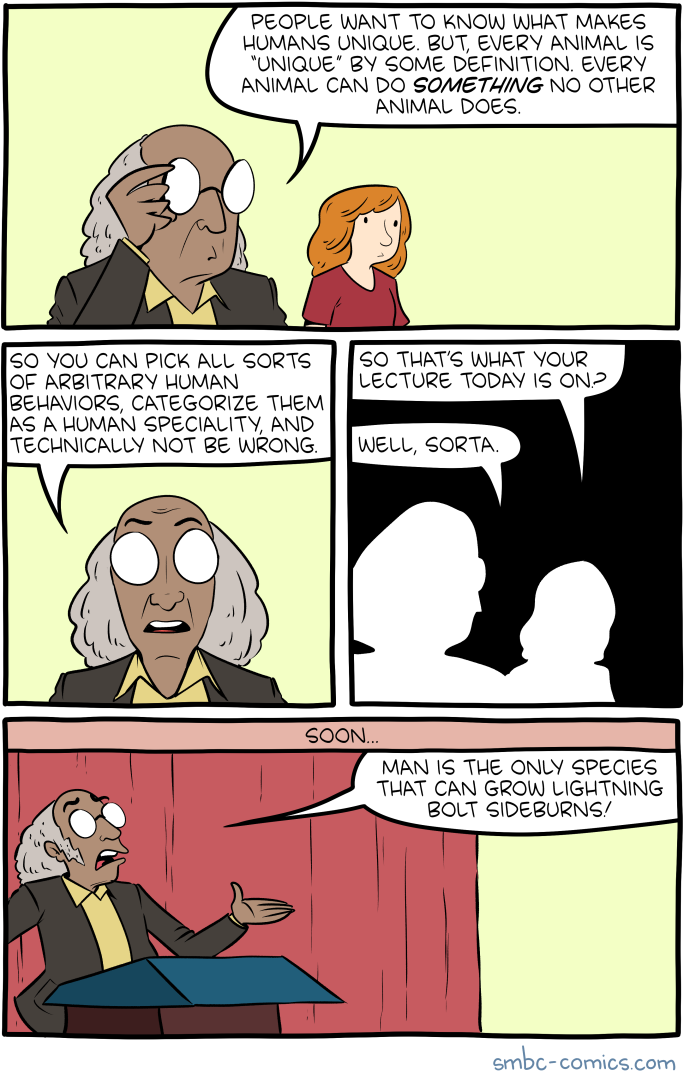
Sorry, no, chimps can't shave themselves. Deal with it.
To be read before the 2020 Presidential Election.
Register to vote, or check to make sure you’re registered to vote here.
Early in President Trump’s term, McSweeney’s editors began to catalog the head-spinning number of misdeeds coming from his administration. We called this list a collection of Trump’s cruelties, collusions, and crimes, and it felt urgent then to track them, to ensure these horrors — happening almost daily — would not be forgotten. This election year, amid a harrowing global health, civil rights, humanitarian, and economic crisis, we know it’s never been more critical to note these horrors, to remember them, and to do all in our power to reverse them. This list will be updated between now and the November 2020 Presidential election.
Various writers have compiled this list during the course of the Trump administration. Their work has been guided by invaluable journalistic resources, including WTFJHT, NPR, the New York Times, the Washington Post, and other sources, to whom we are grateful.
 – Sexual Misconduct, Harassment, & Bullying
 – White Supremacy, Racism, Homophobia, Transphobia, & Xenophobia
 – Public Statements / Tweets
 – Collusion with Russia & Obstruction of Justice
 – Trump Staff & Administration
 – Trump Family Business Dealings
 – Policy
 – Environment
– February 10, 2011 – In 2011, Donald Trump stoked false claims that Barack Obama had lied about his education. During a speech to the Conservative Political Action Conference, Trump said, “Our current president came out of nowhere. Came out of nowhere. In fact, I’ll go a step further: The people that went to school with him, they never saw him, they don’t know who he is. It’s crazy.” This is false. Numerous accounts from Obama’s college classmates refute Trump’s claim, including Obama’s Columbia roommate, Phil Doerner. – March 30, 2011 – Donald Trump was a vocal proponent of the “birther” myth, claiming Barack Obama was not born in the United States. In 2011, Trump told Bill O’Reilly, “If you are going to be president of the United States you have to be born in this country. And there is a doubt as to whether or not he was… He doesn’t have a birth certificate. He may have one, but there’s something on that, maybe religion, maybe it says he is a Muslim. I don’t know. Maybe he doesn’t want that. Or he may not have one. But I will tell you this. If he wasn’t born in this country, it’s one of the great scams of all time.” In response to the “birther” conspiracy theory, the State of Hawaii released Barack Obama’s short- and long-form birth certificate. – August 6, 2012 – Over a year after the White House released Obama’s long-form birth certificate, Donald Trump again promoted the “birther” myth, tweeting, “An ‘extremely credible source’ has called my office and told me that @BarackObama’s birth certificate is a fraud.” President Trump has publicly attacked media outlets for citing anonymous sources, but has himself cited anonymous sources numerous times to support the claim that Barack Obama lied about his biography. – December 12, 2013 – Years after first stirring controversy about Barack Obama’s birthplace, Donald Trump implied a conspiracy surrounding the death of the Hawaiian State Official who had released Obama’s long-form birth certificate in 2011. Trump tweeted, “How amazing, the State Health Director who verified copies of Obama’s “birth certificate” died in plane crash today. All others lived.” – May 27, 2015 – Continuing to build on the debunked “birther” conspiracy, Donald Trump said Barack Obama could have claimed Kenya as his birthplace for special treatment from colleges. Trump said, “There are three things that could happen. And one of them did happen. He was perhaps born in Kenya. Very simple, OK? He was perhaps born in this country. But said he was born in Kenya because if you say you were born in Kenya, you got aid and you got into colleges. People were doing that. So perhaps he was born in this country, and that has a very big chance. Or, you know, who knows?" – June 16, 2015 – In his speech announcing his candidacy for President of the United States, Donald Trump said, “When Mexico sends its people, they’re not sending their best. They’re sending people that have lots of problems. They’re bringing drugs. They’re bringing crime. They’re rapists. And some, I assume, are good people.” – June 16, 2015 – In the same speech announcing his candidacy, Donald Trump said, “I will build a great wall—and nobody builds walls better than me, believe me—and I’ll build them very inexpensively. I will build a great, great wall on our southern border, and I will make Mexico pay for that wall. Mark my words.” Trump’s belief that Mexico should finance construction for the wall led Mexican President Enrique Peña Nieto to cancel a meeting with Trump in June 2017, and again in February 2018. Peña Nieto has repeatedly said that Mexico will not fund the border wall. – July 18, 2015 – Donald Trump insulted the military service of Senator John McCain, a decorated Vietnam War veteran who endured torture and solitary confinement as a POW in Hanoi. Trump said in a speech at the Family Leadership Summit in Iowa, "He’s not a war hero. He was a war hero because he was captured. I like people who weren’t captured.” Trump’s comments drew boos from his audience in Iowa, as well as widespread condemnation from Republicans and Democrats alike. Donald Trump himself was exempted from military service after receiving four student deferments between 1964 and 1968, and a medical deferment for a “bone spur in his foot” after graduating from college. – August 7, 2015 – During the first Republican primary debate in 2015, Donald Trump clashed with moderator Megyn Kelly regarding his many controversial statements against women. In one exchange, Trump claimed his disparaging remarks about women were limited to comments about Rosie O’Donnell, to which Kelly responded, “Your Twitter account has several disparaging comments about women’s looks. You once told a contestant on Celebrity Apprentice it would be a pretty picture to see her on her knees. Does that sound to you like the temperament of a man we should elect as president?” The next day, Trump told a CNN interviewer that Kelly had been “off-base” in the way she treated him. “She gets out and she starts asking me all sorts of ridiculous questions,” Trump said. “You know, you could see there was blood coming out of her eyes, blood coming out of her wherever.” – August 19, 2015 – In August of 2015, just three months after Trump announced his candidacy for president, two of his supporters in Boston beat a homeless Latino man with a metal pipe, and then urinated on him. Asked by the arresting officer why they had done it, one of the attackers said, “Trump was right—all these illegals need to be deported.” During a press conference shortly thereafter, Trump said he hadn’t heard about the assault. “It would be a shame,” he told the crowd of reporters, before continuing, “I will say, the people that are following me are very passionate. They love this country and they want this country to be great again. They are passionate.” – July 30, 2016 – Donald Trump belittled Khizr and Ghazala Khan, the parents of a Muslim American soldier who had been killed while serving in the Army, for their speech at the Democratic National Convention. In his speech at the DNC, Khizr Khan had addressed Trump’s stringent anti-Muslim immigration policies, saying, “Have you even read the United States Constitution? I will gladly lend you my copy. In this document, look for the words liberty and equal protection of law.” In response to the speech, Trump suggested that Khan had “no right” to criticize him. – April, 2016 – Jill Harth accused Donald Trump of sexual assault. In a 1997 lawsuit, Harth stated in court documents that Trump harassed and groped her in 1993. She later dropped the suit but stood by her story. – May 5, 2016 – For the Mexican holiday of Cinco de Mayo, Donald Trump posted a photo of himself eating a taco bowl to Facebook and Twitter, captioned, “Happy #CincoDeMayo! The best taco bowls are made in Trump Tower Grill. I love Hispanics!” – May 31, 2016 – Donald Trump attacked Gonzalo Curiel, the federal judge who presided over the Trump University fraud case, saying that Curiel’s assignment to the case represented "an absolute conflict because the judge was “of Mexican heritage.” “I’m building a wall,” said Trump, “It’s an inherent conflict of interest.” – May 2016 – Temple Taggart, former Miss Utah in the 1997 Miss USA pageant, claimed Donald Trump sexually harassed her. Taggart said that Trump, on multiple occasions, had kissed her on the lips without her consent. – June, 2016 – Cassandra Searles, Miss Washington 2013, accused Donald Trump of sexual misconduct at the Miss USA pageant. Searles posted a photo of contestants with Trump on Facebook, saying, “One guy treated us like cattle,” and “proceeded to have us lined up so he could get a closer look at his property.” – October 7, 2016 – In the 2005 Access Hollywood tape, Donald Trump bragged to Billy Bush about grabbing women by their genitals without consent. In the video published by the Washington Post, Trump said, “I don’t even wait. And when you’re a star, they let you do it, you can do anything… grab them by the pussy.” Trump said his statements were “locker room banter” and apologized “if anyone was offended.” He later issued a further response to the tape’s release, saying, “I’ve never said I’m a perfect person.” – October 7, 2016 – Donald Trump reiterated his false claim that the young men known as the “Central Park Five” were guilty of sexually assaulting a jogger in 1989, despite DNA evidence that exonerated them. – October 11, 2016 – Tasha Dixon, a former Miss Universe contestant, accused Donald Trump of sexual misconduct. Dixon asserted that Trump walked into their changing room in 2001 while contestants were changing. On the Howard Stern Show in 2005, Trump said about the pageant, “I’ll go backstage before a show and everyone’s getting dressed and ready and everything else. And you know, no men are anywhere. And I’m allowed to go in because I’m the owner of the pageant. And therefore, I’m inspecting it. You know they’re standing there with no clothes. And you see these incredible looking women. And so I sort of get away with things like that.” – October 12, 2016 – Mariah Billado, a former Miss Teen USA contestant, claimed that Donald Trump behaved inappropriately during the pageant. Billado said that in 1997 Trump walked into the changing room when contestants were not fully clothed. She is one of four former Miss Teen U.S.A. contestants to tell the same story of Trump’s sexual misconduct. – October 12, 2016 – Rachel Crooks claimed Donald Trump sexually harassed her. Crooks said that when she met Trump for the first time in 2005 while working as a receptionist for a company in Trump Tower, Trump would not let go of her hand and inappropriately kissed her. – October 12, 2016 – Jessica Leeds alleged Donald Trump made inappropriate sexual advances towards her. Over 30 years ago Leeds sat next to Trump on a plane, where he lifted the armrest, grabbed her breasts, and put his hand up her skirt. She described him as an “octopus,” saying, “his hands were everywhere.” – October 12, 2016 – Mindy McGillivray accused Donald Trump of groping her. McGillivray alleged that Trump touched her without her consent while she was attending a concert at Mar-a-Lago in 2003. – October 12, 2016 – Jennifer Murphy, a former contestant on the television show “The Apprentice,” said that Donald Trump kissed her without her consent after a job interview in 2005. She claimed that he had made multiple inappropriate comments to her while she was on the show and when she met with him later about job opportunities. – October 12, 2016 – Natasha Stoynoff, a journalist, accused Donald Trump of sexual harassment. Stoynoff said that Trump insisted on giving her a tour of his Palm Beach estate while she was interviewing him and his wife, Melania. Trump pinned her to a wall and kissed her. Trump called her a “liar” and responded to Stoynoff’s story, saying, “Look at her… I don’t think so.” – October 13, 2016 – Lisa Boyne accused Donald Trump of sexual misbehavior. Boyne asserted that at a dinner in 1996, Trump and modeling agent John Casablancas paraded women in front of their table, looking under their skirts to determine whether each woman was wearing underwear. – October 14, 2016 – Kristin Anderson claimed Donald Trump groped her in the early 1990s. Anderson was at a club in Manhattan with friends when, she asserted, Trump reached into her skirt and touched her without consent, leaving her and her friends “very grossed out.” – October 14, 2016 – Samantha Holvey described Donald Trump’s sexual misconduct at the 2006 Miss USA pageant. While participating in the competition, Holvey noted that Trump inspected each contestant before the event. She noted, “He would step in front of each girl and look you over from head to toe like we were just meat, we were just sexual objects, that we were not people.” – October 14, 2016 – Summer Zervos, a former contestant on The Apprentice, accused Donald Trump of sexual assault. Zervos claimed that Trump assaulted her on several occasions, kissing and grabbing her, and during one business meeting, “began thrusting his genitals.” – October 15, 2016 – Cathy Heller accused Donald Trump of sexual misconduct. Heller said she was having Mother’s Day brunch in 1997 at Mar-a-Lago when Trump grabbed her, tried kissing her, and became angry when she twisted away. – October 21, 2016 – Karen Virginia accused Donald Trump of groping her. Virginia described how she’d seen Trump with a group of men at the U.S. Open in 1998, and overheard him say about her “Hey look at this one!” and “Look at those legs.” After his comments, Trump approached Virginia, grabbed her by the right arm, and touched her breast. The incident lingered with Virginia for years, and she came forward with her story alongside Gloria Allred: “I now understand that I was not to blame. Mr. Trump, perhaps you do not remember me or what you did to me so many years ago, but I can assure you that I remember you and what you did to me as though it was yesterday," she said. "Your random moment of sexual pleasure came at my expense and affected me greatly.” – October 22, 2016 – Jessica Drake, an adult film actor and director, accused Donald Trump of inappropriate sexual contact. Drake said that Trump grabbed and kissed her without her consent at a charity golf tournament in 2006, then made further unwanted advances by inviting her to his suite. After Drake repeatedly declined his invitations, Trump asked her, “What do you want? How much?” – October 27, 2016 – Ninni Laaksonen, a former Miss Finland, alleged that Donald Trump had sexually harassed her. Laaksonen described an incident in which Trump groped her from behind in 2006. – November 13, 2016 – Ivanka Trump accompanied her father on his presidential interview with 60 Minutes. Ivanka’s upscale jewelry brand used her father’s political appearance to promote a $10,800 bracelet she had worn during the broadcast. – November 18, 2016 – One week after Trump’s election, 100 foreign diplomats gathered at the Trump International Hotel in Washington, D.C. to drink champagne and tour the building. One diplomat told the Washington Post, “Why wouldn’t I stay at his hotel blocks from the White House, so I can tell the new president, ‘I love your new hotel!’ Isn’t it rude to come to his city and say, ‘I am staying at your competitor?’” This indicated a conflict of interest that could have violated the Emoluments Clause of the Constitution, which forbids government officials from accepting “any present, Emolument, Office, or Title, of any kind whatever, from any King, Prince, or foreign State.” – November 18, 2016 – Even though he said he would not settle the case, Donald Trump agreed to pay $25 million to settle his Trump University fraud lawsuits. The real estate seminar program was not an accredited university and used misleading marketing tactics to recruit students. – November 27, 2016 – Without citing evidence to support his claim, Donald Trump tweeted, “In addition to winning the Electoral College in a landslide, I won the popular vote if you deduct the millions of people who voted illegally”. This claim has been repeatedly debunked. – End of December 2016 – In December of 2016, Donald Trump’s senior adviser Jared Kushner, incoming national security adviser Michael Flynn, and Russian Ambassador Sergey Kislyak met at Trump Tower to establish a “line of connection.” The meeting occurred around the time that the Obama administration was placing sanctions on the Russian government for interfering in the 2016 election. January 10, 2017 Robert F. Kennedy Jr. said Donald Trump approached him about leading an investigation into “Vaccine Safety.” The prospect that vaccination can lead to autism has been repeatedly debunked by long-running, peer-reviewed studies. Trump had supported the anti-vaccination theory on stage at the 2015 presidential debates. In September 2015 he publicly stated, “We had so many instances, people that work for me, just the other day, two years old, a beautiful child, went to have the vaccine and came back and a week later got a tremendous fever, got very, very sick, now is autistic.” – January 11, 2017 – Donald Trump’s lawyer Sheri Dillon stated that Trump would “voluntarily donate all profits from foreign government payments made to his hotel to the United States Treasury.” Two months into his presidency, no evidence existed that Trump had followed through with this promise. If Trump did accept payments from foreign states through his businesses, as his lawyer claimed, he may have been in violation of the Emoluments Clause of the U.S. Constitution. This clause forbids government officials from accepting “any present, Emolument, Office, or Title, of any kind whatever, from any King, Prince, or foreign State.” – January 11, 2017 – Donald Trump refused to divest from his real estate companies or place his assets in a blind trust, as encouraged by the U.S. Office of Government Ethics. The United States Government designates a “Qualified Blind Trust:” for executive branch employees as one where the trustee has no relation whatsoever to the government official. Contrary to this, President Trump opted to entrust business operations of his companies to his sons, Eric Trump and Donald Trump Jr. According to the Director of the U.S. Office of Government Ethics, Trump’s arrangement “doesn’t meet the standards that the best of his nominees are meeting and that every President in the past four decades has met.” By continuing to maintain a direct connection with his businesses, Trump may...Hi Nicole,
We haven’t received your rent for September, so I just wanted to check-in with you. Here at 10 Chernobyl Lane, our residents’ happiness is our top priority.
I was sorry to hear your skin melted off your body. To improve the air quality in the building, we will provide all residents with a complimentary, six-speed portable fan — a $50 value.
Please remit your rent by September 5th to avoid a late fee. If you are unable to hold a pen to write us a check, we are happy to send the super to your hospital room to assist.
We wish you a speedy recovery and can’t wait for you to return home soon.
Regards,
Daisy
Hi Nicole,
I was surprised to hear that you wish to terminate your lease. Here at 2 Pompeii Road, our residents’ happiness is our top priority.
I imagine this has to do with the recent eruption of Mount Vesuvius. We will permit you to transfer your lease to someone else — provided they can pay three months’ rent up front and have not been incinerated by molten lava.
Please note that, due to the melted building exterior, your unit now boasts 360-degree views of downtown Pompeii and has become one of the most coveted in the building. We will be increasing the rent by 10% upon lease renewal to reflect its future market rate.
I wish you a restful afternoon.
Regards,
Daisy
Top of the morning Nicole,
It has been brought to my attention that you wish to defer rent this month due to the potato famine. Here at 17 Luck ‘O the Irish Street, our residents’ happiness is our top priority.
First and foremost, my condolences for the loss of your sister, both of your brothers, grandmother, and seven children.
I reviewed your request, and unfortunately, mass starvation is not in your lease as a valid cause for rent deferment.
I do have some good news to share with you. We have installed a new, state-of-the-art mini trampoline in our common area for you and your (remaining) children to enjoy.
Have a wonderful day.
Regards,
Daisy
Hi Nicole,
I understand you wish to receive a rent reduction due to the swarm of locusts in the apartment building. Here at 6 Pharaoh Avenue, our residents’ happiness is our top priority.
As per your lease agreement, the landlord is not responsible for any act of God. That includes a plague inflicted upon residents by the God of Israel.
Please mail your rent check to my beach house on the Red Sea, where I am sheltered for the duration of the plagues.
Regards,
Daisy
P.S. Have you closed your windows? This should help.
Hi Nicole,
I was sorry to hear that you disappeared along with the rest of the travelers aboard Malaysia Airlines 370. I hope they locate you very soon.
We received your voicemail from the air prior to disappearing. Thank you for the heads up about your rent delay this month.
Unfortunately, the airline was unable to charge your credit card for the call and has billed the balance to us instead. We will take care of this on our end and add $7.87 plus a $10 convenience charge to your rent bill this month. Let us know when we can expect it.
Have a pleasant rest of your evening… wherever you are.
Regards,
Daisy

"I'm offering to reimburse @Arsenal with the full salary of our big green guy as long as I will be an Arsenal player," Mesut Özil said. It's not clear if his offer has been accepted.
(Image credit: Laurence Griffiths/Getty Images)

Kayleigh McEnany tested negative for COVID-19 last Thursday. She tested negative again on Friday. And on Saturday. And also on Sunday.
But she wasn’t negative on Monday.
And that presents a quandary even if you’re not the White House press secretary. What if you get tested because someone close to you tested positive, but your test shows you’re negative … yet three days later you aren’t, and, unlike McEnany, you have no idea you have COVID-19 because you don’t get tested daily?
The recent outbreak among White House staff and other Republican officials can provide some insight on how to make ourselves, and our communities, safer. That’s because, experts told me, sometimes a “negative” test result isn’t just a negative test result. Sometimes it’s just the first stop on the way to testing positive.
Those first few McEnany tests fall into the category of “false negatives,” said Bobbi Pritt, a microbiologist at the Mayo Clinic. She was infected, but the tests couldn’t tell that yet. Nobody knows exactly how common false negatives are, said Steven Woloshin, co-director of the Center for Medicine and Media at The Dartmouth Institute, but they aren’t rare. In one study from China, between 11 and 40 percent of tests9 conducted on 213 hospitalized, COVID-positive patients in the first seven days of illness came back negative. Another paper, this one a review of 34 studies accounting for more than 12,000 patients, suggested a false negative rate between 2 and 58 percent.
There are multiple reasons why a test could produce a false negative. In McEnany’s case, it’s likely because there’s a lag time between when someone gets an infectious dose of the SARS-COV-2 virus and when there is actually enough virus in their body to register on a test. “Say somebody gets exposed today, then half the people will start having positive test results in five days,” said Davey Smith, a translational research virologist at the University of California San Diego. “Eighty percent will have it by [day] 10 and virtually everyone would have it by 14.”
People who know they’ve been exposed to COVID-19 often want to come in right away and get a test, Smith said. But that’s the opposite of what you need to do. In order to test positive, you have to have enough virus in your system for the test to spot its genetic material in your sample. But virus replication takes time. If you’re tested on day four, there’s a greater than 50 percent chance that any negative test result is untrustworthy.
But it gets more complicated than that. Testing too soon is a concern for anyone, but if you’re one of the people who contracts COVID-19 and isn’t having a serious case, there’s also such a thing as testing too late, Pritt said. In mild cases, she told me, concentrations of virus in a person’s system can start to decline six days after infection — meaning if you got tested after that, the result might come back negative and people who have been in contact with you might not know they were ever at risk.
You can still test positive in the first week after infection — and serious cases can test positive for far longer — but the window for when everyone is most likely to get a “negative” that truly means negative is small. There’s a reason state health departments are recommending that asymptomatic people who think they’re at risk of COVID-19 be tested five to seven days after exposure. What’s more, Woloshin said, the tests only tell you if you have the virus — not whether or when you are contagious. It all leaves a lot of room for error.
This isn’t anything unique to COVID-19. With any virus, there will be differences in how long it takes to replicate to detectable levels. Some are fast. Some, like HIV for example, can take months. And how long it takes a respiratory virus like COVID to reach a detectable point can vary based on the strain of the virus, the person’s immune system, how much virus they inhaled to begin with, and other factors. “If I get a bunch of virus at once, the amount of time it takes to replicate enough to come out my nose is shorter,” Smith said.
But there are two other reasons why false negatives happen, Pritt told me. First, the test might not have reached the parts of your body where the virus concentrates. “The gold standard is still the nasal pharynx, several inches up your nose. The amount of virus is higher there than in the tip,” she said.
Then, there’s also errors in the tests themselves. No test is perfect, after all. And different tests have different profiles of how likely they are to fail. For example, PCR tests — the ones that the virus’ genetic traces in samples taken from deep in your nose — have been kind of the workhorse of diagnostic testing throughout the pandemic. There are different kinds, but generally, experts said, they all have what is called high sensitivity — that is, if you take them at the right time, they’re pretty unlikely to mess up in ways that result in false negatives. The newer rapid tests, on the other hand, are kind of the opposite. They might turn up some false negatives, but are very unlikely to give you a false positive. These traits make the different tests most useful in different settings, Smith said. He uses rapid tests in the ER, where patients come in symptomatic and the most important thing is to be able to trust that a positive test result is for real. For broadly testing the general public, though, you’d rather use a test that produces fewer false negatives, so you don’t send asymptomatic carriers out with a false sense of confidence, he told me. The White House was using rapid tests.
There are a couple of personal lessons you can take away from the outbreak of COVID-19 within the administration. First, consider your pretest probability — or the chances you’ve actually been in contact with the virus. Your likelihood of being infected is different if you’ve been, say, hanging around in the West Wing of the White House, than if you’ve been social distancing in a low-COVID part of the country, Woloshin said. If you take a test, and it comes back negative, the person with a low probability of having COVID-19 in the first place has good reason to believe the test. The person who didn’t, on the other hand, probably shouldn’t give a negative test result too much credence.
Second, quarantines matter. If you know you were exposed to COVID-19 and you get a test and it says negative, you did not just get yourself a “Get Out of Quarantine Free” card. Even after day five, studies done on real world patients have found a 20 percent probability of a false negative test. The Centers for Disease Control and Prevention currently advises people who have been exposed to COVID-19 to quarantine themselves for 14 days from the day they were exposed. McEnany didn’t do that in the days before she tested positive. It’s now been eight days since Joe Biden was exposed to President Trump during the debate, and he tested negative that whole time. But he hasn’t stopped campaigning. “As long as I’m in the window period there’s no real guaranteed safe time,” Smith said.
Third, tests can be useful tools, but you should be very careful how you use them. Say you want to hang out with some friends you haven’t seen in months — so you all go get COVID tests in preparation for meeting up. If you’re all negative, you might assume you’re in the clear. But experts are a bit cringey on that plan. “I can’t say that’s a good idea,” Pritt said. “But knowing that what people do is not always going to follow the guidelines … I understand that.”
You can use tests to reduce risk, but that only works if you know the test is just a snapshot of a moment in time. Ideally, if you’re going to try to do a “hall pass” situation, you want more than just one negative test result. You want people who have no symptoms and no exposures. You would want to get a test that has a high sensitivity. And you want to be able to trust that the people you’re getting together with are isolating themselves before and after taking the test — so you know that they didn’t walk out of the testing clinic and get infected the next day. Nothing is 100 percent, Smith told me. But, if it was done carefully, he didn’t think a hall pass was the worst idea in the world.
Ultimately, despite all the complexities, the takeaway is pretty simple, Woloshin said. “It’s a big mistake to rely only on tests,” he said. “You still need masks, social distancing, hand washing, ect. Especially if you’re in an area where there are high rates of COVID.”
Johnny Nash, a singer-songwriter, actor and producer who rose to fame with the hit I Can See Clearly Now dies in the United States.
A reader writes:
Is there ever a point where it becomes acceptable to comment on an employee’s personal life/choices during COVID times? To start, our policy is if you have symptoms or have had a possible exposure you have to notify the company and stay home until you have negative test results.
While a handful of people have had colds/allergies/exposures once (all with negative results, thankfully!) since our return to the office in June, we’ve had one person, Sam, who has been out five times because of possible exposure. Each of these exposures have caused Sam to be out of the office for at least two days but up to five while waiting to get a test and negative test results. We’re all starting to feel a little resentful because their absence causes an increase in work for others unexpectedly and for an indeterminate period of time each time. Not to mention, it also affects us because if Sam did test positive, now we all have possible exposures so it puts our lives and our families on hold.
Sam (an okay employee and coworker, not great and not without issues) complies with all office rules, like mask-wearing, and has never said anything about it being a hoax but is obviously putting themselves in a position to get exposed a lot. These have ranged from, “I let my son hang out with his girlfriend during lockdown and their family and they had a positive test result” to “I went to play my contact extracurricular sport and someone on the team got tested positive.”
People are allowed to weigh their own risk vs reward factors and exposures can happen from school, daycare, stores, etc., but five times in four months seems like a lot, yeah?
Our company size means we don’t qualify for the federal COVID sick leave so all time is taken unpaid or using vacation, so it doesn’t seem like a ploy to get some free time off, especially considering we have a generous amount of vacation time. I’m senior on my team so I’ve heard the team, managers, and HR all grumble when Sam calls in … again.
Is there a time when an employer can pull you to the side and say, “Hey. Maybe you should stop going out so much during a pandemic?” Or is there going to be a point during this that someone with copious COVID absences can be treated like any other absentee problem?
Ahhhhh, a good question. And it’s complicated by the fact that you of course don’t want to disincentivize people from voluntarily disclosing possible exposures.
I talked with Jeremy Schneider, an employment attorney with Jackson Lewis, P.C. Here’s what he said:
This is a delicate issue. An employee’s illness, suspected illness, and/or the employer’s general duty to protect its employees from harm implicate many legal requirements in a normal year. In a global pandemic, this is taken to an entirely new level. I share your frustration. This is something we have been helping employers deal with since the beginning of the pandemic and it is becoming more and more of an issue now that many employers are (at least partially) bringing employees back onsite….
First, employers should consider communicating with their employees generally about being risk averse in their personal lives so they reduce their exposure to COVID-19 and help keep their colleagues/customers/community healthy. Such a communication could take many forms, but I have helped some clients issue policies, memoranda, or informal announcements in this regard. The message should be that the company and each of its employee are responsible for the health and safety of their colleagues and that the measures we all take will impact the future success of the company. Fostering a sense of community and accountability can go a long way. And while most employees follow the rules when physically at work (including this one), employers should also make clear that refusal to follow the policies you have implemented will not be tolerated. This is also a good opportunity to reiterate that scheduling and coverage disruptions result from repeated unexpected absences. There is a fine line here, though. You do not want to make it appear as though you are discouraging reporting potential exposure. Quite the opposite, you want to strongly encourage and ultimately require timely reporting by your employees.
Second, employers should look into whether their employees have exhausted their available paid leave. It appears that this employee is either taking unpaid leave or using accrued vacation. When an employee exhausts all available leave, the employer should clearly communicate that fact. Employers should also make use of unpaid leave subject to some sort of approval process, even if that process is more form over substance. Again, this is a fine line. There should not be an onerous approval process when an employee is reporting potential exposure because you want them to report it. That said, employees should know that use of unpaid leave is generally something the company frowns upon.
Third, depending on the role, if an employee can work remotely during any exposure period, employers should consider requiring employees to continue working. If the employee’s job generally cannot be performed remotely, get creative and come up with work that they can perform offsite. Again, there is a potential myriad of state/local laws which could impact this course of action, but it can be done.
Fourth, employers can explore this type of behavior as grounds for potential discipline if the employee has exhausted the applicable legally-protected forms of leave (e.g., FFCRA, any analogous state/local leaves, and legally-mandated paid sick leave). Again, this is a fine line with a potentially huge framework of laws that could apply, but it can be done.
I asked Jeremy whether it’s legally permissible (or advisable) for the employer to say to this employee at some point, “Hey, your out-of-work behavior is causing you to miss a lot of work. We do want you to quarantine when you have a possible exposure, but we need you to stop putting yourself in situations where that’s happening so often” … and if so, how do you balance that against the worry that the employee just won’t tell you the next time it happens (and might come into work and potentially expose people)?
Jeremy said:
Right, that is the hard issue. What I typically advise clients is they should work backward from general measures to specific ones. Start with reiterating policies, issuing new guidance, etc. to everyone. … Then, if that does not have the desired outcome with a particular employee, a one on one conversation can be appropriate if handled in the right way. In any such conversation, I would focus on the fact that the company is responsible for ensuring the safety of its employees, but that the company also depends on its employees to behave responsibly and limit the potential impact their behavior has on the workplace. If one of my clients got to a point where you are seriously considering taking employment action, or even threatening employment action, I would work with them to ensure we frame that conversation in the best possible way.
So basically, there’s likely a way to have that conversation, but you need to be careful about how you do it so you don’t violate the law, and you should get guidance from an employment attorney before you proceed.
(About the specific laws that could be in play, Jeremy says, “There are a number of laws potentially in play, including the ADA. The FMLA could also be implicated because reprimanding an employee for taking time off to get tested, especially if the test comes back positive, could arguably be FMLA interference or retaliation. Of course, many states and localities also have their own laws which could apply.”)
employee keeps missing work because of possible Covid exposures in their social life was originally published by Alison Green on Ask a Manager.
/https://static.texastribune.org/media/files/d938b75c82be121c236072f3003101b7/Mail%20in%20Ballot%20Form%20Voting%20MG%20TT%2001.jpg)
Sign up for The Brief, our daily newsletter that keeps readers up to speed on the most essential Texas news.
The elections administrator of the state’s most populous county, an important Democratic stronghold, may not send out applications for mail-in ballots to all 2.4 million of the county’s registered voters, the all-Republican Texas Supreme Court ruled Wednesday in a rebuke of County Clerk Chris Hollins, whose office has worked to expand voting options beyond what is available in a typical year.
The state of Texas sued in August to block Hollins from mailing out the applications, arguing that doing so exceeded his legal authority and would cause confusion among voters, some of whom are not eligible for absentee ballots under Texas’ unusually strict criteria. But Hollins argued that the planned mailers gave clear guidance on eligibility and that encouraging absentee ballots where appropriate was integral to holding a safe election during the pandemic. Lower courts with Democratic judges took Harris County’s side, ruling that Hollins could send applications to voters who would otherwise have to request them or find them online.
But the state’s highest civil court ruled Wednesday that Hollins may not put the applications in the mail. The documents can be accessed online and are often distributed by political campaigns, parties and other private organizations. But for a government official to proactively send them oversteps his authority, the court ruled.
“We conclude that the Election Code does not authorize the mailing proposed by the Harris County Clerk,” the court wrote in an unsigned per curiam opinion.
The Republican justices sent the case back to a lower court in Harris County to issue an injunction blocking Hollins from sending the mailers.
The county has already distributed the applications to voters who are at least 65, who automatically qualify for absentee ballots, and has also begun sending out the applications to other voters who requested them. An attorney for Hollins estimated last week that the county would send out about 1.7 million more applications if the court allowed.
“It is disappointing that the Court has sided with political forces seeking to limit voter access this November,” Hollins said in a statement after the ruling. “Placing limitations on non-partisan outreach that educates citizens about their Constitutional right to vote should not be acceptable in a democracy."
Turnout in Harris County, both major parties acknowledge, will have major impacts on races at the top of the ticket and the bottom of the ballot. In 2018, 17% of the Democratic votes for Beto O’Rourke were cast in Harris County. Applications for mail-in ballots have already gone out to voters in Harris County who are 65 or older.
Throughout the coronavirus pandemic, Texas’ Republican leadership has fiercely fought efforts to expand the state’s limited vote by mail eligibility requirements, which limit those ballots to voters who are 65 or older, those who will be out of the county during the election period, voters confined in jail but otherwise eligible and voters who cite a disability. But the matter of who counts as disabled has recently been politicized and litigated, with the Texas Supreme Court ruling that lack of immunity to the coronavirus does not alone qualify a voter for a mail-in ballot. The court said voters can consider that along with their medical history to decide if they meet the requirement, and election authorities do not have the power to independently verify voters’ disability status, though providing false information is a crime.
During oral arguments in the case Sept. 30, many justices had sounded skeptical of Hollins’ plan, asking whether it would facilitate voter fraud and where in the law he derived the authority.
Solicitor General Kyle Hawkins called Hollins’ effort a “serious affront to electoral integrity on the eve of a national election.” There are documented cases of mail-in ballot fraud, but like all instances of voter fraud, it is rare, experts say. Several states, including historically Republican Utah, vote entirely by mail, and officials there said absentee ballots have not caused more election fraud.
Meanwhile, the clock is ticking. Harris County voters could start dropping off completed absentee ballots in person starting Sept. 28. The deadline for requesting a mail-in ballot is Oct. 23, but the U.S. Postal Service recommends voters submit their requests by Oct. 19.
Wednesday’s ruling was just the latest in a long list of legal battles pingponging back and forth in state and federal courts as the state’s Republican leadership and its largest cities’ Democratic officials gear up for an election unlike any other.
Correction Oct. 7, 2020: The initial headline on this story misstated the subject of the court's decision. The ruling applies to applications for mail-in ballots, not mail-in ballots themselves.

/https://static.texastribune.org/media/files/7b7165c3e050fbbc74f5086d530c0044/SATX%20Ballot%20Drop%20Off%20RJ%2004.jpg)
Sign up for The Brief, our daily newsletter that keeps readers up to speed on the most essential Texas news.
Early voting in Texas can begin Oct. 13, following the timeline the governor laid out months ago, the Texas Supreme Court ruled Wednesday, rejecting a request from several top Texas Republicans to limit the timeframe for voters to cast their ballots.
In July, Gov. Greg Abbott ordered that early voting for the general election in Texas begin nearly a week earlier than usual, a response to the coronavirus pandemic. But a number of prominent Republicans, including state party Chair Allen West, Agriculture Commissioner Sid Miller and several members of the Texas Legislature, challenged that time frame in September, arguing that Abbott defied state election law, which dictates that early voting typically begins on the 17th day before an election — this year, Oct. 19.
Abbott added six days to the early voting period through an executive order, an exercise of the emergency powers he has leaned into during the virus crisis. The Republicans who sued him argued this was an overreach.
The state’s highest civil court, which is entirely held by Republicans, ruled that the GOP officials who challenged Abbott’s extension waited until the last minute to do so, when the governor had already extended early voting in the primary election and announced he would do the same for the general months ago. Chief Justice Nathan Hecht noted also that the election is already underway.
“To disrupt the long-planned election procedures as relators would have us do would threaten voter confusion,” he wrote in the court's majority opinion.
Justice John Devine was the only justice of eight to dissent from the opinion, saying Abbott's emergency proclamation extending the early voting period is "potentially unconstitutional" and disagreeing that the lawsuit should have been dismissed based on its timing.
Democrats have urged Texas’ top Republican leaders to expand voting access during the pandemic, in particular by allowing more Texas voters to mail in their ballots — an option currently only available to voters who are 65 or over, confined in jail but otherwise eligible, out of the county during the voting period or who cite a disability. But state Republican leaders have resisted those calls, fighting Democrats fiercely in court on such issues and sticking largely to business as usual.
Abbott’s order to extend the early voting period has been the main way the state adjusted voting procedures during the pandemic. Local officials are also implementing safety precautions at the polls, including getting creative with polling location choices, stocking up on sanitizer and mandating social distancing in lines. Masks are encouraged but not required at polling places — one of a few exemptions Abbott gave from a statewide mask order earlier this year.
Abbott also doubled the early voting period for lower-turnout primary runoff elections held in July.
The court also rejected a similar lawsuit filed by conservative activist Steve Hotze and other Houston Republicans that specifically challenged the early voting extension in Harris County. The Harris County GOP, along with some local Republican candidates and officials, asked the court to shorten the early voting window in the state's most populous county and prohibit it from accepting absentee ballots until Nov. 3. The suit also challenged Harris County's plan to open multiple drop-off locations for absentee ballots, but Abbott last week issued an executive order limiting counties to one drop-off location.
Abbott's limiting order on ballot drop-off locations, issued last week, is already the subject of four federal and state lawsuits brought by voters and voting rights advocates.

/https://static.texastribune.org/media/files/6c509e8d3a223344070c993408881779/DHR%20COVID%20Ward%20Edinburg%20MG%20TT%2004)
Texas health care workers, unspecified “essential workers,” Texans who are 65 and older and those who are at increased risk of illness because of underlying medical conditions will have first access to a coronavirus vaccine once it becomes available, according to guidelines published Wednesday by the Texas Department of State Health Services.
And in a signal of optimism about a forthcoming vaccine, Gov. Greg Abbott on Wednesday asked doctors, nurses and pharmacists to sign up for a state program to eventually receive shipments of a vaccine to administer to patients.
State officials predict there will be shortages of vaccine doses and distribution equipment in the initial months after federal regulators approve vaccines for widespread use, which could happen before the end of the year.
"While potential COVID-19 vaccines continue to undergo clinical trials, the State of Texas is taking a proactive approach to ensure the vaccine is distributed as quickly as possible once available," Abbott said in a press release.
And with recent opinion polls showing many Americans are hesitant about taking a coronavirus vaccine, Abbott stressed it would be a “voluntary vaccine” for “Texans who choose to be immunized.”
To sign up to be eligible to receive doses of the vaccine to administer to patients, health care providers must enroll in the state’s immunization registry known as ImmTrac2, identify “critical population groups” they serve and agree to report data to the state about vaccine doses they administer.
Health care workers must also agree to administer the vaccine to patients regardless of their ability to pay.
The state guidelines, which may be updated as vaccines receive regulatory approval from the U.S. Food and Drug Administration, do not offer specifics about what jobs or medical conditions would make a Texan eligible to receive a vaccine in the first phase of distribution along with health care workers and other high-risk people.
But the guidelines include populations deemed “critical,” including:
Scientists, including Dr. Anthony Fauci, the U.S. government’s top infectious disease expert, have said that initial doses of a vaccine may be ready for high-priority Americans by year’s end.
But requirements for robust scientific study and regulatory decision-making, coupled with herculean efforts needed to scale up manufacturing and distribution of millions of possible doses, likely mean that a vaccine will not be widely available until the second half of 2021, experts have said.
In a letter to health care workers, Texas DSHS Commissioner Dr. John Hellerstedt laid out a rough timeline for vaccine distribution.
In November and December, state officials will identify doctors, nurses, pharmacists and possibly some employers who work with “targeted and prioritized populations” to receive the vaccine once one is approved. Assuming a vaccine is available by then, Hellerstedt said health care workers will likely be able to place regular, additional orders for more vaccine doses in January.
“During this phase, vaccines may still be limited to prioritized populations; however, the larger volumes of vaccines available should reduce the need for highly targeted allocations,” he wrote.
The initial vaccine will be for adults, state health officials said. They offered no timeline for a vaccine approved for use in children but promised to release more information “once the COVID-19 vaccine is approved for pediatric use.”
The governor’s announcement follows new FDA guidelines published Tuesday for pharmaceutical companies seeking the U.S. government’s emergency authorization to distribute a vaccine.
Four vaccines in the U.S. have reached the final stage of large-scale testing in human volunteers, known as a Phase 3 trial. And the New York Times reported Wednesday that a fifth vaccine candidate is expected to start a Phase 3 trial this month. Many clinical trials are recruiting volunteers in Texas.
The new FDA recommendations call for pharmaceutical companies to gather and share comprehensive safety data in the final stage of clinical trials before U.S. officials grant an emergency authorization. Vaccine researchers have said it is possible that some vaccine doses will receive emergency approval by the end of the year, but that approval is extremely unlikely to come before Election Day on Nov. 3, as President Donald Trump has suggested.
There are a number of logistical challenges. Some vaccines under development must be stored at extremely cold temperatures, as low as around minus 112 degrees Fahrenheit. By comparison, most kitchen freezers are about 0 degrees Fahrenheit.
State health officials said the program will not pay vaccine providers to buy freezers, but the Texas Department of State Health Services does not recommend providers purchase a separate ultra-cold storage unit “until further guidance is provided by the CDC.” But they are asking health care providers to submit information about their ability to store vaccine doses at cold temperatures when providers enroll in the vaccine program.
And some vaccines will likely require multiple doses, requiring health care providers to keep track of patients to ensure they receive subsequent injections as appropriate.
Vaccine shipments to health care providers will include needles, syringes, surgical masks and other supplies to help administer vaccines, state health officials said. The federal government has said it will pay for the vaccine shipments and has hired the Irving-based pharmaceutical distribution company McKesson to handle distribution logistics.
The FDA has said for months that it seeks to accelerate the development of vaccines without sacrificing safety. The new guidelines reiterated that idea, saying that an eventual emergency authorization “requires a determination that the known and potential benefits of the vaccine outweigh the known and potential risks.”
The agency asked pharmaceutical researchers to follow clinical trial participants for a median of two months after receiving the final dose of vaccine product. Trials must also have gone on long enough for researchers to document at least five cases of severe infection in participants who received a placebo instead of the vaccine, according to the guidelines. Researchers need to see that at least some people who did not receive the vaccine product became severely ill from COVID-19 in order to assess the risk-benefit calculation of a new vaccine.
In Texas, some large-scale clinical trials have been enrolling participants since July.
A September Axios-Ipsos poll found that six in 10 Americans say they would not take a COVID-19 vaccine as soon as it is available. Poll analysts said the hesitancy reflected a combination of scientists urging patience and the “political pingpong” of President Donald Trump’s insistence that a vaccine will be available before November and Democrats’ pushback against that promise.

We’ve all heard the urban legend about having a conversation about a product, and then seeing adverts for that product pop up on our browser. The fears that our smartphones are listening to us are unfounded, but it’s quite possible that our remote control is keeping an ear out. At least, that’s what researchers at Guardicore Labs managed, after turning a Comcast XR11 voice remote into a remote microphone. And while the flaw has already been patched by Comcast, it’s a sobering reminder never to trust our internet-connected gear.
Guardicore was looking into Comcast’s set-top-box and remote pairing, and found that the system to push firmware updates wasn’t entirely secure. Armed with an RF transceiver, the team was able to install their own, malicious, software onto the remote control. After much fiddling, it was possible to listen in to conversations via the remote, including hearing “almost word-for-word” a chat taking place 15 feet away.
The team claim that with the 16dBi antenna, they could attack a handset from a range of 65 feet, although more powerful gear could extend that range. That means that, before it was patched, a canny hacker with enough time and resources (as Guardicore say, a van parked outside a house) could have been able to listen in to your conversations at home. In a statement, Comcast said that the flaw has already been patched, and the flaw is no longer exploitable.
A cheeky mid-week call for you, zine friends!

SPOOKY SCARY SKELETONS CALL YOU FORTH TO SUBMIT TO THE COIN-OPERATED PRESS HALLOZINE!!!
Grab your broomstick, sharpen your fangs, carve your pumpkins, and channel all of your spookiest energy to submit your creepy creations to our Halloween themed zine!
We want to see your love poem to a vampire, your werewolf comic, your witches’ brew recipes, your ghostbusting articles, your spoopy bat portrait, and all the other terrifying work you can come up with!
ALL SUBMISSIONS WILL RECEIVE A TRICK OR A TREAT…
Be sure to send us the following details along with your submission:
The name/credit you would like printed in the zine.
Your pronouns.
The city and/or country that you live in.
Any contact details that you would like printed in the zine.
A short one-sentence bio.
A profile photo or image for your bio.
Title of your work, and a short description of how it fits with the theme.
If you wish to remain anonymous, that is absolutely fine – just be sure to let us know when you submit your piece.
The deadline is midnight BST on 17th October.
Please send submissions to coinoperatedpress@gmail.com
For further information please visit our FAQ at https://coinoperatedpress.com/call-for-submissions/

Earlier Tuesday, Federal Reserve Chairman Jerome Powell urged more congressional action to help the economy recover from the recession caused by the pandemic.
(Image credit: Saul Loeb/AFP via Getty Images)


President Trump and members of his campaign and White House staff as well as several Republican allies have tested positive. Here is who has tested positive for the virus so far.
(Image credit: Drew Angerer/Getty Images)


"Agents are already worrying about guns and knives and bombs," a former Secret Service agent says. "Now they have to worry about COVID-19."
(Image credit: Alex Edelman/AFP via Getty Images)

7:40 pm CT Update: Just a quick post this evening on Hurricane Delta. The storm has intensified further since this afternoon, reaching maximum sustained winds of 145 mph at 7pm. However some wind shear in the mid-levels of the atmosphere has lately begun to affect Delta and may prevent further strengthening tonight, or even weaken the storm.
Regardless, Delta will bring devastating winds and storm surge to the Yucatan Peninsula later tonight and on Wednesday. After this time it will enter the Gulf and track west-northwest across the Gulf of Mexico. In terms of what happens after that, not much has changed with respect to the track forecast, which turns Delta north and brings a hurricane to the Gulf coast Friday evening or early Saturday—about three days from now. It seems the most likely location for this landfall will lie somewhere between the Texas-Louisiana border, on the western side, and Morgan City, on the eastern side. Even though we are within three days of landfall, some uncertainty remains, and this is reflected within the National Hurricane Center’s forecast cone.
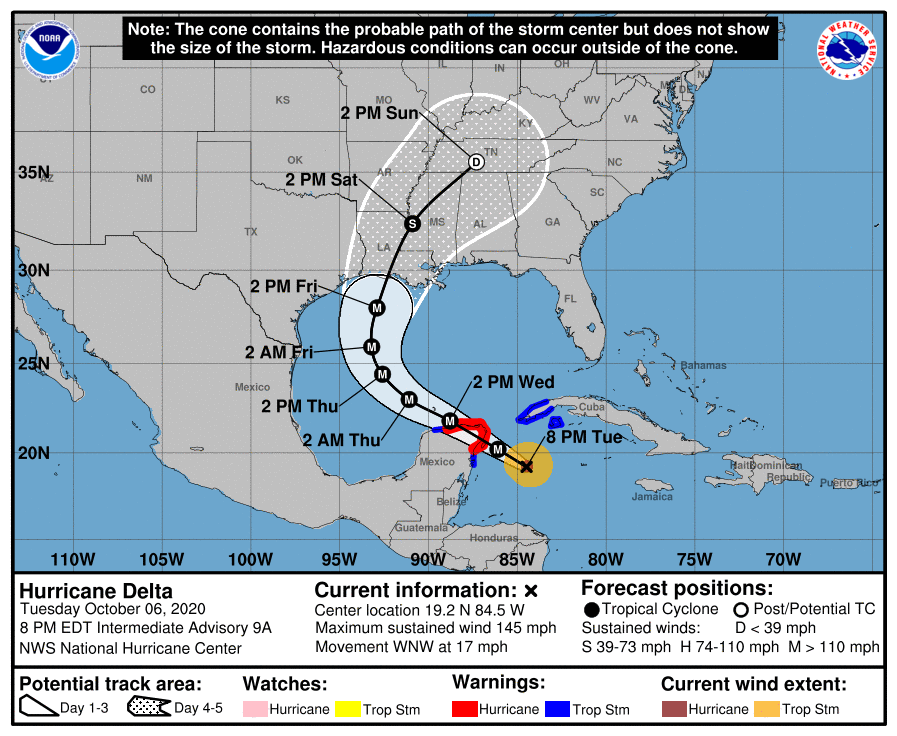
4pm CT track forecast for Hurricane Delta. (National Hurricane Center)
By tomorrow morning we should have a pretty good sense of the ultimate track forecast for Delta, as the overnight model runs ingest data from today’s aircraft reconnaissance missions as well as supplemental weather balloons to sample the atmosphere helping to control the steering flow for this system. The odds still strongly favor a landfall in southwest or south-central Louisiana, but there is enough uncertainty that we’re going to need to continue to watch Delta closely along the upper Texas coast.
That’s just what we’ll do, of course. In tomorrow morning’s post, which will go up no later than 7:30am, we’ll have the latest on track and potential impacts along the upper Texas coast later this week, as well as Louisiana.

 For months, Jonathan Price had been watching the protests against police brutality with interest. But the 31-year-old’s reaction to the movement seemed to defy categorization. He prayed for George Floyd, but worried that “aggressive rioting” after his death would only lead to more racial profiling and violence. He believed in the importance of the Black Lives Matter movement, but remained adamant that his own interactions with police as a Black man living in North Texas had been generally positive. Mostly, though, Price, a one-time high school football star and charismatic mentor with an infectious smile, seemed intent on living a life that wasn’t defined by his race. “I’m on the same fence as Lil Wayne, with him saying a white cop saved his life,” Price…View Original Post
The post Jonathan Price Was Wolfe City’s Hometown Hero. On Saturday, He Was Killed by Police. appeared first on Texas Monthly.

The president's missteps after being exposed to the coronavirus have amplified the risks of spreading it to others and undermined the recommendations of public health officials.
(Image credit: Alex Edelman/AFP via Getty Images)

 Jim Pirtle would once claim that it was the center of Houston. The address of the venue and performance space—314 Main Street—was his evidence: 314 backwards spelled “PIE,” he’d say, and pi, the ratio of a circle’s circumference to its diameter, was 3.14. Pirtle would take people up to the roof and show them the downtown Houston surroundings that encircled the 1893 building: expensive lofts, the Alley Theatre, Jones Hall, and Minute Maid Park. It was a sign, he said. From this magical spot, all of Houston radiated outward; the location would offer a shelter for ideas and strange happenings. Pirtle felt the most appropriate name for such a place would be Houston spelled backwards: notsuoH. Before 1996, when Pirtle bought the Main Street building…View Original Post
The post An Oral History of notsuoH, Houston’s Most Idiosyncratic “Work of Living Art” appeared first on Texas Monthly.
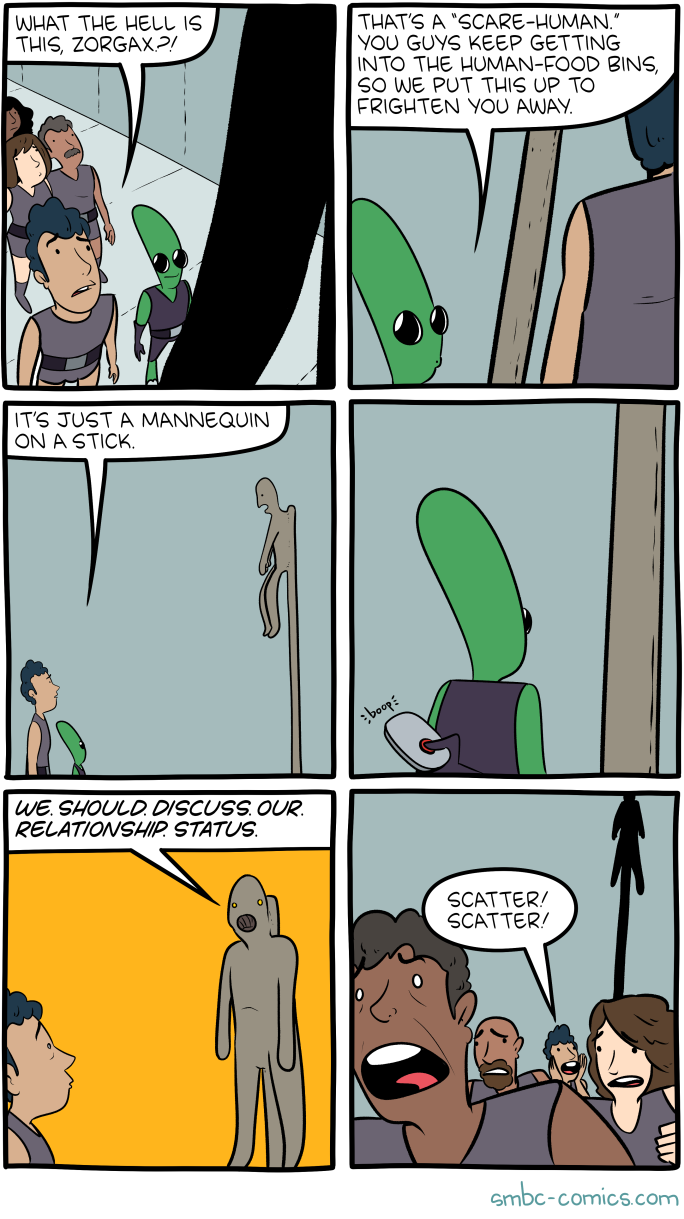
Hovertext:
Just to be clear, the drawing in panel 5 does not want to talk about your relationship. Please proceed to the end of the comic.
/https://static.texastribune.org/media/files/a3e718bbbdf629cf11e248d976454dc5/Biden%20Dallas%20CN%20TT%2002.jpg)
Sign up for The Brief, our daily newsletter that keeps readers up to speed on the most essential Texas news.
Democratic presidential nominee Joe Biden’s campaign is set to spend millions of dollars on TV ads in Texas as polls continue to show a close race in the state.
The former vice president’s campaign announced earlier this year that it would make TV reservations this fall in Texas, and as of Tuesday, it had booked more than $6 million through Election Day, according to the media-tracking firm Advertising Analytics.
“This is historic. That shows you just how important Texas is to them and it shows that Texas is in play,” said Abhi Rahman, a spokesperson for the Texas Democratic Party. “It shows you their investment in Texas is real.” Rahman noted that Biden’s spending is the biggest investment from a Democratic presidential nominee in the last 25 years and is a drastic change from 2016, when then-nominee Hillary Clinton didn’t spend seriously in the state.
As part of its Texas TV spending, the Biden campaign is airing a minute-long spot in the El Paso and San Antonio media markets that features a Latino veteran, Paul Cruz. He contrasts’ Biden’s reverence for the military with Trump’s, noting Biden’s late son Beau, who served in the Army, “was one of us."
“It takes a lot to be able to send your own child off to war,” Cruz says. "Joe Biden understands that decision, he understands sacrifice. "He’s experienced loss, and those losses allow growth. I believe that Joe Biden is the man for this time.”
Biden’s campaign also plans to air Spanish-language TV ads in some of the state’s top media markets, like Dallas and Houston, as well as border markets including El Paso and Laredo. The campaign says it will further reach voters of colors in Texas by advertising on national networks such as BET, Univision and Telemundo.
The campaign additionally plans to advertise during Dallas Cowboys games, including on ESPN Deportes.
Although Biden and Democratic vice presidential candidate Kamala Harris have yet to visit Texas in the run-up to Election Day, Democrats have called for the duo to invest heavily in Texas. In a recent op-ed in the Washington Post, former U.S. Rep. Beto O’Rourke, who endorsed Biden after dropping his own presidential bid, and Tory Gavito, the president and co-founder of the progressive donor network Way to Win, urged the Biden campaign to steer serious money to the state to ensure President Donald Trump doesn’t win a second term.
“Biden, his campaign and Democrats in general need to make it clear: We are competing in Texas, and we’ll invest whatever it takes to turn out the state’s true electoral majority and flip Texas once and for all,” they wrote. “Democrats have historically failed to invest in Texas, despite the size of this prize, because they believed the door is closed to Democratic presidential candidates. But, like many things in 2020, this year is different — Biden has his foot in the door and needs to kick it open for a quick end to the election.”
Biden expanded his on-the-ground presence in Texas in September, hiring 13 more staff members — after an initial hiring announcement in early August — to his team as polls continue to pit a close race between him and Trump.
On Monday, Biden’s team deployed Douglas Emhoff, a lawyer who is married to Harris, to Edinburg and San Antonio. He will visit Dallas on Tuesday afternoon, Biden’s campaign announced Tuesday morning.
News of the campaign’s spending through Election Day comes as The Lincoln Project, the group led by former Republican strategists working to defeat Trump, launched a $1 million digital ad campaign in the state. A spokesperson says the group is targeting over 600,000 “suburban and rural Republican women” and tailoring the campaign to Hispanic voters.
The Lincoln Project’s effort will feature a number of ads, including previously released spots criticizing Trump’s handling of the coronavirus pandemic and his responses to racism and extremism throughout the country. There will be Texas-specific ads, as well as Spanish-language spots, according to the spokesperson, Nate Nesbitt.
As speculation has swirled about the extent of Biden’s investment in the state, the Texas Democratic Party has been ramping up its advertising. On Tuesday, the party announced a digital, print and radio campaign aimed at Black voters in Dallas, Fort Worth, Houston and East Texas. The party described the size of the effort as “high six figure(s).”
Trump won Texas by 9 points in 2016, but recent statewide polls have painted a rosier picture for Biden in the state as surveys continue to show Trump essentially tied with, or barely ahead of, the former vice president.
Still, Trump’s campaign has long dismissed the notion that the state is in play. Lt. Gov. Dan Patrick, who chairs Trump's reelection effort in Texas, led a bus tour through the state last month, and Texas GOP Chair Allen West expressed hope that the president would visit North Texas before Election Day.


President Trump "continues to gaslight the American people by acting like this pandemic is not a real threat," Michelle Obama says in video remarks.
(Image credit: Screenshot from the Biden campaign/YouTube)

 Trump removes his mask upon return to the White House from Walter Reed National Military Medical Center on Monday. | Win McNamee/Getty Images
They said Trump was the “most tested man in America.” Was he tested when it mattered most?
The White House’s refusal to answer a very basic question with serious implications not only for the president’s health but for the health of those around him — when did President Trump last test negative for the coronavirus? — is raising questions about when Trump was first infected and how many people he may have exposed to the virus.
Trump announced that he had tested positive for the coronavirus last Friday morning. But by that point, the coronavirus had been spreading like wildfire in his orbit for a week — and Trump was reportedly not feeling well as far back as the evening of September 30. At least 13 people who had spent time around the president in the days leading up to his Friday announcement (including Trump himself) tested positive for the coronavirus in the past week, and that doesn’t include the 11 positive tests traced to organizers of last Tuesday’s presidential debate or members of the media who covered it.
The Centers for Disease Control and Prevention recommends that people who test positive for the virus isolate for 10 days after the onset of symptoms. But according to the White House’s timeline, Trump’s release from Walter Reed hospital on Monday evening came just four days after he started feeling sick. That discrepancy prompted Howie Forman, a professor at the Yale School of Public Health, to note that Trump is being treated as though he was infected with the coronavirus much earlier than the White House timeline would have people believe.
The White House has repeatedly stonewalled questions asking for clarity about the timeline. Asked on Monday when Trump last tested negative, presidential physician Sean Conley wouldn’t say, instead saying, “I don’t want to go backward.”
Q: Can you tell us when the president had his last negative test?
— Aaron Rupar (@atrupar) October 5, 2020
CONLEY: I don't want to go backwards pic.twitter.com/u3Qe4ECkKG
That was also the line on Sunday when, during a mask-less gaggle with reporters, press secretary Kayleigh McEnany — who on Monday announced she’s tested positive for coronavirus — said, “I’m not going to give you a detailed readout with timestamps of every time the president is tested regularly. He’s tested regularly, and the first positive test he received was after his return” from his a fundraiser at his private club in Bedminster, New Jersey, on Thursday afternoon.
White House Press Sec. McEnany says she won't give “a detailed readout with timestamps of every time the president's tested" for coronavirus. pic.twitter.com/jKqpseZoJC
— NBC News (@NBCNews) October 4, 2020
The White House’s refusal to answer this straightforward question creates the appearance that they’re hiding something — either that Trump wasn’t being tested nearly as often as the White House wanted the public to believe he was or that he had an earlier positive test that he wanted to conceal.
During a briefing in July, McEnany characterized Trump as the “most tested man in America,” saying he was tested for coronavirus “multiple times a day.” But the obfuscation surrounding Trump’s recent coronavirus testing suggests that, like so much else McEnany has said, she was lying.
If Trump really was tested multiple times a day, and if his first positive test came on Thursday, then you’d expect Trump’s last negative test to have occurred sometime either that day or on Wednesday. But that timeline is in doubt not just because Conley suggested Saturday that Trump received a positive test earlier than had been announced (Conley later said he’d misspoken), but because of changes in the president’s behavior leading up to that official announcement.
For instance, as Philip Bump detailed for the Washington Post, at a September 28 White House event, Trump was unusually distanced from others who spoke, raising questions about if he may have already known he’d contracted the virus. The next day was the presidential debate, to which Trump showed up too late to be tested by the Cleveland Clinic. By Wednesday’s campaign trip to Minnesota, top White House aide Hope Hicks was ill, and Trump reportedly fell asleep on Air Force One before the onset of more serious symptoms the next day.
There are already indications that Trump had no qualms about not being forthcoming about the coronavirus cluster that was developing around him at the White House. The Wall Street Journal’s Michael Bender and Rebecca Ballhaus reported on Sunday that Trump had at least two positive test results before he announced his coronavirus infection on Twitter early Friday morning — and that he also “received a positive result on Thursday evening before making an appearance on Fox News in which he didn’t reveal those results.”
"You get close, and things happen ... I just went out for a test ... because we spend a lot of time with Hope" -- asked about Hope Hicks testing positive for coronavirus, Trump says he was just tested pic.twitter.com/Rr7Kd5YfWR
— Aaron Rupar (@atrupar) October 2, 2020
Not only that, but Bender and Ballhaus report that as the coronavirus spread throughout the White House in the past 10 days or so, Trump urged one adviser who had a positive test to keep quiet about it:
As the virus spread among the people closest to him, Mr. Trump also asked one adviser not to disclose results of their own positive test. “Don’t tell anyone,” Mr. Trump said, according to a person familiar with the conversation.
Keeping a diagnosis secret is incredibly dangerous; those who’d been in contact with that adviser wouldn’t know they should quarantine, and in going about their lives they could spread the virus unknowingly if they had become infected.
The reporting suggests the president was unconcerned about this sort of community spread, which raises some questions: Was Trump banking that if he got coronavirus, his symptoms would be mild enough to allow him to continue campaigning — even if he exposed other people along the way? Or, for whatever reason, was he just not being tested nearly as much as McEnany said he was?
The White House’s refusal to say when Trump’s last positive test was suggests one or both of those things is the case, but in the absence of more information, it’s impossible to say for sure. And even if the White House releases more details, its poor track record for accuracy will mean they are unlikely to be taken at face value.
Millions turn to Vox each month to understand what’s happening in the news, from the coronavirus crisis to a racial reckoning to what is, quite possibly, the most consequential presidential election of our lifetimes. Our mission has never been more vital than it is in this moment: to empower you through understanding. But our distinctive brand of explanatory journalism takes resources. Even when the economy and the news advertising market recovers, your support will be a critical part of sustaining our resource-intensive work. If you have already contributed, thank you. If you haven’t, please consider helping everyone make sense of an increasingly chaotic world: Contribute today from as little as $3.
Security flaws in sex toys are nothing new, but one set of vulnerabilities could have been particularly dangerous — not to mention embarrassing. Pen Test Partners has disclosed (via TechCrunch) app programming interface flaws in Qiui’s Cellmate, a male chastity sex toy, that let attackers remotely lock a user’s penis in. If that happened, you’d need to force the toy open using either heavy tools (think an angle grinder or bolt cutter) or jolting certain wires with electricity. There’s no manual override.
The app flaws also let intruders collect private messages, plain text passwords and location info without the need for authentication.
Qiui’s approach was apparently frustrating as well. The company was initially responsive and ultimately fixed the “majority” of issues with a new version of the interface, but it missed three self-imposed deadlines and ultimately went quiet. Pen Test Partners decided to make the issues public after input from other researchers made it clear that poor communication was all too common. The disclosure was in the “public interest,” the security firm said.
While security problems are a reality for numerous connected devices, this incident underscores the particular dangers for sex toys. They not only tend to include sensitive info, but can sometimes give hackers an opportunity to do physical harm. As helpful as connected toys can be for remaining in touch with a partner (particularly during a pandemic), they carry a unique set of risks.