Shared posts

29 Jan 03:21

“Calder-Picasso” and “Incomparable Impressionism” at the Museum of Fine Arts, Houston

by Ruben Cordova
Painting by Renoir in his gestural and painterly style. A detail of a couple dancing and in motion

Renoir, “Dance at Bougival” (detail of life-sized painting), 1883. Photo: Museum of Fine Arts, Boston.

This photo-essay treats two exhibitions at Houston’s MFA: Calder-Picasso, and Incomparable Impressionism from the Museum of Fine Arts, Boston. The former is an exhibition of 80 objects curated by the grandsons of Alexander Calder (1898–1976) and Pablo Picasso (1881–1973). The latter consists of 106 paintings and works on paper organized for the National Gallery of Victoria in Melbourne. After a nationwide COVID shutdown of Australia, the exhibition was re-routed to Houston. 

Photo of Alexander Calder and Pablo Picasso on a wall in the exhibition Calder-Picasso

Entrance to the “Calder-Picasso” exhibition, with photos of Calder and Picasso. Photo: Ruben C. Cordova

Alexander S. C. Rower (b. 1963), the grandson of Alexander Calder, is the founder and president of the Calder Foundation. He initiated the foundation to catalogue, document, and study Calder’s work. His co-curator Bernard Ruiz-Picasso (b. 1959) is the grandson of Pablo Picasso and the son of Paul and Christine Ruiz-Picasso. With his mother he co-founded the Museo Picasso Málaga, and with his wife Almine he co-founded the Fundación Almine y Bernard Ruiz-Picasso para el Arte. Both Rower and Ruiz-Picasso have curated and collaborated on numerous exhibitions featuring the work of their respective grandfathers. 

Picasso and Calder only met four times. The first meeting took place in April 1931, when Picasso visited a Calder exhibition at the Galerie Percier in Paris. Their most significant interaction took place in July of 1937 at the Exposition Internationale in Paris. 

A black and white photo of Alexander Calder between a fountain and Picasso's painting of Guernica

Hugo Paul Herdeg, Portrait of Alexander Calder in the Spanish Pavilion, July, 1937, with Calder’s “Mercury Fountain” (now in the Fundació Joan Miró, Barcelona) in the foreground and Picasso’s “Guernica” (now in the Museo Nacional Centro de Arte Reina Sofía, Madrid) in the background.

Picasso exhibited Guernica in the Spanish Pavilion. This now world-famous anti-war mural was a response to the bombing of a Basque village by Nazi and Italian planes. Calder’s Mercury Fountain — which also referenced the Spanish Civil War — was installed in the center of the pavilion. It referred to the protracted siege of the Spanish town of Almadén — the site of an ancient and productive mercury mine — by fascist forces under General Franco. The Spanish Republic needed revenue from the mine for the war effort. 

Picasso’s and Calder’s common political sympathies and interactions in 1937 did not lead to a friendship between the two artists, though they met again in Antibes in 1952 and Vallauris in 1953. 

Calder-Picasso does not assess questions of influence and priority. If it were to consider those issues, then the exhibition would have needed to include Picasso’s ground breaking early Cubist work. Instead, the exhibition begins in the late 1920s. A few of Picasso’s most schematic paintings (and many drawings) from 1910-1911 suggest wire-like configurations of human forms. How familiar was Calder with Picasso’s early Cubism, and did it influence his wire sculptures? Additionally, two roughly-hewn wood sculptures by Calder called Caryatid (1928) have their closest counterpart in Picasso’s oeuvre in primitivizing wood sculptures that he made in 1907 and 1908. I don’t know if these issues were addressed in the catalogue, because the museum declined to send me a review copy. In many instances, the exhibition did not feature the works by the two artists that resembled each other the most. 

Calder-Picasso is spaciously installed, and, for the most part, Calder’s work is displayed most advantageously. The exhibition makes great use of Calder’s forms in space. The mobiles, in particular, energize the space with the shadows they create as they twist and turn (the base in the foreground of the installation shot illustrated above serves to “display” the equally mobile shadow of Calder’s sculpture). The stabiles, too, are amplified by the shadows they cast. 

Photo of a sculpture work by Pablo Picasso. A metal piece with both round and geometric shapes connected by metal pieces

Pablo Picasso, “Figure” (Project for a Monument to Guillaume Apollinaire). Photo: Ruben C. Cordova.

Picasso’s most important sculptures in the exhibition are rather small, such as the study for the monument to Apollinaire, which is under 15 inches tall. 

View of exhibition with works by Calder and Picasso. A red and black mobile by Calder hangs in the foreground and smaller sculptures and paintings by both artists are in the background

Installation shot of “Calder-Picasso,” with works by Picasso and Calder. Photo: Ruben C. Cordova

In the above installation shot, Calder’s Untitled, a mobile from 1947, is beautifully displayed with a circular, shadow-displaying platform beneath it. It’s a pleasure to watch it turn. To its left, however, Picasso’s Bull’s Head (1942) is behind a barrier and hangs so high that it is difficult to appreciate it. The Picasso is a bronze version of his boldest and simplest assemblage, which the artist fashioned out of the seat and handlebars of a bicycle. When better displayed, it has had a very powerful presence in several sculpture exhibitions I have seen. But in Calder-Picasso it seems wasted. 

Installation view with paintings and sculptures by both Calder and Picasso

Installation shot of “Calder-Picasso,” with paintings by Picasso and sculptures by Calder. Photo: Ruben C. Cordova.

Picasso’s major painting Reclining Nude (1932) (illustrated above) has more impact and is placed near Calder’s Object with Red Disks (1931).  I wonder why a better juxtaposition of similar physical or thematic characteristics was not made between the Picasso and the Calder. 

A hanging mobile and sculpture by Alexander Calder. A wire piece with a figure suspended over a white base

Alexander Calder, “Hercules and Lion,” 1928, wire, the Calder Foundation. Photo: Ruben C. Cordova.

Calder’s most astonishing wire mobile — and the one that most needs to be experienced in person — is Hercules and Lion. The epic battle between hero and lion comes to life as the intertwined wire figures (and the far more complex shadow figures) twist and grapple before our eyes. 

Exhibition view with work by Calder and Picasso. In the foreground are three bronze sculptures of figures, works on paper in the background, and a red mobile by Calder suspended from the ceiling.

Installation shot of “Calder-Picasso,” with bronze versions of three “Bathers”(1956) by Picasso under a Calder mobile called “Red Lilly Pads” (1956). Photo: Ruben C. Cordova.

A pair of water-themed works from the same year are installed in the center of a large gallery. 
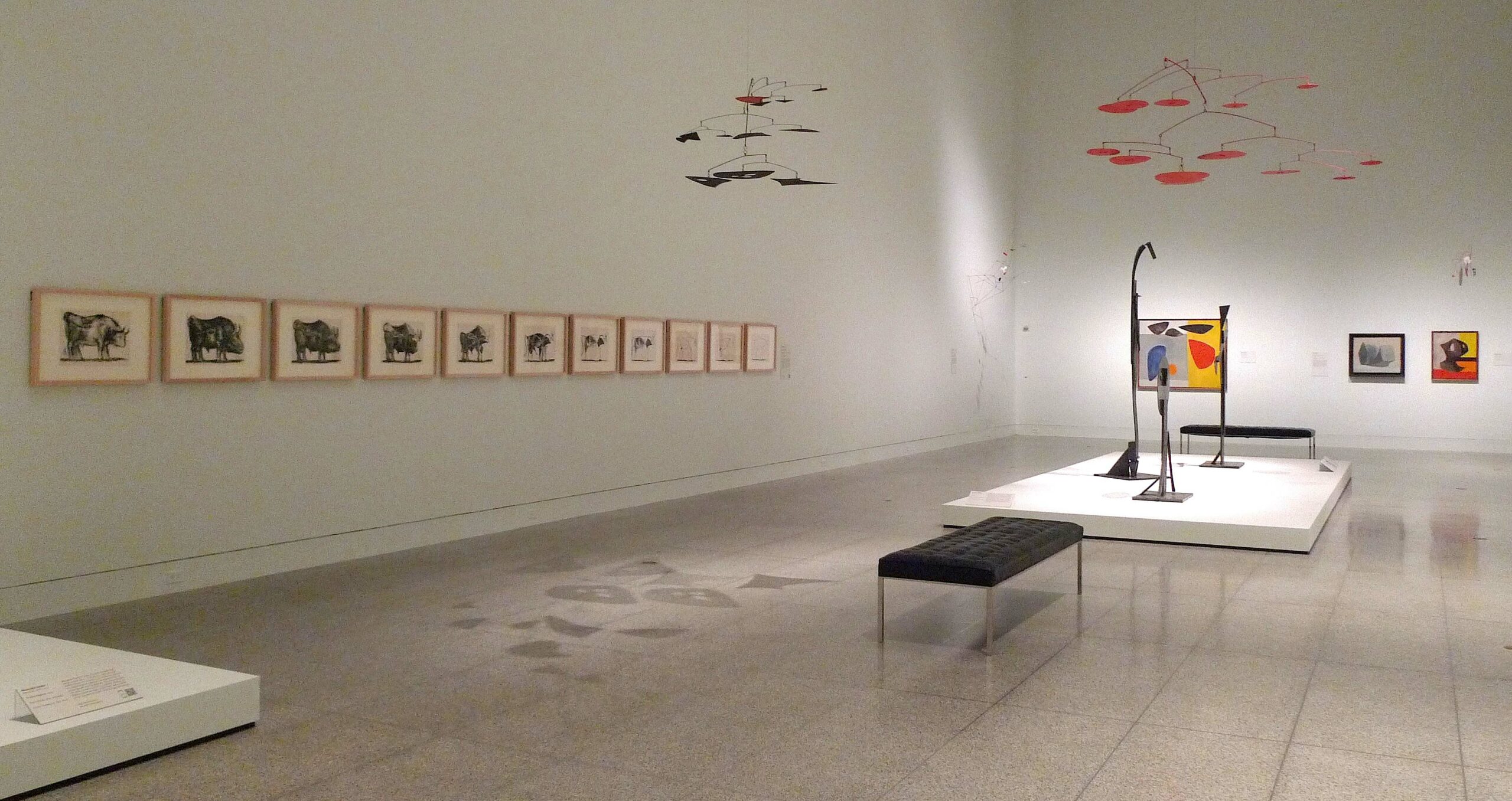
Exhibition view with works on paper, painting, sculpture and suspended mobiles by both Calder and Picasso

Installation shot of same gallery, with 11 states of Picasso’s “The Bull” (1945-1946) in the left foreground. Photo: Ruben C. Cordova.

Picasso created a hulking bull in his second state of the above lithograph, which he gradually dematerialized until it was just a wire figure in its final state.
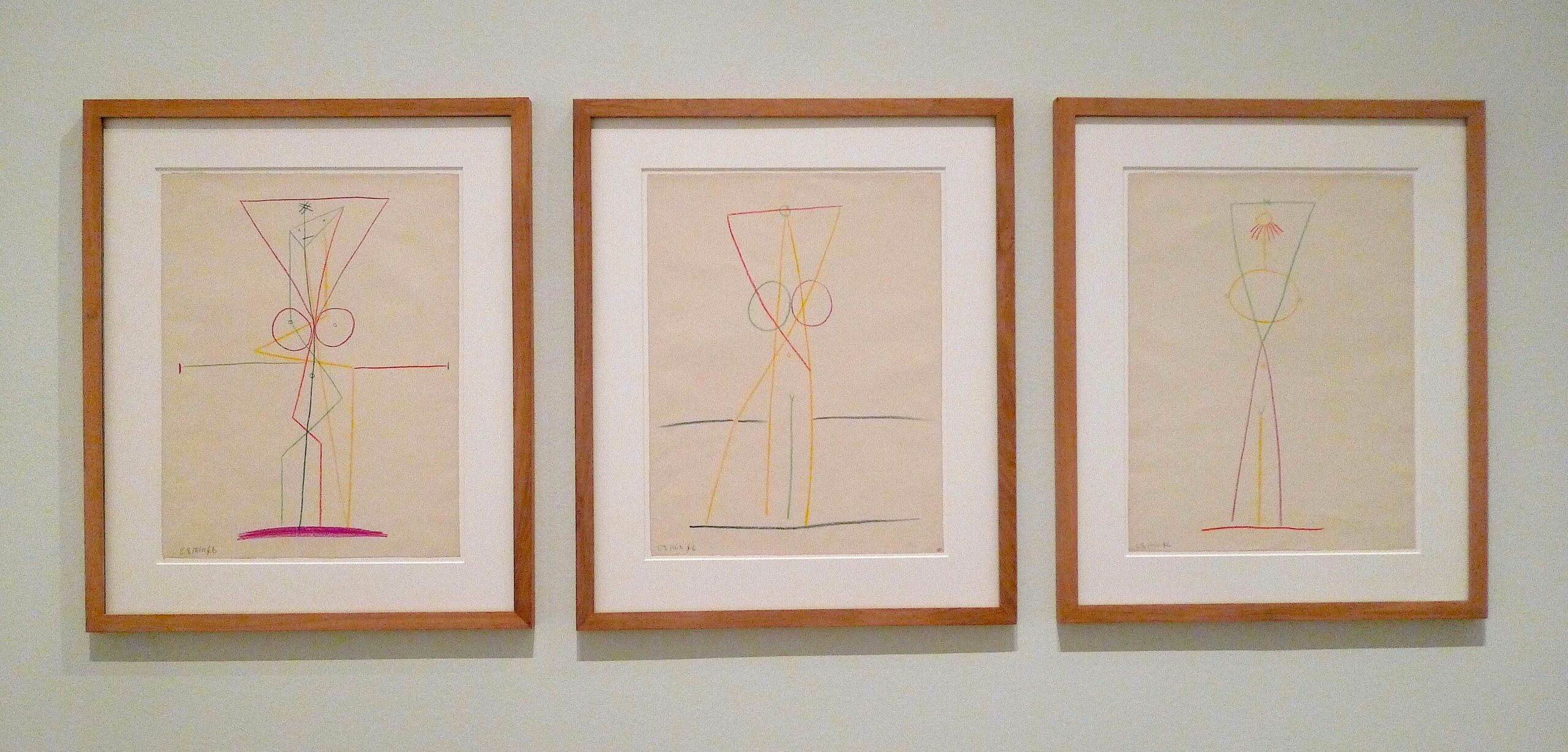
Three colored pencil drawings of a standing nude in the cubist style of Picasso

Pablo Picasso, Three versions of “Standing Nude,” 1946, colored pencils on wove drawing paper, Musée national Picasso-Paris. Photo: Ruben C. Cordova.

These three drawings by Picasso are fascinating examples of the artist’s simplifying geometry. 

Bronze sculptures of figures in motion

Installation shot of “Calder-Picasso,” with Calder’s “Dancer” (1944, bronze), Picasso’s “Vase with Flower” (1951, bronze), Calder’s “One One Knee” (1944, aluminum), and Calder’s “Tightrope Worker (Woman on Cord)” (1944, bronze, rod, and string). Photo: Ruben C. Cordova.

The three Calder statues in the above photograph were models for a public art project. They would have been 30-40-feet high, if the project had been realized. Picasso’s sculptures often look anthropomorphic. In this company, Vase with Flower looks particularly anthropomorphic. 

Calder-Picasso has many interesting works by both artists. I had hoped, however, that it would be a more ambitious exhibition from an art historical perspective. 

Calder-Picasso was organized in partnership with the Calder Foundation, New York; the Musée National Picasso Paris (MNPP); and the Fundación Almine y Bernard Ruiz-Picasso para el Arte. It premiered at the MNPP in 2019, and traveled to the Museo Picasso Málaga, the De Young Museum in San Francisco, and the High Museum of Art in Atlanta. Ann Dumas organized the Museum of Fine Arts, Houston presentation, based on a concept by Claire Garnier, Emilia Philippot, Alexander S. C. Rower and Bernard Ruiz-Picasso. The exhibition runs through January 30 at the MFAH. 

****

Incomparable Impressionism from the Museum of Fine Arts, Boston

Exhibition view of Impressionist show with six paintings on a green wall

Installation shot of a gallery dedicated to the Barbizon school. Photo: Ruben C. Cordova.

Founded in 1870, Boston’s MFA has one of the largest and finest collections of 19th century paintings in the world. Bostonians were early and avid collectors of Impressionism, Post-Impressionism, and their precursors. In 1903, the Boston museum became the first U.S. museum to acquire a Degas. 

Incomparable Impressionism took years to plan. When the exhibition’s run in Australia was truncated by the COVID pandemic, the Houston MFA quickly raised $800,000 to secure the exhibition. It is situated in light-filled galleries on the second floor of the Beck Building. 

Incomparable Impressionism begins with the Barbizon painters, who were precursors of the Impressionists. They include Jean-Baptiste-Camille Corot and Charles Francois Daubigny (van Gogh’s depiction of the latter’s house and garden was treated in my previous Glasstire review. Read that here). 

Installation view of four paintings by Monet on a blue wall

Installation shot of a gallery dedicated to Monet. Photo: Ruben C. Cordova.

Incomparable Impressionism is arranged in nine thematic groupings: The Barbizon School; Boudin, Mentor To Monet; Watery Surfaces: Mastery And Innovation; Impressionist Still Life; Renoir: A Fantastic, Nervous Improvisator; Pissarro: Teacher And Student; Impressionists And The City; Impressionist Printmaking; and Monet: From Fontainebleau To Giverny.

Installation shot of Impressionist exhibition. Four paintings by Monet against a blue wall

Installation shot of a gallery dedicated to Monet. Photo: Ruben C. Cordova.

It includes sections on particular artists, as well as groupings by genre. The exhibition’s greatest strength is groups of works by core members of the Impressionist circle. Incomparable Impressionism culminates in an impressive group of 15 paintings by Claude Monet,  the quintessential Impressionist. The Impressionists habitually worked outside, painting directly from the motif in an attempt to render forms, colors (including colored shadows), and the fugitive effects caused by the play of light directly onto their canvases. Monet developed the practice of working on several canvases in a single day,  moving from one canvas to another as the light changed. In the nineteenth century, there were many developments in optics and color theory, which were of great interest to the Impressionists and Post-Impressionists, who made use of new scientific theories. But one should not conclude — as was often done in the twentieth century — that the Impressionists were somehow “objective,” disinterested in their subject matter, or that they did not paint for expressive purposes.    

Painted over a span of three decades, the Monets in the exhibition range from the Fontainebleau Forest (where the Barbizon painters worked) to the artist’s late paintings of water lilies. Many of Monet’s favorite motifs are represented in the exhibition, and they provide a mini-survey of his development as an artist. 

Installation view of Impressionist paintings on a light blue wall

Installation shot of a gallery dedicated Watery Surfaces. Photo: Ruben C. Cordova.

The most eclectic grouping is called Watery Surfaces. It includes two paintings by the Norwegian Frits Thaulow (one is in the center of the above photograph).  
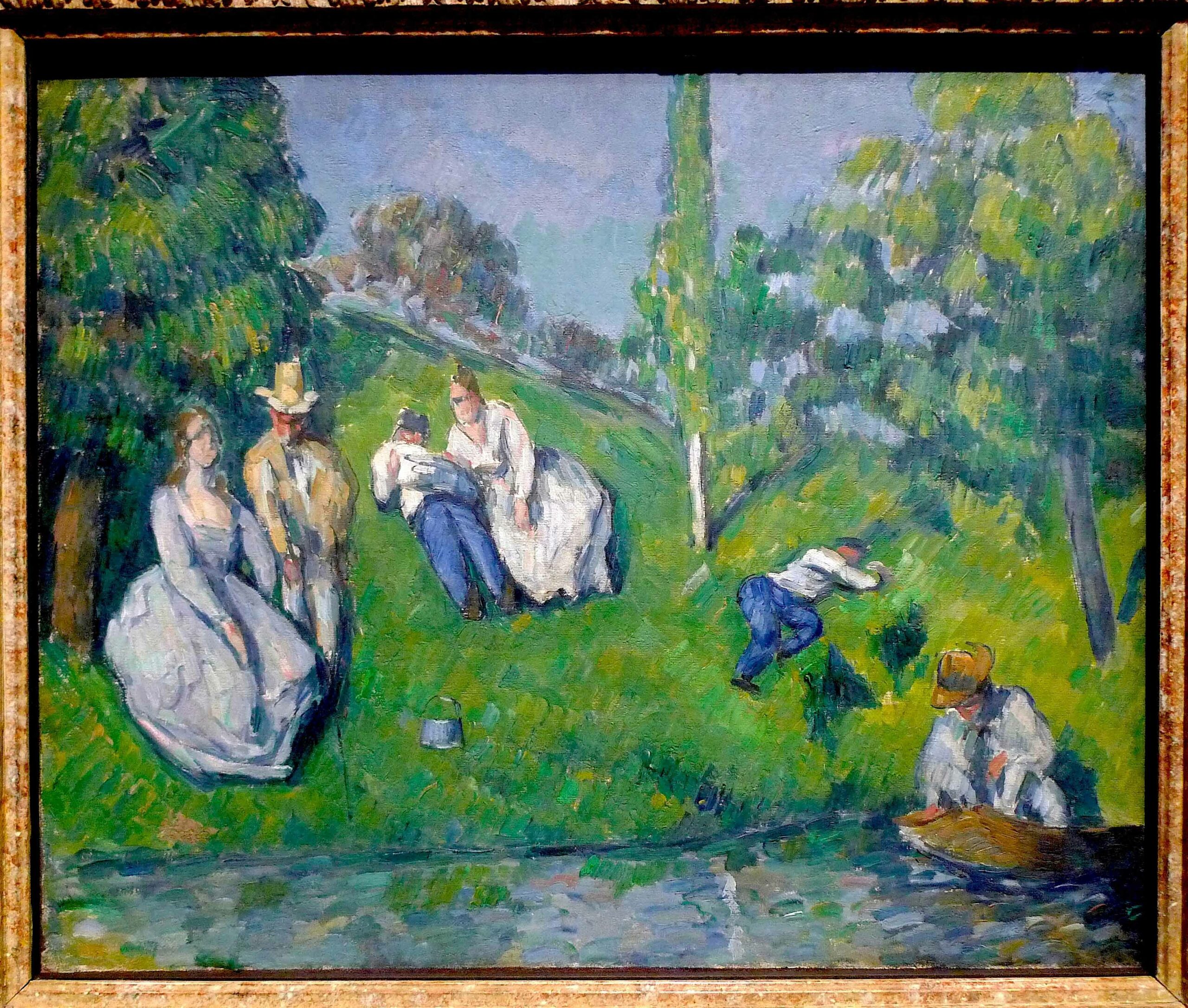
A painting by Paul Cezanne with figures lounging by a pond

Paul Cézanne, “The Pond,” c. 1877-1879, oil on canvas. Photo: Ruben C. Cordova.

One of my favorites among these paintings is Cézanne’s early genre painting called The Pond, c. 1877-1879. This small, enigmatic painting features strange groupings of figures — though they are not as strange as many of his genre paintings. 

Cézanne famously said of Monet: “He is just an eye, but my God, what an eye.” In The Pond he uses parallel strokes of paint that form clusters in an overall pattern. These pronounced accents run counter to the Impressionist concern to render the visible, to capture optical sensations. Cézanne, who is considered a Post-Impressionist, is already rendering an extremely subjective personal vision. Even in this early painting, space is compressed in a very subjective manner. There is little sense of time of day, nor of the details of a specific locale. The putative water in the foreground is not treated very differently from the grass. 

Installation view of five impressionist paintings of still lives against a pale pink wall

Installation shot of a gallery dedicated to Impressionist Still Life. Photo: Ruben C. Cordova.

The still life section ranges from the 1860s to the 1890s, with works by Edouard Manet, Gustave Courbet, Berthe Morisot, and Paul Cézanne. Henri Fantin-Latour’s work from the 1860s and 1870s is particularly well-represented (the second, fourth, and fifth paintings in the installation shot illustrated above are by him). The centerpiece in the installation shot is an early and complex flower painting by Renoir from around 1869. 

Painting by Berthe Morisot of white flowers in a bowl with a blue background

Berthe Morisot, “White Flowers in a Bowl,” 1885, oil on canvas. Photo: Museum of Fine Arts, Boston.

This still life by Berthe Morisot is the only painting by a woman artist in the Incomparable Impressionism exhibition. Morisot studied with and was advised by a number of artists, though she found her own path. She exhibited at the official state-sanctioned Salon (1864-1868) and around 1867-1868, was introduced to Manet by Fantin-Latour. Though Manet encouraged her to stay within the Salon system, Morisot became a founding  member of the Impressionists. She was an enthusiastic exhibitor in the Impressionist exhibitions, which began in 1874, and many artists and writers attended gatherings at her home. 

Though Morisot often painted flowers, White Flowers in a Bowl is one of her rare still life paintings. While most of the Impressionists and the artists they admired revelled in the opportunity to paint multi-colored bouquets, Morisot has chosen white flowers. White, in fact, figures prominently in many of Morisot’s paintings of interiors. Beneath the bowl of flowers in particular, one can see the slashing brushstrokes, one of her hallmarks as a painter. Morisot also lets areas of bare canvas and thin underpainting show through. 

Painting by Renoir of a couple dancing

Renoir, “Dance at Bougival,” 1883, oil on canvas. Photo: Museum of Fine Arts, Boston.

Renoir’s Dance at Bougival is one of the Boston museum’s most popular paintings. It depicts a couple dancing in an outdoor café. Bougival, which is west of Paris on the river Seine, was popular with residents of the city. Renoir was one of several Impressionists who painted at Bougival. They made middle class recreation and sociability the subject of art, which hitherto placed a priority on historical and mythological scenes. 

Dance at Bougival is one of three full-length dance paintings commissioned by the dealer Paul Durand-Ruel. Sketchy, Impressionist brushwork is most evident in the background, which also features casually posed and cropped figures. In particular, note the two black-top hats stacked behind the male dancer’s straw hat. Renoir has portrayed his two dancing figures with more conventional brushwork. Renoir increasingly chose to represent weighty, solid forms rather than those seemingly dissolved by bright sunlight and refractions that typified his Impressionist work. 

Installation view of six impressionist paintings on a red wall

Installation shot of a gallery dedicated to Impressionists And The City. Photo: Ruben C. Cordova.

Edgar Degas is well represented in this portion of the exhibition. All six works in the above installation shot are by him 
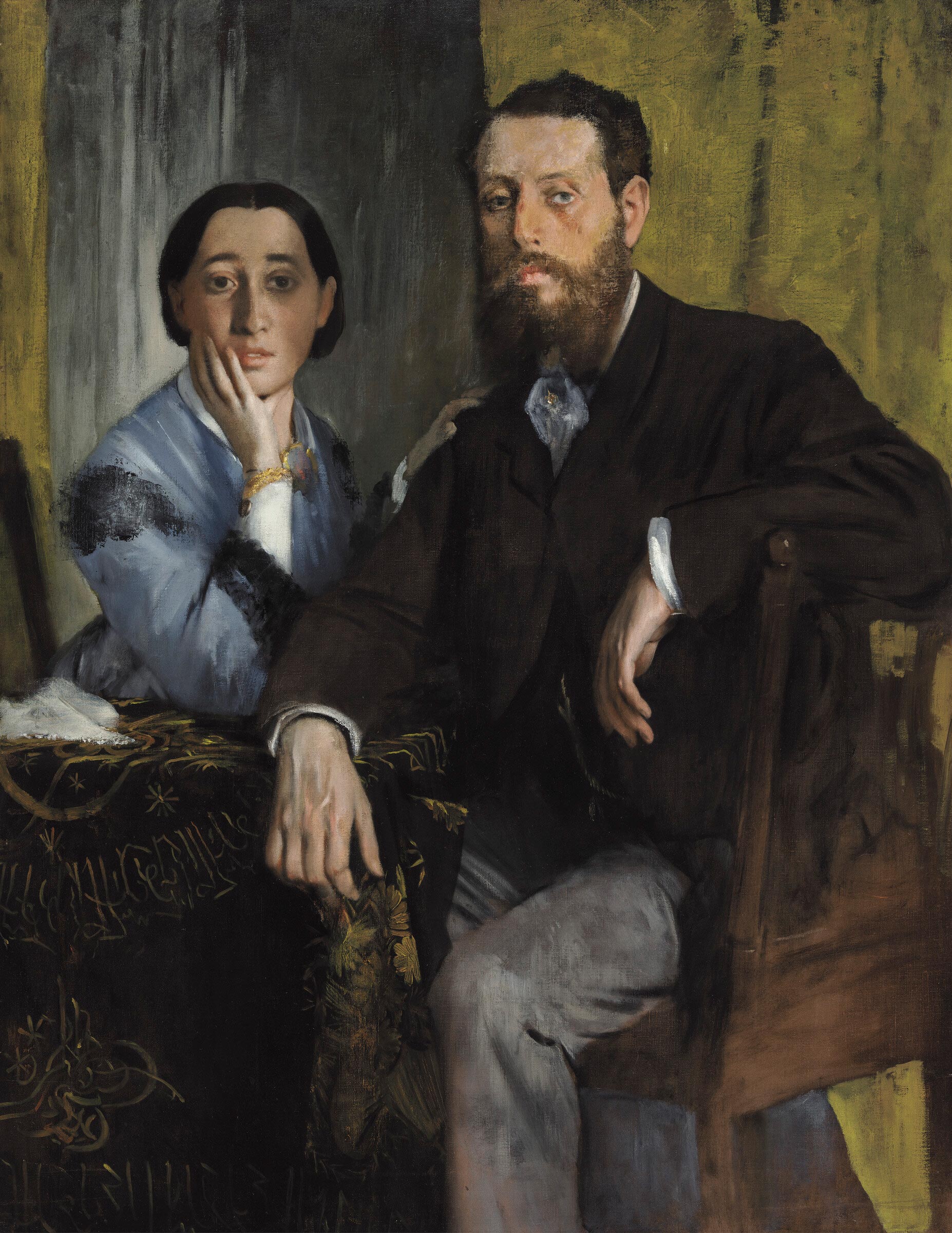
Painting by Edgar Degas of two seated figures

Edgar Degas, “Edmondo and Therese Morbilli,” c. 1865, oil on canvas. Photo: Museum of Fine Arts, Boston.

Degas is a hard artist to categorize. Although he exhibited in most of the Impressionist exhibitions and he is virtually always grouped with them. The standard Impressionist practice was to paint out of doors in a spontaneous manner in order to capture transitory effects and bright colors. Degas, however, worked in the studio and had a disdain for spontaneity and working outside. Whereas the Impressionists virtually banished the color black, Degas often made extensive use of it in his paintings (though he used electric colors in his pastels). Like Manet and the Impressionists, Degas often depicted scenes of modern life. He also often utilized strange viewpoints, croppings, and poses. Degas, who revered the old masters, is regarded as the finest draftsman of his era. He was also deeply concerned with portraying the psychological states of the sitters he painted — which is not a quality generally associated with Impressionism. 

Degas’s double portrait of his sister, Thérèse, and her husband, Edmondo Morbilli (pictured above), reveals the artist’s interest in conveying psychological states. One can also see the influence of the French Neoclassical painter Jean-Auguste-Dominique Ingres in the pose and facial features of Thérèse. Degas worked in a very studious manner — often with many preparatory drawings — that was antithetical to Impressionist practice.  

Portrait of a woman by Edouard Manet

Edouard Manet, “Victorine Meurent” (detail), c. 1862, oil on canvas. Photo: Ruben C. Cordova.

Manet is also also hard to categorize. He and Courbet are recognized as the founders of modern art in France. Manet was the quintessential painter of modern life. He also introduced the alla prima technique (painting directly on the canvas without a colored primer and multiple layers of paint and glazes) that was fundamental to Impressionism. Manet both influenced and was influenced by the Impressionists, yet he always kept a distance from them, even as they greatly admired him. He refused, for instance, to exhibit in any of the Impressionist exhibitions because he always sought recognition at the official Salon. 

Incomparable Impressionism features two paintings that depict Victorine Meurent (1844-1927), Manet’s favorite model of the 1860s. The portrait illustrated above (which is slightly cropped on the sides and at the top) was the artist’s first depiction of Meurent. She also modeled the nude figures in Manet’s two most famous paintings: Olympia  and Le déjeuner sur l’herbe (both painted in 1863 and in the Musée d’Orsay, Paris). One can see qualities in this portrait that disturbed contemporary viewers: Meurent looks directly at the spectator (this look was considered brazen in Olympia); her skin is also rendered in a very stark, abbreviated manner. It is as if she were blasted by a flash: a bright, flat area shifts abruptly into shade, without traditional half tones to make the transition from light to dark.  

Installation view of a portrait of a woman and a full figure against a pink wall

Edouard Manet, “Street Singer,” c. 1862, oil on canvas, and “Victorine Meurent,” c. 1862, oil on canvas. Photo: Ruben C. Cordova

Manet witnessed a street singer emerging from a lower-class café. She reputedly refused to pose for the artist, so he reenacted the tableau with Meurent in his studio. 

Detail of a painting of a woman by Edouard Manet

Edouard Manet, “Street Singer” (detail), c. 1862, oil on canvas. Photo: Museum of Fine Arts, Boston.

As she passes though swinging green doors, the woman eats cherries with her right hand. With her left hand, she simultaneously clutches her guitar and lifts her skirt, all the while securing the parcel of cherries in the crook of her left arm. 

The casual instantaneity, the blurring of the lower portion of the dress-in-motion, the “low” subject matter, the somber colors, and the blankness of the ground have precedents in the art of Diego Velázquez, who Manet would single out as the painter of painters on his trip to Spain in 1865. (For a brief discussion of Velázquez’s hold over Manet, see Peter Schjeldahl on the Manet/Velázquez exhibition in The New Yorker.) Spanish painting was lionized by modern painters in France and other countries because it offered an alternative to academic painting. One can see echoes of Manet’s works such as Street Singer in Renoir’s Dance in Bougival

Other major paintings for which Meurent modeled for Manet include Mademoiselle V. . . in the Costume of an Espada (1862, Metropolitan Museum of Art), Young Lady in 1866 (1866, Metropolitan Museum of Art), and The Railway (1873, National Gallery of Art, Washington, D.C.)

Meurent was also a painter — a more traditional one than Manet — who exhibited in several Salons. After much research, at least four of her paintings have surfaced, all in the last two decades. See: Drema Drudge, “Victorine Meurent, More than a Model,” Art Herstory, March 31, 2020. 

Incomparable Impressionism provides a rare opportunity to view a large body of Impressionist works in the context of their predecessors and successors. 

Incomparable Impressionism was co-curated by Katie Hanson and Julia Welch at the Museum of Fine Arts, Boston. It was organized at the Houston Museum of Fine Arts by Helga Aurisch, where it is on view through March 27.


***

Ruben C. Cordova is an art historian and curator. He reviewed Ernesto Neto’s installation SunForceOceanLife at the Houston MFA in Glasstire on August 14, 2021.  

The post “Calder-Picasso” and “Incomparable Impressionism” at the Museum of Fine Arts, Houston appeared first on Glasstire.
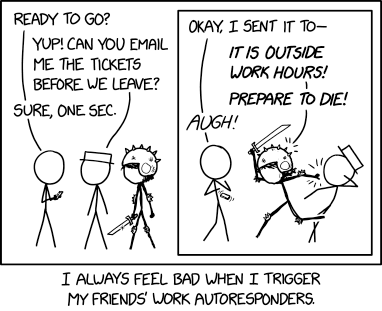
29 Jan 03:19

Autoresponder

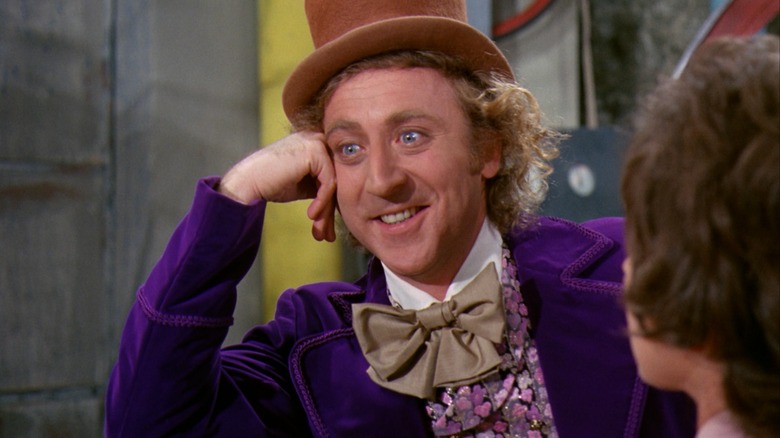
I ADMIRE HOW YOU SET BOUNDARIES AND I HOPE YOUR COLLEAGUES RESPECT THEM! PLEASE SPARE MY LIFE!
29 Jan 03:00

The 15 Best Gene Wilder Movies, Ranked

by Layla Halfhill

In the realm of beloved entertainers, Gene Wilder is one who holds a special place in our collective hearts. The comedically gifted actor graced us with a variety of memorable roles over the course of his career, but his characters always displayed a special kind of charm.

Possessing an intelligent, calmly knowing exterior with a barely restrained manic energy simmering beneath the surface, Wilder exuded the air of someone acutely aware of the madness of the world, but also of its beauty, and he breathed that uniquely appealing energy into every character he played, often to hilarious results.

Thanks to these qualities, and his undeniable talent, we can count more than one of Gene Wilder's movies among the most iconic comedies ever made. We've ranked those here, along with some of his other best films. There's no way of knowing which direction we are going, as we present the best Gene Wilder films, ranked.

15. Hanky Panky

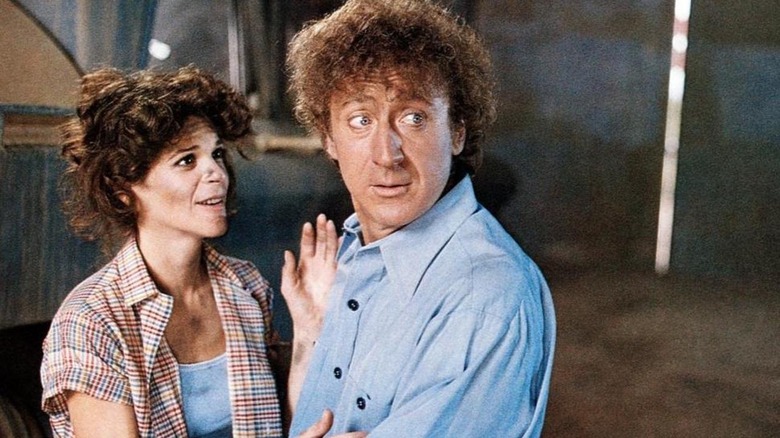
One of several notable partnerships in Gene Wilder's life was his iconic marriage to another comedy legend, Gilda Radner. The duo first met on the set of the Sidney Poitier-directed "Hanky Panky" (1982), which would be one of three movies they starred in together before Radner sadly passed away due to ovarian cancer in 1989.

In "Hanky Panky," Wilder stars as Michael Jordon, a New York City architect who unwittingly becomes involved in a spy-like game of cat and mouse after meeting a woman (Kathleen Quinlan) in a cab who gives him a package, then later winds up dead. Suddenly finding himself the prime suspect in her murder, Michael goes on the run, where he meets Kate (Gilda Radner), whose murdered brother is also involved in the mystery. At first believing each other is the killer, the star-crossed pair then work to solve the mystery of who's chasing them and what's in that darn package that everyone wants.

While it might not be the best Gene Wilder film, Hanky Panky is a fun enough comedy caper that showcases both Wilder and Radner's talents, as well as their on-screen chemistry.

14. Haunted Honeymoon

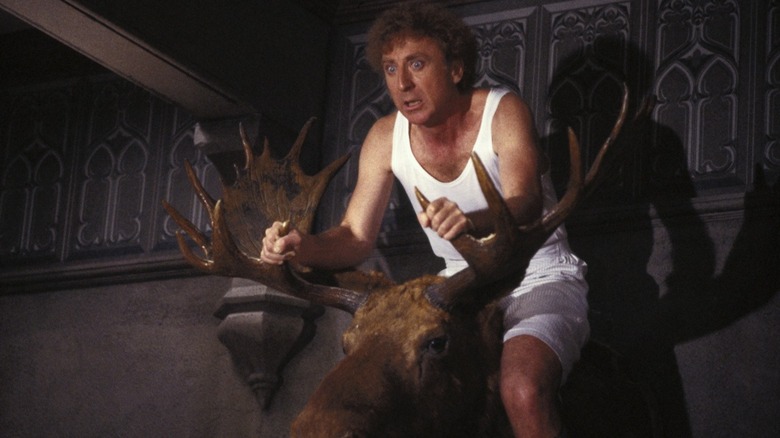
Edging out "Hanky Panky" by just a bit is Wilder and Radner's third and final on-screen pairing, the comedy chiller romp, "Haunted Honeymoon" (1986), which has the bonus element of taking place at a haunted mansion. Spooky.

This time, Wilder stars as Larry Abbot, a radio host who is newly engaged to his co-host of "Manhattan Mystery Theater", Vickie Pearle (Radner). However, Larry comes down with a case of the pre-wedding jitters, at which point his psychiatrist uncle, Paul (Paul L. Smith) decides a bit of "scare" therapy will help. The couple travel to Larry's childhood home for their wedding, where they encounter Larry's Aunt Kate (Dom DeLuise), his cousin Charlie (Jonathan Pryce), and a host of other eccentric family members. But they soon realize Paul's scare therapy isn't the only thing spooky in this manor, when they find themselves in the middle of a real-life murder mystery.

Is it a perfect movie? No. But "Haunted Honeymoon" is a silly bit of fun for those who like their comedies with a few goofy chills thrown in.

13. The Woman In Red

In between "Hanky Panky" and "Haunted Moon", Gene Wilder and Gilda Radner somehow found the time to star in one other comedy together, "The Woman in Red," (1984), which just edges out the others, perhaps in part because Wilder himself adapted the screenplay.

Here, Wilder plays Teddy Price, a married advertising exec who one day encounters a mysterious, seductive woman in red (Kelly LeBrock). As she channels her best Marilyn Monroe over a subway grate, he becomes obsessed with the idea of dating her, despite the fact that he is married to Didi (Radner). The nervous Larry tries to find creative ways to meet the woman in red discreetly, but he gets thwarted at every turn. Will his fantasies ever come to life? And if so, what about Didi?

Adapted from a French comedy called "Pardon Mon Affaire," "The Woman in Red" is a fine enough '80s comedy that allows Wilder's angst to shine and features a strong supporting cast including Charles Grodin. Notably, it won an Oscar for best original song, for Stevie Wonder's "I Just Called to Say I Love You."

12. The Little Prince

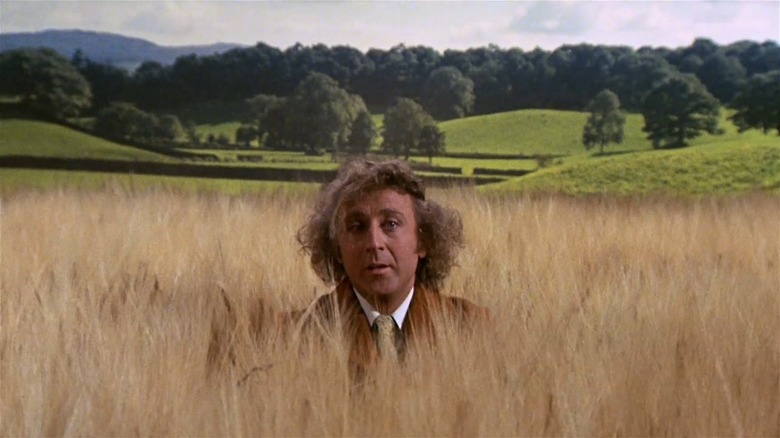
Fans of Antoine de Saint-Exupéry's classic novel will appreciate Wilder's turn in this imaginative adaptation from 1974. There have been other adaptations of "The Little Prince", but this happens to be an imaginative musical which stars Gene Wilder as a talking fox.

Remaining faithful to the novel, "The Little Prince" follows the story of a pilot (Richard Kiley) who crash lands in the Sahara desert, where he meets the titular Little Prince (Steven Warner), fallen to earth from Asteroid B 612. The Prince asks him to draw a sheep, then shares with the pilot his backstory, which includes his encounters with a talking fox (Wilder), as well as a talking snake (Bob Fosse).

The film takes an interesting approach in the way it handles these animal characters. Wilder doesn't voice the character nor is he in an animal costume. He's just a man wearing a brown three-piece suit. Still, seeing him sit in a wheat field while he recites classic lines from the book like "It's only with the heart that one can see clearly. What is essential is invisible to the eye," is an interesting and touching experience that echoes shades of his character in "Willy Wonka."

11. The Adventure Of Sherlock Holmes' Smarter Brother

"The Adventures of Sherlock Holmes' Smarter Brother" (1975) re-teamed Gene Wilder with Madeleine Kahn and Marty Feldman, two of his castmates from "Young Frankenstein," which had been released the year prior.

Wilder wrote, directed, and starred in this clever slapstick parody, whose plot is just about what you'd imagine based on the title. The titular smarter brother here is Sigerson (Wilder), the other "S. Holmes," who is bitter about constantly being outshined by his elder sibling, Sherlock (Douglas Wilmer), whom he calls "Sheer Luck." When Sherlock and Watson go on a trip to Europe, Sigerson is assigned an important case involving stolen documents, which he feels will finally earn him the credit he is due. Sgt. Orville Sacker (Feldman) and Jenny Hill (Kahn) accompany him on the subsequent madcap adventure.

While it doesn't rise to the levels of comedy greatness that "Young Frankenstein" (featured later on this list) achieves, "The Adventures of Sherlock Holmes' Younger Brother" is a fun vehicle to once again showcase the outstanding talents of its cast.

10. The Frisco Kid

Speaking of capitalizing on Wilder's prior movies, "The Frisco Kid" (1979) shares some similarities with a certain other comedy western that Wilder had starred in a few years prior, "Blazing Saddles."

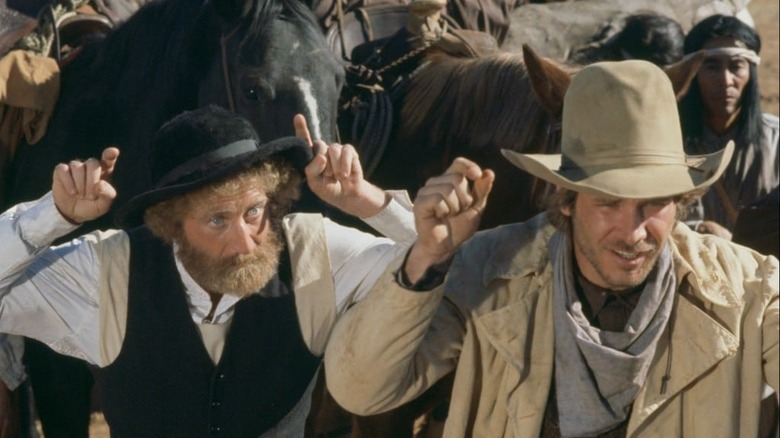
The plot here revolves around a rabbi, Avram Belinski (Wilder), who has arrived in Philadelphia in the 1800s en route to head a synagogue in San Francisco. After a series of misadventures, including a side quest with a group of Amish people, he meets and befriends a bank robber, Tommy Lillard (Harrison Ford), who takes pity on him, and the two have a few Old West adventures of their own, including Avram being taken captive by Native Americans.

"The Frisco Kid" isn't quite the satirical laughfest that "Blazing Saddles" is, it's actually a bit more heartfelt in the end. Directed by Hollywood Heavyweight Robert Aldrich, it has a tone that Wilder himself coined "Young Frankenstein meets The Dirty Dozen." It certainly has its own charms that are worth taking a gander at.

9. Start The Revolution Without Me

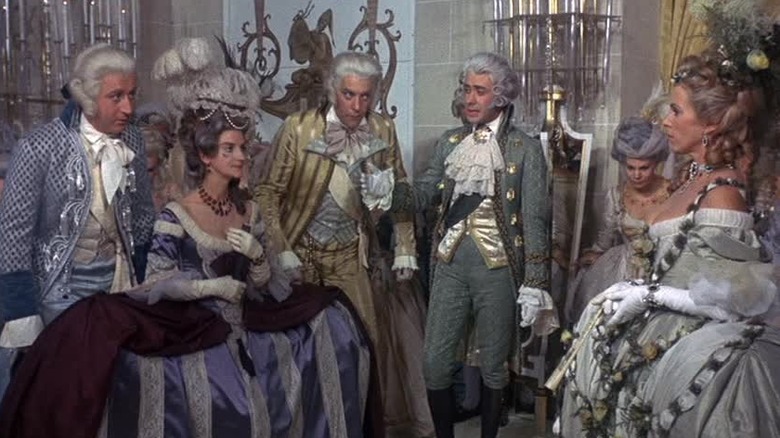
The aforementioned "Young Frankenstein" and "Blazing Saddles" may have inspired some of Wilder's other films, but "Start the Revolution Without Me" (1970) may have actually helped inspire them. Directed by Bud Yorkin, this satirical comedy skewers aristocratic society in the time of the French Revolution with a delightfully funny tale of mismatched twins.

Gene Wilder and Donald Sutherland star as Phillipe and Pierre Disisi, a pair of stuffy identical twins born into aristocracy. They also star as Claude and Charles, a pair of twins who are peasants. When the two sets of twins end up swapping places with each other, hilarity follows.

"Start the Revolution Without Me" satirizes not only the aristocracy of that time period, but the period as a whole. At the same time, it also pokes fun at the big-budget period costume dramas of the Hollywood of yore. While the film itself was a box office flop, it has since achieved a level of cult status. Ironically, Wilder himself panned it, once calling it " a great movie that didn't quite come off."

8. See No Evil, Hear No Evil

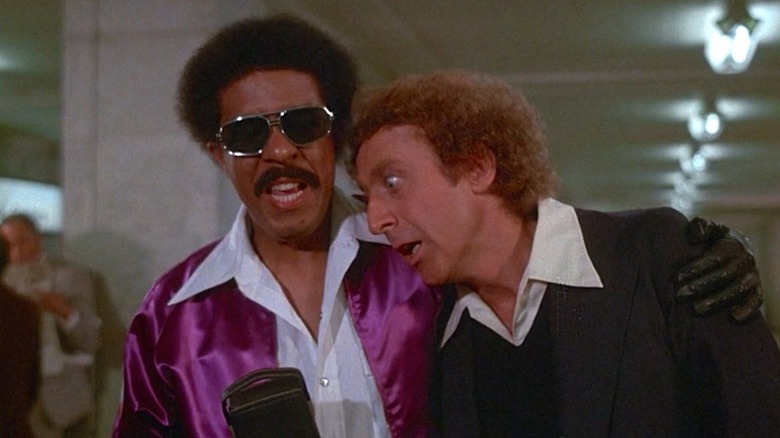
"See No Evil, Hear No Evil" (1989) marked the third in a series of films that paired Gene Wilder with another comedy legend, Richard Pryor. It's an iconic pairing that offered the world a lot of laughs and a lot of warmth.

Pryor stars as Wally, a blind man, and Wilder as Dave, a deaf man. When Wally applies for a job at Dave's newsstand, the two men become fast friends, realizing they can help each other out in terms of filling in for the other's senses in small ways; Wally can be Dave's ears, and Dave can be Wally's eyes. This ends up coming into play in a serious way when a man is murdered at the newsstand, a crime that one of them sees, and the other hears. The police peg the murder on them, then the actual killer returns, and the men must work together to solve the crime before ending up as the next victims.

Though critics were harsh on the film, its simple, funny premise, bolstered by the generous talents of its leads, along with their on-screen chemistry, makes "See No Evil, Hear No Evil" a hilarious (albeit silly) and sweet buddy comedy.

7. Stir Crazy

The great Sidney Poitier directed Gene Wilder in not one but two films, and this one, "Stir Crazy" also marked the second film that Wilder and Richard Prior would star in together.

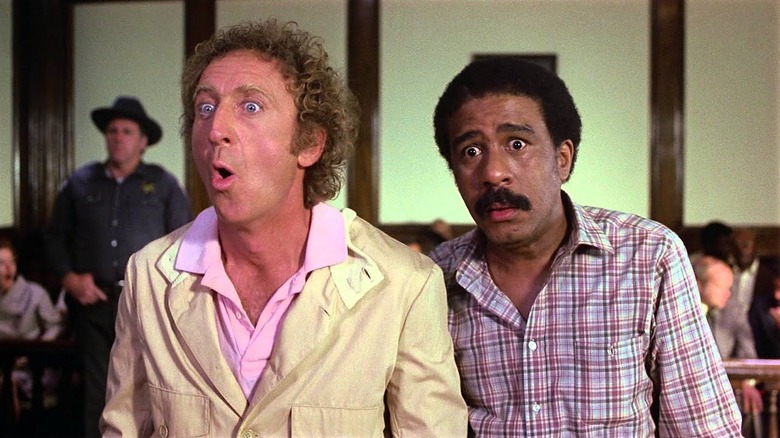
Here, Wilder stars as Skip Donahue, and Richard Pryor as Harry Monroe, two unemployed friends who become wrongfully accused of murder and sent to a maximum-security prison. There, Skip is discovered to have strong bull-riding skills, which leads the warden (Craig T. Nelson) to enter him in the annual prison rodeo. Meanwhile, Skip and Harry are planning their great escape.

"Stir Crazy" marks the peak of Prior and Wilder's work together. Though critics panned the film, the hilarious duo's on-screen chemistry and comic genius made "Stir Crazy" a box office success.

6. Silver Streak

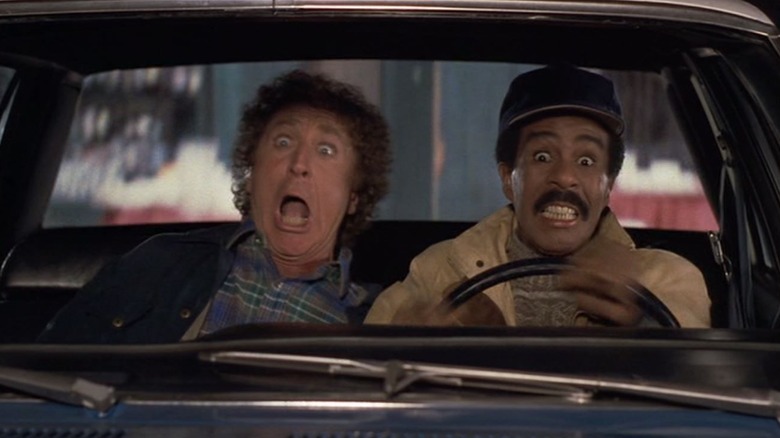
There's something about Gene Wilder that makes him the perfect foil for a murder-mystery, and here again in "Silver Streak" (1976) we have a case of a whodunnit, this time involving murder on a train. It also marks the first on screen pairing of Wilder and Richard Pryor, whose talents complimented each other so well that they would appear in four buddy comedies together.

"Silver Streak" stars Wilder as a businessman who takes a train from Chicago to LA, only to find himself the suspect in a murder that occurs during the trip. Along the way, he steals a patrol car carrying a thief, Grover T. Muldoon (Richard Pryor), and the two team up in an effort to elude the feds.

Collin Higgins, who wrote the screenplays for "Harold and Maude" and "9 to 5," penned the screenplay for "Silver Streak," for which he received a WGA nomination, while Wilder was nominated for a Golden Globe, and Pryor nominated for a New York Film Critics Circle award, respectively.

5. Bonnie And Clyde

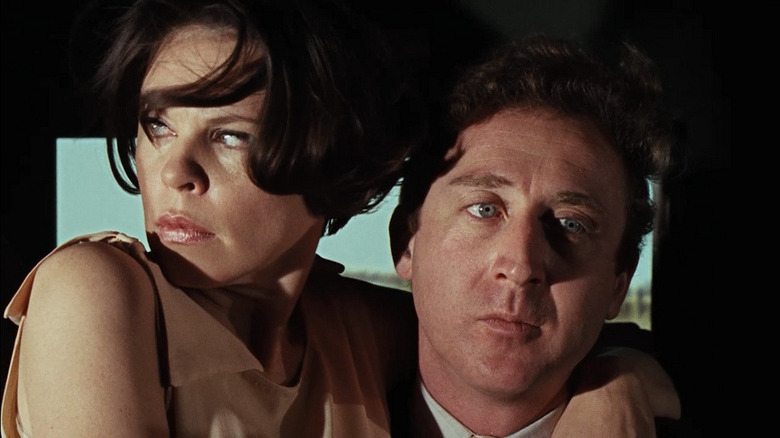
Gene Wilder's first appearance in a film was in "Bonnie and Clyde" (1967), a classic movie that ranks among his very best.

Based on the notorious real-life gangsters Clyde Barrow and Bonnie Parker, "Bonnie and Clyde" stars Warren Beatty and Faye Dunaway in the title roles, following the star-crossed couple's crime spree across the American south during The Great Depression. Their bank-robbing exploits captured the attention of the nation, as they became "public enemies" as well as celebrities.

Though Wilder's role as Eugene Grizzard, one of Bonnie and Clyde's hostages, was a small one comparatively, it was here the world first got to see his unique talent and charm. The film itself is considered a milestone in cinema. It's been called "the first modern American film" and a masterpiece.

4. Willy Wonka And The Chocolate Factory

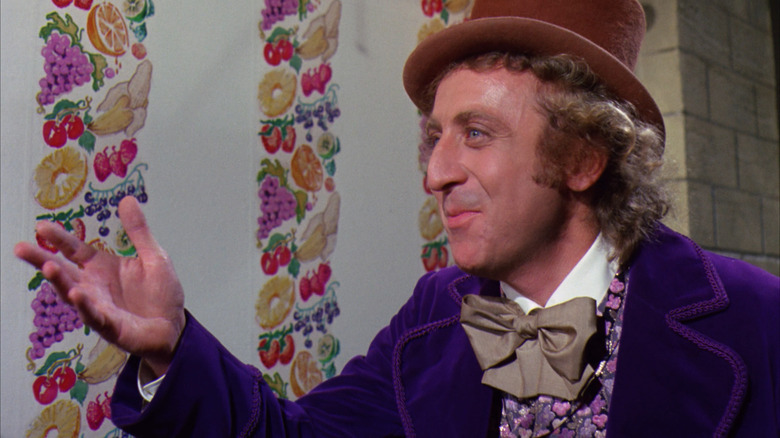
Easily Gene Wilder's most iconic role is that of the titular enigmatic candy factory owner in "Willy Wonka and the Chocolate Factory" (1971). This vividly colored, wildly imaginative, and darkly comedic adaptation of Roald Dahl's classic novel, "Charlie and the Chocolate Factory," was the perfect showcase for Wilder's unique brand of restrained but unpredictable manic energy. He imbued the role with a devilish impishness and humor, as well as heart, endearing himself to a generation of children (and adults) alike.

Peter Ostrum stars as young Charlie Bucket, who wins a coveted Golden Ticket to visit the chocolate factory. He takes his Grandpa Joe (Jack Albertson), and they are joined by other golden ticket winners such as Veruca Salt (Julie Dawn Cole), Violet Beauregarde (Denise Nickerson), and the television-obsessed Mike Teevee (Paris Themmen), but soon they are disposed of one by one in the most unusual ways.

Other stars such as Johnny Depp and soon Timothee Chalamet have stepped into the role, but we'll always remember it as Gene Wilder's.

3. The Producers

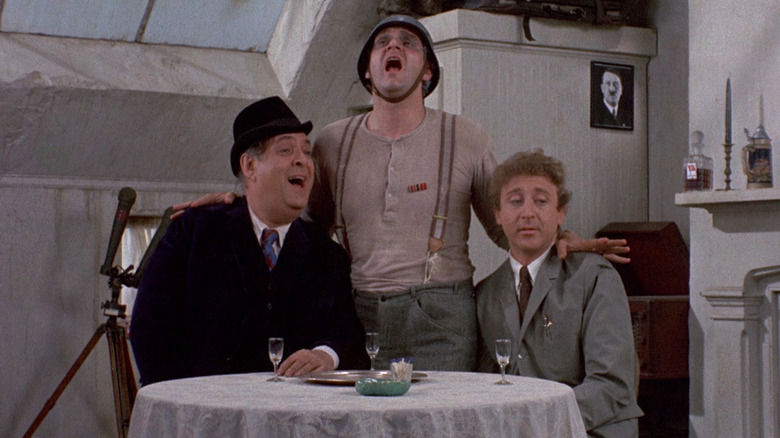
Film critic Roger Ebert called "The Producers" (1967) "one of the funniest movies ever made," and it's undoubtedly true, although the same can and has been said of all three of the classic comedies that teamed Gene Wilder with writer/director and master satirist, Mel Brooks, of which "The Producers" was the first.

Zero Mostel stars as Max Bialystock, a struggling theater producer who hires a neurotic accountant, Leo Bloom (Gene Wilder), to help cook his books. Surmising that, from a tax benefit perspective, there's more money to be made in flops than hits, they devise a plan to stage a guaranteed bomb as a way to make a fortune. Their concept? A wacky, over-the-top musical called "Springtime for Hitler." They hire a Nazi writer, a terrible director, and a hippie actor known as "LSD" for the title role. What could go right? Needless to say, madcap hilarity ensues.

Imbued with a frantic, zany energy, "The Producers" remains a boldly audacious satire, one that still feels relevant and edgy today. Though studios at the time felt it was too brazen for their slates, Brooks found an independent distributor, and ultimately won an Academy Award for his brilliantly hilarious screenplay, while Wilder was nominated for best supporting actor. Regarding the Nazi satire in the film, Brooks once said "if you stand on a soapbox and trade rhetoric with a dictator you never win ... But if you ridicule them, bring them down with laughter, they can't win. You show how crazy they are."

2. Blazing Saddles

Speaking of brazen satires, seven years after making fun of Nazis in "The Producers," Mel Brooks would re-team with Wilder for a most brazen "satire of racism," "Blazing Saddles" (1974), which parodies Hollywood Westerns and their whitewashed version of history. The subversive, over-the-top comedy is filled to its brim with gags and quotable lines, never letting up on the silliness or outrageousness for even a moment.

The plot revolves around a Black railroad worker, Bart (Cleavon Little), who is appointed Mayor of the Western town of Rock Ridge by a corrupt politician named Headley Lamarr (Harvey Korman). Lamarr believes this will lead the town to ruin, making way for a new railroad line for his own enrichment. He also sends some dimwitted thugs in to make sure things go according to plan. But Headley's plans are thwarted when Bart actually becomes popular. Teaming up with the drunkard gunslinger Jim (Wilder), aka the "Waco Kid," the two men figure out a way to save the day.

The success of "Blazing Saddles" inspired a slew of other "interracial buddy comedies," such as those that teamed Richard Pryor and Gene Wilder in the '70s and '80s. It was nominated for multiple BAFTAs and is listed at number six on the American Film Institute's "100 Years... 100 Laughs" list. Mel Brooks himself has called it "the funniest movie ever made," while also speculating that the provocative film would never be made today. It's no surprise this has become a topic of debate considering that "Blazing Saddles" can be considered "one of the most un-PC films of all."

1. Young Frankenstein

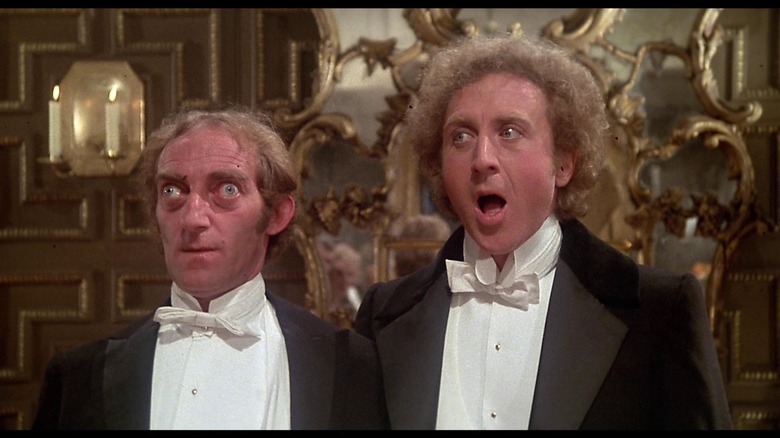
Finally we arrive at the all-time comedy classic, "Young Frankenstein" (1974), an insanely silly spoof that stars Gene Wilder as the titular Dr. Frederick Frankenstein, grandson of the infamous "Victor Frankenstein" of both novels and films.

The young Frankenstein travels to Transylvania, where he has inherited his family's estate. Upon arrival, he meets servant Igor (Marty Feldman), assistant Inga (Teri Garr), and housekeeper, Frau Blucher (Chloris Leachman). Upon discovery of his grandfather's laboratory, he decides to take up his experiments and ends up bringing his own monster (Peter Boyle) to life.

"Young Frankenstein" ended up being a perfect vehicle for Wilder to unleash some of the zaniness that he often held in for other roles. It's a side-splittingly hilarious send-up that has stood the test of time. Wilder received the second Academy Award nomination of his career for the screenplay, which he co-wrote with Brooks.

Read this next: The 15 Best '80s Comedies Ranked

The post The 15 Best Gene Wilder Movies, Ranked appeared first on /Film.

28 Jan 21:41

Saturday Morning Breakfast Cereal - Selfish

by tech@thehiveworks.com


Click here to go see the bonus panel!

Hovertext:
I am he that will have ammed!


Today's News:
28 Jan 21:39

Ubisoft think people "don't get" the thrilling benefits of NFT items

by Alice O'Connor

Ubisoft were the first huge games company to excitedly launch a line of NFTs then be told by almost everyone no, don't do that, it sucks. Well done, almost everyone! In a new interview, Ubisoft's blockchain boys have said people "don't get it".

Read more

28 Jan 17:35

Friday Fiction: My Date with Satan

by Holly

My Date with Satan coverMy Date with Satan: Stories
Richter
1999

Submitter: We are conducting a pretty thorough weeding of our adult fiction at our public library to make room for a new graphic novel section, and I found this short story collection as I made my way through the Rs. I have no idea how this “jewel” of a book survived in our collection until now.

The stories in this book are all quite bizarre, and I was disappointed to discover the jello mold on the cover does not actually appear in any of the stories themselves. The eponymous story involved a trip to a Sanrio store (apparently Satan likes Hello Kitty) and a dim sum dinner.

Holly: This story collection has the subject headings “humorous stories” and “popular culture.” Maybe it’s like a Christopher Moore type of read? Just guessing – I haven’t read the submitted title. I don’t know about anyone else’s public library, but I can name at least three patrons who would go for bizarre short stories like these. Publishers Weekly liked it too. Here’s a perfect example of “your mileage may vary.” Assuming submitter knows their community and their readers and their collection philosophy, this might certainly be an “awful library book” at their library! If nothing else, it’s funny, and sometimes we’re just after a laugh around here.

Date with Satan front flap

Date with Satan back flap

Date with Satan excerpt

Prodigy of Longing

The post Friday Fiction: My Date with Satan appeared first on Awful Library Books.

28 Jan 17:32

Anything for Me

by Reza

28 Jan 15:30

A Tennessee school district has voted to ban the Holocaust graphic novel 'Maus'

by Joe Hernandez
The comic book artist Art Spiegelman poses on March 20, 2012 in Paris. A Tennessee school district has voted to ban Spiegelman

The 10-member McMinn County School Board voted unanimously earlier this month to remove the book over foul language and an image of a nude woman.

(Image credit: Bertrand Langlois/AFP via Getty Images)

28 Jan 15:30

The teen charged in a Michigan school shooting will pursue an insanity defense

by The Associated Press
The American flag flies at half-staff on Dec. 2, 2021, outside of Oxford High School in Oxford, Mich.

A 15-year-old charged with killing four students at a Michigan high school will pursue an insanity defense as he, his parents and school officials face a new lawsuit over the November attack.

(Image credit: Jake May/The Flint Journal via AP, File)

28 Jan 15:25

A bridge in Pittsburgh collapsed on the day of Biden's planned infrastructure visit

by Rachel Treisman
Ten people were injured and at least three hospitalized after a bridge collapsed early Friday in Pittsburgh

Officials said 10 people suffered minor injuries and at least three were taken to the hospital after the collapse, which appears to have involved several vehicles and a Port Authority bus.

(Image credit: Gene J. Puskar/AP)

28 Jan 15:25

Tennessee school board bans teaching of Holocaust graphic novel Maus

The board in Tennessee objected to swear words and depictions of nude mice in the graphic novel Maus.
28 Jan 15:21

Chicago trains drive over flaming tracks

The tracks are set alight to prevent them from freezing over in snowy weather.
28 Jan 15:17

Man arrested after shooting 3 Houston police officers near Third Ward, HPD says

by Lucio Vasquez
Police say the officers were shot in the 2100 block of McGowen Street, and that the shooter fled the scene in a white Mercedes. 
28 Jan 15:13

U.S. Rep. Dan Crenshaw sends mail-in ballot applications to voters after Texas banned the practice for local election officials

by Andrew Zhang, Texas Tribune
The GOP-backed voting law — passed under the banner of ensuring election integrity — banned local election officials from sending out unsolicited mail-in ballot applications. But Crenshaw and other politicians can still do it.
28 Jan 15:06

Hello, It’s Me, the Guy Who Gets Visibly Angry at an Image of Minnie Mouse in a Pantsuit

by Andrew Nadeau

“Fox’s Jesse Watters and guest say Minnie Mouse wearing a pantsuit instead of a skirt is an attempt to ‘destroy fabrics of our society.’” — Media Matters, 1/27/22

- - -

I know, I know. You think I’m just “another conservative white male who wants to stand in the way of progress.” But that is absolutely not the case here. I mean, yes, I am a conservative white male, and I obviously hate any form of progress that does not benefit me personally, but that isn’t my motivation for this particular outrage.

Changing something as iconic as Minnie Mouse’s dress, creates a whole new set of problems. Sure, it’ll help advance the concept that women don’t need to be defined by outdated stereotypes of what is “appropriate” to wear. But there are issues in society much larger than so-called “stereotypical” symbols, and as long as those symbols remain, they only help reinforce the concept that change isn’t needed.

But those aren’t my only issues with it.

No, for me and throngs of other white, conservative men all across the nation, changing Minnie Mouse’s outfit means only one thing: We have wasted THOUSANDS of dollars and countless hours buying and making our own Hot Minnie Mouse outfits.

What, are those just obsolete now? How will my wife and I roleplay as horny Minnie Mouses (“Minnie Mice”? The community is divided over the terminology), knowing that our costumes are now canonically inaccurate?

Yes, obviously, I’m obligated to condemn anything sexually positive when I’m in public. It’s important that what I enjoy in private is not allowed to be enjoyed by anyone else. That’s kind of the entire point of a corrupt power dynamic. But I’ve got over two-dozen god damn HOT Minnie Mouse costumes in my closet right now that are essentially USELESS.

Who knows what they’ll come for next! Donald Duck? Porky Pig? As of this year, Winnie the Pooh is public domain, so the number of perverted situations I can legally put him in is INSANE. I won’t let them take that away from me.

Not to mention, I am terrible with buttons. They’re tiny and my fingers are sore from punching walls whenever I learn something is now different than the way it was in 1954. One of the biggest benefits of having a cartoon character kink is the extreme lack of pants. And even if they do have pants, the buttons on them are like Mickey’s and comically large. With this ridiculous “PC culture gone mad,” we could be seeing fully dressed mice in pants with buttons of regular size in as little as a year. It makes me sick.

I’d be drowning my sorrows by binge-eating chocolate, but I can’t even enjoy that since they made the Green M&M less sexy. And she was by far the hottest M&M. Like I’m pretty sure the red one would be down for more stuff, but the green one would be better at it, you know?

The message here is really quite simple: we need to protect the sanctity of our hottest cartoon characters.

I’m okay with progress, just as long as that progress doesn’t make me any less horny. And I know that feels like it should cover a lot of ground, but it’s important to remember that I consider helping any disenfranchised groups of people to be an absolute boner killer.

28 Jan 13:10

Chicken egg color spectrum

by Nathan Yau

Eggs aren’t always white, which is oddly calming in this photo by way of Bergs Fairytale Garden. [Thanks, all]

Tags: color, egg, physical

28 Jan 13:10

Arin vs TheOdd1sOut (by KaiPie & Emski) - Game Grumps Animated

by GameGrumps

Original Episode ► https://www.youtube.com/watch?v=emSYFq_NpYs
Animated by ► KaiPie & Emski Stay
Subscribe to KaiPie & Emski Stay ► https://www.youtube.com/user/kaipielife
https://www.youtube.com/channel/UCg8sDixlxLtRjqKGYww8fUw
KaiPie & Emski Stay Twitter ► https://twitter.com/KaiPiez
https://twitter.com/EmilyStay2
KaiPie & Emski Stay Instagram ► https://www.instagram.com/thekaipie
https://www.instagram.com/emskistay

MERCH ►► http://gamegrumps.com/merch
Support us on Patreon! ► http://patreon.com/gamegrumps
or support us by becoming a channel member! ► https://youtube.com/gamegrumps/join
Click to SUBSCRIBE ► http://bit.ly/GrumpSubscribe

*********************************************

We have NEW MERCH every other TUESDAY!

►►► http://gamegrumps.com/merch

*********************************************

FACEBOOK ► https://www.facebook.com/GameGrumps
TWITTER ► https://www.twitter.com/gamegrumps
INSTAGRAM ► https://www.instagram.com/gamegrumps/
WEBSITE ► http://gamegrumps.com

*********************************************

Game Grumps are:
Arin ► http://www.youtube.com/Egoraptor
Danny ► http://www.youtube.com/NinjaSexParty

#gamegrumps #animation #gamegrumpsanimated
28 Jan 10:22

Google relents: Legacy G Suite users will be able to migrate to free accounts

by Ron Amadeo
Google relents: Legacy G Suite users will be able to migrate to free accounts

Enlarge (credit: Jericho (modified)/Google/Ron Amadeo)

There is hope for users of Google's "legacy" free G Suite accounts. Last week, Google announced a brutal policy change—it would shut down the Google Apps accounts of users who signed up during the first several years when the service was available for free. Users who had a free G Suite account were given two options: start paying the per-user monthly fee by July 2022 or lose your account.

Naturally, this move led to a huge outcry outside (and apparently inside) Google, and now, the company seems to be backing down from most of the harsher terms of the initial announcement. First, Google is launching a survey of affected G Suite users—apparently, the company is surprised by how many people this change affected. Second, it's promising a data-migration option (including your content purchases) to a consumer account before the shutdown hits.

Google Apps (today this service is called "G Suite or Google Workspace") allows users to have a Google account with a custom domain, so your email ends in your website address rather than "@gmail.com." It's typically used for businesses. The basic tier of G Suite was free from 2006 to 2012—anyone could sign up for a Google account with a custom domain, and apparently, a lot of geeks did this for friends, families, and other non-business uses. Google stopped offering free G Suite accounts in 2012, but it was previously unthinkable that Google would go after its most enthusiastic, early-adopter users and kick them off the service. You trust Google and store a ton of data on a Google account, so the accounts are forever, right?

Read 6 remaining paragraphs | Comments

27 Jan 19:28

Tests of HIV vaccine using mRNA technology have begun

by Towleroad
486307 origin 1
Published by
AFP
486307 origin 1
Hopes of an HIV vaccine have been stirred with the success of mRNA technology, which allowed for the development of Covid-19 vaccines in record time, including one from Moderna

Washington (AFP) – Testing in humans of an HIV vaccine that uses messenger RNA technology has begun, the biotech firm Moderna and the International AIDS Vaccine Initiative said Thursday. 

This Phase 1 trial is being carried out in the United States among 56 healthy adults who are HIV negative.

Despite four decades of research, doctors have yet to develop a vaccine to protect people from the virus that causes AIDS, which kills hundreds of thousands of people around the world each year.

But hopes have been stirred with the success of mRNA technology, which allowed for the development of Covid-19 vaccines in record time, including one from Moderna.

The goal of the vaccine now being tested is to stimulate production of a kind of antibody called “broadly neutralizing antibodies,” or bnAbs, which can act against the many variants of HIV that are circulating today.

The vaccine is supposed to teach B lymphocytes, which are part of the immune system, to generate these antibodies.

In this trial, participants are injected with an immunogen — a substance that can trigger an immune response — and then a booster immunogen later.

These substances will be delivered with mRNA technology.

“The induction of bnAbs is widely considered to be a goal of HIV vaccination, and this is the first step in that process,” Moderna and the IAVI, a research organization, said in a statement.

“Further immunogens will be needed to guide the immune system on this path, but this prime-boost combination could be the first key element of an eventual HIV immunization regimen,” said David Diemert, a lead investigator at one of the four sites where the trial is being carried out, George Washington University in the US capital.

The immunogens used in this trial were developed by IAVI and the Scripps Research Institute, with support from the Bill & Melinda Gates Foundation, the US National Institute of Allergy and Infectious Diseases and Moderna.

A first trial last year tested the first immunogen but without employing mRNA technology. It showed that the desired immune response was triggered in dozens of people taking part in the research.

The next step was to bring in Moderna with its new mRNA technique.

“Given the speed with which mRNA vaccines can be produced, this platform offers a more nimble and responsive approach to vaccine design and testing,” the Moderna-IAVI statement said.

“The search for an HIV vaccine has been long and challenging, and having new tools in terms of immunogens and platforms could be the key to making rapid progress toward an urgently needed, effective HIV vaccine,” said Mark Feinberg, the CEO of IAVI.

27 Jan 19:26

World Class Tree Houses

by Mary Kelly

tree houses title page

Tree Houses
Wills
1957

This book was weeded from a local collection. The book was tired looking and was outdated and hadn’t left the shelf in decades. I was curious about the author and found out that Royal Barry Wills was an architect and was pretty influential. His work was mostly in New England and was considered to be the master of the Cape Cod style.

Considering this was geared to children, the text was more complex and instructions weren’t easy to follow. I think this is more a vanity project, given the author’s credentials. This is not to say this book doesn’t have worth. I am sure that architecture geeks would say this is worth keeping. That may be true, but it still doesn’t belong in a modern youth nonfiction collection. This is something for consideration in a specialty collection or an archive. Again, archival and preservation projects are usually outside the scope and budget of the average public library.

Collection objectives and the library mission statement are important for librarians to revisit time and again. Youth collections are for children. I doubt that most kids would care that a world class architect wrote a book about building a tree house.

Mary

TOCK

building a tree house

wood

bracing

The post World Class Tree Houses appeared first on Awful Library Books.

27 Jan 19:24

Saturday Morning Breakfast Cereal - Uncertainty

by tech@thehiveworks.com


Click here to go see the bonus panel!

Hovertext:
There's no way to *really* know if this comic is funny, so probably the best thing is to send it to other people for confirmation.


Today's News:
27 Jan 18:45

While I Was 42

by Brian Dusablon

The last time I wrote one of these was in 2017. Five years ago. Quite a bit has happened in five years, because life is a flowing river that does not slow down for any of us. Sometimes we sit on the shore and watch it all go by. Sometimes we grab a tube and some beer and float along. Sometimes we're in the kayak or raft riding the rapids. Some of this we do alone, some of this we do with a group, and some of this absolutely requires collaboration and teamwork to survive.

So, here I sit in the waning hours of my 43rd birthday with an "Atomic Habit" task of writing something to this site each day (and a nice IPA). And, for reasons I cannot explain, I decide to pick something with some oomph, depth, emotion, complexity, and a lot of words. I mean, JFDI, right?

I have spent a lot of time reflecting in the last few years. I've reviewed old blog posts, listened to old podcast episodes, and enjoyed swiping through pictures by year and by location. Our ability to use technology to go back is remarkable. It's another reminder that we live in marvelous times.

It’s scary like hell but there’s no doubt
We can’t be alive in no time but now

– Mos Def – Life in Marvelous Times

There's no point in complaining. There's no point in fearing. We just gotta go, do, read, draw, write, work, learn, listen. Because life waits for none of us. And we can't be alive in any other time.

So, here's what I've learned on my 42nd trip around the sun

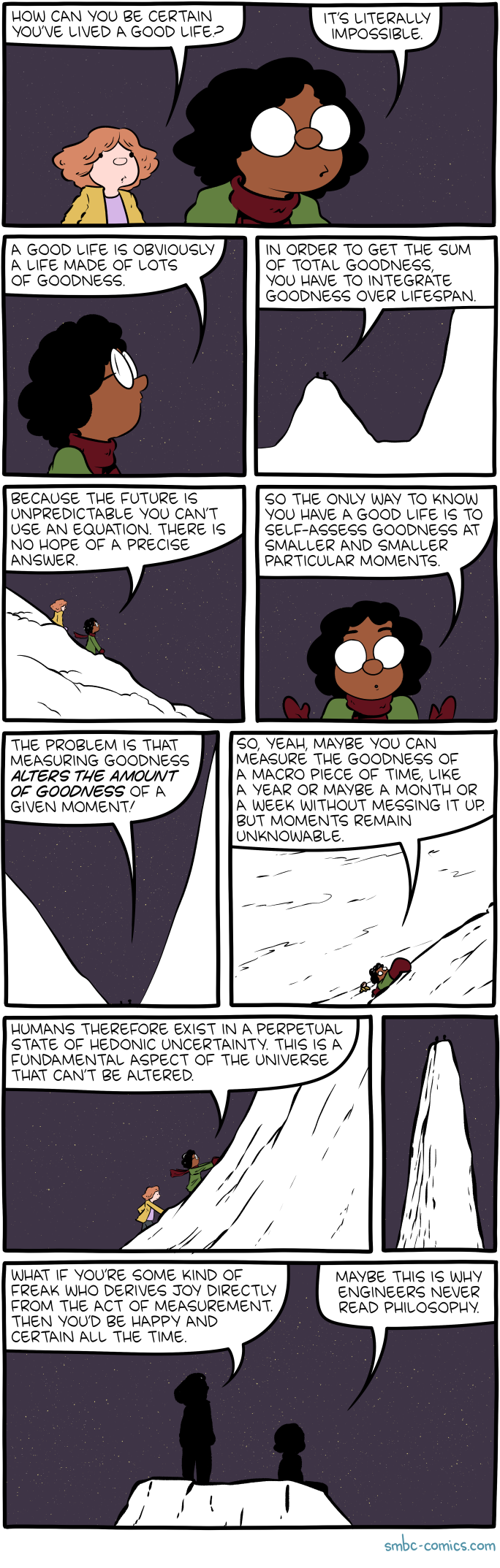
  1. I've had a good life. I feel like 43 is a good midway point for a life. 86 years would be quite a good run. It would be an honor to live that long. Shorter or longer, I've lived.
  2. Our world is amazing. And completely fucked up. We get to choose which one we focus on each day. More often than not, I choose to believe in humanity.
  3. Be present. For a time, I didn't get to see my kids very much. Now, I'm much more present in each conversation. Each moment. Put the phone down. Listen to your kids, your partner, your friend, your parent, your sibling, that stranger you met. It's worth it. Their experiences and stories? That's life.
  4. Road trips are a different kind of travel. If you're able, it's something you absolutely must try at least once. So many things happen on a road trip that don't happen in other forms of travel. You can peel off on that random road and go see that amazing natural arch or hit top speed in your minivan at the Bonneville Salt Flats. You can drive the Going-to-the-Sun road in Glacier National Park and stop as many times as you want to marvel in all it's glory. You learn a lot about your travel partners. And when you need to, you rock the fuck out. So far, the longer the road trip, the more fun I've had. 6,000 miles this summer was something I'll never forget.
  5. Just decide. Forever and ever, I've struggled to make decisions – likely due to some fear of committing to any one thing and then missing something else. Ironically, I've missed opportunities because I have not made a decision. So just pick something. Read Annie Duke's "How to Decide." Once you decide, other things will happen, new people will enter your life, and you'll have more opportunities. For instance, I finally decided to become a rugby referee and get my certification. Because of this one decision, I was paid to travel to a rugby tournament, met some new friends, fast-tracked to my level 2 certification, and was added to the list of available assistant referees for my local Major League Rugby team – all in about six months. And, I absolutely love reffing at all levels and giving back to the wonderful rugby community!
  6. Nothing lasts forever, and it's okay to move on. I left the company I founded, Learning Ninjas, this year. I was burned out, tired of the learning industry, and seeking something new. All of those things were okay. 1) You're not as important as you think. 2) Life and business move too fast for anyone to dwell on your decisions or legacy for very long. 3) The things that you built and did during a period of time can be celebrated even if you decide to go. 4) New places mean new people and new learning opportunities.
  7. We all need folks we can be vulnerable with. Last spring, I started a weekly chat group with an intention to grow it to solve big problems. It ended up being a bit of small group therapy. And it's lovely. It's human. It's intimate. It's comfortable. It's beautiful, and something I'm very thankful for.
  8. Fail. Learn. Try again. I applied to a Masters of Social Work program last year that seemed to perfectly align with what I wanted to do and a timeline I had in my head and I didn't get in. No worries! I am reapplying now and have a backup plan if I don't make it in this time. Whatever it is you're after, keep going!
  9. I love talking to people – in small settings. I started driving for Rideshare2Vote and enjoyed it so much I then applied to become a Lyft driver. That was a blast! I paused because of the Delta variant, but boy, did I have some awesome conversations. This thread will continue soon in what will become the Drifter Life podcast. Authentic, human stories are so interesting and should be shared.
  10. Blood is not thicker than water. You don't have to prioritize certain family over other family, friends, or lovers, just because they are family. And, you don't have to keep forgiving family for their transgressions just because they are blood. Humans are family. Find the ones who respect you and spend your time wisely.
  11. Make time for those you love, and take time to call them and maybe surprise them with random visits. As I mentioned above, life is short. I flew to Oregon to surprise my mom for Mother's Day this year, and had an amazing visit with her. I am pretty sure she enjoyed it, too. I am fortunate!
  12. Live music is life. Even with the pandemic, I was able to see Seth Walker, Satsang, Tim Snider, Kevin Galloway, Ian Moore, Nathan Hamilton, and Black Pumas in person this year. Every time I see a live show, I am reminded how amazing musicians are and how much fun it is to engage with them and their fans in a collective experience.

I thought about how to make this number 13, but decided to just type out exactly what I wrote this morning when I was journaling...

I walked more, played games, loved, cried, sang, yelled, danced, hiked, and enjoyed the moments. I learned a lot, heard pain in others' stories, watched terrible things happening to good people and felt useless and helpless. I've questioned my purpose and existence and wondered how the hell I got here. Mostly, though, I thanked the universe for a good, mostly healthy, and kind trip around the sun and feel good about this next one, and whatever pain, joy, trials, challenges, opportunities, and discoveries it brings.

A final note

In my reviewing of old posts, I came across this post (2011 - whoa) about Carl Sagan's Pale Blue Dot and a short film by Michael Marantz.

‘FOR ALL OUR FAILINGS, DESPITE OUR LIMITATIONS AND FALLIBILITIES, WE HUMANS ARE CAPABLE OF GREATNESS’
Earth - The Pale Blue Dot on YouTube

It's easy to be cynical. But let's not forget what we are, where we live, and how remarkable it is that we even exist. And what a bonus it is to have consciousness and independent thought. Don't waste it. Give thanks. Help others. Share joy. Be kind. Keep learning. BE GREAT.

Peace and love, y'all.

27 Jan 18:40

updates: director is so bad that everyone is leaving, and more

by Ask a Manager

This post, updates: director is so bad that everyone is leaving, and more , was originally published by Alison Green on Ask a Manager.

Here are three updates from past letter-writers.

1. Director is so bad that everyone is leaving (#3 at the link)

In the last 3 months no more people have left and we finally managed to hire on a few people to manage the overflow. The director finally hired my coworker to be the new manager and even began to listen to reason!

I was still unhappy with the way things were going so I was passively job hunting. I had a few interviews and landed a position at about a 10% bump from what I had been making and possible annual bonus of 10% of annual salary. I told my manager I was leaving and he asked me to wait before announcing anything. He got together with the director and told him point blank that I was needed and to get me to stay. I had a meeting with my manager and the director and I laid out all the reasons I was leaving (money, politics, delays, director not committing to projects). The director was really understanding and is willing to make changes for everyone’s benefit. Then they went to HR and came back with a 15% bump in pay. So, I’m staying and I’m really happy. Not just about the money but because the director was open to hearing what I had to say and is willing to improve.

2. I’m the only black person on my team and it seems to be “business as usual” this week

First off, thank you again for responding to my letter and for forwarding some very thoughtful comments from other readers my way during a time when I felt so incredibly alone. Fortunately, I no longer work for that organization. In fact, I was interviewing the same week that George Floyd was killed which was incredibly difficult and I still don’t know how I managed to get through it. I’m pretty sure I cried from exhaustion after my Zoom panel interviews.

Unfortunately, that next company didn’t work out for a variety of reasons. I was again the only POC on my team, and one of only 2 Black people at the whole company, but when I joined, I was hopeful about their DEI efforts and asked a lot about that during my interviews. It turned out to be mostly talk. The CEO was very problematic and lacked self awareness even though he liked to position his company as a leader when it comes to diversity and inclusion. At one point they announced they were going to offer a larger bonus if we referred a POC that was hired into the company. That got shut down within days thankfully due to strong negative feedback.

So now I’m at my 3rd company in 2 years which definitely isn’t ideal for me, but I’ve still managed to perform very well and gain more responsibility with this new role. While I didn’t seek this out explicitly, this company is by far more diverse than any of the previous organizations I’ve worked for. I feel very comfortable here so far and fingers crossed it stays that way.

3. How do “interim” roles work? (#5 at the link)

I was offered the job another employee had been doing under the interim title, but we weren’t able to get to an agreement about salary and benefits, so I turned the job down. (And ended up very glad I did, since I got a promotion and big raise at my job a few months later.) I saw on LinkedIn that they did eventually fill the role with a new hire, so the “interim” person did not end up in it full time.

27 Jan 14:04

Bombshell Report on One of the Many Ongoing Trump Investigations Mad Libs

by Brett Shollenberger

Breaking news tonight out of [ANY OF OUR NATION’S COURTS, JUSTICE DEPARTMENTS, OR SENATE SUBCOMMITTEES], I’m [MSNBC HOST WHO MAKES YOUR AUNT SCREAM AT THE TV].

Things aren’t looking good tonight for Donald Trump. And no, you’re not having déjà vu—because this time, it’s different. This time, we finally got him. This is, in a word, the [IDIOM THAT OVERSTATES THE IMPORTANCE OF THIS EVIDENCE].

Tonight, we have a bombshell report that reveals—for the first time—[EVIDENCE THAT 100 PERCENT HAS DEFINITELY ALREADY BEEN REVEALED]. Now, eagle-eyed viewers may wonder, “Didn’t we already know this? Wasn’t this information previously revealed by the [SCANDAL INVOLVING A TRUMP BUSINESS] or the [SCANDAL WHERE TRUMP TRIED TO COVER UP A DIFFERENT SCANDAL] or [ANY OF THE SCANDALS TRUMP WAS IMPEACHED FOR]?” You may ask yourself: “Am I going crazy?” or “Did I time travel to the future, hear this information, and then time travel back to the past without realizing it?”

But that’s where you’re wrong. Because this evidence makes Watergate look like [UNSUCCESSFUL ANALOGY].

Tonight, we’ve obtained: emails. A treasure trove of new emails between [LOYAL TRUMP ALLY] and [ESTRANGED TRUMP RELATIVE WHO’S ALWAYS HATED HIM]. Now, these emails are a veritable goldmine on the topics of [RED HERRING] and [SPECIOUS CONSPIRACY THEORY], but tonight, we’d like to focus on one particularly damning exchange in which we learn: [HIGHLY SPECIFIC NEW DETAIL THAT DOESN’T FUNDAMENTALLY CHANGE THE FACTS OF THE CASE].

Wow. Now that is a bombshell—the likes of which we haven’t seen since [THE MORNING EDITION OF THIS SHOW].

Now, some viewers at home may be thinking, “C’mon, [MSNBC HOST WHO MAKES YOUR AUNT FULLY WET]—we already have enough truly, maddeningly career-ending evidence to send Trump to prison for [NUMBER OF LIFETIMES SO BIG IT WOULD MAKE A CAT JEALOUS]. Why do you need to treat every minor revelation with the gravitas of the Saturday Night Massacre?”

Here to answer that question is legal expert [TV LAWYER WHO’S AN ACTUAL LAWYER IN THE WAY DR. PHIL’S AN ACTUAL DOCTOR]. Now, [TV LAWYER], given the facts of the case, what would typically happen in a [PHRASE THAT MEANS “FUNCTIONING DEMOCRACY,” BUT WHICH IMPLIES WE NO LONGER LIVE IN ONE]?

Fascinating. So what you just told me is: “If we were living in such a hypothetical society where democracy actually functioned, it would be hard to imagine a more compelling public interest than getting answers about [THE THING THE PRESIDENT DID THIS TIME], our justice department would be able to do [ANY ONE OF THE JOBS A JUSTICE DEPARTMENT NORMALLY DOES], and we wouldn’t be right back here tomorrow—same time, same place—presenting minor revelations using words like ‘smoking gun’ in a desperate attempt to gain the attention of a social-media addicted public, whose opinion, for some reason, the DOJ needs in order to litigate the most clear-cut case of our generation?”

Well, you heard it here first, folks, Donald Trump is going to prison.

27 Jan 12:59

a great job working for someone I can’t stand, coworker is on reality TV, and more

by Ask a Manager

This post, a great job working for someone I can’t stand, coworker is on reality TV, and more , was originally published by Alison Green on Ask a Manager.

It’s five answers to five questions. Here we go…

1. Should I take a great job working for someone I can’t stand?

There’s a job opening up at my company that is a more specialist position compared to what I’m currently doing. While my company pays below industry standard for this position, it’s something that I would be interested in and think good at, and more importantly the industry average is about double what I currently make, up to triple.

Normally I would jump at the opportunity and hope that they hire me, but there’s a catch. I can’t stand the guy who manages this role. He’s a crap boss, and he’s also unbearable — he’s not abusive as far as I can tell, but everything he does puts me into bitch eating crackers mode. I’m not an angry person, and it’s hard to annoy me, but he definitely makes me the worst version of myself and I currently don’t deal with him much.

I would only need to put up with his grandstanding, name-dropping, undermining, oversharing, limelight-stealing ways for two years or so before I could start applying for jobs that page the industry minimum, and it would be a huge step up for me … but the additional pay for that two years wouldn’t be much more than what I’m on. For what it’s worth, I like my current job, but don’t know if there’s much of a future in it. Is there a rule of thumb for this type of dilemma?

Two years is a really long time to be managed by someone you can’t stand! You’re talking about a huge impact on your quality of life for a substantial period of time. (I was going to suggest thinking back to two years ago from today to realize how long a period of time that really is, but that was January 2020 and we entered a time warp right after that, so that probably doesn’t work.) (But what if this guy had been your boss throughout the whole pandemic? Maybe that’s a better way to do it.) (I know those are the same. That’s the time warp.)

I’d also worry that he makes you the worst version of yourself! If other people observe that, taking the job could end up doing you more professional harm than good.

I’d only seriously consider it if you can figure out a way to reframe the way you see him. You don’t need to embrace having him as a boss, but if you’re feeling active dread, I’d be very wary of doing it.

2. My coworker is on a reality TV show

I recently started a new job and it’s been great so far: cool projects, an exciting work environment, and supportive coworkers. One coworker in particular happens to be on a popular reality TV show for which I’ve seen every single episode.

Is it unprofessional to talk to them about it? Ask about it? Mention it, even? As a reality TV superfan, this is the type of situation straight out of TV, but this is also a real person whose reality is documented for millions of people as entertainment (myself included). How do I navigate our work relationship in a transparent yet professional manner?

The best thing you can do is to relate to them only as a coworker, not as a fan. They — and others around them — will appreciate you treating them just as a normal person. Keep in mind that (a) fans probably approach them a lot, (b) it undoubtedly gets exhausting to deal with that when they’re trying to do a totally unrelated job, and (c) you want them to see you as a colleague they can trust, not as a fan who might see them through the warped lens of the show (and who might do things like report on them to other fans). Playing it cool is the best move.

3. Is it weird to have my video on if everyone else’s is off?

Recently, I started a remote role that works with a global team. In this new position, I manage incident response and ongoing programs, but other employees don’t report to me. I have experience in this type of role and in the past have relied heavily on my ability to develop relationships at all levels of an organization to hit my quarterly goals.

Is it weird to turn my camera on for meetings (if I’m leading them) if company culture means everyone keeps their cameras off? I would never ask others to turn cameras on, but 1) I hope that seeing me will in some way help them get to know me or at least remember me and 2) maybe it would inspire others to turn their cameras on as well?

I feel so disconnected from not seeing people’s faces and body language when I’m talking to them! I’m concerned about how this affects my ability to have working relationships with my coworkers and move forward in my new role.

Remote work at my past organization strongly suggested cameras turned on and I’m used to running meetings where there are many people on, but only a few with cameras live. So this is something I would be comfortable with. I just don’t know if it would seem completely tone-deaf.

If your only interest was in letting people see you when you’re facilitating, I’d say go for it — you could even explain at the outset that that’s what you’re doing and that others don’t need to turn their own cameras on if they prefer not to. But since part of your motivation is a hope that other people will follow suit, I’m leaning more toward no, don’t do it.

The thing is, there are a ton of good reasons people might prefer to have their camera off, from bandwidth issues (especially if they have a spouse working remotely too or a kid doing school virtually; turning video on could mess up the connection for others in their house) to privacy (not everyone wants their coworkers peering into their homes and not everyone who’s remote right now has a dedicated home office space) to other household members’ privacy (kids they don’t want on camera or a spouse or roommate nearby) to general video fatigue (research shows video meetings are more draining than ones without video).

That doesn’t mean there aren’t advantages to video (there can be) or times when it’s especially helpful (there are), but you’re in a culture that doesn’t use it. Given how many good reasons people can have for that, I wouldn’t push back too hard on it.

4. Was I fired over not finishing the rolls?

I volunteered to make rolls for a catering event at work and went in on a day that was I not scheduled to work to make the last 30 rolls, on a Saturday. My boss yelled at me because they were a little smaller than normal. I work six days a week and these were the first two days in a row I was not on the schedule to work. Well, the argument got personal to the point that I had to stand my ground. I asked the cook who was there to please finish the rolls. It was during a slow time, and I went home. Where I live, phone service sucks, but apparently my boss had a coworker call me to leave a message saying that if I didn’t come back to finish the rolls, “don’t come back.” Am I fired or did I quit?

Assuming you didn’t go back to finish the rolls, I’d say you were fired. Your boss threatened to fire you if you didn’t return and you didn’t return … hence, fired. (Although has there been any interaction since then? It’s possible that you could have a conversation with them now that would make them retract the firing, if you wanted that.)

But if you’d prefer that it be seen as quitting, there’s an argument for that too. It’s accurate to say that you chose not to return after being mistreated, and you could certainly frame it that way to anyone who asks.

5. Is my reply to LinkedIn requests too aggressive?

I get a lot of LinkedIn requests (as I’m sure a lot of people do). Two-thirds of the time they are from people I don’t know and there is no note attached. When that happens, I send a standard response that goes like this: “Hi Fergus! Thanks for requesting my connection. I don’t believe we’ve met in person (I’m sorry if I’m mistaken). Could you tell me a bit more about yourself and what you’re looking for on LinkedIn through our connection? Thanks!”

I think it’s pretty friendly and to the point: Who are you and why are you trying to connect? Most of the time I get a good response, but it seems that some people are really taken aback by the response. Some have even apologized for offending me.

Is that really that aggressive of a note? Is there a better way to word my response? Or should I just not overthink it and continue as is?

Your note is fine! The subtext is definitely “I’m not going to connect with you without good reason, so you should tell me those reasons” — but that’s not an unreasonable thing to ask. I suspect that the people who are occasionally taken aback just use LinkedIn differently than you do — some people will connect with any and all people who look interesting or useful while others mostly just connect with people they know, and sometimes each group is mildly confused by the other.

27 Jan 12:52

I WONDER IF JUSTICE WILL PREVAIL!

by noreply@blogger.com (JerryMaguire)
27 Jan 12:51

Saturday Morning Breakfast Cereal - Job

by tech@thehiveworks.com


Click here to go see the bonus panel!

Hovertext:
Now is the job market in which to try this. Be a legend.


Today's News:
27 Jan 12:50

Spotify says it will remove Neil Young’s music instead of dropping Joe Rogan

by Jon Brodkin
Neil Young playing guitar on stage.

Enlarge / Neil Young performs at FirstMerit Bank Pavilion at Northerly Island during Farm Aid 30 on September 19, 2015, in Chicago, Illinois. (credit: Getty Images | Raymond Boyd)

With Neil Young having told Spotify that it can keep him or podcaster Joe Rogan but not both, the streaming company today said it will remove Young's catalog of music.

"We want all the world's music and audio content to be available to Spotify users," Spotify said in a statement to Deadline and other media organizations. "With that comes great responsibility in balancing both safety for listeners and freedom for creators. We have detailed content policies in place, and we've removed over 20,000 podcast episodes related to COVID since the start of the pandemic. We regret Neil's decision to remove his music from Spotify but hope to welcome him back soon."

Young's music was still on Spotify as of this writing but will presumably be removed soon unless either Young or Spotify change their minds. Objecting to misinformation about COVID aired on Rogan's podcast, Young told Warner Records this week that Spotify "has a responsibility to mitigate the spread of misinformation on its platform."

Read 6 remaining paragraphs | Comments

27 Jan 05:10

Why Do Eggs Come in Different Colors (and How Much Does It Matter)?

by A.A. Newton

If you eat chicken eggs, you probably have a shell color preference for reasons you can’t explain. Some people only buy brown eggs because they believe they’re “healthier” or more “natural” than white—but is that based on anything more than marketing? What makes an egg white, brown, green, blue, or pink, and does it…

Read more...

27 Jan 05:02

Photo