“This and That” is an occasional series of paired observations. See past “This and That” posts here. – Ed.
Today: Horse costumes
Installation view at SUNNY NY of Andrea McGinty’s “Horse,” 2021, horse costume, mannequin, boot, socks, cat litter container, flag pole, yellow jacket, laundry detergent container, concrete, 73 x 27 x 60 inches. Image via the artist’s website.
Andrea McGinty, “Horse” (detail), 2021, horse costume, mannequin, boot, socks, cat litter container, flag pole, yellow jacket, laundry detergent container, concrete, 73 x 27 x 60 inches. Image via the artist’s website.
*************
No matter how original, innovative or crazy your idea, someone else is also working on that idea. Furthermore, they are using notation very similar to yours. – Bruce J. MacLennan
John Wesley. Photo: Todd Heisler, The New York Times
John Wesley, the New York-based painter with connections to Texas, died February 10, 2022 at the age of 93.
Known for its flat, graphic style featuring a pastel palette of pinks, blues, and greens, Mr. Wesley’s work was unique and did not fit tidily into the categories often used to define art. Though sometimes grouped with the Pop Art or Minimalist movements, Mr. Wesley felt both terms were reductive. Though the style of his work shares similarities with both Pop Art and Minimalism, its content might best be described as surreal. Many of Mr. Wesley’s paintings took on dream-like themes and incorporated unexpected juxtapositions; he may be best known for his eroticized images of female nudes.
John Wesley, “Dream of Frogs,” 1965, acrylic on canvas, 37 x 58 inches. Image: Fredericks & Freiser Gallery
Mr. Wesley was born in 1928 in Los Angeles and had a traumatic childhood experience that he would associate with his propensity to be a loner. At the age of five, he found his father, who had died of a stroke, on the bathroom floor of their family home. Following his father’s death, he spent a year in an orphanage until his mother remarried and reunited with him.
As a young adult, Mr. Wesley worked as an illustrator, transforming aeronautic blueprints into simple drawings. In the early 1960s, he moved to New York where he worked at the Post Office. Both of these career experiences would shape his artistic style. Some of his early paintings even utilized design motifs from stamps and his post office badge.
In 1963, Mr. Wesley had his first solo exhibition at The Robert Elkon Gallery (currently The Elkon Gallery). This proved to be a turning point for the young artist, as Donald Judd would review the show in the April issue of Arts Magazine. Mr. Judd wrote of Mr. Wesley’s early works, “Wesley’s paintings, if they are pop art, are retroactive pop… Most of the forms are nineteenth-century. The forms selected, the shapes to which they are unobtrusively altered, the order used and the small details are humorous and goofy. This becomes a cool, psychological oddness.”
Mr. Wesley continued his relationships with both The Robert Elkon Gallery and Mr. Judd. In 1983, Mr. Judd invited the artist to visit him in Marfa. During that visit, Mr. Wesley completed a series of paintings that became the start to Chinati’s collection of his work. Over the coming decades, Mr. Wesley would continue to visit Mr. Judd and create new works. In 2004, The John Wesley Gallery, a permanent exhibition space, was created in a former horse stable on Chinati’s campus. The organization maintains a collection of Mr. Wesley’s work which spans from 1963 to present day. The collection is rotated occasionally (most recently in 2019) and includes paintings, works on paper, and prints.
Ingrid Schaffner, Curator at The Chinati Foundation, told Glasstire, “With sadness, we mark the passing of artist John Wesley by paying tribute to his work and the friendship that he and Donald Judd shared. Judd collected Wesley’s art in depth and, in 1989, Wesley was Chinati’s first Artist in Residence. For visitors today, the John Wesley Gallery is often one of the most baffling permanent installations; people don’t expect to see figurative paintings (especially such humous ones) at Chinati. But it’s exactly Judd’s vision that makes the rigor of the limited palette and concise line as beautifully apparent as the incomparable specificity of John Wesley’s art.”
Throughout Mr. Wesley’s six-decade career in the arts, he exhibited nationally and internationally, including exhibitions at MoMA PS1 (2000), Stedelijk Museum (Amsterdam, 1993), Krefeld Kunstmuseum (Germany, 2005), and Fondazione Prada (2009). He also received a Guggenheim Fellowship (1976), a National Endowment for the Arts grant (1989), and the Skowhegan Medal for Artistic Achievement in Painting from Skowhegan School of Painting and Sculpture in Maine (2006).
“The Gallery at UTA is honored to host the exhibition and welcome Mel Chin, a world-renowned conceptual artist who utilizes painting, sculpture, film, drawing, collage, as well as and other creative media to address complex social and political issues facing contemporary society. This solo exhibition includes twenty works ranging in date from 1988 through 2022. ”
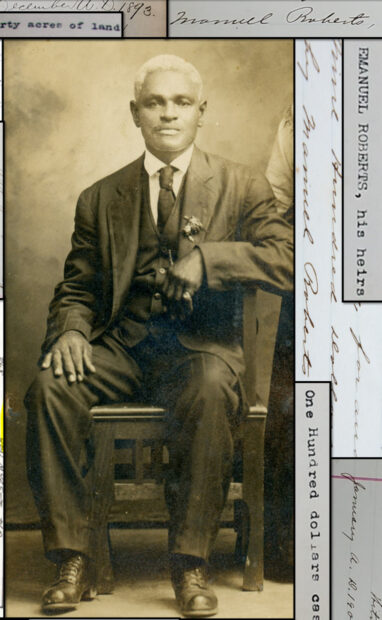
April Frazier, “Photo collage made by my Grandmother Henrietta,” Wharton, Tx, courtesy of the artist.
From the Houston Museum of African American Culture:
“The installation is the artist’s photographic journey through time; her reflection on memories and experiences from her family history. With photographs from as early as 1890 to the present, Frame of Reference serves as recognition of the sacrifice and overarching love shown over time that is at the foundation of black families’ accomplishments and survival.”
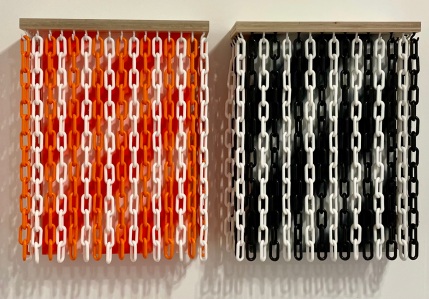
Vinchen, “all+mine+-+all+the+time+-+for+all+time.” Image: Mass Gallery
“Vinchen’s lumpen objects is a sampling of sculptural objects that will inhabit the yard at MASS. These sculptures, comprised mostly from abandoned materials salvaged by the artist and reframed into forms that question waste, disparity, and excess.”
Christopher Paul Dean, “Obstruction Objects.” Image: b-space art house.
4. Building Dreams
b-space art house (New Braunfels)
January 22 – March 5, 2022
From b-space art house:
“Building Dreams, a group exhibition, highlights the works of seven contemporary Texas artists including Christopher Paul Dean, Joshua Duttweiler, Thomas Flynn II, Shelley Hampe, Aaron Hollingsworth, Elvia Perrin, and Dallas Smith. The show presents a variety of media including painting, sculpture, prints, and installation.
The dynamics between the artists’ various approaches provoke ideas found in a relationship between the built and natural environments and in human reaction to societal constructs. Architectural references from urban to domestic scales can be found whether it be through the subject matter, materials used, formal characteristics, or how the work engages with the gallery space.”
“Artist Statement: My practice is focused on the idea of life as an unavoidable journey through which persons and societies are forced to travel. For me, the journey begins with suffering, seen as a sort of storm: a wrenching out of the common through a series of events, active or passive, which create a puncture in what is in order to open space for what could be.”
The Woman’s Guide to Boating & Cooking
Morgan
1974
Submitter: Ahoy ye landlubbers! This book floated across my desk this week and I thought to submit it to you. The condition is what landed it on my little island of a desk. There are some very practical items in the book, like knot tying and sailing information. However, it’s buoyed by its dated ideology. Enjoy the scans before this one is cast off to the recycling bin.
Holly: Fashion, interior design, cooking, “boatkeeping,” and potato wine. Women can have it all…on a boat, no less!
Second Sight left users of its retinal implants in the dark. IEEE Spectrum reports: Barbara Campbell was walking through a New York City subway station during rush hour when her world abruptly went dark. For four years, Campbell had been using a high-tech implant in her left eye that gave her a crude kind of bionic vision, partially compensating for the genetic disease that had rendered her completely blind in her 30s. "I remember exactly where I was: I was switching from the 6 train to the F train," Campbell tells IEEE Spectrum. "I was about to go down the stairs, and all of a sudden I heard a little 'beep, beep, beep' sound." It wasn't her phone battery running out. It was her Argus II retinal implant system powering down. The patches of light and dark that she'd been able to see with the implant's help vanished.
Terry Byland is the only person to have received this kind of implant in both eyes. He got the first-generation Argus I implant, made by the company Second Sight Medical Products, in his right eye in 2004 and the subsequent Argus II implant in his left 11 years later. He helped the company test the technology, spoke to the press movingly about his experiences, and even met Stevie Wonder at a conference. "[I] went from being just a person that was doing the testing to being a spokesman," he remembers. Yet in 2020, Byland had to find out secondhand that the company had abandoned the technology and was on the verge of going bankrupt. While his two-implant system is still working, he doesn't know how long that will be the case. "As long as nothing goes wrong, I'm fine," he says. "But if something does go wrong with it, well, I'm screwed. Because there's no way of getting it fixed."
Ross Doerr, another Second Sight patient, doesn't mince words: "It is fantastic technology and a lousy company," he says. He received an implant in one eye in 2019 and remembers seeing the shining lights of Christmas trees that holiday season. He was thrilled to learn in early 2020 that he was eligible for software upgrades that could further improve his vision. Yet in the early months of the COVID-19 pandemic, he heard troubling rumors about the company and called his Second Sight vision-rehab therapist. "She said, âWell, funny you should call. We all just got laid off,'" he remembers. "She said, 'By the way, you're not getting your upgrades.'" These three patients, and more than 350 other blind people around the world with Second Sight's implants in their eyes, find themselves in a world in which the technology that transformed their lives is just another obsolete gadget. One technical hiccup, one broken wire, and they lose their artificial vision, possibly forever.
What makes the perfect gaming setup? Traditionally, the biggest, best TV for consoles, paired with an ultra-sharp, high-refresh-rate monitor for your PC. For retro gamers, the CRT is the holy grail, perfect for playing classics from the SNES and Genesis. But what about the games in the middle—the not-quite retro but…
On our current web, most platforms are controlled by a central authority—a company, government, or individual—that maintains the code, data and servers. Ultimately, consumers must trust that those central authorities will do what is in their best interest.
“In order to have ease of use, we have ceded control to these big platforms, and they manage our access to information, our privacy, our security, and our data,” explained Wendy Hanamura, Director of Partnerships at the Internet Archive, who led the workshop.
In contrast, the decentralized web is built on peer-to-peer technologies. Users could conceivably own their data. Rather than relying on a few dominant platforms, you could potentially store and share information across many nodes, addressing concerns about censorship, persistence and privacy.
“It is still very early days for the decentralized web,” Hanamura said. “All of us still have time to contribute and to influence where this technology goes.”
At the event, Mai Ishikawa Sutton, founder & editor at COMPOST Mag, explained how her publication can be viewed over the decentralized web using IPFS and Hypercore, while using Creative Commons licensing to openly share its contents. In addition, Paul Frazee demonstrated Beaker Browser, an experimental browser that allows users to build peer-to-peer websites on the decentralized web.
Using the current system, Web 2.0, relies on content living on web servers in a certain location.
“This is a problem because [publishers] want to change it. They want to update it. They … go out of business. They want to merge with somebody. And it goes away,” said Brewster Kahle, founder of the Internet Archive, noting that the average life of a web page is 100 days. The Wayback Machine was built to back up those web pages after-the-fact, but there is a need to build better decentralized technology that preserves a copy as the content is created, he said. “The Web should have a time axis.”
According to Kahle, in the future a decentralized web would look much the same to the user, but could build features such as privacy, resilience and persistence right into the code. It could also create new revenue models for creative works. For example, a decentralized web could enable buyers to make direct micropayments to creators rather than licensing them through iTunes or Amazon.
“This is a good time for us to try to make sure we guide this technology toward something we actually want to use,” Kahle said. “It’s an exciting time. We in the library world should keep focused on trying to make robust information resources available and make it so people see things in context. We want a game with many winners so we don’t end up with just one or two large corporations or publishers controlling what it is we see.”
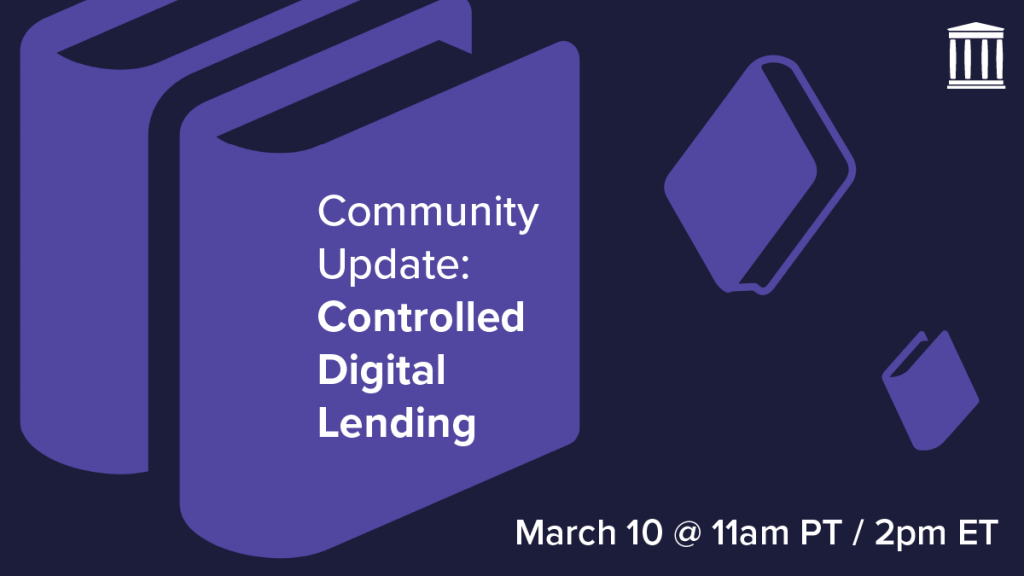
From the hundreds of libraries using Controlled Digital Lending (CDL) to meet the needs of their communities to the many working groups and vendors investigating its potential, it’s clear that this innovative library practice is on the rise.
Want to learn more about what’s going on across the community? Join us for a public webinar at 11am PT on March 10 to hear from active projects, including:
Controlled Digital Lending Implementers group;
NISO’s grant from The Mellon Foundation to support the development of a consensus standards framework for implementing CDL;
Boston Library Consortium’s efforts around CDL for interlibrary loan;
CDL Co-Op (ILL & resource sharing);
Internet Archive, with an update on the publisher’s lawsuit against CDL & libraries;
Presentations will be followed by a facilitated Q&A. Whether you are new to Controlled Digital Lending or have already implemented it in your library, this session will give everyone an update on where the community is today & where it’s going.
Community Update: Controlled Digital Lending March 10 @ 11am PT / 2pm ET – Register
According to a new study, the epidemic of drug-resistant pathogens is worse than researchers previously thought. | Clare Jackson/EyeEm via Getty Images
Antibiotic resistance is approaching a crisis point, and the world needs to act.
Two years ago, the CDC made a disturbing prediction: Without radical change to antibiotic use practices, drug-resistant pathogens,which at that point were estimated to cause 700,000 deaths globally every year,couldkill 10 million people per year by 2050.
A recent report published in TheLancet, however, found that the toll from antibiotic resistance is worsening even faster than expected.
Last month’s Global Research on Antimicrobial Resistance (GRAM) project report estimates that, in 2019, about 1.27 million people died directly due to antimicrobial resistance (AMR), which means cases where the patient wouldn’t have died had their infection been treatable with standard antibiotics. The total rises to 4.95 million deaths once fatalities associatedwith a drug-resistant infection, meaning that a patient died while having an identified antibiotic-resistant infection but it wasn’t clearly the immediate cause of death, are also included.
The report includes data on 23 pathogens and 88 pathogen-drug combinations in 204 countries and territories in 2019, with statistical modeling used to produce estimates for regions missing data.
The new numbers means that AMR is now among the leading causes of death worldwide, exceeding the toll of HIV/AIDS and malaria (864,000 and 643,000 deaths in 2019 respectively, according to the Lancet’s Global Burden of Disease study).HIV research attracts close to $50 billion per year in funding, but as Ramanan Laxminarayan of the Center for Disease Dynamics, Economics and Policy noted in a commentary published along with the Lancet study, “global spending on addressing AMR is probably much lower than that.”
In the last century, antibiotics have revolutionized medicine, massively cutting down mortality from common infectious diseases, while drastically improving the safety of major surgery and recovery rates from trauma. By one estimate, antibiotics have extended average human life expectancy by more than 20 years since their discovery over a century ago.
But the overuse of antibiotics, whether in human patients or in livestock, results in bacteria adapting to the drugs, leading them to become less effective over time. If the pace of resistance isn’t halted — whether through more judicious use of the drugs or through the development of new classes of antibiotics — it will likely lead to soaring deaths from common infections and surgical complications, sending us back to a world where a minor cut could potentially once again be lethal.
We can avoid this fate, but it will require coordinating a global response before it’s too late.
Antibiotic resistance, explained
Antibiotics are drugs that kill or prevent reproduction of disease-causing bacteria, without directly harming the patient’s cells. The invention of the first antibiotics changed everything, offering nothing short of a miraculous cure for severe pneumonia or wound infections that might have otherwise left patients dead.
But due to their ability to rapidly reproduce — staphylococcus, for example, can double every two hours when colonizing the human nose — and to directly exchange fragments of genetic code, bacterial pathogens evolve far more rapidly than multicellular organisms like humans. When a mutation arises that conveys resistance to an antibiotic, a large population of resistant pathogens can rapidly result, and the mutation can then be shared with other lineages of pathogen if they come into contact with each other.
Every time a patient is treated with antibiotics while a given pathogen is present, it’s a roll of the dice for a new resistance mutation to emerge. This isn’t just for human patients; the use of antibiotics for disease prevention and faster growth of livestock, which accounts for two-thirds of the total medically important antibiotics sold by weight in the US, is also a major contributor to AMR.
Resistance can develop with remarkable speed. Methicillin-resistant staphylococcus aureus, or MRSA, was first documented in 1961, just one year after the antibiotic methicillin was introduced. MRSA is actually something of a misnomer, as the pathogen is resistant to two major classes of antibiotics, penicillins and cephalosporins.
The first outbreak was documented in a Boston hospital in 1968, and for several decades most MRSA infections were seen in hospitals or other health care settings. However, by the early 2000s, community-acquired cases were rising even as hospital spread decreased. In 2019, according to the Lancet report, MRSA directly caused more than 100,000 deaths.
Resistance is the inevitable result of using antibiotics. The best we can hope for is to delay it, mitigate the consequences, and buy time for the development of new antibiotics that bacteria haven’t yet evolved resistance to.
How to resist antibiotic resistance
The Lancet study identifies three ways to slow the march of antibiotic resistance: more selective use of antibiotics, tighter infection control measures, and rapid investment in new treatments.
While the best practices for antibiotic usage in medicine are well established, they’re not always followed. Antibiotics are only effective against bacterial infections — meaning they’ll do nothing for a viral illness like influenza — and should be given only when medically necessary for an identified bacterial infection. However, a 2016 study estimates that 30 percent of the antibiotic prescriptions given in clinic visits are unnecessary.
Treatment should always start with the most narrow-spectrum antibiotic, saving for later the “big guns” — broad spectrum antibiotics, which are important to keep in reserve so they remain effective with the sickest patients, as well as newer drugs with less established resistance. Once treatment is started, it’s important for patients to finish the full course; incomplete treatment can result in a surviving population of the disease pathogen, selected for resistance, which can then infect others and spread.
Cutting down on the use of antibiotics in farming is also essential. The low-dose, prolonged regimens given to increase the rate of growth in farm animals creates ideal conditions for pathogens to evolve resistant strains, at which point these pathogens can spread to affect humans. Denmark has been a world leader here, drastically restricting non-therapeutic use of antibiotics in healthy animals solely for disease prevention and faster weight gain, but the US has yet to follow suit.
Preventing the transmission of infections within hospitals is also an essential measure to minimize the death toll from resistant bacteria; hospital-acquired infections are a major concern, with an estimated 650,000 cases annually in the US alone, and drug-resistant pathogens are much harder to treat, so maintaining isolation measures and the appropriate use of protective equipment is key.
One complication is that patients can be asymptomatic carriers without being sick, unknowingly spreading resistant bacteria. US hospitals will often test all newly admitted patients for MRSA and vancomycin-resistant enterococcus (VRE), two of the most common community-transmitted antibiotic resistant pathogens, so that carriers can be isolated from patients at risk of severe illness.
This means that reliable testing and data collection is essential to keep track of and slow the spread of resistant bacteria. That’s a particular challenge for lower-income countries; they lack the resources to test and screen patients as reliably, and they often have a shortage of and sanitation supplies. Those failings matter for rich countries as well — a globalized world means that novel resistant pathogens anywhere will present a risk elsewhere.
These control measures can buy time for pharmaceutical research companies to invest in developing new generations of antibiotics to replace existing treatments as pathogens acquire resistance to them. But progress on new antibiotics has been slow. Truly novel options — not simply tweaks on existing drugs — are what is most needed to stop drug-resistant pathogens, but the last entirely original class of antibiotics, lipopeptides, was discovered in the late 1980s.
Despite the desperate need, pharmaceutical companies are less incentivized to overcome the scientific, regulatory, and financial challenges involved in approving a new antibiotic — especially when the opportunity for profit is limited. Successfully developing an effective and nontoxic new antibiotic is a long and complex process; since 2014, more than half of the drugs being tested were discontinued before reaching the approval stage. According to a 2017 estimate, a single successful antibiotic costs $1.5 billion to bring to market, whereas the expected annual revenue per drug is less than $50 million per year.
Since the most powerful antibiotics are held in reserve as much as possible and then prescribed only as short-term treatment for acute infections, they bring in much less revenue than drugs for chronic conditions such as high blood pressure or Type 2 diabetes.
As Kevin Outterson, a Boston professor who studies antibiotic resistance, told my colleague Sigal Samuel, the problem is that “this is a product where we want to sell as little as possible. The ideal would be an amazing antibiotic that just sits on a shelf for decades, waiting for when we need it. That’s great for public health, but it’s a freaking disaster for a company.” Governments and other funders need to respond by implementing financial incentives for companies, funding academic research, or other significant changes to the current regulatory framework.
There is some good news on this front. The use of animal antibiotics decreased by 3 percent between 2019 and 2020, and the EU recently banned antibiotic administration to healthy animals. But this is far from enough.
Antimicrobial resistance has been a hidden epidemic, less visibly front and center than Covid-19, but the world cannot afford to wait to act until it reaches a crisis point.
Jim Pingle has announced the release of pfSense 2.6.0, the latest stable version of the project's FreeBSD-based specialist operating system for firewalls and routers. Some of the changes and new features of the release include: "IPsec VTI interface names have changed in this release, configurations will be updated....
Hyperbolica is launching on March 14th, 2022, yes that's pi day! Thank you for all your patience and continued support. This has been a wild journey for me and I can't wait for the release!
Good morning. One year ago today temperatures plunged across the region as an Arctic front moved into the Houston region. This marked the beginning of our coldest weather in decades, as ice covered roads, temperatures dropped into the low teens, and millions lost power and shivered inside their homes. It was an absolute disaster. Fortunately, we’re not going to see its like again this winter. Instead, this week, we’ll see a mix of weather, with a little bit of something for everyone.
Have a warm heart on this cold start to Valentine’s Day. (Weather Bell)
Monday
Winds are calm this morning, but will pick up from the south-southwest as high pressure shifts eastward from Houston. This will help lead to a warming trend across the region, with highs generally reaching the upper 60s this afternoon beneath mostly sunny skies. Southerly winds will be light tonight, with low temperatures dropping into the upper 40s.
Tuesday
As atmospheric moisture levels begin to rise along with the southerly flow, some patchy fog is possible on Tuesday morning. Skies will see a mix of sunshine and clouds, with highs likely reaching about 70 degrees. Winds from the south will start to become more vigorous, with some gusts up to 20 to 25 mph possible, during the afternoon hours. Overnight lows will only drop to around 60 degrees.
Wednesday
As dewpoints continue to rise in response to the warm, southerly flow, expect a decent chance of fog. An upper level system with an associated front will be stirring up the atmosphere on Wednesday. This should make for another day with a breezy southerly wind, and partly to mostly cloudy skies. Some rain is possible too, although the better chances will probably come Wednesday night as the front draws near. Storms are possible to the north of the city, with better chances near Dallas. Lows Wednesday night should only drop into the low 60s.
Storm outlook for Wednesday and Wednesday night. (NOAA)
Thursday
The rains, which will generally be light and and result in a tenth of an inch or two of accumulations, should end Thursday morning before a front blows through. This front should reach areas northwest of Houston before noon, the city itself around noon, and the coast during the afternoon. Winds will be gusty in the wake of the front, out of the north, with clearing skies. Temperatures on Thursday afternoon will drop into the 50s for most locations, and into the upper 30s by Friday morning.
Friday, Saturday, and Sunday
The weekend will be cooler, with calmer winds, and mostly sunny skies. Expect highs to reach the upper 50s on Friday, with another night of lows in the upper 30s to 40 degrees in Houston. Saturday and Sunday should both see highs in the 60s. Overall it should be a rather pleasant winter weekend. Expect a fairly robust warming trend as we get into next week, with highs reaching the upper 70s by mid-week, probably.
1. Why should we all have to celebrate the boss’s birthday?
I’m hoping you can tell me if I’m off-base to feel annoyed by something that happened at work. I work in an organization of about 20 people. One of my coworkers sent out an email to plan a surprise Zoom meeting to wish our boss a happy birthday because of “all their hard work.” The thing is, the boss isn’t great. We have lost several people because of their management style and many of us do not have a positive relationship with them. When a colleague pointed out it wasn’t a great idea given the power differential and the fact people will feel forced to participate, the colleague who dreamed it up got defensive, said it didn’t put anyone on the spot, and suggested if we weren’t kind enough to say happy birthday then we could schedule a meeting so we had a conflict. So, if we don’t like it we should lie, I guess?
It feels inappropriate and I’m not happy that I have been put in a position that I either have to participate and fake it or not participate when the boss knows I’m at work and could log in to Zoom. I fear non-participation risks retaliation (there is a history of that) and adding more friction to a relationship that is very coolly professional. Wouldn’t it be more appropriate if those who want to wish the boss a happy birthday sent their own email? Are the handful of us who raised an objection off-base? Isn’t recognizing the boss a Boss’s Day activity? For the record, we have not recognized birthdays in the office historically.
It’s not that recognizing the boss is a Boss’s Day activity (plus Boss’s Day is BS anyway). If your team normally recognized people’s birthdays this way, it would make sense to do it for the boss too, and it’s not unreasonable to expect people to fake their way through a five-minute birthday thing for a colleague if it’s a thing the office does for people generally. The issue here is singling out the boss for special appreciation simply because it’s their birthday when you don’t recognize other birthdays. That’s a gross power dynamics thing: the boss’s birthday isn’t more special just because they manage a staff and, yes, people will feel obligated to participate because the boss has control over their jobs.
Ideally you and your coworkers who object would have the clout to shut it down. If you can’t, the best move is to show up, say happy birthday, and internally roll your eyes. (Or you can opt out, of course, and if enough of you do that, it will give cover to all of you — but with a boss who has a track record of petty retaliation, it’s likely not worth it.)
2. Only some people get to work from home on snow days, even though we all could
My office is located in a metro area in Colorado. Most of the employees have a commute between 20-45 minutes on a good day. When the weather turns and the roads get messy, that can balloon into 60-90 minutes. Not counting if you have kids to run around before and after work, etc.
My boss, who lives the same distance from the office as I do, has a frequent habit of choosing to work from home whenever it snows more than a couple inches (or if she or one of her kids has an appointment, or her kids — young teens — have a day off of school, or if she’s just not feeling like coming in). A couple senior people on the team are allowed to do the same whenever they want. Everyone else (about 15 other people) are expected to physically be in the office.
And when my boss works from home, she is significantly less productive, and less responsive. Almost impossible to get ahold of, and typically works a short day, only a few hours, and then signs off early.
All of our jobs can be done from home successfully (with the proper setup and dual screens) and were for the better part of two years, but last year the company started requiring most people to come back into the office and made most everyone (except those mentioned above) return the equipment that allowed them to work from home. Those that were noisy about it had their privileges maintained regardless of seniority, role, or productivity. Is it worth raising a stink about this unfair practice?
Yes. Annoyingly, it’s not unusual for this kind of benefit to be available for senior people but no one else else and pushing back might not change that, but it’s reasonable to at least try. I wouldn’t focus on it being unfair — fairly or not, there are lots of privileges built into more senior-level jobs that aren’t available to more junior staff so that argument isn’t likely to carry a lot of sway — but rather on the fact that you’ve shown it’s doable, commutes can get unreasonably long during bad weather, and it would be a morale-boosting, retention-enhancing move at a time when they should be concerned about losing staff to more remote-friendly workplaces.
3. Getting a job offer when you couldn’t ask any questions of your own in the interview
Last month, towards the end of my job search, I was interviewing with a few different companies. I was leaning towards company A (who I ended up accepting an offer from) but was still interviewing with company B. Company B’s process started with a basic 15-minute phone screen, and then I was invited to interview with the department director (she would not have been my supervisor had I accepted). We had a short 30-minute interview and I didn’t get the opportunity to ask any questions, but was fine with that since it was the first “real” interview and a short time slot. I got invited for a second round interview, scheduled for an hour, and was hoping to be able to ask the questions I had then. However, the first 30 minutes was the hiring manager asking me questions and before I had a chance to ask any of my own, I was asked to take a skills test. I finished the test in 30 minutes, asked if there was any time available for me to ask a few questions, and was told no, they had other people to interview.
A few days later, they called and offered me the position. The same day, company A had also offered me a position (and I had been able to learn a lot during my interviews with them). I declined B’s offer and emailed them back saying I didn’t feel like I had had enough of an opportunity to ask questions and learn more about the company, so I wasn’t comfortable accepting their offer. The hiring manager got increasingly desperate, basically begging me to accept and offering to increase the salary and PTO, but I reiterated that I didn’t feel comfortable accepting but good luck with their search. She and HR proceeded to email me multiple times a day for the next week asking me to reconsider. I just ignored the emails.
Was there a better way to handle this? Should I have asked the questions I wanted to ask when they offered it to me? I didn’t want to burn a bridge but was so shocked by the way that phone call with the hiring manager went that I just sort of blurted out I wasn’t interested and hung up.
Whenever you get a job offer and still have outstanding questions, it’s absolutely fine to ask your questions at that point! If you have a lot of questions, you can say something like, “I didn’t have time to ask my own questions during our interviews. Do you have time for me to ask them now, or could we set up a separate call for me to do that?” You can ask this even if you did have a chance to ask questions during the interview process; sometimes things come up later that you need answered before you can make an informed decision.
Candidates do this all the time and it’s normal! If an employer balks at answering questions to help you decide whether to accept their offer, that would be a huge red flag. In your particular case, the red flag wasn’t that — it was those multiple emails a day! It’s also bizarre that after you told them you were turning them down because you hadn’t had a chance to ask your own questions, it didn’t occur to them to just say, “Let’s set up a time to do that!”
4. Who should offer who their calendar?
With the “great resignation/upgrade,” I am receiving email requests to meet with new account reps for the vendors that I work with regularly. I’m always happy to put a personal component into these relationships and have made many great friends this way. However, a lot of these requests to meet come with a line that asks me to find time on the sender’s schedule via a link they include in their email.
This irks me. I had previously thought common practice was that the person requesting time on your schedule should be the one to go out of their way to coordinate an appointment. This flip on the onus feels … wrong? Have I reached a point where I’m not keeping up with the times?
I can see the benefits of self-scheduling, but this isn’t an appointment I’m requesting and I very much do not want to dig through a list of timeslots on their calendar to find something that jives with mine … while also guessing at how long this should be (considering I have no agenda in place … because I’m not originating the meeting). What are your thoughts on this?
I see your point that the onus is on the person requesting the meeting to find a time that works — but the idea is supposed to be that this method makes it convenient for you to pick a time that works for you without having to endure a lot of back and forth. That said, if you have your own calendar link they can use to book a time, feel free to respond back, “Actually, would you pick a time on my calendar that works for you?” (I wouldn’t advise doing that if the power dynamics were different, but it’s fine in this case.)
5. Job searching when you’re trans and not out to your references
I may be in a position to start job searching soon, but I’m a bit worried about my references … or rather, my lack thereof. While I’ve been part of the workforce for several years now, I came out as a transgender woman a few years ago. Although I’m normally out and proud about that, none of my previous references are aware.
To me, this means that if i were to use any references beyond the current one who does know, I would either have to come out to older references or share my previous name with any prospective employers. The latter seems manageable for me if it’s kept to HR or recruiting, checking on my previous job history, but I’m deeply uncomfortable with coming out to past references (I used to work in a very conservative environment) or sharing my previous name with a potential supervisor or coworker who I don’t really know yet. Do you have any suggestions for how I should approach this? Who normally checks references, HR or the hiring manager?
Whether HR or the hiring manager checks references depends on the company (and sometimes on the individual manager; I’ve always insisted on doing my own reference checks when I’m hiring); you definitely can’t assume it will be one or the other.
Typically I’ve seen trans candidates advised to reach out to references ahead of time to prep them, but obviously this is tougher if you don’t want to come out to them. One possibility is to use only references who you’re comfortable coming out to but that could be unrealistically limiting. If that’s the case, you’re stuck having to choose between whether you’d rather share that info with the references or with the new employer (in the latter case saying something like, “The following people knew me as OldName”). Neither is ideal since it takes the choice of whether or not to come out out of your hands. Trans readers, what’s your advice on this?
I’m happy to report that I took your advice and mostly left the situation alone. There was one situation in which I had to shut down Luke: He was complaining about a receptionist who doesn’t speak the language in our country perfectly and he said that’s “unacceptable” and “humiliating.” He showed me the email from her that caused the rant – and it was a MINOR grammatical mistake. Nothing anyone should be shamed for, especially if it’s not her mother tongue. So I told him he was being ridiculous. He seemed very surprised and tried to argue about it, but I shut it down (and was very proud of myself afterwards).
There was some confusion in the comments about my manager, so for clarification: She was aware that Luke is interning about our company, but as he was in completely different department, I don’t think she believed in her wildest dreams that this would have any impact on our department.
A few months after my letter, Luke left the company as planned, and I swear, there was a HUGE sigh of relief after he left. I was worried until his last day that someone (Dana) would try anything to have him stay, but nothing ever came out of it. The week before he left, I had lunch with another coworker who told me some wild stories about him which I think you might enjoy:
He showed up 1 hour late to a VERY important event – apparently, because he wanted to use Danas car and refused to take public transport (which is a very normal thing to do in my country/city). He never even apologized, even after his manager told him that this is unacceptable.
When he finally showed up to the event, instead of doing his duties and helping the other staff members setting up, he sat in swivel chair and turned around like a 5-year-old – even when his manager approached him and try to explain something to him. She had to say something like the effects of “Luke, please stop swiveling when I talk to you” which I think is very funny (but also sad).
The day before this event, our company announced how they would implement new Covid-rules which were introduced by the government. As soon as he heard, he called Dana and yelled at her that our company knew about his very important event and why they would announce rules that would make the event a little complicated (mind you, these were GOVERNMENT ISSUED rules that our company is legally required to implement them). The new rules said that people that are unvaccinated need a Covid-test before entering the office – he misread and thought everyone need a test, so after yelling at Dana, he called her again to tell her she needs to come up with a solution to find a last-minute test WHILE his manager was talking to him trying to figure out a solution. A coworker told me that words were exchanged: “Luke, please stop talking to your mom and start talking to me.”
He was tasked with requesting a service from an employee. He hasn’t heard back from him and his manager asked him to ask him again. Lukes answer: “That’s not necessary, my mom will talk to him about something else and she can ask him about our request, too”
Luke left the company a couple of weeks ago and I have to admit I enjoy being in the office more now that he’s gone. Sometimes Dana tells me about him, but now I can enjoy these stories as pure entertainment.
Singer Sewing Book
The Complete Guide to Sewing
Hutton and Cunningham
1969
Note the “groovy” cover. Sewing books probably have a long shelf life in terms of content. Mechanical machines still work the same way they did 50 years ago. Yes, there are more bells and whistles, but fundamentally sewing is pretty much the same as it was decades ago. Knitting, needlepoint, and other crafts that have been around forever also can have a long shelf life as well. Weeding is usually condition or low circulation. The obvious other time to weed is when the book just looks out of date due to fashions. This really depends on the title.
If it is about the fundamentals, and it holds up to library traffic, you can probably hang on for longer than other craft books. When these books start offering more style than substance, then they need to be weeded as tastes change. My feeling is there are 2 distinct types of crafters in public libraries: Total beginners that wouldn’t know a seam ripper from a pair of scissors, and expert level folks looking for something “different”. Of course every library is different. Get your shelf list out and identify those books aimed at beginners and see how those circ numbers track against more project driven/fashion driven books do. It might be interesting.
I want to weed this one based on the home decorating in the last picture below.
“Open Everything. The time to end pandemic restrictions is now.” — The Atlantic, 2/9/22
- - -
When the COVID-19 pandemic first struck, I was among the many that said we should cancel everything. But it’s 2022 now. It’s time to stop living in fear and return to normal. It’s time we end all this unnecessary hygiene theater and go back to taking a shit and not washing our hands.
In the early days of COVID, I listened to the science and acquiesced. We didn’t know the nature of the virus, so it was understandable to exercise caution and wash our hands after taking a dump. But it’s been over two years. How much longer are we going to have to keep using soap and water? It feels like there’s no end in sight, and frankly, I’m burned out on the whole thing.
Critics will say that American life is largely as it was pre-pandemic and that washing your hands after you poop is something you learn to do when you’re potty-trained. While it’s true that practically everything is open for business and mask mandates are being lifted in even the bluest states regardless of case numbers or risk to the immunocompromised and elderly, there is still a lingering specter of shame that casts a heavy shadow over those that choose not to wear a mask indoors or rub their soapy hands under warm water after taking a particularly explosive shit.
Personally, I’m tired of being made to feel guilty by COVID scolds when I come out of the Trader Joe’s bathroom, hands smelling of fresh fecal matter. As I go about my regular shopping routine of groping every single piece of produce, I can feel my fellow shoppers silently judging me. “It’s just not fair that I’m imagining you’re mad at me!” I shout, until the manager comes over and asks if there’s a problem.
I inform the manager that I just took a giant BM and touched everything, doing my best to remind them of the “bathroom fatigue” we all feel from having to wash our hands after we poop for the past few years. As I’m escorted out of the store, I hear someone get on the loudspeaker and inform customers that the store has been contaminated—despite the incontrovertible fact that fewer humans get sick from interacting with another person’s excrement today than at any other point in human history.
Somehow, my stool has shut down an entire Trader Joe’s, despite the fact that I only handled the produce and not the Joe’s O’s or cans of turkey chili. Besides, there is a scientific consensus that the risk of serious illness or death from touching someone else’s turds is minimal. And since there’s minimal risk, no reasonable person should have a problem eating a mango or a carrot I touched with my soiled hands. When I returned the next day to show the manager all the fecal toxicity reports I’ve collected, I was swiftly banned for life from all Trader Joe’s locations—blatantly violating my personal freedom.
Speaking of freedom, my heart goes out to the workers forced to abide by these ridiculous and overly restrictive rules. “Employees must wash hands before returning to work.” Must wash hands?! This is America. We don’t have to “must” anything. Besides, how do businesses expect to enforce this? Some kind of bathroom monitor that checks everyone’s hands for brown streaks? Society coming to a collective understanding that this simple act can greatly reduce the spread of germs and disease and just agreeing to do it for everyone’s benefit? That’s hardly feasible.
But as always, the real victims here are the children. They just want to run outside and play during recess, and forcing them to wash their hands for forty-five seconds has taken an immeasurable toll on their psyche. By insisting our children painstakingly scrub all flecks of shit off their grubby little hands day after day after day, we’re causing irreparable damage to their mental health.
We have to accept the fact that we will never get to the fabled “COVID zero” or the mythical “everyone is washing their hands after they wipe their assholes.” To live a free and happy life, one must take calculated risks when it’s worth taking them, lest the cure (washing your hands after interacting with your anus) be worse than the disease (e. coli, salmonella, hepatitis A and E, etc.). So let’s choose joy over worry, science over fear, blasting shit out your ass and walking straight from the toilet to your dinner table over just washing your goddamn hands first.
End the pandemic malaise. No more performative basic hygiene. Open everything.
If you're a "Star Trek: The Next Generation" fan, you know the character of Guinan played by Whoopi Goldberg. She's the bartender and host of the Ten Forward aboard the USS Enterprise-D. Guinan is hundreds of years old, and from a race of "listeners" called the El-Aurian. It makes her the very best person on the Enterprise to go to for advice. Everyone has been in front of Guinan at some point, particularly Captain Jean-Luc Picard who considers her to be closer than family. She'll return in "Star Trek: Picard" season 2.
Goldberg got the job when her co-star LeVar Burton let the executives know that she was interested in being on the show. When she spoke to "Star Trek" creator Gene Roddenberry, he rewrote the role of the Enterprise bartender for her.
What you might not know is that the role is based on a real bartender, actress, and entrepreneur named Texas Guinan.
From Showgirl To Movie Star And Back Again
Texas Guinan was born Mary Louise Cecilia Guinan in Texas on January 12, 1884, and was set on becoming an actress. She grew up on a ranch, learned to shoot and rope and ride horses. She attended the American Conservatory of Music in Chicago for two years, and then joined a "Wild West" show. She married John J. Moynahan in 1904 — but it only lasted for two years. (Guinan on "Star Trek" was married 23 times.)
Texas Guinan moved to New York City to pursue her dream of performing and was often in vaudeville's "Gibson Girl" shows. Though she performed a lot, she was lured away by a talent scout and moved to Los Angeles in 1917 to be a movie star. The nickname "Texas" had by then become the name she was known by.
In Hollywood, she did a few films, primarily playing a female gunslinger, and ended up starting her own production company, Texas Guinan Productions in 1921. Unfortunately, it only lasted a year. At that point, Guinan moved back to New York and ended up signing at the Beaux Arts Hotel, where she managed to become the emcee of ceremonies — something women rarely did at the time.
Hello Suckers!
What Texas Guinan is really remembered for, however, is her work in speakeasy clubs in the 1920s. She'd already gotten a reputation for saying, "Hello suckers," when people came in — and became famous for that line in the process. She moved from club to club for a while, but after meeting bootlegger and racketeer Larry Fay, she joined his El Fay Club. There, she sat on a stool in the center of the room with a whistle. She coined another phrase during that time, calling someone from out of town spending big a "Big butter-and-egg-man." (We'd probably refer to them as "weekend warriors" today.)
The police closed the El Fay, and Guinan ended up at the Del Fay, then the Texas Guinan Club, the 300 Club, the Club Intime, and Texas Guinan's Salon Royale. Hey, you've got to stay ahead of the law, right? She didn't always manage it, though — getting arrested more than once for working and operating a speakeasy, but nothing stuck.
In an interview with MyHarto, Goldberg mentions one of her famous catchphrases. Goldberg says, "He [Gene Roddenberry] wrote my character, Texas Guinan, she's based on, who had a great bar in New York in the '20s and she greeted everyone by saying, 'Hello suckers' ... So we couldn't do that to the extraterrestrials."
Texas Guinan returned to the stage and had her own review called "Padlocks of 1927," and made two more movies before taking her review on the road. France wouldn't let her perform the show there, so she decided to call it "Too Hot for Paris," and toured the Western United States and Canada. Unfortunately, she eventually contracted amoebic dysentery and passed away at the age of 49 in 1933.
Texas Guinan's life may have been significantly shorter than the "Star Trek" version of Guinan, but oh my, did she make the most of her life.
Trying to overcome my entirely natural aversion to cooking because microwaves exist, I decided I would try to min-max the situation. Make one meal that will last three days, then all I have to do is heat it up for the last two.
That's close enough to the same level of laziness as the microwave. Problem solved. So I went with rotisserie chicken, rice from a rice cooker (which I've never used), squash*, mushrooms, snap peas, and carrots.
Mistakes were made.
Allow me to summarize just a handful of the things I learned: 1. Every natural instinct I have is wrong. 2. *Do not buy what looks like a squash in the grocery store without looking at the label, because it is probably a cucumber. 3. When the instructions to the rice cooker say "add water to this level," you may think this means add the water first, then add the rice. It does not. 4. After slicing vegetables, holding a flexible cutting board underneath with one hand will crown the cutting board, leading to substantial vegetable spill-off on the sides. 5. In reference to #4, you can only catch so many things with one hand. 6. When the rice in #3 completes in the "fuzzy logic" cooker, you will find that it can only "logic" some mistakes, not the basic inability to follow directions. 7. The second time you cook rice, it will be easier to follow the instructions. Unfortunately, this takes another 40 minutes, and by the time it completes, you will be too annoyed to reheat the vegetables and chicken you had to put in the fridge. You may think the rice will heat everything up. It will not. 8. Electric range tops remain hot long after you turn them off. 9. Cooking is for grown-ups. Adult supervision is needed at all times.
In the Mexican city of Cuauhtémoc last week, a security camera captured footage of a flock of yellow-headed blackbirds falling from the sky. Some then flew off but many didn't survive. No, it wasn't 5G radio waves jamming their navigation systems. — Read the rest
Working Women, Workable Lives
Linamen and Holland
1993
This is another of those books that attempts to help women solve their problems with juggling home and family obligations against those of one’s career. I should make these books their own special category. Check out a couple of examples here, here, here, and here.) They all have suggestions like:
Stay more organized
Take time for yourself
Hire a babysitter
Talk to your husband
Meditate
I feel like I read most of the ones published between 1989-1995 when I was trying to to get a handle on my life. None of these books have any real solutions. Even the privileged mother with lots of cash, supportive family, and a staff would find these suggestions ridiculous. The reality is that none of these books go after the real problems or working women. You know, those pesky problems like wage inequality, lack of childcare, sexism, racism, worker exploitation, poor management, etc. You know, the problems that plague 99% of working families.
Basically, like all books of this type, your inability to manage the unmanageable, is because of a lack of organization or failure to “find your creative period”. I am sure if I just embraced my creative time, I could pay the rent and the dishes would magically do themselves.