Shared posts

28 Feb 00:05

EIT! KIDZ KLUB PART FOURTEEN!

by noreply@blogger.com (JerryMaguire)

Come see our new movie and live show EIT! KIDZ KLUB at the Union Stage in Washington DC tonight 2/24/22!

GET TICKETS HERE

Buy our new movie EIT KIDZ KLUB!

On DVD!

On VHS!

EIT KIDZ KLUB TOUR REMAINING SHOWS:

2/22 - Durham NC

2/23 - Richmond VA

2/24 - Washington DC

2/25 - Philadelphia PA

2/26 - Brooklyn NY

2/27 - Portsmouth NH

2/28 - Boston MA

3/1 - Portland ME

3/2 - Montreal QC   [CANCELLED]

3/3 - Toronto ON

3/4 - Pittsburgh PA

3/5 - Detroit MI

3/6 - Cleveland OH

3/8 - Columbus OH

3/9 - Bloomington IN

3/10 - Louisville KY

3/11 - St Louis MO

3/12 - Iowa City IA

3/13 - Chicago IL

3/14 - Milwaukee WI

3/15 - St Paul MN

3/16 - Fargo ND

3/18 - Missoula MT

3/19 - Spokane WA

3/20 - Vancouver BC

3/21 - Seattle WA

3/22 - Portland OR

3/23 - Eugene, OR

3/24 - Sacramento CA

3/25 - Reno NV

3/26 - Oakland CA

Now that society is collapsing, Everything Is Terrible! is reborn with their new and fantastical expedition into found footage... but this time the adults can stay home! EIT! has unearthed thousands of forgotten DVD & VHS tapes aimed at yesterday’s youth to bring you their most mind-melting movie to date. Watch in awe as all colors of the rainbow join forces to destroy the tyranny of adult civilization once and for all! All of your oldest friends will be there; skateboarding web-surfers, rapping math equations, gigantic baby ducks, and maybe even a wizard or two! And what EIT! show would be complete without a live experience that makes the Ice Capades look like a stupid piece of trash! Finally, an all-encompassing extravaganza created for kidz... by kidz! 

24 Feb 23:35

How my Chicago Auto Show tweets reignited the debate over unsafe vehicle design

by AJ LaTrace

Shortly after entering the Chicago Auto Show this past weekend, I saw a pickup truck that seemed almost comically large, so I asked my friend to take a photo of me standing next to it. As we continued through the show, the very large front ends with massive grills and headlights on pickups and SUVs were a recurring theme and we took photos of the two of us standing in front of a handful of vehicles from Chevrolet, GMC, Ram, and Ford. 

I posted the photos to Twitter, expecting that there would be some kind of reaction to them, but the thread ended up taking a life of its own, with more than 8,500 “likes” and more than a thousand retweets. The responses ranged from declarations that all large trucks should be permanently banned from city streets, to cynical comments questioning my manhood.

https://platform.twitter.com/widgets.js

But there were also many impassioned responses about how these truck and SUV designs endanger the the lives of people walking and biking. They noted that the height and shape of the front end makes it all-but-certain that a struck person won’t go over the hood, but will instead be crushed under the vehicle.

Some well-established names in the bicycle industry also chimed in on the thread. Bike blogger and social media influencer John Watson (aka John Prolly) of Prolly is Not Probably and The Radavist warned of the upcoming 9,000-lb Hummer EV. And Keither Bontrager, an innovator who along with Gary Fisher is credited with inventing the modern mountain bike, posted numerous replies, including one of a Tiktok video of a person driving a large truck who was unable to see a Corvette directly in front of him in traffic without looking at a special video screen. 

https://platform.twitter.com/widgets.js

It’s virtually impossible to ignore the increasing size of trucks and SUVs on the roads today. And seeing these vehicles up-close hammered home just how ridiculous this all is. People have been hauling boats and stacking plywood in pickup beds for decades, so why does a truck need to have a front end that comes up to my shoulders (and I’m 6’1?)? The sad truth is that it may just boil down to design language and aesthetic. 

“My first week in Detroit, I was driving through downtown and seeing the fist of Joe Louis, and remember thinking that’s what this truck should look like: a massive fist moving through the air,” said GMC Sierra HD lead designer Karan Moorjani in an interview with Muscle Cars & Trucks. “We spent a lot of time making sure that when you stand in front of this thing it looks like it’s going to come get you.”

The front end of a new Ram truck vs a 36-year-old adult man. Photo: AJ LaTrace

Not only is the vehicle meant to be imposing — it’s intentionally designed to look intimidating. The truck is meant to be an extension of the driver’s ego, and what’s being expressed is pure, unbridled aggression. Moorjani says that the “pissed-off feel” and exaggerated proportions of the truck’s design is to make the vehicle as menacing as possible. “There’s something really mean and violent about an all-black truck,” Moorjani said to Muscle Cars & Trucks.

The irony is that a black 2022 GMC Sierra 3500 HD in the Denali trim like the one on display at the auto show costs around $85,000. Not only does the truck appear “pissed off,” but it’s also incredibly expensive. 

Pedestrians have good reason to be concerned about these types of vehicles being driven through city streets. Not only is the vehicle proportioned like a massive fist in the air, but the enormously large front end on contemporary pickup trucks and SUVs obscure the field of view for drivers. Indianapolis news station WTHR ran a segment in 2020 about the blind spots of these large vehicles and how dangerous they can be. To illustrate how difficult it is to see pedestrians directly in front of the vehicle, it was only when the reporter sat nine children in a row in front of a Chevy Tahoe that the driver was able to see one of the kid’s heads. 

This driver couldn't see any children until nine kids were lined up in front of their truck. Image: WTHR
This driver couldn’t see any children until nine kids were lined up in front of their truck. Image: WTHR

Buyers of these large trucks say that newer vehicles have front-facing cameras and other features like automatic braking to help prevent deadly crashes. But as Keith Bontrager asked in one of his responses to my thread, “What’s the driver’s response time when they have to look at a forward-facing grille cam to decide whether it’s safe to go?”

https://platform.twitter.com/widgets.js

In Chicago, children and other road users have been seriously injured or killed by drivers in SUVs who may have been unable to see them due to vehicle design, which also reduced the chance of the victim surviving the impact. For example, last July off-duty police officer Michael Leverett reportedly ran a stop sign in the West Ridge neighborhood, fatally striking Hershel Weinberger, 9, on his bike. The design of his truck, a lifted Toyota Tundra with bull bars, which exacerbate pedestrian and bike crashes, almost certainly contributed to the tragedy.

The officer’s truck with Hershel Weinberger's bike under it. Image: WGN News
Leverett’s truck with Hershel Weinberger’s bike under it. Image: WGN News

From some of the responses to my thread, it’s clear that in this incredibly divided country the act of simply discussing truck design as it relates to the safety of bystanders can quickly devolve into a culture war. It’s sad that this topic can’t be explored in a rational way without the toxic polarization that taints so many other efforts to reach consensus. However, it’s clear that decisive measures are needed to make new trucks and SUVs safer for those outside of the vehicle. 

In Illinois, trucks have separate registration and license plate guidelines, but there’s only a $5 difference between registering a pickup and a standard passenger car. However, within the city of Chicago, truck owners pay $225 for a city sticker, versus $95 for a typical passenger vehicle. And perhaps the Chicago City Council could impose other rules or restrictions for non-commercial trucks and SUVs with the intent of improving safety for vulnerable road users. 

But at a national level, it’s tough to say how much political will there would be for revised design and safety standards for these types of vehicles. However, the danger is real and concern is valid and the problem only seems to get worse with each new model year. One thing’s for sure: If decisions about vehicle design are purely left to the market to decide, the aggressive “pissed off” design language of American pickup trucks will be around for many years to come, contributing to countless traffic deaths. 

24 Feb 18:47

I can’t get my boss to give me feedback or solve problems

by Ask a Manager

This post, I can’t get my boss to give me feedback or solve problems , was originally published by Alison Green on Ask a Manager.

A reader writes:

I have been with my current company for about four years, as a software developer. A year ago, a new manager was hired for my team. He seemed pretty good at first, but lately I’ve been disappointed.

We have a bi-weekly one-on-one, and if I bring up an issue, he’ll just nod sympathetically while I’m talking, then do nothing about it. Sometimes he’ll say something like, “Well, in the grand scheme of things, you’re not important, so that’s not worth addressing” … like that’s supposed to make me feel better.

I don’t need to vent! I need him to fix the problem! Or at least try. But he doesn’t seem to care if I’m happy I’m my job, or concerned that I might leave. (Which is weird, because our team lost two of its most senior members recently, so it would be in a bad place if I left. Maybe he doesn’t care about the performance of the team.)

I’ve asked about my performance, in case that’s the issue. He says it’s “fine.” I’ve asked, “What could I do to impress you?” but he brushed that off. One of the issues I’ve brought up is that good performance isn’t recognized or rewarded, he nodded sympathetically and changed nothing.

It sounds like your manager might just … suck? Or the management above him does and he knows that. But if that were the case, he should be explaining to you what constraints he’s operating under, not just giving you non-answers, so either way it seems safe to conclude that he does in fact suck.

You could try more clearly spelling out what you want and see if that works. For example, when you bring up an issue that needs to be addressed, you could propose a specific action you’d like him to take — like, “Would you be able to talk to Jane and ask if her team can do X instead of Y?” Or even, “I’d like to set up a meeting for you, me, and Jane to talk about changing the process for X. Okay with you?” That will at least require him to take some sort of stand, even if it’s just saying no.

You can also try asking for feedback in more specific ways. Instead of asking about your performance generally, ask about particular projects. For example:

* “Can you take a look at pages 3-4 in my draft and tell me your main takeaways? I’m not sure I’m conveying it as well as I need to.”

* “Can we go over my plan for the launch? I’d like your feedback on where we’re in good shape and what needs more attention.”

* “I’d like to debrief that presentation with you. Based on some of the questions from the clients, I’m not sure I got my point across on X — what was your take? … Would you have gone about it a different way?”

* “Could we brainstorm ways to get better results with X? I’d like to talk you through what I’ve tried so far and get your thoughts on what else I could do.”

You still might not get useful feedback. But if it’s possible to get concrete input out of this guy, framing your questions this way is more likely to elicit it.

You can also name the issue itself. As in, “I’d like to get more concrete feedback from you about where things are going well and where I should focus on improving. It would be really helpful to me if I could bring a project to each of our one-on-ones and do a deeper dive into it with you.”

But it’s very possible that he’s just bad at managing, and the reason you’re not seeing any real management from him is because he’s simply uninterested or incapable. If that’s the case, you could consider whether there are avenues for providing that feedback to someone above him (like if your company solicits employees’ input about their managers when doing performance reviews, or if you have good rapport with his boss and feel you could safely talk to her). But it also might be a case of simply needing to accept that your boss sucks and isn’t likely to change.

24 Feb 18:44

I took a promotion without knowing the salary, coworker uses Comic Sans, and more

by Ask a Manager

This post, I took a promotion without knowing the salary, coworker uses Comic Sans, and more , was originally published by Alison Green on Ask a Manager.

It’s five answers to five questions. Here we go…

1. I took a promotion and then found out the salary is too low

I was recently part of a reorganization that ultimately led to my promotion as a manager (Hooray!) with a large (for my org) team and leading a very prestigious company-wide initiative. I dove in as soon as my boss told me — both proactively and accomplishing the things she laid out for me. The tricky part is, I wasn’t told a salary or even a range before I started (I KNOW!). My boss told me that HR needed a couple of days — I was fine with that. After two weeks, I asked her about retro pay. A couple of days then turned into six weeks. I just got my salary … and it is low compared to market research and there is no retro pay. My boss tells me all of this (the length of time, and the low salary) are because this happened “off-cycle” despite the fact it was preapproved.

My boss seemed taken aback when I push back on all of this, particularly the retro. I feel taken advantage of — I was putting in huge hours to get my team up and running, and really embracing this role. She is currently checking with HR on all of this, but I don’t have particularly high hopes. I really love my job and my team, but I don’t know how to navigate this situation or even what my future looks like now. Do you have any advice?

So … never accept a promotion without agreeing on salary. This is exactly why. If you’re being pushed to start without a clear salary, it’s fine to say, “I’m very interested but can’t formally accept until we’ve agreed on the salary.” (And then do not get pushed into starting the work anyway, even if you’re excited to get started. You can say, “I’m excited to start, but if I start doing the work and then we can’t agree on salary, we’ll all be in a bind so let’s figure that out first.”)

At this point, you can try making the case for the salary you think you should be getting paid … but the problem is that you have very little leverage now since you’re already doing the job. If you’re willing to play hardball — and genuinely would walk away from the job over this — you can try saying that you can’t accept the job this far below market rate. (Is your old position still available? Would you be willing to go back to it?) But if you’re not willing to do that and/or they they won’t budge, your only option may be to stick around long enough to be able to parlay the promotion into a better-paying job somewhere else.

2. I don’t want my team to be sycophants

I’ve been an executive director at my organization for four years and have lately taken on projects that require me to work across teams and the organization. This has significantly ramped up the number of people and incidents where I am superfluously and publicly thanked for my leadership/advice/insight/whatever. I try to graciously and humbly thank the person for their “compliments.”

In truth, I regard this as sycophantic and I hate it. Can I and how do I address it, particularly when delivered in a large gathering?

It’s a good opportunity to pivot to thanking others — as in, “We couldn’t have done it without Jane’s months of organizing activists and Cecil’s relentless media outreach” or “the real thanks goes to the team who’s been working on this for months — Lucinda and Rupert pulled off some of the best XYZ I’ve ever seen, and Cordelia’s fundraising made the whole thing possible” or so forth.

If you notice senior leaders who you manage seem to default to thanking you rather than recognizing others, you can also make a point of encouraging them to publicly recognize their teams (which is a good thing to do even if you’re not spelling out “instead of me”).

3. Should I say anything about my coworker’s use of Comic Sans in her emails?

Someone on my team recently changed her email font to Comic Sans. She is a public-facing government employee who communicates with outside partners (mostly clinicians) via email. She struggles with Microsoft Office and computers in general.

I would say something, but I’m not her manager. I would say something to her manager, but I don’t know if I’m overstepping my boundaries here. (I am a manager and am on the same level as her manager.) Additionally, her manager isn’t the savviest when it comes to Office or software either. Thoughts? Is this a hill I want to die on or should I let it go?

Since you’re not her manager, you should let it go unless you manage something that’s affected by it (like if you managed public communications, you’d have standing to address it). It does look bad, but it’s not yours to solve.

For what it’s worth, there’s some evidence that Comic Sans is easier for people with dyslexia to read (it’s actually recommended by British Dyslexia Association and the Dyslexia Association of Ireland) and that might be why your coworker using it. Of course, there are lots of more professional looking fonts that are also recommended for dyslexia, but they’re generally not as easy to access for someone who’s not super computer-savvy.

4. Are companies allowed to leave a job unfilled after rejecting qualified applicants?

I’m wondering if you can clarify how the law works (at least in theory) on this. My understanding was that leaving a posted job unfilled after rejecting qualified applicants opens a company up to liability from an EEOC complaint, because applicants could claim that they weren’t hired because of their membership in a protected class. (I’m not talking about roles where personality/culture fit would matter, but more so technical roles with very standardized requirements that a candidate can easily prove they meet with a certification or previous work experience.) I know companies want to hire someone who fits in and who they like, but don’t we also have rules surrounding this that supercede a company’s desires for a culture fit? Isn’t it wrong (on paper) to leave a role posted and unfilled after rejecting qualified applicants?

Why do so many companies do this, holding out for some mythical perfect candidate, with no fear while unemployed people are struggling and hustling trying to get hired? I keep hearing that every company is desperately trying to hire right now, but I also see roles that have been up on job boards for over a year. It doesn’t seem like they are interested in hiring any of the actual available applicants.

Nope, it’s not illegal! Companies have no legal obligation to hire just because they post a job, even if they get qualified applicants. If you could prove that the reason they didn’t was because they didn’t want to hire a candidate because of race, religion, disability, or other protected class, then sure — but the act of not hiring isn’t on its own evidence of that. Sometimes companies end up not hiring because they aren’t convinced any of their candidates are strong enough or don’t complement the skillsets already on the team, or they second-guess what they actually need or whether they need the role at all, or they hold off while they prioritize other things, or they’re considering reconfiguring the department, or waiting to see if person X is leaving because it’s starting to look they will, or all sorts of other reasons.

You’re attributing it to wanting someone who fits in, but there are a ton of other reasons that can be in play instead. And “culture fit” isn’t inherently wrong. When it means “she reminds me of myself” or “I’d like to get a beer with him,” that’s a problem — and is often linked to race, age, and other protected characteristics — but culture fit can also be things like easy-going vs. more driven, or collaborative vs. lone wolf, or entrepreneurial vs. preferring a lot of direction, and all sorts of other things that are legitimate to consider in hiring.

There are companies that hold out for a mythical perfect candidate in unreasonable ways. There are also companies that have a very high bar for good reason, or who don’t need to hire but are open to doing it if someone really strong comes along. You typically can’t know from the outside what’s really going on.

5. I traveled for an interview — and they hadn’t meant to invite me

I recently applied for a job and got an interview. I was pretty pleased because it’s related to a cause I’m passionate about and I felt like I’d be a good fit for the role. My job hunt is due to a move so I spent time and money on travel and a hotel, but when I arrived at the interview — whoops! I wasn’t meant to have been invited to an interview after all, and I was sent out without an interview or apology. Everyone I’ve spoken to about this (the agency, the person who invited me) in an attempt to work out what went wrong has brushed me off. This is bad/non-standard behavior, right? I feel like since it had been scheduled, it might have been worth their while to speak to me, but that may just be my disappointment speaking. Could they or I have done anything differently?

Yes. If they realized when you arrived that they hadn’t meant to schedule you, the courteous thing to do still would have been to speak to you. If they could plausibly interview you, they should have. If that wasn’t plausible (like if you were obviously wildly unqualified for the job), they should have explained what happened and apologized profusely for the mistake — and if they’d known that you had flown in, they should have reimbursed your expenses, even if that’s not something they normally cover.

As for what you could have done, not a lot! In theory you could have explained on the spot that you spent time and money on travel and a hotel at their invitation, and asked if they could reimburse you since it was their mistake … but with an employer that didn’t even bother to apologize for the error, I’m not optimistic that they would have agreed. For the future, it’s smart to confirm interviews ahead of time, especially when you’re traveling (which is not to say you’re to blame for not doing that, just that it’s something to do going forward).

24 Feb 18:37

my wife’s complaints about work are overwhelming me

by Ask a Manager

This post, my wife’s complaints about work are overwhelming me , was originally published by Alison Green on Ask a Manager.

It’s the Thursday “ask the readers” question. A reader writes:

My wife and I have a generally happy household, except for after work times: I think of this as the Airing of Grievances hour. And let me be clear in saying that it is my wife who does the complaining. She is pleasant with her coworkers and customers all day, but after work, look out! I have to hear about all the rotten customers she dealt with, all the mistakes her coworkers made, and how she gets no respect from anyone. This is not a time to talk through it — she just wants to complain and wants me to listen.

For years I have just held my tongue and listened and nodded, but I am tired of it. For 2022, I want our dinner times to be complaint-free … or at least, complaint-fewer. My wife needs a work-stress outlet besides me.

I have tried sensitively saying that we should not spend dinner complaining, but this hasn’t gone well. Her response has been that she needs someone to tell about her day. I understand that, but especially in the current climate where Covid has kept social events minimal and we are spending much more time at home, I am the only outlet for the day’s news. And, to be honest, a lot of complaining is really a choice. You don’t have to complain about everything (or anything, really). There’s a difference between talking about the day and complaining. So this is hard. I do not want to deny my wife the opportunity to talk things out but want to get the complaining down. What I am hoping for is suggestions on how to curb complaining, as well as provide more work stress-relief outlets than me at dinnertime.

Do you have any ideas? For the record, I honestly have a pretty stress-free job and don’t have much to complain about, and when I do have things to complain about, I just don’t.

Three quick thoughts from me and then I’ll throw this out to readers:

First, have you clearly told her that the complaining has become too much for you and you need less of it for your own mental health? It sounds like you might have soft-pedaled the message a bit and if that’s the case, try being much more explicit and saying something like, “I care about your stresses but it’s stressing me out to be your outlet for it every night. Can we talk about different solutions?”

Second, some people find success with “we can complain for 10 minutes and then we move on to the rest of our night” agreements.

Third, if things are this bad with her job, it might be time for her to start seriously planning to make a change. (And if things aren’t that bad and she just enjoys venting, it’s not cool to do that when it means dumping a bunch of negativity on you every night.)

Readers, what’s your advice?

24 Feb 18:35

70s TV for the youngsters

by Mary Kelly

tv slbum cover

TV Album
Herz
1978

If you are under the age of 50 or so, you might not recognize some of these programs unless you got lucky in re-runs. This little paperback is made up of what looks like publicity stills and script summaries. It’s pretty much a “meh” choice in the late 1970s.

We have featured a bunch of these nonfiction tv profiles for kids. Check it out here, here, and here. They are basically all the same book. The author, Peggy Herz has written a bunch of books about television shows for the juvenile audience for Scholastic.

Mary

little house on the prairie

what's happening

8 is enough

star trek

Laverne and Shirley

welcome back kotter

The Waltons


The post 70s TV for the youngsters appeared first on Awful Library Books.

24 Feb 18:30

Map of invasion in Ukraine

by Nathan Yau

This map by Henry Foy and Steven Bernard for Financial Times shows a timeline of Russian military presence. The gray squares represent a presence as of February 20, red diamonds represent a presence four days later, and bang symbols represent reported attacks.

Tags: Financial Times, Russia, Ukraine, war

24 Feb 14:19

EIT! KIDZ KLUB PART THIRTEEN!

by noreply@blogger.com (JerryMaguire)


Come see our new movie and live show EIT! KIDZ KLUB at the Richmond Theater in Durham, NC tonight 2/21/22!

GET TICKETS HERE

Buy our new movie EIT KIDZ KLUB!

On DVD!

On VHS!

EIT KIDZ KLUB TOUR REMAINING SHOWS:

2/22 - Durham NC

2/23 - Richmond VA

2/24 - Washington DC

2/25 - Philadelphia PA

2/26 - Brooklyn NY

2/27 - Portsmouth NH

2/28 - Boston MA

3/1 - Portland ME

3/2 - Montreal QC   [CANCELLED]

3/3 - Toronto ON

3/4 - Pittsburgh PA

3/5 - Detroit MI

3/6 - Cleveland OH

3/8 - Columbus OH

3/9 - Bloomington IN

3/10 - Louisville KY

3/11 - St Louis MO

3/12 - Iowa City IA

3/13 - Chicago IL

3/14 - Milwaukee WI

3/15 - St Paul MN

3/16 - Fargo ND

3/18 - Missoula MT

3/19 - Spokane WA

3/20 - Vancouver BC

3/21 - Seattle WA

3/22 - Portland OR

3/23 - Eugene, OR

3/24 - Sacramento CA

3/25 - Reno NV

3/26 - Oakland CA

Now that society is collapsing, Everything Is Terrible! is reborn with their new and fantastical expedition into found footage... but this time the adults can stay home! EIT! has unearthed thousands of forgotten DVD & VHS tapes aimed at yesterday’s youth to bring you their most mind-melting movie to date. Watch in awe as all colors of the rainbow join forces to destroy the tyranny of adult civilization once and for all! All of your oldest friends will be there; skateboarding web-surfers, rapping math equations, gigantic baby ducks, and maybe even a wizard or two! And what EIT! show would be complete without a live experience that makes the Ice Capades look like a stupid piece of trash! Finally, an all-encompassing extravaganza created for kidz... by kidz! 

24 Feb 13:47

Rounding

I've developed a novel propulsion system powered by loss of precision in unit conversion.
24 Feb 13:46

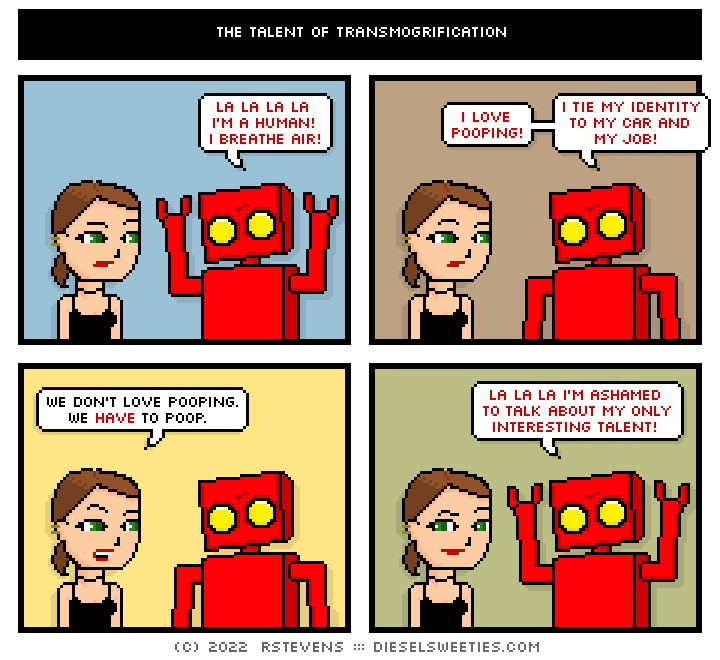
The Talent of Transmogrification

this is a diesel sweeties comic strip

LA LA LA LA I'm a human! I breathe air! I love pooping!

23 Feb 21:46

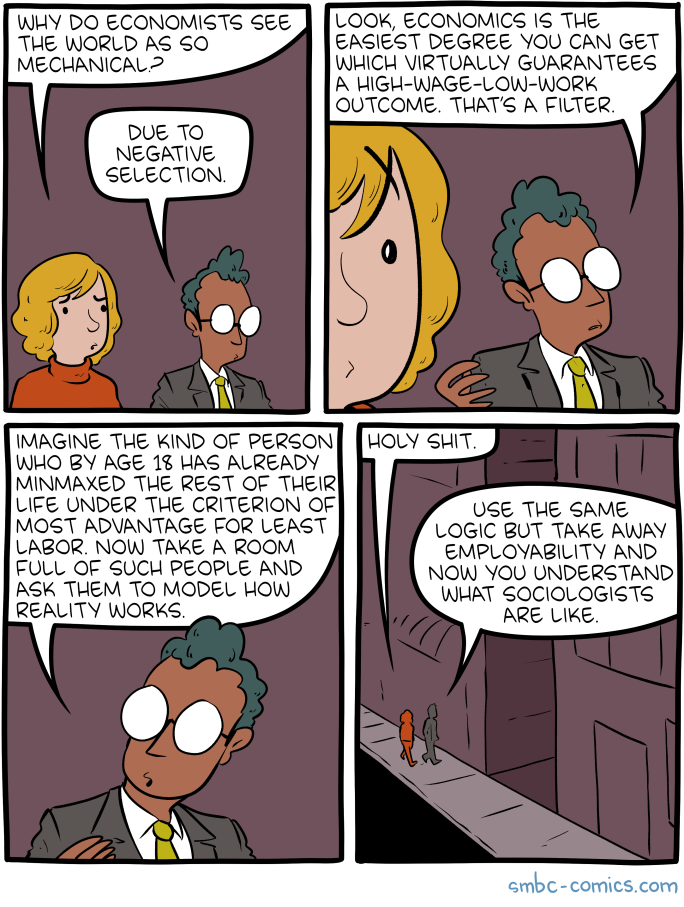
Saturday Morning Breakfast Cereal - QED

by tech@thehiveworks.com


Click here to go see the bonus panel!

Hovertext:
SSS


Today's News:
23 Feb 18:42

Popular Medicines as In-a-Pinch Radiation Sensors

by Marc Abrahams

If all hell breaks loose, so to speak, and you are fortunate to still be alive in a spot that is suddenly in a torrent of dangerous ionizing radiation, you can use any of several popular medicines to start to gauge the radiation level that you’re begin exposed to. That’s the theme of this new study:

Popular Medicines as Radiation Sensors,” Anna Mrozik and Paweł Bilski, IEEE Sensors Journal, epub 2021. (Thanks to Ela Manikowska for bringing this to our attention.)

The authors, at the the Institute of Nuclear Physics Polish Academy of Sciences, explain:

During an uncontrolled release of radiation, it is highly unlikely that members of the public will be equipped with personal radiation dose monitors. In preparation for such a situation various personal objects are being investigated as emergency dosimeters. The already developed methods are not satisfactory, as they are time-consuming or require destruction of things valuable for victims. Here we show, that common pharmaceuticals, which frequently may be found e.g. in personal bags, are the perfect candidate as radiation sensors in emergencies. We investigated several over-the-counter medicines for occurrence of the optically stimulated luminescence phenomenon and found that all of them exhibit strong luminescence signal following exposure to ionizing radiation. Its intensity increases linearly with the absorbed dose. The highest sensitivity was shown by the popular painkillers based on ibuprofen and paracetamol…. Pharmaceuticals are also free of all disadvantages of other emergency dosimeters: their composition is standardized, sampling is immediate, the unit value is usually negligible.

These are the medicines that were tested, all of which “exhibited strong luminescence signal following exposure to ionizing radiation”:

Ibuprom

Ibuprom Max

Ibuprom Zatoki

Nurofen

Nurofen Forte

Paracetamol

Panadol

Panadol Extra

Aspirin

Polopiryna S

Scorbolamid

23 Feb 18:41

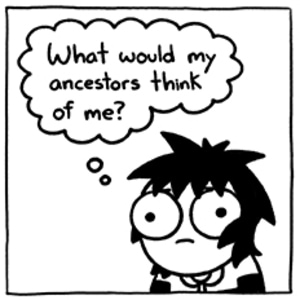
Ancestors

by Sarah Andersen

null

23 Feb 18:39

New Savage Love: Sub Optimal

by Dan Savage
by Dan Savage
022322_savage_sub-optimal_wide.jpeg
Joe Newton
I'm a submissive gay man with a 15-year-old nephew. Through his actions and words, both his parents and I have gathered he might be gay, which is absolutely no issue. However, we've also recently discovered that he seems to be interested in D/s themes with him as the sub. Besides the occasional veiled comments and sketchy online searches, he's also described situations where he's convinced other boys to subtly Dom him, both in vanilla ways and some decidedly more borderline. We're being careful to teach him about healthy boundaries and appropriate behaviors, but I have an additional struggle with all this. As a gay sub, I've been a bit of a failure. I've had no lasting relationships. I've never found a man who wanted me as both a partner and his slave. I know that there are success stories out there—sub guys with partners and families—but I'm not one of them. I want to be a good gay uncle, but honestly, I'm an objectively poor role model. If this is the path he ultimately takes, I want him to be safe, happy, and loved. But I don't know how to do this if I'm advising from my own collection of saddo experiences. Any suggestions?

Uncle Good Heart

23 Feb 18:25

Part I: The Café

by Nguyên Khôi Nguyễn

This is the first installment of a new serial comic by cartoonist Nguyên Khôi Nguyễn, chronicling his and his wife Thảo’s attempts to start a family.

- - -

23 Feb 17:07

Changes

by Reza
23 Feb 16:19

Trump's Truth Social Bakes Section 230 Directly Into Its Terms, So Apparently Trump Now Likes Section 230

by Mike Masnick

When Donald Trump first announced his plans to launch his own Twitter competitor, Truth Social, we noted that the terms of service on the site indicated that the company -- contrary to all the nonsense claims of being more "free speech" supportive than existing social media sites -- was likely going to be quite aggressive in banning users who said anything that Trump disliked. Last month, Devin Nunes, who quit Congress to become CEO of the fledgling site, made it clear that the site would be heavily, heavily moderated, including using Hive, a popular tool for social media companies that want to moderate.

So with the early iOS version of the app "launching" this past weekend, most people were focused on the long list of things that went wrong with the launch, mainly security flaws and broken sign-ups. There's also been some talk about how the logo may be a copy... and the fact that Trump's own wife declared that she'll be using Parler for her social media efforts.

But, for me, I went straight to checking out the terms of service for the site. They've been updated since the last time, but the basics remain crystal clear: despite all the silly yammering from Nunes and Trump about how they're the "free speech" supporting social network, Truth Social's terms are way more restrictive regarding content than just about any I've ever seen before.

Still, the most incredible part is not only that Truth Social is embracing Section 230, but it has literally embedded parts of 230 into its terms of service. The terms require people who sign up to "represent and warrant" that their content doesn't do certain things. And the site warns that if you violate any of these terms it "may result in, among other things, termination or suspension of your rights to use the Service and removal or deletion of your Contributions." I don't know, but I recall a former President and a former cow farming Representative from California previously referring to that kind of termination as "censorship." But, one of the things that users must "represent and warrant" is the following:

your Contributions are not obscene, lewd, lascivious, filthy, violent, harassing, libelous, slanderous, or otherwise objectionable.

That might sound familiar to those of you who are knowledgeable about Section 230 -- because it's literally cribbed directly from Section 230(c)(2), which says:

No provider or user of an interactive computer service shall be held liable on account of any action voluntarily taken in good faith to restrict access to or availability of material that the provider or user considers to be obscene, lewd, lascivious, filthy, excessively violent, harassing, or otherwise objectionable...

That's almost word for word the same as 230. The only changes are that it removes "excessively" from "violent" and adds in "libelous" and "slanderous," -- subjects in which Devin Nunes considers himself something of an expert, though courts don't seem to agree.

Hell, they even leave in the catch-all "otherwise objectionable," even as some of their Republican friends in Congress have tried to remove that phrase in a few of their dozens of "Section 230 reform" bills.

So it's not at all surprising, but potentially a bit ironic that the man who demanded the outright repeal of Section 230 (even to the point of trying to stop funding the US military if Congress didn't repeal the law) has now not only embraced Section 230, but has literally baked a component of it (the part that he and his ignorant fans have never actually understood) directly into his own service's terms.

It's so blatant I almost wonder if it was done just for the trolling. That said, I still look forward to Truth Social using Section 230 to defend itself against inevitable lawsuits.

There are some other fun tidbits in the terms of service that suggest the site will be one of the most aggressive in moderating content. It literally claims that it may take down content that is "false, inaccurate, or misleading" (based on Truth Social's own subjective interpretation, of course). You can't advertise anything on the site without having it "authorized." You need to "have the written consent, release, and/or permission of each and every identifiable individual person in your Contributions." Does Truth Social think you actually need written permission to talk about someone?

There's also a long, long list of "prohibited" activities, including compiling a database of Truth Social data without permission, any advertising (wait, what?), bots, impersonation, "sexual content or language," or "any content that portrays or suggest explicit sexual acts." I'm not sure how Former President "Grab 'em by the p***y" will survive on his own site. Oh right, also "sugar babies" and "sexual fetishes" are banned.

Lots of fun stuff that indicates that like 4chan, then 8chan, then Gab, then Parler, then Gettr that have at times declared themselves to be "free speech zones," every website knows that it needs to moderate to some level, and also that it's Section 230 that helps keep them out of court when they moderate in ways that piss off some of their users.

23 Feb 15:54

Medical, Home Alarm Industries Warn Of Major Outages As AT&T Shuts Down 3G Network

by Karl Bode

It was only 2009 that AT&T heralded its cutting edge 3G network as it unveiled the launch of the iPhone (which subsequently crashed AT&T's cutting edge 3G network). Fast forward a little more than a decade and AT&T is preparing to shut that 3G network down, largely so it can repurpose the spectrum it utilizes for fifth-generation (5G) wireless deployments. While the number of actual wireless phone users still using this network is minimal, the network is still being heavily used as a connectivity option for some older medical devices and home alarm systems.

As such, the home security industry is urging regulators to delay the shutdown to give them some more time to migrate home security users on to other networks:

"The Alarm Industry Communications Committee said in a filing posted Friday by the FCC that more time is needed to work out details. A delay of at least 60 to 70 days could help some customers who have relied on AT&T’s 3G network, although arrangements remain to be negotiated, the group said.

“It would be tragic and illogical for the tens of millions of citizens being protected by 3G alarm radios and other devices to be put at risk of death or serious injury, when the commission was able to broker a possible solution but inadequate time exists to implement that solution,” the group said.

If you recall, part of the T-Mobile Sprint merger conditions involved trying to make a viable fourth wireless carrier out of Dish Network (that's generally not going all that well). T-Mobile's ongoing feud with Dish has resulted in T-Mobile keeping its 3G network alive a bit longer than AT&T. So the alarm industry is asking both the FCC and AT&T for a little more time, as well as some help migrating existing home security gear temporarily on to T-Mobile's 3G network so things don't fall apart when AT&T shuts down its 3G network (currently scheduled for February 22).

AT&T gave companies whose technology still use 3G three full years to migrate to alternative solutions. And it's not entirely clear how many companies, services, and industries will be impacted by the shut down. But there's an awful lot of different companies and technologies that still use 3G for internet connectivity, including a lot of fairly important medical alert systems. Nobody seems to actually know how prepared we truly are, so experts suggest the problems could range anywhere from mildly annoying to significantly disruptive:

Again, this is all something that could have been avoided if we placed a little less priority on freaking out about various superficial issues and a put a little more attention on nuanced, boring policy issues that actually matter.

23 Feb 14:01

The Meadows Museum Acquires a Rare Painting by Renaissance Artist Pedro de Campaña

by Jessica Fuentes

The Meadows Museum at Southern Methodist University (SMU) in Dallas has acquired a painting by the Renaissance artist Pedro de Campaña.

Born Pieter de Kempener in 1503 in Belgium, Campaña spent more than twenty years in Seville, Spain and became one of the most influential artists working in the region. During this time, Campaña was commissioned to create paintings for churches and private chapels in and around Seville.

Because many of Campaña’s works remain in the places for which they were originally created, the acquisition of a work by the artist was a unique opportunity for the Meadows. As the first work of Campaña’s to be acquired by the museum, and perhaps the only painting by the artist in a U.S. collection, Calvary helps to fill a gap in the collection.

The Meadows Museum was born out of the private collection of Algur H. Meadows. Mr. Meadows donated his collection of Spanish paintings to SMU in 1962, and just three years later the museum opened to the public. Through business trips to Spain in the 1950s, Mr. Meadows cultivated an appreciation for Spanish art and culture. According to the museum’s press release, the institution maintains “one of the largest and most comprehensive collections of Spanish art outside of Spain.”

The Meadows Museum’s Director Ad Interim and Curator, Amanda W. Dotseth, said about the acquisition, “This painting will hold a special spot in our collection for being the last acquisition overseen by the Meadows’ late director Mark Roglán, whose passion for and tremendous knowledge of Spanish art left an indelible mark on every aspect of the museum and its collection.”’

A 16th century painting by Pedro de Campaña of the crucifixion of Christ. Christ appears at the top center of the painting on a cross and is flanked by two unknown men who are also being crucified. At Christ's feet, stand Mary and John both with halos. There is a large crowd of people in the distant background.

Pedro de Campaña (aka Pieter de Kempener), “Calvary,” c. 1560, oil on oak panel, 21 3/8 x 17 5/8 inches. Meadows Museum, SMU, Dallas. Museum purchase with funds from The Meadows Foundation, MM.2021.05. Photo by Kevin Todora.

Ms. Dotseth continued, “Campaña’s Calvary is not only the first work by the artist to enter the collection, but also the first by any artist active in sixteenth-century Seville. The acquisition thus greatly enhances our ability to present and study the history of Renaissance Spain.”

The painting is on view at the museum and will remain on view for the foreseeable future.

The post The Meadows Museum Acquires a Rare Painting by Renaissance Artist Pedro de Campaña appeared first on Glasstire.

23 Feb 13:53

Saturday Morning Breakfast Cereal - Econs

by tech@thehiveworks.com


Click here to go see the bonus panel!

Hovertext:
I feel this is a universal and underappreciated phenomenon. Like, consider how all poetry is written by the kind of people who are attracted to poetry classes.


Today's News:
23 Feb 00:19

Toys against God

by Mary Kelly

turmoil in the toy box

Turmoil in the Toybox
Phillips
1986

Did you know that Barbie, GI Joe, and Rainbow Brite are out to corrupt your children?

We have featured our guy Phil sharing his SHOCKING truth about Saturday cartoons that will corrupt and ruin your children. He also has a thing against dinosaurs. This stuff is the equivalent of Christian click bait. This time our guy Phil wants to talk about the cult influences of the toys. If you were a kid in the late 1970s and early 1980s, all of your favorite toys have been outed as evil influence by Mr. Phillips. Right now, you could be walking around with all this evil inside of you and NOT EVEN KNOW IT!

If there is one redeeming quality to this discussion, it is the marketing of toys and other products directly to children. De-regulation in the 1980s opened up more aggressive advertising to children. However, Phil thinks its the devil and it really is just profit.

Mary


back cover

startling discovery

glossary examples of toys more examples

toys garbage pail kids

The post Toys against God appeared first on Awful Library Books.

22 Feb 20:29

changing pronouns at work: a success story

by Ask a Manager

This post, changing pronouns at work: a success story , was originally published by Alison Green on Ask a Manager.

A reader writes:

Several years ago, I decided I was ready to tell people my pronouns are they/them. I wanted to do this at work, too, so I decided to tell my manager first and asked for her support in telling my coworkers “these are Sally’s pronouns now.” She told me that I’m welcome to tell the others, but she won’t provide any support or correct anyone. She continuously got my pronouns wrong, and once, after a correction, told me, “I’ve known you as [gender] for such a long time that I’m not switching now.”

She was a terrible manager in other ways, too, so I started job hunting in earnest — with a lot of help from AAM! My resume and cover letters have never been so good! — and found one that really lined up with what I wanted next out of my career. While I was desperate to leave, I did assess the fit of the new place and reminded myself I wasn’t looking to jump “out of the frying pan into the fire” and to pay close attention to any red or yellow flags.

But I didn’t bring up my pronouns during the hiring because I was desperate enough to leave that if I kept being misgendered but everything else was good, I would put up with it.

I got hired and on my orientation day, told my boss my pronouns. He thanked me and we moved on to training. The next day, he sits down with me and says, “I didn’t understand what you told me yesterday, but I didn’t want to put you in a position where you feel you’re defending your identity or make you uncomfortable, so I asked my trans friend about it. We talked for hours, and I don’t think I totally get it yet — in fact, I don’t think I’ll EVER get it fully — but I do understand this: getting it wrong is very disrespectful. I’ll be honest, this is new for me, so I want you to know, I respect you and your identity, and please correct any mistakes I make.”

He told all my coworkers, too, “These are Sally’s pronouns, please make sure you’re using them.” He’s corrected clients and has said firmly to them before, “Sally’s pronouns are they/them, you will respect my employee and use that.”

New coworkers have started and have been told that these are the pronouns and also he draws their attention to the section of our employee handbook that specifically covers this.

I met his boss soon after starting (she works at a different site), and she referred to me with the wrong pronoun. My boss interrupted her to tell her what my pronouns are, and his boss thanked me for letting the company know.

We needed to order me uniforms, and he called our warehouse because I could only order the ones for my gender, not the ones I wanted, and told them they WILL be giving me the ones I want.

When I struggled for several days with a bad bout of dysphoria, he told me my schedule for the next few days were “flex hours” which are unusual in my line of work because of coverage and encouraged me to WFH if needed.

When I first came out, at my old job, I had thought the best I could hope for was people using the right pronouns. Thanks to my boss, I realize there’s so so much more a good boss can do for a trans/non-binary employee and I am grateful every day for him.

22 Feb 19:25

EIT! KIDZ KLUB PART TWELVE!

by noreply@blogger.com (JerryMaguire)


Come see our new movie and live show EIT! KIDZ KLUB at the Belcourt Theater in Nashville TN tonight 2/21/22!

GET TICKETS HERE

Buy our new movie EIT KIDZ KLUB!

On DVD!

On VHS!

EIT KIDZ KLUB TOUR REMAINING SHOWS:

2/22 - Durham NC

2/23 - Richmond VA

2/24 - Washington DC

2/25 - Philadelphia PA

2/26 - Brooklyn NY

2/27 - Portsmouth NH

2/28 - Boston MA

3/1 - Portland ME

3/2 - Montreal QC   [CANCELLED]

3/3 - Toronto ON

3/4 - Pittsburgh PA

3/5 - Detroit MI

3/6 - Cleveland OH

3/8 - Columbus OH

3/9 - Bloomington IN

3/10 - Louisville KY

3/11 - St Louis MO

3/12 - Iowa City IA

3/13 - Chicago IL

3/14 - Milwaukee WI

3/15 - St Paul MN

3/16 - Fargo ND

3/18 - Missoula MT

3/19 - Spokane WA

3/20 - Vancouver BC

3/21 - Seattle WA

3/22 - Portland OR

3/23 - Eugene, OR

3/24 - Sacramento CA

3/25 - Reno NV

3/26 - Oakland CA

Now that society is collapsing, Everything Is Terrible! is reborn with their new and fantastical expedition into found footage... but this time the adults can stay home! EIT! has unearthed thousands of forgotten DVD & VHS tapes aimed at yesterday’s youth to bring you their most mind-melting movie to date. Watch in awe as all colors of the rainbow join forces to destroy the tyranny of adult civilization once and for all! All of your oldest friends will be there; skateboarding web-surfers, rapping math equations, gigantic baby ducks, and maybe even a wizard or two! And what EIT! show would be complete without a live experience that makes the Ice Capades look like a stupid piece of trash! Finally, an all-encompassing extravaganza created for kidz... by kidz! 


22 Feb 15:40

This and That: Brancusi and Clay in The Contemporary Austin’s Online Shop

by Brandon Zech

“This and That” is an occasional series of paired observations. See past “This and That” posts here. – Ed.

Today: Anthropomorphic hugging

A plaster sculpture of two figures embracing, hugging, and kissing.

Constantin Brancusi, “The Kiss (Le Baiser),” 1907-1908 (cast before 1914), plaster, 11 x 10 1/4 x 8 1/2 in. Raymond and Patsy Nasher Collection, Nasher Sculpture Center, Dallas, TX

A block of gray clay, sitting on a table in a bag.

Dillo White Clay for sale in The Contemporary Austin’s online shop

A block of gray clay, sitting on a table in a bag.

Balcones White Clay for sale in The Contemporary Austin’s online shop

A block of gray clay, sitting on a table in a bag.

Armstone Clay for sale in The Contemporary Austin’s online shop


*************

No matter how original, innovative or crazy your idea, someone else is also working on that idea. Furthermore, they are using notation very similar to yours. – Bruce J. MacLennan

The post This and That: Brancusi and Clay in The Contemporary Austin’s Online Shop appeared first on Glasstire.

22 Feb 14:24

I’m Music Man Stan, and Daniel Tiger Isn’t Who You Think He Is

by Laura Weiss Smith

Music Man Stan, here, you may know me as the owner of the Neighborhood Music Shop in the Neighborhood of Make-Believe. But you know what? I’m a whole lot more than that. I’m a man… with thoughts, feelings, and uncorroborated conspiracy theories.

Do you have any idea how hard it is to run a music store in a global pandemic? The last thing Katarina Kitty Kat’s mom wants is to hand her daughter a pair of drumsticks when she’s walking into her fourteenth Zoom call in the spare bedroom next door. Let’s be honest, we all know she shoved fifteen years of cat toys into that closet behind her. Heaven help us if the latch fails.

You know who else heaven should help? Teachers. Teacher Harriet and I started a pandemic support group last year and you know what? It’s not helping. Every time I tell Harriet how I feel, she sings me a song about breathing. I love her to death—and heaven knows she’s been through a lot this year—but I’m a grown man. Plus, I play the saxophone. So I know how to breathe.

But I digress. I’m here to tell you important news that very well may shift the power dynamics in the Neighborhood of Make-Believe. Are you sitting down? Good. Here it goes: Daniel Tiger isn’t who you think he is.

Little Dan Dan left a poorly drawn map of his side of the neighborhood at my music shop (without buying anything, I might add), and guess what? DANIEL TIGER LIVES ON A GODDAMN BEACH. He can walk out his back door directly into a sun-drenched paradise, obtaining instant, luxurious privacy when the other citizens of the Neighborhood of Make-Believe have to share a tree. And if he doesn’t like the sand texture that day, you know where he can go? To hell. Just kidding. Granpère’s house, because not only does Granpère have beachfront property, but he has a boat as well. That he apparently sleeps in? Even though his house is right there? Anyway, my point is, despite a single income the Tiger family is ROLLING IN IT. And yes, for those about to point it out, I do live in a massive museum/carousel, but I obtained my property completely legally and fairly: by my wife being royalty.

Everyone in the Neighborhood has their own theory about how the Tigers arrived at such everyday luxury. Why do you think Dad Tiger can follow his Tigertastic dream of that niche coo-coo clock store that nobody’s been in except close friends and family? Have you seen the hours? Open for two hours on a Sunday? If that doesn’t scream “front,” butter my butt, call me a biscuit, and serve me up with some veggie spaghetti. Really, Tigers, you expect us to believe you’re vegetarians? You’re not fooling anyone into thinking you’re harmless, everyone knows you’re at the top of the food chain. But, I digress. I’m sure Dad is just really into clocks. You know, like drug lords are really into… laundry.

While I’ve got your attention, I do want to address one community concern. The Tiger family has a corner on public transportation. They always have. The Neighborhood Friendly Investigators found that the Tiger family called on TTS (The Trolley System) no fewer than six hundred and thirty-five times last year, with enviable, wildly anomalous curbside service. Can I tell you how many times I’ve stood on the street with a pile of instruments to deliver, only for Trolley to affably arrive two hours late ringing his bell like nothing happened? I can’t. Because it’s too many to count.

In sum, I implore you to take a closer look at the Tiger family. Why are their curtains made of tiger skin? “Faux fur” they say and yet nobody can tell me what happened to Grandmère. Their inexplicable influence over our Neighborhood can no longer be ignored. In a land teeming with anthropomorphic citizens, I encourage you to resist the desire to be sheeple and start asking hard questions about the Tiger family.

22 Feb 14:21

A Long Bet Pays Off

by Jason Scott

11 years ago, on the site longbets.org, a friendly wager was made between two mavens of the web: Jeremy Keith and Matthew Haughey.

The bet, to be revisited a decade and a year later, would be whether the URL of their wager at Long Bets would survive to a point in the semi-distant future.

That is, this day, February 22nd, 2022, (2/22/2022).

As of this writing, the URL absolutely has survived.

Therefore, the Internet Archive shall receive a $1,000 donation from Mr. Keith and Mr. Haughey ($500 apiece), provided from an escrow account that has held the funds since the day of the wager. (We shout out to the Bletchly Park Trust, a worthwhile historical organization, who will not be getting the donation but who are deserving of yours.)

It would be easy enough to declare it a win for the idea of “the web” and that regardless of concerns brought up about the Internet’s ongoing issues, we can still find hope. So certainly, let us all applaud that things worked this way, and the URL’s 11-year consistency is a bright beam of light, online.

In many ways, however, the bet is at best a bittersweet victory, and at its darkest interpretation, a small oasis in a desert.


To understand The Long Bets, you need to understand The Long Now.

The Long Now Foundation is a non-profit meant to be an organization geared towards projects and approaches to thinking that chronologically leave the average human lifespan in the dust; focusing on 10,000-year timelines and solutions to problems of sustaining cultural contexts for a hundred lifetimes and beyond.

Currently, the Long Now and its ideals are expressed in both a very nice performance and drinking space called The Interval, and a number of stylish projects and websites to bring this realm of thinking into focus.

The most prominent and first major project was the Clock of the Long Now, a project to make a time-accurate clock that would function for 10,000 years. The as-yet incomplete project goal is to build a clock deep in a mountain range and set it off, ticking occasionally (but on time, doing so) for the next ten millennia.

Other projects follow this approach as well, ranging from delicious to provoking. A re-imagining of the Rosetta Stone, a language translation service, a manual for civilization, a mountain land purchase, and others in these themes.

Among these variant projects is Long Bets.

It is a facilitation of long-term thinking, of providing a neutral, fair and equitable way for years-in-the-future bets to be made between parties, each contributing funds towards the prize. It is traditional that the recipient of the prizes be organizations not run or controlled by either bettor.

Browsing the betting page, the bets range from the humorous to the aspirational, from specific sports outcomes to predictions around space travel, vehicle autonomy and economics. They’re a joyride of thought and conversation starters, as they’re meant to be.

And among them is Bet #601.

Jeremy Keith and Matt Haughey are both veterans of The Web as it has historically been described; each has had their voices heard to crowds online and off, describing the nature of websites. Their careers have (deservedly) benefitted greatly from the power of interlinked websites.

They both recall the start of the world wide web, as well as internalizing the rules and mores that followed its birth. They were well-qualified to debate on the longevity of URLs and the position that a specific URL would hold across time.

That said, Keith was skeptical. Haughey was optimistic.

Like a lot of its neighbors, Bet #601 is too clever by half; the bet states that it is won or lost depending on the availability of the bet at the URL the bet is hosted at. That is, two situations exist to judge the outcome: Either the URL https://longbets.org/601 exists, at which point the bet is lost, or it does not exist, at which point the bet is won.

(Strikingly, if the bet had been won, the Internet Archive would possibly be the only place to browse the site in its original form, where it would have then helped prove the funds should go to Bletchly Park Trust. The continued reliance on the Wayback Machine as the vault of the Web’s lost memories would have persisted, in a very sharp and slightly less financially-beneficial way. Such is the price of memory.)

For the record, here are the statements made by each bettor about their arguments for the wager:

Jeremy Keith

Jeremy Keith:
“Cool URIs don’t change” wrote Tim Berners-Lee in 01999, but link rot is the entropy of the web. The probability of a web document surviving in its original location decreases greatly over time. I suspect that even a relatively short time period (eleven years) is too long for a resource to survive. I would love to be proven wrong.

Matt Haughey

Matthew Haughey: Though much of the web is ephemeral in nature, now that we have surpassed the 20 year mark since the web was created and gone through several booms and busts, technology and strategies have matured to the point where keeping a site going with a stable URI system is within reach of anyone with moderate technological knowledge. My oldest sites are going on 13 years old at the time of this bet and the original URL scheme still functions via 301 redirects to a final format we selected about six years ago.

This should be it.

But it’s worth noting how the context of this bet has changed over time. And issues with the continued evolution of the web strike at heart of the point the bet was trying to make.

THE URL:

The Long Now Foundation, intending to maintain its footing for as long as absolutely possible, has a very vested interest in its URLs staying stable. Between hosting structure, the setup of the webpages themselves, and maintaining clean, static URLs (longbets.org/601 is a very simple address, lacking any ornamentation or dependence on programming language extensions or dynamic rendering). The domain name longbets.org is registered until June of 2022 as of this writing, but was registered in June of 2001, twenty years ago, which bodes well for continued survival.

If you’re going to bet that a URL is going to stick around, on a website run by an organization that expresses its character by the longevity of its projects, staking your bet on a specific URL from that organization is a pretty safe bet.

THE WEB:

Both of the parties in the bet clearly think of “the web” as being a set of interacting links between websites, but even by 2011, the idea of a “website” was beginning to experience direct collision with the ever-centralizing, ever-shifting audience of online life. Mobile access is a quirk in the 1990s, an oddity growing into a majority in the 2000s, and now, in the present day, phones with screens are the “home computer” of vast percentages of internet patrons.

In the interconnection of the world, it is harder and harder to think of a “website” where “platforms” rule the roost. A user is more likely to have an account name, or a public identity, than to ever utter the phrase “http” in their daily activity, or maybe even their year. The clear goal of many firms is to dissolve the consideration of the URI or URL, with many of the previous protocols of the earlier Web forgotten. The question becomes less of “will this URL survive” and more of “will the idea of the URL survive?”

THE IDEA OF LONGEVITY AND CHANGE FOR DIGITAL DATA:

Finally, the overarching fact of the situation is that sites like Long Bets are part of a philosophy of the web that is rapidly shrinking. Points of data and dependable signifiers of content and individuals were once the destination. That’s long changed; they are but stops along the way, flotsam and jetsam that ride in nebulous platforms that dominate online life. While Jeremy Keith and Matt Haughey maintain personal websites, they have rapidly become like homesteads that jut out in the center of towering skyscrapers and apartment blocks. Future generations will think of “the web” as much as they think of “the roads”; intensely interest to a few, below the watermark of consciousness to the rest.

As we move into this even-more-ethereal version of the Web, where objects, materials and locations possess data as much as pages and links we ever did, the Internet Archive will do its best to keep up and grow to match the challenge.

But what a challenge it shall be. Bet on it.

The post A Long Bet Pays Off appeared first on Internet Archive Blogs.

22 Feb 12:22

should I let my neighbor hire me, should I remove my mask in an interview, and more

by Ask a Manager

This post, should I let my neighbor hire me, should I remove my mask in an interview, and more , was originally published by Alison Green on Ask a Manager.

It’s five answers to five questions. Here we go…

1. Should I take a job working for my next door neighbor?

My boyfriend and I are the newest tenants in a very small and close-knit apartment complex. It had been a little difficult becoming “a part” of the community but we are finally adjusting. My immediate next door neighbor (and I mean literally a two-foot space separates our doors) offered me a job working at her job with her being my supervisor. I’m totally uneasy with it because although I like her very much, her husband is a very opinionated man who likes to voice his political views, which border extremist. It’s easy to just brush off here at the complex, but he has already complained to management that we had stuff on our porch and other extremely small pretty complaints, and we already walk on eggshells because of the fact we are new here and the previous tenants left a horrible taste in everyone’s mouth.

I truly like this lady and I give her props for dealing with her husband. Did I mention it’s efficiency living? One-room efficiency living! I honestly just feel this has timebomb potential. We can hear them from inside — we hear their arguments and discussions and we know when they leave and return, all without trying. I’m afraid that it could be more damaging to our living situation than it could be good. I know I might sound like I’m making excuses but the job is just a part-time day lunch prep job across town during hours I’m not used to working. My boyfriend and I are night owls and we are usually sleeping during the hours I would be working. We both have night jobs already and I truly believe I wouldn’t do well in the job to begin with. I just want to hear an unbiased opinion regarding my reservations. Am I over dramatizing my qualms or do you feel they have merit?

Do NOT take this job. Neighbor issues aside, it doesn’t sound like you even want it! The hours aren’t right for you, you don’t think you’d do well at it, and you already have a job. You’re not obligated to consider a job you’re uninterested in just because someone offers it to you!

If you were interested, I’d still be telling you to say no. Having a boss as a neighbor can be dicey under the best of circumstances; your lives intersect in ways that can be problems. (For example, if you call in sick, is she going to have Thoughts on seeing you go out that evening? Or recall that she heard you come in late the night before?) Doing that in a space where you can already hear everything about each other’s lives and her husband is already a problem and the community sounds more-than-typically involved in each other’s lives … incredibly bad idea.

You can just tell your neighbor, “It doesn’t sound right for me, but thanks for offering!” If she pushes, hold firm: “Nope, not for me!”

2. Should I take my mask off in an interview?

I have a question about how to navigate mask etiquette during in-person interviews. For context, I live in a state with a mask mandate in all public places, and in my workplace people adhere to the mandate unless alone in an office. Our numbers are starting to go down and people are just now starting to relax, and the statewide mandate will be lifted soon.

I recently had an in-person interview with two people, and was provided a seat across the room from the interviewers, who were also spaced far apart. One of the interviewers (who would have been my direct supervisor) said that it was up to me, but they were both fully vaccinated and comfortable if I wanted to remove my mask. I hesitated but eventually did and they both seemed relieved to remove theirs, and commented that it’s hard to meet someone for the first time when they’re wearing a mask.

I have a panel interview coming up next week, on the exact day that the mask mandate is scheduled to be lifted. I will default to wearing a mask, but I’m not sure what to do if given the choice to remove it in what may be a small room with a large group of people. I’m worried that I’m likely to offend someone whether I keep my mask on or remove it. Any thoughts on how to quickly read the room and make the right call here?

Someone who’s offended by you taking a more cautious approach to public health than they are isn’t someone you should cater to. You might feel that you don’t have the luxury of taking that stand when you’re interviewing, but (a) as you note, you risk turning someone off either way, so you might as well make the decision you personally are comfortable with, and (b) a place that penalizes a candidate for leaving a mask on in a large group is giving you valuable information about how they navigate serious crises like pandemics, something that will be highly relevant to you if you end up working there.

3. Why do coworkers email me when they know I’m not working?

I work for a U.S.-based firm that has a small number of employees around the world. Frequently, I will receive emails from colleagues outside the U.S. over the weekend and during holidays. Is there a way to discourage this practice? I don’t send emails during non-business hours unless there is an urgent, time-sensitive need.

Recently on the morning of a federal holiday, around 4 am, I received an email from “Sven,” asking to reschedule a meeting (two weeks away). I responded (big mistake, I know, blame my insomnia) and went back to bed. Except “Sven” came back immediately, thanking me for my reply and doubling down on the request to the rest of the group, asking for their availability. So I responded again, just to Sven, and pointed out that it was a federal holiday here and many folks may not be checking email. He thanked me and assured me that he was not expecting a response that day from anyone in the U.S. SO WHY DID YOU SEND THE EMAIL?!?!?

I did not ask that question but am wondering, how do I discourage this? Do I need to turn on my out-of-office every night and weekends and holidays? Are we ever off the clock?

I think you’re in the wrong here, not Sven! Email is commonly understood as an asynchronous communication method, where one person will send a message when convenient for them and the other person will respond at some later point. In a functional office, there’s no expectation that people will respond to non-urgent messages as soon as they receive them, especially if they aren’t currently at work … and there’s no expectation that people will refrain from emailing if they know the recipient is not currently working. When you’re off for a holiday or on vacation or when it’s 9 pm or the weekend, it’s okay for people who are not off for a holiday or on vacation to send you emails, and to assume you will respond when you are back to work. The implied message is not “answer me now!” It’s “this awaits you when you resume your next work day.” Otherwise no one could email anyone who was out sick or on vacation, and they would need to do the extra work of tracking everyone’s individual schedule and holding all their messages until the person returned. That would be terribly inefficient and is not how work emails usually work.

If you have trouble resisting responding when you’re off, I’d recommend taking your work email off your phone, or at least turning off notifications for it — and if you do happen to look at it, know people are assuming you’ll reply when you’re once again working but not before. (Just as Sven told you!)

4. I dislike my mentor’s professional connections

A few years ago I moved from my home state to begin my career in higher ed after graduate school. The experience was atrocious. My coworkers’ behavior matched the maturity level of high schoolers at best: The gossiping was out of control from all levels … People skipped meetings if they didn’t feel like attending … My supervisor asked for feedback in meetings, then burst into tears before we (his supervisees) could even say anything … A coworker threw a tantrum in a meeting because of a new policy that prohibited sleeping with students of age. The policy was rescinded! … I could go on and on about that toxic environment. I distanced myself until I left only a few months later for a higher ed job back home. I was diplomatic in my exit interview and tried not to burn any bridges despite my quick departure.

Fast forward to now and we recently hired someone for a senior leadership role. I really enjoy him! He offered to serve as my mentor and I leapt at the chance. As I’ve gotten to know him, he mentioned that he’s close to the people from my previous institution. I don’t talk about my experience at the previous institution often. In fact, I don’t even put it on my resume. But he knows I worked with these toxic people.

He speaks of them fondly. I’m not sure if he ever worked with them directly, and I’m afraid to ask. I’m worried that he’ll start asking deeper questions about my previous coworkers. I don’t want to offend him. Or lie. When he brings them up, I lightly laugh it off and say that my previous job was a learning experience and then I quickly redirect the conversation.

Would it be a misstep to share my not-so-great experience with his professional connections? Should I question his own professional judgment? I’m desperate to leave higher ed and I don’t want to screw up this professional development opportunity.

I don’t think you need to say anything. He’s not asking about your experience working with them or seeking references for them; he’s just speaking of them fondly. It could indicate something about his own professional judgment, but it could also be that he only knew them socially and hasn’t worked directly with them (or that when he did work with them, he was shielded from their behavior by layers in between them so he didn’t see what you saw). Pay attention to what you see of his professional judgment now.

If he ever does ask you directly about your experience working with that team, you might as well stay diplomatic — you were only there for a few months, didn’t get to know people well, etc. — unless there’s a clear reason to be more candid, like if he’s considering hiring someone who you know to be a disaster or he suggests pairing you up with one of them for additional mentoring.

5. My job doesn’t want to pay for headphones I use in my work

I work a job that involves videography and social media management. As such, I frequently wear headphones and would argue that they are an essential part of the tech I need to perform my job.

The pair I currently use is one I got from our work IT department. They are pretty bad quality and this is the second pair I’ve gone through, as they only connect to my laptop via USB and the ports start to malfunction easily. It gets kind of frustrating when my audio keeps going in and out, not to mention I imagine it annoys my coworkers when they start hearing random sounds pop through.

I asked my boss if we could use work funds to get a decent pair of wireless headphones that might last longer than the IT ones. I’m not picky, but I hate to go through a pair every six months when a solid one-time purchase might last years. I didn’t think it would be an issue but she asked if I have a pair at home I could use, as that would be best.

I do have a wireless pair of headphones at home. But they are purely for working out, I keep them in my gym bag. And I really don’t want to worry about bringing them back and forth from work every day. I also feel like this is a fairly basic thing that work should pay for. I don’t need anything fancy, just something solid that will last more than six months. Is there a way to address this with my boss?

Because these are an integral part of your job (unlike headphones you were wearing just to listen to something to entertain yourself), your employer should pay for them. That doesn’t mean they will, but it’s a reasonable request.

Go back to your boss and say, “I tried to figure out if there’s something I have at home that would work, but there’s not. The ones I’d like to order are these, for $X. Can I submit that since they’re necessary for doing video work?”

22 Feb 10:52

The cake also rises

https://www.oglaf.com/cake-also-rises/

22 Feb 10:46

Seattle Public Radio Station Manages To Partially Brick Area Mazdas Using Nothing More Than Some Image Files

by Tim Cushing

Welp. This isn't going to help future fundraising drives. Not when a public radio station is negatively affecting, you know, driving.

Drivers of certain vehicles in Seattle and other parts of Western Washington are shouting at their car radios this week. Not because of any particular song or news item that’s being broadcast, but because an apparent technical glitch has caused the radios to be stuck on public radio station KUOW.

The impacted drivers appear to all be owners of Mazda vehicles from between 2014 and 2017. In some cases the in-car infotainment systems have stopped working altogether, derailing the ability to listen to the radio at all or use Bluetooth phone connections, GPS, the rear camera and more.

Behold the collision of OTA and IO(car)T. This unique situation -- limited solely to drivers in the Upper West -- presented a host of new problems and a lot of speculative answers. The radio station had absolutely no idea why this was happening. One local dealership told a customer it had something to do with 5G, which apparently meant affected Mazdas were now infected with a car-borne form of COVID, presumably necessitating plenty of expensive diagnostics and what have you.

Fortunately, the cars' manufacturer was actually able to pinpoint the cause of the malfunction -- which left some drivers staring at in-car systems stuck in a perpetual "loading…" loop. The answer arrived roughly a week after the problem presented itself. The problem -- discussed in this entertaining Reddit thread -- had nothing to do with network upgrades or an unexplained bug in Mazda software.

Instead, the public radio station had done something completely unexpected, sending affected vehicles into in-car entertainment purgatory. This is the statement Mazda gave to Geekwire.

“Between 1/24-1/31, a radio station in the Seattle area sent image files with no extension, which caused an issue on some 2014-2017 Mazda vehicles with older software,” the Mazda statement said. “Mazda North American Operations (MNAO) has distributed service alerts advising dealers of the issue.”

While it's somewhat troubling to note that Mazdas manufactured within the last eight years are running what Mazda considers to be outdated software, the good news is that it can be fixed. The bad news follows the good news: due to shipping constraints affecting goddamn everything, drivers affected by this oddity shouldn't expect to see a fix anytime soon. "Part delays" cited by Mazda could put permanent fixes months off.

On the other hand (good news!), even older models will be covered by these repairs, whether or not they're still under warranty. The company has instructed dealers to honor "goodwill requests" for free repairs of affected vehicles. Back to the bad news: the part that apparently needs to be replaced is the ominous-sounding "connectivity master unit," which indicates a whole lot of connectivity will be affected until dealers get the part in stock and start dealing with the backlog of semi-bricked Mazdas. Some users have reported in-car entertainment systems stuck in permanent loops, non-functioning GPS systems, and bricked back-up cameras.

This isn't going to go well for Mazda, considering it's the only manufacturer whose systems have been rendered useless by a misconfigured file distributed by a radio station. While this situation is certainly an outlier, there's likely a reason other in-car entertainment systems weren't similarly affected, which suggests a crucial shortcoming in the tech installed in those models -- one that could be exploited by entities far more nefarious than local public broadcasters.

21 Feb 21:26

by dorrismccomics