Shared posts

05 Mar 17:45

EIT! KIDZ KLUB PART EIGHTEEN!

by noreply@blogger.com (JerryMaguire)

Come see our new movie and live show EIT! KIDZ KLUB at The Great Hall in Toronto, ON tomorrow 3/3/22!

GET TICKETS HERE

Buy our new movie EIT KIDZ KLUB!

On DVD!

On VHS!

EIT KIDZ KLUB TOUR REMAINING SHOWS:

3/2 - Montreal QC   [CANCELLED]

3/3 - Toronto ON

3/4 - Pittsburgh PA

3/5 - Detroit MI

3/6 - Cleveland OH

3/8 - Columbus OH

3/9 - Bloomington IN

3/10 - Louisville KY

3/11 - St Louis MO

3/12 - Iowa City IA

3/13 - Chicago IL

3/14 - Milwaukee WI

3/15 - St Paul MN

3/16 - Fargo ND

3/18 - Missoula MT

3/19 - Spokane WA

3/20 - Vancouver BC

3/21 - Seattle WA

3/22 - Portland OR

3/23 - Eugene, OR

3/24 - Sacramento CA

3/25 - Reno NV

3/26 - Oakland CA

Now that society is collapsing, Everything Is Terrible! is reborn with their new and fantastical expedition into found footage... but this time the adults can stay home! EIT! has unearthed thousands of forgotten DVD & VHS tapes aimed at yesterday’s youth to bring you their most mind-melting movie to date. Watch in awe as all colors of the rainbow join forces to destroy the tyranny of adult civilization once and for all! All of your oldest friends will be there; skateboarding web-surfers, rapping math equations, gigantic baby ducks, and maybe even a wizard or two! And what EIT! show would be complete without a live experience that makes the Ice Capades look like a stupid piece of trash! Finally, an all-encompassing extravaganza created for kidz... by kidz! 

04 Mar 18:17

Donation Guidelines for Station Eleven’s Museum of Civilization

by Will Bareford

Thanks for your interest in the Museum of Civilization. Our founder, Clark Thompson, established the Museum of Civilization in year zero, shortly after society’s collapse due to the Georgia Flu.

All the objects we display come from fellow survivors such as yourself. While we greatly appreciate you trekking through the ruins of Detroit, battling hordes of roving red bandanas, and surviving untold miles of post-pandemic wilderness to deliver us your items—there are several things you can do ahead of time to make sure they meet the standards of our museum.

We are a museum dedicated to preserving pre-pandemic objects as an act of remembrance and a testament to civilization’s achievements.

What we are not:

  • A coworking space
  • A sex cult
  • A public restroom

Guidelines

Technology
We gladly accept all manner of machines. But in order to be considered, please observe the following rules:

  • All items must be in working condition and include the requisite power cords. (Pro tip: Sort the cords before arriving at Severn City Airport.)
  • All items must be presentable and “museum quality.” (If there’s a Monster Energy sticker on your laptop, chances are we won’t accept it.)
  • No Samsung products.

NOTE: As of last winter, we’re no longer accepting toasters of any kind. Not because we don’t admire the brilliance of a machine that turns bread crispy, but we already have a ton, and storage space at Severn City Airport is limited.

Literature
The library at the Museum of Civilization welcomes great works of literature, but please submit only previously published works. Anything written after year zero will not be considered. Do not, we repeat, do not journey across a post-apocalyptic dystopia to bring us your unproduced screenplay.

NOTE: We don’t need any more copies of The Corrections. There were already a few in the airport before we started the museum. Every week or so, another wayward soul shows up on our doorstep, wild-eyed and starving, with a copy of The Corrections, only to have it rejected. Don’t be this person.

Visual Art
Visual art is accepted on a limited basis.

  • Pieces from pre-pandemic history’s major artists are preferred (your Picassos, your Rothkos, etc.).
  • Pieces should be professionally framed. (Need help? There’s an abandoned frame store twenty miles south of the museum. Catty-corner to the cannibal den, formerly a Wendy’s.)
  • FWIW, our team has been on an abstract expressionism kick recently, not sure why, but so you know.

NOTE: We’re all set on seascapes, poker-playing dogs, and depictions of the Wild West. Furthermore, after a lively internal debate, be aware that novelty caricatures, like the kind you’d find at what were once known as amusement parks, are not art.

Pelotons
Save yourself the hassle and leave the Peloton bike behind. Use it as a barricade, turn it into a booby trap, or rig it up as some kind of power station—just don’t lug it across the virus-ravaged hellscape for us to reject. Some things aren’t worth remembering.

Response time
In addition to curating the Museum of Civilization, our curation team is trying to rebuild a functional community in a dangerous, ever-evolving world. Therefore, our response time varies. In a typical month, with no major storms or attacks from marauders, expect a reply within three weeks.

Reasons you might not hear back

  • Our quarantine procedure broke down and an infected person was mistakenly admitted into the airport, causing our community to collapse.
  • A false prophet and his army of child soldiers infiltrated our community through a traveling theater troupe, reopening old wounds and corroding the fragile peace we’ve established.
  • Your donation was a toaster.

Payment
Given that there’s no central government and no agreed-upon currency in this post-pandemic nomadic society, the Museum of Civilization does not provide payment at this time.

Curious about an internship? Check back in the spring to see if we survived the winter.

Any additional questions can be directed to Clark Thompson, Severn City Airport, the former state of Michigan.

04 Mar 18:12

Wow! How to discover videos on Facebook and Instagram!

by Matthew Inman
Wow! How to discover videos on Facebook and Instagram!

Wow! Just wow! Just wait for it ...

View on my website

04 Mar 15:05

'Star Trek: Picard' enters the 25th century only to promptly ignore it

by Kris Naudus

The following contains moderate spoilers for the first three episodes of ‘Star Trek: Picard’ season two, but not much more than what was seen in earlier teasers and trailers.

The first season of Picard was controversial, to say the least. Many fans were happy to see old friends again; others weren’t so thrilled at the grimdark direction Starfleet and the Federation went in the 20 years since we’d last seen their 24th century incarnations. Still, we got a look at how technology evolved, met some intriguing new characters and in the finale, at least, everything seems to have been put right.

It’s that brighter world where the second season of Picard begins, with synthetic beings now legal — which is handy, given that at the end of last season Jean-Luc Picard was transferred into an android body. It left me and much of the audience wondering if and how this would affect future stories. The answer comes pretty quickly in season two, now with new showrunner Terry Matalas at the helm. It doesn’t really matter. It’s not made clear exactly who does and who doesn’t know, but Jean-Luc Picard is still subject to the ravages of age while enjoying all the legal protections he would have had as a flesh-and-blood being (he still owns the vineyard, for one thing). Even Q, when he inevitably appears, treats Picard as the same being he’s always been.

Pictured: Michelle Hurd as Raffi and Sir Patrick Stewart as Jean-Luc Picard of the Paramount+ original series STAR TREK: PICARD. Photo Cr: Trae Patton/Paramount+ ©2022 ViacomCBS. All Rights Reserved.
CBS

Viewers may be familiar with the “Ship of Theseus” thought experiment, recently brought up in the finale of last year’s WandaVision. Basically, the idea is that if you slowly replace the parts of a ship over time, and then reassemble the old parts into another ship, which one is the original ship? In Picard, they suggest that the essence of a human being is their intelligence, so the real Jean-Luc Picard is the synthetic being that’s walking around on Earth right now. The problem with this, however, is that this hasn’t always been how Star Trek worked. While characters like Miles O’Brien and Harry Kim were replaced by duplicate versions of themselves, “Thomas” Riker was decidedly not given the same courtesy. It seems that duplicates are acceptable only when they replace someone we’ve otherwise lost.

During press interviews, even Patrick Stewart admitted the synthetic body issue was “a real mess.” Thankfully, the show smartly moves past it. It’s been at least a year and a half since the events of the first season, meaning we’re now in the 25th century. Picard has returned home and assumed the chancellorship of Starfleet Academy. Both Rios and Raffi have gone back to the fleet, and even Elnor is now attending school as a cadet (as the first full-blooded Romulan at the Academy). It’s the nice shiny future we’ve always loved to see on Star Trek, complete with some banging costume design and fun updated tech. Last season I noted how nice it was to see the continuation of the “synthetic being” storyline that ran through The Next Generation, and having all the characters settled into new positions leaves plenty of room to explore other facets of 25th-century technology and society.

Pictured: Sir Patrick Stewart as Jean-Luc Picard of the Paramount+ original series STAR TREK: PICARD. Photo Cr: Trae Patton/Paramount+ ©2022 ViacomCBS. All Rights Reserved.
CBS

However, Picard hasn’t become a happy show overnight. A new crisis quickly emerges, with a rift in subspace demanding Picard’s attention and putting the entire fleet at risk. This is where Q comes in, shunting Picard and his close compatriots over to an altered timeline where the genocidal “Confederation” rules the Alpha Quadrant with an iron fist. This isn’t the Mirror Universe that we’re familiar with from previous shows like the original series, Deep Space Nine and Discovery. In this version, Earth is still very much in charge, having wiped out multiple species with the Borg next on its list.

It’s not entirely clear in the first three episodes how this alternate reality was created, or why Q picked the La Sirena crew over any of Picard’s friends from the Enterprise-D. But it’s really just a tool that lets the show dabble in another Star Trek mainstay: time travel. Rather than create some new device or strange spatial phenomenon that sends the crew back in time, their method of traversing through the centuries harkens back to a method seen in the original series, one later repeated in the The Voyage Home. The ship slingshots around the sun, a technique that requires precise calculations that only someone like Spock can provide… or the Borg Queen, in this case. It’s not necessarily scientifically accurate, but it is a nice callback for a franchise spanning over 60 years, especially when fans have a tendency to try to square every inconsistency with their own theories instead of just embracing the chaos.

Pictured: Jeri Ryan as Seven of Nine, Michelle Hurd as Raffi, Evan Evagora as Elnor and Allison Pill as Jurati of the Paramount+ original series STAR TREK: PICARD. Photo Cr: Trae Patton/Paramount+ ©2022 ViacomCBS. All Rights Reserved.
CBS

And chaos awaits the crew as they slide into the fair year of 2024, just a notch ahead of our own time so there’s very little difference in tech to worry about. Raffi and Seven are aghast at the poverty on display in 20th-century Los Angeles, which points to why the show’s writers chose this year instead of 2022 or 2023: 2024 is the date of the infamous “Bell Riots” as seen on Deep Space Nine’s “Past Tense.”

At that point, the poor and indigent residents interned in “Sanctuary Districts” in San Francisco struck back against the degrading conditions they were forced to live in, eventually prompting higher level changes that would eventually lead to the Federation we all know and love. Whether Picard and friends will end up playing a role in those pivotal events remains to be seen, but the third episode hints at Rios getting some taste of injustice as an undocumented Latino man –though he’s undocumented for a time travel reasons and not because of immigration.

Overall, the beginning of Picard plays like a greatest hits reel: We’re treated to the return of classic baddies like Q and the Borg, other characters are referenced in passing for some fun Easter eggs, and time travel episodes of Star Trek tend to be a blast so I hope that this will be a good storyline. In a way it’s a warm blanket of nostalgia to calm the audience after the mess that was season one. But if you were hoping to actually explore the galaxy and see more of the 25th century, season two looks to be yet another letdown.

04 Mar 14:55

Unfortunate, But Not Surprising: Court Blocks Maryland's Library eBook Law

by Mike Masnick

Back in December, we wrote about how the major book publishers had teamed up to sue the state of Maryland over a fairly tame law concerning ebooks and libraries. As we’ve been detailing, over the last few years, the big book publishers have been working overtime to abuse copyright law to destroy libraries. Whereas, historically, a library could just buy a book like anyone else, and then lend it out, with ebooks, the publishers demand ridiculous prices for libraries and then put nonsensical restrictions on how libraries can lend out those ebooks. This is because publishers hate libraries — and, while they want to insist to you that copying a digital file is “theft,” they will also deny that those same digital files get the kind of first sale rights of physical books.

The Maryland law was very simple. It basically tried to make the digital world for libraries and ebooks similar to the analog world of libraries and paper books. It said that if a publisher offers an ebook to the public then it has to offer libraries an ebook license at a “reasonable” price. Leaving aside the debates about what constitutes “reasonable,” the publishers argued that this law violated federal copyright law, which preempts states from creating their own copyright laws. Maryland argued back that this wasn’t a copyright law, but just about licensing — pointing to an Ohio case about a law that regulated movie licenses that was found not to be preempted by the Copyright Act.

The court, though, has come down initially on the side of the publishers, issuing an injunction to stop the law from going into effect, and suggesting that it looks like the law is preempted by federal copyright law.

The Act’s mandate that publishers offer to license their electronic literary products to libraries interferes with copyright owners’ exclusive right to distribute by dictating whether, when, and to whom they must distribute their copyrighted works. Accordingly, the Court finds that the Maryland Act likely stands as an obstacle to the accomplishment of the objectives of the Copyright Act and that it is likely preempted under the Supremacy Clause.

Which… I get. But then couldn’t you just as easily argue that the First Sale doctrine does the same thing? Or various copyright exceptions?

But, in the end, the Court more or less says that if publishers need to license ebooks on reasonable terms to libraries, it’s for Congress, not the states to decide.

Libraries serve many critical functions in our democracy. They serve as a repository of knowledge–both old and new–and ensure access to that knowledge does not depend on wealth or ability. They also play a special role in documenting society’s evolution. Congress has underscored the significance of libraries and has accorded them a privileged status on at least one occasion, legislating an exception to the Copyright Act’s regime of exclusive rights that permits libraries to reproduce copyrighted material so it may be preserved in the public record across generations. See 17 U.S.C. § 108. Libraries face unique challenges as they sit at the intersection of public service and the private marketplace in an evolving society that is increasingly reliant on digital media. Striking the balance between the critical functions of libraries and the importance of preserving the exclusive rights of copyright holders, however, is squarely in the province of Congress and not this Court or a state legislature.

So, hey, Congress, maybe here’s a copyright reform that the public would actually get behind?

04 Mar 14:51

The Supreme Court hands the CIA a victory in a horrid case about torture

by Ian Millhiser
CIA headquarters in Langley, Virginia. | Charles Ommanney/Getty Images

The CIA’s worst-kept secret will remain a “state secret.”

There’s no reasonable doubt that Zayn al-Abidin Muhammad Husayn, a Palestinian man who is often referred to as “Abu Zubaydah,” was held by the Central Intelligence Agency at a black site in Poland. Nor is there reasonable doubt that he was tortured at this black site.

Nevertheless, the Supreme Court held on Thursday, in United States v. Husayn a.k.a. Zubaydah, that these widely reported facts are “state secrets,” and that the US government may refuse to confirm or deny them.

The upshot of the Zubaydah decision is that the Court prioritized somewhat vague concerns about national security — that foreign governments might lose faith in the United States if the US government reveals “secret” programs that aren’t really secret — over getting to the bottom of a gross human rights violation.

The facts of the Zubaydah case are horrific. Zubaydah was captured in Pakistan in 2002, and American officials incorrectly believed him to be a top al-Qaeda leader. In a vain effort to extract information that he did not possess, Zubaydah was taken to a black site in Thailand and then another in Poland, where he was repeatedly waterboarded, locked in a coffin-sized box for hundreds of hours, deprived of sleep, and forced to remain in “stress positions,” among other similar tactics.

Eventually, in 2006, the CIA concluded that it had made a mistake. Zubaydah, according to the intelligence agency, “was not a member of al Qaeda.” Nevertheless, he remains a prisoner at Guantanamo Bay, Cuba.

The Zubaydah case itself arises out of a Polish investigation into Zubaydah’s treatment. In 2010, Zubaydah’s lawyers and several human rights organizations filed a criminal complaint in Poland, asking for an investigation into Polish officials who may have contributed to Zubaydah’s mistreatment. Though Zubaydah’s complaint initially achieved little, Polish prosecutors reopened the investigation after the European Court of Human Rights determined that “the treatment to which [he] was subjected by the CIA during his detention in Poland ... amount[ed] to torture.”

To aid Poland’s investigation, Zubaydah’s lawyers asked a US court to compel two psychologists and former CIA contractors, James Mitchell and Bruce Jessen, to testify regarding how Zubaydah was treated in Poland. Mitchell and Jessen helped develop the torture techniques used by the CIA — indeed, their company was paid $81 million to devise these techniques and to oversee their use. Zubaydah’s lawyers also sought documents from Mitchell and Jessen related to Zubaydah’s torture.

A federal appeals court pointed to the overwhelming public evidence — including a 712-page unclassified version of the landmark Senate torture report, a ruling by the European Court of Human Rights examining the Polish torture site, and declassified CIA communications — confirming that Zubaydah was, in fact, tortured by the CIA in Poland. The appeals court concluded that at least some of the information sought by the man’s lawyers should be turned over. Although the federal government may sometimes conceal military and other national security secrets under a doctrine known as the “state secrets” privilege, Judge Richard Paez wrote that “in order to be a ‘state secret,’ a fact must first be a ‘secret.’

Thursday’s Supreme Court decision reverses Paez, concluding that “sometimes information that has entered the public domain may nonetheless fall within the scope of the state secrets privilege.”

The crux of the Supreme Court’s decision: Foreign governments need to be able to trust US promises

The Zubaydah case produced a maze of concurring opinions, partial dissents, and full dissents. And the justices divided on fairly unfamiliar lines. Justice Stephen Breyer, a left-leaning Clinton appointee, wrote the Court’s main opinion. Justice Neil Gorsuch, an archconservative Trump appointee, dissented — in an opinion joined by liberal Obama appointee Justice Sonia Sotomayor.

In any event, Gorsuch spends several pages of his dissent laying out the overwhelming weight of evidence confirming that Zubaydah was tortured by the CIA in Poland. Here’s a small excerpt:

As far back as 2007, the Council of Europe issued a lengthy report finding that the CIA held Zubaydah at a black site in Poland after his capture. In 2012, Aleksander Kwasniewski, the President of Poland from 1995 to 2005, told reporters that the CIA site was established “with [his] knowledge.” In 2014, the European Court of Human Rights found “beyond reasonable doubt” that Zubaydah was detained in Poland from December 2002 until September 2003. In support of its conclusion, the ECHR cited evidence spanning over 100 pages, including declassified flight records, Polish governmental records, and eyewitness testimony.

Additionally, a 2014 Senate Intelligence Committee report detailed the CIA’s use of torture. Though the full report is classified, Zubaydah’s name appears 1,343 times in an unclassified executive summary of that report and its accompanying documents.

Despite the weight of all this evidence, the Supreme Court concluded that the federal government can refuse to “confirm or deny whether Poland had cooperated with the CIA.”

To justify this decision, Breyer points to a declaration by former CIA director Michael Pompeo arguing that America’s “‘sensitive’ relationships with other nations are ‘based on mutual trust that the classified existence and nature of the relationship will not be disclosed.’” If the US government confirmed that Zubaydah was tortured in Poland, that would “breach” this trust and threaten the United States’ ability to convince foreign governments to cooperate in the future.

Or, as Justice Elena Kagan argued in a separate opinion concurring with most, but not all, of Breyer’s approach, “official confirmation would conflict with commitments the Government has made to foreign intelligence services to never disclose clandestine relationships,” and foreign governments need to be able to trust the United States’ promises.

The Court — or, at least, its Republican majority — isn’t always so concerned about ensuring the United States keeps its promises to foreign governments. Just last August, the Court effectively forced the Biden administration to resume a controversial program requiring many Central American asylum seekers to remain in Mexico while they pursue their asylum claims in the United States. The Court did so, moreover, despite the fact that the Biden administration told the Mexican government that it would end this program.

Nevertheless, the Zubaydah case concludes with a bloodless, pragmatic assessment of national security interests, even when that assessment requires the Court to turn a blind eye to an atrocity.

It’s unclear just how much this decision will prevent anyone from understanding what happened to Zubaydah in Poland. As Breyer notes, “Zubaydah’s need” for more evidence that he was tortured in Poland “is not great.” His lawyer conceded that “we know where Abu Zubaydah was. We want to establish how he was treated there.” Still, many of the details of his treatment can be found in the Senate Intelligence Committee report and elsewhere.

But the result of Thursday’s opinion is that the Supreme Court — and the US government more broadly — is one of the few entities on the planet that refuses to acknowledge what happened to Zubaydah.

04 Mar 12:40

using martial arts at work, I saw my job posted online, and more

by Ask a Manager

This post, using martial arts at work, I saw my job posted online, and more , was originally published by Alison Green on Ask a Manager.

It’s four answers to four questions. Here we go…

1. Is it weird to incorporate martial arts at my job?

When I saw your recent post about the kneeling coworker, I started thinking all of the weird things that I do, many of which are related to my martial arts experience.

For example, at previous jobs I have taken a controlled fall to get low enough to grab something off a low shelf or under a desk, and at most of my jobs I’ve stood in stance to write on a counter or other surface that was made for someone much shorter than me. I practice forms in out of the way areas during breaks and downtime. I give myself wrist locks when my hands cramp. And yes, I occasionally kneel (though I’m more likely to lie on the floor) for ergonomic variation of position or just because it’s comfortable for a particular task (more likely on carpet than tile, to be fair).

My jobs haven’t tended to be office jobs, but I do wonder what your take is on whether getting into unusual positions at work is unprofessional or just one of those quirks that makes life more interesting. I try to limit my impact on other people (I’m not practicing punches in a crowded hallway or doing forward rolling falls next to someone trying to review a spreadsheet or anything), and I’ve avoided some of these when they had obvious problems (probably better not to take a fall in a chemistry lab no matter how quickly I want to get what fell under the lab bench). That said, I’m not particularly self-conscious about incorporating my martial arts into my day in small ways like the falls to do work down low or doing stances at a desk. Is that a bad thing?

I don’t know anything about martial arts so I made my husband demonstrate each of the moves you mentioned and … yeah.

Wrist locks shouldn’t be a big deal, and practicing forms in out-of-the-way areas on breaks would be fine in a lot of environments, although not all. But a controlled fall is likely to be distracting or even outright alarming to people around you. Standing in stance will be less so but will definitely be A Thing That Stands Out As Odd. You might decide you’re fine with the latter; if you’re willing to be known as the quirky guy at work, that’s entirely your call! But I’d quit the controlled falls; they’re pretty over the top for an environment other people are working in.

2. My boss said they can’t afford to keep me, and then I saw my job posted online

A year ago, I was asked back by a company I used to work for six years ago. Two Wednesdays ago, I was taken to lunch by my boss and told that with business slowing down they couldn’t afford to keep me on full-time and I was being “benched” but not fired or let go but I should put my resume back out there and he would give me a recommendation letter and I won’t be able to apply for unemployment.

A few days ago, I saw my job posted on the website and a few job sites for full-time, same pay. It’s a copy and paste of what I have been doing. I have no warnings, no write-ups, and no complaints. I am at a loss on what to do here. On one hand, I want to confront the issue but on the other, I’m afraid it will cause me to be removed earlier. Oh, I was given “probably the second week of the month” as my “last day.”

That sounds an awful lot like they’re trying to get rid of you without having to pay unemployment, which is BS. They’ve set your last day; that’s not a situation where they can claim you’re not being let go or where you wouldn’t be able to collect unemployment. They’re just hoping you won’t file for it if they tell you that you can’t.

Document everything, and apply for unemployment as soon as your last day comes. (If at all possible, try to get something in writing from your employer indicating they’re having you leave, although you can still apply for unemployment even if you don’t have that.) If you want, you can also ask about what you saw — it’s on the company’s website, after all! It’s bizarre that they’d think they could do that so openly and you wouldn’t notice, and there’s no reason you can’t say, “I saw my current role posted on our website and wanted to ask about what’s going on.”

3. Should I suggest my boss not replace me when I leave?

I’m resigning in a few weeks from a job that has under-used me and offered little work. During my two years here, I have received less than 10 requests to do the highly technical support job I was hired for. I’ve spent most of my time here finding busywork for myself while waiting for requests. In addition, about half of the few requests I’ve received have been for a technical skill dissimilar to my expertise despite having a similar name.

Ergo, I’m departing for a new job. I believe that my soon-to-be-former company should not refill my role (a dedicated expert), especially not one who makes my (well over market) salary for expertise that this company doesn’t need. Would it be worth it for me to strongly recommend that my manager not replace me when I’m gone? He’s aware of my low workflow, but is fairly uncommunicative and has always dismissed my concerns by saying that requests for my expertise will probably pick up soon.

Is your sense that this will be new info to your boss or that it will have an impact? If so, then sure, go ahead and make the recommendation! But it sounds like he might have all the info he needs to reach that conclusion on his own, and if the dynamics of your relationship indicate there’s any risk (for example, that he’ll resent the recommendation and give you a less enthusiastic reference in the future because of it), then skip it.

4. I want to talk to recruiters but I’m not ready to actively job search

I have worked at my company for about 2.5 years. I love my job and don’t really want to leave, but there have been some abrupt changes that are making me a little nervous. I am not ready to actively look yet, but I would like to see what else is out there and start networking with recruiters. I get a lot of cold emails and LinkedIn messages about various roles all the time but I usually don’t respond to them, and if I do respond and say I am not actively looking but would love to be kept in mind for the future I never hear from them again, which is understandable. I would like to speak with recruiters when they contact me and there is a chance that I could be swayed with a really amazing offer, but I want to be up-front with them so as not to waste their time. What is the best way to do this?

If you say you’re not looking currently but want to be kept in mind for the future, most recruiters won’t invest much time with you (unless you have a really in-demand skill set). So I wouldn’t say that if you want to talk to them! Instead, say you’re not actively looking but you’re open to moving for the right opportunity, which is true since you said you could be swayed by a great offer. Or you could skip that caveat entirely and just talk to them; agreeing to talk about a job doesn’t commit you in any way, and there’s really no expectation that you’ll only discuss a job if you’re actively searching.

03 Mar 21:42

In a first, a mysterious rocket part is about to slam into the moon — by accident

by Brendan Byrne
This composite image created with data from the Lunar Reconnaissance Orbiter shows the far side of the moon. A mysterious piece of space junk is set to crash into the far side Friday morning.

A rocket part set to slam into the far side of the moon Friday morning highlights the growing issue of space junk in orbit around Earth, experts say

(Image credit: NASA)

03 Mar 21:28

Saturday Morning Breakfast Cereal - The Trees

by tech@thehiveworks.com


Click here to go see the bonus panel!

Hovertext:
The Lorax is here to report that the Black Walnut trees are actively poisoning their neighbors.


Today's News:
03 Mar 19:22

I, High-Powered Fashion Editor Miranda Priestly, Demand an Assistant Who Is Terrible

by Daniel Kibblesmith and Jennifer Wright

To Whom It May Concern:

You know who I am. I’m Miranda Priestly, Editor-In-Chief of RUNWAY, the most popular and influential print magazine in the world, in this, the current year of 2006. Or maybe you know me by my other names: “The Devil in Prada,” “Dragon Lady,” “The Cerulean Bitch,” or “Anna Wintour.” That last one, of course, is hilariously untrue, because I frequently mention my dear friend Anna as often as is legally necessary.

But however you may know me, I am preceded by my reputation. I am the God of the fashion world and my opinion is the only one that matters to any designer. I can destroy careers with a purse of my lips. It takes every ounce of my focus and every second of my day to stay at the top, and if I don’t demand the same of those around me, my enemies will strike, and my world will crumble.

This is why, today, I am inexplicably putting out the call for an assistant who is terrible.

The official title is Junior Personal Assistant to the Editor-In-Chief, a job that millions of girls would kill for. These ideal girls would all have devoted their entire lives to fashion—looking it, living it, knowing it inside and out from the origins of whalebone corsetry to the bleeding edge of Harajuku Streetwear. But these girls need not apply. What I am looking for is a recent college graduate with zero experience, ideally who majored in a tangentially related field, say, journalism, who wanders in off the street and immediately craps on everything I stand for. To my face.

This is what I require.

Despite having no respect or interest in anything I do or am, you’ll be working directly with me (the Editor-In-Chief) after a short orientation from my Senior Personal Assistant, Emily—a gorgeous model/designer type who knows my world intimately and hyper-competently addresses my every need. You might be asking, “Why not get a second person like that, or why not let EMILY pick her own assistant?” My, but you ask many questions—the kind that can get people around here fired.

But not you, because despite my supposed legendary temper, I’m virtually incapable of firing anyone. Oh sure, I might give a number of dramatic speeches that strongly imply to any third-party magically watching at home that my new terrible assistant is about to be fired. Possibly for the many ignorant comments she’s unable to swallow and the non-stop derisive scoffing and eye-rolling that would get her turfed out of ANY office job, much less lowest-ranking assistant to a legendarily prickly boss. But no, you will not be dismissed. I will stand there and take your abuse because I am the great Miranda Priestly, and my motives are unknowable.

I want an assistant who claims to have zero free time but sits nightly with other young people in hipster restaurants seemingly for hours. There, you’ll toast loudly, drunkenly, blithely unaware that your college piece on “The Janitor’s Union” was no Infinite Jest. Drinking to your “day jobs”! Your “jobs that pay the rent”!

Fuck me for hiring you, I guess. You do realize this is 2006 and there’s a massive recession around the corner?

But it doesn’t matter! Because do you know who will somehow stay afloat? You, my terrible assistant. No matter how many bears you poke, no matter how many third rails you clumsily grope at, you will be magically bulletproof. Until, after dozens of chances, the complete lack of consequences will pay off slightly, as you go behind my back to yet another supervisor and browbeat him into dressing you. Like a child.

The gambit will work. Your game of dress-up will delude me into taking you with newfound, undeserved seriousness. But be warned—credibility comes with responsibility. Soon I will unleash a torrent of standard work tasks, each more normal and reasonable than the last. And if you should falter, even once, I vow that I will become briefly aggravated with you and then keep you in your position.

Remind me to scream at Emily about getting you another raise.

It’s also extremely important that you take every perk of this job either fully for granted or as an immense burden heaped on your disgusting size-six shoulders. Getting thousands of dollars of free luxury goods? Fling them to your snide friends like they’re a rapidly deteriorating Edible Arrangement. Accompanying me to the Gala that your peers plan their entire year around? Make it clear with every furrowed sneer that you’d rather be celebrating your lumpen boyfriend’s birthday with a day-old Magnolia cupcake.

When it is finally clear that you are willing to do the absolute bare minimum to perform what I must reaffirm is an EXTREMELY COVETED JOB IN THE FASHION AND PUBLISHING WORLD, then, and only then, will I soften slightly. By showering you with trips to Paris that other people have clearly earned, and then giving you a sterling recommendation when you pack up your new free wardrobe, your six entire months of work experience, and your crappy attitude, and flit off to an unearned dream job that will be cursed to have you.

Then, I will sit in the back of my town car and smile, thinking about how much of my time and dignity I chose to waste on you—a charmed, hateful girl, failing to the head of the table I had to fight tooth and nail just to get scraps from. Because I am Miranda Priestly, and I am slightly difficult, excellent at my job, and endlessly supportive.

They don’t call me the Devil for nothing.

03 Mar 18:41

what’s the smallest amount of power you’ve seen someone abuse?

by Ask a Manager

This post, what’s the smallest amount of power you’ve seen someone abuse? , was originally published by Alison Green on Ask a Manager.

Remember the person whose company accountant was nitpicking his travel expenses to the point of responding to a $12 Chipotle tab with,”Ordering extra guacamole is wasteful of member dues”? Or the weeks-long battle about the purchase of a $10 calculator? Or the admin who wouldn’t give anyone a new pen unless you turned in your old, used-up pen first?

There is no amount of power too small for someone somewhere to want to abuse it. In the comments, let’s hear your stories about about the smallest amount of power you’ve ever seen someone abuse at work.

03 Mar 18:41

updates: the ominous recruiter, the clueless intern, and more

by Ask a Manager

This post, updates: the ominous recruiter, the clueless intern, and more , was originally published by Alison Green on Ask a Manager.

Here are three updates from past letter-writers.

1. Recruiter made ominous comments about my current job (#2 at the link)

Well, I have an update. Unfortunately, the recruiter was not just full of crap. Our small company (80ish retail stores) has been purchased by another small company (100ish retail stores) in the same industry. I never even considered this as a possibility. We were privately owned, and the owners didn’t want to sell. They’ve been building this business for nearly 30 years. Apparently our investors forced the sale somehow. I’m not clear on the details. New company is based in another state and they don’t allow remote work, so I’m out of a job in 90 days.

The pushy recruiter that reached out to me was from the agency that we’ve retained for help everyone find new employment. I’m not sure why he contacted me early. From talking to my coworkers, it doesn’t seem like anyone else heard from him. I hate that he was right and I hate that he didn’t just…tell me what he knew.

If anyone needs an entry level accounting clerk in the Columbus, Ohio area (or working remotely!), let me know. I’m hoping I can still afford to go back to school in the fall, so hopefully I won’t be entry level forever.

This is not the update I was hoping to have. Hopefully I’ll have a happier update soon, when I find a new job.

2. Is our intern just clueless and inexperienced — or a con artist?

I had a talk with the intern. He appeared contrite and apologetic, but didn’t really have an explanation for the suspicious Time Sheet entries. He claimed he forgot to record those lunch breaks, and that he suddenly remembered that he spent 6 hours reading papers one weekend.

With HR present, I told him, “Everyone makes mistakes, but when there are this many Time Sheet discrepancies, it doesn’t look good. We’re not accusing you of acting maliciously, but it does create the impression of dishonesty and gaming the system. The same goes for taking dozens of T-shirts, when you were invited to take one or two. Think about how these behaviors might cause you to be perceived, so that you don’t keep putting yourself in situations where your professionalism will be doubted.”

He seemed to get it. Quite some time passed without another incident. I was starting to feel confident that we could put these issues in the past, and focus on science and engineering for the remainder of his internship. Tragically, his improved conduct did not last. He logged two more lunch break violations (the 8th and 9th) and then I saw him in the breakroom on a Friday afternoon, stuffing all the snacks and plastic cups into a duffel bag, before slipping out the door.

Enough was enough. I scheduled a meeting with HR and 3 members of the C-Suite (our company is small enough for that). Everyone was aware of all that had happened. My intern also wasn’t making satisfactory progress in his work, and I was also struggling to keep up with my tasks because of all the time spent monitoring his behavior.

HR suggested we terminate the intern, but the C-Suite felt there was no need to go that far. They said that as a 21 year-old undergrad, that would destroy his confidence, and that “Years from now, he will look back and be ashamed of his shenanigans. That will be his punishment. One day, he might even reach out to you and say, ‘OP, I’m so sorry for the way I acted when I was a dumb kid.’”

Even though they don’t believe in firing people, they recognized that the internship wasn’t working out. This student clearly was not ready for the professional world, despite having a lot of extracurricular activities and better grades than the past interns. The C-Suite decided that he would spend the rest of his internship attending workshops and classes on professional norms. They felt that this was the best compromise: I could focus on my work. The intern would receive a clear message that his behavior needed to improve, without enduring actual punishment. In a month, he would be going back to school, and HR would no longer have to deal with him.

Although I would have disciplined the intern more harshly if the decision were mine, I consider the matter resolved. Thank you Alison, and everyone else who shared their insights and experiences with this rookie manager!

3. Attending a rowdy holiday party when no one knows I’m pregnant

I told my manager about my pregnancy at 20 weeks and she told me that she knew I was pregnant because I wasn’t drinking at the holiday party! At one point she offered me a glass of wine and I declined, stating I wasn’t drinking (I didn’t give a reason). I also tried to have a drink in my hand that resembled alcohol most of the time. Oh well! I appreciate your feedback and I feel better knowing that she’s happy about my pregnancy.

03 Mar 17:55

Very, Very Bad Ideas: Ukraine Asks ICANN To Disconnect Russia From The Internet

by Mike Masnick

Much of the world is, correctly, standing up against Russia following its despicable invasion of Ukraine as part of Vladimir Putin’s power-mad fever dream. And in response there are lots of questions about how different companies are looking to punish, sanction, or limit Russian access to goods and services. Some of the ideas make sense. Some of them don’t. And some of them are incredibly dangerous. In the extremely dangerous territory is Ukrainian officials reaching out to ICANN on Monday and asking it to disconnect Russia from the internet, revoking domains issued in Russia and shutting down DNS servers in Russia.

Moreover, it’s becoming clear that this aggression could spread much further around the globe as the Russian Federation puts the nuclear deterrent on “special alert” and threatens both Sweden and Finland with “military and political consequences” if these states join NATO. Such developments are unacceptable in the civilized, peaceful world, in the XXI century.

Therefore, I’m strongly asking you to introduce the following list of sanctions targeting Russian Federation’s access to the Internet:

Revoke, permanently or temporarily, the domains “.ru”, “.рф” and “.su”. This list is not exhaustive and may also include other domains issued in the Russian Federation.

Contribute to the revoking for SSL certificates for the abovementioned domains.

Shut down DNS root servers situated in the Russian Federation, namely:

Saint Petersburg, RU (IPv4 199.7.83.42)

Moscow, RU (IPv4 199.7.83.42, 3 instances)

Apart from these measures, I will be sending a separate request to RIPE NCC asking to withdraw the right to use all IPv4 and IPv6 addresses by all Russian members of RIPE NCC (LIRs – Local Internet Registries), and to block the DNS root servers that it is operating.

All of these measures will help users seek for reliable information in alternative domain zones, preventing propaganda and disinformation. Leaders, governments and organizations all over the world are in favor of introducing sanctions towards the Russian Federation since they aim at putting the aggression towards Ukraine and other countries to an end. I ask you kindly to seriously consider such measures and implement them as quickly as possible. Help to save the lives of people in our country.

It is difficult to describe just how bad an idea this is. First of all, this is kind of what Russia already wants. It’s already looking to cut itself off from the wider internet in order to keep its own citizenry misinformed. Second, this punishes the Russian people, many of whom are against the war. Third, the internet remains the best way for activists on the ground in Russia to organize and to evade crackdowns by the Russian government. Fourth, the internet remains one of the most important ways that people outside of Russia are getting information on what is happening in the country.

Thankfully, it appears that almost everyone realizes exactly why this is a terrible, terrible idea.

“This is a huge request from Ukraine,” says Justin Sherman, a fellow at the Atlantic Council’s Cyber Statecraft Initiative. “It’s very likely ICANN will just say no. The Kremlin is spreading tons of propaganda and disinformation about Ukraine, but this is not the way to go about addressing it.”

The RIPE Network Coordination Centre, which (as noted above) received its own such request has similarly rejected it and explained the many reasons why cutting off Russia from the internet is a dreadfully bad idea.

It is crucial that the RIPE NCC remains neutral and does not take positions with regard to domestic political disputes, international conflicts or war.

This guarantees equal treatment for all those responsible for providing Internet services. This is a fundamental reason why the RIPE NCC has been able to maintain its operations in the way it has for the past three decades. It also means that the information and data provided by the RIPE NCC can be trusted as authoritative and free from bias or political influence. Failure to adhere to this approach would jeopardise the very model that has been key to the development of the Internet in our service region.

Separately, the Internet Society has put out a statement explaining why undermining the internet at this moment is a dangerous idea.

These proposals miss something fundamental about the Internet: it was never designed to respect country borders. The idea of unplugging a country is as wrong when people want to do it to another country as it is when governments want to do it to their own.

Internet connectivity means anyone with access can use the Internet to communicate. This means aggressors and opponents alike. Unlike most historical communication methods, the Internet is astonishingly resilient when conditions for connection are bad. It’s not magic. It won’t end wars or invasions. But it is a great tool for humans to use against their oppressors.

The Internet allows people who otherwise would be silenced to speak, so it should be no surprise that there are people the world over trying to undermine the Internet.

Russia has been trying for over a decade, with limited evidence of success (whatever the Kremlin has said), to be able to unplug from the Internet. Some governments impose Internet shutdowns that harm the interests of their citizens and impede economic development, all in the interests of social control. These efforts are not “the Internet with local characteristics,” or any other catchphrase. They’re opposition to the Internet. The Internet puts decisions about connections into the hands of people who want to connect. It’s a frightening idea to those who want to control the messages. But it’s what has made the Internet a resource to enrich people’s lives.

Furthermore, it notes just how dangerous a precedent this would set:

Once large network operators start demonstrating an ability to make routing decisions on political grounds, other governments will notice. This will attract regulatory requirements to shape network interconnection in real time along political lines. If we travel that path, in short order the network of networks will not exist. In its place we would have a different network design built around national gateways, broken up on geopolitical lines, and just as dynamic and robust as other multilateral, regulation-based systems. The Internet has done a lot to erode those systems because it is more efficient and effective. We’d give that up.

Without the Internet, the rest of the world would not know of atrocities happening in other places. And without the Internet, ordinary citizens of many countries wouldn’t know what was being carried out in their name. Our best hope, however dim, is that those supporting an aggressive regime will change their support. More information can help, even as disinformation circulates. We need a better understanding of what is and is not disinformation. Cutting a whole population off the Internet will stop disinformation coming from that population—but it also stops the flow of truth.

We must not ease the path for those who hate the Internet and its ability to empower people. We must fight the suppression of the Internet. This means making sure connectivity does not stop for anyone. It means ensuring that strong encryption, which protects ordinary communications, but also allows political discourse in the face of censorship, is always available. It means making sure the critical properties of the Internet are not undermined by legislation, no matter how well-meaning. It means making interconnections cheap and easy and ubiquitous, so that all networks are reliable and robust systems that can be made from unreliable parts. It means dedicating ourselves to ensuring that the Internet is for everyone.

I can kind of understand the thinking behind the original request, but it’s important to recognize how such an idea would (1) dangerously backfire in the short-term, and (2) set an extraordinarily bad precedent for the future that would then be widely abused. There are plenty of reasonable actions to take against Russia. Cutting them off from the internet is not one and would play into Putin’s hands.

03 Mar 14:56

I’d rather work than attend a family funeral, client constantly cancels, and more

by Ask a Manager

This post, I’d rather work than attend a family funeral, client constantly cancels, and more , was originally published by Alison Green on Ask a Manager.

It’s five answers to five questions. Here we go…

1. A coworker is upset that I won’t be at a relative’s funeral

A close relative of mine recently passed away — a close enough relative (and I’m young enough) that the assumption would be that this was a shocking tragedy. My feelings about this person, our relationship, and their passing are extremely complicated in ways that are occasionally overwhelming, but don’t fit the expected parameters of “grieving family member.”

The funeral happens to conflict with an event at work. It’s not a particularly important event, but it’s related to a part of my job I genuinely enjoy, skipping it would be a hassle given my role, and frankly going to it sounds much more appealing than going to the funeral. I had intended to just not mention any of this at work and show up as normal, but I accidentally let something slip to a coworker and she ended up dragging out of me that the funeral was on this particular day. She was horrified that I thought that I couldn’t skip this event for the funeral (which I did NOT think — I genuinely don’t want to go to the funeral), and she insisted that I should take the day off.

I was having trouble expressing myself because I do get emotional when I’m talking about this person, but I really, really do not want to get into the details of this relationship with anyone at work. But also I don’t want people to think I’m some insane workaholic who skips a family funeral to attend a minor work thing. I’m assuming I can’t go to work like nothing’s happened now that my coworker knows, right? I don’t know if she’s told anyone else but it’s quite possible. Are my only options hiding in my house (and hoping no one notices that) or attending the funeral? Neither sound remotely appealing.

No! Handle the day however you want and if she asks you about it say, “It’s a complicated family situation that I don’t want to get into, but please trust that I’ve got it handled.” If she keeps pushing after that: “It’s not something I want to talk about at work. Thank you for understanding.”

Alternately, if it’s easier/less stressful for you, go ahead and tell her the funeral was moved to the weekend. She’s not entitled to details about it, and that may be the path of least resistance. (And if you do that and she still keeps inquiring you can say, “I appreciate your concern, but I’m not up for talking about it at work. I’m sure you understand.”)

2. My client keeps cancelling appointments and won’t pay our cancellation fee

I am a personal trainer with a 24-hour cancellation policy. All of my clients are respectful of this, except for one. I’ve worked with this woman for about a year now. She knows the policy and complains about it when I bring it up, but she cancels the majority of her appointments. She’ll make 12 for the month and show up to about one of them. Almost all her cancellations are within the 24 window, but I hesitate in charging her because 1) I literally can’t — she won’t pay in advance so she doesn’t have to pay the cancellation fee 2) she has EVERY emergency under the sun. She always is sick or is taking someone to the hospital, etc. I know I sound heartless but eventually I question how many emergencies someone really can have!

The other problem is she is notorious for making appointments and cancelling, so no one else will take her on as a client, so I can’t even help connect her with anyone else.

Well, obstacle #1 — that you can’t charge her the fee because she won’t pay in advance — isn’t really an obstacle; if you decide you’re committed to enforcing the fee, you could tell her that you can’t schedule her next appointment until she pays the cancellation fee for the last one. In fact, that might take care of the problem: she either won’t schedule the next appointment because she doesn’t want to pay the fee for the last one, or she’ll pay it and realize you’re serious about the policy.

Alternately, you can tell her that because of the number of cancellations she makes, she’ll need to pay in advance from now on.

But really, it sounds like it’s time to tell her that if she continues to cancel appointments, you won’t be able to hold space on your calendar for her at all because it prevents you from spending that time with paying clients. Let her know what the consequences will be and then if she keeps doing it, follow through — tell her you have to part ways and wish her the best.

3. My team is becoming specialists but I want to stay a generalist

I have a question on the matter of being a “generalist” or “specialist.” My company (a marketing agency) is growing a lot lately. Based on plans I’ve heard in meetings, it seems like the agency is moving towards making smaller departments within the marketing department. There’s a lot of talk about raising your voice about what your passions are, and that you could get a promotion according to your new role.

I feel stuck, though. I’m what you could call a content marketer/writer. I like variety in my work, and I’ve already seen the variety of tasks taken away from me as we move toward specialization. I find it tedious to have the same work week after week. I’ve received lots of recognition for my work and have been told I’m one of the strongest members on the team. But I’m starting to think I’m just a “jack of all trades” that doesn’t fit in anymore, with nowhere clear for me to move.

I want to grow in my role, but I don’t see a clear path like becoming an “X specialist.” What should I do? Am I going to be left behind as other people find specialized spots for themselves? Is this company just not a fit for me anymore?

Talk to your boss! Explain what you’ve said here — you see the trend toward specialization on your team but you strongly prefer variety and wonder if there’s room to carve out a jack-of-all-trades role for yourself or whether that doesn’t fit in with this new vision. It’s entirely possible they’ll be motivated to come up with a role you like since you’re a strong employee. Or if not, having the conversation will give you more data about what you can and can’t expect, and then you can plan accordingly. But I think you have a good shot at designing a role you like if you raise the question early enough!

4. My old company won’t return my belongings

I transferred from the U.S. to another country in May of 2020. Since that was the beginning of the pandemic, I was not allowed to retrieve my belongings from the office before I left but I was told that they would be shipped to me.

Cut to two years later after multiple attempts to work with them to get my belongings (including when I was back in the U.S. on vacation), they’re still holding onto my stuff. Complicating this further is that I left the company three months ago and though I’m having continuing conversations with them, they’re now saying they may not be able to ship internationally. The company in question is valued at $593.52 billion, so it’s certainly not an issue of money.

Do you know if this is legal? Is it something that I can contact my former state’s employment commission about?

You’d need a lawyer to comment on the legalities, but if you do have legal remedies, they’re not likely to come through your state’s employment commission. If anything, it would be likely to be a small claims court issue (I think — lawyers correct me if I’m wrong about where she’d need to seek redress) if you wanted to pursue it.

But … how invested are you in getting your belongings back? Obviously they belong to you and should be returned, but if it’s going to be a lot of hassle for stuff you don’t care that much about, it’s probably not worth it. (The hassle could include having to travel to appear in court in person, depending on the state, as well as all the implications of suing a former employer.)

However, if you haven’t already, loop in your former manager and ask for their help (they may be more motivated to fix this than someone who doesn’t know you) and escalate it with HR if that’s possible. Alternately, would you be willing to pay for the international shipping yourself? That’s almost certainly cheaper than enlisting a lawyer would be. Or do you have a friend or family member in the U.S. who they could ship it to and who would hold on to it for you?

This is all assuming they still have your stuff two years later. Hopefully they’ve confirmed they do!

5. My glowingly enthusiastic former manager denied my LinkedIn request twice

My manager recently left our company. He left me absolutely glowing feedback on the way out. He said he recommended me for a promotion. I asked about references and he said he’d be happy to provide one for me.

I requested to add him on LinkedIn about six months ago (when he was still at the company) but he didn’t accept. I figured maybe he doesn’t check it often, so I requested to add him again after he left. He still didn’t accept. And it’s not listed in my pending requests, so it seems he rejected it! To make matters worse, another coworker just joined LinkedIn today and I see he already has this manager in his connections list.

I promise I’m normally not this invested in Linkedin but this has me really alarmed. Did I do something to offend him? Should I send him a message on LinkedIn or a text to see what’s up? He only left recently so it seems way too soon to text him just to “check in.” I’m spiraling a bit and would appreciate any advice.

Don’t read anything into it! A lot of people don’t have any systematic way of dealing with their LinkedIn inboxes and overlook requests, accidentally delete them, and are generally chaotic in their approach there. (My LinkedIn inbox is a mess; I just do not care enough about it for it to be otherwise.)

This is a person who provided glowing feedback and recommended you for a promotion. That tells you how he sees you. An ignored or overlooked LinkedIn request does not.

If you’re really worried, put a note on your calendar to send a friendly email checking in with him in a few weeks, and his response to that will probably put you at ease. But truly, there is no sign of anything to worry about.

03 Mar 14:48

Selected Negative Teaching Evaluations of Jesus Christ

by Amanda Lehr

Our 4th most-read article of the 2022.

- - -

Originally published March 2, 2022.

- - -

“Very inconvenient class! Always holds lectures on top of mountains, in middle of the Sea of Galilee—but never close to the main campus.”

“Inconsistent attendance policy. Said we had to be in class by 9:00 a.m. every day. Over half the class showed up late or didn’t attend until the last meeting, but we all got the same participation grade.”

“He’s nice enough, I guess, but he doesn’t vet his TAs: they all provide completely different, conflicting lecture notes. (TIP: Try to get in Luke’s section.)”

“By week one, I was already tired of his anti-rich, pro-Samaritan bullshit. I wanted to take a course in Christianity, not liberalism.”

“Wears sandals too much. No one wants to see your dusty feet.”

“Not what I expected. They say his area of specialty is carpentry, but we never built anything.”

“Kind of absent-minded. My name’s Simon, and he’s called me ‘Peter’ for the entire semester.”

“I wanted to like this class, but on the first day, he submerged us in a river instead of going over the syllabus, and that was kind of a lot.”

“Doesn’t respect students’ time. A line of us had been waiting outside his office for over an hour. Finally, he showed up, said, ‘And the last shall be first,’ and started seeing us in reverse order. Made me late for work-study.”

“Tells too many stories. Easy to get him off track during lectures.”

“Feels like a class for farmers. Hope you like talking about seeds. Wheat seeds. Mustard seeds. Seeds, seeds, seeds.”

“DON’T take his class if you care about your GPA!!! Treats everything like pass/fail. Only cares about you if you’re failing the class, so good luck getting that A- up to an A.”

“Plays favorites. (Sorry, we can’t all be John ‘The Beloved.’)”

“Brought a bunch of snacks for the whole class once, then never did it again. Kind of a letdown.”

“I asked him to sign my accommodations form from the Disability Services Office, and he spit on the ground and rubbed the dirt in my eyes. I can see now, but it was still rude.”

“Won’t give straight answers. I asked him if something was going to be on the test, and he said, ‘You say that it will be,’ and stared at me with no expression. I mean, come on, bro.”

“Definitely plays favorites. Calls on the same twelve guys over and over. I even heard he took them out to dinner.”

“Weird format for a discussion class. He put everyone on one side of the table, so we can’t face each other when we talk.”

“Instructor is a drama queen. He stopped in the middle of a lecture to announce, ‘ONE OF YOU WILL BETRAY ME,’ right after I had told him that I was switching advisors.”

“What is this class? Why do we keep going out on fishing boats? What was with the thing where we had to sort out goats from sheep? Why did we have to shove a camel through the eye of a needle? What is this class?

“I reached out because I needed an extremely important, last-minute letter of rec for a summer internship. He didn’t get back to me for three days. Do your job.”

“Inaccessible. He told me he’d be in his office; I walked all the way there, and the door was open, and he was gone.”

“One time, I questioned one of his points during discussion, and he made me put my fingers through his hand-holes, WTF.”

“He straight-up ghosted us. He took on the entire class as his advisees, got us all excited to work with him, then immediately left for a 2,000+ year sabbatical. Thanks for nothing.”

“A complete joke. Only got the job because his dad is important.”

- - -

Read an interview with Amanda Lehr about her inspiration for writing this piece.

03 Mar 14:47

Dolly Parton’s “9 to 5” Adjusted for Late-Stage Capitalism

by Josh Baumgart

In case you need help with the tune.

- - -

Come in on a Sunday? You’ve gotta be jokin’
Christmas bonus was a car wash token
Startin’ to think our system might be broken

Check the news, another union got busted
Politicians saying the jab can’t be trusted
Glance at the phone and the emails start comin’
With folks like me on the job virtually

Working 8 to 6, but they call you after hours
Barely gettin’ by, lots of crying in the shower
You might prequalify, won’t even hurt your credit
Ran out of sick days—well, I hope y’all don’t catch it

8 to 6, got no vision, got no dental
But guarantee they got the budget for a new missile
Want to have a child, but the Senate won’t pass the leave bill
But if things go bad they can cut a check for two trill

Zillow lets you dream just to watch them shatter
When the housing bubble bursts it won’t even matter
’Cause you got loans they won’t cancel anyway
In the same boat with a lot of your friends
Waiting for the day you can use that MFA
Wish those unpaid internships would’ve had some sway

Working 8 to 6, get replaced by automation
Barely gettin’ by, shouldn’t wages match inflation?
Piss in a bottle while your boss buys a rocket
Vote to make a change, and they turn around and block it

8 to 6, got a wax for Only Fans
Man I’m sick and tired of all these billionaire Stans
They praise Citizens United while the voter gets blighted
I’m not the only one that feels more than slighted

8 to 6, and they’re tracking time spent off task
Barely gettin’ by, no vacation don’t even ask
Why don’t you just pull yourself up by the bootstraps?
Can you please explain this unemployment gap

8 to 6, read their corporate resolution
In the next fifty years, they pledge to curb their pollution
It’s a rich man’s game, playin’s the only solution
And you spend your life, waiting for the revolution

03 Mar 14:47

Saturday Morning Breakfast Cereal - Forests

by tech@thehiveworks.com


Click here to go see the bonus panel!

Hovertext:
Electromagnetic sewage is the alternative title for SMBC.


Today's News:
03 Mar 14:46

Party Quadrants

Single-elimination might provide more drama, but I think we can all agree that a comprehensive numerical scoring system will let us better judge the party's winner.
03 Mar 14:39

Vladimir Putin has done something seemingly unheard of only a few short days ago... He has united every political party in the world together in seeking his destruction [Spiffy]

02 Mar 19:15

Serpent King

by Reza
02 Mar 17:37

Houston continues to slip into spring

by Eric Berger

Good morning. We’re continuing to warm up, with temperatures this morning generally 40 degrees or above for the metro area. We’re going all the way to the low 80s by this weekend before the next front arrives. If you’re looking for more signs that spring is coming, you can check the Houston Health Department’s daily pollen and mold count report. We’re starting to see heavy levels of tree pollen. For some of us, this means the beginning of a sneezy spring.

Houston pollen and mold count for Tuesday. (City of Houston)

Wednesday

High pressure remains in place, and that will bring us one more day of really dry air. Highs today will warm to about 70 degrees, or a little bit warmer, with light southeasterly winds. Skies will be mostly sunny, but a few clouds are possible tonight as low temperatures drop into the 50s across the region.

If you’re heading out to the Houston Livestock Show and Rodeo to see Tim McGraw later today, temperatures this evening should be in the low 60s, with light winds, and partly cloudy skies. After the show, temperatures will have dropped into the upper 50s, with perhaps a few more clouds. So there are no weather concerns at all!

Thursday

High temperatures will likely rise to the mid-70s on Thursday, with a little more humidity. Skies should still remain partly to mostly sunny, however. Lows Thursday night won’t fall much below the mid- to upper-50s.

Friday

This should be another partly to mostly sunny day, with highs in the mid-70s. As winds from the south become a little more pronounced at 10 to 15 mph, it will also start to feel more humid outside. Lows Friday night may not drop below 60 degrees.

Houston will see stairstep weather this week. (Weather Bell)

Saturday and Sunday

The forecast for the weekend is coming into better focus, and it looks to bring warm and partly sunny weather to the region. Look for highs both days to reach about 80 degrees, and perhaps a few degrees warmer for western parts of the Houston area. While some light, very scattered showers are possible each day, overall there doesn’t seem to be much atmospheric support for rain to develop. Overnight lows will be warm, in the mid-60s.

The next cold front should arrive some time on Monday, likely cooling our weather down into the 60s, with lows in the 50s. We probably won’t see as much sunshine after this front as the atmosphere remains disturbed and with showers are possible into mid-week.

02 Mar 17:35

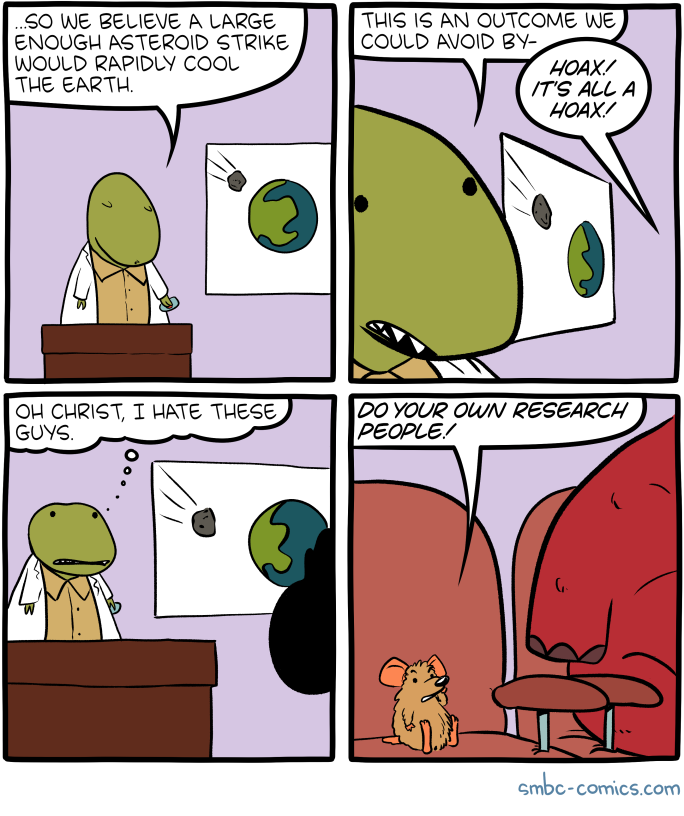
Saturday Morning Breakfast Cereal - Hoax

by tech@thehiveworks.com


Click here to go see the bonus panel!

Hovertext:
Look you can't prove that dinosaurs never said 'CHRIST'.


Today's News:
02 Mar 17:35

Failure

by Sarah Andersen

null

02 Mar 17:34

my employee seemed really frustrated in a meeting where she didn’t realize she was on camera

by Ask a Manager

This post, my employee seemed really frustrated in a meeting where she didn’t realize she was on camera , was originally published by Alison Green on Ask a Manager.

A reader writes:

I’m writing after an unusual Zoom meeting last week. I’m a department director and the meeting was to work on a special project. Just me, my direct report, Jane, and one of her direct reports, Liz, were in the meeting.

We all started the meeting with our cameras on and were following an agenda (that we all were regularly referencing). About 10 minutes in, I noticed Jane’s body language change markedly. She typically appears to be actively engaged in remote meetings leaning in, nodding, displaying neutral or pleasant facial expressions. However, during this meeting she started frequently leaning back, crossing her arms, putting her head back, closing her eyes, and shaking her head at times when Liz or I were talking. Initially I thought Jane looked like she was annoyed or irritated, but it was so unlike her that I then wondered if she was ill or experiencing some pain or major discomfort. This went on for a couple minutes and before I had a chance to ask Jane about it, she had asked for my advice about how to proceed with a small piece of the project and when I gave my response, she did an exaggerated eye roll/head roll and I immediately realized that she had probably forgotten her camera was on. I then quickly asked, “Jane, are you aware that your camera is on?” and she replied that she wasn’t and from that moment forward her body language returned to her normal.

We didn’t talk anymore about it during that meeting but Jane and I had a pre-scheduled 1-1 right after that meeting where I brought it up first thing saying, “Before we get into our agenda I want to talk about something that came up in our meeting with Liz. I noticed a pretty big eye roll from you.” Jane acknowledged the eye roll and said she felt bad and didn’t realize her camera was on. She said she was just frustrated at herself for not delivering on a different piece of the project. I told her I would like her to openly share with me if she disagrees with my advice or feels frustrated by anything going on with the project. I shared that I respect her expertise in this area and want her to help guide the project. She replied that she knew that and was just having an off day. While I appreciate Jane’s professionalism in handling the conversation, this rings false to me. Her actions appeared to be those of someone finding the conversation so insufferable, she couldn’t help but react in a physical way. This wasn’t just a minor eye roll, it was a really big one (which Liz also clearly noticed) and came after other frustrated gestures.

Now for my questions: Jane and I often have meetings with our cameras off. I’m now wondering if these actions are typical of her during meetings when she is not on camera. While she says the right things and sounds engaged, the level of frustration she displayed during the call was shocking and did not appear to be a new slow simmer starting, but rather a full-on rolling boil of irritation, so I’m wondering if she secretly hates her job or the project we’re working or working with me or a combination of all three. Should I dig into this some more? If so, I’m afraid Jane will give me a smooth, professional answer but I don’t know if I would trust that she’s being honest. I also really want Jane to bring her ideas and suggestions to these projects; her experience and expertise in these areas is one of the reasons she’s in her position. I don’t want her to silently stew if she disagrees with something but instead I’d like her to actively engage and help shape our direction.

Jane also leads this project (and others) without me most of the time, so it’s important that she is really building buy-in with her team and isn’t speaking negatively about the project or our approach with others. I also feel like my overall trust in Jane has taken a big hit. Should I share my concerns and try to get more answers? Or just move on and count this as “an off day”?

Well, it’s entirely possible that Jane was just having a bad day. Or she could be someone who has big reactions when she thinks she’s in private, even if her frustration isn’t actually all that significant (those people exist). Or … yeah, it’s possible that she’s super frustrated with you/the job/that project.

There’s a limit to how much you can probe into what might be going on without overstepping. If she’s putting up clear signs that say “there’s nothing to discuss here” and you keep pushing past a certain point, that’ll be legitimately aggravating to her regardless of how well-founded your concern is.

So instead, use this as a flag to do your own reflection. What else do you know about Jane? You said she normally appears engaged and pleasant in meetings, so that’s one piece of data. What kind of feedback do you get about her work from others? Does she bring ideas and suggestions to projects, as you want? Have you seen her speak up when she disagrees with something — and if so, what happens when she does, and have you seen her do it recently? (If she used to do it but has stopped recently, that’s relevant — especially if her feedback in the past didn’t accomplish much.) Have you seen her be willing to have hard conversations? Is the work environment on your team one where speaking up about problems is rewarded and encouraged and one where that leads to positive change? Is she given opportunities to have meaningful input into issues that affect her job?

Other stuff that can cause the kind of frustration you saw: What’s her workload like? What are these meetings like — do they drag on and go off-topic, or do they run pretty efficiently? What kind of recognition has she received or not received for her work? Is she empowered to make real progress in her work or are there unaddressed roadblocks stymying her momentum? Has she made requests for things that have been denied (resources, training, equipment, staffing assistance, time off, money)? When was her last real vacation?

If you’re brutally honest with yourself about all those questions, you might come up with context that helps make sense of what you saw in that meeting, and it might give you a roadmap to address whatever frustration Jane might be feeling without needing her to actively guide you through it.

But if you come up dry … well, at that point if you want to keep digging into it, you could look at things like mechanisms to get honest, confidential feedback on your management from the whole team. But it wouldn’t be unreasonable to decide at that point to just take Jane at her word that there aren’t bigger issues.

It’s also worth noting that there’s a point where Jane’s internal feelings about her job are her own private feelings and not ones you’re entitled to force her to bare.

Ultimately, what matters most is how she’s showing up at work. If she’s doing good work and being generally pleasant and raising ideas/suggestions/problems in a way appropriate to her role … well, she’s doing her job effectively! If she’s silently fuming under the surface but won’t talk about it with you and it doesn’t show up other than in this one on-camera mistake … I get why you’re concerned and it’s also kind of her prerogative. If you do your due diligence as described above, it’s okay to just leave it there.

02 Mar 17:27

We’re Protecting Children by Criminalizing Parents Who Try to Keep Them Happy and Healthy

by Bobbie Armstrong

“Texas officials have begun investigating parents of transgender adolescents for possible child abuse, according to a lawsuit filed on Tuesday, after Gov. Greg Abbott directed them last week to handle certain medical treatments as possible crimes.” — New York Times, 3/1/22

- - -

Here in Texas, we strive to protect our children from those who want to put their well-being ahead of our state goverment’s almost cartoonishly sinister policies. This is why we have taken the necessary step of criminalizing the actions of parents who try to keep their children healthy and happy.

From this point on, the Texas Department of Family and Protective Services will take charge whenever they see mothers and fathers put their children in harm’s way by shielding them from our oppressive government meddling.

The ACLU wants to bar lawmakers in Texas from charging irresponsible parents who are likely committing child abuse by doing what they think is best for their children. How dare they? Don’t they realize that it’s our job as old Republican men, many of us who still refer to grown women as “girls,” to be the deciding factor in trans healthcare in 2022?

Radicalized parents may counter by saying that it is simply not an option for them not to make sure their children have access to the care they need. But they must consider the care that their state government needs. We too have mental health issues. Imagine how depressed we would become if we were no longer allowed to interfere in the private lives of Texas citizens. It would send shivers up our spines, if we had any.

As the midterm election nears, it is important to remind our constituents what the GOP stands for: a total lack of respect and disregard for non-white-adult-male lives. We claim to be pro-liberty and privacy, but we really only mean that if you fit our narrow definition of “acceptable human being.” Otherwise, best of luck.

To parents who feel betrayed by this new directive, just know how betrayed your trans teen feels when you show how much you care for them and want to make sure they have a happy life. No wonder trans teen suicide rates are so high.

Critics may say that our policies in Texas have lurched even sharper to the right, but they actually have swerved straight off the road, crashed through a NO EXIT sign, and nosedived into utter insanity. And that is where we would prefer our policies to stay.

You see, we have no interest in creating laws that in any way, shape or form align with medical science. We simply cannot in good conscience allow minors to do anything that goes against the draconian views of the Republican Party.

We hope you’ll understand that in Texas in 2022, good parenting is now a crime. Sorry for the inconvenience.

02 Mar 15:29

Watch: A lost gentleman from Texas joins forces with Russian soldiers to "bring down the hammer"

by Carla Sinclair

It's not all Russians on the ground attacking Ukraine. Among the Russian military is one confused gentleman from Texas who is now a foot soldier for Putin, proudly standing with the "denazifiers and liberators" in Ukraine.

"These guys are tough, these guys are ready, and there's plenty of 'em," says middle-aged Russell Bonner Bentley, who stands near his Russian comrades in the video clip below. — Read the rest

02 Mar 15:27

Let’s Recall What Exactly Paul Manafort and Rudy Giuliani Were Doing in Ukraine

by by Ilya Marritz

by Ilya Marritz

ProPublica is a nonprofit newsroom that investigates abuses of power. Sign up to receive our biggest stories as soon as they’re published.

Though Russia’s full-scale invasion of Ukraine is just days old, Russia has been working for years to influence and undermine the independence of its smaller neighbor. As it happens, some Americans have played a role in that effort.

One was former President Donald Trump’s campaign chairman Paul Manafort. Another was Trump’s then-lawyer Rudy Giuliani.

It’s all detailed in a wide array of public documents, particularly a bipartisan 2020 Senate report on Trump and Russia. I was one of the journalists who dug into all the connections, as part of the Trump, Inc. podcast with ProPublica and WNYC. (I was in Kyiv, retracing Manafort’s steps, when Trump’s infamous call with Ukraine’s president was revealed in September 2019.)

Given recent events, I thought it’d be helpful to put all the tidbits together, showing what happened step by step.

Americans Making Money Abroad. What’s the Problem?

Paul Manafort was a longtime Republican consultant and lobbyist who’d developed a speciality working with unsavory, undemocratic clients. In 2004, he was hired by oligarchs supporting a pro-Russian party in Ukraine. It was a tough assignment: The Party of Regions needed an image makeover. A recent election had been marred by allegations that fraud had been committed in favor of the party’s candidate, prompting a popular revolt that became known as the Orange Revolution.

In a memo for Ukraine’s reportedly richest man, Rinat Akhmetov, Manafort summed up the polling: Many respondents said they associated the Party of Regions with corruption and considered it the “party of oligarchs.”

Manafort set to work rebranding the party with poll-tested messaging and improved stagecraft. Before long, the Party of Regions was in power in Kyiv. One of his key aides in Ukraine was, allegedly, a Russian spy. The Senate Intelligence Committee report on Trump and Russia said Konstantin Kilimnik was both “a Russian intelligence officer” and “an integral part of Manafort’s operations in Ukraine and Russia.”

Kilimnik has denied he is a Russian spy. He was indicted by Special Counsel Robert Mueller for obstruction of justice for allegedly trying to get witnesses to lie in testimony to prosecutors in the Manafort case. Kilimnik, who reportedly lives in Moscow, has not been arrested. In an email to The Washington Post, Kilimnik distanced himself from Manafort’s legal woes and wrote, “I am still confused as to why I was pulled into this mess.”

Manafort did quite well during his time in Ukraine. He was paid tens of millions of dollars by pro-Russian President Viktor Yanukovych and other clients, stashing much of the money in undeclared bank accounts in Cyprus and the Caribbean. He used the hidden income to enjoy some of the finer things in life, such as a $15,000 ostrich jacket. Manafort was convicted in 2018 of wide-ranging financial crimes.

“We Are Going to Have So Much Fun, and Change the World in the Process”

In 2014, Manafort’s plum assignment in Ukraine came to an abrupt end. In February of that year, Yanukovych was deposed in Ukraine’s second uprising in a decade, known as the Maidan Revolution, in which more than a hundred protesters were killed in Kyiv. He fled to Russia, leaving behind a vast, opulent estate (now a museum) with gold-plated bathroom fixtures, a galleon on a lake and a 100-car garage.

With big bills and no more big checks coming in, Manafort soon found himself deep in debt, including to a Russian oligarch. He eventually pitched himself for a new gig in American politics as a convention manager, wrangling delegates for an iconoclastic reality-TV star and real estate developer.

“I am not looking for a paid job,” he wrote to the Trump campaign in early 2016. Manafort was hired that spring, working for free.

According to the Senate report, in mid-May 2016 he emailed top Trump fundraiser Tom Barrack, “We are going to have so much fun, and change the world in the process.” (Barrack was charged last year with failing to register as a foreign agent, involving his work for the United Arab Emirates. He has pleaded not guilty. The case has not yet gone to trial.)

A few months later, the Trump campaign put the kibosh on proposed language in the Republican Party platform that expressed support for arming Ukraine with defensive weapons.

One Trump campaign aide told Mueller that Trump’s view was that “the Europeans should take primary responsibility for any assistance to Ukraine, that there should be improved U.S.-Russia relations, and that he did not want to start World War III over that region.”

According to the Senate report, Manafort met Kilimnik twice in person while working on the Trump campaign, messaged with him electronically and shared “sensitive campaign polling data” with him.

Senate investigators wrote in their report that they suspected Kilimnik served as “a channel for coordination” on the Russian military intelligence operation to hack into Democratic emails and leak them.

The Senate intel report notes that in about a dozen interviews with Special Counsel Robert Mueller, Manafort “lied consistently” about “one issue in particular: his interactions with Kilimnik.”

Manafort’s attorney did not immediately respond to a request for comment.

Manafort didn’t make it to Election Day on the Trump campaign. In August 2016, The New York Times revealed that handwritten ledgers recovered from Yanukovych’s estate showed nearly $13 million in previously undisclosed payments to Manafort from Yanukovych and his pro-Russian party. Manafort was pushed out of his job as Trump’s campaign chairman less than a week later.

After Trump won the election, the Senate report says, Manafort and Kilimnik worked together on a proposed “plan” for Ukraine that would create an Autonomous Republic of Donbas in separatist-run southeast Ukraine, on the Russian border. Manafort went so far as to work with a pollster on a survey on public attitudes to Yanukovych, the deposed president. The plan only would need a “wink” from the new U.S. president, Kilimnik wrote to Manafort in an email.

Manafort continued to work on the “plan” even after he had been indicted on charges of bank fraud and conspiracy, according to the Senate report. It’s not clear what became of the effort, if anything.

“Do Us a Favor”

With Manafort’s conviction in 2018, Rudy Giuliani came to the fore as the most Ukraine-connected person close to President Trump. Giuliani had long jetted around Eastern Europe. He’d hung out in Kyiv, supporting former professional boxer Vitali Klitschko’s run for mayor. One of Giuliani’s clients for his law firm happened to be Russia’s state oil producer, Rosneft.

By 2018, Giuliani had joined Trump’s legal team, leading the public effort to discredit Robert Mueller’s investigation. Giuliani saw that Ukraine could be a key to that effort.

Giuliani ended up working with a pair of émigré business partners, Lev Parnas and Igor Fruman, to make contacts in Ukraine with corrupt and questionable prosecutors, in an effort to turn up “dirt” on Joe Biden’s son, Hunter Biden, who had served on the board of a Ukrainian energy company. Giuliani also worked to sow doubt about the ledger that had revealed the secret payments to Manafort, meeting with his buddies in a literally smoke-filled room.

Parnas and Fruman told the president at a donor dinner in 2018 that the U.S. ambassador in Kyiv was a liability to his administration.

((<a href="https://www.rev.com/blog/transcripts/donald-trump-parnas-yovanovitch-recording-transcript-trump-discusses-firing-yovanovitch-at-donor-dinner">Transcript</a> courtesy of rev.com))

Trump recalled Ambassador Marie Yovanovitch, who had been a vocal opponent of corruption in Ukraine, from Kyiv in May 2019.

Two months later, Trump had his infamous call with Ukraine’s new President, Volodymyr Zelenskyy.

Zelenskyy asked Trump for anti-tank Javelin missiles. You know what happened next. Trump said he needed Zelenskyy to first “do us a favor” and initiate investigations that would be damaging to Joe Biden. He also pressed Zelenskyy to meet with Giuliani, according to the official readout of the call:

These events became publicly known in September 2019, when a whistleblower complaint was leaked.

“In the course of my official duties, I have received information from multiple U.S. Government officials that the President of the United States is using the power of his office to solicit interference from a foreign country in the 2020 U.S. election,” the whistleblower wrote.

In December 2019, as an impeachment inquiry was at full tilt, Giuliani flew to Ukraine and met with a member of Ukraine’s parliament, Andrii Derkach, in an apparent effort to discredit the investigation of Trump’s actions. Derkach, a former member of the Party of Regions, went on to release a trove of dubious audio “recordings” that seemed to be aimed at showing Biden’s actions in Ukraine, when he was vice president, in a negative light.

Within months, the U.S. Treasury Department sanctioned Derkach, describing him as “an active Russian agent for over a decade” who tried to undermine U.S. elections. Derkach has called that idea “nonsense.”

In a statement, Giuliani said, “there is nothing I saw that said he was a Russian agent. There is nothing he gave me that seemed to come from Russia at all.” Giuliani has consistently maintained that his actions in Ukraine were proper and lawful. His lawyer did not immediately respond to a request for comment.

Where They Are Now...

Many of Trump’s allies have been charged or investigated for their work in and around Ukraine:

Paul Manafort: convicted of financial fraud — then pardoned by Trump

Rick Gates: a Manafort aide who pleaded guilty to conspiracy and lying to the FBI

Sam Patten: another Manafort associate convicted for acting as a straw donor to the Trump inaugural committee on behalf of a Ukrainian oligarch

Rudy Giuliani: reportedly under criminal investigation over his dealings in Ukraine; his lawyer called an FBI search of his home and seizure of electronic devices “legal thuggery”

Lev Parnas and Igor Fruman: convicted for funneling foreign money into U.S. elections; Parnas’ attorney said he would appeal

Key Documents
01 Mar 18:17

For the Sake of Simplicity

For the sake of simplicity, gardeners are assumed to move through Euclidean space--neglecting the distortion from general relativity--unless they are in the vicinity of a Schwarzschild Orchid.
01 Mar 18:01

3 of my employees are having a conflict … and I can’t tell who’s right or wrong

by Ask a Manager

This post, 3 of my employees are having a conflict … and I can’t tell who’s right or wrong , was originally published by Alison Green on Ask a Manager.

A reader writes:

I am currently the executive director of a small organization, dealing with an intense conflict related to three employees I’ll call Maggie, Sarah, and Lisa.

Maggie was hired primarily for a technical role. She’s absolutely excellent at it. In part because she’s unusually quick, we don’t always produce enough work to keep her fully occupied. But to take on any other responsibilities, she needs a lot of training and experience that she currently lacks.

I’ve been up-front with her about this — to move forward in her career, she can either a) continue growing her skills in this technical area (which would likely mean leaving the organization one day if she wants to keep progressing) or b) train in other areas. She’s expressed a preference for b. So I’ve sent her to trainings, and she’s taken on tasks here and there outside her technical area as she continues to learn.

In 2020, Sarah got a promotion. Shortly afterward, she came to me, pretty upset, and said that Maggie was undermining her behind the scenes, criticizing her work and generally making her feel terrible. I spoke to Maggie and told her that this behavior was unacceptable and that it could not happen again. I also moved things around so that they didn’t have to work together as closely.

Eighteen months pass. Things seem basically OK. Maggie is continuing to learn and progress. She and Sarah aren’t friends, but they collaborate occasionally without problems.

Then Lisa gets a promotion. Shortly afterwards, Lisa tells me that Maggie isn’t meeting deadlines for her projects and that it feels like a sign of disrespect. Maggie has missed some deadlines, but Lisa is also being somewhat unreasonable in her expectations. I talk with Maggie about meeting deadlines, with Lisa about reasonable expectations, and with both of them about being respectful and assuming best intentions.

Three weeks pass. Maggie is getting all of Lisa’s projects done early and seems to be going way out of her way to be a helpful, effective coworker.

Then Lisa comes to me, sobbing, and says that Maggie is undermining her behind the scenes, criticizing her and making her feel terrible — basically a more intense version of what Sarah told me in 2020. When I ask for specific examples, she says that Maggie messaged her the day before and told her that her work wasn’t good enough and that she was letting the organization down, and that Maggie then deleted the message to avoid accountability.

I set up a meeting with Maggie right away. I say that undermining and criticizing people isn’t tolerated, that this is the second time it’s happened, and that she is going to be put on a performance improvement plan around this issue.

Maggie, very upset, shows me a screenshot of the message from the day before … and it’s, frankly, innocuous. It’s Maggie asking a question and proposing some work she’d like to take on, in pretty gentle, positive language. Maggie says that Sarah and Lisa have been the ones undermining her this whole time, criticizing her harshly, telling her that her ideas are bad, and then coming to me with unjustified complaints.

At this point, I have no idea what to think. The whole time, in the spaces where I’m present, Maggie, Lisa and Sarah have appeared to be respectful and supportive of each other, so all of this is based on second-hand reports about what’s going on behind my back. How do I move forward from here?

It sounds like your instinct has been to take everyone at their word, so the first person who reported anything to you got believed and the person they accused got reprimanded … without any real questions. That can’t be how you handle complaints from employees. For one thing, sometimes people lie! And even if someone isn’t lying, their perspective can be skewed in ways that really matter. Or they could be getting the facts exactly right but leaving out important context or they might be unaware of extenuating circumstances.

Your job as a manager is to be aware of all of those possibilities and not rush in to condemn anyone. Instead, you need to ask questions. It sounds like that didn’t happen here, and it’s led to a mess — one where you might have been awfully unfair to Maggie. If so, this is the kind of thing that can severely demoralize the person in Maggie’s shoes, destroy their trust in you, and cause them to leave. It’s a big deal!

Ideally when Sarah first complained to you about Maggie, you would have asked for specifics and then met with Maggie — not to scold her but to inquire into her perspective. That means asking questions rather than jumping to any conclusions — questions about her relationship with Sarah, whether she had any insight into why Sarah might feel that way, and how she herself felt things were going. If you didn’t get clarity from that conversation and felt like you were in an unresolvable she said/she said situation, then at that point you could address it with both of them in a way that didn’t draw conclusions but laid out principles for how you want them each operating and what they should each do if they encounter a problem in the future. For example, you could have said to Maggie, “I’m having a hard time unraveling what’s been going on. I’m going to talk with Sarah as well, but for now I want to make it clear to both of you that if you have concerns about Sarah’s work, you should bring those to me rather than trying to address them with her directly. If there continue to be problems of any kind between you, please loop me in early on so I know what’s happening and can help resolve it.” And you could have said to Sarah, “I’m having a hard time unraveling what’s been going on, but I’ve told Maggie that if she has concerns about your work, she should bring those to me rather than to you. If there continue to be problems of any kind between you, please loop me in early on so I can help resolve it.”

It sounds like you did do a version of this when the third employee, Lisa, told you Maggie was missing deadlines, which is good!

But then when she came back to you with the same complaints Sarah had, it sounds like you jumped straight to chastising Maggie and threatening her with an improvement plan without stopping to get her perspective. I realize at that point it likely looked like a pattern — these were the same complaints Sarah had too, after all! — but in both cases of the “pattern,” you had skipped the crucial step of getting Maggie’s perspective on what was happening.

Fortunately Maggie had that screenshot of the innocuous message she had sent Lisa. But what if she hadn’t? Would she be on a performance improvement plan right now? Or what if, like a lot of people, she hadn’t felt comfortable telling you that you’d gotten it wrong?

Of course, before things go further, you need to make sure that’s the same message Lisa is referring to! Maybe it’s not.

Speaking of which, is most of their communication in writing? If so, you can probably solve this right now by reviewing a bunch of it (in some cases even if messages have been deleted on their end). But if there’s not much in writing, keep reading.

It’s possible that by questioning each of these three — starting with no assumptions and not taking anyone’s word as gospel — you’ll be able to piece together a clearer understanding of what’s been going on. But it’s also possible that you won’t be; if one side is deliberately trying to obfuscate, it might still end up as one person’s word against another. If that happens, it’s legitimate to factor in what you know of each person; if one person has a strong track record of integrity and honesty and the other doesn’t, that’s relevant.

Ultimately, if you can’t sort it out, you would need to sit down with each of them and say, “I’m hearing different things from each person, and I haven’t been able to get to the bottom of it. So I am going to lay out principles for how things need to work going forward, and I am going to check in with each of you regularly to make sure that’s happening. I’m also going to be more involved with your joint projects for a while so that I can see firsthand how things are working. If you or anyone on this team is being mistreated, I have a zero-tolerance policy for that, so I’m going to stay involved enough that I can understand what’s been happening.”

And then you’ve got to do that. What that looks like will depend on the details of their work, but it could mean that you sit in on their project meetings for a while, or all their communication needs to take place in a Slack channel you can monitor, or you’re cc’d on emails.

Who knows what’s really going on. Maybe Maggie really is trying to undermine Sarah and Lisa. Maybe Lisa and Sarah are trying to undermine Maggie. Maybe it’s neither of those and Lisa and Sarah are way too sensitive to perfectly normal things Maggie is saying. Who knows. But in a situation where you genuinely can’t sort out what’s happening, all you can do is lay out very clear expectations of behavior to each person involved, stay present enough so that you can see for yourself whether those expectations are adhered to, and check in regularly with each person about anything that might be happening that you’re not seeing.

But if it does turn out that anyone is outright lying — like sending cruel messages and then deleting them so they can deny sending them or falsely accusing someone else of that — that’s a serious enough offense that you’d need to let that person go. It’s beyond PIP territory. But make sure you know for sure what happened before you go that route; don’t assume or blindly trust any one person in a situation like this.

01 Mar 15:47

It's Time to Stop Pre-Rinsing Your Dishes

by Sarah Showfety

I always pre-rinse my dishes. While I’m no nutcase—I don’t actually wash them before placing them in the dishwasher racks—leaving the remains of a runny egg, clingy sauce, or (gasp) oatmeal on my crockery simply feels wrong.

Read more...