When Governor Greg Abbott announced the launch of Operation Lone Star in March of last year, it seemed to be just the latest in a long string of state-sanctioned border security theatrics. First, in 2005, there was former Governor Rick Perry’s “Operation Linebacker,” which sought to stop Al Qaeda terrorists and other criminals from crossing into Texas. Linebacker was then followed, consecutively, by Rio Grande, Wrangler, Border Star, Drawbridge, Strong Safety, and Strong Safety II. In 2015 came Abbott’s first gubernatorial border operation, “Secure Texas.”
Through these various missions, Texas has deployed state troopers and National Guard soldiers to the border to quell one threat after the next, costing tens of millions in state funds. The effects of these operations have been questionable at best, but they’ve made for plenty of great photo-ops for Republican politicians.
But Abbott has gone far beyond previous escapades—in cost, scope, legality, and political grandstanding—by usurping the federal government’s immigration authority with a state-controlled enforcement and detention apparatus. Soon after launching Operation Lone Star, the governor issued a disaster declaration in dozens of counties along the border and beyond, deeming the flow of migrants into Texas an “imminent threat” and granting him greatly expanded executive powers. He also unveiled plans—with former President Donald Trump at his side—for the state to build its own border wall, and for Department of Public Safety troopers to arrest and jail migrants on criminal trespassing charges. With little notice or planning, Abbott then ordered the state military to deploy a huge force of National Guard members to the border. Last summer, at his behest, the Texas Legislature rammed through a bill that would more than triple the state’s border security spending to roughly $3 billion, including $750 million for border wall construction.
Abbott’s actions have prompted a significant backlash. Amanda Woog, head of the criminal justice advocacy group Texas Fair Defense Project, called the governor’s scheme “a road map for any authoritarian ruler of any state to co-opt the criminal legal system and target it at perceived political enemies.” Civil rights lawyers have sued the state for violating the constitutional rights, en masse, of thousands of migrants who’ve been arrested and thrown into makeshift jails for months on end without attorneys or even court dates. Under pressure from far-right primary challengers and an insatiable Republican base, Abbott scrambled to get as many soldiers as possible to the border, totaling about 10,000. National Guard members have complained of being deployed on a mission without a clear end date or purpose. At the outset, the state couldn’t even get paychecks to many soldiers on time or ensure adequate housing and supplies for the Guard’s border outposts.
Abbott’s failures as a commander-in-chief eventually led to the departures of the state’s top military leaders in charge of the operation, including his commander of the Texas Military Department, Major General Tracy Norris, who left her post in March. Meanwhile, Operation Lone Star’s unprecedented size and scope have led to massive cost overruns. In January, Abbott commandeered almost $500 million from the state prison system to cover the National Guard payroll. In April, the new head of the Guard told state senators that those funds were about to run out and that it would need another $530 million to make it through August.
Pressed about the ballooning financial burdens of his state border scheme, Abbott blamed the Democratic president. “Because Joe Biden is not securing the border, the state of Texas is having to step up and spend Texas taxpayer money doing the federal government’s job,” Abbott said earlier this year.
Still, the governor and his law enforcement deputies have deemed Operation Lone Star an unmitigated success, boasting of more than 13,000 criminal arrests (mostly for trumped-up trespassing charges), thousands of pounds of drug seizures, and more than 200,000 migrants that state troopers and guards have referred to U.S. Border Patrol.
Yet, as a joint investigation by the Texas Tribune, Marshall Project, and ProPublica found, those claims of success are based on state law enforcement juking the stats. Reporters discovered that in coming up with their figures, DPS counted crimes that had no relation to the border, work done by state troopers in South Texas well before the operation, and drug busts and migrant apprehensions made in tandem with other agencies.
This isn’t the first time DPS has been called out for padding its numbers to justify its massive border-security budgets. Even before Operation Lone Star, Texas lawmakers had steadily ratcheted up spending on the state’s border dragnet, from about $110 million per biennium in 2008, up to $800 million per biennium in recent years. On top of the already significant federal border patrol presence, state enforcement efforts have turned the Texas borderlands into an even more heavily militarized police zone.
Abbott’s aggressive expansion of Operation Lone Star was a direct political response to a band of right-wing primary challengers that embodied the far-right, Trumped-up Republican base. For them, no step was too far when it came to the border and immigration, and each step Abbott took wasn’t far enough.
Many suspected that the governor was merely feigning far right to get through the primary and would ease back once he won. But, since wiping out his opponents in March, Abbott has kept his foot on the gas.
When President Biden announced in April his administration’s plan to finally revoke Title 42—the Trump executive order that slammed the door on asylum-seekers in the name of COVID-19—Republicans cried out of an impending “invasion” of migrants.
Abbott quickly said that, in anticipation, he was further expanding Operation Lone Star. Like the “steel wall” of DPS vehicles, military humvees, and shipping containers he assembled during the immigration crisis of late last year, now there would be DPS “boat brigades” to block migrants from crossing the Rio Grande. The Texas Military Department began a series of “mass-migration rehearsals”—the sort of military exercises that remind one of Jade Helm.
Abbott also ordered the state’s emergency management agency to charter hundreds of buses and flights to transport migrants whom federal immigration authorities have released from the border to the steps of the U.S. Capitol. The first bus arrived in mid-April, with camera crews waiting, right outside the Fox News studio in Washington.
Back at the border, Abbott also directed DPS to set up checkpoints right after the federal ports of entry and conduct enhanced safety inspections of every commercial vehicle entering Texas, ostensibly to find smuggled drugs or migrants that had slipped through. Predictably, this ground cross-border trade to a halt, with trucks backed up for miles in Mexico. One-by-one, Abbott met with the governors from the Mexican states that border Texas to strike deals: In exchange for vague promises of amped-up security measures on their side of the border, Abbott would end the DPS checkpoints.
The deals were announced in a series of side-by-side press conferences in Texas. Within a week, the safety inspections stopped. Of the roughly 4,100 trucks inspected, DPS found no drugs, migrants, or any other contraband. In the meantime, delayed truckers lost out on pay, thousands of pounds of produce spoiled, and international trade—the backbone of Texas’ economy—was ground to a halt. While Abbott touted the security agreements he secured from Mexican governors, likely worth less than the paper they were signed on, one estimate pegged the cost of the border stunt at about $4 billion.
Today is Morse Code Day! You might be surprised to learn that CW (the modern term for Morse) is still widely used in certain corners of the amateur radio universe, not for nostalgia reasons, but because it’s still the best solution to a particular problem. If you want a human-mediated communication method with low transmitter power requirements, good for portable use, and with a very narrow bandwidth (to avoid overlap or interference with other signals), then Morse is your answer. There are plenty of companies making new CW transceivers, like this Mountain Topper series. Maybe their slogan should be “Morse: not dead yet.”
For the past several weeks I’ve been hard at work attempting to learn Morse, spending time each day with trainer software to practice decoding and sending. It’s hard. It doesn’t take too long to learn the dash-dot patterns of the 40-something letters, numbers, and symbols, but it’s hard to be fluent enough to mentally decode them quickly and without conscious thought. Unlike reading a book in a foreign language, you can’t stop and go back over a section where you had trouble. If you ever need to pause and think “what does dash-dot-dash-dash mean again?” then you’re dead. You just need to practice and practice until dash-dot-dash-dash innately sounds like Y in your head, just as much as a spoken word does.
A few decades ago, most people learned Morse by starting at a slow speed about 5 words per minute, which was once the speed requirement for a Novice radio operator’s license in the United States. But at that speed, you can consciously count the dashes and dots, and you naturally construct a lookup table inside your head. You think 1-1-2, oh that’s a Y. But this turns out to be a handicap when you attempt to go faster, and conscious access to a mental lookup table simply can’t go fast enough. The most recommended learning method today is to start learning letters at 18 to 20 wpm, where you can’t easily count the individual dashes and dots anymore, but you learn to recognize the rhythm of each letter, like a snippet of music. But to avoid becoming overwhelmed, extra space is inserted between each letter so the overall average rate is still 10 wpm or less.
Experienced CW operators tell me that learning to send Morse is actually easier than learning to receive and decode it. I’ve been practicing receiving for several weeks, but only just started sending practice a few days ago.
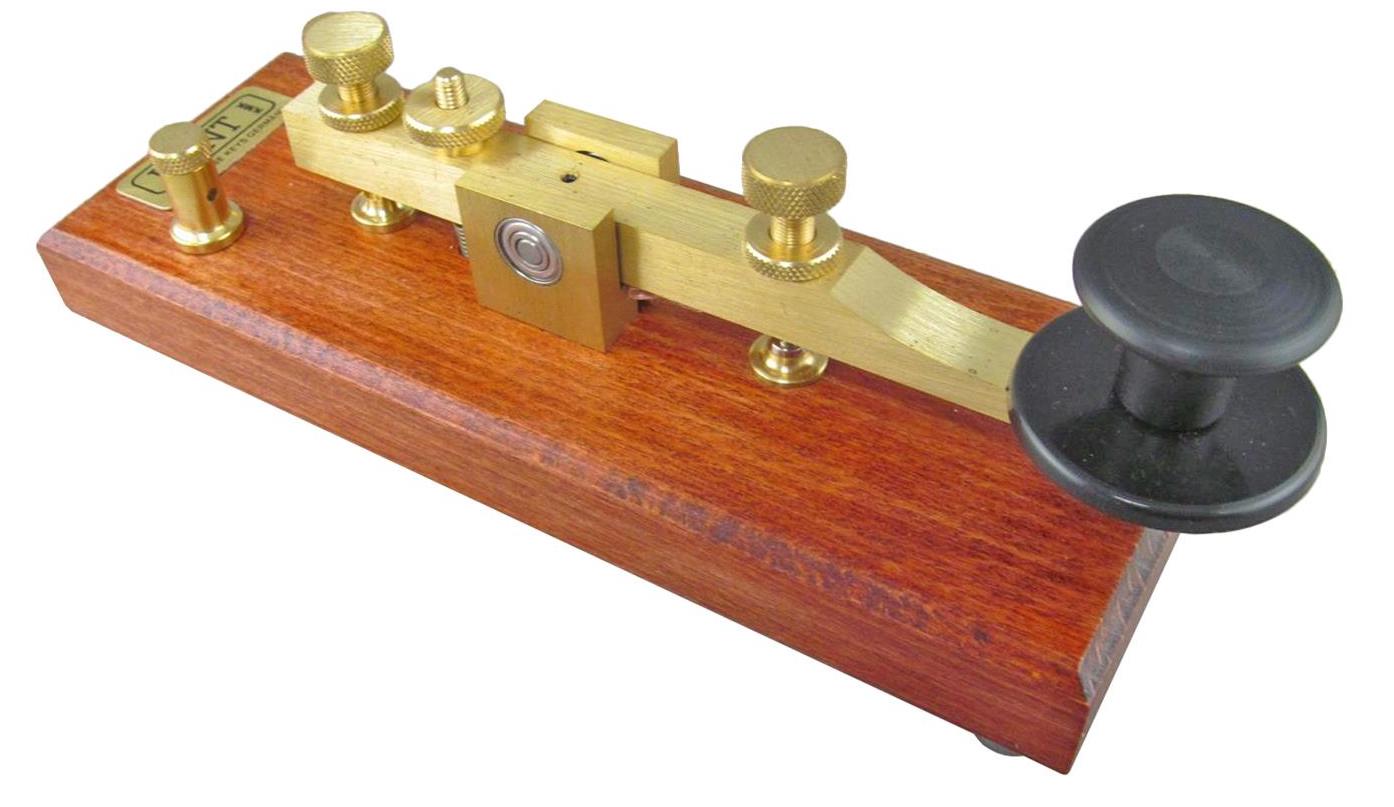
The technology used for sending Morse has changed over the decades. In old movies you see people making tap-tap-tap gestures on a single lever, that’s called a straight key. These aren’t used much anymore, but they’re easy to understand. As long as the key is held down, the radio emits a tone, and the operator has full control over the speed and relative duration of dashes and dots and the gaps between them. This allowed operators to develop a distinctive keying style called a “fist”, which others could use to recognize them even if they weren’t explicitly identified. For example, an operator might have a habit of slightly rushing the last dot in R, or using a particular uneven spacing between the elements of C.
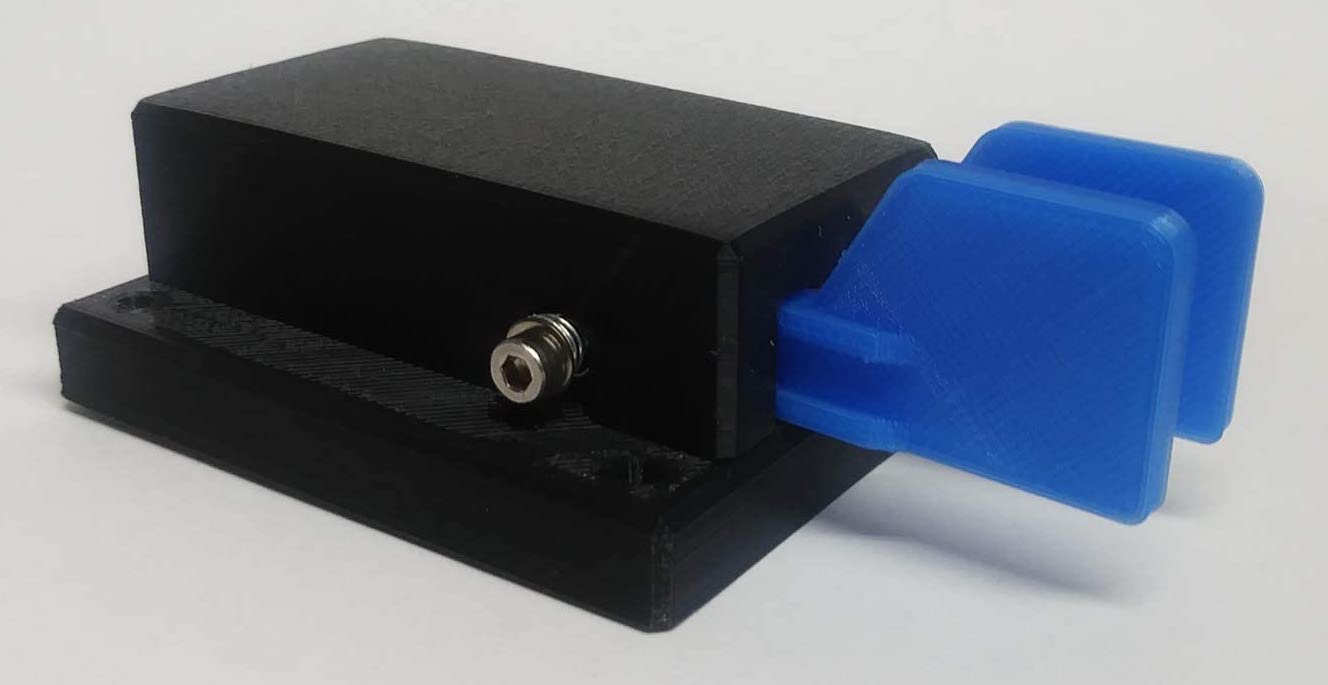
Today most CW operators use a device called a paddle, along with an electronic keyer. The paddle has two levers that are pushed horizontally rather than vertically, one paddle for dashes and one for dots. A circuit in the electronic keyer emits a perfectly-timed series of dashes or dots for as long as the corresponding paddle is pushed. There’s also a simple form of “type ahead”. If you push the dot paddle while a dash is being transmitted, the keyer will emit the dot after the dash is finished, with exactly the right gap between them.
VBand is a fun web-based tool for experimenting with Morse code along with other beginners. You can use keyboard keys as if they were the levers on a paddle, then jump into a chat room and have a horribly fractured conversation with a stranger.
An odd bit of trivia: the original code developed by Samuel Morse in 1838 is not what’s used today. That code was retroactively named American Morse Code, after the rest of the world adopted a different version. American Morse is rather strange, and is now more-or-less extinct. Everybody today uses International Morse Code. Score one for standardization.
This is episode 202 of the Angry Video Game Nerd (AVGN) and The Nerd is talking Contra! After years of playing nothing but crappy games, The Nerd's dreams are fulfilled through a wish on a monkey's paw, allowing him to finally play something good. Contra for NES is one of those games that everyone has nostalgia for and the AVGN is no different, so he's taking us back to the past to relive a series near and dear to his heart. While focusing on the original Nintendo Entertainment System classic and it's sequel Super C, The Nerd also checks out Contra Arcade, Operation C, Contra III: The Alien Wars, Contra: Hard Corps, Contra: Legacy of War, C The Contra Adventure, and Contra 4. -- Contra is a run-and-gun shooter game originally developed and published by Konami for arcades in 1987, before coming to homes on the NES in 1988. Also known as Gryzor and Probotector in some regions.
1. My manager always asks if we’ll be reachable on our time off
I’m looking for a good way to address a pattern I’ve seen with an otherwise very compassionate manager about PTO requests. My direct manager leads a small and hard-working team, where we all are fairly specialized in our roles without a lot of crossover. Whenever anyone requests time off, an immediate first question from this manager is, “Are you going to be totally unreachable, or will you have service if we need something?”
I don’t know about the rest of the team, but the last two years have left me on the edge of burnout at all times, and when I take time off I would love to sign off and not worry about even the potential that I might receive a panicked call from a coworker. While we do work in a very deadline-driven industry (and one that often relies on client input and approval, which can put unexpected pressure on timelines and workflows) nothing we do is life or death and couldn’t wait a day, a week, or honestly even more than that if needed. I have a good rapport with this manager and they are usually receptive to my feedback, but for some reason I don’t quite know how to start this conversation. I want it to come across as a piece of positive and constructive feedback, but at the same time, I need there to be a real change so that the next time I ask for time off I’m not immediately preemptively defending my PTO and mental health.
Since you have good rapport and they’re receptive to feedback, you could lead into it this way: “With so many people dealing with burnout from the last two years, I wondered if I could give you some feedback about how we handle vacation time.” And then: “I’ve noticed that when we request time off, you always ask if we’ll be totally unreachable or if we’ll have service in case you need something. I would love to sign off completely and not worry that I might get work calls — and I think it’s so much healthier to be able to do that, and makes our jobs more sustainable if we have times where we fully disconnect — but that question always makes me feel like I need to be reachable if at all possible. I’d love to see us shift to a default that when we’re away, we’re really away.”
2. I’m exhausted by coworkers’ comments on my hair and clothes
I started a new job at a dream organization about six months ago, and we’re back in the office a couple times per week. Since returning to the office, I’ve noticed that my choice of clothing and hair color are a constant, daily source of conversation.
For context, I’m a fat queer person who likes to wear bold patterns, bright colors, and whose hair color changes frequently. I’m arguably the the most visibly queer person to work for this organization. And I’m also the fattest person to work for this organization.
While my colleagues mean well and are complimentary, every outfit and hair color change being a talking point every time I’m in the office is exhausting and starts to feel like a series of microaggressions, even though I know that’s not the intent. It’s happening with at least 10-15 people. Any suggestions for how I can go about shutting down this behavior?
This is tough; if it were just a couple of people, you could pull them aside and explain what you explained here. But with that many people, it’s going to be harder to shut down. One option is something like, “You couldn’t have known, but it wears me out to talk about my appearance so often! Let’s talk about something else.” But I’m not totally happy with that. What ideas do others have?
3. Can I ask for compensation since the candidate I suggested was hired?
I was approached by a recruiter about a company that had two open positions, one I was very interested in and another where I referred them to a excellent candidate. Both are the same sales position in different states. It ends up that I was passed over for the position I applied for, but the person I referred was actually hired for hers. Since I found that candidate for them, would it be just out of the question to ask them for some type of compensation, or are they just obligated to tell me thanks, if even that?
Asking for compensation for suggesting a candidate to a recruiter would come across as strange and out-of-touch. That’s not a thing that normally happens (outside of internal referral programs within a company, of course, but that’s not what this was). What you did was part of networking — a recruiter contacted you and you said “not me, but maybe Jane Smith” and now that recruiter probably considers you a stronger part of their network than they did before (or maybe not, who knows) but this isn’t a compensation situation.
As a general rule, in most professional situations you can’t normally ask for compensation after the fact (as opposed to the other person agreeing to it before accepting your help). There are some exceptions to this — like if someone uses your work in ways you hadn’t agreed to and which clearly violate the spirit of whatever agreement you did have, or in some cases if you’ve gone above and beyond at your job in very specific ways — but they’re the exceptions, not the norm.
4. Should I put my part-time job on my resume?
I’m a scientist working at a large biotech company. I’ve been very frustrated by constant promises for promotion that never happen. Everyone from my line manager to the Vice President have told me that I “deserve more,” but nothing ever comes of those conversations. I started to search for a new job, but it is difficult because I do not want to relocate and I live in a relatively rural area.
Then, about six months ago, a contact of mine from graduate school asked if I’d be interested doing part-time work for a startup. The job required a lot of skills that I am not strong in, but they offered to train me. Honestly, I would have done it for free just to be trained, but they are paying me an hourly rate much higher than the hourly equivalent of my full-time salary. So I jumped on the chance. I work nights and weekends and, although it is stressful, it has lifted a lot of my financial burden.
I’m still interested in leaving my full-time job, so I’ve been trying to prepare my resume and cover letter. How do I include my experience at the startup? Will employers see my extra job as a distraction? Should I leave it off? What’s the rule here?
You should keep it on your resume if it strengthens you as a candidate — if it shows skills or accomplishments that will be helpful for the jobs you’re applying for.
However, if you include it you’ll likely be asked if you plan to continue that job if they hire you. If you say yes, you’ll likely get questions about how much of your time it takes up and potential conflicts of interest, and you might encounter interviewers who say you’d need to give up the side job if you work for them (sometimes because of conflicts of interests, sometimes because of across-the-board policies on moonlighting, and sometimes because they think the new role will require your full attention/energy/availability). So you should be prepared for all of that and figure out ahead of time where you stand on it and how you want to respond.
5. Rejecting an offer because of the company culture
I received a job offer today that offered a 30% salary increase and a good opportunity for professional growth. The downside, however, is minuscule PTO and the fact that even despite the Great Resignation and the ongoing pandemic, this (huge!) employer insists that everyone come to the office every day. I’m in digital marketing, not client facing, and have had quantifiable successes working remotely over the past two-plus years. This role offers no flexibility for WFH unless it’s whatever they deem a “true emergency,” and staff must be in the office from 9 to 5 and not a minute later or earlier. According to a zillion Glassdoor reviews, folks arriving after 9 or leaving before 5 are marched in to leadership and made to explain themselves.
All of this is to say, this ain’t the culture for me. While my salary is currently low, I have truly flexible/unlimited PTO that my bosses encourage us to take, and my manager upholds an attitude of “I don’t care where you do your work, as long as you get it done.” This suits my responsibilities as a first-time parent, and ultimately I’d rather stick it out on the open market until I find the right balance rather than sacrifice the flexibility that’s crucial to my family in exchange for a decent raise (that would be eaten into by commuting).
When I decline this offer, how do I frame it so that it’s clear that while I was interested in the role and the work, this company’s refusal to budge on flexibility for corporate employees and its apparent lack of trust in staff to get the job done without resorting to enforcing the clock is a turn-off for me?
I’d say it this way: “The job itself sounds great, but my current company and the other employers I’m talking with offer significantly more flexibility on hours and remote work. Those things are really important to me, so I unfortunately can’t accept.”
Reading Rainbow, a program dedicated to children's literacy, aired on PBS for 23 years. LeVar Burton has won 12 Daytime Emmys and a Peabody Award for his work on the show.
(Image credit: Rachel M. Heimerman/Rachel M. Heimerman)
The Walt Disney World complex's governing board says that when Florida created its special district, the state pledged not to alter that status unless all its debts are paid off.
The City of Houston Mayor’s Office of Cultural Affairs (MOCA) and the Houston Health Department (HHD) have selected local artist David Maldonado to create a mural for the renovated Denver Harbor Multi-Service Center in the city’s Pleasantville neighborhood (just southeast of the Greater Fifth Ward).
Houston artist David Maldonado. Image courtesy of The City of Houston Mayor’s Office of Cultural Affairs.
The new center is scheduled to be completed in July 2022 and will provide social services such as educational and technology resources, access to a community garden and food pantry, and services for senior citizens. In preparation for the mural, Mr. Maldonado is hosting community meetings to gather input and feedback from local residents.
This mural commission is just one of many arts opportunities supported by MOCA. In February of this year, MOCA announced an open call with a budget of $430,000 for public art works at the new North Belt Public Safety Complex. Last month, a deadline passed for five public art commissions for the new international terminal at George Bush Intercontinental Airport.
In a press release announcing the commission, Mayor Sylvester Turner said, “The Denver Harbor community is significant to our city, and so is its history. The many partners involved in the development of this project agree that a community-centric artwork, which allows the story of Denver Harbor to be told, is essential for the success of these murals. We look forward to seeing artist David Maldonado engage with the residents of Denver Harbor and debut an original artwork that truly represents the community.”
Mr. Maldonado is a muralist, musician, and founder of Pan Dulce HTX, an organization devoted to creating opportunities for conversation and celebration through music, art, and culture. He was chosen for this opportunity by a selection panel led by the Houston Arts Alliance and composed of arts professionals and representatives from the City and the community. Panelists included Denver Harbor resident and host of All Real Radio Deniz Lopez, visual artists Venessa Monokian and Blake Bermel(aka Mez Data), community representative and Denver Harbor business owner Rene Porras, and Houston Health Department representative Roy Villarreal.
Last year, Mr. Maldonado was selected to paint a mural at a Houston Walmart as part of the company’s Together Somos Más initiative, which commissioned artists in Chicago, Miami, and Houston to create community murals. Recently, the artist was chosen to develop a Houston-specific logo for season nineteen of Bravo’s Top Chef, which was filmed in the city.
Of his mural plan, Mr. Maldonado stated: “For the large-scale mural at the entrance, my overall vision is to incorporate imagery that symbolizes and reflects the many different resources that the Multi-Service Center offers within. For example, floral patterns can represent the community garden. The center’s program areas of health and fitness, education, financial well-being, and community gatherings all offer major themes to be explored. This creative process will extend to the two smaller murals and to the bench at the entrance as well.”
1. I saw my manager’s rude texts about my resignation
I just put in my two weeks this past Friday at a company and during my Zoom meeting with my supervisor, I noticed her texting, which is not uncommon (I assume she’s very busy). However, I also noticed some texts coming into my phone from her from the corner of my eye while on the same call. Our call seemed fine but I realized when I got off that the texts that were popping up on my phone were between her and the CEO regarding me — I was accidentally the third person on this three-way chat. They mentioned me leaving being “not a great loss” and also said that my not receiving a certain bonus (one of the reasons I listed for leaving) was based on “problems” they had with me, although my boss had given me a non-performance reason for that. I was not made aware of any performance issues in my entire employment at this company.
I cannot stop thinking about how they saw me and now I have to finish two weeks here knowing that this was said about me. Should I go to HR under the guise of seeing if I can wrap my time up here sooner? I also want to bring up issues with the fact that they seemed to have withheld information from me that could have been rectified in order to qualify for this bonus. I am so paralyzed with knowing that they regarded me so poorly.
They might not have regarded you so poorly — some managers become bitter and petty when someone leaves and suddenly have complaints about their work that never existed before. Frankly, I’m not not inclined to put a lot of stock in your manager’s judgment (or character) because of what she revealed about herself in those texts; she sounds like a jerk. It’s not that managers never privately acknowledge to another manager that someone’s departure wasn’t a great loss; it’s that texting things like that while you were sitting right there, still in the middle of your resignation is a jerk move and says a lot about her professionalism and judgment.
As for what to do now … you’re right there on the texts so if you wanted to ask your manager about it, you could. You could say, “I don’t think you meant to include me on these texts, but I’m concerned about what you said about the bonus. You told me X but it sounds like it was Y and I’m wondering why I didn’t get that feedback while there was time for me to act on it.” And if you want to, you could indeed say, “It sounds like it would be better for me to wrap up my notice period earlier.” You also could say similar things to HR if you want to.
The big caveat is that you need to balance that against whether you’ll need a reference from her in the future (especially since you don’t always get to choose your references, so it’s not necessary as simple as “well, I just won’t list her”) and whether you think putting her on the spot will harm your ability to get a good reference from her. That’s awfully unfair, but it’s the reality of it … although these texts might show that you wouldn’t have gotten a good reference from her anyway, who knows. One possibility is to talk to HR and say explicitly that you’re concerned that raising this will affect your future references; sometimes they can ensure it doesn’t, but other times they can’t. You’ve got to factor this all into your thinking as you decide what you want to do.
2. Getting a dramatic haircut on my lunch break
My company just moved into a new office building. As luck would have it, our new place is right next door to a hair salon. I’m very overdue on a haircut, so I’ve been debating booking an appointment during my lunch break because it would be very convenient.
Would it (1) be weird to get a haircut during a workday as long as it’s on my break, and (2) be weird to get a sizable haircut if so? My hair is three feet long and very thick, and this would be a pretty major chop.
Nope, go for it. It’s fine to take care of personal errands like a haircut on your lunch break. The fact that it’s a dramatic change will probably draw comments and interest — but just because dramatic changes always do, not because there’s anything wrong with doing it on your break.
3. Applicant complained about not hearing back … a few hours after applying
I totally realize that this is a job seeker’s market, and I equally recognize that employers have definitely established a record of bad behavior when it comes to job applicants. But I have to offer some advice on how applicants follow up.
This morning I received a LinkedIn message from a student at my alma mater who was messaging me about an application she submitted for an internship at the company where I work. I don’t know this person, but she found me through the alumni group on LinkedIn (and I have no problems helping students from my alma mater if I can).
In her message, she told me that she “applied quite some time ago” and hasn’t heard back, and is trying to follow up. She had messaged me at 10 am and the job posting went live when IT refreshed our site in the overnight — literally eight hours previously. This is not exactly “some time ago” and it definitely is giving us pause about bringing her in for an interview!
Yeah … that’s someone who’s letting their impatience to hear back get in the way of reasonable behavior. In fact, it’s so over the top that I wonder if it’s possible she’s referring to a different job that she did apply to a while back, not the one that was posted that day! Even if you’re pretty sure if it’s this same job, though, it’s worth writing back and saying, “This job was just posted today — when did you apply?” That way, if she did mean a different job, you’ll at least know why she sent this weird message … and if she didn’t, you can point out that she hasn’t allowed any time at all for a response (and perhaps as a fellow alum can also explain why this was a bad move).
4. Talking about jobs socially
When I meet someone socially, of course the topic of jobs quickly comes up. If it’s something in office, academia, sciences it is relatively easy to respond with “oh that’s cool, what does the job entail?” or something similar. But what if a person has a job in public service, as a cleaner, bus driver, waiter, garbage man, even some in retail — all jobs which in my view are more essential than many office ones and yet still in a way stigmatized. I often feel that whatever I say as a reaction would feel condescending or patronizing to the person, when I have nothing but respect for their job since I couldn’t do it. How do I convey that? Or generally how to respond so that the conversation goes on?
A different way to look at it is that you don’t need to react to the job at all (with “that’s cool” or so forth) — for any job, not just the types you listed. You can just move straight to, “Oh, how long have you done that?” and “How do you like it?” and any other conversation you want to make.
And really, all jobs are interesting in one way or another, and genuine interest shouldn’t sound patronizing (as long as you’re not responding with a tone of “well, my word, I never expected to meet a bus driver in these circles!”).
5. The job I turned down contacted me again, but my salary requirements have changed
About six months ago, I was almost recruited by BigCorp to move from my SmallCorp position. It would be a very similar job, larger scale. It was a decent process, but we couldn’t get to a salary and benefits figure that made sense. They were under orders to hire for a level 2, and my salary ask was a level 3. We left on good terms, and I genuinely enjoyed the people.
A week ago, the team lead reached out to me and said their hiring mandate has changed because the search has proven unfruitful in my area and the executive gave them the go ahead to “make it happen.”
Here’s my conundrum: the recruiter and hiring manager know what salary I asked for six months ago, but with the current state of the economy, my number would (ideally) change, by about 10% (inflation in my area is 9%). How do I go about saying that gracefully?
“Thanks for thinking of me again! I’m still really interested but I want to be up-front that given the market and economy right now, I’d be looking for a slightly higher number than we talked about last year. If you can do $X on your side, I’d love to say yes.” (Or if you’re not quite ready to say yes, change the last sentence to, “Could you do $X?”)
Prior to the Internet, libraries were the first places someone could go to get some DIY information. It used to be a library card and a few repair manuals meant everyone could do basic repairs. More complex repairs went to your local electronic repair shop. I remember in the early 1980s taking an old tv to our local shop to put in a few new tubes.
You will love some of the pictures of “modern” phones, especially when it has an answering machine built in. (1980s me would have though that was the bomb!) Clearly, repairing a phone from the 1980s or 1990s isn’t a priority anymore, but some libraries would do well to hang on to some of those repair manuals. I’m not sure telephone repair books would be as helpful as other manuals, but every library is a bit different. I also know that some repair manuals are worthwhile to collectors of vintage electronics. What works for one library might be a weeder in another.
We’re facing opposite directions and neither of us feels like rolling over.
We could barely get into, and now can’t get out of, our pants.
We’ve been inhabiting the same physical space for two years and any sense of mystery or spontaneity has been sucked out of the room by our building’s recently improved air-filtration system.
We have yet to return to a consistent shower-every-day schedule.
The new season of Ozark /The Great British Bake Off /The Real Housewives of Literally Anywhere requires our immediate attention.
We didn’t realize the fetishes we were willing to entertain during the honeymoon phase would be lifelong commitments.
We are listing all the ways in which “sex is great, but have you tried…”
We already hit our move goal for the day.
It’s not date night.
It’s date night, but wouldn’t it be more exciting if our sex didn’t feel so prescriptive?
We ordered and ate three pizzas before passing out on each other while watching a true-crime documentary.
It’s raining.
It’s sunny.
Masturbation is more efficient.
We’re waiting for more advanced sex robots.
We injured ourselves opening a jar of pickles.
We’re binge-watching Below Deck and compared to the sexual energy of drunken twenty-year-olds in a jacuzzi on a yacht, our level of attraction seems inadequate.
We are never not tired.
We think we have COVID.
Fuck, we most definitely have COVID.
Our pandemic puppy insists on watching and it’s freaking us out.
Our ongoing conversation about the irreversible destruction of our environment is terrible foreplay.
The constant threat of nuclear warfare is terrible foreplay.
Thinking about the next presidential election is terrible foreplay.
Our fear of accidentally bringing a child into this godforsaken world is greater than our faith in modern methods of contraception.
This weighted anxiety blanket is preventing us from climbing on top of each other.
We’re talking about why we’re not having sex with our sex therapist.
The scholars of wet floor signs commit scholarship to studying wet floor signs. Their web site displays pictograms, photos, and photo-realizations of many signs pertaining to wet floors.
They are led by Elena Kamas, at Stanford University.
(Thanks to Anna Beukenhorst for bringing this to our attention.)
Is your Ubuntu laptop barking at you? For one user it is, and it is worrying their actual dog. Confused, they turned to GNOME developers for assistance.
This channel is supported through viewer contributions on Patreon. Thanks to the generous support of people like you, Technology Connections has remained independent and possible. If you'd like to join the amazing people who've pledged their support, check out the link below. Thank you for your consideration! https://www.patreon.com/technologyconnections
Oh, and look at these wonderful patrons! Kevin Hamilton, Chase Tarson, Marshall Kurtz, Matt Goldman, Hurf Durr, shaun morris, John , Miguel Gonzalez, Johnathan Reale, Charles Corbin, Brett Walton, Martin Schröder, John Van Atta, lakewalk3r , Hayden McAfee, Dan Maku, Mark Injerd, M Akbar, Jacob Harrington, Benjamin Deming, Thorbjörn Meyer, Eben Lowe, M1GEO , Michael Kaegler, Chrno , Colin Macdonald, Shlomi Borovitz, Krispin, Jan Borcherding, Matthew Castellana, ., Sean Anderson, Jason Downs, Dillan Weems, Andrew Bogard, Craig Albert, Brandon Ryan, Travis Geiselbrecht, Pedro Brito, Ryan Milke, Marko , splateagle , Dale Crossley, Timothy Miller, Jim Renney, Steve Lafferty, Noah Dobson, John Plasket, Avery Alexander, Don Eitner, Matt , Nova, Matt Lawrence, Matthew Krajnak, Brian Moore, Mark Majewicz, Matt Beard, Sebastian Mellor, Hildabun, Steets, Matt, Joel Jauregui, James Alexander, Calvin Walton, Jesse Crawford, Justin Tokke, Ryan Morash, Matt Towers, digit777 , Eidorian , Jeremy Price, Nishith Thakkar, Samuel Colburn, Evan Langlais, Huugnuut, R Fisher, Marco Menendez, Rob Tapp, Andrew Bedia, Kenneth Dahle, datajerk , Dukey , James Hamilton, Justin Baros, Denzil Wilson, Thomas Daede, Travis Estell, Sean Levorse, JanxAngel, Julian Kaagman, Antoine G, Tobi , Splendid Gecko, Anicast, Steven Salerno, Kevin Tangney, Nick B, Andrew Sebastian, Daniel A.A. Pelsmaeker, Walter Huf, Nick Daniels, Michael Dragone, Mark Provan, Kevin Ragsdale, Karsten Müller-Bier, Andrew Collings, Wolfin, EndoliteMatrix , Ragnar Jensen, Neale Genereux, Alexander Swaim, Aaron Hile, Kevin Chevalier, Declan M Martin, Kyoto Fox, Andrew Crawley, OG-Biebs , Nathaniel Thompson, Paul Giroux, Daniel Ziegler, Chris Hodapp, Eoin O'Brien, Kyle Brown, Greg Morin, Scott Hutcheson
Good morning. Houston will enjoy a spectacular spring-like day today before we start our rise toward weather I like to call “summer lite.” While the next 10 days won’t feel like the truly sultry conditions we get here in August, after winter and spring the near-90 degree weather with ample humidity won’t feel far off. Bottom line: Enjoy the dry air today, because it will be gone tomorrow.
Also, I want to announce that I’ve started a Space City Weather TikTok page. For many of you, this will be an announcement of no consequence. But my 14-year-old daughter convinced me to experiment with it, so that’s what I’ll be doing. It will be a mix of weather, nerdy humor, and no doubt for me, a modicum of embarrassment.
Temperatures just before sunrise on Wednesday morning. (Weather Bell)
Wednesday
Today’s the day, folks. We may see one or two more weak fronts this spring in Houston, but looking out over the next 10 days there are absolutely no guarantees of that. So enjoy today if you can. We’ll see reasonably dry air—with dewpoints in the 50s—and sunny skies as highs climb to around 80 degrees. Winds will be out of the east at 10 to 15 mph. Temperatures tonight will only be a few degrees warmer than Tuesday night, but the air will already start to feel a bit more humid.
Thursday
This is kind of a transition day from spring to summer lite, as we’ll only probably see temperatures in the low 80s. But there will be some clouds, and we will start to see some gusty southerly winds at 20 to 25 mph. Lows Thursday night may not drop below 70 degrees in some parts of Houston.
Friday
Expect partly sunny skies, with highs in the upper 80s and more southerly breezes, perhaps gusting to 25 or even 30 mph.
By Saturday, temperatures will be pushing 90 degrees in our region.
Saturday and Sunday
You guessed it: More heat and humidity. Highs this weekend will push the upper 80s to possibly 90 degrees, with a mix of sunshine and clouds. We can’t rule out a few scattered showers on each afternoon, but the chance is only probably 10 or 15 percent each day. Expect ongoing southerly breezes. If you’re riding in the Bike MS: Texas MS 150, be sure and drink plenty of water.
Next week
Not a whole lot changes to start next week, with daily rain chances of 10 to 20 percent. However it looks like, by the middle of next week, high pressure may start to exert more influence. That would shut down any potential for rain, and drive highs into the low 90s. So, yeah.
1. I don’t want my new boss to come to my extracurricular activity
I recently started at a new job after leaving a truly toxic work environment that shredded my mental health. I mostly took it for the opportunity to work with my new boss, who is great on every level — really wants me to grow within the role and organization and is super supportive. Maybe too supportive?
I participate in a performance-based activity outside of work (think dance/music) and casually mentioned an event I was doing this coming weekend. She got very excited and asked if she could come to it, since it seemed like something her son would like to see. I was taken aback and said yes, even though on second thought … I really don’t want her or her son there! This particular event is really meaningful to me, and I’d be way more nervous knowing my boss who I’ve only known for a few weeks is in the audience. But I am still reeling from having a boss who hated me at my last job and don’t want to do anything to rock the boat.
She’s mentioned it a second time now, so there’s no hoping she’ll forget about it. Is there a non-awkward way to rescind the invitation while staying on good terms with her? Also, is this weird/a sign of personal/professional boundaries blurring or is it just her being friendly?
It’s probably just her being friendly and genuinely thinking her son would enjoy it. I can understand why it would make you nervous to have her there though, especially since you barely know each other — and it’s understandable that you felt put on the spot by a request you weren’t expecting and thus didn’t say no in the moment.
The most direct way to get out of it at this point is to just own that reaction and say something like, “You’re so nice to want to come but on second thought, I’ve realized how nervous I’d be with someone from work there! Maybe I can let you know in the future if there’s a similar event that I’d be more willing to have colleagues come to?”
If you’re worried this could seem chilly, make a point of having a few warm interactions with her soon after this. It should be fine!
2. My white coworker uses the n-word
What should I do about my coworker, who is white, who drops the n-word loudly at work? They’re pronouncing it with an -a at the end and not a hard r while talking on what sounds like a personal call, but we can all hear it. I’ve addressed it with them directly and their excuse is, of course, they don’t mean it “like that.” The last time it happened, they left the job shortly after so it never came to a head. But now they’re back and it’s happening again. Do I need to say something to my boss? We’re professional services corp and the offender and I are both professionals.
Yes, absolutely you should speak up to your boss and/or HR, depending on your sense of who will handle it better. It’s unacceptable for your coworker to be using the word regardless of how they claim they “mean” it, and the idea that they think it’s okay to use a well-known racial slur at work — after they’ve been asked to stop, no less — is preposterous.
3. My boss multitasks during our meetings
My manager and I have two scheduled check-ins per month, which are frequently cancelled if more important meetings come up. In our most recent check-in, my manager was openly multitasking during our conversation (talking out loud about messages she was responding to or edits she was making to documents). Other times she will vent about how stressed she is. It’s very clear that our meetings are not a priority. Is it possible to gently ask for her full attention or is it better to just skip the meetings entirely?
Is the multi-tasking just annoying on principle or is it getting in the way of you getting what you need from the meetings? If the former, you probably just need to accept that your boss is pulled in a bunch of directions and it likely sucks for her too. But if it’s disrupting what you need from your time with her, it’s worth addressing that directly. When she seems especially distracted, you can try saying something in the moment like, “You seem busy. Is there a better time to talk?” But you can also address the larger issue by saying, “I know you’re pulled in a million directions but sometimes I really need your full attention for topics like X or Y. Is there a way we could schedule time where you’ll be less interrupted, so we can dig into stuff like that without as many interruptions?”
4. Can I suggest a portfolio review instead of a test assignment?
I’m a fairly senior creative at a well-known company, and I’ve been looking for a new job for several weeks now. As I’ve been interviewing, I’ve realized some companies ask even senior-level creatives to complete take-home test projects as part of the hiring process.
I first encountered this practice several years ago, when I was much less experienced, and I was happy to oblige. But now it feels a little insulting to be asked to do free work at my level of experience. Even though they’re relatively simple, these assignments take a couple of hours each to complete, and I’m still currently employed full-time. I have a strong portfolio of recent work that speaks to my skills and talent, and I’m happy to walk folks through it instead.
In these situations, is there a nice way to suggest we review my portfolio or prior work instead? Is it even appropriate to suggest that? Or should I just suck it up and accept these test assignments as unavoidable?
Yeah, in creative fields, when you have years of experience and a large portfolio of work, in most cases the portfolio and your professional track record should suffice. In cases where it doesn’t, the employer should explain why that is. (This isn’t necessarily the case in jobs that don’t lend themselves as easily to a highly visible portfolio.)
But as with many things in hiring, it depends on how willing you are to walk away over it. If you feel you have plentiful options or if you’re not especially invested in this particular job, there’s more room to take a stand than if you don’t have a lot of options or if you really, really want the job.
If you do want to push back, you could say, “I’m happy to send you my portfolio and walk you through my past work, but it would be tough to spend several hours on a new project on top of my full-time job. I’ve been working in the field for X years though and have lots of work I can show you that’s similar to what you’re asking for.” Sometimes that will work. But other times they’ll hold firm on the requirement, or not even bother to get back to you and just move forward with other people. So you’ve got to decide beforehand if you’re okay with that.
5. How do I find a mentor?
I see a lot of advice around that it’s useful to have a mentor, and that it can be really helpful to push your career to the next level, but how do people get mentors? Do you reach out, and if so how? Or are there formal programs you can sign up for? Or is it more an informal relationship where you just learn from senior staff? My only experience was doing a mentoring program as a student, but I don’t know how to handle it now that I have a full time post-graduation position in my field.
Some employers have formal mentor programs, as do some professional organizations for people in your field.
But I’ve always found the best mentoring relationships are ones that come about organically, rather than through formal programs — partly because chemistry really matters with a mentor, both in terms of what you’ll get out of it and in terms of what they’ll be willing to invest and how much they’ll be willing to champion you. if you do have easy access to formal programs, give them a try! But otherwise (and even in addition to that), try just cultivating relationships with people senior to you whose work you admire. When you click well with someone, try seeking their advice on things you’re grappling with at work or in your career more broadly, and let the relationship build from there.
Elon Musk and Twitter’s board had carried out extensive negotiations over the past weekend to hash out a material definitive agreement that would see Twitter (NYSE:TWTR) merging with X Holdings I, a holding company of the CEO of Tesla. However, with the document’s proverbial ink barely getting the opportunity to dry out, the agreement might already be in jeopardy as a result of a seemingly well-meaning tweet from Musk.
To wit, Musk recently touted the Trump-linked social media platform TRUTH Social for featuring at the apex position on the Apple Store’s Top Charts ranking, beating the likes of Twitter and TikTok.
This tweet, however, might be in contradiction with the public announcements clause in the Twitter sale agreement, which prevents Musk from “disparaging” Twitter or its representatives (Form 8-K, page 51):
“Notwithstanding the foregoing, the Equity Investor shall be permitted to issue Tweets about the Merger or the transactions contemplated hereby so long as such Tweets do not disparage the Company or any of its Representatives.”
— Julian Klymochko.eth (@JulianKlymochko) April 27, 2022
Of course, some might argue that the pertinent tweet merely pointed out TRUTH Social’s supposed ascendancy over Twitter without resorting to any disparaging comments. However, others might interpret this comparison in a negative light, especially when there was no critical need behind that tweet.
Meanwhile, as we had noted in a dedicated post recently, the Twitter sale agreement heralds red days ahead for Tesla (NASDAQ:TSLA), especially as Musk is required to cough up around $21 billion from his own resources, with the residual financing for the $43 billion takeover expected to materialize in the form of loans. As we had noted at that time, with no other liquid assets that approach the quantum of funding required, Musk will only be able to cough up $21 billion by liquidating a part of his sizable Tesla stake. This phenomenon is already starting to materialize, with Tesla shares recording a loss of over 12 percent yesterday.
Bear in mind that Musk had liquidated over 13.5 million Tesla shares in late 2021 to pay over $11 billion in tax liabilities. That liquidation, which had netted Musk over $14.1 billion, severely impacted Tesla’s share price, with the stock registering a loss of over 26 percent between early November and late December 2021. Given this analog, we believe Tesla shares will be impacted much more severely this time around in light of the higher quantum of Tesla stock liquidation needed to plug the $21 billion financing deficit for Musk’s Twitter takeover bid, coupled with a much more debilitating macroeconomic environment.
As far as TRUTH Social is concerned, the SPAC Digital World Acquisition Corp. (NASDAQ:DWAC) shares had rallied yesterday when Trump indicated that he would not abandon his own platform to move to Twitter. As a refresher, the SPAC is slated to take the Trump Media & Technology Group (TMTG) public. TMTG’s TRUTH Social app is geared primarily toward conservative-leaning Trump supporters.
Llano County officials said they wanted to remove "pornographic" material from libraries but actually censored books based on political and religious grounds, the library patrons' lawsuit says.
Please help me understand what is going on with my role as an executive assistant to the CEO of my company. I’m struggling to understand if this sort of thing is normal and I wasn’t prepared for it or if something is actually wrong here. Some days are okay but I’m feeling increasingly uncomfortable, isolated, and smothered by my boss.
This will be long but I think anecdotes might add additional context, so I will format in bullet points for easy skimming.
• I was hired in 2019 as an administrative assistant. I quickly became close work buddies with the HR generalist. The CEO began to join our conversations and eventually our smoke breaks, though he doesn’t smoke. We became a friendly little triangle, though I occasionally felt that my boss did not approve of the amount of time that would get wasted while entertaining each other.
• After Covid shut down the offices and we all worked from home, the CEO continued to work from the office and would make very long video calls or start virtual meetings several times a day, to one or both of us at a time. This quickly became an annoyance and at one point I had spent over three hours in one day engaged in some sort of call or meeting with him. These meetings and phone calls were never work-related.
• He became obsessive and would call first thing in the morning, before I had even started working, and usually toward the end of my work day, often past my clock out time.
• Eventually there was a huge blow-up when it was discovered that the HR generalist was a pathological liar who was spreading horrible rumors, trying to get me fired, and committing tax fraud. She was let go.
• In July of 2020, I was approached by the CEO to undergo “career counseling” and he would be my mentor. We had one very strange meeting in which he spoke a lot about brutal honesty, holding nothing back, and advised me that this would be a painful but necessary process, while asking very personal questions about my childhood and family.
• During this time I was struggling with some things in my personal life and I disengaged from him as much as I was able to while remaining employed.
I now see this is going to be WAY TOO LONG if I type out all the history, so I’m going to fast forward to current day and get to the root of my issues.
• My CEO talks a lot about the role of an executive assistant, specifically that they are the one person who is focused entirely on the CEO and always has their eyes on them, and that he waited for years before I came along and he chose me.
• He requires more and more quality time with me, time in which we aren’t working but still during work hours, as part of the “emotional caretaking” that I am supposed to perform as his executive assistant.
• He makes me go on every single business trip he goes on, whether or not I have a professional task or reason to be there. We are currently at odds over a trip that would interfere with an important event in my personal life. He wants me to go on this trip with him even though I have no reason to be there and I would rather attend an induction ceremony to an honor society I was just invited to join.
Are these normal functions of an executive assistant? What does the relationship with an executive assistant and their executive look like? At this point I am so exhausted from managing my relationship with him that I have nothing left for my marriage. I’m very confused because he constantly talks about how lucky we are and how good we have it, which may be true for him, but I’m miserable.
Get out get out get out.
None of this is normal. I don’t know what’s driving your CEO’s behavior, but a lot of it sounds like grooming, some of it sounds like the way cults brainwash people, and none of it sounds like a normal CEO/assistant relationship. None of it.
Do some CEOs cross boundaries with the people who work for them? Sure. Some CEOs waste people’s time with overly social calls, not realizing or not caring that their employees won’t feel comfortable kicking them off the phone. Some CEOs are inappropriately demanding of their employees’ time in other ways too, like keeping them on the phone past the end of their workday.
But this goes way, way beyond that. Things that are huge red flags in your situation:
* You feel his interest in you has become obsessive and he needs to talk with you for hours a day, rarely for work reasons.
* He tried to rope you into a highly personal and highly suspect counseling process with him in which he wanted you to “hold nothing back” and talk about extremely intimate topics. This is not normal; if you described this in other contexts, it would sound similar to quite a few cult indoctrinations. (It’s also interesting to note that although he described it as “painful but necessary,” he doesn’t seem to have ever explained why such a thing would be necessary at work … and that’s because it never would be.)
* He has tried to convince you that it’s an inherent part of your job to give him intense and constant personal attention, when it’s not. Look at how much of the attention he wants from you has nothing to do with work, like those hours of phone calls on non-work topics. This isn’t about work; it’s about something obsessive within him, but he is trying to manipulate you into thinking your job requires it of you.
* His statement that he waited for years before you came along and he chose you … this is frankly rather frightening, particularly in the context of the rest of it, and again very culty.
* You’re feeling that he’s leaving you with nothing left for your marriage. That on its own would be a signal to get out. Combined with everything above, it’s likely exactly what he wants.
None of this is normal. All of it is alarming.
You asked what the relationship between an executive assistant and their executive should look like. To function well, that relationship does need to be a fairly close one — but it’s a work relationship, not a personal one. In a normal EA relationship, you’re supporting the exec’s work by doing things like ensuring they have the right material to prep for meetings, managing their calendar, triaging their work, ensuring action items aren’t dropped, dealing with administrative burdens so they don’t have to, being someone they can delegate tasks to, and sometimes helping them take the pulse of leaders and teams beneath them and sharing insights the executive might have missed.
There is a certain amount of emotional intimacy in the relationship when the job is done well, but it’s stuff like “I know she’s annoyed by how long her meetings go with Jane so I’m going to knock on the door and rescue her at 4” or “he always has a blind spot about how the sales folks will react to stuff like this, so I’m going to flag X concern for him.” It’s intimacy in service of the work. It’s all toward the goal of enabling the exec to be as productive and effective at their job as possible. It’s not about their emotional well-being.
What your CEO is asking of you isn’t in service of the work. He wants you to be his emotional caretaker because of his own emotional needs, to a point that sounds more reflective of something sick within him than anything having to do with his job.
But even if none of that convinces you (and people like him are very good at planting self-doubt in their targets): You are miserable. That alone is reason enough to get out.
Please leave as soon as you possibly can. Be prepared for a ton of resistance from him when you do; assume it will happen and don’t be deterred when it does. This is a situation where you should strongly consider blocking his number when you leave and not letting him know what you’ll be doing next (in fact, consider saying you’re moving out of the area) because he sounds like he may try to hold on even after you leave, and the more you can protect yourself from that, the better.
A couple of months ago, I bumped into a former coworker, Fergus, from my previous company. We chatted for a few minutes and he mentioned he’d recently started a job search because he felt he was underpaid in his current role. He volunteered his salary, which was shockingly low. I did not comment on his salary, but when he asked how I liked my current employer (which is a big name in our field), I told him honestly that I really enjoyed the work and culture. Because I had nothing but good experiences working with him, I told him that I’d be happy to submit his resume through our internal referral program if he found a position that piqued his interest.
A few days later, he reached out through LinkedIn and sent me a job posting he was interested in. It was a very similar role to what he’d been doing and I was confident in his success. I disclosed that I’d get a bonus if he was hired from my referral and informed him that he could apply cold if he preferred. He replied that he knew a referral would give him better chances, so I went ahead and submitted it. He did wonderfully in the interviews and was hired. He sent me a thank-you note after he was hired and disclosed that he’d gotten a massive pay bump (which is what I’d expected after he’d told me his salary).
I took him to lunch on his first day (my treat). During lunch, he asked me how I wanted to send him “his half” of my referral bonus. I explained that’s not how it works, and he acted shocked. He accused me of getting all the benefits with none of the work and said it wasn’t fair for me to get paid for doing nothing. I just told him that’s how the referral program works, and his benefit was the new job and salary. I also encouraged him to refer qualified former colleagues for jobs at our company so he could get the bonus. He scoffed and refused to engage in any other topic for the rest of lunch. Since then, he’s behaved absolutely icily on the rare occasions we are near each other. We do not work in the same department, fortunately.
Am I wrong to not share my bonus with him? I checked with a few colleagues and they all say they’ve never shared, but a few told me I should just split it with him to calm him down.
What, no. There’s not normally an expectation that you’ll share a referral bonus with the person who gets hired.
I don’t know what gave Fergus that idea — maybe he’s thinking of those programs some retailers run where if you refer a new customer you’ll both get $X off your next purchase — but he’s wrong.
Referral bonuses are set up by companies to incentive their employees to refer good candidates. The candidate’s reward is the job and the salary. The referral bonus is payment to you for finding and flagging someone good enough that they were hired.
It’s fine that Fergus didn’t know that. But you explained how the referral program worked and he scoffed at you and is now freezing you out, even though you helped him get a job with a massive new salary. He’s basically saying that he thinks you’re lying about something he could easily discover was true if he bothered to do a little research. He’s being an ass.
You shouldn’t give in and split the bonus with him now just to keep the peace. First, that’s your money, not his. Second, he sounds unreasonable enough on this point that he’d be likely to take that as an admission that you were wrong and would continue to think you attempted to screw him out of money he was entitled to and that it was only because he confronted you that you finally and reluctantly did the right thing. In other words, either way it sounds like this relationship is … well, if not fully burnt, certainly a bit toasted. You might as well keep the money that’s rightfully yours.
While the link is still live, check out the wonderful memorial service for Gilbert Gottfried. Frank Santopadre (co-host on "Gilbert Gottfried's Amazing Colossal Podcast") is particularly touching …and funny, too!
“Elon Musk struck a deal on Monday to buy Twitter for roughly $44 billion… Mr. Musk has said he wants Twitter to fulfill its ‘societal imperative’ as a platform for free speech.” — The New York Times, 4/25/22
- - -
Hi there, I’m Elon Musk. I’m mostly known for rockets and cars, but what I really care about is free speech. I can’t get enough of it. In fact, I like free speech so much I’ve decided to buy it.
That’s right, it turns out free speech isn’t free—it costs exactly $44 billion. That might sound like too much money for one person to be allowed to spend, but that’s only because it is. And I’ve decided free speech is worth the cost. I’m going to make sure some board full of rich guys doesn’t get to define what counts as free speech. Instead, just one rich guy will get to decide what counts as free speech: me.
So what does free speech mean to me? Free speech means… well, anything you want it to mean. Free speech is magical. It’s amorphous. It’s undefinable. That’s the power of free speech: nobody in history has ever defined it—not our founders, or politicians, or judges, or even average citizens. There’s simply no definition of free speech.
“That’s not true,” you might say, “It’s pretty clearly defined.” And to that, I’d say, “That’s the beauty of free speech—it can be a lie. I was lying to you. And that’s allowed.”
And you might say, “That’s misinformation. Plus, private companies don’t have to abide by the more open standards of free speech allowed by the law. They have a responsibility to the public to curtail things like misinformation and prevent the incitement of violent acts like insurrections.” And to that, I’d say, “Blocked!”
Because guess what? Free speech means you can still block people from speaking to you. Isn’t that cool? I know that might sound like it goes against what I’ve been saying up to this point, but I’m allowed to make conflicting statements about free speech because, as I’ve made abundantly clear, I am the proud new owner of free speech.
“Free speech can’t be quantified by money,” you might say. And to that, I’d say, “Yes, it can. Think about free speech like an electric car. And now think about how expensive an electric car is. Free speech is the equivalent of one and a half to two million electric cars. Does that make sense?”
And it won’t make sense, but it also won’t matter—because you don’t own free speech. None of you do. I own free speech, and I get to decide what it is and when it is. Workers trying to unionize? Not free speech. A former president trying to overturn a legitimate election? Free speech.
And now that I own free speech, there’s only one thing left to do: I’m going to buy the free press. Wait, what? Jeff already did that? Crap.
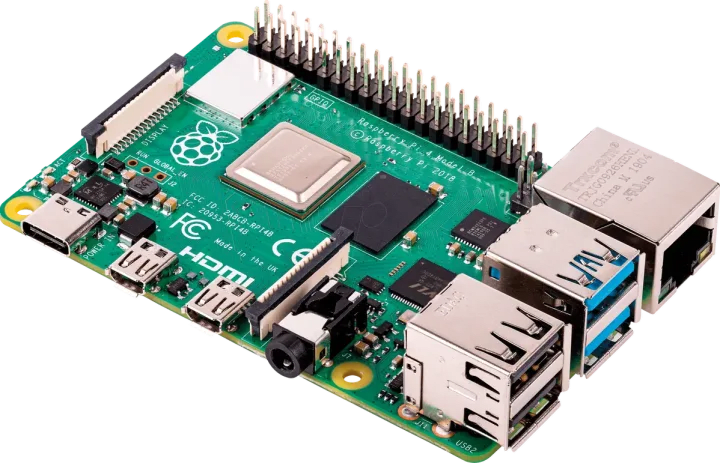
Ubuntu 22.04 LTS (codename: Jammy Jellyfish) is jam-packed (hey hey!) with new features for everyone’s favourite credit-card sized computer. We’ve put together some of the Raspberry Pi highlights below, but for a full overview of Jammy Jellyfish check out the Ubuntu 22.04 LTS press release and release notes.
The Raspberry Pi’s first Ubuntu LTS supported Desktop…
Ubuntu Long Term Support (LTS) releases arrive every two years and are designed to deliver enterprise-grade stability and security with five years of support, including security patches and updates, available to everyone.
Whilst Ubuntu 20.04 LTS was certified for Ubuntu Server, Ubuntu 22.04 LTS is the first time Ubuntu Desktop has also been certified for the Raspberry Pi 4. Ubuntu Desktop is faster than ever on the Pi thanks to numerous optimisations to the GNOME Desktop environment (which is now running GNOME 42), delivering up to twice the frame rate when navigating your desktop compared to Ubuntu 21.10.
Opportunities for user customisation have also been expanded, with our new accent colour-picker and system-wide dark style preference support.
All this is combined with the latest versions of our pre-installed apps, from Firefox to LibreOffice as well as up-to-date toolchains for Python, Ruby, Go, Rust and many more, Raspberry Pi developers have everything they need to innovate in style!
Read more about the new features in Ubuntu Desktop here.
…now available on the Raspberry Pi 4 2GB
Up until now, we’ve recommended users stick with the 4GB and 8GB versions of the Raspberry Pi 4 when running Ubuntu Desktop. With 22.04 we challenged ourselves to lower the barrier to entry for desktop developers by targeting the 2GB model as well.
By pre-configuring a compression tool called Zswap, we’ve been able to keep more pages running in RAM without the need to ‘swap’ them out to the Pi’s SD card or hard drive when the memory is reaching capacity. Whilst users could gain this performance boost with some tweaks on previous versions of Ubuntu, we’ve now included these by default, delivering a solid user experience on the 2GB Raspberry Pi 4 and increasing performance for higher end models as well.
“It’s great to see a certified Ubuntu Desktop release that includes support for the 2GB Raspberry Pi 4, giving developers all over the world access to the most affordable development desktop environment.”
Eben Upton, CEO of Raspberry Pi Trading
You can read more about our performance improvements for the 2GB Raspberry Pi 4 here.
A device of many HATs
Keeping up with the latest Pi peripherals is an ongoing journey, and we’ve made great strides in this area for 22.04. Building on our Sense HAT support in Ubuntu 21.10, we’ve targeted some of the most popular devices available today, with a focus on the Unicorn HAT range. Check out these action shots running on 22.04!
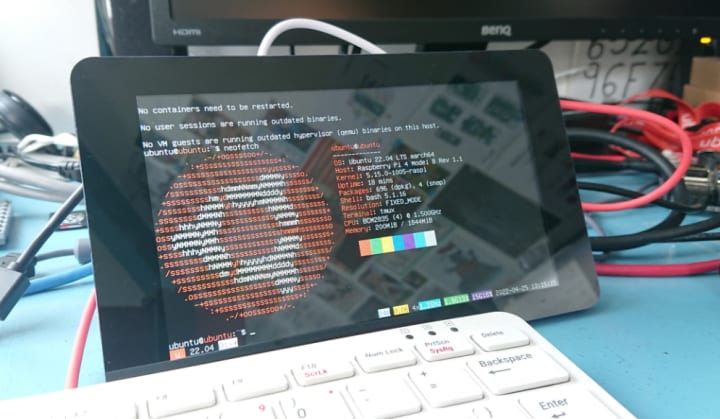
There’s also DSI support for the Raspberry PI Touch Display which comes out of the box for Ubuntu Server and is available on Ubuntu Desktop after switching the graphics stack to FKMS.
You can use the legacy FKMS stack on Ubuntu Desktop by editing “/boot/firmware/config.txt” on your PC after flashing the SD card.
Find the line:
dtoverlay=vc4-kms-v3d
Modify this to:
dtoverlay=vc4-fkms-v3d
Small but mighty – Raspberry Pi Zero 2 W
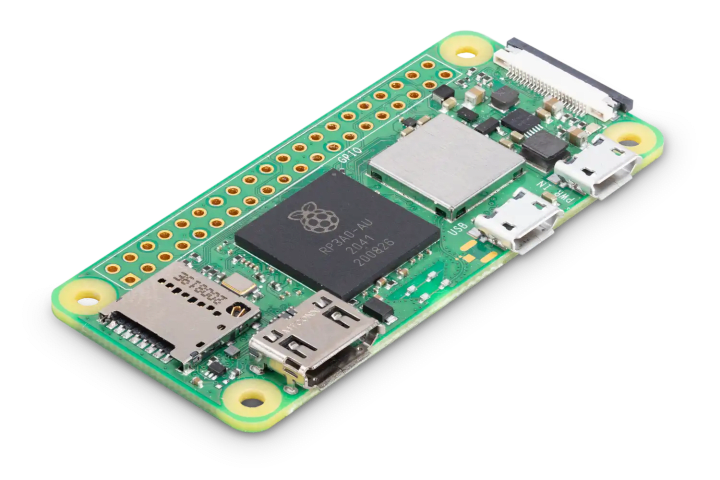
To round out the full range of Pi devices, don’t forget we now have out-of-the-box support for the Raspberry Pi Zero 2 W with Ubuntu Server 22.04 LTS. With a Long Term Supported release you can be assured that your IoT projects will be secure and up to date for many years to come!
Get started on Raspberry Pi today
You can download Ubuntu 22.04 LTS via the Raspberry Pi Imager available in the Snap store or on the Raspberry Pi website here.
You can also get the ISO directly from our download page here.







![[Epic Games] (Game) Paradigm](https://external-preview.redd.it/ly--CcCwOtxwiICK4b86o-V8EAYlnn3_-Rg9iwZN8Qc.jpg?width=640&crop=smart&auto=webp&s=972b93351b4cb668404e907b70c09f51a9f05bfd "[Epic Games] (Game) Paradigm")


 Is your Ubuntu laptop barking at you? For one user it is, and it is worrying their actual dog. Confused, they turned to GNOME developers for assistance.
![[link]](https://i.redd.it/nrkvea4rp4v81.gif)