Hovertext: I have a lurking fear that there's some trivial answer to this, but then again it'd be kind of perfect if students had to spend an entire semester to uncover a trivial truth.
Twitter today announced that it has entered into a definitive agreement to be acquired by an entity wholly owned by Elon Musk, for $54.20 per share in cash in a transaction valued at approximately $44 billion. Upon completion of the transaction, Twitter will become a privately held company. Press release: Under the terms of the agreement, Twitter stockholders will receive $54.20 in cash for each share of Twitter common stock that they own upon closing of the proposed transaction. The purchase price represents a 38% premium to Twitter's closing stock price on April 1, 2022, which was the last trading day before Mr. Musk disclosed his approximately 9% stake in Twitter.
"Free speech is the bedrock of a functioning democracy, and Twitter is the digital town square where matters vital to the future of humanity are debated," said Mr. Musk. "I also want to make Twitter better than ever by enhancing the product with new features, making the algorithms open source to increase trust, defeating the spam bots, and authenticating all humans. Twitter has tremendous potential -- I look forward to working with the company and the community of users to unlock it." Earlier on Monday, Musk tweeted: "I hope that even my worst critics remain on Twitter, because that is what free speech means."
After days and days and days of warm weather, with a persistent southerly breeze, our weather will change today and tonight. Most of the region should see scattered showers this morning, with an increasing chance of thunderstorms this afternoon and tonight. It has been a rather dry spring, so this rainfall will be mostly welcome. A front will bring some briefly drier and cooler weather before we warm up again next weekend.
Monday
It’s rather warm this morning, with lows only dropping to around 75 degrees in the city of Houston. Highs today will reach the mid-80s, with mostly cloudy skies and light southerly winds. Light rain is possible this morning. Due to the front’s approach and our extremely moist atmosphere, thunderstorm chances will start to increase this afternoon for areas north of Interstate 10 before sagging southward this evening toward the coast, where conditions will be less supportive of heavy rainfall.
This is the HRRR model’s forecast for what Houston’s radar might look like at 6 pm CT Monday. Do not take it as gospel. (Weather Bell)
Most of our region will probably get rainfall through the overnight hours, with areas north of Interstate 10 seeing perhaps 1 to 2 inches, and areas south of the freeway recording 0.5 to 1 inches. However there will be wide variability in rainfall totals depending on precisely where storms set up. One location may pick up 4 inches, whereas a few miles away there’s a few tenths of an inch.
Tuesday
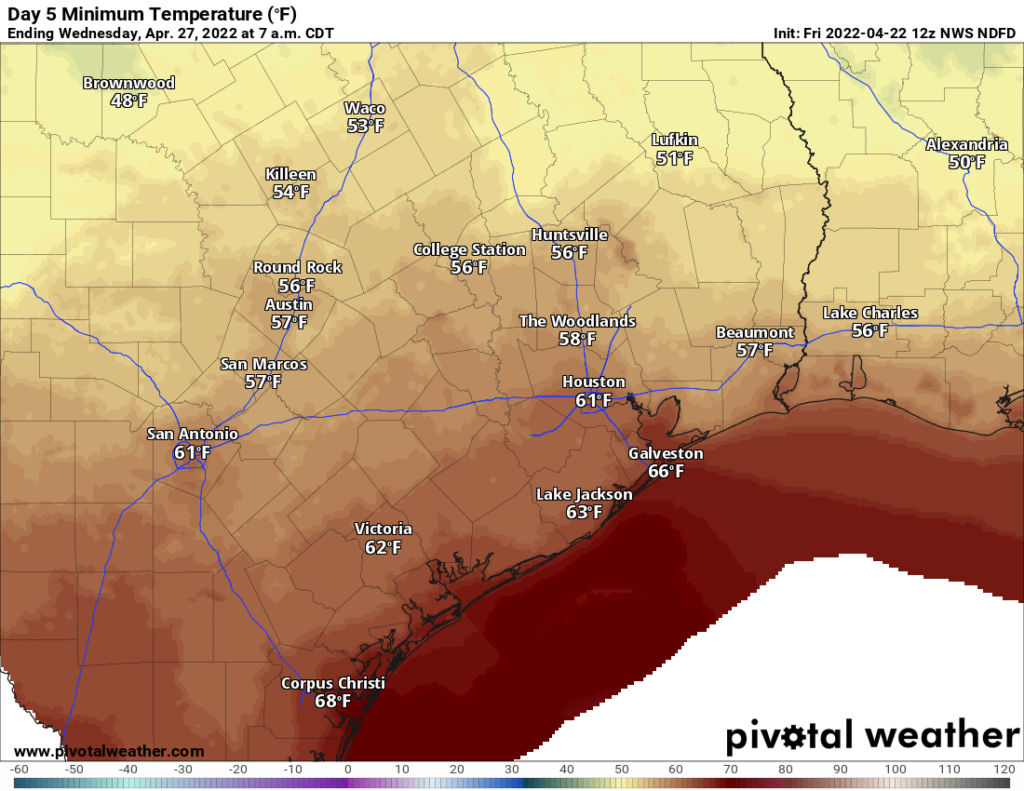
Some rain chances will linger on Tuesday morning, but the threat of heavy rainfall will have passed. However, skies will remain mostly cloudy, and with moderate northerly winds highs probably will only reach the mid-70s. As skies start to clear out overnight, and with the influx of more dry air, lows on Tuesday night heading into Wednesday morning will be the coldest of the week. Expect 50s for inland areas, with mid-60s right along the coast. Don’t blink, because it won’t last long.
Low temperature forecast for Wednesday morning. (Weather Bell)
Wednesday
This should be an extremely pleasant day, with highs of around 80 degrees, light winds, dry air, and partly to mostly sunny skies. Lows Wednesday night will be a few degrees warmer than Tuesday night as a southerly flow starts to exert its influence.
Thursday and Friday
These should be a pair of partly to mostly sunny days with highs in the 80s, although by Friday highs will probably be pushing into the upper 80s. Southerly winds will start to pick up, at 10 to 15 mph, likely with gusts of about 20 mph.
Saturday and Sunday
The weekend looks warm and humid, with highs ranging from the upper 80s to 90 degrees. Both weekend days should see a mixture of sunshine and clouds. We can’t entirely rule out some scattered showers, but for now I’d put the chances in the 10 percent range. Winds will be noticeable out of the south, perhaps gusting to 20 mph. If you’re riding Bike MS: Texas MS 150 on Saturday and Sunday, those southerly winds should be fairly consistent along your whole route.
Conditions look to remain warm heading into early May, with only a slight chance of a weak front during the first week of next month. I hate to say it, but summer is nigh.
I manage a high end resort-like property that has a mix of short term guests (vacationers) and long-term guests (residents). We aren’t big enough for a separate HR department, so that usually falls to me and/or our CFO. Our amenities such as the fitness center, clubhouse, and the pool/spa are open to all guests; they are not separated by length of stay.
We have a long-term guest, let’s call them Pat, who has been a resident about six years. A couple of years ago, they came out as non-binary and for the most part this has been a non-issue. All of our staff and other residents have been wonderful and accepting of Pat, which I’ll admit was kind of a relief as we are in a very conservative part of the country. Pat has a traditionally masculine job (think construction worker) and when in work clothes, they are very male-presenting (tall, muscularly built, facial stubble at times). Pat also often appears very feminine, although this is usually at social functions, etc.
Recently my staff at the front desk, in an effort to be proactive, asked me for a “script,” some guidance on how they could respond to the complaints/concerns they are anticipating this summer regarding Pat’s use of the bathroom/shower facilities at the resort. Pat often utilizes the facilities after work and while still in their work clothes, and tends to use whichever bathroom/shower they feel like, male or female. We do not have a family/unisex bathroom/shower, and nowhere to realistically add one. Our summer vacationer demographic tends to be older and more traditional/conservative, so the desk staff are no doubt correct in their anticipation of complaints about “a man” in the women’s bathroom/shower.
To be clear, we have no intention of addressing this with Pat, I don’t feel like they are doing anything wrong, they have been nothing but understanding and respectful to everyone, even those who may have been less than supportive to their coming out. However, I’m at a loss with what to tell our desk staff to say when, for example, they’re approached by an angry husband whose wife or daughters were “scared” by a “man” in the ladies bathroom/shower. The toilet stalls all have doors, and the showers all have their own non-see-through shower curtains, but the sink/mirror areas are common. How do we support Pat while addressing the concerns of other guests?
Additionally, we can’t just assume every report of a man in the ladies room is Pat. We do have to go check it out each time to make sure we don’t have someone acting inappropriately – that would be extremely rare but not impossible, so we do have to investigate every complaint. I’m leaning towards having the desk staff just say what they normally would, whether or not they suspect that the complaint is about Pat, thank the guest for bringing it to our attention, and send a crew member to make sure.
Is there something more we should say? Is there something I should be sure the desk staff does NOT say? One last twist, this resort doesn’t always have a female staff member on duty or available, so if we get a complaint when we only have male staff on duty, to investigate they’d have to knock, announce their presence, etc. before entering the ladies bathroom/shower. I really don’t think it’s appropriate to be calling attention to Pat like this, assuming it could realistically happen multiple times over the course of the summer when they are using the bathroom/shower. Am I overthinking this? I know there’s a fine line between being proactive and looking for problems where they don’t exist, but considering my staff has asked for assistance with this, I feel like I need to provide them with something.
This one is outside of my wheelhouse, so I asked two experts to weigh in.
Oooh this is a tricky one, because, yeah, the ideal solution would be a unisex area/family room, at least it would be for me as a non-binary person. Others may feel differently, and it sounds like Pat goes where the mood takes them, which hey, is also a thing I plan on doing now that I’ve had top surgery. I’m glad that the resort has been accommodating to Pat and wants to make sure they feel comfortable in what is essentially their living space.
And the writer is right to want to set out a script beforehand and it might not be bad to make it an official policy at the resort. Typically, such a policy would read that “[Resort] does not discriminate on the basis of gender identity, sexual orientation, race, religion, or ability. As such, we welcome guests to use the restroom that is consistent with their gender identity.” Many spas will also have this posted somewhere near the locker rooms so guests know that not everyone in the rooms may look like them.
Their instinct is also right that singling out Pat would likely make Pat uncomfortable, so front desk staff should be clear to reiterate the resort policy. Since it is their policy to investigate every claim (which is a good one because it could be someone else making a problem), that’s still a decent thing to keep up. Trust that Pat already knows this is a probability, and will likely be able to see it happening (unfortunately, we non-binary people are often hyper-aware of when people think we’re in the wrong place, because those people are also not subtle). The important thing to remember is that Pat is not the problem here. The problem is people deciding that they get to police what other people look like.
One more thing to note would be to ensure a privacy policy is in place for guests as well — make it explicit that guests taking pictures, filming, or otherwise putting other guests’ privacy at risk in the restrooms and private areas will not be tolerated. There are, unfortunately, a number of anti-trans activists who will attempt to film trans and non-binary people simply existing in gendered spaces. Having a no tolerance policy for any of that behavior can make it possible to kick out any guests who might be inclined to sneak a photo of Pat in the restroom. There’s an unfortunate element of transphobic media that loves that kind of stuff, so having actionable policy in place if it happens is good.
I also spoke with Kira-Lynn Ferderber, a safety and inclusion expert for the hospitality sector, who was also really helpful:
It’s great that you want to be inclusive of this one guest, and I think the questions you’re asking get at a larger issue, beyond just Pat. Even in a conservative or older community there are non-binary people and others who benefit from inclusive, thoughtful policies regarding bathrooms. And if you can’t imagine this issue coming up again at your facilities, consider the visits of the children and grandchildren whose parents and grandparents stay at the property.
In terms of front desk complaints, you’ve designed a system where non-binary people must use an “incorrect” bathroom, because you only have binary, gendered bathrooms. One thing I would suggest is an inclusivity audit from a local LGBTQ+ agency, thinking about how you might design the amenities if you were trying to be welcoming regardless of Pat. If a non-gendered bathroom is off the table for you, you have to admit that you’ve designed a confusing situation, even unintentionally, and this confusion may lead to questions from non-binary guests and others.
The honest “script” in response to complaints about someone “in the wrong bathroom” is to say just what you’ve laid out in your letter, which is: “We permit our guests to use whichever bathroom is most comfortable for them,” because in the case of Pat, you do. And presumably this will be true of future non-binary guests, though if a staff remember physically responds to a call they may find someone whom the employee doesn’t realize is non-binary. This is the problem with an unwritten policy where one person is the exception. By making an allowance only for non-binary guests with whom you are familiar, you are requiring each individual to come out to all staff, over and over, and you’re requiring them to do so without the knowledge that once they do, they will be included in this unofficial Pat Loophole. This is not very hospitable hospitality.
If your preference remains to handle non-binary guests on a case-by-case basis, you could include something at guest registration or check-in, such as a drop down menu of pronouns or prefixes, or an open-ended comment area where you ask about gender identity and accommodations. Be aware of local or national laws regarding non-discrimination as you write this. But this self-identifying option won’t cover everyone: even with the direct question, some people will never come out in a situation that isn’t openly and proactively advertising that they are inclusive, which you are not. As well, this kind of check-in likely won’t reach the guests of your guests and other visitors.
While the rights of non-binary people are as good a reason as any to make a more inclusive policy, remember that non-gendered bathrooms help more than just non-binary or genderqueer people: anyone who might be helping out a person of a different gender may be relieved not to face a barrier of a ”women’s only” or “men’s only” room. This could include a dad and a young daughter, a woman and her elderly father who needs assistance, a heterosexual couple where one person acts as an aid to another, and many other medical and personal reasons.
If the facilities will remain gendered, I’d recommend posting a sign, something to the effect of: “While we do not have a non-gendered bathroom, our nonbinary guests are welcome to use whichever facility they prefer.” This is your current policy, even if ad hoc, and while you may be afraid to display this openly, clear communication will be better in the long run. Perhaps you can address it more thoroughly in your newsletter, or on your website or social media – wherever you communicate to guests about other policies related to the facilities. If you are dreading backlash to this kind of announcement, consider whether it really is preferable for guests to learn the policy through a series of ongoing complaints, one at a time, catching people off-guard in vulnerable situations such as showering.
Finally, I’d like to suggest asking your guests what they want! Maybe a question about inclusivity needs could be part of some kind of client survey. I know you stated that a new bathroom is not an option, but support for it from your paying customers might go a long way in convincing decision-makers. I’d also challenge the idea that it’s impossible to have a non-gendered bathroom: what would you do if it was made the law tomorrow? What would you do if 100% of your guests wanted it created or they wouldn’t come back? Perhaps there’s a staff bathroom or other facility that can be converted. Perhaps you could talk to other businesses about what their solution has been.
Another guest you could ask is Pat themselves. If Pat came out to you directly, I don’t think it’s out of line to respond with (or go back to them and say), “Thank you for telling me that. I want you to continue to feel welcome and comfortable here. Please let us know if there is anything we can do to accommodate you.” While you don’t want Pat to shoulder the obligation of educating you and consulting for you for free, they might have ideas and insights they want to share, as the best expert you know in what it is like to be a non-binary user of your amenities. Keep in mind though, if you solicit feedback from Pat or any other non-binary guest, you should have the intention and capacity to at least attempt to fulfill their requests.
Excellent advice from both contributors, and I hope it helps.
In discussion in the comment section, please note Dianna uses they/them pronouns, and Kira-Lynn uses they/them or she/her.
Wit Knits: Lively And Original Hand Knitting Designs
Hostler and Brandreth
1985
Submitter: While weeding out the craft section I came across this absolutely dated yet lovely gem. John Iman modeling of sweaters? Is the public still being served by this book? Probably not – but it will do well on the sale cart.
Holly: This. Is. Amazing. And by “amazing,” I mean “awful.”
Mary: This is beyond precious! I have never seen so many people happy about wearing sweaters.
It’s the first historical essay about pranks made by scientists in the last century and over. For the first time I collected 110 pranks made by Nobel prize winners (Guglielmo Marconi, Enrico Fermi, Richard Feynman, Hans Bethe, Andre Geim), and other celebrities such as Benjamin Franklin, Nikola Tesla, Richard Branson, Enrico Bombieri, Thomas Edison, Isaac Asimov (when he was doing his doctorate in chemistry at the university). I discovered that research institutions such as NASA, CERN, FermiLab, journals like Science, Nature, British Medical Journal, Scientific American, museums and laboratories all over the world had concocted sensational jokes in the last 150 years.
In Podcast Episode #1093, Marc Abrahams presents the 2021 Ig Nobel Prize for Physics winners Alessandro Corbetta, Jasper Meeusen, Chung-min Lee, Roberto Benzi, and Federico Toschi. They received the prize for conducting experiments to learn why pedestrians do not constantly collide with other pedestrians.
REFERENCE: “Physics-based modeling and data representation of pairwise interactions among pedestrians,” Alessandro Corbetta, Jasper A. Meeusen, Chung-min Lee, Roberto Benzi, and Federico Toschi, Physical Review E, vol. 98, no. 062310, 20188.
A short guide on how to install Firefox from a PPA on Ubuntu 22.04 and remove the Firefox Snap. Doing this gets you a faster Firefox that can do more OOTB.
Rent increased pretty much everywhere in the United States over the past year. Abha Bhattarai, Chris Alcantara and Andrew Van Dam for The Washington Post use a map to show you by how much:
Nationally, rents rose a record 11.3 percent last year, according to real estate research firm CoStar Group. That fast pace of growth remained elevated in the first months of 2022, as many parts of the country continued to notch double-digit jumps in rent prices.
The governor ordered troopers to thoroughly inspect every commercial truck coming from Mexico in what he described as an effort to stop illegal drugs and migrants from being smuggled into Texas. His order for increased state inspections led to snarling delays in trade between the two countries.
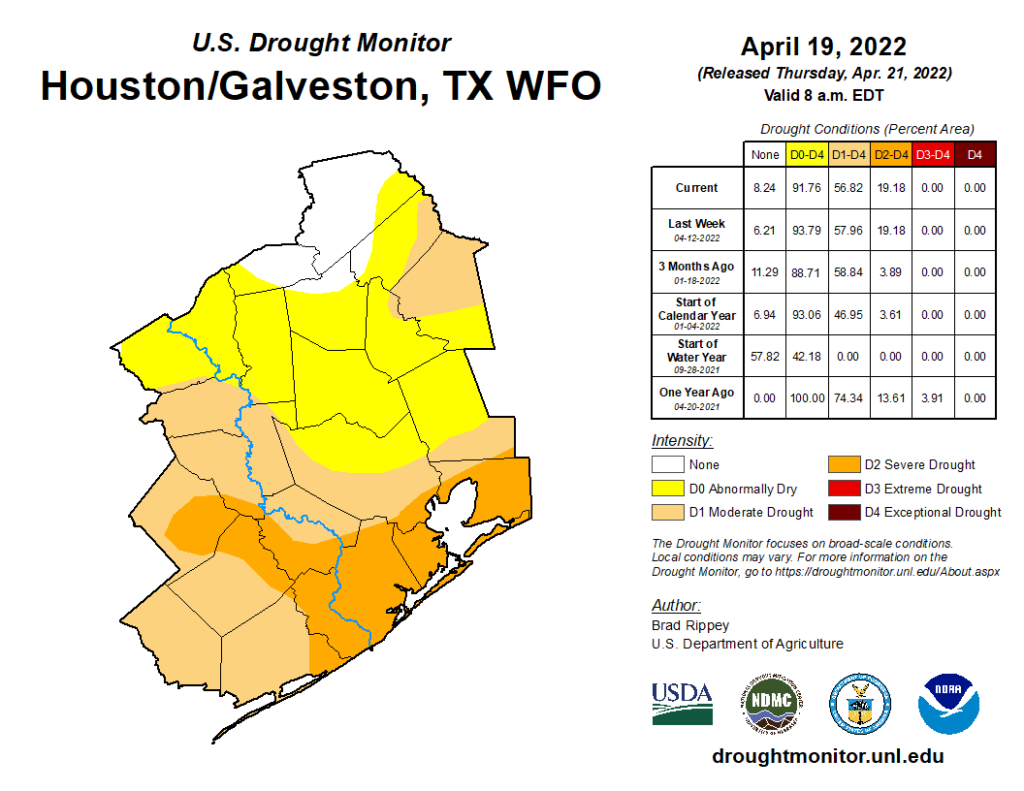
As occurs each week, the U.S. Drought Monitor updated their drought assessment yesterday. Texas continues to see pretty difficult drought conditions overall, however that’s not so much the case locally.
West and central Texas are being hard hit by drought this spring with over 15 percent of the state in D4, or “exceptional” drought. (NOAA)
While over 87 percent of the state is classified in drought conditions, only about 57 percent of the Houston area qualifies for drought at this time. Our most recent serious drought occurred in 2011. It may be somewhat comforting to know that during this week in 2011, the entire state was in drought, with much of the Houston area in D4, or “exceptional” drought. At this point, while it may be tempting to compare current conditions to 2011 across Texas, that is not quite an accurate assessment, certainly locally.
The Houston area’s drought situation is better than most of the rest of Texas, with the only severe drought assessed to be south of the city and no areas of extreme or exceptional drought at this time. (NOAA)
Precipitation over the next few weeks is not going to be absent from Texas, so we’ll see if it’s enough to start denting this drought before it gets too troublesome. But if your travels do take you to central or western Texas, just be aware that the ground there will be much drier than usual and fire risk higher than usual.
Today
The week will close out with, you guessed it, wind. Look for yet another breezy day, with southeasterly winds of 15 to 25 mph. Any morning clouds should give way to sun, with high temperatures up into the 80s.
Saturday
More wind.
Another round of breezy to gusty winds will be likely Saturday. (Pivotal Weather)
Look for another day of 15 to 25 mph winds, with higher gusts at times over the water. We will see a mix of sun and clouds with temperatures warming from the 70s into the 80s. Humidity will remain high.
Sunday
Look for mostly a rinse and repeat of Saturday, with wind perhaps checking in just a notch under Saturday.
One thing I haven’t yet mentioned: Rain. We don’t expect anything meaningful or widespread this weekend, but the chance of a passing shower or some patchy drizzle or sprinkles is not zero. So although it probably won’t rain on you this weekend, don’t be entirely shocked if it does for a short time.
Next week
As we continue our transition toward summer, the cold fronts pack less and less punch in terms of temperatures. The cold front we are expecting later Monday or Tuesday morning should follow that rule as well. Expect scattered showers or a chance of storms, especially north and west of Houston on Monday with morning lows in the 70s warming to highs in the 80s. Those storms should move into the Houston area Monday evening or night, assuming they can survive the trip. There are still some questions as to how much in the way of storms we will see.
Whatever the case, clearing should commence on Tuesday with slightly cooler and less humid weather arriving early. Perhaps we’ll see lows in the 60s with highs in the lower 80s. You’ll probably notice the more comfortable weather mostly on Tuesday night into Wednesday when some outlying areas drop back into the 50s.
Low temperatures may find their way into the 50s on Tuesday night and Wednesday morning next week. (Pivotal Weather)
That will be nice, but it will be short-lived. Humidity should come surging back in late next week, restoring our typical mid-spring pattern. For those of you planning to get back out for MS 150 next weekend, it looks as if you’ll have very warm, humid weather, along with southerly winds. For day 1, it won’t be a true tailwind per se (certainly if you’re starting from Austin), but it will definitely be coming off the Gulf as it stands right now. The day 2 trek from La Grange to Kyle Field should have a pretty stout tailwind. More on this next week!
So there’s this company in the UK, right. They brand themselves on producing fancy free range eggs and as part of that they have breed information written on the carton.
I did some snooping and found that every miracle news story of a supermarket egg hatching in the UK traced back to duck eggs, specifically the Braddock White duck eggs produced by this one company for the supermarket Waitrose.
And one day my mum brings them home and says “I bought these to eat but aren’t they the ones that hatch?”
And it’s spring and I’m hatching a ton this year so in they went.
On candling we had three fertile eggs! That’s a fertility of 50% - the same as shipped eggs from a breeder!
Hatch day comes and we get 2 ducklings, Curie and Becquerel. Sadly, Curie contracts duck septicaemia from an infected navel and doesn’t make it, but Becquerel is a healthy bird and growing like a weed.
I had put 4 breeder eggs in a week after them in case just one hatched, so Becque now has two Khaki Campbell cross friends called Tsuki and Hoshi so she isn’t lonely.
And as of today’s 7am Quacking - Becque is a female! Which means she’s capable of laying eggs and therefore I have pirated a duck.
There has been a push over the last few months by some pro-patent academics and (of course) the pharmaceutical industry to insist that high drug prices and high healthcare costs have nothing whatsoever to do with our broken patent system that grants drug and device makers a full on monopoly. That claim doesn’t just defy logic, it defies all evidence and reality. As we noted last year, an investigation by the House Oversight Committee found some incredibly damning examples of how drug companies exploited the patent system to jack up prices — with the most damning being the story of how AbbVie hired McKinsey to come up with a sneaky plan to effectively extend the patent monopoly of Humira, an important drug for many, many Americans.
They deliberately did some shady stuff to extend the life of the patent monopoly while jacking up prices to insane levels.
Anyway, it appears that the Editorial Board at the NY Times has been paying attention to all of this as well, and has published a fantastic piece calling for significant fixes to the patent system to stop this nonsense and to lower drug and healthcare costs. The article is called “Save America’s Patent System,” but it might just as easily have been called “Save America’s Healthcare.” Because it can do both.
Drugmakers for decades have argued that patents are essential to American innovation. For all that lip service to medical advancement, though, a recent investigation by the House Oversight Committee concluded that market share is more likely the point. Twelve of the drugs that Medicare spends the most on are protected by more than 600 patents in total, according to the committee. Many of those patents contain little that’s truly new. But the thickets they create have the potential to extend product monopolies for decades. In so doing, they promise to add billions to the nation’s soaring health care costs — and to pharmaceutical coffers.
And for all the hand-wringing over how to lower prescription drug costs in recent years, little has been said about the patent system or its many failings. Put simply: The United States Patent and Trademark Office is in dire need of reform.
The editorial comes up with some pretty straightforward suggestions for fixing the patent system. First, stop granting patents for minor changes. The law requires that a patent be new and nonobvious to those skilled in the art. Yet it regularly approves new patents on very minor updates to long-existing ideas.
The pharmaceutical industry is a good example. Nearly 80 percent of the drugs associated with new patents between 2005 and 2015 were not new. But the issue is not confined to drugmakers. The Theranos debacle, to take just one other example, was touched off by officials who granted scores of patents for a device that had never been built and that turned out not to work. The company was able to secure those patents without disclosing almost any technical information about its product.
It also suggests a move that I’ve been arguing for for many years: there needs to be a point at which patent rejections are final. While there is something called a “final rejection,” it’s not actually final. Patent applicants can adjust and keep appealing. And this bogs down the system, and actually encourages patent examiners to eventually approve a patent just to get it off of their pile. We’ve been calling out this problem for nearly two decades, and it hasn’t yet been fixed.
Importantly, the NY Times also highlights that the process to challenge bad patents needs to be improved:
Bad patents have steep costs. They gum up the wheels of innovation by making it harder for would-be inventors to proceed with their work. They strain budgets by preventing cheaper products from entering the market. And they leave honest inventors vulnerable to patent trolls — people who buy up weak patents not to create anything new or useful but to hold legitimate inventions ransom. But the process of weeding these patents out once they’ve been granted remains fraught: It can take years and many thousands of dollars to challenge a bad patent in court, and even when the case seems obvious, success is never guaranteed.
This is big and important for a number of reasons. In the US’s last big patent reform, they enabled some better methods of invalidating bad patents, via the Patent Trial and Appeal Board (PTAB) and the “inter partes review” process, allowing for at least some path to revisiting granted patents to see if they should have never been granted in the first place.
Yet, many in Congress are actually looking to go in the other direction, and to make it much, much harder to challenge bad patents. So it’s great to see the NY Times pushing Congress to actually move the needle in the other direction and to strengthen the PTAB process.
The next suggestion is really great, and surprising. It notes that too many Patent Office directors come directly from industries that rely heavily on patent monopolies, and that they’re biased towards ever more patents, regardless of the quality. And that should stop.
Too many patent office directors have come from or gone to industry jobs within months of holding the federal post. This revolving door poses a real risk to the integrity of the patent office. The most recent example of that comes from the Trump administration appointee Andrei Iancu. During his tenure, the patent office used its discretionary powers to deny a challenge to a patent held by a company that his former law firm represented. He then returned to that firm as soon as his time in government was up.
And then my favorite suggestion of them all — recognizing that under the Constitution, the patent system is supposed to be for the benefit of the public, not the corporations holding the patents. And thus, the public should be a part of the process:
For too much of its history, the patent office has treated inventors and companies as its main customers while all but ignoring the people whose lives are affected by patenting decisions. That needs to change. Officials can start by appointing more public representatives to the patent office’s public advisory committee. Right now, six of the committee’s nine members are attorneys who represent commercial clients or private interests; only one works in public interest.
Officials should also establish a public advocate service similar to the one that exists at the Internal Revenue Service and should make a concerted effort to ramp up their public outreach. “The patent system has gotten so complicated that it’s impossible for anyone who’s not an inventor or a lawyer to penetrate it,” said Mr. Duan.
There’s much more in the piece, but it’s one of the rare NY Times editorials that I think is 100% on point, and hopefully the Patent Office and Congress move towards doing what’s in there to not only help save the patent system, but to fix America’s continuing healthcare debacle.
Marvel to the spectacle of a driverless Tesla as it rolls across an airport runway and hits the back of a jet, causing it to pivot around. So far, there are no details about who owns the self-crashing vehicle, or if the Tesla owner also owns the jet, which is valued at $2 million. — Read the rest
Marjorie Taylor Greene displayed early-onset amnesia today during her hearing to see if she qualifies for the November's ballot after her involvement with the Jan. 6 Capitol attacks. When questioned about whether or not she said Nancy Pelosi is a traitor, the addled Rep. — Read the rest
Even before macOS 10 (then Mac OS X 10) was available to everyone, there was a server version intended for running fleets of Mac computers in businesses, schools, and other organizations. Apple has slowly phased out macOS Server over the past few years, by moving most of its functionality to other places in the Mac operating system, and now it’s officially discontinued.
Apple confirmed in a support document that macOS Server is discontinued as of April 21, 2022. macOS Server in its current form is just an application running on top of a normal macOS installation, and the app is still available to download and is fully compatible with the latest macOS Monterey release.
macOS Server (Credit: Apple)
Some services in the app are available in other areas of the system, like File Sharing, the Caching Server, and the Time Machine Server. However, several other features in recent versions of macOS Server require switching to a slightly-different solution or third-party software — the servers for email, Wiki management, FTP (not SFTP), and VPN don’t have direct replacements in regular macOS. The Profile Manager in macOS Server is perhaps the most important component, and Apple’s only recommendation is switching to a third-party option like Microsoft Active Directory.
macOS Server first arrived as Mac OS X Server 1.0 in 1999, released a whole year before the first public version of Mac OS X. Apple later replaced it with a customized version of Mac OS X 10.0 once that version became available in 2001, which had various server applications and services built-in. Starting with Mac OS X 10.7 Lion, Server became an App Store app running on top of regular macOS. Apple also added features over the years for managing iOS devices, in addition to Macs and cross-platform services.
Scientists in the lab face each problem open-minded, free of bias, and with a unique style that says, “I don’t care what people think of me.”
Lab protocol requires that notes on an experiment are meticulous, detail-oriented, and hella rad.
Everyone uses Celsius instead of Kelvin to boil water because they like to “keep it 100.”
Safety goggles: Oakley. Lab coats: Harley-Davidson. Thermometers: Thermo Fisher Scientific (that’s THE cool brand in thermometers).
Your lab doesn’t do experiments; they’re just “results most people haven’t heard of yet.”
Safety gloves come in both fingerless and leather varieties.
Lab chairs are all in a fixed backwards “AC Slater Style” position.
Ultracentrifuge starts up only if you “Fonzie the side of it.”
Whenever a theory is confirmed, it is customary to note the observation as being “right on” while giving the “hang loose” hand signal.
You and your colleagues are curious, patient, and have a natural “effortlessly flawless swagger.” This prevents your lab from outside peer-reviewed studies since “no one else is on your level.”
Your research is neither qualitative nor quantitative, but has a certain je ne sais quoi.
Next to the first-aid kit is a drum kit. For emergencies.
The lab has regular beakers and Beakers 2: Electric Boogaloo.
Test tubes are specifically referred to as “Test Tubulars”; funnel is spelled “phunnel”; and rubber tubing is referred to as “rubbers,” but not in a creepy way, more of a confident way.
Instead of using the scientific method, you are encouraged to “fuck around and find out.”
The lab has three types of flasks—conical (for mixing), Florence (for boiling), and hip (for top-shelf scotch).
You’ve seen a colleague light a cigarette with a Bunsen burner and vice versa.
You use microscopes while microdosing, use crucibles on edibles, and perform double-blind studies while double-fisting Coronas.
The boiling tubes can get “lit AF.”
Your lab’s hypotheses and observations just hit different, you know?
The lab has a “Lo-fi Beats to Conduct Impartial Research Backed by Independent Trials and Chill To” playlist.
Each morning, the lab mandates a drip tray for your test tubes and a drip check for your wardrobe.
Instead of animal testing, you’re asked to run all your preliminary experiments on your lab assistant named Snake.
The Scientific Journal has said that your laboratory environment is both “professional” and “a really dope hang.”
If you have to ask if you’re in the cool lab, trust us, you’re not.
In February, cash transport business Empyreal Logistics sued the DOJ and a California sheriff for the lifting of nearly $1.2 million in cash from its drivers during two traffic stops. Empyreal, which notes that it follows all federal guidance for the transport of cash generated by legal marijuana sales, was hit twice in California, resulting in officers walking away with a whole lot of legal cash (and bringing in the feds to ensure they could take home up to 80% of the take). Other Empyreal drivers were pulled over in Kansas, during which $165,000 was seized by law enforcement and handed over to the DEA.
The sued sheriff, Shannon Dicus, claimed (without presenting evidence) that nearly all marijuana sold by dispensaries is grown illegally, thus justifying his decision to take cash that had been earned legally. He also claimed he and his deputies were doing the lord’s drug war work and “would prevail” in this lawsuit.
The U.S. Department of Justice agreed Wednesday to return all cash seized from an armored car company used by legal marijuana dispensaries during several traffic stops in California last year.
The California seizures occurred based on what authorities learned in Kansas during a May traffic stop of an Empyreal Logistics car. Conversations between state and federal law enforcement agencies stemming from this stop resulted in a series of events in which Kansas and California officers seized more than $1.2 million.
Note how quickly the DOJ folds when challenged during forfeitures. The DOJ — along with state and local law enforcement agencies — tend to play the odds, assuming that not everyone relieved of cash or property will sue. And if the dollar amount is low enough, it’s almost guaranteed they won’t be sued.
But when the DOJ (and others) are sued, they tend to return property pretty damn quickly. Empyreal was represented by the Institute for Justice in this case, an entity that has successfully secured several returns of property illegally seized by government employees.
And this isn’t the end of the litigation, even though it has resulted in the return of almost all of the money seized by law enforcement officers in two states. As the Institute for Justice notes, the sheriff who claimed he would prevail is still being sued and Empyreal is still seeking the return of $165,000 seized in Kansas.
In exchange for the return of the funds, Empyreal will dismiss its case against the federal government over the seizures. The settlement announced today does not include the San Bernardino County Sheriff and does not affect a separate civil forfeiture action in Kansas in which Empyreal is represented by separate counsel.
The seizures in California expose the bad faith activities of local law enforcement. Weed sales are legal in California but illegal under federal law. Seizing the cash and sending it to the feds laundered the forfeiture, allowing it to be represented as illegal earnings under federal law when the same earnings would be considered legal under state law. This is a crime of opportunity. And it’s being perpetrated by law enforcement officers who’d rather have other people’s cash than a pristine reputation or a healthy relationship with the people they serve.









 Wit Knits: Lively And Original Hand Knitting Designs


 A short guide on how to install Firefox from a PPA on Ubuntu 22.04 and remove the Firefox Snap. Doing this gets you a faster Firefox that can do more OOTB.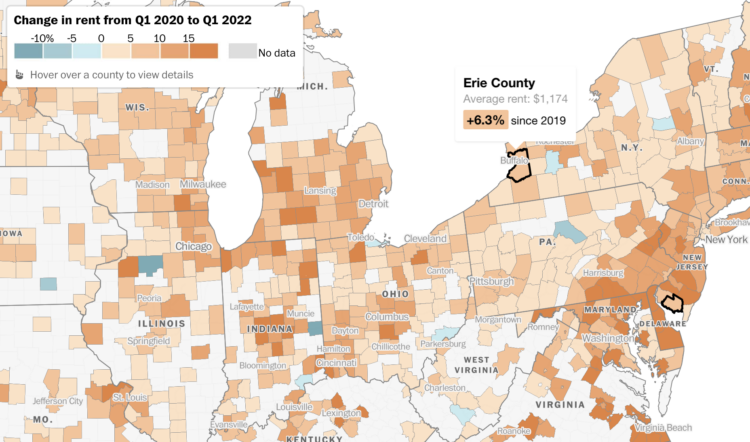


/https://static.texastribune.org/media/files/7b331861373798796f16aa79431fde9c/McAllen%20Inspections%20JG%20TT%2045.jpg)