Four students were killed in the mass shooting in Michigan last November. Seven people were also injured, including a student whose parents are suing Acme Shooting Goods, the weapons dealer.
(Image credit: Paul Sancya/AP)

Four students were killed in the mass shooting in Michigan last November. Seven people were also injured, including a student whose parents are suing Acme Shooting Goods, the weapons dealer.
(Image credit: Paul Sancya/AP)
Jon Niermann, the chairman of the state agency charged with enforcing environmental laws, the Texas Commission on Environmental Quality (TCEQ), appears not to understand how environmental racism works, nor if the phenomenon even exists.
Senator Borris Miles, a Democrat who represents parts of Houston and Harris County, recently had to explain that term at a meeting of the Sunset Advisory Commission, a rotating group of 10 legislators and two laypeople which reviews the performance of state agencies every 12 years. TCEQ is up for review this year, and Miles criticized the agency for permitting too many concrete batch plants in his district.
“They are largely located in poor, minority communities,” he said. “This is the definition of environmental racism.”
In response, Niermann acknowledged the country’s legacy of racial discrimination may still affect areas like Miles’ district, and that some communities have more polluting facilities. But he claimed he didn’t know what to make of the term “environmental racism.”
Niermann leads the Texas agency “charged with protecting the state’s air, water, land resources, and public health,” according to the self-evaluation report TCEQ submitted to the Sunset Advisory Commission in September. Among other responsibilities, TCEQ permits and regulates a wide range of facilities that release pollutants into the air, water, or soil—everything from the world’s largest oil refineries and massive landfills to mom and pop gas stations and dry cleaners. But those who live near these facilities have long known the agency to be an eager permitter and ineffectual regulator.
“They’re protecting no one. They’re only fronting. And they are killing,” said Sandra Edwards, one of hundreds of Texans who traveled to Austin last week from all across the state to participate in a public meeting as part of the Sunset review process. Edwards is a resident of Houston’s Fifth Ward, a historically Black section of the city that’s dotted with metal recycling and concrete batch plants and near a cancer cluster linked to creosote contamination from a century-old rail yard.
Houston, El Paso, the Dallas-Fort Worth region, and San Antonio all have some of the worst ground-level ozone pollution in the country—caused by power plants, refineries, and chemical plants as well as by traffic—according to the American Lung Association’s yearly rankings of U.S. cities’ air quality. In fact, approximately 17,000 deaths in Texas can be attributed to outdoor air pollution each year, according to a 2021 study in the journal Environmental Research.
Laura Hunt, a mother and pediatrician from Midlothian, south of Dallas, used her two minutes at the public hearing to describe the multiple large cement kilns that loom over the city and release visible clouds of air pollution. “These clouds contain thousands of pounds of hazardous chemicals,” she said.
Even before hearing citizens at that public meeting, staff from the Sunset Advisory Commission had already prepared their own report, which includes input from TCEQ staff as well as stakeholders from the public and industry. The report notes that “TCEQ’s commissioners have in some ways become reluctant regulators,” hesitant to punish companies that pollute illegally, let alone use their power to prevent industrial pollution in the first place.
While the Sunset Advisory Commission has the option of disbanding state agencies entirely (hence the name “sunset”), it typically recommends administrative and legislative options for improvement. During the process, the Commission holds one open meeting where members of the public can comment on the agency under review and respond to the Sunset staff’s recommendations.
Senator Miles was one of the few legislators not serving on the Sunset Advisory Commission to attend the meeting last Wednesday. He brought along three busloads of constituents.

Texans traveled to the state capitol not just from Houston and Dallas, but also from Rio Grande Valley colonias dealing with contaminated water and from arid Hill Country towns fending off developers. Over the course of five hours, more than 100 people testified on their experiences with TCEQ. As Harris County parent Sim Kern angrily pointed out, this meeting was the public’s only formal opportunity to address the Sunset Advisory Commission face to face, before their October vote on whether to approve, reject, or modify the recommendations in their staff’s report.
“Not only are [TCEQ] unable to protect us from being poisoned, they don’t even seem interested in it,” Kern said. “All this pomp and circumstance is to put a veneer of respectability on killing kids.”
Before outlining the Sunset staff’s recommendations, policy analyst Robert Romig acknowledged that “a growing number of people are concerned TCEQ favors industry.”
To solicit more input and improve public trust, Sunset staff recommended that TCEQ hold public meetings both before and after issuing draft permits. It currently only holds public meetings after it’s already drafted permits for proposed projects, which can include building new facilities or expanding existing ones. There’s “very little room for conversation at that point,” Romig said.
Members of the public and environmental advocates who came to testify overwhelmingly agreed with this recommendation. At the very least, holding an early public meeting “establishes a relationship between the applicant and the community,” said Adrian Shelley, director of Public Citizen Texas.
The staff report also recommends changing the formula that TCEQ uses to quantify a facility’s compliance history. The agency is required by state law to account for a facility’s level of complexity when rating how well it complied with environmental regulations. But the Sunset staff found that the formula appeared to give complex facilities—like massive petrochemical plants—greater leeway to violate regulations than it gives to smaller facilities. Similarly, a 2018 Observer investigation revealed that TCEQ goes after small businesses like family-owned gas stations with much more diligence, charging bigger fines relative to their size, often just for paperwork infractions.
“Complexity is the main driver of how the rating ends up,” Romig explained.
Missing from the report, however, is any recommendation that TCEQ consider cumulative effects of pollution from multiple industrial facilities in the same neighborhood. For years, residents of disproportionately polluted neighborhoods and their allies have called for regulators to account for already existing facilities when approving or denying permits for new projects in the same area.
Many of the meeting attendees who arrived with Miles previously participated in “People’s Hearings” on TCEQ, organized around the state by Public Citizen and the Coalition for Environment, Equity, and Resilience.
At one People’s Hearing in Houston this April, person after person—most from the historic Fifth Ward or the Kashmere Gardens neighborhood just to the north—lined up to tell stories of family members claimed by cancer that they believe is linked to industrial pollution. Last year, the Texas Department of State Health Services confirmed what these residents suspected: Children in a census tract near the old rail yard that includes part of Kashmere Gardens are nearly five times more likely to develop leukemia than the average for children statewide. An earlier study found that adults in multiple census tracts in the same area of northeast Houston are also significantly more likely to develop several types of cancer compared to state averages.
But when confronted by Miles and two overflow rooms full of Texans, Niermann claimed his agency has no control over where companies choose to locate facilities—though TCEQ has the power to decide whether to approve or renew permits. He and the mostly conservative members of the Sunset Advisory Commission seemed skeptical that communities of color in Texas suffer disproportionately from the impacts of pollution, or that TCEQ should do anything to address that issue.
Senator Charles Schwertner, the current chair of the commission, pointed out that city governments can use zoning powers to limit industrial facilities’ locations, pointedly asking Representative Armando Walle of Houston—who, like Miles, chose to sit in on the meeting—whether his city has zoning laws.
“No,” Walle replied. But he pushed back, adding that unincorporated areas in Harris and other counties lack zoning powers and that the Texas legislature has “neutered” local governments’ ability to regulate industries like concrete through other local ordinances.
“All this pomp and circumstance is to put a veneer of respectability on killing kids.” – Harris County resident Sim Kern
Another debate looming over the TCEQ’s sunset review is how much—or even whether—the agency should consider economic development in addition to environmental quality and human health. TCEQ is known to have a cozy relationship with the companies it permits and regulates, going so far as to call them “customers.” After their time at the agency, officials frequently go on to take lucrative jobs lobbying for these industries.
In fact, former TCEQ Chairman Bryan Shaw appeared at Wednesday’s meeting as a lobbyist on behalf of the Texas Oil and Gas Association. “If the permitting is more arduous, those facilities are likely to locate elsewhere,” he said. But when asked if he has examples of companies choosing to go to another state, Shaw replied, “I do not, but it’s a well-known phenomenon.”
Several Sunset Commission members expressed an explicit desire for TCEQ to permit projects as quickly as possible, doing nothing to dispel public concerns that the agency serves simply as a “rubber stamp.” They also engaged far more with comments from industry groups like the Texas Chemical Association and the Texas Aggregate and Concrete Association—asking extensive follow-up questions addressing their concerns—than they did with testimony from the public or from environmental advocates.
About the only members of the public to get any verbal response from Commission members were children who came to testify about pollution in their neighborhoods.
Natalie Diamond, a 9-year-old from Gunter, a tiny town north of Dallas, testified about the concrete batch plant down the road from her school. “We’ve been taught in school that pollution is bad for our health and growing brains,” she said. “Please help Gunter and all the kids that are victims of poor permitting.”
But even Diamond and the other children got mere thank you’s rather than substantive engagement.
The Sunset Commission has three and a half months to deliberate before voting on staff recommendations on October 12. Ultimately, many community members and advocates felt those recommendations didn’t go far enough on issues like the cumulative impacts of pollution. In TCEQ’s defense, Niermann said there’s significant public confusion about the scope of the agency’s authority, though he conceded that “many people simply disagree” on how broad that scope should be.
Several environmental groups are already pursuing reform through other means. On Tuesday, the Environmental Integrity Project and 13 other organizations sent a petition to the EPA, asking the federal agency to intervene in Texas and investigate whether TCEQ’s air permitting program violates Title VI of the Civil Rights Act, which prohibits programs that receive federal funding to discriminate on the basis of race, color, or national origin.
TCEQ is clearly “not in the business of environmental justice,” said Gabriel Clark-Leach, a staff attorney at the Environmental Integrity Project. He explained that his organization was pursuing this EPA petition in addition to the state Sunset process “because TCEQ is so recalcitrant and entrenched in its ways that it’s difficult to count on any one path or project being successful.”
Though Clark-Leach and many others say TCEQ already has authority to deny permits on environmental justice grounds and simply isn’t acting, meaningful reform might still take legislative change. Representative Walle called for “an equal amount of public policy and legislation” in addition to the Sunset review.
At the Sunset meeting, Edwards, of Houston, put the problem succinctly. “We are tired of losing loved ones to the same old, same old,” she said. “Do something different.”
The post The Texas Commission on Environmental Quality Faces A Reckoning appeared first on The Texas Observer.

Singer R. Kelly, convicted of sex trafficking charges last fall, was sentenced to 30 years in prison on Wednesday in New York City. The judge imposed the sentence after hearing from several survivors who attested to how Kelly's exploitation reverberated across their lives.


Ketanji Brown Jackson, President Biden's first Supreme Court pick, will be sworn in as the 116th justice today at noon ET. She will be the first Black woman to serve on the nation's high court.
(Image credit: Jacquelyn Martin/AP)

Hovertext:
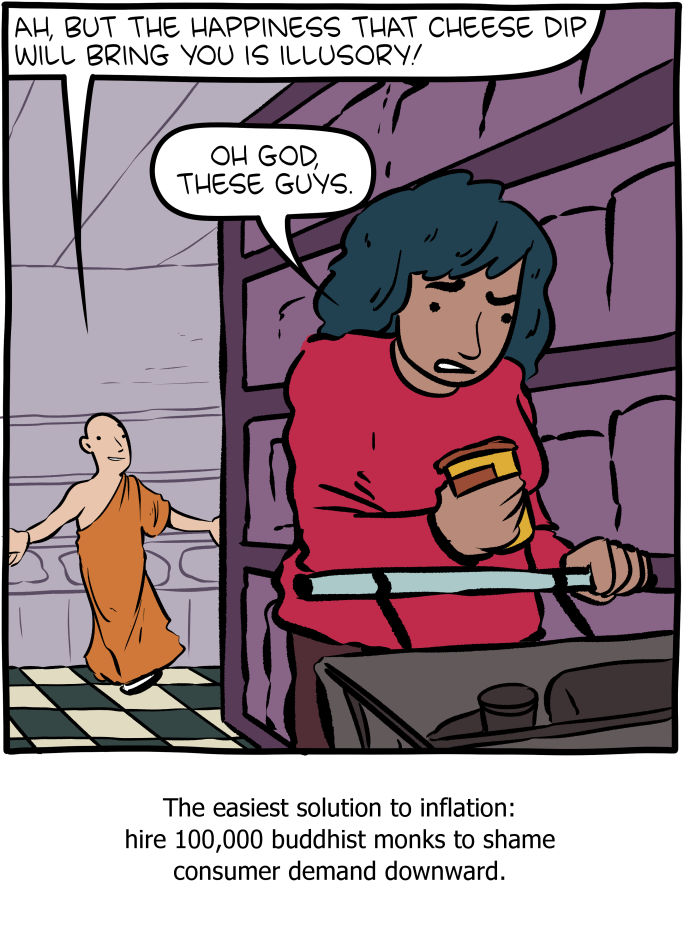
I think we can also get per capita income to infinity by realizing there is No Self.
Cowboy Who?Digital Landlords
Michael E. Karpeles, Program Lead on OpenLibrary.org at the Internet Archive, spotted an interesting blog post by Michael Kozlowski, the editor-in-chief of Good e-Reader. It concerns Amazon and its audiobook division, Audible:
Amazon owned Audible ceased selling individual audiobooks through their Android app from Google Play a couple of weeks ago. This will prevent anyone from buying audio titles individually. However, Audible still sells subscriptions through the app (…)
Karpeles points out that this is yet another straw in the wind indicating that the ownership of digital goods is being replaced with a rental model. He wrote a post last year exploring the broader implications, using Netflix as an example:
What content landlords like Netflix are trying to do now is eliminate our “purchase” option entirely. Without it, renting become the only option and they are thus free to arbitrarily hike up rental fees , which we have to pay over and over again without us getting any of these aforementioned rights and freedoms. It’s a classic example of getting less for more.
He goes on to underline four extremely serious consequences of this shift. One is the end of “forever access”. If the company adopting the rental model goes out of business, customers lose access to everything they were paying for. With the ownership of goods, even if the supplier goes bankrupt, you still have the product they sold to you.
Secondly, the rental model effectively means the end of the public domain for material offered in that way. In theory, books, music, films and the rest that are under copyright should enter the public domain after a certain time – typically around a century after they first appeared. But when these digital goods are offered using the rental model, they usually come wrapped up in digital locks – digital rights management (DRM) – to prevent people exiting from the rental model by making a personal copy. That means that even if the company offering the digital goods is still around when the copyright expires, this content will remain locked-away even when it enters the public domain because it is illegal under copyright laws like the US DMCA and EU Information Society Directive to circumvent those locks.
Thirdly, Karpeles notes, the rental model means the end of personal digital freedom in this sphere. Since you access everything through the service provider, the latter knows what you are doing with the rented material and when. How much it chooses to spy on you will depend on the company, but you probably won’t know unless you live somewhere like the EU where you can make a request to the company for the personal data that it holds about you.
Finally, and perhaps least obviously, it means the end of the library model that has served us so well for hundreds of years. Increasingly, libraries are unable to buy copies of ebooks outright, but must rent them. This means that they must follow the strict licensing conditions imposed by publishers on how those ebooks are lent out by the library. For example, some publishers license ebooks for a set period of time – typically a year or two – with no guarantee that renewal will be possible at the end of that time. Others have adopted a metered approach that counts how many times an ebook is lent out, and blocks access after a preset number. Karpeles writes:
Looking to the future, as more books become only available for lease as eBooks, I see no clear option which allows libraries to sustainably serve their important roles as reliable, long-term public access repositories of cultural heritage and human knowledge. It used to be the case that a library would purchase a book once and it would serve the public for decades. Instead, now at the end of each year, a library’s eBooks simply vanish unless libraries are able to find enough quarters to re-feed the meter.
The option to own new digital goods or to access the digital holdings of public libraries may not be available much longer – enjoy them while you can.
Follow me @glynmoody on Twitter, Diaspora, or Mastodon. Originally posted to Walled Culture.

The January 6 hearings have been damning. Hutchinson’s testimony took them to a new level.
In one fell swoop, former Trump White House aide Cassidy Hutchinson transformed the story of the January 6, 2021, attack on the Capitol.
Hutchinson, who was a top deputy to Trump chief of staff Mark Meadows, revealed a series of stunning details about the events of the Capitol riot during her testimony to the January 6 committee. Hutchinson’s testimony suggests that the president knew in advance that violence was a possibility that day, and may very well have approved of it. He instructed his supporters to go to the Capitol, knowing that they were armed, and planned to join them personally once they arrived. After he was prevented from going personally, he told top aides that his vice president deserved the “hang Mike Pence” chants and that the rioters weren’t doing anything wrong.
Just a few days ago, Donald Trump attempted to downplay the day’s events, describing them as “a simple protest that got out of hand.” This was never credible, but Hutchinson’s testimony has simply demolished it. What once may have plausibly been described as an inchoate violent mob egged on by the president now looks much more like an attempted coup d’état.
To understand how Hutchinson changed what we knew about the Capitol attack, it’s helpful to focus on four key moments in her testimony.
1) In a January 2, 2021, conversation, Trump ally Rudy Giuliani told Hutchinson that “we are going to the Capitol, it’s going to be great, the president is going to be there.” When she asked Meadows about what Giuliani said, her boss warned that “things might get real, real bad on January 6.” In the following days, the White House received repeated warnings from intelligence agencies that the rally might turn violent; neither Trump nor Meadows did anything.
This not only indicates that the White House had warning of a very serious risk of violence at the rally, but raises the question of whether the violence was actually planned — that is, what specifically “real, real bad” referred to.
2) On the morning of the attack, when Trump was informed that people in the crowd for his speech had weapons, Hutchinson heard the president say, “I don’t care that they have weapons. They’re not here to hurt me.”
This is the strongest evidence we’ve had that the president had direct and advance warning on the day of the attack that his crowd was prepared for violence, and that he then proceeded to instruct these people to march on the Capitol, indifferent at best that those weapons might be used there. “They’re not here to hurt me” could be read a couple of ways: It could simply be downplaying any threat to Trump’s person, but it could also suggest he believed that they were there to hurt someone else.
3) After his speech, Trump had planned to personally travel to the Capitol with the rioters. Hutchinson was informed by another White House aide that Secret Service agents attempted to take the car back to the White House instead, citing ongoing violence. In response, Trump reportedly tried to physically seize control of the wheel from a Secret Service agent in a failed attempt to drive to the Capitol.
This is the one key detail that Hutchinson herself did not witness, so we can’t be as confident that it happened as described. Nevertheless, the story — together with other evidence, including National Security Council chat logs released by the committee — provides new and strong reasons to believe that the president was set on leading the Capitol mob, even after it turned violent.
4) When the president returned to the White House, he met with Meadows and White House counsel Pat Cipollone and discussed the rioters chanting “hang Mike Pence” in the halls of the Capitol. Hutchinson heard Meadows say, “You heard him, Pat. He thinks Mike deserves it. He doesn’t think they’re doing anything wrong.”
Hutchinson is not the first committee source to describe Trump as approving the idea of Pence’s execution. But hearing more confirmation, together with testimony that he believed that the crowd assaulting police officers and ransacking the Capitol was doing nothing wrong, paints an even clearer picture of a president who not only condoned the violence, but actively approved of it.
Put together, and assuming the details are true, we now have good reason to believe that the violence of the day was not accidental but intentional: that Trump wanted a violent mob to attack the Capitol on his behalf, to use force to disrupt Congress’s certification of the election results and thus give him a chance at illegally holding onto the presidency.
It appears, in short, to be a kind of attempted regime change: a coup that we would have no problem describing as such in any other country but our own.
Legal commentators are already suggesting that the evidence presented by Hutchinson could fuel criminal charges against Trump, such as seditious conspiracy — with one calling it “the smoking gun” necessary to go after the former president. Whether Attorney General Merrick Garland chooses to act on this evidence is an open question; so far, he has appeared very reticent to pursue former Trump officials on issues relating to January 6.
I don’t have much faith that the gravity of this charge will change the way Republicans think and act about Donald Trump. Perhaps this time will be different, and it will prove too much for rank-and-file Republicans — and even for craven power-seekers like Senate Minority Leader Mitch McConnell and House Minority Leader Kevin McCarthy. When it comes to Trump’s offenses, “this time will be different” has a poor track record.
Yet those of us in the press should not judge the import of Hutchinson’s testimony purely by its likely legal and political consequences. One of the most important roles of the press is to tell the truth: to inform the public about what is happening in their country, describing it accurately and honestly to the best of our ability.
And to that end, it is important to be as clear as possible about what Cassidy Hutchinson has done. She told us, in no uncertain terms, that the sitting president at the very least condoned a violent attack that he knew ahead of time was likely — behavior that is, itself, an assault on the foundations of American government. What we do with that, as a democracy, is up to us.

Mark Meadows warned Cassidy Hutchinson that “things might get real, real bad” on January 6. That was just the beginning of her bombshell testimony.
White House chief of staff Mark Meadows warned one of his top aides on January 2, 2021, that “things might get real, real bad” on January 6, that aide, Cassidy Hutchinson, said in the opening moments of her bombshell testimony before the House January 6 committee on Tuesday.
The testimony she provided over the next two hours included a litany of details about Meadows’s, Trump’s, and other White House officials’ knowledge of the danger the January 6, 2021, rally participants posed, their activities as the Capitol riot happened, and what they did in the days after it.
Although clips of the nearly 20 hours of depositions that Hutchinson gave the committee had previously played in public hearings, this was the first time that a White House staffer has appeared in person during the hearings, and it surpassed the hype stoked by the committee’s last-minute announcement of a hearing.
Hutchinson was a key conduit between the White House and dozens of members of Congress, and the committee previously aired part of her deposition where she named members of Congress who had sought pardons from Trump after January 6. She also was in countless meetings with figures who played key roles in the plot to overturn the election, including Meadows and lawyers Rudy Giuliani and Sidney Powell, and has played a vital role in the committee’s effort to piece together the events leading up to January 6.
Here are the seven most shocking revelations Hutchinson disclosed on Tuesday.
"I’m the F’ing President. Take me up to the Capitol now." pic.twitter.com/LWg2sdFtTi
— January 6th Committee (@January6thCmte) June 28, 2022
Hutchinson revealed that Trump was so intent on going to the Capitol following his speech during the Stop the Steal rally at the Ellipse on January 6 that, according to a colleague who talked to her shortly after he saw the incident, he grabbed the steering wheel of the presidential limousine and then got physical with the Secret Service agent who tried to restrain him.
She said that Trump had believed he was going to the Capitol after his speech that day, and only discovered that those plans had been blocked once he returned to the motorcade afterward. According to Hutchinson’s second-hand account, Trump was so enraged that he shouted “I’m the f-ing president, take me up to the Capitol now” before trying to drive himself there. When a Secret Service officer restrained him, Trump then “lunged at his clavicle.”
Hutchinson said White House counsel Pat Cipollone repeatedly warned Trump and other top officials that going to the Capitol as protesters were marching there to disrupt the counting of electoral votes would create criminal liability.
“We are going to get charged with every crime imaginable,” Hutchinson said he told her of the plans for Trump to show up there on January 6. The top White House lawyer specifically cited obstruction of justice and obstructing the electoral count as crimes that Trump might commit by appearing at the joint session of Congress.
Trump was unhappy that the crowd at his Ellipse rally before his speech was too small, and displeased that many rallygoers were watching from beyond the security perimeter, Hutchinson recounted.
Trump was furious the Secret Service was screening people at his rally for weapons.
— January 6th Committee (@January6thCmte) June 28, 2022
"They're not here to hurt me. Take the F'ing mags away. Let my people in. They can march to the Capitol from here." pic.twitter.com/YEQGkbjuiM
When he was told it was because many of the people at the National Mall were armed and didn’t want to go through security to get closer to the stage, Trump was enraged.
“I don’t care that they have weapons, they are not here to hurt me, take the f’in mags away, and they can march to the Capitol,” he said, according to Hutchinson.
Hutchinson testified at length about her former boss, Meadows, and the warnings he and White House officials got in the days leading up to January 6, including that January 2 comment.
On January 2, 2021, Rudy Giuliani met with White House Chief of Staff Mark Meadows.
— January 6th Committee (@January6thCmte) June 28, 2022
Hutchison was told that things on January 6 might get "real bad." pic.twitter.com/401ThSJNWv
The conversation in which Meadows warned things could get “real bad” occurred minutes after Rudy Giuliani told Hutchinson, “We are going to the Capitol, it’s going to be great, the president is going to be there, he’s going to look powerful.”
Hutchinson testified that she heard Meadows tell Cipollone that Trump agreed with the mob shouting “Hang Mike Pence” at the Capitol. “You heard him, Pat, he thinks Mike deserves it, he doesn’t think they’re doing anything wrong,” Meadows said, according to Hutchinson.
"Mark had responded something to the effect of, 'You heard him, Pat. He thinks Mike [Pence] deserves it. He doesn't think they're doing anything wrong.'" pic.twitter.com/TGeXBmAy3O
— January 6th Committee (@January6thCmte) June 28, 2022
She went on to describe Trump’s mindset on January 7 — that the rioters didn’t do anything wrong. Instead, Trump believed, “The people who did something wrong that day was Mike Pence not standing with him.”
We knew from prior testimony that a half-dozen members of Congress inquired about pardons after January 6. Hutchinson on Tuesday testified that both Meadows and Giuliani reached out to Trump about potential pardons after the attack on the Capitol.
In addition, she testified that Trump wanted to promise a pardon to everyone who stormed the Capitol in his January 7 speech and was encouraged to do so by Meadows. However, White House counsel made clear that “they didn’t think it was a good idea.”
Hutchinson’s revelations were so numerous, it often seemed there was a new bombshell every few minutes. And when she wrapped up her testimony, Rep. Liz Cheney, in her closing statement, offered a bombshell of her own: There had been efforts to intimidate witnesses called to testify before the committee.
CHENEY finishes the hearing by raising allegations of witness intimidation and witness tampering in the January 6 investigation. pic.twitter.com/L1DnyG9v09
— Jamie Dupree (@jamiedupree) June 28, 2022
Without naming the witnesses or who was doing the intimidation, she showed statements received in advance of their depositions or testimony by witnesses appearing before the committee. One read: “I’m protecting who I need to protect ... I’ll continue to stay in good graces in Trump World. And they have reminded me a couple of times Trump does read transcripts and just to keep that in mind.”

My favorite character in the video below is the man in the blue shirt at the front who waves excitedly even as things start to go south. Perhaps he knows what's coming and is waving… goodbye.
Now, I'm no swampologist, but this seemed fairly inevitable.


Read more of this story at Slashdot.

Embroidered shirts are great custom gifts and can also be a great way to show your love for open source. This tutorial will demonstrate how to design your own custom embroidered polo shirt using Inkscape and Ink/Stitch. Polo shirts are often used for embroidery because they do not tear as easily as t-shirts when pierced by embroidery needles, though with care t-shirts can also be embroidered. This tutorial is a follow on article to Make More with Inkscape and Ink/Stitch and provides complete steps to create your design.
Pictures with only a few colors work well for embroidery. Let us use a public domain black and white SVG image of Tux created by Ryan Lerch and Garret LeSage.

Download this public domain image, tux-bw.svg, to your computer, and import it into your document as an editable SVG image using File>Import...

It is helpful to have a checkerboard background to distinguish background and foreground colors. Click File>Document Properties… and then check the box to enable a checkerboard background.

Then close the document properties dialog box. You can now distinguish between colors used on Tux and the background color.

Type s to use the Select and Transform objects tool, and click on the image of Tux to select it. Then click on Object>Fill and Stroke, in the menu. Type n to use the Edit paths by Nodes tool and click on a white portion of Tux. Within the Fill and Stroke pane change the fill to No paint to make this portion of Tux transparent.

Thi leaves the black area to be embroidered.
Now convert the image for embroidery. Type s to use the Select and Transform objects tool and click on the image of Tux to select it again. Choose Extensions>Ink/Stitch>Fill Tools>Break Apart Fill Objects … In the resulting pop up, choose Complex, click Apply, and wait for the operation to complete.

For further explanation of this operation, see the Ink/Stitch documentation.
Now resize the area to be embroidered. A good size is about 2.75 inches by 2.75 inches. Press s to use the Select and Transform objects tool, and select Tux, hold down the shift key, and also select any text area. Then choose Object>Transform …, click on Scale in the dialogue box, change the measurements to inches, check the Scale proportionally box and choose a width of 2.75 inches, and click Apply.

Before saving the design, reduce the document area to just fit the image. Press s to use the Select and Transform objects tool, then select Tux.

Choose File>Document Properties… then choose Resize to content: or press Ctrl+Shift+R

The document is resized.

You now need to convert your file to an embroidery file. A very portable format is the DST (Tajima Embroidery Format) format, which unfortunately does not have color information, so you will need to indicate color information for the embroidery separately. First save your design as an Inkscape SVG file so that you retain a format that you can easily edit again. Choose File>Save As, then select the Inkscape SVG format and enter a name for your file, for example AnotherAwesomeFedoraLinuxUserFront.svg and save your design. Then choose File>Save As and select the DST file format and save your design. Generating this file requires calculation of stitch locations, this may take a few seconds. You can preview the DST file in Inkscape, but another very useful tool is vpype-embroidery
Install vpype-embroidery on the command line using a Python virtual environment via the following commands:
virtualenv test-vpype
source test-vpype/bin/activate
pip install matplotlib
pip install vpype-embroidery
pip install vpype[all]
Preview your DST file (in this case named AnotherAwesomeFedoraLinuxUserFront.dst which should be replaced by the filename you choose if it is different), using this command:
vpype eread AnotherAwesomeFedoraLinuxUserFront.dst show

Check the dimensions of your design, if you need to resize it, you should resize the SVG design file before exporting it as a DST file. Resizing the DST file is not recommended since it contains stitch placement information, regenerate this placement information from the resized SVG file to obtain a high quality embroidered result.
Now create a message to put on the back of your polo shirt. Create a new Inkscape document using File>New. Then choose Extensions>Ink/Stitch>Lettering.
Choose a font, for example Geneva Simple Sans created by Daniel K. Schneider in Geneva. If you want to resize your text, do so at this point using the scale section of the dialog box since resizing it once it is in Inkscape will distort the resulting embroidered pattern. Add your text,
Another Awesome
Fedora Linux User

A preview will appear, click on Quit

Then click on Apply and Quit in the lettering creation dialog box. Your text should appear in your Inkscape document.

Create a checkered background and resize the document to content by opening up the document properties dialog box File>Document Properties…

Your document should now be a little larger than your text.

Many commercial embroidery machines support jump instructions which can save human time in finishing the embroidered garment. Examine the text preview image. A single continuous thread sews all the letters. Stitches joining the letters are typically removed. These stitches can either be cut by hand after the embroidery is done, or they can be cut by the embroidery machine if it supports jump instructions. Ink/Stitch can add these jump instructions.
Add jump instructions by selecting View>Zoom>Zoom Page to enlarge the view of the drawing. Press s to choose the Select and transform objects tool. Choose Extensions>Ink/Stitch>Commands>Attach Commands to Selected Objects. A dialog box should appear, check just the Trim thread after sewing this object option.

Then click in the drawing area and select the first letter of the text

Then click Apply, and some cut symbols should appear above the letter.

Repeat this process for all letters.

Now save your design, as before, in both SVG and DST formats. Check the likely quality of the embroidered text by previewing your DST file (in this case named AnotherAwesomeFedoraLinuxUserBack.dst – replaced this by the filename you chose), using
vpype eread AnotherAwesomeFedoraLinuxUserBack.dst show

Check the dimensions of your design, if you need to resize it, you should resize the SVG design file before exporting it as a DST file.
To show the approximate placement of your design on the polo shirt create a mockup. You can then send this to an embroidery company with your DST file. The Fedora Design Team has a wiki page with examples of mockups. An example mockup made using Kolourpaint is below.
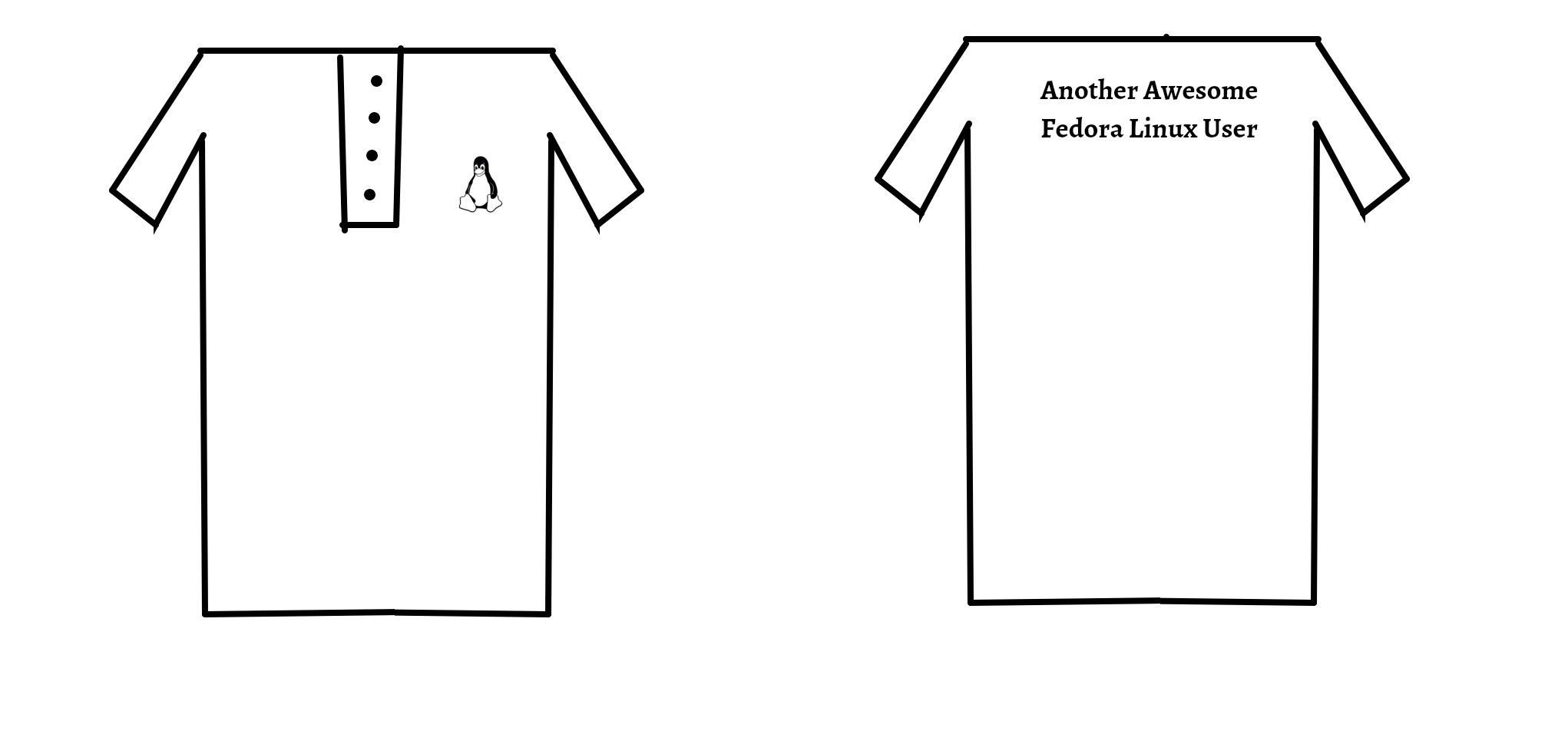
You can also use an appropriately licensed drawing of a polo shirt, for example from Wikimedia Commons.
Pictures of a finished embroidered polo shirt are below



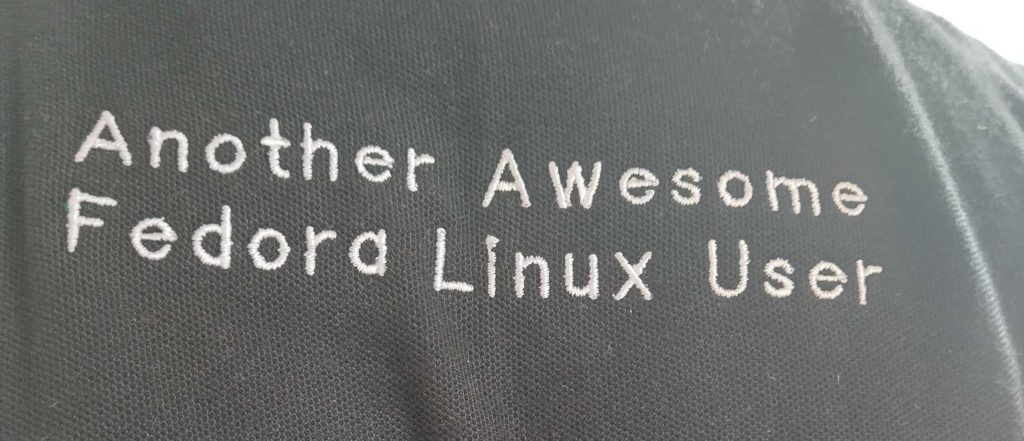
A three color image of Tux is also available, but single colors are easiest to achieve good embroidered results with. Adaptation of this shaded multiple color image is required to use it for embroidery. Additional tutorial information is available on the Ink/Stitch website.
Some companies that can do embroidery given a DST file include:
Search the internet for machine embroidery services close to you or a hackerspace with an embroidery machine you can use.
This article has benefited from many helpful suggestions from Michael Njuguna of Marvel Ark and Brian Lee of Embroidery Your Way.

Apple's latest 13-inch MacBook Pro features the new M2 chip with enhanced performance capabilities. It was previously reported that the 256GB M2 MacBook Pro features a slower SSD performance compared to the M1 MacBook Pro with 256GB storage. It was discovered that the M2 model featured a single NAND storage chip, while the older M1 model was equipped with two NAND chips. In a real-world speed test comparison, the M1 MacBook Pro beats the M2 variant. Scroll down to read more details on the subject.
The M1 and M2 MacBook Pro models part of the test are both 256GB variants. The M2 MacBook Pro with a higher storage configuration would perform differently. However, if you are looking to buy the base model of the M2 new MacBook Pro, check out the real-world speed test below.

It was discovered that the M2 MacBook Pro with 256GB of SSD storage and 8GB of RAM was slower compared to the M1 model with 256GB storage and 8GB RAM. The performance comparison has been conducted by the YouTube channel Max Tech with multiple usage tests that include Lightroom, Photoshop, Final Cut Pro, file transfers, and multitasking.
In the multitasking RAM test, the M1 chip easily beats the M2 MacBook Pro with faster app launch times and content loading speed. The older chip was again faster in the image export test in Lightroom while apps were running in the background. The M1 variant took 3 minutes and 36 seconds to export 50 images while the M2 MacBook Pro took 4 minutes and 12 seconds. You can check out the M2 MacBook Pro speed test comparison against M1 MacBook Pro below for more details.
The built-in 8GB of unified memory of the M2 MacBook Pro is being used simultaneously for several processes. On the other hand, the notebook is using SSD for virtual memory. Due to the virtual memory swapping, the M2 MacBook Pro loses to the M1 variant in the speed test comparison.
At this point, Apple has not shared its side of the story of why it opted for a different NAND chip in the M2 MacBook Pro. We will wait for more tests to determine if the performance is indeed related to the NAND chips. This is all for now, folks. Share your views with us in the comments section below.
The post M2 MacBook Pro Speed Test Comparison Shows it is Slower Than M1 MacBook Pro – Video by Ali Salman appeared first on Wccftech.
This post, how do I talk with my incompetent boss about his ridiculously inaccurate organizational chart? , was originally published by Alison Green on Ask a Manager.
A reader writes:
My boss, the executive director of a small nonprofit, is grossly incompetent. I won’t go into detail, but please trust that I have it on good authority (friends, colleagues, peers, veteran HR professionals outside of the organization – two of them!) that I am right and he’s completely out of his depth.
In January, I asked for an organizational chart for our small org of four people – my boss, his assistant, me, and a colleague in a parallel position to mine. I wanted to understand the organization’s reporting structure, promotion lines, and how my work intersects with my colleagues.
The latter colleague I mentioned was fired and not replaced, so we’re down to three people, my boss included. Five months after I asked for an organizational chart, we were presented with one. It has 15 positions on it, and my boss is the only person whose job is on the chart. My position and his assistant’s aren’t on it! When we asked why, we were told that we would meet with him one-on-one the following week to discuss. Well, he’s postponed those meetings for three weeks. I know for certain that this isn’t some weird roundabout way to fire us because of everything I’m solely responsible for. It’s more likely that I’m about to be promoted and he’s terribly botching the roll-out.
The chart has more issues than I have time to identify, but in a nutshell, it’s unequitable and nonsensical. It demonstrates with no uncertainty that my boss isn’t qualified to do his job. We have been debating my position, title, and compensation ever since I was hired and immediately realized that I was expected to do the work of three people until he got around to hiring “help” for me. And while my current position isn’t on this org chart, there are indeed three positions on there that describe what I do. My boss has been saying “help is on the way” for the last 10 months since I was hired, but it’s taken him five of them to create an aspirational org chart that was not accompanied by any kind of plan for implementation, so I frankly don’t believe him.
While I am waiting for the meeting about my role, I am becoming more certain that nothing good is going to come from it, and anytime I try to talk to my boss about my position or the fact that I can’t sustain the work of three people, he berates me. I don’t want to continue having this conversation with him in secret. We have no HR, and he made it clear that transparency with my colleague is not an option when I talked about my position in front of her and he told me not to put ideas in her head. I don’t know any board members, and they get all their information from him anyway. Is there some way I can ask to have this meeting witnessed or mediated by an impartial third party? Where would I find someone like that?
Is there any use in trying to provide feedback about how terrible this organizational chart is? My boss is sexist and doesn’t believe that I am knowledgeable about this, but maybe he would believe an “expert?!”
Sometimes when you are in a highly dysfunctional situation, it’s easy for one specific thing to become the focal point for all your outrage, even if that one specific thing isn’t the most egregious thing you’re facing.
I think that’s happening here.
The org chart … doesn’t really matter.
Don’t get me wrong, your boss’s chart sounds ridiculous. But it doesn’t really matter, given the situation you’ve described.
It might feel like it’s very important because of what it represents — your boss’s apparent inability to understand organizational basics like what positions exist, whose role is what, and even how many people the organization employs. Those things matter very much.
But those deficiencies in your boss will exist no matter what the org chart says.
Is it ludicrous that your boss produced an org chart listing 15 positions in an organization of three people, and where two of those three people aren’t listed at all and where there is apparently no plan to fund and hire for those other 12 positions, and that it took him five months to create it? Yes! It is.
But it’s not anywhere near your biggest problem. Your biggest problem is that you are working for a tiny organization led by a grossly incompetent manager (tiny matters here because it means that his incompetence is going to deeply affect every aspect of how things operate). Your second biggest problem is that you are facing an unrealistically high workload for which you’ve seen you will get no help. There are undoubtedly other huge problems that stem from your boss’s gross incompetence as well.
So it doesn’t make sense to focus your energy on the org chart. Even if he produced a beautifully accurate and detailed org chart tomorrow, it wouldn’t change anything. All your big problems would remain.
The incompetence and overwork is what matters. You don’t need a meeting about your role or the chart, or a witness or mediator for that meeting. That would be like putting a lot of energy into finding a perfectly sized bandage for a small cut on your foot when your entire leg is on fire.
You will only solve this by leaving.
 Workbook for a Woman’s Guide to Business and Social Success: A Personal Analysis Record
1983
Submitter: We found this workbook still sitting on the shelf, long after the actual textbook was weeded, 15 years ago! The work book is filled with the classic tropes of the era. Ladies need to be thin, pretty and submissive to make it in the working world. An ‘interesting’ glimpse into the past.
Holly: This. Is. Awful. Sections like “My Cosmetics and How I Will Apply Them,” “My Hair Care and Coiffure Arrangement Analysis,” and “Developing and Attractive Voice” make me want to vomit. Also, we all know that workbooks are the kiss of death in libraries. How did this one survive almost 40 years without being all written up?


The post Women Do Business appeared first on Awful Library Books.
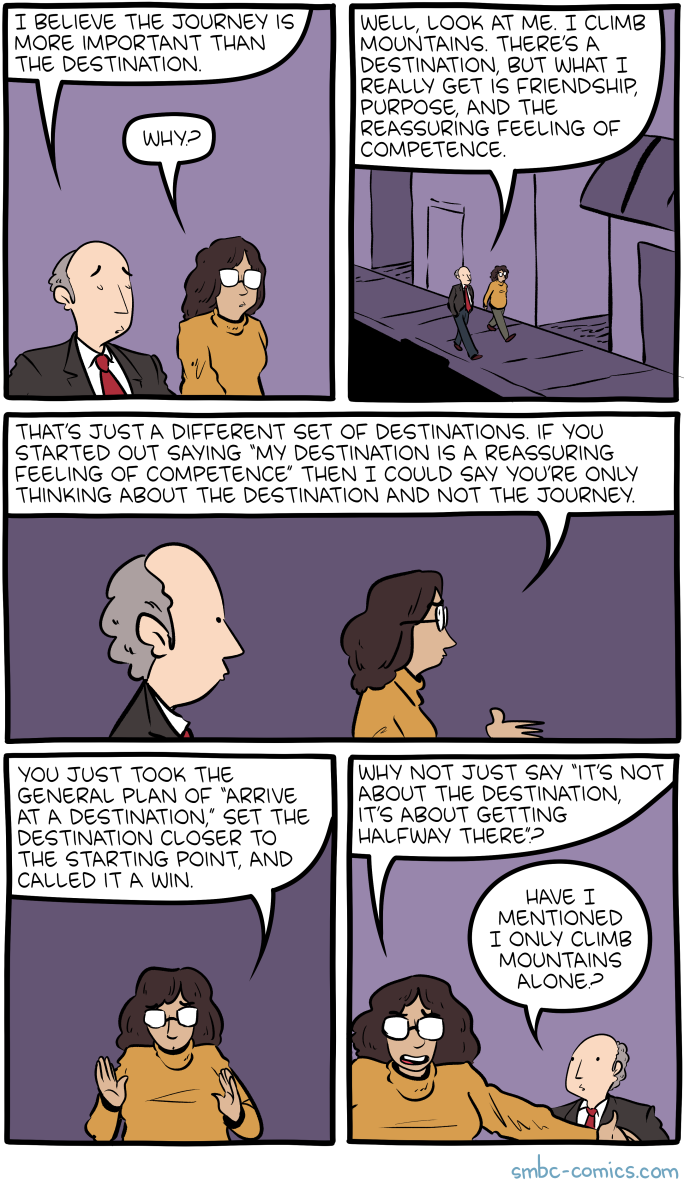
Hovertext:
It's not about the destination, it's about the money we made along the way.

The University of Arizona joins schools in a number of other states in covering tuition and fees for tribal members, who have been less likely than other Americans to pursue higher education.
(Image credit: John Locher/AP)

“This and That” is an occasional series of paired observations. See past “This and That” posts here. – Ed.
Today: Google Maps

Jens Ellstrup Rasmussen (Danish, born 1966), “Google Map Pin”, 2005, digital image file (Gift of Google, 2013), on view at MoMA.
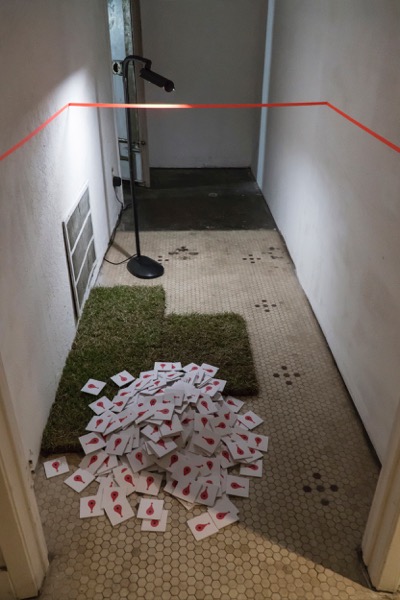
Carolyn Sortor, “Moving Time (2017),” installation with audio, 2,900 custom sticky notes, dying sod, and lamps
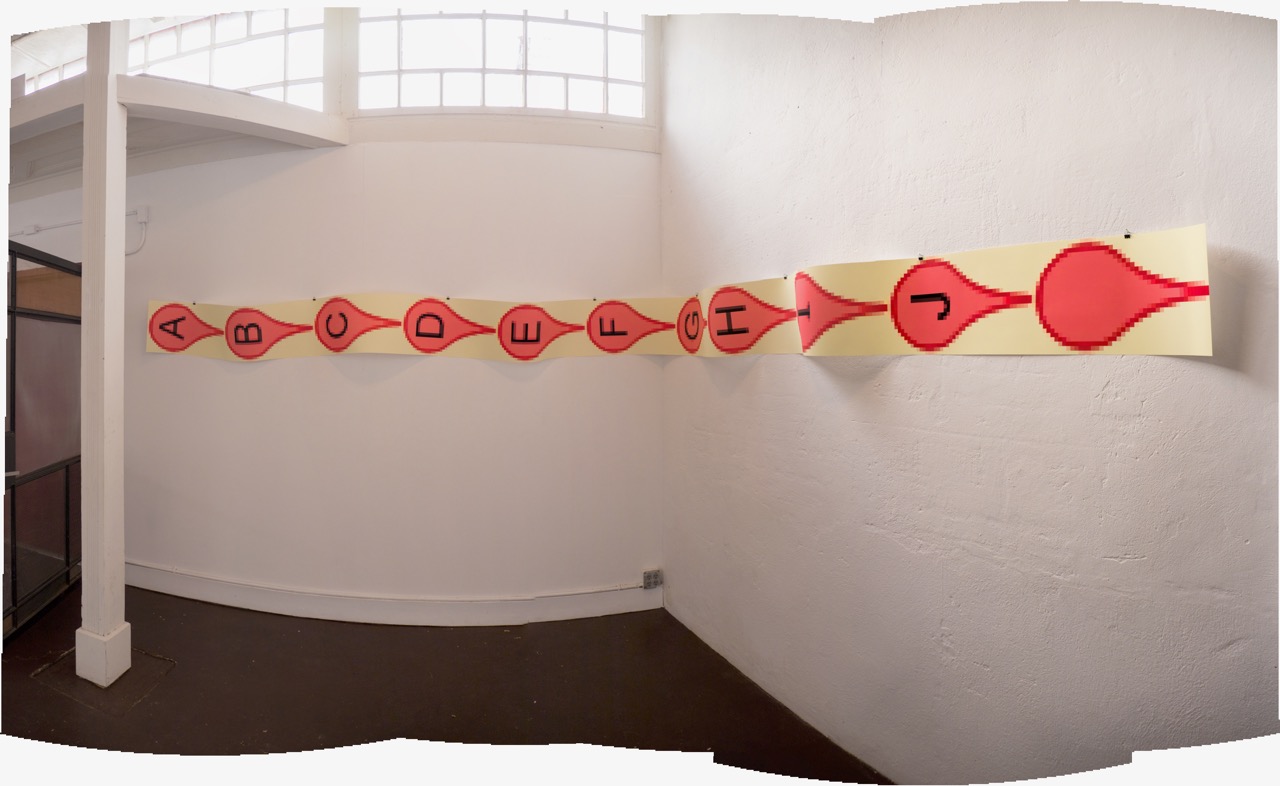
Carolyn Sortor, “Location Markers JPEG (Ribbon),” 2015, digital inkjet print on paper, 240 x 13 inches

Carolyn Sortor, “Location Markers JPEG (Ribbon),” 2015, digital inkjet print on paper, 240 x 13 inches
*************
No matter how original, innovative or crazy your idea, someone else is also working on that idea. Furthermore, they are using notation very similar to yours. – Bruce J. MacLennan
The post This and That: Carolyn Sortor and Jens Eilstrup Rasmussen appeared first on Glasstire.

The Glassell School of Art
Houston artist and educator Joseph Havel has been the director of the Museum of Fine Arts, Houston’s Glassell School of Art since 1991. After more than thirty years, he will be stepping down from his position at the end of June to focus solely on his personal artistic practice.
In a recent conversation, Havel reflected on his time at Glassell and discussed his current body of work executed in collaboration with Hannah, his parrot, along with his plans for the future.
Caleb Bell (CB): Your current body of work, which has been the focus of several recent exhibitions including Parrot Architecture at the Dallas Contemporary, is the result of a collaboration with Hannah, your African gray parrot. Before we discuss the work, can you tell me a little bit about Hannah and how long you have had her?
Joseph Havel (JH): Hannah is a female Congolese African gray. She is 24 years old. She was purchased as a baby just after being weaned to solid food and is domestically bred.
She has lived with me since.
CB: The first time I remember you two collaborating on a body of work was The Hannah Variations around 2017 or 2018. When was the first time you collaborated with her and how did it come about?
JH: We tentatively started in 2016 when I bought her some balsa wood to chew rather than a much more expensive parrot toy, which she loved to destroy. She shredded/carved two figures that looked like Giacometti figures; a small standing figure and a head of his brother, Diego. She seemed to mostly carve when I was in the room and she was looking for approval. This generated a good deal of research regarding her species and what had been discovered before, as well as her species habits and conditions in the wild. This led quickly into considerations of animal/non-human intelligence. It was a fascinating way to enter in a small way into her habits, instincts, and how I might fit into them. Over time, the questions about the environment, the Anthropocene, and the current moment of extinction of species based on human contact became important. And then the pandemic! It was evolving from a marginal consideration to something quite direct.

Works by Joseph Havel and his collaborator and pet parrott Hannah, on view at the Dallas Contemporary
CB: With the onset of the pandemic, how did the collaboration progress? What were some of your initial thoughts around its potential?
JH: The pandemic had a huge effect in a number of ways. The isolation that came with the quarantine meant that I was around Hannah much more each day. My partner and I live in an apartment above my studio and I had moved my office from a separate room into Hannah’s day room to make space for my partner’s studio, since we were all locked down together. Since Hannah mostly works on boxes or wood when I or Mary (my partner) are in the room, this accelerated the production.
Also, suddenly we were no longer going out to stores, but having everything from groceries to needed household items shipped. We had a plethora of boxes. Hannah mostly prefers working on boxes rather than wood; maybe in a 7/8 to 1/8 ratio. Boxes also are the easiest way to engage either of us as a participant, as she can play hide and seek as she cuts holes in them. We refined as well as expanded the box sizes she was comfortable with. Those are all practical developments.
It also focused me more on the related research, allowing me to read and expand my understanding of our engagement, from the species habits and brain structures all the way to questions about the Anthropocene and the extreme extinction moment we are currently in. It grounded everything intellectually and also as freed me to make more complex forms.
All of this led me to invest more and more artistic ambition into the potential and ask questions about how to keep both of our intentions intact, at least to the degree that I can understand them. Obviously my cultural motives are uniquely human, but how is what she is doing is uniquely part of African gray parrot culture? She recognizes that she worked on the sculptures, even if they have been turned into bronze. She also has a stopping point when she no longer feels the need to carve a box or piece of wood.
A friend who is involved in human brain science has told me that suggesting a parrot has the ability to be creative is hearsay, but that seemed such a human centric point of view. That seems to be broadly the same point of view that has been screwing up the planet to the point it’s going to be uninhabitable.

Sculptures by Joseph Havel and Hannah, his collaborator and pet parrot, on view at the Dallas Contemporary
CB: Once Hannah has finished her part, can you explain how you finish the works? What are you considering during that process?
JH: It’s not singular. There is not a process that is always the same, and this really reflects the naturalness of our process. Sometimes I assemble them, sometimes I assemble them and leave them in her “studio “ in case she wants to work on them more; sometimes I “curate” them and simply present them similar to what you see in Neighborhood, included in Parrot Architecture. Presentation, at whatever state, doesn’t matter to her, but is essentially human centric. Experience matters more to Hannah.
CB: I can only imagine how enlightening this whole collaborative process has been. Is there anything else that you would like to share about it? Maybe something that you’ve learned which surprised you?
JH: I have a fortune from a fortune cookie taped to my refrigerator that says “Always, always practice humility.” I think one thing I have learned and continue learning from this project is really to pay attention from a humble position. Author is the root word for authority, but what happens when you’re more of an orchestrator than a singular author? What lessons can be learned from listening and observing?
The exhibitions are up but I am back in my studio constructing and conjecturing. This morning Hannah carved on a new box while I had coffee. Quoting Harold Rosenberg, “Each artist must undertake to invent himself, a lifelong act of creation that constitutes the essential content of the artist’s work”; said simply, the job of an artist is to make an artist. Art works are the evidence, but for me, the process is important and takes humility. Working with Hannah continues to open me up to new wonders and takes me away from myself.

A sculpture by Joseph Havel and Hannah, his collaborator and pet parrot, on view at the Dallas Contemporary
CB: Your work has always dealt with materiality and that has continued with these pieces. In the past, you’ve also elevated mundane objects, as well as explored similar themes of deconstruction. Because of the way these newer works are created, there is a larger element of process present. How do you see this body of work in relation to past ones?
JH: I think in one way or another process has always been a part of my work. This perhaps is because my most influential teacher was the potter Warren MacKenzie, who integrated life/art in a way that no single object was elevated above the collective, and function was an inherent component. I was not a potter, but his philosophy greatly influenced me.
My relationship to performing craft as a way of both presenting and erasing self seems to be more of a focal point in this project. And of course, somehow, the activity of Hannah needs to be preserved instead of simply colonized in the final object. Maybe exposing process is an act of respect towards my collaborator.
CB: Speaking of influential teachers, you have been the director of the Glassell School of Art since 1991 and grown the program tremendously over the years. Towards the end of last year, you announced that you were going to step down from the position at the end of June. How did you reach that decision?
JH: A few years ago, I decided that when the Kinder building opened and the MFAH campus was complete, that it would be time to step away and focus full-time on my art practice, and frankly sleep a little more like a normal person. I have been a workaholic all my life and essentially have been working two full time jobs, getting up very early to do art work and not really taking weekends or vacation days pretty much since I was 20. I also did well with the creative side of being an artist, but was sloppy on the office side.
My job had changed too. When the school was moved to temporary spaces and we were building the new school, I was gradually moved more away from the Core Program and mentoring, which I feel was my signature program. I learned so much from the residents, and hope some also learned from me.
We moved into the new school building a little later than predicted, and then Covid hit. It would have been irresponsible to leave as the school worked through the pandemic, which was difficult. We also really hadn’t figured out the new building, which is fabulous but also has different challenges. I finally feel like we are on the endemic side of Covid and the table is set for the next director. We have great people running programs there right now. Mary Leclere is doing a great job with the Core. It seemed finally, for both my good and the next phase for the school, it was time to step away.

Joseph Havel and his collaborator and pet parrot Hannah
CB: I know you can’t touch on everything, but what are some of the things you are most proud of accomplishing while at the school?
JH: I am very proud of the work I have done with the Core Program. I am pleased to have remained flexible, always asking questions in all programs, particularly the Core and Studio School, from the point of view of an artist. I never really felt like an administrator; I was simply an artist trying to make a better community in which to make and love art. I made mistakes, but listened well and learnd.
Perhaps the new Glassell building and the more direct linkage of the school to the rest of the museum is icing on the cake. I also appreciated the work I did assisting the development of the art residency at Maison Dora Maar in the south of France. It used to be under the guidance of the MFAH, but has recently become an independent program. Finally, I have had a wonderful time helping Mari Carmen Ramirez buy art from artists from the Caribbean. She has become a dear friend. Really, over thirty years, I have been blessed to shepherd change and empower colleagues with good ideas to manifest them. It’s been a good run! Now it’s time to primarily spend my time on my own art practice.
CB: Come July, with the new found studio time, do you have any projects or ideas that you are eager to explore?
JH: I will be in France much of July, August and September. I have an exhibition opening there in a fairly unique nonprofit exhibition space in about a year. I have some ideas, but want to do a site visit and clarify them. I’m also continuing the evolving Hannah work in the studio now and in France, as she is traveling with me. I don’t see a radical shift in my practice at the moment, but rather an evolution of work related to ideas in the Dallas Contemporary exhibit; however, I’m trying to simply be open and respond. I’m sure another solo exhibition will also surface in the next year in the U.S. Having more time is a new frontier!

Joseph Havel playing with his band, Lindale
CB: What do you think more time will mean for your band, Lindale? More gigs?
JH: Ha!! I’m sure when I’m back from France Lindale will rise again! I told them I will write some new songs and send them the rough recordings while I’m away. Look for a new playlist at our post summer shows!
CB: I will be sure to be on the lookout. Joe, congratulations on the recent exhibitions, your approaching retirement from Glassell, and all of the new adventures.
This interview has been edited for length and clarity.
The post Carving Out Time: A Conversation with Joseph Havel appeared first on Glasstire.
Good morning. Houston remains on track for a decidedly cooler and wetter week, with the major question facing us being how much rain the region will receive. For now, I’d expect most locations in the Houston metro area to pick up 1 to 3 inches between now and Friday. The higher end totals, generally, will come near the coast, with lower-end accumulations for inland areas north of Interstate 10.
But there remains a lot of uncertainty as a broad area of low pressure moves westward across the Gulf of Mexico, toward the Texas coast. Given this, the region could see quite a bit more rain, or rain totals could underperform. If you’re wondering about the holiday weekend, sunnier and hotter weather should return by Saturday or Sunday, ahead of the Fourth of July.

The cool front that moved through on Monday and generated showers and thunderstorms for parts of the metro area has moved offshore, and that’s where the bulk of the rain will fall today. I expect inland rain chances of only about 10 to 20 percent, with slightly higher chances right along the coast. Skies will be partly to mostly cloudy today with highs in the low- to mid-90s, and light northeast winds.
Rain chances start to tick upwards on Tuesday night into Wednesday as the aforementioned low-pressure system in the Gulf of Mexico starts to slowly approach the Texas coast. Still, I’d only peg rain chances at about 50 percent for the coast, with diminishing chances for inland areas on Wednesday. Again, the bulk of the rainfall should remain offshore. Look for high temperatures in the low 90s and mostly cloudy skies, with light northeasterly winds turning easterly.
This is when the potential for heavy rainfall will peak. The key questions are where the tropical low pressure system goes, and whether it gets organized into a tropical depression. The low itself is likely bound for the south or central Texas coast. If it organizes sufficiently, this would tend to bring the heaviest bands of rainfall closer to the center of the storm, and south of Houston. If the low remains disorganized, the potential for heavy rainfall would cover much of the Texas coast, including the Houston metro region. As of this morning, the National Hurricane Center is giving the system a 30 percent chance of developing into a tropical depression or storm. Regardless of what happens, we do expect to see at least some precipitation as the upper Texas coast will fall on the eastern, or “wetter” side of the storm. The question, again, is how much.

High temperatures will depend on the extent of rain, so look for anything from the mid-80s to 90 degrees on both days, with mostly cloudy skies.
For now it appears as though the low and its attendant rainfall will be largely gone by the weekend, setting up a pair of partly to mostly sunny days with highs in the low- to mid-90s. I’m not ready to rule out rainfall, given the uncertainty over the next couple of days, but chances are probably in the 20 percent range, especially after Saturday morning.
By the Fourth of July, on Monday, I am reasonably confident that we’ll see mostly sunny skies and highs in the mid-90s. This is fairly typical weather for early July. Such conditions should prevail for most of next week.
Beyond the Gulf of Mexico there is a lot going on in the tropics for late June, but none of this is a direct threat to Texas. Matt will have a full rundown for you in a tropics update later today.

Dan Pasternack grew up in Los Angeles in the 1970s and ’80s, voraciously consuming Looney Tunes cartoons, Marx Brothers’ movies, old-time radio shows, the Dr. Demento radio show, and stand-up comedians on The Tonight Show with Johnny Carson. He went on to become a stand-up comic before embarking on a career in writing, producing, and programming. Dan has been collecting autographed comedy records for most of his life. This is his collection and these are his stories.
When Robin Tyler moved to New York City from Canada, she wasn’t performing comedy yet. She wasn’t even Robin Tyler. She was Arlene, a young Jewish lesbian looking for her place in the world. Looking for a community. And looking for love. In 1962, Robin got her first taste of notoriety. After getting swept up in a police bust of a drag ball at the Manhattan Hotel, she used her one phone call in custody to contact the New York Post. The next day, the headline read, COPS GRAB 44 MEN AND A REAL GIRL IN SLACKS. Robin Tyler now jokes that was what got her started in show business. Seizing the moment, she quickly followed up that incident by getting booked at the campy and colorful Club 82 as a singing Judy Garland impersonator. Yes, long before Julie Andrews starred in Victor/Victoria, Robin Tyler was a woman taking on the role of female impersonator. And it was while she was appearing at Club 82 that Robin met the woman that would become her greatest love as well as her comedy partner. A high fashion model named Pat Harrison.
On June 28, 1969, The Stonewall Inn in Greenwich Village was raided by the police. Back then, this was not an uncommon occurrence at gay bars. But what happened that night was unusual. The patrons of Stonewall fought back, refusing to be arrested. The resistance escalated and the call went out quickly across the city to other members of the LGBTQ community. When Robin and Pat Harrison arrived on the scene, there were hundreds of people protesting on Christopher Street. Robin recalls stepping toward the action when Pat held her back, pleading with her Canadian-born lover to not engage, for fear that she would be deported. The two women watched the melee for a couple of hours and then went home. Robin says she cried that night, vowing that she would never refrain from fighting back again… no matter the consequences.
When I sought out the now eighty-year-old Robin Tyler, I didn’t know that part of her story. I was just curious and eager to learn more about what I suspected was a largely under-explored chapter of comedy history. I knew that she and Pat had been the two-woman comedy team Harrison and Tyler in the seventies. (I had both of their LPs, the first of which includes a brilliant feminist reflection about how men dislike women using a certain “f” word. “They want us to do it, but they don’t want us to say it.”) I also knew that when Harrison and Tyler split up, Robin went out on her own as a solo act and had been a fixture at the Comedy Store. But when I first cold-called her and asked why our paths hadn’t crossed when I was at the Store in the mid-eighties, she chuckled, “That’s because you were above ground. I had gone underground.” At that point, two things were clear to me. One, I needed to know everything about this woman; and two, she was, as my fourteen-year-old daughter has since described her, a “badass.”
Harrison and Tyler were radicals, both on stage and off. And it was deliberate. As Robin says, “We were the first women to make women the subject and not the object of humor.” They performed antiwar material on a USO tour of Vietnam. They had to be dragged off the field during a Rams-Raiders football game after staging a protest about the lack of scholarship funding for female athletes. And when they were courted to star in their own ABC primetime comedy-variety series, they refused to sign their contract until the network removed the “morals clause,” because it would have had them affirm that they were not lesbians.
Sadly, after several failed pilots that diluted their voice, the team broke up. But when Robin went solo, the substance of her act went even further. She shared her coming-out story and talked about being a lesbian, leading to her landmark 1979 album Always a Bridesmaid, Never a Groom. At that time, just being openly gay as a performer was practically unheard of. But performing comedy material about it on stage, on television, and on records was totally groundbreaking.
At the apex of Robin’s ascent as a comic, her potency as a provocateur began to transform her into a figure of political prominence and power. She started using her platform and her wit to counterpunch anti-gay propagandist Anita Bryant, joking that she was “so homophobic that she quit her church after the choir insisted on singing ‘Go Down Moses.’” Then in 1979, following the assassination of Harvey Milk and the criminally lenient sentencing of his murderer, Dan White, Robin served as the MC at the Gay Pride ceremony in San Francisco, delivering an urgent and blistering speech to the angry, broken-hearted crowd. The event took place on the tenth anniversary of the uprising at Stonewall. Later that year, Robin was also a keynote speaker at the first Lesbian and Gay March on Washington, which she had publicly called for the year before. Not since the great Dick Gregory, had a comic assumed such an integral role as a leader in a civil rights movement.
Robin went on to produce dozens of gay and (trans-inclusive) women’s comedy and music festivals, providing safe and fertile environments for a whole generation of talent to cultivate their true, authentic art. She also produced the main stage for two subsequent marches on Washington, featuring unforgettable moments, including a moving presentation honoring gays in the military and a mass demonstration for same-sex couples called “The Wedding.” Marriage equality continued to be one of Robin’s leading causes for years, becoming especially personal when she and her partner Diane Olson sued for the right to marry. Represented by attorney Gloria Allred, the 2008 Supreme Court decision in Tyler et al v. County of Los Angeles resulted in Robin and Diane becoming the first legally married same-sex couple in Los Angeles county. In addition, the City Council unanimously voted for their wedding day, June 16, to be forever known as “Marriage Equality Day” in Los Angeles.
Robin is far left, with her fist raised.
Robin recently lost both her wife Diane and her longtime comedy partner and soulmate, Pat Harrison, who lived with Robin and Diane for many years. Customarily stoic, Robin now breaks down when she recalls how Patty died in her arms. But Robin remains determined to stay vital and in the fight, as she sees treacherous times ahead for so many hard-won civil rights. In fact, just the other day when the Supreme Court took away a nearly fifty-year precedent of women’s rights to govern their own bodies, photos of Robin on the front lines of that battle from decades ago began to resurface. She was and continues to be a warrior for justice. And so, as her friend and advocate, I wanted to help tell her story because, as my daughter remarked, “We should be learning about Robin in school.” (I didn’t have the heart to tell her that we are now also moving in the other direction on that front as well.)
Last year, the FX cable network aired a couple of notable documentaries: Hysterical, about women in stand-up comedy, and Pride, a decade-by-decade miniseries celebration of LGBTQ history. Robin appeared in both. She was included in the former as a trailblazing comic and in the latter as an influential activist and civil rights leader. However, neither project acknowledged the other side of Robin Tyler’s impressive legacy. But if you were to ask Robin which aspect of her storied past best defines her, she would be quick to insist that it has to be both. She regards them as inextricably intertwined. And now that I know her, that makes all the sense in the world to me. Because to her core, Robin Tyler is both funny and fierce.

Ernst & Young is being fined $100 million by federal regulators after its employees cheated on ethics exams.
(Image credit: Sean Gallup/Getty Images)

This post, I don’t want to work with my childhood bully, employee wants to start earlier than everyone else, and more , was originally published by Alison Green on Ask a Manager.
It’s five answers to five questions. Here we go…
1. I don’t want to work with my childhood bully
For the last several years, Company A has been recruiting me pretty hard. The salary, benefits, job description, executives, etc. are perfect, but I’ve said no at least four times now. I feel terrible, and they keep asking me what they could offer me that would make me change my mind. Company A isn’t the problem. Jane is the problem.
Over 25 years ago, Jane bullied me very badly when we were in school together. She emotionally tortured me, socially isolated me, and lashed out at anyone who was nice to me. She was excellent at recruiting people to bully me. No one in charge did anything, and I was left to defend myself.
Today, Jane is an HR executive at Company A. I haven’t seen her in over 25 years. I wouldn’t be working alongside Jane if I took the job, and I wouldn’t see her on a regular basis. But the idea of being in the same building as her or potentially bumping into her terrifies me. I wouldn’t be able to work effectively with the knowledge that she has access to my confidential personnel information or I’d have to go to her or one of her direct reports with a private matter. I’m not mad at Jane; I merely don’t want to be around her ever.
Of course people can change. But that doesn’t mean I want to work at the same place as she does, especially as she has power.
I’d like to send Jane a cordial email to let her know about these multiple offers and that, if pushed again, I’m going to tell Company A (her bosses) the truth. I want her to know that I’m not taking revenge but rather I value Company A and they deserve honesty when they keep making me offers. I don’t want Company A to think they’ve done anything wrong, but I don’t want Jane fired either. (Yes, I get that she wouldn’t be, but if I spilled the beans, my story would affect her in some way.)
Do you think this is the right path forward? Is the email a bit much? Should I avoid corresponding with Jane altogether because she may have not changed at all?
The email is too much. Revealing that Jane was a horrible person 25 years ago as a minor isn’t likely to have a significant impact on the way Company A sees her. First, because she was a kid then and second, because their own experience with her will have more weight with them than an account of what she was like two and a half decades ago from someone they don’t know well.
Also, people’s default response to someone sharing that kind of thing from so long ago is often to feel it’s overblown and/or out of line — which means that it’s likely to make the Company A more uncomfortable with you than with Jane.
But you don’t have to justify your decision not to work at Company A to the people who are trying to recruit you. And you don’t need to feel bad about saying no — people turn down offers all the time, for all sorts of reasons. You can just say that you appreciate their interest but your answer isn’t going to change for the foreseeable future. If they keep contacting you after that — after 5+ rejections — it’s actually a little weirdly pushy on their side, and it wouldn’t be unreasonable to block them if you wanted to so that this doesn’t keep coming up and over and over.
2. My employee wants to start earlier than everyone else — am I a tyrant if I say no?
I manage three people, one of whom started a few weeks ago. My hours are 9 a.m. to 5:30 p.m.; I give my employees the option of setting a schedule that starts as early as 8:30 a.m. or as late as 9:30 a.m. The newest employee wants to start the day at 7:30 a.m. They say they are their sharpest and most creative at the start of the day and they are an early riser, so the 7:30 a.m. work time is better for them.
I kindly told them no — we work closely and need to brainstorm together a lot, proofread each other’s work in a timely manner — usually within an hour. I feel it’s important to have overlapping working hours most of the day.
I’m wondering if this is the right approach. I never used to think anyone could be productive through telework, and now I’m enjoying three days at home and wishing I could have more! My mind was changed on that count — so am I thinking about work hours in the best way? I want the employee to be happy, of course, but I also want them available when I’m working. I fear I’m being a tyrant, though.
It depends on what the work impact would be of that hour by herself at the start of the day, as well as the hour at the end of the day when she’s gone and the rest of you are still there. If it negatively affects the workflow of other people or the team as a whole, it’s reasonable to say that it won’t work. But if that’s not the case — and if it’s more just an attachment to your previous way of doing things — then it’s worth rethinking. It sounds like it’s the former, not the latter, but make sure you’ve thought that through. If you’re unsure, you can always offer to try it for a week and decide once you see how it plays out.
In general, though, if the work requires collaboration throughout the day, it’s not tyrannical to say you need people working roughly the same hours.
3. Can I opt out of my new job’s culture of constant availability?
I started a new job a couple of months ago. I’m in a senior role, but I mostly work independently and it’s rare that someone needs me right away and unexpectedly. What I’ve noticed is that my coworkers tend to act like the expectation is that they’ll always be available. I’ve been apologized to because someone took a couple of days to answer an email, even though they had an out of office message up. People post on our chat if they’re going to be out for a doctor’s appointment, even if they’re only going to be gone for an hour. One of the managers calls into meetings when he’s on PTO, and I’ve had someone feel like he had to give me an elaborate reason for why he was ending his work day at a totally normal time to end his work day.
While I otherwise like the culture of this organization, this aspect really bothers me and I’m not interested in participating in it. Can I just opt out? It’s very unlikely someone will call me on it specifically — my manager likes the work I’m doing and has commented that my role can be done fairly asynchronously. But am I making myself less effective or look bad if I don’t engage in this thing that everyone else seems to be doing?
Nah, opt out. You’re senior and you work independently, two factors that work to your advantage here. If you start noticing a weird vibe from people about it, you can address that at that point (probably by a conversation with your manager about whether she thinks it’s an issue) but it’s pretty likely that you’ll be fine.
4. Why did this company waste my time when I told them what salary I’d need to move?
In March, a prestigious company in my field reached out to me to ask me to apply for a position there. I was flattered as they have a reputation at the top of this field. The position was similar to the one I currently hold at a smaller organization. My only concern was whether they would be able to make the move worth my while on salary, as I’m currently paid well and have very good benefits.
After the first interview, I put in a formal application, which asked for salary expectations. I named a figure using my current salary plus the bump that would make it worth my moving (about 15%).
The company moved forward with interviews and several tests. In a process that has stretched over three months, I met with six people.
They moved ahead to asking for references, and I got a call from HR asking my salary expectations. The person in HR seemed to have no idea I had already filled expectations in on their application form, and the number they had in mind for the position was much lower than I am making now. They said they’d be willing to go higher for a special candidate, and named a higher number. I politely let them know that’s just under what I’m making now but that I’d love to continue the conversation. (They weren’t phoning to make an offer — I understood the salary conversation to be a preliminary to doing so.)
That was three weeks ago. I haven’t heard from them since, though they did check my references the next day. I feel pretty annoyed, because I was transparent about my expectations at the beginning of the process, and they seem to have just ignored their own application forms. How do I avoid this situation in the future?
You can’t entirely avoid it, but you can minimize it by raising the question of salary yourself. Ridiculously, this used to be frowned upon but conventions have changed and it’s pretty acceptable in most fields these days to say, “Before we move forward, can you tell me about the salary range for this role so we can make sure we’re on the same page?” If you ask that, you do need to be prepared to be asked what number you’re seeking on your end, but it sounds like in this case you were.
You were no doubt figuring you didn’t need to do that since salary had already been addressed on the application, which was a reasonable assumption! In your case, because you filled out the application after you had already done the first interview, it’s possible no one looked too closely at it — you were already in their process at that point and they might have treated the application as just a formality. That’s not something you could have known, but I’d especially make sure to have the salary conversation in a situation like that one.
5. Responding to applicants for jobs I’ve shared (but am not helping to hire for)
When the company I work for lists open positions, I tend to share them to my networks and professional groups. Occasionally, an applicant reaches out to me to tell me that they’ve applied, and why they feel that they’re the most qualified for the position—basically, an elevator pitch.
What do I say when I get messaged by an applicant (especially when I’m not on the hiring committee)? “Great—good luck!”?
Yep, that’s all you need to say! Or if you want to say a little more, you could reply, “I’m not on the hiring committee and don’t have any influence on how the hiring goes, but I wish you luck!”

Since the debut of "South Park" 25 years ago, the mother of the series' greatest villain, Eric Cartman, has existed without any real arc that didn't come at the expense of her own humanity. Liane Cartman is notably one of the only single parents in the town of South Park, Colorado, consistently doting on her sociopathic, bigoted child, and bending to his any and every desire. In the early seasons, Liane Cartman was portrayed as (and mocked) for being extremely sexually active, having appeared in "Crack Whore Magazine" and pornographic German scheisse films. The season 1 finale was titled "Cartman's Mom is a Dirty Slut," where the entire story centers on trying to figure out who Cartman's biological father is, but it's difficult to determine because it's implied she slept with every eligible male in town and the entire Denver Broncos football team.
The season 2 episode "Cartman's Mom is Still a Dirty Slut" revealed she was intersex, making her Eric's mother and father. This belief was held for years, until the 14th season, when it was shown the Liane Cartman is a cisgender woman and the lie was part of a scheme to protect the Denver Broncos. Cartman's real father was former player Jack Tenorman, who Cartman had previously arranged to be killed, made into chili, and fed to his son Scott. Throughout it all, Liane has been shown to be a pushover, constantly controlled by her child regardless of his atrocious schemes. Cartman treats Liane like absolute garbage, verbally assaults her, manipulates her, and she's always just taken the abuse as if she deserved it.
Until now.

When Liane Cartman was first created, she was apparently named after the ex-fiance of show creator Trey Parker, who had apparently cheated on him in their personal relationship. This is why the earlier seasons show Liane Cartman in such a demeaning manner. As the years have gone on, Liane's more maternal side has been shown, which is apparently inspired by Parker's own mother. Liane and Eric Cartman have had a sordid relationship to say the least, and this isn't to say she hasn't tried to combat his horrific personality.
In the season 10 episode "Tsst," Liane finally admits that Cartman is out of control and seeks the help of reality TV nannies, but the only person who actually makes any impact is Cesar Millan, "The Dog Whisperer." Unfortunately, after it seems like Cartman has changed for good, Liane immediately bends to his wants and desires when she realizes Cesar doesn't actually want to be her friend, he was just doing a job by training her child.
Due to her negative reputation in the community, and the fact her son is consistently the most hated person in the town, Liane Cartman doesn't have a lot of friends. She has developed a codependent relationship with her son, and she lets him get away with everything (including literal murder) because she's clearly terrified of being alone. Cartman is all she has, and she's willing to endure his endless barrage of mistreatment if it means someone, anyone in her life, loves her. But after 25 years of his crap, she's done. Everyone has their limit, and Liane has finally found hers.

In "The Streaming Wars," the latest "South Park" movie for Paramount+, Liane has hit her breaking point. In the current season, Liane Cartman decided to pursue a career in the real estate business. For the first time in years, she's finally found a job that brings her joy, financial stability, and a sense of independence. Cartman hates that his mom has something to take her attention away from him, so he decides to break the real estate market. He founds his own company and makes flashy videos of the properties he's trying to sell, and Liane eventually quits her job because Eric wants her to. Unfortunately, this means they can no longer afford their home, and are forced to move into a hot dog shaped hot dog stand.
This is the start of Liane's acceptance that her coddling of Eric has gone too far. Eric whines and cries about living in the hot dog stand, and he demands that Liane get their home back, refusing to understand that the only reason they're in this mess is because he begged for her to quit her job. At the start of "The Streaming Wars," Eric sings a "Somewhere That's Green"-inspired song about wanting to leave the hot dog, and rather than bend over backward for him, Liane snaps at him, screaming about how she doesn't want to live there either. But it's all they could afford after Eric pushed her out of her career. Of course, Eric continues to make the situation about himself and completely disregards his mother's feelings, demanding that she get breast implants so she can attract a rich husband and become a trophy wife.

Liane establishes early on that she has no intention of getting breast implants, expressing that she's happy with her body. Even if she wanted them, they have no way to afford the surgery. Cartman then lies to his friends Stan, Kyle, Butters, Kenny, and Tolkien, who have developed their own money-making "streaming service," in the hopes they'll share their profits with him because "his mom has breast cancer and needs surgery." When the boys rally together and raise the funds, Eric blindfolds Liane and surprises her with a trip to the plastic surgeon. Liane puts her foot down and says she's not getting the implants, so Cartman threatens to get them himself, convinced that Liane will then buckle and do as he asks.
"I've given in to you too many times Eric," she says. "It stops now."
Cartman continues calling his mother's bluff, going so far as to actually get the implants himself. When Liane shows up to visit him after his surgery, he's shocked to discover she didn't actually stop the procedure, and instead let Eric go through with it. He now has the largest possible size breasts surgically implanted into his body. For the first time in 25 years, the most underutilized and one-note, major character on the show is getting a legitimate story arc. She's breaking the codependent cycle she's developed with her atrocious son, and she's finally taking control of her own life.

Given the knowledge that Liane Cartman is based on a real person in Trey Parker's life, he and Matt Stone sort of wrote themselves into a corner with her character. Back in 1997 and throughout the aughts, it was commonplace for unsavory female characters to be written as "sluts and whores," and no one was really going to check them on it. That's not the case anymore. They already started weaning out her hypersexuality, as we've evolved to a place culturally where this blatant objectification and slut-shaming is understood as being disrespectful. But Liane's growth is proof that "South Park" is capable of growing and maybe even maturing.
Eric Cartman is more than overdue to be held accountable for his numerous crimes against humanity, and the absolute sweetest and most poetic justice would be if he finally got his comeuppance at the hands of his mother, who created and enabled this big-boned, absolute terrorist. Of course, because it is still "South Park" at the end of the day, that justice is served on a platter of saline implants the size of his head. We know after the finale of the "Post Covid" film, Cartman is in store for a grim future unless he can get it together. Now that Liane isn't going to let him push her around anymore, this might be the start of his inevitable (and deserving) downfall.
Good for you, Liane. We're all proud of you.
Read this next: The Best Adult Animation Of 2021
The post South Park Finally Gave Liane Cartman A Win and We're All Here For It appeared first on /Film.
McSweeney’s supports the Brigid Alliance, a nonprofit that for five years has provided travel, food, lodging, child care, and other logistical support for people who need to travel to access safe abortion. Founded in 2017, the Brigid Alliance has seen the need for their services grow exponentially every year, and now the need will skyrocket. The organization provides personal, wraparound services and prioritizes individuals and communities disproportionately affected by abortion restrictions: people living at or below the federal poverty line, people of color, minors, undocumented immigrants, people living in communities with limited transportation infrastructure, individuals living in states hostile to women’s healthcare, disabled people, survivors of abuse, and those who rely on Medicaid or are uninsured. From the first phone call until the client is safe back at home, Brigid provides extraordinarily sensitive and personalized care for people who need this financial and logistical help.
Please learn more about Brigid Alliance here.
— Amanda Uhle and Dave Eggers