The completed Sheryl Swoopes mural by Jeremy Biggers
In April 2021, Dallas-based artist Jeremy Biggers took his shot and fired off a tweet that simply read, “I want to paint a Sheryl Swoopes mural in Houston or Lubbock. Someone get me a wall!” From there, the rest is history.
Almost immediately after Biggers sent that tweet, Jordan Rogers, a friend of the artist and brand director for Nike at the time, reached out and expressed interest in the potential project. Within a few weeks, Rogers arranged a meeting for Biggers to pitch the idea both to other Nike officials and to former WNBA star Sheryl Swoopes.
“It’s tough to imagine the first player ever selected by the WNBA being underrated, but I don’t think Sheryl Swoopes has been recognized adequately for her role in making women’s sports what they are today and laying the foundation for being a woman in sports in general,” said Biggers. “I wanted to use my skill set to honor her in Houston or Lubbock, the two cities in which she spent the majority of her playing career.”
After searching for a wall for over a year, the decision was made to paint the mural in Houston on the office of Forward Times, the South’s largest Black-owned and independently published newspaper.
An in-progress shot of Jeremy Biggers’ mural of Sheryl Swoopes
Wanting to honor Swoopes as well as acknowledge future generations, Biggers said, “The design I landed on for the mural was a pre-teen girl looking to the left, representing the past, in full color in a triumphant and determined heroic pose, while Sheryl stands behind her, having her back in the same pose. I wanted the girl to have a homemade jersey. Growing up playing basketball myself, my friends and I couldn’t afford to buy the jerseys of our favorite players, so we would use masking tape to create our numbers and spend hours imagining we were our heroes shooting buzzer beaters until our rolled up short sleeved t-shirts were soaked with sweat, causing the masking tape to lose adhesion. I wanted that story in the mural because I feel everyone who grew up in a similar environment would recognize it immediately.”
Biggers completed the mural and unveiled it on Friday, May 27. The mural marks the first by the artist portraying someone that is still alive. He commented that waiting for Swoopes to arrive to see it was somewhat anxiety-inducing, but was a moment he will never forget.
“I could not be happier that we got to finally make it happen,” Biggers remarked. “This entire project has been easily one of my absolute favorites of my career.”
Biggers’ mural can be seen on the outside of Forward Times at 4411 Almeda Road, Houston.
A three-time gold medalist, Sheryl Swoopes played basketball at Texas Tech University before joining the WNBA in 1997. She won four straight championships as a member of the Houston Comets (1997-2000). In 2016, she was inducted into the Naismith Memorial Basketball Hall of Fame.
David Warner, veteran English actor and star of films like "The Omen" and "Tron," has sadly died at age 80. According to the BBC, the performer passed away due to "a cancer-related illness" and the news was confirmed to the outlet by his family "with an overwhelmingly heavy heart."
"Over the past 18 months he approached his diagnosis with a characteristic grace and dignity," Warner's family told the BBC in a statement. "He will be missed hugely by us, his family and friends, and remembered as a kind-hearted, generous and compassionate man, partner and father, whose legacy of extraordinary work has touched the lives of so many over the years. We are heartbroken."
Warner was born in 1941 in Manchester, England to unmarried parents and led an unstable childhood. After making it through school, he went on to study at the well-known Royal Academy of Dramatic Arts, and by 21 years old, he had joined the Royal Shakespeare Company. Much to his surprise, he was cast in the lead role of Karel Reisz's acclaimed picture "Morgan, A Suitable Case For Treatment" shortly after joining the ensemble. Three years later, the RSC cast him as Hamlet, blowing open the doors of his career both on stage and screen despite his portrayal of the character as a young radical being criticized by critics.
David Warner's Legacy
Warner's career was vibrant on stage, and in film, television, and radio. His version of Hamlet, many years on, is considered a top tier interpretation of his generation. From there, he made the move into film work, finding his niche as a character actor. He started off working in English cinema of the 1960s, but as he got older, he moved into genre films quite nicely.
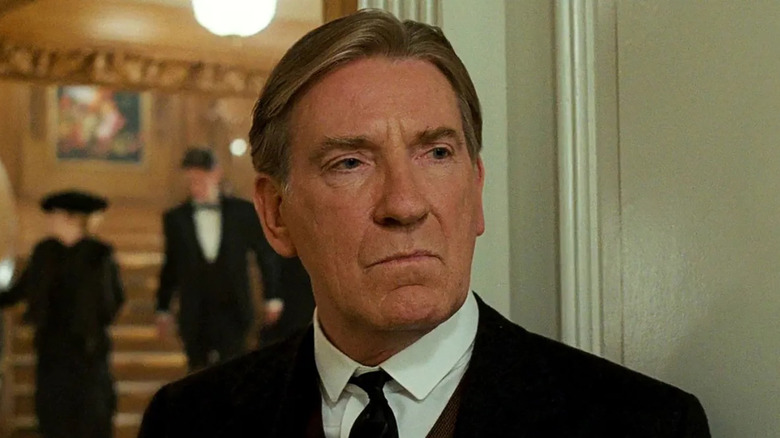
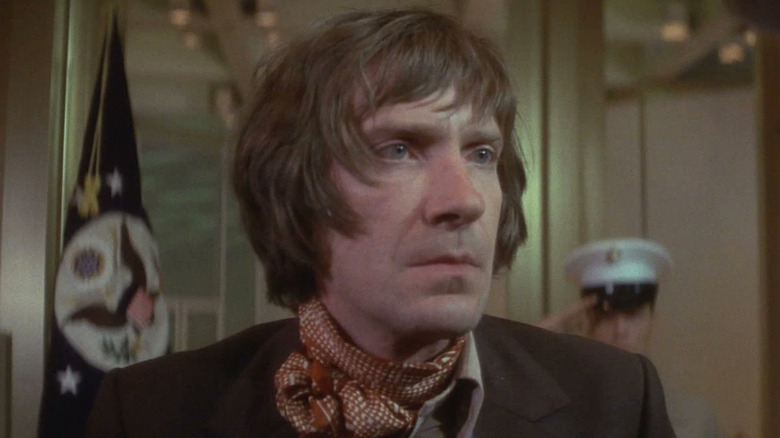
In 1971, he starred in "Straw Dogs," which has since been remade, and five years later, he took on the role of Keith Jennings in the original "The Omen." He even went on to appear in several iconic sci-fi universes, including that of "Tron," "Doctor Who," and "Star Trek." To a lot of younger folks, his most memorable role may be his turn as Spicer Lovejoy, the nasty, vindictive enforcer for Billy Zane's Cal in James Cameron's beloved film "Titanic."
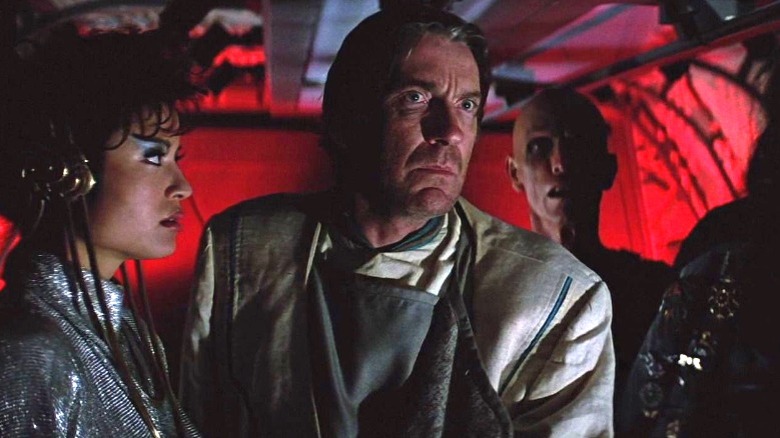
In 1987, the actor moved to Hollywood, where he lived for 15 years. During that time, he got his feet wet on the doomed ocean liner and became a regular fixture on American television, with his "Star Trek" appearances — over the years, Warner has played three different characters throughout the franchise — and "Doctor Who" roles, in addition to stints on "Twin Peaks" and "The League of Gentlemen's Apocalypse."
Fast forward to present day, the actor was still sought after in his 70s. In 2005, he finally returned to the stage after a 40-year absence to play King Lear in Chichester. Most recently, he played Admiral Boon in Disney's "Mary Poppins" revamp "Mary Poppins Returns" in 2018. In 2020, the performer lent his voice to the animated series "Teen Titans Go!" for one episode.
Actor David Warner died on July 24, 2022 at the age of 80, leaving behind a decades-long career of stage and screen that stretched from Shakespeare to "Freakazoid!" The Emmy-winning actor began his career in 1962, appearing on stage as an extra in "A Midsummer Night's Dream" and as Conrad in "Much Ado About Nothing." That same year, Warner garnered his first (uncredited) film appearance in the comedy "We Joined the Navy" as well as his first TV appearance in the televised play "Madhouse on Castle Street."
Since those early days, Warner worked constantly in films and TV, gathering a great deal of fans around him from his association with well-received genre films like "The Omen," "Time Bandits," "The Man With Two Brains," "Teenage Mutant Ninja Turtles II: The Secret of the Ooze," and many others. In 2001, he returned to theater, and entered a phase in his career where he could play King Lear one day and The Doctor from "Doctor Who" the next. His range, devotion, and enthusiasm will be missed.
Warner, as all Trekkies know, had a close relationship to "Star Trek," having appeared in two Trek feature films and on one series, each time playing a vastly different character. Warner left a deep impression, creating a memorable new addition to the franchise's canon. Indeed, one of Warner's roles is perhaps one of the best to ever emerge from "Star Trek: The Next Generation" in the series' single most intense episode.
St. John Talbot
Say what you will about William Shatner's 1989 film "Star Trek V: The Final Frontier" — and there are plenty of negative things that can be said — it certainly didn't lack for interesting ideas. The plot of that film involved a passionate Vulcan named Sybok (Laurence Luckinbill), secretly Spock's half-brother, taking hostages at a remote outpost in order to lure to Enterprise to their rescue. The outpost, located on Nimbus III, was meant to be an attractive galactic "neutral ground" where warring governments could come together for peaceful diplomatic negotiations. The outpost, however, failed long ago, and the ironically named Paradise City is now a desert wasteland overrun by criminals and alcoholics.
Into this sad place came three embittered and burnt-out diplomats — one from the Klingon Empire, one from Romulus, and one from Earth — meant to serve as Sybok's hostages. Warner played St. John Talbot, the human ambassador who, although only serving a supporting role, carried with him the weariness of a job done poorly. Talbot's professional skill had long since become useless, and it seemed as if he had fallen from a once-great height. Talbot's backstory is made more explicit in J.M. Dillard's novelization of "Star Trek V" which explains that he once failed during an important Andorian mission, and turned to booze and cigarettes in its aftermath. Talbot is one of the few smokers to appear on screen in "Star Trek" history.
Although none of that backstory is explained in the final film, Warner's performance manages to communicate Talbot's exhaustion. His first name makes him sounds like a saint. He wasn't.
Chancellor Gorkon
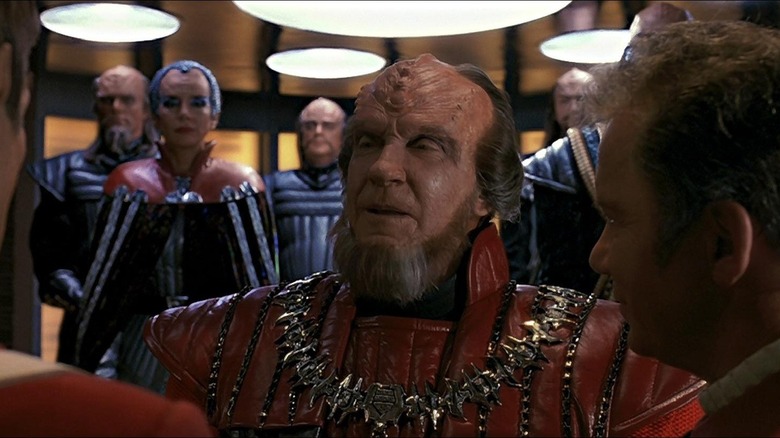
In Nicholas Meyer's 1991 film "Star Trek VI: The Undiscovered Country," Warner returned as a diplomat, only this time in a much more hopeful mode. In "Country," the entire Klingon moon of Praxis — a vital source of natural resources — explodes in a mining accident. The explosion leads the already-waning Klingon Empire reluctantly to the negotiation tables to finally talk about an end to the Cold Wars they and the Federation had been embroiled in for decades. Yes, "Country" is a metaphor for the falling of the Iron Curtain and the end of the real life Cold Ward between the United States and Russia (which had experienced a coup earlier that year). Praxis could even be seen as an analogue for the accident at Chernobyl. This is the most political of the Trek feature films.
In "Country," Warner plays Chancellor Gorkon, a high-ranking Klingon official who meets with Kirk (Shatner) face-to-face in order to attempt friendly relations. Diplomacy is rough going and the humans and Klingons don't necessarily get along very well; the intimidating General Chang (Christopher Plummer) seems upset that such let's-be-friends meetings are now required. Gorkon, however annoyed he might seem at meeting with humans, does indeed believe in a lasting peace and is determined to be on his best behavior. It will be Gorkon who will be assassinated by secret murderers in order to stymie peace talks.
Unlike his burnt-out diplomat in "Frontier," Warner brings an authoritative warmth to Gorkon. Kirk and co. are intimidated by him, but are careful to listen and welcome him. He's someone devoted to peace, but also someone you don't want to disappoint. When he arrives on the Enterprise, it's like your college professor is visiting your house. Don't say anything dumb in front of him.
Gul Madred
One of the better episodes of "Star Trek: The Next Generation" is a two-part espionage thriller called "Chain of Command" that aired at the end of 1992 in the middle of the show's sixth season. In it, Capt. Picard (Patrick Stewart) goes on a covert sting operation to destroy a secret Cardassian biological weapons facility. Picard finds no weapons, however, and is captured by the cold-eyed, soulless Gul Madred (Warner) who explains that the facility was a trap.
The second part of "Chain of Command" is devoted to the tête-à-tête between Madred and Picard, with Picard stripped of his clothes and his dignity and tortured incessantly. Madred attempts to sadistically impose his will on Picard, and it becomes clear that Madred doesn't so much need information as he needs to prove that humans are weak-willed and can be dominated. Picard, as he withers from starvation and injury, finds that Madred is, in fact, little more than a wounded bully, his Nazi-like thirst for dominance springing from a specific moment of childhood embarrassment.
The crux of "Chain of Command" is Madred shining four spotlights into Picard's eyes. He insists Picard admit there are, in fact, five lights. Picard, in the midst of torture, finds himself tempted into to seeing — into being convinced there are — five lights. This carries echoes of George Orwell's "1984," wherein the government insists it has the power to dictate that 2+2=5.
Warner is chilling as Madred, and the actor wholly projects the confidence, arrogance, and pathos of the character. He brought depth to the role, layering his performance to match the character's backstory. It's not an overstatement to say Madred is among the best "villain" characters in all of "Star Trek" — all thanks to the extremely talented Warner.
A relative I haven’t spoken to in years is fraudulently applying to my department at a large university. To put it simply, this is a potential Rachael Dolezal situation. “Connie” is applying for a research and teaching position in my department. Her mother was married to my uncle for about 15 years and for 15 years I spent most weekends and every holiday and summer with Connie. We were quite close as kids.
For full clarity: Connie is white. She is not an immigrant, she is not adopted, and both of her parents come from white, American multi-generational wealth. There is not a hospital, museum, or major university in our city without her family name on at least one building. Her mother and my uncle got divorced quite a while ago, but our mothers are still very good friends. Connie and I lost touch as we grew up but reconnected on social media a few years ago.
When we were introduced in the interview, she pretended not to know me. During her team interview with me, two department chairs, and four other faculty, Connie spoke passionately about being a white-passing woman of color who has to confront racism daily, and how her past struggles with an impoverished upbringing as an immigrant in the U.S. have shaped her teaching values. I was speechless the entire time. Her resume is impressive, which makes me concerned she’s been lying to get certain grants/opportunities or that her resume is false.
The two department chairs were very impressed with her, a few people are neutral, and the rest seemed uncomfortable during the interview and passed on notes saying such. How do I approach this? I’m struggling with ethics vs optics: it’s unethical to put Connie forward as a voice for an underrepresented student population and an expert on certain racial and social justice movements and issues. My mentor (an older white male) told me to stay out of it because the optics are poor. I’m white, and I have had a privileged life that allows me to live comfortably on an academic salary. It would look like I’m attacking a candidate based on race in a predominantly white department. Regardless of optics, I would be complicit in this unethical situation if I didn’t say anything and she’s offered the job. So far nobody else has been invited to interview.
First, I’m assuming that you know this is definitely the same Connie you grew up with. Assuming that’s the case, say something.
You can’t let someone you know to be white and privileged lie about her background when she’s applying for a job to be a voice for marginalized populations (and presumably taking that job from a candidate who isn’t lying about their background). You can’t ethically say nothing, and it’s likely to harm you professionally if it later comes out that you knew and didn’t speak up.
I’d approach the person on the hiring panel whose judgment you most respect and who’s reasonably senior/influential, and share what you know. Your framing should be, “I’m concerned this will hurt the department when it comes out.” (Not if — when.) That’s not attacking Connie based on race; it’s sharing info about significant misrepresentations she’s made, and the potential for real harm if those lies go unchallenged.
From there, it’s up to them but you’ll have sounded an alarm that you’re uniquely positioned to sound right now.
It’s a high-stakes gambit that will test whether the Supreme Court actually meant what it said in Whole Woman’s Health v. Jackson (2021), which held that because of SB 8’s unique style of enforcement, it was immune from meaningful judicial review — and thus would take effect despite very strong arguments that the law was unconstitutional at the time.
Shortly after Jackson was decided last December, Newsom announced that he disagrees with the Supreme Court’s conclusion that states can dodge judicial review of unconstitutional laws. But Newsom also said that, if the Court’s Republican-appointed majority would give this power to states, then he would use it to limit access to firearms.
If states can shield their laws from review by federal courts, then CA will use that authority to help protect lives.
We will work to create the ability for private citizens to sue anyone who manufactures, distributes, or sells an assault weapon or ghost gun kit or parts in CA. pic.twitter.com/YPBJ00vN6z
— Office of the Governor of California (@CAgovernor) December 12, 2021
Indeed, California’s new gun law, known as SB 1327, is explicit that the new law’s fate is tied to SB 8’s. SB 1327 provides that its SB 8-like provisions “shall become inoperative” if SB 8 is struck down “in its entirety by a final decision of the United States Supreme Court or Texas Supreme Court.”
The state of California, in other words, appears to be trolling the Supreme Court. SB 1327 should force the justices to either overrule Jackson and admit that they were wrong to let states evade the Constitution, or give California’s new gun ban the same immunity from judicial scrutiny that five justices gave SB 8.
Whole Woman’s Health v. Jackson is an attack on every constitutional right
To understand why Jackson is such a troubling decision, it helps to understand some of the details of how SB 8 — and now, SB 1327 — operate.
As a general rule, someone who wants to challenge an unconstitutional state law in federal court may not sue the state itself. Instead, under Ex parte Young (1908), they must sue the specific state official charged with enforcing that state law. So, for example, if a state passes a law requiring the state police to blockade abortion clinics, a plaintiff might sue the chief of the state police to seek an injunction prohibiting the state’s police force from enforcing the law.
SB 8 effectively bans abortions after the sixth week of pregnancy — a ban that, at the time the law was enacted, violated the Supreme Court’s now-overruled decision in Planned Parenthood v. Casey(1992). The law also provides that this ban “shall be enforced exclusively through ... private civil actions” that can be filed by anyone who is not a state employee. So the idea is that, since no state employee enforces the law, no one can be sued to block it. SB 1327 contains similar language providing for private enforcement.
An abortion provider who is successfully sued under SB 8 must pay the plaintiff a bounty of at least $10,000, and there is no upper limit on this bounty. Similarly, SB 1327 provides for “statutory damages in an amount of not less than ten thousand dollars.”
In Jackson, the Supreme Court blessed this method of getting around the Constitution. Under Jackson, a law which is enforced solely by private lawsuits cannot be challenged in federal court. Instead, anyone accused of violating the law must wait until they are sued by a bounty hunter, and then argue that the law is unconstitutional in state court.
But this is not an adequate remedy against an SB 8-style law for two reasons. One is that literally any person who is not an employee of Texas may seek a bounty under SB 8, so an abortion provider could potentially be hit with thousands of lawsuits seeking such bounties. Additionally, because there is no limit on the amount of the bounty, an SB 8 defendant who does not defend against every single lawsuit filed against them could be ordered to pay a bounty of a million dollars, or a billion dollars — or whatever amount is enough to bankrupt the provider.
SB 8 does provide that only one plaintiff may collect a bounty from an abortion provider for each alleged violation of the law. But, again, the penalty for even a single violation is potentially unlimited.
In effect, this means that someone bombarded with SB 8 lawsuits has only two choices: hire an army of lawyers at enormous cost to defend against a barrage of lawsuits, or consent to paying a bounty that could be even more expensive than paying these legal fees.
Nothing in Jackson, moreover, prevents states from enacting an SB 8-style law that targets literally any constitutional right. A state could theoretically pass a law sending bounty hunters against anyone who criticizes the state’s governor, or against any Black child who attends a majority-white public school.
SB 1327 enables the Supreme Court to correct its error in Jackson
It’s hard to exaggerate just how much of a threat Whole Woman’s Health v. Jackson is to the US constitutional order. If states can evade constitutional rights through SB 8’s Rube Goldbergesque enforcement mechanism, then those rights cease to function in any meaningful way.
At oral arguments in Jackson, two justices who eventually joined the Jackson majority — Brett Kavanaugh and Amy Coney Barrett — seemed bothered by the idea of SB 8-style laws neutralizing constitutional rights that conservatives actually care about. Kavanaugh even pointed to an amicus brief filed by the Firearms Policy Coalition, which argued that, if SB 8 survives, “it will undoubtedly serve as a model for deterring and suppressing the exercise of numerous constitutional rights,” including the Second Amendment.
Nevertheless, Kavanaugh and Barrett’s anti-abortion sentiments appear to have prevailed over their desire to live in a country where state governments are required to respect constitutional rights. Both joined the Jackson majority opinion in its entirety.
Now, however, the Court’s anti-abortion majority does not need to fear that a decision striking down SB 8-style laws would lead to a flowering of abortion rights. The Court’s decision in Dobbs v. Jackson Women’s Health Organization (2022) overruled Roe v. Wade. States are now free to ban abortions the old-fashioned way — through laws that are enforced by police, prosecutors, and other state officials.
There is, in other words, no good reason for Jackson to remain good law — even from the perspective of the anti-abortion movement — unless, of course, a majority of the justices want states to have the power to ignore the Constitution.
What to do
Everyday guides for everyone
Bendick and Warren
1967
This one looks a bit sad. Highlighting and a few damaged pages make this weed worthy. I am happy to report that this book was sent to the bindery so the ugly cover is in pretty good shape. Those old bindery covers could probably withstand a nuclear explosion. That said, I think 1967 etiquette rules are probably due for some updating.
The phone advice is comically out of date. We are still over a decade from even having portable phones, let alone smart phones. Individual phones were just not a concept. In my high school, if you had more than one extension in your home, you were living the good life. I am also surprised there wasn’t a comment about calling “late” or tying up the phone by talking too long. This was a HUGE issue when I was a teen. If any of my friends called past 10 pm, I was in trouble!
This book was fun to peruse for old time sake, but it is going to be a waste of space for today’s youth.
The CDC confirmed that a patient in New York has contracted polio, the first U.S. case since 2013. But most people shouldn't be concerned about contracting the virus because of high vaccination rates.
It has great bones, three bedrooms and one and half baths, and it comes with its own machine that mines cryptocurrency. But in a year of reckoning for crypto, how interested are potential buyers? | Subscribe to Planet Money+ in Apple Podcasts or at plus.npr.org/planetmoney.
An intriguing look at the 1981 court case that brought justice to Vietnamese fishermen in East Texas who were terrorized by the Ku Klux Klan. This is an encore of the July 17th, 2021 broadcast.
“All but eight House Republicans voted against a bill to codify the right to contraception federally amid concerns that the Supreme Court could overturn a decades-old ruling prohibiting states from banning contraceptives.” — Salon, 7/21/22
It's said that those who do not study history are doomed to repeat it. I'd suggest that the adage should be extended to, "those who do not study history and learn from her lessons are doomed to repeat it."
My engagement with technology began at an early age; in the early '80s, I was programming BASIC on a very early IBM-based PC, the Timex-Sinclair 1000, and Mac IIe. By the mid-'80s, I'd programmed in BASIC and Pascal on the TRS-80. However, it wasn't until I completed my initial military training in 1990 that I began providing technology as a service to others; I was a Communications Officer in the Marine Corps, providing trained technical Marines, servicing technical assets, in support of others. I had been taught about the technology...radios, phones, switchboards, etc...and troubleshooting in school, and now I had to apply what I had learned, as well as continue to learn from the experiences of others.
My first unit was deployed to an exercise in Nov, 1990. We set up radio and phone communications as part of our plan, which included a TA-938 phone configured as a "hot line" (think the "Bat phone" from the '60s Batman serial) to another unit. The idea...and implementation...was that when someone picked up the handset on one end, the phone on the other end would ring, a red light would blink. It was set up this way, tested, and found to function as expected.
TA-838
Except when it didn't. As the platoon leader, I took overnight shifts and filled in on switchboard watch, etc. One night, we got a call from the operations tent that the hotline "wasn't working", so I sent one of my young Marines over to check the phone out. When he returned, he reported that the Captain in the ops tent had repeated that the phone "wasn't working", and said that they hadn't done anything to attempt to troubleshoot or address the problem themselves. The Marine continued by saying that they'd checked the batteries...TA-938 (the TA-838, similar in form to the TA-938, is shown on the right) phones took 2 D cell batteries...and found that someone had, indeed, attempted to troubleshoot the phone. An interesting aspect of the TA-938 phone is that both batteries had to be placed in the phone with their positive terminals facing up, which is something very different from what most folks are used to. The Marine shared that they'd ensured the correct placement of the batteries, and everything seemed to be functioning correctly but when they picked up the hot line, no one on the other end answered.
About 20 minutes later, we got another call that the hot line in the ops tent wasn't work; this time, there was more frustration in the caller's voice. So, I went over and checked out the phone...only to find that the phone had been disconnected from the wires and thrown across the tent. Fortunately, the phones are "ruggedized", meaning that they are intended to take some level of punishment. I got the phone reconnected, checked to ensure that the batteries hadn't been tampered with, and picked up the handset...only to have the line answered on the second ring. I spoke with the person on the other end, explaining the "issue" we'd experienced at our unit, and found that there was only one person manning the other end of the hot line that night, and that they'd gone for a bathroom break, stopped on their way back to get a cup of coffee, gotten into a conversation while they were out, and had only recently returned to the tent.
The lesson I learned here is that technology most often functions as designed or configured, not as expected. If we don't understand the technology, then we may have expectations of the technology that are far out of alignment with its design. As such, when those expectations aren't met, we may declare that the technology "doesn't work". As someone providing services based on technology...Communications Officer, DFIR consultant, SOC manager, etc...we often need to keep this in mind.
Another lesson I learned that served me very well when I was a DFIR consultant was the Captain's statement that he "hadn't done anything" to troubleshoot the issue. Not understanding the technology, his statement was meant to convey that he hadn't done anything of consequence, or anything that was terribly important. I've also seen this during targeted threat actor/nation-state APT response engagements, where an admin will say that they "didn't do anything", when the evidence clearly demonstrated that they deleted Registry keys, cleared Windows Event Logs, etc. Again, these actions may be part of their normal, day-to-day operations, things that they normally do as a course of business; as such, it doesn't stand out to them that their actions were of consequence.
And it's more than just lessons in technology and it's deployment. History also provides us with, among others, lessons in working with others. Some refer to this is as "leadership", but in my experience, those who talk about leadership in this way often present it as a bit one-sided.
When I was in military training, we'd have various exercises where we'd leave the school house and go out into the woods to actually do that things we'd learned. One of my favorites was patrolling. One of the students (including myself) would write up a "patrol order", specifying equipment to bring, as well as specific roles for other students. The day of the exercise, we'd take buses out to a remote area that we hadn't encountered in previous exercises, and be dropped off...only to find that some students had not brought the specified equipment. In one instance, the gear list specified that everyone bring a poncho, but only about half of the students showed up with ponchos...and there was no, "hey, give me a sec, I'll be right back." One time, the student who was supposed to be the navigator for the patrol showed up without a compass.
About 20 yrs later, I'm on an IR engagement, one on which the customer very specifically asked me to be an advisor to his team; rather than doing all the work myself, guide his team in the approach, providing "knowledge transfer" throughout the process. At one point, I went to an administrator and asked him to copy the Event Log files from an XP system, onto a thumb drive. I was very specific about my request; I specifically stated that I did not want them to open the Event Viewer and export the contents to text. Instead, I needed him to copy the files to the thumb drive, preserving their original format. After acknowledging that they understood, I went off to complete another task, collecting the thumb drive when I returned. Later that night in my hotel room, before shutting down for the evening, I wanted to take a look at the data (follow a hunch) so I tried to access the copied files with my tools, assuming that my request had been followed; none of them worked. I opened the files in a hex editor, only to see that the administrator had exported the contents of the Event Logs to text, and renamed the output files the the ".evt" extension.
The lesson here is that, even in the face of leadership (be it "good" or "bad"), there's an element of followership. People have a choice...if they don't understand, they can choose (or not) to ask for help. Or, they can choose to follow the request or guidance, or not. Given that, if something has a material impact on the outcome of your engagement or project, consider doing that thing yourself, or closely supervising it. Be thankful when things go right, and be especially grateful when someone involved sees an issue and shares their justification for doing something other than what was requested. However, you need to also be ready for those instances where things do not go as requested, because it will happen at some point.
Let's do more than just study history. Let's dig into it intentionally, with purpose, and develop and learn from those lessons.
Enlarge / Kids line up to get their polio vaccines at the Woodbury Avenue School in Huntington, New York, on April 27, 1954. (credit: Getty | Newsday LLC)
Health officials in New York have detected a case of polio, marking the first case of the dangerous viral disease in the United States in years.
The case was detected in Rockland County, which in 2019 struggled with an explosive measles outbreak fueled by pockets of the community with low vaccination rates. Health officials in Rockland, neighboring New York City, and the state are now urging unvaccinated residents, particularly children, to get vaccinated, and those vaccinated, but at high risk, to get boosted.
"Many of you may be too young to remember polio, but when I was growing up, this disease struck fear in families, including my own," Rockland County Executive Ed Day said in a statement. "The fact that it is still around decades after the vaccine was created shows you just how relentless it is. Do the right thing for your child and the greater good of your community and have your child vaccinated now."
Enlarge / We have pretty clear evidence that declining ozone levels were something more than liberal scare tactics. (credit: NASA)
Conservative political commentator Matt Walsh took to Twitter last Wednesday to say that the widely held belief that humans are causing climate change is, in fact, a crock. The podcaster and Daily Wire columnist apparently knows this because previous environmental issues we were concerned about in the past—namely acid rain and holes in the ozone layer—disappeared, never to be heard about again.
“Remember when they spent years telling us to panic over the hole in the ozone layer and then suddenly just stopped talking about it and nobody ever mentioned the ozone layer again?” Walsh tweeted. “This was also back during the time when they scared school children into believing that "acid rain" was a real and urgent threat,” Walsh tweeted again.
It’s true that you don’t hear much about acid rain anymore, and discussions about humanity’s long-standing propensity to metaphorically kick the planet in the groin have largely moved away from the ozone layer to newer, flashier issues like sea level rise, rising global temperatures, and mass species die-offs served with a side of ecosystem collapse. (Although, if you know where to look, you can still find mention of the ozone hole.)
I always liked funny movies, but there was a time when there existed a level ABOVE funny. Movies that were outrageous. The king of that genre was Mel Brooks. He's influenced so much of our humor today and I recently read his memoir "All About Me", so I figured it's about time for Cinemassacre to pay tribute to him!
I wrote in back in March asking if it was okay to lie about who your new employer is to your problematic boss who is known to reach out to future employers to try mess things up for people resigning . I was already job searching at the time of my letter & one lead was promising. I actually got an offer a couple of weeks after you posted my letter. When asked where I was going I used your script to say I couldn’t announce that yet as the organization had asked me to keep it private until all internal processes had been completed. Some people (including problematic boss) said but they wouldn’t tell anyone and I insisted that I was just following the wishes of my new employer. This worked as I told everyone the same thing. I‘ve been at my my new job for a month now and the new company is great, everyone is so welcoming and excited to work with me. I got a 63% salary bump and get to move to my favorite state where most of my friends live. I’ve been sleeping so much better since I quit my toxic job! Thank you for all that you share and teach, thank you also to the commentariat. I’ll be a reader for a long long time to make sure I always remember what’s toxic in a workplace and how to conduct myself.
I wrote in about the terrible ex-friend becoming a new coworker, and I have an update!
I ended up going to the first meeting for the project, and everyone was incredibly delighted to see me. My ex-friend was there, and basically treated it as though we had never actually met. I had a fine time with everyone else, and was thinking it might not be as bad as I thought to give up a few weekends… and then my grandmother was diagnosed with dementia and I got Covid. With six weeks to the conference and everyone here on AAM telling me to run the opposite direction, I decided not to ignore the signs the Universe was putting out and promptly resigned from the project.
I ended up going on vacation during the conference, since my presence wasn’t required–and the conference ended up being a massive Covid super-spreader event. Almost everyone on that team has Covid, and I’m feeling like I dodged a cannonball. So! There’s that.
First of all, thanks for your advice and thanks to everyone who weighed in on the comments, I didn’t interact too much, but I did read all of them and definitely appreciated the feedback.
A lot has changed since then and as often happens, things got worse before they got better. Our pay cut ended up lasting 16 months, even though in the words of both Jeff (boss) and Mike (boss’s son) ”we did much better than we expected to during the pandemic.”
Regarding Carrie’s mysterious pay, I ended up not mentioning it to any of my coworkers, because I was concerned about backlash from Jeff. I’ve seen him snap over much smaller things, and I could in no way afford to lose my job at that point. I have a very strong feeling the payments were a way for Mike to maintain his pre-pandemic salary with an added tax exclusion, while making it look like he took a pay cut the same as the rest of us.
The past months have been some of the busiest and most stressful I’ve ever experienced. Our already full workload doubled, and during the worst couple months of it, I was having weekly panic attacks, and regularly working 12 hour days, as were most of my coworkers. During this time, I was very open with Jeff about the fact that we needed extra support, and that we can’t work at this rate forever. Jeff gave a lot of lip service to wanting to help us out by looking for new hires, but two months after he said that, he let it slip that he didn’t plan to hire anyone else unless we won 2-3 more big projects.
One more thing I didn’t include in my last letter is that our company was acquired 2 years ago by a much larger company. The new parent company has stayed out of daily operations for a while, but they’ve been increasingly frustrated by issues they’re seeing within my company, and are feeling blocked out, largely due to Jeff being completely unwilling to give up any control. I used to work with the CEO of the new parent company, ”Jenny”, and while we don’t speak regularly anymore, I’ve known her pretty well for years.
When she heard I had handed in my notice, Jenny reached out and asked if I’d be willing to have an open & honest exit interview directly with her, which I was more than happy to do. Our conversation ended up lasting over 2 hours, and I was completely honest about the strengths (mainly my coworkers) and the issues (mainly management & lack thereof) I saw. It turns out that Jeff has been (seemingly intentionally) misleading the parent company about a number of things, including role structuring within the company, their hiring plan, the fact that everyone can see payments to coworkers (Jenny was EXTREMELY concerned about this – she was told this issue was fixed just after the acquisition) as well as a few day to day operations and financial liquidity issues. Jenny will not be mentioning our interview to Jeff until after my last day to make sure I don’t get caught in the middle, but I suspect there will be some messy confrontation when she does.
So finally some good news – I revamped my CV & cover letter using all the advice I found on AAM, and I am thrilled to say I landed a stellar job in a completely new field! It comes with a 20% pay increase, stock options, and a team that highly prioritizes work/life balance and employee wellness. The new role is closer to what I studied and what I want to do long term, as well as being part of a much larger and seemingly much less dysfunctional company. Getting this new job brought such a sense of relief – I don’t think I understood exactly how unhappy I was during the worst of last year. Looking back, I now realize that my mental health was worse than it has ever been and I’m definitely still recovering from long-term stress & burnout. So needless to say, I am incredibly excited for this new chapter to begin.
I wish I could say I had some dramatic screw-you resignation story, but I just quietly handed in and worked through my 4 week notice. Jeff was surprised I was leaving in spite of the many times I told him how stressed and unhappy I was. I think he tried to be nice to me, but he did call me insane in the same breath that he said I would be missed. I start my new job in two weeks, and it honestly can’t come soon enough. Thanks again for all your help!
The Texas attorney general would be the one to hold True the Vote accountable on allegations that it swindled a $2.5 million donor. But the nonprofit’s founder has been a friend and an ally.
Today we’re going to try to save reality - or at least realism. However this rescue effort has a price; one that you may not be willing to pay. Your very soul, or at least your free will, is on the line.
Hosted by Matt O'Dowd Written by Matt O'Dowd Post Production by Leonardo Scholzer, Yago Ballarini, Pedro Osinski, Adriano Leal & Stephanie Faria Directed by Andrew Kornhaber Associate Producer: Bahar Gholipour Executive Producers: Eric Brown & Andrew Kornhaber Executives in Charge (PBS): Adam Dylewski, Maribel Lopez Director of Programming (PBS): Gabrielle Ewing
Big Bang Level Gautam Shine Zachary Wilson Adam Hillier Bryce Fort Peter Barrett David Neumann Charlie Leo Koguan Ahmad Jodeh Alexander Tamas Morgan Hough Amy Hickman Juan Benet Vinnie Falco Fabrice Eap Mark Rosenthal David Nicklas Daniel Muzquiz
Quasar Level Alex Kern Ethan Cohen Stephen Wilcox Christina Oegren Mark Heising Hank S
Hypernova Level Ken S Gregory Forfa Kirk Honour Mark Evans drollere Joe Moreira Marc Armstrong Scott Gorlick Paul Stehr-Green Russell Pope Ben Delo Scott Gray Антон Кочков John R. Slavik Mathew Donal Botkin John Pollock Edmund Fokschaner chuck zegar Jordan Young Daniel Muzquiz
Gamma Ray Burst Level Mason Dillon Harsh Khandhadia Thomas Tarler bsgbryan Sean McCaul Carsten Quinlan Susan Albee Frank Walker Matt Q WhizBangery MHL SHS Terje Vold Anatoliy Nagornyy comboy Andre Stechert Paul Wood Kent Durham jim bartosh Nubble Scott R Calkins The Mad Mechanic Ellis Hall John H. Austin, Jr. Diana S Ben Campbell Faraz Khan Almog Cohen Alex Edwards Ádám Kettinger MD3 Endre Pech Daniel Jennings Cameron Sampson Geoffrey Clarion Darren Duncan Russ Creech Jeremy Reed Eric Webster David Johnston Web Browser Michael Barton Mr T Isaac Suttell Devon Rosenthal Oliver Flanagan Bleys Goodson Robert Walter Bruce B Simon Oliphant Mirik Gogri Mark Delagasse Mark Daniel Cohen Nickolas Andrew Freeman Shane Calimlim Robert Ilardi Eric Kiebler Craig Stonaha Martin Skans The Art of Sin Graydon Goss Frederic Simon Tonyface John Robinson A G David Neal justahat John Funai Tristan Bradley Jenkins Daniel Stříbrný Luaan Cody Thomas Dougherty King Zeckendorff Dan Warren Patrick Sutton John Griffith Daniel Lyons DFaulk















/https://static.texastribune.org/media/files/0c1542b03ee32de2c47ba7db149f3fec/Trump%20Rally%20Houston%20JV%20TT%2007.jpg)