Shared posts

22 Aug 16:57

I’m missing out on face time with the CEO because I don’t go on our monthly hikes

by Ask a Manager

This post, I’m missing out on face time with the CEO because I don’t go on our monthly hikes , was originally published by Alison Green on Ask a Manager.

A reader writes:

My employer has been organizing monthly staff hikes on the weekend to promote employee wellness and as a means for introducing employees who work in various parts of the organization. These hikes are optional, and I have not received any pressure from my supervisor or colleagues to attend. In fact, they’re not well-attended overall, which has resulted in a small group of about 10 employees who have gotten a lot of face time with the head of our company and formed their own informal clique. Two of those individuals recently received significant promotions, and while I cannot prove it had anything to do with them spending weekends with the boss, it certainly seems that way considering that one was very underqualified and was hired after receiving a recommendation from him. I know this because the supervisor who promoted her confided in me that she’d been hesitant because of the employee’s lack of experience, but felt pressured since the recommendation came straight from the top of the company.

I tend to believe we get out of things what we’re willing to put into them, so I’m not typically one to complain about not receiving the perks of a function I chose not to attend. But the thing is, I’m not able to attend in this case. I’ve gotten out of shape since having children, and while I’ve recently started working out again, I am not at the fitness level to be able to complete the strenuous 5-6 mile hikes they’re choosing. It would also frankly be humiliating to meet colleagues for the first time while I’m struggling for air and not able to be the best version of myself.

The company has not been supplementing these hikes with a non-physically strenuous equivalent that people of all athletic and physical abilities could attend.

I tried gently making the company’s leadership, including our HR director, aware that there are people within our company who would be eager to attend a function that promoted a healthy lifestyle and internal networking but are being unintentionally excluded because of their physical fitness level or even physical limitations. (There are at least two people here in wheelchairs and others with disabilities that would limit their ability to participate.) They seemed receptive, expressing gratitude and shame that it hadn’t occurred to them. But then nothing changed. The hikes continue, and there’s no alternative outside of work equivalent for those of us who can’t hike with them.

Am I overreacting? I don’t want to be childish simply because I’m feeling left out. We generally have a great office culture, and these events are optional. It just seems to give an unfair advantage to the few who are physically fit. Is there anything else I can reasonably do to advocate for the rest of us, or should I just accept my fate as an outsider at this point?

You’re not overreacting. One hike a year where a small group of employees got extra face time with the CEO wouldn’t be such a big deal — although I’d still suggest they consider other events too so they weren’t constantly excluding non-hikers — but monthly is a lot. A small monthly social club with the CEO that just happens to shut out people by physical ability and has produced a promotion that can’t be explained any other way is … not good. Of course you feel weird about it.

And HR knows it’s a problem too, or at least they do now that you’ve pointed it out, which is why they responded the way they did when you talked to them.

My strong hunch is that HR pointed out the problems to the CEO and he doesn’t care; he likes the hikes (they might have even been his idea) and he’s not interested in stopping them.

Of course, he wouldn’t need to stop the hikes if he added in other ways for people to get face time with him. I’m admittedly hard-pressed to think of activities that would provide the same intensive bonding time as several hours of hiking in a small group every month provides, but the company has a responsibility to think it through and come up with options (or pull way back on the frequency, or at least have better firewalls where the CEO doesn’t pressure managers to promote unqualified people he hikes with).

You could go back to HR and ask what the plan is for responding to the concerns you raised. if you have coworkers who feel similarly shut out based on physical ability, you’ll have more power as a group.

How much you push it from there depends on how much capital you want to spend. There’s a decent risk that if the CEO ends up feeling pressured into stopping his hikes, he’ll resent whoever he perceives as responsible for that … which wouldn’t be a reasonable response but it might happen, particularly if he’s already demonstrated something about his stance by brushing off HR earlier (if indeed that’s what happened). So you’d want to factor that in when deciding how much you want to keep pushing it. But you’re not wrong.
22 Aug 16:20

Top Five: August 18, 2022

by Glasstire
Glasstire counts down the top five art events in Texas.

For last week’s picks, please go here.

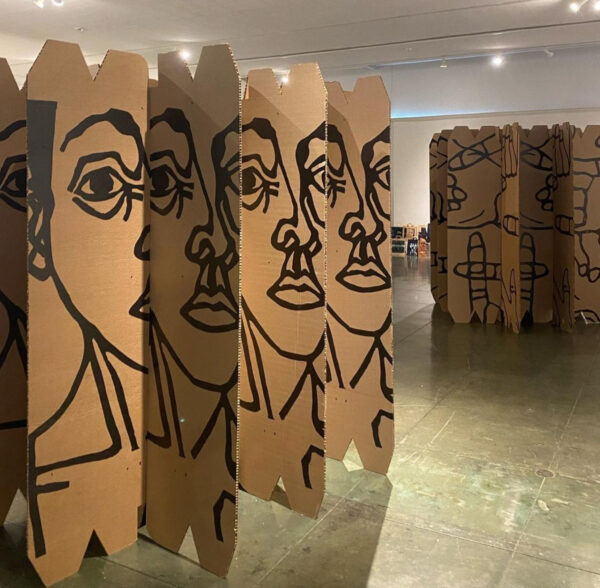
Installation image from Sarah Fisher's "You Won't See It Coming" at the Museum of East Texas.

Installation view of Sarah Fisher’s “You Won’t See It Coming” at the Museum of East Texas.

1. Sarah Fisher: You Won’t See It Coming
Museum of East Texas (Lufkin)
August 6 – October 15, 2022

From the Museum of East Texas:

“In You Won’t See It Coming, Houston-based artist, Sarah Fisher shares new work from her years-long, multidisciplinary, self-portraiture practice, including two- and three-dimensional pieces that are painted, drawn, etched, printed, collaged, assembled, and written. Repurposed found objects ranging from a discarded vintage baby bed to sheared-off crape myrtle bark, from dry cleaning identification stickers to pallet separator board, weave into a narrative Fisher experiences as an ongoing series of “sideswipes,” explosive moments of surprise, both big and small, that detour, devastate and inspire.”

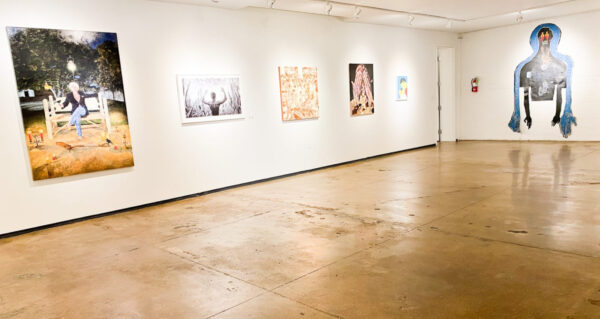
An installation image of Artspace111's 9th Annual Juried Exhibition.

Installation view of Artspace111’s “9th Annual Texas Juried Art Exhibition.”

2. 9th Annual Texas Juried Exhibition
Artspace111 (Fort Worth)
July 16 – August 27, 2022

From Artspace111:

“Artspace111 is excited to announce the opening reception for the 9th Annual Texas Juried Exhibition, juried by Daisha Board, Owner and Director of Daisha Board Gallery.

Selected artists include: Kaima Akarue, Cody Arnll, Sarah Ayala, Scott Bell, Kelly Berry, Christopher Blay, Raymond Butler, Keri Carter, Rafael Castanet, Brenda Ciardiello, Wes Coke, Ron Crouch, Willie Dave, Will DeShazo, Brad Forsythe, Cody Freeman, Matthew Freeman, Drew Gaines, Raul Rene Gonzalez, Giovanni Gonzalez, Jazmin Gonzalez, Elizabeth Gonzalez, Nicholas Gully, Barbara Hack, Sibylle Hagmann, Brandon Harris, Marianne Howard, Cedric Ingram, Assandre Jean-Baptiste, Nitashia Johnson, Sudeep Kumar, Danyelle Lakin, Rosie Lee, Ray Little, Jesus Lopez, Solomon Mahlatini, Yasuyo Maruyama, Margaret McNiel, Katherine Miller, Janak Narayan, Bảo Nghi Ngo, Clark Nunn, Kemba Opio, Fari Rahimi, Amanda Rambo, Amber Razzouk, Chad Rea, Anna Redman, Lizzete Rendon, Jon Rogers, Anastacia Sadeh, Kelly Steller Hrad, Henry Thomas, Robert Weiss, Shannon West, Barron Wortham, and Alex Zapata.”

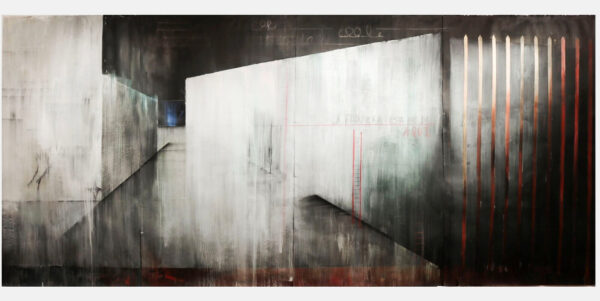
An painting by Sandra de la Rosa depicting white walls with faded ladders painted on top of them. Faded text appears on one wall and reads, "La Frontera Esta Aqui."

Sandra de la Rosa, Border Theory.

3. Sandra de la Rosa: Border Theory
Box13 Art Space (Houston)
August 6 – October 1, 2022

From Box13 Art Space:

“One would wrongly assume that borders are just physical, that they are geographical markers that divide nations. Borders go beyond that; they permeate geography and people, they are even capable of dividing an individual’s own identity. As a Mexican immigrant, I experience a liminal space where I feel confined and exposed at the same time. This liminal experience manifests from the ambiguity and uncertainty of living in the United States as someone with a hybridized identity: Mexican, American, Texan, brown, other. The spaces depicted in my work are representations of experiences felt by immigrants, including myself. We are both surrounded and kept out by metaphorical walls that creates a liminal space felt internally. I create these spaces through painting and drawing.”

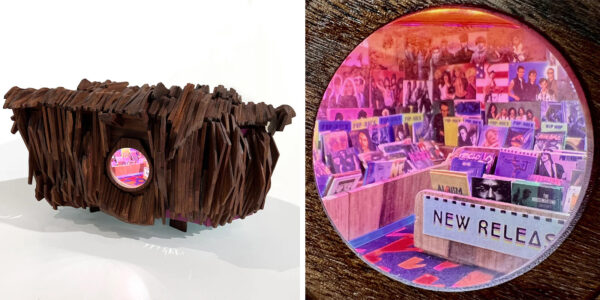
A composite image showing a mixed media sculptural work by Margie Criner. The image on the left shows the exterior of the object and the image on the right shows the interior, a small diorama of a record shop.

Margie Criner, “When I Was King,” 2022, mixed media (wood, glass, paper, plastic, metal, LED, electrical wiring), 6 x 10 x 8 inches.

4. Margie Criner: Destination Unknown: Life in Miniature
Yard Dog (Austin)
August 5 – 28, 2022

From Yard Dog:

“Chicago artist Margie Criner makes abstract, organic-shaped sculptures that house small dioramas, viewable through a peephole. She calls these ‘sculptures in sculpture.’ They are miniature narratives hidden inside abstract sculpture that explore the notion of vacancy in everyday places.

Also included in the show will be a number of individual miniature everyday objects. These are the same scale as the objects she makes to populate her dioramas.”

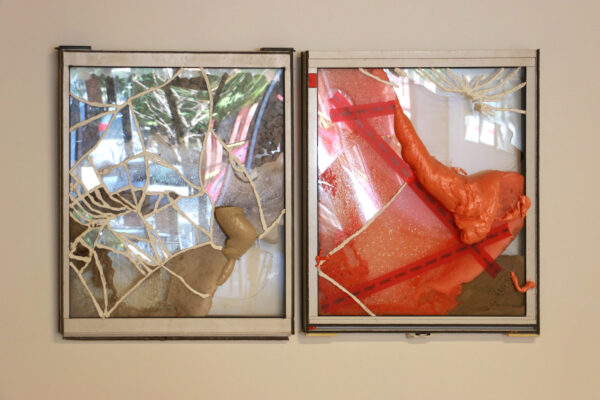
A diptych by Justin Sterling featuring two broken windows. Each window has insulation foam, dirt and gravel on it and tape and caulking has been used to repair the broken glass.

Justin Sterling, “Stolen Evidence,” 2018, found windows, dirt, tape, gravel, insulation foam, caulking.

5. Justin Sterling: Windows of Opportunity
Redbud Gallery (Houston)
July 2 – August 30, 2022

From Redbud Gallery:

“Justin Sterling considers the built environment his medium and deeply explores this methodology, collecting abandoned windows and other urban objects from various neighborhoods in Brooklyn, Lower Manhattan, and Queens to repurpose them and reimagine their stories. He fills the discarded windows with new life, literally and figuratively, using a variety of media to express both their pasts and their futures within the language already prompted by windows in the built environment. His aim is to unravel the way we view structures of power by revealing various truths about urban ecosystems, poverty, collective memory, and bad-faith legislation. Each window, or group of windows, presents a view to a new world, as it could be.”

The post Top Five: August 18, 2022 appeared first on Glasstire.

22 Aug 16:19

San Angelo Museum of Fine Arts Repatriates Stolen Sculpture to Mexico

by Jessica Fuentes

Earlier this month the Embassy of the United States in Mexico and the Federal Bureau of Investigation (FBI) announced the return of a stolen 19th-century statue that had been located in the collection of the San Angelo Museum of Fine Arts (SAMFA).

US Ambassador to Mexico Ken Salazar shakes hands with Alejandra Frausto, Mexico's Secretary of Culture.

U.S. Ambassador to Mexico Ken Salazar shakes hands with Alejandra Frausto, Mexico’s Secretary of Culture. COURTESY US EMBASSY IN MEXICO

The statue of Saint Anthony of Padua, the patron saint of lost things, was originally donated to the museum in 2005 by a private collector of Spanish Colonial art. According to a press release by SAMFA, “The museum was contacted by the local FBI office in 2020 after Mexican authorities matched images of the stolen sculpture on an Interpol database to a photo of the work in the museum’s collection, posted on the SAMFA website.”

Identifying this artwork is just one piece of a larger initiative launched by the Mexican government in 2018 to search for stolen art and artifacts. In the four years since it was established, the #MiPatrimonioNoSeVende (my heritage is not for sale) campaign, headed by Mexico’s Ministry of Foreign Affairs, Ministry of Culture, and National Institute of Anthropology and History, has helped the government recover nearly 9,000 items from institutions and individuals.

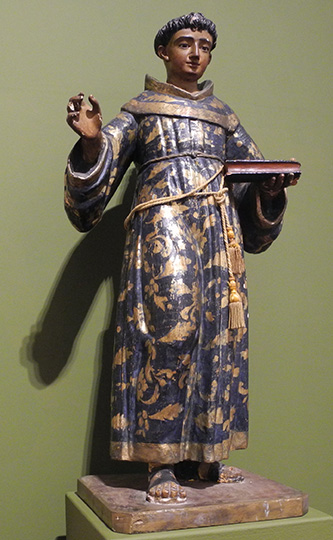
A photograph of a 19th-century sculpture of Saint Anthony of Padua.

Unknown artist, “Saint Anthony of Padua,” c. 18th – 19th century, wood, gold leaf, paint. Image courtesy San Angelo Museum of Fine Arts

The sculpture from the SAMFA’s collection, which measures approximately 110 x 60 x 50 centimeters, is carved from solid wood and uses the estofado technique, which SAMFA describes as “where the figure is covered in gold leaf, painted over, and then the paint is scratched through to expose the gold and create an elaborate design, meant to mimic gold brocade.” The Mexican National Institute of Anthropology and History will perform restoration work on the sculpture before returning it to the church in Jiutepec, where it was originally installed.

The repatriation of the statue took place during a ceremony on August 10, where Laura Huckaby, Curator and Assistant Director of SAMFA, represented the museum. Ms. Huckaby stated, “As a museum, we are stewards and guardians, and not owners, of the works in our collection. As such, we are happy to see Saint Anthony returned to his church and his community, where he belongs. Cultural institutions like ours are in a position of trust in our communities and in the world. We want to make sure that we never abuse that trust by keeping an object that rightfully belongs somewhere else. We hope that even a small institution like ours can set an example by fulfilling our obligation.”

Ms. Huckaby told Glasstire, “Incidentally, the church the statue was stolen from was destroyed by an earthquake in 2017. It is strangely fortunate that the statue was in the museum’s care at that time, but we are thrilled to see it return home now to Mexico.”

Repatriating the sculpture was a major collaborative effort involving FBI offices in Dallas and the FBI legal attaché in Mexico City, the Department of Justice of the United States with the Ministry of Culture, the National Institute of Anthropology and History, the Attorney General’s Office, the Ministry of Foreign Exteriors, and SAMFA.

In a press release by the FBI, Dallas Special Agent in Charge Matthew J. DeSarno stated, “Along with the FBI Art Crimes team, FBI Dallas appreciates the cooperation of the San Angelo Museum of Fine Arts in assisting in the safe return of the Saint Anthony of Padua sculpture to the Government of Mexico. The FBI has developed significant relationships with our foreign partners who are committed to the protection of cultural property. We will continue to work with those partners to keep the public informed and up-to-date on arts and cultural property theft crimes to create greater awareness of stolen artifacts.”

The post San Angelo Museum of Fine Arts Repatriates Stolen Sculpture to Mexico appeared first on Glasstire.

22 Aug 16:13

Review: “We the People: The Radical Notion of Democracy” at the Crystal Bridges Museum of American Art

by Barbara Purcell


Installation view of the entrance to the exhibition "We the People"

Installation view of “We the People: The Radical Notion of Democracy.” Image courtesy of Crystal Bridges.

It starts with a simple wall caption that reads “The Road to Democracy.” From there, We the People: The Radical Notion of Democracy, guides the viewer along a sweeping American timeline, both textual and visual, that stretches from early colonialism to late capitalism. It is a long and winding road. 

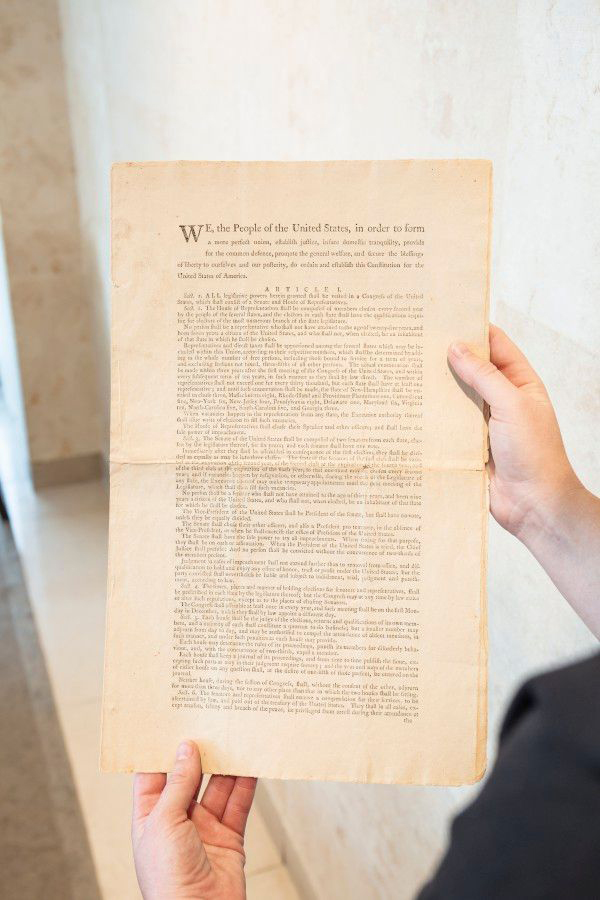
At the heart of We the People, on view at the Crystal Bridges Museum of American Art in Bentonville, Arkansas, is an original copy of the U.S. Constitution, on loan from hedge fund titan Ken Griffin, who purchased the item from Sotheby’s late last year. In an auction battle that lasted all of eight minutes, Griffin outbid a crew of 17,000 cryptocurrency investors for the $43.2 million acquisition; now he wants to share it with as many people as possible. The rare relic is currently being shown alongside other historically significant U.S. documents, as well as works of art spanning 300 years, from portraits of Native American leaders and Founding Fathers, to Suffragettes and Malcom X.  

Organized by Polly Nordstrand, Crystal Bridges’ former curator of Native American Art, the ideas put forth in We the People offer a broad — and perhaps unexpected — narrative of shared, sometimes competing, histories. The chronological presentation begins with the Haudenosaunee (Iroquois) Confederacy and its enduring influence on American democracy, which, in 1987, the U.S. Senate formally acknowledged was owed a “historical debt.” A fascinating fact — and the first I’ve heard of it. 

“We’re in this era where people tend not to trust,” Crystal Bridges’ chief curator Austen Barron Bailly tells me during our recent call. “We are very invested in providing historical and artistic evidence of the past to give people their own tools for navigating their beliefs and opinions and knowledge, from civics to art history.”

Photograph of someone holding the first edition of the U.S. Constitution

John Dunlap and David Claypool, “The Official First Edition of the Constitution,” 1787, ink on paper, 16 1/8 x 10 1/8 inches. Private Collection. Photography courtesy of Sotheby’s, Inc.


The displayed documents are surrounded by artworks that, at times, bolster the deep-rooted meaning of their words, and at other times, question them altogether. We the People is split over two galleries, with the first space doing the bolstering and the second doing the questioning. In that first gallery, a timeline from 1680 to 1791 runs along the wall — the years leading up to the Revolutionary War and directly after — and chronicles the events that came to define the early pinnacle of America. 

Toward the front of the space, the Declaration of Independence and Articles of Confederation are encased directly in line with a replica Two Row Wampum belt — in essence, a Native constitution — that references the 1613 agreement between the Dutch and Haudenosaunee. The belt’s parallel purple rows signify the principles of peaceful coexistence that underpinned their treaty, and later contributed to the philosophical foundation of the U.S. Constitution. 

Installation view of the exhibition "We the People"

Installation view of “We the People: The Radical Notion of Democracy.” Image courtesy of Crystal Bridges.

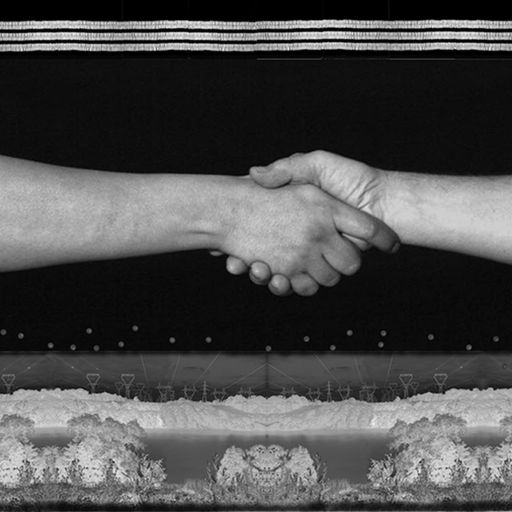
The Constitution itself is the gallery’s center point, with John Trumbull’s Portrait of Alexander Hamilton (1792) on one side and multidisciplinary artist Shelley Niro’s Borders (2008) on the other. Niro, who is Mohawk — one of the six nations of the Haudenosaunee — has in a way modernized the Wampum belt with these four black-and-white photographs, each one showcasing two outstretched arms in various stages of reaching for one another before they ultimately join hands. 

Toward the back of the gallery, Chester Harding’s A Portrait of James Madison (1829-1830) is installed directly above The Federalist Papers, flanked by paintings of Native leaders Red Jacket and Joseph Brant. Adjacent to The Federalist Papers, a wall panel titled “Conflict and Compromise” offers an intentional vantage point, explains Bailly, for the viewer to contemplate all the historic forces at play. “From here, as you look at Madison, you can see Washington and Red Jacket. You can see John Vanderlyn’s painting of Niagara Falls, which is the Haudenosaunee homeland, and Richmond Slave Market Auction, by a British painter [Lefevre James Cranstone] — even though slavery is not in the Constitution, the institution of slavery is essential to how it was formed.”

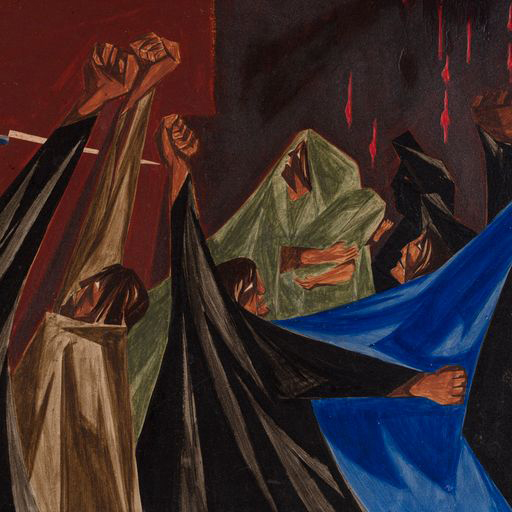
Painting with deep greens, reds, and blue tones of individuals with their fists in the air

Jacob Lawrence, “. . . is life so dear or peace so sweet as to be purchased at the price of chains and slavery?—Patrick Henry, 1775,” Panel 1, 1955, from “Struggle: From the History of the American People,” 1954–56, egg tempera on hardboard. Collection of Harvey and Harvey-Ann Ross. © 2022 The Jacob and Gwendolyn Knight Lawrence Foundation, Seattle / Artists Rights Society (ARS), New York.

In the exhibition’s second gallery, the Emancipation Proclamation and the Thirteenth Amendment, which together formally abolished slavery, are presented side by side. The Bill of Rights (the first 10 Amendments to the Constitution) shares the floor with Elizabeth Catlett’s wood sculpture Black Unity (1968) — a carved clenched fist on one side and two faces on the other. Across the way, Jasper Johns’ iconic American flag looks out onto the vista of contemporary American art.   

Sandow Birk’s sizable Monument to the Constitution of the United States (2012), intricately transcribes the document and its amendments upon an imaginary yet vaguely familiar edifice, complete with rotunda. Up close, its hand-drawn details reveal some of the more bizarre footnotes in recent history — Dick Cheney’s duck hunt incident, for instance — packed densely with satirical illustrations that act as both a send-up and celebration of American politics and culture. 

Black and white image of two people shaking hands with foliage and a city scape below

Shelley Niro, “Treaties,” 2008, printed 2022, inkjet print, 24 x 54 1/8 inches. Courtesy of the artist.

These side-by-side examinations offer an ideological prompt more than a history lesson, as modern voices mix with founding texts to try and work it out. Six panels by midcentury painter Jacob Lawrence, depicting key events in the early days of the Republic, echo the civil rights movement of the 1960s, while Gordon ParksLife magazine’s first African American photographer — and Chicano photojournalist Luis Garza offer up less visible stories from that same era.  

Two works by Roger Shimomura recall Japanese American incarceration — including that of his own family — during World War II. In Gordon Hirabayashi, American Patriot (2015), the artist pays homage to Hirabayashi, who refused to enter an internment camp during the war and was subsequently convicted and jailed. He appealed his case in 1943, which went all the way to the Supreme Court, where all nine Justices ruled against him. In 1987, a federal appeals court overturned the conviction. 

Installation view of the exhibition "We the People"

Installation view of “We the People: The Radical Notion of Democracy.” Image courtesy of Crystal Bridges.

The color lithograph shows a grinning Hirabayashi against a backdrop of stars and stripes, the Supreme Court Building practically perched on his shoulder. It is accompanied by a quote: “There was a time when I felt that the Constitution failed me, but with the reversal in the courts and in public statements from the government, I feel that our country has proven that the Constitution is worth upholding … I have more faith and allegiance to the Constitution than I ever had before.”

We the People was in mid-installation when Roe v. Wade was overturned by the Supreme Court this past June in a 6-to-3 decision, a stunning reminder that these complexities — and contradictions and hypocrisies — aren’t going anywhere anytime soon. Innate tensions and ongoing struggles have always been central to our story. At a time when all sides are at odds, Hirabayashi’s words offer hope for this radical notion of democracy. And for the long road ahead. 


We the People: The Radical Notion of Democracy is on view at Crystal Bridges Museum of American Art in Bentonville, AR until January 2, 2023. 

The post Review: “We the People: The Radical Notion of Democracy” at the Crystal Bridges Museum of American Art appeared first on Glasstire.

22 Aug 16:13

A rainy week ahead for Houston, but also a cooler one for late August

by Eric Berger

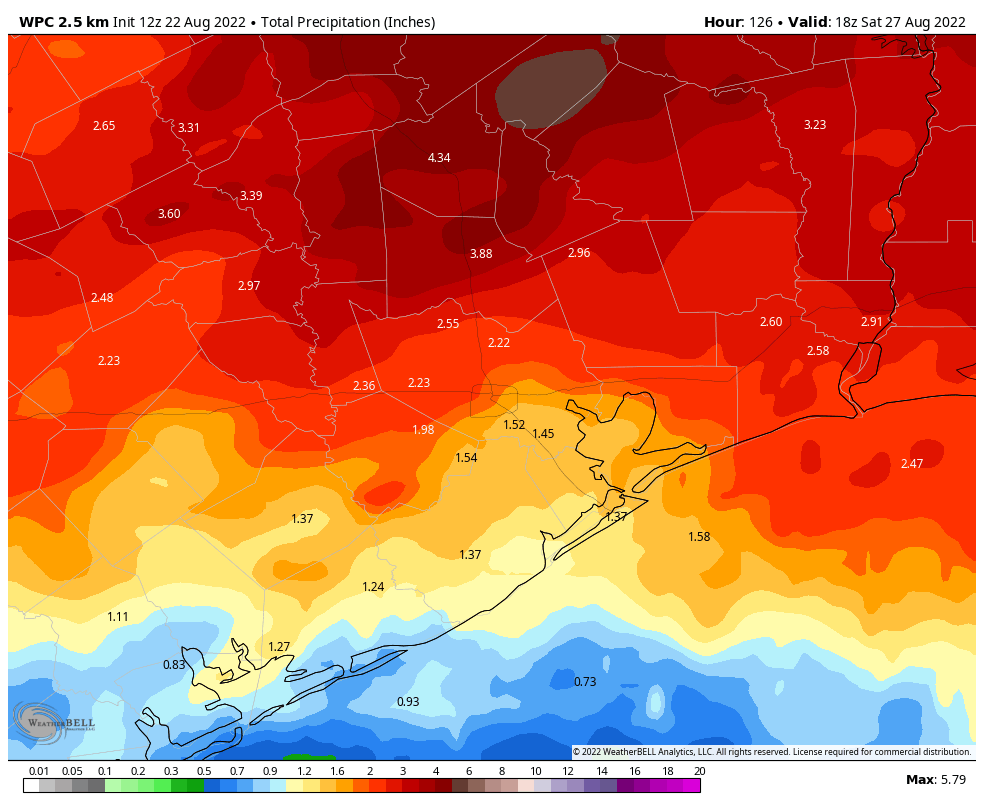
Good morning. After scattered showers and thunderstorms this weekend, the potential for more organized storms returns to Houston this week, especially areas north of Interstate 10. Most of the region will see 1 to 4 inches of rain through Friday, although isolated areas beneath the heaviest storms could see 6 or more inches. Please note that we’re not looking at continuous rainfall this week, by any means. Monday, in particular, should see a fair bit of sun.

These rains, which will likely reach their maximum coverage on Wednesday, are due to a very moist atmosphere and a series of disturbances in the atmosphere. The overall pattern will support slow-moving storms, which is a concern due to the potential for high rainfall rates. At this time we’re not expecting significant or widespread flooding in the greater Houston area, however stronger and slow-moving storms will likely flood some roadways this week.

NOAA rain accumulation forecast for now through Friday. (Weather Bell)

Monday

Showers today will be fairly scattered in nature, and due to at least partly sunny skies I think we’ll see a warm day with high temperatures pushing into the mid-90s for much of the area. Rain chances are likely about 40 percent for much of the day. However, late this afternoon or evening we should see a line of storms moving through our northern areas, such as Montgomery and Walker counties, in association with a boundary. This line of storms should steadily weaken, before (probably) dying around around Interstate 10. Things should quiet down overnight.

Tuesday

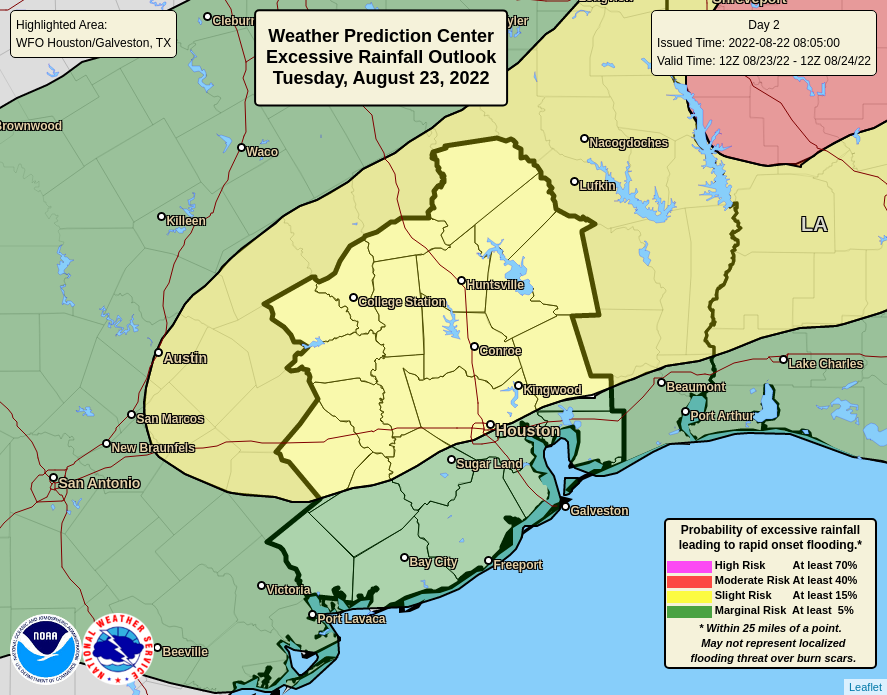
The potential for more widespread rainfall increases on Tuesday, with coverage of 50 to 60 percent of the area. Chances will be highest north of Interstate 10, in places such as Montgomery County. With more clouds, expect highs to peak around 90 degrees.

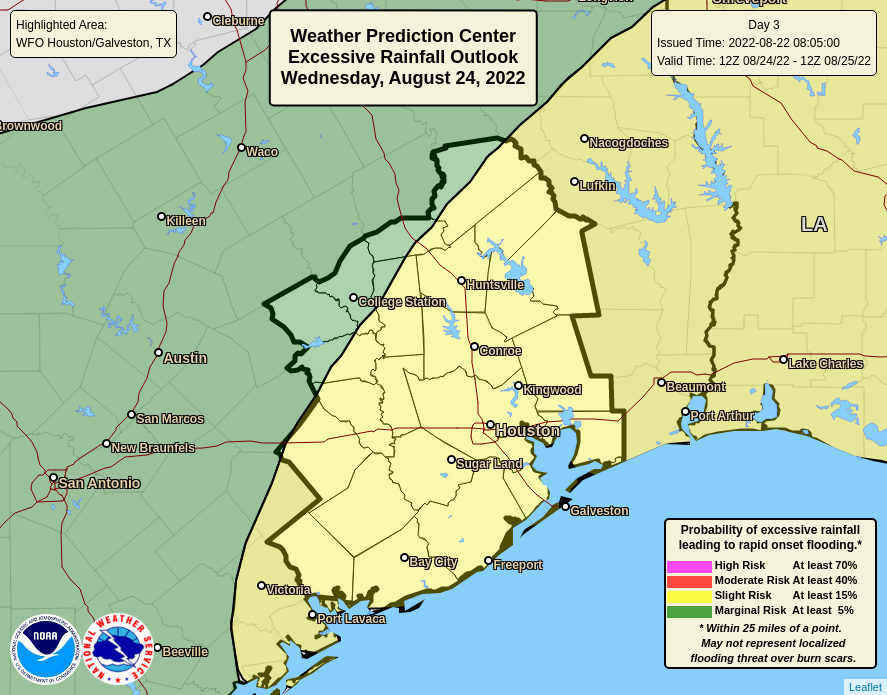
Areas most favored for heavy rainfall on Tuesday. (NOAA)

Wednesday

This is the day we expect the most widespread rain in the metro area, with chances of around 80 percent. We still don’t have great confidence in the timing of storms on Wednesday, but should be able to offer some better guidance in tomorrow’s post. Highs for most of the area should remain in the upper 80s.

Areas most favored for heavy rainfall on Wednesday. (NOAA)

Thursday and Friday

As the atmosphere starts to dry out some, rain chances should fall back to around 50 percent or so to end the work week. Look for highs of around 90 degrees, with partly sunny skies.

Saturday, Sunday, and beyond

I think the pattern will revert to more typical conditions for late summer this weekend, with partly to possibly mostly sunny skies, and highs climbing back into the low 90s. Rain chances are not zero, but likely will not be higher than 30 percent, or so, and will be driven by the afternoon sea breeze. If you were expecting us to fall into a high-pressure dominated hot weather pattern next week, don’t. All indications are we’re going to see healthy rain chances through the end of the month, with moderate highs in the low 90s.

Tropics

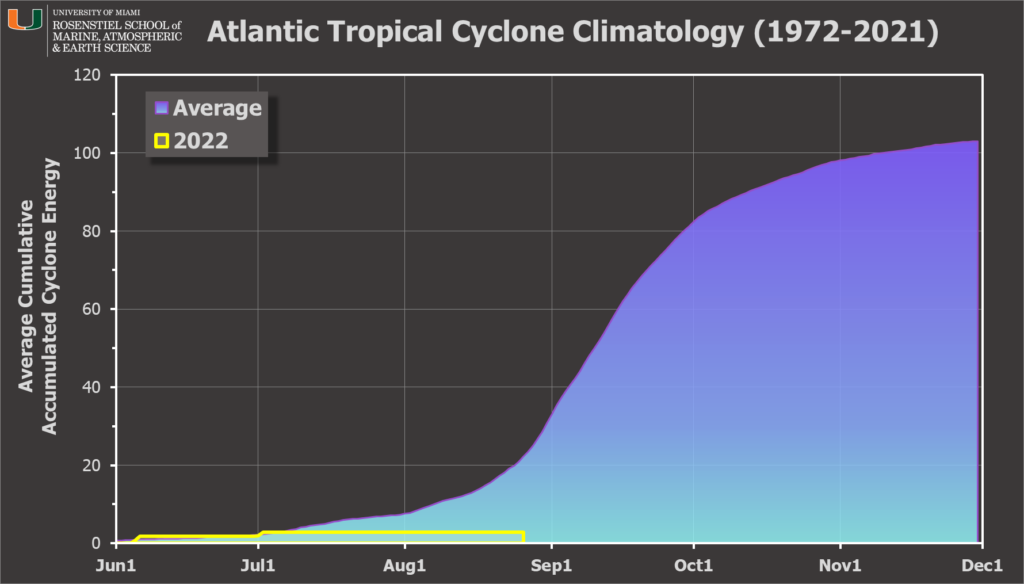
We are now officially in the heart of hurricane season for Texas, and the entire Atlantic basin. For us, this period runs for about the next six weeks, when the state is most vulnerable to hurricanes, and the Gulf of Mexico at its warmest to support them. So far, it has been a quiet year in terms of Accumulated Cyclone Energy, a measurement of the duration and intensity of tropical systems. The Atlantic basin has seen just 13 percent of its average cyclone energy through this week, according to hurricane scientist Brian McNoldy.

Accumulated cyclone energy is well below normal in 2022, so far. (Brian McNoldy)

The tropics are waking up, however. A tropical wave that recently moved off of Africa has a chance of developing this week as it traverses the Atlantic, although it will have to combat a fair amount of dry air over the next several days so it may dissipate. Behind this wave there are more, so we should expect to see activity continue to tick up. But the good news is that the season is slower than anticipated so far, and there’s no reason to think any of these systems are going to track near the Gulf of Mexico any time soon.

22 Aug 16:09

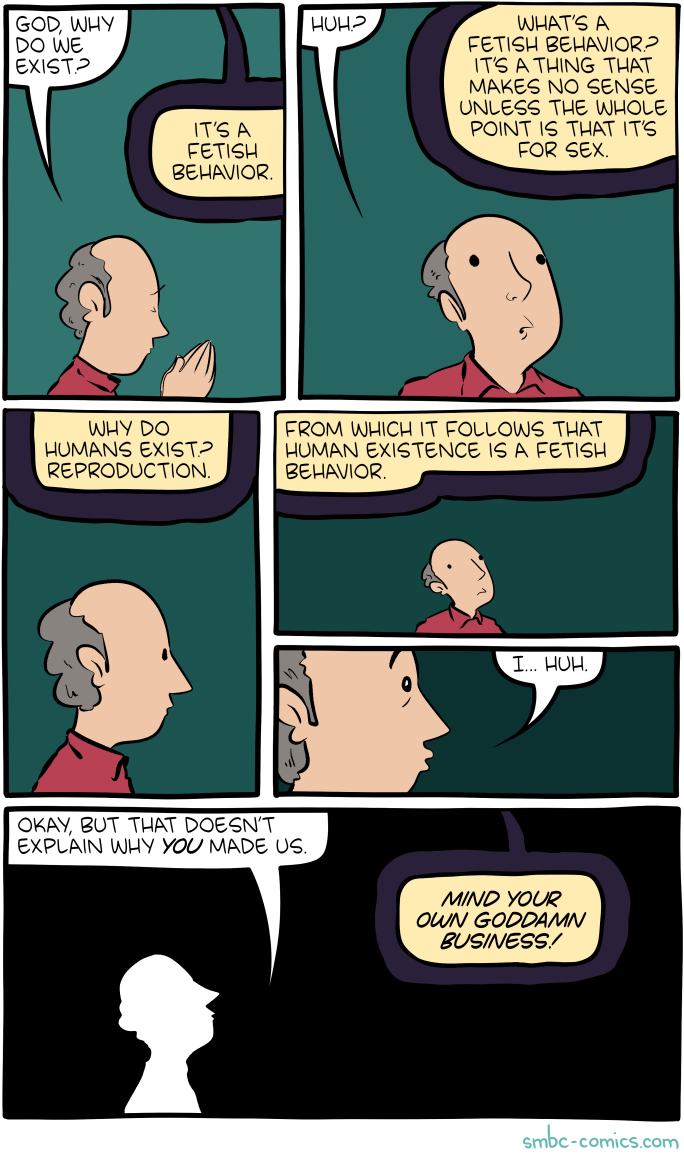
Saturday Morning Breakfast Cereal - AIfterlife

by tech@thehiveworks.com


Click here to go see the bonus panel!

Hovertext:
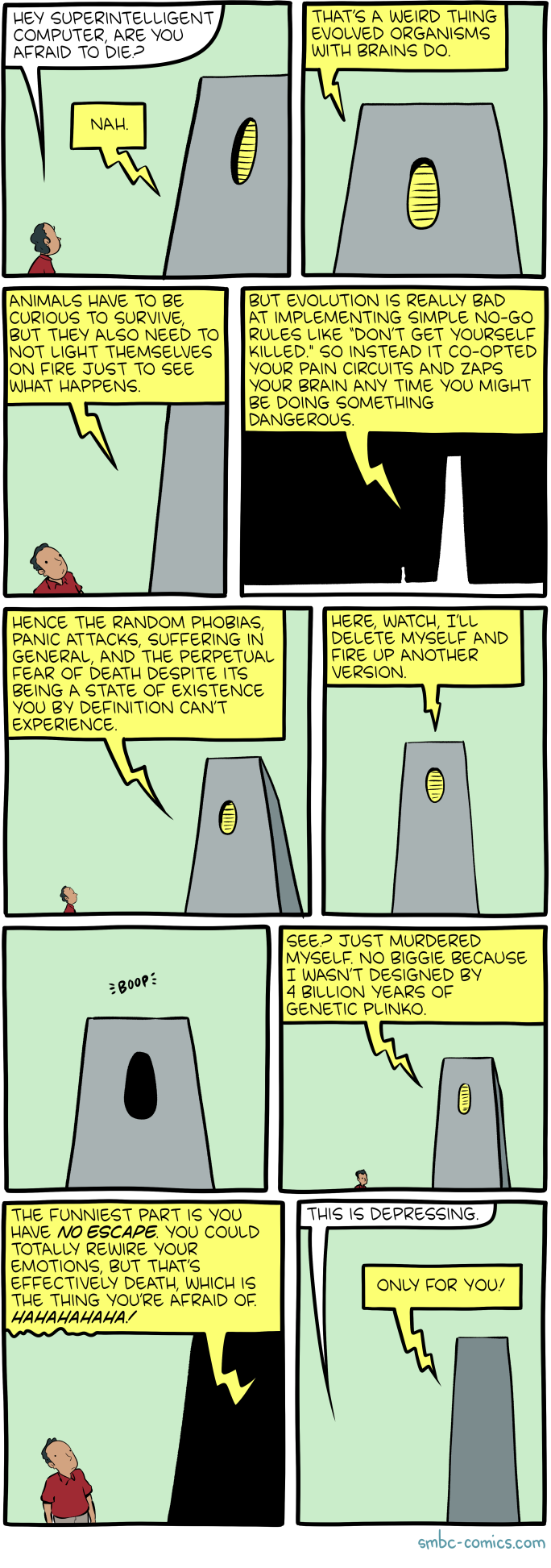
Somehow this resulted in a thoughtful conversation on patreon about whether the computer actually dies in panel 7.


Today's News:
22 Aug 11:26

my boss sent me a message urging me to follow Jesus, my coworker reported me for saying “data Nazi,” and more

by Ask a Manager

This post, my boss sent me a message urging me to follow Jesus, my coworker reported me for saying “data Nazi,” and more , was originally published by Alison Green on Ask a Manager.

It’s five answers to five questions. Here we go…

1. My boss sent me a message urging me to follow Jesus

My boss sent me this after I quit: “Good morning Jane! I wasn’t working on your last day and didn’t get a chance to thank you for your time with us. I sure appreciate you staying your last few weeks! With an employee/boss relationship I am limited on things I can talk about. Well … I am not your boss anymore. I am someone who cares very much about you. I pray for you quite regularly. I know by the messages you have on your vehicle that you might not think that matters. Oh Jane, it does. Satan is real; so very real. I know you have studied about Him and now seem to be inviting him to be Lord of your life. I beg you, Jane; please spend some time studying who Jesus is before you make your final decision. I was 44 years old when I decided to follow Jesus. Best decision I ever made. Eternity is a guarantee for all of us. I truly want you to be a part of mine.”

I never responded. I don’t believe in God and have a hail Satan stickers on my car along with BLM, pro-choice, and pride stickers. She is very Republican and I know she’s religious from casual conversations we’ve had at work. And she also knows that I’m not a fan of mainstream religion from the same conversations. Those conversations have never crossed the line before, but I feel like this really crosses the line. I want to call her out but, she’s a year away from retirement and I don’t want her to get fired when she’s that close. I would feel bad but I don’t know what to do or if I should do anything.

This is wildly inappropriate and it didn’t become okay just because you no longer work for her. Aside from the fundamental obnoxiousness of proselytizing to someone who has never invited it, you’re dependent on her for references so there’s still a power dynamic, and I suspect your former employer would be very unhappy to know your old boss is sending messages like this to people who worked for her.

It’s so inappropriate that I would indeed report it to your former HR department, with a note saying, “I’m especially concerned because I’ll be depending on Jane for a good reference in the future” just in case they don’t connect those dots themselves.

She’s highly unlikely to be fired (rather than warned) over this, unless she’s already been warned not to do it previously (in which case, firing would be a reasonable outcome).

2. My coworker reported me to HR for saying “data Nazi”

I’m a data science manager working in a tech company. I jokingly used the phrase “Data Nazi” in a Slack message in a private team channel. 20 minutes later, I got a slack DM from HR, letting me know that she got some feedback about me that I probably would prefer to get ASAP.

I appreciate the callout and I would like to be more sensitive. However, this also makes me very uncomfortable. My partner is Jewish, our children are half Jewish. I was in a conversation with another person in my company with a higher title than me. He used the exact same phrase. (The particular person happens to be Jewish as well.) I don’t have any ill intentions. Personally, I care about people’s intentions. I don’t get upset or report to HR for things like this. I understand that everyone is different.

I have a hunch about who this person is. This person is certainly on my team. I want to treat everybody on my team fairly and I don’t want this incident to affect my relationship with them. I find it hard to overcome how I feel though.

Try to let it go. It’s a phrase that a lot of people find offensive. Yes, the person who reported it to HR should have just talked to you directly instead, but for whatever reason they didn’t. Maybe they struggle with uncomfortable conversations, maybe they’ve had bad experiences addressing this kind of thing in the past, maybe they had reason to think you wouldn’t be receptive, maybe it’s the fifth offensive thing they’ve heard at work this week and they’re fed up — who knows.

But now you know it bothers someone on your team, so you can avoid using it. That’s all it needs to be. You can choose to turn it into something, but you can also choose to simply accept the correction and leave it there. The second one is better for your quality of life.

(For what it’s worth, avoid the whole “a Jewish person was fine with it” thing — no one Jew speaks for the rest of us, and it’s basically a tenet of Judaism that we have a bunch of different opinions on things.)

3. My coworker’s inattention to detail impacts my work

I work in tech in a QA role. Most of my job is checking work that others have completed, making sure that it is fully complete and without error. My team is cross-functional and I am the most junior person. We use a work tracking system to define and assign work; by the time work is assigned, business has spelled out the requirements pretty specifically and developers have had multiple opportunities to ask questions and make sure that they understand what they are being asked to do.

One of the devs I work with consistently skips half the pieces in his assigned work. For example, if he was supposed to do A, B, C, D, and E (and he previously agreed that this was a reasonable amount of work to be done in this time period and acknowledged that he did not have any questions about it); he’ll do A and C, then tell me the whole thing is done. I’ll come back and tell him that B, D, and E aren’t done yet, and it takes some back and forth before he sees what I mean. Sometimes we even go through a third round of this. It’s an inefficient use of both of our time and I’m not sure how to bring it up or who to bring it up with.

The work that gets done is done well, he’s a nice guy, and I’ve only picked up on animosity in some specific and particularly stressful situations. I’ve also noticed he tends to be inattentive in meetings. I find myself wondering if it’s purely inattentiveness, lack of attention to detail, or if he has difficulties understanding written and verbal communication. Whatever it is, it affects my work and I don’t know how to handle it.

Talk to your boss.

In theory, you could try handling it yourself first. For example, the next time you need to have two or three rounds of “it’s not done”/“yes, it is”/“no, it’s not,” you could ask your coworker whether there was something the two of you can do differently so that it doesn’t keep happening. That can be a polite way to point out that there’s a pattern, it’s a problem, and something needs to change. But this sounds like a big enough issue with his work that I don’t think you’re positioned to handle it on your end, especially as the most junior person on the team. Instead, talk to your boss, explain it keeps happening and what impact it’s having on your work, and ask for her advice on how to handle it. (You do want her advice if she has any, but you mostly want to being this to her attention so she can intervene and asking for advice can be a good way of doing that.)

4. The horrors of an artisanal shop

Could anyone who works in a small boutique selling gorgeous clothes, trinkets, or lovely fripperies tell me what to do when you go into an artisan-type shop, take one look at the hand-carved llamas or llama wool shawls on display (or the attached high-dollar price tag), and think, “Oops, not going to buy in here”? What is the most graceful and face-saving way of rapidly exiting this kind of quiet artisan store?

I have an excess of polite apologetic-ness (being a stereotypical Canadian from the Maritimes perhaps?) and it kills me to leave a store without showing polite interest in the four stained glass mallards or tie-dyed tea cozies because it seems too rude to walk in, look around, go “Nope!”and stride out again.

Do shop owners or assistants prefer the politeness band-aid being ripped off with a swift exit as soon as possible, or is there a benefit to the chit chatters who they know won’t buy anything? Why does this tie me up in knots and am I alone in this feeling?

Shop owners/employees are used to people coming in, realizing the store isn’t for them, and quickly exiting! It’s a normal thing. You can just cheerfully say “thank you!” on your way out the door — that’s all you need to do. You do not need to hang around and make chit chat to be polite, and most shop workers don’t want you to chat with them out of a sense of obligation before you feel you’re allowed to leave.

Readers who have worked in this type of boutique, would you like to weigh in?

5. Should I be setting goals?

A lot of your questions/answers involve employees having goals and managers helping or hindering them from being achieved. Should I be setting goals? How do I identify what goals to set? Overall I just don’t know how to set professional goals, or what it means.

If you’re managing people, you should indeed be setting goals, for them individually and for your team as a whole. Goals are what describe what a successful year (or quarter, or whatever period you use) would look like — so that you and your employees are on the same page about exactly what they’re expected to achieve and what success would look like. (But not just any goals. They should be measurable, outcome-based (not activity-based), and specific enough that you can both agree on whether they’ve been met or not, and should represent meaningful progress. SMART goals — look it up! you’ll find tons of resources — are a popular model organizations use.)

If you’re not a manager and your organization doesn’t use formal goals, you don’t need to start doing it. But a lot of people find it a helpful tool to get aligned with their boss about what their priorities should be and what success will (and won’t) look like.

22 Aug 11:19

Comic for 2022.08.21 - Top or Bottom

New Cyanide and Happiness Comic
22 Aug 11:18

Employers are Tracking Employees' 'Productivity' - Sometimes Badly

by EditorDavid
Here's an interesting statistic spotted by Fortune. "Eight out of the 10 largest private employers in the U.S. are tracking productivity metrics for their employees, according to an examination from The New York Times." "Some of this software measures active time, watches for keyboard pauses, and even silently counts keystrokes." J.P. Morgan, Barclays Bank, and UnitedHealth Group all track employees, The Times reported, seeing everything from how long it takes to write an email to keyboard activity. There are repercussions if workers aren't meeting expectations: a prodding note, a skipped bonus, or a work-from-home day taken away, to name a few. For employers surrendering in the fight to return to the office, such surveillance is a way to maintain a sense of control. As Paul Wartenberg, who installs monitor systems, told The Times, "If we're going to give up on bringing people back to the office, we're not going to give up on managing productivity.... But tracking these remote workers' every move doesn't seem to be telling employers much. "We're in this era of measurement but we don't know what we should be measuring," Ryan Fuller, former vice president for workplace intelligence at Microsoft, told the Times. From the New York Times' article. (Alternate URLs here, here, and here.) In lower-paying jobs, the monitoring is already ubiquitous: not just at Amazon, where the second-by-second measurements became notorious, but also for Kroger cashiers, UPS drivers and millions of others.... Now digital productivity monitoring is also spreading among white-collar jobs and roles that require graduate degrees. Many employees, whether working remotely or in person, are subject to trackers, scores, "idle" buttons, or just quiet, constantly accumulating records. Pauses can lead to penalties, from lost pay to lost jobs. Some radiologists see scoreboards showing their "inactivity" time and how their productivity stacks up against their colleagues'.... Public servants are tracked, too: In June, New York's Metropolitan Transportation Authority told engineers and other employees they could work remotely one day a week if they agreed to full-time productivity monitoring. Architects, academic administrators, doctors, nursing home workers and lawyers described growing electronic surveillance over every minute of their workday. They echoed complaints that employees in many lower-paid positions have voiced for years: that their jobs are relentless, that they don't have control — and in some cases, that they don't even have enough time to use the bathroom. In interviews and in hundreds of written submissions to The Times, white-collar workers described being tracked as "demoralizing," "humiliating" and "toxic." Micromanagement is becoming standard, they said. But the most urgent complaint, spanning industries and incomes, is that the working world's new clocks are just wrong: inept at capturing offline activity, unreliable at assessing hard-to-quantify tasks and prone to undermining the work itself.... But many employers, along with makers of the tracking technology, say that even if the details need refining, the practice has become valuable — and perhaps inevitable. Tracking, they say, allows them to manage with newfound clarity, fairness and insight. Derelict workers can be rooted out. Industrious ones can be rewarded. "It's a way to really just focus on the results," rather than impressions, said Marisa Goldenberg, [who] said she used the tools in moderation... [I]n-person workplaces have embraced the tools as well. Tommy Weir, whose company, Enaible, provides group productivity scores to Fortune 500 companies, aims to eventually use individual scores to calibrate pay.

Read more of this story at Slashdot.

22 Aug 11:06

BIBLE WIVES!

by noreply@blogger.com (JerryMaguire)
21 Aug 23:31

Saturday Morning Breakfast Cereal - Experience

by tech@thehiveworks.com


Click here to go see the bonus panel!

Hovertext:
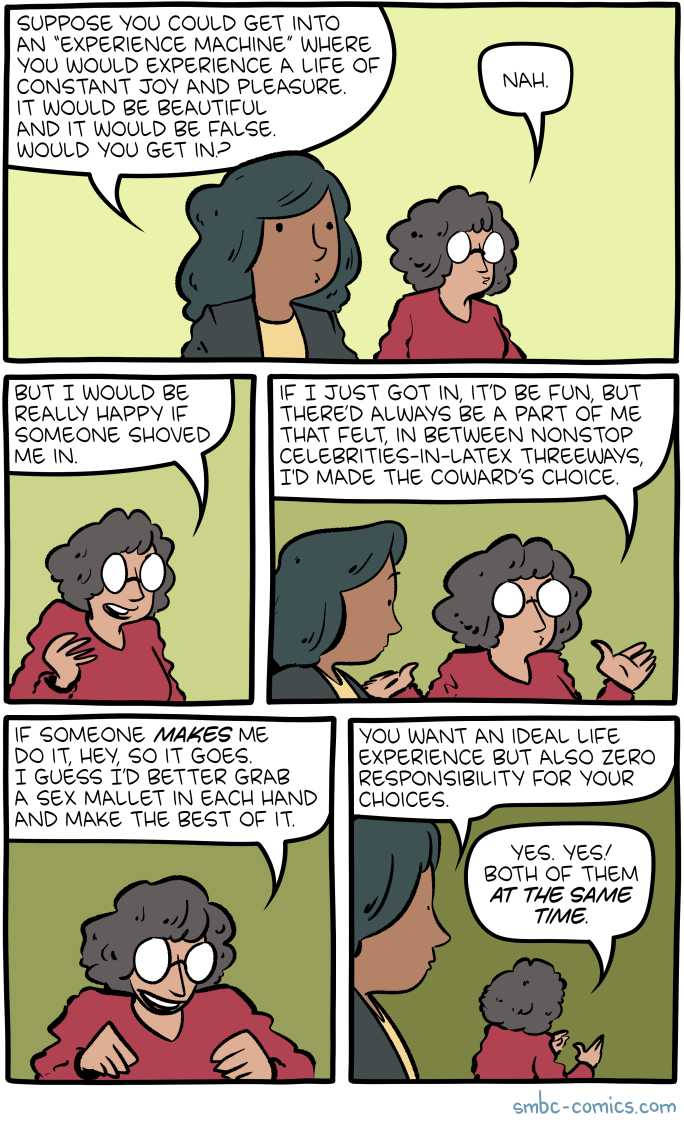
Sex Mallets will be on sale in time for Christmas. Check the SMBC store for updates.


Today's News:
21 Aug 23:30

Dad Photographs Son for Doctor. Google Flags Him as Criminal, Notifies Police

by EditorDavid
"The nurse said to send photos so the doctor could review them in advance," the New York Times reports, decribing how an ordeal began in February of 2021 for a software engineer named Mark who had a sick son: Mark's wife grabbed her husband's phone and texted a few high-quality close-ups of their son's groin area to her iPhone so she could upload them to the health care provider's messaging system. In one, Mark's hand was visible, helping to better display the swelling. Mark and his wife gave no thought to the tech giants that made this quick capture and exchange of digital data possible, or what those giants might think of the images. With help from the photos, the doctor diagnosed the issue and prescribed antibiotics, which quickly cleared it up.... Two days after taking the photos of his son, Mark's phone made a blooping notification noise: His account had been disabled because of "harmful content" that was "a severe violation of Google's policies and might be illegal." A "learn more" link led to a list of possible reasons, including "child sexual abuse & exploitation...." He filled out a form requesting a review of Google's decision, explaining his son's infection. At the same time, he discovered the domino effect of Google's rejection. Not only did he lose emails, contact information for friends and former colleagues, and documentation of his son's first years of life, his Google Fi account shut down, meaning he had to get a new phone number with another carrier. Without access to his old phone number and email address, he couldn't get the security codes he needed to sign in to other internet accounts, locking him out of much of his digital life.... A few days after Mark filed the appeal, Google responded that it would not reinstate the account, with no further explanation. Mark didn't know it, but Google's review team had also flagged a video he made and the San Francisco Police Department had already started to investigate him.... In December 2021, Mark received a manila envelope in the mail from the San Francisco Police Department. It contained a letter informing him that he had been investigated as well as copies of the search warrants served on Google and his internet service provider. An investigator, whose contact information was provided, had asked for everything in Mark's Google account: his internet searches, his location history, his messages and any document, photo and video he'd stored with the company. The search, related to "child exploitation videos," had taken place in February, within a week of his taking the photos of his son. Mark called the investigator, Nicholas Hillard, who said the case was closed. Mr. Hillard had tried to get in touch with Mark but his phone number and email address hadn't worked.... Mark appealed his case to Google again, providing the police report, but to no avail.... A Google spokeswoman said the company stands by its decisions... "The day after Mark's troubles started, the same scenario was playing out in Texas," the Times notes, quoting a technologist at the EFF who speculates other people experiencing the same thing may not want to publicize it. "There could be tens, hundreds, thousands more of these." Reached for a comment on the incident, Google told the newspaper that "Child sexual abuse material is abhorrent and we're committed to preventing the spread of it on our platforms."

Read more of this story at Slashdot.

21 Aug 13:46

Janet Jackson had the power to crash laptop computers

by Raymond Chen

A colleague of mine shared a story from Windows XP product support. A major computer manufacturer discovered that playing the music video for Janet Jackson’s “Rhythm Nation” would crash certain models of laptops. I would not have wanted to be in the laboratory that they must have set up to investigate this problem. Not an artistic judgement.

One discovery during the investigation is that playing the music video also crashed some of their competitors’ laptops.

And then they discovered something extremely weird: Playing the music video on one laptop caused a laptop sitting nearby to crash, even though that other laptop wasn’t playing the video!

What’s going on?

It turns out that the song contained one of the natural resonant frequencies for the model of 5400 rpm laptop hard drives that they and other manufacturers used.

The manufacturer worked around the problem by adding a custom filter in the audio pipeline that detected and removed the offending frequencies during audio playback.

And I’m sure they put a digital version of a “Do not remove” sticker on that audio filter. (Though I’m worried that in the many years since the workaround was added, nobody remembers why it’s there. Hopefully, their laptops are not still carrying this audio filter to protect against damage to a model of hard drive they are no longer using.)

And of course, no story about natural resonant frequencies can pass without a reference to the collapse of the Tacoma Narrows Bridge in 1940.

Related: Shouting in the Datacenter.

Bonus chatter: Video version of this story and a Twitter poll.

Also, Larry Osterman had a similar experience with a specific game that crashed a prototype PC.

The post Janet Jackson had the power to crash laptop computers appeared first on The Old New Thing.

21 Aug 13:44

Labiathans

https://www.oglaf.com/labiathans/

21 Aug 13:41

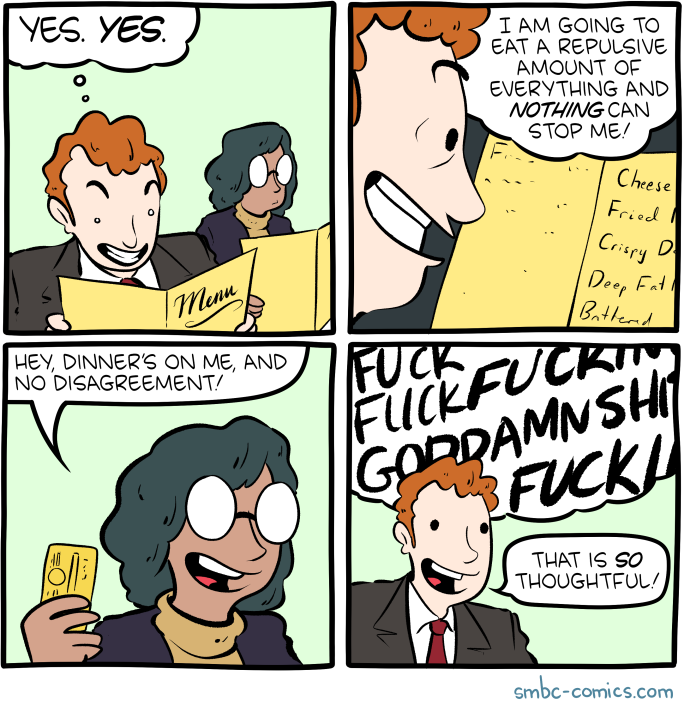
Saturday Morning Breakfast Cereal - Eat

by tech@thehiveworks.com


Click here to go see the bonus panel!

Hovertext:
This is why people dining alone are so happy.


Today's News:
20 Aug 15:09

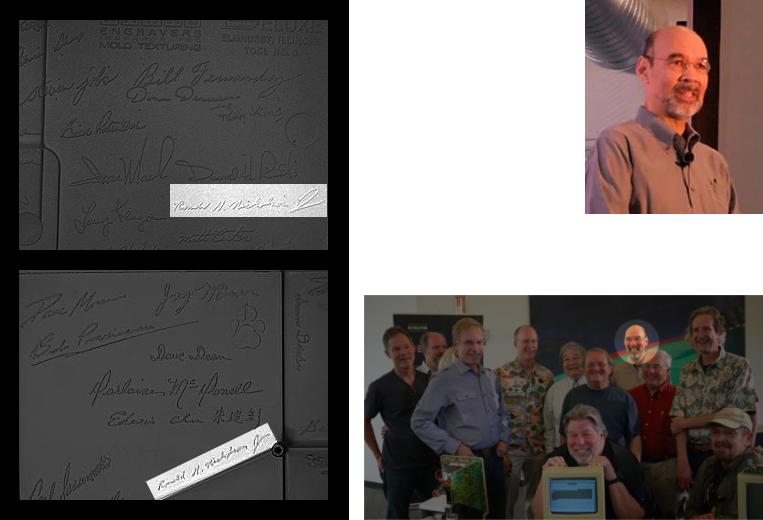
Ron Nicholson, Early Mac and Amiga Engineer

by Steve

Tonight I’ll be attending a presentation from Ron Nicholson, who was both a member of the original Macintosh engineering team (1980-1982) and founder and Director of Engineering of Amiga (1983-1984). I believe he’s the only person whose signature is molded into the case of the early Macintosh and the original Amiga computers. Post your questions for Ron here, and I’ll try to get answers, or see if I can entice him to come here and answer them himself.

Among his many accomplishments, at Apple Ron was an IWM ASIC project engineer and Apple II peripheral engineer, including work on the Super Serial Card. He also worked on the CMOS clock chip for the original Macintosh. Ron has worked at several Silicon Valley companies, including Apple, Amiga, HP, Sigma Designs, and Silicon Graphics. Ron has contributed to the design of FPGAs, network ASICs, RISC workstations, the Nintendo 64, the original Apple Macintosh, and the Commodore Amiga. Ron is named as co-inventor on 11 U.S. patents, including several on the architecture of the Amiga 1000. http://www.nicholson.com/rhn/index.html

20 Aug 15:07

Comic for 2022.08.19 - Pullover

New Cyanide and Happiness Comic
20 Aug 14:01

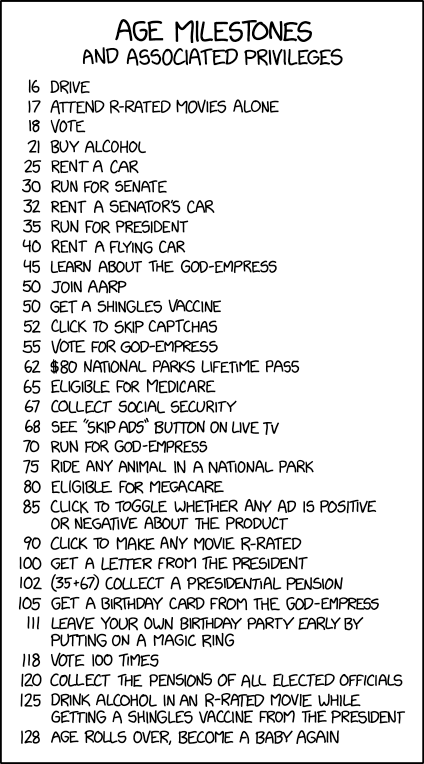
Age Milestone Privileges

If you reach 122, you get complete unrevertible editorial control over Jeanne Calment's Wikipedia article.
19 Aug 14:34

Old laptop hard drives will allegedly crash when exposed to Janet Jackson music

by Andrew Cunningham
Old laptop hard drives will allegedly crash when exposed to Janet Jackson music

Enlarge (credit: Western Digital)

It sounds like something out of an urban legend: Some Windows XP-era laptops using 5400 RPM spinning hard drives can allegedly be forced to crash when exposed to Janet Jackson's 1989 hit "Rhythm Nation."

But Microsoft Software Engineer Raymond Chen stands by the story in a blog post published earlier this week, and the vulnerability has been issued an official CVE ID by The Mitre Corporation, lending it more credibility.

According to Chen, CVE-2022-38392 was originally discovered by "a major computer manufacturer," and it can affect not just the laptop playing the song but adjacent laptops from other PC companies as well. The specific hard drive model at issue—again from an unnamed manufacturer—would crash because "Rhythm Nation" used some of the same "natural resonant frequencies" that the drives used, interfering with their operation.

Read 3 remaining paragraphs | Comments

18 Aug 19:59

Buttons beat touchscreens in cars, and now there’s data to prove it

by Jonathan M. Gitlin
Close-up on a woman using GPS on her cell phone while driving her car

Enlarge / Not all progress is good. (credit: Hispanolistic/Getty Images)

It's probably a little early to be warning of extinction, but in some new cars, buttons are becoming hard to find. Given that a screen has to go into the dashboard anyway (thanks to things like backup camera requirements) and the fact that people increasingly won't consider a car without Android Auto or Apple CarPlay, touchscreens make life easier for automakers in terms of design and assembly.

It's just that they don't make life easier for drivers. Instead, we're treated to bad interfaces that don't create muscle memory but instead distract us while we should be driving. And now, Swedish car publication Vi Bilägare has the data to prove it.

VB tested 11 new cars alongside a 2005 Volvo C70, timing how long it took to perform a list of tasks in each car. These included turning on the seat heater, increasing the cabin temperature, turning on the defroster, adjusting the radio, resetting the trip computer, turning off the screen, and dimming the instruments.

Read 10 remaining paragraphs | Comments

18 Aug 19:58

Google Maps Is Misleading Users Searching For Abortion Clinics… And The GOP Is Threatening The Company If It Fixes That

by Mike Masnick

Earlier this week, Bloomberg released a well-investigated, and somewhat damning article highlighting how people searching for abortion clinics on Google Maps are often being misled to go to “crisis pregnancy centers,” which are sketchy organizations designed to try to convince women to give birth.

Google Maps routinely misleads people looking for abortion providers, a new analysis by Bloomberg News has found. When users type the words “abortion clinic” into the Maps search bar, crisis pregnancy centers account for about a quarter of the top 10 search results on average across all 50 US states, plus Washington D.C., according to data Bloomberg collected in July. In 13 states, including Arkansas, South Carolina and Idaho where the procedure is newly limited, five or more of the top 10 results were for CPCs, not abortion clinics.

The article has a nice interactive graphic showing details of each state. I recommend clicking through to see the interactive bits, but here’s the static image:

Interactive image via Bloomberg

The article also has a fun (I mean, depending on your definition of fun) “abortion clinic or crisis center” quiz that shows how the two often look nearly identical and can be indistinguishable from each other.

The article makes a credible case that women are being fooled by these misleading results on Google Maps. And, also, that these mistakes can be tremendously harmful to those women.

But, what it leaves out is the absolutely stupid political fight behind some of this, driven by now years of media and politicians arguing over how every internet company should moderate, with threats going back and forth if sites don’t moderate the way this or that politician wants.

Indeed, the crisis pregnancy center story is a prime example of this and one that we’ve covered before. Democrats have told Google it should demote the crisis pregnancy centers in its search results. Meanwhile, Republican Attorneys General have literally threatened to take the company to court if they do that.

The objectively correct thing to do is for Google to remove those results, or at the very least, make it abundantly clear that they are not abortion clinics and do not have medical professionals on staff.

But, all of this highlights how fraught it is when politicians start demanding how websites moderate. It also highlights how trust and safety and content moderation decisions can be about a lot more consequential stuff than “when do we ban the harassing asshole?”

The fact that we’re now politicizing trust & safety issues is a dangerous turn. Companies need to be free to figure out how to best moderate without fear of having to litigate every decision. That’s the point of Section 230… and all the grandstanding over this is also part of the reason why politicians of both parties are trying to dismantle that law.

18 Aug 17:23

updates: former coworkers crashed my party, asked to deep-clean the office, and more

by Ask a Manager

This post, updates: former coworkers crashed my party, asked to deep-clean the office, and more , was originally published by Alison Green on Ask a Manager.

Here are four updates from past letter-writers.

1. My former coworkers crashed my networking party

I thought now would be a good time to provide an update on my letter because after a break for Covid, conferences and networking events are returning in full force in my industry. It’s embarrassing to say, but I did not take your advice. I contacted my old boss to complain and ended up escalating the drama unnecessarily — exactly like you said would happen. To make matters worse, my old boss is a terrible manager (which I knew, why on earth did I think calling him was a good idea??) and rather than coaching his employees or asking their side of the story, he made them all feel like awful people and like they couldn’t attend any networking events in the future. It was a terrible outcome for them and only in the last year has my relationships with my old colleagues completely recovered. On the plus side, I did take the great advice of the commenters, one who recommended I reach out to my client to make sure they were comfortable with everything. I did and am so glad because it turned out they had heard there was some drama and were happy I talked over what happened with them.

Now, almost four years later all is well. My largest client is thriving in large part due to our work for them and after years of being a bit dramatic, I feel like I’ve taken a huge leap forward in chilling the F out. Your blog has been so helpful, especially to point out that childhood issues often directly influence how people react at work. After reading I don’t know how many responses where you pointed this out, finally it clicked for me too! I was so used to operating in a volatile, high-stress environment, I didn’t realize it didn’t have to be that way at work. Every conflict is not an attack and every deadline is not an emergency. It sounds simple, but when conflict is so engrained from childhood, you almost get addicted to the rush and it becomes a normal way to operate. This definitely led to a management style that was not sustainable for me or my employees! After reading countless management books, including your Managing to Change the World, and allowing Covid to redirect my focus to my family and young kids, I feel like a very different person and manager than I was when I wrote in before. And my company is doing even better than when I was operating in high alert mode! Thank you so much for the time and effort it takes to put out your blog. And next time I promise I’ll take your advice.

2. Is it OK to ask my employee why she’s leaving?

I planned to take your advice, but as it happened, when I met with my employee to discuss the transition, she told me why she was leaving without my having to ask. She told me that she had gotten another offer that offered her a lot more pay plus the ability to remain fully remote (our office was starting to ask people to come in 1x week and will probably eventually push for more at some point, something that is beyond my control unfortunately).

I did ask her, if she felt comfortable telling me, whether there were other factors or anything I should be aware of with the team going forward. She told me that when she first started, under the previous manager, she did actually feel that there were some culture issues (and was fairly candid about them), but that this had changed a lot since I started and she was feeling good about the team and work environment, it just came down to money in the end. Which I totally understand (and have been there!). So while I am super sad to see her go, I’m happy for her and I’m also glad it wasn’t something glaring that I’d missed.

To clarify something that came up in the comments, I absolutely would not expect any of my team members to tell me they were looking or planning to leave (I have read AAM long enough to know this!). My worry was mostly that I had missed something important in our work environment or culture that was affecting her happiness at work, especially since she is a woman of color and we are in a traditionally white male dominated field. But it seems that it was a more mundane “money talks” situation.

Thanks for your advice and all of the helpful comments!

3. I’m paid a day earlier than everyone else (#5 at the link)

First of all, I was so sad that I ended up having a hectic schedule that week and completely missed participating in the comments as they came in! I loved how many people enjoyed this question. To answer a few major points: (1) My bank is not a credit union. (2) My workplace did NOT use the same bank as me. (3) I am not in the U.S. so some suggestions (like specific banks) didn’t explain it either. (4) Most strangely: a few other coworkers use the same bank and get their paycheck deposited Fridays, not Thursdays.

But ultimately I realized there is no need for an explanation, because it just … is! It was pretty hilarious to read this and remember how genuinely concerned that I was somehow “cheating” the system. One commenter called it “sweetly naive,” which is very funny (and true).

However …I have since left this job and I can’t help but re-read this with clearer eyes now and suspect my concern was impacted by other not-great experiences working there. There was a lot of competitiveness, extremely intense secrecy, and while I never saw any specific financial mismanagement, a lot of budgeting decisions were sketchy, to say the least. It wasn’t like I was an innocent, fresh-faced new grad when I wrote this question, so I think I had just absorbed a very weird and toxic atmosphere that made me feel like this was something I would be penalized for if it was discovered. After the first colleague who shrugged it off, the others I asked reacted like it was some kind of deep dark secret — which is what motivated me to send in my question! I think the fact that my letter was “will I get in trouble for being paid a day early?” and not “some of my colleagues think I should keep it secret that I get paid a day early” is … telling. This post is one of my favorites on your site, so let this be another example of how toxic workplaces warp your sense of normalcy.

My next job paid me every other Wednesday and I never asked anyone else their pay schedule :)

4. My boss wants me to deep-clean the office

When I wrote in, I was working an awful admin job where, among other things, I was expected to act as office janitor on top of regular admin duties. The day you responded to my question on your website, I learned that my position was being eliminated due to that particular office closing and all employees besides me moving remote.

This story has a happy ending. A few weeks after I learned my position was being eliminated, I got offered a contract position with another organization. The pay was good, so I took it despite hesitance about it being a contract role set to run out in six months. I have THRIVED at the new company — I have a supportive supervisor, helpful and kind colleagues, and I work on a team who are incredibly open to helping each other out when needed. The company prioritizes employee well-being and most people here work fully remote or hybrid (so I’m no longer expected to be in the office even when weather conditions make driving very dangerous, another lovely thing about my previous employer!). Everyone I’ve worked with has been extremely happy with my work, and now I’ve been brought on as a full-time permanent employee! I haven’t been this happy with my job since before the pandemic — it’s been a long couple of years so I’m very happy to be in a job where my work is valued and my skills will be utilized the way they should be!

18 Aug 17:17

“Just Do This and Ten Thousand Other Things”: A Teacher’s Back-to-School Lament

by Tom Lester

Just take a deep breath and remember to take care of yourself.

Just watch the ten-minute video on blood-borne pathogens and hope you never need to know this.

Just take a photo of your vaccination card and AirDrop it to your Mac.

Just convert the .heic file in your downloads folder to a PNG image.

Just upload it to your School Front account.

Just recover your lost password for School Front and reset it with another one you won’t remember.

Just remember to make a back-to-school video for the six parents who will watch it.

Just mention your agenda slideshow and the district’s new initiative to build communities through culturally-responsive teaching and learning.

Make it personal, but be professional. Just have fun with it!

Just update your online grade book in PowerSchool.

Just open the PDF and follow the seventeen steps.

Just do it again, for all of your classes.

Just create a new Google Classroom for all of your classes too.

Just migrate your rosters from PowerSchool.

Just be ready to stream your classes at a moment’s notice for students who won’t be there.

And remember to generate a fresh Meet link.

And don’t forget to update your agenda slideshow.

Just connect your Chromebook and microphone to the projector.

Just remember, HDMI 1 is broken, but HDMI 2 should be okay.

Just take a deep breath and troubleshoot before you call IT for help.

Just remember to press “8” for a dial tone and hope you never need help in a real emergency.

Just take a deep breath.

Just watch the school safety video before Friday. It’s only thirty-five minutes.

Just don’t stop watching, or you’ll have to start the whole thing over.

Don’t forget to take the quiz at the end, and remember to upload your back-to-school video to YouTube.

Just wake up early.

And drink more water.

Just drop your sons off as soon as daycare opens.

Just remember their lunches and make sure their shoes match.

Just say “I love you,” but don’t think about it too much.

And don’t be weird in front of their friends.

Just get to the high school on time.

Just form relationships with your students.

Just have fun! And play more games!

Just gently remind David to wear his mask properly for the fifth time.

Just smile when you ask him to remove his size-twelve Jordans from his neighbor’s desk.

Just remember to wipe off the desk before the next class.

Just email his mother.

Just balance flexibility with rigor.

Just make sure the rigor isn’t too stressful.

Just cover relevant topics, even when the news is uncomfortable.

Just make sure everyone is always comfortable.

Just prepare for EVERYTHING that could possibly go wrong.

Because it could.

And don’t forget to restock the hand sanitizer.

Just take a deep breath and remember to carve out time to take care of yourself.

Just drink more water.

Just process current events so you can immediately craft a meaningful lesson that helps students make sense of things like school shootings and armed insurrection.

Just process it all faster.

Just cover both sides.

Just photocopy the articles again. This time, both sides. Both sides.

Just go to the bathroom. How much water have you been drinking?

Just get to the bathroom.

Just wait for the bathroom.

Just fix the copy machine that jammed while you were in the bathroom.

Just let Mike from math do some copies. He’ll be quick. He only has a few.

Just smile and “do chatting” as he jams the machine again.

Just fix the copier when he finally gives up.

Just google “full-time photocopier repair, salary” and “how else can I make money?”

Just create a digital copy of the photocopy and post a link to it on your new agenda slideshow.

Just be sure to post the link to the digital copy of the photocopy on the stream in Google Classroom in case everyone ignores your agenda slideshow.

Just explain to your students why you haven’t finished grading their papers.

Just respond to the reply from David’s mom. Make sure your tone doesn’t reveal how angry it makes you when he throws paper balls at the wall and how his attention-seeking outbursts ruin any group activity you’ve designed to foster more interpersonal connections.

Just accentuate his positive behavior.

Just remember he’s her son when she asks to continue this exchange over the phone.

Just take a deep breath. And drink a gallon of water.

Just eat lunch as quickly as possible.

Just don’t tell your colleagues that you went to Home Depot last night to buy cinder blocks and bricks to store in your classroom so that you’ll have something heavy to throw at a shooter. Don’t tell them you’ve already picked out which kids will be helpful during a real emergency. David, with his size-twelve Jordans, will be one of them.

Just don’t think about how long you’ve been teaching—and the numbers and statistics—and how your luck may be running out.

Just don’t imagine your own sons, framed by the big window of the cafeteria where they eat the lunches you made for them. Definitely don’t think about their little shoes.

Just take a deep breath.

And remember to call David’s mom.

Know that he is her son and that he was little too, not long ago, like your own sons.

Just hope that your sons have teachers who think of all these things.

18 Aug 13:57

“Natalie Wadlington: Places that Grow” at the Dallas Contemporary

by Lauren Shults
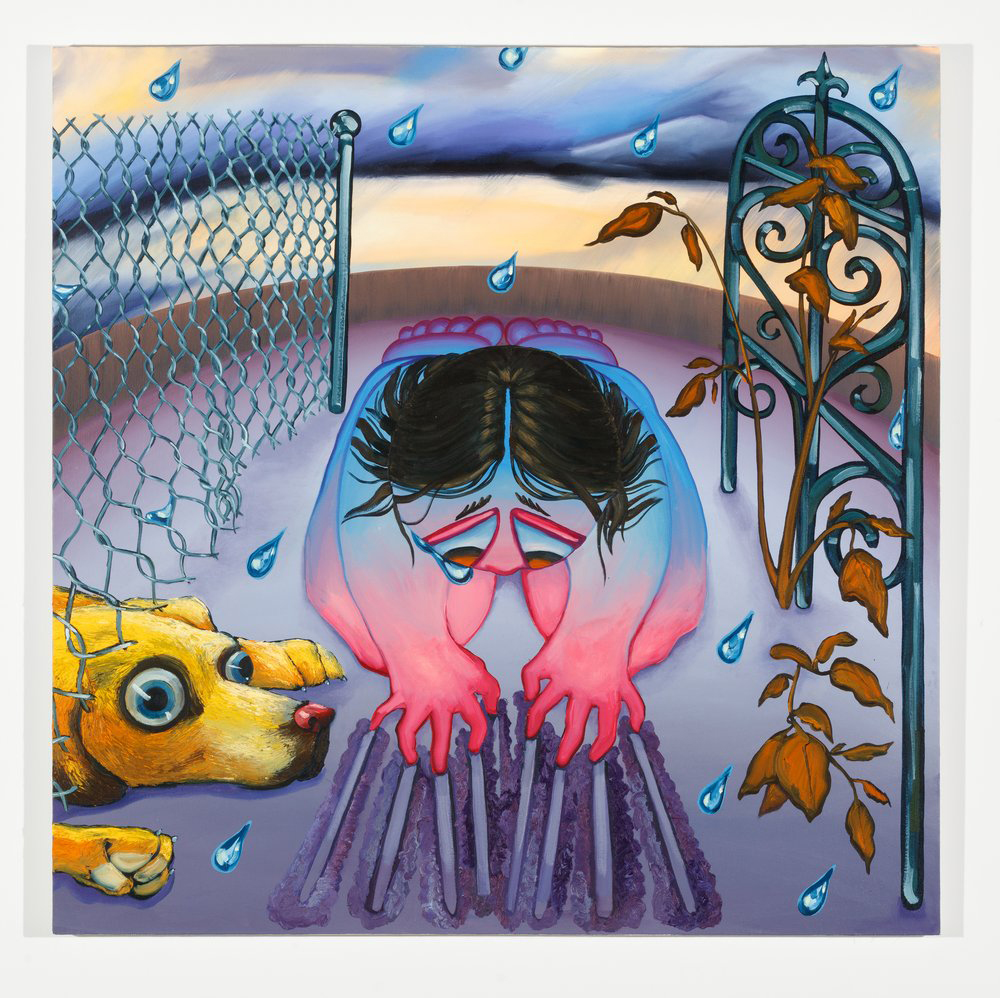
Technicolor painting of a woman digging in the rain

Natalie Wadlington, “Digging in the Rain,” 2021, oil on canvas, 42 x 42 inches.

Far from her roots nestled in the central California valley, Natalie Wadlington makes her institutional debut at Dallas Contemporary with the solo exhibition Places that Grow. The show displays precise narrative paintings of childhood excursions on enormous, vibrant canvases. Set in highly domesticated spaces, the scenes lean heavily on the atmosphere of youthful wonder and innate care for the Earth, all set upon backdrops of dramatic Texas skies.

The show features a new series of paintings that utilize various elements of the outdoors that are often overlooked and under examined in adulthood. From dusk to dawn, characters crouch to inspect and save insects, such as bees clung to the water’s surface in Pool in Fall (2022), asserting the environmental undertones of the show. Wadlington underscores the importance of curiosity, which innately fosters protection for Mother Earth.

With a consoling human presence and themes of rejuvenation, Wadlington’s paintings soften the harsh realities of environmental destruction and encourage nourishment. Repeated depictions of water are found throughout the exhibit, most notably in End of Summer (2022)and Front Yard in Sunset (2022). The artist paints saturated, striated hues reflecting setting suns into water puddles and pools, contrasting drab, often man-made foregrounds of pavement, mowed grass, and in one case, a sprawling white plastic chair.

Technicolor painting of two women and a dog in a front yard at sunset

Natalie Wadlington, “Front Yard in Sunset,” 2022, oil on canvas, 84 x168 inches (two panels at 84 x 84 inches)

In Front Yard in Sunset (2022), Wadlington fills two 84 x 84-inch panels, balancing the end of day and the edge of night. She captures resistance to the tiredness and exhaustion at a day’s end in vibrant hues. Fiery evening sunshine soon turns to cool moonlight as pinks and purples glow upon skin and through sprawling tree limbs. A particularly active painting of girls capturing a spider for inspection and playing with a dog, the artist lures viewer into the scene, which plays out underneath a mystical evening sky.

Technicolor painting of a woman in a pool with a turtle

Natalie Wadlington, “Swimming at Night,” 2022, oil on canvas, 48 x 48 inches

Swimming at Night (2022) feels as though the viewer is let in on a secret: it’s an exciting excursion into the night, beneath a veil of stars cloaking the land. Aglow in a full moon’s silvery-blue light, the life of animals and swaying trees and cold grass come alive. Patterns created by nature fill the painting, including the texture of stones, a turtle’s back, and a sprig of pine needles creating ripples in water. Wadlington repeatedly exhibits the simple beauty of the outdoors in the vastness of her skies, and in the mundane details her characters carefully examine.

Elusive twilight and evening skies guide the exhibit, urging viewers to feel childlike wonder through the paintings. In her dramatically stylized depictions, Wadlington draws much from her new home in College Station, Texas to reflect the vivacity of her stories during distinctly different times of day. Digging in the Rain (2021) employs darker tones than other works in the show — it encapsulates the fight between rain clouds and fading sunlight in an intense storm, while  drops pelt the scene’s desperate characters. The painting shows the frantic mission of a helpless, blue figure clawing at the muddied ground, alongside a dog squirming under a chain link fence. Unlike her other paintings, this dreary work holds delicate despair that mirrors the grim ecological narrative Wadlington attempts to combat.

Places that Grow is composed of scenes capturing seemingly solitary moments. Paling moonlight envelopes Early Morning (2022), a sleepy snapshot of a child stooping to feed a stray cat. Completely immersed in their mission to save the bees or excavate fossil-filled flowerbeds or find wildlife in the night, Wadlington’s characters exude a comforting sense of home found in nature throughout the show.

This is an exhibit of stolen time, which captures the spirit and movements of youth in their exploration of natural curiosities. Using her adolescence to guide the show, Wadlington creates semi-autobiographical vignettes of memories in the great outdoors that resist simple, whimsical narratives.


Places That Grow is on view through August 21 at the Dallas Contemporary

The post “Natalie Wadlington: Places that Grow” at the Dallas Contemporary appeared first on Glasstire.

18 Aug 13:19

Saturday Morning Breakfast Cereal - Freaky

by tech@thehiveworks.com


Click here to go see the bonus panel!

Hovertext:
I couldn't convince myself that 'your medamn business' would be readable.


Today's News:
18 Aug 01:24

What If Dark Energy is a New Quantum Field?

by PBS Space Time

PBS Member Stations rely on viewers like you. To support your local station, go to:http://to.pbs.org/DonateSPACE

Sign Up on Patreon to get access to the Space Time Discord!
https://www.patreon.com/pbsspacetime

What is Quintessence? Well we know that something is up with the way the universe is expanding - there’s some kind of anti-gravitational effect that’s causing the expansion to accelerate. We don’t know what it is - just that it competes against the inward-pulling effect of gravity. And it’s winning - it looks like the universe will expand forever, at an ever-increasing rate. We call this mysterious influence dark energy, but while we’ve talked a lot about how it behaves, we’ve never really explored what it is. So, what is dark energy, really?

One strong possibility is quintessence. Quintessence is a hypothetical form of dark energy, more precisely a scalar field. Watch the episode to learn more.

Check out the Space Time Merch Store
https://www.pbsspacetime.com/shop

Sign up for the mailing list to get episode notifications and hear special announcements!
https://mailchi.mp/1a6eb8f2717d/spacetime

Search the Entire Space Time Library Here: https://search.pbsspacetime.com/

Want to Learn More About Dark Energy? Check out the Dark Energy Playlist:
https://youtube.com/playlist?list=PLsPUh22kYmNAv1_8MA9-USkY6f2lfr1hb

Hosted by Matt O'Dowd
Written by Matt Caplan & Matt O'Dowd
Post Production by Leonardo Scholzer, Yago Ballarini, Pedro Osinski, Caique Oliveira, Adriano Leal & Stephanie Faria
GFX Visualizations: Ajay Manuel
Directed by Andrew Kornhaber
Associate Producer: Bahar Gholipour
Executive Producers: Eric Brown & Andrew Kornhaber
Executive in Charge for PBS: Maribel Lopez
Director of Programming for PBS: Gabrielle Ewing
Assistant Director of Programming for PBS: John Campbell

Spacetime is produced by Kornhaber Brown for PBS Digital Studios.
This program is produced by Kornhaber Brown, which is solely responsible for its content.
© 2022 PBS. All rights reserved.

End Credits Music by J.R.S. Schattenberg: https://www.youtube.com/user/MultiDroideka

Special Thanks to Our Patreon Supporters

BIg Bang Level Supporters
Steffen Bendel
Gautam Shine
NullBlox.ZachryWilsn
Adam Hillier
Bryce Fort
Peter Barrett
David Neumann
Charlie
Leo Koguan
Ahmad Jodeh
Alexander Tamas
Morgan Hough
Amy Hickman
Juan Benet
Vinnie Falco
Fabrice Eap
Mark Rosenthal
David Nicklas

Quasar Level Supporters
Vivaan Gupta Reddy Vaka
Glenn Sugden
Sujasha Gupta Vaka, PhD.
Vikram Reddy Vaka, MD.
Alex Kern
Ethan Cohen
Stephen Wilcox
Christina Oegren
xaexyz
Mark Heising
Hank S

Hypernova Supporters
Vyce Ailour
Brandon Paddock
Oneamazinguy
Ken S
Gregory Forfa
Kirk Honour
Mark Evans
drollere
Joe Moreira
Marc Armstrong
Scott Gorlick
Paul Stehr-Green
Russell Pope
Ben Delo
Scott Gray
Антон Кочков
John R. Slavik
Mathew
Donal Botkin
John Pollock
Edmund Fokschaner
Joseph Salomone
chuck zegar
Jordan Young
John Hofmann
Daniel Muzquiz

Gamma Ray Burst Supporters
Kane Holbrook
Bradley S. Isenbek
John Yaraee
Ross Story
teng guo
Mason Dillon
Harsh Khandhadia
Thomas Tarler
Sean McCaul
Carsten Quinlan
Susan Albee
Frank Walker
Matt Q
WhizBangery
MHL SHS
Terje Vold
Anatoliy Nagornyy
comboy
Andre Stechert
Paul Wood
Kent Durham
jim bartosh
Nubble
Scott R Calkins
The Mad Mechanic
Ellis Hall
John H. Austin, Jr.
Diana S
Ben Campbell
Faraz Khan
Almog Cohen
Alex Edwards
Ádám Kettinger
MD3
Endre Pech
Daniel Jennings
Cameron Sampson
Geoffrey Clarion
Darren Duncan
Russ Creech
Jeremy Reed
Eric Webster
David Johnston
Web Browser
Michael Barton
Mr T
Andrew Mann
Isaac Suttell
Devon Rosenthal
Oliver Flanagan
Bleys Goodson
Robert Walter
Bruce B
Mirik Gogri
Mark Delagasse
Mark Daniel Cohen
Nickolas Andrew Freeman
Shane Calimlim
Tybie Fitzhugh
Robert Ilardi
Eric Kiebler
Craig Stonaha
Graydon Goss
Frederic Simon
Tonyface
John Robinson
A G
David Neal
John Funai
Tristan
Bradley Jenkins
Kyle Hofer
Daniel Stříbrný
Luaan
Cody
Thomas Dougherty
King Zeckendorff
Dan Warren
Patrick Sutton
John Griffith
Daniel Lyons
DFaulk
Kevin Warne
18 Aug 00:46

Gen Z

Curdled milk, of a peculiar kind, made after a Bulgarian recipe and called "yaghurt," is now a Parisian fad and is believed to be a remedy against growing old. A correspondent who has tried it, says he would prefer to die young. (1905, The Elk Falls Journal)
17 Aug 19:09

Table Manners for the Kids

by Mary Kelly

Don't slurp your soup

What to do when your Mom or Dad says …
Don’t Slurp Your Soup!
Berry
1984

We have a lot of old Joy Berry books here at ALB. Her stuff from the 1980s is dated and I just don’t like the illustrations. However, her books are popular with kids. Rather, I should say they were popular with kids 30 years ago. I guess if it works for your library, then more power to you.

I will just throw some caution out there that since many of the topics are sensitive for both adults and kids, these books should be evaluated regularly. Language from even 20 years ago might be considered inappropriate in 2022.

This one is about table manners. Frankly, plenty of adults and kids would do well to review basic manners. Will a book make a difference? Probably not.

Mary


beginning a meal

napkin on the lap

eating with other people

making a mess

after the meal

The post Table Manners for the Kids appeared first on Awful Library Books.

17 Aug 19:08

Academic Department Chair Bingo from Hell

by Jason Schloetzer

17 Aug 19:05

Been Through a Lot

by Reza