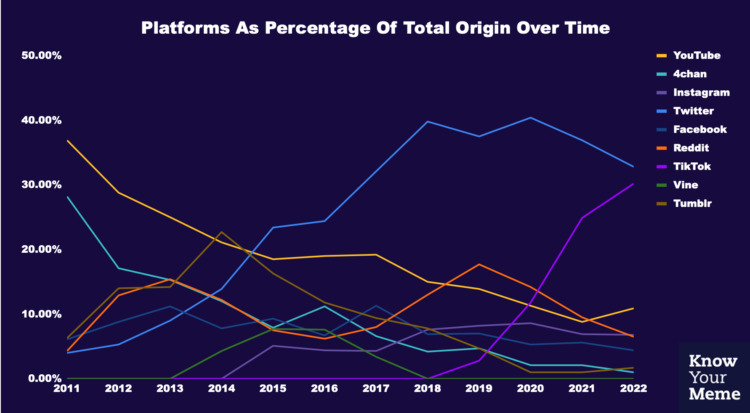
Know Your Meme analyzed a decade of meme data to see where the memes have come from, breaking it down by year. It’s all Twitter and TikTok these days, but it used to be YouTube and 4chan.
Tags: Know Your Meme, meme
Know Your Meme analyzed a decade of meme data to see where the memes have come from, breaking it down by year. It’s all Twitter and TikTok these days, but it used to be YouTube and 4chan.
Tags: Know Your Meme, meme
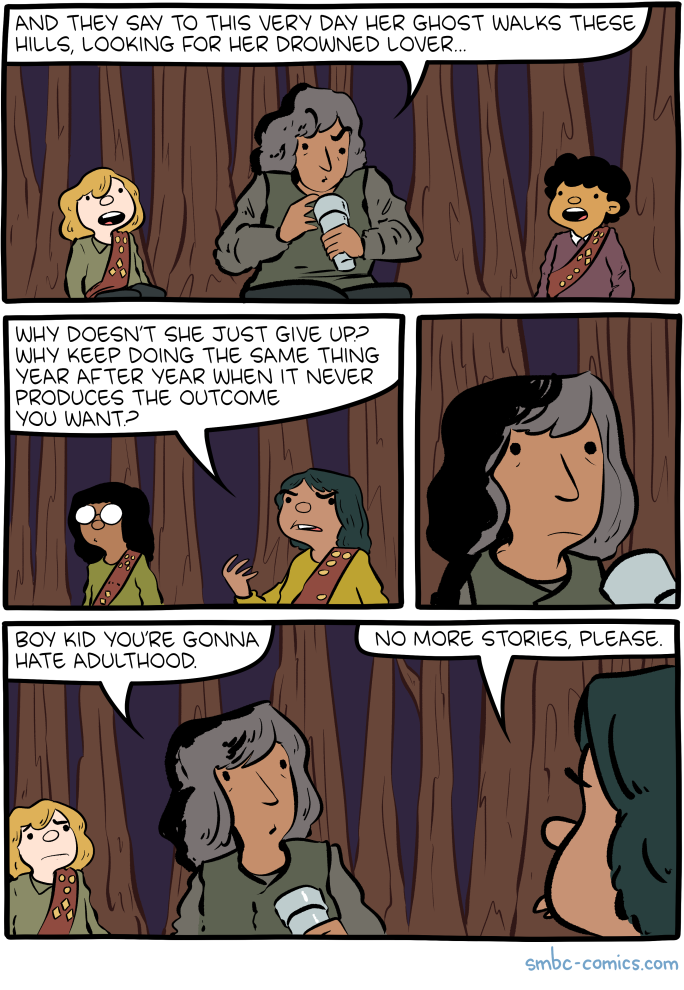
Hovertext:
This is thematically weirdly close to the kids' book I'm announcing in another month.
For last week’s picks, please go here.

Hope Gangloff, “Queen Jane Approximately,” 2011, acrylic on canvas. Collection of Alturas Foundation, San Antonio, Texas.
1. Women Painting Women
Modern Art Museum of Fort Worth
May 15 – September 28, 2022
Read Jessica Fuentes’ Peering Through the Female Gaze for an overview of the exhibition.
From the Modern Art Museum of Fort Worth:
“Women Painting Women features 46 female artists who choose women as subject matter in their works. This presentation, international in scope, includes evocative portraits that span the late 1960s to the present. All place women—their bodies, gestures, and individuality—at the forefront, conceiving new ways to activate and elaborate on the portrayal of women.”
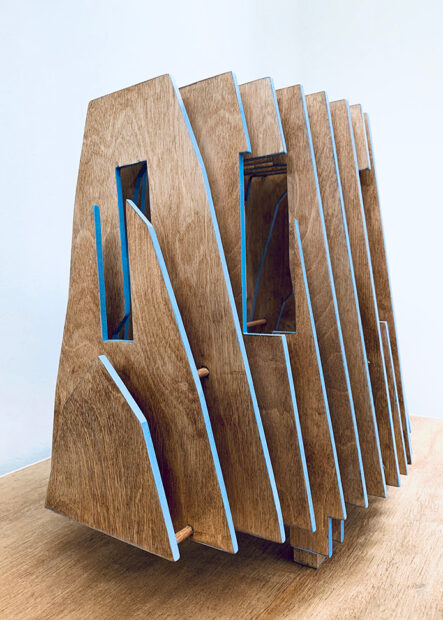
A work by Garland Fielder
2. Garland Fielder: Bunker Melodies
G Spot Gallery (Houston)
September 3 – October 15, 2022
From G Spot Gallery:
“Artist Statement: Bunkers represent several architectural types simultaneously. On the one hand, they are modernism distilled—form-follows-function quite literally in that the concrete megaliths derive their structural expression solely from functional needs as dictated by the ravages of modern technological warfare. In another sense, the bunkers are a timely typology, even if at first they seem anachronistic. The stable forms, once signifying a terrific solace against immediate annihilation have through time, become upended, so to speak, in their various strategic locations. In situ, they are enigmatic, creating hidden spaces for nefarious acts, yet, they still present a contemporary visitor a sense of stability—a comforting psychological totem in today’s uncertain times. They are modern ruins and ruins speak of endurance. These images and sculptures depict one of mankind’s most striking architectural forms, suggesting an unfortunate relationship between the current zeitgeist and a building strategy necessitated by a total war economy.”

A painting by Sarah VonKain.
3. Sarah VonKain: Vulnerable
The Art Studio (Beaumont)
September 1 – 24, 2022
From the Art Studio, Inc.:
“Sarah VonKain, who is originally from Orange, TX, received a bachelor’s degree in Art Education from Lamar University in 2014 and a master’s degree in Modern Art History from Azusa Pacific University in 2021. She says she has ‘left a piece of myself in every place I have been. From a very young age I was taken to galleries and museums and the works I saw developed into a language I understood.’ VonKain has found inspiration in the works of Jenny Holzer, Jenny Saville and Marlene Dumas. The pieces are an amalgamation of the artist’s personal writing and manipulated memories from 2014 to 2022. The exhibition is titled Vulnerable. ‘My biggest influence for these pieces have been the events of the past year of my life. They, like the works, have forced me to confront who I am and the raw reality of life,’ she said. ‘I would describe the works as relatable raw emotions.’”
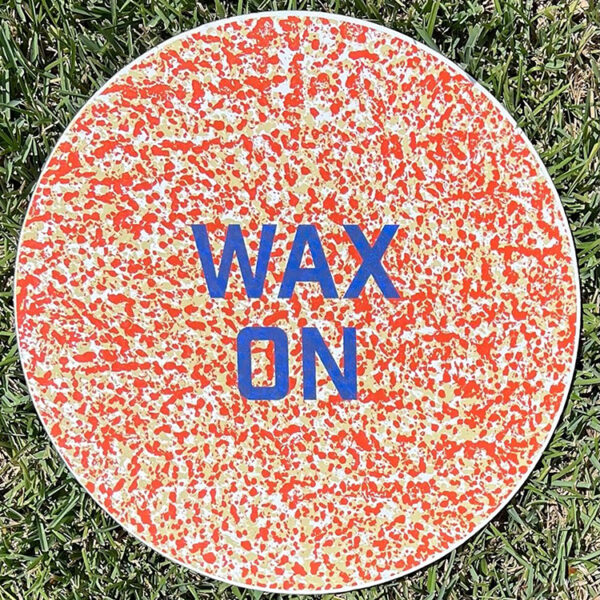
4. Ethan Thompson: Wax On
Produce Gallery (Corpus Christi)
September 2 – 30, 2022
“’Surf Art’ usually means paintings of fantasy waves, idyllic beaches, and airbrushed surfboards, but Ethan Thompson instead makes prints and printed objects out of the materials of surfing. Surfboard wax, foam dust, seawater and other elements are used to create patterns, which, in combination with text, reflect and comment upon Texas’s unique surfing culture, as well as the commodified aspects of surfing and its mediation in popular culture.”

5. Chris Wicker
Common Space (Bartlett)
August 7 – September 10, 2022
Watch the Five-Minute Tour here.
“Common Space is proud to present our latest Window Space exhibition featuring the video work of Chris Wicker
ChrisWicker sources from imagery consumed during the early 2000s to deal with concepts such as shared memory, trance, video consumption, and sensory bombardment through video, sound and installation. By manipulating, stretching, layering, and repeating sampled media, Wicker translates his personal viewing history into a hypnotizing experience for the viewer.
While crafting these compositions and being influenced by said past viewing history, analogue media, and intellectual properties such as Power Rangers and NASCAR, Wicker’s work provides insight on both past and contemporary media consumption, the affective properties video has and video itself through media sampling.”
The post Top Five: September 1, 2022 appeared first on Glasstire.

Afghans
Traditional and Modern
Bray
1977
I was prepared for a very 1970s vibe for this relic of a craft book. I wasn’t disappointed with a few crafts that looked like it came from a grandma’s couch. However, I was surprised that a few were actually quite good. There were some very plain but nicely detailed afghans that would have made nice throws for a couch in this century. The bad news is that the projects were crowded out with the examples below. (Warning! A clown afghan is one of the examples!)
The book itself was a bit dirty and ripped in places, so it could be weeded on condition alone. I think it has done more than enough work serving in the small public library where it is still in service. Again, each librarian should be familiar with their community and users to make the determination to keep or weed. Both Holly and I like to make a “watch list” where we track titles that we are “iffy” on weeding. We give it some time and then check on if there has been any improvement in use. It also can help you promote some of the hidden gems in a collection. When you do finally weed a title, you can rest assure you gave it a fair chance!
Mary


The post Craft yourself an Afghan just like Grandma appeared first on Awful Library Books.
This post, coworkers keep hugging me, scales in our break room, and more , was originally published by Alison Green on Ask a Manager.
It’s five answers to five questions. Here we go…
1. Is my workplace toxic or am I just inexperienced?
I came into my first job excited and idealistic, believing everyone wanted to improve the company and work towards the same goal. I was given some warnings prior to starting that my position had high turnover, but I initially couldn’t figure out why. It slowly became clear that my boss only listened to the opinions of one employee. That employee was friends with the boss at a previous job, and is close with the two directors who are directly below the boss. This employee is deemed untrustworthy by her peers, as she tends to monitor our work and report anything she finds disagreeable. This concerns my position because she is my partner in my team and we work closely together as peers. Other employees warned me of the partial treatment and recommended I keep my head down and appease this employee as much as possible. I did this for as long as I could, until she started threatening to tell my boss if I didn’t agree with her or do what she wanted and the work environment started to feel unsafe.
When her treatment finally became abusive and discriminatory (yelling, saying racist things, spreading rumors about me), I reported the treatment to HR. HR performed mediation and approved my request to sit in a separate office, but my relationship to management has not been the same. I was previously viewed positively, but after standing my ground, I could never do right again. My boss started yelling at me, falsely accusing me of things. HR had to get involved, and he was forced to apologize to me. He gave me a written warning which I found unreasonable and I requested a second opinion. That person agreed it was overreactive and could’ve been easily dealt with with some coaching. He wasn’t pleased with that either and recommended I leave my job if I didn’t like the treatment (I’ve had to stay for personal reasons).
Luckily his boss saw how he was treating me and demanded that all his conversations with me be mediated by her. She ultimately stepped in and requested that I nominate a mentor who could advise me and also be present in my meetings with the boss. This was immensely useful, and my boss ultimately ended up hearing my side (albeit begrudgingly when my nominated mentor spoke up for me). My boss abruptly left a few weeks later.
Work has never been the same for me since. I am now scared of punitive treatment every time I am called to a meeting, even though my new boss is reasonable and fair. Is my workplace toxic or am I just inexperienced with how to handle workplace situations? Should I have just put my head down, been agreeable, and kept a low profile?
No! This is about your workplace, not you. It’s not just your ex-boss or that favored coworker; it sounds like everyone there has learned to tolerate a level of dysfunction that they shouldn’t. When an employee is yelling at a colleague and saying racist things to them, HR shouldn’t be mediating; they should be shutting down that behavior firmly and with finality. When your boss’s boss saw how he was treating you, it’s good that she intervened, but that should have involved laying down the law with him immediately, not just having someone sit in all your meetings with him. (That said, if his abrupt departure was the result of her firing him, then she did do the right thing, and the chaperon might have been her mitigating things for you until she could act, if the organization’s processes made a speedier resolution impossible.)
You might be inexperienced, but it sounds like you handled all of this well and your instincts were good. Now you’re dealing with the emotional reverberations of having worked for such an awful manager, which is very normal. This may help with that.
2. I don’t want my coworkers to keep hugging me
I started a new job in hospitality around a month ago. My coworkers (managers included) are all very close (as they have all worked together for at least a year) and often show affection by hugging. I am not comfortable with this but I haven’t said anything because I’m scared about offending them or causing a rift in the workplace.
What can I do to stop this? And how can I make sure I don’t offend them?
The words you want are: “Oh, I’m not a hugger!” You might need to put up a hand as a physical sign as well so they see it before they’ve already gone in for the embrace (not with a fully outstretched arm like you’re stopping traffic, but closer to your body). But even if they’re already hugging you by the time they hear the words, they’ll hopefully remember for next time.
I know it might feel strange to say you’re not a hugger after you’ve been hugging them, but it shouldn’t be that big of a deal. Most people will realize that you only just now felt comfortable saying it, not that you suddenly developed a new aversion to them.
This shouldn’t offend anyone or cause a rift! Some people are huggers, and some people are not. Make a point of being warm with them in other ways (greet them warmly, take an interest in them as people, engage where you can) and it should be fine.
3. I’m losing out on money because I got a raise
When I accepted my position over two years ago, I reported to a manager, who reported to our director. After six months, the manager resigned, and the director used that position to fill another role in our group. I ended up being assigned all of the former manager’s responsibilities, which included leading two massive projects with tight deadlines.
My director, to whom I now report, has been promising me a raise the entire time. In August, he finally came through and excitedly told me the merit pay would be retroactive to the beginning of July. Not great considering how long I’d had additional responsibilities, but they usually don’t allow any sort of retroactive pay.
Last week, our CEO announced that everyone would be getting a pretty large one-time bonus. However, anyone who received a raise from January 1 to July 1 is ineligible. That lump sum payment is significantly more than what my raise will yield in a YEAR.
I feel ungrateful for being upset, but I honestly think they granted my retroactive pay as a money-saving tactic. It’s worth noting that this is the only time our company has provided a bonus, and my raise was lower than expected. Should I say anything to my director during our next check-in?
Yes. I wouldn’t even necessarily wait for your next check-in unless it’s in the next few days; if it’s not, schedule a separate meeting (both because it’s time-sensitive and to underscore the importance). Point out that you are losing money through the raise, after already not being paid for the higher level of work for the last … 18 months? Say, “I’m sure the company’s intention is not for me to lose money through this raise, so I’d like to ask that it be corrected.”
4. Someone put scales by our vending machines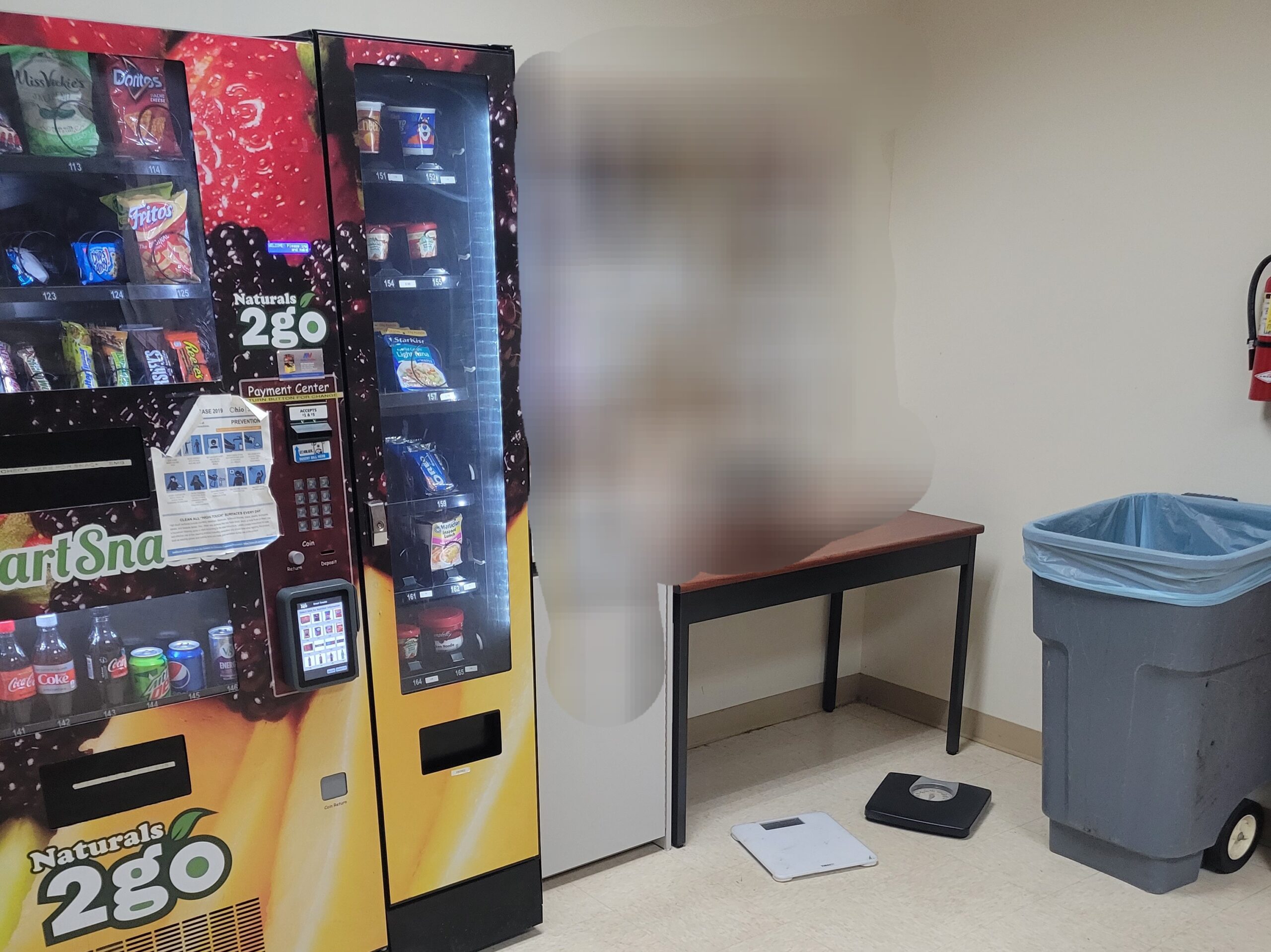
I was at our office’s main building today for a multi day training, and noticed these fun additions next to the vending machines!
BRB,
Gonna go burn it all down. (Figuratively.)
WTF no.
There is zero reason anyone needs to weigh themselves at work (as opposed to at home if they choose to). And if for some reason they did feel the need to do it at work, they could do that privately. Putting two scales next to the vending machine sends a message and that message is a problem.
5. Asking to go part-time as a new employee
I was recently hired into a new full-time role shortly after having a baby. I quickly realized that although I like the team and the work, I want to spend more time with my children. I am considering quitting altogether. However, I’m already getting very positive feedback in my new role, and the company seems to really need people. Is it worth asking to drop to part-time?
Yes! If you’re going to leave otherwise but would be willing to stay part-time — and so their choice is none of your time or some of it — it absolutely makes sense to ask. (That assumes that you’d want to go part-time, of course. If you’d rather just leave entirely, do that instead — don’t give them hours just because they need people.)
Good morning. Houston will see a couple of days with slightly reduced rain chances, before the potential returns on Friday and persists through Labor Day weekend. We still don’t see any signals for anything beyond street flooding, but the holiday weekend will be marred by on-and-off showers and thunderstorms, some of which will be at-times heavy. If you have outdoor plans I hope they include easy access to shelter from such storms.
Conditions in the atmosphere are a bit less favorable for heavy rainfall today, but there’s still plenty of moisture to work with. Therefore while showers and thunderstorms will be somewhat scattered today, they’re still going to develop, and move generally from southeast to northwest. Areas west of Interstate 45 are slightly more favored for rain today. With partly sunny skies I think we’ll see highs this afternoon push up into the low-90s, or possibly mid-90s for areas well inland. Winds will be light, from variable directions, but mostly out of the southeast.

This will be another day lacking ideal conditions for heavy rainfall, but we’re still expecting about 50 percent of the area to see some form of precipitation, including a few stronger thunderstorms. Otherwise, expect partly to possibly mostly sunny skies, with highs in the low- to mid-90s.
Rain chances increase a bit during the day on Friday, and an increase in cloud cover should limit temperatures to the low-90s.
A weak front will nudge down into the area from the northeast on Friday night, and as this front more or less stalls over the Houston region we’ll see a period of unsettled weather this weekend. (The front is going to do nothing for our sticky humidity or warm nights, alas). Areas north of Interstate 10 will probably be little drier than the coast, but most of the metro region should see 2 to 4 inches of rainfall through Monday with on-and-off showers. Some areas will, of course, pick up higher amounts. The increased cloud cover and rain-cooled air should help to limit high temperatures to the 80s for most of the region.

Honestly, this unsettled pattern does not look to change a whole lot next week. We should continue to see at least partly cloudy skies, healthy rain chances, and highs in the upper 80s as we get a little deeper into September.
There remain no threats to the Gulf of Mexico for at least the next week or so, if not longer. This has been a remarkably quiet hurricane season. In fact, if there is no tropical cyclone in the Atlantic basin today, this would be the first August without a named storm since 1997. That is not a complaint.
This post, is it bad to be alone with coworkers of the opposite sex? , was originally published by Alison Green on Ask a Manager.
A reader writes:
I work in an STEM industry that is probably 75% male and I’m the only woman in my company (seven full-time employees and one temp employee) .
I graduated in spring 2021 and this is the first salaried job with benefits I’ve held since graduation (I’ve been at this company since last fall). I live in a high cost of living area and so I live with my parents still. They know a few of my coworkers and talk to them frequently.
Recently, one of the owners pulled me aside and let me know that he was told that I’m uncomfortable with being left alone with one or two guys instead of being with all five (we have three fully remote employees) and he can’t always accommodate that in the office as people are often working from home or going on-site to clients, but he can try to let me know when that will happen and I am free to work from home. He also told me that he and the other owners can stop having one-on-one meetings with me with their office door closed.
Needless to say, I was confused and asked where he’d gotten that impression. It took a little bit of digging, but it turns out one of my coworkers had approached him and let him know that my parents are uncomfortable with the fact that I’m in office alone after hours (my job sometimes involves working past close of business) or with just one or two of the guys. He seemed relieved when I was understandably livid that my parents had said anything intended to make its way to the owners.
We have cameras and an open floor plan office, and I’ve never felt uncomfortable. I’m just wondering if it’s normal for there to be strict rules surrounding this. In my industry, this could really hurt my career since it’s so male-saturated. Also, I’m pretty sure it’s not normal for parents to do stuff like that, but I grew up in a very strict religious and conservative household and my sister has told me that my parents’ concern is valid and their way of communicating it is also valid.
Nooooo. This is about your family overstepping.
It’s very normal for people to find themselves alone with colleagues of the opposite sex, or with just a few of said colleagues, or having closed-door meetings with someone of the opposite sex. All the things that people do with others in the work world — have meals, work together on projects, meet privately, give feedback, get feedback, brainstorm, chit chat, joke around, travel together — all of that is very normal to happen with the opposite sex, either one-on-one or with a small group where you might be the only woman.
There are people who ask to avoid that (generally on religious grounds) but they’re in a small minority — small enough that it’s not something that comes up in the vast majority of offices. When it does, it has the potential to cause real problems for women, who more often than not are the ones who miss out because of it.
Your parents are entitled to hold whatever beliefs they want, but they are not entitled to interfere with how you manage your career as an adult. If they did indeed tell one of your coworkers that you were uncomfortable being alone with men, they were wildly out of line! First, it doesn’t appear to be true. Second, under no circumstances should they be intervening in this sort of thing on your behalf — ever, but particularly not behind your back.
If they have concerns, the only appropriate avenue for them to use would be to talk with you directly. (And then to back off after doing so, not to continue to push the issue if you disagreed.)
I’m curious how it’s come about that your parents know and talk with your coworkers at all (let alone “frequently”). Did they know them before you got the job, or did they meet through you after you started working there? If it’s the latter, I strongly recommend not introducing colleagues to your parents in the future, since your parents have shown they’re willing to violate boundaries and try to manipulate your professional life from behind the scenes. And either way, consider asking those colleagues not to discuss you with your parents at all, and definitely not to pass messages from them to your employer. (I’m sure the coworker who did that thought he was helping, but that was an overstep too.)
Don’t let your parents convince you that their concerns are typical ones. They are not.
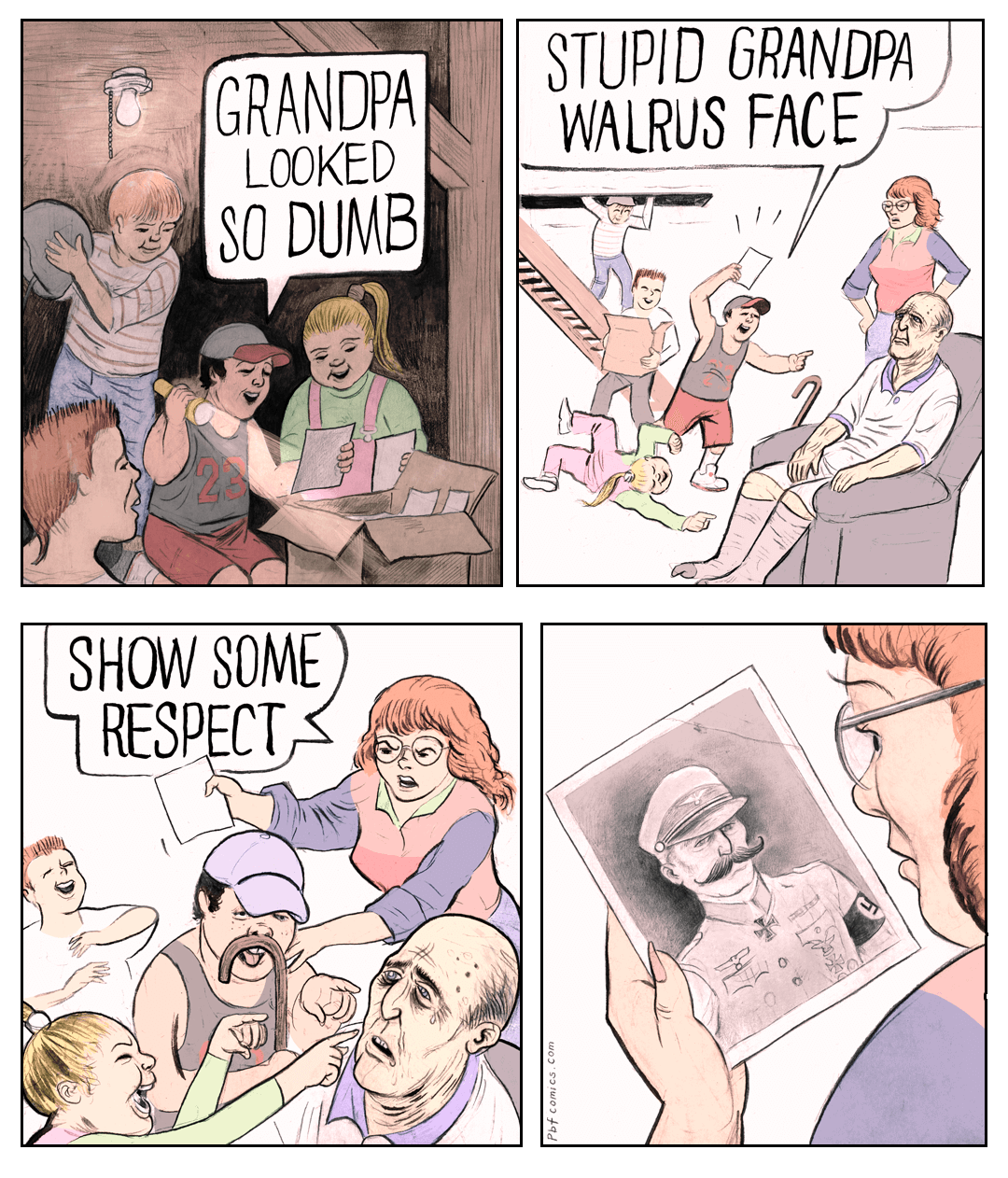
The post Grandpa’s Silly Mustache appeared first on The Perry Bible Fellowship.
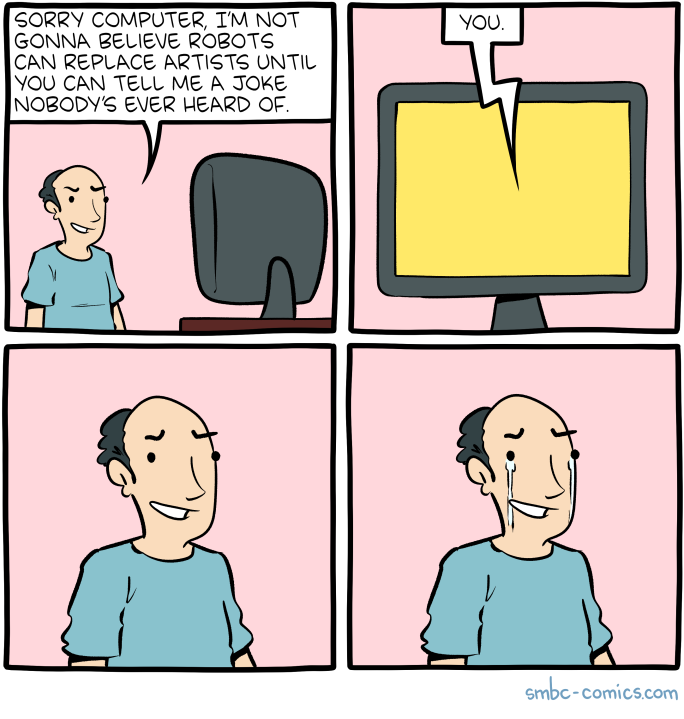
Hovertext:
Patreon backers are developing a tradition where they feed my jokes to dall-e and it's funnier than me. Hooray.
This post, is this investor shady, low-paying jobs that expect your family to support you, and more , was originally published by Alison Green on Ask a Manager.
It’s five answers to five questions. Here we go…
1. Should I work with this investor or run for the hills?
I have a connection who is a successful entrepreneur and investor who wants to start a business in my industry. Because of my industry experience, he asked if I wanted to work with him on the side. I was initially excited for the opportunity! We have only had a couple in-person meetings to discuss, so the real work hasn’t yet begun. However, even in these early days, I have noticed a few red flags:
(1) I had to press for information on his existing companies to learn more. They appear legitimate, but he seemed taken aback when I said that I wanted to learn about what they do. (2) He used a lot of flattery and said he saw a lot in me, even though he does not know me very well and we have never actually worked together. (3) We’ve already had a couple miscommunications. After our first meeting, I had the impression that this would be a consulting arrangement since he mentioned a consulting fee. When we met the second time, he told me he wanted me to be a “partner” in this, yet there was no talk of a contract of any sort. He said that if he pays me for my time, there is less equity to invest in the business, and it became apparent in that meeting that he was not planning on paying me until this business turns a profit. During that meeting, I shared some ideas which he seemed to really like, and when we concluded the meeting, he told me to run with it and then said, “Tell me what to do next.”
I walked away feeling uneasy, knowing that it would be a significant time investment to put together a business case in order to tell him what our next steps should be. I called him a few days later and said that because of the effort involved, I would need to be paid for my time. He pushed back and said that because we have no idea what we’re doing yet, he would not pay me. He then clarified that all he wanted was a list of some problems in the industry and which ones I think we should solve; this is not at all what I gathered from our last conversation.
My gut is telling me to run, but before I say back out, I want to be sure I am not turning down a potentially life-changing opportunity. He’s had success before, he’s well-connected, and I understand that there will be ambiguity with startups. He seems like a genuinely nice guy and I truly don’t sense any malicious intent; I think he is just a bit scattered. I am also wondering if this is a “me” problem, like maybe I just misunderstood him, jumped to conclusions, or am not cut out for the unstructured nature of a startup. However, something is not sitting right with me, and I sense that I could be taken advantage of. What is your perspective on this situation?
Right now, with no agreement in writing, you’re just giving this guy your time and ideas for free. There’s no agreement for how you’ll be compensated, or when, or in what amounts. He could have you pour hours into ideas and a business plan and “telling him what to do next” and then decide it doesn’t make sense to work together or abandon the project entirely, and you’d be left with nothing. If he’s proposing paying you in equity or ownership or money down the road, that needs to be hashed out now and put in writing. Otherwise, you have zero protection.
It’s up to you whether you want to be a partner who doesn’t get paid until later (and who might make nothing, a little, or a ton) or a consultant who gets paid right now (without the potential for a windfall later) — but you need to be one of those, and it needs to be settled and written down before you put more time in. If he balks at doing that, he’s not someone you should work with — he either isn’t willing to commit to the promises he’s throwing around, or he’s so naive about how business is done (or so cavalier about your protection) that he’d be a crappy partner anyway.
Personally I’d choose consultant — it’s guaranteed pay for your work, and I’m risk-averse. But if you choose partner, make sure the partnership is structured in a way that rewards you fairly for your contribution. If you’re doing all the work, your compensation/ownership should reflect that (unless he’s offering something of high value too, like all the capital).
2. Justifying a low salary because the person in the job lives with their parents
This happened to me years ago and I’m wondering if there would have been a good response at the time. I was working in my first job out of college, making $34K a year in New York. No one I was friends with made much more, but it’s not like I was saving anything. I was applying for other jobs, and was in a second interview for one that paid $28K (if I remember correctly). I asked if they could go up at all — I think I told them that I could go down in salary for the perfect job but not that far down — and the response was, “We know it’s low, but the person in the role right now lives with her parents,” as if maybe there was some secret no-rent solution I wasn’t thinking of.
Even in my very green state, I remember thinking that you can’t base a job’s pay on the employee having no rent. Do you think this is still a thing when figuring out what roles at nonprofits should pay?
In some fields it is, yes. It’s not a universal nonprofit thing by any means, but there are fields that are structured around the expectation that employees — especially junior ones— don’t need to earn a living wage because someone else helps support them. Think some parts of fashion and the art world, for example. It’s not always as direct as “we plan to hire someone with family financial support” … but they have so many applicants who can take less money for that reason that it completely skews the field’s market rates.
And of course this ends up hugely gatekeeping who can enter those fields.
3. Was I wrong to share the reason for a coworker’s absence?
I was in our workplace lunchroom when an employee I don’t know well asked why she hadn’t seen Jane (a coworker in my department) recently. I answered that she had had a death in her family, namely a brother who died while on the job as a fire fighter at a forest fire. This was how our department manager had explained the absence at a recent meeting, with no caveats.
At a later department meeting, the manager scolded us, saying it had come to his attention that one of us had been gossiping about Jane and that we were not to share the reason for her absence, because it was all private information. I was not aware of his policy before that; the employee manual didn’t cover the situation. How could I have better handled the lunchroom query?
(The manager then also told us not to bring up the brother’s death to Jane when she returned, not even to express condolences.)
The manager is the one who should have handled it differently, not you. It’s not normally off-limits to share this kind of thing with a colleague if you haven’t been told otherwise. It’s not typically gossip; it’s sharing important information about someone you feel warmly toward, so that people can send extra good will their way. If your manager or Jane didn’t want it shared with others, your manager should have clearly explained that when he first shared it with you.
4. What’s up with behavioral interviewing?
I just got a flyer for a workshop on hiring, specifically behavioral interviewing. I’ve had pretty good success in the past with plain old interviewing and I’m not too inclined to change, but I wondered: Is this a thing? Does it work? Is it as wacky and touchy-feely as it sounds?
Behavioral interviewing, for anyone who doesn’t know, is what interviewers are doing when they ask “tell me about a time when…” questions. (“Tell me about a time when you had to work with an unhappy client,” “tell me about a time when you had conflicting deadlines,” etc.) And yes, it is very much a thing, and it works. It’s pretty common and not wacky or touchy-feely!
The idea is that you will make better hires if you probe into how people have actually operated on the job in the past (or observe how they operate in the present, via exercises and simulations), rather than just asking hypothetical questions about how they think they might handle something in the future. It’s really easy for people to BS their way through hypothetical questions. For example, a question like “how do you think you’d stay on top of everything?” is likely to get you answers that sound good in theory, but you’ll get far more useful info if you ask, “How much volume did you have to handle in your last job? How did you stay on top of it all? Tell me about a time when the volume was at its peak. What did you do?”
Approaching interviews this way will also give you real examples that you can dig into more deeply, so that you’re able to go beyond surface-level answers and get a sense of how the candidate truly operates and whether they have the skills to excel at the work you need done.
5. Intern as contractor
I work at a small nonprofit (about 10 staff) that has some management/organization issues. We are hiring an intern, and while it is great that we plan to pay them (the bar is on the floor), my manager is requiring him to send an invoice every month to receive his stipend. This makes the intern responsible for his own payroll taxes, as well as the responsibility of making sure he is paid. What should I do in this scenario, as someone who is not entry-level but is not directly in charge of hiring? Is this as crazy as it seems?
It’s almost certainly illegal. Your manager is treating the intern as an independent contractor (no taxes taken out) rather than an employee (taxes required to be taken out), but whether someone should legally be an employee or contractor isn’t up to the employer’s preference; it’s controlled by factors laid out by the IRS. If the employer controls when, where, and how the person works, they’re generally an employee, not a contractor. It’s very unlikely that an intern doing intern-type work would qualify as a contractor.
I’m guessing your boss doesn’t know that or figures the organization is too small for the law to apply (it’s not). You could say something like this: “Federal law doesn’t allow us to pay someone as an independent contractor if we’re treating them essentially like an employee, and we could have to pay fines and back taxes if we do it this way. Legally we need to pay him the way we do employees, with taxes taken out.”
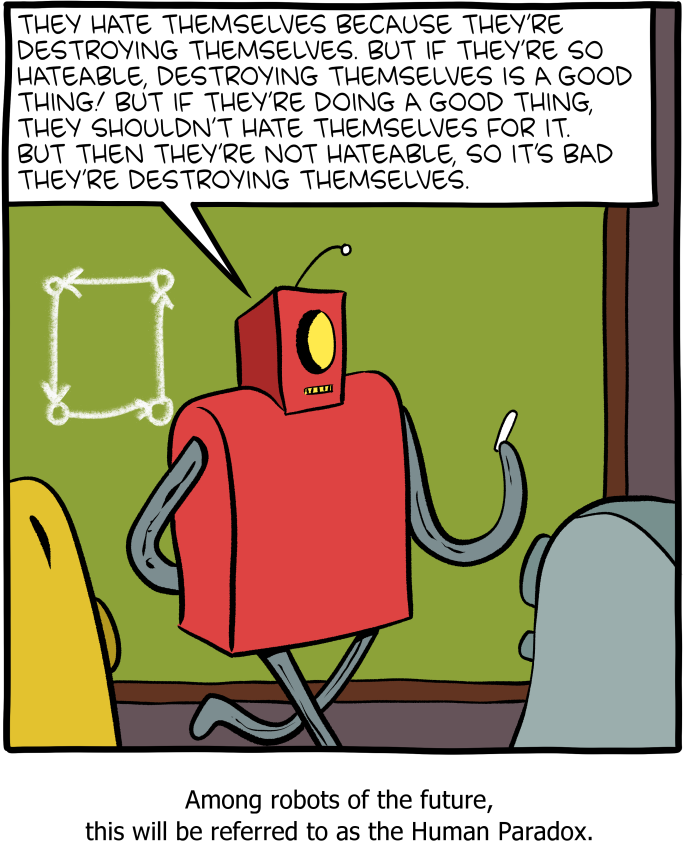
Hovertext:
Anyway, you can resolve the paradox by not having any humans.
We’re living in a time of artistic rediscovery. Frequently, the narrative goes like this: curators dig deep into their institutional collections and find that they hold a work (or, sometimes, many works) by an artist who was never really given their due. This artist, who ran with a popular 20th century crowd, was a crucial part of their artistic movement and contributed just as much as the individuals who are heralded as “masters” of modern art, Surrealism, Ab-Ex, etc. Then, the curators, who are continuously looking for ways to broaden the canon and make their mark (and, presumably, who are trying to avoid a rehash of shows that have already happened over the past 50 years), dig around to see where this person’s art actually is. This is a lengthy process, but the result is fruitful: a show that makes us reexamine an artist we didn’t know that we didn’t know.
A significant number of these recent shows have featured pre- and post-war artists. Francis Picabia, though not overlooked in the traditional sense, was an artist whose work, when seen one piece at a time, could be rather easy to dismiss. His 2016 retrospective at MoMA, however, got the critics and curators talking. The show, which was huge and varied (if you hadn’t been paying attention, you could’ve easily thought it was a group exhibition), showed Picabia in a new light. He wasn’t just a Dada leader — rather, he was an artist who bucked any semblance of classification. Similarly, the Guggenheim’s lauded 2019 Hilma af Klint show was a reconsideration of an artist who had been more or less invisible both to the public and the larger art world. This show was, I’d say, more groundbreaking than Picabia’s; at least Picabia had a sparse painting or two up in major museums.
Many of the artists featured in these types of exhibitions haven’t been considered widely or reassessed in the contemporary era. This too was the case with Sophie Taeuber-Arp, the spouse of Hans/Jean Arp, whose most recent major U.S. show had been nearly 40 years ago. Just last year, MoMA opened Sophie Taeuber-Arp: Living Abstraction, a new exploration of the artist’s life and work.
I see it as no coincidence that Anne Umland, MoMA’s Blanchette Hooker Rockefeller Senior Curator of Painting and Sculpture, organized both the Picabia and the Taeuber-Arp exhibitions. It is not surprising, in this case, that Umland also has a hand in this spring and summer’s best show in Houston: Meret Oppenheim: My Exhibition at the Menil Collection.
Co-curated by Umland from MoMA, Natalie Dupêcher from the Menil, and Nina Zimmer, from the Kunstmuseum Bern / Zentrum Paul Klee, the exhibition offers a top-down overhaul of any perceptions you had about Oppenheim’s career. While her name may be familiar to art history undergrads (her Object, a fur-covered teacup, saucer, and spoon, tends to make an appearance in survey textbooks), oftentimes the recognition stops there. And although this piece has defined the Surrealist movement ever since it was first shown (it is not on view in the Houston stop of the exhibition, as like some of Oppenheim’s other works it is too fragile to travel), it also pigeonholed Oppenheim’s talent.
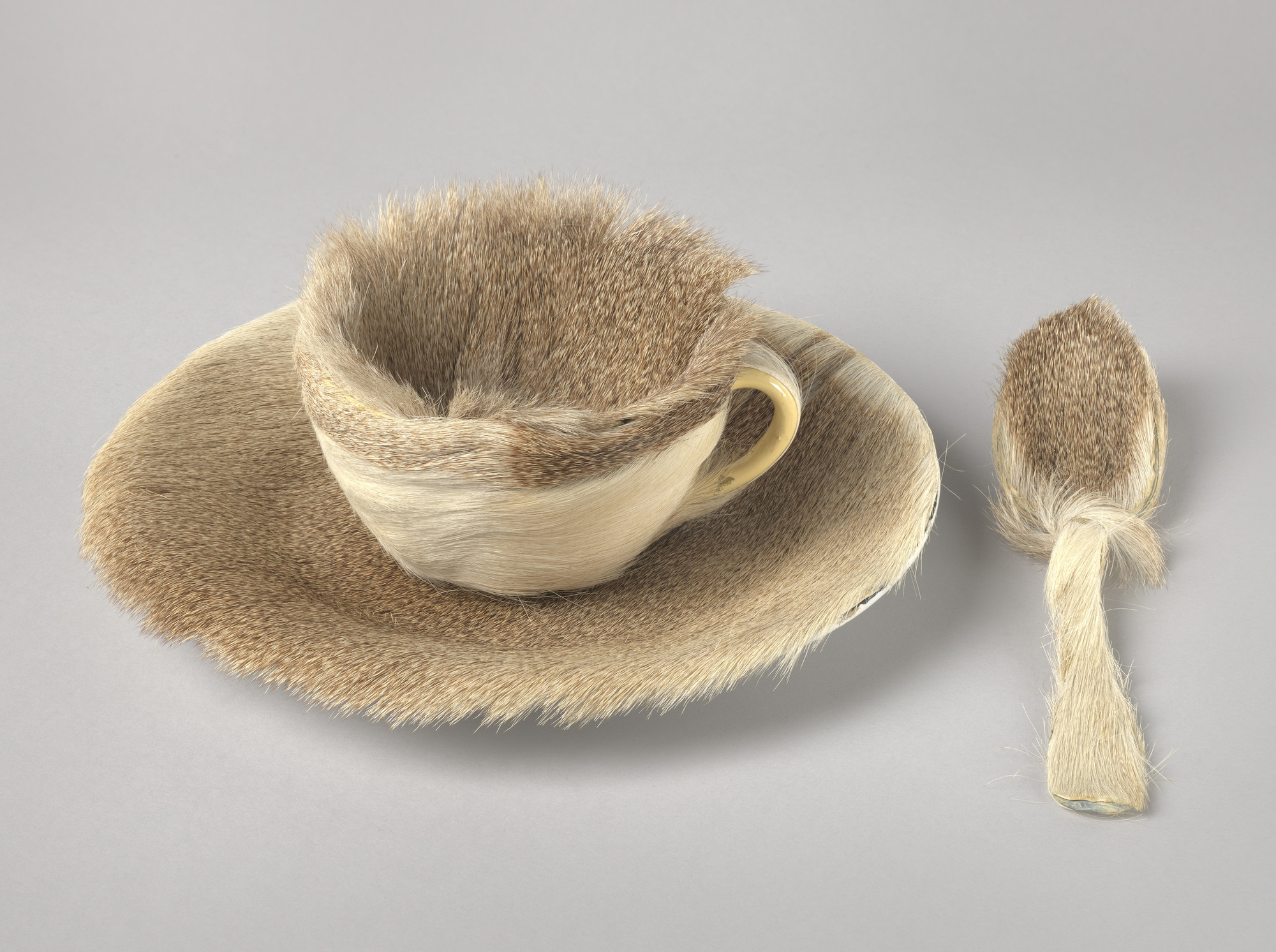
Meret Oppenheim, “Object,” 1936, fur-covered cup, saucer, and spoon, cup 4 3/8 inches in diameter; saucer 9 3/8 inches in diameter; spoon 8 inches long, overall height 2 7/8 inches. Collection of the Museum of Modern Art, New York. © 2022 Artists Rights Society (ARS), New York / Pro Litteris, Zurich
The artist was conscious of this when MoMA purchased the work in 1936, when she was only 22 years old; she didn’t want to become “the fur artist.” To counter this, she pushed her output further, moving out of the Surrealist movement and modernism entirely, until she reached a sort of making that was based in conceptualism: have an idea, and form will follow. She also kept a firm grip on her own narrative: she wrote letters voraciously, including her thoughts and opinions about art and other topics, and also annotated her press clippings and interviews, seeking to set records straight. Notably, because she considered herself an artist not limited by gender or artistic generation, she declined to be interviewed for a book on women Surrealist artists.

Installation view of “Meret Oppenheim: My Exhibition” at the Menil Collection, Houston. Photo by Paul Hester
In line with Oppenheim’s view of her life, My Exhibition offers more than delayed recognition of an undersung woman artist. Instead, it is an upending of pre- and misconceptions about who she was and what she stood for, and a lesson that one work does not an artist make.

Meret Oppenheim, “Ma gouvernante – My Nurse – Mein Kindermädchen,” 1936/1967, metal plate, shoes, string, and paper, 5 1/2 x 13 x 8 1/4 inches (14 x 33 x 21 cm). Moderna Museet, Stockholm. © Artists Rights Society (ARS), New York / Pro Litteris, Zurich
Similar to Picabia’s show, the stylistic diversity of the art in My Exhibition is remarkable. At the Menil, visitors are greeted by a room of early works that form the springboard for Oppenheim’s career. These 1930s (teacup-era) pieces immediately satisfy what we’ve be conditioned to look for in a show of the artist’s work. Two sculptures flank the entering viewer: on the left, a pair of high heels sit upside down and tied together. Each stiletto wears a turkey frill, and the whole of the work, quite convincingly, emulates a trussed chicken. On the right is Fur Gloves with Wooden Fingers, which, as its title suggests, is a marriage of human and beast. The sculpture retains a biting femininity, which is a through line in Oppenheim’s career, and is contradictorily both erotic and unsettling.
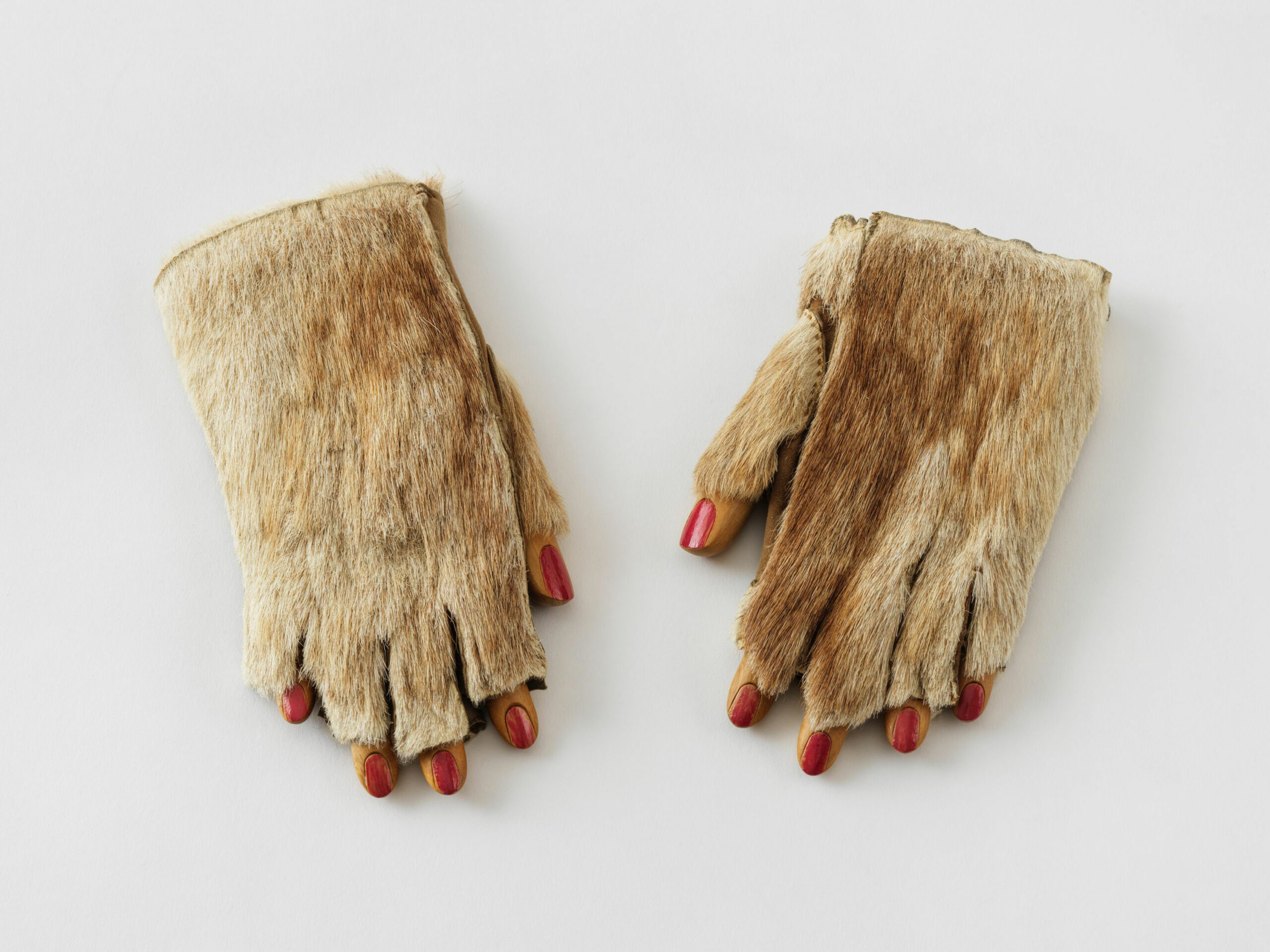
Meret Oppenheim, “Fur Gloves with Wooden Fingers (Pelzhandschuhe),” 1936, fur, wood, and nail polish, 2 x 8 1/4 x 3 7/8 inches (5 x 21 x 10 cm). Ursula Hauser Collection, Switzerland. © Artists Rights Society (ARS), New York / Pro Litteris, Zurich
Because the pieces in this room are early, in them you can see Oppenheim working it out. Whether purposeful or not, there are elements of Constructivism, Surrealism, mysticism, and expressionism. Votive Picture (Strangling Angel), a watercolor made in 1931, when the artist would have been about 18, shows an elegantly dressed woman holding a bleeding child. The double-peaked hill behind her alludes to a pair of breasts, and in the foreground we see that she appears to be standing on three other women, represented by upturned legs topped off with high heels. The painting shares qualities with the work of George Grosz and Ernst Ludwig Kirchner; it has a caricatured roughness and a violence about it, while also maintaining a healthy dose of black comedy.
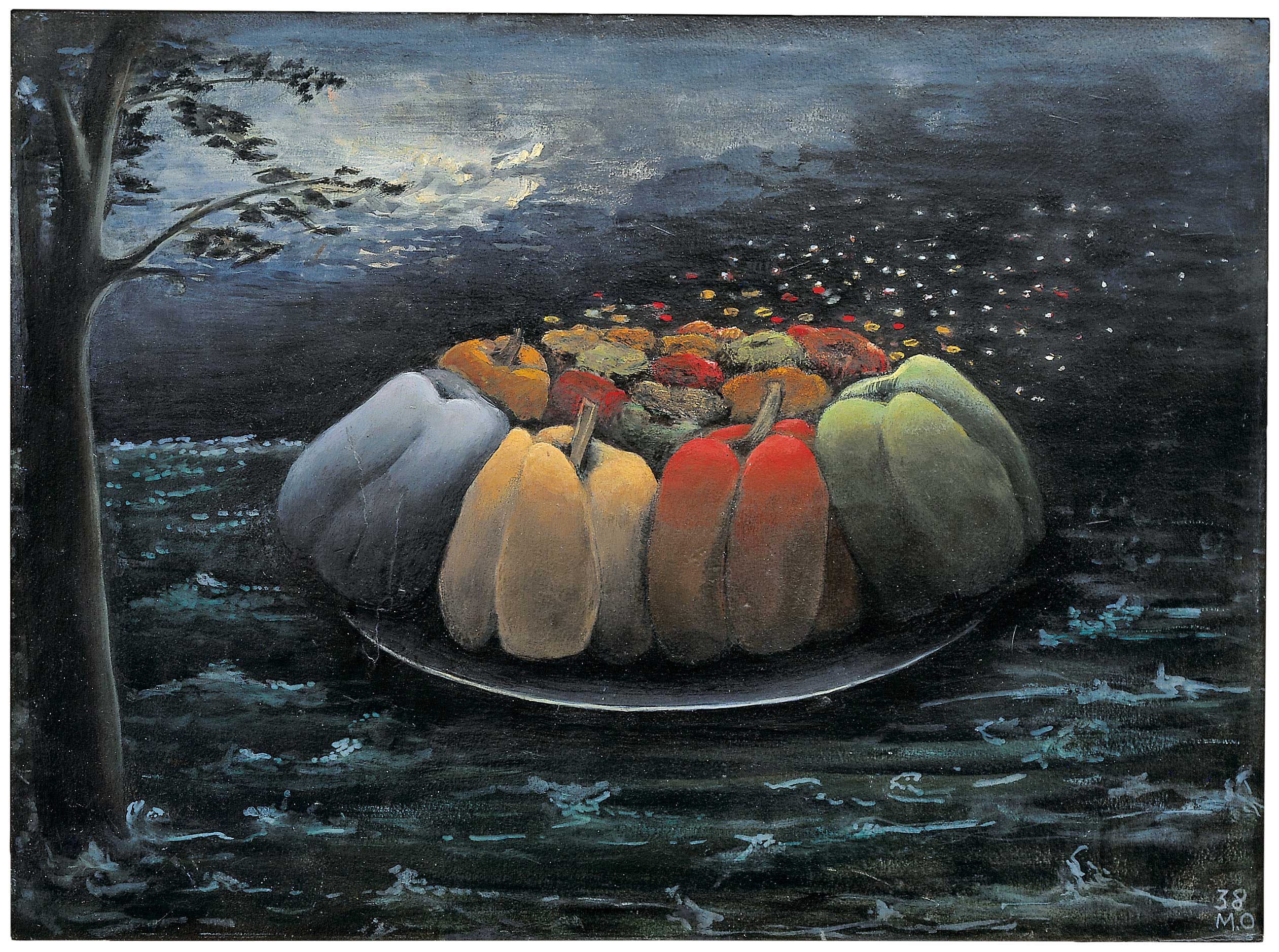
Meret Oppenheim, “Sweet Peppers on the Water (Peperoni auf dem Wasser),” 1938, oil on cardboard, 17 1/8 × 23 7/16 inches (43.5 × 59.5 cm). Kunstmuseum Solothurn, Switzerland. Lilian Benziger-Schild and Alfred Benziger Bequest. © Artists Rights Society (ARS), New York / Pro Litteris, Zurich
Paintings in the exhibition’s second gallery move into the surreal and the mystical. As World War II approached, Oppenheim left Paris, where she had lived since 1932, to return home to Switzerland. There, while stationed at her great grandparents’ house in Basel, she began to take painting classes at a local trade school. Works like Sweet Peppers on the Water are the result of the artist’s newfound medium and talent. In this properly bizarre still life, the world is not as we know it: peppers are either shedding their leaves into the wind or migrating to the foreground, eager to be a part of the display, which is hovering over a churning black ocean. A tree grows out of the water on the left side of the picture, unmoored to any landmass. As a whole, the composition and palette are fantastic, and are uniquely Oppenheim’s.
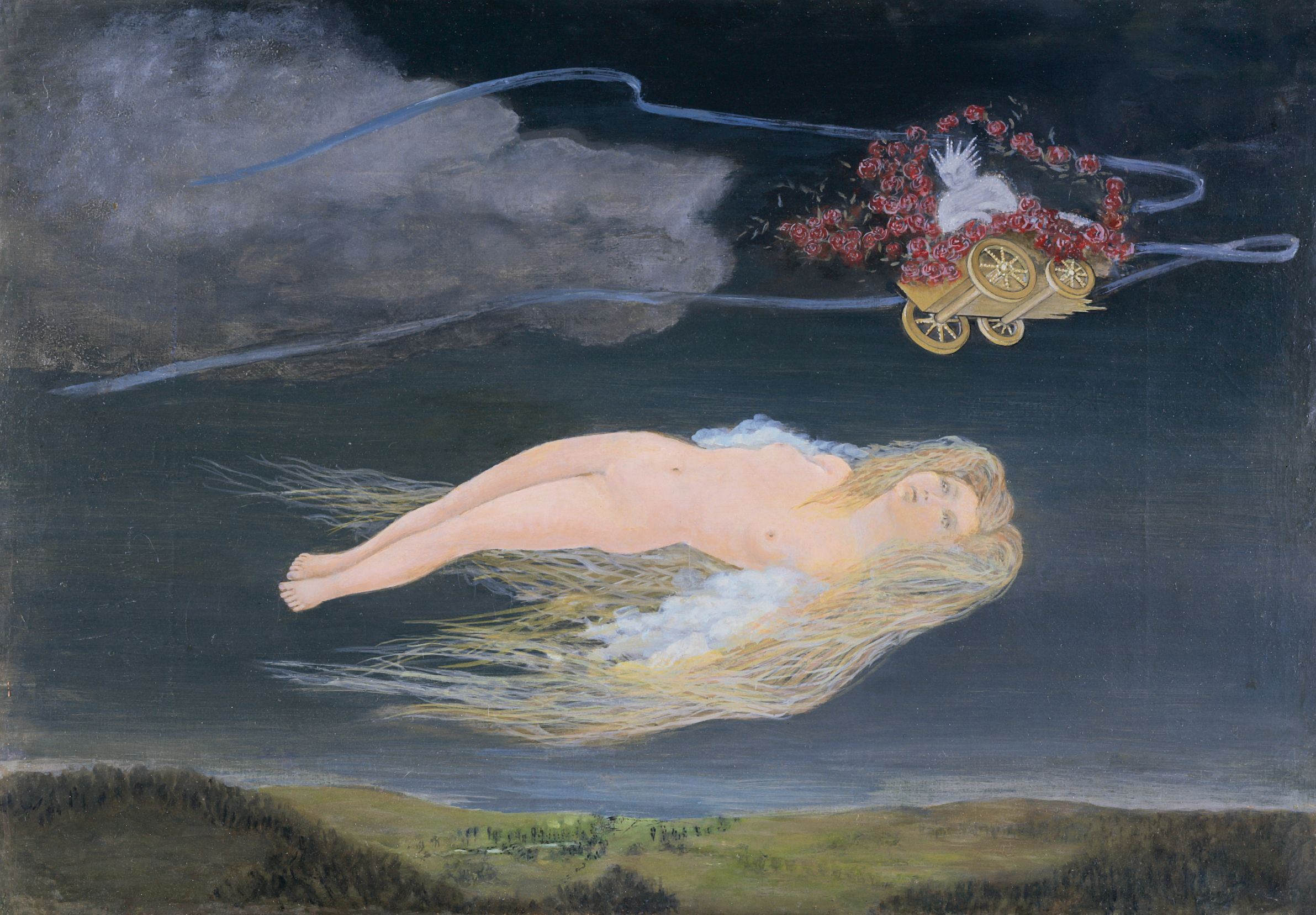
Meret Oppenheim, “The Suffering of Genevieve (Das Leiden der Genoveva),” 1939, oil on canvas, 19 1/2 × 28 1/8 inches (49.4 × 71.5 cm). Kunstmuseum Bern. Meret Oppenheim Bequest. © Artists Rights Society (ARS), New York / Pro Litteris, Zurich
Other pieces from this period have a more anchored surrealist bent. Stone Woman (1938) is a reimagining of a Man Ray photograph from 1933, while Rhine Landscape (1941) has a Max Ernst feel. The Suffering of Genevieve (1939), which is one of Oppenheim’s early depictions of the High Middle Ages legend of the exiled noblewoman (a subject she returned to throughout her career), has a Henri Rousseau mood. However, whatever stylistic nods may be present, she has taken the subject and run with it. Rather than depicting the exiled woman waiting in a pasture or a cave, Oppenheim paints Genevieve nude, hovering over a forest landscape, with a town in the background. While the composition is fairly simple, there’s much to discover, including a small, speckled, spiky-headed imp-like creature that rides overhead in a broken wagon filled with roses.
This early depiction of the Genevieve myth is significant, as it kicks off the artist’s lifelong kinship with the legend’s namesake. According to the exhibition’s catalog: “Just as the innocent noblewoman [Genevieve] had to flee the castle [after being falsely accused of infidelity by her husband, a high-ranking court official], the artist had been forced to leave Paris and her circle of friends when it became clear that World War II was imminent; she had found herself marooned in the ‘forest’ of the comparatively provincial Basel, where she suffered bouts of depression that put a heavy damper on her creativity.”

Meret Oppenheim, “Some of the Uncounted Faces of Beauty,” 1942, oil on canvas. 31 7/8 × 21 1/4 inches (81 × 54 cm). Private collection. Photo: Gerhard Howald, Kirchlindach, Bern © 2021, ProLitteris, Zurich
The stylistic developments Oppenheim made in the Genevieve painting spill over into one of the most original works in the room, Some of the Uncounted Faces of Beauty. In this 1942 painting, the artist has taken elements of her other pictures to create her own world. In it, a non-gendered figure with breasts is holding and petting a rabbit. On the figure’s head, which is dissolving into clouds, is a house with a leaking stovepipe; a cherub being skewered by a caged, long-beaked bird; and a tree-looking object sitting on a wheeled cart. The piece feels identity-less and discombobulated — an apt parallel to how Oppenheim’s world likely felt at the time. Paris had fallen to the Nazis in the summer of 1940, and the artist must have been coming to terms with the possibilities of a new European reality.

Meret Oppenheim, “Genevieve Hovering over the Water (Genoveva über dem Wasser schwebend),” 1957, oil on fiberboard, 14 3/8 × 18 1/2 inches (36.5 × 47 cm). Collection of Foster Goldstrom. © Artists Rights Society (ARS), New York / Pro Litteris, Zurich
Artistically, Oppenheim was unproductive during the war period; she made few pieces, and destroyed some of her earlier works. The third gallery of the show, however, charts her reemergence. She settled into a studio in Bern, Switzerland in 1954 and began to make work anew. Yes, there are still oil paintings from this period, but they don’t stick to her pre-war magical style. Instead, they are akin to Genevieve Hovering Over the Water, a 1957 painting that eschews representation in favor of allusion. Nearly 20 years after depicting the suffering woman floating above a village, here she has stripped the story down to its bare bones: Genevieve is a black mass, and the sea an impastoed spray of white. Oppenheim has already shown that she can paint; now, she is going to explore.

Installation view of “Meret Oppenheim: My Exhibition” at the Menil Collection, Houston. Photo by Paul Hester
Other works in the room more pointedly mark Oppenheim’s progression toward conceptualism. In them, we see the introduction (and mastery) of new materials — plaster, ceramic, limewood, copper, and other, found objects are combined to great effect. A display of five sculptures takes center stage, each with their own personality. Animal-Headed Demon (1961) features a Neoclassical clock case whose face has been impaled by a piece of wood; Miss Gardenia (1962) is comprised of a molded plaster protrusion, which has been sculpted to seamlessly compliment an ornate, metal frame. In a third sculpture, A Distant Relative (1966), sagging breasts and a pointed phallus spill out of a bronzed iron frame, resting neatly in the frame’s stand.
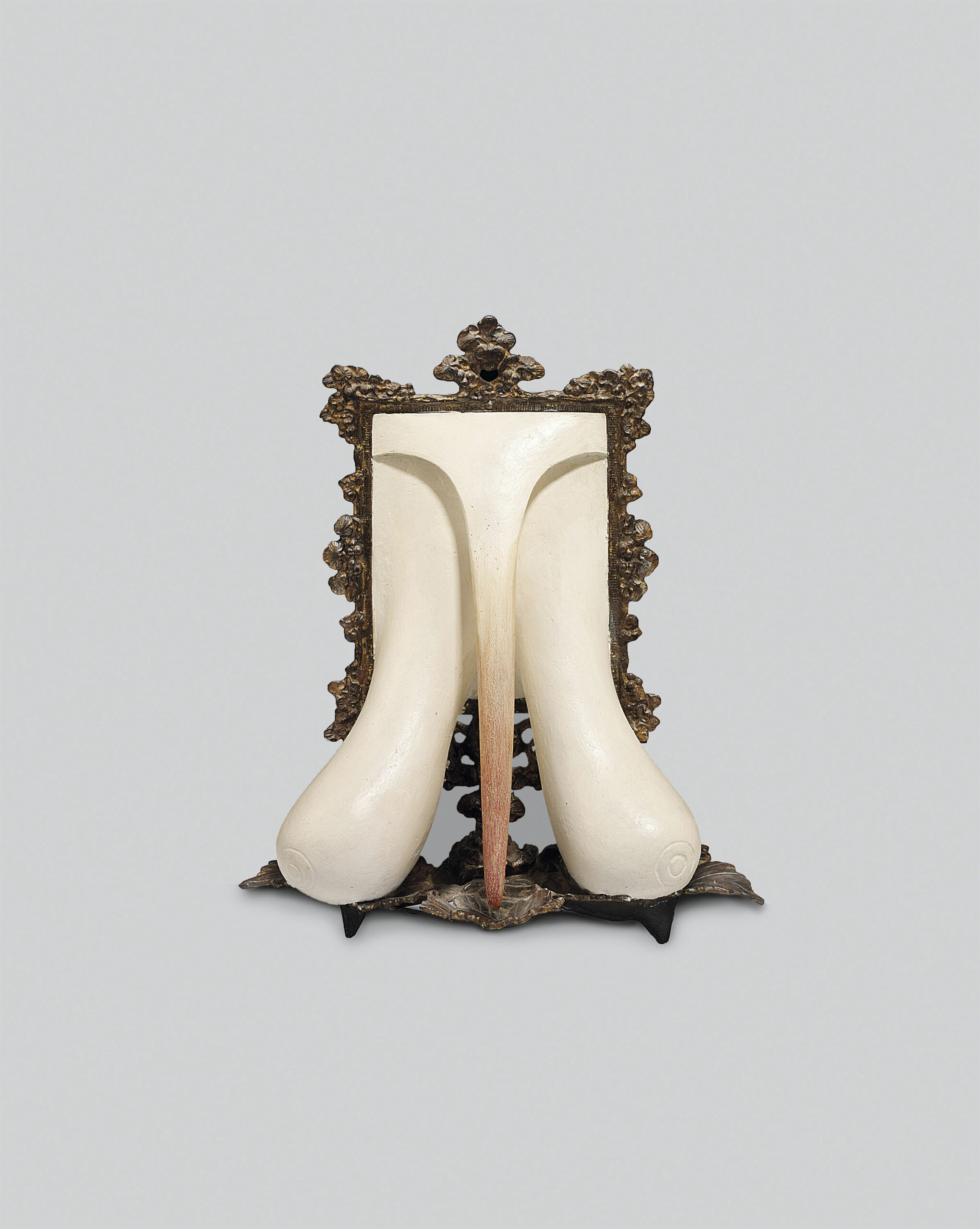
Meret Oppenheim, “A Distant Relative (Eine entfernte Verwandte),” 1966, molded substance (Rugosit) in bronzed iron frame, 10 5/8 × 9 1/16 × 6 5/16 inches (27 × 23 × 16 cm). Klewan Collection. © Artists Rights Society (ARS), New York / Pro Litteris, Zurich
In this return to object making, we see a playfulness reemerge from Oppenheim’s work. Sexuality, and the idea of the gray area therein, also becomes a more overt topic, particularly in A Distant Relative. As Nina Zimmer notes in her catalog essay: “This ambiguous sexuality is of a piece with Oppenheim’s thinking at the time. She frequently argued against rigid distinctions between gendered identities and advocated accentuating the masculine facets of femininity and the feminine facets of masculinity.”

Installation view of “Meret Oppenheim: My Exhibition” at the Menil Collection, Houston. Photo by Paul Hester
At the same time Oppenheim was looking for found materials to alter, she was also creating art about looking up. The fourth gallery is loosely based on her paintings and sculptures of and about clouds, which she made in the early 1960s. The palette of these works is light and airy — blues, grays, and whites bring the compositions to life, a stark departure from the dark, brooding scenes and characters that filled her oil paintings in the war years.
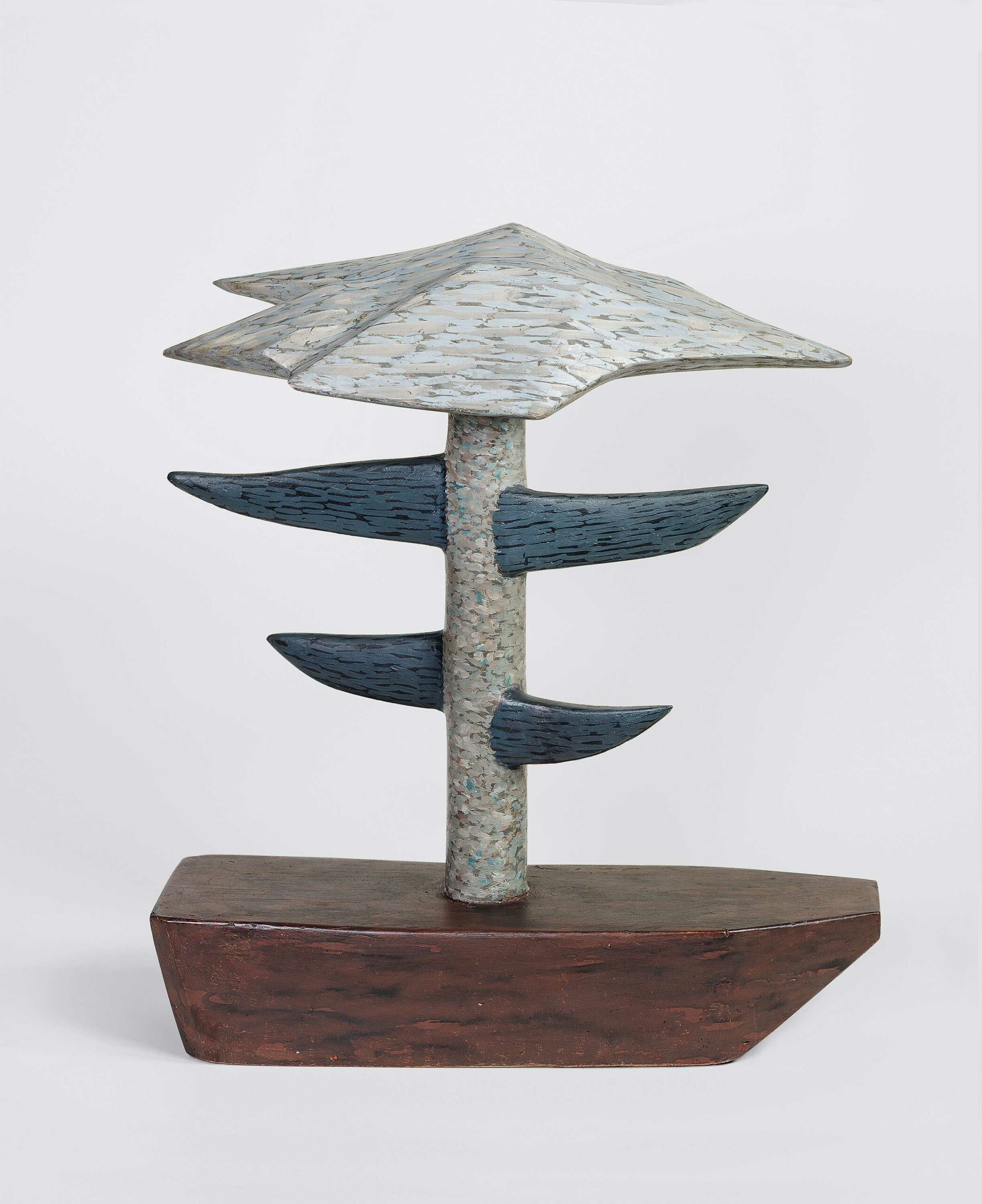
Meret Oppenheim, “Cloud on a Boat (Wolke auf einem Schiff),” 1963, plaster and paint, 14 9/16 × 13 × 4 3/4 inches (37 × 33 × 12.1 cm). San Francisco Museum of Modern Art. Gift of David A. Kaplan. © Artists Rights Society (ARS), New York / Pro Litteris, Zurich
The most powerful of these works are her in-the-round sculptures, including Cloud on a Boat and Cloud on a Bridge (both 1963), which have the aura of modernist monoliths made anew. Her painted, curving shapes, which she formed using plaster, wood, and another substrate, feel like they’re more than they let on. Her titles mention boats, bridges, and clouds, but the sculptures also give off an alien, trophy-like quality. In this way, the works share similarities with real-world clouds: look up and, depending on who and where you are, you’ll see something different than your neighbor. Physically, the sculptures give off a cool, supple harness; the fact that they’re perfectly pedestal-sized and have smooth surfaces makes you want to pick them up and caress them.

Installation view of “Meret Oppenheim: My Exhibition” at the Menil Collection, Houston. Photo by Paul Hester
The exhibition’s next gallery opens into a wide variety of work, including large-scale paintings, sculptures, collages, and editions. Along one wall is a selection of four collages that incorporate various types of papers, films, and drawing implements. One piece, Mask (1971), features images of peacock feathers, a flower, and a yellow spider, all on wood-imitation paper. Together, the elements form an anthropomorphic face, which gazes out blankly at the viewer. This faux-wood paper appears in some of Oppenheim’s pieces executed ten years earlier, and seems to be an ongoing base the artist employs to create a panel-like feeling for her works. In Mask, the effect is twofold: it ups the importance of the piece, since it appears to be on wood, and it also serves in place of the sculpted material of a real mask.

Installation view of “Meret Oppenheim: My Exhibition” at the Menil Collection, Houston. Photo by Paul Hester
Although a carved limewood mask by Oppenheim is included in the exhibition (Mask, 1959), the show does not feature four other masks, which were part of the exhibition’s Bern iteration. This work on paper, then, while also being a prime example of Oppenheim’s ability to effectively collage found materials, acts as a stand-in for the artist’s other mask works. The talent behind collaging and mask-making is one in the same, as Natalie Dupêcher notes in the show’s catalog: “Mask construction thus became the vehicle for Oppenheim’s passion for assemblage and found-art materials, offering the possibility of transformation not only of quotidian ‘stuff’ into personal adornment but also of its wearer.”

Installation view of “Meret Oppenheim: My Exhibition” at the Menil Collection, Houston. Photo by Paul Hester
Other pieces in the gallery highlight how far the artist’s assemblage eye has come. Two of these sculptures, Hm-hm and Octavia (both 1969), act as sentinels, guarding the doorway to the exhibition’s final gallery. Playing with a sort of tromp l’oeil, each work has painted and collaged elements that together make up the body and appendages of a single figure.

Meret Oppenheim, “Hm-hm,” 1969, acrylic on canvas; oil and gold leaf on wood; bark; and carved wood, 6 feet 6 ¼ inches x 37 3/8 x 3 9/16 inches (200 x 95 x 9 cm). Private collection, Bern. © Artists Rights Society (ARS), New York / Pro Litteris, Zurich
Hm-hm is more stoic, its wooden hand emerging from behind the canvas to clutch a painted, yellow cane. Octavia, by contrast, is playful. A sculpted tongue reaches out to lick the top of the blade of a saw, which is collaged onto the left side of the figure. Light gray paint has been applied under the object, mimicking a shadow cast by its teeth. The mirror outline of the saw is drawn on the right side of the figure, a painted eye occupying its handle hole. There’s a dangerous sensuality that exudes from this piece, and a viewer’s reading of it can vary; according to the show’s catalog, one critic thought the work “embodies fear of castration.”
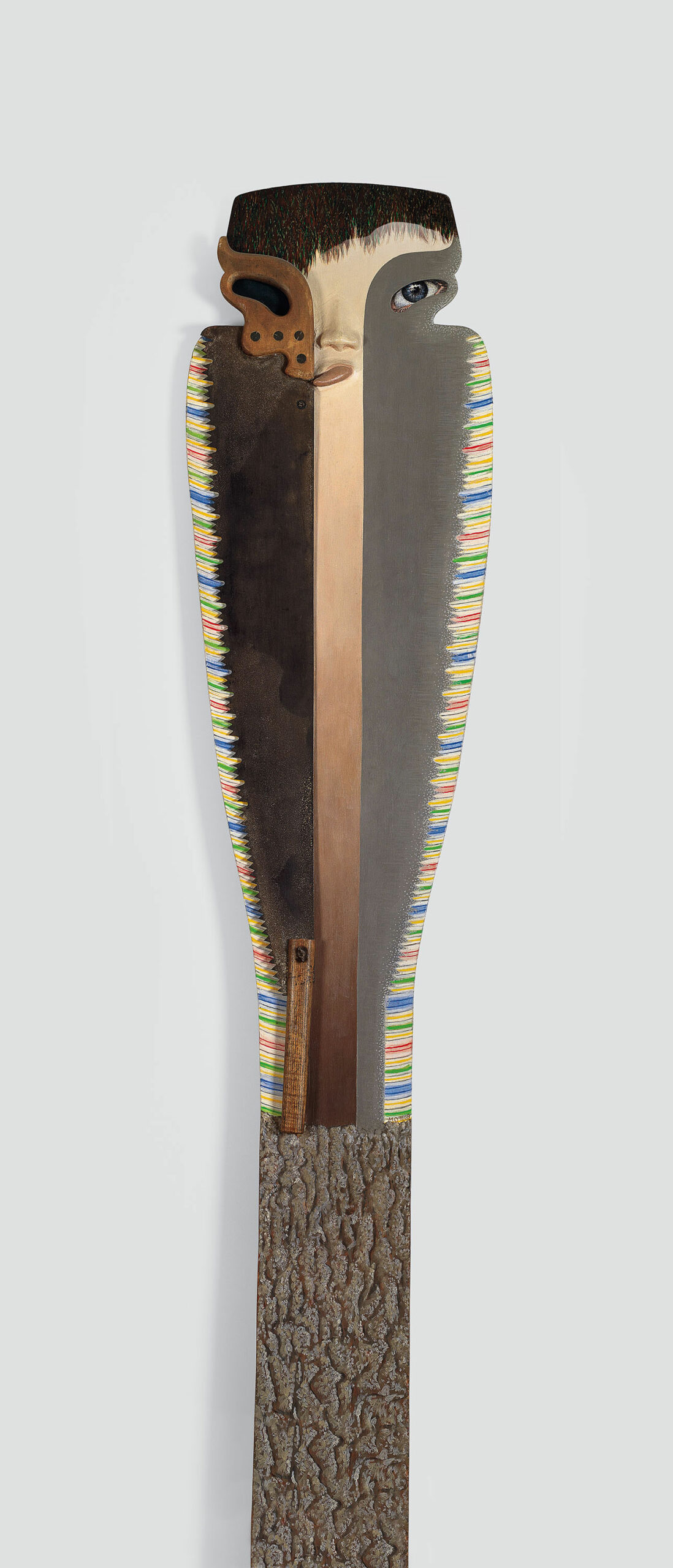
Meret Oppenheim, “Octavia (Oktavia),” 1969, oil on wood and molded substance with saw, 73 5/8 × 18 1/2 × 1 9/16 inches (187 × 47 × 4 cm). Private collection, Bern. © Artists Rights Society (ARS), New York / Pro Litteris, Zurich
The elements of Dada (found objects) and Surrealism (a nebulous figure and confused, dangerous sexuality) in Octavia fuse in the piece’s kinship to the nouveaux réalisme movement. In Zimmer’s essay, she notes that “the majority of the artists [in the movement] were French or Swiss, and Oppenheim felt at home among them; she was close to the group’s central members, including Niki de Saint Phalle, Jean Tinguely, and Daniel Spoerri.” Oppenhiem’s association with this movement is just one data point in the ever-evolving through line in recently organized exhibitions — to this point, the Menil co-organized a show of Saint Phalle’s work last fall.

Meret Oppenheim, “Schoolgirl’s Notebook (Le Cahier d’une Écolière),” 1930/1973, etching on paper, embossed and printed in rust, gray, green, and black; original blue paper-covered stiff wrappers, 11 x 8 ½ inches (closed), Edition 41/100. NMWA; Gift of Thomas Hill in memory of Rosemary Furtak. Photograph by Lee Stalsworth, image courtesy of Lisa Wenger and Martin A. Bühler, Meret Oppenheim Estate
The last gallery of My Exhibition acts as a landing pad for visitors preparing to leave the show. There’s a sort of recapping of Oppenhiem’s grand artistic vision, expressed by Schoolgirl’s Notebook, a piece from 1930 (originally made when the artist was 16) that was remade 43 years later as an etching and stencil print. In the work, Oppenheim riffs off of the “solve for X” math problems students receive as school assignments. She finds that X equals rabbit, an absurdist, funny conclusion that turns the problem on its head. This is also an example of the artist’s career-long penchant for revisiting and rehashing earlier ideas.

Installation view of “Meret Oppenheim: My Exhibition” at the Menil Collection, Houston. Photo by Paul Hester
Two paintings in the room, Head of Fog and Flower of Fog (both 1974), show us that Oppenhim has finally let her subjects drift all the way up into the clouds. In these works, although her forms are visible, they’re greatly obscured. Flower of Fog, which is one of the artist’s larger paintings, clocking in at over 6 by 4 feet, feels like a rounding off of Oppenheim’s painting output: she went from surreal, dark, and twisted scenes inspired by the unknown and the ravages of war to a light, airy close-up landscape that’s concerned with feeling and immersion just as much as it is with painting technique.
Capping off this final room is M.O.: My Exhibition, a series of twelve drawings in which Oppenheim plans out an ideal version of her career retrospective. These works were created, according to the show’s catalog, “in anticipation of a major retrospective of her work, scheduled to open in September of 1984 at Kunsthalle Bern.” On the first drawing of the series, Oppenheim writes that while this is her version of a show, it is “only an example” of what the exhibition could be, saying “I had to leave aside many works that for me are no less important.”
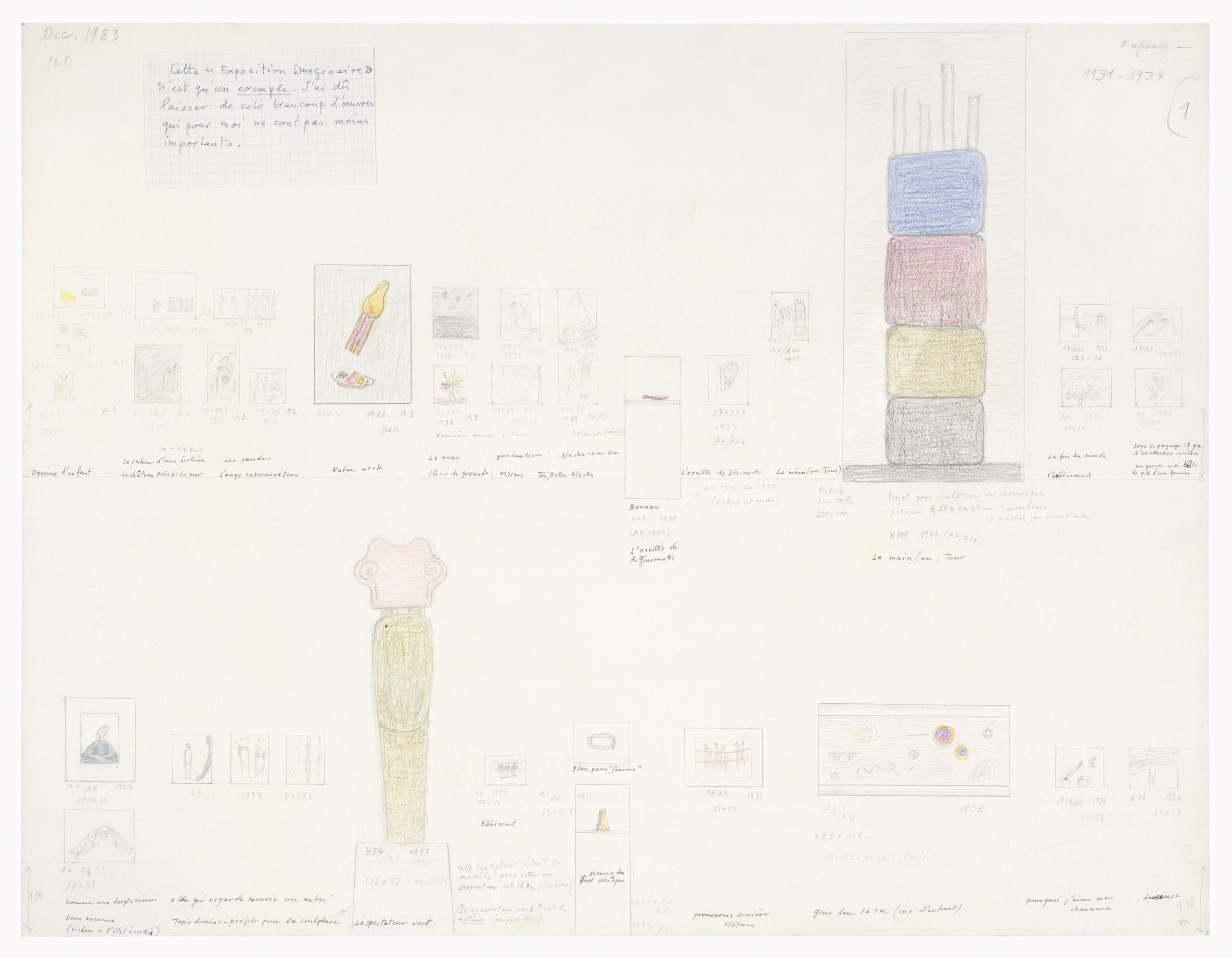
Meret Oppenheim, “M.O.: My Exhibition (M.O.: Mon Exposition),” 1983, pencil, colored pencil, and ballpoint pen on paper, 25 1/2 x 19 11/16 inches (64.8 x 50 cm). Bürgi Collection, Bern. © Artists Rights Society (ARS), New York / Pro Litteris, Zurich
While the piece has many enjoyable moments of discovery — it turns out her fur teacup is indeed on view, just as a micro drawing — it is also a perfect finale. The work practically hits you over the head with Oppenheim’s personality: she’s someone who knows her craft, someone who has strong opinions about her own work, and someone who cares about how people perceive what she’s done. Even though she admits these drawings are not a be-all and end-all exhibition, she’s willing to speak up and tell you what her show, if she had to pick, would be.
Walking out of My Exhibition, visitors encounter New Stars, an oil painting the artist made between 1977-1982. The work is hung in the Menil’s long hallway, outside of the show’s proper galleries. Fittingly, the painting is the only piece illustrated in the twelfth panel of Oppenheim’s fantasy exhibition drawing, alone because of its large scale. In her 1984 exhibition, this piece was hung exceedingly high on a wall above a doorway — lofty, aspirational, out of reach, and dreamlike.

Meret Oppenheim, “New Stars (Neue Sterne),” 1977–82, oil on canvas, 6 feet 8 11/16 inches x 8 feet 1 13/16 inches (205 x 248.5 cm). Kunstmuseum Bern. Meret Oppenheim Bequest. © Artists Rights Society (ARS), New York / Pro Litteris, Zurich
I’m a fan of the painting’s placement here in Houston; the piece is both a hello and a goodbye, giving visitors a peek of what’s to come in the show’s later hours, and then acting as a final look for those leaving. It completes the circle of the artist’s career in a wonderful and unexpected way: instead of being greeted by intimidatingly large wall texts or graphics of the artist and her work (this isn’t the Menil’s style anyway, but I digress), the entrance and exit is simple, clean, and thoughtful. There’s no fur in sight. When thinking about how the artist looked at and assessed her own career and how she wanted to be her own artist and person, this work’s placement, in relation to the rest of the exhibition, makes perfect sense. It’s what Oppenheim would’ve wanted.
Meret Oppenheim: My Exhibition is on view at the Menil Collection in Houston through September 18, 2022.
The post Rediscovering Meret Oppenheim at the Menil Collection appeared first on Glasstire.
This post, my new hire built a blanket nest in her office , was originally published by Alison Green on Ask a Manager.
A reader writes:
I have a new employee on my team. This is her first full-time office job, which is common for employees at my company. I’ve recently heard from other managers that she’s primarily working from a nest of blankets and pillows she built on her office floor. We are a very casual office and she’s getting her work done, but this is still weird. I’d like to address it with her before we move another new hire into her shared office area next month.
My first step is to stop by her office a couple of times to verify the hearsay, but overall how do I address this with her? We have a company policy handbook but it is pretty vague (to the point of tongue in cheek) about “professional” behavior.
I admit my first reaction was to laugh, and my second was to think about whether I would like to work from a blanket/pillow nest of my own.
But yeah, in most offices this is going to stand out as really odd — hence the comments you’re getting about it.
There is a larger philosophical question about why “odd” is bad, and whether it needs to be bad. If she’s comfortable working like that and she’s getting her work done well, should anyone care? Personally, if I were creating work norms from scratch on a new planet where they didn’t yet exist, I would be pro-pillow-fort. Why not? Some people work well from a desk, some work well from a couch, some apparently work well from a nest of blankets and pillows. It shouldn’t matter.
And yet, in the world we live in, not the hypothetical one I’m creating on a distant planet, it will matter. Something this far out of the norm — and so associated with “bed”— is going to read strangely in most offices and raise concerns. That goes doubly, if not triply, when the employee is very junior and hasn’t established a reputation for herself yet.
If she were more senior and known to be very good at what she did … well, it still wouldn’t fly in a lot of offices! But in others she could get away with it; it could be an idiosyncrasy people accepted because her work was great. But when you are entry-level, you don’t have nearly the same freedom to flout norms; instead, it’s likely to become the thing she’s known for — along with connotations like “immature” or “unprofessional” — and could end up holding her back significantly. I’m not defending that, but it’s the reality of it. It’s sort of like showing up to work in pajamas — it won’t affect the quality of your work, but in most offices it would impact the way people see you. (Caveat: different industries have different norms. This could go over far more easily in some parts of tech, for example, and apparently at NPR. But it sounds like your office isn’t one of those, since you’re getting the comments about it.)
When you have enough capital built up to push back on these norms, you can! But since she’s a junior employee at her first job, it’s more likely that it would take your capital, as her manager, to fight this battle on her behalf and I’m guessing it’s not something you want to spend your own capital on. If I’m wrong about that, by all means, spend capital on it. It helps nearly everyone if we revisit our definitions of “professional.” But otherwise, here we are.
So … start by asking her about it before you do anything else. Who knows, maybe there’s some reason for it that you’d want to know, like that something about her desk or chair is uncomfortable and she needs a more ergonomic set-up. But then it’s reasonable to explain that generally in your office people are expected to work at their desks and that, rightly or wrongly, working from a nest of blankets and pillows will read as not terribly office-appropriate, and risks becoming the thing she’s known for right as she’s trying to establish a professional reputation for herself … and that especially with a new hire about to move into the space with her, sadly the blanket/pillow nest must go.
RIP pillow fort.

Car dealerships deploy tricks and traps to make as much money as they can from you. Here's what I learned when trying to buy a new car.
(Image credit: Creative Commons)


Material culture is an ever-present but often overlooked aspect of life. It refers to the objects that come to define a society and make the values, beliefs, and traditions of that society manifest. As the title of an exhibition, “Material Culture” lays out a humble and monumental task all at once. In her show at The Grace Museum, Houston-based artist Anna Mavromatis takes the materials of daily life and uses them as source materials for her commentary on United States American values, both historically and presently.
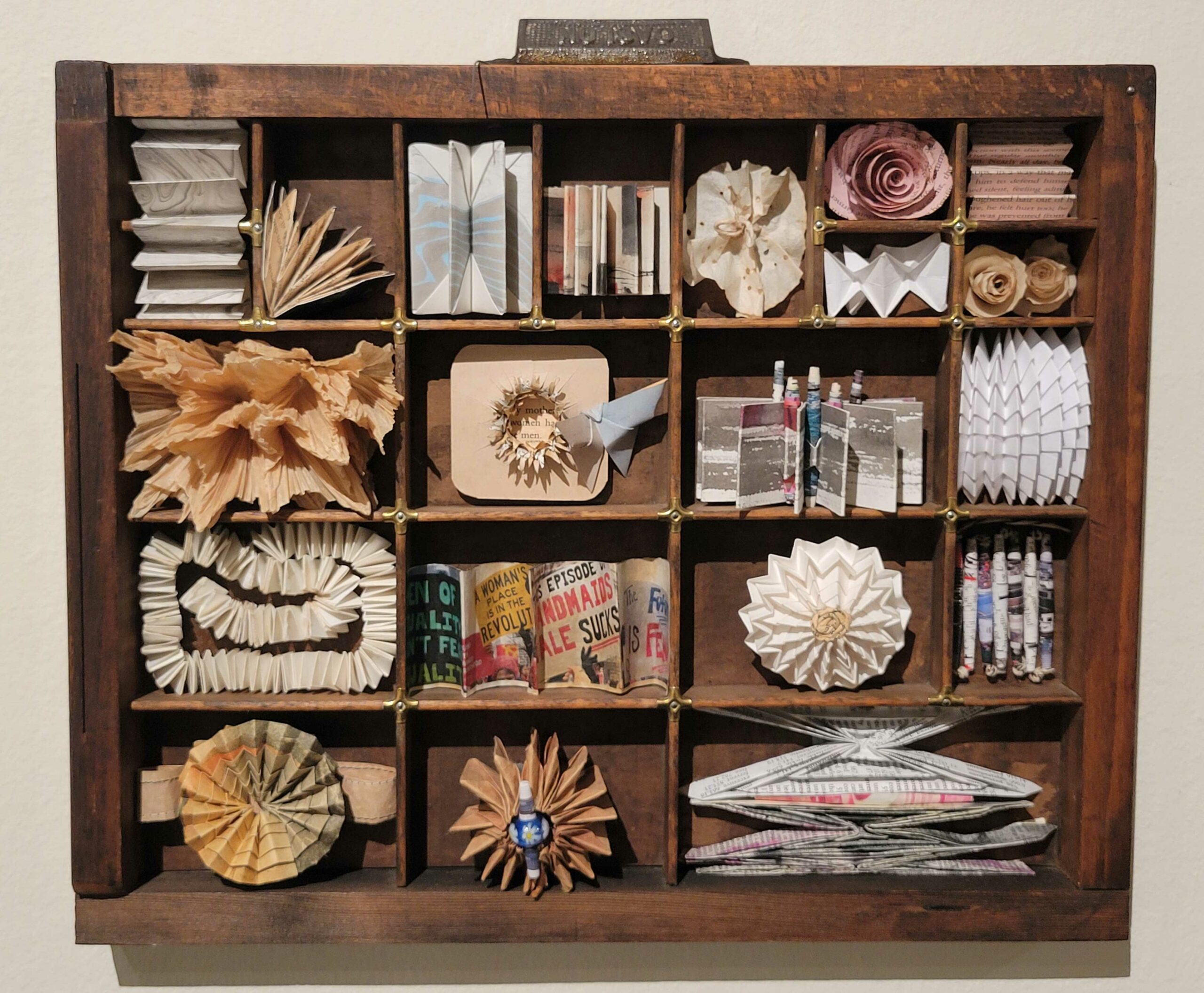
Anna Mavromatis, “Cabinet of Curiosities,” 2019, paper objects created by hand arranged in a vintage printer’s drawer. Courtesy of the artist and Barbara Davis Gallery
Reminding visitors of the long history of display by Western collectors and museums, Mavromatis provides her own Cabinet of Curiosities. Held within a wooden printer’s drawer that has several small compartments to sort the wares of her trade, the artist arranges multiple works of hand-folded and rolled paper.
While this certainly serves as a tidy way for Mavromatis to show off her masterful technique and artistry with a material as humble as paper, it also subtly comments on ideas around womanhood in the Western world. Floral motifs abound throughout her cabinet, from a rolled pink paper rose at the upper right, to a white blossom a few compartments lower, and a floral band at the bottom left. The work also reminds visitors of the struggle for gender equity within the art world by highlighting the material that women artists of earlier generations would have most readily accessed. It is only in the past two centuries that art schools admitted women into their programs, and even then, access to certain advanced lines of study were initially restricted to prevent corruption of their expected innocence.
For many women prior to the twentieth century, decorative arts, textile works, and illustration on paper would have been the primary forms of art they could’ve made. Even within these gendered limitations, it is important to remember the class dynamics that would have further impacted women’s access to the tools for making art, rendering paper the most viable medium for many women artists. Presently, arts institutions are carving out a space for these artworks, previously denigrated as craft, and bestowing the recognition these art forms have long deserved.
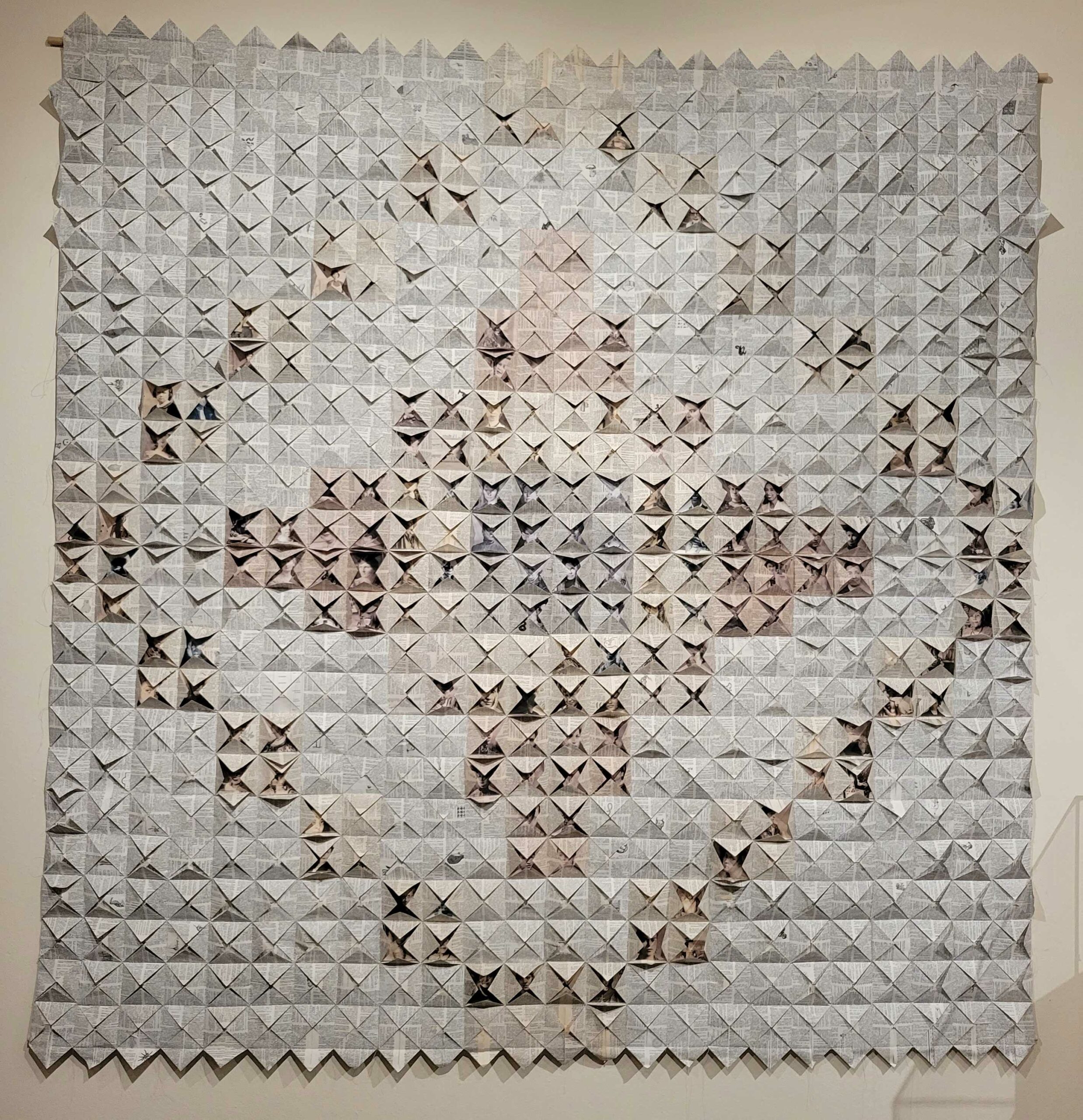
Anna Mavromatis, “Hidden Figures,” 2021, 576 squares cut from an old dictionary, dyed, folded and stitched into a six-foot square. Courtesy of the artist and Barbara Davis Gallery
A centerpiece of the exhibition is Hidden Figures, a paper quilt created with 576 individually folded paper squares, similar to the paper fortune tellers many children create with hopes of getting a glimpse into their future. Slightly opened, the paper squares take viewers on a journey into the past with the faces of several women writers, scientists, inventors, artists and activists peeking through.
Mavromatis has imbued this work with meaning on several levels. She has taken the time to tone some of the squares with teas and wine to provide just enough color to construct diamond patterns, transforming the individual paper squares into a quilt. The quilt has a long tradition in the United States, serving as a project that brought women together for fellowship. Here, the compilation of all these women’s faces does provide fellowship and encouragement to the many women who are still traveling along their paths. It is also important to consider how these women and their accomplishments contributed to the very fabric of this nation. Although in many cases, their work — like their faces in this artwork — has been somewhat obscured and hidden from view in the canonical history of the Western world.
Over the past 50 years, great efforts have been made to revise the histories that have largely erased women from narratives of innovation and progress. Yet, Mavromatis’s work cautions us not to start self-congratulating too soon. How many of the figures do we know today? Where do we learn about these women? She provides the images and biographical information she compiled as research and source material for this piece alongside her artwork. This raises a question similar to those posed about exhibitions solely of women artists: when will supplemental texts highlighting women no longer be necessary, because they have finally become so thoroughly embedded in the canon of writing about United States history?
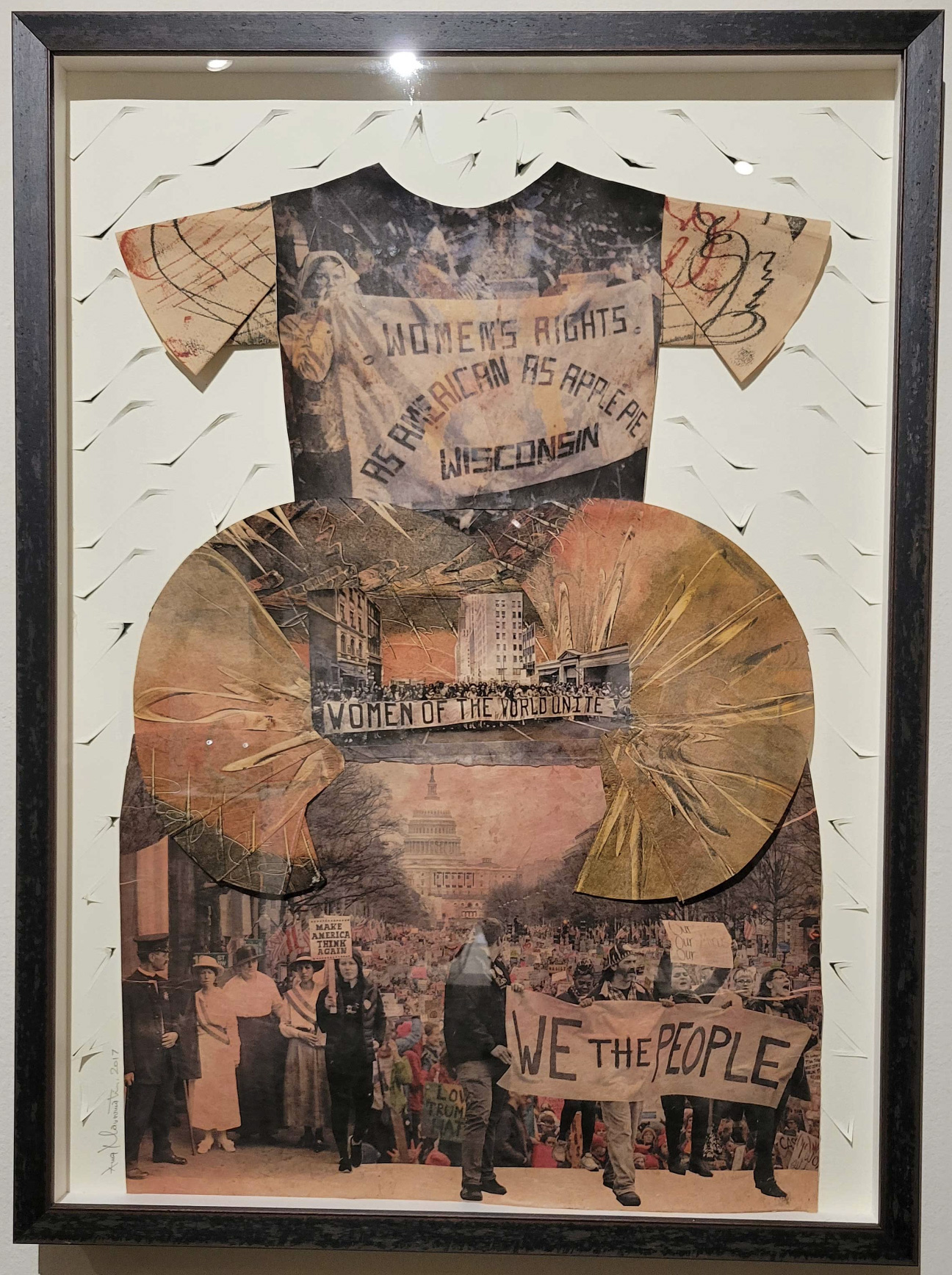
Anna Mavromatis, “Apple Pie,” 2018, toned cyanotypes, monotypes with archival pigment prints of historical images obtained from the National Archives collaged into the form of a girl’s dress and mounted on a cut-out patterned background. Courtesy of the artist and Barbara Davis Gallery
In Apple Pie, Mavromatis draws from her background in clothing design as she continues her exploration of the long legacy of women’s struggles for rights and equity in the U.S. A vintage girls’ dress pattern with bell sleeves and a full, floor-length skirt serves as her base. Across the dress, she has woven together historic images of protests for women’s rights throughout the twentieth century, from suffrage demonstrations to the Women’s March following the election of Donald Trump as president in 2017. The title of the work is drawn from a sign in the historical image across the chest of the dress that reads, “Women’s Rights As American As Apple Pie.” The peach, yellow, and tan tones of the work amplify the Americana apple pie motif.
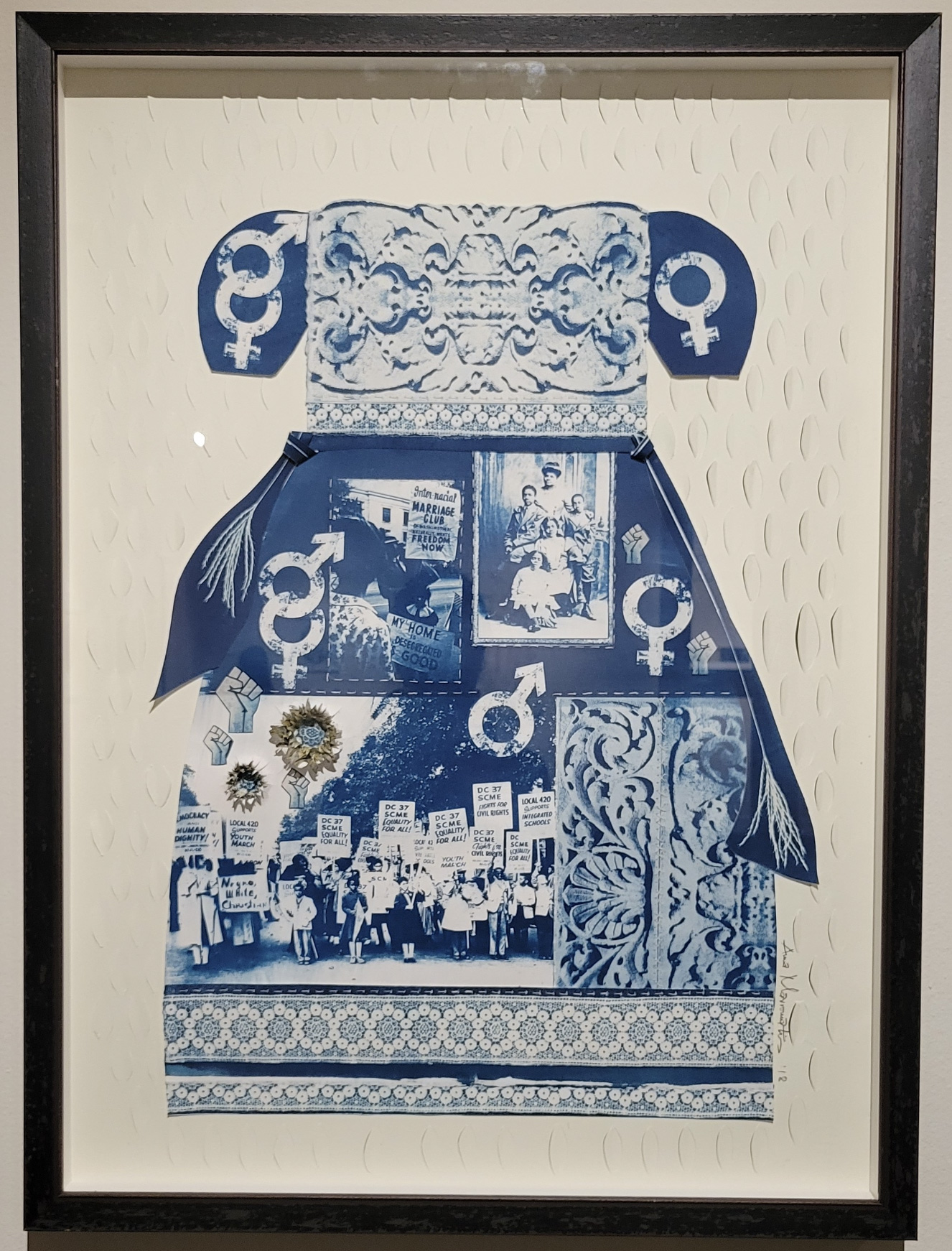
Anna Mavromatis, “Long Lasting Blues,” 2019, cyanotypes, cutout blossoms with stitching collaged into a dress form and mounted on a cut-out patterned background. Courtesy of the artist and Barbara Davis Gallery
When looking at women’s history and movements in the U.S., there is often a foregrounding of the experiences of White, middle-class, heteronormative women. Yet, Mavromatis has taken care to acknowledge the contributions of women of color and to remind visitors that many women had multiple fronts to fight on when seeking greater equity in this nation. A great example of this is Long Lasting Blues, the artwork that first pulled me into this exhibition. In this piece, Mavromatis again employs a vintage child’s dress pattern, but has toned it blue as a nod to the popular African American musical genre of the blues.
Across the skirt, one finds images of protests for integration in schools as well as the home, in the form of the legalizing of interracial marriage. Black power fists are layered onto the image, along with flowers and the symbols for male and female. It is interesting to encounter this work in the summer of 2022, when these struggles should seem distantly tucked into the past. However, this is also the summer that the United States House of Representatives has felt it necessary to codify interracial marriage, for fear that such rights that had seemingly been settled are no longer so certain. The long-term standing of rights of individuals who aren’t represented by the simple binary of male and female gender symbols also feels unresolved in the present year, adding another layer of meaning into this artwork.
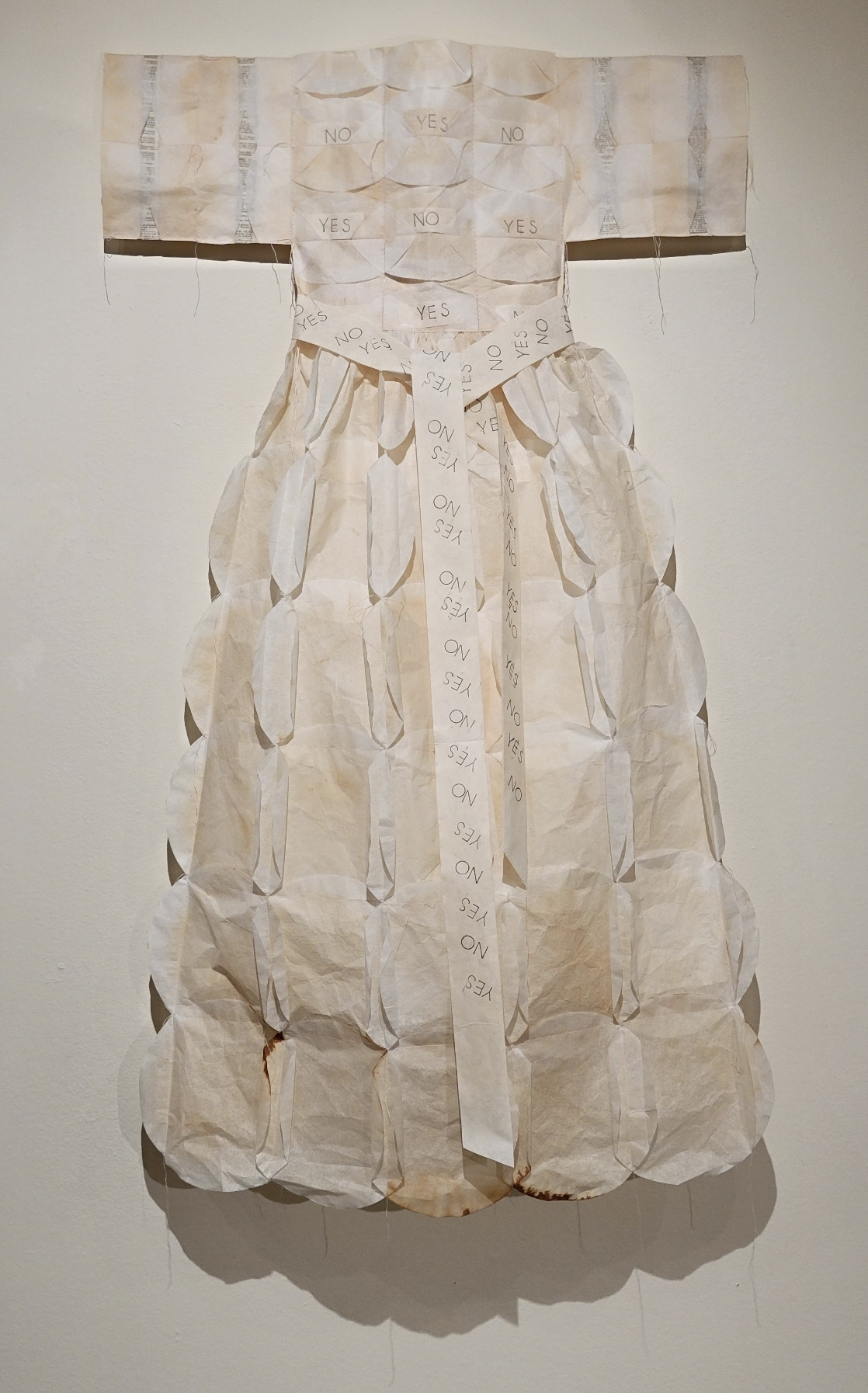
Anna Mavromatis, “Perpetual Dilemma,” 2021, three-dimensional dress made of recycled coffee filters and vintage book pages, hand stamped with words of ambiguity: yes, NO!. Courtesy of the artist and Barbara Davis Gallery
This is what makes art so fascinating, and exhibitions so relevant. While an artist certainly approaches their creations with particular intentions, the rapidly changing state of society can drastically alter how we as viewers create meaning when standing in front of them.
Another perfect example of this is Perpetual Dilemma. For this artwork, Mavromatis takes pages of text from vintage books, paired with tinted coffee filters, to create another vintage-style dress form. Coffee filters are found in many works in this exhibition and it is truly exceptional the delicate texture they provide to the artist’s works — in this case, flowing down the dress like ruffles.
The dress form is such a resonant theme for Mavromatis, because of the important role it has historically played in the lives of women by communicating information about status, family, and in many ways, potential as a future wife. The true impact of this work comes from the text Mavromatis stamped across the chest and sash that hangs down from the waist to the base of the skirt. It alternates “Yes” and “No,” a commentary on the challenging balance women face between being desirable while appearing chaste. As courts and legislatures continue to re-decide the rights and responsibilities of women, particularly in the area of bearing children, the poignancy of this subtle and delicate work is quite powerful.
Overall, this exhibition invites visitors to assess how everyday items, like books, coffee filters, paper, and old photos, tell the histories of a society. In this case, these items speak volumes about women’s positions in United States society in the twentieth and twenty-first centuries. What is most fascinating about these artworks is that they remind us all of how relevant the material culture of the past still is in the present day.
Values and beliefs can be slow to shift. The fact that many of the concerns displayed in the historic images sourced for Mavromatis’s artworks have returned to the fore today shows the power of objects, everyday and artistic, to reflect culture and indicate how far or little it has progressed.
Anna Mavromatis: Material Culture is on view through September 17, 2022 at The Grace Museum in Abilene, Texas.
The post Materially Relevant: a Review of “Anna Mavromatis: Material Culture” at The Grace Museum appeared first on Glasstire.
This post, pushy coworker won’t stop bringing me food I didn’t ask for , was originally published by Alison Green on Ask a Manager.
A reader writes:
I started a new job just over a month ago. On my first day, a coworker — Kevin — asked if I would like a doughnut from a popular bakery near our office, as he was headed there anyway. I said yes, and he brought it. (He got my order wrong, but oh well, still a free doughnut!)
I thought he was just extending a nice gesture to the new employee, and that would be the end of it. But had I known what would happen next, I never would have accepted the doughnut — because it opened the floodgates of unsolicited food items.
At least five times now Kevin has brought food I didn’t ask for. I say no to the food every time and have outright asked him to check with me first before bringing me anything, which he verbally agreed to, but he has not actually stopped bringing me things unprompted. Most recently today, he slammed a big bottle of iced tea onto my desk, and demanded to know why I didn’t want it when I turned it down.
I’ve told him I have health-related dietary restrictions (not just a deflection tactic, some foods make me pretty sick), which also hasn’t deterred him. I’m at the point where I’m not really able to be polite about it anymore, since I set the boundary and he seems to have no intention of respecting it, despite me sticking to the “no.” My work station is freely accessible to everyone, so I can’t prevent him from bringing me things by shutting an office door.
I’m so annoyed but I feel bad for him at the same time, because my impression is that he badly wants to be liked by me and our other coworkers, but he’s so clueless that his overtures just have the opposite effect.
Is this something I can take to my boss? She also manages him but I feel almost silly bringing this issue to her, especially since I’ve only been working here for a month. I’m worried she’ll think I’m being too harsh/judgmental, or that I’m trying to stir up trouble. Any advice would be much appreciated.
I wrote back and asked, “When you told him you had dietary restrictions, what did he say? And have you noticed him doing it to anyone else?”
He acted like he understood when I told him about my restrictions and asked what kinds of things he should avoid, I told him it’s kind of a long list so the safest bet is always to ask me first. He seemed to agree but then brought me a brownie without asking three days later, which I turned down.
I’m one of the first people you see when walking into the office, so when I inevitably say no to the food, he brings it straight to someone else. It seems like he wanders around until he finds someone who wants whatever random food he has. I asked another coworker about it and she somewhat sheepishly admitted she’ll usually take what he offers but then throw it away later.
As an even weirder side note, on my first day when he brought me the doughnut, he also asked my manager if she wanted one; she told him no. He proceeded to bring her one anyway.
What on earth.
I’m sure you’re right that Kevin is desperate to be liked by people — this is very much currying-favor behavior — but doing the exact opposite of what people have repeatedly asked from you is a weirdly bad strategy for that. It seems like he picked up on the idea that bring food can be a gesture of warmth (it can be!) and he cannot let it go, no matter what the people he’s aiming it at tell him.
So, you’ve got two options here:
1. You can call him out on it more assertively: “I asked you not to bring me food anymore, what’s up?” Or, “I asked you not to bring me food. Please respect that.” Neither of these would be rude, but you might feel rude saying them — it’s a level of bluntness that you normally don’t need to use with colleagues and it might feel like a lot for a work relationship. But his aggressive food pushing is a lot for a work relationship! It’s not inappropriate to tell him bluntly to stop when he’s ignored politer wording.
2. If you don’t want to do that, the other option is to just consistently say no every single time. Don’t ever give in — even if he shows up with an enticing item you very much want — because if you do, you’ll be training him that if he asks enough, sometimes you’ll say yes. Stick with “no” every time. Feel free to sound bored or even annoyed when you say no.
If he again demands to know why you’re saying no like with that iced tea (!!), you can say “because I don’t want it” or “because I asked you to stop bringing me food” or “because I asked you to stop bringing me food and it’s getting really weird that you won’t.” (That last one feels kind of mean, but you have standing to say it because it is getting weird. And after something passes a certain level of weirdness, it’s arguably kinder to just tell the person that. That level has been passed.)
I don’t think this is worth taking to your boss — not because she’ll think you’re being too harsh or trying to create trouble, as you worried about, but because ultimately it’s a pretty small interpersonal issue that most managers will want you to deal with by just telling Kevin no … and also because he’s apparently doing it to everyone and she probably already knows about it. (If the behavior were worse — like if he were leaving food items on your desk that he knew you were allergic to or if he starts throwing more of those iced tea tantrums — my answer would be different.)
If you weren’t new, there would be more room for going to your boss and asking what the F is up with Kevin’s aggressive food behavior, but as a new person I’d handle it on your own for now.
This post, when should I let my new boss fail? , was originally published by Alison Green on Ask a Manager.
A reader writes:
I (23) have been at my current job for about one year. This is my second job out of college and I love the work I’m doing, and I’m compensated quite well compared to others in my industry. About seven months into my job, my director accepted a position with another organization. Since our department is only two people (me and the director), I was appointed interim director for two months while my grandboss filled the position.
Two months ago, my grandboss hired somebody with 25 years of experience in our field to fill the job. When my new boss (Jim) was announced, I mentioned him to some colleagues at a happy hour. I was met with some concerning comments about their experience with him and how, despite his experience, he lacked some of the skills needed to be successful in the position. I brushed these concerns off and was relieved to have a new director as I was approaching burnout from having to do two jobs and making decisions that I felt I wasn’t qualified to make.
Jim has been on the job for almost two months now and, since I’m the only one in our department, I have been responsible for training him. After two months, I’m starting to see that the comments my colleagues made were, in fact, correct. I have had to explain the same project details many times, have needed to come to his rescue in meetings with clients, and continue to manage our $10M+ department budget because he has shown no interest in learning anything about them, even though it’s his responsibility. Our consultants continue to reach out directly to me with questions, despite that being something Jim should handle. And my grandboss even emails me to discuss organizational strategy with Jim only CC’d.
My new director seems quite fine with me doing most of the work while he sits back and collects a check. But I’m getting frustrated with doing the work he is paid double my salary to do. I knew I would still be the point of contact on many things for the first month while training Jim and facilitating handoff. But, it seems he has no interest in assuming these duties. When should I become more hands-off and just let my boss sink or swim? I’m not trying to set him up for failure, but I think the training wheels need to come off at one point.
Right now.
By covering for Jim, you’re preventing people above him from seeing that there’s a problem, or at least from seeing the full extent of it. You might also be letting him avoid seeing that there’s a problem and that he needs to do more if he’s going to function in his job effectively. And the longer you keep picking up the slack, the more likely all the work is to become “yours” and the harder it will be to get him to see it as his.
At this point you should say to Jim, “Now that I’ve shown you XYZ, I’m going to officially hand those over to you since you’re the point person on them now.” And then do that — and stick to it. Don’t jump in to save him when you see things going wrong, and when people email you about things he should handle reply with, “Now that Jim is on board, he’ll take this over so I’m cc’ing him.” (Being transparent about it like that is important, so that if a ball is dropped afterwards, people will know you’re not the one dropping it.)
There’s some nuance to this, of course. If you see a disaster starting to form and it will be clear that you could have spoken up, you do need to say something. But that doesn’t mean stepping in and doing the work for him. It could be more like giving him a heads-up (in writing! so there’s a record that you warned him) — “my sense is that Client A was frustrated on that call because they are looking for ___” or “our deadline for X is getting close and traditionally we’ve needed to start the process at least Y weeks out or we’re at risk of missing it” or so forth.
It’s also possible that at some point you should take your concerns to your grandboss, who sounds like she trusts your judgment, but it’s going to be much easier to do that after you’re stepped back a bit and given Jim room to show what he can or can’t do on his own. (And in fact, if I were your grandboss and you came to me with your concerns while you were still stepping in to keep things running yourself, the first thing I’d want you to do would be to step back from that extra work so that I could see how he operated without you propping him up.)
But yeah, the time to let him sink or swim is now.
This post, my employee blames others for her mistakes, lying about when you left your last job, and more , was originally published by Alison Green on Ask a Manager.
It’s five answers to five questions. Here we go…
1. My employee blames others for her mistakes
I’m wondering how I deal with an employee who is “never in the wrong.” I try to provide constructive feedback, but she just denies that she’s done anything wrong or made any mistakes. Even when I provide concrete evidence that she’s not doing her job, she insists that she’s done it and then starts blaming other people for the issue at hand and goes on tangents about all sorts of other things that are “someone else’s fault.” I don’t know if it’s the way I’m approaching things — I usually start the conversation with something like, “I need to talk to you about X issue; I’m finding Y is happening, can we talk about your process so we can find where the disconnect is?”
Overall, the issues individually are low-stakes (think leaving file charts all over the place instead of putting them away), but collectively the issues are causing a lot more work for other people. For a variety of reasons, I can’t let her go at this moment, but it’s frustrating everyone in the office. How can I shut down this “wasn’t me” retort and have a meaningful, constructive conversation?
Name the pattern. For example: “I need to give you feedback about something, and I’d like you to just focus on listening to me, not responding just yet. I’ve noticed that when I give you feedback or ask you to do something differently, you often seem focused on why the feedback is unnecessary or telling me that others are to blame. For example, when I asked you yesterday to put away the charts, you said you had done it, even though I could clearly see they were still out, and then blamed Jane for it. I need you to be open to what I’m saying without pushing back or blaming others. I’m not interested in hearing you blame others and it’s important that you stop defaulting to that.” (In general with this approach you have to be careful that you’re not making the person feel they can never tell you when you’re actually wrong about who’s responsible for something — but in this case, it sounds like that’s outweighed by the need to stop her from so reflexively blaming someone else.)
From there, if she does it again, say, “This is an example of what we were talking about. I don’t want to hear you blame others; I want to talk about your process.” And then, because defensiveness usually comes from some kind of fear (in this case, probably fear of what will happen if she takes responsibility), use the conversation that follows to demonstrate that what happens when she accepts responsibility isn’t a bad thing — make a point of keeping your tone even, don’t sound annoyed, thank her for helping you solve the issue, etc. It’s possible that if she sees enough times that the ceiling doesn’t come crashing down on her when she takes ownership for mistakes, she’ll drop some of the automatic defensiveness. (Or not, of course! But it’s worth trying to see if it helps.)
If that doesn’t solve it, then you’d need to treat it like any other performance issue where coaching hasn’t worked.
2. I’m worried a graduate student has a serious eating disorder
I think there’s probably nothing I can do about this, but you often come up with exactly the right response to situations that would stump me, so I’m hoping you can help. I’m visiting a lab for a few days, and there is a graduate student here who visibly seems to have a severe eating disorder. I’ve never seen anyone who looks like her except in news stories about people with eating disorders.
I don’t know her at all, and she could have some other health issue instead, but based on her appearance, this woman is very, very ill. Like, maybe she should go to the hospital right now, ill. She’s sat with us for lunch the last few days, and she hasn’t eaten anything (not that that proves anything).
I know people’s health is off-limits at work and I don’t even work here, so there’s a strong argument for not getting involved at all. On the other hand, I hate the idea that this graduate student could be getting sicker and sicker to the point of dying while we all sit by and do nothing. We’re also both women in a male-dominated field, and I know how totally oblivious our colleagues can be, and I also know how getting a PhD can invisibly grind people into the ground. Then again, she could already be in treatment and in the process of recovering. The last thing I want to do is point out to her that I’ve noticed what she looks like and make her uncomfortable (but is that the same thought everyone else is having, so nobody is helping her?).
I have some basic rapport with some postdocs and professors here, and I could try to bring it up and ask if she’s doing okay, if she’s getting help? Maybe that would nudge them to notice something is up with her and step in, point her towards resources? I’m also a postdoc on a fixed-term contract, so basically every time I’m invited to visit a place I have to think about it being a possible next job for me, so I should be on interview behavior.
You’re kind to be concerned, but you should leave it alone. It’s very, very possible that she has a medical issue that’s not an eating disorder (there are a ton of medical conditions that cause significant weight loss) and/or that she’s in treatment. And if she does need help, you are not well-positioned to be the one to provide it, versus people who see her regularly and have a relationship with her. Asking a postdoc or professor about whether she’s okay or getting help would carry a high risk of being seen as overstepping.
It’s hard to feel like someone might need help and do nothing! But there’s really not enough to conclude that’s the situation here. The kindest thing you can do is to treat her normally.
3. Buzzwords on resumes
My husband is updating his résumé and hired a service to re-write his. They sent it back with the trendy corporate buzzword, “servant leader.” I am never a fan of trendy corporate speak but find that phrase especially odd and even offensive. Yep, I understand that it means he manages with employees in mind but we are all employees not servants.
The résumé service has argued to keep it but every single person I’ve floated it to has found it to be nonsense or questionable. What is your take on using buzzy corporate speak on résumés? Should my husband embrace being a servant leader or should we find another way to express that he’s a good manager?
Ugh, yes, he should not not include it. It’s a jargony buzzword that will read as filler and doesn’t belong on a resume. It’s the kind of thing people include because they’ve heard it sounds good but, when questioned about why they’re using that label, often can’t elaborate with anything particularly compelling. (I’m not saying this is the case for your husband, of course.) Also, if the resume service suggested it and it’s not something your husband himself offered up to describe his leadership style, that really proves the point — they’re not adding it there for any good reason. And if your husband doesn’t describe himself that way, it really doesn’t belong on his resume.
His resume isn’t the place for subjective self-assessment anyway; he should focus on accomplishments. If he wants to demonstrate he’s a good manager, the way to do that is to write about the results he’s achieved with that skill.
4. Coworker keeps questioning me about my work
I work in a specific field within a government agency (let’s say sorting paper). The paper sorting division has two sections, one for blue paper, and one for red paper. The blue paper division is headed by John, who has a team of about eight people under him. The red paper division is headed by Claire and has five people, including me.
The blue paper division recently had an internal meeting, after which their performance was placed under extreme scrutiny, with daily progress updates and general micromanagement.
Now a coworker from the blue division, Sarah, is constantly asking me how my own work is progressing, when my deadlines are, etc. I do not report to her, she is not a senior colleague, and my work has no bearing on her ability to function. Can I just tell her that Claire has all the necessary info for my deadlines or just plain refuse to answer?
I have to add that should John ask me directly, I will reply as necessary, as he is the person primarily responsible for our department’s report to upper levels of our agency, but generally Claire’s part of the report should be sufficient for what the higher-ups need.
Is Sarah looking for ammunition that her team is being treated less fairly than yours? Or is something else behind this?
You don’t need to answer to Sarah, but it’s possible there’s context that you’re missing that would make the questions more reasonable. So the next time she approaches you with these questions, it makes sense to reply, “This isn’t normally info we report on to your team. Can I ask why you’re asking?” If she doesn’t have a good answer that, then say, “You can always get this kind of info from Claire if you need it” (because she’s probably unlikely to go to Claire for it, but if she does then Claire can deal with it). You might also give Claire a heads-up that it’s happening because it’s odd.
5. Saying you’re still at a job that you’ve really left
What is your perspective about listing a job you are no longer employed at as current on your resume when applying to jobs, as opposed to accurately listing it? I’m asking because I’ve seen guidance elsewhere to list the job as current in this situation because if you show that you are not currently employed, you are severely cutting your chances of getting interviewed.
Furthermore, that same guidance stated that a lot of places will take at it face value that you are still at the current role and it’s worth the risk because the chances of them finding out are much lower than the chances of you not getting a call-back simply because you are not currently employed. Thoughts?
I’m asking because my wife just left her current job this month (it was a very toxic place to work and she quit to save her sanity) and is beginning to apply for roles.
As a general rule, lying on your resume is a really bad idea. It can easily be discovered in background checks and, if it is, it will take you out of the running immediately. Worse still, in some cases it’s discovered after you’ve already been in the job for a while and can be grounds for immediate firing. (For example, if you apply for a promotion, some places will re-check your past job history and find out then — and then not only are you not promoted, but you can lose the job you’re in. This is more common as you become more senior, but it is indeed a thing that happens.)
There are hiring managers who prefer to hire already-employed candidates, but it’s much less of an issue in this job market than in weaker ones. Also, your wife just left her job this month; that’s not the sort of long gap that creates concern. She’ll probably be asked why she left, but it’s not going to be a big deal or put her at any kind of significant disadvantage. But even if the job market were weaker and she’d been out of work longer, lying would be the wrong move.

A man evicted from a Houston apartment building shot five other tenants. Two people were dead at the scene, and a third died at a hospital. Officers fatally shot the gunman.
(Image credit: Brett Coomer/Houston Chronicle via AP)


Hovertext:
The key is first to realize this and then decide it's a belief system.


Read more of this story at Slashdot.
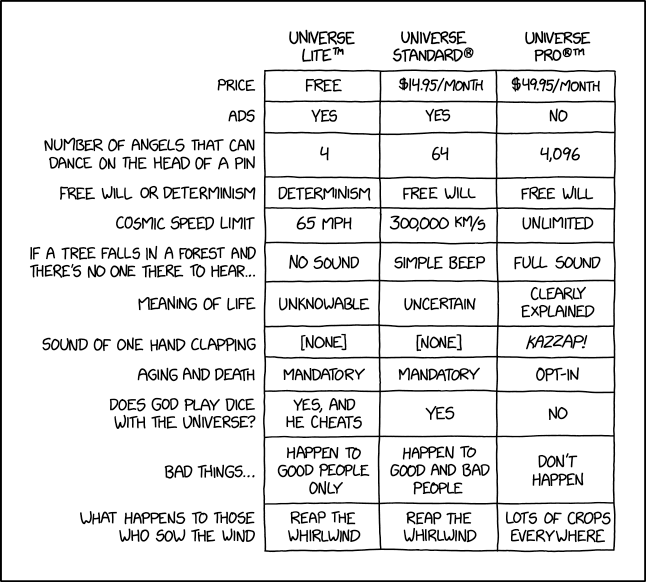
/https://static.texastribune.org/media/files/8298f8cd95875ff208d329dd182aabf2/Dallas%20Bullet%20Train%20BT%20TT%2007.jpg)

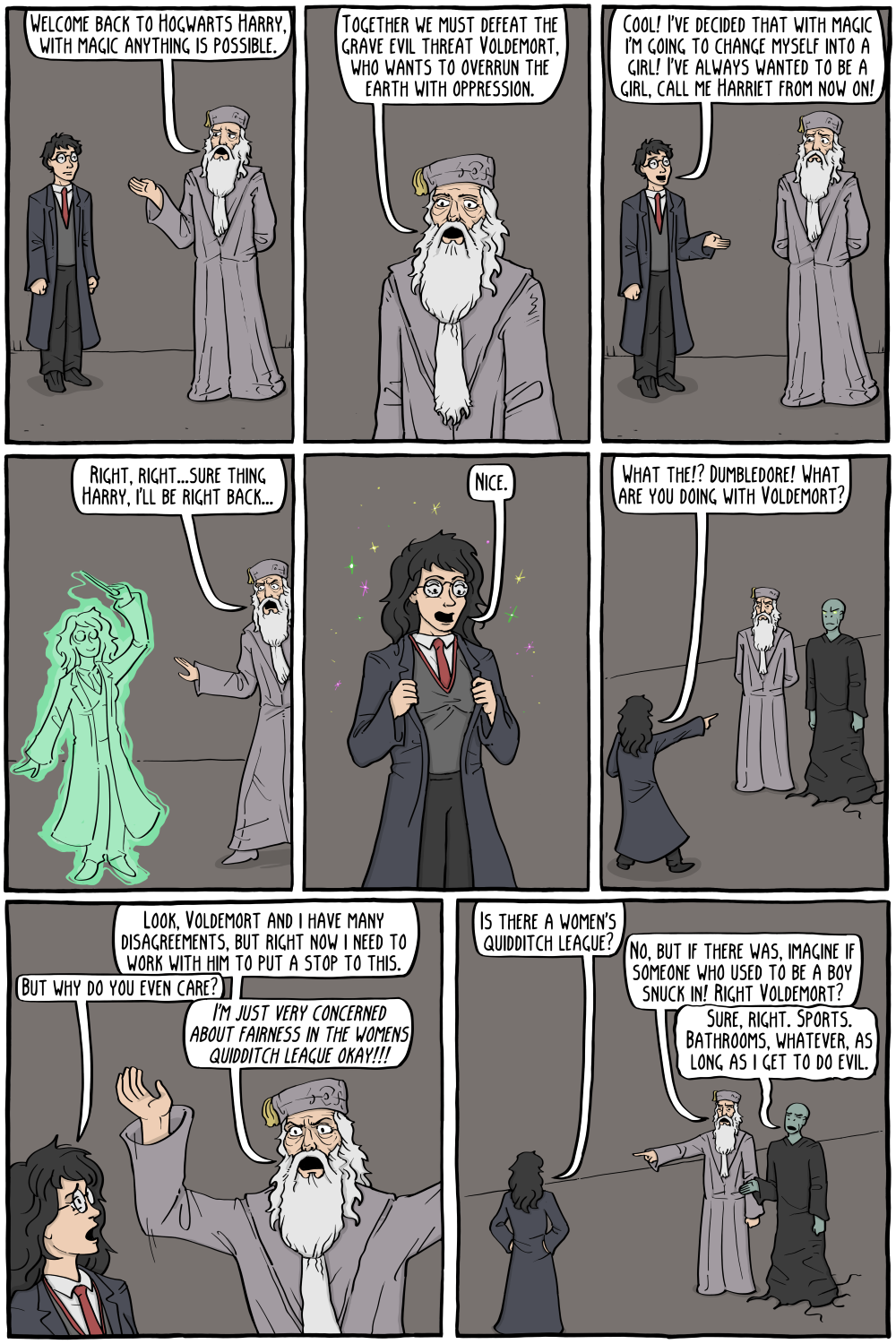


/https://static.texastribune.org/media/files/23e43f6c983510851d52a6cd02ba0b34/Election%20Day%20El%20Paso%20JAJ%20TT%2025.jpg)