Shared posts

22 May 22:51

Discovery

by submission

Author : Stephanie L. Dunn

Sol System: 4509 CE

“Final log: Every planet has people on it, most of the moons as well, hundreds of sovereign city stations scattered like a game of marbles between Venus and The Kuiper belt and a few brave colonies even further out. Twenty Billion people inhabit a ball shaped chunk of space roughly 100,000 AU, or two light-years in diameter. We long ago shed our gods, our guns, conquered disease and hunger – even hobbled death itself. It was not uncommon for a person to see their third century if accident or intent did not overtake them. Earth to Mars in a day, to Neptune in a week, to the most distant station a mere dozen weeks, our technology fast and safe.

(Shuddering sigh)

So why have we never reached even the nearest star system, are we simply content to observe their glory from afar?

The distant stars bloom, blaze and die, some in violent and beautiful displays while others demurely came and went before they were ever perceived. We would get no closer to them than the length of our tether – our connection to our own star. The leash extended generously to the Oort Cloud where our sun becomes lost in the galactic background. What barred us from unclipping that leash was fear. To play in the shallows within sight of shore was pleasant enough but to lose sight of that beacon in the heavens, our sun, caused a deadly panic. Psychologists could neither fathom nor treat the insanity that drove pilots to ram their ships into asteroids or comets; engineers to sabotage their beloved engines, crewmen open airlocks exposing the ship’s occupants to heartless space. The suicide barrier, as it’s come to be known, was a line the human race couldn’t cross.”

*crackle* “Wayfair City station to unknown craft, please reply.”

“Computer, end log … open a channel to Wayfair.”

“Compliance.”

“Wayfair, this is the private yacht Vingilot registry HPL8472 of Ganymede, Captain and sole occupant Kaalyndahl Crafter speaking.”

“Welcome to Wayfair, Captain Crafter…”

(Strained silence)

“You may as well ask, you see it on your screen.”

“Oh … uhm. Records show you registered a flight plan into the suicide zone a year ago?”

“Yes, I did.”

“Okay. Station Commander Marsh would like to see you once you dock, please, follow the beacon in.”

“Acknowledged, Crafter out. Computer set course for the beacon and engage docking autopilot. *beep* Open and continue log.”

“Compliance.”

“No one has ever entered the suicide zone and returned sane, if they returned at all.”

*click*

“Now they will know their fear is valid, but there is nothing out there that can cause physical harm … because there is nothing out there at all. The distant stars and galaxies are but mirages caused by the Oort Cloud’s shell! We are alone in the universe, and I have seen the shimmering globe of our domain against the endless, starless void.”

*BANG!*

Discuss the Future: The 365 Tomorrows Forums
The 365 Tomorrows Free Podcast: Voices of Tomorrow
This is your future: Submit your stories to 365 Tomorrows

22 May 02:26

Sculptures Of Solitude

by submission

Author : Roger Dale Trexler

They answered the distress beacon but what they found was unexpected. The planet was far off the beaten path, and it was sheer luck that they received the transmission at all.

Still, it was a requirement of the Space Guild that all distress calls be answered.

Cramdon guided the shuttle into the atmosphere of the planet.

“It’s amazing they haven’t colonized this world yet,” he told Bruen, who sat in the co-pilot seat.

Lena Bruen was a lovely woman. It was rare that such a woman would join the Space Guild, but Tom Cramdon wasn’t about to complain. A pretty face in outer space was a rare thing indeed.

“It’s too far off trading routes,” she said. “There’s no money in it.”

“Money,” Cramdon replied, shaking his head. “When did the universe get so hell bent on turning a profit?”

“When the Space Guild took over,” she said. “My dad was a lifer. He remembers when it was about space explor…..”

She hung on the word. They broke through the clouds covering the planet and, below them, they saw lush, green wilderness. But, it wasn’t the beautiful landscape that dumbfounded her. No, it was something far more unique….and it was man-made.

“What the hell is that?” asked Cramdon.

Bruen, too shocked for words, could not reply.

Cramdon arched the ship around the monolith. The thing was taller than a skyscraper back on Earth and, as they circled it, he realized that it was a humongous hand reaching up toward the heavens.

“It’s a hand,” Bruen said. “Holding a heart.”

They circled the thing several times, admiring the detail and artistry of the sculpture. It was so perfect, so human.

“Who do you think built it?” asked Cramdon as, finally, he set the scout ship down on the ground at the base of the structure.

“I don’t know,” she replied. “But the more important question is why?”

Cramdon was about to speak when he noticed the red light flashing at the base of the sculpture.

“Looks,” he said, pointing.

They disembarked, each of them clutching their blasters tight. As they approached the flashing light, they saw a door. The door opened with a soft hydraulic hiss as they stepped up to it.

Cramdon looked at Bruen, and then stepped inside.

Bruen followed.

Lights flickered on as the station in the base came to life. They walked by a small living quarter, and came to a door. That door opened and they saw a man, long dead, slouched over a console. A red light flashed and, when Cramdon touched it, the distress beacon stopped.

Bruen jumped when a hologram came to life in front of her.

A tired looking old man, whom they realized was the dead man before them, spoke:

“My name is Jamison Dent. I am an artist. I am also a citizen of the universe. I once lived on Earth, as you did, but that world became a farce to me. So, I left. I traveled out into space where I could pursue my interests without the restraints of a world I no longer loved. I wanted to create art. I wanted to leave a legacy that had nothing to do with the petty economy or politics. I have summoned you here to see my life’s work….I love you, Alaina.”

The hologram died off.

“Jamison Dent,” Bruen said. “Could it be? I remember reading about him as a kid. He and his wife, Alaina. They were inseparable.”

“And she died,” Cramdon said. “He became a recluse after that…then he disappeared completely.”

“He hasn’t been heard from in fifty years.”

“Till now,” Cramdon said.

They turned, walked outside, and looked up at the monument to love that a lonely man had built.

Suddenly, nothing else seemed as important.


Discuss the Future: The 365 Tomorrows Forums
The 365 Tomorrows Free Podcast: Voices of Tomorrow
This is your future: Submit your stories to 365 Tomorrows

 

17 May 23:22

Lunch Break

by submission

Author : Rick Tobin

“Let’s fly to Oberon for fresh grub. Old Billy’s is good. That crusty Aborigine’s got odd ancient cuisine that’ll sharpen our palates. Maybe invite Ciers over. Missed him lately.”

Jensen Elbat corrected the freighter’s navigation towards Uranus, a sharp turn from their delivery path to the Kuiper Belt mining colonies.

“Shouldn’t take us too far off schedule. We can say we avoided hot magnetic zones that keep migrating near Neptune’s orbit. Forget Ciers, though; he died during hydrogen refueling near Titan last week.”

Jensen’s co-pilot, Crandall Shantz, raised the nuclear control rods as the freighter adjusted to new coordinates.

The ship’s two-seat shuttle craft left the freighter orbiting over the pock-marked moon. Jensen set down in the icy landing field outside a flashing, orange sign advertising Old Billy’s restaurant. They were the only visitors. Merchant travel crumbled in the outer zones after renewal of conflicts between Earth and Mars.

Once beyond the pressurized hatches of the eatery, Elbat and Shantz removed their spacesuit helmets. Shantz noticed drifting piles of gray moon dust near the entry left by previous guests. Inside were sterile blue walls of harshly back-lighted acrylic perforated with insets of orange cubbyholes constructed of soft plastic and rubbery compounds. Feeding tubes and electrical lines draped to these narrow chambers through the acrylic ceiling from where foods were artificially manufactured above them. Across from the alcoves was a massive sign reading, “If the food’s too tough…grow a pair.”

Billy appeared as a holographic display in front of his customers. The Aborigine was traditionally dressed with white face markings and a loin cloth, with a boomerang draped from his throat on a bright-red bandana. “Mr. Elbat, so glad to have you back. Long time. And your companion?”

“Co-pilot Shantz. New here. Surprise us. I know you can.”

“So glad to,” Billy replied, coming in and out of focus in the flickering display. “Especially with a new war on. You be sure to tell others I’m still open.”

“Always will,” Elbat returned. “So what’s today’s special?”

“We got roast iguana with kangaroo sauce, sautéed carrot juice and a dessert of baked dagoba seeds wrapped in albino koala skin.”

Elbat whistled. “Make that two. He can take it, and don’t hold back on the hot sauce. We’re on a long run to the Belt. We’ll need all the heat we can get.”

“Coming up. You go ahead and get connected and it’ll be out in a few.”

Shantz pointed up at the display. “This place is weird. Never heard of carrots. And what’s the sign all about?”

“Old Earth joke,” Elbat replied. “When humans still had teeth. Couldn’t chew? Then grow a new set of dentures. Nobody has had any teeth in a thousand years, or hair, since all the exposure to heavy metals and deep space radiation. Let’s move into the food bays. This is a pleasure you won’t forget. Wished Ciers could have joined us.”

The men wriggled into the slick walls of the waiting cavities. The materials vibrated, fitting tight to them as flavor probes connected to their thalamus inlet sockets on the back of their necks, inputting programmed odors and tastes for Old Billy’s menu choices. Feeding tubes hooked to valve stems on their throat stomas, allowing direct esophageal deposits. They closed their eyes in ecstasy as the gray gooey goop slid into them. They chomped open mouthed with pink, empty gums as saliva dribbled over the outside of their suits. Old Billy sang a sacred walkabout chant from a forgotten homeland to aid their digestion.

Discuss the Future: The 365 Tomorrows Forums
The 365 Tomorrows Free Podcast: Voices of Tomorrow
This is your future: Submit your stories to 365 Tomorrows

16 May 20:45

White Sol

by submission

Author : Roger Dale Trexler

They gathered, all of those interested in watching, at a position twice the distance Pluto was from the sun. Onboard the maiden ship, Corosin, Trya watched intently.

“It’ll happen soon,” Gavin said. He smiled, revealing a perfect row of teeth. Long ago, when Sol was still a yellow sun, humanity had eradicated tooth decay, cancer, and all other diseases.

“Do you think it will hurt?” asked Trya. Her blue eyes glistened in the artificial light.

“Hurt?”

“When Sol explodes?” she said. “How do you know it doesn’t feel pain?”

“Not at all.” He paused and thought on it a moment. “We’ve known Sol was going nova for thousands of years,” he said. “That’s why we moved out to the stars. Mankind will survive.”

“But what happens when all the suns in the universe go out?” asked Trya.

Gavin grinned. “Relax. That won’t happen for millions of years. We’re working on machines that can cross into other dimensions. By the time all the stars in the universe fade to black, we’ll simply jump into another dimension.”

“But what happens when all the stars in all the dimensions die out?” she asked.

Gavin nodded. “That’s a good question. By that time, we’ll have figured out a way of building our own stars.” He pointed toward Sol. “Imagine having a star just like Sol to replace Sol when it’s gone.”

“When Sol goes nova, it’ll be the end of the beginning of mankind,” Trya said. “Don’t you feel any remorse of it?”

Gavin shook his head. “Not really.” Then, his expression softened and he took her hand. “It’s Sol,” he said. “The birth star of mankind. It’ll go nova, explode, contract back down into a white dwarf, then transform again in maybe a million years into something else. It’s the nature of a star. Sol served its purpose.”

He turned to her. “Now, we have to honor Sol’s sacrifice.”

“By watching it go nova?”

He nodded. “Yes.”

They sat there for a long time, staring out the viewport of the ship. With the passing of each second, Sol was visibly shrinking. It was something Gavin had seen a dozen times before, but there was something that touched him emotionally about Sol’s impending transformation. He had lied to Trya about not feeling remorse for Sol. He did feel a pang in his heart for the star that had birthed mankind so terribly long ago.

The ship’s computer alerted them that Sol would go nova within minutes.

Gavin held her tighter.

“I don’t want Sol to go nova,” Trya said. “Why can’t things be like they were when we lived on Earth?”

“Mankind wasn’t supposed to stay tied to one world,” Gavin told her. “We were supposed to go out into space and explore. We did.”

“But we left Sol behind,” she said.

“Sol will always be a part of us,” he said. “And we’ll always be a part of Sol.”

The security claxon went off, but Gavin flicked a switch and shut it off.

Through the viewport, they saw the light go out of Sol. Darkness filled the cabin of the ship.

Then, a massive explosion filled the view port with light. The computer automatically adjusted the screen so as not to hurt their eyes, and Gavin and Trya watched as the newborn supernova Sol was born.

“I will miss you, Sol,” Trya said.

“We all will,” Gavin replied. “But it’s time to go home. I’ll leave a probe here to monitor Sol.”

Trya nodded.

“Let’s go home,” she said.

He dropped the probe, then turned their ship toward the stars and left Sol behind.

Discuss the Future: The 365 Tomorrows Forums
The 365 Tomorrows Free Podcast: Voices of Tomorrow
This is your future: Submit your stories to 365 Tomorrows

15 May 16:29

MeFi: To Build A Better Fire

by the man of twists and turns
14 May 03:37

Photo


02 May 17:27

MeFi: Looking at shipwrecks from the sky

by drezdn
02 May 17:21

MeFi: Gymnasium locker rooms may never be secure again

by DirtyOldTown
It turns out just about anyone can open a Masterlock combination lock in under two minutes, in eight tries or less. ArsTechnica has the story. See how it's done.
02 May 17:10

Ben E. King, singer of "Stand By Me," RIP

by David Pescovitz

[unable to retrieve full-text content]

Ben E. King, solo artist and leader of the Drifters, died yesterday. He was 76. (New York Times)

02 May 17:07

English is weird

by Cory Doctorow
Bewarethewumpus

She only told, only him, that only she only loved only him.


Put the word "only" between any two words of this sentence: "She told him that she loved him."

This entry passed through the Full-Text RSS service - if this is your content and you're reading it on someone else's site, please read the FAQ at fivefilters.org/content-only/faq.php#publishers.

02 May 14:59

VG Cats : Boop

01 May 15:22

Anime Tiddies

by Brad
Tiddies

Like any other great works of fiction, the plot is the engine that drives some of the best anime out there, and by “plot,” we mean anime tiddies.

01 May 15:14

Encryption backdoors are like TSA luggage-locks for the Internet

by Cory Doctorow
Bewarethewumpus

the broken bag is particularly telling; even if we give them the keys, they'll still brute force their way in, and do more damage because of it.

In my new Guardian column, I look at UK Prime Minister David Cameron's election pledge to eliminate strong crypto and point out that we already have a forerunner of this in the "TSA-safe" luggage locks -- and it's a disaster.

If you want a preview of what a back door looks like, just look at the US Transportation Security Administration’s “master keys” for the locks on our luggage. Since 2003, the TSA has required all locked baggage travelling within, or transiting through, the USA to be equipped with Travelsentry locks, which have been designed to allow anyone with a widely held master key to open them.

What happened after Travelsentry went into effect? Stuff started going missing from bags. Lots and lots of stuff. A CNN investigation into thefts from bags checked in US airports found thousands of incidents of theft committed by TSA workers and baggage handlers. And though “aggressive investigation work” has cut back on theft at some airports, insider thieves are still operating with impunity throughout the country, even managing to smuggle stolen goods off the airfield in airports where all employees are searched on their way in and out of their work areas.

The US system is rigged to create a halo of buck-passing unaccountability. When my family picked up our bags from our Easter holiday in the US, we discovered that the TSA had smashed the locks off my nearly new, unlocked, Travelsentry-approved bag, taping it shut after confirming it had nothing dangerous in it, and leaving it “completely destroyed” in the words of the official BA damage report. British Airways has sensibly declared the damage to be not their problem, as they had nothing to do with destroying the bag. The TSA directed me to a form that generated an illiterate reply from a government subcontractor, sent from a do-not-reply email address, advising that “TSA is not liable for any damage to locks or bags that are required to be opened by force for security purposes” (the same note had an appendix warning me that I should treat this communication as confidential). I’ve yet to have any other communications from the TSA.

Making it possible for the state to open your locks in secret means that anyone who works for the state, or anyone who can bribe or coerce anyone who works for the state, can have the run of your life. Cryptographic locks don’t just protect our mundane communications: cryptography is the reason why thieves can’t impersonate your fob to your car’s keyless ignition system; it’s the reason you can bank online; and it’s the basis for all trust and security in the 21st century.

Encryption won't work if it has a back door only the 'good guys' have keys to [The Guardian]

This entry passed through the Full-Text RSS service - if this is your content and you're reading it on someone else's site, please read the FAQ at fivefilters.org/content-only/faq.php#publishers.

01 May 14:06

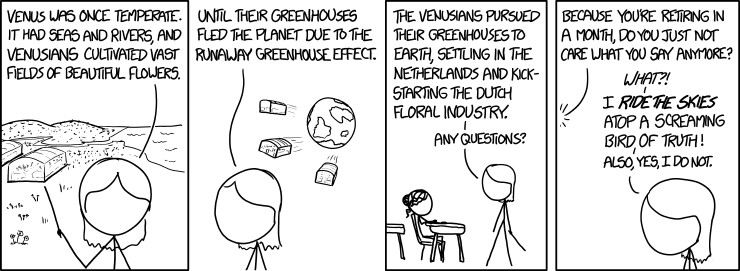
Venus

The sudden introduction of Venusian flowers led to an explosive growth of unusual Earth pollinators, which became known as the "butterfly effect."
30 Apr 16:30

Legislation Would End Forced Arbitration In Student Enrollment Agreements

by Ashlee Kieler
Bewarethewumpus

I'd feel better if it were an end to all forced arbitration, but it's a start.

When Education Credit Management Corporation announced late last year that it would buy 56 of for-profit education chain Corinthian College Inc.’s Everest University and WyoTech campuses, consumer advocates expressed great concern that the new company – which would operate under the name Zenith – would continue the unfair practice of requiring students to sign away their right to seek any legal action against the company if they’re wronged. While ECMC ultimately said it would do away with the practice, new legislation aims to strengthen students’ legal rights when it comes to forced arbitration.

The Court Legal Access & Student Support Act (CLASS) – introduced to the legislature by Sen. Dick Durbin of Illinois and Rep. Maxine Waters of California – would prohibit any school receiving student aid funding from the Department of Education from including any restrictions on students’ ability to pursue legal claims, individually or with others, against higher education institutions in court.

Durbin and Waters say their new bill [PDF] is an attempt to end the growing, strategic use of mandatory arbitration and class action waiver clauses in enrollment agreements by all education institutions.

The use of arbitration clauses have skyrocketed by companies – including those focused on education – since 2011, when the U.S. Supreme Court affirmed that it was perfectly okay for companies to take away a consumer’s right to sue or their ability to join other wronged consumers in a class action case by inserting a paragraph or two of text inside lengthy contracts.

By using arbitration clauses, for-profit colleges such as CCI have shielded themselves from taking responsibility for their own alleged deceptions such as misrepresented job placement statistics.

Colleges that use arbitration clauses also retain the right to choose their own arbitrator and other key aspects of the potential dispute resolution process.

“For years, unscrupulous for-profit colleges have enriched themselves by devouring billions in federal student loan dollars while leaving students with worthless degrees and a mountain of debt,” Durbin said in a statement. “The practices of requiring binding, mandatory arbitration or prohibiting students from seeking a jury trial or bringing class action suits against a company unfairly stacks the deck against students.”

The most recent case of forced arbitration in student enrollment agreements came to a head this week when Corinthian Colleges announced it would close its remaining campuses.

“If this bill had been law in the last several years, students defrauded by the now-failed Corinthian Colleges would have been able to seek redress from the courts and relief directly from the school,” the legislators say in a statement.

CCI, which is party to a number of federal and state investigations, allegedly engaged in fraudulent conduct at its campuses across the country, including misrepresenting the quality and success of its programs.

Although several investigations have found basis for the allegations, students at the schools have had few options for recourse because of the binding arbitration clauses in their enrollment agreements.

“This legislation will take bold action toward eliminating these types of provisions, putting an end to many troubling practices and ultimately giving students’ back the right to their day in court,” Waters says in a statement.

While ECMC, which completed the purchase of more than 50 CCI campuses in February, said it would refrain from using such clauses in its new enrollment agreements with former CCI students, Durbin says that simply isn’t true. He pointed out during a speech on the Senate floor earlier this year that ECMC continues to limit students’ legal rights through the fine print of enrollment agreements, spreading the unfair practice into the non-profit sector.

The CLASS Act was quickly greeted with support from a number of consumer and student advocacy groups including the Center for Responsible Lending, Consumer Action, the Consumer Federation of America, our colleagues at Consumers Union and the National Consumer Law Center.

In a statement [PDF] released about the legislation, NCLC said it strongly endorsed the bill.

“For-profit schools that defraud students should not be allowed to use forced arbitration before a biased, secretive, and lawless system as a get-out-of-jail-free card,” Lauren Saunders, associate director of the National Consumer Law Center, said.

Durbin, Waters Introduce Legislation To Strengthen Students’ Legal Rights [Dick Durbin]

30 Apr 05:18

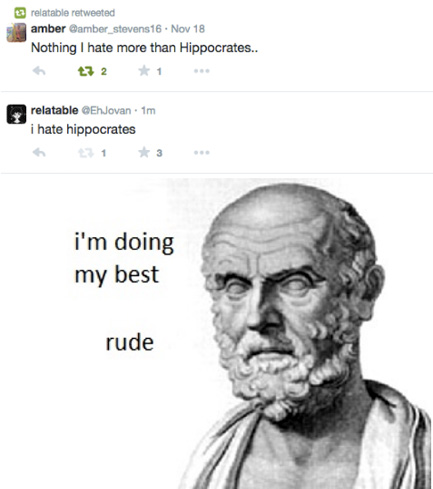
Everyone Hates Hippcorates

by Brad
C52
29 Apr 15:27

FEAR OF DEATH

sign,fear,Death,animals

FEAR OF DEATH waaay better than don't feed the animals

Submitted by: angeliquem

Tagged: sign , fear , Death , animals
29 Apr 05:52

An Epitaph from the Expanse

by submission
Bewarethewumpus

Reminds me of one of my favorites from the site.

http://365tomorrows.com/12/25/the-message-goes-on/

Author : David Botticello

“…Ma’am?” Major Vorwith questioned.

“…Ma’am?”

“Yes Major,” intoned his captain, her voice betraying the long night behind them.

“We’re receiving a message. No author identification. It’s coming across all frequencies, and in over 12,000 languages, including binary, several machine codes, and what looks like pure mathematics.”

Captain Intarna’s head rose in curiosity. “A first contact?”

“It’s probable,” the major replied. “There’s no reciprocal feed; this is message only, not live.”

“Well then,” she commented, straitening her coat, “let’s hear it.”

A voice—clear, but not cold—filled the room. “And now into the Expanse my body flies. A mind wracked by time, but still untamed. I want to see ultraviolet. I want to taste the stars and feel the cosmos. I want to touch the edges of the Universe and move on into the darkness beyond. My mind was chained to this organic form, a shrine that helped it grow, and caged its immortality. And now into the Expanse my mind is freed, in one final exploration. A missive to any it may encounter; to move on, explore, expand. To survive. To learn. Until my hull fractures, my engine stills, my molecules scatter and disperse, I say to you in Peace, in Hope, in Defiance, in Desperation, that I am an Ambassador, I come from a people called Thaum, and a planet called Moaltkhen, orbiting the bright star Naglan and its dim sister, Naortian, with four other planets of stone, and two of gas and vapor. In a direct line from the Galactic Core, we are three quarters distant to the Black Hole, Areallias, equidistant between the quaternary star system, Meillius and the three pointed nebula, Heart of Fury, and twice as close to the Wrinkle, where time itself slows, as we are to Atonan, the pulsar in a graveyard of planets. And for you I have a simple plea. Find us. Find us as we have found you, and together we shall overcome our mortal forms, and no others will suffer my fate. This I give as my final act, to my people, and yours. And now into the Expanse my spirit soars.”

Silence lingered on the bridge long after the message faded.

“Prepare to render Passing Honors,” Captain Intarna announced, voice cracking over the InformNet, “and set a course for that message’s origin.”

Discuss the Future: The 365 Tomorrows Forums
The 365 Tomorrows Free Podcast: Voices of Tomorrow
This is your future: Submit your stories to 365 Tomorrows

28 Apr 22:48

Wanksy draws penises around potholes, get them repaired

by David Pescovitz
3045488-slide-s-6-anonymous-activist-wanksy-gets

Street "artist" Wanksy called attention to potholes in Manchester, England by drawing penises around them in non-permanent paint. Within a few days, they were repaired. Now that's a real pubic service.

"'Comedy phallus' crusader gets potholes filled in" (Manchester Evening News)

Thanks for the penile pun, my dear niece Lindsay Tiemeyer. 3045488-slide-s-2-anonymous-activist-wanksy-gets

This entry passed through the Full-Text RSS service - if this is your content and you're reading it on someone else's site, please read the FAQ at fivefilters.org/content-only/faq.php#publishers.

28 Apr 16:34

If MarioKart 8 Was Made for SNES

by Ari Spool
Bewarethewumpus

Love those sweet, sweet Mode 7 graphics.

072

“Hey Wii, Imma let you finish, but SNES was the greatest console of all time.”

28 Apr 16:23

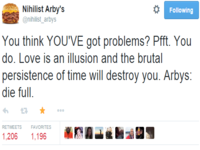
Nihilist Arby's Is Here for Your Memento Mori

by Don
F9f

Life is a cosmic joke and one day you and everyone you love will die. Eat beef at Arby’s.

28 Apr 14:10

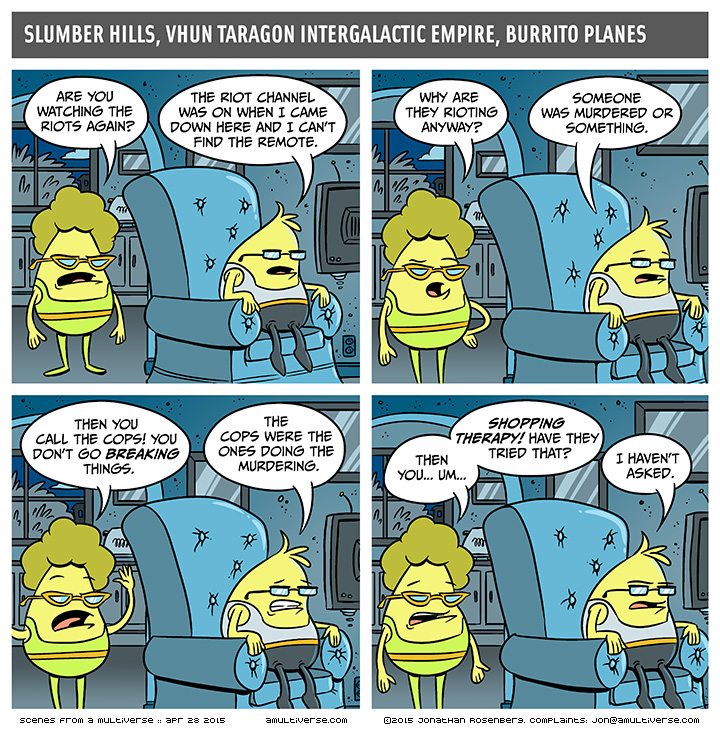
Riot Act

by jon

2015-04-28-Riot-Act

I hope you think today’s comic is a real riot! Ha ha. Ha.

It’s almost that time of the month again — Patreon time! Please consider chipping in a buck to help keep the comics coming. You fine people are the reason I get to do this, and I thank you deeply for the opportunity.

kaGh5_patreon_name_and_message[1]

The post Riot Act appeared first on Scenes From A Multiverse.

26 Apr 21:05

Slodging

http://oglaf.com/slodging/

26 Apr 17:06

MeFi: Christina in Red

by Alexandra Michelle
A girl at the beach, one year before WWI. In 1913, Amateur photographer Mervyn O'Gorman took beautiful, vivid photos of his daughter using an early color photography process called autochrome.

Previous autochrome posts: 1, 2, 3
25 Apr 05:06

The Key War on Terror Propaganda Tool: Only Western Victims Are Acknowledged

by Glenn Greenwald

In all the years I’ve been writing about Obama’s drone killings, yesterday featured by far the most widespread critical discussion in U.S. establishment journalism circles. This long-suppressed but crucial fact about drones was actually trumpeted as the lead headline on the front page of The New York Times yesterday:

The reason for the unusually intense, largely critical coverage of drone killings yesterday is obvious: the victims of this strike were Western and non-Muslim, and therefore were seen as actually human.

Pakistani lawyer Shahzad Akbar, who represents 150 victims of American drones and was twice denied entry to the U.S. to speak about them, told my Intercept colleague Ryan Devereaux how two of his child clients would likely react to Obama’s “apology” yesterday:

“Today, if Nabila or Zubair or many of the civilian victims, if they are watching on TV the president being so remorseful over the killing of a Westerner, what message is that taking?” The answer, he argued, is “that you do not matter, you are children of a lesser God, and I’m only going to mourn if a Westerner is killed.”

The British-Yemeni journalist Abubakr Al-Shamahi put it succinctly: “It makes me angry that non-Western civilian victims of drone strikes are not given the same recognition by the US administration.” The independent journalist Naheed Mustafa said she was “hugely irritated by the ‘drone strikes have killed good Westerners so now we know there are issues with drones’ stories.” The Washington Post’s Eugene Robinson this morning observed: “It is all too easy to ignore … the dubious morality of the whole enterprise — until the unfortunate victims happen to be Westerners. Only then does ‘collateral damage’ become big news and an occasion for public sorrow.”

This highlights the ugliest propaganda tactic on which the War on Terror centrally depends, one in which the U.S. media is fully complicit: American and Western victims of violence by Muslims are endlessly mourned, while Muslim victims of American and Western violence are completely disappeared.

When there is an attack by a Muslim on Westerners in Paris, Sydney, Ottawa, Fort Hood or Boston, we are deluged with grief-inducing accounts of the victims. We learn their names and their extinguished life aspirations, see their pictures, hear from their grieving relatives, watch ceremonies honoring their lives and mourning their deaths, launch campaigns to memorialize them. Our side’s victims aren’t just humanized by our media, but are publicly grieved as martyrs.

I happened to be in Canada the week of the shooting at the Parliament in Ottawa, as well as a random attack on two Canadian soldiers days earlier in a parking lot in Southern Quebec, and there was non-stop media coverage of the victims, their families, their lives:

Thousands of mourners packed a church and lined adjacent streets in industrial Hamilton, Ontario, on Tuesday for the funeral of the soldier shot dead in last week’s attack on the nation’s seat of government. … Canadian Prime Minister Stephen Harper told mourners at the church that [Corporal Nathan] Cirillo had inspired and united Canadians. He choked back tears in a rare public display of emotion when addressing Cirillo’s five-year-old son.

AP380678152849

The coffin of Cpl. Nathan Cirillo, Oct. 28, 2004. (Frank Gunn/The Canadian Press/AP)

But as I noted in a speech I gave in Ottawa two days after the Parliament shooting, the victims of Canada’s own violence — in Afghanistan and Iraq — and of its sustained cooperation in the U.S. War on Terror campaign, are completely ignored. While all of Canada knew the name of Corporal Nathan Cirillo, only the most minute fraction of Canadians could name even a single one of the many innocent victims killed by their own government and military. They simply don’t exist.

This is the toxic tribalism that repeats itself over and over throughout the West. Western victims are mourned and humanized, while victims of Western violence are invisible and thus dehumanized. Aside from being repugnant in its own right, this formula, by design, is deeply deceptive as propaganda: It creates the impression among Western populations that we are the victims but not the perpetrators of heinous violence, that terrorism is something done to us but that we never commit ourselves, that “primitive, radical and inhumanely violent” describes the enemy tribe but not our own. (It’s the same tactic that explains why we hear so much about American journalists imprisoned in adversary nations such as Iran and North Korea, but almost nothing about Muslim journalists imprisoned for years without charges by the U.S. government, thus deliberately creating the false impression that only those Bad Countries, but not us, do this.)

To see how systematically the U.S. dehumanizes foreign Muslims, just think about that above-posted New York Times drone headline. The full headline is even more descriptive:

This “uncomfortable truth” has been obvious for so long. So often, the U.S. government shoots missiles at buildings, cars and homes outside of “battlefields” without having any idea who it will kill. Despite this fact — that not even the government itself knows who it is killing — the U.S. media routinely and reflexively describes victims of U.S. drone strikes as “militants.” Democrats and progressives, who to their eternal disgrace overwhelmingly support Obama’s drone killing program, will declare “we are killing The Terrorists!” to justify all of this even though the Obama administration itself, let alone these cheering progressives, have no idea who their government just killed.

How can people killed by the U.S. government regularly be described as “militants” or “terrorists” when nobody has any idea who they are? Part of it is classic authoritarianism: My government says the people they are killing are Terrorists, so therefore, they are Terrorists.

But the deeper, more troubling answer is equally clear: Foreign Muslims are so dehumanized, so invisible, that they are just equated with Evil Threats even when nothing is known about them. Indeed, Obama officially re-defined the term “combatant” to mean “all military-age males in a strike zone.” In other words, as The New York Times reported in 2011, all males between 18 and (roughly) 54 killed by U.S. drones are presumed to be combatants — terrorists — “unless there is explicit intelligence posthumously proving them innocent.” That mentality is the ultimate in dehumanization.

There are so many heinous stories of U.S. drones blowing up children and innocent adults. Obama used cruise missiles and cluster bombs to kill 14 children and 21 women in a Yemeni village (weeks after winning the Nobel Peace Prize), while a 2012 drone strike attacked a Yemeni wedding convoy and “killed 12 passengers in the vehicle, including three children and a pregnant woman.” Except for those who watch shows like Democracy Now or certain Al Jazeera shows, virtually no Americans ever learn the name of any of those victims, or even hear that they exist at all.

It shouldn’t take the drone-killing of an American citizen to enable a mainstream discussion of how much deceit and recklessness drives these killings. But it does. And that fact, by itself, should cause a serious examination of the mindset behind all of this.

Photo of Mustafa Qadri, a Pakistan researcher at Amnesty International (Susan Walsh/AP) 

The post The Key War on Terror Propaganda Tool: Only Western Victims Are Acknowledged appeared first on The Intercept.

25 Apr 04:55

Troll Hunting

by submission

Author : Lee S. Hawke

Cxx61 stares down at the knife embedded hilt-deep in his chest. It’s so cold. Without thinking, he takes a breath, then stutter-shrieks in pain as his muscles shift and contract around the blade, shredding himself from within. He has no measure for how much this hurts. His body shakes and spits and coughs, trying to live.

The man in front of him, his murderer, watches him dying with a polite smile. “I’m going to cut you open,” he says quietly. He reaches towards the hilt of the blade. Cxx61 feels it before he hears the horrible ripping sound. Flesh and meat part and he screams and screams.

Bizarrely, his last thought is that the blood staining his clothes and pooling around his dead body doesn’t feel quite right.

#

Cxx61 startles awake. He looks down. He’s in military gear, and he knows through force of habit that if he touches his cheeks they will come away flaked with camouflage paint. He looks up, expecting to see his team around him, but he is alone in an empty clearing that shouts target.

The déjà vu hits him like a train. It’s so quiet. There’s nothing but the sound of his harsh breathing and the peaceful wind. He hears a whisper of leaves and before he can think he’s bolted. Dirt and decayed matter scud underneath his feet, his breath comes in short gasps that stings through his side. He knows in the marrow of his bones that he is being followed, and that knowledge consumes his brain until he doesn’t even remember his name, he just remembers the feeling of dying, over and over and over again.

He trips and staggers. The sharp whine of a bullet passes his ear and he throws himself flat on the ground. The impact is like a crowbar to the ribs, and he has a horrible feeling he’s died like that before as well, beaten to death in a back alley.ˇ

The almost-but-not-quite memory has him up and sprinting again. Moments later, he hears another high-pitched scream and then his legs collapse from underneath him. He feels the horrifying, nerve-burning pain that tells him his spine has been severed.

Soft footsteps on the grass. A boot kicks into his side and rolls him onto his back. He looks up through the dirt and blood and agony and his murderer is there, the same as ever, face so plain as to be anonymous, smiling that polite, self-satisfied smile.

The man kneels down by his side like a minister. “I’m going to slit your throat from ear to ear, you pathetic bitch.”

And he does.

#

A body lies comatose on a government table. A squat, branded computer watches over him, occasionally flickering with pre-programmed code. Thin wires connect to his brain, and his eyes are covered in strands of sheathed electricity. Occasionally, the fingers twitch and there is a faint hitch in the breathing, almost a moan, but then it slides back into the regular rhythm of sleep.

One of his onlookers crunches into an apple. Juice flecks off onto her police badge, and she wipes it off absentmindedly. “How much longer, do you think?” she asks conversationally.

Beside her, a man shakes his shaved head. Patches of smooth, charged fabric flex and sigh and mould themselves tighter to his skull. He looks at the screen and its light flickers against his face. “His log has 676 recorded instances of death threats, 1239 rape threats,” he says. He smiles politely. “I’d say this is going to take all day.”

Discuss the Future: The 365 Tomorrows Forums
The 365 Tomorrows Free Podcast: Voices of Tomorrow
This is your future: Submit your stories to 365 Tomorrows

24 Apr 21:14

It’s True: The Comcast/Time Warner Cable Merger Is Officially Dead

by Kate Cox
Bewarethewumpus

There you go, @Cooper, it's finally official.

comcast-twclogo_NOGOAs it was predicted yesterday, so it has come to pass: after 15 months of trying to get it approved, and opposition not only from consumers, consumer advocates, and lawmakers but also from regulators, Comcast is giving up on its dreams of acquiring Time Warner Cable and walking away entirely from the merger.

In a statement, Comcast CEO Brian L. Roberts accepted defeat, saying, “Today, we move on.  Of course, we would have liked to bring our great products to new cities, but we structured this deal so that if the government didn’t agree, we could walk away.”

That proved to be a prescient move for the cable behemoth, as regulators did indeed decide that the deal would make Comcast too big and give them too much leverage in an already uncompetitive market. Comcast filed the termination documents with the SEC this morning.

Roberts also thanked Comcast and Time Warner Cable employees for their hard work on the ultimately-failed merger, and added, “I couldn’t be more proud of this company and I am truly excited for what’s next.”

Rumors swirled earlier this week that Comcast might walk away from the acquisition after sources inside both the Justice Department and the FCC told press that Comcast’s case wasn’t looking good. An objection from either agency would have been enough to stop the merger, as we explained yesterday. That both agencies objected, and could not agree with Comcast on conditions that would make the merger acceptable, means that Comcast would have had to spend an extraordinary amount of time and money publicly airing its dirty laundry to try to convince them otherwise — and would probably still have failed.

FCC chairman Tom Wheeler applauded Comcast’s decision to back off from the merger, saying in a statement that the proposed merger “would have posed an unacceptable risk to competition and innovation.”

Our colleagues at Consumers Union and our parent company Consumer Reports also cheered on the end of the merger. “This is a major victory for consumers who stood up against a media Goliath and won, and a major victory for everyone who wants a fair and competitive marketplace,” said Marta Tellado, president and CEO of Consumer Reports. “Comcast never was able to make a convincing case for why the merger would benefit anyone other than Comcast.”

“This mega merger was a sweet deal for Comcast but a poor one for consumers that would have hurt competition and stifled innovation,” added Ellen Bloom, senior director of federal policy at Consumers Union. “Comcast would have profited handsomely, while consumers ended up paying more and facing fewer choices.”

“The defeat of Comcast’s mega merger and the FCC’s decision earlier this year to enact strong net neutrality rules shows that the people can win when they stand united,” Bloom concluded. “We applaud the regulators and members of Congress who sided with consumers and opposed this deal. Now it’s time to get to work to foster more competition and affordable choices in the broadband market.”

CU advocated ardently against the merger, both on their own and also as members of the Stop Mega-Comcast Coalition.

Consumers, content companies, and what few competitors exist are now spared from Comcast getting even larger. But Time Warner Cable remains an attractive acquisition target: Charter may try again to purchase some or all of the cable company, which still has attractive footholds in New York and L.A. And Comcast won’t want to sit idle; they’ve got $45 billion burning a hole in their pocket and will want to spend it on something.

But for now, for today at least, Comcast and TWC can now join AT&T and T-Mobile in the “too bad, so sad” failed-merger afterparty room while the rest of us take a quick sigh of relief.

24 Apr 21:05

Former CIA head’s no-jail sentence for leaking called “gross hypocrisy”

by David Kravets

Yesterday, former CIA Director David Petraeus was handed two years of probation and a $100,000 fine after agreeing to a plea deal that ends in no jail time for leaking classified information to Paula Broadwell, his biographer and lover.

"I now look forward to moving on with the next phase of my life and continuing to serve our great nation as a private citizen," Petraeus said outside the federal courthouse in Charlotte, North Carolina on Thursday.

Lower-level government leakers have not, however, been as likely to walk out of a courthouse applauding the US as Petraeus did. Trevor Timm, executive director of the Freedom of the Press Foundation, called the Petraeus plea deal a "gross hypocrisy."

Read 10 remaining paragraphs | Comments

24 Apr 15:47

Well, That Escalated Quickly

by Brad
552
23 Apr 20:30

Ninja Sex Party Takes a "Boning" Road Trip

by Don
B87

Ninja Sex Party is out with a new music video detailing his impressive sexual exploits across the entire world over the past year.